




Abstract
Creating an environment suitable for language acquisition through shared reading significantly contributes to improving a child's language development and parent–child relationship. Reading in an interactive way, such as dialogic reading, is favorable. Nevertheless, dialogic reading is designed for children above the age of two and shared reading is recommended to start during the child's first year. The present study aimed to explore the feasibility of an interactive shared reading intervention, inspired by dialogic reading, where the reading techniques were designed to complement infants’ preverbal developmental level. The study further intended to explore its preliminary effect on infants’ cognitive and language development. Eleven parent–infant dyads participated, bi-monthly, in four in-depth intervention sessions where the shared reading techniques were modeled. Between sessions, parents and infants engaged in shared reading using these techniques. Post-intervention interviews served to reflect the feasibility of the intervention. Infant cognitive and language assessments were conducted pre- and post-intervention using BAYLEY-III and CSBS DP ITC. Favorable results regarding feasibility and infant language development were found, however, for cognitive development the results were non-significant. We discuss clinical considerations and the scope for conducting future studies.
Keywords
I Introduction
Providing children with a language-rich environment during the first 3 years of life positively affects their language, cognition, and school readiness (Zauche et al., 2016). Shared reading, where a parent reads books together with their child, is a useful child language boosting activity (Dickinson et al., 2012) and has a positive effect on the parent–child relationship (Seden, 2008; Zuckerman and Needlman, 2020). Furthermore, adopting an interactive reading style, such as dialogic reading, where the reader uses evocative reading techniques to encourage child participation, is favorable (Mol et al., 2008; Muhinyi and Rowe, 2019). Initiating shared reading before the child's first birthday is recommended (DeBaryshe, 1993; Muhinyi and Rowe, 2019; Niklas et al., 2016), however, parents describe uncertainty of how to share books in an age-appropriate manner (Brown et al., 2017). Therefore, providing information and modeling how to read a book as a means of supporting a child's language development is valuable (Zuckerman and Needlman, 2020).
Dialogic reading
Dialogic reading was developed for children above the age of two and was first introduced by Whitehurst et al. (1988). Dialogic reading assumes that child language development can be aided through a process where the parent encourages the child to actively participate in the reading session (Arnold et al., 1994). For younger children, aged 2–3 years, the parents use questions about illustrations, provide feedback, ask the child to repeat or provide appropriate labeling to any unknown word. For children 4 and 5 years old, parents are instructed to use more challenging questions to elicit longer verbal responses from their children. The acronyms CROWD and PEER aid parents in remembering the reading techniques. CROWD represents the reading techniques—completion, recall, open-ended questions, wh-questions, and distancing. PEER is a reminder of—prompt the child, evaluate, expand, and repeat the response (Zevenbergen and Whitehurst, 2003).
Dialogic reading was constructed for children already using verbal language and little is known about its effect on toddlers and infants. To the authors’ knowledge, only a few studies on the effectiveness of dialogic reading have focused on children under the age of two (Chang et al., 2022; Cooper et al., 2014; Murray et al., 2016; Vally et al., 2015). Cooper et al. (2014) studied book sharing with participants from a low SES community. In their pilot study, parents and their infants aged 14–18 months were grouped in either a book sharing group, or a toy play group. Each group received equal intervention time. Post-intervention, the group receiving instructions and coaching on sensitive book sharing improved on both parent and infant variables. Parents became more sensitive in book sharing and play and the infants improved in attention, comprehension, and vocabulary (Cooper et al., 2014). In a different study, dialogic reading was presented to parent and infants 14–16 months old. The participants were randomly assigned to a training group and a no-training group. The parent–infant dyad received eight training sessions, once a week for eight consecutive weeks. Infant attention and language were assessed pre- and post-intervention and results showed greater gain in both variables for the group who received dialogic reading training (Vally et al., 2015). Besides attention and language, the team also assessed carer–infant interactions during book sharing and toy play as well as infant pro-social behavior. The parents in the training group displayed improved sensitive behavior toward their infant. Further, infant pro-social behavior and imitation in play improved for the infants in the training group (Murray et al., 2016). Dialogic reading techniques provided for parents and infants from a low SES community served to increase several infant developmental abilities as well as parent–infant relationship and parenting.
In a recent study by Chang et al. (2022) the authors intended to observe to what extent the dialogic reading techniques, as designed for 4- and 5-year-old children, were used by carers when sharing books with infants 12 months old. Parents were asked to share a book with their children, these sessions were recorded, and the observed dialogic reading techniques were then coded. These parents frequently used the reading techniques that required non-verbal responses from the infants and rarely or never used the techniques that required longer verbal responses (Chang et al., 2022). Hence, the dialogic reading techniques may be mismatched if applied when sharing a book together with an infant in the preverbal stage.
Research has defined the importance of early book sharing in child development (DeBaryshe, 1993) as well as the advantages of interactive reading methods such as dialogic reading (Whitehurst et al., 1988). However, recent findings highlight a discrepancy in using the original techniques of dialogic reading together with pre-verbal infants (Chang et al., 2022). Recognizing that parents benefit from guidance on how to share books with their infants (Brown et al., 2017; Zuckerman and Needlman, 2020), it becomes essential to develop interactive shared reading techniques tailored to the preverbal stage.
Parental behaviors serving to support infant language development
a Joint attention and sustained attention
Joint attention is associated with child vocabulary development (Markus et al., 2000; Morales et al., 2000). It involves the child and another individual simultaneously shifting and coordinating their attention toward an object or event (Morales et al., 2000) while conscious of the other individuals’ comparable focus (Markus et al., 2000). This ability develops during the infant's first year and consolidates when the child is around 12–18 months (Morales et al., 2000). An environment promoting joint attentional episodes is beneficial for infant language development (Markus et al., 2000) and parents naturally use attention-recruiting verbalizations together with their infants (Chang and Luo, 2020; Sénéchal et al., 1995). Recent research reveals the connection of both joint attention and infant sustained attention to vocabulary acquisition. Sustained attention comprises the infant to stabilize their gaze on a specific object for longer than 3 s (Yu et al., 2019) and has been found to predict language development (Kannass and Oakes, 2008). Longer periods of sustained attention is favorable when learning novel words (Macroy-Higgins and Montemarano, 2016; Pereira et al., 2014; Salley et al., 2013).
b Parental use of parentese and onomatopoeia
Parentese is a manner of speaking to infants, where the parent exaggerates intonation, pitch range, and elongates vowels and consonants (Zauche et al., 2016). It aids infant language acquisition (Zauche et al., 2016) by directing the infant's attention (Dunst et al., 2012) and facilitates the process of reinforcing novel words into long-term memory (Singh et al., 2009). Parentese is often delivered with a positive affect used for encouraging, teaching, and providing cues to the infant about the intent of the interaction (Saint-Georges et al., 2013).
The use of onomatopoeia is another communicative technique used together with infants. Onomatopoeia are sound-words that represent a specific word, for example using choo-choo instead of the word “train” (Laing, 2019). Onomatopoeia can easily be incorporated into communication with infants (Laing et al., 2017) and infants themselves naturally use these substitute words (Laing, 2014). Hence, onomatopoeic words enable infants to actively participate in conversations. Furthermore, using onomatopoeia while interacting with children serves to support child language development as it is often delivered in a salient manner (Laing et al., 2017). Lastly, through onomatopoeia, infants are guided to connect speech sounds to objects and events (Imai and Kita, 2014).
c Parental use of contingent response
Contingent responses refer to the parents’ immediate and appropriate reply to an infant's communication (Hoff, 2006) at a time when the infant is oriented toward receiving it (Topping et al., 2013). Contingent responses positively influence infant language development, early language comprehension, and infants’ use of gestures (Paavola-Ruotsalainen et al., 2018; Rocha et al., 2020). Infants of mothers who use contingent responses vocalize using more adult-like sounds as compared to a control group (Goldstein et al., 2003). Further, contingent responses serve as support for infant word mapping (Tamis-LeMonda et al., 2014). Parents who use contingent responses tend to be more verbally and socially engaged with their children, and children of contingent responsive mothers reach language milestones earlier than other children (Hoff, 2006). Another advantage is that contingent responsive communication cues infants to understand that language is a communicative tool (Tamis-LeMonda et al., 2014).
d Parental use of gestures
Parents’ non-verbal and verbal communication, when used together, positively support both expressive and receptive language development of their children (Zauche et al., 2016). Infant gestures serve as a means of early communication and children acquire them through experiences in social interaction. The time between the onset of gestures to an age when the children communicate verbally, symbolic gesturing can act as a communicative complement. Moreover, the use of gestures facilitates verbal development (Goodwyn et al., 2000).
e Parental use of questions
Using questions during shared reading together with infants in the preverbal stage is associated with greater expressive, receptive, and pragmatic language skills when the child is 18 months old. (Muhinyi and Rowe, 2019). The use of questions support infants’ attention and encourages vocalizations. Using yes/no and referential questions results in language development gains (Luo et al., 2022), encourages verbal responses, and supports reasoning ability in 2-year-olds (Rowe et al., 2017). In dialogic reading, wh-questions (what, when, where, why, how, and who) are an integral part of the shared reading techniques that encourage child participation (Zevenbergen and Whitehurst, 2003). Cooper et al. (2014) successfully used wh-questions in an intervention involving infants 14–18 months old. Infants as young as 13 months old show an understanding of the intention of wh-questions (Seidl et al., 2003). Further, Leung et al. (2021) found that parents naturally use both wh-questions as well as yes/no questions together with their 12-month-old children during shared reading.
f Parental use of expansions
The use of expansions refers to framing and adding information over and above the child's response and is used within dialogic reading (Whitehurst et al., 1988; Zevenbergen and Whitehurst, 2003). Infants 14–18 months old responded positively to the use of expansions (Cooper et al., 2014). Furthermore, using extended talk while engaging in shared reading with children 14 months old correlated with the children's receptive language development (Ece Demir-Lira et al., 2019). Encouraging parents to use expansions in the preverbal developmental stage can positively affect infant language development (Muhinyi and Rowe, 2019). In fact, parents of preverbal infants naturally apply expansions as a response to infant's nonverbal behavior and non-word vocalizations in the shared reading context (Chang et al., 2022).
Shared reading techniques for preverbal infants
Child language development is sensitive to different caregiver input during developmental stages (Rowe, 2012) and parents modify their interactions as the child matures (Chang and Luo, 2020; Leung et al., 2021; Sénéchal et al., 1995). Therefore, shared reading techniques chosen to be used together with pre-verbal infants should preferably match the infant's language proficiency, encourage pre-verbal communicative behaviors, and aid to support verbal language acquisition. Research show that parentese, onomatopoeia (sound-words), providing contingent response, using gestures, questions, and expansions, are communicative behaviors used by parents to initiate, support, and uphold infant attention, as well as support preverbal infant's language learning (Goodwyn et al., 2000; Hoff, 2006; Laing, 2019; Levickis et al., 2014; Luo et al., 2022; Muhinyi and Rowe, 2019; Yu et al., 2019; Zauche et al., 2016). These parental supportive behaviors can be used within the shared reading session to encourage infants to actively participate, an essential goal when sharing books according to dialogic reading.
Aim and research questions
This study explored the feasibility, and potential effect of an interactive shared reading intervention targeted at infants and inspired by dialogic reading. As a feasibility study, the emphasis was to learn about the process, implementation, and preliminary outcomes (Orsmond and Cohn, 2015) and served to prepare designs of larger and more costly studies. The reading techniques served to promote the infant's active participation. The techniques were delivered in a gradual manner where the progression of the techniques corresponded to the infant's language ability. As the infant's communicative skills developed, the complexity of the shared reading techniques also advanced. This study proposes that infants’ cognitive and language abilities would be enhanced. It explored the following questions: (1) How do parents express the feasibility of the interactive shared reading techniques that are designed to match the infant's language developmental level? (2) Do shared interactive reading techniques lead to any potential gains in infants’ cognitive, expressive, or receptive language development? (3) Can potential effects from the intervention be assessed using one-on-one testing and/or parent questionnaires?
II Method
Participants
Study participants came from medium-sized cities and rural communities. Infants were between 8 and 9 months old at the start of the study. The only inclusion criteria were sufficient Swedish comprehension, as appraised by the child health service nurse, to understand and answer the study questionnaires. The 11 participants’ demographic characteristics are shown in Table 1.
Participants’ demographic characteristics for the group receiving six intervention sessions (n = 11).
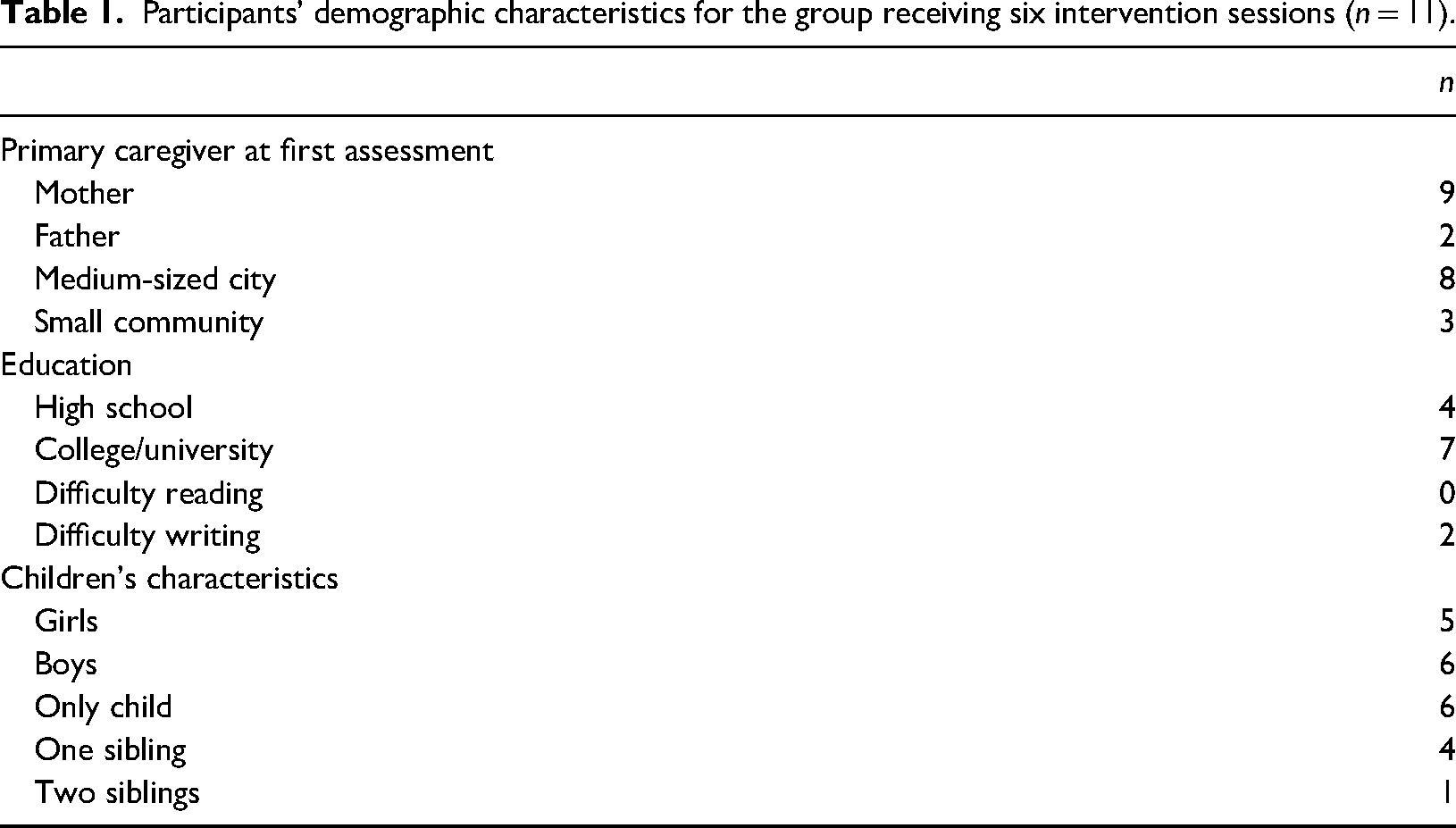
Participants’ demographic characteristics for the group receiving six intervention sessions (n = 11).
a Participant characteristics
A questionnaire including six items inquiring about the family composition, parental reading and writing difficulties, their educational background, and whether the family was living in a medium-sized city or small community was constructed by the research team. Participating parents answered this questionnaire pre-intervention.
b Parent interview
A battery of questions was developed to explore the parents’ experience of participating in the four sessions and whether they found the techniques used in shared reading sessions to be user-friendly. The questions were as follows: “Why do you read to your child?,” “Describe a shared reading activity with your child,” “How do you think [name] perceives the shared reading activity?,” How does [name] act within the shared reading activity?,” and “What is your experience of participating in the study and using the shared reading techniques?.” The interview was conducted in Swedish 6 months post-intervention.
c Bayley-III
Participating infants were assessed pre- and post-intervention with the BAYLEY-III instrument. The Bayley-III is an instrument used for assessing infant cognition, language, and motor development. For the study, the Swedish version was administered. It is administered individually to children and normed scores for the instrument exists for children between 1 month and 42 months (Bayley, 2006). We used the Cognitive, Expressive, and Receptive Language scales as assessment instruments (Bayley, 2006). The Cognitive scale measures information processing, processing speed, concept formation and categorization, and the Cronbach's alpha obtained at 8 and 18 months is .93 and .91, respectively. The Receptive Communication subscale assesses responses to sounds and word comprehension and the Expressive Communication subscale assesses the infant's production of sounds and words. The Cronbach's alpha obtained for the Receptive Communication subscale at 8 and 18 months was .80 and .90, respectively. At 8 and 18 months, the Expressive Communication subscale indicated a Cronbach's alpha of .91 and .94, respectively. Normative data was collected in the United States (Bayley, 2006). BAYLEY-III was used to answer research questions 2 and 3.
d The communication and symbolic behavior scales developmental profile infant–toddler checklist (CSBS DP ITC)
All participants completed CSBS DP ITC (Wetherby and Prizant, 2002) pre- and post-intervention; the infants were 8 and 18 months old at time of testing. CSBS DP ITC is a standardized parent-report instrument used to assess communication and language skills in children who are 6 months to 2 years old. The questions target preverbal communication, emotions, parent–child interactions, gestures, sounds, words, and understanding (Wetherby and Prizant, 2002). The speech and the symbolic composite subscales were used as assessments for the second and third research question. The speech composite subscale assesses communication. The parents answer questions such as “Does your child use sounds or words to get attention or help?” using a 3-point rating scale (not yet, sometimes, or often). The Cronbach's alpha for the speech composite subscale in the original study was .88 (Wetherby and Prizant, 2002). Further, the symbolic composite subscale enquires about the infant's understanding of words, phrases, and the use of familiar objects (e.g. “About how many different words or phrases does your child understand without gestures?”). The parents respond by checking a pre-suggested answer. (Wetherby and Prizant, 2002). In the original study, the Cronbach's alpha for the symbolic composite subscale was .87. Normative data were collected in the United States and Canada (Wetherby and Prizant, 2002). The version of CSBS DP ICT that previously was translated into Swedish (Karolinska Institute and Stockholm University) was used in this study.
Study procedure
In the participating region of Sweden, at the regular health check-up when infants are 8- and 18-months old, the child health nurse briefly demonstrates shared reading to all parents. The instructions include pointing, using sounds and gestures, talking instead of reading, and asking questions. These instruction sessions take about 5–10 min. Participating parent–infant dyads in this feasibility study did receive the universal interventions during their ordinary visits to the child health office. However, it is important to note that these sessions were not evaluated within the scope of this feasibility study. Instead, this study focuses on four additional sessions provided to the parents in their homes.
Between August 2018 and May 2019, at the 8-month visit, 125 parents and infants were recruited by their nurse to participate in a larger study conducted by the research team (Bergström et al., submitted). Twelve parent–child dyads were randomly selected from this larger convenience sample and were extended an invitation to participate in this feasibility study. All parents signed consent forms and were informed that they could terminate their participation at any point. One parent opted to terminate after the pre-intervention assessment.
At the 8-month visit, after the parents signed the consent form, parents were given the participant characteristics questionnaire and CSBS DP ITC. They were instructed to complete the questionnaires in their homes directly after the visit and to send the questionnaires by mail to the research team. Shortly after, when infants were between 8 and 9 months old, BAYLEY-III was administered in the families’ homes. At the 18-month health check-up visit parents were provided with CSBS DP ITC by the nurse and instructed to complete the questions in their homes and send the questionnaire by mail to the research team. BAYLEY-III post-intervention was conducted in close proximity to the 18 month health check-up visit. All families, except one, conducted the BAYLEY-III post-intervention assessment in the research teams’ office. Due to COVID-19 restrictions, the final infant was assessed in the home. To minimize bias, different psychologists tested the infants at these two points. Both had undergone training in the use of BAYLEY-III. The missing data was handled according to the manual instructions for CSBS DP ITC and BAYLEY-III (Bayley, 2006; Wetherby and Prizant, 2002). No subjects or individual scores were eliminated.
The first intervention session was conducted between October 2018 and July 2019, and the final intervention session was conducted April 2019–January 2020. Post-intervention assessment occurred between June 2019 and March 2020. Lastly, telephone interviews with participating parents were conducted when the children were between 23 and 24 months old. Parent interviews were conducted October 2019–July 2020.
The study was ethically approved by Regionala etikprövningsnämnden i Linköping, drn 2017/582-31.
a Intervention instructions included in the feasibility study
The four sessions were conducted every other month when the children were between 10 and 16 months old; each session lasted for about 40–60 min. The first author met with one parent and the infant in their home. The sessions began with a discussion on how the shared reading progressed, summarized earlier techniques, and introduced new techniques. The first author modeled the novel techniques and coached the parent together with their infant on how to implement the techniques. Forthcoming, the parent was encouraged to keep practicing the previously learned techniques continuously and newly introduced techniques were added. In each session new books were introduced (available upon request). The books were used for demonstration of techniques and not gifted. The first author described and modeled the new techniques and the parent then practiced reading together with the infant using the novel techniques. Parents were instructed to continue reading between sessions using books that were available in the families’ homes.
Two procedures were applied to ensure fidelity of the intervention. First, all sessions to all participants were delivered by the first author, to secure identical instructions. Second, after each session, all participating parents received a summary of the new techniques, these served as a reminder of the instructions and techniques (available upon request). No individualization of session instructions was given. See Supplementary File 1 for intervention instructions presented in each session.
Analysis
To provide a comprehensive account of parents’ experiences of using the shared reading techniques, we used an explorative descriptive approach by compiling the answers to two interview questions. The questions chosen focused on the continuous reading activity and parents’ experiences of learning the shared reading techniques. These answers served as support of the feasibility of the intervention. For language and cognitive analysis, raw scores were converted to standard scores. Standard values were used to account for infant's natural development over time. Test for normality show non-significant results for the language scales but significant for the cognitive scale. We opted to conduct both parametric (t-test) and non-parametric (Wilcoxon) analyses for all variables. The results were comparable regardless of the method. With such a small sample, a non-parametric approach would traditionally be chosen. However, since the results are identical, we opted to report the parametric approach as it is considered more demanding. We assessed the infant cognitive and language development pre- and post-intervention using both one-on-one testing, BAYLEY-III, and CSBS DP ITC, a parent questionnaire. Results on BAYLEY-III cognitive, expressive, and receptive language subscale and CSBS DP ITC were analyzed using a one-tailed paired sample t-test. All analyses were conducted using SPSS 27.
III Results
Feasibility of intervention
To answer the first research question regarding the feasibility, parents’ answer on two interview questions served as support: “Describe a shared reading activity with your child” and “How does [name] act within the shared reading activity?” These questions provided an understanding on how the shared reading techniques were applied within the shared reading activity and the infant's reaction to the techniques. The data showed that applying the reading techniques changed the parents’ reading behavior. It altered from a more conventional reading of the text to more freely talking about and describing the illustrations while using specific behavior to promote infant attention and participation. As stated by one parent, “I used to read the text in the book. Now I talk more about what we see in the pictures….[Child] is active by saying words, making noises to animals or cars and points a lot to the pictures.” Furthermore, parents expressed that the instructions helped them with how to go about sharing books when the infants were this young, “I thought it was good that you came home and told us how to read to our baby. This is my first child, so I did not know how to read and what to read when she was little.” Most parents expressed that the infant's behavior also changed; they became more active as a result of reading techniques. Parents stated that the infants assimilated the techniques, such as using gestures and onomatopoeia: “He is active by pointing and saying words. He uses sounds and gestures to the pictures.” As the children matured, their participation in the reading also incorporated pointing and demanding to hear novel words. Some children even became the storytellers when reading a well-known book. Only two parents expressed that the instructions did not come at a point that was suitable for their shared reading activity. One parent expressed, “We had already tried the introduced techniques.”
To examine how parents experienced learning and using the reading techniques, answers from the following question was used: “What is your experience of participating in the study and using the shared reading techniques?” Overall, the parents responded positively. They expressed appreciation that the focus was on infant development, and that the instructions and techniques helped them commence with reading, “Your visits were good. They reminded us to keep up with the reading.” Some parents appreciated that there was ample time for practicing the techniques between sessions while others stated that the regular occurring visits served as an important reminder to pick up on shared reading activity that had been paused. A few parents expressed that they had not believed that their child was mature enough for shared reading and that the support they received was valuable. As one parent expressed, “Without your visits, I don’t think we would have kept up with the reading. We would have thought it was too soon, that she was not mature enough.” One parent expressed that she shared the information presented to her in each session to the child's other parent to ensure that they both read using the techniques: “What we talked about, when you were here, I tried to tell [Child's] father.”
Lastly, statements from most parents indicated that there are other benefits of the intervention. Advantages that can be associated with the parent–infant relationship as well as infant and parent well-being are prominent in the interviews. Parents expressed that shared reading was an enjoyable activity with their infant, a pastime where they felt emotionally and physically close to their child. The activity developed the infant's abilities and served to calm the infant. “Shared reading is a nice, cozy moment to be together, an activity where we are close,” “She likes to read on her own, but likes it best when we do it together,” “It is a good way to get him to calm himself,” “It allows him to develop his fantasy,” and “It is so nice, I think it is important to communicate with my children.”
Infant cognitive and language development
To answer research questions 2 and 3, a one-sided paired t-test showed a non-significant difference between pre- and post-intervention when analyzing BAYLEY-III Cognitive Index: pre (M = 90.91, SD = 6.64) and post (M = 95.45, SD = 11.28), t(10) = −1.264, p = .117. Analysis of paired samples t-test on language development (expressive and receptive subscale on BAYLEY-III) provided significant results between pre- and post-intervention: expressive language score pre-intervention (M = 6.55, SD = 1.64) and post-intervention (M = 9.73, SD = 2.61), t(10) = −4.47, p < .001 and Hedges = −1.25. Receptive language scores also yielded significant results for pre-intervention (M = 7.27, SD = 2.53) and post-intervention (M = 13.00, SD = 4.58), t(10) = −3.86, p = .002 and Hedges = −1.07. A Bonferroni correction was conducted to adjust for multiple variables, resulting in a p-value of .016. Significant results on expressive and receptive language scores remained significant. See Table 2 for descriptive statistics.
Descriptive statistics for BAYLEY-III subscales cognitive, expressive language and receptive language for pre- and post-intervention presented as standard scores.
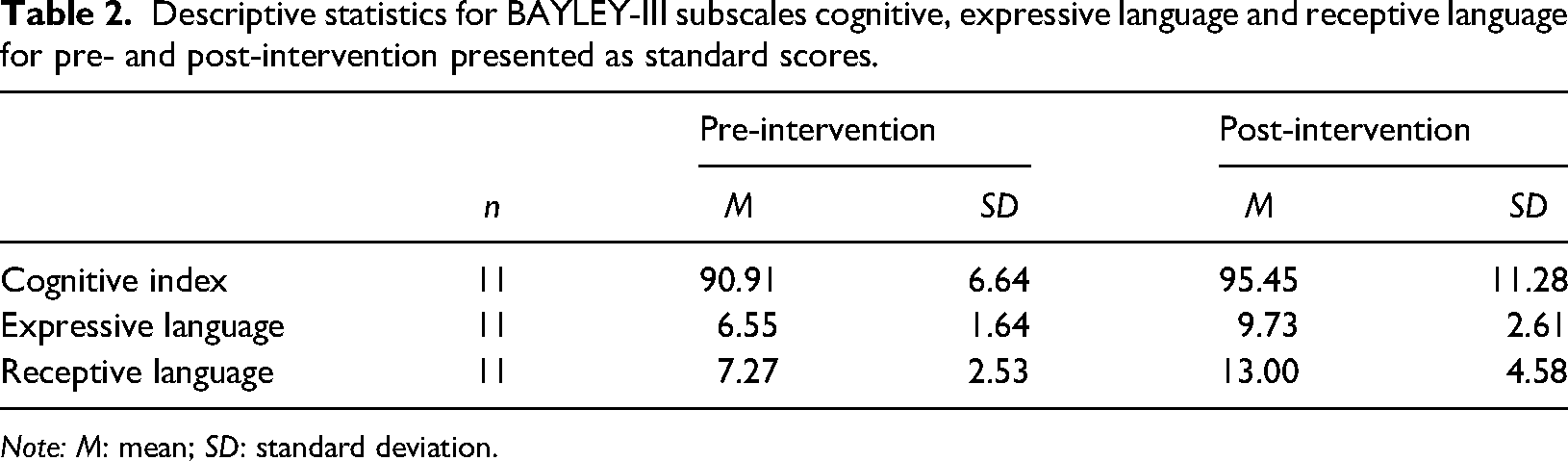
Descriptive statistics for BAYLEY-III subscales cognitive, expressive language and receptive language for pre- and post-intervention presented as standard scores.
Note: M: mean; SD: standard deviation.
Further, to answer research questions 2 and 3, results revealed that language development assessed with CSBS DP ITC using a one-sided paired t-test yielded non-significant results for the speech composite subscale. Significant results were attained for the symbolic composite subscales. Results are standard scores. See Table 3 for results.
Paired sample t-test for the speech and symbolic composite subscales for the CSBS DP ITC.
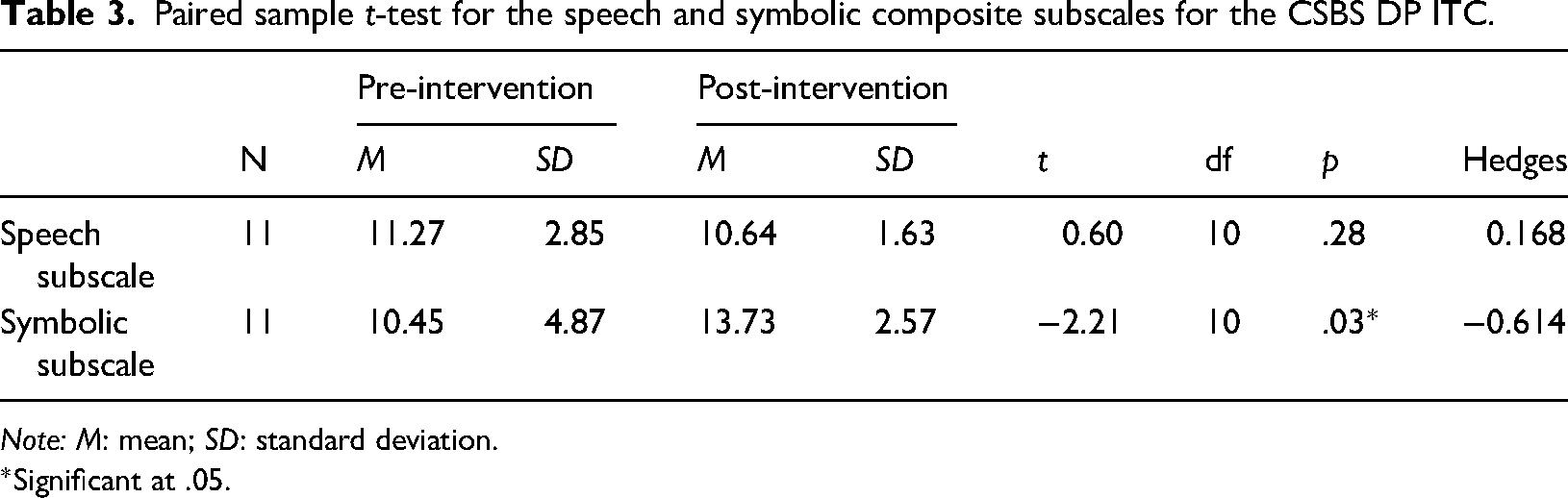
Note: M: mean; SD: standard deviation.
Significant at .05.
IV Discussion
Interactive shared reading techniques were designed to match the infant's language developmental level and were delivered through four instructional sessions with parents. The study aimed to explore the feasibility of the novel intervention and any potential effect on infant cognitive and language development. This study also aimed to explore how to assess the intervention outcome, that is, using one-on-one testing and/or parent questionnaires. In answer to research question 1, the results validate the feasibility of the shared reading techniques and the intervention design. Results for research question 2 show that cognitive and language assessments yield a preliminary favorable effect on infant language development, but not on their cognitive development. Lastly, to answer research question 3, both one-on-one testing and parent questionnaires seem to capture some effect on infant language development.
First, feasibility of the intervention and the shared reading techniques is implied through the unfailing participation of parents. All parent–infant dyads participated in all four instruction sessions. Second, parents expressed that the reading techniques were enjoyable, and most parents continuously applied the techniques while reading books 6 months post-intervention. Further, parents believed that the user-friendly character of the techniques could easily be communicated to others, enabling more adults to share reading with the infant in an age-appropriate and interactive manner. Further, the recurring intervention sessions served the parents in commencing and continuing the shared reading activity; parents expressed that the intervention sessions came as timely reminders. The feasibility of the intervention was also established by parents who expressed uncertainty about how to proceed with reading when their child was this young. The information, modeling and training of the techniques enabled these parents to share reading with confidence. Shared reading early in the infant's life support language development (DeBaryshe, 1993; Dickinson et al., 2012; Muhinyi and Rowe, 2019; Niklas et al., 2016), however, according to Brown et al. (2017) parents are uncertain of how to read to their infants. To ensure that the perceived challenges of reading to an infant may be diminished, instructions through intervention programs, such as this one, is one way to address the dilemma. Another indication of feasibility is how the infants responded to the reading techniques. As reported by the parents, the younger infants imitated behaviors, gestures, and sounds, while the older infants, to their ability, verbally answered or recapped the story for their parents. Taking an active part and becoming the storyteller is a desired child behavior when reading according to dialogic reading (Whitehurst et al., 1988; Zevenbergen and Whitehurst, 2003).
There were no indications that these novel shared reading techniques were unfeasible. However, two parents expressed that they already had commenced using the techniques before the actual session. One primary incentive of the intervention was to match the reading to the infant's language developmental level. Because infants mature and develop in an individual pace, an assessment of the infant and when to commence using these specific techniques may improve the outcome. Naturally, this increases the effort before the intervention, and from a clinical perspective, a reflection of time input compared to infant's needs must be considered. It may be that time consuming interventions should be provided for clinical populations. Because this is a feasibility study, no consideration of the population was taken.
Lastly, the interviews revealed two unexpected findings regarding parent and child well-being and the support of parent–infant relationship. First, parents expressed satisfaction, of sharing a fun and intimate activity with their infant, and how the infant is calmed as a result of using the shared reading techniques were prominent in the interviews. Zuckerman and Needlman (2020) state that optional shared reading session is filled with both language-rich and affect-rich interactions. Research support that shared reading activity has the potential to positively affect both parenting stress (Canfield et al., 2020; Huebner, 2000) and parenting style (Canfield et al., 2020; Jimenez et al., 2019). Therefore, an early shared reading intervention, such as this one, that targets language development as well as serves to ease the negative effects of parenting stress and harsh parenting is important to study further. Another interesting finding can be attributed to infants’ socioemotional development. Parents expressed that their infants imitated behaviors and sounds learned in the reading session. Imitation of adult behavior has been associated with socioemotional development (Murray et al., 2016). Murray et al. (2016) found a positive effect on pro-social behavior when dialogic reading techniques were provided for infants who were 14 and 16 months old. Further, O’Farrelly et al. (2018) found that infants who were read to at 6 months scored higher on assessment of socioemotional competence at 12 months as compared to a control group. However, further studies are needed to explore and establish any such effect from this novel shared reading intervention.
Preliminary effect on infant cognitive and language development
Studies investigating the correlation between shared reading and infant cognitive development specify that there exists a positive relationship (Niklas et al., 2016; Rodriguez et al., 2009). Intervention studies showed significant results on infant cognitive development when children were read to at 6 months old (O’Farrelly et al., 2018). In the present study, non-significant results were attained regarding cognitive development and several factors should be considered. First, the participants in this study may be too few to yield any measurable effect. Another important consideration can be related to intervention content. These reading techniques were chosen to match the infant's language development, and as such, may not have any bearing on cognitive development. Further studies using a larger study pool and a control group should be conducted to fully understand if infant cognitive abilities are affected by enriched shared reading at this age.
Regarding infant language development as assessed using one-on-one testing with BAYLEY-III, results are significant for both expressive and receptive language. For the assessment using CSBS DP ITC, a parent questionnaire, results obtained are significant for symbolic language. These significant results are consistent with previously conducted intervention studies where improvements in infant expressive and receptive language is observed (Muhinyi and Rowe, 2019; O’Farrelly et al., 2018). However, they are inconsistent with the findings from Goldfeld et al. (2011) whose results were non-significant on language outcomes. One difference between these results can be attributed to when the final assessment was conducted. In the study by Goldfeld et al. (2011), the assessment was conducted 6 months post-intervention, whereas in the other studies the assessment was conducted in conjunction to the last intervention. In this study, assessment was conducted about 2 months past the final intervention. Earlier studies have reported a fade out effect, where results from the intervention over time decreases (Barone et al., 2019, Whitehurst et al., 1988); however, this is a hypothesis that must be studied further conducting longitudinal studies.
The final research question concerned which type of assessment instrument could detect study outcome. Both the one-on-one testing and parent questionnaires successfully identified effects on infant language development. Assessing infants can be quite challenging and choice of assessment instrument and method must be considered when planning a study. Traditionally, expressive language is assessed through verbal responses. In this study, the intervention techniques instructed parents to use gestures and onomatopoeia when reading a book. In turn, parents were to encourage their preverbal infants to imitate and use these communicative behaviors. Hence, for preverbal infants, using an assessment instrument that also includes gestures, sounds, and onomatopoeia as valid and measurable means of expressive language, may yield a more accurate reflection of the infant's expressive language ability.
Lastly, in this study, the participating adult were parents. In Sweden, parents can take parental leave for up till 18 months to stay home with their infants. However, in many parts of the world, infants aged 10 months and older spend much of their time in a day-care or pre-school settings with teachers and educators as the adult who shares books with them. The research team sees no hindrance in applying the intervention techniques in this setting. However, a study must be conducted to understand true effects of the intervention in a different setting and with different adult participants.
Strengths and limitations
This study has some notable strengths. Participants were randomly drawn from a larger study pool. Since no participants opted to terminate once the intervention commenced, both quantitative and descriptive results regarding intervention outcome was collected satisfactorily. Further, the reading techniques were easy for participants to learn and implement as well as enjoyable to use together with infants.
This study also has limitations. First, the lack of control group limits the design and the implications of the results, rendering the results more explorative. Further, as argued earlier, an assessment instrument that considered all the infant's expressive communicative skills might have yielded results truer to the infant's abilities and should be considered in forthcoming studies. The parents in this study can be considered well educated which makes any generalization of the findings to other SES groups difficult. Lastly, using different assessors on BAYLEY-III, for pre- and post-intervention, was planned as a precaution of assessment bias. However, using different assessors may have resulted in a possible limitation given the vulnerability of assessing small infants. Future studies should consider benefits and consequences of using the same assessor.
V Conclusion and future considerations
Dialogic reading has in most studies focused on children older than 2 years (Whitehurst et al., 1988). Nevertheless, shared reading is recommended to commence during the infant's first year (DeBaryshe, 1993; Muhinyi and Rowe, 2019; Niklas et al., 2016) and recent studies include research on the effects of dialogic reading techniques on younger children (Chang et al., 2022; Cooper et al., 2014; Murray et al., 2016; Vally et al., 2015). This study utilized shared reading techniques that tailored to infants’ language developmental stages. As a feasibility study the aim was to learn about the process, implementation, and preliminary outcomes of an intervention (Orsmond and Cohn, 2015) and results are favorable of the novel interactive shared reading techniques and intervention design. Forthcoming, a study using a random control design, with modifications based on vulnerabilities from this feasibility study and involving a large study pool should be conducted to unveil any true effect of the intervention.
Providing four in-depth sessions is a time consuming and costly intervention and may be difficult to provide as a universal intervention. However, for clinical populations such as children at risk for language delay, this extended intervention may provide enough support to boost child language acquisition and to lessen negative outcomes. Future studies to explore these interactive shared reading techniques on clinical populations should be conducted.
Further, a promising finding beyond the study questions show an influence on parent and child well-being. In this study, the parents expressed that the shared reading and these novel reading techniques had an influence on the relationship with their child. A qualitative study focusing on how these interventions impact the parent–infant relationship is presently being conducted by the research team.
Supplemental Material
sj-docx-1-clt-10.1177_02656590241250234 - Supplemental material for An interactive shared Reading intervention designed for preverbal infants: A feasibility study exploring early language and cognitive development
Supplemental material, sj-docx-1-clt-10.1177_02656590241250234 for An interactive shared Reading intervention designed for preverbal infants: A feasibility study exploring early language and cognitive development by Emma Bergström, Anna Sofia Bratt, and Idor Svensson in Child Language Teaching and Therapy
Footnotes
Declaration of conflicting interests
The authors declared no potential conflicts of interest with respect to the research, authorship, and/or publication of this article.
Funding
The authors received no financial support for the research, authorship, and/or publication of this article.
Statements and declarations
The authors declares that there is no conflict of interest. No funding was received for conducting this study. This study was performed in line with the principles of the Declaration of Helsinki. Approval was granted by Regionala etikprövningsnämnden I Linköping (Dnr: 2017/582-31). Informed consent was obtained from all individual participants included in the study.
Supplemental material
Supplemental material for this article is available online.

References
Supplementary Material
Please find the following supplemental material available below.
For Open Access articles published under a Creative Commons License, all supplemental material carries the same license as the article it is associated with.
For non-Open Access articles published, all supplemental material carries a non-exclusive license, and permission requests for re-use of supplemental material or any part of supplemental material shall be sent directly to the copyright owner as specified in the copyright notice associated with the article.
