




Abstract
As a response to the growing recognition of the importance of ensuring a sustainable future for humanity and the planet, there has been a push by various stakeholders for the integration of sustainability education in the early years. This small-scale, exploratory study uses a phenomenographic research approach to examine a variation of conceptions early childhood educators may adopt when practicing sustainability in their respective settings. Four preschool teachers from the Philippines and three preschool teachers from Sweden participated in this study, taking part in semi-structured interviews to explicate their present understandings and practices related to early childhood education for sustainability. From the responses, four preliminary categories of description were identified—connecting with the self; connecting with humans; connecting with more-than-humans; and interconnections—wherein there is a hierarchy in how these categories are related, beginning with the self and then radiating outwards. Participants do not necessarily practice from only one category, but rather embed the different categories of connections in their practice. This study offers an initial investigation of alternative ways of organizing preschool teachers’ practices in education for sustainability in a logical, hierarchical structure, as well as allowing considerations for ways in which categories could be expanded or made more inclusive through further research.
Keywords
Introduction
As a response to the growing recognition of the importance of ensuring a sustainable future for humanity and the planet, there has been a push by various stakeholders for the integration of sustainability education in the early years. Those who are most vulnerable and at risk from current and future sustainability issues are young children (Dyment et al., 2014), and the discipline of early childhood education and care is called upon to advocate for a future that is sustainable for all (Ärlemalm-Hagsér and Elliott, 2017). Teachers’ knowledge is vital in orienting children’s knowledge toward early childhood education for sustainability (Larsson and Samuelsson, 2019), as they have an important role in guiding children’s activities (Sundberg et al., 2019), fostering children’s active participation, and decision-making competences that may not always develop organically (Borg and Samuelsson, 2022). In addition, literature suggests that how teachers understand education for sustainability has a degree of influence on their practices, which might affect how pedagogical objectives are emphasized and enacted (Inoue et al., 2016).
Background of the study
Previous research has endeavored to identify the different definitions and conceptualizations that have been developed on education for sustainability. For instance, Hedefalk et al. (2015) identified two definitions of education for sustainable development in their review of research articles that concerned early childhood education for sustainability (ECEfS): (a) as a threefold approach that involved education about, in, and for the environment; and (b) as an approach that encompasses environmental, social, and economic dimensions. A review of literature by Somerville and Williams (2015) also identified three theoretical orientations that underpinned articles about ECEfS under their investigation: (a) connection to nature, which is linked to environmental education; (b) children’s rights, relating to children’s voice and also a focus on the “intertwined social, cultural and economic global issues of sustainable development” (p. 109); and (c) post-human frameworks that seek to further the discourse beyond the nature/culture binary.
Initiatives such as the 2030 Agenda for Sustainable Development (United Nations, 2015.) are indicators of a global focus toward targeting key areas seeking to ensure a better world not only for generations present and future, but for the planet as well. The seventeen identified Sustainable Development Goals outline a variety of approaches educators can take to engage young children in sustainability education (Audley et al., 2024). In particular, Goal 4 (Quality Education) emphasizes and advocates for access to and quality of early childhood education and care and pre-primary programs, promoting inclusive and equitable education for all.
This focus has contributed to a wealth of research emerging in the past years about sustainability in early childhood and how educators conceptualize and enact it. Some perceptions put forth the view of education for sustainability as a means for knowledge transmission or skill development. Interviews with Turkish preschool teachers demonstrated the conception of sustainable education as an extension of how to teach learning processes (Veisson and Kabaday, 2018), and research investigating Ethiopian primary school teachers’ conceptions of environmental education determined that there is a primary focus on environmental education as being knowledge-centered, or a tool for imparting knowledge about the environment and bringing awareness to the problems it faces (Gugssa and Aasetre, 2023). Additionally, a survey of early childhood teachers in Australia depicted a practice that follows a tradition of nature-based approaches; however, the focus of these activities is oriented more toward developmental outcomes rather than learning about sustainability (Inoue et al., 2016).
Educators also hold attitudes that may be at odds with each other. For instance, two opposing attitudes were found in questionnaire responses from French and Swedish in- and pre-service teachers—ecocentric attitudes reflected a consideration for all living beings, while anthropocentric attitudes described a consideration for humans (Nyberg et al., 2020). Attitudes toward preservation dominated (ecocentric), even though a minority of responses pointed to attitudes of utilization (anthropocentric). Similarly, environmental education as a means to teach children about using natural resources as well as living in harmony with nature were also expressed by Ethiopian primary school teachers (Gugssa and Aasetre, 2023).
Other aspects of sustainability in early childhood education can also be found in previous studies. Research with preschool teachers and parents in Spain emphasized the importance of collaborating with stakeholders not just within but also outside the preschool through other centers and associations, having a shared goal of ensuring that sustainable practices continue to develop in the community (Buil et al., 2019). Meanwhile, interviews conducted with Estonian preschool teachers revealed a consideration of respondents for cultural sustainability, as they place importance on keeping the culture and language of their small country (Veisson and Kabaday, 2018).
Broström and Frøkjær (2019) suggested some ways that teachers can begin to orient themselves toward education for sustainability based on their experiences and observations from Danish preschools: (a) identify sustainability topics that are routine and simple to discuss and act on with children; (b) design dynamic learning environments, both indoors and outdoors; (c) construct playworlds that are grounded on children’s perspectives and nurture their sense of wonder; and (d) encourage inquiry from children through interactions and investigative activities.
In sum, education for sustainability is defined and oriented toward multiple dimensions, and these differences are exhibited in the attitudes and values that preschool teachers hold, as well as the approaches that they use in their practice. Nevertheless, research also argues that further action could be taken to embrace all living beings in education for sustainability (Nyberg et al., 2020). Posthumanist scholars also urge a rethinking of pedagogy, where children are given space to be attuned to their environment and understand their entanglement with the world, rather than merely having the perspective of controlling or managing it (Weldemariam, 2020).
Early childhood education for sustainability in Sweden: Curricular and research perspectives
Swedish preschools are overseen by the Ministry of Education and Research and adhere to two legislative frameworks: the Education Act (2010:800) and the Curriculum for the Preschool (Lpfö 18). The latest iteration of the Swedish Curriculum for the Preschool (Swedish National Agency for Education, 2019) identifies sustainable development as a fundamental value of the preschool. This concept appeared explicitly for the first time in the revised curriculum, which provides overarching goals and guidelines for preschool staff. The curriculum makes visible sustainable development in education by promoting education that has a sense of optimism for the future and expands knowledge by letting children explore, inquire, and discuss their world and the consequences of people’s choices on our collective sustainable futures.
Previous research has delved into Swedish preschool teachers’ perceptions and practices surrounding education for sustainability. An in-service project with four Swedish preschools found that teachers considered collective resources such as communal spaces, language, and play as vital in their practice of education for sustainability (Larsson and Samuelsson, 2019). Merging teaching content with children’s fantasy was observed in two Swedish preschools to be a means of introducing science learning opportunities, which may also be linked to education for sustainability concepts such as agency and empowerment, being connected with nature, and creative problem solving (Sundberg et al., 2019). Different methods in practicing education for sustainability were also found in a case study of an eco-certified preschool in Sweden, which included intentional and spontaneous dialogues, visual arts, and media, among others (Borg, 2019), and an ethnographic study that looked at a preschool and primary school in Sweden and Finland described how aesthetic and multimodal tools were used in relation to sustainable education, using art, natural materials and sensory exploration as tools for communication and meaning-making (Häikiö et al., 2020).
Swedish preschools view the child as a learner who holds the right to take part in issues that concern them, both in the present and the future (Hägglund and Samuelsson, 2009), and sustainability has become one of these pressing issues that early childhood educators must contend with in their practice.
Early childhood education for sustainability in the Philippines: Curricular and research perspectives
In the Philippines, early childhood education programs are offered for children from 0 to 8 years old, with mandatory schooling starting at kindergarten when they turn five. Early childhood education is overseen by two government agencies: the Early Childhood Care and Development Council (ECCD Council) for pre-kindergarten programs (0–4 years old) and the Department of Education for kindergarten programs (5 years old).
In contrast to the revised Swedish curriculum, legislative and curricular frameworks within early childhood education do not explicitly mention sustainability. Nevertheless, aspects of it can be found in various policy documents. For instance, the basic educational reform implemented in 2021 strives for the formation of Filipino graduates who are concerned and engaged with social issues and who value their fellow human beings and the world (SEAMEO-INNOTECH, 2012). Philippine preschool curricula also feature suggested learning competencies and topics to guide teachers. As an example, the Kindergarten Curriculum Guide recognizes the importance of interpersonal values and belongingness in a community. Meanwhile, the National Early Learning Curriculum includes “[a]wareness and appreciation of the natural and physical environment” as well as “[a]ppreciation of one’s culture and heritage” as suggested scoping topics in the learning resource available for teachers (ECCD Council, 2015).
Most literature regarding education for sustainability in the Philippines covers compulsory and higher education. There have been initiatives toward education for sustainability within Philippine universities, due in part to legal mandates and international cooperations (Balanay and Halog, 2016). However, a mixed-methods study involving teacher education institutions in the Caraga Region found differing levels of awareness regarding policy and legal frameworks related to education for sustainability (Flores 2023). A survey of pre-service elementary and secondary teachers in a state university revealed that respondents had a low awareness of issues and policies about the environment, although they have moderate participation in practices surrounding waste management and environmental initiatives (Lualhati, 2019). This paper seeks to contribute to this pool of literature by including perspectives from early childhood education.
Method
Research aim and questions
While sustainability is a term that encompasses critical issues, it is just as important to understand its limitations to strengthen its usefulness (Jickling, 2000). Before one can begin to take a critical perspective toward sustainability in early childhood education, the first step is to articulate how stakeholders understand sustainability as an organizing concept and how these understandings are reflected in their practice.
This study aims to explore the variation of conceptions early childhood educators may adopt when practicing sustainability in their respective settings. Interviews from four Filipino and three Swedish preschool teachers were analyzed with a phenomenographic research approach to undertake an initial investigation on the different ways of how preschool teachers experience early childhood education for sustainability. In particular, it seeks to answer the following research questions:
(1) What preliminary variations of meanings about early education for sustainability can be discerned through a small sample of preschool teachers’ descriptions of their practice?
(2) How can these preliminary variations of meanings be logically and hierarchically structured?
Phenomenography
The research is underpinned by a phenomenographic research orientation, which foregrounds human’s conceptions of phenomena in teaching, studying, and learning (Svensson, 2024). Developed in the 1970s at the Department of Education at the University of Gothenburg, phenomenography is interested in what is experienced and how (Marton and Booth, 1997). Whereas a first-order perspective is more oriented toward how human experience becomes a means for investigating reality as it truly is, phenomenography takes a second-order perspective and focuses on how humans experience phenomena and the variation in which this phenomena is experienced (Åkerlind, 2018). Furthermore, data analysis following this approach considers the collective whole and not the experience of individuals (Åkerlind, 2023a).
The basic unit of description in phenomenographic research is a “conception,” which comprises a meaning and a structure, also known as their referential and structural aspects, respectively. The referential aspect pertains to a conception’s overall meaning, while the structural aspect denotes features of the phenomenon that are focused on (Marton and Pong, 2005). Moreover, the structural aspect of a conception possesses an external and internal horizon. The external horizon indicates the context, and how a particular conception is related to what surrounds it, while the internal horizon has to do with the relationship of the parts within the conception (Koole, 2023). In phenomenography, structure and meaning are viewed as having a dialectical relationship, that is, that “structure presupposes meaning and meaning presupposes structure” (Pang, 2003: 149). Pang further expounds that something is discerned from its context when it has been ascribed meaning, and simultaneously, it can also be discerned by recognizing its internal structure—what parts make up what is discerned.
Nevertheless, even though experience can be analytically deconstructed into its parts, an individual will always experience phenomenon as a whole in terms of what it means to them (Åkerlind, 2023b). Therefore, conceptions are depicted in phenomenographic research by means of categories of description that feature holistic meaning, and it is through the outcome space that hierarchical part-whole relationships among the conceptions are expressed.
Participants
Four preschool teachers from the Philippines (Amihan, Mayumi, Marikit, and Hiyas) and three preschool teachers from Sweden (Karina, Anna, and Sarah) were contacted to participate in the first phase of this project. Their two settings were chosen to capture the collective experience of preschool teachers from a variety of contexts—from curricula that express sustainability differently, to the different ways that the daily routine is structured, among other aspects. Consent forms were disseminated among the preschool teachers and center heads. Prior to the interviews, the researcher conducted a 3-hour observation for the child groups of six of the preschool teachers involved in the study, ensuring that parental consent was given to children who were in the room with the researcher. Due to challenges in gaining parental consent from one group, the researcher decided to perform a walk-through of the group’s empty physical spaces (i.e., rooms and garden) as an alternative to the observations. These observations were not used for data generation but were instead only used as discussion points in the interviews, and to familiarize the researcher with the participants’ settings. Pseudonyms were used to protect the participants’ identities.
Interviews
Semi-structured interviews were conducted to explicate the participants’ present understandings and practices related to early childhood education for sustainability. Seven of the interviews were conducted face-to-face, while one was conducted through Zoom, lasting between 40 and 60 minutes. Their daily routines, conceptualization of sustainability, and the kinds of activities they consider related to sustainability are some examples of the topics that were explored in the interviews. Aspects from the observation such as activities, verbal or non-verbal cues, and physical features in the environment were also brought up to elicit a deeper discussion with the participants. The interviews were audio-recorded and transcribed, and a phenomenographic analysis (Ashworth and Lucas, 2000; Sandbergh, 1997) was conducted to generate key themes that arose from the data. As the phenomenographic orientations focuses on the collective experience, all seven interviews were analyzed as one corpus.
In analyzing the interviews, descriptions were chosen based on the key critical aspects of experiences, delineating distinctions as minimally as possible (Åkerlind, 2023a). Here, an iterative analysis was used, alternating between emergent interpretation of data and existing frameworks, and acknowledging the role of the researcher’s reflexivity in the process (Tracy, 2012). Outlined below are the phases followed in the analysis (ibid.):
(1) Organizing and preparing the data;
(2) Data immersion and primary-cycle coding, where data is examined and words or phrases that encapsulate its essence are determined;
(3) Secondary-cycle coding, where the primary-level codes are examined and organized further into, in this case, interpretive categories of description;
(4) Synthesizing and making meaning from codes, revising arguments as deviant data is encountered to more appropriately accommodate all emerging data and strengthening claims by going back to the aim and research questions.
These categories were then structured in the outcome space, which is based on hierarchical inclusiveness, organizing them by complexity and comprehensiveness of experiencing the phenomenon (Åkerlind, 2023b).
Results
Four categories of description were identified from the interviews on how preschool teachers experience education for sustainability (Figure 1). These were developed through iterative analysis, choosing vignettes that were most representative of the research findings (Anderson, 2010). The first category shows how the preschool teachers described education for sustainability as connecting with the self; this is related to notions of health and well-being. The second category is more expanded, where the participants characterized education for sustainability as connecting with humans; this includes ideas that are linked to building community and fostering culture. The third category is more inclusive as responses associated education for sustainability with connecting with more-than-humans; these are views that have to do with encounters with more-than-humans. Finally, the fourth category overarches those that precede it, pointing to education for sustainability as interconnections, which encompasses concepts of care and protection. These categories are further explained below, with vignettes from the interviews to support them. The quotes presented are those which best reflect the referential and structural aspects of their respective categories.
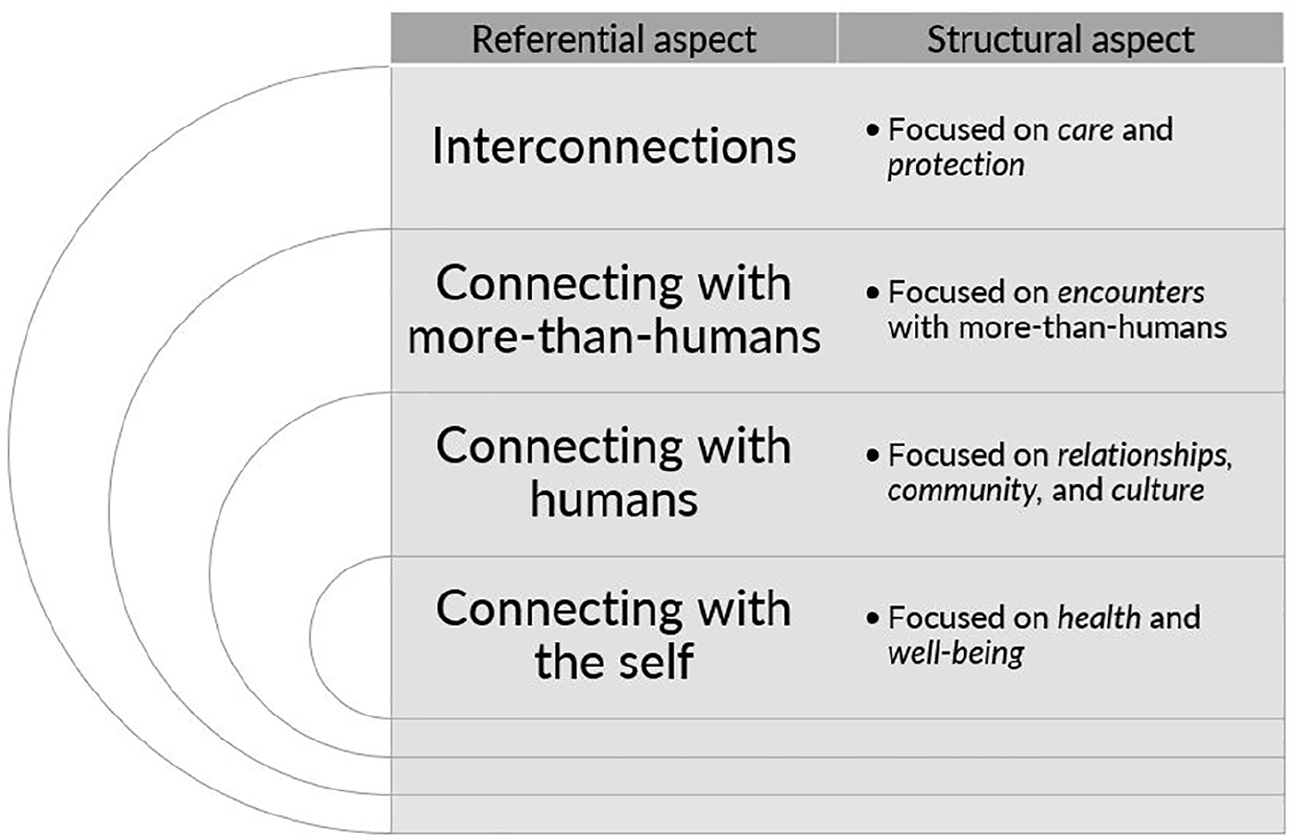
Outcome space of preschool teachers’ experiences with education for sustainability.
Education for sustainability as connecting with the self
The responses indicate that preschool teachers related education for sustainability to carrying out practices that promote children’s health and self-esteem. Food and movement are some of the ways that this category is expressed. Anna shared how these activities that are embedded in the daily routine can be considered a part of sustainability:
We also talk about like the joy of movement, eating healthy food, the access to food. And that is also something that we encourage, of course, and it’s also part of their development, like the moving, climbing. And so, it’s like when we think about sustainability, it’s such a big part of what, like we do like all day in the meetings when we see each other. (Anna)
Healthy food was further explicated by some participants. In Amihan and Mayumi’s setting, most children brought their own snacks and lunch, so they have established a policy to encourage parents to prepare non-processed food. Amihan related healthy eating to a healthy lifestyle, and Mayumi explained how these standards surrounding food influence children’s attitudes toward eating:
We also have here healthful food. So, everything they eat is healthy and less sugar for their health, also so they can sustain a healthy lifestyle. (Amihan) And the kids know this, they are already the ones that if they see some of their friends with food that is unhealthy, they would immediately tell the teacher or their friend that, “Oh, that’s not healthy, you cannot eat that in school” . . . So, we make sure that [the food] is not processed, so usually what they bring are sandwiches, fruits, and veggies. Some of the kids would bring veggies and rice. And usually their viand is really something healthy. So, it’s not like corned beef, Spam, ham, not like that. So, really more on home-cooked foods. (Mayumi)
There is also a focus on movement and relating it to caring for one’s body and mind. Sarah made a connection between physical health and sustainability, while Mayumi described the relationship between movement and mental health in getting children ready to participate and learn:
So, the small children, it’s quite a lot of focus on more on the motor skills, but it’s part of the sustainable development, I think it’s a part of that, too. Take care of your body and health. (Sarah) That’s why we have this, is that for them to be able to have a good mental health as well . . . So, we really want to start the day for them to be ready . . . what we do is we start with exercises, or if not exercises, then dances as well, dances would really help. (Mayumi)
In summary, participants placed significance on children having a positive relationship with themselves through activities and routines that promote health and well-being, relating this to maintaining a sustainable lifestyle. Nevertheless, they also recognized a broader area in which education for sustainability can be further adopted.
Education for sustainability as connecting with humans
Participants also described their experience on education for sustainability in terms of relationships, community, and culture. The preschool teachers mentioned how they themselves connect with the children, communicating with them in simplified ways to relay the concept of sustainability. Marikit gave an example of how she simplifies a complex topic such as “carbon footprint” for children:
Before, with carbon footprints, I really have a difficult time to discuss those with the kids. But we brought it down to “good choices.” You always think about, “Is this gonna waste something?” We are able to bring down the guide questions, examples, and also using videos and pictures really help to introduce and for the children to grasp the concept of sustainability. (Marikit)
Preschool teachers were also concerned about how children interact with each other, guiding the fostering of relationships within the preschool community. This was expressed by Sarah who spoke about helping children develop their socialization skills:
A lot of times, it’s like that, explain and show we can’t just do that or we can’t hit our friend. We need to use our words. So, yeah, a lot of time goes to spend how we are, how we treat each other and how we take on each other. We can’t be like, hitting each other, pulling, pushing each other. (Sarah)
This category also includes concepts like “getting to know the people in the broader community” as well as participating and contributing to the community through planned activities and events. Mayumi gave an insight to the progression of their topics in the group, and Amihan expounded on some school initiatives for the community that the children have been involved in:
After self, we venture into family and friends and neighbors. So, what are the roles of each family member, and of course, neighbors and community helpers are much bigger as well. They get to know about the jobs, what are the other people doing, and with that we also relate our lessons to other things too. Like, for example, the community helpers that are related to food industries. So, we relate it to healthy food, preparing healthy food. (Mayumi) Now we are also helping the community, because we want the community to be involved on the things that we are doing here in school. So, the kids help facilitate webinars about mental health, sustainable eating, even with tourism. (Amihan)
The preschool teachers also expressed the importance of promoting culture and designing activities that let children understand more about their culture. For some participants, like Mayumi, this meant promoting traditional food and designing opportunities for children to meet members of indigenous groups.
And we also suggest for [the parents] to bring kakanins [traditional rice cakes], so that [the children] will be exposed to Filipino food. And at the canteen, usually they also offer champorado [chocolate rice pudding], turon [banana spring rolls], food that’s really for Filipinos. . .we had a speaker from the Aeta community too, and they get to share their life and the places where they live. (Mayumi)
Community and culture are also expressed through how participants talk about acceptance and diversity. Anna shared how media such as pictures can also be vehicles to introduce different environments and contexts.
We try to work with also this social sustainability where we are accepting to each one and we talk about different varieties. We try to put pictures on the walls where it shows different types of food, the world buildings, different family types. (Anna)
This category covers multiple facets that illustrate participants’ descriptions of how education for sustainability involves connecting with humans. This includes the relationship of the preschool teachers with the children, fostering relationships within the community, and advocating for cultural representations in the preschool settings. Yet, responses indicated still a wider space that preschool teachers considered when enacting education for sustainability.
Education for sustainability as connecting with more-than-humans
Participants go beyond human relations and also described education for sustainability as connecting with more-than-humans. Interestingly, one of the connections that preschool teachers described is their own connection with school or policy documents. Karina’s response illustrated how the state curriculum benefits her practice:
I think it’s been helpful because then we make sure that we actually, even though we know that we always try to include everything that the documents says [sic] we’re going to do, it helps to just focus. And also, with the documentary that we can make sure that what have we done and that we can see like the result of it in the end of year. How have we brought this with us in the daily basis? So yeah, I would say that it’s helpful. (Karina)
Practices within this category also included encounters with outside spaces and the creatures that inhabit them. Hiyas and Sarah highlighted the importance of children spending time in nature:
[Children] need to just run around, lie down on the grass. For them to connect with nature, for them to understand that this is their home, this is what I need to protect, which connects to the school’s sustainability program. I need to protect it. I get to have fun in it. There is a lot of beauty in it, and actually really enjoy it. (Hiyas) I think showing them and giving them experiences of—but also going to nature, to the forest, to just—to give them that experience, to hopefully appreciate nature, and I think it’s good to start really early, very young, so to have positive experiences of nature and everything but like nature can be a part of that when it comes to sustainable development. (Sarah)
This category also covers preschool teachers’ practices that had the intention of providing children with hands-on, practical experiences with nature, to get to know and understand their immediate surroundings. Karina and Marikit described activities they have done with their groups that give children opportunities to interact with insects and animals:
We have had activities when we go to the forest, we look for insects. And we have a little paper that they can look on what they have. And we have an insect hotel. Just to get familiar, familiar with what kind of insects we have on our yard and that we get to experience the like. What do we have around us first. (Karina) So, the experience is different when we are outside. They see real animals. It’s also less structured because they see different views compared to when we take a picture. With a picture or if the animal is just walking. But when we are at the rescue centre sometimes they jump, sometimes they do something else, they eat, they sleep. So, discussions are expounded and enriched. (Marikit)
To summarize, preschool teachers included more-than-humans when providing activities they considered to be within education for sustainability, which mainly involved experiencing nature and interacting with its inhabitants. Nonetheless, there is one more category that goes beyond just encounters with more-than-humans, which will be detailed in the next section.
Education for sustainability as interconnections
The final category touches on the most encompassing conception that the participants related to education for sustainability, which revolved around interconnections—that humans do not exist in this world in isolation but are seen as part of the bigger world through various linkages. Mayumi explained how their group’s topics progress to include more-than-humans such as animals and plants:
After that, we venture into community places. So, after the places, that’s when they have the concept of what they can see in their surroundings. So, that’s the time we transition to what are the things that you can see around us, aside from us people. I mean the places that you can see. So, that’s the time that we venture into animals and plants, because in sustainability, we are all interconnected. So, we want to share to them that we are all connected. (Mayumi)
Care and protection are the main ideas featured in this category, in particular participants having discussions about the ripple effect of human actions on the world. Hiyas described how she introduces these increasingly complex relationships to the children:
Not going to lie because it was a bit of a process, because it’s not like I could tell them, “Oh, trash destroys the ocean.” It’s not as simple as that. It started from me, us, explaining the different things in the world. For example, their family, plants and then going out to animals. And then now, little by little, they see that, for the plants, “Oh, if I don’t take care of the plants there will be no more food. If I don’t take of the plants, animals will have no homes.” So, little by little, they understand that, what do you call this, it was more of surface level explanation little bit by little bit until they were able to grasp the idea that all things are connected. (Hiyas)
The preschool teachers interviewed also applied this category to experiences and discussions that reflected actions aiming for environmental protection such as waste management. Anna and Sarah described their experience of segregating and recycling or reusing waste in their settings:
I think that the valuable part is like—that you as a person have the opportunity to affect. That, even though we’re just talking about like that—we are—we are sorting out paper and plastic and it’s such a small, small part of the sustainability. It’s the—that you can affect—you can do something. You are able to be a part of a change. (Anna) Sometimes you say that . . . maybe more with the paper that we can make new products of these . . . and the plastic, you can use it to [make] new ones, maybe it’s a bit more complicated to explain the compost. But the older children, it’s easier to explain and talk about it. (Sarah)
This concern for protecting the environment also extended to practices related to water and energy consumption. Marikit gave an example on how this is demonstrated in practice:
But I observe that they absorb [the concept] because they talk about it. Like when they turn off the light, “We need to save energy, so that planet Earth will not be sad.” There are kids that take time to really absorb the concept of sustainability, but at their level we make sure that we introduce the basics. Like we need to save water when brushing your teeth. So, we really start it in their day-to-day activities. (Marikit)
Participants also described navigating tensions surrounding conflicting needs among members of the community, human and more-than-human. Karina gave an example of the challenge they navigate of balancing managing food waste and children developing a positive relationship with food through exploration:
I think it’s a hard topic sometimes because we want the children to taste everything. And that’s the thing with this as well in the kitchen, that we want to let them explore with all the senses and that it’s also like we don’t want them to, we want them to taste, but we also want them to—to know about the importance of not wasting food. That’s also something we talk about during lunch that we can maybe taste it before we want more and just bring awareness about the things that we eat and how much we throw away have an impact. (Karina)
The final category is also the most inclusive, portraying early childhood education for sustainability as a practice that recognizes the interconnectedness of humans and more-than-humans that make up this world.
Discussion and conclusion
From the participants’ descriptions of their practice, the most apparent variations of meanings about education for sustainability that can be discerned were related to the scope of connections being fostered. Preschool teachers do not necessarily practice from only one category—in fact, responses indicate that they take into consideration the different categories of connections and find a way to embed them in their practice. Nevertheless, there is a clear hierarchy in how these categories are related (Åkerlind, 2023b). It can be inferred from the most inclusive category that preschool teachers’ practice of education for sustainability is oriented ultimately toward the care and protection of our world, for the sake of both humans and more-than-humans.
What this study offers is a way to organize preschool teachers’ practices in education for sustainability in a logical, hierarchical structure. It also allows considerations for ways in which categories could be expanded or made more inclusive. For instance, while responses by the participants are consistent with previous research that describes how preschool teachers enact practices about, in, and for the environment in addition to social and economic aspects (Hedefalk et al., 2015; Somerville and Williams, 2015), it is also worth zooming out to reflect on and articulate silences that may characterize broader ways of enacting education for sustainability. To illustrate, even though diversity is touched on in some responses, issues regarding economic and social inequalities were largely unproblematized, as well as how children’s voices contribute to meaning-making when discussing sustainability. This is in light of research that suggests that status socialization can develop even at the preschool level (Espy and Lynn, 2023) and the agency of children in participating and engaging in aspects of socio-political sustainability (Paujik et al., 2020), even as preschool teachers are underequipped to deconstruct the concept of class (Mikander and Mansikka, 2023).
This study is not without its limitations. Challenges in obtaining participants mean that the study is small-scale and exploratory in nature. Hence, the results of this study may not be generalizable outside the time and space of the research project’s specific context. Further research can investigate more exhaustively whether the structure and connections identified here are formed in similar ways from a wider population of preschool teachers. Moreover, while participants agree that positive experiences are important in children developing attitudes that value sustainability, the study does not address whether these practices do result in the embodiment of sustainability-related dispositions.
In conclusion, preschool teachers partake in practices of education for sustainability that vary in complexity, which are logically and hierarchically structured. The categories begin with connecting with the self and then radiate outward—with fellow humans, with more-than-humans, and finally, the category that recognizes the interconnections among the preceding spheres. Practices that are considered less complex are still contributing to the aims of education for sustainability, but they are nested within more inclusive practices. These categories may serve as a starting point in exploring even more inclusive practices, embedding social, economic, and environmental justice in educating for a sustainable future.
Footnotes
Funding
The author disclosed receipt of the following financial support for the research, authorship, and/or publication of this article: This study was supported by The Adlerbertska Foundations through the Adlerbert scholarship (AD2022-1946).
Compliance with ethical standards
The research project was conducted in accordance with the ethics guidelines of both the Swedish Research Council (Reference number 2023-00845-01) and Philippine Social Science Council (Reference number CB-22-63).
