




Abstract
This paper explores the perceived benefits of and barriers to, using puppets in early years classrooms and childcare settings. An online survey of 121 early years educators revealed that puppets are widely, but infrequently, used in the early years, and are largely found to be valuable pedagogical tools by those that use them. Puppets were reported to benefit play, teaching, wellbeing and the communication of behaviour requirements, as well as positively impacting engagement with learning and behaviour mediation. Frequent users were more positive than infrequent users. Barriers to usage included a lack of confidence or awareness of how to use puppets pedagogically (23%, n = 19), a lack of puppet resources (23%, n = 19) and a series of ‘sub-conscious’ decisions not to use puppets based more on apathy than dislike (49%, n = 40). A small minority (10%, n = 8) made a conscious decision not to use puppets because they were negative about puppets. Training and information are required to encourage more puppet use and raise awareness of the benefits; there is also a need for the provision of puppet resources to realise the pedagogical potential of puppet play in the early years.
Keywords
Introduction
Recent, comprehensive reviews of the pedagogical use and benefits of puppet play conclude there are multiple benefits to puppet play, but that puppets are generally under-utilised in schools (Kröger and Nupponen, 2019) and early years educational and childcare settings (Råde, 2021b). At a time when play-based early years curriculums are being squeezed and formal teaching methods are becoming increasingly common (Patte, 2020; Sproule et al., 2021), the importance of finding ways to bring different types of play into the classroom is evermore important (Taylor and Boyer, 2019). The value of learning through play is supported both by a plethora of research (McInnes, 2021; Parker and Thomsen, 2019; Zosh et al., 2017) and, in general, by English and Welsh government policy for early years settings (Department for Education, 2021; Welsh Government, 2022); puppet play, with its multiple benefits to teaching and learning, should fit well into a learning-through-play approach in the early years. Indeed, it has even been proposed as the ideal option to help bridge the gap between formal and play-based teaching and learning (Råde, 2021b). Up-to-date relevant evidence on the pedagogical benefits of puppet play would therefore be useful for informing both curriculum content and teacher training programmes.
With their fun and exciting demeanour that children respond to and believe in (Korošec, 2012), puppets are an enduring entertainment medium (Banfield, 2022), prevalent today in both television shows and live theatre productions, as well being an easily accessible toy at home and in education and care settings. Puppets are also valuable therapeutic tools and have been used for many years in medical settings to help prepare children for surgical procedures (Athanassiadou et al., 2012; Reid-Searl et al., 2017) or to deal with other medical stressors (Shapiro, 1995). Puppets are used extensively by child therapists to aid communication about traumatic events and to assist with behavioural and emotional issues (Hartwig, 2014), facilitating the exploration and expression of children’s underlying feelings (Bernier and O-Hare, 2005; Codrington, 2021). In this way, puppets enable both role play and projection opportunities, along with enjoyable sensory exploration (Howard and McInnes, 2013). Puppets provide a crucial dramatic distance (Jennings, 1999; Karaolis, 2020); when the puppet experiences the emotions, rather than the child, children are more able to talk freely in the safe space created by the puppet (Briesmeister, 2010; Howard and McInnes, 2013).
Kröger and Nupponen’s (2019) detailed review of the pedagogical use of puppets in educational settings analysed 15 empirical studies of puppet use in schools amongst 5–18 year olds and found there were five main pedagogical benefits to puppet play: encouraging communication, creating a positive classroom environment, fostering creativity, stimulating cooperation and integration into a group, and changing attitudes. Råde’s (2021b) more extensive review of 104 peer-reviewed studies, reviews and meta-analyses of puppets as pedagogical tools for use with younger children, aged 1–9, also concluded there were five broad areas of beneficial use of puppets in early years care and educational settings: communication (language and children’s voice), science (direct teaching), healthcare (wellbeing, health teaching, simulation), creativity (art, dramatic play and play-based learning) and behaviour (social skills and empowerment).
It is somewhat surprising that the pedagogical use of puppets is less prevalent than the therapeutic use (Korošec and Zorec, 2019) given the broad evidence of the benefits of its pedagogical application (Keogh and Naylor, 2009; Shepherd and Koberstein, 1989; Simon et al., 2008; Råde, 2021b). Further weight can be added to the potential pedagogical value of puppets by considering the theoretical frameworks within which puppet play sits; for example, Neumann’s (1971) definition of play that considers play as a process of modes and operations occurring in sequence has a clear synergy with puppet play. For Neumann (1971), play involves the operations of ‘exploration, repetition, replication and transformation’ which interact with the modes of ‘sensori-motor, affective, oral and cognitive activity’ (p. 11); this resonates with puppet play on many levels, from puppet-making, playing with puppets as a sensory soft-toy and using puppets to enact plays and stories, to role-playing and exploring emotions through a puppet, along with listening and responding to puppets as if they were real. Moreover, the embedding of the pedagogical use of puppets within a theoretical framework is highlighted by Råde (2021a) who, on examining the theory underpinning puppet play, concluded that ‘several relevant theories can be used to support the pedagogical use of puppets with young children’ (Råde, 2021a: 1365), not least Bandura’s (1977) social learning theory which, he asserts, is evident in the positive impact on behaviour and engagement witnessed when puppets are used for storytelling and modelling in class.
Despite the strong theoretical underpinning (Råde, 2021a), their widespread appeal to children (Korošec, 2012) and their positive impact reported by the settings that have used them (Korošec and Zorec, 2019), puppets appear to be generally underused and it is not evident why this is so. In particular, relatively little is known about teachers’ perceptions of puppet play and the reasons why they underuse puppets in their classrooms. Some studies have suggested the low usage of puppets is attributable to unfamiliarity with how to use puppets educationally or a lack of awareness of their pedagogical benefits (Korošec and Zorec, 2019; Kröger and Nupponen, 2019). Korošec (2013) also believes some practitioners feel using puppets would be too time-consuming, although her 2013 study usefully reports that the teachers who did use puppets, specifically said that they did not take up too much time. Korošec (2012) also reported that teachers were surprised at how well the children’s attention was better focussed when puppets were used, supporting other earlier research (Keogh and Naylor, 2009; Simon et al., 2008) that similarly reported more engagement and focus on learning when puppets were used in lessons.
Puppets will not, however, suit everyone; whilst most children are said to respond well to puppets, there are some children who do not like them (Råde, 2021b) and some adults who do not enjoy working with them (Remer and Tzuriel, 2015), and teachers’ affinity with puppets has also been questioned (Hackling et al., 2011). Interestingly, research by Korošec (2013), that was based on a significantly larger sample of teachers than Hackling et al.’s study of just 12 individuals, found that teachers were, on balance, positive about the concept of using puppets in the classroom; it was the awareness of the pedagogical value of puppets that was sometimes lacking. Additionally, later research by Tzuriel and Remer (2018) found teachers were positive about the strong behaviour mediation role of puppets.
Kröger and Nupponen (2019) assert that the pedagogical benefits of puppet play are so great that puppet play should be incorporated into more teacher training programmes and the use of puppet play expanded across more schools and early years settings. However, the limited, recent, research available about teachers’ perceptions of puppet play in terms of why some practitioners choose to use puppets, and others do not, has resulted in a gap in knowledge about how to encourage educators to incorporate puppet play into their practice. This study was therefore designed to explore what the benefits and barriers to puppet use are currently perceived to be amongst early years educators, and to consider what would encourage the increased use of puppets as pedagogical tools. If puppet play were to become more widespread, then the multiple positive outcomes of puppet play may allow a wider range of children to benefit.
Methodology
Procedure
Utilising the survey tool, Qualtrics, an online survey was used to gather information from early years educators about their perceptions of puppet play. After a pilot study, a link to the final survey was made available for several weeks across a wide range of Facebook® early years teaching and practitioner social media pages. This method was chosen to allow for a very specific group of respondents to be contacted in a cost-efficient and expedient manner; a known advantage of Facebook® recruitment over other self-completion recruitment methods (Whitaker, 2017, cited in Clark et al., 2021). Self-selection online recruitment surveys are known to risk selection bias by over-representing certain groups in the sample (Khazaal et al., 2014) therefore this likely limitation of this study’s sample needs to be considered in the interpretation of the findings.
Data collection and analysis
The survey was designed to collect both a robust set of quantitative data (obtained from a series of pre-coded closed questions), and detailed qualitative data (gathered through open-ended, write-in questions). Some questions allowed participants to both ‘tick a box’ and write in further details to expand their answers. A range of questions about puppet use was included in the survey; not all questions are reported on here due to the limited scope of the paper which focuses on benefits and barriers. It is intended to report on the other findings in further papers.
The quantitative dataset was analysed by first cleaning the data by checking for inconsistencies, validating the data and dealing with missing data (Boynton, 2005). ‘Write-in’ answers were also examined, formatted, and ‘back-coded’ where relevant (such as if a participant had inadvertently written in an ‘other’ answer that was already an existing pre-code on the survey). The cleaned data was then uploaded into the survey software program, Snap, and data tabulations run to describe the data in terms of frequency distributions, to group participants’ answers where relevant (such as the proportion who agreed with any of a range of options given in a multi-code question), and to examine trends within the data by sub-group, by running cross-tabulations (Davies and Hughes, 2014).
The qualitative data was analysed using the thematic framework developed by Braun and Clarke (2006), which involved identifying codes which were then grouped into themes and sub-themes. Credibility on the themes and sub-themes constructed was achieved by the researchers independently coding the data and comparing and commenting on the themes constructed to confirm they were an accurate and authentic account of the data collected (Shenton, 2004), providing inter-rater reliability in relation to trustworthiness.
Ethical considerations
Ethical consent was obtained through the Faculty of Humanities and Social Sciences at Swansea University. Participants completed a detailed consent form before completing the survey, which informed them their participation was voluntary and that their responses were anonymous, as well as describing how the data would be used (Davies and Hughes, 2014).
Eligibility
The study sought the views of early years educators; those not employed in a teaching capacity were rejected from the final sample, along with those not working with children aged up to 5.
Survey response
One hundred twenty-one responses were used in the analysis. Teachers made up 32% of the sample (n = 39); the remainder, whilst not employed specifically as teacher, had either all, or most, of the responsibility for planning and teaching (40%, n = 48) or some teaching responsibility (28%, n = 34) in their setting.
Those not employed as a teacher had a range of job titles: Early Years Practitioner/Senior Practitioner (47%, n = 57), Teaching Assistant/Higher Level Teaching Assistant (12%, n = 14), Manager (8%, n = 10), Childminder (1%, n = 1).
Most participants were experienced practitioners with on average 15 years 2 months early years experience. Over a third had over 20 years experience (34%, n = 41); just under a fifth had been in the sector for 5 years or less (18%, n = 22).
Half the sample worked in a school (50%, n = 60), 20% in a pre-school (n = 24), the remainder worked in childcare: day care/nursery (25%, n = 30), children’s centre/playgroup (5%, n = 6), childminding setting (1%, n = 1).
Results
Perceptions and usage of puppet play
The majority of participants used puppets at least occasionally in their settings (83%, n = 100) but most were infrequent users; very few said they, ‘used puppets a lot and they are a very important part of our day’ (6%, n = 7). Participants were more likely to say either they, ‘regularly used puppets and they are quite important to the day’ (24%, n = 29), that puppets were, ‘available in the provision but were not that important’ (31%, n = 38), or that they, ‘only occasionally or rarely used puppets’ (19%, n = 23). In total, 30% of the sample can be described as frequent puppet users (use a lot or regularly, n = 36), 50% as infrequent users (puppets are available or are used occasionally/rarely, n = 61) and 17% as non-users (n = 21).
Note. Frequency of use does not total 83% as three puppet users did not specify frequency.
Puppets were used across all setting types (school usage: 88%, n = 51; pre-schools and childcare settings usage: 78%, n = 47) and during all types of teaching and learning environment; use was most prevalent during child-initiated play-based learning (80% of puppet users, n = 80), however over half of users used them during adult-guided play-based learning (62%, n = 62) and/or during more formal adult-led teaching (51%, n = 51). Thirty percent of users (n = 30) used puppets at other times of the day, for example, playtime.
How puppets are used and the perceived benefits
Thematic analysis
The majority of puppet users felt there were benefits to puppet play: 76% said they were beneficial to their practice (n = 76) whilst only 3% (n = 3) of users said there were no benefits; the remainder did not state an opinion (21%, n = 21). Frequent users were more positive than infrequent; no frequent users said there were no benefits to puppet play, whilst 5% (n = 3) of infrequent users said there were no benefits.
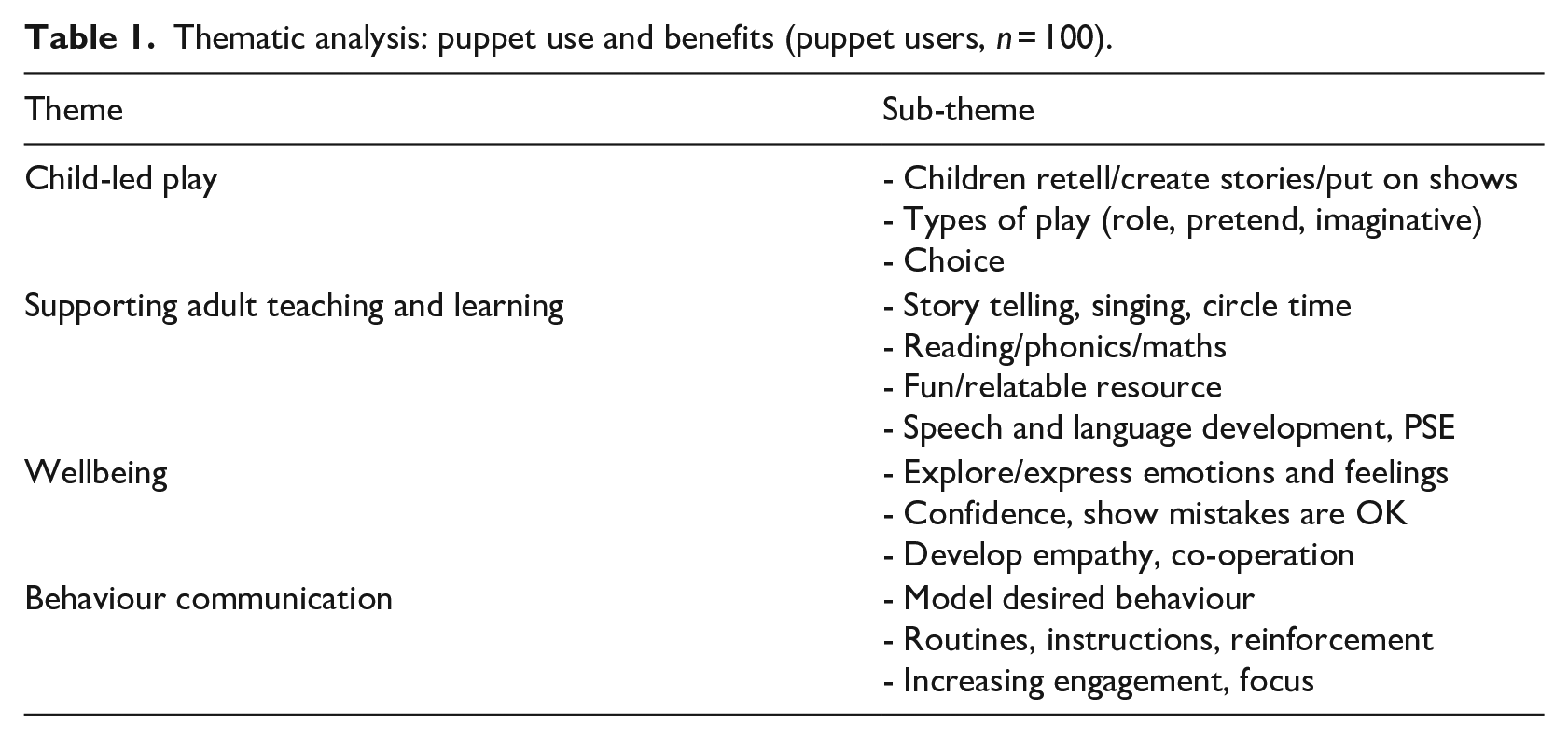
Thematic analysis using Braun and Clarke’s (2006) framework resulted in four themes being constructed about how puppets were being used and what the benefits to this use were perceived to be. Table 1 details the four themes along with sub-themes within each, and shows puppets were found to be beneficial for child-led play, adult-led teaching and learning, wellbeing and for communicating behaviour requirements.
Thematic analysis: puppet use and benefits (puppet users, n = 100).
The impact of puppets on engagement and behaviour
Almost two-thirds of puppet users agreed that engagement with learning improves when puppets are used (65%, n = 65). Very few participants disagreed with this concept (2%, n = 2); those that did not state they agreed were more likely to say they neither agreed nor disagreed (21%, n = 21), or to say they did not know (2%, n = 2). A further 10% (n = 10) did not answer the question.
Similarly, almost half of puppet users agreed that children’s behaviour improves when puppets are used (46%, n = 46), and again, very few actively disagreed with the concept (2%, n = 2), being more likely to say they neither agreed nor disagreed (37%, n = 37) or they did not know (6%, n = 6). A further 9% (n = 9) did not answer the question.
More frequent puppet users were more likely to report a positive impact on engagement and behaviour when puppets were used; over 9-in-10 frequent puppet users said engagement with learning improves with puppet use (92%, n = 33) and almost 8-in-10 frequent users said behaviour improves with puppet use (78%, n = 28). Infrequent users were less likely to believe that engagement with learning (52%, n = 32) or behaviour (30%, n = 18) improved with puppet use.
Non-puppet use
Barriers to use
Non-users and infrequent users were asked why they did not use puppets either at all, or more often. Content analysis of both the prompted and unprompted responses resulted in the identification of four barriers to use, as shown in Figure 1.
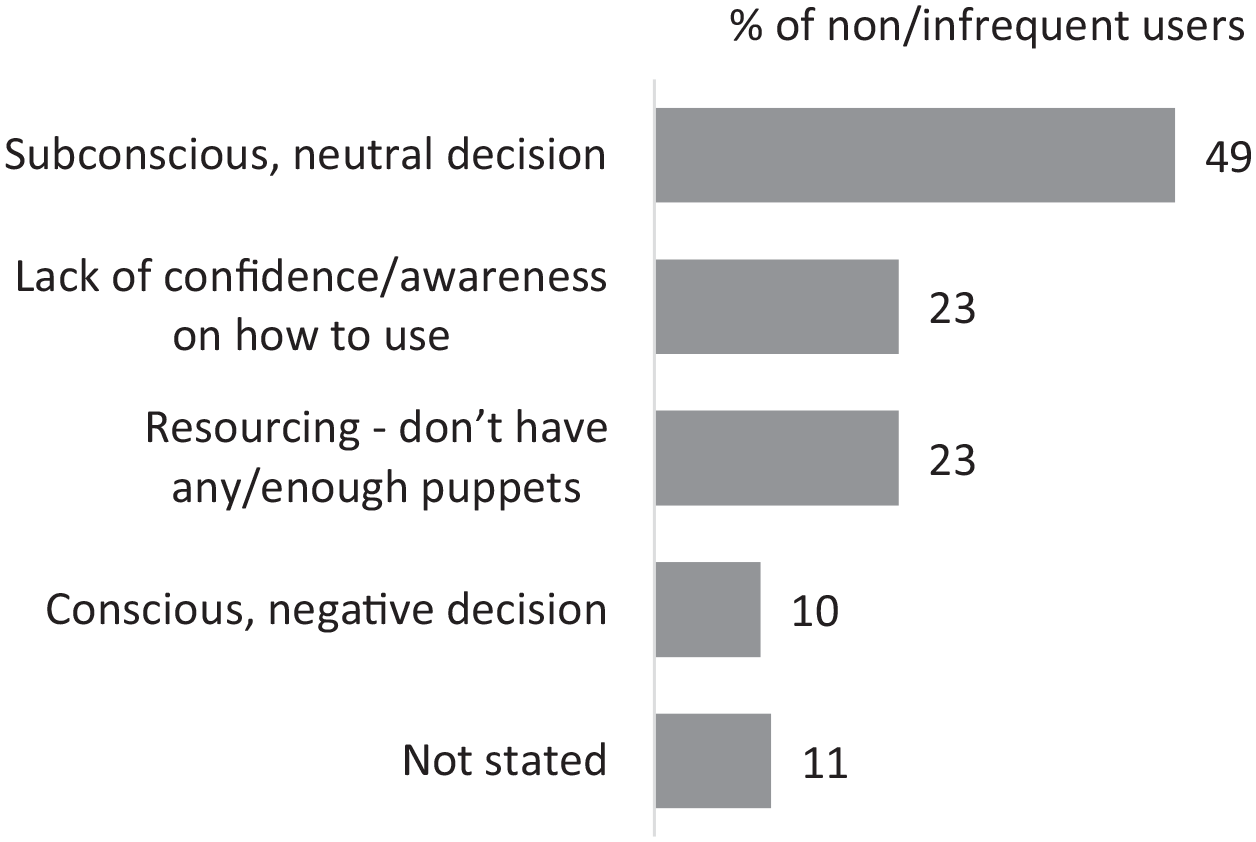
Why puppets are never/infrequently used (non/infrequent puppet users n = 82).
Almost half of non and infrequent users (49%, n = 40) stated a barrier that related to a ‘sub-conscious’ or apathetic decision not to use puppets; some had just not thought about using them or were generally uninterested (20%, n = 16), ‘Never really thought about it but will in the future!’, whilst others in this group said they had no time to use puppets (16%, n = 13) or that puppets were already available in their classrooms but the low usage matched the low desire (13%, n = 11), ‘they are there to use as the children see fit or when adults feel they will help’ or that puppets were just one of many resources they had available (4%, n = 3).
One of the main specific reasons stated for not using puppets was a lack of confidence or awareness of how to use them (23%, n = 19). A further primary reason for non/infrequent use, related to resourcing (23%, n = 19); either participants did not have any puppets, enough puppets, or they lacked the money to acquire any.
A small proportion of non-users and infrequent users made a conscious decision not to use puppets (10% of non/infrequent users, n = 8) because of a negative perception about puppets. A very few participants said either they did not like the feel of puppets themselves (n = 1), they believed the children were frightened of them (n = 1) or they considered them a distraction (n = 1). Other participants restricted the use of puppets, either because they chose to only use them to enhance certain types of learning or classroom areas (n = 3), or because they felt children in their cohort would not look after the puppets and they may get broken (n = 3).
How to encourage more puppet use
The main areas that would encourage non and infrequent puppet-users to use puppets more often were to receive training on how to use them (49%, n = 40) or money to buy puppets/be given puppets to use (49%, n = 40). A third of non/infrequent puppet users said they would like to receive information on the benefits of puppet use (33%, n = 27). Just one participant selected the option that, ‘nothing’ would encourage them to use puppets – Figure 2.
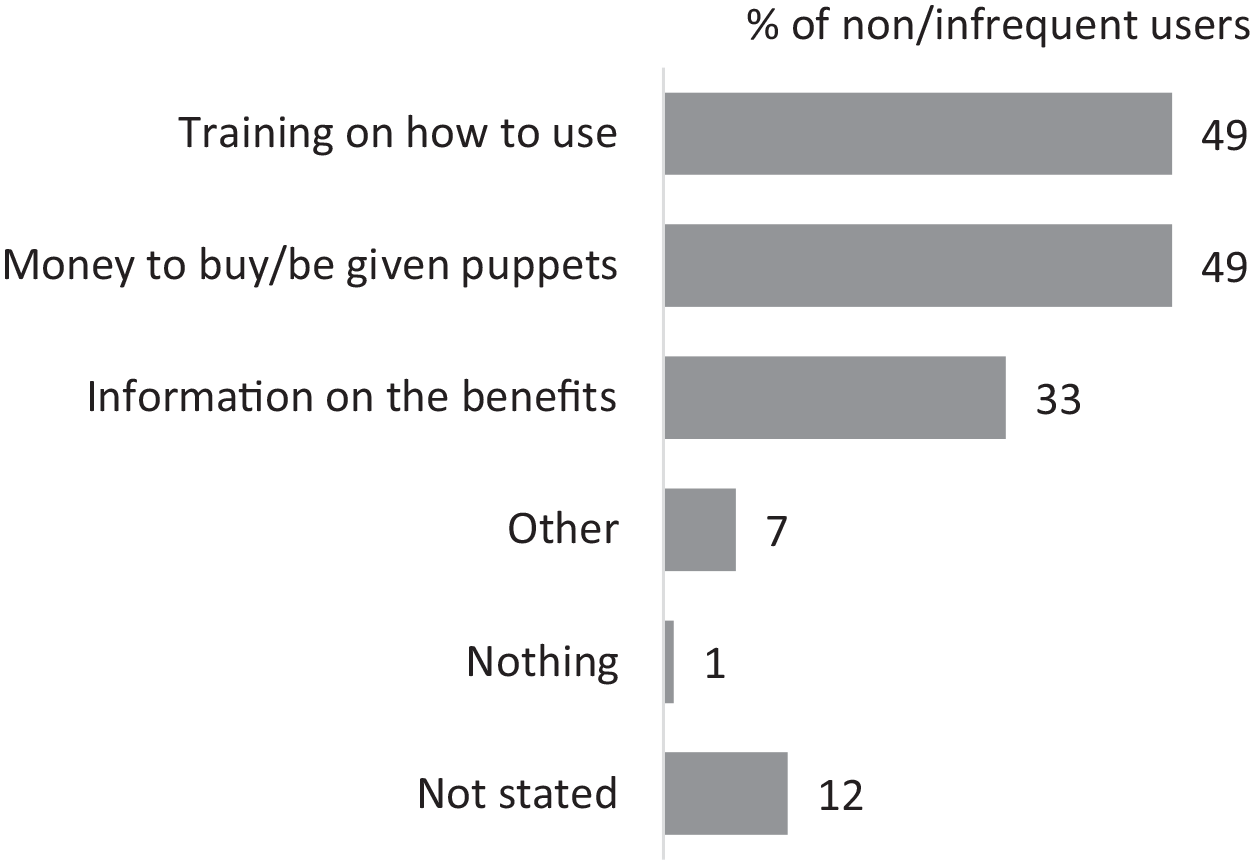
What would encourage puppet use (non/infrequent puppet users n = 82).
Most non/infrequent users said they would be fairly likely to increase their puppet usage if their required conditions were met (77%, n = 63), including almost a quarter saying they would be ‘extremely likely’ to do so (24%, n = 20). Only 2% (n = 2) said they would be unlikely to use puppets regardless of requirements being met; the remainder were non-committal or did not state an opinion, Figure 3.
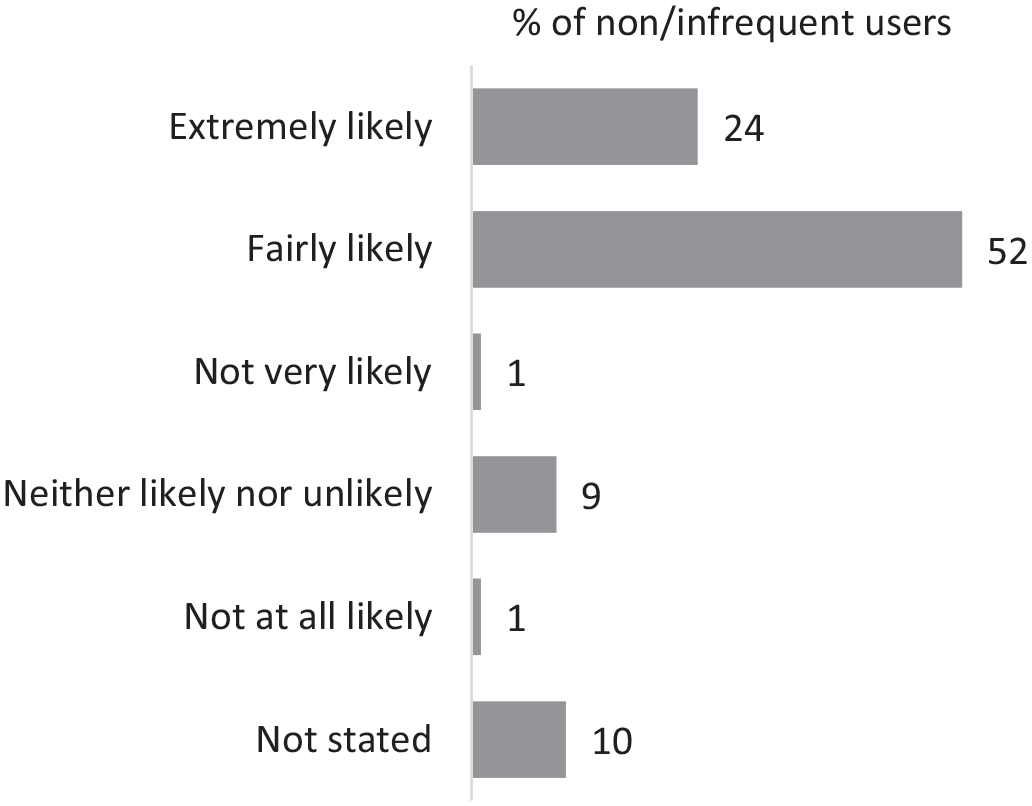
Likelihood of trying/increasing use of puppets if desired condition met (non/infrequent puppet users n = 82).
Those who had requested training or resources were particularly likely to say they would increase their puppet use if these conditions were met, at 93% (n = 37), as were those who had requested information on the benefits, at 81% (n = 22).
Summary of main findings
The main findings from the survey, in relation to the benefits of puppet play, are that most puppet users found puppets to be beneficial to their practice (76%, n = 76), with four main areas of benefit identified: child-led play, adult-led teaching and learning, wellbeing, and communicating behaviour requirements. On prompting, most puppet users also found puppets beneficial for engaging children in their learning (65%, n = 65) and almost half said puppets were beneficial for improving behaviour (46%, n = 46). Frequent puppet users were much more likely to report the positive impact of puppets on engagement (92%, n = 33) and on behaviour (78%, n = 28) than infrequent users.
Four barriers to puppet use were identified: lack of confidence or awareness in how to use puppets (23%, n = 19); lack of resources (23%, n = 19); sub-conscious decisions not to use puppets (49%, n = 40) which included not thinking about it or being generally uninterested (20%, n = 16), feeling there was no time for it (16%, n = 13) or believing the low use matches the low demand (13%, n = 11); and, by a very small minority (10%, n = 8), conscious, decisions not to use puppets. Non-users and infrequent users might be encouraged to use puppets more often if they had training on how to use them (49%, n = 40), money to buy puppets or be given puppets (49%, n = 40) and information on the benefits (33%, n = 27).
Discussion
Frequency of puppet use
The literature suggested that puppets are underused in early years settings despite many benefits (Kröger and Nupponen, 2019; Råde, 2021b). On one level, puppets were found to be widely used in this study; over 8-in-10 participants said they used puppets at least occasionally in their classrooms (83%, n = 100), and usage levels were fairly constant across all setting types (88% of school-based practitioners used them, n = 51, and 78% of practitioners in pre-schools and childcare settings did so, n = 47). However, as suspected, puppets were not generally found to be an integral part of participants’ days; very few stated that they ‘used puppets a lot and they are a very important part of our day’ (6%, n = 7). Overall, around 30% of early years educators in this study were classed as frequent puppet users (use a lot or regularly) and 50% were classed as infrequent users, whilst 17% were non-users.
There is limited recent published data to compare this frequency of use data with, however, Korošec’s (2013) study provides some useful information and suggests the frequency of use in this study is similar to that reported elsewhere; 75% of Korosec’s teachers ever used puppets, compared with 83% in this study, and 31% of Korošec’s teachers used puppets frequently (daily or weekly) comparable to this study’s finding that 30% of early years educators were frequent users (using puppets ‘a lot’ or ‘regularly’).
Uses and perceived benefits
Interestingly, puppets in this study were used during all types of teaching and learning time; it had been expected that use would be most prevalent during child-initiated play-based learning (Råde, 2021b), and indeed, 80% of puppet users did use puppets at this time (n = 80), however, puppets were also used during adult-guided play-based learning (62% of puppet users, n = 62) and also during more formal adult-led teaching (51% of puppet users, n = 51). The latter finding, in particular, suggests that even if early years classrooms are becoming more formal and less play-based (Patte, 2020; Sproule et al., 2021), there could be a place for puppets within that more formal structure; puppets appear to be a reliable way practitioners can ‘infuse playfulness’ into their teaching styles in order to adopt a more playful approach in the classroom (Sproule et al., 2021: 228).
Puppet-users in this study were very positive about the benefits to puppet play, indeed 76% of users (n = 76) felt puppets were beneficial in some way, whilst only 3% (n = 3) were negative on this issue (the remainder not stating an opinion). The benefits determined in this study support much of the existing literature, with puppets being found to be beneficial for play, teaching, wellbeing and communicating behaviour requirements. Puppets were also found to be useful behaviour mediation tools and could increase engagement and focus, supporting Råde’s (2021a) assertion that Bandura’s (1977) social learning theory is evident in the positive impact the pedagogical use of puppets for storytelling and modelling has on behaviour and engagement. This assertion is strengthened by the finding in both this study, and in other research (Korošec, 2013), that frequent puppet users are more positive about the engagement and behavioural benefits of puppets than infrequent users.
Barriers and potential solutions
Four broad barriers to puppet use were found by this study: a lack of confidence (23%, n = 19), a lack of puppet resources (23%, n = 19), sub-conscious or apathetic decisions not to use puppets (49%, n = 40), and conscious, or negative, perceptions of puppets by a small minority (10%, n = 8).
Lack of confidence
One of the main barriers to using puppets was a lack of confidence in how to use them, a finding also implied by the Kröger and Nupponen (2019) review. By asking the question directly in this study it was revealed that almost a quarter (23%, n = 19) of non/infrequent users did not use puppets because of a lack of confidence or awareness of how to use them educationally.
The survey revealed a need for training in puppet play with almost half of non/infrequent users (49%, n = 40) saying that training on puppet play would encourage them to increase their usage. Over 9-in-10 of those who requested training said they would be at least fairly likely to increase their puppet usage if they were able to access training (93%, n = 37). Similarly, a third of non/infrequent users (33%, n = 27) said that if they received information on the benefits of puppet play, they would be more likely to increase their pedagogical use of puppets; over 8-in-10 of this group (81%, n = 22) say they would be at least fairly likely to increase use/try out puppets if they received information about how to do so.
Lack of puppet resources
The other main barrier to use revealed by this study was a lack of resources, and this was not something found elsewhere in current literature. In this study, almost a quarter of participants mentioned resourcing as the reason for their non/infrequent usage (23%, n = 19), and concomitantly, almost half of non/infrequent users (49%, n = 40) said that being given puppets, or the money to buy them, would be a factor that would encourage them to increase their puppet usage. Of this group, again, over 9-in-10 (93%, n = 37) said they would be likely to increase their usage if they received puppet resources or the money to buy puppets. This issue is not easily addressed without funding being made available. Puppets can, however, be relatively cheap to acquire and can also easily be made out of everyday items, like socks or material scraps; indeed, when teachers are careful not to take over the design and making process, puppet-making can also be a creative development opportunity for children (Korošec, 2013). Perhaps incorporating puppet-making into the creative opportunities available to children in the classroom would help address this issue; indeed, some advise that children in educational settings should have the opportunity for regular puppet-making which has a range of creative and wellbeing benefits (Exner, 2005) and which complements the operational processes of play, described as involving ‘exploration, repetition, replication and transformation’ (Neumann, 1971: 11).
Sub-conscious decisions not to use
Around half of all non/infrequent puppet users in the study cited one of a range of ‘sub-conscious’ decisions for their low, non-use (49%, n = 40) from being generally uninterested or never thinking about puppets (20%, n = 16) to feeling they had no time for puppets (16%, n = 13) or that puppets were already being used as much as was needed (13%, n = 11). The defining factor for this group of non/infrequent users appears to be that puppets are simply not on their radar; by not considering puppets to be of particular value, they simply do not use them. Other research has reported that teachers are not always aware of the value of puppet play (Korošec, 2013); this is clearly manifested in some of the sub-conscious decisions for not using puppets found amongst some of this survey’s participants as well as the 3% (n = 3) of users who felt there were no benefits to puppet play.
The generally apathetic barriers to use reported here are not evidenced in the literature, and could therefore provide useful information to add to the debate, as it appears that a lack of consideration of puppet use is a key barrier to non-use, more so than an active dislike or avoidance of puppets. Raising awareness of puppet play as a resource option in early years could therefore help address this issue; promoting to teachers how puppets can contribute to a playful atmosphere (Sproule et al., 2021), how they can make children laugh (Remer and Tzuriel, 2015), engage them in learning (Simon et al., 2008) and are an efficient use of their time (Korošec, 2013), along with practical advice on how to use puppets in the classroom, might encourage those practitioners who avoid puppets due to neutral or apathetic reasons to try them out. Certainly, most non/infrequent users in this study (77%, n = 63) said they would be at least fairly likely to try puppet play if their required conditions were met, including 24% (n = 20) who would be extremely likely to do so.
How many of those who say they would use puppets if they received training, information or resources, would be converted to actual use, is debatable, particularly as survey respondents are known to often overclaim their future behaviour habits, sometimes due to social desirability bias (Brenner and DeLamater, 2016). Nonetheless, it is a positive finding of this study that so few non/infrequent users are not actively against ever trying out puppets; indeed, only 1% (n = 1) of the sample said that nothing would encourage them to try or increase their usage of puppet play.
Conscious, negative decisions not to use
Similar to Remer and Tzuriel’s (2015) research that revealed around one-in-ten respondents did not always like using puppets, just 10% of non/infrequent users (n = 8) in this study reported making a conscious decision not to use puppets. The negative perceptions about puppets reported in this study included restricting puppet use to only enhance certain types of learning or certain classroom areas (n = 3) and believing the children were either frightened of them (n = 1), would be too distracted by them (n = 1), or that they did not like the feel of puppets themselves (n = 1). Some adults and children occasionally not liking puppets has been reported elsewhere (Hackling et al, 2011; Tabore, 2004, cited in Råde, 2021b) and is not an issue that is easy to address; this study acknowledges that puppet use is not for everyone, however only a small proportion of this survey’s participants held such views.
A very few participants (n = 3) in this study felt that the children in their cohort would not value puppets or look after them; they therefore chose not to make them available, believing the puppets would get broken. This could be a resourcing issue, and as such, without funding is difficult to address. However, training on the value of puppet play, and possibly information on making simple puppets with the children, could potentially help alleviate the concerns of this very small group of practitioners.
The belief that puppets are distracting is directly contradicted in both the literature, and by this research; 92% of frequent users in this study agreed engagement improved when puppets were used (n = 33), whilst Kröger and Nupponen (2019) concluded that puppet use increased children’s concentration and Korošec (2012) reported that teachers observed how well children’s attention was better focussed when puppets were used. Similarly, puppets were found to increase engagement in learning in primary maths lessons (Keogh and Naylor, 2009) and science lessons (Simon et al., 2008) again suggesting that teacher training focussing on the benefits of puppet play for increasing engagement with learning, could help address this issue.
Strengths and limitations
This exploratory study provides fresh insight into areas not extensively, or recently, covered by current literature about puppet use and perceptions of puppet play. The online nature of the survey, and the structure of easy to answer questions (Clark et al., 2021), resulted in a sample of a hard-to-reach group in a short period of time; this enabled a breadth of data to be collected and allowed for thematic analysis of the qualitative data. The study was possibly limited by being a self-completion survey, which did not allow for a researcher to probe for more detail or for ideas raised to be developed (Denscombe, 2021), therefore the information gathered could be incomplete in some areas. Furthermore, the self-selection nature of the sample, with no control over who participated, could mean there was bias towards a particular, more interested, group or type of respondent (Khazaal et al., 2014). Future research conducted via one-to-one interviews would allow for issues to be discussed and ideas to be probed more fully (Denscombe, 2021).
Conclusion
This research aimed to explore early years educators’ perceptions of puppet play, barriers to incorporating puppet play into their professional practice and how the barriers could be addressed. Results found puppets were widely, although mostly infrequently, used across all types and structures of early years settings and that a range of perceptions around puppet play exist. Some perceptions could be addressed by training; others relate to practitioners’ own direct experiences, both positive, neutral and negative. The majority of puppet users in this research (76%, n = 76) said puppets were beneficial to their practice and only 3% (n = 3) were negative about puppets being beneficial; particular benefits included puppets supporting play, teaching, wellbeing, communicating behaviour requirements, behaviour mediation and increased engagement and focus. Frequent users were most positive about the benefits of puppet play, whilst infrequent users were less positive, confirming the findings of previous research (Korošec, 2013) that the more puppets are used, the more practitioners value them.
Very few participants did not use puppets because of an aversion to the idea of them per se; a lack of resources, confidence or awareness of the benefits along with some apathy towards puppets, were more prevalent barriers. Actively negative perceptions were much less common than positive, and included, from a small minority of participants (10%, n = 8), decisions not to use puppets due to dislike or perceiving them to only be of use at certain times, or that they were distracting, frightening or likely to get broken.
Training, acquiring puppet resources, and receiving information on the benefits of puppet play, were the main factors that would encourage more frequent use; indeed most non-users and infrequent users (77%, n = 63) said they would be fairly like to try puppets in the future if these needs were met.
Although the self-selection sampling limits the generalisability of the findings (Khazaal et al., 2014) the approach taken was effective for providing insight into current perceptions on puppet play, from a broad range of setting types and structures, including users and non-users of puppets across the sample. The findings to be considered within the context of both school and early years care settings, and amongst practitioners involved across the spectrum of child-initiated play, adult guided play-based learning and adult-led formal teaching.
Prior to this research, there was a gap in knowledge around the barriers to implementing puppet play in early years settings, and what would encourage more educators to use them in their practice; the literature reviewed reported a variety of concrete benefits but only inferred what the barriers to more frequent usage might be. The strength of this study was the opportunity to directly ask practising early years educators about the perceived benefits and barriers to puppet use, and to explore what would encourage non and infrequent users to use puppets more often. Incorporating the benefits and practicalities of using puppets as pedagogical tools into initial teacher training programmes would go some way in addressing the issues raised by this research, as also advised by Kröger and Nupponen (2019). If the multiple therapeutic benefits of puppets are to be transferred to pedagogy, teachers need to be informed of the benefits of puppet play, shown how to use them pedagogically, and be provided with the tools to do so.
