



Abstract
In light of ongoing inequalities within society, the role of social justice leadership in educational spaces remains a central arena amongst research and practice. It is widely recognised that clear recognition and understanding of social justice among educators can offer the capacity for meaningful change against inequalities that continue to saturate both the profession and the experiences of children themselves. Yet, as argued with most clarity by Furman, recognition and understanding alone remain limited strategies in the absence of examples of practice and the development of capacities needed to advance social justice. Furman’s model of social justice leadership offers an avenue to consider the more precise nature of anti-racist practice praxis in the early childhood field. This article will evaluate the effectiveness of the model as applied to anti-racism. It will draw on data from a qualitative study on ethnicity and the early years workforce to consider the extent to which nursery school head teachers may be becoming attuned towards anti-racist social justice leadership praxis, inclusive of reflection and action. Our data reveal that, in more and less structured ways, leaders are already cognisant of the need to engage in anti-racist social justice leadership. The production of this framework offers a stepping stone towards more formalised anti-racist praxis for leaders in the early years profession.
Introduction
Though leadership in early childhood is by no means a new concern, the status of social justice within related discussions remains an emergent field (Nicholson et al., 2020). In even shorter supply are frameworks for anti-racist leadership that encompass both reflection and action across personal, communal and ecological dimensions. This paucity of theory is compounded by an absence of qualitative data that might offer useful insight into how anti-racist leadership could be enacted in practice. This paper examines the need for social justice in the current political climate within the UK. It considers how frameworks for enactment might be usefully applied to a precise focus on anti-racism for leaders. Data will be presented from a wider study examining ethnicity among the staff profession within Maintained Nursery Schools (Sakr, Dujczynski and Santos Pinto, 2022) in the UK with a view to producing capacities for anti-racist leadership that might enable leaders to enact change not only individually but also at an interpersonal, communal, systemic and ecological scale.
The need for social justice leadership in early childhood
In the current political moment, matters of social justice appear as a salient concern for educators working with young children. Against a broader backdrop in which issues of equality and equity have become embroiled in divisive public discourse in the UK (Hope, 2021; Somerville, 2022), those working to challenge oppression remain routinely labelled as ‘woke’ (Tikly, 2022); and the challenges facing the early childhood profession itself are now increasingly the subject of mainstream political attention (Archer, 2023), the need for social justice leadership in educational settings has been identified as a critical strategy towards meaningful changes against inequalities (Miller, 2020; Nicholson et al., 2020; Torrance et al., 2020). This is primarily because, as has long been recognised, educational spaces can serve as meaningful sites of transformation in partnership with their communities. This is perhaps especially true in an early childhood context and maintained nursery schools (MNS) from which the data has been drawn. MNS are early education providers, legally constituted as schools and funded by their local authority. They are required to employ a headteacher and at least one teacher with qualified teacher status. MNS were originally set up to support disadvantaged children in the most deprived areas of England and remain more likely to be located in disadvantaged neighbourhoods than other provider types (Paull and Popov, 2019).
Yet across the scholarship, the term social justice itself has been said to be definitionally opaque (Sarid, 2019; Wilkinson, 2020). In part, such a claim stems from the complexity of issues covered within the term. There are also critical questions of whom exactly social justice is for and whose voices might be inadvertently obscured, silenced, or erased along the way. It could be posited that when applied poorly it may inadvertently perpetuate some of the issues sought to be challenged. Nonetheless, there is a general consensus that social justice broadly pertains to eliminating all forms of oppression and marginalisation (Furman, 2012; Nicholson et al., 2020). When applied through leadership in educational contexts, Furman’s (2012) explanation of social justice adds further complexity to the term. Her review of the literature proposes several themes prevalent among social justice-oriented leaders. They are often (but not always):
Action-Oriented and Transformative
Committed and Persistent
Inclusive and Democratic
Relational and Caring
Reflective
Oriented Towards a Socially Just Pedagogy.
Taken together, these themes reflect an initial set of values for leadership towards social justice. They might prove especially generative when applied in an early years context, where leadership has often not been aligned with social justice. As argued by Nicholson et al. (2020), leadership theory in the early years has been derived from business and corporate fields which are problematic when applied in early childhood contexts since the values carried over (an emphasis on individual performance, competition, and authority) arguably have little traction in environments said to be more orientated towards relations of care (Langford, 2021). On balance, this is a crude distinction when one considers the increasing marketisation of childhood in England, where expansions of for-profit nursery businesses might suggest, knowingly or otherwise, a re-alliance with traditional models of leadership (Roberts-Holmes and Moss, 2021). Regardless, such a trend only underlines the need for more educators to align their understanding of leadership with a way of knowing rooted in social justice.
Linking social justice with racial justice
As a key component of social justice work, anti-racism has re-emerged in recent years as a precise area in need of attention in the early years profession (Tembo, 2018). Yet it matters to note that attention to this issue could be understood as long overdue in light of widespread colour-avoidance amongst the profession towards how race and racism shape practice (Bhopal, 2018; Tikly, 2022). The experiences of minoritised educators have proved especially insightful in revealing how race shows up in everyday encounters (Tembo, 2020). Recent research, too, from Sakr, Dujczynski and Santos Pinto (2022) has supplemented the qualitative research with statistical data to show how ethnic diversity decreases as qualification levels progress and as management responsibilities increase. It is worth considering the merit of drawing out anti-racism from social justice insofar as the latter is said to encompass the former, yet without explicitly naming race there is a risk it may become obscured in light of other areas of inequality. While in reality it is expected that race will intersect with other social characteristics, there remains value in parsing out this area for clarity of analysis.
For those who are situated in management and leadership roles, it appears clear that, notwithstanding the challenges of the role, opportunities may often occur for leaders to open pathways for other members of staff and promote racial equity within and beyond their settings. This is not least due to the responsibility placed upon all staff within the Equality Act 2010, but also as a result of their capacities to enact changes on a wide scale compared to non-leadership-level staff. Yet thus far, frameworks and models have largely failed to explicitly incorporate social justice within the purpose and goals for leadership in early childhood (Nicholson et al., 2020). Indeed, given that a focus on social justice is rare, it is unsurprising to note that frameworks specifically for anti-racist leadership are even shorter in supply.
It is widely acknowledged that a holistic mode of understanding is necessary to address the multifaceted nature of racism across multiple levels. For instance, though valuable work may take place between colleagues within a setting, any impact would be limited without meaningful participation from the wider community, or vice versa. For early years managers and leaders, then, who are able to exert influence on these different levels of engagement, the development of a framework that might allow one to reflect upon and see the relationship between them would appear to be advantageous. For these reasons and those stated above, here we turn to Furman’s (2012) social justice framework leadership as a heuristic to consider opportunities for anti-racist practice and the development of capacities to sustain work in this area. Although it is predominantly aimed at educational rather than early childhood contexts, a generative reading sees clear opportunities for application within nursery settings and applied to anti-racist practice more specifically. Following her own literature review on available models, Furman’s framework, (Figure 1) delineates social justice leadership according to five dimensions: personal; interpersonal; communal; systemic and ecological.
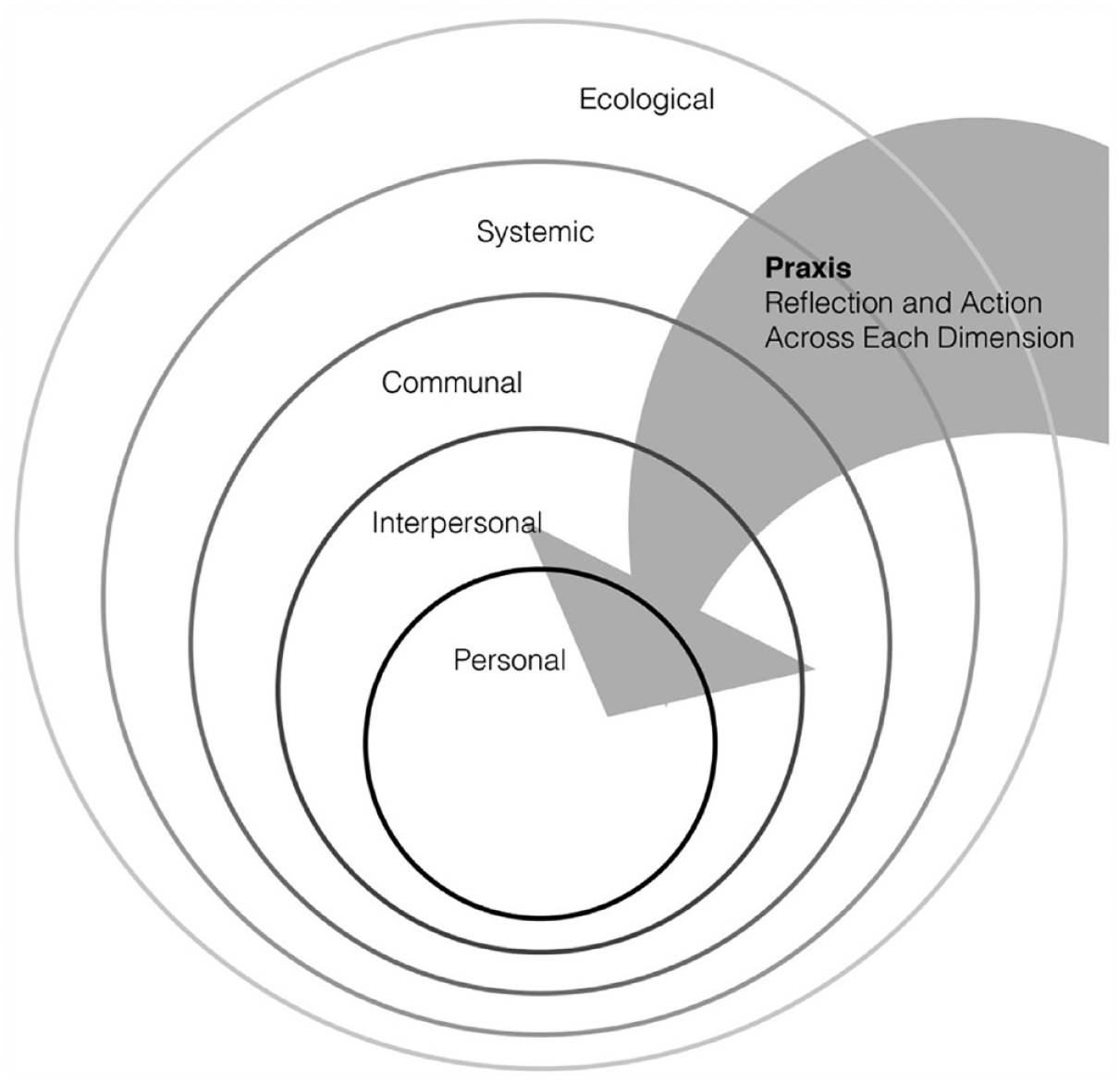
Furman’s (2012) social justice framework.
Within each dimension, praxis, or the unity of reflection and action, serves as the basis for the enactment of capacities. Furman offers praxis for social justice according to each dimension in a broad sense, of which we précis in Table 1. For the purposes of this study, we propose a supplementary column for understanding how one might consider anti-racist praxis in a similar way. Praxis for anti-racism is informed by our personal and professional experiences and insight, and through an overview of the existing literature on anti-racist practice that will be discussed throughout the findings section (Dabiri, 2021; Lane, 2010; Liebel, 2020, Okun, 2021; Pemberton, 2022; Siraj-Blatchford, 1994; Thomas, 2022).
Furman’s (2012) dimensions and praxis aligned with praxis for anti-racism.
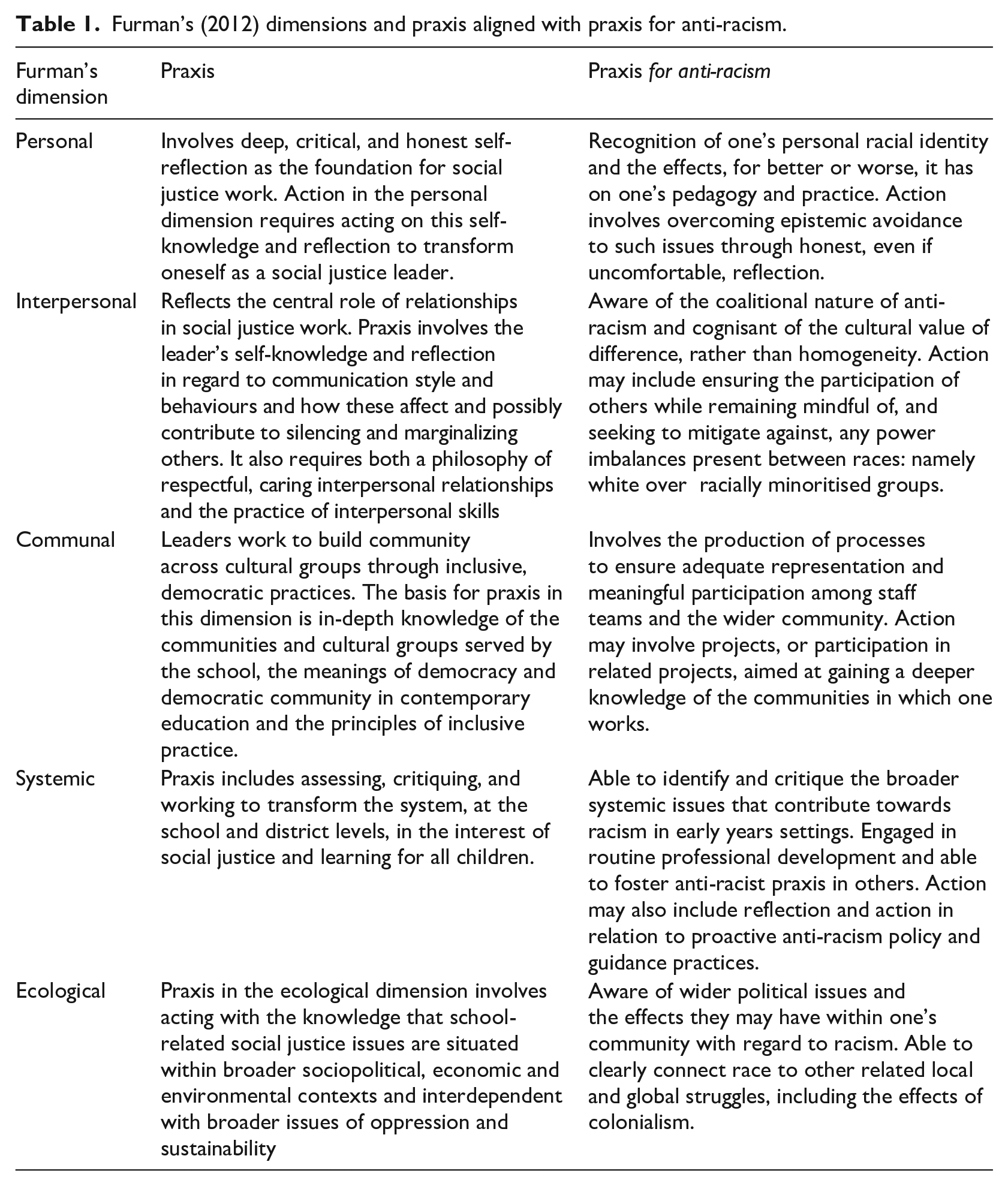
As an attempt towards more holistic thought in relation to anti-racism, Furman’s (2012) model clearly offers opportunities to apply social justice to a specific area of inequality. Such a framework in all its neatness should, however, is not without its limitations. When interpreted stripped of context, one may consider that all educators begin with personal reflection. Yet for many leaders, minoritised or not, such reflections may have shaped their entire life course, let alone their leadership journeys. The actual experience of anti-racist leadership may be much less linear; one might begin with a communal encounter that then prompts action in other dimensions. For instance, a conversation with a parent about race might spark personal reflection. Or it might be coming up against a systemic issue (being overlooked for a promotion) that serves as an impetus in the first instance.
Yet how race appears in leader’s lives raises the question of how encounters stick to some, leading to engagement in anti-racism, but not others. Furman’s theorisation points towards a conscious acknowledgement that, while helpful to an extent, risks eliding how bodies affect and are affected by other bodies in non-conscious ways (Massumi, 2015). One answer might be found in the role of ‘attunement’, which Stewart (2010: 4, emphasis our) describes as ‘an alerted sense that something is happening and an attachment to sensing out whatever it is . . . [attunement] turns a potentiality into a threshold to the real’. Applied here, the process of becoming attuned to anti-racism involves a felt registering of an encounter that might lead towards more conscious practice across different levels. Clearly, there are barriers at play. Fostering attunement involves an invitation that not all practitioners might readily accept – which returns us to the praxis identified in the personal dimension as needing to overcome epistemic avoidance to such issues. Arguably, then, while practitioners may encounter anti-racism at different levels, it is inviting practitioners to become attuned, in this case through engagement with research and interviews that the data in the following section will speak to, that may stage the conditions for praxis across multiple levels. Complicating Furman’s leadership model ultimately offers the opportunity to consider how attunements feed into openings within a leader’s existing praxis that might offer a springboard towards capacities for new practice across the whole framework. In the following section, we turn to the methodological approach for this research project before drawing attention to openings and capacities for anti-racist social justice leadership among nursery school head teachers in the UK.
Methodology
The dataset used within the article represents the second phase of an inquiry into ethnicity and the early years workforce across UK maintained nursery schools. Initially, as a part of BERA funded study (Sakr, Dujczynski and Santos Pinto, 2022), researchers sought to gather quantitative data on the ethnic representation of staff in relation to the ethnicity of the children served by MNSs, and the intersections of staff ethnicity with qualification levels and leadership responsibilities. This qualitative data was subsequently produced through interviews intended to understand what the participants of that study made of the key findings from the quantitative report. These discussions produced deep reflections on how and why ethnic inequalities are deeply embedded within the culture of career progression in the EY context. Yet they also posited openings where educators were seemingly engaged with certain dimensions of antiracist practice.
Ethical approval was obtained from redacted University prior to the process of data collection and in line with the university’s guidelines, we have addressed participants’ privacy by ensuring their anonymity and confidentiality. Wanting to avoid jeopardising our participants’ anonymity and confidentiality breach, we believe that the quotes used in this article are unidentifiable although we are aware that participants may be able to identify their own words in the quotes used.
Ethical approval was obtained prior to data collection aligned with related University guidelines. Names have been changed to ensure anonymity and maintain confidentiality. A total of 14 nursery school head teachers from across England were interviewed. Recruitment took place through an advertisement to all nursery schools followed by a social media campaign for the purpose of generating interest around the subject. It was not a requirement that the participants were racially minoritised in any way. All of the participants were women. All of the participants were highly experienced in working in EY and particularly in nursery schools, and all had Qualified Teacher Status (QTS). We did not collect data on the precise locations of participants, though it is worth noting that MNS are much more likely to be located in more deprived areas than other forms of early years provision. Interviews were conducted online and lasted between 20 and 40 minutes. They were semi-structured in style, enabling some control over the focus of the interview while enabling space for participants to elaborate and reflect on issues that they felt were important. The following findings from the initial quantitative study were discussed (Sakr, Dujczynski and Santos Pinto, 2022):
Lack of diversity among the nursery school workforce with higher qualifications, particularly QTS.
Lack of diversity among nursery school senior leaders, compared with middle leaders and educators without a formal leadership responsibility.
Lack of ethnic representation in the nursery school workforce compared with the communities served.
Initial data analysis produced a number of key themes worthy of discussion in their own right: issues of struggle and resistance; unconscious bias, cultural prejudice and deficit thinking; recruitment, selection and progression; and openings towards a more holistic anti-racist framework for change. In this article, we focus on the latter issue, working through Furman’s model to present and discuss findings that might serve as reflective cases for leaders to embed anti-racism through praxis.
Analysis is not a neutral process (MacLure, 2013). Hence it is of note that the data was predominantly analysed by SB. As with their analytical approach elsewhere (Tembo, 2020), it is necessary to acknowledge that they themselves will have been somewhat, affectively, attuned to the encounters presented here – by virtue of their own experiences as a former early years practitioner and current early years academic concerned with anti-racist practice. In lieu of feigning objectivity, then, SB acknowledges the necessarily relational nature of research inquiry whereby they hold themselves ethically accountable for what is produced (Barad, 2007). The data in the following section will speak to the nature of encounters that might set in motion capacities for anti-racism. Quotes are shared at length to enable readers a full view of the insights given by leaders (Fina and Georgakopoulou, 2015). We share moments where an attunement has occurred in relation to each domain, serving as springboards to produce capacities for reflection and action.
Findings
Encounters in the personal dimension
Leaders who shared reflections in the personal domain demonstrated a capacity to understand how their racial identity has shaped their career trajectory and consider how certain encounters in their life course have affected their understanding of race. This is identified within the literature as essential to developing racial awareness – even if uncomfortable (Frankenberg, 1994; Leonardo, 2005; Okun, 2021; Pemberton, 2022). As Ashley is able to reflect on below, their racial identity has clearly shaped opportunities for career development:
Despite being ready to be a head teacher from aged 30 I didn’t get there until 49. That’s 19 years of me knowing I was more than ready to do this job and I could do it and I could do it well. The journey. . . I’m 62 now. I kept being told ‘oh you’re too young’ at aged 40 plus. Why am I too young? Or they didn’t realise I was in my 40s, and they said they will give someone else a chance as they are older than you and won’t get an opportunity. Despite me being more qualified than this person. When I moved to my area, I was asked to go and interview for a role to be a substitute for a year to help gain experience when I went there, I was just a paper exercise as I was told once again that I was not a good fit. There was no other reason other than not being a good fit. And I had recently had an opportunity to go to the same school and the same thing happened again. That was 20 years ago and 19 years later, I was still not a good fit in the same school to be an executive leadership role. I was proven in headship, the person who was employed for that role didn’t have my experience and qualifications and was just a teacher in the school so no leadership experience and was promoted in emergency. It’s challenging, there’s some areas that I wouldn’t even try to apply for because I know I wouldn’t get the job. There are some areas that are blocked for people of colour you know I wouldn’t even think to go to some areas as a person of colour I know I have to stay in a city (p.1-2)
What Ashley speaks to here is a routine self-consciousness of how their racial identity has shown up in various encounters to prohibit career development (I kept being told ‘oh you’re too young’, ‘I was just a paper exercise’), at the same time as offering a systemic account of race in wider society (There are some areas that are blocked for people of colour). This account clearly contrasts with the experiences of those for whom issues of race have not had an affect on their experiences – either explicitly or otherwise. Attention to the personal dimension is also given within Charlie’s account, who shares a personally transformative moment in their own understanding of how race shapes one’s sense of community:
maybe because of the area I’m in, I mean maybe that makes a difference actually. I’m not in an area that’s particularly cosmopolitan or anything like that. I used to work in Northampton town centre and I had a gorgeous family. Dad was White British; mum was White Polish and they moved from London to Northampton. And they stayed a year and the mum said to me afterwards, ‘I just feel like it’s really racist’. I hadn’t sort of, even considered it but she’d moved from London to Northampton. And that mindset wasn’t. . . it wasn’t as cosmopolitan and people still put people into groups rather than mingling (p.28)
In this account, a previous encounter is shared that forces a transformative thought where Charlie is becoming attuned to racial difference (‘maybe that makes a difference actually’, ‘I hadn’t sort of, even considered it’). This is potentially powerful as it signals an overcoming of epistemic avoidance towards awareness of how another’s life experience has been shaped by race. Charlie’s comments further straddle the line between the personal and interpersonal dimensions as it demonstrates consciousness beyond one’s individual self. On the basis of both of these encounters, it is possible to propose some capacities for anti-racist reflection in the personal domain:
Leaders may reflect back on their life histories and consider the extent to which race has featured prominently or not, in more or less advantageous ways – even if potentially uncomfortable.
Leaders might reflect back on encounters with others to consider how such events may have been shaped through race.
Such reflections, as Furman (2012) identifies in her social justice model, must then produce action towards structured personal development. This could take the form of reflective journalling of one’s ongoing experiences or a leadership growth plan that may include further areas for exploration in relation to one’s personal identity. Although this level of action was not present within the interview data, the initial accounts suggest that both practitioners might be suitably attuned to engage in such a process.
Encounters in the interpersonal dimension
Praxis for anti-racism in the interpersonal domain necessitates an attunement towards the coalitional nature of anti-racism (Dabiri, 2021). It asks practitioners to become cognisant of the cultural value of difference, rather than homogeneity and/or assimilationist ways of knowing (Liebel, 2020; Siraj-Blatchford, 1994) and grasp any imbalances of power that may exist between racial groups (Sakr, Dujczynski and Santos Pinto, 2022). Across the interview data, a number of comments were made regarding the representational value of colleagues within their staff teams:
It just makes the community so much richer and you can talk as a staff from a viewpoint of having collective knowledge, because you’ve had those discussions. So, if you’ve got somebody that knows about celebrating a range of Indian festivals, rather than the one that schools are always, ‘Oh, it’s Diwali, fantastic,’ and she’s like, ‘But there are other much more important festivals.’ So, [Children] have to have some we call Agnieszka because she can speak to them in their home language. Immediately you see a child thinks kind of wow, this is somebody that knows what I’m talking about which is amazing . . . And you do see the children’s eyes light up when they hear something being said in their language, it makes a big difference. I would love to have more staff like that.
Difference is valued in a number of ways across these accounts, from fostering ‘collective knowledge’, encouraging ‘language diversity’ and importantly supporting the child’s own sense of self – ‘the children’s eyes light up when they hear something being said in their language’. For leaders, drawing on the value of other’s skills and experiences can therefore be a significant strategy in promoting anti-racist practice. However, there is a need to be mindful of essentialism (Lynn and Dixson, 2013). As Sam perceptively notes in their reflection:
As Tembo (2020) has noted elsewhere, while it is clear that not all minoritised educators can or should serve as perfect role models for minoritised children, pragmatically there is certainly some utility in this approach. In terms of capacities for reflection and action that may be teased out from these accounts, then, the former may include:
Leaders may proactively seek to understand the nature of cultural difference among staff teams and the children within their settings.
Leaders may consider the extent to which the cultural practices within the setting are sensitive to the cultural backgrounds of colleagues, children and families within the setting and further afield.
As capacities for action in the interpersonal domain, leaders might consider the extent to which a range of voices can be meaningfully included in discussions towards anti-racism without unduly placing a burden upon them. Another useful action may be holding space to speak with colleagues about their backgrounds and offering opportunities to share their expertise on cultural issues that others may not be au fait with. This may then support any amendments in practice with children. The interpersonal domain may also involve working with colleagues to support their own personal attunement towards issues around race and racism, particularly for those who may appear reticent to engage or, worse, harbour actively racist views (see communal dimension next). Ultimately, supporting practitioners to remain mindful that racism harms everyone, and becoming attuned towards an equitably shared understanding of anti-racism within the setting through these interpersonal reflections and actions could harbour fruitful returns that mitigate against assimilationist processes.
The communal dimension
Closely aligned to the interpersonal dimension, the communal dimension builds upon the development of knowledge of others towards embedding racism across the community. As Lane (2010) notes, without the promotion of cohesion within communities, potential ignorance has a tendency to grow into suspicion and fear between cultural groups. Praxis therefore may involve working with parents and carers and developing an awareness of the particular needs of the local community, as these accounts speak to:
We’ve got quite a diverse community of children and we’re always very mindful in adverts to put that we would like to reflect our community of children and, actually, in terms of teachers. we’d like to I think that representation really matters, I think we see in our community both, that it’s quite inspiring for parents from ethnic minority background to see other people from their community doing really well. We also see massive advantages in terms of the sort of cultural competence, the understanding of the issues that children and families might face, the multilingualism.
Through recruitment practices and inviting parents and carers into the setting to contribute their skills to enhance practice, these accounts reveal the ways in which leaders may build and sustain a clear sense of community. These actions may go some way towards mitigating racial prejudice and discrimination. Data gathering practices are also acknowledged as potentially fruitful within this dimension to better become attuned to the views of colleagues and the wider community – aligned with the broader scholarship on practitioner enquiry and action research (Hall and Wall, 2019). The role of surveys is discussed by Ash:
I did a
This encounter offers salient insight into racism brought to the foreground of attention through data-gathering practices. The anonymous nature of the survey responses has enabled the leader to become clearly attuned towards the views of others within the setting and the subsequent actions of staff tailing off from these views (‘I had people who had left when they realised I was not going anywhere’). It is worth questioning whether such a view goes against the grain whereby most practitioners would not harbour explicitly racist perspectives of this kind; or whether it represents the tip of an iceberg to which other equally racist but less explicit views are held by other staff. In any case, this underlines the value of data gathering as a means to become to the communal dimensions of anti-racism. To pull out some possible capacities for reflection from across these accounts:
Leaders may consider the extent to which the wider community is involved in the practices of the setting for the purpose of fostering positive and anti-racist cultural relations.
Leaders may engage in data gathering to better grasp the views and needs of both colleagues and those in the wider community.
As capacities for action, leaders might take steps to ensure that a range of cultural groups are actively included in the practices of the setting – particularly seeking participation from groups who appear less engaged. Thinking both ways, leaders may encourage settings to venture out into the community where positive relationships and a strong sense of belonging might be fostered between children, families, colleagues and their neighbourhood.
The systemic dimension
Praxis within the systemic dimension can be said to involve an ability to identify and critique the broader systemic issues that contribute towards racism in early years settings. Leaders are expected to be engaged in routine professional development and able to foster anti-racist praxis in others, as well as begin to develop clear policy and guidance documents that challenge racism. It is regrettable that the latter of these was absent within the data gathered, especially since it is widely identified as important means to formalise practice and ensure consistency across staff teams (Lane, 2010). However, when asked about recruitment practices, leaders did demonstrate that they were well attuned to the systemic issues present within the sector:
It’s hard to recruit anyone at the moment, to be quite honest, into early years settings. And I’ll say that across the sector. There is a recruitment crisis. It’s really difficult to get staff in because it’s not a great-paid job, it’s really hard work, and you can get more being paid, actually, now working in Lidl. So, that’s one reason. For the past 12 years or so we’ve had the sword of Damocles hanging over us in terms of funding, are we even going to exist? I think it’s important to raise the status of the early years, generally, in the public, political, whatever, right across the thing. So, it’s not just seen as child minding day-care, low-status job. Because I think, in other countries, especially in the Scandinavian countries and places, where it has a higher status and it’s a more valued job, then it’s going to be more attractive to everybody to go into it . . . just generally, the UK sector’s not valued, and it’s not well organized in terms of career progression and all the rest of it, so I think all of those things would make a difference and make it easier for people to get into it, and progress within it
Across each, challenges with recruitment and status are noted, albeit implicitly, as precursive barriers to developing more inclusive recruitment practices. The status of the early years profession is becoming an increasingly discussed issue within the public domain, alongside the basic challenges for leaders in ensuring that their settings are adequately funded. For Maya this reflection compels the need for action:
I think we need to talk about what the
An attunement towards transforming the culture of the organisation offers some synergy with the communal dimension but goes further in seeking to identify strategies for change. Shifting organisational culture towards becoming actively-racist requires long-term planning (‘I have quite a lot of opinions about how we can work on it over time’) and must identify and critique the barriers in place that may prevent this. One barrier, as Maya suggests, might be the overall governance of the settings:
We’re looking at our anti-racism practices and making sure that even amongst our governors, that we are making sure that we’ve got a variety of ethnicities, so that we have representation for all the children
Though this comment primarily speaks in terms of representation, it does at least signal an awareness of the broader factors that may enable or constrain anti-racist leadership that may lead to systemic change. In terms of developing capacities for reflection within the systemic dimension, then:
Leaders may demonstrate an awareness of the broader systemic issues facing their settings that may serve as barriers to anti-racist practice. Importantly they must be able to critique these issues where appropriate and consider strategies for change.
Leaders may consider opportunities and barriers at a governance and organisational level to embed anti-racist practices throughout the organisation, leading to more sustained and long-term change.
Leaders may consider their existing policies and practices with a view to ensuring their relevance for anti-racism within the setting.
As capacities for action, it is feasible that leaders might come to offer a more prominent voice on sector-related issues and put in place clear strategies, or what Furman (2012) refers to as ‘activist action plans’, towards systemic changes with identifiable goals and appropriate timelines. Further, tied in with the communal dimension, leaders may facilitate the development of policy and practice with participation from a variety of cultural groups and members across the organisation – including at the level of governance.
The ecological dimension
Finally, the ecological dimension necessitates an attunement to wider political issues and the effects they may have within one’s community with regard to racism. Leaders should be able to clearly connect race to other related local and global struggles, such as within later education or in terms of intersections with other areas inequality. This was visible across several of the interviews:
It’s a
These first two encounters accurately identify the myth of meritocracy within society where it is thought that one may achieve through individual effort alone (Bhopal, 2018). Rather, it is acknowledged that ‘the world is not fair’ and that structural inequalities hamper efforts towards anti-racism in terms of who is seen as, and who is able to, assume the position of an early years worker. Such claims can be well supported by research on perceptions of Black and minoritised people as less intelligent compared to their white counterparts (Gillborn, 2016), and through research on the awarding gaps for universities (Universities UK, 2022). Specifically within the early years, the perceptions of what sorts of people can take up teaching roles is well attuned to by Mara:
There are many
Overall, each of these reflections denote a broader attunement to connecting the issues within the early years outwards. On these terms, a capacity for reflection may include:
Leaders may reflect on effects of ecological issues at a global level and consider their implications as filter down through to matters of anti-racist social justice leadership. This may include reflections on the historically-present affects of colonialism as they appear through cultural norms and habits (Okun, 2021), and fixed ways of being and relating with others.
As actions, Furman’s writes of the need to develop skills to educate others on ecological matters related to social justice. Here, this action extends beyond ensuring others are including and listened to as in previous domains. Instead, it asks leaders to be able to foster capacities for anti-racist leadership in others and ensure that an understanding of anti-racism with colleagues and peers can be connected to other interrelated struggles.
Coda
This article has sought to set in motion a framework for anti-racist social leadership specifically within the early years profession. By thinking-with the data, whereby educators have demonstrated an attunement towards the five dimensions identified by Furman, we have shed light on how such reflections might align more broadly with a holistic framework inclusive of both reflection and action. Our data reveals that, in different ways, leaders are already cognisant of the need to engage in anti-racist social justice leadership. The challenge remains, then, to further sustain these attunements across all dimensions. We acknowledge the scope of the paper insofar as views are only gathered from a select number of leaders in MNS rather than across the early years sector. We also remain mindful that a greater knowledge of the geographical locations of participants may have offered another line of inquiry. Future research might consider this avenue. Nonetheless, it is our intention that this framework be used to provide all early years leaders with a more structured way of grasping how to implement anti-racist praxis. We remain mindful of the traps of rigidity when applying frameworks in practice – leaders should draw on their own experiences and demonstrate creativity in moments where praxis can be developed further beyond the reflections and actions identified. It is regrettably well outside the scope of this paper to note every single act of reflection and action in each domain – hence we ask that any critique creates, that it asks the question of what else might be possible through this framework. We would also stress that any engagement with this framework be ongoing, rather treated as a linear process. One does not ‘complete’ anti-racism having reached the ecological dimension, rather this is a continual cycle through which leaders can re-engage at different times to reflect changing contexts. Ultimately, given the urgency of anti-racist praxis in early childhood, we are hopeful that this paper offers a venture point for those keen to develop anti-racist praxis.
