



Abstract
Teacher-facilitation of play is proposed as an effective method for supporting early literacy learning, however, educators remain uncertain how to balance child-autonomy in play while also directing play toward explicit academic objectives. In response, this study sought to understand how kindergarten teachers can successfully facilitate play to support early literacy development. Classroom observations and semistructured interviews were gathered and qualitatively analyzed to identify key perspectives and classroom practices that lead to the educators’ successful facilitation of play to support literacy. Results of this study showed how different core literacy skills can be supported through different types of play, with each offering unique and critical opportunities for learning. Results also demonstrated how a multitude of core literacy skills can be supported through guided approaches to play, and begin to illustrate how teachers are facilitating a continuum of guided play to support literacy learning.
Literacy development is a fundamental goal of early years education (Oberhuemer, 2005; Sverdlov et al., 2014) that is necessary to future academic learning (Duncan et al., 2007). To support literacy development, kindergarten programs world-wide endorse (Lynch, 2015; Tafa, 2008), and even mandate (Ontario Ministry of Education, 2016), play-based learning as a leading pedagogical approach. While the notion that children learn through play has been widely accepted for years (Piaget, 1951; Vukelich, 1993), the focus on what children learn through play has evolved over the past decade. Historically, play was believed to support children’s developmental learning (e.g. social), while contemporary views of play include a focus on children’s academic learning (Pyle et al., 2017). Specifically, current research proposes teacher-facilitated play as an effective approach for supporting children’s early academic learning, including literacy development (Goble and Pianta, 2017; Jensen et al., 2021; Weisberg et al., 2013). However, some educators remain uncertain how to collaborate with children while directing play toward targeted literacy skills (Pyle et al., 2018a). Therefore, the objective of the current study is to identify kindergarten teachers’ perspectives and practices that lead to the successful facilitation of play to support literacy learning.
Core literacy skills in kindergarten
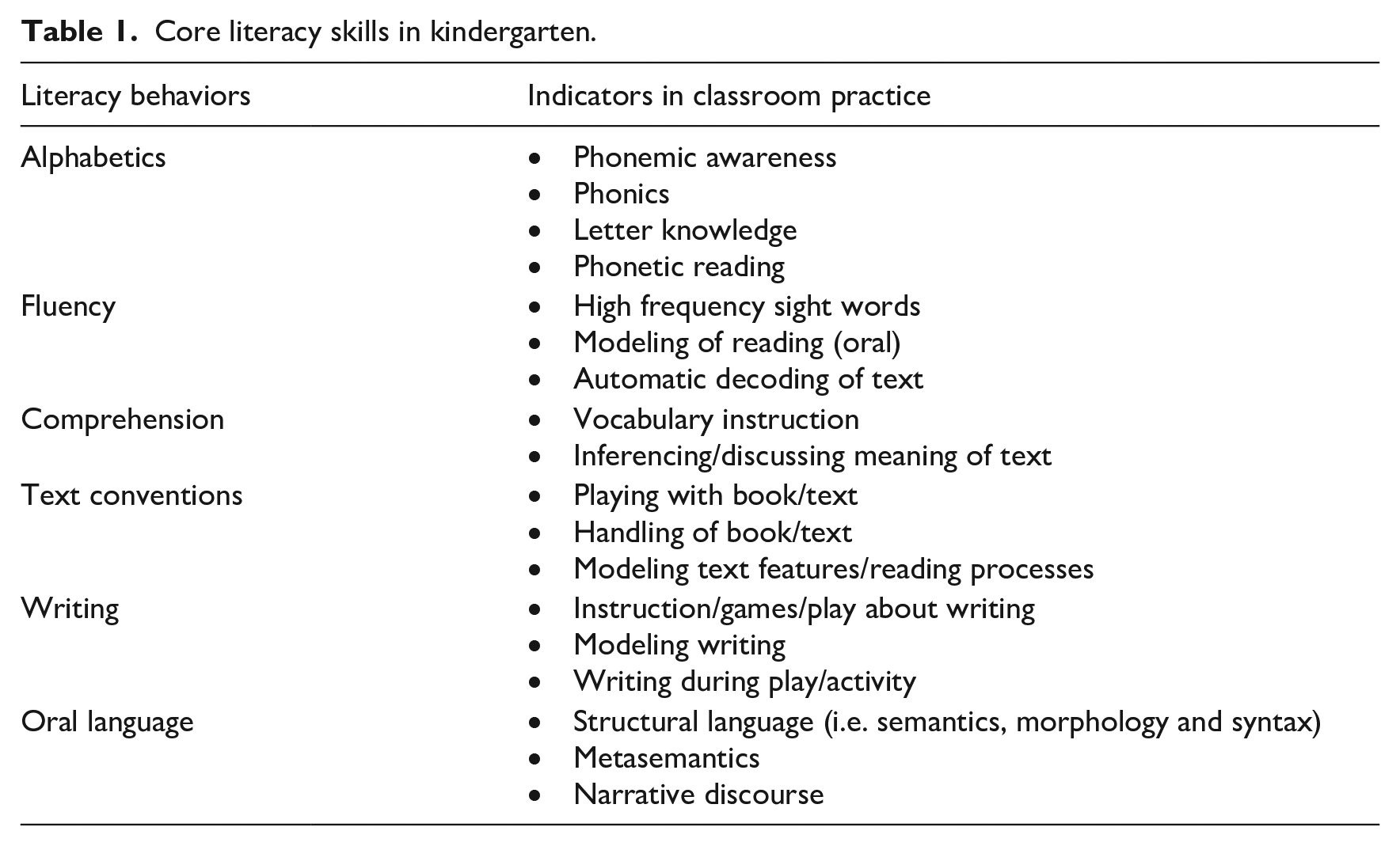
Literacy is a complex concept with many definitions. It is how we communicate ideas and understand messages, requiring the learning of both meaning making and foundational skills (Brownell, 2023; Pyle et al., 2018b). Throughout this paper we adopt a complex definition of literacy that encompasses both social interactions that promote literacy development and the foundational skills that support children’s ability to decode and encode written text. The early development of these literacy skills is imperative, as these skills are predictive of children’s future literacy achievements (Duncan et al., 2007). Gaps in these areas must be addressed early as challenges in early literacy development affect achievement in later grades (D’Agostino and Rodgers, 2017). The National Reading Panel (NRP, 2000) identified three foundational literacy skills. The first is Alphabetics, which includes alphabet knowledge (knowledge of the names and sounds of letters; Pyle et al., 2018b), phonemic awareness, (ability to isolate and manipulate phonemes in spoken words; NRP, 2000), and phonics, (ability to make grapheme to phoneme correspondences in order to decode and spell words; NRP, 2000). Second is Fluency; the ability to read text with speed, accuracy, and expression (NRP, 2000). Fluency is built upon word recognition skills that contributes to an individual becoming a skilled reader (NRP, 2000). Third is Comprehension; the ability to understand text and vocabulary, often viewed as the “essence of reading” (NRP, 2000). Pyle et al. (2018a) added onto NRP’s (2000) framework with two other fundamental literacy skills: Writing and Text Conventions, each uniquely contributing to literacy development.
According to the oral language framework adopted by Roth et al. (2002), three components of oral language also contribute to literacy development and are predictive of later literacy achievement (Elliot and Olliff, 2008); Structural Language; semantics, morphology, and syntax, Metasemantics; the ability to manipulate the meaning of words, phrases, and sentences and the ability to understand non-literal language (e.g. similes and proverbs) and, Narrative Discourse; familiar story production and story comprehension. Systematic instruction of these skills is essential, but as previous literature has described, this learning can, and many would argue should, be accomplished through developmentally appropriate practices, such as play (the use of songs to teach rhyming and phoneme substitution; acting out stories to build comprehension; Wohlwend, 2023).
Play-based learning
Play, and play-based learning, have long been essential components of early learning (Jenvey and Jenvey, 2002; Wallerstedt and Pramling, 2012). Here, we differentiate play-based learning as a pedagogical approach, whereby children learn academic and socioemotional skills through play (Pyle et al., 2017). In doing so, we take a constructivist perspective toward learning and play, espousing the view that children actively build knowledge as they engage with their environment, including interactions with peers and adults (Vygotsky, 1978).
While historical views of play largely describe child-directed free play, contemporary notions of play align with constructivist views endorsing adult involvement (Roskos and Christie, 2011; Weisberg et al., 2013, 2016). Specifically, Pyle and Danniels (2017) describe play as a continuum ranging in level of child and adult direction. While their original continuum outlines five types of play, this continuum is commonly condensed into three approaches (Pyle et al., 2020). Free Play is entirely directed by children with little to no adult involvement, often involving pretend or sociodramatic play. Teacher-Directed Play involves games with specific objectives that are initiated and monitored by the educator. In Guided Play, direction, or control, over the play is shared between children and educators.
Teacher-facilitated play
Guided play resides in the middle of the Play-Based Learning Continuum (Pyle and Danniels, 2017), consisting of two key elements: child autonomy and adult guidance (Weisberg et al., 2016), which make the play engaging, joyful, and meaningful to the child (Zosh et al., 2018) while enabling the teacher to focus children’s learning on targeted goals (Jensen et al., 2021; Weisberg et al., 2013; Zosh et al., 2018).
In the classroom, guided play can take many forms. Adults can design a play context to focus on a particular learning goal and allow children to freely explore within that context, or, adults can observe child-directed play then extend children’s play through commenting, questioning, and encouragement (Jensen et al., 2021; Weisberg et al., 2016). While growing evidence shows guided play’s suitability for children’s socioemotional learning, such as self-regulation (Cavanaugh et al., 2017; Pyle et al., 2022), it is most prominently touted as an optimal pedagogy for academic learning (Fisher et al., 2013; Jensen et al., 2021; Weisberg et al., 2013). Studies have demonstrated that children who learn about geometric shapes through guided play acquire more shape knowledge than children who learn through either free play or direct instruction (Fisher et al., 2013), that guided play can effectively introduce science concepts (Sliogeris and Almeida, 2019), and that parents and children engage in more math talk during guided play than unguided play (Eason and Ramani, 2020).
When specifically considering the relationship between guided play and literacy development, research indicates that teachers’ engagement in play positively relates to children’s language and literacy learning, including vocabulary, print knowledge, and phonological awareness (Goble and Pianta, 2017). Similarly, an experimental study by Cavanaugh et al. (2017) demonstrated that children who learned about initial letter sounds and consonant-vowel-consonant rhyming words through guided play scored statistically significantly higher on measures of early literacy skills than children who learned through a teacher-directed activity. Experimental design has been a common and effective method for understanding the positive relationship between guided play and literacy learning (Cavanaugh et al., 2017), however, when looking at the enactment of teacher-facilitated play to support literacy learning in the classroom, there is less research to draw from, with some exceptions. For example, Strauss and Bipath (2020) found that guided play promotes children’s classroom engagement and attention to orthographic and grapho-phonemic features of words, while also allowing the teacher to pace instruction and assess word recognition skills.
Despite the current emphasis on guided play to support academic development (Jensen et al., 2021), much of the existing research comes from experimental studies (Cavanaguh et al., 2017; Fisher et al., 2013). While this knowledge is essential to understanding the relationship between guided play and child outcomes, limited research exists that examines the implementation of guided play and literacy at the classroom level. This lack of classroom-based data, coupled with teachers’ uncertainty directing play toward targeted literacy skills (Pyle et al., 2018a), signals a need to examine the integration of guided play and literacy in classrooms. In response, this study aims to identify approaches teachers are implementing to successfully facilitate play to support kindergarten children’s literacy development.
Method
Participants
Participants for this study included 31 teachers, from two public school districts and one independent school in Ontario, Canada. Ontario is an ideal context for this research as it mandates play-based learning and its kindergarten curriculum includes explicit literacy goals that align with the six core literacy skills (Table 1). Recruited participants were teaching kindergarten, expressed an interest and willingness to participate, and displayed a range of demographic diversity (SES, rural/urban communities, diverse student populations, teaching experience). Ethical review boards from two universities, two public school districts, and one independent school granted clearance for this study. Written consent was received from the 31 participating teachers and children’s parents before commencing data collection.
Core literacy skills in kindergarten.
Data collection
Qualitative inquiry was used to explore how teachers facilitated play to support literacy development through classroom observations and semi-structured interviews. Observations included video recordings, photos, and field notes and were conducted using a running record protocol (Patton, 2014). Specifically, observations focused on teachers’ instructional practices, including a range of play-based activities (i.e. free, guided, and teacher-directed play) as well as other pedagogical approaches to literacy instruction (e.g. story time, whole group discussions, explicit instruction).
Semi-structured interviews (Patton, 2014) elicited teachers’ perspectives regarding the role of play in children’s academic learning, adult’s role in play, and approaches to supporting literacy development in play. The interviews lasted approximately 1 hour, were audio recorded, and transcribed verbatim.
Data analysis
Data analysis began with a deductive analysis of the observational data to identify teacher’s approaches to literacy instruction, implementation of play, and the facilitation of literacy learning in play. Next, an inductive analysis of the interview data was conducted to identify teachers’ perspectives toward play, adult’s role in play, and literacy development in kindergarten. Data were coded by three research assistants, who met bi-weekly to compare codes and resolve any discrepancies through discussion.
Deductive coding of observational data
All observational data (videos, photos, field notes) were deductively coded (Patton, 2014) for: (1) the frequency of six core literacy skills, (2) the frequency and type of play, and (3) play-facilitation approaches to support literacy learning.
First, observational data were deductively coded to identify all instances of literacy learning and instruction. Coding was guided by the six core kindergarten literacy skills, and their indicators in classroom practice (Table 1; NRP, 2000; Pyle et al., 2018a; Roth et al., 2002). The frequency of the six core literacy skills was based upon the number of incidences that were observed across all classes, as well as the number of classrooms where the skills were observed.
Next, videos of literacy learning were deductively coded to identify the type of play (i.e. free, guided, or teacher-directed play), guided by Pyle and Danniels’ (2017) Continuum of Play-Based Learning, which is an accepted method for identifying and categorizing instances of play in classroom-based research (Pyle et al., 2020; Wickstrom et al., 2019). Only videos of play and literacy were kept for further analysis. All videos of literacy learning occurring through other modes of instruction (e.g. direct instruction) were excluded from the analysis as the aim of the present study was to understand how educators facilitate play to support literacy learning. The frequency of play type was determined by the number of incidences of play observed across all classrooms, and the number of classrooms in which the play types were observed. One classroom did not exhibit any play supporting literacy learning and was therefore removed from analysis, resulting in a total of 30 classrooms.
Lastly, the frequency data that was generated from the deductive coding was used to develop three initial play-facilitation approaches: using teacher-directed play to target literacy skills, joining play to extend it toward literacy goals, and questioning children about their play to support oral language development. These three initial play-facilitation approaches were further refined by triangulating interview data.
Inductive coding of interview data
Following the deductive coding of the observational data, an inductive analysis (Patton, 2014) was conducted using all 30 semi-structured interview transcripts. First, each teachers’ transcript was open-coded line-by-line, to conduct a within-case analysis of teachers’ perspectives regarding play and literacy (Patton, 2014). Next, using a method of constant comparison, a cross-case analysis was conducted to identify commonalities and patterns regarding perspectives of play and literacy across all participating teachers. This inductive analysis provided greater clarity to the three initial play-facilitation approaches generated from the observational data, resulting in the expansion to four approaches: free play, transitioning free play to guided play, teacher directed play, transitioning teacher directed play to guided play.
Results
The results of this study describe how different literacy skills are supported within different play contexts. More so, the results paint a picture of how educators are beginning to transition both free and teacher-directed play toward guided play, as a method of balancing child-autonomy and teacher-facilitation of literacy learning. A multitude of core literacy skills were observed within guided play, illustrating the rich literacy learning potential of this context (Figure 1).
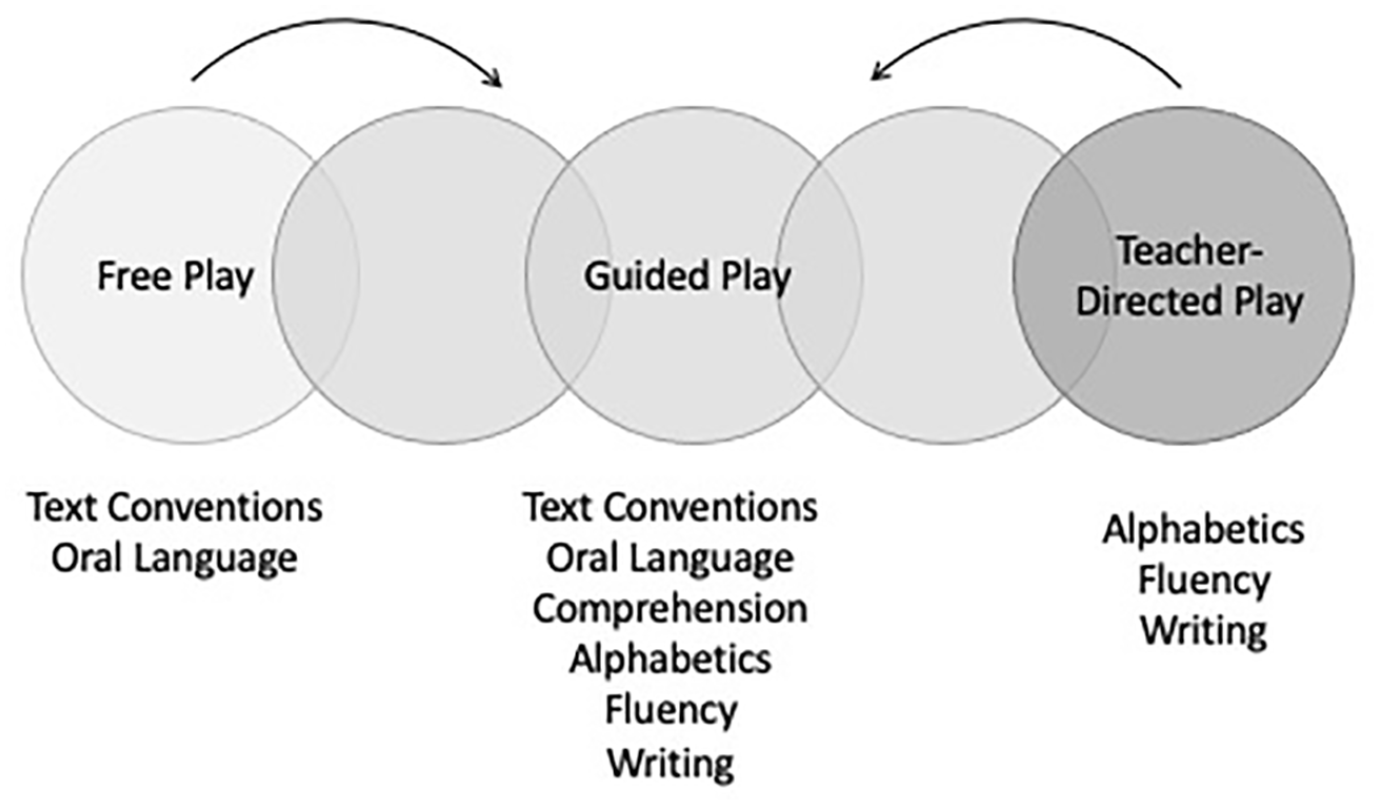
Integrating core literacy skills across play contexts.
Free play
Educators described intentionally creating environments to inspire literacy behaviors during free play. This was the most common strategy, occurring 187 times across 29 classrooms, accounting for 61% of all observations of teacher-facilitation of literacy learning in play. During free play only text conventions (40 times across 13 classrooms) and oral language (147 times across 29 classrooms) were observed. Oral language in free play account for 49% of all the instances of teacher-facilitation of literacy in play, making it by far the most commonly observed literacy skill supported through play.
Educators created play contexts by providing materials that reflected student interests and classroom inquiries. For example, Teacher 30 connected the toys available during free play to subject matter they were discussing as a class: [There’s] intentionality. In the block area, we’ve been talking about animals and how they get ready for winter, we’ll put some animals there and books. I’m very big on picture books and having them as part of the setup. So that literacy is embedded in there, but it also can spark some ideas for them.
Embedding picture books was a common method for supporting children’s practicing of text conventions in free play: When they’re at the reading center and they’re looking at books, to me that’s still play in the eyes of a four-year old. They may not be reading words but they’re looking at the pictures and they’re storytelling. And I think that will help them later, when it’s time to read, or in their writing. (Teacher 30)
A clear example of this was observed in Class 1 when three students were sitting on a couch looking at a book together during free play. Two students pointed to images in the book and the other turned the pages. The student who was turning the pages stopped, looked at the page, pointed to the image, and realized that it was a picture of the book they were currently exploring. The student exclaimed, “That’s the same book!” Another student acknowledged this connection by saying, “Oh, yeah!”
Teachers also commonly shared the perspective that oral language was best developed through opportunities that allowed for narrative discourse, sharing that free play provided children with an opportunity to explore their interests, act out roles, and dialogue with their peers: They’re using language that they wouldn’t necessarily otherwise use, but they’re doing it in a context of play. Last year, our kids were super into space, so we turned our dramatic center into a shuttle. . . and they were saying, “I’m going to Jupiter” and “don’t forget the engines!” . . . they may not know those words but because we incorporated it into their play, and especially dramatic play, that’s the best area to do these things. (Teacher 28)
Opportunities to engage in dramatic play and dialogue were commonly observed in the drama and block centers. Children would create structures and use small figurines to act out different scenarios. For example, during free play, three students in Class 1 were observed playing with animal figurines and wooden blocks:
I’m gonna be, I’m an elk. I’m a bison.
Ok, I’m gonna be a grizzly bear.
You know, a bison and an elk are the same thing?
Bison and an elk!
The bison. They’re the widest.
Can we be? Can we be on the same [team]?
Yep.
Can I be on the same team?
Sure. But you can be on the same team with the bear.
Oh! [speaking to the bear]. You eat the elk and you get very very full.
In this example, the students discussed the animals, chose their figurines, and acted out characters by moving their animal figurines as if they were walking on the wooden blocks. As the play evolved, various students were observed entering and exiting this play context by building structures and acting out different roles with their animals. Each child that joined the play added to the narrative discourse, by saying things like “where’s the secret hideout?” or “here’s more food!” In this example, the narrative discourse was driven by the children and the educator remained uninvolved in the play.
If students were not independently engaging in narrative discourse, however, educators joined the play to initiate dialogue and support oral language development: I’m kind of pushing them to come up with different sorts of answers. . . I have this background in oral language from working with KELI [Kindergarten Early Language Intervention program]. I push them when they give me an answer, often I’ll say to them “tell me more.” (Teacher 10)
Teacher 21 demonstrated this technique by joining a child engaged in solitary free play with Lego. The educator approached the student to discuss the creation, asking prompting questions such as: “How do you know it’s a crane, [Child’s Name]? What does a crane do? What do you want to lift up with your crane? [Child says “boat”] So where is your boat? Let’s make a boat.” The educator encouraged the student to use oral communication to make personal connections by asking, “Does your family have a boat? Do you go and play on the water?” In this example, the teacher facilitated oral language in free play through conversation, questioning, and encouraging the student to make personal connections.
Educators described the development of oral language in free play as building the foundation for more complex literacy skills: “those kind of experiences help them along with the oral language, and if the oral language is not there, you can’t put print to it” (Teacher 20). In order to “put print to it” educators actively extended play toward more advanced literacy skills.
Transitioning free play into guided play
In order to extend children’s literacy learning, teachers observed children’s free play, identified opportunities to guide the play, and then joined to facilitate the implementation of literacy skills. Transitioning free play into guided play was observed 22 times in 4 classrooms. This approach allowed educators to respect children’s autonomy while guiding play toward targeted literacy skills. Only in guided play were educators observed to support all six core literacy skills. Teacher 27 illustrated this guided technique by co-creating a doctor’s office with her students, expanding the range of literacy skills the children were practicing: That’s also part of interest in the way their bodies work. . .they were [talking about] their skeleton and their skulls and they were tapping on their bones and I came and had a conversation with them about that. And then they said, ‘can we bring some books about our bodies into the class?’ Absolutely. . .We did a little brainstorming [about what goes in a doctor’s office]. It’s on the window. We talked about it. Some of the children drew some pictures and wrote some words about what we may see at a doctor’s office. . .I find that we’re very intentional in what we put on paper as that can lead to further discussions. . . So, use some symbols as well, just to see how that learning is connected. And there’s some pictures that show people with different aches in their bodies. We use some symbolic representation as well because that really connects to some of the learning we have done prior. (Teacher 27)
Many core literacy skills were observed within this play context. Books about the human body were placed in the office, supporting the development of text conventions through book handling. One student chose a book and said to the other students, “Read this book, read this book! It’s about bodies. Let’s see what’s inside a body!” Various materials were provided, including masks, first aid kits, telephones, and clipboards, which were stored in labeled bins. The educator encouraged students to refer to the labels when returning items during play, which promoted reading. Students took on various roles at the doctor’s office, including doctor, patient, and receptionist. The educator encouraged the development of oral language skills by participating in play to model these various roles. During one observation, the educator asked a student, “Are you a dinosaur in the office? Is the dinosaur sick?” then asked another student, “Where’s your checklist? The dinosaur is in the office. Can you go check up with him?” After retrieving the checklist, the student pointed to the image that depicted “injury” and said, “He slipped!”
The educator also encouraged writing by providing various checklists. For example, a patient checklist was provided, where students were encouraged to write the patient’s name, heart rate, temperature, and medical notes as well as a checklist for eyes, ears, nose, and vaccinations. Students were also provided with copies of another checklist, which listed various symptoms using pictures and words, and included boxes with the words “yes” and “no” to indicate the patient’s response. The educator further encouraged literacy learning through the creation of an appointment chart for students to record names of patients, and students used this chart as a model to create their own: “The initial chart I created but then it just got them thinking and then they started making their own. So, I find sometimes planting a little seed allows them to come up with their own ideas.” A student-made chart was observed, which included lines and letters. Similarly, a student was seen sitting at the receptionist’s table writing a name on a blank piece of paper, while using a student name card as a guide. Through this collaborative process, the educator participated in play and guided student learning, while encouraging the development of core literacy skills, including text conventions, writing, and oral language.
While we observed many excellent instances of teachers transitioning free play into guided play, this process did present many challenges. In particular, educators described the challenge with balancing opportunities for children to freely engage in play while also ensuring that students achieve curricular standards in preparation for later academic learning. Beyond foundational oral literacy skills, educators described the need for children to develop more formal literacy skills that contributed to reading and writing proficiency: There is definitely an oral piece. I think that’s the majority of the foundation of our literacy. We start off with oral, and then we kind of direct it more purposefully. We take the oral piece and then teach them the pieces that come for literacy in terms of guiding them towards reading. So, there’s that self-directed oral play and the narrative, but then there’s also the teacher-directed very specific learning tasks going towards learning to read. (Teacher 20)
To help build these specific literacy skills (alphabetics, fluency, and writing), educators commonly used teacher-directed play: There’s still an end goal in mind. They still have to go to Grade 1, Grade 2, and so on. And they need some skills to take with them. So, we do work on letters and sounds, but we try to disguise it. (Teacher 15)
They “disguise” this discrete academic learning through teacher-directed play.
Teacher-directed play
Educators described teacher-directed play as developmentally sensitive to the needs of young learners, while simultaneously providing the opportunity to target literacy skills: In play, this is how they engage. Kids this age are not going to be able to sit down, paper pencil tasks, so everything has to be in a game. The activities that we put out on the tables at the literacy and math centres, and tabletop activities are all around playing games. It entices them and it brings them into the play. (Teacher 20)
These games had specific goals, determined by the educator, and explicit steps that children followed in order to learn targeted skills. For example, There are lots of activities aimed at reading skills, like rhyming games or activities. We have a great one, that’s kind of like that game – trouble – where you pop it and a letter comes up. The kids have a list of words on their card, and a picture, and they have to figure out, ok, that sound, where does it fit on my card to make a word. (Teacher 20)
Teacher 9 demonstrated this approach using a teacher-directed game focused on learning syllables. Students first identified an image/word on a card. Next, students counted the number of syllables by saying the word aloud while clapping each syllable. Finally, students represented the number of syllables by placing the corresponding number of stones on the card. The educator created the rules of the game, interacted with students during the game, and monitored students to ensure that the game was played correctly. As students gained experience with this activity, educator involvement decreased. Educators used these types of games to target specific literacy skills, including phonemic awareness, syllable counting, and alphabetics. Educators then encouraged students to apply strategies learned in play to other learning contexts. Facilitating children’s alphabetics, fluency, and writing through teacher-directed play was the second most commonly observed strategy (91 times across 22 classrooms) and accounted for 30% of total observations of literacy learning in play.
Transitioning teacher-directed play into guided play
While supporting children’s literacy through teacher-directed play was common, we also observed teachers transitioning teacher-directed play into guided play by creating playful scenarios or games with embedded literacy goals and inviting children to join. Educators often modelled how to engage in literacy behaviors within the playful context and then stepped back while children played. Then the educator monitored and interjected when needed to refocus the play back toward literacy objectives. This strategy was observed six times across 3 three classrooms and represents a promising technique for facilitating literacy learning in play.
For example, Teacher 25 created a pizza store. She provided literacy materials within this center so that, “They could write little tickets [at] the pizza store” and added “a cash register” to ignite engagement since, “everybody wanted it because it was so fancy.” She then modelled how to use these materials to achieve a literacy goal, suggested roles for children to assume, then stepped back to allow children to engage in the playful context. As the play progressed, the teacher introduced and modelled new materials for the pizza store to help support literacy objectives. During circle time, she shared a large round container and a note pad so that students could deliver pizzas and write bills for their customers, modeling the integration of writing into play: For example, when we brought out our pizza store, they wanted delivery boxes, so we gave them cardboard and then more and more start asking for stuff, so we found more. And then the next day I brought in bigger boxes. . . [asking them] “what else would you like to bring?”. . . Kind of responding to what they need. (Teacher 25)
The educator facilitated the play toward a targeted literacy goal (writing) through modeling, while also respecting children’s autonomy and responding to their needs in play.
Discussion
This study aimed to identify how kindergarten educators facilitate play to support children’s literacy learning. Results demonstrated that teachers facilitated free, guided, and teacher-directed play to support a range of early literacy skills. Each approach offered unique, meaningful contributions to students’ literacy learning. Free play included minimal, or no, adult involvement resulting in more naturalistic learning with higher levels of child agency and choice (Schwartz, 2008). Among its many benefits, this approach to play allows children to practice and internalize previously learned skills. In the current study, teachers created play environments based on students’ interests, providing children with opportunities to practice oral language and text conventions. Although this approach has clear benefits, limitations are also noted. In this study, free play was not observed to support more advanced literacy skills, such as reading and writing, and was not used as a context to introduce new literacy skills, as educators are needed to introduce new literacy learning (Goble and Pianta, 2017). The use of free play alone does not target specific needs of children or specific learning goals, often resulting in more incidental learning, rather than intentional and targeted curricular goals (Goble and Pianta, 2017). Regardless of its limitations, free play is a valuable approach that supports children’s literacy development due to its focus on child agency, opportunities to practice previously learned skills such as text conventions, and the high incidence of observed oral language development.
Teacher-directed play was a commonly observed context for facilitating literacy-learning. This highly educator-controlled approach to play is beneficial for student learning as it allows for explicit, targeted, and well sequenced teaching of discrete literacy skills (Newbury et al., 2015). In this study, teachers utilized this approach to target literacy skills such as alphabetics, fluency, and writing. A strength of this approach is that it allows educators to teach children specific skills that they need in the moment in order to support and extend their literacy development (Saracho, 2002). Research has repeatedly described the importance of explicit and systematic instruction in phonemic awareness and phonics (Ontario Human Rights Commission [OHRC], 2022) and the current study suggests that teacher-directed play is currently being leveraged to target such skills. However, teacher-directed play is not without limitations. Whereas free play is directed by the child, teacher-directed play includes limited child input or choice, and therefore can lead to less contextualized learning contexts that can be less meaningful or relevant to children’s interests (Weisberg et al., 2013). Additionally, other factors such as teacher availability, additional planning, and access to resources can present barriers to implementation of this approach (Pyle et al., 2018a, 2018b). While free play provides opportunities for learning in naturalistic settings, children cannot and should not be expected to learn literacy skills on their own. Teacher-directed play supports the development of skills that do not naturally emerge through free play alone. The use of “explicit and systematic” teaching of the skills that provide the basis for reading success are essential for literacy learning (OHRC, 2022: 25), and teacher-directed play provides an avenue for teaching these foundational literacy skills in a developmentally appropriate manner.
While free and teacher-directed play were effective contexts to target specific literacy skills, guided play provided the unique opportunity to support a multitude of literacy abilities. In fact, guided play was the only play context that was observed to support all six core literacy skills while also providing a child-centered context where students could apply their literacy knowledge in an authentic and meaningful way (Zosh et al., 2018). The most significant limitation of guided play was its limited prevalence, which may point to potential challenges implementing collaborative approaches to play. Such challenges have already been identified in the literature, including educators’ uncertainty in how to follow children’s lead in play while also directing play toward academic goals, uncertainty concerning how and when to enter children’s play, as well as difficulties balancing limited teacher availability with class size (Jensen et al., 2021; Pyle et al., 2018a). This may suggest larger overarching challenges pertaining to physical and conceptual barriers toward implementing guided play to support literacy learning. Despite these challenges, implementing guided play is a promising technique for supporting children’s early literacy development, which could be actualized by expanding notions and definitions of guided play.
Rather than viewing guided play as a singular entity, findings from this study begin to demonstrate how guided play can exist along a continuum, ranging in level of child-autonomy and adult-facilitation (Figure 2). This guided play continuum can be approached from the child-directed side, where children are engaged in free play and the educator observes an opportunity to integrate literacy learning into the play or to extend the play toward specific literacy skills. For instance, in the space shuttle example shared in the results of this paper, educators could write down the new vocabulary used by students in this play context and label the space shuttle accordingly, or they could provide pictures of the solar system with labels that would support the development of reading skills without shifting the play in which children are engaging. This approach provides the opportunity to continue to follow children’s lead while also ensuring that academic learning is infused in play. However, while this approach addresses the first presented challenge, it may not help when teachers are feeling uncertain about how and when to enter children’s play, as the entering of free play relies heavily on an educator’s knowledge of both curriculum standards and children’s development of targeted skills. Shifting the guided play to a collaborative model, where teachers and students work together to design contexts of play, can respond to this challenge. As teachers observe an interest in their students (caring for sick patients), they can have conversations and planning sessions where students describe the context of play and materials they require, and the teacher provides materials, activities, and support to infuse literacy learning into the play context, such as in the doctor’s office described in the results. In this context, the teacher provided patient charts to encourage the development of writing skills. This collaborative approach to guided play removes some of the uncertainty surrounding how and when to enter play by providing more concrete entry points as teachers provide support when children participate in planned activities.
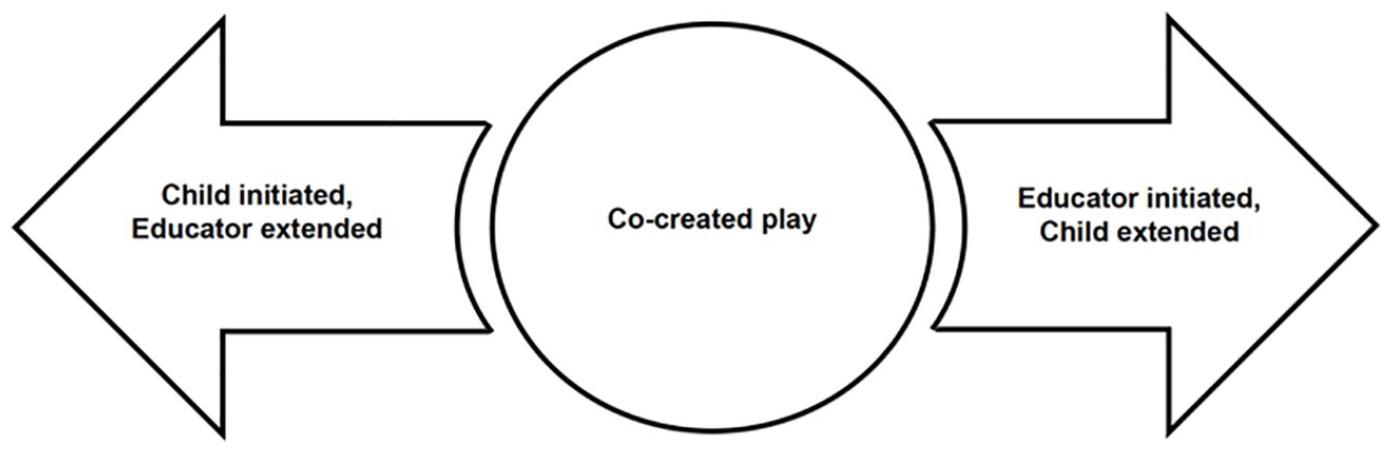
Continuum of guided play.
Alternatively, when teachers are struggling to balance class size with their limited availability and thus struggle to spend time observing play either to enter this play or to guide collaboratively planned play, the guided play continuum can be approached from the teacher-directed side. In this context, educators can create a playful scenario and help direct literacy learning within this play scenario, as described in the pizza store example above. This approach to guided play allows teachers to be more planful, providing the opportunity to infuse academic learning and ensure that there are concrete points at which teachers can enter the play to support children’s learning when they are available.
Teachers documented challenges, including fear that they are interrupting play by getting involved, uncertainty surrounding how and when to enter children’s play to support academic learning, and concern that play makes it difficult to plan for the learning of mandated academic skills (Pyle and Danniels, 2017), make it necessary to conceptualize guided play more broadly. Approaching guided play as a continuum rather than a singular construct provides multiple entry points for teachers. In particular, by conceptualizing guided play as a continuum, educators can select their approach to play based upon their students’ needs, the curriculum requirements, the learning that can be supported or extended, and be planful about how and when they enter children’s play.
In conclusion, this study advocates for the continued inclusion of both free play and teacher-directed play to support children’s literacy development. These play contexts, respectively, serve different purposes including the opportunity to practice learned skills and to systematically introduce new skills that are targeted to individual student needs. Here, we argue not only for the expansion of guided play opportunities as a context to integrate and apply a multitude of core literacy skills, but also for the expansion of the construct of guided play, to conceptualize it as a continuum ranging in levels of child-autonomy and teacher-facilitation. All three play contexts, free, guided, and teacher-directed, have demonstrated, yet different, potential to support children’s literacy learning. They all present unique opportunities to foster student engagement and build a strong foundation of literacy learning in early years education.
