




Abstract
Playgroups are a unique form of early childhood provision involving parents and their children attending together. Parents’ attendance at playgroups provides opportunities for involvement in play. However, little is known about parents’ practices of co-play in playgroups and the potential for these practices to enhance children’s play experiences in early childhood. Drawing on practice architectures theory, this paper identifies parents’ practices of co-play in a community playgroup, and the enablers and constraints on those practices. Data were collected through ethnographic methods, which included participant observation and informal individual interviews. The findings show that parents’ practices of co-play consider the child’s needs and interests in ways that support development and enhance children’s play in the community playgroup. This research contributes new knowledge about the range of co-play practices engaged in by parents with children in community playgroups.
Introduction
Playgroups are a popular option for parents or carers to provide play opportunities for their young children and to socialise with other families. Research about playgroups internationally confirms that participation in a playgroup is beneficial for children’s learning and developmental outcomes (Sincovich et al., 2020). Playgroups exist in many countries including Hong Kong (Williams et al., 2020), the United States (Mize and Pettit, 2010), the United Kingdom (Statham and Brophy, 1991) and Australia (Sincovich et al., 2020). In Australia, playgroups offer rich opportunities for parents and their children to engage in co-play through participating at playgroup together. The term ‘co-play’ is used in this study to refer to parents’ involvement with their children in play activities at playgroup in ways that promote children’s learning (McLean et al., 2017b), such as sitting down with the child to support entry into an activity or talking and modelling actions to encourage the child’s play.
Despite the popularity of playgroups internationally (Williams et al., 2020) and reported benefits of playgroup in early childhood education (social, emotional and academic learning; Sincovich et al., 2020), little is known about the potential and/or otherwise of parents’ practices of co-play for enhancing children’s play while attending playgroup. The research reported in this paper aimed to identify parents’ practices of co-play in a community playgroup, and the enablers and constraints on those practices to understand the potential of parents’ involvement in their children’s play for enhancing play experiences in community playgroups. Kemmis and Grootenboer (2008) refer to ‘practices’ as sayings (ideas and talk), doings (activities) or ways of relating (e.g. relationships) which are formed through a person’s education, circumstances and experiences (Kemmis and Grootenboer, 2008). In this paper, practices of co-play refer to parents’ sayings (e.g. ‘What puzzle will we do today?’), doings (e.g. ‘Choosing a puzzle for their child’s play’) or relatings (e.g. ‘Joining in the play with their child to complete a puzzle together’) with their child and/or play objects at community playgroup.
Playgroups in Australia
Playgroups are recognised in the Australian preschool curriculum (Early Years Learning Framework (EYLF), Australian Government Department of Education (AGDE), 2022), as an ‘early childhood setting’ (p. 66) alongside preschools, kindergartens, and long day care. However, unlike other early childhood education services where children are left in the care of early childhood professionals (e.g. educators, childcare staff) at the service (Australian Institute of Health and Welfare [AIHW], 2020), caregivers (parents, guardian, kinship family members) attend playgroup with their children. In contrast to formal educational contexts, playgroups often do not have a ‘strategic focus on improving outcomes’ (McLean et al., 2017a: 231). In Australia, these groups tend to operate on two broad models, which are supported playgroups and community playgroups. Supported playgroups are typically facilitated by paid professionals tasked to organise play experiences for families and foster positive social interactions (Commerford and Robinson, 2016). Community playgroups, which are the focus of this study, are attended by more than 100,000 families each week (Daly et al., 2019). These groups are volunteer-led (Dadich and Spooner, 2008), which is usually by participating caregivers who facilitate the children’s play.
Benefits of playgroup participation, in general, for children and caregivers are widely reported. For example, children’s participation in play activities with other children at playgroup has been shown to contribute to social, emotional and academic learning outcomes (Sincovich et al., 2020). Similarly, caregivers benefit from the opportunity to meet and socialise with other attending parents. Known benefits for caregivers include increased knowledge about early childhood education through talking about and sharing experiences of parenting issues (Berthelsen et al., 2012), reduced social isolation due to friendships formed with other parents (Hancock et al., 2015) and access to information and resources to support parenting (Armstrong et al., 2019).
Despite community playgroups being a widely accessed early childhood service, these groups have received limited research attention. A recent systematic literature review on community playgroups indicated not only a lack of research into community playgroups, compared to supported playgroups, but also limited attention to children’s ‘developmental and educational outcomes associated with participation in community playgroups’ (McLean et al., 2020: 165). Research into community playgroup participation has tended to focus on social benefits such as social networks and parenting support (Armstrong et al., 2019), with little attention given to the potential benefit of caregiver co-play with their children at playgroup. This would seem to be a missed opportunity for identifying new knowledge to support caregiver involvement in their children’s play. To date, there would appear to have been no reported studies investigating caregiver, and specifically, those identifying as parents’ co-play practices in community playgroups despite the benefits of co-play having been reported across a range of early years settings (e.g. home and classroom setting).
Benefits of co-play
Previous studies into co-play, which are mostly undertaken in the context of videogame play at home between parents and their teenage children, indicate that co-play affords parents opportunities to bond with their children (Wang et al., 2018), and facilitates learning through parent and child shared interactions (Toh and Lim, 2021). There is a significant body of research on adult–child interactions in early childhood which has been found to support the development of children’s social, emotional and cognitive skills (Fivush et al., 2011). More recent studies have shown that adults’ utterances, such as the use of hypotheses and open questions, can influence children’s reasoning and contributions to interactions (Lohse et al., 2022). However, co-play as distinct from adult–child interactions has received less attention. For example, Ward’s (1996) study identified co-play strategies such as play-related language exchanges and higher-level questions employed by an educator with 3-year-old children at a kindergarten in the United States, helped facilitate meaningful play experiences with the children. Similarly, Qu’s (2011) study, which examined the effects of co-play configurations such as co-players as opponents or coplayers in cooperation using an experimental research design with young children in Singapore, found that co-play improves children’s control of behaviour and concentration on the play activity (Qu, 2011). Other studies, while not specifically about co-play, have demonstrated that teachers’ practices such as sensitively responding to a child, giving suggestions and making comments about a child’s actions (Kalliala, 2014; Pursi and Lipponen, 2018) contribute to the guiding of children’s learning in classrooms. Nevertheless, these studies suggest potential for adults to guide children’s learning and development through practices of co-play.
Whilst benefits of co-play have been minimally identified in the literature, few studies have focused on co-play practices between parents and their children in the context of community playgroups. Fleer (2019) has examined teacher and child interactions during participation in conceptual playworlds as form of co-play. She found that children’s learning and play is enriched when teachers and children collectively enter the imaginary play situations together. Research indicates that benefits of having parents involved in children’s play, such as at community playgroups, is potentially far-reaching (Evangelou and Wild, 2014). For example, research into child’s attachment argues that parents’ physical presence provides a secure base for their children’s exploration (Ainsworth et al., 1971), which is more likely to lead to opportunities for learning. This is because children learn how to think, understand, communicate, behave, show emotions and develop social skills from engaging in shared activities with a companion (Roberts, 2011).
In the study reported in this paper, practice architectures theory is used to identify parents’ practices of co-play with their children in a community playgroup, and the enablers and constraints on these practices. The term parents is used in the reporting of this research rather than caregivers, as all participating adults in the study with children identified as parents, rather than guardians or kinship members. The research questions guiding this study are: (1) What are parents’ practices of co-play in the community playgroup? (2) What do parents say about enablers or constraints on their practices of co-play in a community playgroup?
Theoretical framework
The theory of practice architectures has been primarily used in educational research to explore teaching, learning and leading practices across a range of education contexts such as the practices of early childhood educators (Salamon et al., 2016); classroom reading practices (Edwards-Groves, 2017); school leaders’ instructional leadership practices (Wilkinson et al., 2019) and financial literacy education (Blue and Grootenboer, 2017). Recently, it has been used in research with families to better understand bedtime reading practices (Kemmis, 2019), between children and caregivers. In the study reported in this paper, co-play in community playgroups between parents and their children could have potential for fostering parents’ practices to enhance children’s play experiences – should these practices be identifiable in the first instance. Practice architectures theory provided a way to understand this potential by identifying, firstly, parents’ practices of co-play in a community playgroup, and secondly, the enablers and constraints on those practices of co-play.
Grounded by a view of ‘praxis’ as action aimed for the good of individuals and humankind, the notion of practice architectures was initially used by Kemmis and Grootenboer (2008: 38) to describe the conditions that produce ‘good’ educators and education. They argue that a good educator does not develop naturally but is formed and transformed through his or her education, circumstances and experiences. Kemmis and Grootenboer (2008) further contend that an educator’s intention to act for the good of children is enabled and constrained by various kinds of social connections. These connections influence how educators chose to act, whether as ‘agents’, who are active within the system in which they work, or as ‘operatives’, who operate by following set rules and orders (Kemmis and Smith, 2008: 5). Diverging from Kemmis and Grootenboer’s (2008) focus on educators, in the research reported for this study, parents are viewed as agents rather than operatives in community playgroups, who through practices of co-play can enhance their children’s play. Practice architectures thus refers to the ‘mediating preconditions’ that ‘shape and give content’ to how people think and speak, do things, and relate to one another (Kemmis, 2009: 466). The study reported in this paper aimed to identify the enablers and constraints on parents’ sayings, doings and ways of relating with their children during co-play in a community playgroup.
As previously noted, practice architectures theory defines a practice as a combination of the practitioner’s ‘ideas and talk (sayings)’, ‘activities (doings)’ and ‘kinds of relationships (relatings)’ (Kemmis, 2018: 2–3). These practices are enabled and constrained by language, ideas, objects, spatial arrangements or relationships between people (Kemmis et al., 2014), which are the practice architectures found in, or brought into a site. Through the lens of practice architectures, a parent’s co-play practice at playgroup may be composed of the parent’s sayings (e.g. ‘What is in here? Dinosaur? Ball?’), (e.g. a parent laying out a box of toys, and/or relatings (e.g. a parent assuming the role of a co-player as they stand across from their child waiting to catch the ball). Based on the notion of practice architectures, parents’ co-play practices are enabled and constrained by cultural-discursive, material-economic and social-political arrangements found in, or brought to, the community playgroup. Specifically, cultural-discursive arrangements are the conditions that influence parents’ sayings. For example, the kinds of knowledge which influence a parent’s sayings during co-play. Material-economic arrangements are the conditions that influence parents’ doings (e.g. toys provided at the playgroup). In this study, toy refers to the material objects intended for children’s play such as blocks, dolls, tea sets, water table and battery-operated electronic toys. Social-political arrangements are the conditions that influence parents’ relatings. For example, in this study, parents’ beliefs and understandings about children and childhood may influence how they relate with their children at the community playgroup. By identifying the cultural-discursive, material-economic and social-political arrangements enabling and constraining parents’ practices of co-play, the study considered the potential for parents’ practices of co-play to enhance children’s play in community playgroups.
Methodology
Ethnographic research methods were used to collect data about parents’ practices of co-play in a community playgroup. Ethnographic methods involve gathering data through direct observation in the field and informal conversations with research participants (Hammersley and Atkinson, 2019). This study used the participant observation method (Gobo and Marciniak, 2011) which involved the researcher (Celine) observing and interacting with parent participants at the playgroup. This method was used to gain insights into co-play practices, through recognising common circumstances of parenting young children. Using this method, care was taken to ensure that researcher attention was focussed on understanding practices of co-play and not imposing influence on the parents to engage in co-playing with their children, in ways which may not be their norm (Zhao and Ji, 2014). To minimise any influence on the parent participants, the researcher avoided using the term co-play during interviews and open-ended questions were used to elicit discussions about parents’ practices of co-play.
Participants and setting
One community playgroup from metropolitan Melbourne, Australia was recruited using convenience sampling (Salkind, 2012). Six families from the participating playgroup agreed to participate in the research. Participants included three mothers, three fathers and six children aged between 12 months and 3.5 years. Ethics approval was obtained from the University Human Research Ethic Committee. All participants were provided with an information letter explaining the research and consent documentation. Child assent was also sought from participating children 3 years and above through a child assent form, where they were asked to indicate Yes (smiley face) or No (sad face) (Dockett and Perry, 2010). Participating families were invited to assign pseudonyms for themselves and their children for use in the reporting of data. There were two non-participating families at the playgroup. Care was taken to ensure that these families were not included in observations, interviews or in any parts of the research.
Data collection
Field observations were carried out in five playgroup sessions across 9 weeks from January to March 2020. At each session, parents’ participation in at least three co-play activities were documented. A co-play activity referred to an encounter between a parent, child and toy, with toys included in co-play activities because toys were commonly used in children’s play at this playgroup. Parents’ practices in terms of the sayings, doings and ways of relating in each co-play activity were recorded as field observation notes. Six informal individual interviews were carried out with each parent at the end of each co-play activity to understand why they adopted specific practices in the co-play activities. The parents were asked open ended questions such as ‘Tell me about how you were playing with your child during this activity?’. This interview approach was taken to enable parents to share their real perspectives rather than what they believed to be ideal for this study (Zhao and Ji, 2014). The interviews occurred in situ to provide context-specific data, for enabling understanding of why each parent adopted specific co-play practices in their play activities (Dube et al., 2014). The interviews were audio-recorded and later transcribed by the researcher. By collecting information through observations and interviews, method triangulation (Twining et al., 2016) was ensured to strengthen the findings’ credibility.
Data analysis
Data collected included field observation notes and transcripts of individual parent interviews. Data were inductively and deductively coded (Creswell, 2013) to identify parents’ practices of co-play in the community playgroup and what parents say about enablers or constraints of their practices of co-play. The analysis used five phases of Clarke and Braun’s (2013) thematic analysis. These were (1) familiarisation, (2) coding, (3) searching for themes, (4) reviewing themes and (5) defining and naming themes.
Identifying parents’ practices of co-play
In phase one of Clarke and Braun’s (2013) thematic analysis, field notes were read to gain familiarity with the content. In phase two, the field notes were inductively analysed and assigned initial codes where there was content related to parents’ practices of co-play (e.g. ‘Alex [parent] asks Mia [child] what she would like to play’), then deductively coded to sayings, doings and relatings (Kemmis and Grootenboer, 2008) as constituents of parents’ practices of co-play. The combination of inductive and deductive coding aimed to ensure that parents’ voices were captured in the meanings assigned. In the third phase, the coded data were collated to search for potential practices of co-play themes. Examples included amongst others ‘making toys available’ and ‘setting up a play activity’. In the fourth phase, a thematic map was created to review and check that the identified themes captured the meanings in the coded data. In the fifth phase, the themes were further refined by referring to the coded extracts to confirm meanings conveyed about parents’ practices of co-play. This phase, which included naming and defining each theme, established six types of parents’ practices of co-play in the community playgroup.
Identifying what parents say about enablers or constraints on their practices of co-play
Using the five phases of analysis (Clarke and Braun, 2013), the inductive and deductive coding process was repeated to identify what parents say about enablers and constraints on their practices of co-play in the community playgroup. The interview data were inductively analysed for content relating to enablers and constraints on practices of co-play (e.g. ‘If we put it around her and say we’re building something, we ask her what will we try to build and then it becomes a bit more fun for her’), then deductively coded to cultural-discursive, material-economic and social-political arrangements (Kemmis and Grootenboer, 2008) as constituents of enablers and constraints on parents’ practices of co-play. The deductive coding process provided an awareness of the sensitising concepts within the data that enabled identification of parents’ practices of co-play, and the enablers and constraints on those practices (Pope et al., 2000).
Findings
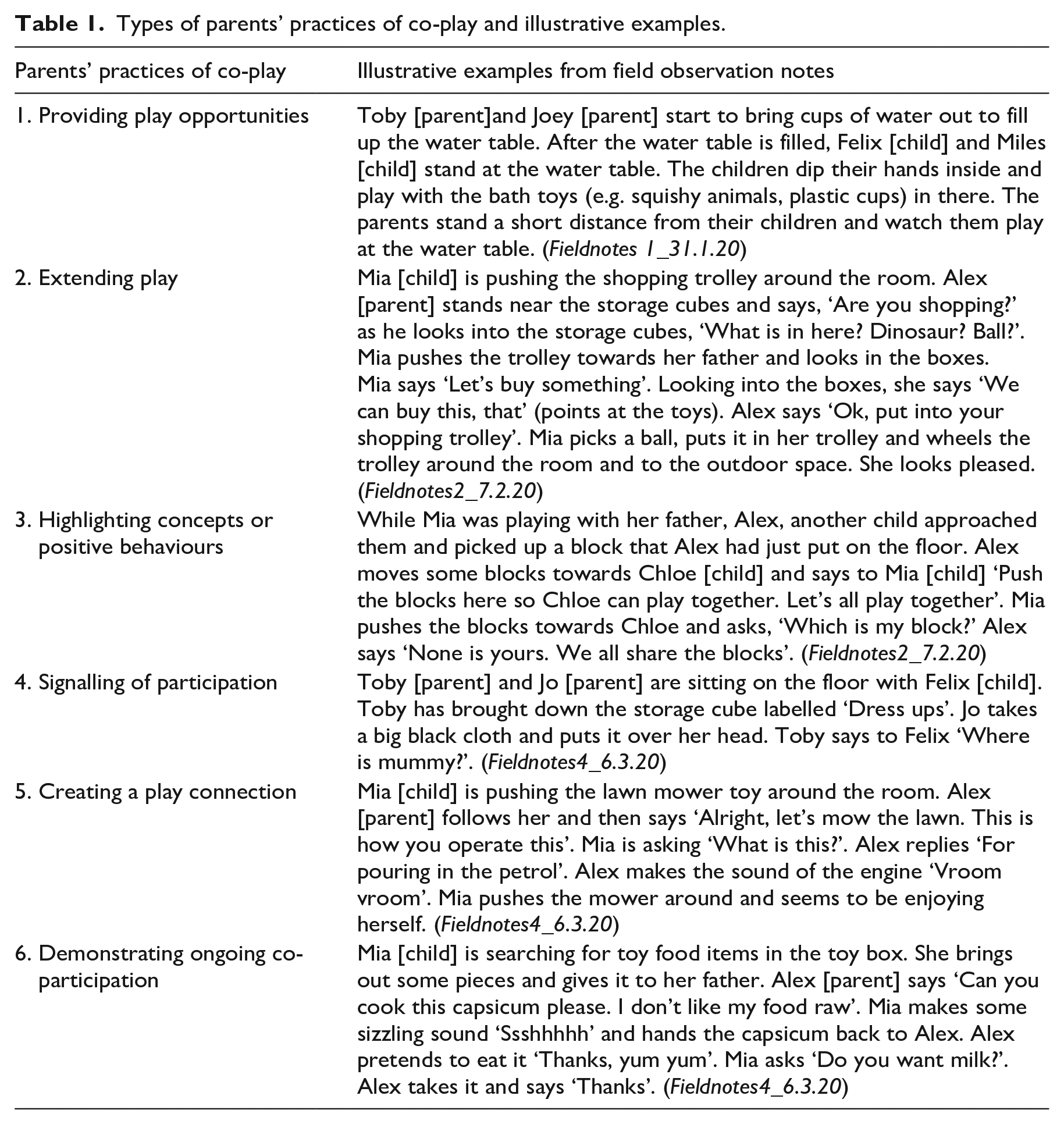
The findings established six main types of parents’ practices of co-play in the community playgroup, which are enabled and constrained by cultural-discursive, material-economic and social-political arrangements. The six types of parents’ practices of co-play together with examples from the field observation notes are presented in Table 1.
Types of parents’ practices of co-play and illustrative examples.
The enablers and constraints on parents’ practices of co-play coded to the three arrangements of cultural-discursive, material-economic and social-political, and examples identified from the parent interview transcripts are presented in Table 2.
Enablers and constraints on parents’ practices of co-play and illustrative examples.
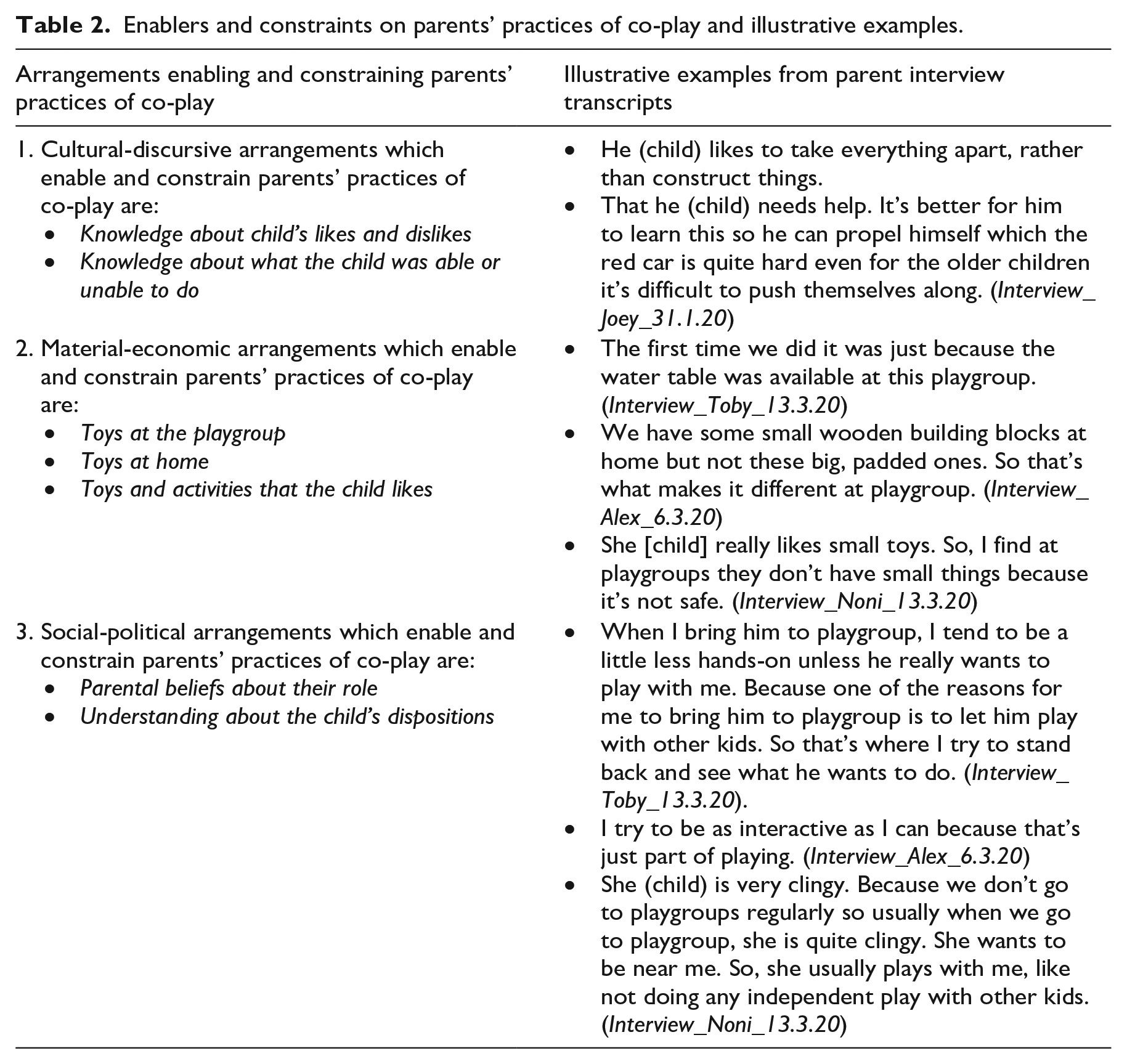
Parents in the community playgroup were involved with their children’s play through six practices of co-play identified as (1) providing play opportunities, (2) extending play, (3) highlighting concepts or positive behaviours, (4) signalling of participation, (5) creating a play connection and (6) demonstrating ongoing co-participation. These practices of co-play composed of parents’ sayings, doings and relatings. The enablers and constraints on those practices of co-play were identified as the arrangements of cultural-discursive (influence sayings), material-economic (influence doings) and social-political (influence relatings). More specifically, parents’ sayings (ideas and talk) during co-play were enabled and constrained by cultural-discursive arrangements, identified to be about their children’s likes and dislikes, and what their child was able or unable to do. For example, one parent shared that her child liked taking apart rather than constructing train sets. During co-play, the parent instructed the child to try connecting the vehicles together (extending play) after the child had taken them apart. The parent’s knowledge of how the child tended to play with the toy trains in a particular way had enabled the parent to extend the child’s play by way of encouraging the child to try connecting the vehicles together.
Parents’ doings (activities) during co-play were enabled and constrained by material-economic arrangements, identified in this study as the toys at the community playgroup, toys at home and toys and activities that the child likes. The variety of toys available such as padded blocks, water play table, play food items and ride-on vehicles enabled the children and their parents to engage in a range of play experiences at the playgroup, but also constrained play. For example, one parent indicated that his child was not interested to play with the toys provided at the playgroup because they were more suited for younger children. In one co-play activity, this parent encouraged the child to use the padded blocks to build something taller than herself, which the child did with excitement. This example demonstrated the parent’s co-play practices of create a play connection (use the padded blocks to build something tall), as well as provide play opportunities (encourage use of the padded blocks). Parents’ knowledge about their children’s play experiences at home also helped to provide continuity for their children’s development through co-playing in the community playgroup. For example, one parent shared that she would put blueberries around a low coffee table at home by way of encouraging her child who was learning to walk. This continuity for the child’s development was provided at the playgroup when the parent used a medium-height stool to replicate what she did at home (providing play opportunity) by way of encouraging the child to walk.
Parents’ ways of relating with their child during co-play were enabled and constrained by social-political arrangements, identified in this study as parental beliefs about their role and understanding about the child’s dispositions. Many parents shared that they seldom engaged in co-playing because they wanted to give their children the opportunity to interact with other children when at the playgroup. For example, it was observed that these parents often talked with other parents and rarely participated in co-playing at playgroup. Parents also expressed concern about providing support to their child, but not to the extent of interfering in their natural development as a constraint to their practices of co-play. For example, one parent described the balance between doing everything for the child and allowing him/her to play on her own. For these parents, the concern about not wanting to be too involved in the child’s play that it may intrude upon the child’s natural development such as playing with other children constrained their initiative to co-play with their child at playgroup.
Discussion
The study reported in this paper drew on practice architectures theory to identify parents’ practices of co-play in a community playgroup, and the enablers and constraints on those practices. By examining parents’ sayings, doings and relatings, the findings indicated that parents engage in a range of practices of co-play with their children such as (1) providing play opportunities, (2) extending play, (3) highlighting concepts or positive behaviours, (4) signalling of participation, (5) creating a play connection and (6) demonstrating ongoing co-participation. Previous studies have tended to focus on parents’ involvement with children’s play in the home environment (Desforges and Abouchaar, 2003; Evangelou and Wild, 2014) or in supported playgroups (Mize and Pettit, 2010) rather than identifying parents’ practices of co-play. Findings about co-play in this study suggest that parents can be involved with their children’s play in ways that enhance play experiences at community playgroups. For example, previous studies documented teachers’ classroom practices such as sensitively responding to, giving suggestions and commenting about what children say and do, which contribute to the guiding of children’s learning and development (Kalliala, 2014; Pursi and Lipponen, 2018). These practices were found in the parents’ practices of co-play in this present study – as evidenced by the responsiveness and sensitivity in the parents’ ways of saying, doing and relating (e.g. asking questions, commenting on or observing the child’s play) towards their children’s play experiences at playgroup (e.g. lack of toys that cater to child’s interests, sharing of toys with other children, child’s preferences). Parents, through practices of co-play, can support their children’s active engagement in play opportunities at community playgroups. This may be due to the parents’ knowledge and understanding of their children, identified in this study as the arrangements enabling and constraining the practices of co-play. According to Kemmis (2009), how people think and speak, do things, and relate to one another are enabled and constrained by the arrangements of cultural-discursive, material-economic and social-political. The findings indicated these arrangements were important for enabling and constraining parents’ practices of co-play that supported their children’s play experiences at the playgroup, thus, suggesting implications for encouraging parents’ involvement with their child’s play in community playgroups.
Firstly, the parent’s knowledge about their child’s likes and dislikes (cultural-discursive arrangement) enabled the parent to suggest to the child another way of playing with the toy train (provide play opportunity). Moreover, parents often made connections to prior co-play experiences from previous playgroup sessions or from home such as the toys they liked playing at home and how they would play with specific toys. These connections informed knowledge that enabled parents to provide continuity to their children’s development through co-playing in the community playgroup. These findings suggest benefit in encouraging parents to draw on knowledge of their children’s interests to support co-play at playgroups.
Secondly, the toys provided at this playgroup were important enablers in that they had enabled parents to engage their children in new play experiences and to replicate home play experiences, but also constrained play. In this study, the parents felt their children’s play was constrained by the range of toys provided that were not appropriately suited for their children, thereby failing to capture their interests. Research suggests that children have preferences for different types of play as they mature, with younger toddlers preferring to use their mobility to engage in independent play while older toddlers were more social and ready to engage in more advanced use of play objects (Dauch et al., 2018; Knox, 2008). Previous research established the benefits of children playing with different types of toys for promoting their cognitive, social, and fine and gross motor skills (Kavousipor et al., 2016; Tomopoulos et al., 2006). The lack of a wider variety of toys that would meet the interests of the children at this playgroup had led to parents adapting their practices pertaining to the use of the toys to meet their children’s needs, such as in the example where the parent encouraged the child to use the padded blocks to build something taller than herself. This finding highlights the importance of the parent’s practices of co-play such as extending the play or creating a play connection (use the padded blocks to build something tall). These co-play practices supported children’s play at playgroup by adapting the use of toys which did not meet the interests of the children.
Thirdly, the findings indicated that parental beliefs and understandings of their children’s dispositions appeared to have the most influence over parents’ practices of co-play in terms of how parents generally related with their children at the community playgroup. The parents that were generally observed to be more involved with their child’s play at the playgroup made comments about the importance of joining in the play, and their expressions demonstrated understandings of the child’s disposition (e.g. preference for the parent to be near). Parents who were observed to be less involved with their child’s play at the playgroup talked about giving opportunities for their children to socialise with other children and parents. This finding mirrored previous studies which had reported that parents attended playgroups mainly for addressing social isolation and for other child-related reasons (e.g. Berthelsen et al., 2012; McLean et al., 2017b), and further extended on those findings by suggesting that what parents believed was important about attending the playgroup (e.g. socialisation) influenced their practices of co-play at the playgroup. This finding can be used to suggest the importance of enhancing parents’ knowledge about involvement with children’s play at community playgroups. Not-for-profit and other community organisations could seek to develop resources promoting parents play practices with children. Further research is also needed, as presently, the focus of research is on the social benefits of community playgroup participation (Hancock et al., 2015) for adult caregivers, rather than in-situ understandings of parent and child co-play in community playgroups. The impact of changing arrangements, such as material-economic arrangements related to the availability of toys, or socio-political arrangements concerned with parents knowledge and understanding of children’s play suggest potential for maximising the known benefits of joint adult–child interactions during play to the benefit of children’s learning and developmental outcomes.
Limitations
There were several limitations that were identified in this study. The first of these related to the participant observation strategy. The participant-observer, actively participated in play activities with the families, which at times may have resulted in missing recording some parts of the parents’ speech or actions that unfolded in the play activity. The second limitation related to evidence for the children’s learning and development. Due to the focus of this study, which was parents’ practices of co-play, the children’s practices were not given equal attention. Future research is needed to examine children’s learning associated with parents’ involvement with play in community playgroups. Finally, this study was undertaken with parents from one community playgroup, the perspectives offered in this study might have varied degrees of relevance across community playgroups. Further research is needed to extend understanding about how parents are involved with their children’s play and determine if the practices found in this study are reflective of other community playgroups.
Conclusion
Community playgroups are a unique form of early childhood provision involving parents and their children attending together. As a play-based offering community playgroups provide opportunities for parents’ involvement in play, however, the potential for parents’ practices of co-play to inform children’s play in community playgroups is yet to be fully examined. This research contributes new knowledge about the range of co-play practices engaged in by parents with children in community playgroups. With the use of practice architectures theory, this paper identified parents’ practices of co-play in a community playgroup and the cultural-discursive, material-economic and social-political arrangements as enablers and constraints on those practices of co-play. Practice architectures theory suggests that understanding a practice in terms of its practice architectures highlights the social arrangements enabling and constraining people’s practices. This paper found that parents’ practices of co-play in the community playgroup are informed by practice architectures that consider the child’s needs and interests in ways that support development, for example by providing continuity to the child’s learning. The findings highlight the value of parent-child co-play in community playgroups as opportunities for enhancing children’s learning and development. Further research should examine how deliberate intervention within arrangements are likely to mediate enhanced co-play practices.
