




Abstract
The purpose of this study was to examine the involvement of early childhood pre-service students (PSSs) in children’s constructive play and highlight how this involvement supported children’s play skills towards advanced play behaviours as seen by previous literature. Drawing from the conceptual framework of the Zone of Proximal Development, as proposed by Vygotsky, and supporting adult involvement in children’s learning, we specifically examine PSSs involvement in constructive play. Participants were four out of 26 PSSs participating in their school experience program phase III and 17 children of the ages 5–6 years. Data was collected through videos, 12 in total, of approximately 20 minutes each, during which the PSSs interacted with children while participating in constructive play. Also, data was collected through reflective journals reported after each video. Data analysis highlighted the different ways the PSSs employed to get involved in children’s play, these being either using direct or indirect involvement. This study suggests that early childhood teachers’ reflection can create a Zone of Proximal Action which refers to good fit direct and indirect involvement supporting children’s mature constructive play behaviours.
Keywords
Introduction
Block play, or constructive play, as used in this study involves the processes children follow in order to build a structure either taking on a socio-dramatic or an imaginary thematic route. There is a vast amount of research that proposes play as an effective way of promoting learning and development (Fleer, 2019; Loizou and Trawick-Smith, 2022; Nilsson et al., 2018; Wood, 2008); and specific content areas (e.g. literacy and mathematics) (Dockett and Perry, 2010; Perry and MacDonald, 2015; Saracho and Spodek, 2007) or types of learning (e.g. pretend play) (Leong and Bodrova, 2012). It is important to note that there are fewer studies examining constructive play. When this does happen, the emphasis is on what and how children act during constructive play, thus exhibiting important constructive play behaviours and sometimes highlighting advanced play behaviours. Block play has also been directly and indirectly related to important skills such as problem solving (Park, 2007), engineering (Bagiati and Evangelou, 2016), abstract thinking (Otsuka and Jay, 2017) concentration, representation of ideas and social interaction. Also, Trawick-Smith et al. (2016) examined children’s block play and suggest that such experiences support structure complexity and math learning. But this research is to a lesser extent examining how the teachers can support constructive play skills. So, drawing from the conceptual framework of Vygotsky’s Zone of Proximal development, supporting teachers’ involvement in children’s play to take it a step further, to enhance it towards mature forms of play, we value teacher involvement and aim to examine how PSSs can support constructive play.
Constructive children’s play skills
Trawick-Smith et al. (2022) suggest a list of block play behaviours that children exhibit in participating in block play and define what they consider advanced levels of these behaviours. Using the specific study as an example, we noted in our study some of these children’s block play behaviours while participating in constructive play. These behaviours included (1) Representation in Building (e.g. providing details on their construction building), (2) Persistence in Building (e.g. not giving up when structure keeps falling), (3) Planning Structures (e.g. deciding on the construction they are about to build), (4) Role Playing (e.g. taking a role in relation to their construction), (5) Narration of Imaginary Scenarios (e.g. developing a scenario that refers to their construction), (6) Co-operation in building (e.g. discussing with peers what and how to build), (7) Verbalization in building (e.g. thinking out loud with peers during building) and (8) Problem Solving (e.g. finding solutions about the construction process). Park (2019a) on the same level of thinking explored the criteria/qualities of children’s constructive play through observations. She suggests the following elements to be considered as important in exploring children’s advanced constructive play: the time spent on play (duration of play), the number of structures constructed (diversity); the connection between the theme explored and the building (organization); the detailed constructions (elaboration); the level of imagined themes and construction (imagination); the ability to stay focused (concentration); and the number of blocks and block types (variety).
It is evident that there are commonalities of what these researchers expect as advanced constructive play skills or mature forms of constructive play. These refer to the abilities children exhibit in representing different structures, the persistence or concentration they show, as well as the imagination (role playing and narration of imaginary situations) that can be involved due to their structures or because of their building.
Teachers’ involvement in constructive play
There is lot of research examining teachers’ involvement in children’s play but this predominately refers to pretend play (Hakkarainen et al., 2013; Loizou, 2017; Loizou and Michaelides, 2020; Loizou et al., 2017). Such work refers to how adults can effectively participate in children’s pretend play to support it towards mature forms of play (Leong and Bodrova, 2012). It is important to highlight that such research refers to direct and indirect intervention in children’s play; directors or partners in children’s play; inside or outside involvement in relation to their play theme (Jones and Reynolds, 2011); and using stories or narrative interventions as tools to initiate and support play skills (Brėdikytė and Hakkarainen, 2011). Little research focuses on constructive play but it is apparent that some of the above-mentioned ways of teacher involvement that previous research is advocating for are as vital for teachers’ involvement in constructive play.
Loizou (2022) suggests the use of direct (providing specific ways to act) and indirect (providing options of actions) involvement in children’s constructive play, after careful observation and based on their play needs, can be supportive of their constructive play and enhance it. It is important to note that when referring to play needs, we allude to the actions or materials needed to be taken by the teachers in order for children’s play to advance. These have to do with questions or comments stated by the teachers that relate to the use of the most appropriate materials for building, to the building of more complex constructions or even the creation of a dilemma that would support further their building actions. Park (2019b) explores teachers’ involvement in children’s constructive play and suggests that providing support of children and provision of enough time, along with open-ended materials and stories are important in enhancing children’s constructive play skills. Additionally, Trawick-Smith et al. (2016) propose that specific questions and comments by teachers can help children think about what their construction represents and extend it, increasing their building complexity. In addition, Trawick-Smith et al. (2022) in their study refer to targeted good-fit block play interactions as created by the teachers, interactions that positively support children’s advanced levels of block play. For example, they refer to strategies that teachers use, such as asking children about their play, using open-ended questions, using questions or comments that encourage role play. Good-fit block play interactions will be further elaborated in the specific study.
In acknowledging the gap in the literature referring to the support and enhancement of constructive play and in strongly sustaining teacher involvement in children’s play we aim to respond to the following research questions:
How do pre-service early childhood teachers participate in children’s constructive play?
How does this involvement support children’s constructive play skills?
Methodology
Study context
The context of this research is the School Experience Program (Practical practice in public kindergartens) of fourth-year pre-service students (PSSs). The PSSs attend three phases of the School Experience Program, during their second, third and fourth year of studies. During the third phase of the School Experience Program, the PSSs are placed in a public preschool class with children of the ages 3–6 years old. They stay in the specific class for 2 months during which they are responsible for the daily curriculum focusing on play and structured activities, covering all areas of development and content areas, as suggested by the national Early Childhood Curriculum. During this time, the PSSs have to implement 46 lesson plans and 30 play activities and are responsible for the whole classroom which includes 25 children. The specific group of PSSs had to also video record themselves while interacting with children during constructive play and then respond to a reflection journal of each video they collected. The reflective journals included specific questions regarding the materials they chose, their role in children’s play, the learning outcomes and future practices they would enact if they were involved in the specific play again.
In preparing our pre-service students for the School Experience Program and especially the School Experience III course we organize a series of seminars on the different subject areas and on play, where we provide them with enough information to reflect, assess and consider in practice their involvement in play. One of these seminars that our study participants attended was focused on constructive play. It basically reminded them of the information explored and supported them to further elaborate and clarify their play involvement in reference to constructive play. A compulsory course Play: Learning and Development includes information on the different types of play, among these being constructive play and how the teacher can best get involved in play to support and enhance it towards mature forms of play. The course aims to develop teacher’s play pedagogy through a series of activities and readings. Specifically, the Constructive Play Teacher Guide (Loizou, 2019) is also explored as a tool to use when planning and implementing constructive play with children. In addition, when referring to the revised national Early Childhood Curriculum which our PSSs need to follow, a distinction is clearly made between free and structured play. Specifically, during free play teachers mainly follow children’s scenarios, or suggest one themselves, in all types of play and participate based on the children’s invitation while play needs focus on the overall development. Whereas during structured play teachers do follow children’s scenarios, or develop their own, at all types of play, and when involved they take into consideration and aim to accomplish the learning goals they have set, in relation to the different subject areas and the overall development, while exploring a specific project theme.
So, in the School Experience Program seminars, the Constructive Play Teacher Guide was shared again, and specific practice examples were discussed for reflection and to point out the teacher’s most appropriate behaviour. More specifically, the participants watched a play video and analysed the teacher’s involvement based on the tool and children’s constructive play skills.
Tool
In order to respond to their reflective journals in reference to constructive play, the PSSs consulted the Constructive Play Teacher Guide. The specific guide includes, among other information, a definition of constructive play, suggestions of appropriate building materials, the stages of block play, the areas of development that can be developed during the specific type of play, along with details on the teacher’s involvement during constructive play. More precisely, based on the child’s play needs, which are specified, within the context of constructive play actual comments are provided to the teachers as suggestions to use to support children’s building skills.
Participants
Participants were four out of 26, fourth-year female students and 17 children aged 5–6 years, from 19 public preschools and 26 classrooms. Some of our students were placed in the same public school but in different classrooms. The sample was convenient since for this study we choose the data from the four participants who received the highest grade in the assignment of video reflection journals.
All of the participants had taken the course Play: Learning and Development described earlier. Also, all of the PSSs signed a consent form at the beginning of the School Experience III course that data can be used for research, and teacher training purposes (e.g. reflection). A consent form was also signed by the parents of the children who took part in the video recordings, as well as the class teacher. Nevertheless, during video recording each PSS informed the children who were at the specific play area that she was going to video record and they verbally responded whether they accepted or not to be part of the video. The children were familiar with the process of video recording and had no problem in being video recorded. When analysing the data, pseudonyms were used for both the children and the PSSs who took part in the research.
Materials used by the PSSs during their play interactions were mainly building blocks such as – soft and wooden blocks, Legos, as well as materials that were employed to enhance dramatic play such as puppets, animals, cars, superheroes, human replicas and figurines.
Data collection
Videorecording
For this study, the data collection included 12 video recordings for all of the four PSSs during constructive play. Each student video recorded the specific type of play three times in her class. These took place during the fourth week of the students’ stay in the classroom, the sixth and finally the ninth week. During the first video, the PSSs were responsible only for the specific play area. While for the other two the PSSs were responsible for all the play areas who were 10 in total. Therefore, in the last two videos, the PSSs moved in and out of children’s play. The duration of each video was approximately 20 minutes. Video recording took place with a small group of children at the constructive play area, with 1–4 children, during morning playtime (7:45–9:05 am).
Reflective journals
The PSSs wrote a reflective journal after each video recording, therefore had each three reflective journals, responding to specific questions. These were related to the constructive materials they used during play, their role and involvement in children’s constructive play, the learning outcomes and future practice they would use to enhance children’s constructive play experience. During this process, the PSSs were expected to refer back to the Constructive Play Teacher Guide, in order to define their play involvement and consider the reasons they decided to be involved. They were very familiar with direct and indirect involvement since they explored it in the play course but also during the school experience seminars. But it was evident that they were not simply copying the intervention guidelines provided in the Guide. Rather they created their own questions and comments based on children’s play development and what skills they considered as important to enhance.
Data analysis
The current study used qualitative analysis and the coding process is described below.
Phase 1 – PSSs play involvement in the videos: The video recordings were initially transcribed by the researchers (and authors) and a total of 264 play episodes were noted. Then together the researchers worked on phases 1 and 2 in analysing these play episodes. During phase 1, each episode was categorized based on the PSSs involvement as mentioned in the Constructive Teacher Play Guide (Loizou, 2019). The involvement actions noted were: (1) She asks questions to identify play needs, (2) She is a role model in using constructive play materials in the context of the play (being in role or not), (3) She suggests options in terms of materials, scenario and roles, (4) She poses challenges or concerns within the context of children’s scenario, (5) She provides direct feedback on the construction children make, (6) She asks questions within subject area to enhance their thinking, and (7) She asks questions or gives information to direct and enhance play development. A play expert was then contacted to independently review some of the play episodes and note the PSSs actions during play. There was great consistency in the categories of the researchers and the expert, so confirmability was ensured.
Phase 2 – children’s constructive play actions in the videos: During phase 2, the episodes were analysed and categorized based on Jeffrey Trawick-Smith et al.’s (2022) existing variables that describe mature building play behaviours for children. So, based on teacher’s involvement as mentioned above we noted the following play behaviours in the play episodes: (1) Representation in Building, (2) Persistence in Building, (3) Planning Structures, (4) Role Playing and Narration of Imaginary Scenarios and (5) Problem Solving. These were again reviewed by a play expert and she was able to note children’s constructive play skills based on the list provided to her by the researchers. Again, she was able to code similar behaviours for children ensuring confirmability issues. In considering all of our analysis we decided to have role play and narration of imaginary scenarios as one category since in our episodes they were combined.
It is important to note that the above-mentioned ways of teacher involvement were employed to enhance, one or more of the children’s behaviours mentioned during phase 2.
Phase 3 – PSSs play involvement and children’s constructive play actions in the reflective journals: During Phase 3, the reflective comments of all of the participants were reviewed in reference to the questions that guided them, ‘Describe your role during the specific play. What type of involvement did you choose and why? (consider the Constructive Teacher Play Guide). Refer to specific comments or questions you used during your play participation.’ Overall, the two researchers worked together and analysed the 12 reflective journals and placed them on the different categories considering the children’s actions, as these were used in the work of Trawick-Smith et al. (2022) and the PSSs involvement taking into consideration the work of Loizou (2019).
Findings
The outcomes of this study provide evidence to support the work of Trawick-Smith et al. (2022) referring to the children’s mature building play behaviours and the work of Loizou (2019) in relation to teachers’ involvement as described in the teacher guide. So, data from the play episodes show how the PSSs employed a variety of strategies to participate in children’s play, in order to support it towards mature forms of play. Through specific play episodes we will identify the children’s constructive play behaviours and then point out the actions and actual comments of the PSSs that support the specific constructive play abilities, and thus enhance children’s play towards mature forms of constructive play.
Representation in building
Constructive play episodes
The children built the space where each animal will live and PSS2 points out to them that each animal needs its own food: ‘So can we have space to separate the food of each animal?’ Markos says that he built a space for the food in each cage ‘I put it everywhere?’ Then, PSS2 suggests to build a warehouse to store the food and says: ‘Where will the warehouse be and where will the food be?’ Markos points to a specific area. PSS2 says: ‘Perfect there!’ She then gives him blocks and says ‘you can build the warehouse and you can use it for the food,’ Markos takes them and begins to build (episode 1).
PSS3 suggests to the children to build something around the apartment building they have already built ‘How about if in addition to the apartment building, you also build the area around the apartment building?. . . What can we have around the apartment building?’ Stefanos replies: ‘A fence that you go through, to enter the apartment building’ So PSS3 brings Legos to build the fence and the children start building the fence around the apartment building. Stefanos places a Lego in the shape of an arch and says that it will be the door: ‘Here we will put the door that we use to enter’ (episode2).
PSS4, after inviting children to build furniture, she starts to make her own sofa with Lego. Then Eva starts to make a sofa too. PSS4 looks at the sofa that Eva is making and says: ‘Should we make a bigger sofa? Oh! Will you make a huge sofa? Look at mine’ she points to the sofa she made (episode 3).
PSSs involvement
To support children’s representation in building, PSS2 was observed to ask questions to pose challenges or concerns within the context of children’s scenario. For example, in episode 1 PSS2 asks children to consider if each animal will eat their food on their own? Moreover, in order to identify play needs she asks questions. For example, she asks children to consider where the warehouse will be and where they will keep the food for each animal. Through these questions, she forces children to consider another space to build. As suggested in episode 2 above PSS3 provides children with the option to build a fence around their building. Moreover, she provides them with the proposed materials, in this case Lego. Finally, in the episode 3 PSS4 is a role model in using constructive play materials, in this case again Lego, in the context of children’s play while building her own couch.
Children’s constructive play behaviours
The episodes above provide evidence to support children’s ability to build a warehouse, a fence around an apartment building and a couch. Their constructive behaviours suggest their ability for representation in building structures and landscapes. It is evident that with the help of questions by the PSSs their building structure qualifies for diversity as they expand them.
Persistence in building
Constructive play episodes
Theodoros indicates the place where the animals will drink water saying ‘Here! They will drink water from right here’ PSS2 has him thinking about whether all the animals will drink water from the same container saying ‘Will all the animals drink from same place?’ Theodoros says that each animal will have to go to the specific food and drink area in a separate cage. Markos adds that the zoo keeper should open the cage for each animal. PSS2 states ‘So, the zoo keeper should open the cage for every animal?’ Theodoros explains ‘The zookeeper should put a leash on each animal and take them to drink water and eat’ PSS2 makes him think ‘Yes, but if the lion wants to drink water at night and the zookeeper is sleeping?’ Theodoros says that the lion will bite the fence and break the cage to get out. So PSS2 has Theodoros consider the strength of the bars saying ‘So the bars will break so easily? Markos then replies that they should make a space for water and food in all of the cages’ PSS2 agrees with Markos (episode 4).
PSSs involvement
In supporting children to stay focused the specific PSS2 poses challenges or concerns within the context of children’s scenario. Specifically, she invites children to consider where all the animals will drink water from. Also, she asks them to think of what would happen when the animals, that is, the lion, want to drink water during the night and the zoo keeper is sleeping. Her goal is to challenge children’s thinking into showing persistence in expanding their building (episode 4).
In further developing the above scenario (episode 4) and in reflecting on children’s responses PSS2 asks questions and gives information to direct and enhance play development. When the children suggest that the lion will bite on the fence when thirsty, the PSS2 asks them to consider if their zoo’s fence is strong enough and won’t break easily. This forces children to consider the strength of their fence, along with the necessary space to build each animal’s drinking area.
Children’s constructive play behaviours
For the same period, around 30 minutes, that the children were observed playing, they stayed focused on the specific building they started off with; they were persistent and concentrated in building a zoo. The PSS’s involvement supported their concentration by challenging them to elaborate their constructions, extend their buildings by adding more areas and making them more complex.
Planning structures
Constructive play episodes
PSS2 asks children about a specific space ‘Is this area the pool? or is this space for the table?’ She then continues to ask, ‘Victoria, what space is this area?’ Victoria answers and says it’s where the pool will be in. Then the PSS2 gives to Victoria bricks to build the pool ‘Take these to build the pool’ (episode 5).
PSS4 brings figurines and tells the girls that they can include them in their play. She also says: ‘We can use these blocks to make some furniture. I’m going to make a sofa’ Zoe says she’ll make a table, stating ‘I know how to make a table’. PSS4 responds ‘Zoe go ahead and build the table’. And she then takes Lego and starts building a chair saying: ‘I will build a chair.’ The girls continue to make the furniture and the pool with the Lego blocks (episode 6).
PSS2 asks the children ‘How will you make the table? What shape does the table have?’ Nicoleta answers ‘Rectangular and square’ PSS2 suggests ‘We can make the table rectangular and the chairs square’. She then gives two flat square bricks and two flat rectangular bricks to Nicoletta and tells her to make the table. Nicoletta asks the PSS2 how to make the table with the rectangular bricks saying ‘But how can I build it?’ PSS2 shows her by placing one brick on top of the other and tells her how they will sit on top of them to eat. Then Nicoleta takes the bricks to build the table and mentions that it needs to become higher (episode 7).
PSSs involvement
In episode 5, through a discussion and by asking questions the PSS2 is trying to identify the child’s play needs in order to figure out how to act. Once she realizes that the child will build a pool she provides her with the specific building material, the blocks in this case. In episode 6 the teacher becomes a role model in using constructive play materials, in the context of the children’s play, and uses Lego to build a chair. In the case of episode 7 the PSS2 asks questions within the subject area of Mathematics to enhance the child’s thinking in building the table. She specifically asks her to consider the shape of the table and the chairs referring to rectangle and square. In addition, the PSS2 provides direct feedback on the construction of the chair, explaining and showing how to connect the blocks to build it.
Children’s constructive play behaviours
In the above episodes, children and the PSS discuss information in reference to planning the specific structures the children are about to build; for example, a pool and furniture (chair and table). It is evident that because of the PSSs’ involvement the children are trying to consider and plan the space, where and how they will build their structures enhancing their play organization.
Role playing and imaginary situation
Constructive play episodes
Two children hold the puppets but play independently; Stefanos pretends that he jumps from the wall of the house and falls into the sea. He informs PSS3 that he will go into the sea to clean himself. PSS3 asks him if he will he get into the sea to clean himself and wonders what happened to him, Stefanos tells her that he got dirty from the tea, Stefanos still in role says ‘I found something! I found a treasure!’ PSS3 says ‘Let’s see what the treasure has inside’ Stefanos using the hand doll pretends to open the treasure ‘Wow diamonds and gold! Gold!’ Then PSS3 has him consider a possible issue/problem ‘What if the pirates come and steal your treasure?’ Stefanos in role says ‘I will protect it’ Then PSS3 suggests ‘You should find a very good place to hide the treasure’ Stefanos says that they will hide it in the window. SoPSS3 poses another question ‘you don’t have a safe in your castle to keep your treasures?’ Stefanos says they have and starts building it with the blocks ‘Here it is, we have one’ (episode 8).
Mary takes the cat figurine and stands inside the castle. PSS3 holds the lion figurine and addresses the cat ‘Hello kitty’ Mary responds by changing her voice ‘Do you have a problem?’ PSS3 responds in the role of the lion ‘I came to tear down your castle because it doesn’t seem that strong to me. . . I’ll take a huge axe’ Mary runs and adds Lego around the castle (episode 9).
PSSs involvement
The PSS3 who is present at the specific construction area, listens to the children’s scenario and takes advantage of their imagination and scenario development and poses challenges or concerns within the context of their scenario. She asks questions to direct and enhance their building play development. So, she specifically challenges children thinking of where they can hide the treasure they found and has them consider the space they have in the castle, and think of a hiding area referring to a treasury.
Another evident example is episode 9 during which the PSS3 poses a challenge and has children worried about the strength of their building within the context of their scenario. She pretends to be part of the children’s imaginary situation taking on the role of the lion and mentions that she has come to break down the castle because it does not seem strong enough. Basically she takes on a role to have children consider further their building and enhance their construction skills. In this case the child responds immediately by adding more Lego building blocks around the castle.
Children’s constructive play behaviours
There were several instances that children created an imaginary situation while involved in constructive play and role playing was part of the scenario they created. There were times that this scenario and role playing was related to the outcome of their building and other times it was the reason for their construction. In episode 8 above the children begin to develop a scenario of someone jumping into the sea and discovering a treasure. While in episode 9 the child in response to the teacher’s role playing (imagination) goes ahead to support her structure by extending it. The PSS invites the child to reconsider his area of construction to hide the treasure he found.
Problem solving
Constructive play episodes
Markos tries to build a castle and places a block vertically and it falls. Then PSS2 asks him ‘why do you think the block falls Marko?’ He replies ‘Because we need to lay it horizontally – flat’. (episode 10)
PSS3 observes children’s play. Michalis has constructed a building with large triangular prisms and is one short of completing it. He looks in the box to find one more and can’t find one. he says ‘I only want one’ PSS3 comes over to help him and gives him alternatives ‘Which one, a triangle? There is no more; Can’t you use another block?’ PPS3 also looks for one but can’t find it ‘Stefanos there isn’t one. What if you leave it blank or if you put another block?’ Stefanos thinks and finds a solution, he gets a smaller triangular prism ‘I will put something that looks like this’ (episode 11).
PSSs involvement
In episode 10 it is evident that the PSS3 firstly provides direct feedback on the construction the child is making. Then she asks the child a question that indirectly refers to a specific content area (Science) to enhance his thinking about his construction. In the specific case PSS3 refers to balance (scientific content) and has the child consider why his tower keeps falling. The child is able to respond and acts based on his knowledge and skills of building.
In the case of episode 11 the PSS3 asks questions and gives information to direct and enhance play development. The child looks for a specific triangle-shaped block to finish his building. But since there is not one available, the PSS3 invites the child to consider other options, leaving the specific space empty or using other shapes in constructing his building.
Children’s constructive play behaviours
The children when involved in constructive play they face a lot of challenges and problems and it is evident that they participate in problem solving in order to succeed what they have in mind with their construction. There are instances during which they resolve building issues that refer to balance and design with the help and guidance of the PSSs.
PSSs reflective comments
The reflective journals of each PSS suggest that they considered their play involvement based on how they impacted children’s construction skills. Their reflection comments provide details of how they acted and were involved in play, in order to support children’s behaviours during constructive play. Table 1 provides specific examples of their actions and specific reflective comments while pointing out the way these affected children’s constructive play actions.
PSSs involvement based on their reflective comment and children’s building action.
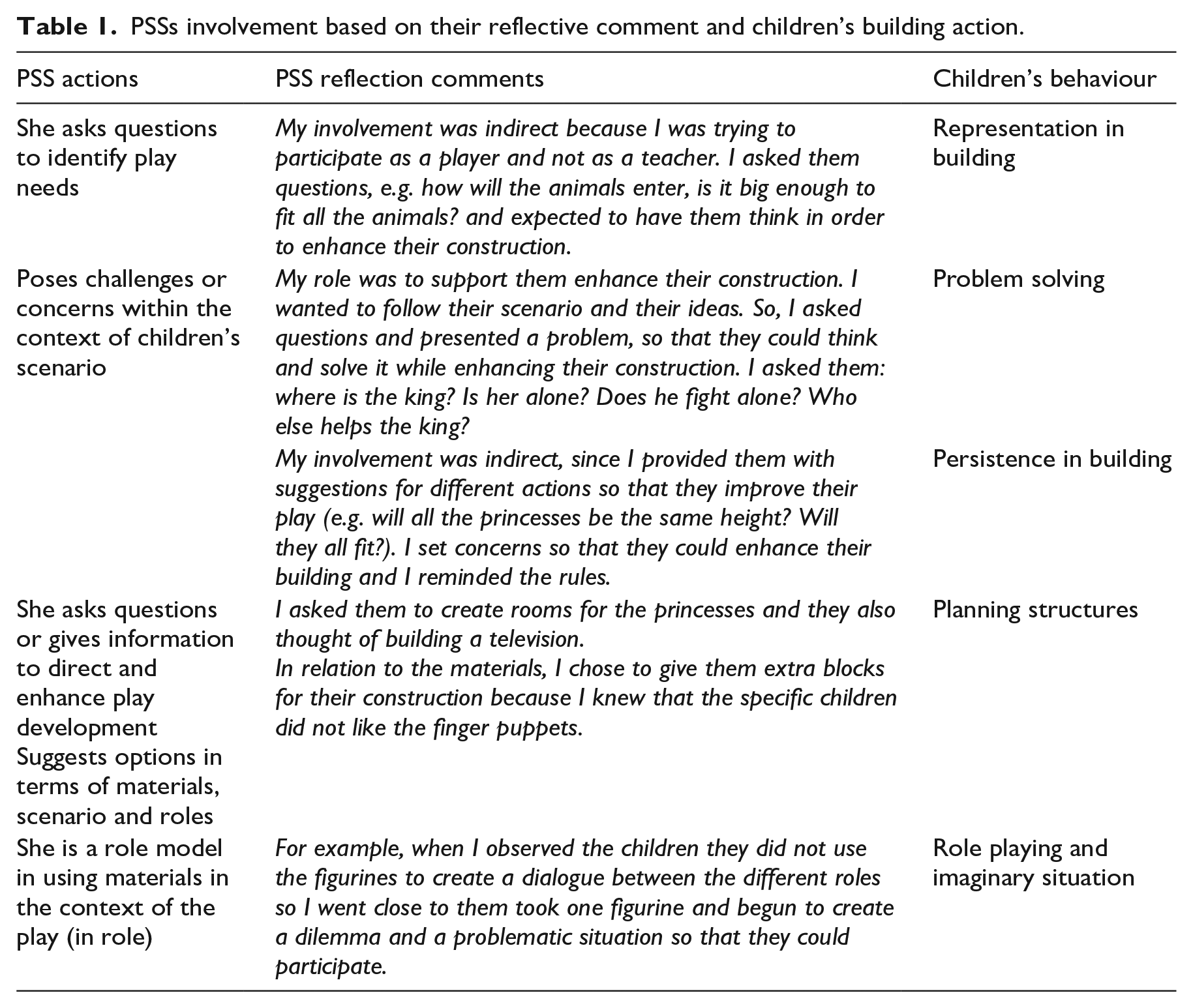
It is evident that the PSSs were involved in children’s play in different ways, using direct or indirect guidance. Their main goal was for the children to enhance their construction, and their play participation actions were at times focused on what they were observing children’s play needed at the time.
Discussion
Gaviria-Loaiza et al. (2017) analysed the different roles the teachers took on while involved in children’s constructive and sociodramatic play (e.g. onlooker, stage manager, co-player) pointing out how the teacher’s involvement benefitted children and their learning. Moreover, the work of Trawick-Smith and Dziurgot (2010) provides us with a model of teacher–child play interactions suggesting that when teachers respond to children’s play needs then this is referred to as good fit interaction as it supports children to play independently. We further elaborate on this model exemplifying the type of involvement teachers employ to respond to play needs and enhance play. Loizou (2019) developed a Constructive Play Teacher Guide where she basically elaborates on the work of Trawick-Smith and Dziurgot (2010) on direct and indirect teacher responses and provides specific ways teachers can respond to children based on their play needs. It is evident from the data that the interactions chosen by PSSs to interact with children during their constructive play can be considered as good fit interactions and are placed within the direct or indirect involvement spectrum.
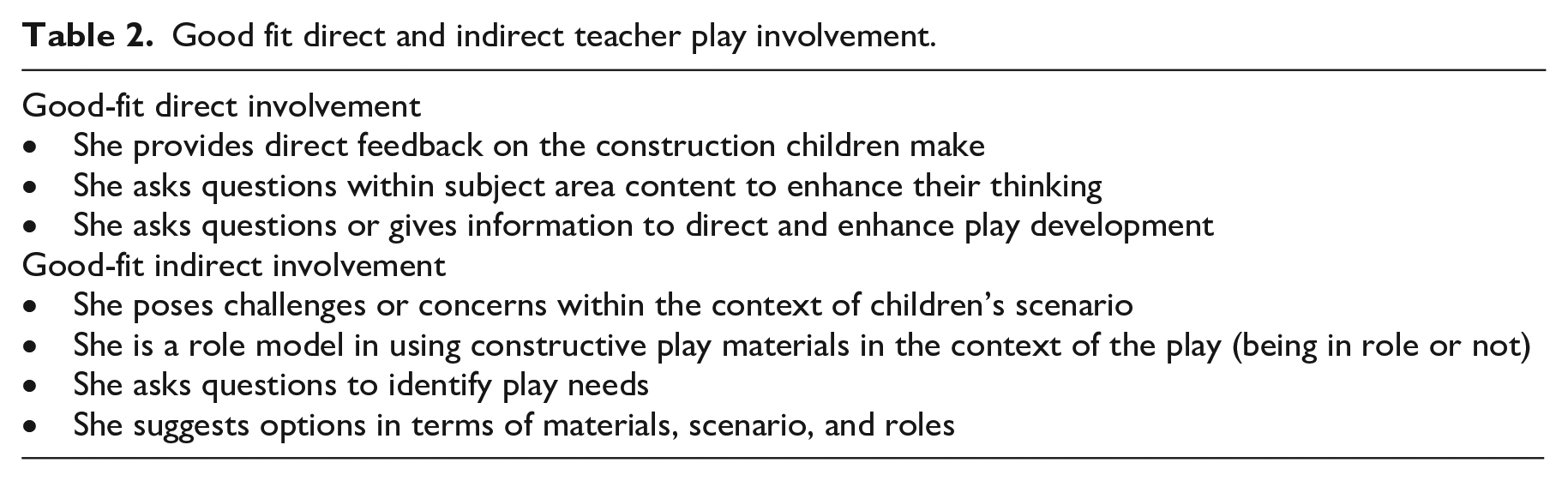
So, the PSSs were flexible in participating in children’s constructive play and employing multiple ways to ensure that play moved towards mature forms. These good fit interactions supported children in their ability to exhibit constructive play behaviours related to mature constructive play behaviours. We are proposing a list of good fit direct and indirect involvement (see Table 2) ways to respond to children’s constructive play needs as these were implemented by our PSSs.
Good fit direct and indirect teacher play involvement.
The PSSs acted within a Zone of Proximal Action (ZPA), (Michaelides, 2022), an adult-led zone which is juxtaposed to Vygotsky’s Zone of Proximal Development (ZPD). The ZPD suggests that children’s developmental potential is enhanced through interactions with peers or adults. Moreover, Michaelides refers to drama and play, and their connection, as the factors that create the ZPA for teachers. The ZPA is a zone in which teachers through the development of drama skills act at their full teaching potential and support children’s play. We extend this concept considering that the PSSs by participating in children’s constructive play, in the different good-fit ways suggested above, enacted within a ZPA, supporting children’s play behaviours towards advanced levels. We noted in our study some of these children’s advanced play behaviours in constructive play. These were: (1) Representation in Building, (2) Persistence in Building, (3) Planning Structures, (4) Role Playing and Narration of Imaginary Scenarios and (5) Problem Solving, as discussed by Trawick-Smith et al. (2022). These play actions are considered as advanced construction play skills and it is evident that these appear due to the PSSs involvement in their play. What is proposed in this study is best exhibited in figure 1 where in order for children to exhibit mature forms of constructive play and develop their skills (e.g. representation and persistence in building, problem solving) the PSSs need to reflect and act within the ZPA, thus implement good-fit direct or good-fit indirect involvement.
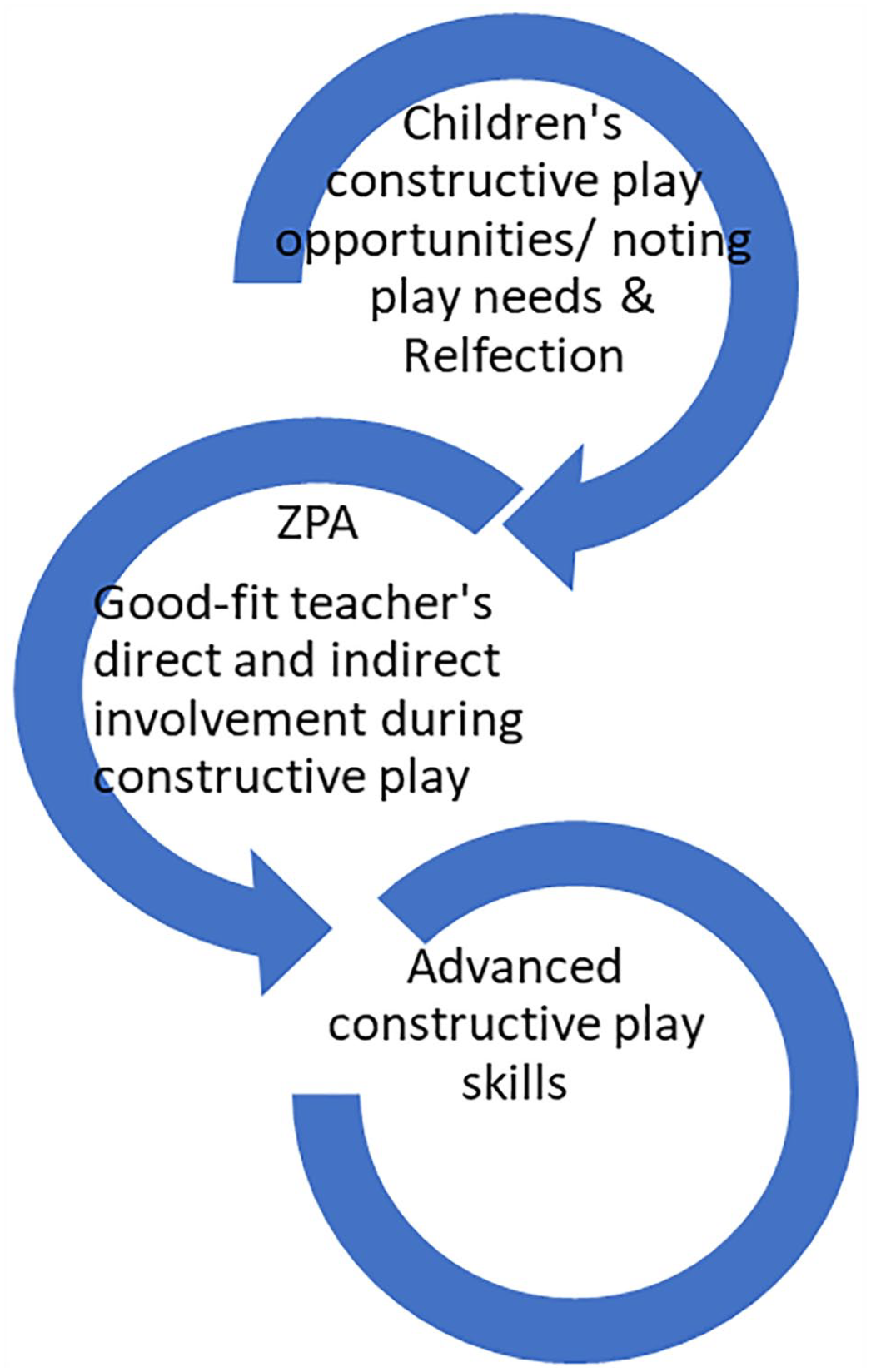
Process towards advanced constructive play skills.
Trawick-Smith and Dziurgot’s (2010) work suggests that teachers who are trained to consider play as an important learning context were able to respond to children’s play needs and thus their interactions were seen as good fit interactions. Similarly, Han et al. (2022) discuss ways in which to train and coach teachers to support play and leaning (e.g. group coaching, group reflective practice, video sharing). It has been evident in our study that our PSSs develop a clear understanding of play theory and the necessary skills to reflect and best respond to children’s constructive play needs guiding them towards mature forms of constructive play. It is important to note that PSSs were actively involved during free and structured play, as described above, so we need to underpin teacher involvement in play. As ECE teachers are expected to guide children to develop literacy and mathematics skills, they should also guide them to develop play skills. Regardless of the familiar position that children naturally learn and develop through play, their play skills to be fully developed need guidance through teacher involvement.
Considering teacher education implications and extending on previous work (Loizou, 2022), we propose the following:
Every early childhood teacher education program of studies needs to include at least one course on play where students develop their play pedagogy, learn theoretically and in praxis how all types of play can be implemented, to support learning and development.
A series of Teacher Play Guides are useful tools in supporting day to day practice and can be a valuable reference point for pre- and in-service teachers.
During any school experience program PSSs need to be supported in implementing play activities and reflecting on their involvement.
Through video recording and reflection, PSSs begin to reconceptualize their play pedagogy and become very specific in their play skills and in fundamentally supporting children.
In conclusion, we acknowledge that teachers need to be professionally trained to explore their involvement in constructive play, as in the case of socio-dramatic and imaginative play. Once they learn to create a Zone of Proximal Action and enact good-fit direct and indirect play involvement they impact children’s constructive play skills leading them towards advanced levels.
