




Abstract
This study examined the mediating roles of home learning environments and SES on early learning attainments of naturalised refugees in Tanzania using concurrent embedded mixed design. Data were collected by EGRA and EGMA, questionnaire and interviews. The sample were 400 grade one and grade two children (aged 70–86 months), 120 parents, eight teachers and four school principals. Findings indicated comparable early math and reading attainments of children from naturalised refugees/citizens and those of more advantaged urban majority. Family SES and HLE predicted early learning attainments while parental beliefs and expectations influenced it. There were gender divides in learning attainments across groups. These findings have policy, research and practice implications.
Keywords
Introduction
The notion of learning attainment during the early years of schooling is attracting increasing attention from policymakers, researchers, practitioners, parents and standards-based agencies (National Examination Council of Tanzania; Ndijuye, 2020; Ndijuye and Rao, 2019; UIS, 2021). Improved early learning attainment has been found to correlate with quality early childhood education, hence improving children’s cognitive and socio-emotional outcomes (Brinkman et al., 2018; McCoy et al., 2017). Parallel to this is the importance of developmentally supportive home learning environment for children from low-income families (Tamis-LeMonda et al., 2019), which is more critical for disadvantaged children in developing countries (Ndijuye, 2020).
Additionally, early childhood education has consistently been associated with reducing the deficit in learning attainment in all areas of emergent literacy and numeracy (Lehrl et al., 2020; Melhuish et al., 2008). This has resulted in a formalisation of this level of education in many countries around the world (UIS, 2007). Regardless of socioeconomic status, parents who engage with their child in more intellectually stimulating activities using stimulating materials enhance the child’s development of verbal skills (Lehrl et al., 2020; Melhuish et al., 2008; Tamis-LeMonda et al., 2019).
Disparities in early learning attainment
The early developmental and achievement gap between children from the rich majority and those from a poor refugee and/or immigrant background is a well-researched topic among education scholars (Coleman, 1968; Ip et al., 2016; Ndijuye and Rao, 2019). Globally, the early learning achievement gap is said to start even before children begin pre-primary education (Lehrl et al., 2020; Troller-Renfree et al., 2021) and to persist throughout their academic career and beyond (Han et al., 2012; Weiland and Yoshikawa, 2013). Recent evidence has documented that in the sub-Saharan region, even after interventions, the early learning achievement gap widens as children progress to upper-level grades (Ndijuye, 2020; Ndijuye and Rao, 2019; SACMEQ, 2020; Uwezo, 2020).
The early achievement gap has increasingly attracted the attention of early childhood researchers for various reasons (Ndijuye, 2020; Weyer, 2018). Weyer (2018) has established that early achievement characterise the quality of early learning, which can be observed through enhanced early language and pre-literacy skills. This enhances self-regulation and executive functioning (Tamis-LeMonda et al., 2019) and may potentially predict future high school graduation rates while minimising the possibility of special education placement and retention (Weyer, 2018). Given the significance of this, global, regional and individual countries have launched initiatives to ensure that broadened quality pre-primary education offer effective early learning experiences that improve equity (Troller-Renfree et al., 2022). Moreover, efforts are being made to ensure the equalisation of educational opportunities and reduction of achievement gaps in preparing the future workforce (Weyer, 2018).
The available findings by Uwezo (2015 to 2020); RTI International (2020); and NECTA (2020) show that while Tanzania has achieved almost universal access to basic education, most rural children are just schooling. For instance, in 2020, about 10% of school-aged children did not attend any form of schooling (MoEST, 2020), even though the official 2014 Education and Training Policy of the country requires that all school-aged children must be registered (United Republic of Tanzania [URT], 2014). Furthermore, about 72% of grade four children cannot attempt grade two word problems involving subtraction, and the curve progresses slightly lower to about 43% for middle graders. Similarly, among middle-grade children, only 33.4% can perform numerical operations on the division level. Among children of refugee background, about 42% of middle graders are able perform a grade two mathematics exercise (NECTA, 2020).
Compared to neighbouring countries, findings have consistently indicated that learning attainments in Tanzania sharply declining (Ndijuye, 2020; NECTA, 2020; Rawle, 2015). The SACMEQ (2020) results show that while the regional average score was 404 points, middle graders in Tanzania scored relatively below this average, at 388 points. The TIMSS (2011) sub-Saharan piloting results show that Tanzanian fourth-graders perform far below their counterparts in countries beyond the sub-Saharan region who are registered in a comparable grade. On average, more than 4 out of 10 children (44%) in the fourth grade of primary school in Tanzania can be classified as innumerate (SACMEQ, 2020). This proportion increases to about 62% for children attending under-resourced rural schools (SACMEQ, 2020; Uwezo, 2020).
These disparities have been attributed to poor family socioeconomic status (Kafle et al., 2018), parental beliefs and expectations (Ndijuye and Tandika, 2022b), quality of the existing schools (Anderson and Sayre, 2016), and gender preferences (NECTA, 2020). Findings by Uwezo (2020) indicate that in early reading and math tests, children from the upper quartiles of SES outperform their less advantaged rural peers from the lower quartile by a statistically significant margin. Observed by gender, there is a relatively large divide in early learning attainment, with boys outperforming girls in numeracy tests, while girls outperform boys in literacy tests (Ndijuye, 2020; NECTA, 2020; Uwezo, 2020). To date, in the Tanzanian context, the reasons for gender gaps in early learning attainment are not yet empirically accessible.
Educational situation of naturalised citizens in Tanzania
From 1959 to 2020, Tanzania has been home to about three million refugees and immigrants from Burundi, South Sudan, Somalia, Rwanda, Democratic Republic of Congo, Mozambique and Uganda (Ministry for Home Affairs, 2020). Until 2017, about 300,000 of Burundian refugees had been naturalised as Tanzanian citizens (Ndijuye and Rao, 2018). They live and work in the specific settlement areas of Ulyankulu, Mishamo and Katumba or in well-established villages as ‘self-settled’ naturalised citizens. Children from this group are registered in the public schools located in their respective settlement areas or along with local rural majorities. As a distinctive minority group, the early learning attainment of children from this group in Tanzania is not documented (MoEST, 2020) hence, least known (Ndijuye and Rao, 2018, 2019).
Until 2020, there were 52,718 pupils from this group registered at the primary school level, while around 16,289 of them attended secondary schools across Tanzania (MoEST, 2020). It is important to note that in Tanzania, basic education – which spans from pre-primary to the lower secondary school level – is free and compulsory (URT, 2014). Findings from various studies (Ndijuye and Rao, 2019; NECTA, 2020; RTI International, 2020; Uwezo, 2020) indicate that the early learning attainment of children of naturalised citizens is comparable to those from more advantaged urban groups. These findings pinpoint the vital role of parental beliefs and practices in influencing children’s learning attainment (Ndijuye and Tandika, 2022b). However, previous studies did not address the nature and magnitude of these differences, nor the extent to which home learning environments and family SES could reconcile or mitigate these differences. This study will fill the identified gaps by addressing the research questions below.
Theoretical underpinnings of the study
The study was based on bioecological theory (Bronfenbrenner and Ceci, 1994), which assumes that children’s development and learning are the result of the interaction between genes and the environment that occurs in a nested arrangement of structures/layers, each contained within the other. Development is the outcome of the reciprocal interaction between the bio-psychological human, individuals, objects and symbols within a specific context and environment (Bronfenbrenner, 1979; Bronfenbrenner and Morris, 2007). This necessitates the understanding of effects of the proximal processes on development which focus on the individual person, quality of interaction, context and developmental outcomes (Bronfenbrenner and Ceci, 1994; Bronfenbrenner and Morris, 2007). The main assumption of this study is that children’s development occurs when they are immersed and interacting in and with the interrelated nested structures or ecological sub-systems (Bronfenbrenner and Morris, 2007). This study considered the implications of the relationship between the home learning environment and family socioeconomic status and children’s early reading and math learning attainment.
Early reading and math development in Tanzania
In Tanzania, studies have been conducted on early literacy and reading (Ndijuye and Rao, 2019; Shukia, 2016;) and early numeracy or both (Mmasa and Anney, 2016; Ndijuye, 2020; Trako et al., 2019). Findings indicated tremendous challenges ranging from overcrowded classrooms (Shukia, 2016) and limited culturally and developmentally appropriate instructional materials (Ndijuye and Rao, 2019) to low parental participation in children’s learning activities (Ndijuye and Tandika, 2022b). Further, learners from minority and disadvantaged groups – including naturalised citizens – are reported to receive inadequate learning benefits (Ndijuye and Rao, 2018).
As noted earlier, in Tanzania most of the children are schooling but are not acquiring the learning skills relevant to their grade level (Ndijuye and Rao, 2019; NECTA, 2020; Rawle, 2015; Uwezo, 2020). For instance, the 2020 seventh grade examination results show that only 7 out of 10 children completed the basic education cycle with the knowledge and skills required to pass the examination. While the achievement gap among and between naturalised citizens and refugees in Tanzania is understudied, to our best knowledge, there is no single study that exclusively focused on differences by gender on early learning attainments, and the implications of home learning environments and family SES among naturalised citizens (self-settled naturalised citizens, in-settlements naturalised citizens) and majority groups. Against this background, this study aims to answer the following questions:
Research questions
Are there any differences in learning attainment by gender between children of naturalised citizens and the local majorities?
How do the differences in home environment and family SES relate to children’s learning attainment among children of naturalised citizens and local majorities?
Methods
Study design and sampling issues
To gain a broad and in-depth understanding of the learning attainment of naturalised citizens within a context of an acute shortage of educational resources, we used a concurrent mixed method design. More specifically, the study used a concurrent embedded design in which qualitative data aided the clarification and interpretation of the quantitative findings (Creswell and Creswell, 2017). Qualitative findings provided contextual details about the differences in learning attainments and how HLE and family SES mediated the attainment differences across social groups. In Tanzania, a large population of naturalised citizens – both in-settlement and self-settled – is mainly found in the Kigoma, Katavi and Tabora regions. The first two regions were deliberately selected for the study to target both the population of self-settled and in-settlement naturalised citizens. One primary school was selected from each population group.
A total of 400 first and second-grade pupils (aged between 70 and 86 months) from the four groups (urban majority, rural majority, self-settled naturalised citizens and in-settlements naturalised citizens) were randomly selected. In addition, four principals from the participating schools, eight early grade teachers (two from each school) and 120 parents were recruited to gain insight into the school and home learning environments. Parents were selected on the following basis: (i) not a member of the parent-teacher association at this time to prevent any personal conflict of interest, such as social desirability and personal bias, (ii) with a child registered in that specific school and (iii) with a first-generation child after naturalisation – for parents from the group of naturalised citizens.
Tools
The Early Grade Reading Assessment (EGRA) and Early Grade Mathematics Assessment (EGMA) were used to measure literacy and numeracy attainment, respectively. The two tools are designed to measure early grade foundational skills (Dubeck and Gove, 2015). These tools have been successfully used in the sub-Saharan context such as Kenya (2012), Liberia (2012), Nigeria (2013) and Tanzania (2013). In this study, they were modified slightly to achieve the objectives of the study to reflect the 2016 Tanzania Early Grades Curriculum in Tanzania. Among early childhood education researchers, it is common to adopt, contextualise and use tools developed elsewhere (Ndijuye, 2020; Ndijuye and Tandika, 2022b). The rationale behind this is to allow researchers to link the findings with research conducted in other parts of the world and thereby contribute to global knowledge generation and. However, the adaptation and contextualisation of these tools has implications for the reliability and validity of the tools (Creswell and Creswell, 2017). The modified and adapted EGRA and EGMA instruments showed adequate psychometric properties including absence of floor and ceiling effects since we established anonymity, the tests did not have a pre-set artificial limit on responses, and the level of difficulty of items varied from simple to complex.
Tasks and application of tools
The tasks for EGRA included to identify alphabetic letters and read common words aloud. Children were also tasked with a demonstration of comprehension of sentences followed by complete paragraphs. This tool was contextualised to reflect the 2016 Tanzania Curriculum for Early Grades and needs of its predominantly rural participants. For instance, although the study included first and second graders, it was necessary to omit double-lettered sounds that are taught in the second semester of second grade. The study also deleted Ch, X and Q since they do not exist in Kiswahili alphabets.
The tasks for EGMA focused on early numeracy attainment (Dubeck and Gove, 2015; USAID, 2014) by assessing the extent to which children can identify numbers, identify missing numbers, discriminate quantity, recognise shapes, do addition and subtraction, and solve word problems. Given that the study involved first and second graders, the addition and subtraction items were designed to progress from simple to complex. Moreover, items related to multiplication and division were omitted because they are taught during the final academic quarter of grade 2. The highest possible EGRA and EGMA points that a child can score was 50.
School and home contexts
There were one-on-one interviews with school principals and early grade teachers on admission criteria, how they created school and classroom environments that facilitate tolerance, multiculturalism, and diversity among learners, medium of instruction and classroom and/or school management with learners from diverse linguistic and ethnic backgrounds.
The study used a home environment questionnaire developed by Rao et al. (2013) to gather information related to home learning environments (HLE) and limited variables related to family socioeconomic status (SES). Items for HLE collected information about quantity and quality of parent-child interactions, parent-school interactions availability of educational materials at home such as print materials, TV and radio; and family SES which focused on parental education and family wealth. To develop rapport and mutual trust, home visits were organised to administer the parent-reported questionnaire. The parents’ questionnaire allowed for asking follow-up questions which proved useful in collecting supplementary qualitative data. It was necessary to do this because most parents in rural Tanzania have limited interaction with strangers – including researchers. The items were validated and showed significant psychometric properties such as ceiling and floor effects.
Procedures
Four enumerators were recruited and trained by the authors for piloting the tools, data collection and data entry into the software for analysis purposes. The enumerators were trained and qualified early grade teachers. The authors and enumerators independently conducted preliminary data collection to determine inter-rater reliabilities. Preliminary data analyses indicated the inter-rater reliabilities as follows: first author (0.91), second author (0.90), first enumerator (0.92) and second enumerator (0.90). The calculated Cronbach’s alpha or internal consistency: EGMA = 0.89, and EGRA = 0.88. The administration of each of the two tools took place at school after lesson hours in which the order of assessment was counterbalanced.
For both tests, a child was given a booklet containing questions, while the assessor had the scoring booklet. The assessor read the item aloud and the child responded. In administering the tests, a stopping rule was applied when a child could not correctly respond to two consecutive items or when time had run out. Arrangements were made for home visits to interview parents individually, which allowed the researchers to become familiar with the local environments, establish rapport and control social desirability and personal bias (Creswell and Creswell, 2017). Specific appointments were made with school principals and teachers for one-on-one interviews. Each session lasted between 60 and 90 minutes and took place either in their respective offices or under the shade of a tree on the school premises.
Ethical considerations
The ethical issues in this study were those about anonymity and privacy, safety, procedural authorisation, voluntary participation and consent to include children below the age of 18 years. As observance of the 2017 Research and Statistics Act, we applied and obtained ethical clearance from the National Bureau of Statistic – the responsible state organ which approves all research activities in the country. Moreover, we obtained introductory letters from relevant local government authorities in the Katavi and Kigoma regions. Written and verbal parental consents were obtained to include children in the study who were under the age of 18. Although participation was voluntary, school principals, teachers and parents had signed a written consent to be involved in the study. As part of protecting the participants’ identities and privacy, pseudonyms and pass codes were assigned and unauthorised persons had no access to the collected data in whatever form.
Data analysis methods
To determine differences across population groups, preliminary analyses were conducted with demographic information – gender, grade and age – which were correlated to the children’s early learning attainment. To determine covariates for the final analyses, the study used specific group frequencies, means and correlations among the variables. The main analyses examined the differences in mean scores for reading and math among self-settled and in-settlement naturalised citizens compared to urban and rural majorities using a two-way analysis of variance. Moreover, we conducted a separate regression analysis for a sub-group of 120 children whose parents were interviewed to identify factors that would predict their reading and math learning attainment. Both the parent and teacher interviews were conducted in Kiswahili and therefore had to be back-translated into English by experts in basic education and English-Kiswahili linguistics. Qualitative interview data were analysed using the procedures proposed by Miles and Huberman (1994). More specifically, interview data was reduced, coded and described to identify themes and sub-themes.
Results
Family socioeconomic status
Parents’ education
Almost 1 out of 10 mothers (7%) from the naturalised citizen groups and about 37% of mothers from the rural majority had no formal education. In the urban majority group, all mothers had undergone at least 7 years of primary schooling. Comparatively, the fathers across the population groups were more educated than the mothers, with an education level ranging from primary to secondary school or postgraduate levels. However, in the rural majority group, only almost one out of four (23%) fathers had a secondary education. The most educated group of parents were those from the urban majority, while the least educated were the rural majority. While we are aware that virtually universal access to basic education was achieved in the 1970s (UIS, 2021), this study could not establish reasons for parents from the rural majority to have such limited educational levels. Detailed findings are presented in Table 1 below.
Parental education across population groups.
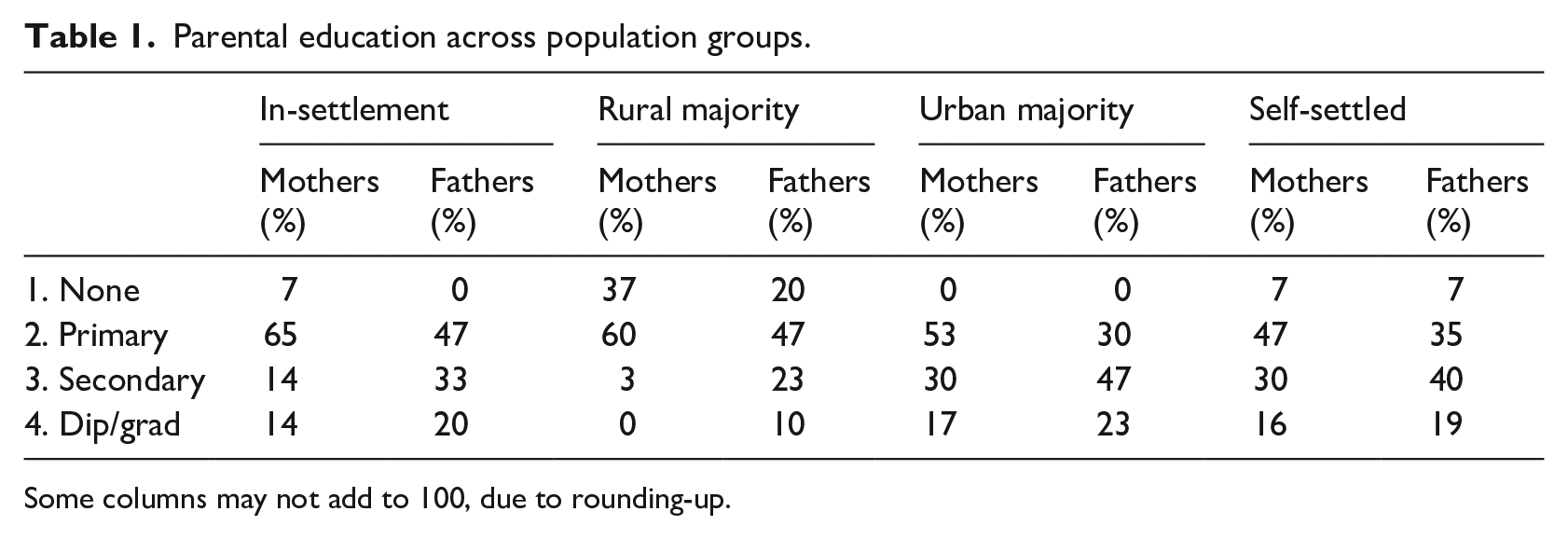
Some columns may not add to 100, due to rounding-up.
Family wealth across population groups
While about 40% of fathers from the urban majority group reported owning at least a small business, this was only 20 and 22% among in-settlement and self-settled naturalised citizens, respectively. In terms of asset ownership, naturalised citizens seemed to have gained a considerable amount of wealth compared to the rural majority, even more so in relation to the number of years they had lived in the country. More specifically, about 93% reported owning a home and between 10 and 15 hectares of land – but we did not ask about the quality of these homes. And a substantial number of them (53–56%) reported having a bank account – but we did not ask how much was saved in that account. Detailed findings are reported in Table 2 below.
Family wealth (asset ownership).
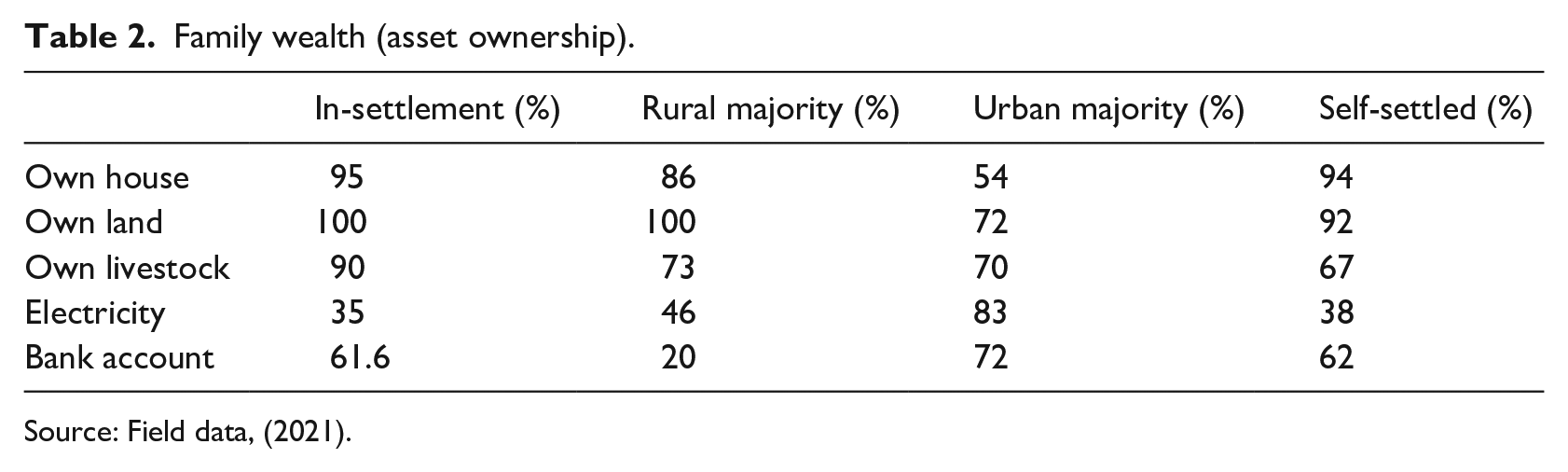
Source: Field data, (2021).
Parental involvements as a proxy for home learning environment
The study explored culturally and developmentally appropriate learning activities relevant to a typical sub-Saharan context. These included doing simple domestic chores at home with adult supervision, storytelling at home, singing and dancing folklore dances, reading children’s books, playing locally available games, naming common items, drawing and counting. For analytical purposes, scoring and coding was assigned as follows: 1 for Yes – mother; 2 for Yes – father; 3 for Yes – another adult; and 4 for No activities were done. The mean, standard deviation and range for the number of activities each of the family members involved and completed with the child were calculated and tabulated.
In general, the findings show that compared to local majorities, both parents – father and mother – among the naturalised citizens are more involved in their children’s learning and development. Among the rural majority, children received support mostly from ‘another adult’ and not their biological parents. The study did not explore the reasons behind such practices among parents in the rural majority group. Nevertheless, this relationship is not uncommon among extended families in sub-Saharan Africa (Kjørholt et al., 2019). Detailed findings can be found in Table 3 below.
Parental involvement and family support across population groups. a
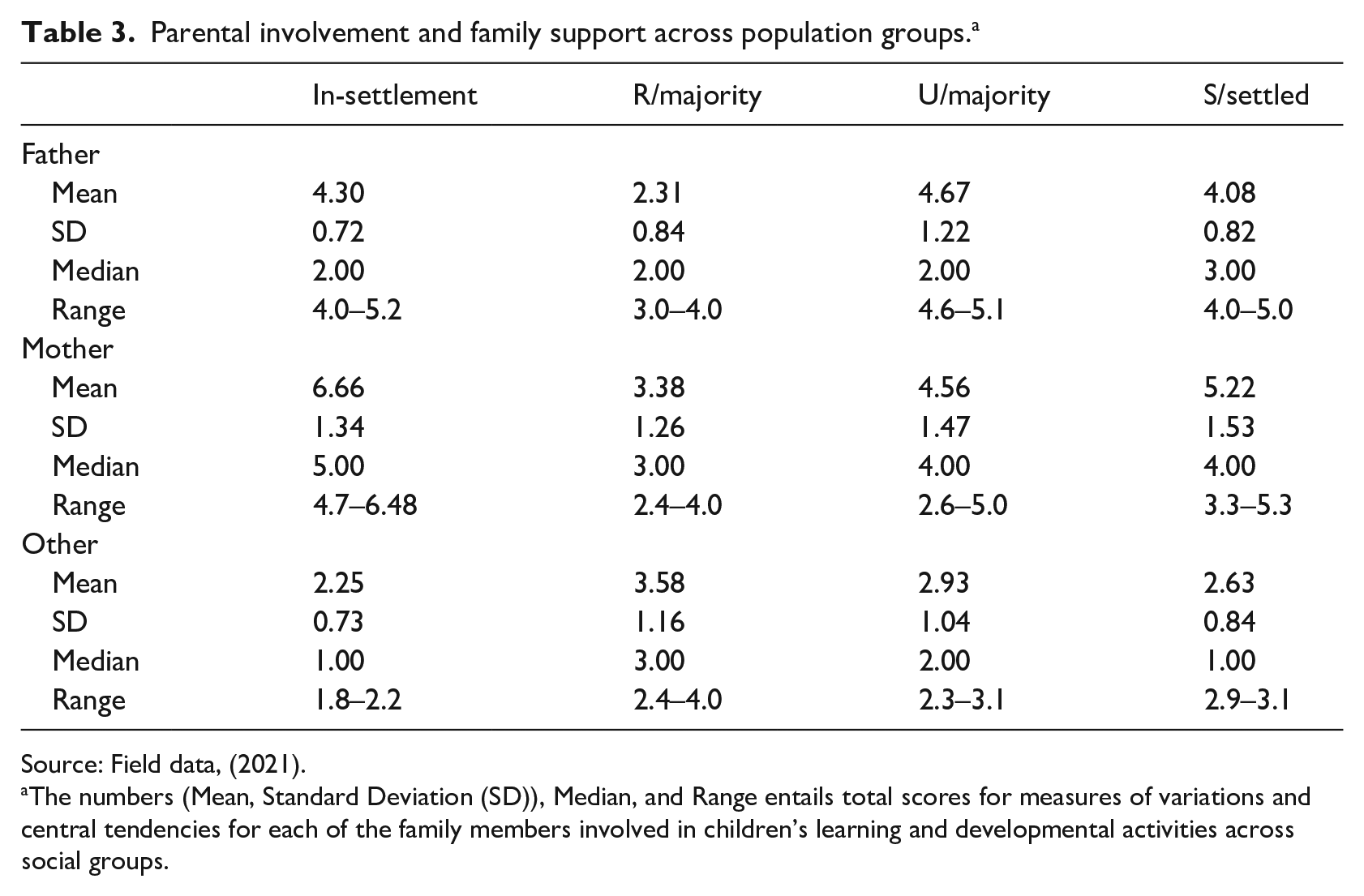
Source: Field data, (2021).
The numbers (Mean, Standard Deviation (SD)), Median, and Range entails total scores for measures of variations and central tendencies for each of the family members involved in children’s learning and developmental activities across social groups.
Differences in early reading learning attainment across the social groups
A two-way analysis of variance that included population groups and gender as in-between variables indicated that the main effects of gender (F (1, 142) = 20.688, p = 0.013, d = 0.07) were significant for early reading attainment, but insignificant for early math. A follow-up test was conducted and showed that the mean for early reading of children from self-settled naturalised citizens (M = 38.60, SD = 2.65) and in-settlement naturalised citizens (M = 37.71, SD = 2.72) was comparable to that of children from more advantaged urban majority groups (M = 39.63, SD = 1.55). Moreover, children of naturalised citizens outperformed those from the rural majority group (M = 18.44, SD = 0.57). Across the groups, girls from the urban group (M = 42.11, SD = 1.23) significantly outperformed boys (M = 33.42, SD = 1.23). Detailed findings are shown in Table 4 below:
Early reading means score across populations and gender.
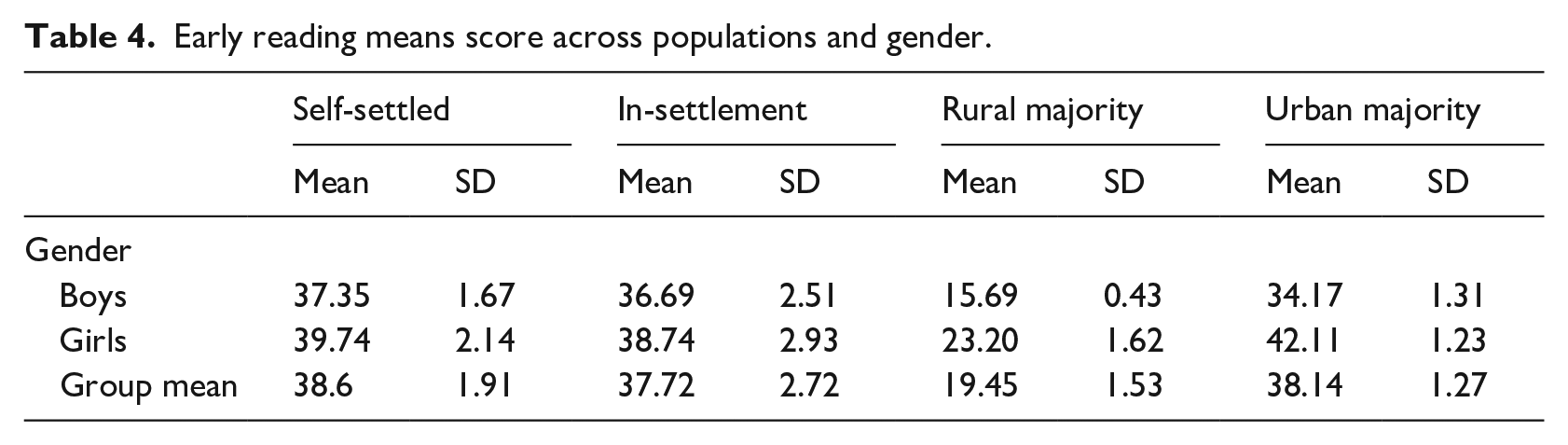
HLE and family SES as predictors of early reading learning attainment
Hierarchical multiple linear regressions were conducted to determine the extent to which HLE and family SES variables would relate to children’s literacy attainment. The mean for early reading (EGRA) was used as a dependent variable. For block one, we entered age and gender and for block two, home learning environment and family SES – indexed by parental education and family wealth – as control variables. Empirical evidence has consistently indicated that parental education is the best predictor of disadvantaged children’s learning attainment, with maternal education being most significant in the early years (Murphy et al., 2018; Ndijuye and Rao, 2019). In the third block, the social group (naturalised citizen or local majority) was entered. The study used dummy coding system in which the categorical variable of social group was assigned 1 for self-settled naturalised citizens, 2 for in-settlement naturalised citizens, 3 for rural majority group, and 4 for urban majority group.
The results indicate that age and gender significantly predict children’s early reading attainment (F (2, 44) = 83.422, p = 0.0011), accounting for 32.1% of the total variance. While family SES explained an additional 32.4% of the variance (F (4, 42) = 72.441, p = 0.0012), home learning environments (F (4, 44) = 74.383, p = 0.0022) explained 15.3% and social groups explained 10.3 of the variance F (5, 43) = 74.461, p = 0.0013, and the change in R2 was significant. The findings for specific variables indicate that the critical predictors of early reading attainment were age (β = 0.125, p = 0.031), gender (β = 0.173, p = 0.022) and parental education (β = 0.212, p = 0.013), followed by family wealth (β = 0.165, p = 0.036), home learning environment (β = 0.153, p = 0.001) and social group (β = 0.103, p = 0.018). In the final model, the variables together accounted for 90.1% of total variance.
Differences in early math learning attainment across population groups
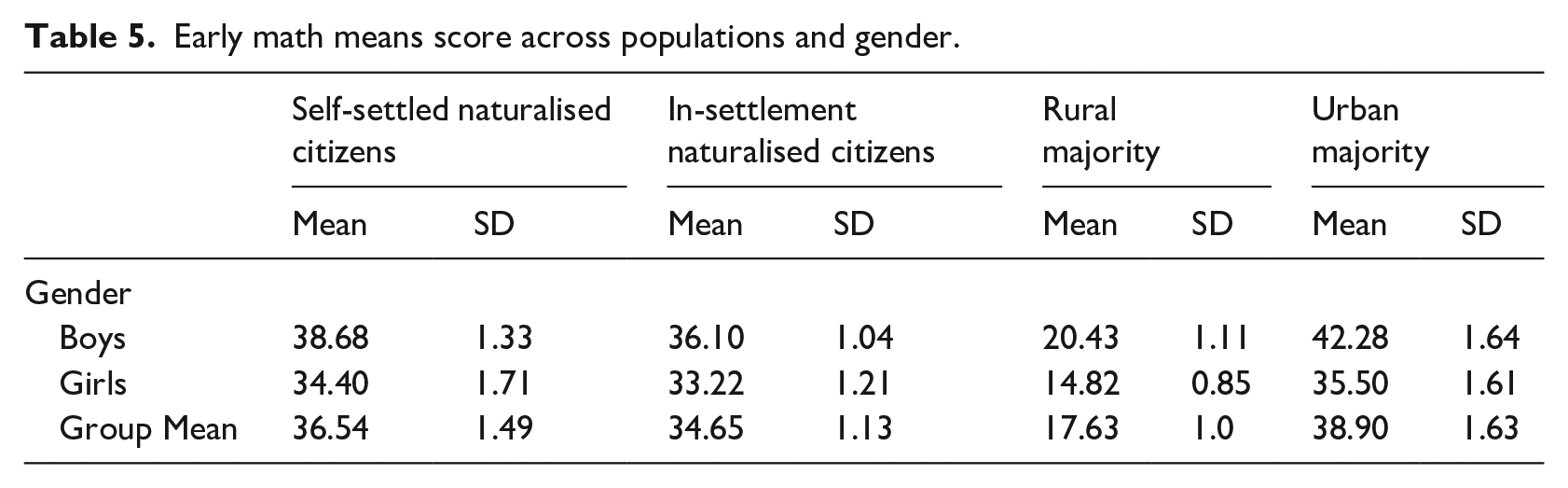
For this component, a two-way analysis of variance that includes social groups and gender as in-between subject variables was conducted. The results indicate that the main effects of gender are significant (F (1, 142) = 20.219, p = 0.021, d = 0.567). The follow-up test revealed that the early math mean for children of naturalised backgrounds – self-settled (M = 37.54, SD = 1.33) and in-settlement (M = 35.66, SD = 1.11) – was comparable to those from more advantaged urban groups (M = 38.32, SD = 1.41). Compared to other groups, children of the rural majority undergo schooling, but not entirely learning (M = 17.66, SD = 1.65). Observations of the findings by gender indicate that across population groups, boys (M = 38.39, SD = 1.54) performed significantly better than girls (M = 22.61, SD = 1.27). And boys from the urban majority group (M = 42.28, SD = 1.63) had the highest mean than boys from other population groups. A detailed report is presented in Table 5 below.
Early math means score across populations and gender.
Predictors of early math learning attainment across population groups
Hierarchical multiple linear regressions were conducted to determine the extent to which HLE and family SES variables would predict the children’s early math attainment. In block one, age and gender were entered, while in block two, we entered the control variables of parental education and family wealth as proxies for family SES, and home learning environment. The social group was entered in the final block of the regression model. For analysis, this study used dummy coding system in which the categorical variable of social group was assigned 1 for self-settled naturalised citizens, 2 for in-settlement naturalised citizens, 3 for rural majority group and 4 for urban majority group.
As indicated in Table 6, in block one, the contributions to the regression model of age and gender were significant (F (1, 43) = 109.112, p = 0.0011), accounting for 31.1% of the variance. In block two, the combined family SES variables (F (2, 44) = 82.235, p = 0.000) explained an additional 37.6 of the variance, while home learning environments (F (2, 45) = 80.3114, p = 0.0012) explained 20.4% of the variance. In block three, the social group explained an additional 1.7% of the variance (F (3, 40) = 68.574, p = 0.0023) and the change in R2 was significant. Important predictors of children’s math attainment are age (β = 0.075, p = 0.026), gender (β = 0.236, p = 0.024) and parental education (β = 0.213, p = 0.014), family wealth (β = 0.163, p = 0.011), home learning environment (β = 0.204, p = 0.0012), and to a lesser extent, social group (β = 0.013, p = 0.0078). In the final model, the five variables together accounted for 90.8% of the variance in numeracy attainment.
Hierarchical regression analyses for literacy and numeracy attainments.
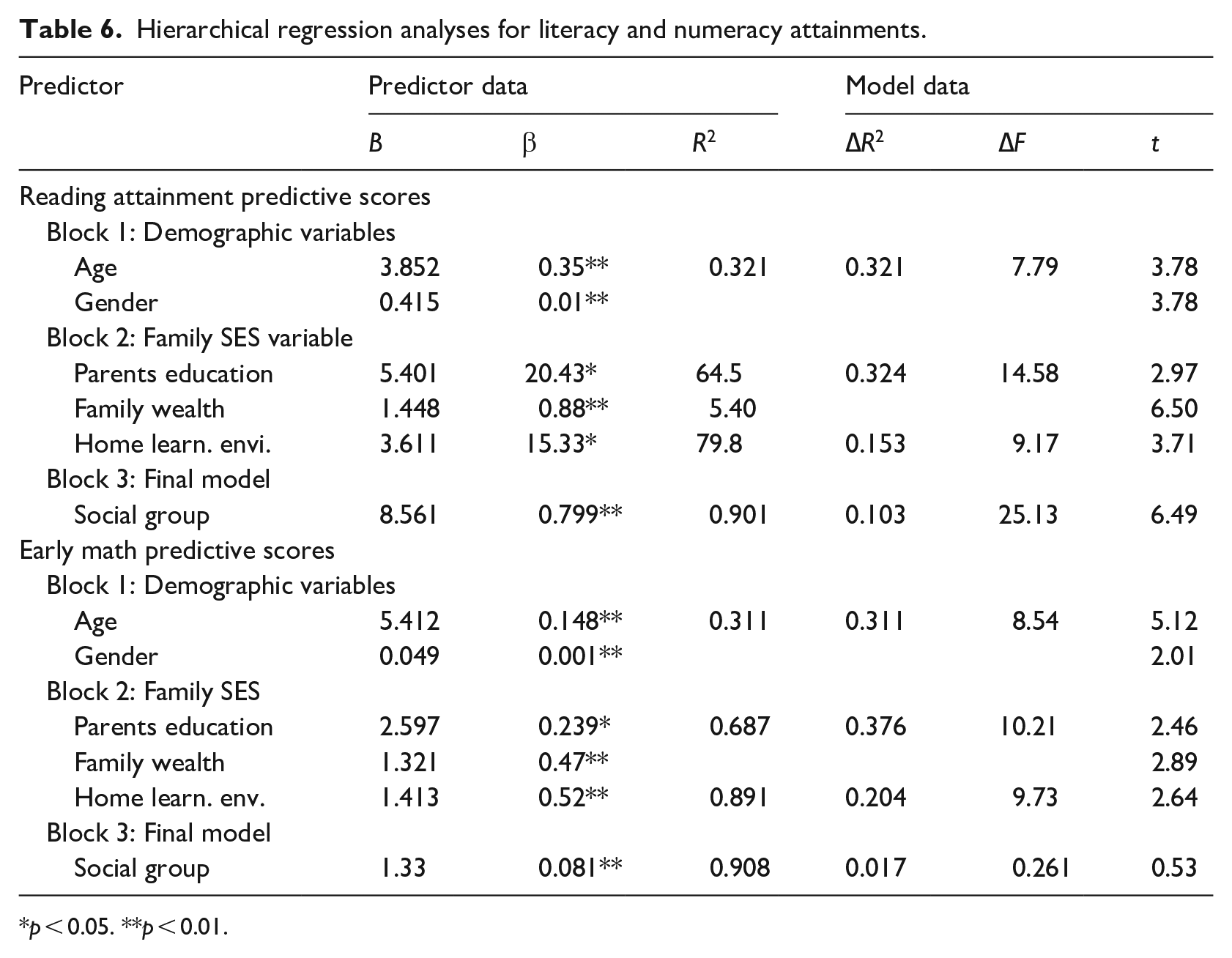
p < 0.05. **p < 0.01.
Findings from follow-up interviews
The interviews with school principals showed that to achieve the children’s all-round developmental potential, it is vital to have well-trained and qualified early grade teachers. The school principals centred their arguments on having qualified teachers and teaching experience to work with early graders. Moreover, they pointed out the need to recruit, train, and retain more early grade teachers. It was found that in Tanzania, one out of eight teachers is trained to teach this level of education and after working for fewer than 5 years, one out of three qualified early grade teachers switches jobs or quits the profession altogether.
Teachers and parents indicated that most of the early grade children spoke vernacular languages and were highly conversant in another language – but not Kiswahili, which is the language of instruction. This was particularly reported by teachers as the greatest stumbling block for children to acquire and develop the necessary foundational skills to master basic learning experiences. It was revealed that among children from the groups of naturalised citizens and rural majority in particular, the language spoken by children at home was different from Kiswahili, the official language of instruction – see Figure 1. Among the self-settled naturalised citizens, almost all children were multilingual – speaking Kirundi at home, interacting with children from the local majority in Kiha and using Kiswahili in the classroom. One school principal for the population group of naturalised citizens commented:
Some children here are from the local majority. However, Kirundi is widely spoken and children speak it here, while my teachers don’t understand a word of it. It’s challenging to facilitate early learning for these children.
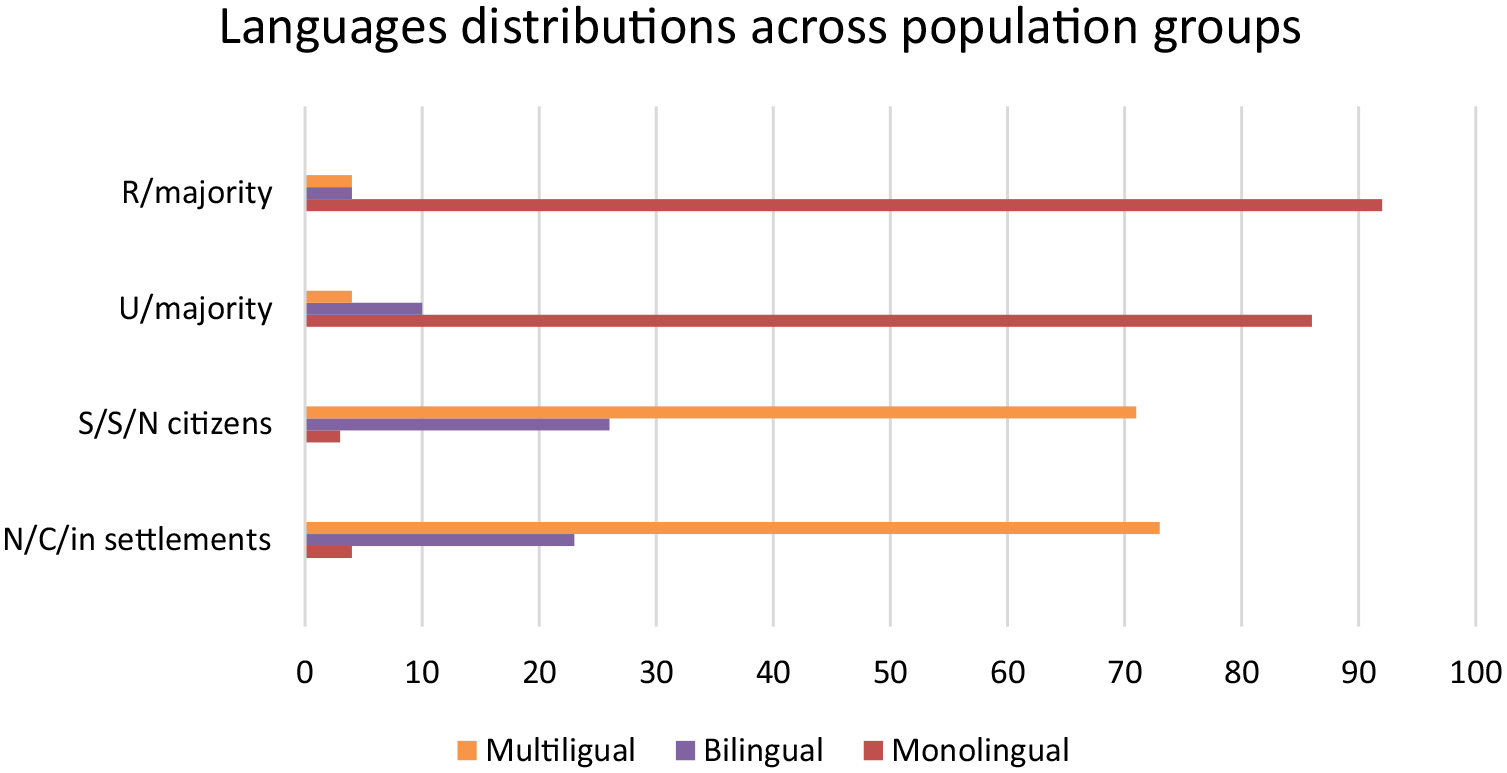
Reported language distributions spoken by children across social groups.
Parental beliefs and expectations about their children’s education vary across the population groups. While parents from the urban majority group consider education to be a child’s right and necessary preparation for the future, their rural majority counterparts are of the view that education for their children is an imposed government programme, that is, they send their children to school only to avoid violating the existing laws and imprisonment. Parents from the two groups of naturalised citizens consider education for their children as a means of upward social mobility and protection from recruitment as child soldiers. As such, they ensure that their children were not just schooling, but learning as well.
Discussion
Differences in learning attainment across social groups
While the findings indicate that children of naturalised citizens have comparable learning attainment to that of the more privileged urban majority, rural majority children generally undergo schooling, not learning on their grade level, as do their peers. These findings pinpoint the important role of family socioeconomic status and supportive home learning environments as the determinant factors for children’s learning attainment (Ip et al., 2016; Troller-Renfree et al., 2022). However, given the immigrant and refugee backgrounds, these findings could be broadly interpreted by considering the vital role of family SES and home learning environments in relation to other contextual factors that influence children’s development and learning (Ndijuye and Tandika, 2022b; Wolf and McCoy, 2019).
Gender divides in early reading and math learning attainment
Across the social groups, the girls outperformed the boys in early reading attainment, while the boys outperformed the girls in early math learning attainment. As a distinctive group, compared to other groups of girls, those from the urban majority showed a higher early reading attainment. These findings are consistent with those by Ip et al. (2016) and Koury and Votruba-Drzal (2014) on gender divides during the early years of schooling and the Ndijuye and Rao (2019) on immigrant girls demonstrating comparable learning attainment to local majorities.
These findings reflect and are consistent with other studies conducted in this region (Kafle et al., 2018; McCoy et al., 2017; SACMEQ, 2020). For instance, a regional assessment of early literacy by the Southern and Eastern Africa Consortium for Monitoring Education Quality – SACMEQ (2020) showed gender divides across all tested countries. It was speculated that the attainment gaps across genders were due to the limited number of female staff, school safety such as school fences and sanitation measures, such as separate toilets for boys and girls. However, more studies are required to establish empirical basis for this claim.
Relationship between the children’s social group and early learning attainment
While the findings show the association between social groups and children’s reading attainment, there was no association with early math attainment. These findings seem to suggest the critical role of the language of instruction in the children’s acquisition of reading skills. If so, these findings are very interesting in that about 75% of children in this study did not speak Kiswahili at home, although Kiswahili is the language of instruction in Tanzania. Empirical evidence indicates that children acquire foundational reading and mathematics skills when taught in a language they can understand – preferably their mother tongue (Busch et al., 2021; Piper et al., 2018).
However, the current 2014 Education and Training Policy mandates that teaching and learning of all early graders registered in public schools should be in Kiswahili (URT, 2014). Unfortunately, this language is commonly used in urban areas (Hiza, 2018; Qorro, 2013). As a result, children, especially in rural areas, are fated to be unskilled bilingual or multilingual pupils as soon as they enter the school. Given the existing evidence (Busch et al., 2021; Qorro, 2013), this approach has negative implications on their early reading skills, partly because Kiswahili is not a language most of them have mastered (Ndijuye and Rao, 2019).
The findings of follow-up interviews indicate deep-rooted parental beliefs and expectations of education among naturalised citizens. More specifically, parents from this sub-group consider education an important means to remove their children from intergenerational poverty and raise their social status. These findings are consistent with those by Han et al. (2012) and the Ndijuye and Rao (2018, 2019). Moreover, they contribute to the ongoing debate about the role of parental beliefs, expectations and home practices in children’s early development and learning in a context with an acute shortage of educational resources (Ndijuye and Tandika, 2022a, 2022b). The role of parental beliefs in influencing children’s early math and reading could be the result of positive parental beliefs towards math (Mues et al., 2022), in a predominantly paternalistic communities, fathers’ beliefs about the importance of mathematics or reading (Niklas et al., 2020). However, in the context of this study, these are still speculations which should be empirically verified.
Role of home learning environment on children’ early reading and math learning attainment
Children of naturalised citizens – both in-settlements and self-settled – demonstrated almost comparable reading and mathematics attainment as those from more advantaged urban majority group. These findings can be explained within the context of the existing role of family SES, parental involvement level and parental beliefs and expectations of education. In a context with limited educational resources, existing studies from both developed and developing countries have documented parental beliefs and expectations to be a critical predictor of children’s early development and learning (Ip et al., 2016; Ndijuye and Rao, 2019).
Findings indicated that compared to other groups, parents from the naturalised citizens were more involved in their children’s learning and development. This led to their children to indicate higher learning attainments. Similar findings from this region were reported by Ndijuye and Tandika (2022b), and Ndijuye and Rao (2019). Findings from other contexts – the United States (Niklas et al., 2020), Oman (Tekin et al., 2022), and Hong Kong (Ip et al., 2016) indicates a linear relationship between family SES and level of parental involvements. In this study, parents from naturalised citizens were relatively socio-economically less privileged than those from urban local majority – who, surprisingly were less involved in their children’s learning. Their increased involvements could have been triggered by immigrant/refugee backgrounds, beliefs, and expectations or both. However, these are speculations which require empirical evidence to justify.
Conclusion and recommendations
While most of the developing sub-Saharan countries have successfully broadened access to basic education, most still face the challenge of ensuring that registered children are learning at their respective grade level (RTI International, 2020; SACMEQ, 2020). This calls for deliberate efforts to invest in key strategic areas, such as broadening access to quality pre-primary education, improving the quality of teacher education, empowering educational systems management and strengthening parent and school relationships to forge partnerships.
In terms of rights, all children deserve access to quality early grade education regardless of their background, gender, family socioeconomic status or civil status. This study recommends that in a context with an acute shortage of educational resources, systemic support is needed to ensure that all children have access to quality early years education. To reduce disparities in early learning attainment across social groups, immigrant status and gender, the quality of the existing teacher education programme must be improved. This study used a mixed design, there is a need to conduct in-depth qualitative study to explore how parental beliefs and expectations influence children’s early reading and math in a context with limited school-related resources and poor home environments.
Footnotes
Authors’ note
We are equally grateful to our study participants including children, parents, teachers and school principals.
Declaration of conflicting interests
The authors declared no potential conflicts of interest with respect to the research, authorship, and/or publication of this article.
Funding
The authors disclosed receipt of the following financial support for the research, authorship, and/or publication of this article: We would like to acknowledge support from Education Quality and Learning for All (EQUAL), a Global TIES for Children initiative funded by the New York University Abu Dhabi Research Institute, New York University’s Steinhardt School of Culture, Education, and Human Development, Ford Foundation, the Open Society Foundation and the Catalyst Foundation for Universal Education which partly financed this study.
