




Abstract
This paper is located within a larger study of children’s voice and storytelling. The focus is on how children use artifacts, such as special objects and photographs, to tell stories about their lives. We studied the collaborative learning of educators, in two schools in Eastern Canada, as they used sharing circles and multimodal pedagogies, and worked to elevate and listen to children’s voices during a period of pandemic teaching. This study examines children’s things/artifacts as material culture and relates things/artifacts to artifactual literacies. The action research design included a consideration of children’s voice in early years research alongside the collaborative professional development inquiry undertaken by educators in the study. An analysis of key findings as they relate to evolving pedagogies, including how artifacts were used to tell stories, and how voice can be viewed through this artifact sharing is presented. We argue that building voice and collaboration can result from pedagogies of classroom sharing and listening. Educators’ challenges in this research and their classroom teaching during a constantly shifting set of teaching conditions are fore fronted. Insights from children’s particular artifacts and their stories enhanced educator and peer awareness of difference, and of cultural practices in families. Finally, implications for practice, and future research possibilities are presented, along with an argument for viewing children’s voice as emergent alongside classroom multimodal pedagogical practices that augment children’s voices.
Keywords
Introduction
Children’s voices, and their stories, can be heard—materially and audibly—through the artifactual sharing that emerges from multimodal pedagogies. Here, we recount how young children (aged 5–6 years) used artifacts, such as special objects and photographs, to tell stories about their lives. We also share how educators find ways to listen to children’s voices. We view young children’s voices through a shared perspective of both words spoken for communication and the materials in the form of artifacts, together these form multimodal stories. We are proposing that voices can be “heard” through materials and that artifacts can tell stories.
Two Canadian academic researchers studied the collaborative learning of educators, as they used sharing circles and multimodal pedagogies in two schools in Eastern Canada. The data collection at this site was a part of an international research study focused on children’s voice and agency and took place during the COVID-19 pandemic in the spring of 2020. A dual focus on children’s stories and voices invited educator professional learning opportunities to enhance their inclusion of student voice in curriculum through artifacts. Educators learned about children’s lives through the “artifactual stuff” they keep, the stories they generate around these possessions, and the contexts in which these stories are shared.
***
Since Miller published Stuff (2013) and Pahl and Rowsell published Artifactual Literacies (2010), others have drawn from and built on their ideas and thinking about materials and artifacts (i.e. Heydon and Du, 2019; Ibrahim, 2016; Savage-Shepherd, 2012). Miller brought to the forefront how things act on humans as well as how humans act on things, and particularly illuminated how the things that surround us also define us. Looking through the lens of artifactual literacies provides insight into identities (Whitmore, 2007), and points to the agency of artifacts, the power of emotions related to artifacts, and possibilities for understanding artifacts in culturally diverse contexts.
Firstly, the framing of this paper in material culture and its relation to artifactual literacies, provides a lens into children’s voices, identity, and agency. Then we describe the study’s inquiry design, which includes a discussion of children’s voice in early years research alongside the collaborative professional development opportunities as invitations to educator inquiry. These sections are followed by our key findings as they relate to evolving arts-based pedagogies, including how artifacts were used to tell stories, and how voice can be viewed through this artifact sharing. Finally, implications for practice, and future research possibilities are presented, along with an argument for viewing the emergent processes of classroom multimodal pedagogical practices that are purposefully framed to elevate children’s voices.
Material culture and artifactual literacies in young children’s lives
Children relate to and learn from material culture. The artifacts that provoke children’s stories connect them to people, places, events, feelings, and identities.
Material culture
Objects both create meaning and are meaningful. The objects in our lives are enmeshed with the ways that we display our inner worlds and voice our identities to those around us. Through the clothes we wear and by the things we choose to use or display, material culture displays or expresses ourselves and identities (Miller, 1998, 2010). When Miller talks about “the humility of things” (p. 50), he emphasizes their silence or invisibility in daily lives and how, because they are quiet and integrated, they influence our actions, and our relations, in powerful ways. He argues that “objects make people” (p. 53), that the stuff of our everyday lives, once brought into being, influences passions and how people live. There is a mutual dependence between the social and the material within our lives (Gutman and De Coninck-Smith, 2008; Woodward, 2020).
This paper focuses on children’s material culture as a representation of voice. A child’s life “experience is defined by materiality” (Derevenski, 2000: 5). Often objects are both spatially and temporally sensitive (Frykman, 2016), and can trigger memories and emotions of places, times, and relationships to others (Barrett, 2001). Children’s things exist, are seen, and are used in ways that far exceed their branding or their makers’ intentions. For children, material objects can be mutable and adaptable (McDannell, 1995: 3). Sometimes, this stuff can fade into the background. Here, we present what we can learn about identity when children’s stuff or things are brought into the foreground in an early years classroom. A focus on children’s material culture is a one route into a focus on children’s voices and perspectives.
Building artifactual literacies
Children’s favored objects may also be viewed as artifacts. Using “artifacts” makes an explicit connection between ethnography and anthropology. Here, the practice of seeing objects as reflective and productive chronicles the building of personal histories and relations (Heydon and Du, 2019). Artifacts are contextually intertwined and socially situated; they are closely linked to the cultural, social, emotional, and spiritual aspects of human life. Artifacts can be represented in multiple modes, such as drawings and photos (visual) or songs and oral storytelling (oral) (Randall and Mercurio, 2015). In Artifactual literacies: Every object tells a story, Pahl and Rowsell (2010) describe the characteristics of an artifact as follows:
Has physical features that make it distinct, such as color or texture.
Is created, found, carried, put on display, hidden, evoked in language, or worn.
Embodies people, stories, thoughts, communities, identities, and experiences.
Is valued or made by a meaning maker in a particular context (p. 2).
Artifactual literacies are assembled within the praxis of multimodality and material culture. Multimodality allows artifacts to be viewed as texts and literacy practices that can be enacted across modes, cultures, and languages, whereas material culture allows insight into how materials represent culture, and emphasizes the literacy value of artifacts (Kress, 2003; Pahl and Rowsell, 2010, 2011; Rowsell, 2011). The sharing of artifacts by children has bridged children’s out-of-school and classroom experiences (Whitmore, 2007). The use of artifacts as a storytelling device has been employed by grandparents and other elders alongside children (Heydon and Du, 2019). Furthermore, children’s artifacts have been studied through the narratives generated by children (Brahms and Crowley, 2016), whether they are told online (Bogard and McMackin, 2012; Ellison, 2016) or face-to-face. Children have created diverse artifactual stories, with photographs being the most used elicitation tool (Allen et al., 2002; Clark and Moss, 2001; Moss, 2001; Newman et al., 2006). The use of artifacts has allowed immigrant children’s border crossings to mitigate the impact of stereotypical representations within schools (Karam et al., 2020). Telling stories from artifacts can center children’s voices and enhance their sense of agency (Harris et al., 2020). An artifactual literacy framework can be used to understand the discourses which underpin children’s voices, that are less often heard, and have the potential to address classroom inequities.
Educator inquiry about children’s voices
In our initial meetings with educators during the September onset of the COVID-19 pandemic school year, we were struck by educators’ hopes for normalcy alongside continued safety routines for the upcoming school year. Originally our research was planned to work alongside educators in their classrooms. As the school year progressed and ‘COVID cases increased, we came to depend more on virtual project meetings with educators, and educators became the primary data collectors. The majority of the educator data was collected through virtual interviews, focus groups held outside of school, and email correspondence. In the end, we were able to make three to four in-person visits per class. Our meetings with educators emphasized that their classroom pedagogies were focused on building trusting student and family relationships while using intentional listening strategies. Educator inquiry as a methodological approach supported this classroom research.
Educator inquiry
Educators were interested in exploring pedagogies that emphasize children’s oral language within circle time held daily in their classrooms, while also sharing artifacts. The usual sharing time practices of educators were examined more closely, and, in addition, children engaged in extended sharing of cultural and family artifacts that were co-chosen with their family members. Sharing circles are often used by educators as ways to build meaningful skills for discussion that can be later transferred to small groups (Moses et al., 2015), can be used to enhance student voice while responding to and critiquing literary texts (Cloonan et al., 2020), and require young children to respond and to listen to others in ways that may be new to them (Zaghlawan and Ostrosky, 2010). The approach to educator inquiry was collaborative (Black, 2019) and based on educators’ needs and their already strong networks in their own schools. In order for educator inquiry to be successful, the strengths and perspectives of educators must be the starting point and guide for change (Fleet et al., 2016).
Children’s voices
There can be tensions between research agendas and the methods needed to gather data that honors children’s perspectives (Fielding, 2012). Children’s perspectives may not neatly match the researchers’ original intentions and questions. Co-researching with children can be logistically difficult and time-consuming. An intergenerational approach where children’s voices are encouraged by adult facilitators in “responsive, gradual and sensitive ways” that serves to capture both the researchers’ inquiries and engage children’s voices is one adaptation that is useful (Blaisdell et al., 2019: 28). In “the practice of listening to children,” Yoon and Templeton (2019) explain how children often create their own stories in the classroom, and this may or may not align with the curriculum agenda. At times, children’s own stories can be dismissed when they fall outside of the classroom lesson. Missed learning opportunities about children’s storied lives can result when their voices are not taken seriously.
As reasoned in the sections on material culture and artifactual literacies, we view children’s voices as multimodal, and exceeding understandings of voice as “beyond the articulation of words or sentences” (Arnott and Wall, 2022; Wall 2017). At the same time, while working with educators’ beginning understanding of children’s voices, we paid attention to the things that children said aloud. With online teaching, educators became acutely aware of who was speaking and whose voice was heard in the virtual classroom. Educators shared how they began to listen more intentionally with purpose to understand some students in new ways, especially those who were often silenced in the in-person school classroom due to some children’s stronger voices and individual personalities. Seeing children’s voices as diverse and emergent can benefit educators and researchers as well as children. Doing so can create more inclusive pedagogies that shift power relationships in classrooms and impact the learning of both the educator and children.
Sites, participants, and data collection
Research design
The data collection represented here took place from May 2020 to June 2021. Institutional ethics approval was received. Interested educators were contacted by each school’s administration team. All educator participants were introduced to the study at a full-day artist workshop at The Rooms Art Gallery in August 2020. Due to the pandemic, permissions were collected by the school administration teams in September 2020. Prior to the collection of these permissions, schools were visited with the children and educators outside on the school playground. Due to changing COVID-19 health regulations, schools switched from in-person education to online education twice during this data collection. We adapted by switching between in-person and online interviews alongside both in person and virtual classroom observations.
As a collective, the researchers and educators agreed that collaborative approaches and multiple formats acknowledged the global community residing in both schools. We worked with educators and artists to plan a curriculum that would merge arts-based instructional pedagogies with storytelling. Children were invited to bring their own voices and stories through their chosen artifacts of favorite family objects and to participate in sharing circles. Children were encouraged to respond in various multimodal ways such as through engaging in interviews and conversations between classmates, viewing pictures of landscapes that families provided, making drawings of favorite places, and, in some cases, playing with their objects/artifacts when pandemic measures were eased.
Educators also expressed concerns about the toll of exhaustion and extra tasks needed to accommodate the COVID 19 health and safety measures in their classroom. We noted that time to use arts—based practices was impacted at particular points during the pandemic. For example, each child needed their own art supplies and were not able to share supplies as the usual practice. Educators were also impacted by the cumulative effect of so many small tasks (i.e. disinfecting, sweeping, reminding, masking, supervising lunches, and snack breaks) which also meant that their days provided no breaks or spaces for catching up with children and simply taking a breather (Focus Group, June 2021), which made classroom life like a “death by a thousand cuts” (Adele, 1 Educator).
The educator inquiry groups
Both educator inquiry groups were situated in schools, representing two of the lowest socioeconomic areas of the city, in a major urban city located on the East coast of Canada. A number of children lived in group home settings, in foster care, with grandparents, or with other family relatives. About 45% of the students at each school spoke a primary language other than English, and about 30% of the students came from refugee backgrounds. In both schools, upwards to 20 different languages were spoken. A number of children identified as having Canadian Indigenous status or family ancestry. All educators in the study actively participated in school social justice initiatives such as provision of food hampers for families, reading program resources for new immigrants, setting up LGBTQ2 meeting spaces, and general outreach. As such, the research sites are renowned for their efforts to promote multicultural education, Indigenous education, and have played a critical role in supporting migrant and refugee children. All educators and researchers identified as White cis-gender women.
Research processes
The table below gives a sense of unfolding research events over the course of the academic years.
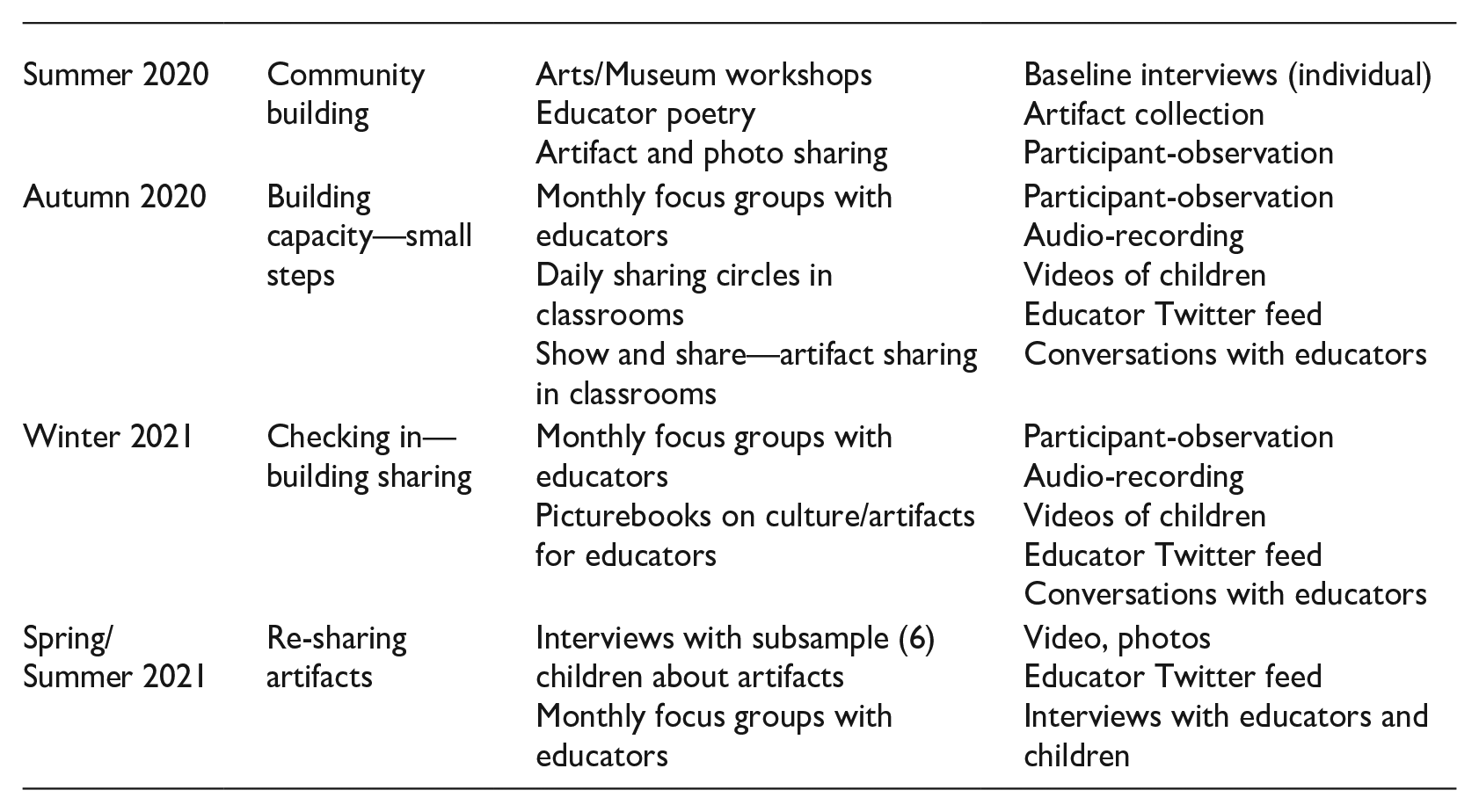
From the outset, educators provided us with additional information about the ways in which educators already considered and centered children’s voices in their classroom. To bolster the transparent, ethical, and collaborative nature of the educator inquiry, ongoing findings and data transcripts were shared with educators (Groundwater-Smith and Mockler, 2007). Using the factors of listen with purpose and culture proposed by Wall et al. (2019) as central to pedagogies that promote children’s voices, we worked with educators to examine how children’s voices can be heard and honored in diverse and expansive ways. The research interest in children’s voices was reframed in ways that were accessible and reasonable in terms of the classroom time and focus required from educators, especially considering the pandemic health measures in the classroom that prevented children from bringing artifacts to school. The academic researchers reflected on educators’ concerns, communicated usually via text on a research phone, and through email, and guiding questions for the focus group emerged about how children’s voice was manifested through the activities resulting from health measures.
We conducted interviews and focus groups with educators about current sharing circle practices and how the workshops impacted their practice, and collected images, artwork, twitter data, and observations in the classrooms. There were 5–6 focal educators working at each of two sites with 15–20 children in each of their classes. Educators collected video data of children sharing their portrait photos, photos of the objects, and, in some cases, the physical objects themselves. Although we collected video data, these representations (child standing and talking while holding/showing object) were quite stilted and not seen as useful for multimodal data analysis. For this reason, we focused on the kinds and types of objects shared and the transcripts words spoken.
Data analysis focused on the ways that children’s stories materialized through the sharing of artifacts, the kinds of artifacts that are shared, the ways that sharing circle pedagogies shifted, during the earlier and later stages of the pandemic. Some of the teaching avenues which affirmed the emergence of children’s voice as diverse arose with children’s connections to important family objects/gifts and photographs representing family memories associated with a place.
Findings: Pedagogies, artifacts, and educators listening to children’s voices
Focal findings, which appeared through the inquiry research cycle, include how educators were building of voice and collaboration, the influence of COVID-19 and online teaching constraints on artifact sharing, and insights into the kinds of cultural artifacts and stories that were shared.
Pedagogies of classroom sharing and listening—building voice and collaboration
In our initial conversation with educators, we noted their commitment to create both classroom and community spaces where children could speak and share their ideas and thoughts. Educators reflected on their trajectories of learning to listen intently to young children. As a part of our focus group discussions they identified (1) the potential for listening to children’s voices when providing individual support to children, (2) the sense of calm and increase in children’s confidence that a sharing environment can evoke, (3) the benefits of community building approaches such as using a talking stick within sharing circles to provide space for less vocal students to be heard, and (4) the ways that children’s reflections can influence educators’ planning as well as their understanding of children’s experiences. We share some of the events and conversations when educators saw as opportunities to enhance children’s voices.
One experienced educator named Winifred described the atmosphere that sharing circles created, and described the length of her journey toward achieving that atmosphere:
And it’s probably the quietest part of my day. Everybody – everybody is listening to what the other one is going to say, how they’re feeling. It’s amazing. Right? And yeah, so it is – it’s a very – it’s a really – I enjoy it. You know. Just to see how they’re feeling. And if someone says, you know, “pass,” because they’re allowed to pass if they don’t want to talk, and I’ll – I’ll make it a point to get to that person after circle. . .It took years to do that, right? (Interview with Winnifred)
Although many educators were familiar with similar sharing strategies, enacting such practices in an outcomes/curriculum delivery framework is not easily achieved in early years classrooms. It also takes confidence on the part of the educator to understand that “silence” or “passing” is also a child’s way of sharing their voice. In a similar way, other educators expressed what they learned, sometimes unexpectedly, from listening to children during sharing circle time:
And sometimes too it’s eye-opening for me because something that may seem insignificant or to me might be “Oh, three or four kids said that this was their least favourite part of the day” or “They learned this, but they didn’t learn that” well, that’s something that I can focus on for tomorrow. (Interview with Adele)
On a practical level, educators expressed how they used children’s reflections to inform their day-to-day-curriculum decisions. These were often shared at the weekly meeting where the educators came to plan curriculum delivery for the following week and where they shared common experiences of “eye-opening” moments when children voiced concerns enhanced their collective listening and led to considering children’s voices in planning. Together, with the educators we worked to develop a mutual understanding of what we meant collectively when we used the term “voice.” Another educator shared
The idea of children’s voice really, is probably at the core of a lot my teaching practice, because I think that, you know – that’s ultimately the people that we want in our future are people that have strong voices and, you know how to use it to create and effect change, you know. So, our circle time is definitely a place where students begin to understand their “voice” and I find circles effective because it allows children who are quieter and maybe not as dominant in their personality to be able to express those ideas. (Interview with Janice)
Janice acknowledges how shared circle time is not only a physical space in a classroom but also a space of trust where students can voice their feelings, whereas a busy curriculum does not always support open sharing. For Janice, the sharing circle is a place where voice is defined through active listening by educators and children.
Educators also talked about other ways they made space for children’s input, such as taking photos of children’s art making, and posting these in classroom spaces children chose. Educators made space for children to teach each other, provided open-ended play-based centers, engaged in outdoor nature child-directed inquiry, and read books focused in developing social and emotional understanding. In our meetings, educators stressed the importance of building a trusting classroom environment through the strengthening of classmate relationships and outreach to families through emails, Twitter and classroom newsletters. We observed how these strengthened relationships through children’s turn taking, purposeful listening, and educators’ questions when they talked about the artifacts in the classroom.
We invited all educators to video record children sharing a favorite artifact. Educators invited parents/guardians to help children choose an important artifact that reflected children’s lives at home, their time spent with family, or their cultural practices. Educators included families through encouraging them to talk and ask questions at home to prepare children for their artifact sharing circles. In the next section, we examine the kinds of artifacts that were brought to school and the stories they provoked.
Educators’ perspectives on artifact sharing
The constraints imposed by the pandemic impacted how educators could draw from previous classroom approaches to sharing. When children were unable to bring in their physical objects to share, parents shared emailed photographs. The lack of tactile learning, of holding, feeling, and passing artifacts from child to child while sharing about the objects and associated stories, may have constrained how sharing circle activities were usually carried out, and therefore impacted how educators could support children’s voices. Further to this, educators found that additional lesson planning and time were needed for digital sharing of artifacts. The technology set up and digital delivery in the classroom disrupted how the children’s stories could be shared and elaborated upon by peers. Educators witnessed how the physical absence of artifacts meant less pausing, and limited reflection and sharing on the part of other children. Instead, children stood alongside an image of their chosen artifact projected onto a PowerPoint slide displayed on the classroom smartboard (see Figure 1).
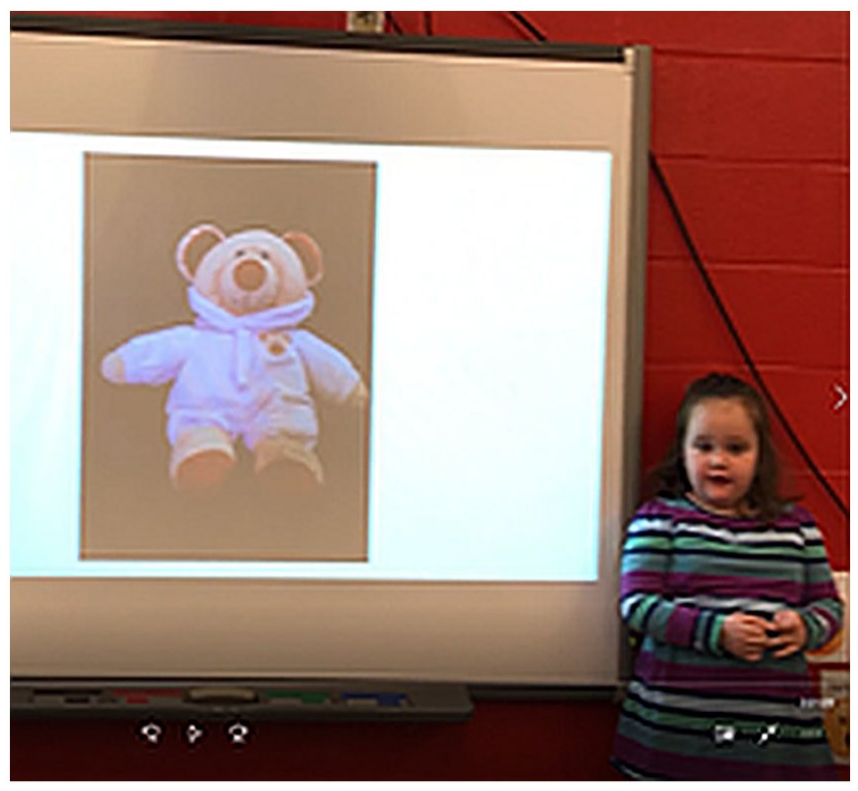
Girl showing teddy.
As a result, the sharing circle where typically everyone’s attention is directed to the child who gives a brief introduction and then the object is passed around for children to view, ask questions and share their own connection, was stilted. This type of format tended to lead to more educator-guided questions, often with short student responses, and fewer naturally occurring conversations amongst peers. One of the educators commented: “It was very directed by the questions. They couldn’t just get up and speak to what they had and what it meant to them” (Focus Group, March 2020).
After viewing the videos, many of the educators expressed a lack of satisfaction with the richness of the stories associated with the digital artifact photographs and the ways in which they felt children’s voices were “just not there” (Interview with Adele, 2020). Kary felt “the kids could not connect.” Further discussions shared educators’ feelings that the digital sharing activity was too structured and not organic enough compared to pre-pandemic sharing. Educators acknowledged that this lack of physical contact with the artifacts limited the connection and affections usually shared by children in sharing circles.
In this study, educators were placed in the unique position (to them) of being responsible for collecting data during periods when we could not gain access the school. The increased pressure and demand on an educator’s attention and teaching practices may have intensified their concerns that the data collection would be more scrutinized, and even performative due to the video data collection. Educators also questioned whether October and November were too early in the school year for children to have built trusting relationships within the classroom community for this type of sharing (Focus Groups March 2021; June 2021). Certainly, the digital sharing of artifacts seemed less authentic than other interactions. We noted alongside the digital sharing with the stresses and health restrictions of COVID-19 created constrained sharing contexts for both children and educators.
Stories and artifacts: What did children and families choose to share?
Educators sent notes home to families with an invitation to “share a photograph of something that is personally connected to your child in some way. For example, a picture of an object that holds a special memory or moment, an object that was given as a meaningful gift or a photo of a special person or family heirloom. (Students will be given another opportunity to share their favourite toy later.)”. Families were asked to help their children prepare by talking about the artifact in their photograph. The letter further elaborated that children could bring, for example, a favorite storybook, given by a family member, that is a comfort object, that is read often, and will be passed onto the child’s family in the future. Some of the children still brought a photograph of the object to school, and a few brought the physical object.
The kinds of artifacts (as depicted in photos) that children chose belonged to three broad categories: toys, cultural objects (marked by culture-language-religion), and photographs (see Table 1 below). Toys were often chosen because either the giver was special, or the artifact marked a special occasion (such as a birthday). Cultural artifacts were usually made by someone special or used for a particular practice (such as Muslim prayer beads). Photographs sometimes recounted special events (such as a family trip) or a treasured, often deceased, loved one.
Artifacts.
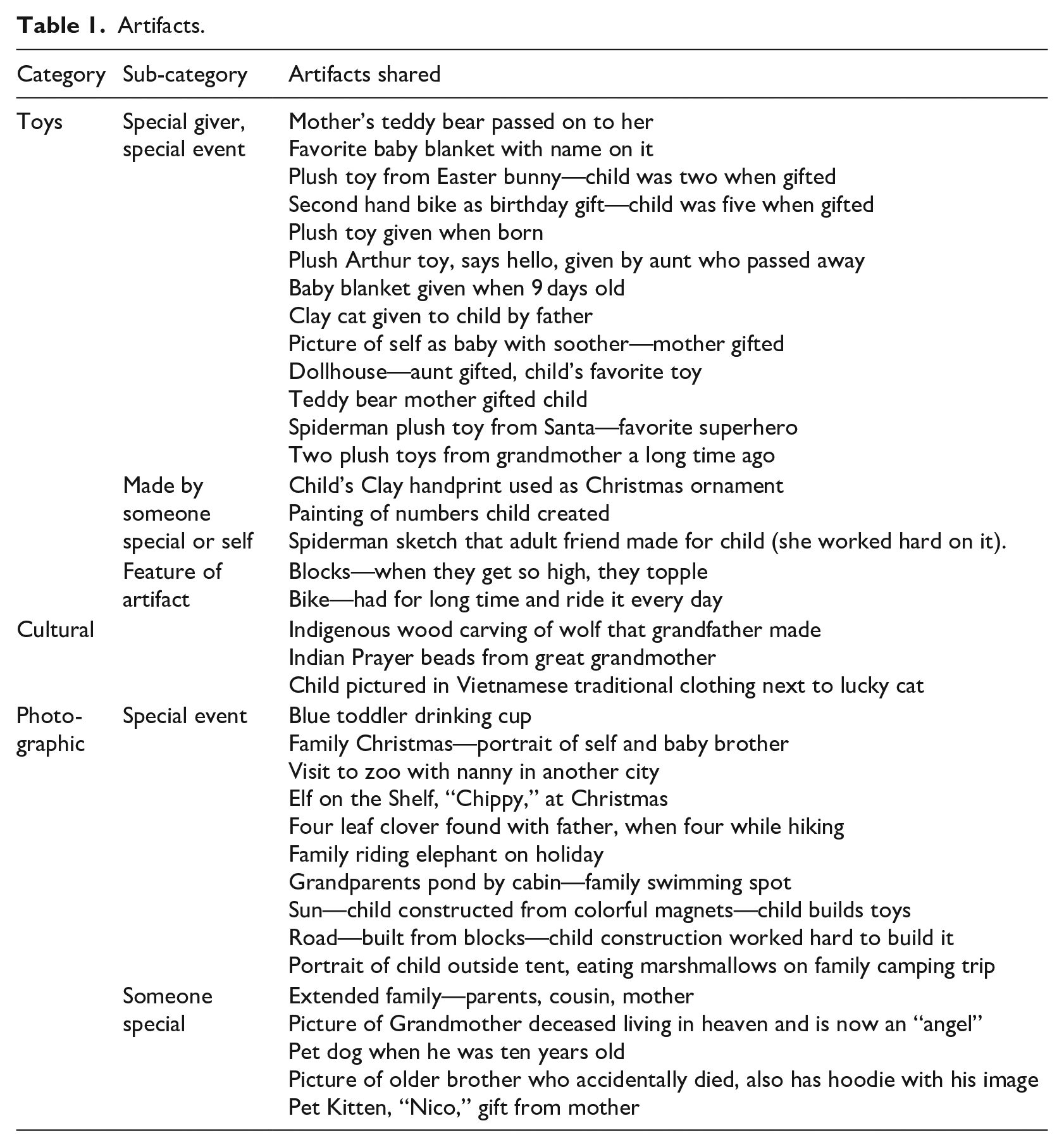
Educators were concerned that, if children brought in toys, that they might not be able to share personal stories and memories in elaborated ways outside of the popular culture narrative that came with the toy. Nonetheless, many of the artifacts (photographs and artifacts) brought in were toys given by a special person in the child’s life. Children and families interpreted toys received as gifts as meaningful objects, and children were able to talk with some prompting from their classroom educator. Educators felt that children had input into their selection of artifacts and often were able to answer questions about them and share elaborated stories about them: Educator Janelle shared, “I had a little boy who brought a Spiderman figure as his special object. He talked about how he used the superhero figure as a bowling pin and this toy had a special place in his room. He mentioned how he played superheroes with his cousins.” The sharing of toys evoked stories of family connection, of important past practices and leisure activities, and, in a sense, scaffolded children’s sharing and talk. Their material culture, or popular culture practises, were brought into view and validated in this way. The importance of these objects to parents (who gave it or who used to own it) was also shared.
Educators acknowledged that for children who were migrants, their family objects seemed more salient and more specifically tied to their heritage and experiences outside of the Canadian context. They noted that these children could easily make connections when sharing narratives about their objects. They also brought in the kinds of artifacts that educators had imagined with their home invitation. In this interview, Nora brought in her physical prayer beads from Bangladesh, which were passed down from her great-grandmother. The other children were curious and enthusiastic about the sharing of the prayer beads, they generated new knowledge about Nora’s culture and language, as well as their own personal connections to the artifact. During this artifact sharing, the educator invited Nora to answer children’s questions:
(Points to child).
Um, how. . .how does it make you feel when you hold it?
Happy.
Christopher?
Why do you love it so much?
Yeah. (She holds the beads close to her heart.)
How do you say your prayers?
In response, Nora moved the beads through her fingers and recited a prayer in Bengali. The children listened closely as the educator asked her how she memorized her prayers. Nora felt empowered to share stories about her place and her family religious practices when sharing her artifact. She later shared in an interview:
Everybody was saying, “What is that? What is that?” And I like to answer stuff.
The prayer beads themselves represent cultural and artifactual literacy practices; they need to be learned so that they can be read for prayer, as Nora explains to Author 1 in the interview
What is the most important thing about the prayer beads?
(while holding the beads) Um, I have to learn to read the prayer beads and I learned it, and I can read it by myself. That’s the important part.
Family photos evoked memories and stories about children’s experiences. The artifacts enabled children to participate in discussions about their learning. For example, sharing the prayer beads in the school opened spaces for conversations about the student’s home life and culture. Later in the interview, Nora talked about cooking with both parents, learning to make bread by herself and helping to take care of her baby sister.
And what does Mommy tell you about when she shows baby pictures to you?
My Mommy tells me about when I was small, I did this, and I did this. And you know the silly part?
Yes?
What I do, ah, when I was one, I picked up the noodle, ate it. My Mom and Dad gave me a fork, but I moved the fork, and take up my hand and put it in, and I eat it. And it was noodle—noodle was everywhere! Even my body, even my head. Everywhere!
The artifact activity firmly illustrated for the educators the importance of the inclusion of parents as supporters of their child’s cultural identities. With the enlistment of parents, we saw how associated narratives and chosen words of parents cropped up in many children’s word choices during sharing (e.g. saying that the grandmother who had passed on was an “angel”) and educators reporting a better understanding of children’s family contexts and histories.
The inclusion of family perspectives and, in a sense “family voice” was not something we had originally anticipated in this study but resulted from the kinds of activities that took place. The presence of families in the classroom was evident, at least in part, through the choices that were made. Families are often included in reading practices, when they are asked to practise reading at home and are often seen as the early literacy educators of their children (See Carroll et al., 2019; Wiescholek et al., 2018) and studies abound that make connections between literacies at home and literacies at school. Through discussion with educators about their discussions with parents, we came to understand that many shared artifacts were seen as highly valued and important by parents.
Sharing artifacts often inspired stories about grandparents who were noted as important members of many children’s families. In another example, Evan shared an artifact that his grandfather made for him, one of three wooden wolves with different-colored eyes. The object is a present-day Inuit artifact, passed down to the child before his grandfather died: “he carve[d] them with a knife.” Evan mentioned his Nan who sews all manner of children’s things, but only lets him watch her mending, because of the “pointy needle.” Another student shared in her interview that her family did not eat meals at her grandmother’s apartment, but she visited daily and helped her make bread which she sold to the neighbors.
She makes bread! That’s wonderful. Now, tell me Keira, what is the hardest part about making bread?
Um, putting the. . . dough in the bowl (shows she is kneading, punching the dough)
Do you have to knead the dough a lot? I bet your Nan—(AB demonstrates how she kneads/punches the bread) is good at it.
I don’t like it! (laughing)
Sharing memories also enabled children to talk about home literacies and cultural practices, such as making bread with their grandparents. Educators learned more about families.
Educators learning about and listening to children’s material culture, artifacts, and memories: Significance and Implications
For many of the children, their photos of holidays, everyday cultural objects, and their toys, generated reminders of people, events, and memories. Those writing about material culture Miller, Pahl, and Rowsell remind us that the objects with which we surround ourselves help to express our identities, cultures, and lived experiences. It is through these representations, and associations that objects become things, and that these things can be seen as artifacts, embodying traces of memories (an adventure resulting in a four-leaf clover) or embodied experiences (e.g. drinking from a cup, sucking on a soother were other artifacts we heard about). It is possible or perhaps even likely that children were drawn to sharing certain objects for reasons that were not obvious, and then had to attempt to verbalize or even create an explanation of what made that object seem important, as an artifact of their life. Nostalgia circled around many of the artifacts that children shared, and even though most of them were 5 or 6 years old, their recounts nodded to the past, when they were born, or when they were toddlers, or even earlier in the pandemic year. A developing bond of classroom trust alongside a school development effort to focus on children’s social and emotional health were contributing factors to elevating children’s voices. Additionally, we recorded in field notes that the circumstances of the lockdowns during the pandemic may have intensified children’s feelings about family and friends for both the children and educators.
Upon reflection, and through our discussions, we saw much value in the act of sharing and the artifacts children brought to school. Educators shared moments of intense emotion, as they gained new insights about their students’ families and family life using artifacts. Even though they were initially disappointed that many of the artifacts were toys or photos of people and places, they eventually concluded there was value in how pedagogies could enhance children’s voices as children answered questions and told stories about where the object came from, how it was received, as well as the important memories about a person and place through photos.
The sharing circle is a common teaching practice in early years settings. Looking at this teaching practice with an attentive and purposeful lens, helped educators to see ways to revalue the kinds of artifacts that children, especially those situated in low-income, and diverse population settings, might choose to share. In this case study, the diversity and richness of the artifacts chosen, and the stories and memories that were evoked speak to the diversity of children’s voices and experiences.
We also considered what voice can mean in classrooms through children’s silence. There were instances where children chose to not speak or share in the circle. Educators reminded us how children’s voices can also be heard through silence, refusal, and resistance. Children may not share and talk in ways that we expect, not because they do not have something to say, but because they do not wish to share. Educators acknowledged that enhancing children’s voices was a dual act on their part complicated by children’s understanding that they have choice and placing trust in the educator for what they share about themselves in the classroom.
As a result of educators’ discussions about the sharing circles, discussions arose around students’ mental health—this was a growing concern due to the re-emergence of a second wave of COVID-19. Educators reported changes in how they listened for children’s voices. For others, it was understanding more about the importance of giving space to voices less heard and building trust with more vocal children to understand their voices are always acknowledged. Educators worked with more vocal children to acknowledge their contributions with a sign (such as a head nod from the educator, a held hand to the heart with two fingers indicating 2 minutes). As more vocal children began to understand more about these multimodal gestural signs, educators could devote more time to listening to more quiet children in their classes, or those who were at times overlooked. Adele reflected, “And I’ve been taking more time just to listen to them, um, when I would just normally be working with somebody else in the background, just listening and seeing what I hear. . .to bring a more authentic way for questioning different things that were happening in the classroom.”
Overall, educators’ data acknowledged the arts-based interventions that they had implemented to make space for children’s perspectives and voices were successful. In particular, the pedagogical approach with artifacts, brought a richer understanding on the part of educators. We saw how they invoked practices that focused on listening with purpose, and how they embraced new pedagogies to invite children to speak freely about the artifacts that frame their young lives. Overall, it brought forth a richer understanding of the discourses around children’s homes and their lived experiences.
This study showed how educators’ use of artifacts can shift classroom pedagogies towards a focus on student voices and diversify students’ expressions of stories and identity. First, by using artifacts, as multimodal texts, educators were empowered to see past the pandemic into the lives of children. With teaching instruction in two realms, virtual and in-person, and often delivered by educators at the same time, classroom trust and relationships developed between home and school. In this case study, the building of trust and relationships were attributed to the children’s story sharing and experiences across home to school. Despite all the challenges set forth during the pandemic, participating educators experienced how listening with purpose, attention to cultural practices and building trust in the classroom resulted in a rich giving and sharing between classmates, families, and educators. The use of artifacts to enhance oral language and children’s storytelling, invited parents to participate in their child’s learning and resulted in a gained understanding of their children’s gifts and challenges.
Second, the use of artifacts shifted the classroom pedagogies to focus on student voices. Students became excited about the objects they were sharing and enjoyed asking and answering questions about each other’s objects. Further to this finding, the material culture chosen and loved by children was a tangible vehicle for demonstrating artifactual literacies. Using artifacts as a pedagogical approach further enhanced children’s voices with the use of the digital presentations to be shared with parents and also invited parents into the classroom fold to act as co-educators with their child sharing their family cultural heritage. Finally, using artifacts provided a multimodal means of teaching and telling stories of identity (Pahl and Rowsell, 2010). Devoting time specifically to the sharing of stories, cultural, family artifacts, and personal experiences democratized the classroom where every child could participate in classroom discussions, including those whose voices were previously overlooked or unheard.
