



Abstract
Young children encounter a diverse range of written and multimodal texts in their play and everyday lives. Prior to formal education, children may not be considered ‘readers’ or ‘writers’ in the conventional sense, yet nonetheless, they engage creatively and agentively in everyday literacies. However, little is known about the motives and intentions of our youngest citizens in their activity with text. This paper reports a sub-section of findings from a wider ethnographic involving 3 to 4-year-olds, their families and practitioners at their early childhood setting. Data gathering and analysis were shaped by two distinct theoretical lenses, namely, the neo-Vygotskian concept of perezhivanie and posthumanist affect theories. The study findings are exemplified through two vignettes extracted from data, which illustrate how children’s motives and intent in their everyday encounters with text are underpinned by three overarching and interrelated goals – to make meaning, make relationships and make identities. In addition, building on posthumanist literacy research, this paper considers the nature and emergence of motive and intent in everyday literacies. The study provides more textured understandings and accounts of young children’s everyday encounters with a diverse range of texts.
Keywords
Introduction
Literacy is considered pivotal to improving children’s educational outcomes, enhancing their life chances and enabling them to participate in society, hence literacy tends to take centre stage in education policy (Ellis, 2014). In the quest to ‘drive up standards’, some governments have introduced prescriptive early literacy curricula, mandating the skills and knowledge that children should have acquired before they even start formal education. In England, and elsewhere, such curricula tend to be rooted in a ‘view’ of literacy that Street (1995) referred to as the ‘autonomous model’ – that is, literacy involves a universal set of skills that can be applied to decode or encode a written text, regardless of context. However, over the past 40 years, literacy research and scholarship has challenged this view of literacy. Early childhood literacy studies have pushed the boundaries of knowledge regarding what constitutes reading and writing and how young children become literate.
This body of work highlights how, in many societies worldwide, written and multimodal texts are omnipresent; babies and young children are immersed in the everyday literacies of their families and communities, which may include a diverse range of media, such as conventional paper-based texts, logographic, environmental and commercial print and digital texts. Whilst young children may not have learnt to ‘crack the alphabetic code’, Early Childhood Literacies scholars have convincingly challenged deficit views of young children as passive pre-literate beings awaiting formal teaching (e.g. Compton-Lilly, 2006; Daniels, 2014; Dyson, 2001; Levy, 2011). Babies and young children are not passive in everyday literacy events, rather they can actively engage and can be deeply affected in these complex assemblages of humans, texts and other non-human bodies (Rodriguez Leon, 2023). From infancy, children are in a continual process of finding out about texts, interpreting what they mean, discovering what different texts do in different contexts, and understanding who they are for (or not for), amongst other things.
This paper explores young children’s motives and intentions in these everyday encounters with a diverse range of texts and media. Reporting findings of an ethnography involving 3 to 4-year-olds, this paper’s original contribution is to offer an empirically based discussion that explores what young children appear to be invested in during everyday literacies. The findings illustrate how young children’s literacies involve so much more than learning to interpret, or communicate with, written and multimodal texts. The data presented demonstrate how children engage agentively and creatively to fulfil three overarching desires, to make meaning (of the text and the world), to make relationships and to make identities.
Early childhood literacy studies: A brief review
Since the seminal work around ‘emergent’ reading and writing gained traction in the 1970s (Clay, 1975; Goodman, 1977), early childhood literacy has evolved as a distinct field of study. Subsequently, new and emerging theoretical perspectives have exponentially advanced knowledge of early reading and writing. From the 1990s, research and scholarship grounded in sociocultural theories have prompted us to view literacy as a series of social practices that are enacted in literacy events; from this perspective literacy is something that happens ‘between people’, shaped by cultural, historical, political and economic factors and that differs across contexts (Barton and Hamilton, 2000; Lankshear and Knoble, 2003; Street, 1995). Research attention shifted from how children ‘learn’ literacy, to how children participate in the literacy practices associated with different domains of life; as Gee (2015) commented, ‘People do not just read and write texts; they do things with them’ (p. 36).
In the 21st century, digital devices, internet connectivity and artificial intelligence co-exist with paper-based literacies in many parts of the world; new and emerging technologies have proliferated what people (including young children) can do with text. Producing multimodal texts that combine alphabetic script, still and moving images, sound, colour, logos etc. is no longer confined to publishers and producers, it is widely available. The plural term ‘literacies’ is now frequently used to acknowledge that texts, and peoples’ engagement with them, vary considerably (Larson and Marsh, 2015).
Research grounded in sociocultural theories has illustrated how children exert cultural agency with text. Daniels (2014) studied a group of 5-year-old boys in a UK school, illustrating how they drew on both their personal and collective interests to develop their own lines of enquiry to create collaborative texts. Similarly, Dyson (2001, 2002, 2013) meticulously illustrated how children’s personal out-of-school literacies permeate the formal school curriculum. In the classroom, children incorporated content, language, ideas and graphic conventions from their experiences with popular culture, video games and sport to create ‘hybrid texts’ that met teacher expectations but that also appealed to their own interests. Sociocultural research has also studied young children’s self-perceptions as readers and writers, and how this shapes their literacy development. Studies demonstrate how young children’s literate identities can be heavily influenced by school-based understandings of literacy and by children comparing themselves with the abilities of their peers, or by being positioned as ‘able’ or ‘struggling’ readers by their teachers (e.g. Beach and Ward, 2013; Compton-Lilly, 2006; Levy, 2008).
More recently, early childhood literacy scholars have turned to posthumanist theories (e.g. Hackett and Somerville, 2017; Hackett et al., 2021; Kuby and Rowsell, 2017) and socio-material perspectives (e.g. Burnett and Merchant, 2018; Burnett et al., 2020; Burnett and Merchant, 2020, 2021); this work has further enriched how we know early childhood literacies. Posthumanism recognises that ‘human beings never act alone and are always entangled with/in their environments’ (Dernikos et al., 2020: 3). Thinking of young children’s literacies as ‘more-than-human’ prompts us to look beyond the human participants and think about what else is involved (Hackett, 2021). Researching and knowing literacies through attending to people – materials – text – time – place relations has surfaced more layered accounts that can challenge mainstream educational discourses about young children. For example, Burnett et al. (2020) consider how arrangements and relations of bodies and things in the classroom environment can favour children who reproduce conventional and standard forms of literacies; moreover, the authors explore how different classroom assemblages could disrupt deficit views of some children’s literacies.
The brief review presented above inadequately captures the richness of early childhood literacies research, yet it illustrates how different theoretical lenses have influenced and expanded how literacies and literacy learning are conceptualised. However, one area that has received limited attention in research is preschool children’s reading and writing motivation.
Reading and writing motivation
Reading motivation in primary/elementary school aged children has been extensively studied over the last three decades. Reading motivation is complex and multifaceted, it involves the individual reader’s personal beliefs, values and goals around the text’s subject matter and around the process of reading (Conradi et al., 2014; Guthrie and Wigfield, 2000). Large-scale international comparative studies such as the International Reading Literacy Study (PIRLS) has consistently reported a link between motivation, frequency of reading and reading attainment (Mullis et al., 2017). Quantitative research using various reading motivation scales has found that intrinsic motivation to read, that is, factors such as enjoyment or a keen interest in the topic, is most positively associated with reading skill, rather than extrinsic motivation, such as stickers or rewards (e.g. Hebbecker et al., 2019; Troyer et al., 2019).
In a quantitative study in kindergarten classrooms, Mata (2011) characterised children’s reading and writing motivations through a survey of the value children perceived in reading and writing tasks, their perceived self-efficacy and their enjoyment. The study found that seeing the value of the reading or writing was most important, Mata states that ‘in order to value writing and reading it is essential that one must have reasons to use and to feel the importance and necessity of written language’ (Mata, 2011: 288).
Studies of reading motivation have tended to focus on traditional, book-bound views of reading. However, a more nuanced understanding has been presented from a qualitative study with 9 to 11-year-olds (McGeown et al., 2012), which found that children’s motivation to read varied considerably across different text types. For example, pupils reported reading books for enjoyment and ‘to become immersed in the story’ (p. 587). They reported reading newspapers out of a desire to be informed and they enjoyed interactive games as they could control the narrative.
Absent from the literature is research that focuses on preschool children’s motivation to engage with everyday literacies. Quoting Nelson (2007), Dyson (2013) suggests that young children’s overarching motivations in any social practices are to ‘make meaning’ and to ‘make relationships’, and that writing is a mediator of these pursuits. The study reported in this paper draws on both neo-Vygotskian and posthumanist theories to explore young children’s motives and intentions in their everyday literacies. It presents empirical evidence supporting Dyson’s views; in addition, it proposes one additional overarching motivation, that is, to ‘make identities’.
This paper reports a subsection of findings from an ethnography involving 3 to 4-year-olds in England, which explored how children’s literacy experiences unfold in their everyday encounters with written and multimodal texts (Rodriguez Leon, 2020). The specific sub-research question addressed here asked, ‘What motives and intentions underpin young children’s engagement in everyday encounters with text?’
Theoretical frameworks
The ethnography was framed by two distinct, yet complementary theoretical lenses. The notion of ‘experience’ was theorised through contemporary work advancing Vygotsky’s concept of perezhivanie. Simultaneously, posthumanist affect theories shaped the author’s perspectives of how experiences, motive and intent can be thought of as emerging in the dynamic people – materials – text – time – place relations of everyday literacies.
Perezhivanie
Rooted in wider cultural-historical theories, Vygotsky’s concept of Perezhivanie (translation, lived-through-experience) provides an analytic tool that prompts the researcher to study the child and the environment in unity, as a relational whole. The concept guides us to consider ‘what’ is experienced and ‘how’ it is experienced in unison. As a theoretical concept, perezhivanie explains how the conditions for a child’s participation in activity are created in the dynamic relations between the individual and their social and material environment (Quinones and Fleer, 2011). To illustrate the concept, Vygotsky used the metaphor of a refracting prism, portraying perezhivanie as each individual’s unique prism made up of their collection of significant lived experiences. When light is refracted through a prism, the resultant images are determined by the shape of the prism. From this viewpoint, how a literacy event (or any situation) is experienced is not simply a reflection of what is happening in the environment, but rather, how it is refracted through one’s prism of perezhivanie. It is not the environment per se that influences a child’s experience, but rather, how it is subjectively perceived by the individual (Vygotsky, 1994, 1998). Hence, the same concrete literacy event will affect different children in different ways, a shared social experience is also a personal unique experience for the individual (Rodriguez Leon, 2020).
Posthumanist affect theories
Over the last decade, literacy research has been enriched by scholarly work shaped with posthumanist affect theories. For these scholars, affect is conceived of as a ‘pre-personal intensity’ (Ehret, 2017: 101), or a bodily response to stimuli that precedes cognitive registering or processing (Massumi, 2015; Mulcahy, 2012). Thiel and Dernikos (2020) describe affect as ‘visceral’ and ‘non-conscious’, emerging fluidly and unpredictably within and between human and nonhuman bodies. Posthumanist affect theories involve a relational ontology, illustrating how human beings are always entangled with their environments (Dernikos et al., 2020). From this theoretical perspective, Burnett and Merchant (2021) discuss the relationship between text and affect, encouraging a re-think of how ‘meaning’ emerges and the ways in which the text participates. Hence, seeking insights into how young children affect and are affected by the atmosphere of the socio-material environment enriches our understandings of their everyday literacies. In this way, posthumanist affect theories may in fact bring us closer to knowing human expression (Ehret and D’Amico, 2019).
The theoretical lens of perezhivanie and posthumanist affect theories involve distinct ontologies, or ways of perceiving world. However, the author has previously proposed that bringing neo-Vygotskian theories into dialogue with post-humanist ways of knowing literacies offers ways to appreciate both the subjective and relational emergence of intent and motive (Rodriguez Leon, 2023).
In the present study, these dual theoretical lenses shaped how the ethnographer conceptualised young children’s everyday literacies and informed how data were gathered and analysed. Engaging with posthumanist lines of thinking, the ethnographer’s awareness during fieldwork, and during subsequent analysis, were directed to how agency, motives and intentions unfolded in and with the ever-shifting relations of humans, texts and other materials in the encounter (Hackett et al., 2021). Each encounter was thought of as a ‘relational whole’ that could not be easily disaggregated into its component parts (Rodriguez Leon, 2020). Simultaneously, the conceptual lens of perezhivanie prompted the researcher to consider how children’s encounters with text were uniquely and subjectively experienced by the individual child. The aim was to make theoretically driven interpretations about the motives and intentions underpinning young children’s engagement in everyday encounters with text.
Methods
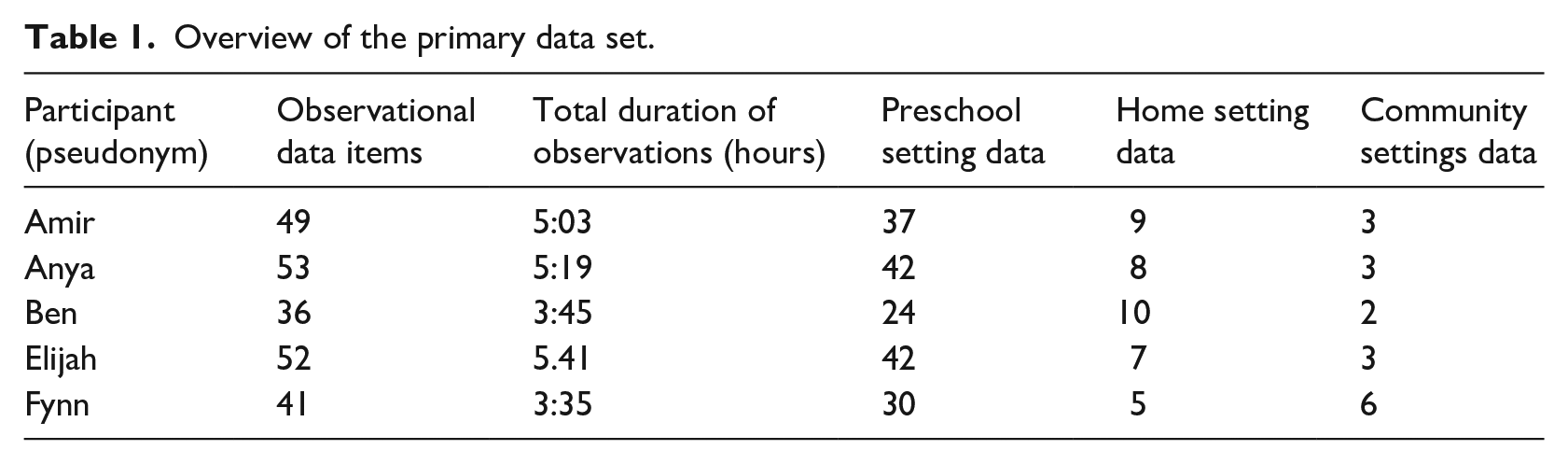
The ethnography involved five focal children and their families; when the study commenced the children’s ages ranged from 3:1 to 4:0 years. Data were gathered periodically over 8-months. The main study’s primary data set (see Table 1) comprised 231 observational data items, recorded as video data and field notes, which captured children’s naturally occurring ‘encounters’ with text in their preschool setting, in family homes and in community spaces. These ‘literacy events’ involved 42 different types of written and multimodal texts, including paper-based and on-screen texts, environmental and commercial print, hand-written and name-based texts. A secondary data set comprising audio recorded mediated dialogues with children, data from interviews with parents and the ethnographer’s reflective notes also informed the analysis and interpretation of data. Data were largely recorded by the ethnographer, although five videos in home settings were recorded by parents or siblings during the ethnographer’s visits. The community settings were a supermarket, the public library and a town centre market that the focal children visited whilst on preschool trips. Two data items were also gathered at a community celebration, to which the ethnographer had been invited by a participating family.
Overview of the primary data set.
The preschool setting was selected due to the researchers’ established connections and its convenient location. At the time of the study, the setting followed the English EYFS statutory framework (Department for Education (DfE), 2017) and non-statutory practice guidance (Early Education /Department for Education (DfE), 2012). As a ‘state-maintained’ setting, places were offered free of charge and children attended for 15 hours or 30 hours each week.
Potential families were invited to join the study after consultation with practitioners, who identified children who would likely be comfortable with observations, and confident to express their preferences regarding participation in research activity. Ethical approval was obtained from the Human Research Ethics Committee at The Open University and ethical considerations were informed by guidelines from the British Educational Research Association (BERA) (2018). This guidance ensured that participant wellbeing, confidentiality and anonymity, and informed consent, were foregrounded from the outset. Recognising the distinction between ‘procedural ethics’ and ‘ethics in practice’ (Guillemin and Gillam, 2004: 265), ethical research was viewed as an ethos, achieved through an ongoing commitment to conduct the study in a manner that was respectful to all participants and to the audience of the research (Alderson, 2014). In addition to parental consent, a pictorial information sheet was created to help the children understand the research, differentiate between research activity and other activity in the setting and to reinforce the message that it was okay to say ‘no’. Children’s ongoing assent to participate was monitored and respected through noticing subtle cues of body language and facial expression.
Analysis
Across the main study, 231 video and field note data items were catalogued and thematically analysed using the CAQDAS platform, ‘Dedoose’. Analysis was informed by both Braun and Clarke’s (2006) 6-phase model of thematic analysis and Saldaña’s (2016) ‘streamlined codes to theory model’. Data reduction is an integral part of ethnographic data analysis (Guest et al., 2014), although researcher reflexivity is essential to ensure data selected for deeper-level analysis are representative and not biased towards confirming a particular perspective (Cohen et al., 2011). Accordingly, the first phase of analysis involved methodically evaluating each data item to assess; (1) the extent to which the data corresponded with the research questions; (2) the prominence of the text in the encounter; (3) the quality of the audio/video recording or the detail of the fieldnote. Based on these criteria, each data item was rated from 1 to 5. During the second phase, micro-level, systematic coding of data began with higher rated data items for each participant and continued until it was felt that no new codes were being generated, and hence, code saturation had been reached (Braun and Clarke, 2013). Thirteen of the data items analysed at micro-level related to the sub-section of the study reported here. These data comprised one field note item and 12 video data items (totalling 92.44 minutes of film), capturing the focal children’s engagement with the range of texts described earlier in both the preschool and home settings.
Inductive coding of ‘discernible indicators’ of children’s motives and intent resulted in the generation of 21 codes. Coding was grounded in what was ‘seen’, ‘heard’ and ‘read’ in the data, however, it was also shaped by the ethnographer’s lived experience and ‘sense’ for the data (Cohen et al., 2011), hence it must be acknowledged that the analytic process was highly interpretive. After deconstructing the data into small units of relevant meaning, the following phase involved seeking patterns and reconstructing those units in a way that conceptually organised the codes into categories and themes. The aim was to generate meaning at increasingly higher levels of abstraction, cumulating in empirically grounded theoretical propositions that addressed the research questions (Saldaña, 2016). However, codes did not fit neatly into one category or another, rather they intertwined. For example, children’s actions coded as ‘offering advise’ could be interpreted as, initiating human interaction, a means of positioning themselves, expressing agency, seeking recognition, or consolidating their understanding of a topic. As represented in Figure 1, the analytic process culminated in the key themes, or findings, as discussed in the following section.
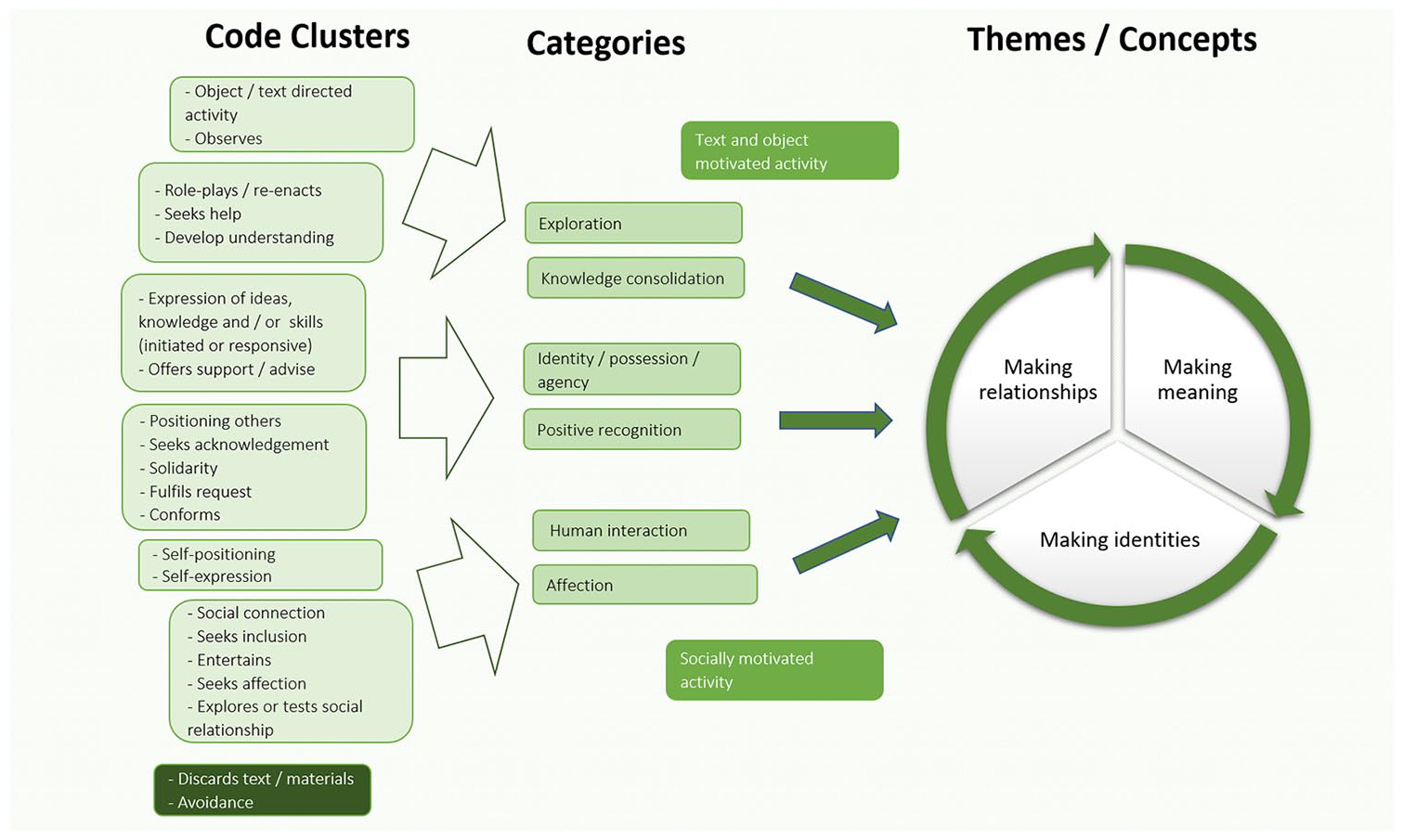
Codes to themes.
Findings
Coding shed light on how children engage with texts for multiple purposes, such as negotiating interpersonal relationships, socially positioning themselves and others, expressing and communicating ideas, demonstrating skill and knowledge, making sense of emotionally charged situations, making connections in life and for enjoyment, amongst many other things. The analytic process culminated in the theoretical proposition that children’s engagement in everyday encounters with text is driven by three overarching, and interrelated goals, to make meaning, make relationships and to make identities. In addition, analytic work resonated with the work of posthumanist scholars, analysis of data illustrates how motives and intentions are not fixed or predetermined in the mind of the individual, but rather, emerge and evolve in dynamic social, textual, material, spatial and temporal relations, which are often visceral and instinctive in nature. The findings are discussed in the coming sections; firstly however, two vignettes are presented to contextualise, and exemplify the findings.
Exemplifying the findings
The following vignettes are extracted from data items recorded in the preschool setting. The first, recorded as a video data item, was selected because, firstly, its coding involved the broadest code application for the specific research sub-question addressed in this paper, and secondly because of the diverse nature of the multimodal texts involved (a comic and Christmas catalogue with multiple elements and modes of representation). The second vignette was recorded as a field note and was selected as the most fleeting and transient of the children’s encounters with text captured in the data set.
VIGNETTE ONE This event evolved spontaneously in the role play area of the preschool setting. Anya (pseudonym) aged 4:3 years, had selected a comic based on popular children’s TV programmes. The ethnographer, Lucy, selected the Tesco Christmas catalogue and sat down next to her. Anya initially pretended to be sleeping, snoring loudly under the comic. After a few moments Lucy asked, ‘Are you having a good snooze there?’ Anya jumped up saying, “tricked you” and she giggled as Lucy acted surprised. Anya turned a few pages of the comic in quick succession then excitedly pointed out ‘Alvin and the Chipmunks’. She explained that Alvin was cheeky and naughty, and when Lucy asked what he did that was so cheeky, Anya thought for a moment, then pointed to each of the images in the comic strip and described what was happening, She said, ‘Well, he takes that over and he puts where, where that stand in there and he, and he, he, banged on the window and that was really scary’. Anya then noticed a ‘word search’ in the catalogue and looked intently at the page. She pointed out various letters using both phonic sounds and letter names. ‘There’s ‘A’ and there’s ‘S’ and ‘I’’ She then found matching pairs of letters, saying ‘there’s an e and an e’. ‘Oh yes, they match’ said Lucy. Anya then pointed out 4 letter s, Lucy responded by pointing out 4 ‘t’s. They carried on taking turns, and when Anya pointed out ‘m’ and ‘m’, they joked that they wished they had some M and Ms. As the letter matching game naturally came to an end, Lucy continued to browse the catalogue and Anya returned to the comic. The image and logo for a Vtech electronic toy caught her attention; she announced that she had a Vtech at home and explained how it worked. Lucy listened intently with regular brief affirmations. Another child, Ella approached, looking over Lucy’s shoulder at the catalogue on the Disney Princess page. Ella commented, naming some of the characters. Anya turned her attention back to the catalogue, the level of her voice raised, and she became more animated, pointing to the image of the Disney Princess dressing up clothes, she said, ‘Oh I love that, I really, really love that, it’s amazing - I want that’. Lucy agreed that the dress was lovely and asked if it was Belle’s dress from Beauty and the Beast. Anya agreed in an authoritative manner, ‘yes, yes that’s Belle’. Lucy asked Ella which character was her favourite, but before she could answer, Anya leant in front of Ella, and said, ‘And I Ella moved away and Anya’s gaze followed her momentarily, then she returned to her comic, singing quietly to herself while looking at the pages. After another minute or so, Anya noticed something happening across the room, put down her comic and left the area. VIGNETTE TWO As Ben (pseudonym) aged 3:10 years, moved across the classroom with two other children, he noticed a home-made scrap book on the table, open on a page with pictures of various motorbikes. As his friends continued, Ben stopped, the ethnographer, Lucy, noticed and the following encounter unfolded. Ben said ‘Look, that’s Kawasaki’; he was looking towards and pointing at the logographic print next to the image. His comment did not appear to be directed toward anyone, but as Lucy approached, he made eye contact. Lucy commented, ‘Oh, is it’, to which Ben replied, ‘Yeah, yeah, that’s a dirt bike’, he used an authoritative tone, whilst nodding vigorously. Lucy asked ‘Okay, so what’s a dirt bike?’. Ben hesitated, then commented, ‘Them race on the dirt track’, making eye contact. ‘Ahh, can all these race on the dirt track?’ asked Lucy, gesturing toward the pictures collectively. Ben looked more closely at each motorbike picture in turn, and said, ‘Nah, that’s for the circuit’, pointing to the Suzuki, ‘but that, that, and that Kawasaki, them are dirt bikes’, he said, tapping the corresponding pictures in turn. Ben looked up, then quickly continued across the classroom to join his friends.
Discussion
Making meaning, relationships, and identities in everyday literacies
These vignettes describe two very typical and unremarkable literacy events – ordinary sorts of interactions that might take place in any early years setting. They illustrate how young children engage in interpretation and meaning making with text, and also how they initiate and sustain relationships, and how they construct and enact a range of identity positions. Each aspect is discussed in turn below.
Making meaning
The vignettes illustrate how Anya and Ben agentively made meaning with and through a text. Anya’s familiarity with the characters and logographic print from children’s popular culture enabled her to draw on her home and community-based funds of knowledge (González et al., 2005), to ‘figure out’ what different elements of the text were about. For example, drawing on knowledge from her home environment, she commented on Alvin’s mischievous character. However, she hesitated when asked what it was about Alvin that was ‘cheeky’. Seemingly unable to generate an explanation from her previous experience, she interpreted the comic strip images and described what was happening to construct a convincing explanation to support her views. In essence, she made meaning that served her ‘in-the-moment’ purposes. Similarly, the logo for the Vtech electronic toy caught her attention, it brought her personal knowledge to the fore, and prompted her to explain how the Vtech worked. As Dyson (2002) asserts, popular culture texts ‘build bridges’ between children’s worlds.
Vignette two illustrates how the ‘Kawasaki’ logographic print caught Ben’s attention, changing the course of his activity. The text was laden with personal meaning for Ben; his grandfather was a former competitive motorcycle racer, who occasionally took Ben and his brothers to motorbike events. Ben seemed somewhat surprised by the question, ‘what’s a dirt bike?’, yet he quickly constructed the explanation that they race on the dirt track. When asked whether the images were all of dirt bikes, he appeared to assess each image, discerning features and characteristics that met his criteria for a dirt bike.
Interpreting these data through the lens of perezhivanie (Vygotsky, 1994, 1998) directs our attention to how Anya and Ben’s experiences in these literacy events were refracted through their own unique prisms of lived experience; the ways in which they interpreted the text and the context, and the ways in which they made meaning was socially, culturally and historically shaped. In parallel, thinking with posthumanist affect theories de-centres the human and prompts us to consider how meaning emerged fluidly and unpredictably in the atmosphere of the socio-material environment, and significantly, how the text participated in the meaning making (Burnett and Merchant, 2021). From this perspective, meaning was not ‘made’ in the minds of Anya and Ben, but rather, can be thought of as unfolding in human and non-human relations (Hackett et al., 2021). Yet both theoretical perspectives illustrate that the ‘simple view’ of reading does not suffice – young children’s meaning making with text is far greater than decoding and word comprehension; it is textured, nuanced and complex. Furthermore, meaning making was intertwined with relationship making.
Making relationships
In vignette one, Anya initially used the text to hide, she seemed to want to catch the researcher’s attention with her loud snoring, and she sought to evoke a reaction by jumping up and announcing she’d tricked her. For much of the episode, Anya appeared highly invested in the relationship. She initiated much of the dialogue and joint activity, and when the researcher responded by also matching letters, for example, Anya eagerly sustained the interaction by continuing the game. The texts mediated the ‘connection’ between Anya and Lucy; words, facial expressions, gestures and actions passed back and forth between them, all related to the content of the comic and catalogue, and they shared a moment of humour over the dual meaning of ‘M and M’.
This vignette also elucidates how Anya not only made relationships, but also shaped relationships. Ella’s arrival coincided with reaching the Disney Princess page, and both aspects, arguably, changed the social dynamics. Anya possibly felt that her position in the relationship was under threat, and she worked to dominate the communicative space by responding to Lucy’s comments more rapidly and more intensely. Posthumanist affect theories prompt us to consider the visceral and non-conscious nature of the feelings that emerged in these moments, and how these shaped Anya’s activity (Thiel and Dernikos, 2020); she may have been unaware of how she was restricting the communicative and physical space for Ella. However, the vignette illustrates how the text, and Anya’s knowledge of Disney Princesses were integral to how she shaped relationships.
The relationship between Ben and Lucy in vignette two was but a fleeting one; arguably, Ben did not seem orientated towards relationship making at the outset. Yet, in this brief encounter he confidently stepped into an authoritative position; expressing his knowledge and expertise on the text’s subject in ways that dismantled the adult child power differential that might typically be present in preschool settings. These findings echo those of Hedges et al. (2011), who argue that responsive adult – child relationships are enhanced when children draw on their funds of knowledge-based interests. These data exemplify how texts are powerful artefacts that mediate the expression of those funds of knowledge.
Making identities
The vignettes also illustrate how children’s encounters with texts, particularly popular culture texts and commercial branding, are vibrant sites of identity making, in which young children express, configure and position themselves. As with all cultural artefacts, texts are ‘inscribed’ not only with meaning, but with identity (Esteban-Guitart and Moll, 2014).
In both vignettes, Anya and Ben seized opportunities to speak with authority and confidence on subjects represented in texts. By associating herself with Disney Princess popular culture, as Gee (2000) suggests, Anya, possibly sought to position herself within a powerful affinity group in the preschool setting, and through the ‘word search’ game, she demonstrated her letter knowledge. Given the classroom environment, she may have perceived letter knowledge as particularly valued, and positioned herself as capable and ‘clever’. Through a home-made scrapbook, Ben became an expert on motorcycle racing, his identity position evolved spontaneously with very little effort.
When participating in social activity, a child does not only experience the event, but they also experience themselves as ‘someone’ in the event (Bang, 2009). The vignettes illustrate how Anya and Ben configured, expressed and positioned themselves as someone who was an expert, or an authority on a subject. Yet, these encounters might have unfolded very differently; hypothetically, it is worth considering how the episode might have unfolded if the researcher had been focused on Ben’s ‘letter knowledge’ and had taken the opportunity to quiz him about the initial letter of Kawasaki. In this hypothetical scenario, Ben may have configured, expressed and positioned himself very differently. In these vignettes, children’s encounters with texts enabled them to draw on their funds of knowledge (González et al., 2005) providing favourable conditions for identity making, however, it is also clear how fragile those identities may be. Considering children’s everyday literacies through the lens of perezhivanie highlights that the nature of children’s early encounters with text matters. Each encounter has the potential to reshape a child’s prism of lived experience, through which subsequent episodes are perceived and interpreted.
Recognising the value of young children’s activity with multimodal texts offers practitioners and parents opportunities to scaffold and nurtured children’s meaning making, their relationships, and their identities as legitimate readers and writers. Doing so may help establish firm foundations upon which other specific literacy skills and knowledge are built.
The emergence of motive and intent
The dual theoretical lenses guiding the study offered some fresh insights into the nature of motive and intent in young children’s everyday literacies.
The lens of perezhivanie directs analysis to how motives and intentions are shaped by lived experience, as happenings are refracted through one’s personal prism of perezhivanie; hence, motive and intent transcends the spatial and temporal boundaries of the concrete event. For example, having attended the preschool setting for some months, Anya and Ben’s intentions in the activities were grounded in their established knowledge and understanding of the social and cultural norms at the setting, their established relationship with the researcher, and their detailed funds of knowledge of the content of the texts. Their personal prisms of perezhivanie shaped how they perceived the situation, and shaped what they believed they could do, should do, and wanted to do – that is, their motives and intentions.
However, posthumanist perspectives challenge the idea that motives and intent are predetermined and reside in the child’s mind. Rather, motive and intent continually unfold, or emerge moment-by-moment in the relationality of the event (Burnett and Merchant, 2020; Hackett et al., 2021). For example, Anya’s motive and intention to express her letter knowledge ‘emerged’ with the appearance of the word search and the researcher’s responses. It was with Ella’s arrival that the social dynamics of the literacy event changed, and in which Anya’s motives to assert her Disney Princess knowledge and to restrict Ella’s view of the text unfolded.
The vignettes exemplify how, at times, children are affected by, and affect relations in everyday literacies in profound ways. It is impossible to know the extent to which Anya and Ben were aware of their motives and intentions. However, the ethnographer’s feeling, or sense, was that children’s activity was often driven by a visceral, instinctive urge to make meaning, make relationships and make identities. Just as ‘affect’ can be conceived as a bodily response to stimuli prior to cognitive registering or processing (Massumi, 2015; Mulcahy, 2012), these data suggest that, oftentimes, so too are young children’s motives and intentions in everyday literacies.
Conclusion
There are multiple perspectives from which to understand and to research children’s everyday literacies. As the author has previously argued, the neo-Vygotskian lenses of perezhivanie and posthumanist affect theories are rooted in distinct paradigms, or ways of knowing the world, however, they are not incompatible (Rodriguez Leon, 2023). Theories are not abstract truths, nor are they fixed constructs; in research (and indeed, everyday life) theories shape what we see, hear and sense, and how we interpret it and how we explain the phenomena under study (González Rey and Mitjáns Martinez, 2017).
Bringing these theoretical lenses together has potential to support researchers and practitioners to know young children as unique individuals more fully. By exploring what children appeared invested in, seeking to understand their motivation and intent has offered a more expansive and layered understanding of their everyday literacies, and the significance of text in young children’s lives.
The findings offered in this paper are highly conceptual, however, they also hold relevance for early education policy and practice by offering an alternative view of everyday literacies. Vygotsky (1978) asserted that, ‘reading and writing must be something that the child needs’ (p. 117). Whilst national educational policies might stress that children ‘need’ literacy to succeed in education, vignette one exemplifies that, in these few moments, Anya needed literacy to initiate and sustain a relationship, to assert her identity as a competent and knowledgeable individual and to make connections in her life experiences.
Too often, classroom environments are disconnected from young children’s out-of-school experiences; providing meaningful texts and media breaks down the divide between everyday literacies and school-sanctioned literacy (Compton-Lilly, 2006; Levy, 2008; Marsh, 2003). Whether it be picture books, popular culture texts, digital texts, or comics and catalogues, for example, familiar texts enable children to draw on their ‘funds of knowledge’ (González et al., 2005), to participate in literacies more fully, agentively and creatively.
These findings suggest that young children engage in literacies for the same purposes as any competent reader– to make meaning and sense of the world, to connect and foster social relationships, and to understand themselves and how they fit in various social groups. Learning to read and write is not the ‘end-goal’; literacies are a means to participate in society, even for our youngest citizens. This study adds further empirical evidence that literacy can no longer be thought of as simply a set of skills. It illustrates that everyday literacies are relational and involve personal, social, affective and cognitive processes that are shaped by temporal, spatial and material dimensions, as well as social and cultural forces.
