




Abstract
Indonesia is committed to creating an inclusive education system. Kindergartens have a key role to play in this endeavour. However, there are specific challenges that need to be addressed if this potential is to be fulfilled. It has been suggested that the use of keyword signs within Sign Supported Big Books (SSBB) as part of everyday story time activities might offer one way to begin to address some of these challenges. This research used a questionnaire method to evaluate the uptake and impact of SSBBs from 214 kindergartens across Indonesia. Analysis of teachers’ responses revealed the inclusive affordances of the approach. For the majority of teachers: the books were in regular use in their classrooms, teachers and children enjoyed using them, SSBBs made learning fun, the approach impacted positively on teachers’ classroom practice and they reported that it had benefits for children, including those with special educational needs. These results indicate that SSBBs can make a positive contribution towards creating an inclusive kindergarten pedagogy. Suggestions for further developments of the SSBB approach and future research are discussed.
Keywords
Introduction
Since 1991 the Indonesian government has sought ways to improve the educational experience of children with special educational needs and disabilities, moving from a right to special education in 2003 for children with intellectual, emotional, and/or social disabilities (Kusuma, 2021) to the 2009 regulations designed to initiate the development of an inclusive education system (Ediyanto et al., 2017). This move is seen as complementing the government’s aim to give all Indonesian children a minimum of 9 years of education. This is a profoundly challenging aspiration for a nation of over 273 million people (Review, 2021) with approximately 3.7 million enrolled kindergarten students (Statistica Research Department, 2021) and in a context where, across its 17, 524 islands (Direktorat Pembinaan Sekolloah, 2008), over 75%, of disabled children or those with special educational needs might remain outside of the education system (Faragher et al., 2021).
Inclusive education can be construed and enacted differently in different countries (Rix, 2015). In Indonesia, the aspirations expressed in policy are in keeping with the United Nations Committee on the Rights of Persons with Disabilities (United Nations Development Programme, 2002). This aims to facilitate a situation in which potentially excluded children, such as those with special educational needs and disabilities, have the same rights to education as their peers and join them in the same schools. It is suggested that this process could be facilitated though structural and paedagogical changes that enable equitable and participatory, learning within classrooms (Hehir, 2018). Kindergartens have been identified by Indonesian policy makers as having an important role in growing an inclusive educational system that produces positive outcomes for all children (Ediyanto et al., 2017). However, inclusive Indonesian kindergarten provision has been relatively slow to develop (Poernomo, 2016). Several factors contribute to this inertia, including a ubiquitous stigmatisation of disabled children (Handoyo et al., 2022) and their teachers (Budiyanto et al., 2020). This fuels a reluctance to admit disabled children even to schools identified as being inclusive (Tucker, 2013), a fear that disabled children and their needs will hold back other children (Anggia and Harun, 2019), and a perceived lack of paedagogical resources and training (Diana et al., 2020). These factors help create a paradox in which
“. . kindergartens do not train or buy resources because they have no pupils with special educational needs. They have no pupils with special educational needs because they do not have the resources or training” (Rofiah et al., 2023: 3)
The Inclusive Indonesian Classrooms project is a collaboration between Universitas Negeri Surabaya (UNESA, the State University of Surabaya, Indonesia) and the Open University, United Kingdom. It aims to support the creation of teaching approaches and paedagogical strategies that can help teachers to be inclusive in their work, and able to produce positive educational and social for all class members (Budiyanto et al., 2018). In researching how to address the lack of inclusive provision, the project created and piloted the use of Sign Supported Big Books (SSBB) for kindergarten story times.
Sign Supported Big Books
Keyword signing approaches are a simple way to support communication and use manual signs to highlight the important ‘key’ words in a spoken sentence. Keyword signing is used internationally, with the signs typically taken from the language of a country’s Deaf community. Examples of keyword signing include Makaton (UK), Lambh (Ireland), SMOG (Netherlands ) and Auslang (Australia) (see Grove and Launonen, 2019)’ . The Inclusive Indonesian Classrooms project used Signalong Indonesia, a free and accessible keyword signing approach designed to support full class communication through Bahasa Indonesia (Indonesian Language) (Budiyanto et al., 2018).
Signalong Indonesia is inspired by Signalong UK (Signalong Group, 2012), based on principles that were judged to be valuable in the Indonesian context. These included a ‘one sign: one concept’ approach where, for example, ‘bed’ and sleep’ have different signs. This is helpful for children who might who experience difficulties in concept generalisation. Another principle is the use of specific describable handshapes, allowing signs to be reliably described and transmitted. Signalong Indonesia uses simple signs taken from Signalong UK and Indonesian sign languages (see Budiyanto et al., 2018) and has evolved its own teaching approach, symbols and materials.
Big books are a common feature of early years settings. As their name indicates they are big, around 34×42 cm, and have large story illustrations that help teachers to engage the interest of young children (Jayendra et al., 2018a) and support interactive, dialogic, storytelling (Lever and Sénéchal, 2011). Rofiah and colleagues (Rofiah et al., 2023) created big books with a Signalong Indonesia sign for each page of the story. These Sign Supported Big Books (SSBB) featured a single visual sign prompt on the back of each page for the teacher when telling the story to the class.
Teachers were trained to use the SSBB approach, and a pilot evaluation compared the use of books with and without signs in five mainstream kindergarten classes, for children between 4 and 6 years of age, which had no disabled children. The findings suggested that the incorporation of Signalong Indonesia signs in this way was associated with children’s improved engagement, story comprehension and recall, and that the SSBB approach was more enjoyable and fun for teachers and pupils alike (Rofiah et al., 2023). Fun and happiness have been indicated as having a central role in Inclusive Indonesian pedagogy in contrast to beliefs revealed in non-Indonesian research (Budiyanto et al., 2018). This small-scale research highlighted the potential of the SSBB approach but raised several key questions.
Teachers were keen to take up and use the SSBB approach, using Signalong Indonesia to enhance other stories and activities. This implied that the SSBB approach might avoid the stigmatisation that is commonly associated with signing when wholly associated with special education for children with disabilities (Sheehy, 2014). However, there were strong caveats to this claim. Firstly, these findings were from a sample of only five volunteers. Their attitudes and feelings might not reflect the wider population. Secondly, these were kindergarten classes in which there were no children with special educational needs or disabilities. Thirdly, the small sample of teachers were from a large city in East Java. Given Indonesia’s geographical and cultural diversity, the approach might not meet the needs of teachers and children in other locations. These issues therefore raised research questions, which the current research sought to address.
How would a larger, more representative sample, of teachers respond to the approach? To what extent would they engage with it and use it in their schools?
What do teachers feel about the use of SSBBs with children with special educational needs in their classes?
In what ways would teachers wish SSBBs to develop or be improved to support their work?
One request from teachers who used Signalong Indonesia had been for an ‘app’, and the project team had created SIDRA (Signalong Indonesia Digital Read Aloud) (Signalong Indonesia, 2021). This app included digital SSSB stories, but their use in kindergartens was not known. Therefore, the research also sought to explore the use of this app.
Method
SSBB materials were distributed to 274 kindergarten teachers across Indonesia. This distribution was based on kindergarten teacher networks that were linked to Universitas Negeri Indonesia. Approximately 300 teachers had attended an online seminar on story telling for kindergartens, after which 274 participants requested the SSBB materials. Each of these teachers received three SSBBs and a teacher’s manual, which explained how to use the approach. The books and manual had been created specifically for this project by the Signalong Indonesia team.
Figure 1 illustrates how the materials were distributed geographically across the provinces, spanning over 5000 kilometres East to West.
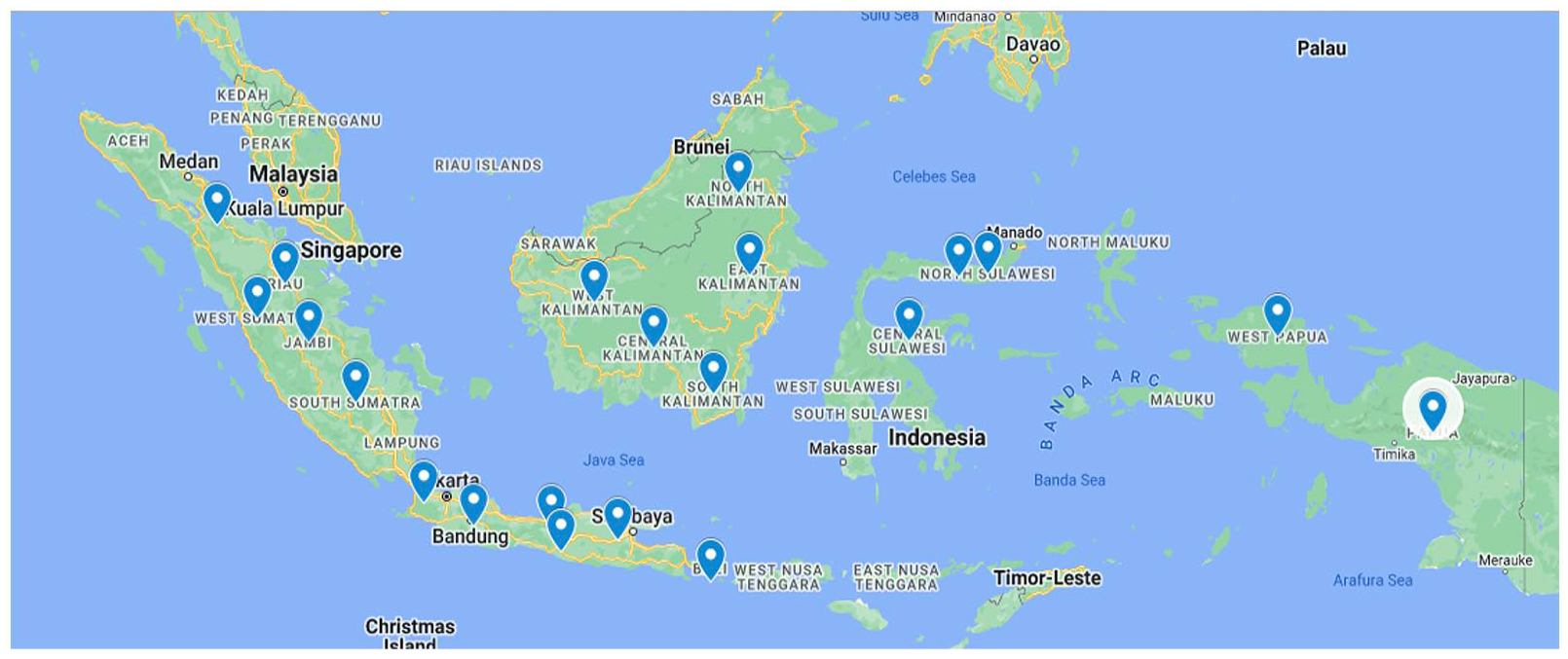
Distribution of Indonesian kindergartens receiving the Sign Supported Big Books. (Each pin represents approximately 10 kindergartens in that province) [Map data ©2021 Google, INEGI].
After 6 weeks all 247 teachers were sent an email indicating the option for giving feedback about the books via a questionnaire. Those who wished to could then chose to complete an online Qualtrics™ questionnaire, or not. Although the initial locations of the kindergartens were known, so they could receive the materials, the locations and identities of those who responded to the questionnaire were anonymous.
Ethics
The research proposal was reviewed and approved by the Ethics committees of the researchers’ universities (ref HREC/3785/)
Questionnaire
A questionnaire (See Appendix 1) collected the teachers’ responses to closed questions regarding their use of the books and the app. These data were analysed using the software Statistical Package for the Social Sciences (SPSS v20). There were also two open response items, regarding teachers’ views on developing and improving the books. These responses were analysed thematically (Braun and Clarke, 2006) ‘by hand’ (i.e. without a software package). Thematic analysis is method for ‘identifying, analysing, and interpreting patterns of meaning (‘themes’) and then qualitative data’ (Clarke and Braun, 2017 p 297). Participants’ responses were analysed through a staged process: familiarisation and rereading of the transcripts of participants’ responses, generating initial codes (through colour highlighting parts of the text), searching for coherent themes that might combine these codes, and reviewing and refining the themes (Dawadi, 2020).
Findings and discussion
Of the 274 kindergartens that received the SSBB materials, 78% (n = 214) chose to respond to the questionnaire. The majority of teachers (81.9%) found the approach easy to use and were using them regularly in their classrooms with 4 to 6 year old children, albeit with a wide variation in the frequency of this use. The average class size was 12 and the majority of teachers used the books once per week (35%), 18.5% used the books two or three times per week and 10.3% of teachers used the books every day. However, a significant proportion (25.5%) only used the books occasionally that is, less than once per week. Although it related to a minority of responses, if this approach is rolled out at scale, then a low frequency of use may impact on access to kindergarten story time activities for a significant number of children. Future research will need to explore this issue.
Teachers reported that using the SSBBs in their classes had an impact on their practice. As Figure 2 shows nearly all (92.4%) of the teachers reported that the approach had changed or influenced the way they taught.
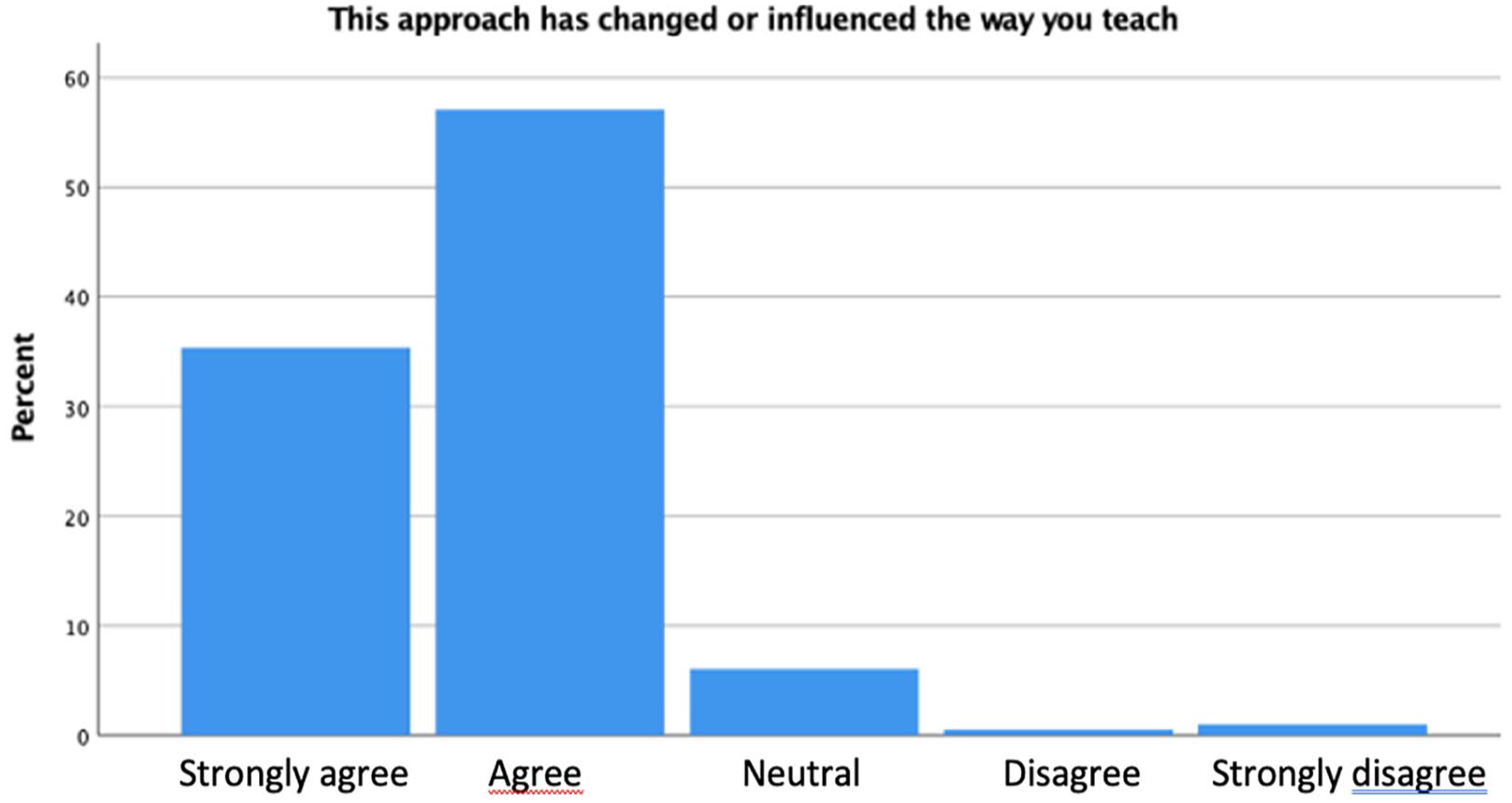
Teacher’s responses to question ‘This approach has changed or influenced the way you teach’.
The majority of teachers (91.8%) reported that they enjoyed using the approach and 90.3% agreed that ‘It makes learning more fun’. Similarly, 88.4% agreed that children enjoyed it, with only 1.9% disagreeing with this. Teachers (70%) disagreed with the statement the approach didn’t help children to understand that the story and 93% of teacher believed that the approach helped children to remember the stories. This supports findings from the pilot study, which found that children had improved comprehension and recall of stories with SSBBs, and that teachers and children found the approach fun (Rofiah et al., 2023).
It goes beyond the pilot study by collecting data regarding inclusion and SSBBs. The use of keyword signing has been identified in international research as a way to reduce barriers to inclusion with schools (Cologon and Mevawalla, 2018; Grove and Launonen, 2019) and 88.6% of participants agreed that SSBBs supported the inclusion of children with disabilities in their class, with only 1.4% disagreeing. The majority of the teachers (75%) intended to use this approach with other teachers in their schools and for 23% of teacher this was a possibility. This suggests that the SSBB approach may be useful in overcoming a reluctance to use or be associated with keyword sign support in schools, which has previously been identified in Indonesia (Budiyanto et al., 2018).
The responses to questions about the Signalong Indonesia Digital Read Aloud app indicated that only a small number (n = 39) of the kindergarten teachers had downloaded it. This small response rate was not unexpected given that SIDRA had only recently become available (launching in February 2021). The majority of this, albeit small, group of teachers were positive about its use, with 73% agreeing that it was more interesting than a book, although 58. % felt that the app could not replace a book and 38.7% responded neutrally.
The open question responses (Q16 and Q17) were analysed thematically, which produced six themes.
Access to more books that are ‘close to the child’
There was a shared belief in the need for more books, which could be easily obtained. In the initial study teachers wanted access to Signalong Indonesia training so they could apply this to any books or activities. However, in this larger sample the unanimous request was for more ‘ready-made’ SSBBs
[That the] The book is reproduced again because this book is very useful. [An] increased quantity I hope the book is easy to find and the story themes are reproduced. It is hoped that more PAUD [Early Childhood Education] schools will have the opportunity to get story books like this one.
One teacher suggested that selling the books might improve access.
Maybe it can be published so that it can be circulated or bought by those who need it.
Although having more books was important, this increase in number was suggested in order to bring greater diversity to the content. This content should reflect the breadth of the kindergarten and PAUD [Pendidikan Anak Usia Dini, -Early Childhood Education) curriculum.
The theme of the stories is made more diverse according to the themes in the PAUD curriculum. Maybe the theme of the story can be more diverse, because in kindergarten there are several themes that we use, it would be nice to have a variety of themes. National themed book, reflecting the national curriculum. Hopefully books with other themes are [will be] easy to find. Not only in story books, kindergarten children’s textbooks may be developed by including sign language in their teaching.
It was suggested that a series of books could follow the curriculum, with the supporting signs following the progression of the curriculum vocabulary.
. . . for better use of signs that children understand and are across the learning curriculum. Because with the new cue [sign], you have to start from the beginning again when it’s different from the cues used before.
This variety could also be helpful in presenting content that is ‘close to the children’ that is, reflecting their lives and interests.
More attractive to children’s interests. [topics] that are close to children.
Linked to this was the idea that the book illustrations could be more realistic, again to bring the book content closer to the children’s lives.
It is very helpful if the illustration of the image is made as close to the original as possible or uses the original image. Examples such as birds, which are used are not cartoon birds but real birds.
The overall picture was a desire for books that would relate thematically to the PAUD curriculum and reflect ‘things that matter’ in children’s lives. This concept of being ‘close to the child’ is multifaceted. At the most obvious level, the books need to be relevant to the children’s lives and interests. This could occur through books that fitted with the early years’ curriculum. An important point is raised by the ‘you have to start from the beginning again. . .’ comment with regard to the progression of the signed vocabulary. Rather than needing to use mostly new signs for each book, the sign vocabulary might be structured to build on and develop in a way that complemented the curriculum. This structured integration of signs into the curriculum would help bring the signs closer to the child’s everyday school activities.
For example, across Indonesia there is a requirement for disaster risk reduction education in kindergartens. However, materials and activities that are accessible to all learners are lacking (Pertiwi et al., 2020). Future developments might explore if the SSBB approach could be used to meet this need. An unexpected finding was that teachers only sought additional materials. This contrasted with the pilot study teachers, who all requesting training on how to apply the SSBB approach to all books and personalise it for their own location and children. However, this was not suggested by any teachers in the broader sample.
Only one teacher suggested publishing the books for sale as a mean of improving access to them. However, this model is the one found in other keyword signing approaches around the world. Typically, an organisation or charity generates income from retailing key word sign resources and training. There may be advantages to this model in supporting the production and dissemination of materials, however the Signalong Indonesia team has endeavoured to supply material and support at little or no cost to Indonesian schools who are striving to become inclusive, supported by project funding from universities and the Indonesian Ministry of Education and Culture, Directorate of Special Education.
Teacher training, supported by social media
There were requests for training for early years and kindergarten teachers, and these highlighted the use of visual social media to support training.
Make digital and instructions for use [that are] are also distributed through social media such as YouTube, so that we can study repeatedly and more clearly. It can also be accessed via the internet, supported by learning videos. Please support with audio visual, because sometimes we have a bit of trouble translating images into real movements that are correct.
Teachers wanted to be able to see the signs used, which contrasts with the static pictures and descriptions given in the materials. Pragmatically, these suggestions were seen as helpful ways to support training for teachers who may be remote from local training events, an important point in such a large and geographically dispersed nation.
Initial training was also suggested as a way to support later opportunities involvement for teachers to become in researching and developing the approach.
Maybe it is possible to hold training or seminars related to learning sign language where the participants are teachers so that later if there is such research, the lecturers can involve PAUD teachers in making this research. More precisely, working with PAUD teachers.
The above quote suggests a participatory way researching with teachers, and the willingness of a greater number of teachers to play an active part in research would be essential in developing the SSBB approach further.
Enthusiasm for the positive impact of the books
The majority of participants’ comments were in line with the positive impact identified in the preceding questionnaire items. These were often enthusiastic in nature.
Amazing, very helpful. It’s amazing to help learning. Alhamdulillah so far it has been very useful, . . . we will immediately practice and provide benefits to all our students, both normal and ABK [Anak Berkebutuhan Khusus children with special needs]. Sign language supported books are very useful for all teachers.
There were also indications of the aspects of learning that were being enhanced by the approach. These included
Children are more enthusiastic about this method. Clarity in conveying messages. Easier for students to understand. It can help develop a child’s imagination and can be understood by children. The use of books in sign language helps children to introduce other ways of communication. It’s easy for children to use this method. . .With this cue [sign] book, it is easier for teachers to teach and make it easier for children to understand.
These comments reflect the broad welcome for the SSBB approach that existed and a belief SSBBs could be a valuable part of kindergarten pedagogy. Teachers’ enthusiasm was based on the benefits that they identified in their children’s learning. It was found to be easy to use, children were motived to use it and it had benefits for all the children.
One factor that has shaped the development of the SSBB approach was the notion of fun and happiness in Indonesian pedagogy. In developing Signalong Indonesia, research examined the paedagogical beliefs of Indonesian teachers. This highlighted the centrality of fun and happiness in inclusive Indonesian pedagogy (Budiyanto et al., 2018; Sheehy et al., 2017) and this became an important part of the SSBB teaching approach. This was seen as being central to Indonesian pedagogy and something that would make engagement and uptake of the approach much more likely (Budiyanto et al., 2018). The findings of this research highlight that teachers and children enjoyed using SSBBs and found it fun to use. The majority of teachers reported that they enjoyed using the SSBB approach, agreed that ‘It makes learning more fun’ and that children enjoyed it. This complements previous research which found that children greatly enjoy using keywords signs (Bowles and Frizelle, 2016) and Big Books (without signs) (Jayendra et al., 2018a). It extends these findings by showing positive outcomes for combining keyword signing with Big Book stories. This suggests that the intention to include fun within the learning process was successful, and that this may have enhanced the engagement with, and use of, the approach for most of the teachers.
Confusion about the approach
The responses of several teachers indicated that the purpose of the approach had not been understood. Most fundamentally, for whom the SSBB approach was intended to be used by.
The use of books that are supported by sign language is highly recommended if a school has persons with disabilities The use of books is very useful for teachers to be able to provide learning to students with special needs.
Whilst both comments are sound ones, in that the approach does benefit children with special educational needs, there is an implication here that the approach is solely for this group. This was more explicit in other comments. For example
No signing needed, no disabled children in the class.
For this teacher the approach was only to be used if there were disabled children in the class, rather than being a way of teaching for all children regardless of having a disabled child in the class.
The nature of keyword signing was unclear for some teachers, who believed it was a sign language rather than being a simple support of spoken communication.
The basics of sign language development must be introduced first. Is there no international sign language the same? meaning that it does not differ from one country to another?
There was also confusion about, or rejection of, the approach as a way to enhance the curriculum for all children in a shared story time,
. . . . without waiting for their turn [our emphasis] to use the book.
These confusions of the nature of keyword signing, who the approach is for, and how to use it, might reflect issues with the training manual or that the approach did not meet the needs of the teachers or their class. For some teachers the SSBBs might be seen as an individualised sign language resource for disabled children.
The idea that Signalong Indonesia is only for children with disabilities was found in the background development research of the keyword signing approach (Budiyanto et al., 2018). Several factors may relate to this such as the stigmatisation of signing and negative beliefs about its effects on language development (Sheehy, 2014). These beliefs are noted in other countries, where keyword signing is closely tied to separate special education provision, as is the belief that there might be a universal sign language or that key word signing is a signed language -rather than a simple communication support (Grove and Launonen, 2019). This suggests that the inclusive nature of the approach needs to be foregrounded more clearly and these issues explicitly addressed in revised SSBB training materials.
Another issue for a minority of teachers was being able to replicate the signs accurately. One of the reasons that Signalong Indonesia chose Signalong (UK ) as its inspiration was that the Signalong (UK) methodology uses standardised handshapes and explicitly described movements (Budiyanto et al., 2018). This type of description is included in the teachers’ materials, but perhaps these are not being picked up on. This aspect of training could be enhanced by the social media resources that the teachers suggested.
Technology and the pandemic
The Signalong Indonesia app was only used by a handful of teachers. Although they responded positively to it, further research will be needed once the uptake has grown. For example, some open comments suggested that teachers valued the app because of the context of the COVID-19 pandemic.
Hopefully there will be digital[format] soon, especially during this pandemic. So that each child can access it more quickly without waiting for their turn. Because the number of books we get is limited. This book is loved by children, but during this pandemic, the digital form of Signalong Indonesia is what we need to make it more interesting and accessible to children. if possible [if] there is a cd, so we can use it through the screen.
These suggestions appear to relate to the ease with which apps (or CDs) might be distributed, in contrast to a physical book, and thereby better support teaching at a distance ‘through a screen’. Kindergartens were in different and varying levels of ‘lockdown’ during the pandemic, depending on the risk level in the province or city. This might have meant teaching smaller, socially distanced groups but for many this entailed providing support activities for individual children at home (Maimun and Bahtiar, 2022) and a major challenge in this situation was the lack of engaging, interactive learning media for children (Yuza and Ramadan, 2021). This is likely to be a factor in the request for ‘on screen’ materials. As kindergartens return to normal teaching practices it would be possible to examine if and how the app is being used in this more typical context. This picks up on an issue related to inclusive teaching. The results implied that the app might be used in a more solitary fashion than the physical SSBB. The SSBB approach was designed for groups of children to be taught together, inclusively. Research will need to explore the extent to which the app might undermine this inclusive approach by supporting a purely individualised form of teaching.
This research set out to access the views of teachers who had the opportunity to use SSBBs in their kindergartens. The findings of this research were positive in that the majority of teachers welcomed the approach, enjoyed using it and reported benefits for themselves and the children in their class. The findings that teachers and children enjoyed using SSBBs and found it fun to use suggests that the intention to include fun within the learning process was successful, and that this may have enhanced the engagement with, and use of, the technique for most of the teachers.
A systematic review of kindergarten education in Indonesian, indicated that there is a significant issue regarding inclusive education and kindergartens (Suhendri et al., 2020). Where children with special educational needs are in the kindergarten, they are typically not ‘being actively involved in the learning process’ (p75). Our findings suggest that the SSBB could contribute to addressing this situation. It is an inclusive approach, designed for teaching a diverse class of young children, and an accessible approach, in that it makes the stories comprehensible for a wider group of children. In this way it is a small step towards fulfilling the right of all children to education with their peers.
Conclusion
Sign Supported Big Books (SSBBs) were valued by teachers, the majority of whom who used them regularly, and reported positive impacts on their pedagogy in a way that was inclusive and supported the learning of the children in their class. The findings of this study are therefore important and suggest that SSBBs are a useful addition for supporting the development of inclusive Indonesian kindergartens, in a context where relevant resources are lacking. Overall, teachers were enthusiastic about using SSBBs and found it fun for themselves and their pupils. This supports the SSBB project prediction that making inclusive pedagogy fun can facilitate teacher and pupil engagement.
Supplemental Material
sj-docx-1-ecr-10.1177_1476718X231188467 – Supplemental material for Towards inclusive practice in Indonesian kindergartens: Evaluating the impact of Sign Supported Big Books
Supplemental material, sj-docx-1-ecr-10.1177_1476718X231188467 for Towards inclusive practice in Indonesian kindergartens: Evaluating the impact of Sign Supported Big Books by Kieron Sheehy, Budiyanto, Sri Widayati and Khofidotur Rofiah in Journal of Early Childhood Research
Footnotes

References
Supplementary Material
Please find the following supplemental material available below.
For Open Access articles published under a Creative Commons License, all supplemental material carries the same license as the article it is associated with.
For non-Open Access articles published, all supplemental material carries a non-exclusive license, and permission requests for re-use of supplemental material or any part of supplemental material shall be sent directly to the copyright owner as specified in the copyright notice associated with the article.
