




Abstract
While research on children’s humour is growing, few investigations have focused on how children use humour in conflict interactions, and specifically in group early childhood settings. Using data extracts from a project that investigated children’s naturally occurring conflict interactions in a multi-ethnic early childhood setting, we use interactional sociolinguistics to analyse how children used humour at unexpected moments during conflict situations. The analysis probes different meanings carried in the children’s use of humour, illustrating how humour intersected with personal and relational power to resolve or defuse conflict, or to coerce compliance with existing peer relational positions. The analysis broadens understandings of the significance of humour in children’s lives in early childhood settings, and particularly in the context of conflict interactions that have a ‘stretchy temporality’ connecting interactive moves to others in the past, and to existing power positions in peer relationships.
Introduction
This paper focuses on young children’s use of humour in the context of peer conflicts in a multi-ethnic early childhood (EC) centre. We analyse instances of humour that arose during children’s conflicts in situations where they often did not have a language in common. Lack of a common language and shared cultural background can create misunderstandings, increasing the potential for conflict interactions. Children’s use of humour in such a context provided rich insights into the ways that humour and conflict intersected with relational power in children’s social interactions.
While conflict has undoubted developmental potential (Cameron et al., 2008) including in fostering individual and social competence (Clarke et al., 2019; Dunn and Slomkowski, 1992; McGhee, 1989; Semrud-Clikeman and Glass, 2010), in practising problem-solving skills (Singer and Hännikäinen, 2002), and in providing opportunities to learn social-mindedness (Hayashi and Tobin, 2015), early childhood practitioners often see peer conflict as something to be avoided and challenging to respond to. In our own observations, we recorded numerous instances when conflict presented challenges to both children and teachers; but children also showed extreme resourcefulness in dealing with conflict, including through their use of humour. By focusing on the use of humour within conflict we hope to broaden understandings of the multi-layered nature of peer conflict in early childhood settings, including the significance of humour within conflict and within EC interactions more generally (Tallant, 2015).
Humour and peer conflict in early childhood settings
Research on the role of humour in early childhood settings is limited (Cekaite and Andrén, 2019), and research on the role of humour in children’s peer conflicts is more limited still.
Notoriously difficult to define, it has been suggested that humour is ‘more readily demonstrated than described’ (Hatch and Erhlich, 1993: 506). Defining humour among children can be ‘perplexing’ (Loizou and Recchia, 2019: 1) since children’s ways of understanding the world and expressing themselves are often quite different from adults’. Researchers often deploy other words interchangeably with ‘humour’ – such as laughter, amusement, incongruity, and playfulness (Apte, 1985; Cekaite and Andrén, 2019; Loizou, 2005). Loizou and Recchia (2019: 1) offer the following ‘simple’ definition of humour: an ‘experience which is either produced or appreciated and causes smiling and/or laughter, the social indicators of humour’.
Studying children’s humour from a developmental perspective, McGhee (1989) posited four stages in children’s humorous capacity – marked by progress from more literal to more abstract forms of incongruity – and linked to Piaget’s stages of cognitive development. He argued that humour is best understood ‘in the framework of social exchange’ (p.18), and as positively related to social competence, a view that is widely supported (e.g. Cekaite and Andrén, 2019; Loizou, 2005, 2007; Mireault and Reddy, 2016; Semrud-Clikeman and Glass, 2010). As a synonym for humour, incongruity is defined as a violation of intention, convention, or fact (Loizou, 2005; Semrud-Clikeman and Glass, 2010).
Building on theories of children’s use of incongruity as humour, Loizou (2005) proposed two theoretical ways of understanding young children’s humorous behaviour: the theory of the absurd, and the theory of humour as empowerment. As children develop a sense of self during the first 2 years of life, they also learn what is acceptable and not, starting to have fun with pushing the boundaries. In violating the rules of what might be expected of a situation, sometimes even through mixing humour with violence and looking for a reaction, children gain a sense of their own power in relationships (Loizou, 2005, 2016).
There is consensus that even infants produce and appreciate humour (Mireault and Reddy, 2016), and that clowning starts in infancy (Reddy, 2001). Humour is a shared phenomenon and needs an audience (Hoicka and Gattis, 2008), and humorous and playful events among toddlers communicate a sense of belonging and wellbeing, and can be expressions of trust (Alcock, 2013). Studies of toddlers’ abilities to distinguish between pretending and joking have shown that toddlers can tell the difference between an utterance that is intended as a joke, rather than a second language error (Hoicka and Akhtar, 2011; Hoicka and Martin, 2016).
This breadth of research on children’s humour notwithstanding, as noted, earlier research on how children use humour in conflict is rare, especially in group early childhood centres. An exception is Singer and de Haan’s (2007) work which distinguished between three types of laughter: social smiles or laughing; incongruity-based humour and jokes; and laughter because of pleasure in mastering a skill or task. They observed that social smiles and humour can be a way of reconciling after a conflict (see also Singer, 2019).
In our study we define conflict among children as an interactional event that starts when one child overtly opposes or resists the actions of another child (Hay and Ross, 1982; Shantz, 1987). With this unit of analysis as our starting point, our long-term presence in the EC centre as ethnographic researchers led us to see that conflict events (over objects, rules of play, access to play and so on) not only had an immediate impact on interactions but also had an effect that carried over time. This has led us to conceptualise conflict events as having a ‘stretchy temporality’ with an impact that can resurface in later interactions (Dalli et al., 2020; Strycharz-Banaś et al., 2020; Strycharz-Banaś et al., 2021).
In this paper we bring these ideas to bear within an interactional sociolinguistic analysis of instances of humour that occurred within children’s conflict interactions. Our data comes from a study in which the primary aim was to understand the structure of young children’s conflict in a multi-ethnic EC centre where children often did not have a language in common. 1 In this context, children’s use of humour became an unexpected focus for analysis.
Study site and methodology
Data in this paper were gathered in a small inner-city early childhood education and care centre attended by 25 children aged between 2 years 6 months and 5 years. The EC centre was community-owned and operated and employed three qualified early childhood teachers and one untrained practitioner. 2 A total of 11 home languages were spoken by the children, with three of these also spoken by the centre adults (English, Mandarin and Samoan). The diversity of language backgrounds is relevant to this paper because of the sometimes-fractured English sentences used by the children in the data extracts. It is important to note that fractured utterances do not necessarily indicate interactional difficulties on the part of the children but may merely signify their multilingual status.
Our analysis of children’s conflict events uses interactional sociolinguistics (IS), an approach that treats all communication as social action and pays attention to contextual information, such as speaker stress, volume, and rhythm changes, in interpreting communicative intent. It addresses global questions (‘what is this exchange about?’) and local ones (‘what is intended by this particular move?’) (Gumperz, 2006: 728).
Our analysis is also informed by a view of children as active social actors rather than passive recipients of social forces (Corsaro, 2003; James et al., 1998). They act upon their social world, interpreting events and interactions, negotiating their identity, and co-constructing their social order and their place within it.
To understand the children’s social world, and specifically their conflict interactions, we adopted an ethnographic, non-participant observational approach and gathered audio and video recordings of naturally occurring interactions over a period of 18 months, starting in June 2018. During this time the main field researcher (Strycharz-Banaś) visited the EC centre two mornings per week keeping fieldnotes and videoing the children using one hand-held and one stationary go-pro camera and two external microphones placed strategically indoors in the centre. The children were able to handle the recording equipment and we have numerous recorded extracts of interactions among them indicating that they were comfortable with the cameras.
The video data were archived on a secure server after each day of data gathering and reviewed to identify instances of naturally occurring conflicts as defined in our study. Relevant audio and video data were then synchronised in ELAN software (Wittenburg et al., 2006) for linguistic annotation and transcription. The extracts in this paper come from 270 hours of video-recordings.
Ethical issues
The NZARE (New Zealand Association for Research in Education) Ethical Guidelines (2010) were followed, and approval to carry out the research granted by the Human Ethics Committee of Victoria University of Wellington and by the community-based management committee of the EC centre. Given the possible sensitivities around a study focused on children’s conflicts, we started negotiating the possibility of the project with the teachers and centre community in 2016, enabling us to start building an ‘ecology of trust’ (Dalli and Te One, 2012). We aimed to maximise openness in voicing comfort or discomfort about participating in the project ahead of embarking on formal consent processes and well before the start of data gathering in 2018. All project documentation was translated in the home languages of the centre children, and we invited opt-in written consent from teachers and parents, encouraging the latter to talk to their children about the project and explain what it would mean for them at the EC centre. This first step to inform children and gain their assent for the project was followed by a ‘mat-time’ session (for those children whose parents had returned a positive consent form) in which we explained that we would like to video them as they played together. We also explained that the children could let us know if/when they would like us to stop, and if/when they would like us to re-start after a stop. We gave the children the opportunity to handle the video-camera and let them do this whenever they requested it during data-gathering. Continuing assent from the children was then monitored through active observation of their bodily, non-verbal as well as verbal indications that they might be uncomfortable or uneasy. On those (few) occasions when this happened, we stopped videoing and only re-started after we checked that the child/children were happy, or the children themselves actively indicated that they wanted us to resume videoing. The consent documentation included options for parents and teachers about whether, and how, visual data from the project could be used for publications and teaching purposes. Still images used in this paper are taken from the video data and used in line with the form of consent granted by the children’s parents.
Humour in our data: Incongruity and relational power during conflict
We identified at least three types of humour in our dataset: teasing; physical attempts at humour (such as tickling); and humour based on incongruity. Since incongruity-based humour was by far the most frequently used type of humour in our data, in this paper we focus our interactional sociolinguistic analysis on three extracts that are illustrative of how this type of humour functioned within children’s conflicts.
Incongruity-based humour sometimes provided immediate resolution of conflict between individuals (Extract 1); it sometimes appeared to defuse an immediate conflict but misfire as a complete resolution (Extract 2); and sometimes it required persistence (and possibly a little coercion) to achieve the goals of the child attempting to create humour from conflict (Extract 3). We argue that besides these easily observable and functional outcomes of humour, when analysed contextually in the ‘framework of social exchange’ (McGhee, 1989: 18) and with a view of conflict as having what we are calling a ‘stretchy temporality’, the use of humour in conflict performed other functions. It acted to shift the relational power between children thus revealing the complex social dynamics children encountered and co-constructed as they negotiated their place in the social order of their early childhood setting.
Humour as resolution and as personal and relational power
Extract 1 is a small part of a much longer conflict interaction between two boys, Assad (4 years 4 months) and Rashid (4 years 9 months). The boys often played together at the centre. They both came from Arabic-speaking families and their families socialised together outside the EC centre. When Assad joined the EC centre, Rashid’s mother explicitly told Rashid ‘you look after him’ – a directive repeated several times by both mothers as they dropped off the children. Assad clearly looked up to Rashid, and Rashid often played the role of attentive older brother, with Rashid, for instance, tucking in Assad’s shirt for him, helping Assad find his way around, inviting him into games, and at other times excluding him and correcting his behaviour. Rashid was the core member of a self-styled ‘Big Boys’ friendship group at the centre (see Strycharz-Banaś et al., 2021) and Assad was often on the periphery of that group, his entry at times facilitated, and at other times blocked by Rashid.
Extract 1 starts with Assad playing alone with some toy train cars next to a large dollhouse inside the EC centre. Rashid runs inside, looks around and approaches Assad, interrupting his play by picking up one of the toy train cars. What follows are three short sequences of physical and verbal conflict over control of the train cars. Each of them ends with Rashid engaging in incongruous behaviour (e.g. pushing cars out of the windows of the dollhouse, making funny sounds). Assad accepts these humorous gestures, accommodating to Rashid’s actions by imitating or mirroring Rashid and by smiling or laughing. Extract 1 is the fourth and final conflict sequence and it illustrates how humour helped align the boys cognitively, allowing for ongoing harmonious play at the same time that it allowed them to continue to negotiate their social relationship in which personal power and relational control were never far from the surface.
3
Extract 1: The train tracks
Assad and Rashid are playing with tracks and trains on the floor. Assad puts the train on the tracks and starts pushing it around. Rashid lifts the tracks and pulls them apart while looking directly at Assad. 1. Assad: no! ((protesting)) 2. Rashid: ((lifts a piece of the tracks up high in the air)) 3. Assad: no, RASHID! 4. Rashid: yes 5. Assad: ((tries taking the piece of train track from Rashid’s hand)) 6. Rashid: no 7. ((pulls the piece away from Assad, puts it back in place and starts playing with the trains)) 8. Assad: ((frowning)) I’m no baby 9. Rashid: ((continues playing)) 10. Assad: no: ((frowns)) 11. Rashid: ((joins up more parts of the tracks)) 12. Assad: ((joins Rashid on the floor fitting track parts together)) 13. Rashid: like this 14. like this Assad 15. Assad: yes 16. Rashid: like this 17. Assad: ((starts driving the train on the tracks)) 18. wheee, yeyeye 19. Rashid: no, like this 20. Rashid: ((takes another train, pretends the train is jumping)) 21. RARARARARARA 22. Assad: ha ha ha 23. yes RARARARA The boys continue playing together for another minute, then run outside together where they continue playing together on the hammock. (12032018.1c1)
4
Rashid initiates conflict here by lifting a piece of the track Assad had been playing with, thus breaking Assad’s play. Rashid had already attempted this earlier and on that occasion repaired his own disruption by restoring the tracks. Now, in Extract 1, Assad resists Rashid’s actions verbally (in line 1), but Rashid counters by lifting the tracks even higher and the conflict starts to be enacted verbally and physically (lines 3–7). Assad’s comment in line 8 (‘I’m no baby’) invokes other rights and obligations that define the ‘Big Boys’ friendship group they both belong to (see Strycharz-Banaś et al., 2021). In the context of that group, Assad’s assertion will be interpreted by Rashid as implying ‘you can’t treat me like this because I am one of the “big boys” group not a “baby”; “big boys” can control the play of “babies” but not the play of other “big boys”’.
Rashid takes a step to resolve the conflict shortly after that. In lines 11–16, Rashid begins to restore Assad’s arrangement of the tracks and the two boys align their actions and collaborate on this. We notice that even as this alignment of the two friends proceeds, Rashid establishes that alignment does not entail equality – he instructs Assad: ‘like this, like this Assad’ (lines 13–14, 16), and Assad agrees. Hence, although the overt conflict over control of resources has been resolved, there remains the potential for the boys to be in conflict over who is directing this co-play. Is it Assad, who set up the tracks and had been playing with them first, or Rashid who pulled them apart and put them together again? The conflict is no longer just about control of the train tracks, it is about control of the relationship between Assad and Rashid: Rashid is seeking the upper hand, asserting the dominance with which he had been endowed by the injunction of the two boys’ mothers to ‘look after’ Assad, even as Assad reminds him that he’s ‘no baby’ (line 8).
We suggest therefore that Rashid’s use of humour (lines 20–21) here performs more than one function. Firstly, the humour introduces an incongruity that enables Assad to let go of his intended way of playing with the train and leads him to mirror the incongruity of trains flying through the air, making odd noises (lines 22–23). Incongruity models of humour recognise humour as being a two-phase process: identifying the source of the incongruity, and reassessing the situation to resolve the incongruity (Semrud-Clikeman and Glass, 2010). The humour arises when the normal expectations of a situation are violated (Loizou, 2005) and there is a collision of similar, but obviously incompatible, elements. It is this momentary collision which generates laughter. In this extract, Assad demonstrates an empathetic understanding of Rashid’s intentions in setting up the collision between expected ways that trains move and his ‘jumping’ trains (line 20). Assad recognises Rashid’s intentions and he aligns with Rashid’s point of view of this instance of incongruity. This co-alignment and shared perspective-taking is what enables a humorous exchange to help resolve conflict between friends (Cekaite and Andrén, 2019).
Secondly, the shared humour acts to camouflage the uncertainty in the interpersonal dimension caused by Rashid’s repeated interruptions of Assad’s play and by his refusal to accept Assad’s resistance both verbally and through his frown (lines 8, 10). By ignoring and overriding Assad’s resistance and, moreover, in succeeding to make Assad laugh with him, Rashid also succeeds in retaining the upper hand in this interaction thus also turning humour into a tool that exerts relational power. As a result, the pre-existing status quo between the two boys is maintained: the two boys are friends but Rashid retains the more directive role in their relationship.
Humour and incongruity defuse but do not resolve conflict
In Extract 2, humour and conflict play out slightly differently to Extract 1. In this case incongruity-based humour is similarly used to defuse an escalating situation, but we do not see the conflict resolve in harmonious co-play. As in the previous extract, the broader background to this interaction helps to provide meaning to the way the extract unfolded.
At the time of this conflict event, two pairs of butterfly wings had become contested objects of desire for some of the girls in the EC centre. Two girls, including Emma (3 years 2 months) in Extract 2, were frequent wearers of the butterfly wings and had formed a reasonably tight friendship pair whom we came to call ‘The Butterflies’. The Butterflies very rarely allowed other children to be included in their play. When the exchange in Extract 2 took place, Hang (4 years 2 months) had been very actively trying to gain entry into ‘The Butterflies’ several times during any given week.
Extract 2: Butterflies and marbles
Emma is standing at a small table visibly focussed on carefully picking over a collection of marbles and sorting them into different containers. Hang stands next to the table observing Emma. After a while, Hang takes a step closer to Emma and attempts to gain entry into Emma’s play: (file/fieldnotes 18022019) 1 Hang: I want to play [with] you 2 Emma: no no 3 Hang: I want to play [with] you 4 Emma: No: ((stomps foot)) you not my friend 5 ((puts down marbles she was holding in her hand and turns away from Hang)) 6 Hang: ((picks up a few of the marbles from one of the containers)) 7 Emma: ((turns back towards Hang and looks at marbles, then at Hang’s hand)) 8 ((shaking her head)) no no 9 ((starts reaching for Hang’s hand)) 10 Hang: ((clutching on to the marbles, quickly moves her hand away)) 11 Emma: ((high pitched voice)) NO: 12 Hang: I WANT one 13 Emma: ((shakes her head looking down)) 14 Hang: ((slowly puts down all but one marble)) 15 Emma: ((looks at Hang)) 16 Hang: ((starts shaking her head very fast and then her whole body making funny sounds)) 17 Emma: ((smiles)) 18 Hang: blah blah blah blah ((keeps moving her arms and head)) 19 Emma: ((starts laughing)) 20 ((both laugh)) 21 Emma: ((goes back to playing with marbles)) 22 Hang: ((watches Emma for a moment then puts down the marble in her hand and walks away to play outside))
Let us first consider what happens between Emma and Hang in this exchange, and then we will place it in the broader relational context between the two girls.
Hang’s repeated bids to enter Emma’s play and to use the marbles are all refused verbally or through gesture. The refusals include Emma’s move to take the marbles from Hang (line 9), and physical rejection and aggression (line 4, 8, 13). By line 14, it is unclear if the conflict can be resolved and Hang looks ready to abandon her attempt to gain access to the marble play, putting all but one marble back on the table. Emma is now either shaking her head or saying ‘no’, or doing both at the same time (line 8). In line 16, Hang suddenly changes tactics and starts mirroring Emma’s head shaking, but she does this at speed, accelerating and expanding the shaking until it involves her whole body, something that would be incongruous for someone expressing genuine anger or rejection. This resort to incongruity and body clowning by Hang changes the key (Hymes, 1972) of the interaction from conflict to joke: Emma’s response (smiling in line 17, laughing in line 19) indicates that she has recognised the incongruity of Hang’s body shaking and this cognitive process provides grounds for ‘emotion sharing’ (Cekaite and Andrén, 2019: 2) – the two girls laugh together (line 20). For a moment, it looks like Hang has found a way to strengthen her affiliation with Emma – they are emotionally attuned – and one might expect that perhaps Hang could be close to achieving her desired entry into Emma’s play.
But the momentary solidarity occasioned by the change of key is short-lived (lines 17–20). By line 21 Emma is back at her solitary marble play and she makes no space for Hang to join in. In turning back to the table Emma signals the end of the girls’ brief cognitive and emotional attunement (Cekaite and Andrén, 2019) and it is clear that Hang’s use of humour has failed to produce her desired outcome in relation to the content of the conflict – entry into the marble play.
Looking next at the broader context of the relational dynamics between the girls at their EC centre, Emma’s rejection of Hang’s attempt to join her in the marble table takes on an additional significance. It signals that, contrary to Rashid’s humour in Extract 1, Hang’s humour in Extract 2 ultimately did not succeed in exerting relational power and the girls’ social relationship remained at its pre-extract state: Hang was still not accepted into ‘the Butterflies’.
Because Hang had been engaged in a concerted but unsuccessful effort to be admitted to Emma’s friendship pair – ‘the Butterflies’ – when Emma says ‘You not my friend’ (line 4), it is likely to have evoked other contexts of its use: Emma in effect was inviting Hang to remember that Hang had so far failed to be admitted as a friend to ‘The Butterflies’ friendship group. Moreover, since we know from our longitudinal data that at this point Hang still desired to be a ‘Butterfly’, Emma’s statement may have put additional pressure on Hang to resolve the immediate source of conflict in some way: it was not in her interest to allow this conflict to escalate. Emma therefore held more social power in this particular relationship as she can – to paraphrase Weber (1968) – carry out her will despite resistance. This means that Emma could accept the humour in Hang’s incongruous body clowning (lines 16–18), without committing herself to any long-term change in their alignment as friends within the centre. In this way Hang’s humour could be seen to resolve the immediate dispute while simultaneously reinforcing the existing power dynamic between the girls.
These dynamics make the conflict and incongruity-based humour in Extract 2 more than fleeting events or characteristics; rather, they emerge as part of a broader social drama that stretches over time, influencing friendships, identities, and power relationships within the EC centre.
From this perspective it is also possible to see Hang’s use of body clowning which mimicked the loss of control over her body, as a self-deprecating move which Tsukawaki et al. (2019) found to be a kind of humour that is particularly beneficial in some communities. Their study shows that deploying self-deprecating humour correlates positively with emotional wellbeing and self-esteem among Japanese children. From this perspective, Hang’s use of humour could also have been a self-protective device from the impact of a further rejection of friendship.
Humour as coercion and as playing to an audience
The final extract involves a boy, Rashid (whom we met in extract 1), and a girl, Selva (4 years 6 months). Rashid (4 years 8 months in this extract) engages in disruptive, teasing behaviour around control of an outdoor tyre swing on which Selva had been quietly swinging. Selva initially withdraws herself from the conflict, which Rashid appears to find an unsatisfactory resolution of the conflict he had initiated. What follows are protracted efforts to share a joke with Selva before he finally leaves her to play with other children. There is relatively little verbal communication in this encounter; we transcribe what little talk there was and then recount the rest of the interaction in note form.
Extract 3: Controlling the swing
The following interaction takes place after morning tea, in the outdoor sandpit. It is a sunny day, and there are many children playing outside. There is a large tree in the sandpit area, and two swings are hanging from its branches – one made of a car tyre. Selva has been sitting in the tyre swing for over three minutes, peacefully swinging back and forth, at times singing to herself or digging in the sand. Rashid approaches and starts pushing the swing. 1. Selva: ((looks at Rashid)) 2. Rashid: ((starts twisting Selva’s swing)) 3. Selva: ah, no! 4. Rashid: ((stops twisting the swing and walks around it)) 5. ((starts pushing the swing again)) 6. Selva: no no no: 7. Rashid: ((moves away, looks at Selva)) 8. ((glances quickly at the teachers who are not looking in his direction)) 9. Selva: ((starts swinging)) 10. Rashid: ((comes closer)) 11. ((tries catching the swing)) 12. Selva: no, no: 13. Rashid: ((moves away a little)) 14. Selva: ((starts swinging again)) 15. Rashid: ((touches the swing as it swings past him)) 16. Selva: whaaa, no: 17. Rashid ((pushes the swing)) 18. Selva: no, no push me 19. Rashid: ((pushes the swing)) 20. Selva: no, ouch
At this point in the interaction, the swing came to a stop and, staying on the swing, Selva pushed with her feet to move as far as she could from Rashid (Image 1a). They smilingly looked each other in the eye for a moment (Image 1b), then Selva turned away, giving her back to Rashid but remaining on the swing. Rashid approached and started play-punching the swing, then patting it, then punching it again. He then started shaking the swing, holding it with both hands. Finally, Selva shook her head, got off the swing and moved to play in the sandpit, staying within Rashid’s view. Rashid immediately took control of the swing and hopped onto it, starting to sway back and forth (Image 1c).
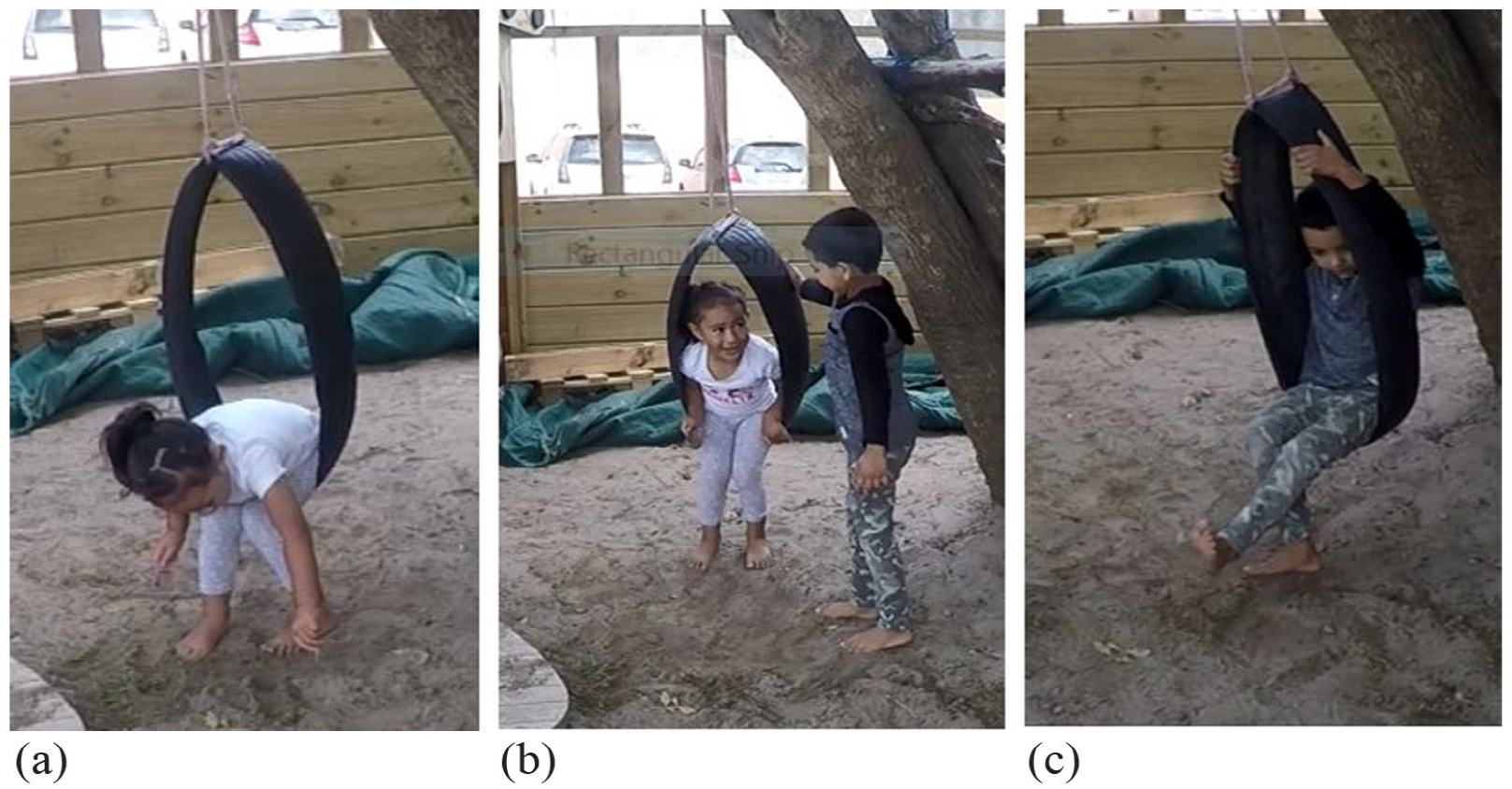
(a) Selva controls the swing. (b) Rashid and Selva make silent eye contact. (c) Rashid takes control of the swing.
For the next four minutes, Rashid stayed on the swing and Selva occupied herself with digging in the sand by herself. At that point, Rashid jumped off the swing and approached Selva, first standing at a distance and making funny faces to attract her attention, then walking towards her with his arms stretched out in a ‘zombie’ move that was popular at the EC centre. Selva smiled, then shook her head and went back to digging in the sand.
Rashid looked at her, and then turned away and ran up a slope in the garden where two other boys were watching the interaction. Before reaching them or interacting directly with any of them, Rashid looked at them and ran back down the slope to Selva in the sandpit. As he arrived, he glanced briefly back at the other boys. He came close to Selva and made a face at her. Selva looked up, and then down again as she stated: ‘No funny’. Rashid made more funny faces, coming up close to Selva until they were face-to-face with each other. After initially remaining impassive, Selva finally looked him in the eye and laughed out loud. At this, Rashid laughed as well, looked at her once more, and then ran back up the slope to re-join the other boys in their play.
(Fieldnotes 14022018.1c1)
In Extract 3, we see another example of physical clowning being used to create humour. As in Extract 2, the joke lies in the incongruous, non-human body movements which, in Extract 3, are associated with zombies. It is unclear whether acting like a zombie was itself enough of a running joke in the EC centre to occasion immediate hilarity, or whether Rashid chose to adopt a physical joke explicitly to repair the conflict caused by his physical interference with Selva’s swinging. Or, alternatively, whether Rashid’s incongruous actions and their ability to produce laughter in Selva were in fact for the benefit of the audience of boys on the slope. There is a great deal to be said about this interaction, and for reasons of space we cannot unpack it completely. However, we draw attention to a few aspects of the exchange which offer important lessons for the analysis of children’s conflict, the role of humour within conflict, and about young children’s ability to navigate their social relationships and identities within them.
Focusing first on the conflict over control of the swing, we see Rashid initiating the conflict by physically interfering with Selva’s solo play on the swing (lines 2, 5, 11, 15, 17) and persevering with his unwelcome interventions despite Selva’s objections and explicit requests to stop. By line 20 it is clear that Rashid has hurt her. The smiling eye-to-eye confrontation after Selva stops swinging (Image 1b) could be seen as a challenge or potential escalation of the conflict, with Selva’s smile a confident statement of her refusal to give up the tyre swing. However, Selva’s subsequent physical withdrawal from Rashid (as far as the swing allowed her) leaves the situation ambiguous. Rashid’s actions, while ostensibly directed at the swing itself, must be perceived as threatening to Selva while she remains inside it. It is unclear what she ‘rejects’ by shaking her head – is it Rashid’s physical power to unseat her, or is it that she is not interested in playing Rashid’s power game? But Selva’s decision to dismount the swing at this point allows Rashid to take control of it, a goal that we assume he adopted sometime before or during the exchange in Extract 3.
While linguistic exchanges are limited in this extract, the children’s gestures and body language speak eloquently of their negotiations of the interaction. By remaining close to the swing even after she had dismounted it, Selva appears to suggest that she does not concede Rashid’s right to it, but rather that her withdrawal is strategic and, in the face of Rashid’s escalating physicality throughout Extract 3, also prudent.
After 4 minutes of uninterrupted play on the swing, Rashid seems to realise that there might be interpersonal work that needs to be done before leaving Selva and the swing. He makes a perfunctory attempt at a joke using funny faces, which Selva rejects. She likewise refuses to acknowledge the established joking quality of the zombie walk, or the personal appeal Rashid is making by bringing the zombie walk to her. At this point Rashid seems to feel that his business on the swing and with Selva is done and starts to look for new play opportunities. However, having identified two boys he would like to play with, a complicated series of moves follows in which Rashid seeks to re-engage Selva in humorous exchanges. We suggest that knowing that he had had an audience of two boys watching him and Selva, Rashid’s subsequent efforts at humour towards Selva may not have been prompted by Selva’s previous reaction, but rather by his awareness of an audience (Hoicka and Gattis, 2008; Loizou, 2016). With an established identity as a ‘big boy’ within the EC centre community, Rashid may have felt an obligation to make a good-faith attempt to resolve conflict. Alternatively, we suggest that Selva’s refusal to accept Rashid’s zombie walk as mitigation for his previous interruption of her swing-play, was in effect a refusal to allow Rashid to have the last word in this interaction – a move that could be seen as a threat to Rashid’s identity as a ‘big boy’ in the EC centre.
The evidence that Rashid’s comic resolution of the conflict with Selva might have been primarily for another audience lies in (i) his repeated orientation to the other boys, even as he was directing his joke at Selva and (ii) him running off to join the other boys once Selva’s eventual laughter appeared to close the conflict between them. It is unclear whether, for Selva, the conflict was satisfactorily resolved. At this point we argue that the humour was only partly about Selva’s social and interpersonal needs. Rather, it was also about coercion, about asserting one’s will, and about consolidating one’s social status in front of an audience of peers.
Concluding thoughts
This paper has presented interactional sociolinguistic analyses of three extracts of children’s use of humour in conflict interactions taken from an 18-month longitudinal study in a multi-ethnic EC centre. The aim of our analysis was to probe different meanings carried in the children’s use of humour during conflict so as to broaden understandings of this phenomenon and its contribution to the social dynamics of young children’s daily lives in EC centres.
The humour extracts analysed in this paper contribute to the growing evidence that even very young children are remarkably resourceful in dealing with conflict (e.g. Ashby and Neilsen-Hewett, 2012; Blank and Schneider, 2011; Butovskaya et al., 2000; Clarke et al., 2019; Hay and Ross, 1982; Shantz, 1987) including through the use of incongruity-based humour (Loizou, 2005, 2016; Singer, 2019; Singer and de Haan, 2007). Much like adults (Norrick and Spitz, 2008), the children in these extracts used humour to resolve and defuse conflict interactions which otherwise directly threatened their interpersonal relations and possibly even their own reputational standing. Humour helped them manage their social relationships (Bergen, 2007; Singer, 2019; Singer and de Haan, 2007) and its use was linked to relational power (Loizou, 2005).
In the three extracts, shared humour was not always a unifying and bonding experience, nor did it always signal solidarity or consolidate in-group membership, as in Extract 1 – quite the contrary. In Extracts 2 and 3, we suggest that beyond functioning to defuse and resolve conflict, humour was also a means through which children negotiated interpersonal relations. In each negotiation, pre-existing power dynamics were at play and, at times, at stake. Here humour served a calibrating function that shifted, re-instated or enhanced the relational power within pre-conflict friendship allegiances and boundaries. For Hang in Extract 2, humour enabled a fleeting attunement with Emma, the desired but unattainable ‘Butterfly’, briefly shifting the status of their pre-existing relationship; for Rashid in Extract 1, humour reinstated and enhanced his relational power vis-à-vis Assad whom he had been enjoined to look after; while in Extract 3, despite an initial lack of success in gaining a reaction from Selva through his incongruity-based humour, Rashid’s sudden awareness of an audience led him to persevere and eventually to prevail in making Selva laugh, thus enhancing his personal power and avoiding loss of face as a ‘big boy’.
This variability of outcome from humour is important and could be pedagogically useful, alerting early years practitioners to the multiple ways that humour can play out for different children with different histories of interpersonal relations and power positions in the social order within an EC setting.
By focusing on the three extracts in context and analysing humour in conflict as a component of ongoing relationships which, moreover, are infused with power, conflict events are revealed in our analysis as having what we have called a ‘stretchy temporality’. In other words, the interactive moves in each conflict event and in which humour plays many functions, connect with other interactive moves both in the past and forward in time. This makes each interaction part of a broader social drama than is ever visible in any one interaction. Pedagogically, this points to the value of looking closely at children’s interactional moves in peer relationships while never losing sight of the broader and temporally wider context of those same interactions.
Footnotes
Appendix
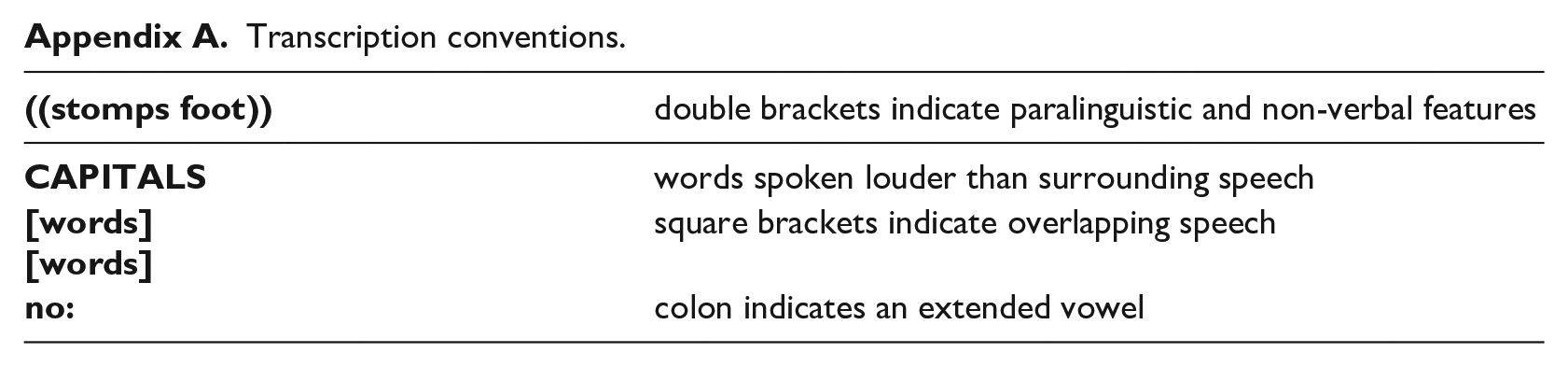
Transcription conventions.
|
|
double brackets indicate paralinguistic and non-verbal features |
|---|---|
|
|
words spoken louder than surrounding speech |
|
|
square brackets indicate overlapping speech |
|
|
colon indicates an extended vowel |
Funding
The author(s) disclosed receipt of the following financial support for the research, authorship, and/or publication of this article: This work was supported by Marsden Fund (Royal Society of New Zealand – Te Aparangi) Grant VUW 1633.

Data availability
The data collected for this study are protected under the conditions set out in the Victoria University of Wellington, Human Ethics Committee, approval number: 25333.