




Abstract
This study focuses on a close examination of how children express themselves at ECEC in play situations, which form an integral and large part of a typical day. The main research question has been: How can children’s social and emotional expressions be understood through analyses of communication and interaction during free play? A qualitative approach has been deemed suitable for this study, since it can provide insight into children’s social interaction and engagement with their peers and with ECEC staff, in their natural, everyday ECEC environment. The study was carried out at eight different ECEC centres and one pre-school at various locations in the Swedish-speaking regions of Finland. At the time of observation, the group sizes at the ECEC centres and the pre-school ranged from about 10 to 20 children, aged 3–6. The analysis showed an overarching category of exclusion in play, and in the article we present examples of how children limit each other during play. This is done through imposing limits in play through favouritism by prioritising certain children above others. The article exemplifies this with detailed analysis of play situations showing children’s verbal favouritism as well as clear exclusion of other children. The results highlight the need of discussing the issue more in depth.
Keywords
Introduction
Emotional and social competence is an ability formed in one’s early life that is of great importance for children’s well-being in a number of areas; this competence also has consequences for a child’s learning and development later on in life (Halle and Darling-Churchill, 2016; Kirk and Jay, 2018). There is a range of scientific evidence that indicates that the early years of childhood form an individual’s health and well-being throughout the rest of their lives (Sroufe et al., 2010; Tickell, 2011). For example, research indicates that the socioemotional development that takes place during early childhood is more intimately intertwined with academic success than what was previously assumed (Heller et al., 2012; Raver and Knitzer, 2002).
Emotional and social competence have consequences, for example, in a child’s behaviour and success at school because this competence involves thinking, planning, problem solving and the ability to make decisions (Kirk and Jay, 2018; Papadopoulou et al., 2014). As a result, weak socioemotional competence means that the child, besides showing reduced academic success, also runs the risk of social adjustment problems, including peer rejection and behavioural challenges (Eisenberg et al., 2005). Therefore, it is crucial that the conditions that help children feel that they are accepted members of a group are created as early on as early childhood education (Kirves and Sajaniemi, 2012).
Within this context, the current study closely examines how children express themselves at early childhood education and care (ECEC) settings in play situations. Play is an arena in which social constellations change and a variety of social and emotional expressions occur. The main research question is as follows: How can children’s social and emotional expressions be understood through analyses of communication and interaction during free play? What dimensions of negotiation can be found in an empirical material of children’s free play?
Theoretical framework: Children as social agents and creators of peer cultures
The current article is positioned within a larger theoretical framework, which can be included in what William Corsaro (among others) defines as the new sociology of childhood. This is understood to mean that children are active, social agents and that childhood is a structural form of society (Corsaro, 2000, 2018). Corsaro (2000) points out that it is within early childhood education that most children form their first peer cultures, which contribute to reproduction and change in the wider adult culture or society. Corsaro (2000: 92) defines peer culture as consisting of shared activities or routines, artefacts, values and concerns. Children strive in their peer cultures to create control over their own lives and share that control with each other (Corsaro, 2000). One way for children to create control over their lives is to circumvent the rules that adults have made by collectively making secondary adjustments, which is a term created by Goffman (1961: 189) and that means ‘any habitual arrangement by which a member of an organisation employs unauthorised means, or obtains unauthorised ends, or both, thus getting around the organisation assumptions as to what he should do and get and hence what he should be’. During early childhood education, the children’s secondary adjustments contribute to the formation of a group identity, giving the children an opportunity to express their personal interests and goals (Corsaro, 2018).
During play, children learn, among other things, to make decisions, to control their feelings, to see things from another child’s perspective, to negotiate with each other and to form friendships (Casel, 2013). This can be considered an extension of what Corsaro (2000, 2018) has highlighted as central to children’s relationships. Children who are socioemotionally competent are often at an advantage during playtime interactions. Children’s communication during play is often about the negotiation of roles and rules, as well as about conceding to and rejecting proposals (Howe and Leach, 2018). Understanding social rules gives the child an interpretation of the norms and suitable behaviour in different situations (Cobb-Moore et al., 2009), and when entering play, the child needs to be able to identify rules to be included by the other play members (Bateman, 2011). Identifying the social rules is something that can become hard if play members suddenly start to manipulate the game by creating fixed directives that other children must follow if they want to play, too (Goodwin, 2002). These kinds of situations can easily become unfavourable and controlling, increasing the ways to limit the game and, thereby, excluding others (Cobb-Moore et al., 2009). Kirves and Sajaniemi (2012) point out that changes in the rules of a game can lead to a situation in which a child seems to be part of a game but in fact has no possibility in affecting how the game progresses and develops. Various expressions of emotion are often featured during this type of communication, and previous research has shown that children who can handle their emotions are less often involved in conflicts and can also deal with negotiations and conflicts more constructively (Laursen and Adams, 2018).
Exclusion through favouritism: Prioritising certain children over others
In-group favouritism has been identified in many different types of social groups, child constellations and cultures (Bennett et al., 2004; Pinter and Greenwald, 2011), and in practice, it means giving specific chosen individuals preference over others (Castelli and Carraro, 2010; Tajfel et al., 1971). In the three representative examples in the results section, we analyse how certain children are favourised regarding entry into the play area or during the game. Favouritism is expressed through one or more children being accepted into or during the game above the others, despite the others’ repeated attempts to join in. This favouritism limits and forbids the children who have not been chosen to take part in the game, which results in exclusion.
Research examining exclusion in the form of the social phenomenon termed ‘in-group favouritism’ usually adopts an intergroup approach, which here could be about how a group of people interact based on stereotypes and norms. For example, this could be how a person is treated by others in a group because of their gender, skin colour, sexuality, disability or age (Brown and Bigler, 2005; Castelli and Carraro, 2010; Ingulia and Musso, 2013; Killen et al., 2009; Shutts, 2015). In-group favouritism involves the discussion of the in-group versus the out-group. An ‘in-group’ consists of those who are generally considered to be like ourselves, whom we like or who are deemed to be popular. An ‘out-group’ consists of the opposite, that is, people we consider to be different from ourselves, whom we dislike or who are deemed to be unpopular (Zebrowitz et al., 2007). A positive relationship between differential inclusion and differential evaluation shows that children are more favourable towards the in-group member they think is more popular within the in-group, but they are also more favourable towards the out-group member they believe is less popular within the out-group. That is, a positive correlation between differential inclusion and evaluation would show that children do not simply favour others who appear to be more popular per se but instead favour those who provide relative support for the in-group (Abrams and Rutland, 2008: 55).
Amodio and Devine (2006) and Stangor and Leary (2006) describe ‘in-group’ and ‘out-group’ as a form of social categorising that is created when we automatically place each other in various ‘boxes’, without taking individual personality into consideration. According to Tajfel et al. (1971) and Amodio och Devine (2006), this behaviour has negative consequences when these ‘boxes’, which in research are called ‘in-group biases’ (see Dovidio et al., 2010), consist of our own conceptions of various stereotypes. Our in-group bias can result in us finding it difficult to relate objectively, so it can cause us to express enmity towards – and even to exclude – the individuals who are considered to belong to another group. This behaviour is caused by the experience of ‘out-group treats’ (Dovidio et al., 2010). Emotional ties also constitute a risk for social categorisation, which means that we have a tendency to evaluate the actions of people we like (liked in-groups) as more adequate than the actions of people we dislike (disliked out-groups) (Amodio and Devine, 2006). Stangor and Leary (2006) point out that in many cases, in-group favouritism can be considered natural because social categorisation helps us simplify and structure our environment.
Methodology
A qualitative methodology was chosen to further explore the research questions:
How can children’s social and emotional expressions be understood through analyses of communication and interaction during free play? What dimensions of negotiation can be found in an empirical material of children’s free play?. Qualitative methods facilitate nuanced reasoning about how phenomenon such as communication and social interaction occur and, within this context, how children’s communication and social interactions can be understood (Cohen et al., 2018).
The data material consisted of snapshots of free play from the different ECEC centres. These snapshots provided close insights into the children’s social interaction and play with their peers and within the ECEC centres, here in their natural, everyday environment (James, 2007). The core of this approach was to gather information about how things are or were at a certain point in time for a group of participants rather than to observe changes and development over a longer period (Denscombe, 2014; Hammersley and Atkinson, 2019).
Participatory observations
Participatory observation is commonly used in studies that adopt a qualitative approach in research on and with children. Joining a natural environment for a period of time makes it possible to examine, experience and retrospectively represent the social lives and processes that have occurred in that environment (Emerson et al., 2011). By stepping in as an observing stranger and trying to acclimatise to a previously unfamiliar setting or group, the researcher can become aware of details that are banal, irrelevant or invisible to the other participants. These details are often the key to understanding the underlying structures of a culture (Giampietro and Molle, 2008). In the current study, participatory observations were considered the best way of finding children’s social interactions in play because other methods tend to include more interpretative layers rather than the children’s direct interactions.
The participatory video observations yielded data regarding how the children communicated and interacted with each other during free play as part of their everyday ECEC routines. Using video observations and recordings made it possible to analyse the children’s multimodal interactions in play, hence removing the limitations imposed by audio recordings, which only capture speech and voice, or field notes, which risk capturing only parts of the play interactions.
Material, delimitations and implementation
The present study was carried out at eight different ECEC centres and one preschool at various locations in the Swedish-speaking regions of Finland. A large number of ECEC centres were invited to in-service training on children’s socioemotional competencies, and the participating ECEC centres were asked to participate in the research. The target group for the observations was children aged 3–6 years, and all children at the participating centres were asked to participate. At the time of observation, the group sizes at the ECEC centres and the preschool ranged from about 10 to 20 children.
During the participatory observation, video recordings were made of the children’s play over the course of 1 day with each ECEC group. An average of one hour of free play was filmed during each ECEC centre visit, meaning that the collected data material amounted to approximately 9 hours of film. Because the focus of the research question is interaction during free play, films depicting planned activities in the form of games that were initiated by adults have been excluded. The video recordings were carried out with an iPad mini and regularly downloaded at the university’s secure server for research purposes.
Ethical considerations
The present study has actively adhered to the Guidelines of the Finnish Advisory Board on Research Integrity (TENK, 2012). In a study in which the primary material consists of video observations of playing children, the research team is faced with a number of ethical considerations. These ethical considerations were tackled in different ways, all equally important, and discussions among the research teams were ongoing when it came to this topic (Bodén, 2021).
After each participating municipality had given its approval for conducting the research at the ECEC centres, the children’s guardians received a form that contained information about the study. The children, parents and teachers were informed of ethical considerations such as the importance of the anonymity of all participants and the video recordings not being a means of valuing teachers’ work or children’s play. The parents of all the children and the teachers were also asked to give written consent for taking these video recordings. The children who did not have parental consent were not filmed.
Different ethical aspects were included in the ongoing video recordings (Peters et al., 2021). First, those children who were not included in the study were not recorded, but when they accidentally entered a situation where recording was taking place, the video recording was stopped, and the recording was not used for any analysis. Second, the children were also asked to give consent during ongoing video recording. The children were informed that they had different ways to say no to filming: saying ‘no’, putting up a hand or showing with their body by turning their back towards the researcher or shaking their head. Third, the researcher doing the video recordings also tried to carefully monitor for any other signs that the children did not want to be filmed.
To guarantee the anonymity of the children, all the children’s names were changed at the transcription stage, and some dialectal expressions were also standardised so that the children’s regional origin would not be detected.
Data processing and method of analysis
The video observations were processed by means of a multimodal interaction analysis (Cowan, 2014; Norris, 2013). All video sequences were first examined in their entirety, without interruption, here at least once per ECEC centre. This was the first phase of the analysis. In the second phase, films with good sound and light quality were included, along with footage of the children playing together with other children. In the next examination, sequences that fulfilled these criteria were chosen to be further analysed: free play and interaction between at least two children. This resulted in material consisting of 58 sequences, and the filmed sequences ranged from 30 s to 5 min in length. These 58 sequences of free play were transcribed, amounting to approximately 2 h of data that were transcribed and analysed. In the third phase of the analysis, we found that play negotiations were often featured. In 26 of the 58 sequences, there was a specific pattern of exclusion in the play negotiations that occurred. These 26 sequences were examined to be analysed more thoroughly, and sequences specifically categorised as exclusion through favouritism comprised eight of these. These eight sequences serve as a backdrop against the three sequences we have chosen to highlight. The three examples presented here are clear examples of favouritism, making it possible to exemplify favouritism through short extracts.
In qualitative research, transcription signifies the process by which parts of a spoken language are reproduced in written form for the purpose of analysis and the communication of new discoveries (Cowan, 2014). The transcription process can be considered a kind of negotiation in the qualitative research process, in which the negotiation involves making both minor and major decisions at an early stage, here in relation to the future analysis (Heikkilä, 2017). One such decision, according to Cowan (2014), can be to choose a transcription technique that does justice to the material so that as many types of expression as possible can emerge in a way that is clear and transparent. Heikkilä (2017) asserts that expanding the content of transcription – from exclusively focussing on speech and the representation of an activity in words to including other forms of communication – is the basis of a multimodal interaction analysis. In the current study, the chosen video sequences were analysed through a transcription programme that captured verbal and nonverbal communication in the form of the following: time, speech, body language/gestures and glances. Norris (2013) highlights the use of a multimodal interaction analysis as a holistic methodological framework. This framework provides a comprehensive overview of what is being studied, facilitating the integration of the verbal and nonverbal in the analysis work while also making it possible to connect these with material objects and the environment the individuals are interacting in.
After the video sequences from each ECEC centre had been transcribed using the transcription programme, categories were made using codes with numbers and patterns of action, according to: The type of play, often recurring social and emotional expressions, how these emerge in the play situation, and what types of strategies are used in the game. At this stage, the phenomenon of exclusion emerged as to be prevalent in the play negotiations and was selected as a potential main theme.
The analysis of the material brought our attention to the play negotiations taking place during free play, and the subphenomena in the negotiations emerging from the material were the different types of exclusion strategies the children used. We identified an overarching category of exclusion showing how children limit each other during play.
Results
During play negotiations, children interact and communicate about their play and the game, and relationship skills, which have been previously highlighted as central to socioemotional competence, also become apparent. Play negotiations can be considered a concentrated form of children’s socioemotional competencies, and they also easily lend themselves to empirical research. We found three subcategories displaying how exclusion through imposing limitations features in various ways: (1) exclusion through manoeuvring, or using fantasy and fiction, (2) exclusion through passive resistance, or ignoring and neglecting, and (3) exclusion through favouritism, or prioritising certain children above others. In the current article, the focus is on the third subcategory, and the results concerning the other two subcategories are published elsewhere (xxxxxxx).
The subcategory of how exclusion is made through favouritism is presented through close descriptions of the three chosen examples from the observed and transcribed play situations. Eight sequences (totalling 26 transcribed and analysed sequences) were analysed as part of this subcategory. The chosen examples clearly represent the material and the theme favouritism but are not the only examples that could have been presented here.
Sia and another girl are taking turns caring for Adam, who is lying on a mattress on the floor, pretending to be a patient. Tuva, who expressed earlier on in the game that she could also play the patient, is standing by, watching the others play. When Sia and the other girl have given Adam injections and then gone off to get more medicine, Tuva steps forward and attempts to give Adam an injection, too. Adam allows Sia and the other girl to inject him with syringes but reacts angrily to Tuva’s initiative to give him an injection. 01:35 – 01:36 – 01:37 – 01:39 – 01:40 – 01:43 – 01:44 – 01:46 – ((Tuva moves the stethoscope in the direction of Adam’s chest)) 01:48 – 01:56 – 02:00 – ((Tuva removes herself from the game)).
Sia returns and sits down beside Adam with a new instrument in her hand (01:37). Tuva seats herself beside Sia and makes a new attempt to participate in the game by listening to Adam’s heartbeat instead (01:39). Sia interrupts Tuva’s attempt repeatedly (01:40, 01:44). Adam, who is lying on the mattress, allows Sia to take care of him but pushes Tuva away (Figure 1) and rejects her verbally several times (01:48, 01:56). Tuva removes herself from the scene (02:00), and at the same time, both Sia and the other girl continue to nurse Adam using various instruments, without being spurned.
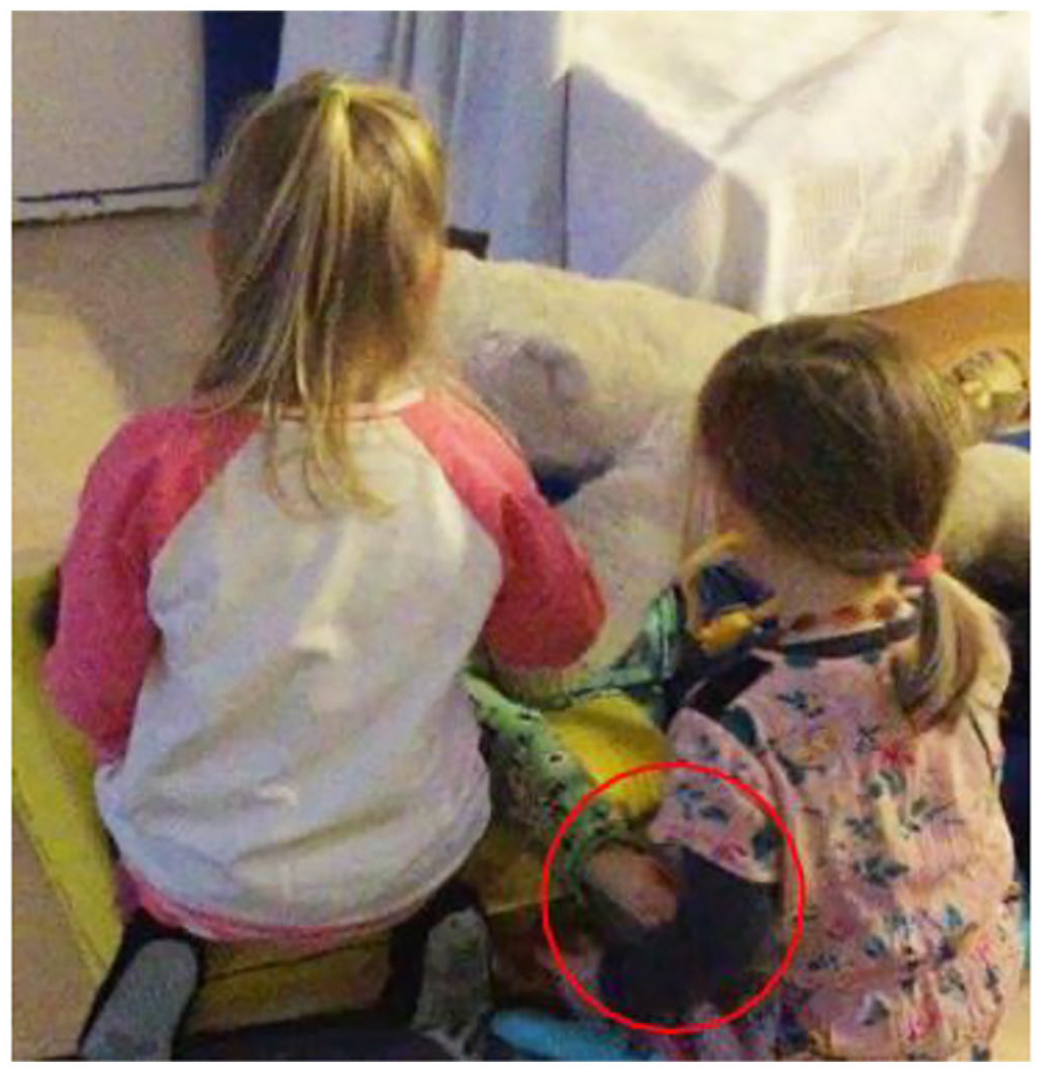
Adam pushes Tuva’s hand away (red ring).
In the example, Tuva’s actions are limited by both Adam and Sia through their refusal to let her care for the patient, which results in her not gaining entry and, hence, being excluded from the game. By observing the play space in the beginning (see the example’s introductory text), Tuva gets an idea of what norms are applicable for acceptance (Bateman, 2011; Cobb-Moore et al., 2009). Although Tuva wants to do exactly what Sia and the other girl are doing – give an injection – it is not accepted. In this case, Adam repeatedly prefers the care of the other girls above Tuva’s, which indicates that ‘in-group favouritism’ occurs in the game (Castelli and Carraro, 2010; Tajfel et al., 1971). None of the children express directly that Tuva has to leave the play area, but both verbal (01:56) ‘I don’t need that! I don’t need it!’ and nonverbal gestures (see Figure 1) clearly signify exclusion.
In example one (1), Adam prioritises receiving healthcare from the two other girls who originally started the game with him, relegating Tuva, who tries to gain entry while the game is in progress, to not playing. That Tuva is not permitted to be a part of the play space is made evident through the enmity expressed both in words and in touch, signifying rejection. She refuses to be excluded, resulting in her trying again to be included, which lead to Adam physically moving her away from his body; this then results in Tuva going away. In example two (2), the favouritised child is singled out as a higher priority than the other child, even though they both try to gain entry into the game. According to Abrams and Rutland (2008), it is not always about favouritising the popular members of the in-group, but it also involves instances of favouritising members of the out-group. If a child who belongs to the out-group shows loyalty to someone in the in-group or contributes some form of support, that child can also be favouritised above the other members of the in-group.
Mindy, Klara, Ingvar and Viktor are gathered in a ring outdoors. Viktor and Ingvar walk towards Klara and Mindy from their two different directions and try to get into the game. 00:02 – 00:05 – 00:08 – 00:10 – 00:13 – 00:16 – 00:18 – 00:21 –
Both Viktor and Ingvar make an attempt to join the game. Viktor emphasises that he wants to participate (00:02), while Ingvar, after the teacher’s input (00:05), asks if he may join in (00:02). Klara points out that there is only room for one of them in the game (00:10), at which point Mindy makes a decision that this person should be Ingvar (00:13, Figure 2). Ingvar reacts to the girls’ rules with dissatisfaction and stands his ground (00:18). Neither Klara nor Mindy change the rules, despite the display of displeasure. The teacher affirms Ingvar’s comment before she, Ingvar and Viktor go off to play something else.
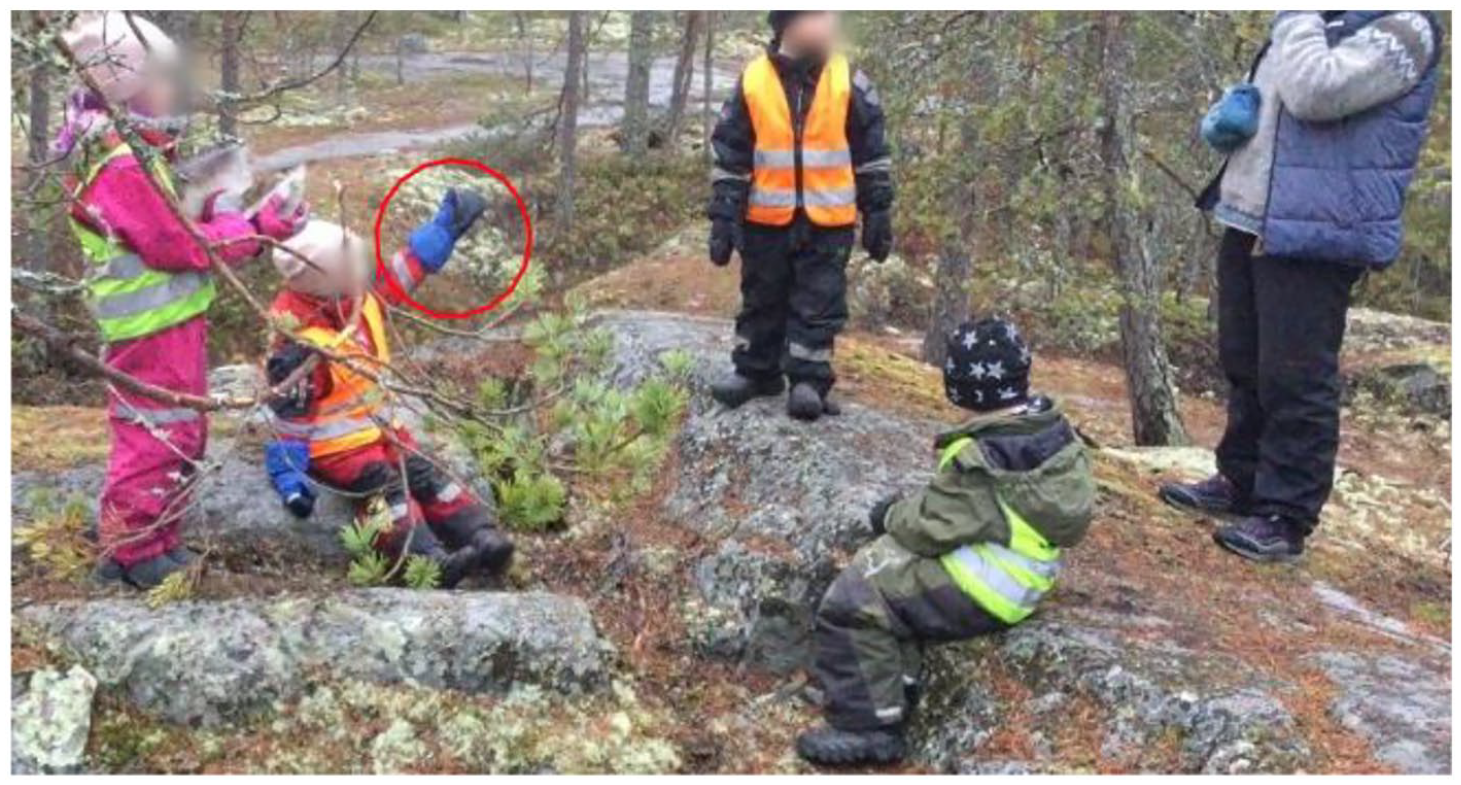
Mindy points at Ingvar.
In the example, Klara and Mindy are the ones who initiated the game, while Viktor—particularly Ingvar—try to negotiate access by stretching the rules, which are violated. Klara and Mindy both control and manipulate the negotiation situation by giving their own fixed rules for how many boys are permitted to take part in their game (Cobb-Moore et al., 2009; Goodwin, 2002). The previously determined rules limit and exclude one of the boys from participating: ‘Only one boy can play with us’ (00:10). In the negotiation phase, Ingvar is clearly chosen above Viktor, which indicates favouritism (Castelli and Carraro, 2010; Tajfel et al., 1971), but he is also the one only explicitly asking for permission to join the game. In the situation, Ingvar is not a part of the girls’ own ‘in-group’ and is favouritised instead based on being in the ‘out-group’ (Zebrowitz et al., 2007). Ingvar is favouritised above Viktor, even though he belongs to the ‘out-group’. In the example, Ingvar objects to there being a limit on the number of players (00:18), and later, he comments that he and Viktor leave to play together. Viktor and Ingvar show competent social organisation practices in terms of being made the favourite but rejecting that role. The last example (3) is similar to the other two examples in the way that one child is prioritised over another. The situation differs, though, in the way the exclusion takes place. It is experienced in a more aggressive way and is more directly expressed than the other examples.
Two boys (Mattias and Rune) are swinging together outside. Signe approaches them from the side and observes them for a while. Mattias gets up from the swing and screams something to another child. Signe sees her chance to take the half-empty seat and puts her leg over it. Mattias notices Signe’s move and pushes her away from the swing seat with his leg. Signe reacts strongly by confronting Mattias about what he is doing (Figure 3). Mattias and Signe start arguing about the incident. After the argument, Signe sits down face to face with Mattias at the third empty swing seat and starts swinging. This results in a new argument but this time with Rune (who is sitting behind Mattias). 01:08 – 01:10 – 01:13 – 01:15 – 01:17 – 01:20 – 01:25 – 01:30 – 01:35 *silence* ((Mattias gets up from the swinger, looking at Rune and start walking away towards another swinger)) 01:38 – ((Signe walks away))
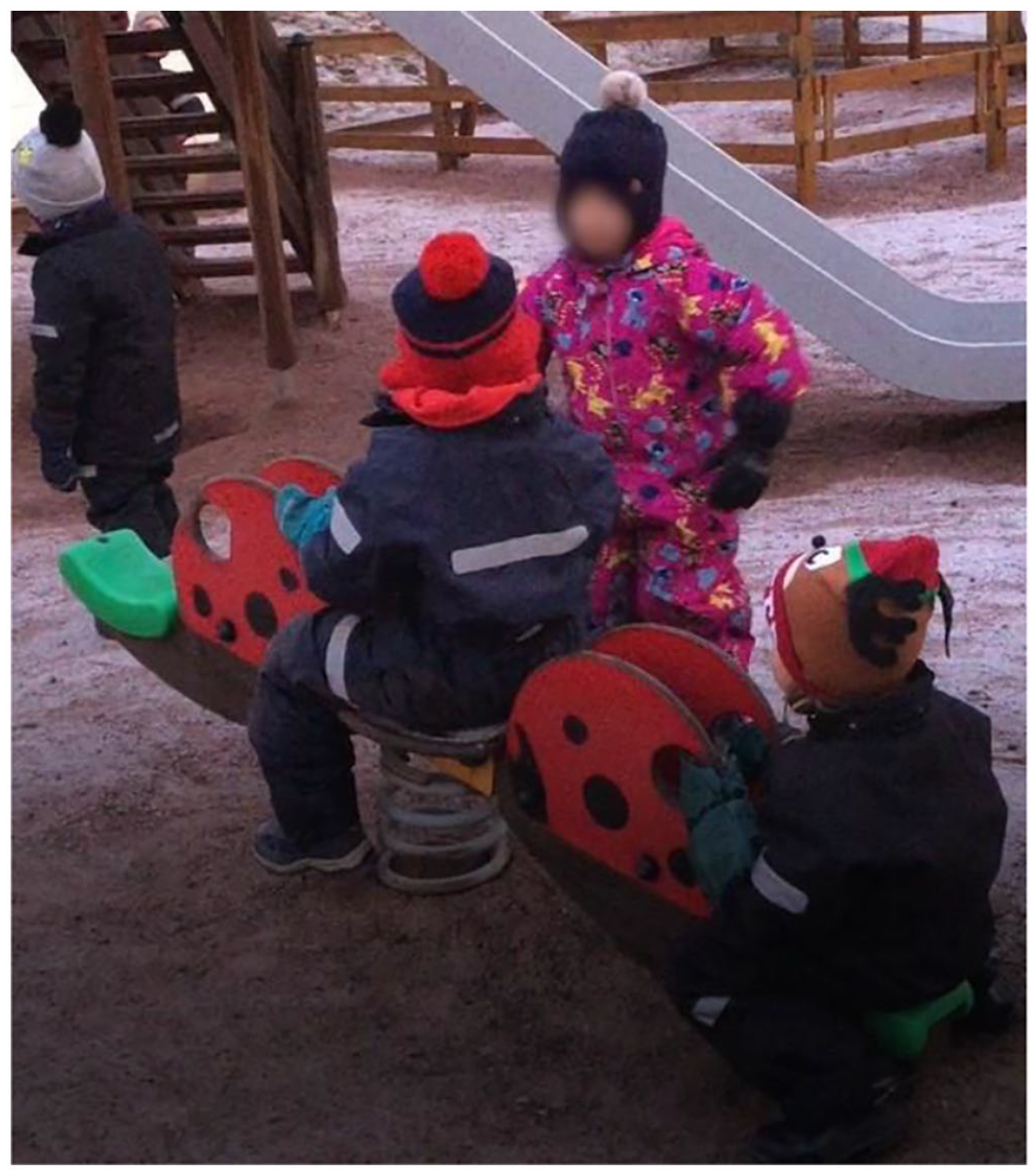
Signe (in purple) confronts Mattias (in the middle) about his action.
Here, Signe tries to gain access to the swing, first by waiting for Mattias’ seat to open up and, second, by taking the third seat that is free. Signe’s attempt to gain access triggers an argument with Mattias, which is followed by an argument started by Rune. Rune seems bothered by Signe’s presence when he suddenly starts to provoke her with statements about strength (01:08, 01:13, 01:17). This is something that Signe responds to with verbal self-defence (01:10, 01:15, 01:20), which in turn ends with being excluded from the game by the boys, who seem to prioritise each other over playing together with Signe (01:30, 01:35).
In the example, it is clear that Signe first of all is exposed to a type of exclusion, being attacked with predications about her being weaker than Rune (Brown and Bigler, 2005; Castelli and Carraro, 2010; Killen et al., 2009). The ‘favouritism happens’ in the transcription where Rune states that they are swinging with Mattias (01:25). In this example, exclusion because of favouritism of others is tried to be negotiated (see Singne’s response – 01:30). Signe answers him by defending herself against his provocative and offensive behaviour, which leads to Rune prioritising Mattias and excluding Signe (Castelli and Carraro, 2010; Tajfel et al., 1971). This excluding and favouring behaviour is first caused by Rune’s disapproval of Signe’s appearance, which limits her inclusion and puts her in an out-group position (Zebrowitz et al., 2007) from his and Mattias’ game. The issue cannot be caused by a lack of space on the swing but can instead be explained by Rune’s will to only play with Mattias. Rune’s statement makes the intention of exclusion through favouritism in the situation quite clear: ‘I want you to go away. I don’t want to swing with you anymore. I am swinging with Mattias’ (01:25). This is a harsh and direct statement, followed by the boys leaving Signe behind for another swing she cannot handle.
All these examples show how one child is rejected while one or several others are chosen when they attempt to gain entry into a game or get full participation when a child already is a part of a game. In example one, Sia, Adam and the third girl are already underway with the game and, therefore, are ‘the in-group’, while Tuva, who stood outside the game at the beginning, is ‘the out-group’. Despite the fact that Tuva tries to use the same play strategy as the other two girls in the group, she is both verbally and nonverbally denied access to the play space, which means that Adam favouritises the other two above her. In example two, one child is prioritised above another, this time instead by two children simultaneously. The prioritised child, Ingvar, is situated outside the play space from the outset, just like the rejected child, Viktor (the out-group). Both try to join in at the same time, whereupon Klara and Mindy first express that only one boy is allowed, subsequently prioritising and favouritising Ingvar above Viktor. The third example is a bit more visible in showing its exclusivity, where Signe begins her attempt to get access the game by getting verbally discriminated, continuing with facing limitations to access by Rune’s way of showing animosity towards her. Rune also openly favouritises Mattias through a verbal statement, which results in the collective exclusion of Signe by both of the boys.
Conclusion and discussion
The current study has shown how children’s social and emotional expressions can be understood through analyses of communication and interaction during free play and what dimensions of negotiation can be found in the empirical material of children’s free play. The results are based on the understanding that play is an arena in which communication and interaction occur between children on a daily basis (Howe and Leach, 2018). In this communication and interaction, children create peer cultures (Corsaro, 2000) that are partly built on emotional reactions expressed both verbally and nonverbally in negotiation situations (Casel, 2013). Negotiations that are emotionally charged can lead to conflicts between the parties involved, and if the feelings become difficult to deal with, destructive consequences can ensue (Laursen and Adams, 2018). For instance, the negotiations and conflicts between children during play can be about roles, rules, toys or the content of the game (Howe and Leach, 2018) and, in unfavourable cases, can lead to exclusion (Cobb-Moore et al., 2009; Goodwin, 2002).
In the present study, social and emotional expressions have been identified and analysed in situations involving social interaction and communication between children, with in-group and out-group tendencies in mind. Within the context of play negotiations and conflict, exclusion emerged as a recurring phenomenon.
All of the exclusion situations were expressed through some form of limitation, in which three different strategies were discernible. The exclusion process presented here, exclusion through favouritism or prioritising certain children over others, displays children’s ability to favouritise their playmates so that the prioritised children get both access and benefits (Castelli and Carraro, 2010; Tajfel et al., 1971) in the play situation, while the children who are not prioritised are forbidden to participate (Amodio and Devine, 2006; Dovidio et al., 2010) and, therefore, are left outside the play space.
Several patterns of exclusion through favouritism became visible. Favouritism happens after a child has tried to verbally or multimodally renegotiate being excluded from play or a game. The renegotiation process ends when the verbal exclusion is accompanied by either a child being pushed away, when pointing has occurred or if the renegotiation is responded to with silence. These strong communication signals (pushing, pointing and silence) are all very explicit and are met with physical movement away by the targetted child. It is also visible in the analysis that an explicit question ‘Can I join?’ is very seldom used, and when it is used by Ingvar (in example 2), there is a positive outcome. This explicit question is also a form of risk taking, with a risk being actively excluded. What can be discussed is also that in these examples, there are children of the opposite sex executing the exclusion. The in-group and out-group processes shown in the examples correspond with Abrams and Rutland (2008) and Zebrowitz et al. (2007) stating that in-group processes are in favour of those who are ‘similar’ to those playing or of those who are very different in the out-group.
Earlier research studying children and favouritism has mostly focussed on how gender, race, disability and age impact favouring behaviour (Brown and Bigler, 2005; Castelli and Carraro, 2010; Ingulia and Musso, 2013; Killen et al., 2009; Shutts, 2015). In the current study, both girls and boys favouritise in-group members over out-group members and out-group members over in-group members. Same-gender favouritism is a pattern. Age did not significantly impact these actions, and situations where race or disability affected the outcome were not found. More research is needed when it comes to better understanding the social factors that lead to these different kinds of complex favouring behaviours.
It is crucial that future and existing educators know more about exclusion strategies in play. When obtaining more knowledge of these exclusion strategies, educators can better support and teach children about handling conflicts and negotiations to reduce exclusion and strengthen children’s socioemotional expressions. Therefore, we suggest that future research could seek to determine which interventions are the most effective when it comes to encouraging prosocial responding, especially towards members of the perceived outgroups in children’s play. If different exclusion strategies in play are not identified and given attention, it is not possible for early childhood education to focus on the right kind of support for children in handling their emotions so that they can better manage how to master conflicts and negotiations in relationships with their playmates in a more constructive way.
