




Abstract
In the field of early childhood education, play has become synonymous with curriculum but is sometimes viewed narrowly as a pedagogical tool to enhance child development. However, it is known from a range of multidisciplinary work that child-initiated and child-guided forms and contexts of playing can offer rich insight into diversity in childhood(s), peer cultures and children's meaning-making. This article draws on an ethnographic study that was conducted in a full-day childcare centre in Singapore and focused on children's everyday world of self-initiated play, improvisation and peer culture. Specifically, it presents examples of songs and rhythmic chants created by a group of 4-year-olds . Such ‘musicking’ is a form of social play that illustrates children’s ways of teasing, relating with others and sense-making within their contemporary social world. The article argues for educators to look beyond the instrumental value of play in the preschool curriculum, inviting all to take some time to allow children's multifarious play activities to influence their adult sensibilities.
Introduction
Within the culturally and linguistically hybridised city-state of Singapore (Chang, 2003), children are largely viewed as innocent and immature adults-to-be. Furthermore, the nation's meritocratic education system places great emphasis on academic achievement and inadvertently limits teachers’ and parents’ view of young children's capabilities as knowers. Early childhood educators have tended to rely on traditional developmental psychology to focus on children's lack of language, cognitive and social skills. Such is the deficit view that tends to reduce the young child to a mere shadow of an adult, the yet-to-be participant in society.
Although this tabula-rasa view of children is common in many parts of the world, it is a paradigm that has already been challenged by sociologists, anthropologists, educationalists and an established body of work in neuroscience research (Corsaro, 1996; Dyson, 2003; James and Prout, 1999; Jenkins, 1998; Montgomery, 2009; Shonkoff and Phillips, 2000). In-depth studies and theoretical tools in the last three decades have been generating an image of young children as fully human, capable and competent social actors in their own terms and within their own sociocultural contexts (Alderson and Yoshida, 2016; Corsaro, 2003; Dyson, 1993, 2003; James and Prout, 1999; Paley, 1980, 1986; Seiter, 1993; Walkerdine, 1997). This stance is also in line with the United Nations Committee on the Rights of the Child (2006) and its General Comment No. 7 specific to early childhood in acknowledging young children below the age of eight as rights-holders, equally deserving of protection, provisions and participation in their communities.
Singapore's childcare context
It is compulsory for all Singaporean children to attend primary school the year they turn seven but, prior to that time, most families enrol their children in one of two types of privately managed preschools: kindergartens, offering three-to-four-hour academic programmes to children from 36 months, or childcare centres, offering half-day or full-day programmes to children from 18 months and including an academic curriculum for the older children. Although preschool education is not compulsory, it is seen as preparation for primary school (Ministry of Education, 2007) and more than 95% of preschoolers are enrolled by their families for at least a year. The Ministry of Education (2013) has a recommended curriculum framework for four-to-six-year-olds. In line with the nation's bilingual education policy, most preschools offer at least a bilingual English and Mandarin curriculum. While it is not ideal, given that 74.3% of Singapore's residential population is of Chinese ethnic descent, 13.5% are Malays and 9% Indians (Singapore Department of Statistics, 2021), it is common to find non-Chinese-speaking children in a typical preschool. More than 20% of Singapore's population of 5.6 million are foreigners, as the nation continues to depend on a migrant workforce. Singapore's total fertility rate fell to its lowest at 1.1 births per female in 2020 (Singapore Department of Statistics, 2021) and the average household size was 3.22 (Department of Statistics Singapore, 2020), with women's participation in the labour force at 61% (Manpower Research and Statistics Department, 2020).
The government has been promoting childbirth through monetary incentives, as well as support for families such as increasing the number of affordable childcare services. In Singapore's landscape of more than 1900 childcare centres and kindergartens, the number of new centres is increasing as the government provides grants to selected operators each year. About half of the preschool operators are commercial and the remaining are non-profit, and there will be about 50 preschools offered by the Ministry of Education by 2023. Preschool fees vary widely, and these centres often have to cater to families’ wishes in order to maintain healthy enrolment. This often means that preschools are compelled to prepare young children for subject-based academic learning in primary school (i.e. languages, mathematics, science) through largely teacher-led learning experiences. In a pragmatic society like Singapore, even early education serves a utilitarian purpose, and ‘play’ in curricula is often guided by the adults’ agenda for school readiness (Bautista et al., 2019; Lim, 2010).
As a signatory of the United Nations Convention on the Rights of the Child, Singapore is still working towards creating greater awareness of ‘children's rights’. Locally, there has been more interest in studying the developmental needs of young children more than their present-day knowledge(s) as social actors and cultural producers. There has been virtually no published research evidence of Singaporean children's playful ways of knowing or the emergence of peer culture within kindergartens and childcare centres. Within a meritocratic climate, ‘play’ is often considered unproductive and hence polarised against ‘work’ (Lim, 2010), and many Singaporean adults would rather spend time and money to help their children achieve academic merit rather than understand the dynamic nature of child-initiated play, much less appreciate their ‘musicking’ as an essential means of participation in social life.
Play and playfulness in children's peer culture
Play activity has always been an integral part of our humanity, contributing to our individual and social learning regardless of how old we may be. Huizinga (2000) refers to human beings as homo ludens (‘man the player’) for good reason. For Huizinga, play is a natural human endeavour that is game-like, self-initiated and enjoyable; it represents part of human knowing and is a creative representation of what we imagine to be possible within our cultural contexts. Focusing on young children, Vygotsky (1978: 102) believed that play creates a ‘zone of proximal development’ of the child and, in play situations, ‘a child always behaves beyond his average age, above his daily behaviour; in play it is as though he were a head taller than himself’.
Children play when they are alone and when they are in the company of their peers; hence, play activities are a prominent aspect of children's meaning-making within their daily lives and a big part of children's peer culture. Peer culture is ‘a stable set of activities or routines, artefacts, values, and concerns that children produce and share in interaction with peers’ (Corsaro, 2014: 110). Children's peer culture evolves within adult-regulated spaces such as homes, schools, kindergartens and day-care centres. Investigations framed by interpretive sociology present children's social worlds in non-pathologising ways, with data generated by close observations and interpretations of children's sharing, rule-breaking, spontaneous playing and relations to authority (Corsaro, 1985, 2003, 2014). Such studies have found children to be more than imitators of the adult world – they are social agents and active joint interpreters of our world on their own terms.
The classroom, although an adult-created territory in which children's bodies and minds are often controlled, is anything but a homogeneous place where children respond and behave in the same way at the same time. Studies by Campbell (2010), Corsaro (1985, 2003), Dyson (1993, 2003), J Marsh (1999) and Paley (1980, 1986) have shown us, from different disciplinary and theoretical orientations, that children move in between the official world of schools and classrooms (as directed by teachers) and the unofficial worlds created and ordered by their peers within the same physical space. Children often act without adult-given instructions, and do so for their own reasons. They are social agents negotiating ways to be heard in the adult world, appropriating and internalising multiple experiences and realities.
It is the process of playful meaning-making and shared culture of peer music-making that this article seeks to illustrate with ethnographic data. It is grounded in Corsaro's (1985, 2003, 2014) argument that children's play process is an interpretive reproduction of the existing adult-created world and not a mere mimicking of adult talk and action. The symbolic and material aspects of young children's peer culture are often influenced by family and community relations and values, classroom activities and popular culture, such as television programmes, movies and children's books. The key assumption underlying this article may be summed up by the following quote: Children are and must be seen as active in the construction and determination of their own social lives, the lives of those around them and of the societies in which they live. Children are not just the passive subjects of social structures and processes. (James and Prout, 2003: 8)
Musicking in children's lives
Music is a biological part of being human, as well as a cultural product and communicative and expressive process. Hence, the playful musical interactions of children presented in this article contribute to the cross-disciplinary work of sociologists, psychologists, educators, ethnomusicologists and folklorists. Trevarthen and Malloch (2002) assert that musicality is a biological part of human sharing and occurs as early as when infants communicate with their parents. In children's lives, music-making is a meaningful activity (Campbell, 2010), both a natural and necessary part of childhood play (Lew and Campbell, 2005). Small (1998) coined the term ‘musicking’ to highlight music as a verb and human action, not merely an end product. Musicking encompasses both activities of making-music and listening to music. According to Small (1998), even the act of listening to music is an act of engaging with the sound patterns that one hears, and allowing the sounds to shape one’s thoughts and feelings, not unlike the process required in performing music.
When given autonomy, young children have been found to engage in plenty of musical exploration and expression, as discovered in a classic study (Moorhead and Pond, 1941/1978), and musical behaviours have been central to their spontaneous play activities (Bjorkvold, 1989). Children's spontaneous vocalisations have been found to include standard songs and free-flowing humming or singing, as well as chanting (Young, 2006). Across a wide range of countries, children have also been found to personalise learned music to fit their sociocultural norms and needs. Campbell (2010) explored the meaning and value of music in children's lives by recording children's musical utterances and observing children's musicking behaviours in elementary schools and on school playgrounds. She found that children create music for a variety of purposes, and she observed how some children wanted to keep the songs in their heads or their singing in their bedroom for their own enjoyment – ‘nobody knows my music except me’ (262) – while others enjoyed singing and rapping as a social activity, as part of their kid culture, where they would incorporate jingles from commercials and theme songs from movies.
In Singapore, adults traditionally pay little attention to child-initiated play activities and often try to eradicate behaviour or speech that they deem immature and noisy. Campbell’s (2010) vignettes from an elementary school also show adults exercising power over children's social and physical behaviours – for example, when children were carving out their unofficial spaces in a school cafeteria with their impromptu songs and rhythms, they were reminded by adult monitors to be quieter or to ‘leave the singing for music class’ (39). Similarly, I have witnessed in my own work in classrooms that adults are often the ones who prefer to draw clear boundaries between expected behaviours and tasks (i.e. singing is for music time; silence is required during writing time). Many teachers and parents in Singapore are often quick to reprimand children when they move, sing, chant or laugh, especially in classrooms and public places where children are generally expected to be seen and not heard.
With the support of their peers, children often find a way to create unofficial spaces within the official spaces dictated by adults. These child-created spaces, which are usually unsanctioned by adults, can reveal a lot about how children understand the social world on their own terms, and influence the way they learn. Paley's (1980, 1986, 2010) rich documentations of preschoolers’ fantasy play and friendship-building have been seminal in advocating for children's curiosity and moral lives to be central in our curricula. In a North American kindergarten classroom, Dyson (1993, 2003) found children's love for song and rhythm evident in their participation in official school activities such as writing time. She presents children's remix versions of various ‘worldly’ texts, including commercials, movies, cartoons, songs and television sports reports, to illustrate how they actively re-present their cultural world(s) as tangible products in classroom literacy activities (Dyson, 2003). Through keen observations and detailed recordings of the children's words and sounds, she approaches from within the focal children's cultural worlds, looking out towards the demands of school, and creates a contrapuntal piece. With a focus on literacy, Dyson shows children bringing into school a rich accumulation of different discourses – from home, communities and popular culture, such as hip-hop songs, rap, music, movies and television – in their unofficial sphere in the classroom with ‘brothers and sisters’, even as that sphere intersects with the official writing time.
Methodology
Campbell (2010), Corsaro (2003) and Dyson (1993, 2003) have demonstrated how ethnography is suited to the purpose of obtaining a more intimate understanding of some aspects of contemporary childhood culture through children's self-initiated vocalisations and peer play. Inspired by these studies, and with the opportunities and resources available, I observed a group of 23 four- and five-year-olds over a period of six months almost daily (110 observation days), generating field notes and video recordings to document and analyse the children's cultural knowledge and social interactions. The study's broad focus was to understand how children's peer cultures were created within a typical childcare setting, and how children were perceived by the adults in that space. Even though I was focused on observing the children's play episodes, their rhythmic chants and songs caught my attention during the first month in an unexpected way because these were not often loud and were sometimes fleeting, but significant, in the children's play processes.
Taking a broad definition of ‘culture’ as a way of life which reflects the unspoken symbols and meanings that guide individuals and particular groups in their values, thought and behaviour (Corsaro, 2003; Jenkins, 1998), the findings in this study are limited to the peer culture of a small group of children in a particular community and setting. However, they aim to inform Singaporean educators’ image of the young child and encourage a rethinking of pedagogical practices and curricular goals.
The study site
Childcare centres in Singapore mostly cater for children from 18 months to 6 years. I chose the centre because of the diverse demography it catered for: it was located in a 30-year-old public housing estate and yet was within a five-minute drive of private landed property and newly built private condominiums. As such, there were a handful of children who were on maximum financial assistance; the majority were from middle-income families; and about 10% were from high-income families. The families of this group of children ranged from being unemployed to earning about S$120,000 annually per household (approximately 20% higher than the prevailing median household income). While this wide range of socio-economic statuses may not be typical, because of the varied housing types that existed in the neighbourhood, the centre had a typical mix of ethnicities.
The centre offered a typical bilingual curriculum for the children, albeit only English and Mandarin. While Singapore has an ethnic Chinese population of more than 70% and Mandarin was self-reported as the most frequently spoken home language in the 2010 census for over 35% of residents aged five and above (Department of Statistics Singapore, 2020), the country is a multilingual and multi-ethnic nation, with English as the common working language but not the first language for most families. The children were encouraged to use the English language as much as possible, unless they were conversing with the Mandarin language teachers. As a result, many of the children's conversations were in informal Singlish (the localised version of English widely spoken in Singapore), sprinkled with Mandarin and Malay words.
Ethics and researcher role
I was at the childcare centre five days a week for a period of six months, observing for about three to four hours per day and focusing largely on child-initiated talk and play events during free play, transitions, breakfast, lunch and snack times. As a participant observer, I played the ‘least-adult’ role (Mandell, 1991) and employed a reactive strategy (Corsaro, 1985, 2003) that allowed me to join in the children's activities only when they invited me to do so. I observed a group of 23 children (aged four to five), generating field notes, photographs taken of the children and audio recordings of conversations to document and analyse the children's social interactions. I initially spent time getting to know as many of the children in the classroom as possible (there could be a maximum of 25 children in the class), listening in on their conversations or observing their activities. Corsaro's (1985, 2003) ‘reactive strategy’ enabled me to get close to the children as a non-authoritative adult in the setting who did not direct or initiate conversation and activity. Over time, as I got to know the children and their informal groupings, I was able to focus my attention on particular peer groups to gather more in-depth information from their talk and actions (Corsaro, 1985, 2003; Dyson, 1993, 2003).
After approval from the institutional review board, I obtained informed consent from the teachers and the children's parents. I also made a point of explaining to the children why I was going to be spending a lot of time at the centre. I introduced myself to the teachers and children using my first name, explicitly asking the teachers not to introduce me as ‘teacher’ or ‘aunty’, both of which are terms of respect for persons of authority or seniority that are commonly used in our cultural context. By the end of my first week of observation, the children themselves decided to call me Sister Sirene or Sirene jie-jie (which means ‘big sister’ in Mandarin). The children figured that this was a comfortable enough term of reference, as it is not customary in the local context for children to call adults by their first name. Once the children had decided my place, it was important for me to remain in this role throughout the research so that they would be comfortable inviting me into their play situations. They allowed me to watch them closely, knowing that I would not restrict their play but would watch out for their safety. Although it was not always natural for me to approve of all their talk and play, I learned to respect the children's playful creativity and spontaneity.
Data generation and analysis
I created daily observations as handwritten jottings in a portable spiral-bound journal so that I could move around freely with the children. Sometimes, the children wanted to write in my journal and I would let them; often, they would write the letters of their name or draw symbols like stars, hearts or human figures. At the end of each day, I typed up the jottings as expanded field notes with descriptive detail (Emerson et al., 1995) and transcribed bits of audio-recorded talk and utterances, with a particular focus on complete interactive episodes of the children's peer talk or play (i.e. the start and end of episodes initiated by the children, where the episodes often ended when play was curtailed by a teacher or the last child playing decided to stop the activity). Some episodes occurred within a fleeting 30 seconds, when a child would approach another with a proposition; other episodes lasted up to 30 minutes in a role-play situation. My field notes also contained theoretical and personal notes (Corsaro, 1985) to aid my understanding and interpretation of what I had seen and heard. All of the observational and conversational data was grounded in the particular experiences of particular children (Graue and Walsh, 1998). The data was organised through open and focused coding (Emerson et al., 1995; Graue and Walsh, 1998).
The data analysis phase of the study began as soon as enough data had been collected and could be organised via the coding process. Subsequently, the coded text was clustered into chunks grouped around salient or recurring topics or themes to answer the research questions (Emerson et al., 1995; Graue and Walsh, 1998). The data analysis process was continuous throughout the fieldwork and continued for months after the fieldwork had ended, as I compared observation notes across different days, weeks and months. The field notes were categorised through an initial phase of an open-coding process to generate probable codes, which was followed by a more focused process of combining and finalising the list of codes (Emerson et al., 1995). In this article, the findings focus on aspects of the children's self-initiated musical play.
Findings: contextualising the children's songs and chants
The children ‘employed’ songs and rhythmic chants for a variety of reasons and purposes within their peer interactions, demonstrating their own creativity and freedom of expression, and sometimes as a way of exercising power over their peers. As an adult, I would never really know why the children did what they did. As an interpretive researcher, I try to describe and contextualise these spontaneous behaviours without necessarily explaining the children's rationale, knowing that they were exploring ideas and making connections for themselves. Hence, I have organised this findings section according to the nature of the children's musicking behaviours – whether they were (a) individual musickings, (b) social musickings, (c) influenced by classroom activities or (d) influenced by popular culture. Moorhead and Pond's (1941/1978) seminal work on young children's spontaneous singing found two main types: (1) solitary songs that are melodically and rhythmically freer and (2) more metric and repetitive songs shared with peers in social situations. Some of the children used songs and chants to comfort themselves, while others invented chants to humour or tease others. Their singing would also often merge official and unofficial classroom spaces during their ‘work’ time or help them to create individual safe spaces away from the crowd. In the official classroom space, I often heard teachers teaching songs, rhymes and chants to the children. Many of the songs and chants that were introduced by adults were either related to the curriculum content (to develop the children's vocabulary as drawing and writing activities) or used as transition activities to help them stay together as a group when moving from one place to another. And these songs and chants were also showcased as performance during special events for families. In general, singing and chanting took place as a group activity, and only sometimes would children be invited to sing or recite a rhyme in front of their friends during large-group activities. However, individual chanting and singing was generally not valued at all times of the day at the centre. Often, teachers preferred the children to be silent whenever they were writing or drawing, giving verbal warnings to the children – such as ‘Be quiet, children!’ – to extinguish their chanting, humming or singing. Due to the open floor plan, the teachers also explained to the children that they should not disturb their friends in the neighbouring classes during quiet curriculum time. Away from teacher surveillance, the children always found ways to sing and chant as they wished.
Individual musicking
One of Campbell’s (2010: 90) child participants explained that ‘nobody knows my music but me’ as he spoke fondly about personal and private musicking, and how his music was sometimes internal and existed only in his head. In my observations, some of the four-year-olds in my study were heard humming snippets of tunes their teachers had taught them, especially when they were involved in individual activities such as drawing, writing or playing with tangrams. In the following episode, I found Mimi (pseudonym) singing to herself to boost her own sense of confidence and also to comfort herself while creating her own safe space in a noisy setting. In this episode, we see her chanting and singing softly to herself even when she was not welcomed by the peer groups she had approached: ‘Nooo, Mimi! NO. NO.’ Jenny and Ching-Yi have just rejected Mimi from their play. Several groups of children are scattered around the room during this free-play time, talking loudly and laughing, while Mimi is on her own, standing on the sidelines. Having been rejected by her friends, Mimi does not frown or fret; she simply walks away to see if she could join some other friends. Walking with slow steps and swaying her body a little, she circles a group of girls who are drawing and talking. She ventures closer to take a look at what they are doing, perhaps deciding if she would like to join them. As she looks, she’s chanting softly to herself, one of the girls’ names: ‘Roki, Roki, Roki-ki-ki … Roki, Roki, Roki-ki-ki’. She stops when her eye catches my gaze, smiles slightly and looks away. She decides to join the group. Unobtrusively, she sits down on an empty chair next to Candice, only to be greeted by a loud ‘Noooo! Go away’. Unperturbed by Candice’s protest, Mimi quietly stands up, bends over to pick up a little basket that is lying on the floor. She stands upright, balancing the basket on her head, and walks around a small area adjacent to the table, singing and humming to herself a rendition of the refrain from Ella Fitzgerald’s ‘I found my yellow basket’: ‘A basket, a basket, a very little basket … la-la-la-la-la-la … hmmm’. This is repeated for about 30 seconds as Mimi circles around the table, watching from the outside in.
On another occasion, I caught a fleeting instance of spontaneous singing by a child who was on his own in a quiet corner. He was singing a Barney tune as a lullaby to a toy figurine: E is holding a large orange ladle with a toy figurine he brought. E holds it up in the air while he’s half lying on the floor and he sings, ‘I love you, you love me’ [Barney tune] – this was another song that the class had performed. He showed me the little man on the ladle minutes before this, whispering, ‘He’s sleeping’.
Social musicking
In contrast to the private songs created by individual children, I found many instances of songs and chants that were blended into loud talking and laughter. Musicking was very social in nature during transitions and free-play time. There were often outbursts of laughter within small-group activities or when a few children gathered at the snack table. Such episodes were often infectious and attracted the attention of other children in the same physical space. These moments make ethnographic studies of children a pleasurable endeavour. Sherman (1975) was the first to study the phenomenon of children's joyful screams and laughter in preschool classrooms, and aptly named it ‘group glee’. Even though Singaporean children now live in an academically competitive environment and have been reported in the local news to experience home and school stress from an increasingly early age (Teng, 2015; Tham, 2012), this ethnographic study of children's peer culture has assured me that at least this particular group of children engaged in much laughter on a daily basis.
In the following episode, a group of girls created a chant to tease their peer, Rokiah (pseudonym), when she was walking around wearing just the hood of her light-grey cotton jacket, leaving the sleeves dangling by her sides: Rokiah parades around the snack tables with the hood of her light-grey cotton jacket hanging from the top of her head so it looks like a veil falling down her back. She is amused by her own action and has this cheeky grin on her face. She calls out to me to look at her: ‘See jie-jie … I pretty?’ The children at the table start laughing hysterically. Ching-Yi announces to the group: ‘Rokiah get married! Rokiah get married! Hahaha’. Following this announcement, Ching-Yi bursts into a chant that I have heard before, one that is usually for making fun of others: ‘Say yourself, say people, go home let your mommy say. Mommy give you ten dollar go and find your own boyfriend!’ Halfway through her chanting, Jenny joined her, chanting out even louder amidst the cacophony of laughter created by the other children. As the chant was repeated, Rokiah continued to grin from ear to ear as she sashayed from one end of the room to the other, unperturbed by the words of the chant but relishing the limelight.
In another episode, Ching-Yi (pseudonym) showed off her ability to sing and gyrate her hips, as if imitating popular dancers and singers in television commercials, concerts and shows: Ching-Yi: Hey! Jie-jie, see me [giggling]! She starts to sing a wordless tune that I could not recognise, and she was moving her hips around, first waving her arms in the air and then sweeping her hands across her upper body. After a few seconds of what seemed like an introduction, the lyrics appeared and her song had more of a structure: Ching-Yi: My but-tock can walk [head moves forward twice], And my but-tock can talk [gyrates her hips and then ends by jumping on the spot, laughing]. She repeats the movement with a few other word settings, including the use of nonsense words and syllables such as: ‘My kaki can walk, and my kaka-ki-ka; My didi can walk, and my dada-di-da’. The whole performance was punctuated by her giggling (probably exacerbated by my quiet amusement). Jeremy noticed what Ching-Yi was doing and started to pay attention as well; he then moved away from his block-building task and came over to show us that he could also shake his hips (grinning but not uttering a word). This resulted in peals of laughter from the two children.
Influenced by classroom activities
Children can exert power over other children through loud jeers and what Opie and Opie (2001) have categorised as ‘juvenile correctives’. Sometimes, a combination of spoken chants and improvised melody was used as a tool to reprimand and demonstrate authoritative power over peers. On one occasion, Ching-Yi combined the phrase ‘greedy cat’ (from a book read during circle time) with the familiar ‘Say yourself’ chant extended by an ad lib phrase: Jenny and Ching-Yi reprimand Candice for slapping Desmond’s arm at the breakfast table: You, every day, beat people, 打架 da-jia [‘fight’ in Mandarin]. Yah, touch you, only you beat. You boy, ah, YOU?! You beat people. We call you greedy cat! Gree-dy cat, gree-dy cat. YOU are a gree-dy cat! Mommy give you one dol-lar. Go and find your own boy-friend! Say yourself, say people, go home let your mommy say, ra-ra-ra-ra-ra-ra-ra, bleh-bleh-bleh-bleh doo-doo-doo!
Influenced by popular culture
Children's creative rhyming and musical efforts have been found to be influenced by popular culture (Ackerley, 2002; K Marsh, 1999), and studies have also shown how popular culture seeps into young children's multimodal literacy activities (Dyson, 2003; J Marsh, 1999). During the time I spent with this group of children in childcare, I noticed how the children employed popular tunes as a means to liven up the quiet classroom atmosphere or generate singalongs, especially during table work, when the teachers always reminded the children to work quietly so as not to disturb their friends.
The children always found ways to carve out their own unofficial musical space within the official curriculum time. A favourite among some of the children was an exuberant single-line chorus that had been introduced by Chen-Han during seatwork: ‘We will, we will rock you, rock you!’ 1 As he belted out the line while continuing to stay on task, he accented the words ‘rock you’ with exaggerated up-and-down head movements that soon grew to include arm gestures and foot-stamping. The first time he introduced it, only Richie recognised the phrase and could immediately join him in repetition. But, soon enough, within a week, the other children learned the catchy phrase too, and they would take turns to lead chorus repetitions of ‘We will, we will rock you, rock you!’ during table work, only to be punctuated by the teacher's occasional ‘Shush, be quiet!’ In this way, we could say that music functions as an aid to academic learning, which has also been found in a primary school setting in Singapore among older children (Lum, 2009).
Another favourite tune initiated by individual children (usually the girls) during seatwork was the chorus of a once-popular Mandarin song, 老鼠爱大米 (‘Mouse loves rice’), by a local singer who had performed the song with a group of children (Figure 1). The children often hummed the tune when they were working at the tables. During my fieldwork, I even heard non-Chinese-speaking children humming the tune on the street. Such an image of young children belting out popular tunes in a carefree manner is not an unfamiliar one in many urban societies, where children's lives are intimately connected with media and popular culture, despite restrictions placed by adults to limit screen viewing and the use of digital gadgets such as tablets and phones. Through unofficial peer-interaction spaces, it is the children who ultimately decide what they like or dislike.
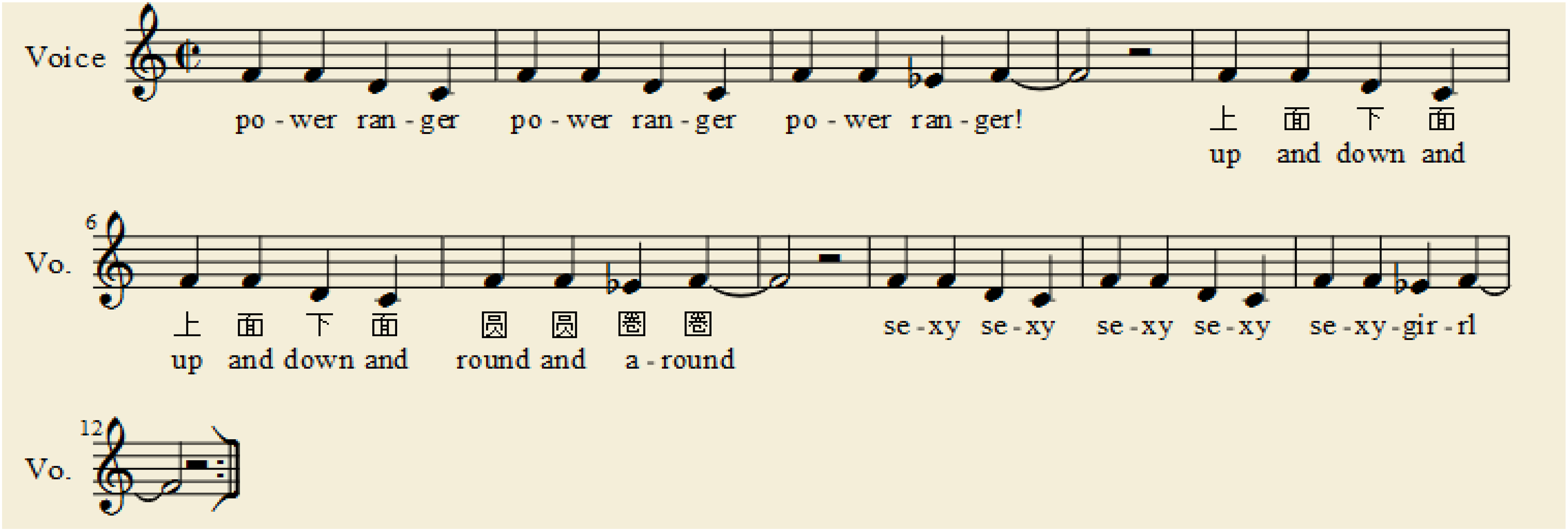
A variant of a Power Rangers theme.
Another popular tune was from a variety show that some of the girls watched with their families (Figure 2), which sounded like an old Mandarin pop song, but the girls would generate different dance moves and fill-ins each time.
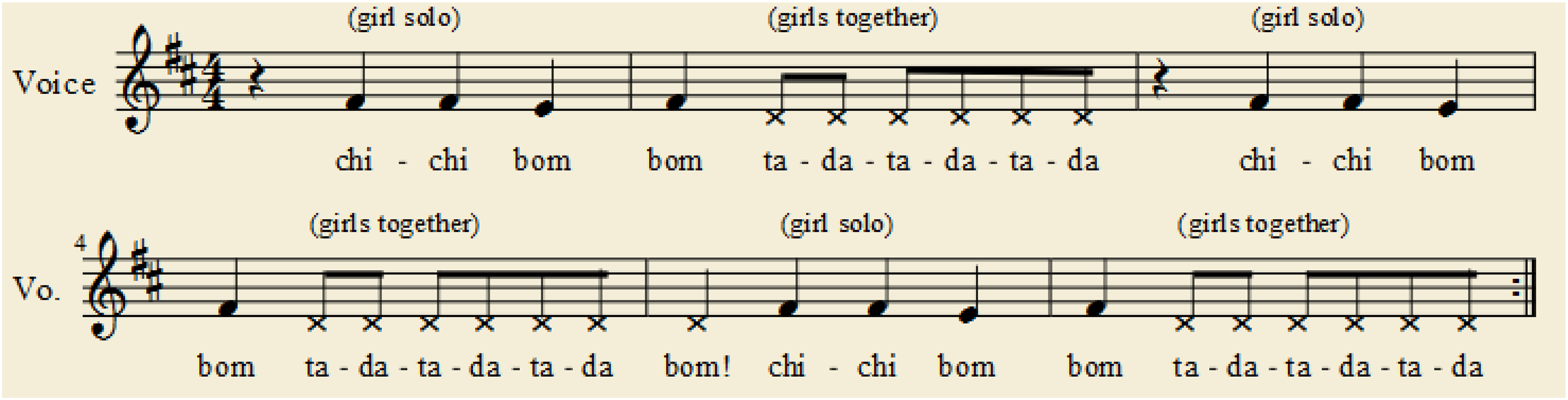
Song from a Chinese variety show on television.
Other than singing popular tunes in chorus-response or karaoke fashion, the children in this study also created original lyrics and tunes during curriculum time. Of particular interest to me was a series of variations that a few of the girls had created based on a motif inspired by a Power Rangers theme song. There was an occasion towards the end of my observations when a group of girls started the trend of singing a rhythmic motif with original lyrics. When I asked them where the tune was from, they said it was from the popular television series Power Rangers, but I have not been able to locate its original source. In my search through the dozen or so original Power Rangers theme songs, the girls’ refrain most resembles ‘Go, go, Power Rangers’ in its melodic mode, but the children never sang the original lyrics. Nevertheless, what interests me most is the girls’ appropriation of a popular source and their ingenuity in creating different words to fit the tune and rhythm, in both English and Mandarin (Figure 3).
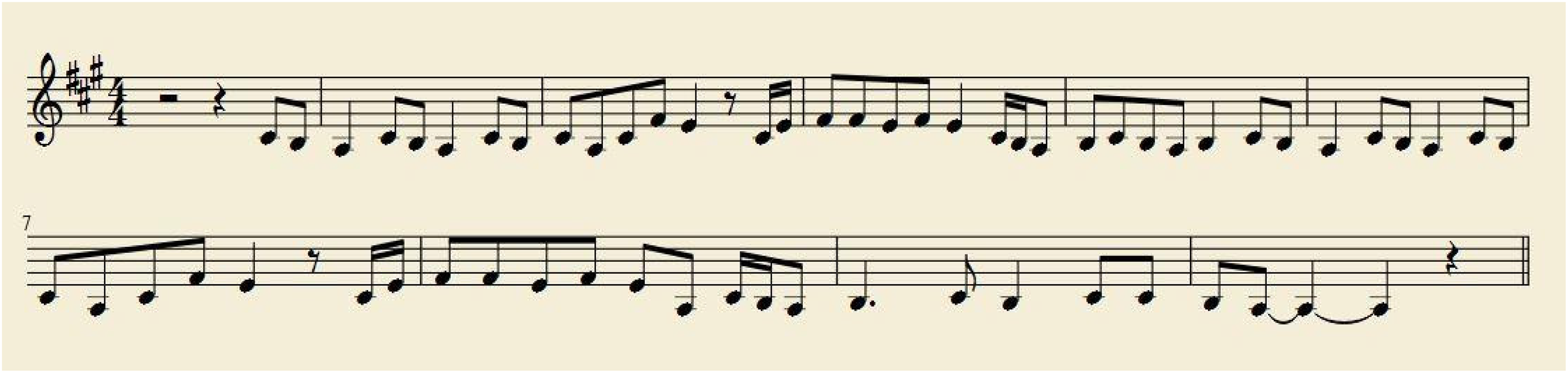
‘Mouse loves rice’ a popular Mandarin song.
Discussion
What does music do for young children? How do they ‘use’ music? The children's musicking described in this article is a form of playful vocalisation that is meaningful to both the children who initiate it and those who participate in it. Musicking, like the role playing found in Corsaro's (1985, 2003) peer-culture studies, appears to also allow children to exercise autonomy and control in ways that are not always sanctioned by adults. In such musical play, children do not merely imitate adult-created music; they generate their own songs and rhymes for their own purposes in peer interactions. This study has shown how children use music to be at ease with themselves, to generate laughter and glee, to admonish their friends in social ways, and to bring popular culture into the official classroom space, thereby rendering it ‘unofficial’, like the children in Dyson’s (2003) study. Careful observations of children's play reveal a double helix, with ‘one strand representing the universal, ubiquitous features of child lore, the other the particular manifestations of children's play lives which result from particular circumstances’ (Factor, 1988: xiv).
Why should we continue to broaden research into children's playful and play-filled peer cultures? Who would benefit from such work? The research literature on child development is full of evidence pointing towards the instrumental benefits of play in young children's cognitive, social and emotional development (e.g. Pitt and Welch, 2021; Rose et al., 2019), and these represent adult-centred concerns for young children, usually aligned with educational and social policy concerns at national and international levels. Less frequently found, especially in Singapore's literature, are discussions of the benefits of investigating childhood play as a means of educating adults such as educationalists, parents, therapists, psychologists and folklorists. Bautista et al. (2016), in their longitudinal kindergarten impact study, found early childhood teachers to be concerned about their own professional development needs in the following learning areas (as presented in the national kindergarten curriculum framework for four-to-six-year-olds): social and emotional development, aesthetics and creative expression, and discovery of the world. And the same group ranked social and emotional development as the most important area for children's development, and aesthetics and creative expression as the least.
This article has shown how children's ability to build peer culture (Corsaro, 1985, 2003) could involve all their social-emotional skills as well as their musical improvisational skills. There are blurred boundaries between learning areas and developmental domains in young children's process of knowing. As such, the work of teaching should be ‘a daily search for the child's point of view accompanied by the sometimes unwelcome disclosure of [our] hidden attitudes’ (Paley, 1986: 124). Children's self-initiated play reveals to us what concerns them most and may sometimes make us feel uncomfortable – stereotypes around race, gender, ethnicity and ability, fairness, friendship, good people/bad people, and other unproductive dichotomies (e.g. Blaise, 2005; Jenkins, 1998; MacNaughton, 2006; Walkerdine, 1997). To work with young children, we all need to be educated about how they see the world and make sense of it on their own terms. This article contributes to the international literature founded on a strengths-based and children's rights perspective (United Nations, 2006), and ongoing work that continues to reveal the inventiveness and flexibility of children through their myriad forms of play (Factor, 1988), and specifically through their soundscapes (Bjorkvold, 1989; Opie and Opie, 2001; Small, 1998).
This article has shown that musical play is also a natural aspect of the multifarious dimensions of children's spontaneous play-as-knowing-the-world, and yet it is seldom studied or reported to inform educationalists. In Singapore, as we work towards greater understanding of how educational and social policies and practices can indeed be in the ‘best interests’ of children (United Nations, 2006), we need to appreciate the nature of contemporary childhood and peer culture. Before we allow educational efforts to become narrowly deterministic (Cannella, 2002), we should guard against being limited by rigid and a priori classifications of young children's play activity. Instead, we should strive to understand the multiplicity and fluidity that is found in children's ways of getting to know the world – otherwise termed their ‘one hundred languages’ by educators in Reggio Emilia (Edwards et al., 2012).
Concluding thoughts
Montgomery (2009) has asserted that the study of childhood should be central to anthropology in this age of the United Nations Convention on the Rights of the Child. I argue that the study of children's daily lives, as shown and described by themselves, should be central to all of our efforts to live and learn with them as educators. After decades of relying on traditional developmental perspectives to inform educational practices, it is time to review our image of the young child and look beyond narrowly defined developmental deficits of young children within Singapore's early childhood pedagogical and curricular practices. While academic learning in primary school is important in Singapore's educational landscape, neuroscience findings have revealed that the very early years of a child's life are optimal for what are typically considered as ‘non-academic’ pursuits, such as executive functioning skills, which include self-regulation, perspective-taking and cognitive flexibility, as well as identity-building, friendship and confidence-building through multimodal expressions (such as improvised songs, playful movement and nonsense rhymes). In other words, we need to educate ourselves about children's peer-influenced agencies, their seemingly frivolous social concerns, negotiations and learnings, to see their play as original adaptations of their social world. As contemporary urban societies become socially more complex, it would be wise to listen and learn with young children so as to be in step with the seemingly mundane yet important learning that is taking place in their lives (Paley, 1986, 2010).
Footnotes
Declaration of conflicting interests
The author declared no potential conflicts of interest with respect to the research, authorship and/or publication of this article.
Funding
The author received no financial support for the research, authorship and/or publication of this article.
