




Abstract
This research focussed on documenting the praxis and paedagogy of paid, professional childminding (family childcare/day care) in Ireland. It explored professionalism and professionalisation among childminders in the context of the evolving understanding of professionalism in Early Childhood Education and Care (ECEC) nationally and internationally. The research was conducted within the framework of Ecocultural Theory (ECT) on the eve of mandatory regulation of childminding against the backdrop of Irish ECEC policy. A mixed method approach was adopted, using the Ecocultural Family Interview for Childminders (EFICh), including participants’ photographs, case study surveys, researcher field notes and holistic ratings. We present findings related to childminder professionalism and professionalisation, highlighting its significant differences from centre-based provision. It is vital to understand childminding as an ecocultural adaptation to create a stable family niche, relationally and economically. It helps to explain childminders’ approach to just-in-time training as adult learners, their desire for public recognition of childminding’s differences and unique value, and their need for supportive supervision in their family home ahead of annual inspection. Imposed professionalism is rejected in favour of a participatory approach sensitive to agentic childminders’ professional development. To support and develop professional 21st century childminding, Ireland requires a tailored regulatory system specific to childminding.
Keywords
Introduction
The question of professionalism among childminders is often raised in the context of the professionalisation of early childhood educators more broadly (Urban et al., 2011), despite significant differences between centre-based provision and home-based, self-employed childminders. These differences can be seen most clearly in the close relationships between childminder, family and children (O’Regan et al., 2020; Tonyan, 2017), the flexible, real-life paedagogy (O’Regan et al., 2021) as well as the necessity of business practices in managing a sustainable childminding service (Greener, 2009). These differences impact both childminders’ understanding of professionalism and the process of professionalisation in childminding.
Background
In Ireland over the last two decades, the professionalisation of Early Childhood Education and Care (ECEC) has meant steadily rising levels of minimum qualifications with aspirations to a graduate led workforce (Urban et al., 2017). Curricular policies, regulation and inspection criteria are determined nationally, with individual childcare services, from crèches to childminders, experiencing ever tighter regulation and inspection (Oberhuemer, 2011) within competitive childcare markets (Gallagher, 2012; Lloyd and Penn, 2012), while experiencing little improvement in pay and working conditions (Moloney, 2015).
In this context, the question of professionalism among childminders has been raised (Urban et al., 2011), with the inference that the professionalisation of childminding ought to follow along the same lines as other forms of ECEC. For Vandenbroeck and Bauters (2017), childminders’ poor pay and working conditions, the challenges of isolation, and low levels of societal esteem pose a dilemma of sustainability and fairness, which requires professionalisation as commonly understood: that is, raising the standard of qualifications required for childminding in order to increase childminders’ career prospects, improve the quality of childcare for children, and mitigate high attrition rates among childminders. Previous research into the professionalisation of childminding in Ireland has documented progress in the process of professionalisation(O’Regan et al., 2019). Specifically, despite poor pay and working conditions, childminders hold rising levels of qualifications, consider childminding to be a career, value their distinctive approaches as childminders, and enjoy collaborative relationships within Childminding Ireland, the national association for professional childminders (O’Regan et al., 2019). However, childminders’ views on professionalism and professionalisation were found to vary considerably along a spectrum from demands for full inclusion in the ECEC sector on the same terms to calls for specific recognition as home-from-home, independent, childcare providers (Brooker, 2016).
In Ireland, childminding is not yet fully included in the national ECEC system and operates outside regulation in the informal economy for the most part, at the time of writing. Current legislation exempts most paid childminders from regulation, even though non-relative childminders care for an estimated 10% of children in Ireland from infancy to 12 years of age, (n = 88,000) according to the Central Statistics Office (CSO, 2017). Exempt childminders are allowed to care for three or fewer unrelated preschool children (DCYA, 2016) or up to six children of any age (DCYA, 2018b). In January 2021, of an estimated 15,000–19,000 childminders (Dcediy, 2021; DCYA, 2019a), only 77 were registered with Tusla, the Irish national Child and Family agency, tasked with improving wellbeing and outcomes for children. Tusla is responsible for child protection, early intervention, and family support services as well as the regulation and inspection of ECEC.
From 2002 to 2012, the National Childminding Initiative (NCMI) aimed to support childminders to professionalise in preparation for inclusion in an early years’ registration system for all ECEC services (DJELR, 2000). Similar to the entrepreneurial model in the UK (Bond and Kersey, 2002; Cragg and Dawson, 2003; Greener, 2009; Owen and Roby, 2006), the National Guidelines for Childminders (DCYA, 2008) promoted a model of professional childminding intended to raise the quality of childminding services and associated outcomes for children as well as bringing childminding out of the informal economy, in which most exempt childminders operated. NCMI offered free training, a development grant, and a tax relief designed to encourage childminders to professionalise voluntarily. This involved three main strands: (1) gaining ECEC qualifications, (2a) registering as an ECEC provider with Tusla, or if exempt from regulation, (2b) making a voluntary notification to local Childcare Committees and (3) registering with the Departments of Revenue/Social Protection for tax and social insurance.
While similar to the entrepreneurial model in the UK, this contrasts markedly with childminders’ working conditions in France and Denmark. Rather than being self-employed, since 2004 French childminders are considered independent contractors, with protection under employment law, social welfare benefit, exemption from income tax, and access to a state subsidy system. In Denmark, childminders are directly employed by local childcare authorities, and paid on an incremental scale like other early years’ workers, with all associated benefits.
From 2010 onwards however, the NCMI was progressively dismantled in all regions due to financial constraints, without any national evaluation (Daly, 2010), and no research evidence, providing impetus for the present study. Local Childminder Advisory Officers (n = 33) were made redundant, cutting childminders off from local networks and home visits, and greatly reducing the training opportunities available to exempt childminders. The new Early Years Regulations still did not include exempt childminders (DCYA, 2016), since they were introduced under the Child Care Act (Acts of the Oireachtas, 1991), which effectively continues to exempt the majority. Childminders were likewise excluded from participation in the new National Childcare Scheme, apart from the tiny minority of registered childminders (DCYA, 2019c). More recently, under the new Childminding Action Plan (Dcediy, 2021), the Irish government now plans to implement mandatory registration and regulation of all paid childminding (DCYA, 2019b) with the amendment of the Child Care Act (1991). To develop the system, six regional Childminding Development Officers and a National Childminding Coordinator have been recruited in preparation for the rollout of tailored regulations and supports for all childminders (DCYA, 2019b). In a time of transition for childminding, this study seeks to situate and highlight childminders’ perspectives on professionalism.
Theoretical framework
In this context of informal childminding, previous research found Irish childminders wished to be included in a professional ECEC system, once it did not ‘compromise the essential nature of childminding, but instead (it) should be derived from its distinctive characteristics in a bottom-up, organic manner’ (O’Regan et al., 2019: 12). In order to do this, the framework of Ecocultural Theory (ECT) was adopted (Tonyan, 2015; Weisner, 2002) because it theorises links between daily activity and cognitive dimensions including emotions, motives, cultural models, values, goals and scripts. Like other socio-cultural theories, ECT proposes that the ‘culture’ of early care is not an abstract concept, but is visible in everyday activities (Gillen et al., 2007; Rogoff, 2003; Tonyan, 2012). Thus, when childminders talk about how and why they organise their daily caregiving routines, their descriptions reflect the meaning systems they draw from, providing insights into their cultural models those semi-articulated, taken-for-granted, shared understandings within a community (Quinn and Holland, 1987 ).
From this ecocultural perspective, childminding can be defined as ‘a home-based ecological niche in which multiple families (i.e. childminder, children, childminder’s own family and children’s families) work together in raising children’ (Tonyan and Nuttall, 2014: 119). To document the daily routines of informal childminders and understand the underpinning cultural models, we used the Ecocultural Family Interview for Childminders (EFICh) based on the Ecocultural Family Interview For Family Child Care Providers by the California Child Care Research Partnership (Tonyan, 2012, 2015). The ideas and methods that guided the development of this instrument are drawn from anthropology, ethnography, psychology, sociology and clinical practice (Cccrp, 2014; Tonyan, 2012). In collaboration with a member of the original team in California, the protocol was specifically adapted to the Irish ECEC system and terminology in order to capture the ecocultural features of childminding in Ireland. The researcher was also trained in its use.
Methodology
The EFICh research instrument has four main components: first, the semi-structured, conversational interview; second, childminder photographs illustrating their daily practice used as prompts in the interview, and third, researcher field notes of observations of the home and interactions between the childminder and the children. In addition, a background survey gathered information about the family’s economic circumstances, the childminder’s reported levels of agency, their education level and views on parenting in early childhood.
Two visits were made to each setting. During the initial visit, the research project and protocol was explained, holistic observation of the home and interactions was conducted (<1 hour) and a background survey was left for completion. During the second visit, the conversational, semi-structured EFICh interview was conducted (1–1.5 hours). Subsequently, based on all these sources of data, the researcher completed ratings for each childminder to assign holistic ratings in four thematic areas: (1) cultural models, (2) sustainability of daily routines, (3) service needs and use and (4) quality Improvement, Advocacy and Complexity. Based on what childminders valued in what they said, enacted in what they did, and evaluated in how they reflected on their work, the researcher gave High, Medium, or Low ratings, which the researcher had to justify by supporting vignettes drawn from the field notes, interview, or background survey. To receive a HIGH rating, the childminder must value a model in what she says, enact it in her daily routine activities, and see (or evaluate) its impact on the children’s outcomes in some way; a MEDIUM rating means the childminder partially values, enacts or sees the model, while a LOW rating means that there is little or no evidence of valuing, enacting, or seeing the model.
The data were coded for analysis using Dedoose®, a web-based application for analysing mixed method research with text, photos and spreadsheet data (Salmona et al., 2019). This allowed for a qualitative analytic process of structured discovery, ‘during which analytic strategies remained open to unexpected processes and patterns while focussing on project-specific topics’ (Weisner, 2014: 167), identifying patterns through close, iterative listening, reading and observing of the sample data, guided by project-specific questions.
Ethical considerations
This research was approved by the Ethics Committee of TU Dublin in accordance with its policies and procedures. To facilitate informed consent to participate or withdraw at any stage, all participants were given complete and accurate information as well as the opportunity in conversation to discuss the nature, purpose and outputs of this significant, exploratory study, the first ecocultural study (Tonyan, 2017; Weisner, 2002) conducted in Ireland. This research involved building rapport and listening deeply to participants’ concerns and needs, while maintaining sufficient researcher objectivity to complete ratings, usually at a later date. Anonymity and confidentiality were guaranteed regarding any information disclosed; participants’ names used in this article are fictional. No observations of individual children were conducted, and photographs used as prompts during interviews were shared with parental consent. Children’s identifying features were removed to ensure anonymity where necessary, and no photos of children were retained for use by the researcher afterwards.
Limitations of study
Since the research was conducted with a small, self-selecting sample of professionalised childminders, it may reflect primarily the views of childminders who were more confident about coming forward to participate. Caution should be exercised in applying the findings to Irish childminders in general. This investigation is also the work of a sole researcher, and the possibility of interpretation bias must be acknowledged.
Study participants
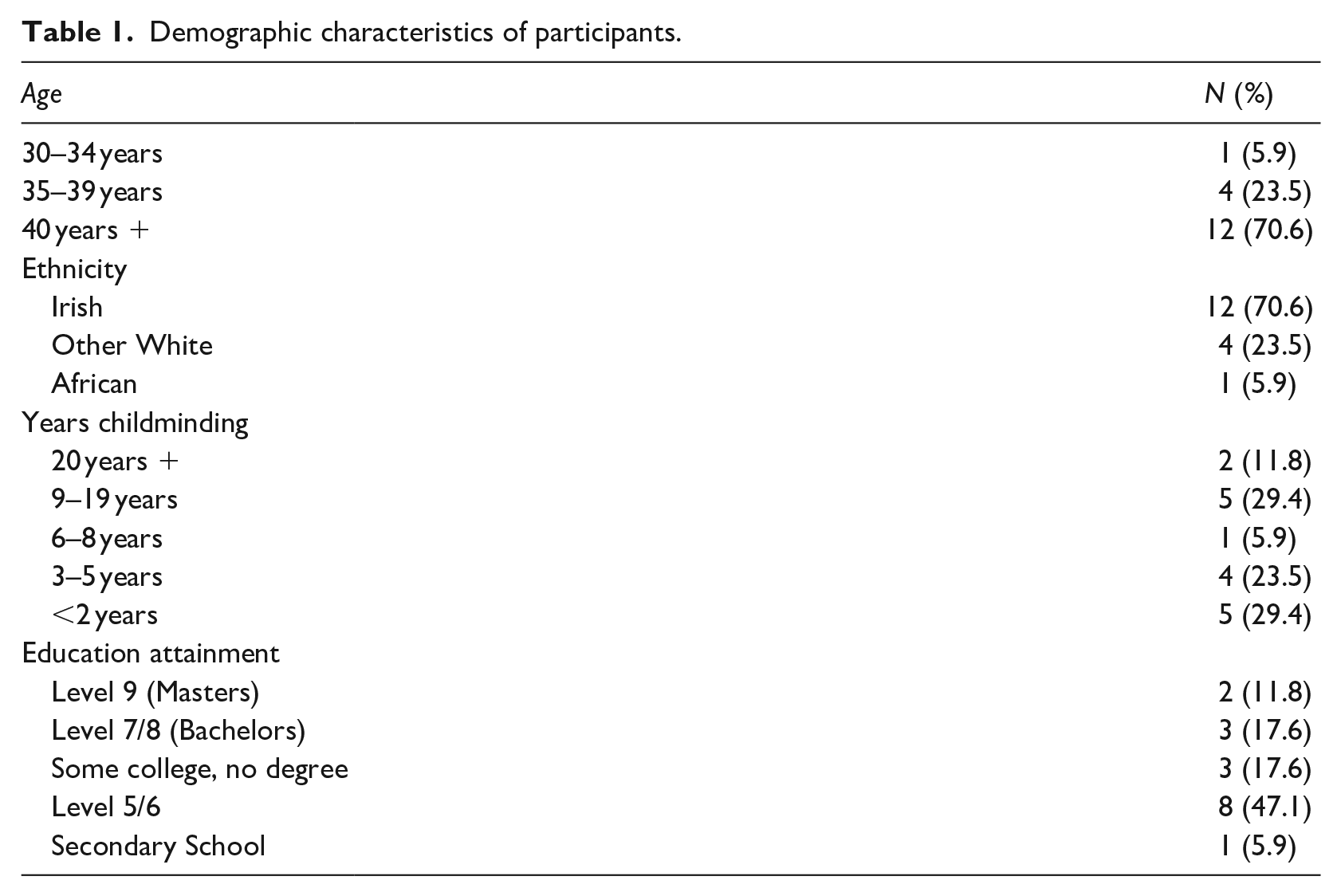
In total, 17 childminders participated in this research: only two were registered with Tusla, although 15 were members of Childminding Ireland. All participants were female, and over 70% (n = 12) held at least the national standard qualification for centre-based ECEC practitioners, a 400-hour post-secondary certificate. In addition, nearly 30% (n = 5) held qualifications at degree level in other disciplines, in line with the national average of 27% for 25 to 64 year olds in 2018 (OECD, 2019), see Table 1. There were no male participants, reflecting the almost non-existent male childminder in Ireland.
Demographic characteristics of participants.
Findings
In relation to professionalism and professionalisation, the findings highlighted two significant areas of difference, which contrast significantly with the existing paradigms of professionalism in ECEC. The first difference relates to childminding as a business: unsupported by the State, childminders in Ireland are self-employed and must market and manage their ECEC services as small businesses also. The second difference relates to how childminders enter the profession: almost all study participants, except for two, started childminding in their own home as intending or new mothers looking to meet the needs of their own young children (Page, 2011). This is strikingly different from the more usual choice to embark on a career in ECEC typically during or after secondary school education.
Moreover, the findings highlighted the tension between the caring, nurturing paedagogy of childminding on the one hand, and the need to manage a service and earn sufficient income on the other. In childminding, the functions of manager and practitioner are rolled into one person working at home, unlike centre-based services, where the ECEC practitioner and manager are two separate roles in professional environments.
Professionalism in practice
The influence of the NCMI entrepreneurial model was evident in the range of business practices adopted by childminders in the study, from contracts and policies to insurance and engagement with government and professional bodies. The tension between paedagogical and administrative skills has been highlighted in ECEC previously (Campbell-Barr, 2018). However, it was noteworthy that the exempt childminder participants adopted only those practices which they found beneficial, and which did not detract from their primary goal of being with the children.
Childminding business relationships
The research narratives revealed unique aspects of the childminder-parent relationship, which in addition to a close, personal relationship also involved a transactional, business dimension. Childminders emphasised the necessity of clear boundaries between these parallel relationships in order to balance the needs of all concerned. As promoted by NCMI (DCYA, 2008), one way in which childminders achieved harmonious personal/business relationships was through using a contract setting out the details of services agreed, resultant fees due, arrangements for holidays or sick leave, and permissions to do with outings, photographs and medicines. Usually, written policies and procedures were used to outline their practice regarding behaviour, food and intimate care, and to give details of emergency back-up arrangements.
Most participants indicated that contracts, policies and procedures facilitated the conduct of their service as a business: ‘Yeah, I felt like I actually am a business rather than just childminding, ad hoc’. – Chloe. Some childminders felt this type of paperwork had been very useful in setting boundaries of mutual respect and gaining desirable conditions of work, such as paid leave, and in commanding respect for childminding as a profession. The following description highlighted changes in the sector brought about under the NCMI: I suppose in the beginning when I started childminding, you were very much taken for granted. It was ‘Ah sure, you're only babysitting. Here you are’. And I used to have parents who’d come say, 'You know what now, I’m off. I’ve holidays for the rest of the week. So, I won’t bother sending him to you.’ Which meant I didn’t get paid. . . So, I found down through the years things have gotten better. And both parents are working. They both understand that it’s a profession as well. They understand the whole thing about holidays and all that kind of stuff. And we have kind of a good agreement. I have contracts now, which I never had before. – Cathy
Some participants acknowledged how difficult this aspect of the business relationship was when the parents involved had become friends: ‘I suppose if I had set, maybe I need to be stricter myself in, you know, regarding my own worth, and say, you know, ‘Look, if you don't turn up, you still pay, that it’s a set wage’. –Mary
However, other participants found that paperwork was not always valued by parents in any meaningful way. Several mentioned how parents never asked to see policies, or qualifications, or insurance certificates, things which they believed were important aspects of their professional approach to childminding. While parents approved of contracts, policies and procedures in theory, participants felt they made little impact on their conduct in relation to the childminding service in practice. This lack of interest may be explained by the priority placed on close relationships by childminders and parents: No, they don’t want to see them (policies and certificates). And I have them, and they’re in the drawer. . . They’re not bothered. Do you know what they want to see? They want to come, and they want to see what you’re like. –Marianne
Although childminders needed to project a business-like approach to successfully run their services, it seems the individual caring relationships which developed with children and families went beyond this ‘business relationship’ as the primary influence shaping and informing their professionalism.
Professional code of conduct among childminders
Another significant finding was the identification of a common code of conduct among childminders, generally unwritten, which valued trustworthiness, reliability and flexibility as professional attributes in relation to client families. These could be construed as a cultural model or principles of professional practice for childminders (Brock, 2013).
To be entrusted with the care of other parents’ children was seen as an honour and a responsibility. For one participant, parental trust was one of the privileges of childminding: ‘. . .that their parents trust me. Like I have them longer than what they spend with their parents, you know, yeah, it really is lovely’. – Mary. Another participant mentioned the challenge of this responsibility, of being entrusted with such an important role in children’s lives: So, I think it’s a big responsibility that they’re going to turn out right, because I’m putting my values in, [shaping them] or the way that I do things could be different to the way they do things at home. – Cathy
Such relationships of trust require considerable emotional intelligence and maturity, which Page (2018) has characterised as the principles of Professional Love: emotional resilience and reflectiveness; the capacity to act with the needs of the other person in mind, non-judgementally; and the patience to build a gradual, authentic, reciprocal relationship with the child and parent in order to create an enduring mutual relationship of affection (Garrity and Canavan, 2017; Grimmer, 2021).
Reliability was another important trait of professionalism for childminders in the study. Several even spoke of working through illness in order to provide a reliable service and to avoid the letting parents down: Sometimes I work my days through migraines. And it’s, you know, you don’t want to disappoint the parents, you don’t want to ring them in the morning and go like this, And I’m not well, because it’s just, you don’t want to do that. So, you want to be reliable. – Rianne
Other participants mentioned flexibility as a key attribute of their professionalism: that is, extending hours to support minded children in times of family crisis, or being willing to adjust to a child’s needs by taking on different activities, such as attending dental appointments or chauffeuring to dance classes. As the ecocultural definition highlights, childminding is also family minding, as multiple families work together in raising children (Tonyan and Nuttall, 2014).
Narratives revealed a professional pride as childminders in building and maintaining secure, long term, close relationships with children and families through consistent love and kindness over time. Being considered trustworthy, reliable and flexible were vital components of their personal pride as professionals as well as their reputation in the community.
The process of professionalisation
Another noteworthy finding was the identification of a process of professionalisation specific to childminders, which differs in significant ways from the process of professionalisation for care workers. (Brannen and Moss, 2003). There were differences in terms of motivation and purpose, in approach to qualifications and supervision, and in terms of self-understanding as childminding professionals.
The ecocultural research protocol opened a window into underlying cultural models and values through the conversational description of daily routines, activities and concerns. The patterns of professionalism which emerged have highlighted some striking contrasts with professionalisation for centre-based ECEC practitioners, indicating a distinctive approach to professionalisation among study participants, as illustrated in Figure 1. Firstly, the most common starting point for becoming a childminder was becoming, or planning to become, parents, not a career choice to train to become an ECEC professional; in fact, most had pursued different careers previously. The main motivation for starting a childminding service was being able to care for their own children at home by earning a sufficient income. Thus, the primary goal was the creation of a stable family niche rooted in their values and beliefs, which would work within family resources and constraints, to meet the needs of their family members; a typical adaptation described by ECT (Gallimore, 1993; Gallimore and Lopez, 2002). Consequently, as adult learners, participants sought professional training which was relevant, ‘just-in-time’ education specific to childminding as opposed to long term programmes (Tonyan et al., 2017). Supportive supervision was preferred to inspection, in keeping with the relational nature of childminding, and study childminders advocated for public recognition of the different type of provision childminding offers rather than pressure to conform to centre-based standards. Each of these will be explored further in the following sections.
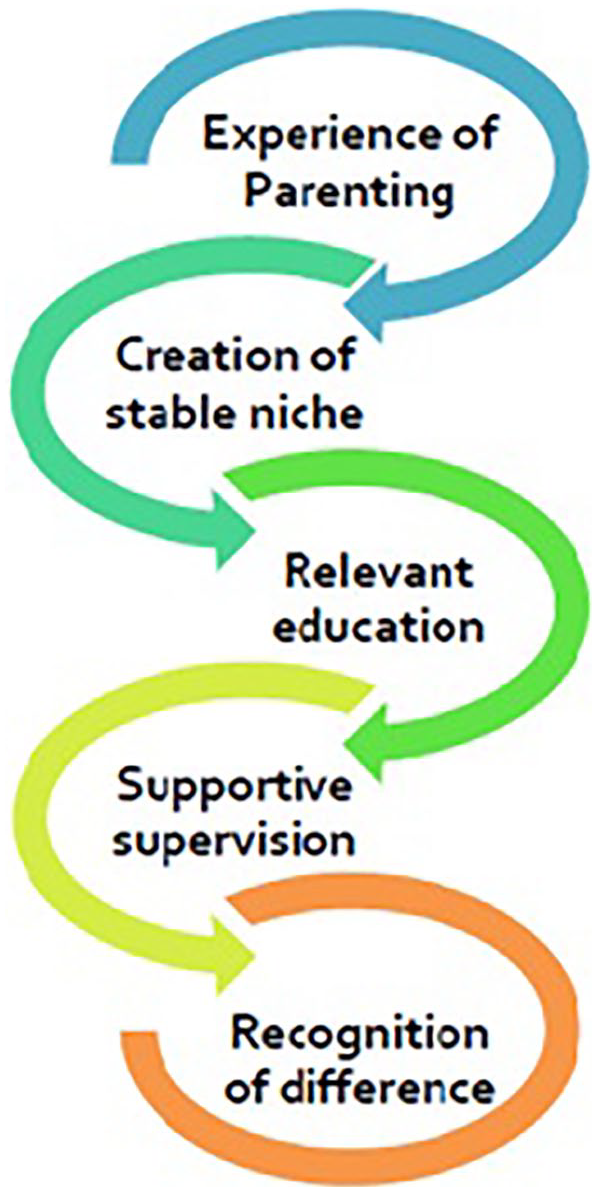
Childminders’ process of professionalisation.
Experience of parenting as motivation
In initiating a childminding service, two motives clearly predominated: the desire to be able to raise their own child/ren, and the need to gain a sufficient income to do so; it was not, primarily, the desire to provide an ECEC service in the community. In an earlier survey, the most common reason given for starting a childminding service was to be able to stay home with their own children (O’Regan et al., 2019). This motivation was further highlighted by childminders’ narratives: of 17 interviewees, 15 had become childminders to allow them to create a sustainable family routine as new or intending parents. There were only two non-parents in the study, both of whom had previously worked as nannies, prior to setting up as childminders once they had homes of their own: one of them was expecting her first child. A typical example is Joanna, who started childminding after having her second child and moving to a rural area where jobs in her field were a considerable commute away. As she explained: . . .and the thought of having my two children out at six o’clock in the morning. . . I wouldn’t really know my own kids, the stress of it. . . If I went back working now, I’d be paying to work until they are 4 or you know, go to school, five or whatever. -Joanna
Creation of a stable family niche
According to ecocultural theory, in order to thrive, families make adaptations to their niche in ways that are meaningful to them in terms of their beliefs and values; congruent with the needs and characteristics of family members; and sustainable for relatively long periods of time, given the constraints and opportunities involved (Weisner et al., 2005 ). For study participants, starting a childminding service was a necessary adaptation to allow for the creation of a stable family niche which met the family’s needs sustainably, even if it meant leaving a lucrative career in another profession. It was a practical response to family constraints in line with meaningful personal values, meeting the needs of mothers with very young children. For most participants, childminding income enabled childminders stay home and care for their own, often very young, children, while saving money on travel and childcare expenses. This was done with the full support of their spouse/partner, who usually became the primary earner, and whose income subsidised the childminding service. This was an intentional step, as former IT specialist Mary explained: My journey started after we adopted my daughter from Ethiopia because I’d worked in IT and travelled an awful lot, and I just knew that that wasn’t going to suit family life. So, while on my leave, I did my Quality Awareness Programme and my First Aid, and started writing up policies and procedures, and then in about March 2011, I had my first two little girls come and join us, and it’s just gone on from there. – Mary
With the goal of creating a stable family niche in mind, childminders viewed their relationships with minded children and their families primarily as a type of extended family, with an emphasis on nurturing paedagogy similar to parents at home (Hayes, 2007; O’Regan et al., 2021).
Relevant education specific to childminding
As adult learners, many participants started to undertake training and education in ECEC ‘just in time’ while setting up their childminding service or during the first few years; most had no ECEC training prior to that. This ‘just-in-time’ approach, typical of adult learners, is learner-centred, learner-driven and it provides immediate skill formation (Tonyan et al., 2017). While enthusiastic about ECEC learning, several respondents highlighted the need for courses more directly relevant to childminding, and at times and in places accessible to childminders working long hours all week. Due to its relevance and practical application, the unaccredited Quality Awareness Programme (QAP) for childminders was highly appreciated, while QQI level 5 in ECEC, the national accredited qualification, was considered less suitable for childminding: I don’t really think the way the course was set out, I don’t think it was geared towards my type of practice, childminding in the home. . . I’d say if people wanted to be childminders, just alone, then there needs to be a course, if it’s going down the qualification route, there has to be a course geared for childminding, or even just individual modules that have to be completed. - Chloe
Similarly, several study participants noted the difficulty of attending courses offered in difficult to reach locations, or held during the day, when childminders were working. While online learning was an option, the importance of education in a local childminding community of practice was also emphasised: It doesn’t even have to be a stringent, you know level 5, but that you’d be given, let’s say, your folder on 1-2. You’d go away and you’d read it, and then you come into a discussion with other childminders, and you know, where you’ve questions with that, you’d learn from others, with you’ve been given this pack. . . -Paula
Supportive supervision for emotional work
Even when eligible, with relevant qualifications, childminders in Ireland remain reluctant to engage with current regulatory and quality support systems, as evidenced by very low numbers of childminder registrations with Tusla, due to what most participants considered the inappropriate and disproportionate nature of existing regulations. Rather than the inspection of settings, participants sought supportive supervision and individual mentoring, particularly in light of the isolation and intensive emotional labour involved in childminding. Some of those who had experienced inspection as childminders were critical of the process: It was just more about the ticking the box es for the paperwork, than are those children actually engaged? Are they happy? No one ever asked, ‘Are the parents happy?’ or ‘Have you lost children due to concerns?’ or ‘How are you doing? How are you feeling? Do you feel pressure in this job?’ – Paula
Public recognition of difference
In this study, childminders advocated for public recognition and respect for the different provision that childminding offers rather than pressure to conform to centre-based standards. They sought recognition for who they really are – parents who open their homes to care for other parents’ children: I think appreciation . . . needs to be given to families who are willing to mind children in their home. . . . And I don’t think it’s fair to ask of parents to open their home to millions of checks, to a ton of paperwork, when there’s already so much to do, in very small-scale services like these. . . because they become part of the family, they become part of, you know, a really nice small place. -Rianne
Several participants expressed a sense of low esteem for childminders in society in general and spoke of the desire for recognition for the impact and influence of childminders on the young children and their families: ‘It’s a very unrecognized career. I don't think it's recognized enough for what we do’. –Sonia
Moreover, many expressed the view that childminding was more than a business, it was their career, and that this was how they wished to see childminding promoted: I’d like them to realize that childminding is a career, and that it’s part of Irish society. And instead of trying to push it out, that they embrace it, and have it work in some way where people are like putting their hand up to join Childminding Ireland, that they’re not hiding, that they’re not afraid. – Mary
This reinforces the idea of childminding as a unique form of childcare involving key paedagogical skills, generating long-term commitment, enduring relationships and family-minding.
Discussion
Childminders’ views of professionalism and professionalisation in this study varied from calls for full inclusion as ECEC providers to demands for recognition as home-from-home childminders. One common thread united them: childminders of all views tended to reject a technical performative professionalism of policies, paperwork and property imposed by regulation, in favour of an agentic professionalism from within, autonomous and self-directed (Jones and Osgood, 2007; O’Regan et al., 2019).
Childminders and agency
Findings in this ecocultural study emphasised the agency of childminders in initiating, organising and maintaining their services. This seems understated in the existing ecocultural definition of childminding as: ‘a home-based ecological niche in which multiple families (i.e. childminder, children, childminder’s own family and children’s families) work together in raising children’ (Tonyan and Nuttall, 2014: 119). This could convey the erroneous impression that everyone involved somehow played interchangeable roles in raising the children. To emphasise the agency of the childminder, as found in Ireland, we propose this amended definition of childminding as ‘a home-based ecological niche in which
Childminders and parenthood
This study has also highlighted the important role that parenthood plays in the decision to open a childminding service. In contrast to official professionalising discourse for childminders, which sometimes involves rejecting the role of ‘mothering, home and family’ (O’Connell, 2008: 13), childminders in this study clearly articulated how much parenthood influenced their entry into the profession. Understanding childminders are most often parents helps explains why childminders and parents agree on family-friendly regulations for childminding (DCYA, 2018a): they are both simply parents seeking home-based care for their children. Understanding childminders as parents can also shed light on the issue of childminder attrition (Bauters and Vandenbroeck, 2017): childminders will continue their service for as long as it meets the needs of their own family, relationally and financially, or at least, when it does not conflict with the needs of their own family.
For most childminders in this study, operating outside the ECEC system, their priority was family, not a career in childminding necessarily. However, as childminding becomes integrated into the national system, under tailored, childminding regulations (Dcediy, 2021), perhaps more career ECEC practitioners will be drawn to home-based childcare work when it is fully supported under the National Childcare Scheme (DCYA, 2019c). This could be of particular relevance post-pandemic, as a national survey has shown that up to 94% favour working from home and Ireland has introduced a national strategy on remote work (Department of Enterprise Trade and Employment, 2021).
Childminders and professional education
Childminders in this study were interested in self-directed ECEC learning. As in the UK (Brooker, 2016), most had undertaken self-funded courses, both accredited and unaccredited, to enhance their own practice with children. This contrasts with France and Denmark, where childminder training is free and unaccredited. In France, childminders complete 120 hours of mandatory training during the first 2 years of service; in Denmark, local authority childcare supervisors provide ongoing training for childminders in network groups but the number of hours varies (European Commission/EACEA/Eurydice, 2019).
Perhaps professionalisation for childminders should be conceived in terms of acquiring a reflective stance rather than acquiring accredited qualifications, as in Reggio Emilia (Urban et al., 2011). In the Irish context, a local childminders’ community of practice could explore and reflect on tailored childminding modules in mixed age learning, the principles of professional love (Page, 2018), effective business relationships with client families, as well as the cultural models of Close Relationships and Real Life Learning previously identified in research. This would be a style of professionalisation much more appropriate to childminding, better aligned with the paedagogical and business skills needed in the context of professional childminding.
Implications for childminding policy
This fresh, ecocultural paradigm of professionalisation for childminders has the potential to make a significant contribution to supporting the process of professionalisation of childminding in Ireland within a sustainable system. Professionalised childminders in Ireland seek increased inclusion in the national ECEC system, but such inclusion needs to be within a tailored, regulatory, education and support system, sensitive to the process of professionalisation most suited to childminders. To engage childminders in Ireland, a competent system should support and develop their distinctive professional praxis for 21st century childminding to thrive and continue to benefit young children and their families.
