



Abstract
This study investigated early childhood educators’ identity construction in their narratives of emotion-laden situations with children. Narrative analysis was conducted with Greimas’s actantial model on video-cued interviews with 15 educators. Two narratives were identified: in the narrative of educators managing their emotions, educators’ negative emotions connected to challenging interactions with children shattered the identity of the professional educator. In the narrative of educators rejoicing in their success, the trust and affection expressed by children evoked positive emotions, and the sense of inadequacy created by insufficient resources challenged the warm, child-centred educators’ identity. In their narrations, educators commit to an ideal educator identity in close relationships with children, but also describe the emotional labour involved in working with children to manage their own negative emotions. The study enhances understanding of the interconnection between professional identity and emotions, the construction of professional identity through small moments in everyday life and the importance of emotional labour from the perspective of professional identity in early childhood education and care (ECEC).
Keywords
Introduction
In early childhood education and care (ECEC), emotion-laden situations are at the heart of the work of educators as they engage in intensive daily interactions with children (Hargreaves, 1998; Zhang et al., 2020), and thus, these emotion-laden interactions are meaningful for educators’ professional identity construction (Zhang and Jiang, 2023). However, research on professional identity and emotions in ECEC contexts remains scarce. This article aims to fill this gap by examining how ECEC educators construct their professional identity through their narratives of emotion-laden situations involving children. As emotions are fundamental in identity construction (Zembylas, 2003), studying them can provide new insights into professional identities (Beauchamp and Thomas, 2009).
Following the narrative approach, in this study, professional identities are understood as narratively produced social and dynamic processes in which emotions are intertwined (see Meijers and Lengelle, 2012). Bamberg and Georgakopoulou (2008) define narrative identity construction as unfolding through small stories – that is, through everyday speech sequences embedded in interaction. We explore professional identity as narratively constructed through small stories identified from interviews with 15 ECEC professionals in Finland. The educators’ small stories about emotion-laden situations with children are analysed with the help of Greimas’s actant model (1983). Our research question is as follows: What professional identity narratives can be identified from ECEC professionals’ narration of emotion-laden situations with children?
Narrative construction of professional identities and emotions in ECEC work
Shortly described, professional identity seeks to answer the question ‘Who am I as a professional actor?’ (see Beijaard et al., 2004; Vähäsantanen, 2022). In previous research, professional identity is defined as a dynamic process constantly constructed in interactions among social relationships and the environment in a specific context (Gergen, 2011; Meijers and Lengelle, 2012; Schutz and Lee, 2014). Professional identity is also structured emotionally (Beijaard et al., 2004; Meijers, 2002). As in identity construction, emotions are also formed in interaction, whereby the experience and expression of emotions are linked to one's living environment (Schutz and Lee, 2014; Zembylas, 2007). Holland and Lachicotte (2007) connect identity and emotions by conceptualising identity as a self-understanding to which a person is emotionally attached. Meijers (2002) argues that emotional situations motivate individuals to engage in defining and structuring identity. When someone's professional goals and interests align with their work, such work is perceived as emotionally meaningful, which strengthens professional identity (Beijaard et al., 2004; Kira and Balkin, 2014). However, an individual's experience of dealing with negative emotions is essential for identity construction (Meijers, 2002), whereby emotional reflection becomes an important part of constructing professional identity (Beijaard et al., 2004; Zhang and Jiang, 2023). Professional identities are shaped by emotions, with emotions either supporting or restricting affirmative identity construction (Beauchamp and Thomas, 2009; Meijers, 2002; Zhang and Jiang, 2023). Thus, professional identity construction requires educators to be viewed as emotional subjects (see Zembylas, 2003).
Teachers’ emotions at work are particularly influenced by teacher–child relationships, and teaching can be viewed as an emotional practice in which the managing of emotions is an integral part of work (Hargreaves, 1998; Schutz and Lee, 2014), where educators are expected to manage their emotions, for example, by expressing pleasant emotions and restraining unpleasant ones (Jiang et al., 2016; Sutton et al., 2009; Zhang et al., 2020). Hochschild (1979, 1983) approaches the managing of emotions with the dual concept of emotion work and emotional labour. She suggests that emotion work can be seen as a lens through which to view the self and interactions (Hochschild, 1979). Emotional labour, in turn, means the work that professionals in certain fields undertake to constantly manage their emotional behaviour when interacting to achieve professional goals and ensure situationally appropriate emotional responses (Hochschild, 1979, 1983). In ECEC, emotional labour is particularly intense and continuous throughout the day, manifesting, for example, in preschool teachers avoiding affecting children with negative emotions (Zhang et al., 2020). Conversely, emotional labour in ECEC also involves maintaining positive emotions, as ECEC teachers use their positive emotions to stimulate children's active participation (Zhang et al., 2020).
Although emotional labour in ECEC has been studied and the strong emotional nature of the work is recognised, scant research exists on the relationship between ECEC professionals’ emotion-laden work and their professional identity, with previous research focusing on primary and secondary school levels (Hargreaves, 1998; Nichols et al., 2016; Sutton et al., 2009). Teachers’ emotions at work shape their identities by influencing their commitment and attitudes toward teaching (Hargreaves, 1998). According to Zhang and Jiang (2023), in their work with children, teachers use their emotions as a pedagogical tool to communicate deliberately designed identities to children. Furthermore, Zhang and Jiang's research shows that the positive emotions, such as pride and trust, that arise in teachers’ work with children strengthen their professional identity commitment. Also, Nichols et al. (2016) tie pleasant emotions, such as contentment, stemming from the achievement of teaching goals to the strengthening of teacher identity. Conversely, unpleasant emotional expressions caused teachers to adjust their identities to cope with their work (Nichols et al., 2016). In the study of Hanhikoski and Sevón, 2024, educators’ ideal identities clashed with the external resourcing of work, and unclear expectations of their positions led to an emotionally charged identity narration.
In this study, professional identities and emotions are approached as narratively constructed, which means that people structure themselves and construct their professional identity while narrating about their work (see Bamberg and Georgakopoulou, 2008; Kleres, 2011; Meijers and Lengelle, 2012; Sarbin, 1989). However, professional identity is not built only through biographical stories but also in conversations and reflections that arise in interaction (Bamberg and Georgakopoulou, 2008). We explore ECEC educators’ professional identity constructed through emotional narration in small stories, which refer to ‘the sites of engagement where identities are continuously and collectively practiced and tested out’ (Georgakopoulou, 2007: 153). In other words, in the narration of their work, educators construct their professional identity and portrayal of an educator (Bamberg, 2006; Georgakopoulou, 2007). When individuals structure their lives and define themselves in their narration, they also position themselves in relation to others and their possibilities for action, and emotions are central to this process (Bamberg, 2006; Hanhikoski and Sevón, 2024; Meijers, 2002). Given that research should pay more attention to the study of emotions in ECEC settings (Akpovo et al., 2023), our study examines ECEC educators’ narrations of the complex emotional environment in which they construct their professional identities.
Research context and data collection
The context of the study in ECEC in Finland is characterised by a multiprofessional teamwork, where the team is responsible for a group of children and their work is guided by the Act on ECEC (540/2018) and the National Core Curriculum for ECEC (Finnish National Agency for Education (EDUFI), 2022). Sensitive and individual encounters are considered part of the code of good professional practice and are a legal requirement for Finnish educators (Act on Early Childhood Education and Care, 540/2018; EDUFI, 2022; Hjelt et al., 2024). The ideal cultural narrative of a good professional is, therefore, also shaped by these guiding documents.
In Finland, the ECEC team working in a child group usually consists of three professionals with three different educational backgrounds: an ECEC teacher, a childcarer in ECEC and a social pedagogue for ECEC. Hence, they have their own specific competences acquired through formal education. For example, teachers’ work involves planning, evaluating and developing pedagogy in the child group (Karila et al., 2017); childcarers’ work is more focused on care and health; and social pedagogues’ expertise is in family and social work (Ranta et al., 2023). Thus, different types of education can produce different professional identities. Yet, professionals share certain competences concerning ethical principles, ECEC guiding documents, the understanding of basic ECEC tasks and how to implement them in the child group (Karila et al., 2017; Ranta et al., 2023). Even though ECEC professionals have different educational backgrounds, they all work as a close-knit team in which their expertise is shared to care for and educate a group of children. Thus, they also partly share a relational, collective professional identity (see Vähäsantanen, 2022).
This study is part of a larger development and research project TUIKKU - Emotional skills and Participation in ECEC, that aimed to enhance emotion skills and participation in ECEC. A further aim was to support professionals’ well-being at work. The participants of the study also took part in the development programme of the TUIKKU project during the spring term of 2022. The participants of the programme were children, their parents and professionals in 25 ECEC centres in 12 municipalities that were selected to represent different-sized ECEC providers in various parts of Finland. As part of the TUIKKU project, diverse data sets, such as parental and professional surveys and focused ethnography, were collected.
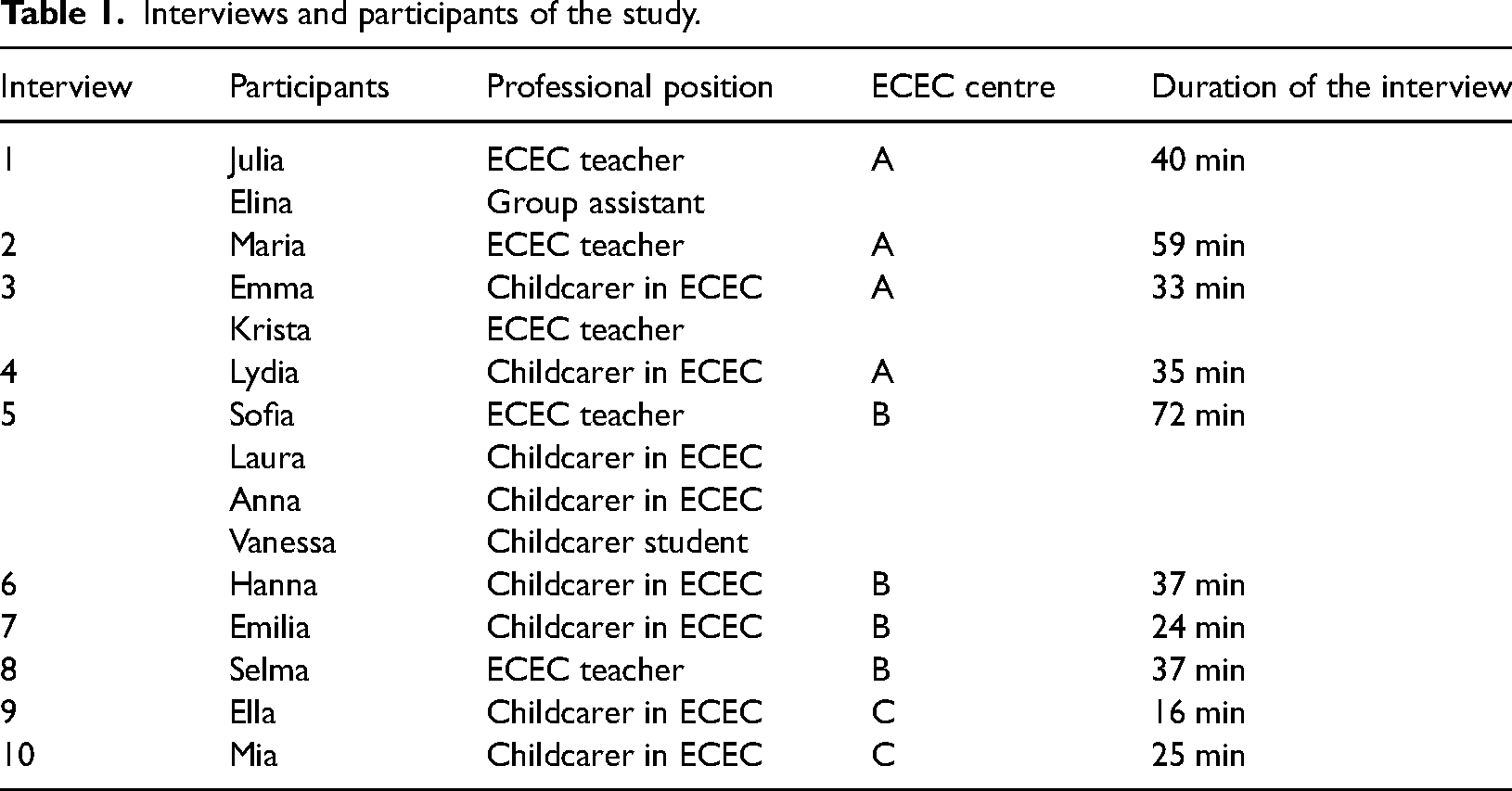
Ethnographic data collection was conducted in three voluntary ECEC centres in three municipalities with 15 ECEC professionals (see Table 1). The selection also covered the two official languages of Finland, with two Finnish-speaking and one Swedish-speaking ECEC centre. The present study applied video-cued multivocal ethnography (Tobin, 2019). This type of ethnography employs a collection of video recordings from observations as cues for shared reflection in research interviews to elicit tacit thinking and knowledge and to provoke conversations that encourage participants to share their experiences (Adair and Kurban, 2019). The importance of this approach lies in how the participants respond to the video and articulate connections between it and their own lives (Tobin, 2019). In this study, the method allowed for rich narration related to emotion-laden situations with children. The study followed the ethical principles of the Finnish National Board on Research Integrity (2019), including obtaining participants’ informed consent.
Interviews and participants of the study.
From the footage taken during the observation days in participants’ ECEC child groups, five- to seven-min videos were compiled for each ECEC group as a starting point for the discussion and for building shared meaning-making in the interviews (see Adair and Kurban, 2019; Tobin, 2019). The video material was selected to represent diverse ECEC group interactions, chronologically following the daily routine, such as mealtimes, guided activities, playtime, going out, child–educator conversations and emotion-laden moments such as conflicts between children. Only material filmed in each participant's own child group was shown in the interviews, meaning the children and educators in the video were familiar to the participants.
The data comprise 10 video-cued interviews collected in the spring of 2022. There were seven individual interviews and three group interviews. As the interviews were conducted during the educators’ working days when they were responsible for the children, scheduling group interviews was sometimes challenging. Thus, the originally planned group interviews were partly modified into individual interviews to allow for interviewing of all voluntary professionals in the child groups. Some professionals required more prompting from the interviewer's questions, while others narrated their thoughts quite independently during the individual interviews. The group interviews allowed for more conversational interviews in which participants’ individual narratives complemented each other with their own perspectives to construct a shared narrative.
Seven of the participants were vocational ECEC nurses, six were ECEC teachers, one was a group assistant and one was a childcarer student. The work experience of the interviewees varied from one to 40 years, and they worked with three- to six-year-old children. Participants’ names in Table 1 are pseudonyms.
After watching the video, participants were asked to share their related thoughts and feelings. Subsequently, they were encouraged to reflect on their emotions at work, for example, with the following questions: ‘What kind of emotions do you experience in the type of situations shown in the video?’ and ‘What is rewarding in your work?’ Interviews (total of 6 h, 18 min) were audio-recorded and transcribed. Watching the videos produced discussion about emotion-laden situations with children, teamwork, well-being at work and cooperation with parents.
Analysis
The analysis started by identifying small stories in narrations focusing on emotion-laden situations with children in the interviews (see Bamberg and Georgakopoulou, 2008; Georgakopoulou, 2007). We followed Bamberg and Georgakopoulou's (2008) definition of small stories intertwined in everyday speech situations as short speech sequences embedded within an interview interaction. Small stories include narrations about ongoing, future or hypothetical events, as well as references to previous narrations, through which people construct their identities in interaction (Bamberg and Georgakopoulou, 2008).
The first author identified small stories in which professionals narrated emotion-laden situations with children from the transcribed interviews. A total of 25 small stories were identified. Next, we examined the positions the educators constructed for themselves in these small stories by using Greimas’s (1983) actantial model, which has previously been employed in studying identity (e.g. Wang and Roberts, 2005) and emotions in educational interactions (Ryökkynen et al., 2022). The actantial model explores how to place characters in positions, providing information about the realities that characterise the narrator's world and how this world is constructed (Wang and Roberts, 2005).
Greimas’s (1983) model allowed us to explore how professional identity was constructed in the small stories from the perspective of the positions in which educators place themselves in emotion-laden situations at work. Greimas’s (1983; see also Schleifer, 1987) actantial model was used as an analytical tool for identifying the actants and their relationships in each of the 25 small stories. In a story, all actions can be divided into six interrelated categories of functions, actants. These six actants are grouped in the narrative according to their functions. Actants can appear as anthropomorphic or zoomorphic characters or groups, or as abstract concepts (Greimas, 1983; Wang and Roberts, 2005). The actantial model contains six different actants each assigned to a specific role (Greimas, 1983; Wang and Roberts, 2005). The subject is the protagonist and central actor of the story. In this study, the subject was the narrator, i.e. the ECEC educator. The object is the target of the action, answering the question ‘what the protagonist is aiming for?’ The sender provides an obligation, a reason or justification for why the subject is aiming towards the object, answering the question ‘what motivates the protagonist?’ The receiver answers the question ‘For what benefit or harm is the subject acting?’ and informs the narrative's ultimate destination. This actant evaluates the success of the protagonist's action. While the helper supports the subject in achieving the goal, the villain tries to hinder the subject and must be overcome to achieve it. By examining the relationships among the subject, helper and villain, it becomes possible to identify educators’ opportunities for action, which are influenced by factors such as workplace contexts and practices (Wang and Roberts, 2005). While reading the small stories, we concentrated on how the relationships among the different actants were presented in relation to the object.
The first author conducted the preliminary analysis, which was then reviewed by and discussed with the other authors to ensure its reliability. By comparing the similarities and differences among the actantial models, two prevailing models were identified, representing two different professional identity narratives describing how the participating educators construct their professional identity. The small stories presented as examples in the Findings section are the ones that most clearly illustrate the actantial models. Some small stories were shorter and more fragmented speech sequences, while others were longer reflections on a specific emotional situation.
Findings
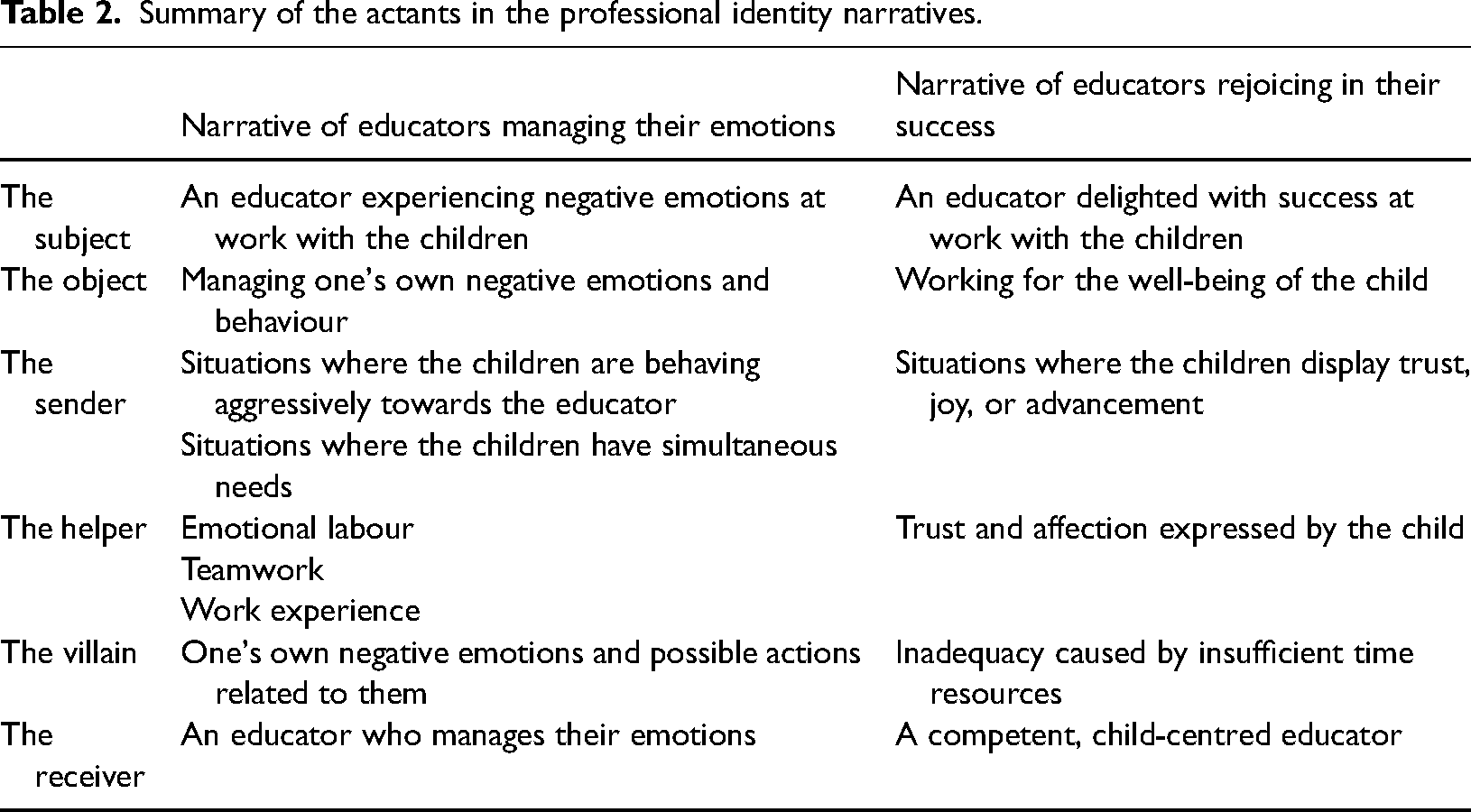
The 25 small stories could be identified as belonging to two narratives of professional identity embodying differing actantial models – narrative of educators managing their emotions and narrative of educators rejoicing in their success (see Table 2) – which reveal the role of emotions in educators’ professional identity construction.
Summary of the actants in the professional identity narratives.
Narrative of educators managing their emotions
In the narratives of educators managing their emotions, which were identified in eight interviews, the subject was an educator experiencing negative emotions linked to challenging interactions with children. Educators portrayed themselves as able to control their strong negative emotions and behaviours, which was the object of the narrative. The sender could be either a child behaving violently, like in Small Story 1, or situations where children had simultaneous needs, as in Small Story 2. The names in the data examples are pseudonyms.
Small Story 1: Educators Laura and Anna, ECEC Centre A Laura: When it comes to infringing on physical integrity, I mean, it's almost like having to remind yourself ‘it's a child you’re dealing with’, and like you really have to sit on your clenched fists to ensure nothing happens when the emotions take over. Researcher: What emotions are there in that situation? Laura: There's almost every kind … disappointment is perhaps one of the biggest emotions. And then there's… Anna: And confusion about why someone behaves that way … what's the reason for the child to come at me. Laura: It may happen that [educators'] glasses can get damaged, and [educators'] noses broken in early childhood education too. That's when emotions can suddenly take over, and as a reflex you may, as a reflex, hands may be used in defence. That's why it's really important you take a step back and calm yourself down. Ask your colleagues for help in those situations. But surprisingly rough situations do occur. It's one of the hardest parts of this job that there's all this interaction everywhere, all the time, in multiple directions. In such moments, somebody [a child] may come along and be like, ‘You have to give me everything you have’, so it feels like you’re not enough anymore, that there's nothing to give anymore … [You want to] understand the child's needs and would like to meet them, but at the same time, there's no strength to do it, and at the same time, there's a bit of a conflicted [feeling] about it, and it's like, ‘okay, if I now fully commit myself to this child's games and very intense presence, it's also a threat to my own ability to cope, so I also need to find a balance in how much I really have to give here’. It's no use trying to respond to everyone's needs all the time, it's just not going to work. I tried that when I was younger, but the result was not good … There's not much else that can be done, except to remember that there's only one of me and possibly about seven children, or a little more depending on the day, and it's just a matter of having to go with what you have. So, if it's not possible to recognise your own emotions, those emotions can very quickly start to lead the interaction and activities in a certain direction. That's something I feel is really important.
The narratives were linked to descriptions of how educators coped with their emotions in daily situations where they experienced negative emotions. In Small Story 1, the educators described the strong negative emotions evoked when a child behaves violently towards them. However, with the expressions ‘almost every kind’ and ‘perhaps’, they lessened the strong emotions in their narration (see Hufnagel and Kelly, 2018). Additionally, in Laura's narration, phrases like ‘glasses can get damaged’ and ‘emotions can suddenly take over’ show emotions, rather than the narrator, as the subject of the sentence. In this way, the educator diminished the extremity of the strong negative emotions and faded their agency in their narration (see Platow and Brodie, 1999). In Small Story 2, Maria portrayed inadequacy and being under stress in interactions where children have different needs at the same time, to which the educator is unable to respond. The educator described the emotional labour involved in situations in which children's parallel interactions forced her to compromise between their needs and her own need to cope with her work. Maria described constant multidirectional interactions as a job burden, generating inadequacy which defines the everyday life of the educator. Similarly, Hanna's story described her emotions under the pressure of multiple initiatives as follows: ‘Yes, there is some fatigue and sometimes a feeling of inadequacy that I should be in many places at once and then remember everything and make sure I have taken care of everything’ (Interview 6, ECEC Centre B). Thus, in this type of narrative, the educators presented as the object their need to cope with their own negative emotions.
In this narrative, participants’ professional identity as professionally acting educators was challenged by their own negative emotions as they described possibilities of wrongdoing, contrary to the ideal of a good educator, as the actant position of the villain. The narrative demonstrates how identity construction intertwines with emotional labour whereby, through the reflection on their emotions, the educators presented themselves as a professionally behaving actors. In Small Story 1, the educators portrayed how the violent behaviour of a child meant they had to manage their emotions actively and intentionally. The actual villain, however, was not the child's behaviour but the educators' strong emotions. The educators identified with the ideal narrative of the professional who can resolve emotionally challenging situations successfully. This was apparent in how they spoke cautiously about their emotions and avoided direct descriptions of strong ones. In the educators’ narration, emotions become the subject, thus blurring ownership of their emotions and leaving the narrator in a tangential position (see Hufnagel and Kelly, 2018).
The helpers identified were, in addition to emotional labour, teamwork and work experience. In Small Story 1, the educators described how their reflection on a situation helped them manage their own emotions. Additionally, sharing their emotional load with their team was described as a helper. In Small Story 2, the educator interpreted the situation as requiring emotional competence, which she associated with recognising one's own emotions and using emotional regulation amid the constraints related to her job. Additionally, work experience was identified as an important tool for managing one's own emotions and performing emotional labour. In Small Story 2, the educator detailed how her work experience helps her understand she cannot respond to all children's interactional initiatives, and that she has learned strategies to regulate her own emotional state, such as taking a breath and some distance in difficult moments. In the educator's narration, a competent educator knows how to manage their emotions and does not let them control their behaviour. In this professional identity narrative, emotional labour through emotional reflection supported educators in constructing their professional identity towards the receiver – that is, an educator who manages strong negative emotions in challenging situations with children.
Narrative of educators rejoicing in their success
Narratives of educators rejoicing in their success were identified in all the interviews. This type of narrative was linked to situations where children showed positive affection or in which educators observed children's development and well-being, for example, during free play and at naptimes. These situations were linked to joy, gladness and pride. Small Stories 3 and 4 below are examples of this narrative type.
Small Story 3: Educator Mia, ECEC Centre C I know, um, I’m probably the one who gets challenged the most by the children … the ones who maybe need security in daycare and someone to hold them in their arms. They’re the children that I’m most passionate about … So, it's challenging, yes, but because I think the need is often so apparent that one stays in the situation and gladly provides for them, so in the end, it's not a challenging role at all … But to be able to meet those kids's needs … in the questions where they might need support, and that's always the challenge, because all people are so different, how can they be helped to be able to move forward in the best possible way? But I feel that it's often somehow my strongest area. They are the ones I become attached to … Of course, when everything goes smoothly, the day also feels good, but at the same time … there must be this [educators’] presence, with everyone there, so that we can divide these groups of children up and have them in small groups, so that we can devote our time to the children. And that's when I think the day's a particularly good one. That's when we have time to listen to everybody, to do something extra, so that's when it feels especially good.
Small Story 4: Educators Anna and Sofia, ECEC Centre A Anna: There's the humour, the funny situations, doing things with the children and experiencing the good moments. Sofia: Yes, and when a child comes to you, and you’re like, ‘Here I am, you’re welcomed, I’m here for you’. Anna: Yes, it's that the kids want to be hugged. And I’m quite a hugger … I really love to give them hugs! And, at least in the nap room, many children will ask for their head to be stroked. And I love to stroke them and see their eyes start to droop even when they’re not sleepy. And then, if you take your hand away for a while, they say, ‘Don’t stop!’ [laughter], and you continue stroking again and get the child to fall asleep and calm down, so it's somehow a kind of affectionate feeling [laughs]. It's a wonderful moment… Sofia: Not having to be constantly racing against the clock, I don’t want to feel like that. Anna: That terrible hurry. Sofia: The hustle and bustle and all that, if that was gone… Anna: And the time and being present with the children would increase. You could be involved in playing, if they let you take part in it with them [laughter]. But at least you’d be able to be present and enrich their play and activities there. Sofia: And not going full speed ahead with a lot of different things to do … It's about being present.
In this narrative type, the educator was presented as delighted with the success of their work with children. In Small Stories 3 and 4, the educators identified themselves as professionals who can work sensitively according to the children’s needs. Situations describing success at work, that is, when children show trust in and closeness to the educator, were the sender of the narrative. The sender was identified when we examined how the educators positioned children: in Small Story 3, the educator described her satisfaction when she was able to meet a ‘challenging’ child's needs on an individual basis. In Small Story 4, the educators described their feeling of joy from having trusting children–educator relationships. Positive emotions were described as generated from the well-being of children and, thus, the success of the child-centred educator in the narration. The educators described their professional success by referring to situations in which they observed children thriving and developing in ECEC, as well as when they were able to gain a challenging child's trust.
The educators situated the emotion of inadequacy caused by insufficient resources in ECEC as the villain, challenging them in their work towards procuring children's well-being and making it difficult to construct their identities as child-centred educators. This challenge was identified when educators described their feeling of inadequacy from not having enough time for the children, which threatened their self-image as child-centred educators. In Small Story 4, educators expressed their wish for more time to be present with the children. In the educators’ narration, rushing and lack of time were presented as regular elements of their work with children.
In this narrative type, the affection and trust children showed emerged as helpers in maintaining the educators’ identity as warm and competent. Julia described the helpers as follows: ‘When someone comes to hug me, like today at the dinner table, they press themselves against me and hug me, or give me a kiss on the cheek or say, “You’re wonderful” (Interview 1, ECEC Centre A). In Small Story 4, the shared joy of children and educators strengthened their professional identity as child-centred educators who are present for the children. The educator in Small Story 3 described adequate conditions and resources for doing her work well, describing the importance of being able to properly address each child's individual needs. In Small Story 3, the participant constructed her professional identity as a child-centred educator by reflecting on her ability to act and fight for the children who need the most support. However, in the educator's narration, working conditions, for example, the possibility of dividing the children into smaller groups or insufficient time resources, were intertwined with how well the receiver was achieved.
In emotional narrations, references to knowing the children better brought a personal dimension to the educational interaction. Thus, in this narrative type, the professionally successful educator was constructed as a child-centred one who works for children’s best interests and well-being by creating close and warm relationships with them, even when the ECEC environment does not always enable working conditions that support these unrushed and heartwarming interactions.
Discussion
The purpose of this study was to identify how ECEC educators construct their professional identities in their narratives of emotion-laden situations working with children. In the narrative of educators managing their emotions, which involved situations where educators described a child's violent behaviour or experienced multiple simultaneous interaction initiatives from children, complexities in managing negative emotions challenged the educators’ perceptions of themselves as ones acting professionally. In this narrative type, the educators constructed their professional identities through the need to detach themselves from the emotions connected to situations in which a child was showing strong negative emotions. This was manifested when the educators presented themselves as acting according to a professional ideal by lessening their negative emotions using similes, metaphors and avoiding the use of the first-person form in their narration (see Hufnagel and Kelly, 2018; Platow and Brodie, 1999). This is in line with previous studies in which educators considered emotional labour to be a necessary professional skill and where down-regulating negative emotions was common (Jiang et al., 2016; Sutton et al., 2009; Zhang et al., 2020).
In the narrative of educators rejoicing in their success, warm interactions and the closeness of the child–educator relationship engendered joy and enhanced the educators’ professional identity as a child-centred one. Positive affection evoked by children's displays of emotion or development reinforced the educators’ professional identity (also Nichols et al., 2016; Zhang and Jiang, 2023). In this narrative type, educators’ goal to be caring and loving was challenged by their working conditions, such as insufficient time resources, which were in opposition to their professional ideal. Therefore, working conditions also determine the emotions experienced in educator–child interactions. For example, the requirement of increasing work efficiency with the same or fewer resources (e.g. Kangas et al., 2022) can lead to educators experiencing inadequacy. This puts a burden on educators’ work with children but also challenges their professional identities (see Beijaard et al., 2004; Hanhikoski et al., 2024).
Ultimately, the narratives illustrate educators who can both display positive emotions and cope professionally with negative ones. Thus, in the narratives, educators construct a competent, child-centred identity where the value of acting in the best interests of the child and being present with them is highlighted (see also Hanhikoski and Sevón, 2024; Hjelt et al., 2024; Kangas et al., 2022). However, the narratives also highlighted situations where this professional ideal was tested, requiring constant emotional labour on their part. As the emotional labour to construct an ideal educator identity is done while supporting the child in managing their emotions, educators’ identity construction is particularly intensive. Additionally, in their narratives, educators described not only engaging in emotional labour in relation to children but also to the cultural master narratives and discourses that define the ideal educator. However, Akpovo et al. (2023 : 486) describe how the emotional discomfort and staying in unpleasant emotions should be considered ‘as a path toward transformation and growth’. Thus, in ECEC, attention should be paid to giving educators possibilities to reflect on emotion-laden situations with colleagues as this can help strengthen their professional identities (Zhang and Jiang, 2023).
The narratives illustrated how the emotions of educators and children are intertwined and interdependent processes. Thus, emotion-laden identity adjustments do not arise only during educational reforms or when working conditions conflict with professional ideals (see e.g. Hanhikoski and Sevón, 2024; Vähäsantanen and Eteläpelto, 2015) but also in the daily interactions between the educator and the child. Our study illustrates the importance of emotional reflection in the construction of professional identity (see also Albin-Clark, 2020; Beauchamp and Thomas, 2009; Beijaard et al., 2004); and that support from the work team in emotional labour brings a new perspective on the relationality of the construction of professional identity in the Finnish ECEC context.
Our study enhances understanding of the interconnection between professional identity and emotions, the construction of professional identity through small moments in everyday life and the importance of emotional labour from the perspective of professional identity in ECEC. Based on our study, educators’ professional identity can be supported by building collegial relationships and shared practices related to coping with and sharing challenging situations within the work community, and by providing an environment for educational work that involves unhurried encounters with children. Emotional labour in ECEC involving colleagues as peer support in the work community can help educators deal with challenging emotional situations (Hanhikoski et al., 2024). This means strengthening the structures of teamwork and shared practices to support ECEC educators in their emotional labour with children, thus enhancing their professional identities. As Meijers (2002) describes, identities are constructed by balancing emotions and thinking through dialogues both within and between individuals. Zembylas (2003) also addresses coalitions and friendships, emotional affinities, as a requirement for the emotional construction of a teacher identity. Further research could ask how educators form such relationships and how these relationships affect their work.
As the interviews were part of a larger project aimed at enhancing socio-emotional skills in ECEC, this might have highlighted the need for educators to reflect more on their emotional skills, that is, the ideal that a good educator is emotionally competent. Both narrative types appeared in all but two interviews, where challenging interactions were not mentioned. This may be related to the interview interaction, but hesitation to talk about such situations may also reflect how ECEC professions are culturally perceived through positive emotional situations. Since emotions and professional identities are context-bound, in terms of the transferability of our research, the context must be considered (Ahmed, 2024). However, the reliability of the analysis was strengthened by the identification of actantial models from all the small stories, which were employed to construct the narratives. Finally, shared reflections among the researchers during the analysis enhanced the study's trustworthiness (Ahmed, 2024). Since this study was based on a narrative interpretation of emotions, future research could use ethnographic methods, such as observing ECEC educators at work, to provide another situational perspective on educators’ emotions in this context. Additionally, as educators had different qualifications, further research could focus on these groups separately and in comparison.
Methodologically, the actantial model (Greimas, 1983) offered an in-depth, systematic tool for examining how professional identity in the narratives of emotion-laden situations with children was constructed. The use of the model does not imply the narratives have a fixed structure; instead, it allows to look specifically at how the narrator perceives the meaning of emotions in relation to their professional identity (see Wang and Roberts, 2005). Additionally, video-cued interviews (Tobin, 2019) offered a new way of connecting emotions, aroused by mundane daily incidents, with professional identity, as the participants were able to return to the situations they saw on the video and reflect on their emotions.
Conclusion
This study illustrated how ECEC educators’ emotion-laden professional identity is constructed in their narration of daily interactions related to balancing one's emotions and being a professional and competent educator. Thus, the study suggests daily emotions experienced in interactions with children are fundamental to professional identity construction for ECEC educators. Considering the importance of emotions and emotional labour in ECEC work, these issues should also be included in pre-service training. Finally, ECEC organisations need to reflect on the self-perceived inadequacy of educators in their work with children, as it challenges professional identity construction, affecting work engagement and the well-being of both children and ECEC professionals.
Footnotes
Data availability statement
Participants of this study did not give written consent for their data to be shared publicly; thus, due to the sensitive nature of the research, supporting data are not available.
Ethical approval and informed consent statements
This study was approved by the Research Ethics Committee of the University of Jyväskylä (2021). All participants provided written informed consent prior to enrolment in the study. The study followed the ethical principles of the Finnish National Board on Research Integrity.
Funding
This study was a part of a larger research project ‘TUIKKU – Emotional Skills and Participation in Early Childhood Education and Care’, which was funded by the Finnish Ministry of Education and Culture.
