



Abstract
Whilst transition to primary school is a commonly experienced phenomenon for most children, some groups of children, including those with disabilities, are less likely to engage in the process because it can be very challenging for them and their families. This article presents evidence from a review of research looking at the transition of children with disabilities within early childhood and primary education in low income countries in Sub-Saharan Africa. From the meta-aggregation, three central areas were identified within the topic of transition of children with disabilities to primary school in sub-Saharan Africa: key actors, obstacles and enablers. Although this review identified some of the main obstacles to transition related to finance, it has highlighted the fact that many children with disabilities and their parents wish to attend school, and there are a number of ways to support and enable successful transition from home to school.
Introduction
Global agreements, including the UN Sustainable Development Goals (2014), emphasise good quality early childhood development, from birth to eight, as an international priority for all children. This includes a number of transitions which require children to cope with a ‘. . .potentially challenging episode of change. . .’ (Newman and Blackburn, 2002: 1) and be able to adapt to different environmental systems (Colton et al., 2001). A recent literature review by the Organisation for Economic Co-operation and Development (OECD) (2017) identified eight key elements of successful transition programmes. Some related to the early childhood education and care (ECEC) and primary school staff such as shared views on transitioning and how children learn individually, alignment in working conditions, curriculum, pedagogical understanding and practices alongside collaborative practices such as sharing written information on the children. Centrally, there was a need for collaboration, flexibility and responsiveness to individual communities, families and children through reciprocal communication linked to values of inclusivity, mutual trust and respect. These transitions from home to (ECEC) provision, then onto primary education can be particularly challenging for young children with disabilities and their families as these occur relatively quickly (Hebbeler and Spiker, 2016).
Whilst transition to primary school is a commonly experienced phenomenon for most children, some groups of children, including those with disabilities, are less likely to engage in the process (WHO, 2011). Indeed, children with disabilities, compared to their peers, have lower levels of school attendance and fewer transfers to higher levels of education (WHO, 2011). Yet, an estimated 53 million children globally (approximately one-tenth of all children) have a developmental disorder (Olusanya et al., 2018) with most of these children living in low- and middle-income countries (LMICs). The term ‘disability’ indicates collective vulnerability to inequalities, whilst recognising the heterogeneous, individual nature of disability, an impairment or a developmental disorder. In this article, we use the term ‘disability’ in its widest sense as a multi-dimensional, dynamic and complex construct taking a more a biopsychosocial definition (Shakespeare, 2014) that incorporates a child’s functional ability in multiple domains for example seeing, hearing, mobility, self-care, communication, the interaction of the person and their environment and not on a ‘diagnosed’ impairment such as autism.
A review of the literature forms part of the first stage of a 2-year Early Childhood Education project funded by the British Academy which seeks to explore the historical and cultural contexts of early childhood education for children with disabilities in Malawi. The purpose of this wider review was to analyse the research produced on early childhood education of children with disabilities in low income countries in Sub-Saharan Africa in order to enhance understanding of how, and why, educational and health interventions/enablers support their participation and inclusion in education. This evidence will inform the development of an inclusion and participatory framework that can be used to identify examples of positive education, care and health practice for young children with disabilities and their families.
This current section of the wider review aimed to identify key factors within transition to primary school for children with disabilities and their families in low income countries. It focused on the following research questions:
What do the key actors view as central to transition?
What are the obstacles to transition?
What enables transition?
It begins by defining key terms related to ‘transition’, then explains the methodology undertaken to conduct a systematic literature review which helped to illuminate the factors that impact on children’s opportunities with disabilities to transition from pre-primary or early years to primary education (this includes special schools and resource centres attached to mainstream schools). It concludes by identifying and discussing potential ways for professionals, para-professionals, schools and early childhood centres to work together with children with disabilities and their families in more a transparent and collaborative environment in order to ease the process of transition.
Method
A review protocol was prepared, discussed and agreed upon before the initial searches for the wider research project were undertaken between January and March 2020 including eligibility criteria and key search terms. The general framework for the review included appraisal of the included studies, data extraction and synthesis (Boland et al., 2014).
Articles and reports that fit the following eligibility criteria were included:
Peer reviewed journal articles published within 2000–2020,
Published reports for example World Bank, UNICEF, UNESCO, WHO, Bernard van Leer, INGOS (Save the Children, Humanity and Inclusion),
Studies conducted in Malawi or in low income countries,
Reporting data for children aged 0–8 years old,
Studies written in English, French and Spanish,
No restriction in terms of study design.
The following key terms; models of inclusion; models of participation; models and theories of disability; multidisciplinary; interdisciplinary; safeguarding; early childhood; early years; kindergarten; infant; early childhood education and care; early childhood care and education; early childhood development; transition; pre-primary, pre-school, special school; resource centre; primary school; community based child centres and inclusive education, were used.
The initial search was within the University of Birmingham database which included ProQuest, ERIC, JSTOR, SABER, Eldis and the British Education Index. A snowball approach was taken whereby reference lists were reviewed to identify further material. A total of 263 titles were identified, 72 duplicates were removed and 191 titles and abstracts were initially screened to check for relevance to the wider research question. A total of 79 articles were read in full for data extraction with seven identified as having information relevant to transition for children with disabilities between and into early childhood care and education and primary school, with a focus on low income countries.
Data analysis
Nine steps for a systematic review were followed with the purpose of the qualitative synthesis identified as meta-aggregation, an approach that involves a comprehensive search for identifying all relevant studies and the critical appraisal of their methodological quality. The nine steps are: planning review; performing scope searches; identifying the review question and writing protocol; literature searching; screening titles and abstracts; obtaining papers; selecting full-text papers; data extraction; quality assessment; analysis and synthesis (Dickson et al., 2014: 13–14).
The representation of the systematic strategy search above is presented in the flow diagram of Figure 1.
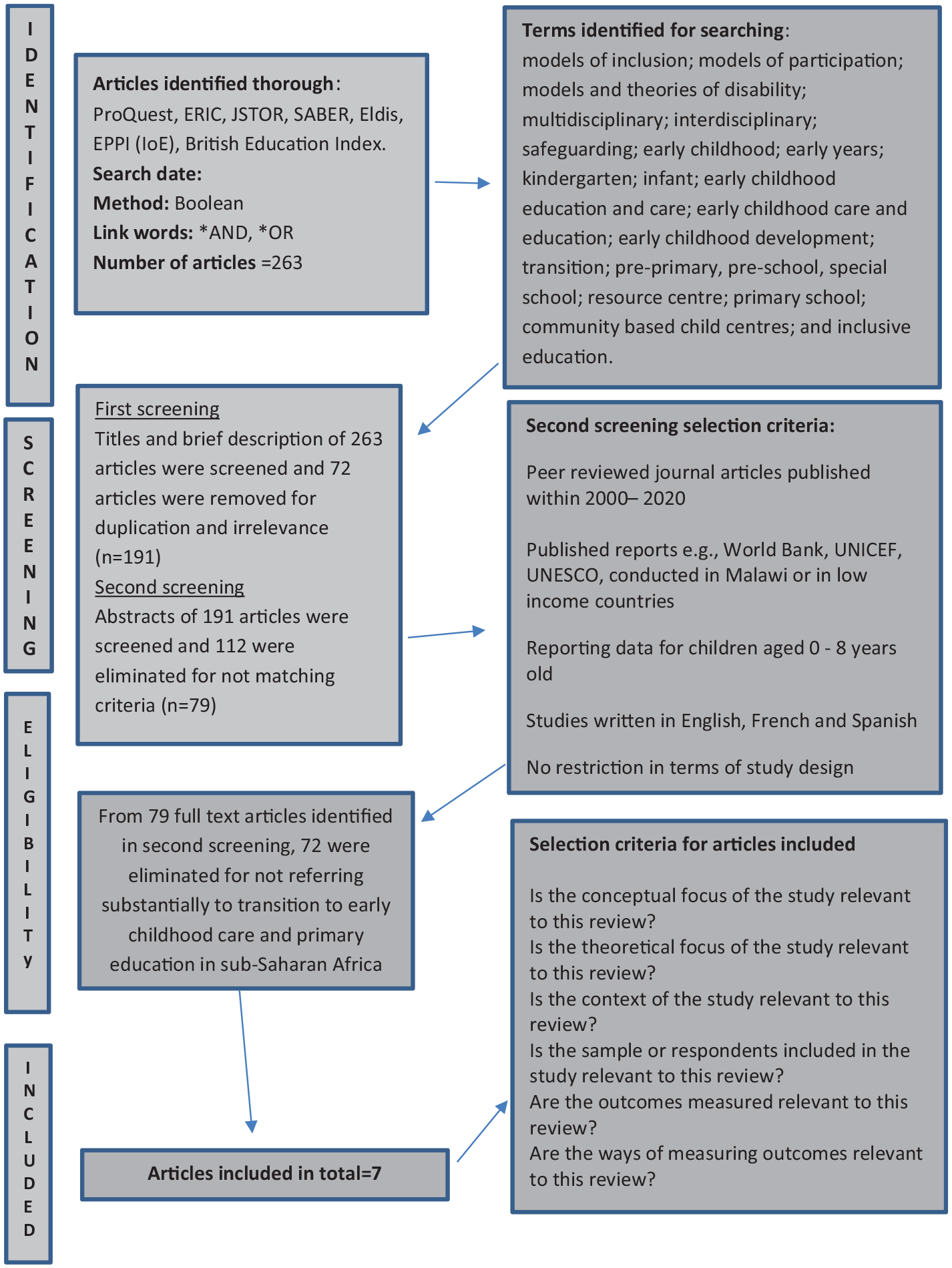
Systematic search strategy using PRISMA flow diagram.
For the wider review, data was extracted from the 79 articles and reports and then recorded in a predefined data extraction sheet which was developed and agreed by the four researchers. The form recorded key background information, themes, findings and conclusions from each study. Each form represented a data-record and was used to extract the data and subsequently synthesise the findings.
Dickson et al. (2014: 35) highlight the importance of the transparency of the review process, being explicit about the steps followed and minimising bias. To meet these threats to quality assurance, two researchers separately extracted the data from the seven key articles on transition, and identified themes and subthemes following guidance from Rutter et al. (2013).
As a small number of articles were identified, all were included, and findings which were related to transition at other points in education such as primary to secondary were noted. Of the seven papers identified, one paper went beyond the immediate context of sub-Saharan Africa, to the United States of America (Hebbeler and Spiker, 2016), but was included in the discussion as it focused on young children with disabilities transitioning to school. Where this occurs, Boland et al. (2014) suggest having an analysis plan, which includes consideration of the relevance of the population, phenomenon of interest and context.
Three were primary research papers exploring the population identified, namely young children with disabilities, their families, primary school teachers and the professionals who support them in the context of low income countries in sub-Saharan Africa (Banks and Zuurmond, 2015; Luger et al., 2012; Torgbenu et al., 2018) and therefore were placed centrally. Banks and Zuurmond (2015) researched 23 families of disabled children in Malawi. Luger et al. (2012) conducted outline case studies of the move to education for two children with physical disabilities living in a township in South Africa. Torgbenu et al. (2018) surveyed the attitudes of over 600 parents of children with and without disabilities to inclusive education in Nigeria.
Of the remaining three papers, all discussed transition, with one exploring early childhood care and education more broadly in Malawi (Munthali et al., 2014), one examining inclusive education in two primary schools in Malawi (Rothe et al., 2016) and a final paper linking schools and early childhood care and education, offering a model of transition (Britto and Limlingan, 2012).
In order to quality appraise each paper, guidance from the Social Care Institute of Excellence (SCIE, 2010) was followed with a focus on the relevance of the paper. This included consideration of the internal validity of the studies in terms of meeting its identified aims, participants, methods, data analysis and transparency in reporting outcomes and relevance to the research aim posed in this paper (see Table 2).
Key issues identified are discussed in the limitations section. The following section presents a synthesis of the evidence on children with disabilities, their families and professionals in relation to transition to early childhood and primary education in low income countries.
Results
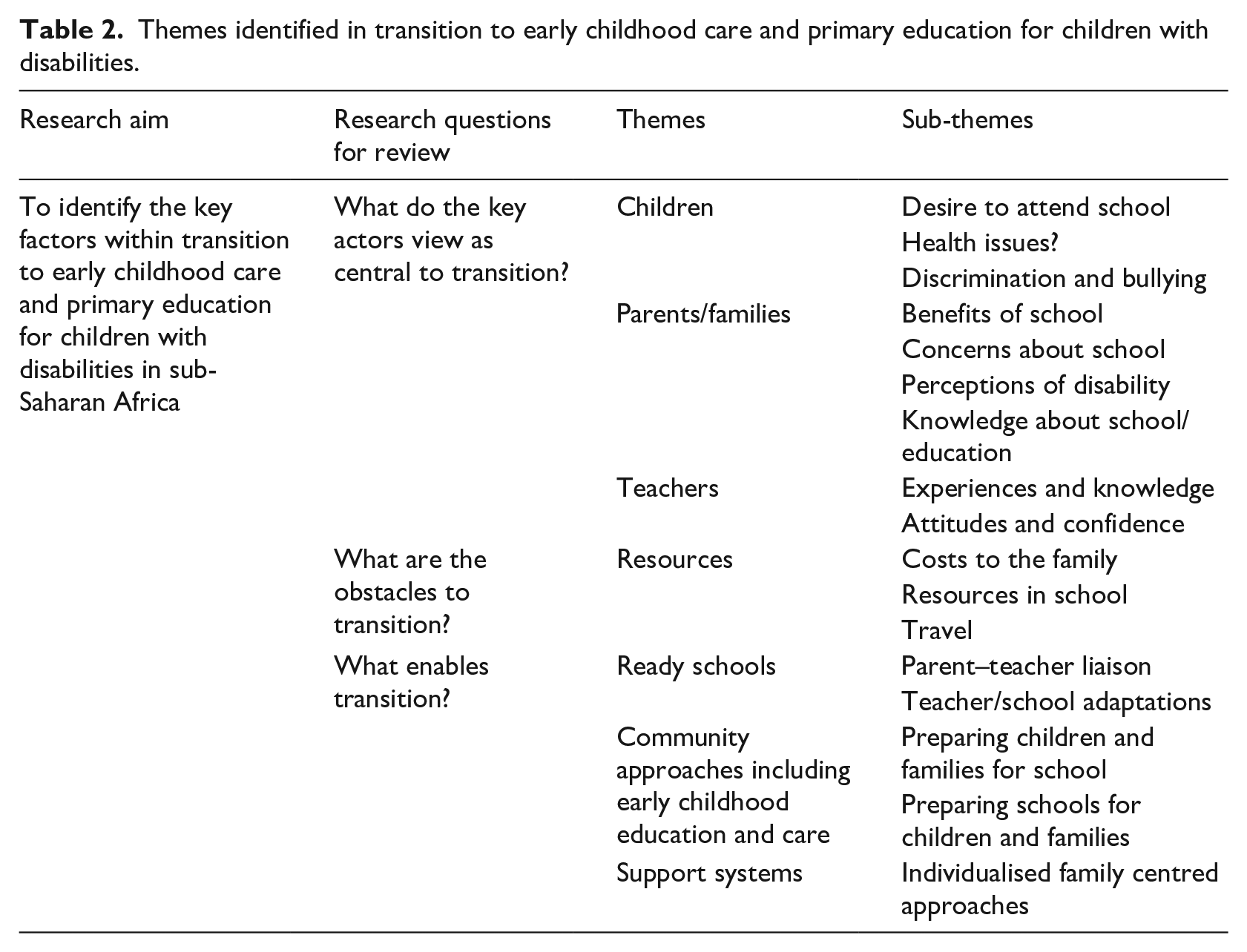
From the meta-aggregation, three central areas were identified within the topic of transition of children with disabilities to primary school in sub-Saharan Africa: key actors, obstacles and enablers. As shown in the Table 1 below, the key actors identified were children, parents/families and teachers. Three themes enabled transition through the promotion of holistic school readiness, which in turn means school readiness programmes can benefit disadvantaged children rather than seek to exclude them (UNICEF, 2013). These were ready schools, early childhood education and care centres and support systems. The main obstacles to transition related to financial implications, such as costs to the family, resources in school and travel, were identified within the articles (see Table 2).
Quality assurance of research design.
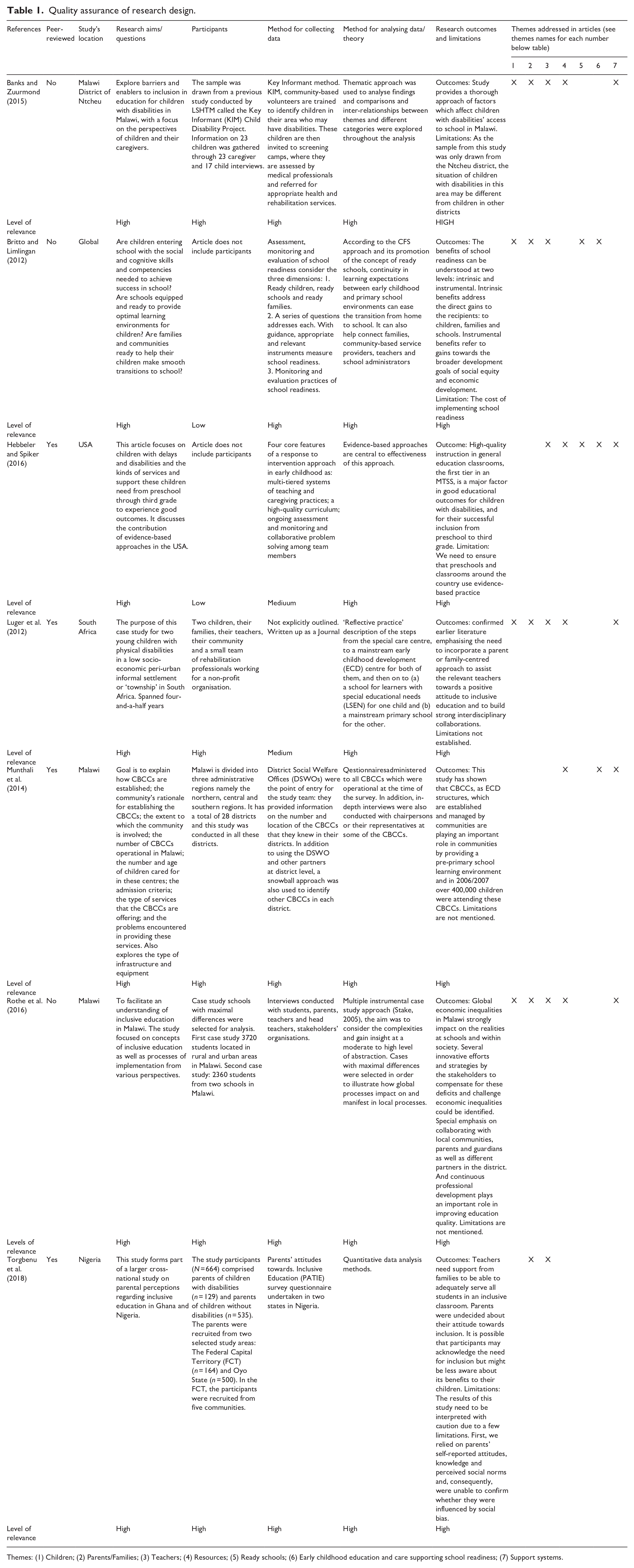
Themes: (1) Children; (2) Parents/Families; (3) Teachers; (4) Resources; (5) Ready schools; (6) Early childhood education and care supporting school readiness; (7) Support systems.
Themes identified in transition to early childhood care and primary education for children with disabilities.
Discussion
Each research question and the associated themes and sub-themes identified from the literature are discussed below.
What do the key actors consider as central to transition?
The key actors within the literature were identified as children, parents/families and teachers. Each group is considered in turn alongside the key issues they identified as central to transition.
Children
Children’s desire to attend school
It is important to start with children’s own views about their experiences. Banks and Zuurmond (2015) found the majority of the 23 children were highly motivated and enthusiastic about going to school in Malawi. The reasons given include a love of learning, a desire to be with peers and a route out of poverty. Indeed Banks and Zuurmond (2015) note there were frequent reports of children’s agency including enrolling themselves and going despite caregivers’ wishes. Similarly, Rothe et al. (2016) in their study of two primary schools in Malawi, highlighted that children with disabilities liked attending school most of the time.
Children’s health
Banks and Zuurmond (2015) found that poor health or the need for treatment were reasons for not attending school. These included visual or hearing impairments as a result of unresolved and untreated eye and ear infections which caused pain. Furthermore, four children within the research started school markedly late, or did not attend at all, as their families hoped for a ‘cure’ in order to enrol them. In these cases, families either did not think their child could be educated without the resolution of their impairment or else were actively seeking out different treatment options that conflicted with school time.
Children’s experiences of bullying and discrimination
In both Malawi and South Africa, children with disabilities reported concerns regarding acceptance, discrimination and bullying (Banks and Zuurmond, 2015; Luger et al., 2012; Rothe et al., 2016). Banks and Zuurmond (2015) highlighted that discrimination, stigma and abuse were pervasive themes with virtually all children having experienced these, either at school, in the community or at home, impacting upon their self-esteem and confidence. They note this occurred to an even greater extent for children with disabilities who had communication difficulties. Nearly three quarters of the 23 children, had experienced bullying or violence, mainly from peers, and in a few cases from teachers, in school discouraging children with disabilities from wanting to attend school. Rothe et al. (2016) also reported that students with disabilities were mocked, segregated and not accepted by peers.
Parents
Benefits of school for parents
Munthali et al. (2014) stated that results from low-income countries have demonstrated early childhood education and care (ECEC) programmes prepare all young children for enrolment in primary school and schooling achievement (van der Gaag and Tan, 1998). Alongside this, many parents, and families of children with disabilities view education as potentially transformative both economically and socially. Even those who doubted their child’s abilities to receive a formal education, still felt their child could learn some helpful skills and socialise and this would in turn supported their behaviour and abilities. Croft (2013) included two studies in an evidence review that utilised life history interviews with disabled higher education students highlighting the positive impact of education (Hammad and Singal, 2011; Morley and Croft, 2011). Banks and Zuurmond (2015) found some parents, particularly those whose children had physical disabilities, understood their children would not be able to engage in manual labour and other traditional livelihoods and anticipated education would offer an alternative. Torgbenu et al. (2018) cited in Brydges and Mkandawire (2020) qualitative study involving 12 participants in Nigeria, reported that many parents of children with disabilities acknowledged the usefulness of inclusive education for the social inclusion of their children. However, they felt that only students with mild disabilities were facilitated to participate in regular schools, while those with severe disabilities were enroled in special school settings.
Parental concerns about school
Parents of children with disabilities are concerned about the school’s capacity to support and protect their children. Globally, whilst parents may be undecided or positive about their view of inclusive education, they are consistently concerned about the capacity of regular schools to promote the learning of their children with disabilities in Singapore (Wong et al., 2015), Australia (Mann, 2016; Mann et al., 2018; Stevens and Wurf, 2018), Bhutan (Jigyel et al., 2018a, 2018b), Zimbabwe (Magumise and Sefotho, 2018) and Nigeria (Trogbenu et al., 2018). Indeed, some parents were concerned about the safety of their children with disabilities in regular schools and, as a result, chose special schools (Mann et al., 2015). These concerns were also evident in Malawi, where Banks and Zuurmond (2015) and Lynch et al. (2014) identified that some families did not send their children to school, particularly those with high support needs, as they feared they would not be adequately cared for. In South Africa, Luger et al. (2012) also found the two parents in their study were initially hesitant about the transition of their children from special care centre as they were worried about discrimination in the new placement and the possibility of decreased therapy and care.
Parental perceptions of disabilities
Parents held differing beliefs about the ability of children to engage in education, or whether it was beneficial for them. The Convention on the Rights of People with Disabilities (UNGA, 2007) challenging attitudes and approaches to persons with disabilities which objectify them as in need of charity, medical treatment and social protection and promotes viewing them as participants with rights, active members of society, capable of making decisions for their lives based on their free and informed consent. In spite of this statement, cultural beliefs persist whereby children with disabilities are not seen as deserving of an education. Trogbenu et al. (2018) highlight that in Nigeria, people with disabilities are not recognised as equal members of society (Obiakor and Offor, 2011) are perceived as liabilities and are considered incapable of learning (Akinbola, 2010; Brydges and Mkandawire, 2020), or are viewed negatively, which in turn limits access to education for children with disabilities (Brydges and Mkandawire, 2020). Similarly, in Malawi, Banks and Zuurmond (2015) and Rothe et al. (2016) identified parents who sometimes did not believe children with disabilities should be included in mainstream schools, particularly for those with behavioural problems, and these frequently were the children out of school. This was due to concerns that their inclusion would burden teachers, whereas others did not believe the child could receive a meaningful education.
Parental knowledge of education and school
Whilst some parents were aware of the benefits of education more broadly, Torgbenu et al. (2018) highlighted that parents of children with disabilities may think that their children are destined to study in special schools (Brydges and Mkandawire, 2020). Therefore, they would benefit from understanding the advantages of transition to inclusive education, that is, education in regular schools rather than in special schools in terms of their academic, social, emotional and personal progress (Afolabi et al., 2013; Mohsin et al., 2011). Indeed, all parents need a detailed understanding of inclusive education including teachers’ capabilities, the availability of resources and specialised facilities in schools that can support children with disabilities (Ruijs et al., 2010). This, then addresses concerns about the adverse effects of inclusive education such as teachers having to spend most of their time with students with disabilities which might, reportedly, lower academic standards (Stevens and Wurf, 2018) and lead to non-disabled children achieving less.
Torgbenu et al. (2018) explored the factors that influence parental attitudes towards educating students with disabilities in regular schools, highlighting the impact of education (Abu-Hamour and Muhaidat, 2014), the severity of a child’s disability (Abu-Hamour and Muhaidat, 2014) and gender (De Boer and Munde, 2014). Afolabi et al. (2020) in their literature review examining parents’ beliefs about inclusive education in sub-Saharan Africa, highlighted the impact of traditional attitudes and practices, religious beliefs and the lack of stakeholder involvement in policy setting and implementation.
Teachers
Teachers’ experiences and knowledge
Similar to the issues faced by parents, the articles highlighted gaps in teachers’ knowledge of disability and inclusive education. In Malawi, Banks and Zuurmond (2015) found few teachers had received training in these areas either at their teaching colleges or whilst teaching. For those who had received training, this tended to be general, focusing on promoting the need to include children with disabilities in the classroom without providing practical strategies. Also, in Malawi, Rothe et al. (2016) discussed how the lack of funding leading to only special needs teachers accessing training on inclusive education and disabilities, but within a primary school with a resource centre, the transfer of specialised skills from the special needs teacher to other teachers was limited. In South Africa, Luger et al. (2012) also noted the need for more information and skills training on disability for teachers both in the curriculum for teacher training and in schools, highlighting this should include social as well as academic aspects of school life.
Indeed, within interviews, Banks and Zuurmond (2015) found frequently teachers were unaware that the child being discussed had a disability, and UNICEF’s State of the World’s Children report (UNICEF, 2013) suggests that school and clinic staff may not routinely recognise the presence of children with disabilities. Certainly, Croft (2013) and Eide and Loeb (2005) described information on disability in general to be particularly weak and widely varied in low-income countries, with the WHO/World Bank (2011) emphasising the need for improved data collection on disability using a uniform definition of disability.
Teacher attitudes and confidence
A lack of training in disability and inclusive education impacts on teachers’ confidence and willingness to teach children with disabilities. Banks and Zuurmond (2015) highlighted that in many cases where children were not in school, it was because of behaviour difficulties, with school staff suggesting or requesting the child should not be sent to school. They state that teachers frequently believed children with disabilities, even those with minor difficulties performing at or above expected levels, should be taught outside of the mainstream system, recommending caregivers send their children to a special school. In Malawi, Rothe et al. (2016) also found teachers reported an unwillingness to include children with disabilities as they were concerned about their ability to teach them.
What are the obstacles to transitioning for children with disabilities?
Costs to the family
Banks and Zuurmond (2015) found poverty to be a dominant theme and served as a main reason for children with disabilities not being in school. This was due to the costs of treatment and taking time off work, and in turn meant that basic supplies were not available to the child. They identified two children who had dropped out of school at transition to secondary school, one over fees and the other was struggling to pay on time. Although this related to a different transition, this is likely to be relevant in transition to primary school.
Additionally, perceived cost (of both boarding and school fees) was cited as the main reason for not sending children to special schools. Even when expressing an interest in sending children to special schools, caregivers stated that they had not researched these alternative options for schools as they believed they would be too costly.
Resources in school
Resourcing, both physical and human, has been identified as a key issue for all children, including those with disabilities, in low-income countries. In terms of inclusive education in regular schools, Torgbenu et al. (2018) reported that schools in Nigeria lacked materials, facilities and sufficiently qualified teachers (Brydges and Mkandawire, 2020; Obiakor and Offor, 2011), and in Bhutan parents of children with disabilities claimed that regular schools did not have the resources to enable the learning and participation of their children (Jigyel et al., 2018b). In Malawi, Banks and Zuurmond (2015) found schools frequently ill-equipped and inaccessible for students with disabilities which led to exclusion of many from the learning process. Key informants described that, generally, only resource centres or special schools had minimal specialist resources, with virtually nothing in mainstream schools, let alone adapted curricula.
Banks and Zuurmond (2015) identified class size as a major challenge by all teachers across all types of schools, which meant that they often lacked the capacity to provide any individual attention to students. Although the maximum class size under Malawi educational policy is 60 students per teacher, almost all teachers had well over 100 children in a single class. The two case study schools included by Rothe et al. (2016) had average class sizes of 70 and 275 respectively. In addition, Rothe et al. (2016) highlighted the lack of specialist teachers in regular schools, whilst Banks and Zuurmond (2015) identified the turnover of teachers as high, particularly in rural areas.
Travel
In Malawi, a more common barrier to physically accessing schools was travel (Banks and Zuurmond, 2015) with nearly half of families reporting challenges in getting to school such as the assistance of a family member to get to school, which was not always regularly available. Similarly, special schools and resource centres were few and far from the communities in which children live, and although some children could board for free, transport between terms was costly and parents were concerned about whether their children could cope. There were also concerns about the safety and welfare of the children if they did board, particularly for girls. This was similar to the case study discussed by Luger et al. (2012) where trips for a parent to collect his child from his special school were lengthy.
What enables transition for children with disabilities?
Ready schools
Teacher/school adaptations
Croft (2013) acknowledges that for children with complex and significant disabilities, the likely educational consequences are substantial, but highlights that most children have moderate disabilities that can be addressed with relatively simple adaptations to the pace of teaching, and include positioning, focused additional support and extra time to complete tasks. Luger et al. (2012) gave examples of successful inclusion adaptations such as moving classes to the best space available, engaging community volunteers to assist with children with areas of difficulty such as toileting and transferring children to be in class with their friends. Banks and Zuurmond (2015) also gave several examples of teachers providing support and small, helpful interventions including positioning children with hearing and visual impairments at the front of the class, letting children take notes after class and following up with children and their caregivers if they missed class or were performing poorly. Luger et al. (2012) noted how the teacher engaged with the whole class, specifically addressing the diversity of the children in the class and encouraging acceptance of differences. Rothe et al. (2016) also highlighted how teaching methods, such as mixed ability seating plans, learner centred methods and group work, promoted the acceptance and participation of children with disabilities within the classroom.
Parent–teacher liaison
Whilst in the US, Hebbeler and Spiker (2016) highlight national studies (Carlson et al., 2009; Early et al., 2001) that found both parents and teachers benefited from the use of transition practices such as parent-teacher liaison. These included receiving children’s records, information on the child from preschool programs and encouraging parents to meet the child’s new teachers. Interestingly, this was more likely in smaller, wealthier, suburban and rural districts in comparison to larger, poorer and urban districts. Parents and teachers alike reported that when the school and early childhood education and care settings took steps to facilitate the transition, the process was easier for children. Similarly, in Malawi, Banks and Zuurmond (2015) found some parents engaging actively in their child’s schooling such as talking to teachers about their child’s condition and need for accommodations. However, this requires time, both to initiate and follow-up as well as parents feeling confident this is helpful to teachers, and not a burden.
Early childhood education and care (ECEC) programmes and community approaches
Supporting school readiness for children and families
UNICEF (2019) emphasise the role of ECEC programmes in preparing children for entry to primary education. ‘School readiness’ is a term which embodies three aspects that work together to improve the transition from ECEC to primary education: preparing children (‘ready children’), preparing families (‘ready families’) and preparing primary schools (‘ready schools’). Britto and Limlingan (2012) state that an essential factor in preparing ‘ready children’ is the holistic development of the child during the early childhood years alongside support for the family, which is particularly necessary for children with disabilities, who can be supported by high-quality ECEC programmes. However, Munthali et al. (2014) found that whilst early childhood centres in Malawi are meant to register all eligible children, many centres indicated they did not have children with special educational needs because of the absence of children in their area, or because the child had communication or behaviour difficulties. Rothe et al. (2016) shared how sensitisation strategies led by parents sought to enhance community acceptance of the value of education for children with disabilities.
Supporting child and family readiness for school
Just as schools needed support to see the potential for all children to attend school, parents also required support. In Luger et al. (2012) study parents were cautious about transition due to concerns about safety, ongoing therapy and support for their children, but through discussion and commitment to ongoing assitance, the parents felt ready for school. In Nigeria, Torgbenu et al. (2018) suggest the need for public awareness campaigns and sensitisation programmes for parents to educate them about the benefits of inclusive education in regular schools, and the supports and services available, as without this parents might not understand the benefits of inclusive education. The same was found in Malawi (Rothe et al., 2016), however alongside a recognition of the need for resourcing from government. Rothe et al. (2016) give examples of parent-teacher associations and mother/father groups undertaking sensitisation activities that aim to increase acceptance within the community using door-to-door campaigns and highlighting role models.
There were examples of supporting children to become ready for school. Although within special provision, Luger et al. (2016) describe how it was agreed the two children would benefit from first developing a solid foundation before they reached the age of 6 and 5 years respectively and then enter primary school. In this time, they were enabled to become more independent in feeding, toileting, communicating effectively and interacting confidently with their peers and carers.
Support systems
Family centred approaches
Luger et al. (2012) highlight the importance of a parent- or family-centred approach (Dunst et al., 2006; Turnbull et al., 2007); to enable transition to school for children with disabilities and to build strong interdisciplinary collaborations (Silverman et al., 2010). In this instance, community workers and therapists participated in discussion meetings where detailed information was shared about the children’s respective conditions, their strengths and difficulties, the areas they could expect the children to cope with at the level of their peers and where they are likely to need extra help. In addition, the school was made physically accessible and teachers were assisted with practical issues such as correct use of care of the children’s assistive devices, increasing understanding and acceptance of learners with special needs and including lesson plans focused on a range of disabilities. They engaged in collaborative problem-solving such as reflecting on where the child should sit and when peers could help instead of teachers.
Although coming from a different angle, Croft (2013) advocates breaking down school-age populations of disabled children, into more potentially useful categories regarding the levels and types of impairment, activity limitations and participation to identify where increased needs and costs occur. This means developing individualised programmes, whilst using pre-existing sources of data from support programmes, service generated knowledge and the views from disabled people’s organisations as to what helps and hinders their transition to school, their development and learning.
Limitations
A key limitation to this review of relevant literature is the small number of articles which drew on different participant groups and methodologies, of which none were focused solely on transition of children with disabilities to primary school in low income countries, such as Malawi, Nigeria and South Africa. For example, Banks and Zuurmond (2015) was the only article to include children’s own views. As such, information and perspectives have been aggregated and brought together from different articles, rather than applying a traditional synthesis of research drawing on a single group of participants or methodology. Whilst this is a limitation, just as Hebbeler and Spiker (2016) identify, there is a need for further research on successful transition to primary school for children with disabilities (Rous and Hallam, 2012), including children’s own views.
Recommendations
Whilst this review has identified small amounts of evidence of how children with disabilities are experiencing transitions to school in low income countries, further research is needed to understand how schools are facilitating the transition of these children into the learning process, given the more recent focus on building more inclusive education systems. Croft (2013) emphasises that a frequently stated barrier to extending education and improving transition for children with disabilities to primary school in low-income countries is the lack of prevalence data on disability, however, she argues that the need for a good quality responsive education should be foregrounded. This argument has been supported by large donor organisations including UNICEF, and the UN (CRPD).
This review has highlighted a number of factors that can lead to significant negative impact on the transition practices of children with disabilities in LMICs, many of which, can be addressed by the key actors both at pre- and primary school level. Taking a more holistic view of school readiness, children with disabilities, teachers and parents can work together to discourage behaviour that leads to instances of bullying and violence against children of disabilities which can have a significant impact on the confidence, self-esteem and well-being. District education authorities should work with schools to ensure that anti-bullying and child-safeguarding policies contain statements on the protection of vulnerable children and set out practical ways to tackle bullying practices in schools. Having these policies in place should encourage parents to send their disabled children to the local mainstream school and not to special schools which may be considered to have better child protection in place.
As highlighted by the OECD (2017) there is a need for training of those working in ECEC and in primary schools. This review has identified the need to move beyond general training to include practical strategies on how to support disabled children both in and out of class. A helpful strategy, which is in line with parent-centred approaches, is to set up formal parent-teacher(s) liaison process with other support systems (e.g. child protection officer, social worker) to plan a successful transition process for disabled children in advance of the child’s entry into primary education. This process would encourage the exchange of information about the child’s pre-school programme which is provided by the pre-school, discuss any difficulties the child is still encountering and come up with ways to address these difficulties. This, potentially, could involve the engagement of community volunteers to assist with such areas as toileting, feeding and transferring children to be in class with their friends. Formal agreements can be put in place over time, but short-term strategies can be instigated to support school readiness for children and families in both urban and rural settings.
Conclusion
Whilst this review has identified some of the main obstacles to transition related to finance, it has highlighted the fact that many children with disabilities and their parents are keen to attend school, and there are a number of ways to support children, parents, teachers and schools to enable successful transition from home to school. Luger et al. (2016) emphasise the need to recognise the child within their family as well as part of the community and other social networks (Garbarino and Ganzel, 2000; Pillay and Di Terlizzi, 2009), to facilitate a smoother transition. Collaborations need to be on-going and supportive and should include the family, the child, the community, the schools (both present and future) and strive towards trans- or interdisciplinary approaches by professionals. As Rothe et al. (2016) and Luger et al. (2016) emphasise, it is important to work together to develop community driven, responsive approaches which are sensitive to overcoming locally specific barriers to transition and ensuring all children’s right to quality education.
Supplemental Material
sj-docx-1-ecr-10.1177_1476718X211035428 – Supplemental material for A review of the factors affecting of children with disabilities successful transition to early childhood care and primary education in sub-Saharan Africa
Supplemental material, sj-docx-1-ecr-10.1177_1476718X211035428 for A review of the factors affecting of children with disabilities successful transition to early childhood care and primary education in sub-Saharan Africa by Anita Soni, Marisol Reyes Soto and Paul Lynch in Journal of Early Childhood Research
Footnotes

References
Supplementary Material
Please find the following supplemental material available below.
For Open Access articles published under a Creative Commons License, all supplemental material carries the same license as the article it is associated with.
For non-Open Access articles published, all supplemental material carries a non-exclusive license, and permission requests for re-use of supplemental material or any part of supplemental material shall be sent directly to the copyright owner as specified in the copyright notice associated with the article.
