




Abstract
Nursery Schools in the UK have been described as the ‘jewel in the crown’ of early years provision because of the quality of education and a wide range of other support services that they provide, particularly for children from socio-economically disadvantaged families and those with complex special educational needs (SEN). In this paper, we explore the role of Nursery Schools in the local community, arguing that they have been re/constructed as a frontline service in the context of austerity policies enacted in England over the past decade. The data presented in support of this argument arise from detailed interviews with 17 staff based in four Nursery Schools. Our data lead us to argue that, in the current context of austerity and cuts to a range of local services, Nursery Schools are filling welfare gaps for families by providing clothing, trips and food voucher advice to families. They are also supporting increasing numbers of SEN children and are described as a first point of contact with state-run services by many, especially minority ethnic and working-class families. We conclude by arguing that Nursery Schools’ funding must be protected so that they can continue to provide support to some of the most vulnerable children and their families in England.
Introduction
Nursery schools in England are state-funded schools catering specifically for children aged three and four. They form part of a complex early years sector which also includes private nursery provision (paid for in part by government-provided ‘free hours’) and Nursery Classes for 3- and 4-year-olds based in primary schools. A key difference between Nursery Schools and Nursery Classes is that Nursery Schools are standalone schools with their own leadership and administrative systems, whereas Nursery Classes operate under the leadership and administration of a primary or infant school. In Nursery Schools, economically deprived 3- and 4-year-olds are more likely to have access to a teacher with qualified teacher status (QTS) because a greater proportion of these staff are in Nursery Schools rather than other settings for this age group (Gambaro et al., 2015). Qualitative evidence, from Bell et al. (2005) and Roberts (2007) also suggests that Nursery Schools and Nursery Classes in schools are more trusted by low-income parents than other private, voluntary and independent (PVI) providers. This may relate to the fact that MNS are funded and governed by local authority and have higher standards of staff qualifications, in clear contrast with voluntary pre-schools, for example, that are governed by a committee of volunteers with perhaps no experience in education.
Furthermore, Nursery School are largely located in inner city areas, which suggests that disadvantaged children may be more likely to attend these settings. Yet, despite the key role they play in supporting some of the most vulnerable children in England, Nursery Schools’ funding is under threat due to changes in early years policy that has resulted in shortfalls. Indeed, we argue that the current policy context is very hostile towards Nursery Schools in particular. There is an erroneous belief that there is a level playing field across providers, leading to the national funding formula of 2017, which purportedly allows local government’s distribution of funds to be equitable.
In this paper, we explore the role of Nursery Schools in the local community, arguing that they have been re/constructed as a frontline service in the context of austerity policies enacted in England. The data presented in support of this argument arise from detailed interviews with 17 staff based in four Nursery Schools. We begin by providing a brief historical overview of the inception of Nursery Schools, focusing on policy moments that saw the expansion and contraction of these providers. We then touch on the current context of fiscal austerity to demonstrate the increasing strain that Nursery Schools have faced in trying to meet the needs of the children and their families, who are suffering due to a shrinking welfare state in England, set against funding cuts facing Nursery Schools. Next, we briefly outline our methodology, methods and theoretical framework before presenting our key findings. To theorise the data, we draw on a multi-dimensional conceptualisation of social justice (Gewirtz, 2006). Our data lead us to argue that, in the current context of austerity and cuts to a range of local services, Nursery Schools are filling welfare gaps for families by providing clothing, trips and food voucher advice to families. They are also supporting increasing numbers of children with SEN and are described as a first point of contact with state-run services by many, especially minority ethnic and working-class families. We conclude by arguing that Nursery Schools’ funding must be protected so that they can continue to provide support to some of the most vulnerable children and their families in England and continue their vital contribution to social justice.
The rise and fall of Nursery Schools in England
The era of the rise of the Nursery School took place, according to Whitbread (1972), between 1900 and 1939, although the final 10 years of this period had only limited expansion. During the First World War, Nursery Schools were first set up to allow married women to do paid work (Jarvis and Liebovich, 2015), and the 1918 Education Act provided a further boost as it allowed for Local Authorities to set up more Nursery Schools, but importantly did not require them to do so. Driven by a desire to improve health among the poorest children, Nursery Schools were intended to ensure the ‘cultivation of good habits’ (Palmer, 2016: 922). By 1923 there were enough Nursery Schools for a national association (the Nursery Schools Association, NSA), by 1929 there were 27 Nursery Schools and several more opened during the 1930s. However, their role and position within education policy continued to be debated in comparison with the cheaper alternative of Nursery Classes in primary schools.
The view held by some socialist politicians at the time was that ‘the Nursery School, if it became universal, could, in one generation, remove the profound differences in education which at present divide classes’ (Russell, 1926: 181). Socialist politicians were arguing that social class differences have a significant bearing on the sort of provisions deemed acceptable by families (Russell, 1926). England’s unique social class hierarchy has resulted in different provision for different children relational to their family’s class background and associated cultural and economic capital. For the first quarter of the 20th century, social rescue and health were the prime motives for establishing Nursery Schools in addition to allowing mothers to work (Tizard et al., 1976). But advances in child psychology showed the educational advantages Nursery Schools offered (Whitbread, 1972), a view supported by the layman that nursery education was an extension of nursery care that gave young children richer experience than any home could offer alone. Thus, the Education Act of 1944 was well received by its advocates and has been heralded for giving Nursery Schools ‘their proper place within the national system of education’ (De Lissa, 1945: 1). Despite this the following years failed to deliver on the promises purported and expansion of Nursery Schools did not occur in any significant amount. By the 1950s, the main priority was preservation rather than expansion (Palmer, 2016). Palmer (2011: 154) captured this period well noting ‘the vision for a better future for the nation’s children was heroic, but the roots of its demise were present in its conception’, referring to the lack of investment and lack of commitment within government. Although the social change of increased numbers of women working began to change the debate in the 1960s, the issue of Nursery Schools versus Nursery Classes was forgotten in the 1967 Plowden Report and by 1972 the matter was settled with classes the preferred option. From that point until the late 1990s, Nursery Schools had to fight to maintain their position; the 1980 Education Act, for example, left it up to Local Education Authorities to decide if they would provide for under-fives (West and Noden, 2019). Coupled with a seemingly ill-thought-out policy reform, with relatively little input from those who would be responsible for implementing it and an inadequate account of the needs of working mothers (Palmer, 2011), then there were perhaps the conditions for the perfect storm of its time, and the ultimate failure of the Nursery Schools’ network. This period has been described as ‘60 years of virtual inactivity’ in early years policy (Brehony and Nawrotzki, 2011: 238); into the 1990s, there continued to be calls for a ‘comprehensive, integrated and coherent early childhood service’ (Moss and Penn, 1996: 148).
The Nursery and Grant-Maintained Act of 1996 intended a drive towards more Nursery Schools and began a pilot of a voucher scheme that had the planned for effect of creating competition in the sector (Tomlinson, 2005). However, Nursery Schools had an advantage with the support of government to be able to borrow money from private sources to allow for more resources and autonomy. It could be suggested they had the upper hand and consequently, some voluntary pre-schools closed down. Shortly into the pilot scheme, before any national moves could be made, Labour came into power and put a stop to the voucher scheme.
Major change came to the early years sector under the Labour governments of the 1990s and 2000s. The 2003 Green Paper ‘Every Child Matters’ moved to create Sure Start Children’s Centres, offering a range of services in the 20% most economically deprived neighbourhoods in England. Over one hundred Children’s Centres, usually with an existing Nursery School at their heart, built upon McMillan’s original vision of such schools, providing a form of education that offered nurture, physical and emotional care and, ultimately, social salvation for the working classes (Palmer, 2011).
Succeeding Conservative-led governments allowed the continuation of Children’s Centres, although the removal of the ring-fenced financial protection around their budget left them vulnerable to closure, along with the Nursery School (Melhuish, 2016). There are inconsistencies by providers in the sector in terms of quality 1 (Gambaro et al., 2015) and concerns around funding, as we discuss below. Nonetheless, it is commonly argued that Nursery School quality shines through with this provision having the ‘highest scores on pre-school quality, while playgroups, private day nurseries and local authority centres had lower scores’ 2 (Melhuish, 2016; Sylva et al., 2004: 4) – hence their position as the ‘jewel in the crown’ of early years. Nursery Schools also have the lowest percentage of workers with no qualifications and with this in mind it is a cause for concern that the numbers of 3 and 4-year-olds attending these types of provision has declined (West, 2006).
The current era of austerity
More recent developments in the sector have formed a new perfect storm for Nursery Schools around 75 years after the first crisis outlined above. Previously, the perfect storm was a mix of the lack of government investment and commitment combined with a lack of consultation on policy reform from those involved on the frontline. This time, in a House of Commons Backbench Business (2019) debate around the sustainability of Nursery Schools, Lucy Powell MP stated that the perfect storm now facing Nursery Schools is a combination of the changes to the early years funding formula taking the discretion away from Local Authorities (LA) to subsidise high quality Nursery Schools and the ‘30 hours funding formula’ adding extra pressure on Nursery Schools. The latter is a result of government funding for 30 hours of ‘free’ childcare for 3-and 4-year-olds, which is seen as insufficient; Nursery Schools do not get all their funding back for taking the most deprived children (Powell, 2019). With higher overheads for operating as a school continuing to be unrecognised and LA funding dramatically being cut, then the perfect storm, we argue, is only set to worsen.
This is in spite of Powell (2019) and many of her parliamentary colleagues’ efforts, and recent research highlighting just how outstanding and wide-reaching Nursery Schools’ impact can be, particularly on those families in the most deprived areas. Nursery Schools, campaigners posit, are the jewel in the crown of social mobility specifically (Powell, 2019). They go on to claim in the debate that it is a false economy to save on funding Nursery Schools, as it causes increased costs in other areas; they argue that very few ‘just’ provide good education. Support for their claims come from the Yorkshire LA report which set out to raise awareness of the immeasurable or hidden value of the Nursery School sector. The motivation for this report, amongst other things, was to press the government to confirm whether supplementary funding, worth around £60 million previously, for Nursery Schools will continue after 2019/20, which has fortunately now been secured as without this money, the funding available for Nursery Schools will be significantly reduced. The report suggests these sorts of policy and funding changes could lead to staff and quality reductions and potentially closures, and specifically if their region was without its seven Nursery Schools, the annual cost to public sector services, ranging from Social care to SEN, could be over £1.2 million, based on real-life case studies (Powell, 2019). Additionally, it would mean the displacement of 924 children with a range of socio-disadvantaging factors ranging from Education, Health and Care plans (EHCPs) to those children looked after by local government authorities. It is pertinent to keep in mind that this refers to figures from just 1 of the 418 Local Authorities. These warnings are supported by the work of the Health and Social Care Committee earlier this year when exploring ‘The First 1000 days of life’ (HSCC, 2019), which states that it is projected that in real terms funding will drop by 12% between 2010 and 2021 for education and health and spending per child on benefits and on children’s services will fall even further. The committee called on the Government to use the 2019 Spending Review as an opportunity to initiate the next early years revolution with long-term investment to support young families and the sector dedicated to supporting them, but this was not taken up by the Government.
The Yorkshire LA report quotes Powell as saying ‘The maintained nursery sector is increasingly accommodating children with complex, life affecting conditions, who would usually have their needs met in a specialist setting with specialist resources. The private sector cannot meet these types of needs’ (Powell, 2019: 7). The belief is clear that Nursery Schools can not only support the children most in need, but also deliver high quality teaching and learning experiences for children. This only adds to the value and uniqueness of provisions that Nursery Schools offer (Pascal and Bertram, 2019). Whilst PVI providers can also boast high quality markers like Ofsted 3 outstanding, it is the demographic of children generally attending MNS that make them particularly notable.
However, Campbell et al. (2018) suggest that subsidies for early education are concentrated disproportionately on children who least need a head start. Coupling this with new 15/30 hours funding resulting in a shortfall for providers, there is a fear that the current context may be in fact widening inequalities, in direct contrast to stated policy aims. Murray (2017) stated that childcare providers warned parents that the Government’s flagship 30-hour free childcare scheme was doomed to failure just days before the scheme opened and made it clear that the current funding arrangement is not sufficient; as a result, parents’ costs are increasing as they are being charged for meals, nappies and trips just so nurseries can remain financially viable.
The onus, it seems, is on Nursery Schools to provide evidence of their value for money, as this Government report (Paull and Popov, 2019) points to a currently limited selection of evidence that does not specifically apply to Nursery Schools and lacks the academic rigour expected. There is clearly a need for research that examines this head on, to understand if and how Nursery Schools are the ‘jewel in the crown’ of early years education and should be protected and supported to continue their important work, particularly with children from the most deprived areas across England. Nursery Schools were left worse off as they have more stringent requirements in terms of staffing and higher operating costs. Until this expectation is addressed in government policy, there cannot be a level playing field and funding allocations should be considered accordingly to avoid more Nursery Schools being under threat of closure.
The evolving role of Nursery Schools
Nursery Schools over time have been shown to have a larger role in supporting children experiencing socio-economic disadvantage given that deprived 3- and 4-year olds are more likely to have access to a teacher, because a greater proportion of them are in Nursery Schools rather than other settings (Gambaro et al., 2015). Research regarding what staff in Nursery Schools actually do to improve outcomes for socio-economically disadvantaged children is not explicitly apparent in existing research. Is it more implied that by having spaces available for these children, Nursery Schools can provide a better start in life and allow parents to go back to work and improve the life chances of their children. Given that it may be more difficult to deliver outstanding provision in a setting where a higher percentage of children come from lower income homes, it may be unwise to expect the scant resources of playgroups and the like, especially those in working-class areas, to provide the same opportunities (Jowett and Sylva, 1986). Thus, policies that facilitate greater social integration within settings are likely to be beneficial, directing funding where it needs to go most. Research also underlines the importance of a holistic approach that encompasses the broader circumstances of children’s lives (Gambaro et al., 2015).
Tizard et al. (1976) contended that a child who attends a half-day Nursery School from their third fifth birthday will have only spent about 4% of their waking hours of the first 5 years of their life at school. Thus, we argue that we cannot expect too much from nursery education and policy makers must not use purported ‘failures’ as a justification for withdrawing the support for this important sector. Woodhead (1976) suggested in the 1970s that until nursery education can be viewed as an integral part of the continuous process of education, rather than a cure for social ills and inequalities, it is unlikely to prosper, and we suggest this same argument still applies today.
Throughout this review, our aim has been to establish through existing research the value for money role that Nursery Schools play in serving children and families in areas of high socio-economic deprivation. We have found that, whilst the research in this area tends to be piecemeal, it presents a picture of the wider valuable role Nursery Schools play in their local communities.
The research study
To build on existing research and to understand how Nursery Schools play a role in reducing the effects of socio-economic disadvantage for children in their settings in the current policy and funding context outlined above, we conducted case study research in four Nursery Schools located in urban and suburban areas in Greater London. In each of the four Nursery Schools, we carried out one-to-one semi-structured interviews, which lasted up to an hour, with up to five members of staff comprising both practitioners and managers. In the interviews we invited staff to discuss and reflect on their experiences, perceptions and understandings of the role of the Nursery Schools in the local community. In constructing our sample we selected four best case study examples of Nursery Schools. Our selection criteria included settings that have been graded as Ofsted ‘good’ or ‘outstanding’ (the highest grades) in their most recent inspection, and located in areas of high socio-economic deprivation.
When collecting the data the research team adhered to an agreed set of procedures and parameters and to a research code of practice, to ensure the quality of data collected. The interviews were digitally recorded and professionally transcribed. The data was subjected to a thematic content analysis using NVivo and summarised by theme, with findings paralleled and contrasted, looking in particular for evidence of Nursery School’s social justice role in improving the educational outcomes of children from disadvantaged backgrounds with a focus on practitioner pedagogy and practice. Techniques to identify emergent thematic data categories and concepts enabled a ‘progression from merely describing what is happening in the data [. . .] to explaining the relationship between and across incidents’ (Goulding, 2002: 69). These data analysis processes will ensure the reliability and validity of knowledge claims (Punch, 2009).
The proposed research has complied with the ethical protocols set out by the British Educational Research Association (BERA, 2018) and Brunel University London. The research team obtained institutional ethical approval prior to fieldwork commencing. The research involved the collection of semi-structured interview data with consenting adults and the ethical concerns addressed are issues of confidentiality, anonymity in terms of protecting the respondents’ identities and obtaining informed consent. A consent form was created for our participants to sign and this set out the conditions of participation in the proposed study including anonymity of identity, deletion of audio files once fully transcribed, the right to withdraw at any time and the right to not answer questions throughout the research process. Anonymity has been ensured by removing any identifying factors and through the use of pseudonyms.
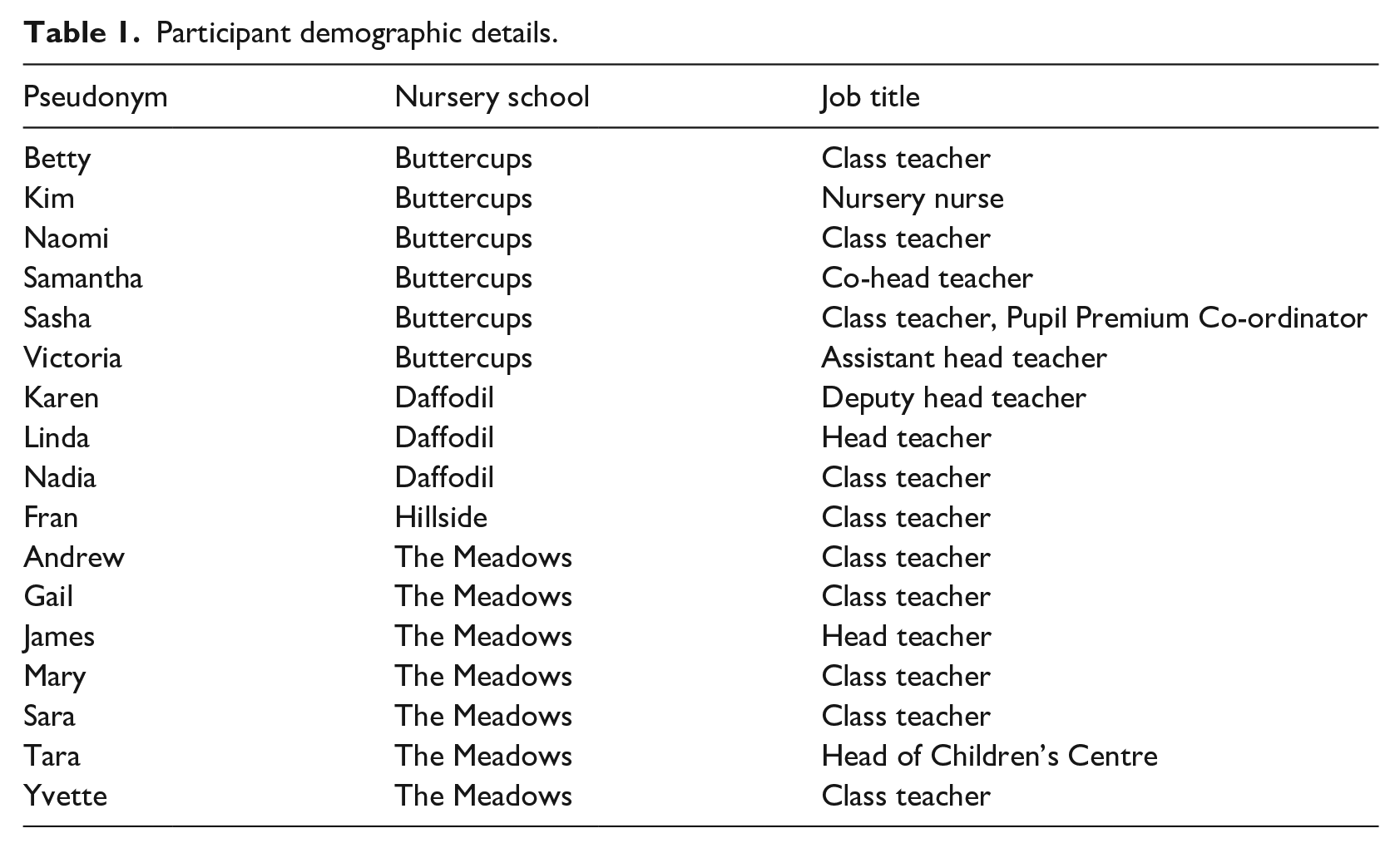
The sample demographics are captured in Table 1 below:
Participant demographic details.
Theoretical framework
To theorise the data we have drawn on a multidimensional conceptualisation of social justice that combines distributional, relational and associational elements together. Distributional social justice refers to ‘the principles by which goods are distributed in society’ (Gewirtz, 1998: 470). Relational social justice is context specific and includes concepts such as ‘respect and dignity’, which ‘cannot be viewed unproblematically as goods to be distributed’ (Gewirtz, 1998: 472). Associational social justice advocates equality between cultures and peoples. It seems that the remedy to cultural injustice is to affirm cultural difference; those historically excluded on the basis of their ethnicity and/or social class (and the associated culture), could be affirmed, rather than repressed (Young, 1990). To draw these stands together in a multidimensional approach means when ‘evaluating social justice according to whether persons have opportunities’ we must, according to Young (1990) evaluate ‘not a distributive outcome but the social structures that enable or constrain the individuals in relevant situations’ (p. 26). However, as Gewirtz (2006) notes ‘what counts as justice is level – and context – dependent’ (p. 70). The educational context significantly influences what constitutes enactment of social justice. As Young (1990) points out ‘education is primarily a process taking place in a complex context of social relations’ and the material and cultural context within which education takes place is varied, this difference needs to be taken into account (p. 26). Gewirtz (2006) argues that ‘any meaningful discussion of what counts as justice needs to engage with concrete, practical dilemmas and not merely abstract conceptualisations (p. 70).’ Following Gewirtz and Young, in this paper we draw on the concept to understand if and how the social, educational and material support provided by Nursery Schools constitutes multi-dimensional social justice.
Supporting socio-economic disadvantage
A key aim of this project was to understand if and how Nursery Schools support children and families experiencing socio-economic disadvantage. Across the four Nursery Schools all staff reported that they work in myriad different ways with children and families to support and reduce some of the impacts of socio-economic disadvantage. Betty explained that: For our children that come in from a disadvantaged background, [. . .] what they get here at this age, gives them the chance to feel equal, to not have that stigma attached to them, to . . . you know our children here wouldn’t know that they’re pupil premium
4
. . . we don’t do school meals but . . . two of my children are pupil premium and have got extra funding for extra lunch club, but no one knows that because they’re of the age where they just come to lunch club with everybody else. And it gives them that extra time that they might not get at home to have time with an adult here who can help them to grow and to find a love of learning which they might not get at home (Betty, Buttercups).
Betty highlighted the important role she and her colleagues play in reducing the stigma attached to pupil premium children, an issue that is well documented (Rock, 2012). As children get older, they are increasingly reluctant to reveal they are in receipt of this funding (Rock, 2012). By encouraging equality amongst nursery age children to enable their full participation, in both the material sense of providing food and the educational and social sense of supporting their learning and eating habits, the Nursery School can arguably be seen as providing a multi-dimensional social justice response to socio-economic disadvantage (Gewirtz, 2006).
The theme of helping and supporting groups of disadvantaged children was echoed as important by Andrew, who explained that: Well the main role of that is to provide that quality early education for the children and to give these children the best possible chance of achieving more throughout their schooling and throughout their lives. [. . .] I think without it, there’s a chance that children will be so far behind by the time they start school . . . that’s a really important part of what we do . . . because we’re in an area of such deprivation, there’s not a lot of information out there for some of our parents. A lot of them, because of the demographic, they tend to be quite isolated as well or they kind of stay with people that they know but not necessarily have access to wider information about health, nutrition . . . activities to do with their children (Andrew, The Meadows).
Andrew’s comments highlight that whilst the primary role of his Nursery School is to provide a quality education to young children a further important role is to provide information about health, nutrition and activities that parents can do with their children, both in the home and the local area. Andrew talked about how the demographic in the local area, which was predominately minority ethnic, meant that many parents did not have the knowledge of England’s education and welfare system, nor the language to engage with these systems. State Nursery Schools such as The Meadows are filling knowledge gaps in relation to the welfare provision available for disadvantaged families.
Betty explained her view on the consequences of losing Nursery Schools for the most socio- economically disadvantaged and vulnerable children: If there aren’t state funded Nursery Schools, those children will not go anywhere because their parents can’t afford for them to go to day nurseries or private nurseries or pre-school, and even if they get their funded hours, quite often they have to pay a top-up and . . . they just won’t take them, and then they’ll start school a year behind, or without having any exposure to . . . and then that will put the pressure on reception classes
5
, which are already under pressure to be more like year 1 [. . .]. So, they get stressed at four and five that they’re not doing what everybody else is doing. And then if they haven’t got the home life to support them, then that’s it, they’re always behind. So, they need to keep us (Betty, Buttercups).
Betty acknowledged the role of Nursery Schools in providing some of the social and educational interactions and understanding demanded by the school readiness agenda that dominates priorities in early years settings in England (Hoskins and Smedley, 2018). We note that the staff seem to engage with a discourse apparent in policy which assumes the home lives of children from poorer backgrounds are less engaging and stimulating, which is of course questionable, but common within current education discussion.
Similarly, Tara noted the significant educational role that Buttercups Nursery School plays for disadvantaged children by giving them an opportunity to engage with a range of educational and social experiences: I think that the opportunities the children get at Nursery School sort of exceeds possibly what they’d get in another provision. The, not so much the experiences and the opportunities we provide, we’re fortunate to have . . . we’re rich in resources and rich in expertise, so our staff really understand child development, they know those building blocks and where those next steps are for those children. In terms of supporting the parents as well in that team around the child, so as a maintained Nursery School we access other resources to the local authorities, so we buy in to the educational psychology service. (Samantha, Buttercups).
At The Meadows Mary also noted the important role the Nursery Schools play in the lives of socio-economically disadvantaged children: To really make sure that the children aren’t disadvantaged and left behind, you know, that we’re doing everything that we can to support families really, it’s supporting the families that is the thing, not just the children but the work that we do integrated with the Children’s Centre staff. So, making sure . . . we call it the bottom 20%, it’s the children that are most disadvantaged, those are the children . . . and the families that we’re putting most work into (Mary, The Meadows).
Reflecting on the level of socio-economic disadvantaged families in London, James pointed out that: Yeah, and you have to kind of . . . we have quite a lot of links with Danish municipalities and pedagogues [. . .] and the Danes are always astonished by the idea that London is such a wealthy city, and yet it has so many children living in poverty. And they can’t work out how we’ve sort of achieved it [. . .] you know it feels like a perverse achievement to them, how do you manage to be so wealthy and yet have so many poor children?! (James, The Meadows).
The recent rise in inequality in England is well documented (Dorling, 2018; Wilkinson and Pickett, 2010) and is felt most keenly across the most vulnerable groups despite the overall wealth of the UK as a whole. Our participants all identified the role of the Nursery School in reducing some of the effects and impacts of socio-economic inequality and emphasised the material, social and economic support they provide. Thus, our data suggest Nursery Schools do play a social justice role in the lives of some children and their families by providing social structures that are enabling.
Supporting SEN children and their families
In the past two decades, provision for SEN children has increasingly moved into the mainstream due to the closure of specialist units that were established to meet the complex array of needs that exist under the SEN umbrella (Black, 2019; Pirrie et al., 2006). Our data similarly indicate that in our participants’ experiences, the move to include young children with SEN in mainstream education has resulted in Nursery Schools taking on disproportionate amounts of these children. We asked our participants to describe the children they supported and how local referrals operated. Staff in all four settings told us that they had substantially increased their support to children with SEN. Samantha told us that: We have a high proportion of (special educational needs and disability) SEND within our organisation because we tend to be signposted from other professionals, so the consultant paediatrician would recommend that their child comes here to the parents, and then you do get a reputation locally, and absolutely we’re a maintained Nursery School, so we believe passionately that’s what we’re here for (Samantha, Buttercups). One of our heads is the SEND early years lead for the borough, so we have a lot of input with our SEND, we’ve got our own assistant SENCO
6
, so we do things, lots of interventions, and then we can signpost parents to educational professionals or to what groups are running, and we know the Children’s Centre run some groups specifically for childminders . . . and parents who we might feel need a parenting course, we’ve got Family Friends on site, so there’s lots of things that we can call on here (Betty, Buttercups).
The local reputation of Buttercups Nursery School amongst professionals from childminders to paediatricians has resulted in them being signposted as the best quality local SEN provider to families of children with additional needs. This informal, and at times formal, referral system has resulted in a steady increase in the numbers of children with SEN on roll in Buttercups over the past decade and this in turn has broadened out the role of the Nursery School as staff training has needed to keep pace with demand. These hidden demographic demands in the Nursery School system are not captured and taken into account in government funding formulas creating financial and resourcing strain on these settings (Powell, 2019).
Similarly, staff at The Meadows and Daffodil Nursery Schools reported that they have also increased and prioritised the places they ring-fence for children with SEN to meet growing demand in their local, socio-economically deprived communities: We’ve got just over 200 children on roll, aged two, three and four, most of them attend part-time, so they attend for their fifteen hours, either five mornings a week or five afternoons a week, and then we have eight full-time places which we prioritise for kids with SEND who are eligible for a thirty-hour place. We know from the Children’s Centre that that’s the group of families where even if they’re eligible for a thirty-hour place, they don’t find it easy to access it because other nurseries and childminders may well say that they don’t have the ability to meet their child’s needs for the full thirty hours, so that’s who we’ve prioritised (James, The Meadows). Because we have kind of a personalised curriculum, we are able to reach all of the children. You know we have got a SENCO, so any children with additional needs, we are straight on to that, we’re observing the children, we’re working with the parents of those children. At the moment, you know we, as I say we’re supporting speech and language therapy through a course run by the borough. So, we’ve got members of staff on that so we want to be able to help everyone (Linda, Daffodil).
These comments highlight the important role that Nursery Schools take in supporting young children with SEN. The current context of austerity in England has resulted in provision for SEN children increasingly moving into mainstream schooling (Black, 2019), and this has contributed to funding challenges in the early years, but particularly for state Nursery Schools (Powell, 2019).
Discussion: A frontline service?
In this paper we argue that Nursery Schools have become a frontline service for many deprived and marginalised families, due to the shrinking welfare state and associated loss of policies that protect socio-economically disadvantaged families and minority ethnic immigrant families. Children from working class backgrounds still suffer disadvantages compared to their more affluent peers, even from birth. Forty-three per cent of pupils eligible for free school meals (FSM) at age five did not achieve a Good Level of Development in 2018 (the benchmark grade in the Early Years Foundation Stage Profile assessment), compared to only 26% of non-FSM eligible pupils.
Several of our participants commented on the wide range of support they provide. Kim explained that in her view, the role of the Nursery School has substantially increased in recent years: I think we’re their first port of call for everything, because unless a doctor, if they don’t see the health visitor, as I said, you know a GP, I don’t know, would they go to a GP to say about, ooh I don’t . . . I’m not sure how to do toilet training (Kim, Buttercups). There is lots of different things that we do actually. For the families that come here . . . so we’re making sure that they have got access to all the things that they deserve, in terms of money, you know, benefits, health, you know all of those sorts of things, employment support. And then for the children, really getting them integrated into the school, and feeling like part of the community that there are people here that will help them, that they’re not on their own, that they’ve arrived. And they don’t really understand you know how things work for them, we make sure that they feel that they’re somewhere safe, that they can come and talk to us and you know we will support them as best we can. [. . .] It’s not just about literacy and numeracy, you know it’s much, much more than that, because you know these children are so young, there are lots of things that they often need support with, you know, their physical development, their toileting, their feeding, their sleeping, you know, so there’s lots of things that we help them with, and that really makes a big difference. It makes a big difference to the children but then to the families, [. . .] we’re supporting them to get things, to make things better, to make their lives better (Mary, The Meadows). This is the first thing they see as a school, like children, so I feel like this is the most important part, this is where parents get to build those, those really important relationships and you know if they have a bad experience here, as in when we meet the parents and we don’t . . . if it doesn’t go well, then their idea of education is not going to be that great. So, I feel like we’re the sort of first sort of stage and it’s important that we give that good impression (Nadia, Daffodil).
Our data shows the role of the Nursery School has changed significantly over the past 5 years as families struggle to cope with changes in welfare, notably the move under the Conservative and Liberal Democrat Coalition government to Universal Credit 7 , as this leaves families unable to cover their expenses whilst they wait up to 6 weeks for their claim to be processed (Thompson et al., 2019). Through meeting the social, emotional, educational and some of the associated material needs of families, Nursery Schools are fulling a multi-dimensional social justice function that is arguably of lasting benefit to the children and their families.
Conclusion
To conclude, we argue that Nursery Schools have a key role to play to enable all children to have a chance to be school ready when they enter Reception. Our data suggest that the role of the Nursery School in supporting all children, but particularly those from socio-economically disadvantaged families, has expanded in the past decade as a direct consequence of austerity policies. We contend that it is inexcusable that the most vulnerable children in British society are most at risk at being disadvantaged by a hostile policy landscape and political rhetoric that perpetuates a deficit discourse about the lives of children from poorer families. We recognise the multidimensional social justice responses made possible through Nursery Schools; the children have opportunities to participate in a broad and balanced early education and receive the associated care they need to flourish. The Nursery Schools in our sample also create the associated conditions of enablement required to allow the children and their families the chance to engage with these opportunities through providing the material and emotional resources needed to thrive. In sum, the current funding uncertainly facing Nursery Schools in England is counterproductive and socially unjust for a ‘frontline service’ that can fundamentally reduce the effects of disadvantage, particularly for children living in poverty and those with SEN.
Footnotes
Acknowledgements
Thank you to Brunel University London for funding this project and to the practitioners for their time and involvement in the project.
Declaration of conflicting interests
The author(s) declared no potential conflicts of interest with respect to the research, authorship and/or publication of this article.
Funding
The author(s) received no financial support for the research, authorship and/or publication of this article.
