




Abstract
‘Well-being’ is increasingly used in child rights discourses and early childhood education (ECE) policy contexts as a desirable outcome for young children. In spite of its ubiquitous use, however, child well-being remains largely under-theorised, thereby contributing to implicit understandings within policy arenas. This paper contributes to attempts to address this gap by proposing a theoretical framework of child well-being.
The framework is developed in stages. First, two prominent approaches to well-being are described: distributive and relational approaches. Distributive approaches are subdivided into primary goods theory and capability theory. These theories focus on differential approaches to resource distribution. Relational approaches to well-being are then considered. These focus on the intrinsic importance of the processes of well-being. Second, the concepts privileged by each of these well-being theories are further developed into a framework by reflecting on children’s rights to provision, protection and participation as promoted by the United Nations Convention on the Rights of the Child. Following this, the framework is used to analyse ECE policy with a specific focus on the Early Years Foundation Stage (EYFS) curriculum and measurement requirements. Academic literatures examining ECE policy is then reviewed to extrapolate understandings of the potential implications of this policy for young children’s well-being.
The findings suggest that the EYFS theorises well-being in ways that are limited and may be limiting of young children’s well beings and doings. The associated measurement practices and curriculum goals, in particular, may undermine practice supportive of young children’s well-being.
Keywords
Introduction
Theorising well-being has a long history. It was Aristotle who was among the first to map some of its key constituents (McLellan and Steward, 2015). It is perhaps ironic then, that interest in well-being is said to be relatively new (Feeney and Collins, 2015; McLellan and Steward, 2015). What also appears to be a relatively new concern, is the growing interest in theorising child well-being as distinct from human well-being.
To understand what is distinctive about child well-being, it is suggested that one needs to understand how, in what ways and for what purposes children themselves are conceptualised. Conceptualisations of childhood also have a long history (Raghavan and Alexandrova, 2015). However, it is also suggested that well-being theories, developed predominantly with adults in mind, cannot be extended uncritically to children (McLellan and Steward, 2015: 312). In other words, child well-being cannot be understood without first exploring how childhood(s) is/are understood. This is necessary because childhood is both socially constructed (Camfield et al., 2009: 76) and a structural concept (Archard, 2014: 13; Burman, 2019).
Academics contributing to and influenced by the ‘new sociology of childhood’, have supported temporally nuanced conceptualisations of young children as ‘beings’, ‘becomings’ and ‘having beens’ (Kingdon, 2018). However, policy relating to young children in general, and ECE policy literatures in England, in particular, continue to draw from and perpetuate prevailing social constructions of young children as ‘becoming’ future adults only (Creasy and Corby, 2019). This predominant construction of young children in ECE policy may provide a rationale for their conceptualisation as vulnerable only and with ‘intrinsically inferior’ agency in comparison to that of adults (Macleod, 2015: 59). As such, the skills and competences considered to be required in adulthood may be privileged above children’s current interests and their own knowledge about their needs (McLellan and Steward, 2015: 312).
Similar to theories of human well-being, conceptual reviews of child well-being tend to focus on identifying the term’s multiple dimensions (see e.g. Amerijckx and Humblet, 2014; Statham and Chase, 2010). Few of these reviews offer underpinning theories of these dimensions. Statham and Chase (2010) present a review of the term’s components with regard to children, and make recommendations to those interested in supporting children’s well-being. These include, for example, supporting children’s well-being in the here-and-now, focusing on their strengths, taking account of their contexts as well as their socio-cultural characteristics. Yet, it could be argued, these recommendations are relevant to adult or human well-being too.
Proposing a theoretical framework of young children’s well-being addresses concerns that the concept is under-theorised (Amerijckx and Humblet, 2014), or attempts to propose a ‘unified theory’ of child well-being (Raghavan and Alexandrova, 2015: 899) or even that there may be no need to theorise it at all, as well-being theories were developed without children in mind (Lewis, 2019). This paper, therefore, attempts to contribute to existing debates by proposing a framework of child well-being that may be used to surface implicit theories within ECE policy in England. This is important for two reasons. First, there appears to be a lack of agreement across disciplines about what well-being means in educational contexts (Soutter et al., 2012: 112). Second, because there appears in ECE policy contexts, to be a strong link between ECE and future well-being, in terms of social and economic mobility. As such, policy narratives focus on ‘outcomes’ in an attempt to set up continuing educational achievement and attainment and thus apparently, future social inclusion and prosperity. In this evolving early years policy context there is also a sense in which such outcomes are now becoming conflated with other more general notions of well-being so that to thrive and experience well-being is predicated on achieving stage specific educational outcomes in early years contexts and beyond, and to be ‘school ready’. Children’s ‘best possible outcomes’ (Department for Education [DfE], 2017: 10) is a term often conflated with ‘well-being’ (ibid.).
The proposed framework of child well-being, and its application as an analytical tool, is developed in the following stages:
A summary introduction to two prominent theoretical approaches to well-being is presented: distributive and relational approaches. These approaches are well documented in academic literatures (Lippert-Rasmussen, 2018; Prilleltensky, 2012), but are usually applied only to considerations of adults’ well-being. Distributive approaches are subdivided into two theories: Primary Goods Theory (PGT) and Capability Theory (CT). These theories focus on differential approaches to resource distribution, and are predominantly influenced by economic considerations (McLellan and Steward, 2015: 308). Relational approaches to well-being (RWB) are then described. These focus on the intrinsic importance of the processes of well-being, and are predominantly influenced by sociological concerns.
The concepts privileged by each of these theories are considered in relation to the prevailing social constructions of young children extant in the legislative framework of the United Nations Convention on the Rights of the Child (UNICEF, 1989).
Given the importance attributed to measurement of children’s educational outcomes within ECE in England, the epistemological influences of these differential well-being theories are considered against their approaches to the assessment of young children’s well-being.
The key concepts emanating from each of the well-being theories, are presented as a child well-being framework, and depicted in a summary table.
This framework is deployed to show how the well-being theories and their intersections with prevailing social constructions of young children, are reflected in the Early Years Foundation Stage in England.
Following this, academic literatures relating to ECE policy are reviewed to extrapolate from them the potential implications for young children’s well-being.
Well-being theories
In this section a summary introduction to two prominent theoretical approaches to well-being is presented: distributive and relational approaches. The two distributive approaches are subdivided into two theories: Primary Goods Theory (PGT) and Capability Theory (CT)
Distributive approaches: Primary goods theory and capability theory
Primary goods theory
Put simply, PGT as presented in ‘A Theory of Justice’ (Rawls, 1971), holds that the provision and equal distribution of primary goods is the means to a good life and forms the basis and first principle of justice. These primary goods are subdivided into two categories: natural primary goods including intelligence, imagination and health; and social primary goods including rights, income and wealth, and the social bases of self-respect. PGT therefore invites comparison of individuals’ holdings of resources as a measure of their well-being. In addition, and crucially, Rawls’ second principle of justice – ‘the difference principle’ – mandates for the arrangement and distribution of public goods (such as education and health provision, e.g.) as means to the end of supporting individuals to acquire the primary goods outlined in his first principle. The ‘difference principle’ asserts that any inequalities in the distribution of primary goods are permissible only if they benefit the least well off in society (Rawls, 1971: 75). It is suggested therefore that the concepts foregrounded by this theory are that
Capability theory
Capability theorists argue that an equal distribution of primary goods, even if possible to achieve, cannot account for different people’s opportunities to convert these into valued ‘functionings’. Sen describes CT as, . . . the various combinations of functionings (beings and doings) that the person can achieve. Capability is, thus, a set of vectors of functionings, reflecting the person’s freedom to lead one type of life or another. Just as the so-called ‘budget-set’ in the commodity space represents a person’s freedom to buy commodity bundles, the ‘capability set’ in the functioning space reflects the person’s freedom to choose from possible livings. (Sen, 1995: 40)
Because CT focuses on the ‘extent to which people have the opportunity to achieve outcomes that they value and have reason to value’ (Sen, 1999: 291) it has been described as a more nuanced approach to human well-being (Macleod, 2010: 183). It is argued that its application supports people to self-define their well-being and that the act of participation is, in itself, a means of achieving well-being (Sen, 2010: 250). Crucially too, the challenges of supporting participation are acknowledged, not least because conceptualisations of well-being may be culturally and socially influenced. In other words, personal aspirations may be affected by ‘adaptive preferences’ whereby, Through making allies out of the deprived and the exploited the underdog learns to bear the burden so well that he or she learns to overlook the burden itself. Discontent is replaced by acceptance, hopeless rebellion by conformist quiet, and. . .suffering and anger by cheerful endurance. (Sen, 1984: 309)
That said, Robeyns (2017: 140), for example, questions the assumption of an idealised state against which preferences are considered to become ‘adapted’ and who determines these. By so doing, she cautions against over-simplifying interpretations of adaptive preferences.
Sen contends that if provided with opportunities to participate in discussions about their well-being, people usually cite valued ‘ends’ rather than just the ‘means’ by which to achieve them (Sen, 1999). In this way it may be said that CT privileges the distribution of differential amounts of ‘havings’ so that individuals may attain the same ‘functionings’ as others, if indeed these ‘functionings’ are valued. It is suggested therefore that the concepts foregrounded by CT are that
Relational approaches to well-being
Unlike distributive approaches’ focus on ‘havings’, proponents of RWB view ‘havings’ as being only instrumental to what is intrinsically important to people: relationships. As such, it is argued that well-being is not the property or ‘havings’ of individuals. Instead, it is something that belongs to and emerges through relationships with others. Well-being is ‘emergent through the interplay of personal, societal, and environmental processes’ (White, 2015: 5): it is a ‘happening’; it ‘inheres in the dance; it is not the property of individual dancers’. (White, 2015: 11).
It is a concern about the potentially damaging impact on well-beings of individualising people that has prompted a consideration of the primacy of relationships to well-being. It is proposed, for example, that relational well-being is ‘grounded within the interpretivist tradition’ (White, 2015: 2) and is ‘interested in the experience of wellbeing, in how people are doing when they say they are doing well’ (White, 2015: 4) rather than what it is (White, 2015: 1). Crucially, RWB is presented as ‘social or collective, going beyond the individual’ (White, 2015: 2) and that well-being comes from ‘between’ (ibid). This theory could be said to speak to a ‘mutuality of being’ (Sahlins, 2013: 19). In this sense, RWB is much more than a ‘needs based’ approach to well-being, which includes individuals’ need for relationships (Raghavan and Alexandrova, 2015: 893) and speaks to an approach that privileges an inextricable interdependency of all beings.
It is suggested therefore that the concepts foregrounded by RWB are that people are
Well-being theories and how they relate to prevailing social constructions of young children
In this section, some issues relating to children’s well-being are viewed through the lenses of distributive and relational approaches, and how they intersect with current social constructions of young children. The initial focus centres on children’s rights, which have been much promoted in recent decades. Of particular interest are the provision of rights and protection of young children and their participation in discussions about their own well-being. These foci have been chosen to illustrate how different theoretical perspectives of well-being influence and are influenced by social constructions of young children. Emanating from these issues is a consideration of the theories’ approaches to how young children’s well-being is and might be assessed or measured, another current and prevailing preoccupation in policy contexts (Raghavan and Alexandrova, 2015: 891)
The provision of rights, and protection of young children
It might be reasonable to suppose, at least provisionally, that most children across the world now have access to a universal set of rights – one of the key social primary goods requisite within Rawls’ theory of justice. Children’s rights have gained supranational attention in recent decades largely resulting from the introduction of the United Nations Convention on the Rights of the Child (UNICEF, 1989). This convention comprises a list of 54 ‘articles’ setting out what governments must do to safeguard children’s provision, protection and participation.
However, in spite of its almost pan-governmental ratification, shortcomings and contradictions are apparent within this Rights Charter, which, it is suggested, speak to the well-being theories previously outlined. Proponents of CT, draw attention to the irony that children did not have the opportunity to participate in the formation of these rights (Ballet et al., 2011: 39). It could be argued, perhaps, that had children been involved in the formation of ‘their’ Rights Charter, ‘play’ and ‘learning’ might not have been disaggregated into two separate ‘articles’ (28 and 29 respectively).
Still others, speaking from a relational perspective, signal the unhelpfulness of establishing rights hierarchies which, they argue, can lead to relegating others’ rights, and particularly those of women. It is argued that rights hierarchies contradict general human rights ideals and, ironically, may adversely affect children because women are often their primary carers and their interests said to be interdependent (Burman, 2008). So, for example, ‘evidence’ is presented that ‘breast is best’ for both mothers and child(ren), and this may well be so from a biological perspective, but the practical difficulties and potential psychological impacts of ‘failure’ to breastfeed, may militate against mothers’ sense of well-being and hence, potentially that of her children (Símonardóttir and Gislason, 2018).
Children’s participation
In spite of the almost universal ratification and provision of children’s rights (which it is argued, is in keeping with PGT), children’s participation in decisions that affect them (a key tenet of CT) is said to be the ‘most limited and least developed in practice’ (Munoz, 2010: 43). It is proposed here that the paucity of opportunities for young children to participate in decisions that affect them, is influenced by (and in turn, contributes to) deficit social constructions of them. ‘Their’ Rights Charter, for example, only gives ‘due weight’ to the views of children ‘in accordance with the age and maturity of the child’ (Article 12). This statement is commonly interpreted as precluding young children from participation as they are generally considered incapable of expressing (i.e. verbalising) reasoned (i.e. cognitive) views. Another consequence of the deficit social construction of young children is that their views about their own well-being are very rarely, if ever, sought. The Good Childhood Reports (The Children’s Society, 2020), for example, outlining children’s subjective well-being are conducted with children aged 8 to 17 years only, even though there may be good reason to think some of the issues leading to some children’s self-reported unhappiness may start at younger ages. It might be supposed, at least again provisionally, that CT might speak to the participation of young children in discussions about their own well-being. However, and crucially, it is generally held, not least by Sen himself, that young children are incapable of participating in such discussions because they cannot reason (Sen, 2003). It is proposed therefore that CT also draws from and influences deficit social constructions of young children.
Young children’s individuality and/or mutuality
It has been argued that distributive approaches and relational approaches to well-being differ most fundamentally in their view of the human subject (White, 2015: 5). CT, for example, is generally understood as being primarily focused on individuals (Underwood et al., 2012: 296; White, 2015: 5) while RWB focuses principally on the social and collective - the mutuality of being (Sahlins, 2013; White, 2015). Proponents of RWB argue that the promotion of individualism is problematic. They maintain that insisting on people’s multiple diversities (i.e. their unique beings and doings) obfuscates the commonalities and shared values that might otherwise connect them, thereby at least in part, achieving well-being through a sense of belonging (White, 2015: 6).
Some of these criticisms have been contested by proponents of CT. Robeyns, for example, has insisted that CT only focuses on individuals as a
That well-being may be principally about ‘belonging’ and what happens ‘in between’ might be said to provide the conceptual space to consider children as social actors: contributing to, losing out and/or gaining from social interaction. It is proposed therefore that RWB intersects with proponents of the ‘new sociology of childhood’, which promotes a re-conceptualisation of young children as
In addition, given the focus on ‘belonging’, RWB surfaces questions about the potential for people to attain well-being unless everyone else does so too; and this in a world of limited resources. Furthermore, viewing well-being as principally about ‘belonging’ raises an important question about what children may belong to. Young children may well be ‘social actors’ but, as has been previously suggested, are still not provided with sufficient opportunities to act socially given prevailing deficit discourses, nor to do so equally. For example, children are disproportionately affected by poverty and are constrained as a result of this (Brown, 2015).
Having examined these different theories, as they are understood and applied to young children, I briefly review the implications for measuring young children’s well-being to highlight the epistemological differences between them.
Assessing young children’s well-being
Growing interest from policy makers about child well-being has contributed to a concern about measuring it, and a proliferation of its possible indicators (Raghavan and Alexandrova, 2015: 891). It is suggested that PGT, CT and RWB foreground distinct approaches to the conceptualisation and application of measurement approaches. Proponents of PGT, for example, foreground the equal provision of primary goods as its metric of social justice. By so doing, it focuses on a conceptualisation of children as ‘
In contrast, proponents of CT have convincingly argued that, ‘equality in one space tends to go, in fact, with inequality in another’ (Sen, 1995: 20) and that, If human diversity is so powerful that it makes it impossible to equalise what is potentially achievable, then there is a basic ambiguity in assessing achievement, and in judging equality of achievement or of the freedom to achieve. If the maximal achievement that person 1 can have – under the most favourable circumstances - is, say, x, while person 2 can maximally manage 2x, then equality of attainment would leave person 2 invariably below his or her potential achievement. (Sen, 1995: 91)
Equally, it could be argued that Person One, under this metric, might be considered to have failed to achieve. In this passage therefore, Sen invites us to acknowledge the impossibility for
Of principal concern, perhaps, is arriving at the ‘focal variables’ that would provide some evidence that all unique, multiply diverse children were achieving their valued ‘functionings’ that might also prepare them for their futures. In other words, one of the challenges that CT presents is capturing the complexity of human well-being without imposing huge information burdens on front-line practitioners. That said, proponents of RWB have questioned what they consider to be, a predilection for vast amounts of quantitative indicators. These indicators are said to be often assigned to ‘an elephants’ graveyard. . .[and] are never used or referred to’. (White, 2015: 15) and their generation, often motivated by a quick fix mentality (Underwood et al., 2012: 296).
While RWB may highlight shortcomings in distributive approaches to the measurement of (child) well-being, its own approach is no less complex and problematic. As previously mentioned, RWB focuses on the processes of well-being that is, how well-being is experienced rather than what it is, and may therefore be seen to render well-being less tangible. In addition, and in spite of her criticism of CT in particular as individuating, White states that RWB seeks to understand someone on their own terms rather than rank them against others (White, 2015: 5). However, viewing children on their own terms may obscure the injustices that may be meted upon them. Indices that allow for comparison between children (and are therefore more akin with PGT), may at least allow such injustices to be surfaced.
A Theoretical framework of child well-being
Key concepts from theories of well-being in relation to children
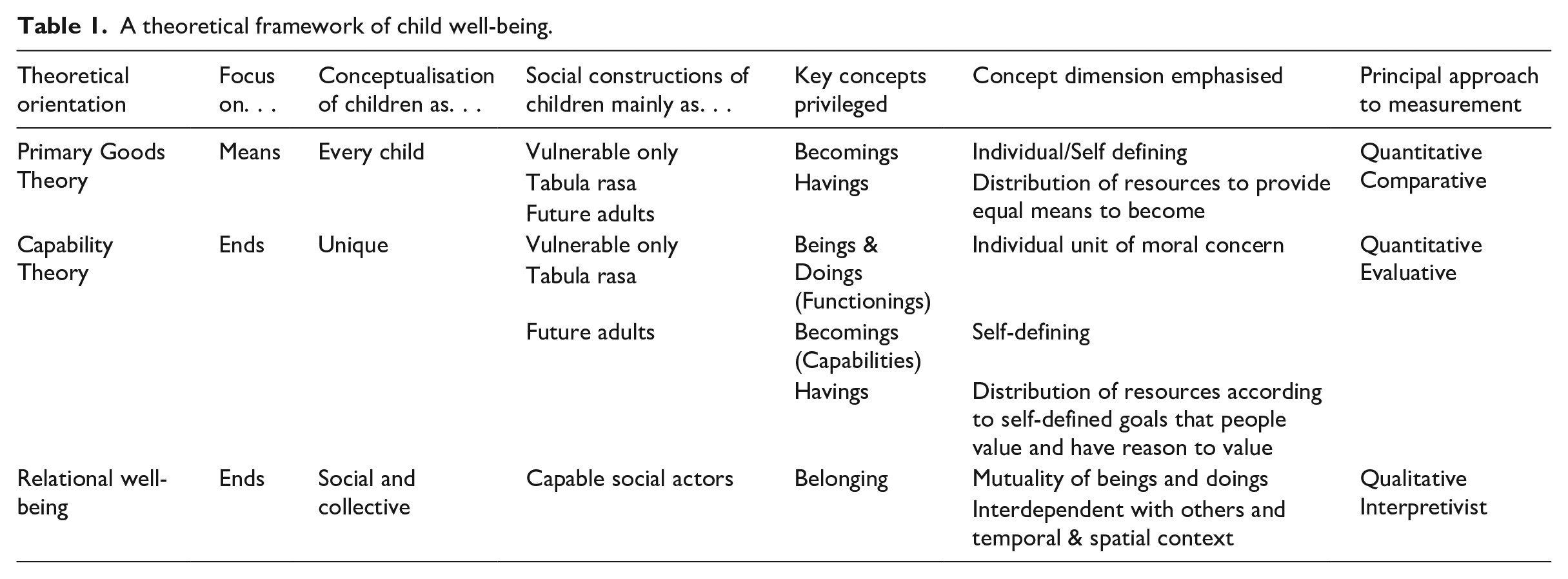
In sum, it is argued that prevailing deficit social constructions of young children as vulnerable only, tabula rasa, adults-in-formation inform and perpetuate attitudes to their provision, protection and participation. The central concerns of distributive approaches (i.e. PGT and CT) to child well-being focus on their differential propositions regarding the role and distribution of resources (‘havings’) to support individual young children’s ‘beings’, ‘doings’ and ‘becomings’. In contrast, RWB focuses on well-being as an embedded process between people, and privileges the concept of ‘belonging’. It differs from the distributive approaches in two main ways. First it supports a re-conceptualisation of young children as potentially capable social actors and therefore away from deficit discourses. Second, it promotes ‘mutuality of being’ above individual being.
The theoretical framework below (see Table 1) outlines the concepts privileged by each of the theoretical approaches. Such a device inevitably obscures nuance as it records the differences between the theories as binaries rather than highlighting areas of overlap. So for example, RWB also accommodates ‘personal’ experiences of well-being (White, 2015: 12), and includes the importance of ‘materiality’ (White, 2015: 2) to well-being thereby implicitly shadowing distributive approaches’ much stronger focus on individuals and resources. Similarly, proponents of CT emphasise that well-being is ‘interdependent’ (Sen, 1995: 57) suggesting some sense of relatedness between people. That said, the concepts listed in the table are those that are privileged by each of the theories and provide a convenient tool to capture some of their distinctions.
A theoretical framework of child well-being.
How well-being theories are reflected in ECE policy in England
The EYFS is the current curriculum and assessment framework for children under the age of 5 years in England. Its statutory framework (DfE, 2017), assessment requirements (Standards and Testing Agency, 2018), supporting documentation (Early Education, 2012) and academic literatures responding to this policy context in England, are now considered with and against the proposed theoretical framework of child well-being. By so doing, the impact this policy is said to have on young children’s well-being is extrapolated.
The EYFS curriculum and assessment arrangements
It is emphasised in the statutory framework for the EYFS that ‘every child is a
It is proposed therefore that the EYFS is congruent with CT in its emphasis on each individual child as unique, and acknowledging that they develop at different rates. In addition, it might also be argued that the EYFS incorporates elements of RWB. It draws on a conceptualisation of children as being ‘capable’ and includes a focus on ‘personal, social and emotional development’ as one of its three ‘prime areas’ of learning. That said, it appears that this approach, while being nominally about a focus on relationships, does so in the service of and by privileging individual efficacy.
The developmental self of resilience may be relational, embedded in affective and effective relationships, but this self is not for that matter a social being. Relationships are meaningful within resilience science to the extent that they are capable of reducing later vulnerability in the individual. They are investments in agency in the context of a life course, agency that is manifested in an individual’s healthy choices and, when his or her life enters into relationship ‘ecologies’ with others, in affective interactions that promote individual competencies. (Henderson and Denny, 2015: 360)
In this sense, it could be argued that the EYFS foregrounds ‘personal, social and emotional development’ as an individual skill. In other words, the development of relational skills are set within the context of other skills which are to be acquired for the advancement of individuals that is, as emotional intelligence or capital, and the property of an individual (and therefore more congruent with distributive approaches).
There are two summative assessments of children’s progress against the EYFS’ ‘Early Learning Goals’ (ELGs). The first is of children aged 2 years and the second, when they are 4 or 5 years old, towards the end of their ‘reception’ year. The latter assessment forms part of a child’s EYFS Profile (EYFSP) and is published nationally at school level. Children who have reached ‘expected levels of development’ (DfE, 2017: 14) in the three prime and two specific areas of ‘literacy’ and ‘mathematics’ at the end of their reception year are considered to have reached a ‘good level of development’ (Standards and Testing Agency, 2018: 59). The ELGs within each of the seven areas of learning are supported by early years educators’ promotion of three ‘characteristics of effective learning’: ‘playing and exploring’, ‘active learning’ and ‘creating and thinking critically’ (DfE, 2017: 10). The ‘characteristics’ may thus be said to describe how rather than what young children learn and, it is proposed, speak more to RWB. These ‘characteristics’ are ‘measured’ by a short commentary prepared by each child’s ‘key person’ and passed onto their Year One teacher: again, suggestive of RWB’s preference for interpretive assessment. This commentary, however, does not form part of a child’s EYFSP.
The expectation for children to attain a ‘good level of development’ (GLD) at the end of their reception year, speaks to PGT as it supports notions of equivalency in the procedural distribution of educational ‘goods’. These ‘goods’ are demonstrated by the EYFSPs, which are said to potentiate for young children a collection of qualifications and credentials, which eventually have (in theory, equivalent) use and exchange value. In other words, it may be said that one of the purposes of education is to provide children with the means by which to acquire what is considered to be, the necessary human, social and cultural capitals with which they may then acquire financial capital and ultimately, well-being. Similarly, ECE enjoins early years educators to ensure children are ‘ready for school’ (DfE, 2017: 7) and have received a specific skill-set (i.e. their ‘goods’) deemed necessary for them to begin their schooling from the same starting point. According to policy narratives, the EYFS seeks to provide ‘
In sum, the expectation for all young children to attain a ‘GLD’ at the end of their reception year, suggests that assessment procedures treat them as ‘every child’. This is in contrast to the ‘unique child’ privileged by the EYFS curriculum and its non-statutory guidance (Early Education, 2012) with its emphasis on children being able to develop at their own rates, and in their own ways. This highlights a central paradox and, in the light of the theoretical framework of child well-being, suggests that the EYFS undermines itself in expecting young children to be concurrently ‘unique’ and ‘every child’.
Possible implications for young children’s well-being
In this section, having established that each of the well-being theories is visible within the EYFS, albeit differentially so (with CT and especially RWB being backgrounded), the academic literatures are reviewed to consider views about the implications on young children’s well-being of privileging PGT’s measurement approach, apparently in the service of equality.
In spite of support for investment in ECE, and claims that the EYFS is doing ‘a good job’ (Mathers et al., 2014: 38), it has nonetheless, excited considerable and increasing amounts of criticism. Most of the criticism targets the EYFS’ assessment arrangements. First, it is argued that the EYFS bases its understanding and consequent measures of children’s educational outcomes on classical developmental psychology (Gesell and Piaget, for example) which posits children as passing naturally and inevitably through specific phases of development. This view, however, is contested by more critical scholars (see, e.g. Burman, 2017). They argue that linear ‘ages and stages’ models, currently used to measure children’s learning, are predicated on narrow conceptualisations of children’s development.
Second, it is argued that the EYFS’ measurement requirements in the form of profile results, which depend on this linear development model, become constitutive of well-being or other of its proxies, rather than merely descriptive (Gorur, 2014). These normative standards against which all children are judged, begin to shape children’s perceptions of themselves and others in ways that can create failure by damaging self/other perceptions (Roberts-Holmes and Bradbury, 2016). Relatedly, it is argued that curriculum goals, albeit for older children, are anyway subjectively determined to privilege certain socio-economic groups (Reay, 2017). Similarly, it is further argued that even if it were possible to equip all children with equal educational credentials this would still not potentiate the same life chances because people have different values and ‘conversion opportunities’ (Sen, 2010: 248). Thus, it is convincingly argued that education becomes a competition with winners and losers (at ever younger ages) and that rather than supporting equality of opportunity, ECE actually reinforces inequality (Kay, 2019).
It is suggested that the EYFS’ assessment arrangements and accompanying inspection frameworks, while nominally espousing equality, actually shape the curriculum and pedagogies in ways that may potentially serve to undermine young children’s well-being. First, it has been argued that play has become appropriated in the service of policy narratives that privilege the measurement of children’s learning, cognitive learning especially (Mathers et al., 2014: 39). So, while free play is considered to be essential to children’s well-being (Wood and Hedges, 2016), it has been highlighted that the EYFS promotes play as long as it aligns with curriculum goals and demands for outcomes-led policy drivers (Kane, 2016; Roberts-Holmes, 2012). As such, it is argued that play becomes harnessed for teaching and learning a prescribed curriculum; in other words, ‘eduplay’. Consequently, it is argued that free play is not valued and that learning and play are seen as two distinct activities (Kane, 2016). Indeed, the EYFS references ‘planned, purposeful play’ (DfE, 2017: 9) but this raises questions about whose purpose.
Following this, it is often argued that young children themselves are conceptualised as ‘means’ (rather than ‘ends’) and become instrumentalised in the service of national economic growth. It is contended that efforts to ensure children are ‘school ready’ prefigure their ‘work readiness’. Critics argue that improving children’s educational outcomes is seen as providing the means to increase their labour market participation and subsequently the country’s economic competitiveness in the growing global knowledge economy (Gorur, 2014: 60). Consequently, children’s development prefigures national development and childhood is thus colonised by adults (Burman, 2019: 13). As such children not only acquire educational ‘goods’ as means to the end of their well-being, but instead become the goods that provide the means to others’ ends and upon which prosperity, for some, may depend.
Discourses of ‘quality’, ‘standards’ and ‘accountability’ prevalent in ECE policy and practice documents are described as being similarly problematic. It is argued that such language belies a promotion of human capital theory as the chief means of alleviating poverty, a theory which is considered to be defunct in a post-industrial society (Wood and Hedges, 2016). Further, it is maintained that the appropriation of education for this main purpose has a diminishing effect on children’s well-being as they are reduced to the status of consumers only. That said, others (see for example, Paananen et al., 2015: 703) argue that human rights and human capital theories are not necessarily mutually exclusive as everyone contributes to and benefits from (albeit differentially), the financial economy. This is particularly important for children and young people growing up in low-income areas, and especially those in poverty. Taken together, these arguments suggest that ECE policy in England generally, and the EYFS in particular may undermine, while at the same time characterising itself as espousing, practice supportive of young children’s well-being.
Conclusion
This paper has put forward the development of a theoretical framework of child well-being to surface how well-being is theorised in ECE policy in England, specifically the EYFS. Elements of the three well-being theories described are visible within the EYFS, albeit differentially so. However, it is clear that assessment arrangements informed by PGT predominate in ways that indicate that current ECE policy may, at best lead to confusing practice resulting from conceptual confusion and/or, at worst, serve to undermine young children’s well-being. In light of this, it is suggested that there may be a need for a more coherent conceptualisation of well-being within ECE policy arenas in England. More work is needed to explore the perspectives of parents, early years educators and young children themselves about their well-being. Such a recommendation is consistent with others calling for educational policy-makers to respect the integrity of the complex and diverse cultures, and socio-economic circumstances of its policies’ implementers and recipients (Soutter et al., 2012). A synthesis of potentially different perspectives may support better working together in the interests of young children, their families and wider communities.
Footnotes
Acknowledgements
I would like to thank the two anonymous reviewers for their very helpful feedback on this article.
Declaration of conflicting interests
The author declared no potential conflicts of interest with respect to the research, authorship, and/or publication of this article.
Funding
The author received no financial support for the research, authorship, and/or publication of this article.
