




Abstract
The participation of Black educators in the UK’s education system has been a source of much debate in recent years. Research indicates having a teaching force that better represents society is critical because of the character, ubiquity, pervasiveness, duration and importance of teaching as a social activity. However, to date, many of the existing studies have taken place in primary, secondary and higher education contexts. The primary purpose of this paper is to draw upon concepts of identity to make Black educator identity visible in the Early Childhood Education and Care (ECEC) context. Secondly, this paper aims to contribute to recent developments around mobilising Black studies as an academic discipline by seeking to explore how Black ECEC educators construct their identity through their professional practice. This paper draws on Critical Race Theory and narrative analysis methods to illustrate the experiences of Black ECEC educators. While this paper does not generalise to the experience of all Black educators, it does highlight a much under-researched area and advocates the need for counter-narratives to challenge normative unracialised experiences.
Introduction
The purpose of this paper is to draw upon concepts of identity to make Black educator identity visible in the Early Childhood Education and Care (ECEC) context and contribute to recent developments around mobilising Black studies as an academic discipline within this field. 1 The participation of Black educators in the UK’s education system remains a source of much debate. Central to this are the ways the teacher constructs their racial identity against expectations of their practice, where previous research has shown that deeply engrained experiences with race and racism can influence teaching, learning and outcomes for children (Maylor, 2009). Foregrounding counter-narratives of Black teachers exposes the tacit nature of racism and marginalisation in education. This challenges a related colour-blind narrative that has led many people to think that issues around race do not merit discussion in the ECEC context, or that children do not ‘see’ race.
This paper proceeds on the basis that education can serve as an important vehicle for the political formation of citizens within a democratic society (Freire, 2005). However, to date, there is a paucity of research documenting the narratives of Black educators in ECEC. Notable examples aside (Houston, 2018; Lane, 2008), most studies have principally been either outside an English context (Farago, 2016; Hensel, 2014), or focused on teachers within primary and secondary education (Matias, 2016; Stevens and Dworkin, 2014). Research consistently indicates having a teaching force that better represents society is critical because of the character, ubiquity, pervasiveness, duration and importance of teaching as a social activity (Maylor, 2009). Yet, the ECEC profession remains overwhelmingly white (Department for Education, 2014; Office for National Statistics, 2011).
In recent years, a renewed interest in discourse on Black studies in Britain has led to calls for the voices of individuals whose inside perspectives and lived experience can provide valuable insights about the roles of equity and race in education (Andrews, 2019; Andrews and Palmer, 2016). This is, in part, influenced by Critical Race Theory (CRT), which affords scope for counter-narratives from minority groups countering the perspective of the majoritarian (Delgado and Stefancic, 2017). This paper aims to understand how Black ECEC educators construct their identity through their professional practice. This work takes the form of qualitative analysis, drawing upon data from nine Black ECEC educators in England to illustrate their experiences of race and identity. The findings of the study contribute towards the narrative experiences of Black educators and shed light on the ways race and racisms affect identity formation in ECEC.
Positioning race
The study follows Palmer’s (2010: 47) definition in describing race as ‘a socially constructed myth based on implausible pseudo-scientific meanderings and superstition’. Race is a consequence of colonial Enlightenment logic which sought to formalise scientific and popular European perceptions of the human race (Eze, 1997). However, importantly, in the 21st century we are not in a post-race race society, despite many arguing as such. Post-race refers to the contention that contemporary democracies have transcended the logics of race and racism and is therefore irrelevant (Valluvan, 2016). However, as Kapoor et al. (2013: 06) write:
The problematic of the ‘postrace’ discourse comes to light when one considers the large discrepancies between racial rhetoric and racial experience, where for many racialised minorities ongoing racial stratification and injustice mean that conditions have largely remained unaltered or have worsened under present systems.
Black people’s proximity to death exists as normalised within a context where Black bodies are routinely dehumanised and over-regulated with racialised power (Kwoba et al., 2018). In the UK, Black students are over-represented in school exclusions and Black British babies are twice as likely to die in their first year than white British babies (Department for Education, 2019; Office for National Statistics, 2016). Some scholars suggest that traditional racism and the practices associated with it have changed, become covert, subtle and seemingly non-racial (Bonilla-Silva et al., 2015; Winant, 2004). However, the recent events surrounding the English national football team, in which their opposition team’s fan base were seen actively displaying Nazi salutes and shouting monkey chants to the players, provides a compelling illustration that explicit forms of racism remain as prevalent as more covert forms (McNulty, 2019).
Having pointed to race as both a socially constructed myth and a reality, it is salient to address this tension between race as an arbitrary sign, and race as a term still widely used in scholarship. This paper adopts a ‘racial ambivalence’ positionality, complicating race as both real (as a social tool) and unreal (as a scientific category) (Warmington et al., 2018). We live as if race has meaning, and it is not sufficient to regard race as less important than other supposedly more ‘real’ relationships, such as class or gender. Similarly, the consequences associated with race are understood according to ‘racialisation’, a term used to highlight the constructed nature of racial categories and implicitly to reject the notion of race as fixed, natural and real. Racialisation produces possibilities both for subjection and subjectivation and is useful in drawing attention to socio-political and historical processes, whereby phenotypical features of given individuals and groups are constructed as meaningful differences and a set of meanings are ascribed to the difference thus construed (Murji and Solomos, 2005).
Positioning Blackness
Black studies exists in the vein of an ‘epistemological world view that concentrates the experiences of Black people in providing perspective on the formation of western society’ (Andrews and Palmer, 2016: 19). This paper adopts Black to locate those from African/African Caribbean diasporas, rather than drawing all minoritised groups together on the premise of being discriminated against. Such an approach is ontologically disempowering and reinforces a one size fits all approach for ethnic minorities that does not allow a nuanced understanding of the genuine tensions and complexities that exist within racialised groups. For example, the term ‘Black’ marginalises British Asians since they do not refer to themselves as Black (Modood, 1994). In the same way, race and racisms have a disproportionate effect upon different groups. School attainment illustrates this disparity, where Indian and Chinese students outperform whites, while Pakistani, Black Caribbean, Black Other, Black Mixed and Gypsy/Traveller achieve significantly lower grades at GCSE level (Department for Education, 2014).
According to Andrews (2018), academia has been quick to distance itself from Blackness, since the term is often conflated with race. However, while Blackness is founded on what the foundations of race represent, it implies more than just differences of phenotype. Instead, it is an active commitment to the liberational politics that tie into skin colour. Blackness seeks to address the racialised specificity from those of African/African Caribbean diasporas in Britain, while accounting for full complexity of the British context. Recognising Black as a political category, and Africa as simply a place, challenges cultural nationalism and draws attention to the politics of Blackness as of equal importance for people on the continent as for those on the diaspora (Andrews, 2018).
Identity as concept
Indeed, ‘identity’ is not exactly the first word that comes to mind to describe a never-ending interactive, unconstrained, highly complex and pragmatic process of construction and reconstruction of the self. Gutwirth (2009: 132)
The value of ‘identity’ as an academic concept remains highly contested within social sciences research. In perhaps the most widely acknowledged critique of the term, Brubaker and Cooper (2000: 34) argued that the time had come to break with identity altogether and move beyond a term ‘ill suited . . . riddled with ambiguity, riven with contradictory meanings, and encumbered by reifying connotations’. For them, identity means too much when understood in a stronger sense, and too little when understood in a weak sense or nothing at all because of its sheer ambiguity. Rather, they argued that identification may be a more useful term to use in particular social and political circumstances, rather than writing of a monolithic ‘identity’ which ‘links past, present, and future in a single word’ (Brubaker and Cooper, 2000: 30). While I sympathise with this view as far as identity is, and perhaps always will be, a messy concept, the term continues to mean something to a lot of people, particularly when it comes to race. The empirical territory that identity offers is too significant to dismiss, especially since the term exists far beyond academia within public discourse. Instead, I work with definitions that have sought to affirmatively embrace the complexity of identity in relation to a number of influences, such as race, gender, class and location. Mbembe (2019), for instance, returns back to ancient traditions in Africa to discuss identity as a matter of co-composition, of relationality. hooks and Hall (2018) too, suggest that the gesture of claiming identities has a certain ‘domino effect’, opening a person up to relate more closely with others. This ties into the earlier discussion on Blackness as an active commitment towards more liberational politics.
Similarly, within the educational context, the literature on teacher identity reveals that identity is dynamic and that it shifts under the influence of a range of internal and external factors (Beauchamp and Thomas, 2009). Olsen (2008: 139) points to teachers’ identity as a label for the collection of ‘influences and effects from immediate contexts, prior constructs of self, social positioning, and meaning systems’. This positioning points to the diverse ways in which teachers understand ‘how to be’ and ‘how to act’ within their environment. The term ‘becoming raced’ used by Bonilla-Silva et al. (2015) reflects the active social construction of developing a racial identity. The ascription of Black, for example, affects one’s life in diverse ways. We are not born into a race, rather we learn how to ‘do race’ over time. Racial identities are the contingent effect of a series of different events, concerns and agendas (Warnke, 2008).
The role of identity and educators
Positioning education as a political site reveals dominant ideological norms and epistemological assumptions about race and identity. More precisely, the ECEC context can be understood in terms of its connection to the state goals of national identity, citizenship and moral values (Wollons, 2000). This view disrupts assumptions of neutrality in education, whereby schools are political sites involved in the construction, control and containment of oppressed cultural populations (Darder, 2014). Yet, despite it being understood that the formative years of child development are a critical time in developing the child’s subsequent world view, ECEC is still widely regarded in public discourse ‘just childcare’ and perceived as little value as a career (Clarke and Watson, 2014). This is in part due to gendered perceptions of the profession, where the idea that working with young children is an ‘easy’ job for women school leavers with limited academic qualifications remains dominant (Vincent and Braun, 2010).
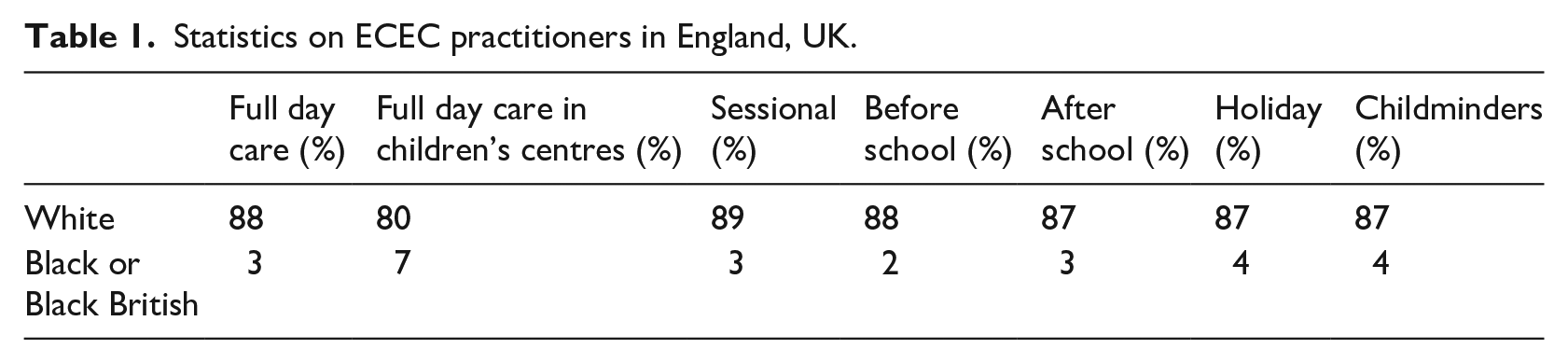
In the English policy context, talk of equalities is dominated by calls to address the gender imbalance and tackle gender stereotypes. For instance, the Early Years Workforce Strategy (Department for Education, 2017: 25) makes explicit reference to the ‘Gender diversity of the workforce’, stating: ‘We recognise that recruitment and retention of men is a challenge for the early years sector’. However, there is no such reference to the fact that the most recent statistics reveal Black or Black British educators make up just a fraction of profession, in which the majority of educators are white (Department for Education, 2014) (See Table 1). 2
Statistics on ECEC practitioners in England, UK.
Despite this, the lack of an explicit reference to race within education policy points to a wider notion that Britain has entered not a post-racial field but a field in which education and social policy discourses have largely been deracialised (Warmington et al., 2018).
In 2017, a report was published by the National Association of Schoolmasters Union of Women Teachers (NASUWT, 2017) examining BME Teachers experiences in England. The publication revealed evidence of everyday racisms in schools, with twice the proportion of BME teachers reporting that they had experienced discrimination in the workplace in the last 12 months (31%) compared to their white counterparts. The report is a significant condemnation of race inequality in education and further emphasises the need to address racial inequalities. Notably, the ECEC context is omitted within this analysis. The report feeds in to an argument made by Eddo-Lodge (2017: 83), who discusses personal risk in relation to talking about race, writing ‘you’re never sure when a conversation about race and racism will turn into one where you are scared for your physical safety or social position’. In the same way, Leonardo and Porter (2010: 141) state ‘people of color [sic] find themselves between the Scylla of becoming visible and the Charybdis of remaining silent’.
Existing research has uncovered that deeply engrained experiences with race and racism can have a negative effect on teaching, learning and student outcomes (Maylor, 2009). This has been shown to be the case for minoritised people in predominantly white institutions, where ‘diversity’ rhetoric is widely employed to replace or displace other ways of talking about inequalities including racism, social justice and institutional exclusion (Ahmed, 2012; MacNevin and Berman, 2016). Counter to this, in recent years there has been an emergence of the ‘role model’ discourse, where there have been efforts, in primary education and above, to engage more BME role models (Pells, 2017; Rhodes, 2017). Research has shown that Black teachers, through their identity, do bring specific life experiences and strengths that benefit children, thus challenging institutional norms. Wei (2007), for example, highlights the value of co-identification: where Black children benefit from seeing Black adults in education as influential adults. Co-identification can play a role in enticing BME students to enter the teaching profession (McNamara et al., 2009), which may result in increases the likelihood that minority families will enrol their children in that setting (Brosnan, 2001). It is crude to position Black educators as disciplinarians of children or to act as models of acceptable Blackness. Nor do I wish to negate the multitude of other relations with people that the child may enter into through their formative lives. However, recognising that these educators may inevitably model some kind of Blackness in learning environments, and can play some kind of role in mediating whiteness, may ultimately provide important insight in the ways we can understand the construction of identity.
Methodology and method
This study comprised an analysis of nine Black ECEC educators’ narratives about race and identity in the profession. Five were based in South-West England, two in London, one in the Midlands and one in the North of England. The spread reflects of the sampling methods employed, which drew upon the use of gatekeepers and social media to recruit participants. It was explained that this study aimed to provide insight into the experiences of Black educators in ECEC settings, through the use of interviews with Black educators currently working in the profession. All who agreed to take part signed a consent form detailing that their participation in this study is voluntary and that they may choose to withdraw at any time. This study received clearance from the Research Ethics Committee at the University of Bristol and there were no known or anticipated risks associated with participation.
Critical Race Theory
Responding to challenges in addressing new forms of racism, CRT emerged from the field of critical legal studies in the 1970s as a broad theoretical framework for exploring the endemic presence of race within the American social and political formation. This research aligns with Gillborn (2015: 284) who articulates the ‘primacy of race’, identifying three ways in which racism remains a primary concern for CRT scholars:
Empirical primacy of racism: When we study how racist inequity is created and sustained, racist assumptions and practices are often the crucial issue when making sense of how oppression operates.
Personal primacy of race: The dimension of the social world, of our lived reality, that we foreground in making sense of our experiences and shaping our interventions and agency.
Political primacy of racism: If we are to change the racial (and racist) status quo, we must refuse the growing mainstream assertion that racism is irrelevant or even non-existent.
Examining narrative and practices on race in ECEC contributes to the broader field in which racial oppression operates and will inform the epistemological approach towards analysing participants’ narratives.
Counter-narratives and narrative analysis
Counter-narratives are a key tenet of CRT. They are perspectives that contrast the presumed order of control, seeking to challenge and deconstruct ‘master-narratives’, accounts that justify the world as it is, and offer alternatives to dominant discourses (Delgado and Stefancic, 2017). Counter-narratives privilege ‘experience’: people of different races have radically different experiences as they go through life. Stories that describe the reality of Black lives validate epistemologies and bridge the gap between their worlds and those of others countering white stories as normative. In this study I drew together counter-narratives with narrative analysis for the purpose of exploring the experiences of ECEC practitioners working in the profession. Narrative analysis offers researchers a rich framework to investigate the ways in which humans experience the world depicted through their stories (Andrews et al., 2013). I position narrative as the primary medium by which people make sense of their lives, thus allowing me to illustrate the full complexity of experience. Narrative research represents a shift in focus from individual meanings to broader cultural narratives and their influence on people’s lives (Higgs et al., 2001). Bringing this together with counter-narratives, then, allows for new knowledges to emerge around the ways in which Black educators experience their professional identity. I make a further distinction with ‘small story’ narratives: shorter texts that are understood as ‘fleeting shifts into narrativity’ (Georgakopoulou, 2015). These allow opportunities to study how people place themselves within the story as characters; and to examine how their referential world is constructed. Finally, this analysis employed NVivo, a software package designed to support researchers in the coding and analysis of qualitative data. NVivo has standard word processing and editing capacities, and additional elements in enabling researchers to engage in code-based theory building. This analysis follows the ‘touch test’ strategy to progress from real to abstract, and link subject to theory (Saldaña, 2012).
Findings and discussion
In this section I discuss four narratives that emerged from my data collection, presenting a diverse picture of the Black educator experience in England. For clarity when presenting findings, each participant is assigned a pseudonym, places are anonymised, and certain words and phrases are emphasised to avoid losing importance when embedded in narrative. In relation to my role as the sole researcher, I recognise that I come to this study and situate myself as Black man from a working-class background within a predominantly white British community. I have now been involved in various aspects of the ECEC profession for the past 8 years, as practitioner, a family support worker, an advocate for the profession and now as a research student. I name these not to boast, but rather to point to the complicated, messy and relational nature of conducting qualitative research with participants in one’s field. I take the experiences presented to me as necessarily ‘partial’ (Haraway, 1988) and I accept that the ‘same’ experiences may be told differently in another set of relations. However, I reject the notion that this makes any version anymore ‘true’ than any other.
Blackness and identity
Blackness is defined as a ‘world view that centralises the experiences of Black people in providing perspective on the formation of western civilisation’ (Andrews and Palmer, 2016: 19). These findings reveal that, far from simply a theoretical term, the discursive nature of Blackness forms part of the lexicon of self-identification in the narratives from Black ECEC educators:
I’m always aware of my Blackness and I think because I’m tall as well and you can’t like miss me! (Lucy) It wasn’t until it initially came up at work that I thought now is the time to show your true Blackness as they say. (Mandy) I’m a strong Black woman, I’m great. (Megan)
Being Black is identified as key to the experience of these educators. Blackness is not fixed, nor something innate, instead it is a process of the social-cultural experiences of that person. Mandy’s narrative is instructive of how she discovered her Blackness through working in a more diverse setting, having previously worked in a setting where the majority of the workforce was white:
I grew up in a predominantly white area myself so for me it was, I went to an all-white school . . . it wasn’t until I came here and saw lots and lots of Black people and I’m thinking oh this where they all sort of thing cos I grew up in [a predominantly white area] so it was never, probably me and my family and maybe sort of two other families where up that way so it wasn’t until it initially came up at work that I thought now is the time to show your true Blackness as they say.
On this evidence, while Mandy did not explicitly identify as Black in her youth, contact with more diverse communities led to a realisation process of her identification, or how she was identified by others. This is salient in terms of revealing the dynamic, transient nature of identity (Beauchamp and Thomas, 2009). For others, Black identity has firmer roots in the home through the family in cementing the Black experience. As Justin recounts:
[B]ecause my dad is very woke he’s always been a reader of pan-African books and he’s always made me aware of the role of the Black man in the community, so that has had changed for me because I don’t think there is men in this female role, but I have always been confident in my Blackness. And that has stuck with me.
Prior to the more formal interview questions, I asked several shorter questions to ‘break the ice’ and ease into the process, since for all participants this was their first time being interviewed in this format. One notable question I asked each participant was whether or not they knew any other Black practitioners, the majority did not. This is illustrated in the small story responses that provide a counterpoint to my larger narratives (Georgakopoulou, 2015). These snippet-length responses highlight what sometimes gets missed:
Int: How many Black practitioners are there in your setting? Just me (laughing) (Patricia) Int: And are you the only Black practitioner? Yes, sadly. (Emily) Int: And I’m glad you’ve said yes (to being interviewed for my study) Well there’s not many, not many Black people to ask in this place is there? (Laughing) (Mandy)
As highlighted in the literature, the lack of consensus around terminology with workforce statistics makes it difficult to draw any definitive conclusions on the proportionate number of Black educator in ECEC. These small story responses, however, are indicative of a broader feeling that there is a real need to narrativise and foreground the experiences of the Black educator.
The Black role model
The notion of the role model manifested itself in several disparate ways. For some, race and culture were primary factors. Mandy’s experience of working with Black families in a primarily white spaces, and the impact of her presence and identity on them, is illustrative of this:
I think with the parents I’ve met at the moment that are Black, they seem happy to see me! It’s like they were hiding everybody away and suddenly I pop up, so they’re asking what have you been doing and where have you come from? So yeah, I delight in the fact that it looks like there’s a relief on their face, I can say oh we’re not the only ones here or thank god there is someone I could talk to that looks like me
This narrative highlights the value of representation in community work with parents and speaks to Maylor’s (2009) findings that deeply engrained experiences with race can affect teaching, learning and student outcomes. Similarly, Safi emphasised the value of Black role models in disrupting whiteness and challenging normativity, especially when she is the sole Black practitioner within her setting:
It’s just being that role model because it’s for the kids to know that it doesn’t really matter what complexion you are, if they were to see someone else I wonder if they – they would be more aware that actually it’s normal its fine there are people everywhere of different colours so it’s just making it more talked about and more normal.
I also considered Safi was likely viewed as a racial token (Kanter, 1977) due to the way she is positioned as an ‘expert’ on race and upheld as the ‘perfect Black person’. For instance, I asked if she believed the setting was having conversations about race before she started working:
I don’t think they were beforehand I don’t think so because there wasn’t an obvious thing to talk about cos when I came they and started they were all firing questions at me, especially in the preschool especially because they are older they so curious about my complexion that I don’t think they had seen a Black person before. There wasn’t as much diversity then as there is now, so it wasn’t anything that they were used to or that they saw.
Because of Safi’s presence, she was able to reflect on her impact for Black families who were visiting the centre for the first time. Safi also makes a useful analogy with gender, where she is very much aware of the implications of harmful stereotypes for children, while race carries less visibility:
I think the Black parents that come in and look around, they do worry because it isn’t as diverse as it could be. I think they worry about the interactions with other children because they exclude even by gender so as they get older I have noticed that is more of a thing. From 2/3 to preschool, they begin to see boys playing with boys and vice versa. So, I think that sort of comes in (with race) because some kids can be like that and they obviously don’t want it to be seen as a negative I suppose. With gender we always challenge that sort of stuff, so I guess with people of colour that could also be something that happens.
One unexpected discussion arose between myself and Lucy, who reflected on the boundary between personal and professional identity. When asked whether she felt she was a role model, she replied:
Not in terms of my race I don’t think. You know there was something on the tv the other day where the teacher was gay and they had a debate about how much you should know and let them in, and someone was saying well no you shouldn’t tell them anything of your life, and some was saying oh they will trust you more if you let them in a bit of your life and some people saying with things like pregnancy there are things you can’t hide and well no, but then you would say it in a sensitive way. I think I am the same, I don’t know, this is hard!
Here, Lucy highlights a tension in the relationship between personal and profession identity in practice. Later on, Lucy articulates her sense of performance with parents:
Int: Do you think you are showing a perfect side of you to parents? Yeah! You know what I was talking to a (white) colleague of mine and she said the same thing, you almost putting on a performance and that was just a conversation because someone was going through something and it’s just like when you go to work with the children you literally putting your game face on and its refreshing to know that she’s putting her game face on because I didn’t think she would.
Covert racisms
This study, while not looking to position Black educators as victims, did set out to understand experiences in their daily practice. It therefore remains salient to note the ways in which the participants experienced forms of racist practices against them.
I find it limited. I’m shocked that even in Bristol there is not a lot of managers who are ethnic BME like from my own example I’ve been in this 30 year and there’s been very few little room for progression and even when it is you feel overlooked. (Mandy) but we’ve had people come here in the past and ask for a keyworker that speaks English – they asked for a white keyworker that speaks English – we thought that was quite strange so we were quite taken a back, and we think that parent wanted their child to be taught English. (Julia) when a parent was visiting nursery with her child, and because in the garden we have to position ourselves around I could see her walking past the staff and I didn’t see nothing of it, and then she came up to me and said ‘um this little boy threw bark at my son, YOU BETTER SORT IT’ and I thought oh ok, so obviously when I went to look, it was a Black child that threw some bark. So, I just, you know, laughed it off and stuff and she passed all of you and came to me and the Head at the time pulled me into the office and said Patricia that is actually racist. (Patricia)
With Patricia’s narrative, above, she goes on to reflect on her experiences with the racisms she has experienced:
I said to be honest I’ve experienced it so many times that I let it go over my head now, I wasn’t taking it that way round. But it got so bad that parent wasn’t allowed on the premises anymore. I think she behaved badly to a Polish member of staff, too. Which I didn’t realise, and I apologised because it was after my experience and if I had reported it she wouldn’t have received that. But I think people think we are thick skinned and we just get on with it, that is what it is.
This story points to the difficultly in talking about race. The trope Black people are thick skinned and just ‘get on with it’ is harmful, although common. This is what Eddo-Lodge (2017) points to, that for many Black people, bringing up the ‘race card’ creates a space for exposure and vulnerability, to the point it is better to leave it and move on. This is also raised by Lucy, who says:
I think I just hope it doesn’t come up to something I have to deal with, you know I’m not like fighting a cause or anything that’s not my life and when these things crop up tis more of like oh f-sake it’s just something I’m going to have to – can’t let it go and guess I’m going to have to deal with it, but you can never find the right words, so thankfully I’ve never had to deal with it . . . People are just silly, and I can’t be dealing with them to be honest with you!
Critical pedagogy
Despite evidence of racisms, narrative interviews allowed for a space for reflection on their practice with young children. The stories of Justin, Julia and Lucy indicate a critical pedagogy where there is an awareness of the determining factors of their reality (Freire, 2005). All three, following reflection, offer forms of reaction in the pedagogical approach.
So, I address them and teach them, the only way to change a racist is to teach them, to show them a more positive way . . . Things get challenged when people go in head first with stuff and challenge it. (Justin) It’s been very interesting I’ve been able to reflect more, because I’ve always just done and done what needed to be done, I think it’s one of those things that people think, people have their preconceived things and won’t necessarily show it to my face, even though they are ha ha you are so great, you know really know so I will take it but I never really know, and that is the privilege that white people have when they say you are wonderful, they can take it 100 per cent, I don’t feel like I can, which is a shame but I don’t think about it I just know that I do a fantastic job at what I do and I’m happy with that, I don’t need anyone’s validation. Thank the lord. (Lucy)
Lucy’s narrative is compelling since she explicitly names white privilege. In another part of the interview, she touches on the implications of children ‘passing as white’, where Black children are not afforded the same freedom:
I mean I had a German child start and I was like ‘oh yes we can do this and that’ and mum was kind of like ‘I don’t really want to highlight the fact that he was German’ and when she said it I could totally understand because it totally hit me, we kind of go with it but she was actually like I don’t really want people to know because it’s not good connotations with it, and I was yes I understand that, but then again he could necessarily hide in his whiteness couldn’t here? He could be anything. But when it comes to me and Black children, we wouldn’t be able to do that.
Here, an analogy can be drawn with Kanter’s (1977) theory of visibility, where token Black educators experience pressures and social psychological troubles due to their high visibility against white educators. This might well apply to the case of Black children in predominantly white settings. It remains regrettable there is a paucity of research in this area.
Conclusion
The aim of this study was to examine the experiences of Black ECEC educators as counter-narrative against the normative experiences within the profession, and to problematise ways in which educators constructs their racial identity against expectations of practice. Blackness is key part of identity for Black ECEC educators. For some, this manifested in the family, while others became Black as a process of identification through their social environment, in line with Bonilla-Silva et al.’s (2015) term ‘becoming raced’. However, this is not always the case, as a tension was raised between showing too much of one’s personal or profession identity in practice. Small story narratives provided a glimpse into being the only Black educator, with Mandy responding ‘Well there’s not many, not many Black people to ask in this place is there? (Laughing)’. The literature identifies the pressure of being a role model for the children. This is echoed in the data where being Black takes on pressure for educators who become the ‘blueprint’ for people who have not grown up in homogenous areas. Having educators from different backgrounds is therefore revealed as a salient issue for all participants, as it contributes to countering children’s normative experiences. The conclusions must be viewed with a caveat. They are based on nine interviews with Black ECEC educators in England and therefore do not generalise to the experience of all Black educators. Instead, the study highlights a much under researched area and proposes that this study will be of interest to other researchers in the field of Black studies and education. Clearly, there are some implications for future policy and practice. This study demonstrates the need for policy to address ways to support educators to celebrate their racial identities in ways that extend beyond tokenism. For the many of the participants I interviewed in this study: their racial identity matters, however the ways in which it is made to matter often manifested negatively. Moving beyond the notion of race as something that is irrelevant, or inappropriate at this level of education, towards a more critically informed understanding of what kinds of influence that minoritised educators can have is crucial in addressing experiences of racism in educational spaces. Black studies remains a relatively new field in academia and the paucity of research on the Black educator in ECEC, combined with the data presented, therefore justify a need to continue to on the experiences of those in the ECEC profession.
Footnotes
Acknowledgements
Firstly, I would like to thank the participants who took part in this study for their invaluable contribution. I would also like to thank Anne Pirrie for her initial comments and insight on this article and the anonymous reviewers for their important feedback through the submission process.
Declaration of conflicting interests
The author declared no potential conflicts of interest with respect to the research, authorship and/or publication of this article.
Funding
The author received no financial support for the research, authorship and/or publication of this article.
