



Abstract
Strategic management research generally assumes that high-status teams outperform their low-status counterparts. Indeed, status can cause decision makers to favor high-status teams, providing them with better access to resources. However, we theorize that in organizations which demonstrated high previous performance, status has a much weaker influence on decision makers. This is because in these organizations, there is no expected resource scarcity that would push decision makers to favor high-status teams. We therefore hypothesize that the difference between low- and high-status teams in terms of performance is smaller in organizations that exhibited high performance in the recent past. By analyzing a unique data set from the video game industry, we find support for our theory. Our results confirm that the relationship between team status and performance is much stronger in organizations with low previous performance. Our study provides fresh insights about the organizational contingencies of the Matthew effect.
Introduction
Previous research has shown that status functions as a “magnet” is attracting tangible resources for teams (Prato et al., 2024: 2267). This is because high-status teams receive more credit than their low-status counterparts for the same quality of work (Benjamin and Podolny, 1999; Ertug and Castellucci, 2015; Kim and King, 2014). This positive perception often gives high-status teams access to valuable resources that they can use to outperform others. In so doing, they can live up to the expectations others attach to them, which in turn, can become a self-fulfilling prophecy (i.e. the Matthew effect) (Azoulay et al., 2014; Fralich and Bitektine, 2020; Merton, 1968; Packalen, 2007; Stuart et al., 1999). In other words, status signals help high-status teams to outperform others, while, at the same time, it limits low-status teams’ opportunities to exhibit high performance (Sauder et al., 2012).
We argue, however, that the degree to which status helps project teams to exhibit high performance is context-dependent. Indeed, previous research has explored various contingency factors which influence the performance effects of status, such as the timing of a status shock (Maoret et al., 2023), ritual enactments (Maoret et al., 2023), team composition (Szatmari, 2022), consumer base diversity (Kovács and Sharkey, 2014), seasonality (Sharkey and Kovács, 2018), leader narcissism (Yang et al., 2023), and the distance from others in the status hierarchy (Piezunka et al., 2018). We extend these insights by investigating how the status of teams affects performance in a context of creating innovations. Here, the success of innovation projects is a function of the development teams’ ability to attract resources throughout the whole project development process.
We suggest that a team’s success in attracting resources for their project depends not only on their own status level but also on the expectations that decision makers have regarding the availability of future resources. When an organization had successful innovation projects in the past (i.e. high previous performance), we argue that decision makers have higher expectations of additional resources flowing in, which should be available for ongoing and future product development projects (Carnes et al., 2019). In these organizations, there is less need for competition among the project teams for resources. Hence, low-status teams can also have good access to resources throughout the whole project development process, similarly to their high-status counterparts. This is different in organizations which did not perform well in the recent past. Decision makers in these organizations are dealing with or will need to expect resource scarcity. We suggest that in these situations, decision makers will favor high-status teams more when having to allocate resources to ongoing projects. As a consequence, high-status teams can use the resources they have access to in order to significantly outperform their low-status counterparts.
We study team status in an innovation context by examining how central a team is positioned in an intraorganizational project affiliation network (Kim and Rhee, 2017; Waguespack and Sorenson, 2011). Specifically, we investigate new product development teams in the video game industry. The video game industry is a creative industry where the success of products does not only depend on their technological, but also their artistic qualities (Tschang, 2007). This complexity creates significant variation in the uncertainty about the potential success of new products being developed. Thus, it provides an appropriate context to test our theory on how status affects the success of new products, as status signals exert their influence on the decision-making process only when the perceived uncertainty of decision makers is high (Reitzig and Sorenson, 2013).
We leverage a unique data set for which we combined data on sales and social networks. We adopt a multilevel design where team-level observations are embedded in organizations. Besides our quantitative analysis, we also collected qualitative data through semi-structured interviews with six industry experts who are CEOs or project managers at either small or large, established organizations. These interviews provided valuable insights about the specificities of the video game development process, and the role of status signals in this process.
Our key contribution to the strategic management literature and recent calls in this domain is to shed light on the organizational contingencies of the performance effects of status (e.g. Bitektine et al., 2020; George et al., 2016; Piazza and Castellucci, 2014). Investigating the performance of project teams who develop product innovations, we demonstrate that low-status teams do not always perform significantly worse than their middle- and high-status counterparts. Looking at the most successful (and hence largest) video game developers and publishers, we reveal an important boundary condition for the Matthew effect (Azoulay et al., 2014; Bothner et al., 2011; Piazza and Castellucci, 2014) by showing that status seems to matter less for project performance when organizations managed to exhibit superior performance in the recent past.
Research context: The video game industry
Our research focuses on new product development in the video game industry. According to De Vaan et al. (2015: 1155), “[f]ew if any cultural forms have been marked by such explosive growth as that of video gaming.” Indeed, almost nonexistent 50 years ago, global spending on video games surpassed that of the film industry already in 2007. In 2022, it reached $184 billion making the gaming sector the number two media sector, after the TV sector (Schudey et al., 2023). The development of video games is both a creative and knowledge-intensive endeavor, as it needs to combine elements of both entertainment and technological innovation (Mollick, 2012; Szatmari, 2024; Tschang, 2007). This makes the prediction of the success of video games being developed difficult, as new products are always evaluated by consumers and critics based on both of their artistic and technological qualities.
The explosive growth of the industry also led large video game developers and publishers to adopt a formalized product development process, similar to that of other industries. While most organizations in the industry apply traditional waterfall-type of methods, firms have increasingly adopted iterative, agile development practices such as “scrum,” as well (Koutonen and Leppänen, 2013; McKenzie et al., 2021). These processes consist of stages or iterations from concept development to the release of video games separated by decision points (or gates) where budget holders make a decision on whether to continue or terminate an ongoing development project, the direction it should take, and the amount of resources (e.g. human or financial) it should receive. The composition of project teams and the amount of resources they have access to often vary across the whole project development process.
Earlier studies show that managers make resource allocation decisions based on their explicit and implicit priorities, as well as the expected availability of future resources available for development (Irish, 2005). Video game products are typically being sold for a long period, meaning that new product success does not necessarily translate into slack resources directly available for development. Instead, the success of video games create an expectation for decision makers that there will be a stable flow of resources that they can allocate to current and future development projects, which should affect their present-day decisions. Decision makers are usually the CEOs in smaller organizations, whereas in large, established organizations, this role is typically filled by members of the executive management team (Irish, 2005). There are noteworthy exceptions to this common decision-making approach though. For instance, the very successful organization Valve applies a highly informal approach where decisions are made in a highly ad hoc manner with the participation of many organizational members (Puranam and Håkonsson, 2015). Here, the function of decision makers is still fulfilled, but in a more decentralized manner.
Large established video game publishers often develop video games internally but collaborating with external developers and studios remains prevalent in the whole sector. When a video game is being developed by an external developer, it is still the publisher who provides the resources for development and has the power to determine the direction of development by exercising control throughout the project development process and across the different decision points. This is echoed by one of our industry experts as follows:
Once we got work from a renowned company [. . .]. I was completely convinced that the idea was extremely far from what we should do, but there was this guy who sold the project to the owners of the company so well that they blindly believed in him despite all the apparent signals. This guy was on our back for many years and burned a lot of million Dollars. [. . .] We signalled the problems to the owner of the company lots of times, but it took almost two years that one of the owners started to look into this. We could have created a very nice game, but we didn’t unfortunately.
The previous quote also implies that decisions concerning continuation and termination of projects cannot be entirely explained by rational and economic factors. In fact, they are often subject to social influences, even in organizations with highly formalized decision-making processes. Indeed, our industry experts claimed that the intra-organizational status of the development team plays an important role in influencing the assessment of decision makers at important decision points. How status affects these assessments and decisions is explained by one of our industry experts as follows:
I’ve some high-status guys in mind in our company. If they’re working on something and would like to have a new project, I know they’re so good that I would definitely take the risk to implement their new project. I even often skip testing, which is very risky. I would never take this risk in case of others. I can really vouch for their work. [. . .] If my high-status people are on one team, I would assume that the project is more stable. So, if that’s the only factor that’s different between two projects then of course I would go for the one with the high-status people.
As this quote illustrates, team status can be expected to influence decision makers and their resource allocation decisions in settings such as our study, which concerns the decision-making process regarding uncertain innovation projects. Clearly, resource access strongly determines the extent to which development teams are able to exhibit high performance and create new products that become successful on the market.
Theory
Team status and innovation projects
Status is a signal of the underlying quality of actors (Stuart et al., 1999). Our study investigates how the status of teams affects their ability to implement successful innovations. In this context, team status can be understood as the team’s perceived ability to produce high-quality work (i.e. perceived competence). Our theoretical rationale for investigating team status is that the process of project development and implementation is a result of a collective effort by a team of individuals rather than the work of a single individual. Provided that we examine intra-organizational processes, we focus on the status of teams and their members within their own organization, not on team status at a more macro level, such as a team’s status within the industry.
Status research suggests that people can derive additional benefits from their status beyond what might be explained by the actual quality of their contribution to a project or an organization. This is because the work of high-status teams is typically perceived to be more valuable than that of low-status actors (Kim and King, 2014; Simcoe and Waguespack, 2011), which has been shown to influence the organizational decision-making process (Reitzig and Sorenson, 2013) and specifically the amount of resources that decision makers will allocate to innovation projects (Green et al., 2003). In this paper, we focus on this organizational decision-making process and apply a predominantly alter-centric perspective. This means that we study how teams are perceived by others such as decision makers due to status signals. Specifically, we are interested in understanding how these status signals influence resource allocation decisions.
The implementation process of product development projects involves some degree of uncertainty (Baer, 2012; Green et al., 2003; Sethi et al., 2012), which creates the condition for status effects to occur (Reitzig and Sorenson, 2013). Decision makers likely consider the status of a project team in two critical phases of the innovation process: first, prior to the launch of the product development project when they need to determine the budget of the developer team, and, second, during the development and implementation process when they need to determine whether a project should get killed or should be—with a possible allocation of additional development budget or human resources—continued (Markham and Lee, 2013; Schmidt et al., 2009; Sleesman et al., 2012). These decisions determine the degree to which the various project teams have access to the resources needed to carry out their innovation projects (Green et al., 2003).
Team status and performance
Based on what we have argued above, our baseline hypothesis is that—without considering an organization’s previous performance—higher team status leads to higher project performance. From an alter-centric prespective (i.e. how teams are perceived by others), we make the argument that high-status teams are given exclusive access to many resources by decision makers (Agrawal et al., 2017; Kehoe and Tzabbar, 2015; Packalen, 2007; Sauder et al., 2012; Szatmari et al., 2021). These resources are likely to be more difficult to obtain for low-status teams. Having more resources can enable a project team to improve the quality of a project and help the team to overcome obstacles and problems that they might face during the project development and implementation process (Ancona and Caldwell, 1992). Resources allow high-status teams to improve the quality of their products being developed. It helps them to turn their project into a successful product that can be launched on the market and commercialized (Basuroy et al., 2003). Thus, the baseline hypothesis in our study is that team status has a positive relationship with project performance.
The moderating effect of previous organizational performance
We focus next on the moderating effect of previous organizational performance which is the main focus of this study. We define organizational performance as an organization’s demonstrated ability to create innovations that are successful. High performance often lead to increased customer demand for an organization’s products, translating into greater value captured from recently commercialized new product development projects. Consequently, these organizations generate higher revenues and profits from their innovation initiatives resulting in high expectations of a stable flow of slack resources available for allocation to ongoing and future product development projects (Carnes et al., 2019; Sharfman et al., 1988).
In organizations which failed to create innovations that are successful (i.e. low organizational performance), decision makers do not expect slack resources to be directly available for product development projects. Hence, they experience more pressure to make the “right” resource allocation decisions in order to turn the negative trend in organizational performance (Picone et al., 2014; Sharfman et al., 1988). This motivates them to allocate most resources to those teams which they trust will be more successful in developing successful innovations (i.e. high-status teams). It is assumed that all project teams are motivated to compete for resources for their new product development projects; however, high-status teams should be more effective in such a competition for resources due to their perceived competence (Kim and King, 2014). Thus, in organizations with low previous performance, high-status teams are expected to obtain proportionally more resources from decision makers compared to their low-status counterparts.
This is different in organizations which exhibited superior performance in the recent past. Here, decision makers expect to have ample resources available for product development projects. After allocating resources to projects that decision makers may feel have priority (for instance, because they are run by high-status teams), we suggest that they are more willing to also provide resources to projects which have a lower priority (for instance, because they are run by low-status teams). Consequently, resource allocation in organizations with a strong track record of performance may exhibit a more equitable distribution between projects of low- and high-status teams (Bothner et al., 2011). This results in no or few differences between low- and high-status teams in terms of performance. Moreover, the expected availability of slack resources allows for more experimentation (Carnes et al., 2019). Hence, decision makers in organizations with high previous performance are more willing to experiment with resources. This motivates them, for instance, to provide more opportunities and resources to low-status teams, which they would not do otherwise.
Following these reasons, we expect that, in organizations with high previous performance, team status will have a less-positive effect on performance than would be the case in organizations with low previous performance.
Hypothesis. Previous organizational performance negatively moderates the relationship between team status and project performance.
Method
Sample and setting
We tested our hypothesis in a new product development context, specifically in the video game industry. The video game industry is an appropriate setting for our study as it allows us to construct accurate professional networks for game developer teams working in an uncertain and complex environment (Aoyama and Izushi, 2003; Scarbrough et al., 2015; Venkatraman and Lee, 2004) in which development budgets are determined by the decision makers of organizations (Irish, 2005) and innovations are carried out by project teams (De Vaan et al., 2015). The archived data allow us to investigate more effectively sensitive topics such as the possible negative side effects of status.
Our data set is drawn from two sources. First, we collected data on innovation projects from the online public database MobyGames.com, which contains information about more than 41,000 projects which correspond to most video games developed from 1972 onwards. MobyGames.com lists their goal as: “To meticulously catalog all relevant information about electronic games (computer, console, and arcade) on a game-by-game basis, and then offer up that information through flexible queries and data mining. In layman’s terms, it’s a huge game database.” From Mobygames.com, we collected the names of the developer team members, and all the available information on the characteristics of video games. Second, we use data from the NPD Group on the sales of video games. The NPD Group collected information for most major retailers on the monthly sales of most console video games sold in the United States between 1995 and 2012. We focus on the US market because since 1990, it has been by far the largest video game market (Euromonitor International, 2017). The data set of NPD Group contains information on more than 13,000 projects, allowing us to compare revenues generated by each video game using time-windows of the same length for each game. We apply a 12-month time-window in this study (Mollick, 2012).
Following previous research which used similar data, we decided to focus on a single platform because the financial performance of video games is highly dependent on the success of platforms for which they have been developed (Katila et al., 2022; Mollick, 2012). Following Katila et al. (2022), we focus on video games developed for PlayStation 2 for several reasons. First, video game development for PlayStation 2 provides a suitable setting for examining our hypothesis due to its advanced technological features, which rendered game development more demanding compared to PC and earlier or subsequent gaming consoles (Katila et al., 2022). Therefore, the teams’ technical competencies were particularly important in the development of video games for this particular platform. Second, it had the largest share of revenues throughout the whole life cycle of consoles which are covered by our data. Hence, there is more variation in organizations’ previous and subsequent performance than in markets for video games developed for other platforms. Third, the success of the console also attracted a high number of diverse developers and publishers. This provides us with a representative and comprehensive overview of products, developers, and publishers. Fourth, the success of the console also allowed developers to innovate more and create more diverse products than in other console markets where developers specialized more in certain genres (Katila et al., 2022). This allowed us to investigate a more representative sample of products in terms of genres, as well. Thus, the performance of products was less dependent on whether the product’s genre in question is over- or underrepresented in the product market. Since both the MobyGames.com and NPD Group data set contained information on whether or not a video game was released on the PlayStation 2 console, we could match the sales data of NPD Group with, in total, 669 projects in the MobyGames.com database.
Next, we decided to limit our analysis to established organizations that were the largest in terms of market share because what interests us most are the mechanisms used by managers in these organizations when deciding which projects they should prioritize and give resources to. Large and established organizations can serve as a context for our analysis because they generally develop a number of projects in parallel, with substantial development budgets—something that is usually not possible for smaller players and new entrants. Larger organizations also tend to have more experience and use a more structured form of implementation to ensure high revenues from their projects, which makes them more suitable for our analyses than smaller organizations.
To select relevant organizations, we used the data set from NPD Group and complemented it with information from Euromonitor International. Euromonitor International monitored the global video market since 2008. We selected projects from the organizations that were in the top 10 largest organizations in terms of global or US market share (United States being by far the largest video game market in the world) in any of the years between 2000 and 2012. In each database, we ranked the top 10 organizations in terms of market share in the global or US market in each year, and we included every organization which has been part of these lists in any of the years between 2000 and 2012. This procedure resulted in a list of 22 organizations. However, only 20 of these organizations developed games for the PlayStation 2 platform. These organizations had, together, consistently held more than 60% of the global market share between 2008 and 2012 and more than 80% of the US market share between 2000 and 2012. Had we included the next largest organization in our sample, the market share would only have risen by a fraction of one percent. After taking these steps, our sample consisted of 303 projects developed between 2000 and 2012. However, because our theoretical model includes previous organizational performance as well, we could not use those projects of these organizations which were implemented in the year when they entered the PlayStation 2 video game market. This further reduced our sample to 260 projects that were implemented by 14 organizations. Our approach enabled us to test our theory in a conservative way.
We constructed separate longitudinal affiliation networks based on all available information on all the projects of the 14 organizations between 1998 and 2012, regardless of the platform for which they were developed (2907 projects). This enabled us to gain a reliable picture of every individual’s network position in their organization. The source of these data was the video game credits listed on MobyGames.com. In 2000, there was no information on organizations’ previous performance on the PlayStation 2 video game market, which just was created in 2000. Therefore, the starting year in the final data set is 2001. An affiliation network is a network of vertices connected by common group memberships, such as projects. Social network analysts have a long tradition of analyzing affiliation networks (e.g. Uzzi and Spiro, 2005). Indeed, (Newman et al., 2002) argue that affiliation networks tend to be more reliable than friendship ties, for example, since group membership can be identified with greater precision. Following prior social network research, we used a 3-year moving time-window (Ferriani et al., 2009; Uzzi and Spiro, 2005). That is, there was said to be a tie between two persons, if they had worked together to implement at least one project in the 3 years prior to a given year. For instance, if employee A and B participated in a project that was released in 2005, there will be a tie between A and B in years 2006, 2007, and 2008. We argue that a 3-year tie decay parameter is appropriate, because the vast majority of individuals with normal employment contracts in the video game industry typically participates in multiple projects over a period of 3 years (Musil et al., 2010). This allows decision makers to have a reliable picture of an individual’s (and hence a team’s) organizational status. We set the boundary for each affiliation network to the boundaries of one organization, because organizational members can more directly observe intra-organizational than inter-organizational ties.
Dependent variable: Project performance
Using the sales data from NPD Group, we summed the revenues (in million US Dollars) generated by each video game in the 12 months after it was released in order to look at the performance of each game using time-windows of equal length (Mollick, 2012). Arguably, a development team performs well when there is demand for the product of the development project, and sales revenue is a project performance factor decision makers care most about. Furthermore, project teams with more resources usually have more opportunities to generate high-quality products which, in turn, should sell more successfully on the market (Rego et al., 2013). We then divided the sum of revenues by the size of the team to get a proportional measure for project performance (i.e. how much revenue a project generated per team member). Since the video game industry is a hit-driven industry, the revenues are highly skewed. We therefore took the natural logarithm of sales (Mollick, 2012). We also checked our results using the natural logarithm of absolute revenues as the dependent variable and we found support for our hypothesis.
Independent variables
Team status. The video game industry is a project-based industry, hence, similarly to the movie industry, it is extremely rare that teams of the same composition ever work on more than one project. Hence, in order to get team-level measures, we aggregated individual-level measures. For instance, team status is measured by aggregating individual status scores.
Following Hagedoorn and Duysters (2002), Waguespack and Sorenson (2011), Grigoriou and Rothaermel (2014), Paruchuri and Eisenman (2012), Szatmari et al. (2021), and others (for other examples, see the review of Piazza and Castellucci, 2014: 304–307), we derive each team member’s status based on their position in the affiliation network. We measure status by applying Bonacich’s centrality measure to our affiliation networks using the following formula (Bonacich, 1987; Bothner et al., 2012; Kim and Rhee, 2017; Podolny, 2005; Szatmari et al., 2021):

where
Network centrality is a valid measure for status in our context because central actors are often seen as star performers in organizations (Oldroyd and Morris, 2012; Szatmari and Deichmann, 2023). Indeed, Betancourt et al. (2018) showed in an experiment that individuals ascribed the most status to those members of a social network who were the most central ones in three different types of networks. In addition, central organizational members are the ones to whom people often turn for help and advice (Cullen et al., 2018; Kehoe et al., 2016; Oettl, 2012; Oldroyd and Morris, 2012), and they are the ones who are given access to resources because they are thought to be highly competent (Call et al., 2015). Since we are interested in an actor’s organizational status, we did not include ties that stemmed from an actor being involved in implementing a project in a different organization, without any collaboration with the organization in question before year
We focus on team-level status. This is because—and as explained in more detail above—the project development and implementation process is a collective effort by a team of individuals rather than the work of a single individual. To construct our team status measure, we first needed to obtain individual-level scores, which we did in the following way. Similar to Grigoriou and Rothaermel (2014), we measured status by examining the relative bidirectional centrality of people compared to others within the organization. We chose the scaling vector
We argue that decision makers look at teams as a whole and, therefore, aggregated individual status scores to the team level by taking the average of status scores of all project team members who could be associated with a certain project (Soda et al., 2004). We believe it is reasonable to assume that a team consisting of exclusively high-status individuals has a higher status and prestige than a team where only a few members have high status, ceteris paribus, and this is reflected by averaging the individual status scores to the team level. Where members had not implemented any project connected to the organization in question during the 3 years prior to a given year, we assumed that they had no status during that year (Soda et al., 2004). We therefore set the status scores for those project team members to zero. We took the natural logarithm of team status scores, because status hierarchies are by nature highly skewed constructions, and this applied to our sample as well. Taking the logarithm of our status scores normalized their distribution. It can be argued, however, that assigning a low-status member to a project team does not decrease but increase the status of the team. Therefore, we also tested our hypothesis measuring team status by the sum of all team members’ status scores and taking its natural logarithm. This measure corresponds to the proportion of the sum of status scores in the organization that the whole team has captured from the organizational status pool. Using this measure did not change the significance or the direction of the hypothesized moderation effect.
Our industry experts also confirmed that being central in the intra-organizational network signals high status. How networks serve as a source of status is explained by one of the decision makers as follows:
Social networks are very important in this industry [. . .] and they can be very valuable. [. . .] these social networks give you a lot of work-arounds. If I have a problem, I can call someone who will pull some strings and arrange that we get a custom solution in a price-efficient manner. [. . .] Also, I can ask things from others, like ‘please take a look at what I’m doing; your feedback matters a lot to me.’ This is something that a young person without any social network cannot provide.
The quote illustrates what benefits work-related ties within an organization can provide. Moreover, the quote shows that decision makers distinguish between those individuals who have a developed work-related network and those who have not. For instance, individuals with a developed network can more easily arrange work-arounds when faced with problems during a project. In other interviews we had, the industry experts confirmed that individuals who have a valuable network are better able to signal their status to decision makers.
We also tested whether our results depend on the assumption that decision makers consider the status scores of every team member. As an alternative approach, we examined the number of team members considered high-status within the organization. To do this, we measured team status by counting the number of high-status organizational members in a team. High-status members were defined as those whose status scores exceeded specific thresholds, set as follows: (1) the average status score of all organizational members in organization k at time t, (2) the average status score plus one standard deviation, (3) the fourth quintile, (4) the ninth decile, and (5) the 19th vigintile. Using these alternative measures did not change the significance or direction of the hypothesized relationship in this study.
We also considered using other alternative measures for status such as industry awards (Jensen, 2010). We collected information on the number of awards each video game got from the Academy of Interactive Arts and Sciences (AIAS, 2017). Then, in each project team in our sample, we looked at the average number of awards the individuals received in the team before the year when the video game in question was published. We checked whether the correlation between our measure and the number of awards is positive. Indeed, we found a positive and significant correlation (r = 0.27, p < 0.05). Using the average number of awards as a measure for our independent variable provided support for our main hypothesis that previous organizational performance negatively moderates relationship between team status and performance. We also considered using a combined measurement by first standardizing the two measures and taking their average scores. Using this measure again provided support for our moderating hypothesis.
Previous organizational performance
Previous organizational performance is defined as the organization’s demonstrated ability to create innovations that are successful. To capture previous organizational performance in year
We checked our results using the absolute relative revenues an organization had realized in the 3 years before a given year, meaning that we subtracted all the revenues an organization realized from the average of revenues all the organizations realized in the same time window (i.e. we did not divide these values by organizational size), and we found support for our hypothesis. In addition, we also checked our results by measuring previous performance with the sum of all revenues that an organization realized in the same time window (i.e. absolute revenues instead of relative revenues) and they were consistent.
In our theory section, we argue that previous organizational performance corresponds with more expected slack resources available for development. Although it was not possible to collect reliable data on decision makers’ expectations, nor on the precise amount of slack resources available, we searched for indirect evidence for our theoretical claims. In the meta-analytic review of Carnes et al. (2019), one main component of measuring available slack resources was indeed previous sales, and the authors found a strong positive relationship between slack resources and competitive aggressiveness which was captured by new product introductions. Therefore, we checked whether organizations which generated more revenues per capita than the industry average during the 3 years prior to a focal year (i.e. with high previous performance) indeed introduced a higher number of new products during the 3 years following the focal year. Thus, we counted the number of new products each organization introduced in years
Control variables
Game-specific controls
We include the year of release as separate year dummies for each year to control for year-specific effects. We also control for video game franchises, because consumers more likely buy a product, if it is part of a franchise (Cox, 2014). Franchise is included as a dummy variable which takes the value of 1, if the video game in question was part of a video game franchise (e.g. Call of Duty), 0 otherwise. We also control for vertical integration, because teams are better able to acquire resources when they are part of the publisher organization (Gil and Warzynski, 2015). Vertical integration is a dummy variable taking the value of 1, if the developer studio was part of the publisher, 0 otherwise. Another control we include in our analysis is whether a game is licensed. While licensed games tend to be underfunded, they also tend to generate more revenues than other projects (Millsap, 2020). This is because consumers often buy these products irrespective of their quality. A licensed game is an adaptation of a movie (e.g. a James Bond movie), a comic book (e.g. Superman), or a TV series (e.g. Star Trek). We control for this by including a dummy variable, with 1 meaning that the game was licensed and 0 if not. We also control for the number of reviews for each video game on online professional outlets to control for media attention. The reviews are done by professionals and Mobygames.com collect these reviews from a wide variety of online websites that specialize in reviewing video games. Media attention is arguably independent from a team’s intra-organizational status (as opposed to their industry status), but strongly affects consumers’ willingness to buy a product (Micheli and Gemser, 2016).
Project controls
We control for team network constraint because in an organizational context, network constraint affects the ability of social actors to gather resources for their projects and exhibit high performance (Carnabuci and Diószegi, 2015; De Vaan et al., 2015). Network constraint is an inverse measure of structural holes that actors have in their direct network. Constraint refers to the extent to which an actor is connected to others who are themselves connected with each other. To compute the network constraint of each individual in an organization, we applied Burt’s constraint measure, which is given by the following formula (Burt, 2004):
Organization-level controls
We control for organizational product range, because having experience in more product genres may affect an organization’s ability to develop successful products in the future. We calculate product range by taking the number of categories an organization’s video games could fit into before year
Results
Main analysis
The descriptive statistics and bivariate correlations can be found in Table 1. Here, project team status correlates negatively with project performance. This is because team status, due to our rescaling factor
Descriptive statistics and correlation matrix.
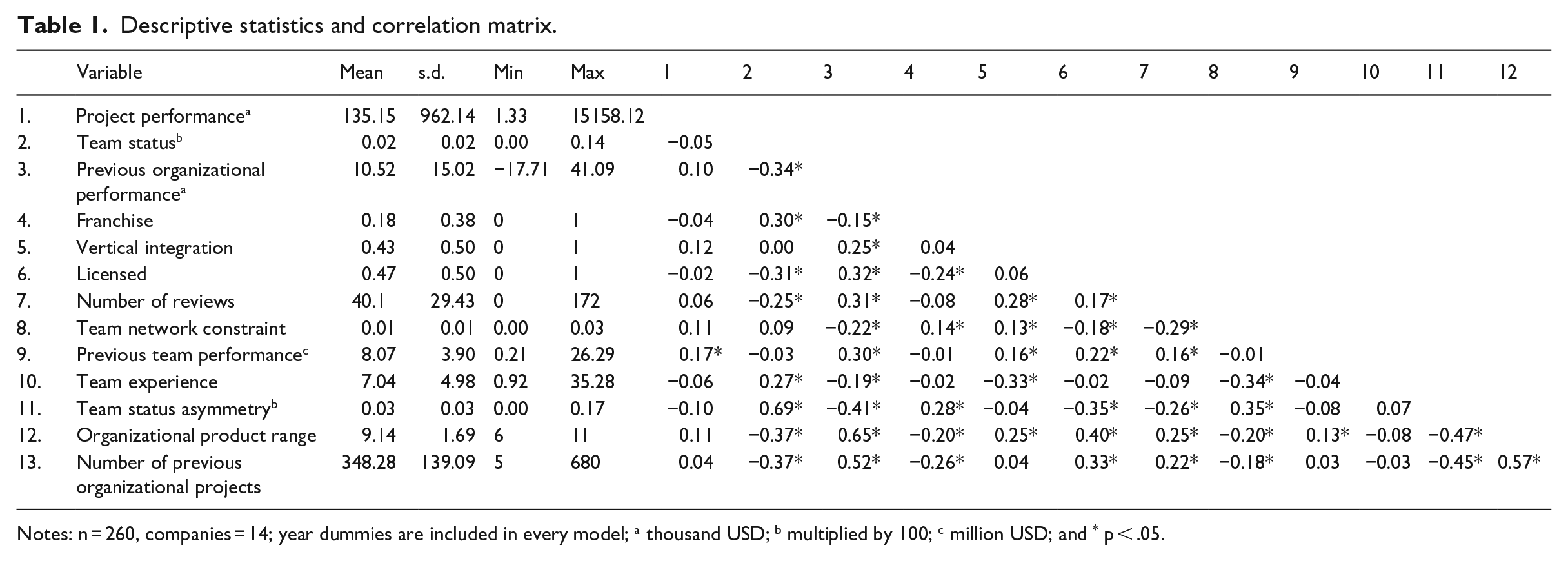
Notes: n = 260, companies = 14; year dummies are included in every model; a thousand USD; b multiplied by 100; c million USD; and * p < .05.
Since teams are nested in organizations, there might be within-cluster dependence among the observations (Washington and Zajac, 2005). Hence, we built a linear mixed-effects model, including organizations as a level 2 random effect. Since no project was implemented by the same set of individuals, our observations were not nested in project teams. Table 2 presents our statistical analysis of the predictors of project performance. As expected, team status positively affects project performance (Model 2: β = 0.33, p < 0.01).
Estimates for mixed-effects models of the natural logarithm of project performance.
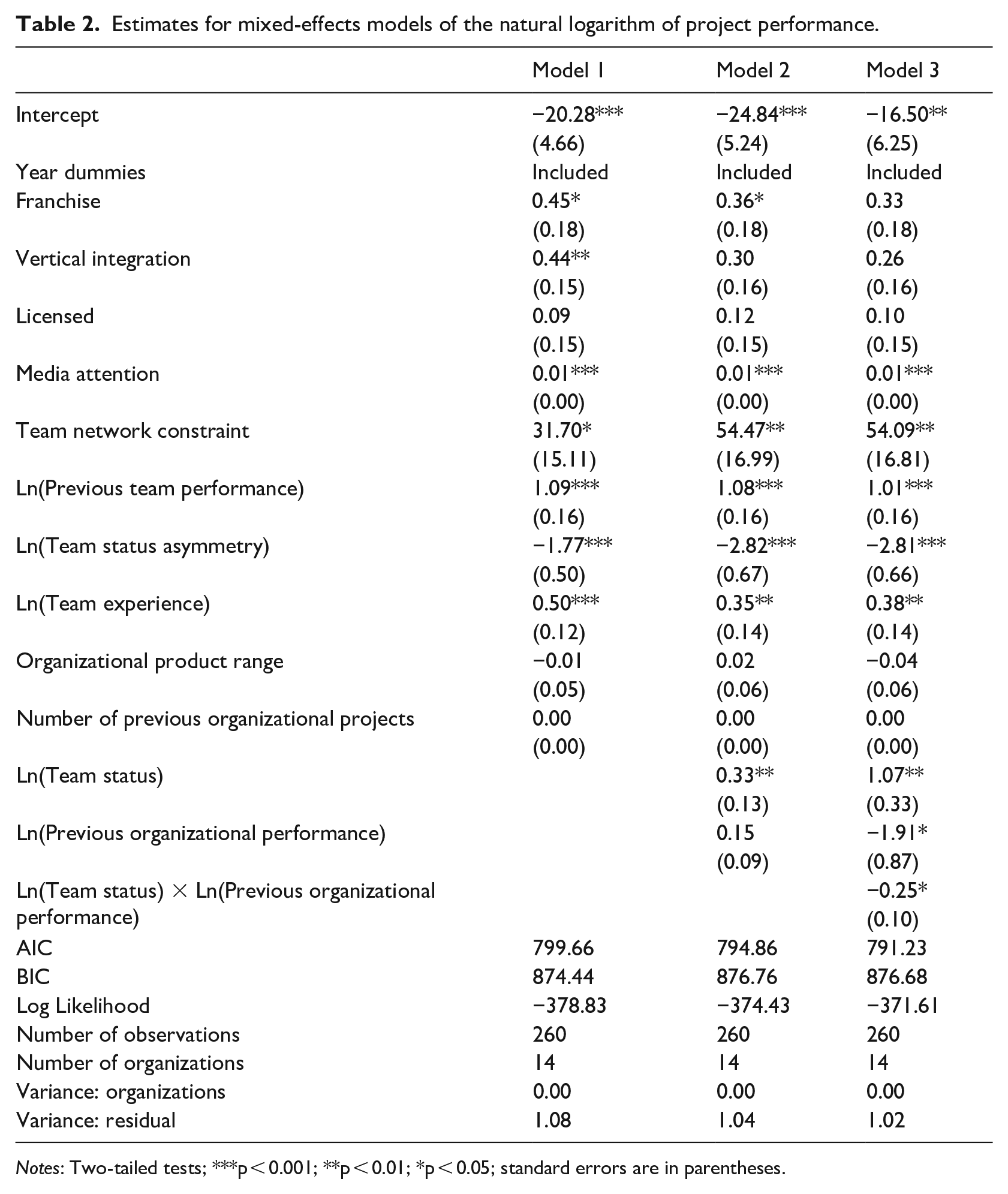
Notes: Two-tailed tests; ***p < 0.001; **p < 0.01; *p < 0.05; standard errors are in parentheses.
Model 3 shows our test for our moderation hypothesis which predicts that previous organizational performance negatively moderates the relationship between team status and project performance. The coefficient of the interaction effect between team status and revenues generated by previous innovation projects is indeed negative and significant (β = −0.25, p < 0.05). To show more clearly the differences in effect size, we depict in Figure 1 the effect of team status on project performance when previous organizational performance is low (one standard deviation below the mean) or high (one standard deviation above the mean). As expected, with the increase of previous organizational performance, the effect of team status on project performance decreases. The slope of team status is positive and non-significant at high values of the moderator (β = −0.04, p > 0.10), whereas it is positive and significant at low values (β = 0.39, p < 0.05). This supports our hypothesis.
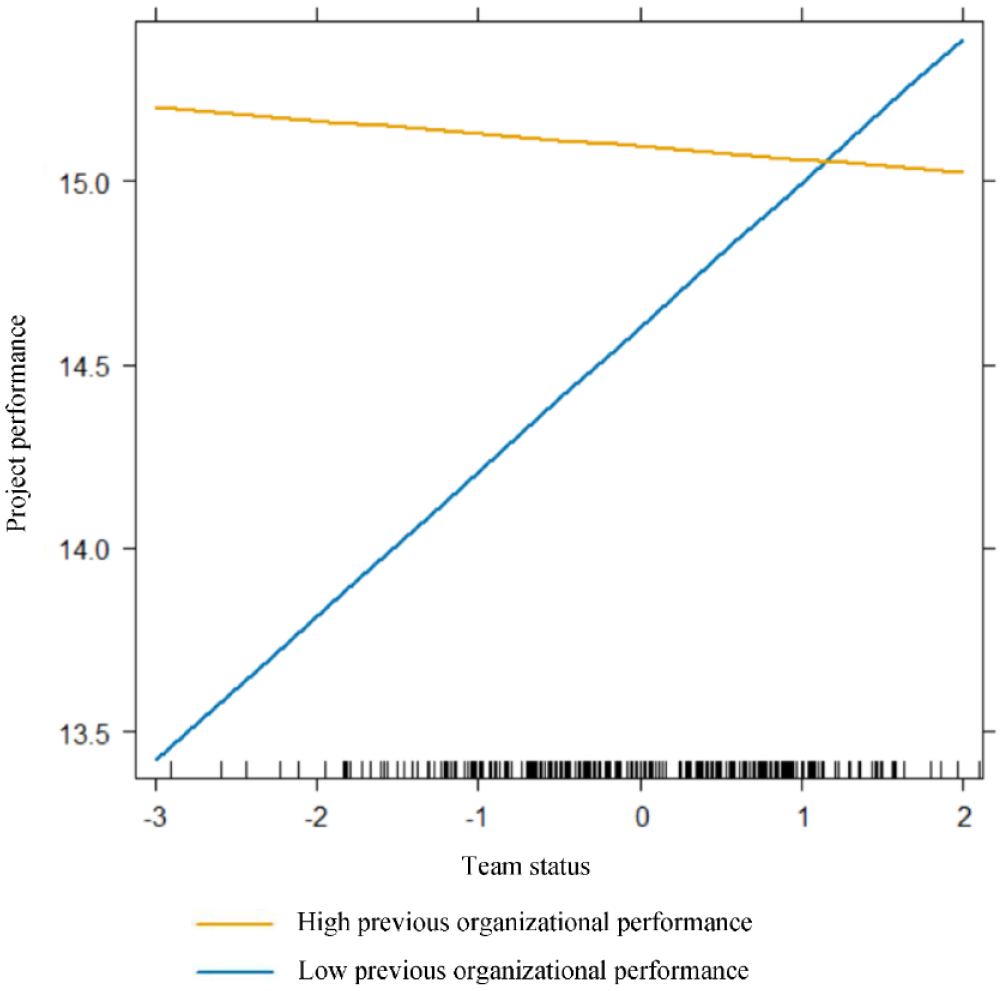
Moderating effect of previous organizational performance on the relationship between team status and project performance.
Additional analyses
We conducted some additional analyses to substantiate our findings and to address some alternative explanations. First, we were concerned about the possibility of endogeneity due to a selection bias. We were focusing on video games developed for PlayStation 2 which is a platform that is created by a Japanese organization: Sony. Therefore, it is possible that video games developed by Japanese organizations had a higher likelihood of being selected into our final sample, which may have affected our statistical results. In order to control for that, we checked our results using Heckman’s two-stage selection procedure (Heckman, 1979). First, we created the variable country of organizational headquarter in order to use it as an instrument in our analysis. The headquarters of all the organizations in our sample are located in three countries: the United States, Japan, and France. In our selection equation, we regressed all the variables for which we had full information in our full dataset of all 6041 projects developed by the 22 organizations in our sample: year of release, license, project size, and the number of reviews. We also included project novelty, because we could also create this variable for all the 6041 projects. Project novelty was included as a dummy variable, and it was created by using 62 category codes based on information from MobyGames.com. The category codes could take the values 0 or 1, 1 meaning that the game fitted into a certain category (e.g. action game, racing game, etc.). We considered a project to be novel when it was new-to-market meaning that there was no game of the same type (i.e. with the same combination of category codes) that had been released prior to the game in question (Stettner and Lavie, 2014). In addition to these variables, we also included the country of headquarter in the form of two dummy variables for the United States and Japan, with France being the reference category, on the likelihood of being selected into our final sample of 260 projects using the sample of all 6041 projects developed by the 22 organizations in our sample. Running this regression, we found that video games developed by organizations which had their headquarter in Japan indeed had a higher likelihood of getting into our final sample, and the second stage regression provided further support for our hypothesis (see Table 3). Our additional analyses showed that the variable country of headquarter did not have a significant relationship with project performance, though.
Estimates for Tobit two-stage regression models of the natural logarithm of project performance.
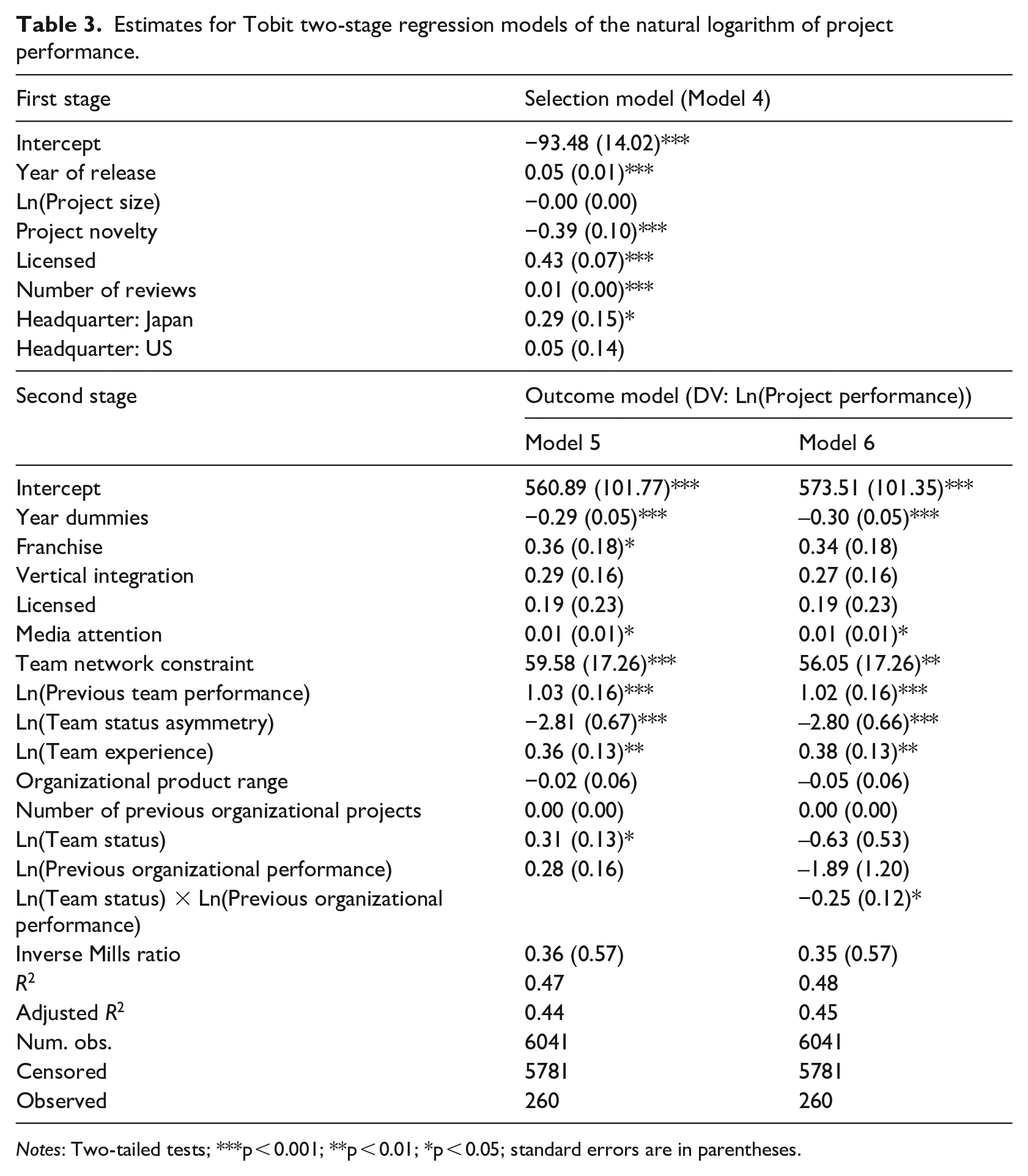
Notes: Two-tailed tests; ***p < 0.001; **p < 0.01; *p < 0.05; standard errors are in parentheses.
Second, we were concerned about the possibility that previous organizational performance might moderate the relationship between team status and project performance due to knowledge spillover effects. It can be argued that in organizations which demonstrated superior performance in the recent past, low-status teams manage to reach the performance level of their high-status counterparts, because they learn how to implement innovation projects more effectively from high-status teams, and thus, become more competent. We addressed this explanation as follows. First, we checked whether the standard deviation in project performance is higher in organizations with high previous performance. The intuition behind this is that if there is a higher level of spillover in organizations with high previous performance, there should be less variance in project performance, since all teams should possess a similar amount of knowledge about video game development. Comparing the standard deviation of revenues generated by new products in organizations with below and above average previous performance, we found that the standard deviation is about 34% higher in organizations with high previous performance. We also compared the standard deviation in our measure of project performance (revenues generated per capita), and we found that the standard deviation is more than 16 times (1539%) higher in organizations with above average previous performance. Second, if previous organizational performance increases knowledge spillover between low- and high-quality teams, it should have a similar negative moderating effect on the relationship between previous team performance and subsequent project team performance, because quality is more closely linked to previous performance than to status (Washington and Zajac, 2005). If previous organizational performance affects the teams’ ability to share knowledge with their less-knowledgeable counterparts, teams with low previous performance should exhibit similarly high subsequent performance as teams with high previous performance in well-performing organizations. In other words, the performance difference between these teams should decrease with the increase of previous organizational performance. In order to investigate this idea, we checked whether previous organizational performance negatively moderates the relationship between previous team performance and project performance, and found that our moderator, in fact, positively moderates this relationship (β = 0.99, p < 0.01). This means that the difference between the exhibited performance levels of teams with high and low previous team performance is larger, and not smaller, in organizations with high previous performance. Thus, the gap between these teams seems to become larger. In organizations with low previous performance, however, the performance difference between teams with high and low previous team performance is relatively smaller. Specifically, when previous organizational performance is one standard deviation below its average, the relationship between previous and subsequent project team performance is statistically insignificant (β = 0.08, p > 0.10). These results made us confident that the alternative explanation of spillover effects does not seem to hold. To that end, we do not see in our data how spillover effects helped teams that performed less well in the past to perform better in a subsequent project.
Third, we checked whether the main reason why we observe a significant relationship between team status and project performance, and a significant moderating effect of previous organizational performance on this relationship, is due to biased estimates because of the limited sample of organizations in our analysis (n = 14). To do so, we ran ordinary least squares (OLS) regressions without including organizations as a level 2 clustering variable. Our OLS regressions provided support for our hypothesis (β = −0.25, p < 0.05).
From these findings, we draw the following key conclusions. First, the main reason why we observe a statistically significant and positive relationship between team status and project performance and a statistically significant negative moderating effect of previous organizational performance on this relationship is not due to selection effects, nor due to the limited sample of organizations. Second, the moderating effect of previous organizational performance on the relationship between team status and project performance cannot be explained by knowledge spillover.
Discussion
In this article, we suggested that when slack resources are expected to be available, low-status teams have a similarly good access to development resources as their high-status counterparts. We hence theorized that the relationship between team status and performance becomes weaker in organizations with high previous organizational performance—here, slack resources can indeed be expected—compared to organizations with low previous performance. Investigating the largest organizations in the video game industry, we found support for our hypothesis. As such, our results extend our insights into how status affects teams’ ability to create successful new products in innovating organizations, especially incumbents.
Theoretical contributions
Our study makes important contributions to different areas of management theory. First, our findings extend the literature on status. Based on previous research, one may argue from an alter-centric point of view that managers often favor high-status teams. This provides these teams with exclusive access to resources others do not have and allows them to perform much better (Azoulay et al., 2014; Merton, 1968; Piazza and Castellucci, 2014; Reitzig and Sorenson, 2013; Sauder et al., 2012). We show when status matters the most by looking at the moderating effect of previous organizational performance. Our findings demonstrate that previous organizational performance plays an important moderating role—it affects the expected amount of slack resources available for product development in organizations. As a consequence, low-status teams in organizations with a history of high performance can access a comparable amount of resources for their innovation projects as high-status teams can do.
Second, while it has been repeatedly shown that status has a positive effect on the performance of social actors, previous management research holds a similarly positive view regarding the effects of previous organizational performance on subsequent project and organizational performance. This is because previous performance is an important source of organizational reputation (Hall, 1992) that should positively impact the performance of subsequent development projects (Henard and Dacin, 2010). We contribute to the ongoing debate on the contingency factors of the performance effects of status (Kovács and Sharkey, 2014; Maoret et al., 2023; Sharkey and Kovács, 2018; Szatmari, 2022) by revealing that previous organizational performance is also an important contingency factor that affects high-status actors’ ability to outperform others in a context where ongoing development projects compete for resources with each other.
Third, our research deepens our understanding of the factors that affect organizational decision-making in new product development projects. The purpose of this decision-making process is to determine the allocation of resources and organizational support (Markham and Lee, 2013). Although decision makers typically apply a set of formal criteria to select which projects they think are most worthy of receiving organizational support and resources for further development, previous innovation management research has shown that these decisions cannot entirely be explained by rational and formal criteria (Green et al., 2003; Schmidt and Calantone, 2002; Sleesman et al., 2012) because innovation projects are inherently uncertain (Van de Ven, 1986). This is echoed by our industry experts in the video game industry, as well. Strategic management scholars have been paying increasing attention to how informal factors, such as networks (Baer, 2012), coalitions (Sethi et al., 2012), and status (Reitzig and Sorenson, 2013), affect these resource allocation decisions. Our research contributes to the innovation management literature by highlighting the importance of previous organizational performance for these decisions. We show that past performance affects the strength of status signals that project teams send to decision makers.
Limitations
Like all research, our study is also subject to limitations. First, our results should be generalized with caution beyond the console video game market and the video game industry. Despite the fact that all innovation projects involve some degree of uncertainty in every industry, there may be variation across industries, which might influence the effectiveness of status signals (Podolny, 1994). In addition, our selection process could also be a concern, influencing the generalizability of our results. Although selecting the largest organizations has been a widely applied method in previous research (e.g. see the works of Bunderson (2003) and Granados and Knoke (2013) on status), our sampling process might have introduced some bias in our study toward more successful and larger organizations, which should be taken into account. It is possible, for instance, that in smaller organizations, status might have an even stronger influence due to a higher level of resource scarcity and competition for resources.
Second, we do not have information on projects that were not implemented. Hence, one may argue that our data did not reflect the actual social networks of the organizations analyzed in this study—a common limitation in social network studies aimed at analyzing affiliation networks (Cattani and Ferriani, 2008; McFadyen and Cannella, 2004; Uzzi and Spiro, 2005). While we recognize the importance of this limitation, it can nevertheless be argued that affiliation networks serve as an adequate proxy for the actual social network. Moreover, it can also be argued that this type of critique is less applicable to studies which focus on the signaling effects of status, since the main focus of such studies is not the analysis of communication or information flows in the network, but to examine how a team’s ability to provide high-quality work is perceived (cf. Kim and Rhee, 2017; Waguespack and Sorenson, 2011). We believe that ties stemming from projects that have been implemented should contribute to status to a larger extent than ties stemming from projects that have not been implemented.
Third, our results might be driven by endogeneity caused by selection bias. It is possible that high-status teams tend to get the most promising projects. In this article, we argue it is likely that high-status teams get the projects with the most resources, and in this sense, they do get more promising projects than others. However, according to our industry experts, status does not affect any other characteristic of video game concept development. As one of them pointed out, “[i]t’s absolutely random” what kind of projects developer teams get from managers. Another suggested that high-status teams “typically work on large-budget projects. [. . .] They probably get the blockbuster works,” which is in line with our theoretical arguments. In addition, our correlation table suggests that characteristics which should indicate to managers that one project may be more promising than another (and thus should positively correlate with project performance), in fact, negatively correlate with team status. These characteristics are the following: licensed and franchise projects. And even in the unlikely situation that the outcomes are caused by the selection of projects and teams, we argue that our results would still imply that managers in organizations with low previous performance are more influenced—also in terms of team selection processes—by status signals than managers in more successful organizations. To that end, our paper would still show how the organizational context affects the reliance on status signals in managing innovation.
Finally, we made some methodological choices that future research should scrutinize. For instance, we set the tie decay parameter to 3 years following prior network analytic studies in similar contexts (e.g. Ferriani et al., 2009); however, this parameter might be too low or too high to accurately capture the status of teams. In addition, because we measured the intraorganizational status of teams, external developers, on average, tended to have lower intra-organizational status scores than internal developers. Although we believe this is justifiable, since it is reasonable to assume that external organizational members have lower influence on an organization’s internal resource allocation decisions, future research should investigate the validity of this approach.
Practical implications
Our study also offers important implications for practice. The findings suggest that practitioners should pay attention to the effects of quality signals when making decisions relating to projects. More specifically, our results show that in organizations with low previous performance, high-status teams are more likely to implement highly successful projects (or hits) than their low-status counterparts, whereas low-status teams in these organizations have a high likelihood to implement failures (or flops).
Although one may conclude from our findings that decision makers should rely on status signals in organizations with low previous performance, and, therefore, distribute resources unevenly between low- and high-status teams—provided that the effect of team status on performance is highly positive in such a setting—we would advise to refrain from making such hasty conclusions. We theorized that the effect of status is positive because decision makers should favor high-status teams when distributing organizational resources among the development teams. This creates an interesting paradox in low-performing organizations. While the main reason why an organization failed to implement successful innovations in the past is because their high-status teams failed to exhibit high performance (along with their low-status counterparts), these conditions seem to push decision makers to favor high-status teams even more going forward. We suggest that this paradox should be addressed by keeping an organization’s overall innovation strategy in mind. Is the strategy to aim for hits or is the strategy to avoid flops (Csaszar, 2013)? Decisions which govern the distribution of resources should be aligned accordingly. Thus, if the organization’s strategic goal is to avoid flops, prioritizing high-status teams in the distribution of resources might be an issue in organizations with low performance. In these settings, decision makers should better not be led too much by quality signals in their decision-making process. Doing so could be problematic since in low-performing organizations, decision makers run the risk of underfunding the projects of their low-status teams. In low-performing organizations that want to prevent failures; therefore, it might be useful to have a blind project selection review process before making final resource allocation decisions. Of course, providing low-status teams with more resources might come at the expense of providing high-status teams with fewer resources, but this should be less problematic given the strategic goal of avoiding flops. Another measure managers could consider in low-performing organizations is to better coordinate the information-flow. Low-status teams have access to less information and resources than their high-status counterparts via their network ties, which limits their ability to exhibit high project performance. Managers, however, can create roles in their organization for individuals to serve as bridges in their network to connect high- and low-status individuals and teams to facilitate information diffusion.
In contrast, one may argue that status should not matter in organizations with a track record of successful innovations because our results show that low-status teams perform equally well as their high-status counterparts. Again, we argue that decision makers should carefully consider their innovation strategy when distributing organizational resources. If the organization’s strategic goal is to maximize the likelihood of hits, decision makers in organizations with high previous performance might face the issue of not prioritizing enough those teams which they believe to be the most competent ones (i.e. high-status). In these organizations, there is a lower likelihood that a high-status team is able to create the best performance it could, if it were provided with more support and resources. This is a particularly concerning issue when an organization is aiming to implement blockbusters, even at the potential expense of generating some flops in the process (e.g. as many organizations do in hit-driven industries). Thus, decision makers should be careful not to completely disregard status signals in their resource allocation decisions. Disregarding quality signals completely could be detrimental to the fit between the performance exhibited by projects implemented by the organization in question and the organization’s strategy in such settings, since high-status teams cannot completely fulfill their potential. This can be revised by implementing mechanisms that give more weight in the formal decision-making process to the teams themselves, and thus less weight to their product ideas.
Footnotes
Acknowledgements
The authors would like to thank the editor, Oliver Alexy, and three anonymous reviewers of Strategic Organization for their valuable suggestions and comments provided throughout the reviewing process.
Funding
The author(s) received no financial support for the research, authorship, and/or publication of this article.
