




Abstract
Spin-outs (new ventures founded by ex-employees) have received attention partly due to the potential negative implications they present to the incumbents from which they originate (i.e. parents). Spin-outs can threaten parents not only because of the increased future competition but also because of the immediate disruptions to their knowledge bases. These negative implications rest on the notion that parents are mere bystanders. We depart from this bystander notion by considering parents’ adaptations to disruptions caused by spin-outs. Specifically, we investigate both the effects of spin-outs on parents’ innovation and the factors that motivate and enable parents to cope with the knowledge gaps arising from spin-outs. We demonstrate that although spin-outs dent parents’ innovation output in the knowledge areas affected by spin-outs, such decline is non-enduring. We also argue and demonstrate that the importance of knowledge areas affected by spin-outs as well as the availability of human capital—internal and newly hired—drive the recovery of parents’ innovation output. We contribute to the literature by refining the theoretical and empirical understanding of the factors shaping parents’ adaptation and creative reconstruction in the aftermath of spin-outs.
Keywords
Introduction
The departure of skilled employees from incumbents to found new ventures, dubbed spin-outs, has attracted significant scholarly attention in strategy and entrepreneurship (Agarwal et al., 2004; Bahoo-Torodi and Torrisi, 2022; Campbell et al., 2012; Cirillo, 2019; Kim and Steensma, 2017). Specifically, strategy scholars suggest that spin-outs have strategic implications for the incumbents from which they originate (i.e. parents), building on the premise that employees create, store, and recombine firm-knowledge to drive innovation (Kogut and Zander, 1992; Schillebeeckx et al., 2021; Xiao et al., 2022). Some argue that spin-outs can disrupt the knowledge production and storage in parents, impacting them adversely and even crippling them terminally (Agarwal et al., 2016; Campbell et al., 2012; Phillips, 2002). By contrast, others contend that certain spin-outs may benefit parents in the long run through knowledge spill-ins flowing from the spin-out to the parent (Cirillo, 2019; Kim and Steensma, 2017). Despite the diverging implications of spin-outs for parents, these two lines of work relegate parents to bystanders, neglecting their adaptation to disruptions caused by spin-outs (Agarwal and Helfat, 2009; Hrebiniak and Joyce, 1985; Martin and Cuypers, 2024). This omission leaves a crucial gap in our understanding because the macro effects of spin-outs on parents may depend on micro-level factors that drive parents’ adaptation.
This study addresses this gap by considering parents’ adaptation after spin-outs occur. Specifically, we ask the following research questions: Which factors associated with parents modify the effects of spin-outs on parents’ innovation? To what extent do spin-outs affect parents’ innovation? To answer these questions, we draw on the micro-foundations of the knowledge-based view and locate the effects of spin-outs on parents’ innovation not at the firm level but at the level of the knowledge areas where the departed employees worked (Davis and Aggarwal, 2020; Felin et al., 2015; Grant, 1996b; Kogut and Zander, 1992). Focusing on parents’ knowledge areas, we argue that spin-outs depress parents’ innovation output in the affected knowledge areas. We probe this baseline effect by building on the premise that parents differ in their motivation and capacity to adapt to spin-outs. We posit that the importance of the impacted knowledge area motivates parents to recover innovative output in the affected areas (Aggarwal et al., 2017; Hall et al., 2005). We also argue that how fast parents can replenish the gaps arising from spin-outs depends on the degree to which they can deploy human capital (internal and newly hired) and bring in external knowledge through patent acquisitions in the affected knowledge areas (Ahuja and Katila, 2001; Caviggioli et al., 2017; Ganco et al., 2020).
We tested our predictions using a comprehensive data set that allowed us to track the life histories of incumbents and new ventures in the semiconductor industry between 1997 and 2014. Our results show that parents’ innovation output is impaired in knowledge areas subject to spin-outs. However, the impairment does not persist. Furthermore, our results show that the extent of impairment and recovery depends on factors associated with the impacted knowledge area. We demonstrate that the impairment that parents suffer is short-lived when the affected knowledge area is of greater importance to the parent. We also show that parents are able to mitigate the adverse impact of spin-outs when human capital—internal and newly hired—is available to fill voids arising in the knowledge area affected by spin-outs. Finally, we did not find evidence in favor of efforts to fill the voids left by spin-outs through direct knowledge acquisition. Specifically, we found that patent acquisitions in the affected knowledge area did not assist in the recovery of the parents’ innovation output.
This study makes two major contributions. First, we extend the literature on the strategic impact of spin-outs on parents by considering parents’ adaptive responses in the knowledge areas affected by spin-outs (Agarwal et al., 2016; Campbell et al., 2012; Cirillo, 2019; Cirillo et al., 2018; Ioannou, 2014; Kim and Steensma, 2017; McKendrick et al., 2009; Phillips, 2002). Our focus on the deliberate mechanisms that drive the recovery of the parents’ innovation output complements prior work focusing on passive knowledge absorption and integration mechanisms, for example, knowledge spill-ins flowing from the spin-out to the parent and proximate isomorphism between the parent and the spin-out (Friesl et al., 2019; Ioannou, 2014). We, therefore, illuminate the means by which the creative construction process can unfold (Agarwal et al., 2007). Furthermore, by specifying the conditions under which adaptation occurs, our study delineates the boundary conditions for the adverse effects of spin-outs on parents. In this respect, our study highlights the impact of spin-outs on the affected knowledge areas and reveals heterogeneity in recovery. Second, our adaptation focus complements previous work on organizational change by shedding light on firms’ adaptation through firm-specific mechanisms (Eggers and Kaul, 2018; Eggers and Park, 2018; Joseph and Gaba, 2020; Schijven and Hitt, 2012). Our study also offers insights into the managerial levers that enable parents to adapt to spin-outs—the redeployment of internal and external human capital (e.g. Dickler and Folta, 2020; Karim and Capron, 2016)—and those that do not (i.e. the acquisition of patents).
Theory and hypotheses
The knowledge-based view of the firm and the knowledge recombination perspective of innovation underscore the role of employees as creators of knowledge and explain how firms use that knowledge to innovate (Grant, 1996b; Nelson and Winter, 1982; Nonaka, 1994; Schillebeeckx et al., 2021; Xiao et al., 2022). From this theoretical standpoint, employees play a role that goes beyond the mere execution of daily tasks; they possess a nuanced understanding of what routines and processes to activate and when to perform them (Cyert and March, 2006; Nelson and Winter, 1982). Employees can achieve such activation and execution of routines by interacting with other members of the organization, decoding messages, and interpreting information in ways unique to the organization (Guan and Liu, 2016; Kogut and Zander, 1992; Schillebeeckx et al., 2021). However, because employees are under limited organizational control and are free to quit at will (Campbell et al., 2012a; Coff, 1997), firms are exposed to the risk of disruptions to these processes and routines when employees leave.
Prior research suggests that departures are particularly challenging when employees leave to establish their own ventures (Agarwal et al., 2016; Campbell et al., 2012; Phillips, 2002; Wezel et al., 2006). Such departures can rupture the organizational fabric that not only knits members together but also functions as a collective repository of tacit knowledge necessary for performing the recombinations needed for innovation (Argote et al., 2003; Phillips, 2002; Schillebeeckx et al., 2021; Xiao et al., 2022). Employee departures, therefore, result in knowledge gaps that can be costly to fill, ultimately threatening firm failure (Agarwal et al., 2016; Campbell et al., 2012; Phillips, 2002; Wezel et al., 2006). In making this bleak prognosis, however, this line of work relegates parents to mere bystanders, overlooking their propensity and potential to adapt to disruptions caused by spin-outs.
Nevertheless, recent studies present a countervailing view of spin-outs, somewhat tempering the gloomy outlook for parents. This line of work argues that certain types of spin-outs benefit parents in the long run due to knowledge spill-ins from spin-outs to parents (Cirillo, 2019; Kim and Steensma, 2017) and to improved alignment with the internal (Friesl et al., 2019; Ioannou, 2014) and the external environment (McKendrick et al., 2009). However, by focusing on spin-out characteristics, this line of work fails to attend to parent characteristics that drive action and facilitate adaptation to disruptions, a failure that emanates from considering parents as bystanders.
In contrast to the literature outlined earlier, we subscribe to the notion that parents adapt to disruptions caused by spin-outs and focus on parent characteristics that motivate and enable adaptation. We argue that parents’ motivation to adapt to spin-outs hinges on how severely the knowledge gaps resulting from spin-outs threaten their innovation output. In addition, we posit that parents’ adaptation is influenced by their capacity to mobilize resources to fill knowledge gaps caused by spin-outs. Specifically, we build on the knowledge recombination perspective to assert that parents’ capacity to fill knowledge gaps depends on the extent to which they can redeploy human capital internally and externally and the extent to which they can acquire knowledge developed externally. These contingencies are further elucidated after establishing the baseline effects of spin-outs on parents’ innovation.
Effects of spin-outs on parents’ innovation
Innovation is driven by processes of trial and error as well as recombination (Fleming, 2001; Karim and Kaul, 2015; Nelson and Winter, 1982; Xiao et al., 2022). These processes join technical and market knowledge to set in motion cycles of experimentation and problem-solving (Von Hippel and Katz, 2002; Von Hippel and Tyre, 1995). The primitive elements within organizations that actuate these processes are the individuals, the tasks they perform, and the devices they employ. A network of these elements orchestrates interdependent actions that become the locus for the creation, retention, and transfer of new knowledge (Argote and Miron-Spektor, 2011; Felin et al., 2015; Guan and Liu, 2016; Schillebeeckx et al., 2021).
Our baseline expectation builds on the notion that parents’ knowledge production mechanisms are disrupted when employees leave to create spin-outs (e.g. McKendrick et al., 2009; Phillips, 2002; Wezel et al., 2006). Employees store tacit knowledge, which is integrated through spontaneous interaction patterns enabled by coordination processes and shared firm knowledge (Grant, 1996a; Kogut and Zander, 1992). These interactions drive the mechanisms that combine knowledge elements to produce new knowledge. The departure of employees to form spin-outs affects both the structural and performative aspects of knowledge-production mechanisms due to the loss of tacit knowledge (Feldman and Pentland, 2003; Phillips, 2002).
An adaptive view of organizations would suggest that the loss of tacit knowledge residing with departing individuals is apt to engender changes in the schemas of interdependent actions through task repartitioning (e.g. Nelson and Winter, 1982). It also suggests the emergence of new configurations of the three primitive elements—individuals, tasks, and devices—due to the introduction of new information, perceptions, and implementations (Feldman and Pentland, 2003). However, to the extent that these modifications take time to settle into stable and repetitive patterns (e.g. Carroll and Hannan, 2000), employee departures to spin-outs are likely to adversely affect the efficiency and effectiveness of knowledge production, at least in the short term. Moreover, these adverse effects are likely to be localized in specific knowledge areas where the departed employees were active. Thus, we propose the following hypothesis:
Baseline hypothesis: A spin-out in a firm’s knowledge area has a negative, non-enduring association with the firm’s innovation output in that knowledge area.
In our baseline prediction, we expect that parents will adapt to reduce the negative impact of spin-outs. To better understand how parents recover their innovation output after losing human capital to spin-outs, we next examine the conditions that motivate and enable their adaptation. We distinguish between the motivation for adaptation and the levers that the parent can pull to adapt to spin-outs. Below, we suggest that the motivation for adaptation derives from the importance of the affected knowledge area, which refers to whether a particular knowledge area occupies a salient position in the knowledge portfolio of the firm. We then consider the ways in which firms restore the knowledge production mechanisms that drive innovation output.
Importance of the affected knowledge area
Given the disruptions that spin-outs cause in the departed employees’ areas of expertise, the rate at which parents seek to adapt comes with the following trade-off. Adapting slowly may threaten parents’ knowledge and competitive position in the focal area (e.g. Levinthal and March, 1993). Conversely, adapting rapidly by taking brisk actions to limit potential losses and regain lost positions in the focal area may burden parents with higher adjustment costs (e.g. Levinthal, 1991). We argue that the net benefit calculus for a parent depends on the importance of its position in a given knowledge area. This is because the costs of intra-organizational adjustments may have an upper limit, but the losses from the erosion of the firm’s position in a knowledge area can be total and irreversible (Argyres et al., 2019; Bigelow et al., 2019). The costs of internal adjustment following a spin-out may be nontrivial, but they involve the continuation of a path in which the parent was engaged (Lichtenberg, 1988). Consequently, the motivation to adjust depends on how critical the affected knowledge area is to the parent. That is, the importance of the knowledge area for parent’s knowledge position becomes a key factor driving the net benefit calculus.
Firms build their knowledge positions in various knowledge areas by investing in R&D to develop proprietary stocks of knowledge that help them generate future income (Jaffe, 1986). To the extent that proprietary knowledge stocks have a significant impact on a given knowledge area, firms are naturally motivated to protect their positions in those knowledge areas from leakage and erosion (Oxley and Wada, 2009; Ziedonis, 2004). Losing knowledge from a more significant area for the firm elevates the level of threat, compelling urgent action to rebound and protect the firm’s position in that area. Particularly, in high-tech sectors where technology advances cumulatively, incumbents often engage in patent portfolio races with each other, and any drop in innovation rates may weaken their ability to safeguard their bargaining positions (Ziedonis, 2004). Thus, parents are more motivated to regain their innovation levels in knowledge areas in which they hold impactful patent portfolios. Hence, we posit that:
Hypothesis 1: The greater the importance of the knowledge area affected by a spin-out, the speedier the recovery of the firm’s innovation output in that knowledge area.
Internal and external human capital
As previously indicated, spin-outs can interrupt innovation within parents along two dimensions. The first dimension is the loss of accumulated experience and knowledge residing in the departing individuals that contribute to the development of innovations; the second dimension is the disruption of the routines that sustain inherently interdependent innovation tasks (Phillips, 2002; Wezel et al., 2006). To maintain innovation levels ex-post, parents depend on their capacity to replenish knowledge gaps and restore the effectiveness with which employees complete innovation-related tasks (McKendrick et al., 2009).
One adaptation parents can undertake to alleviate the disruptive effects of spin-outs on innovation is to deploy “new” human capital with the requisite knowledge and skills (e.g. Bidwell and Keller, 2014; Dickler and Folta, 2020; Karim and Capron, 2016). To the extent that human capital with the desired knowledge and skills is available, parents may still have to make appropriate adaptations to recover their innovation output (e.g. Cohen and Levinthal, 1990; Parrotta and Pozzoli, 2012). Notwithstanding their knowledge and skills, human capital still has to adjust to the localized knowledge production context affected by spin-outs for at least two reasons. First, the knowledge to be refilled is tacit, sticky, and socially embedded (Guan and Liu, 2016; Nonaka, 1994; Szulanski, 1996). Second, experimentation and recombination, which are essential for innovation, are context-dependent processes shaped by firms’ social, cultural, and cognitive frames (Brown and Duguid, 2001; Nonaka and Von Krogh, 2009).
These considerations suggest two distinct sources of human capital for firms to revive any loss in innovation output following spin-outs: internal and external human capital. Internal human capital refers to human capital already affiliated with a firm that is well acquainted with the knowledge areas in which gaps have emerged. Such human capital is also well immersed in the organizational context and is thus equipped with an understanding of the roles and informal procedures of coordination necessary for knowledge production (Bidwell and Keller, 2014; Ganco et al., 2020; Grant, 1996a). External human capital refers to the human capital recruited by a firm that is conversant with the knowledge area but is alien to the knowledge area and the firm (Parrotta and Pozzoli, 2012). Neither internal nor external human capital may necessarily substitute identically and permanently for the lost human capital (Bidwell and Keller, 2014). However, their availability can facilitate parents’ adaptation and buffer the impact of spin-outs. Therefore, we propose the following hypotheses:
Hypothesis 2a: The greater the number of internal inventors with expertise in the knowledge area affected by a spin-out, the speedier the recovery of the firm’s innovation output in that knowledge area.
Hypothesis 2b: The greater the number of newly hired inventors with expertise in the knowledge area affected by a spin-out, the speedier the recovery of the firm’s innovation output in that knowledge area.
Acquisition of externally developed knowledge
In the foregoing hypothesis, we focus on the human capital-based mechanisms that facilitate parents’ adaptation to spin-outs. The human capital dimension underscores the need for tacit knowledge to drive a firm’s inventive routines (Nelson and Winter, 1982). In addition to replenishing tacit knowledge, parents may rely on acquiring codified knowledge to offset the losses arising from spin-outs (Jaffe, 1986; Kogut and Zander, 1992; Leiponen and Helfat, 2010). To the extent that patents codify knowledge and support appropriability, firms can utilize the secondary markets for patents to access and own innovations related to the affected knowledge areas (Ahuja and Katila, 2001; Arora et al., 2001; Caviggioli et al., 2017; Figueroa and Serrano, 2019). Access to and ownership of at least the codified components of innovations not only reduces the likelihood of being fenced in by others (Hall and Ziedonis, 2001; Kwon and Marco, 2021; Ziedonis, 2004) but also lowers the barriers for parents to develop follow-on innovations and to recombine with other in-house innovations (e.g. Fleming, 2001). Consequently, patent acquisitions in the affected knowledge area can enhance the cumulative value of innovations in the area and help parents recoup and maintain their innovation output in the affected knowledge area. Therefore, we propose the following hypothesis:
Hypothesis 3: The greater the number of secondary market patent acquisitions in the knowledge area affected by a spin-out, the speedier the recovery of the firm’s innovation output in that knowledge area.
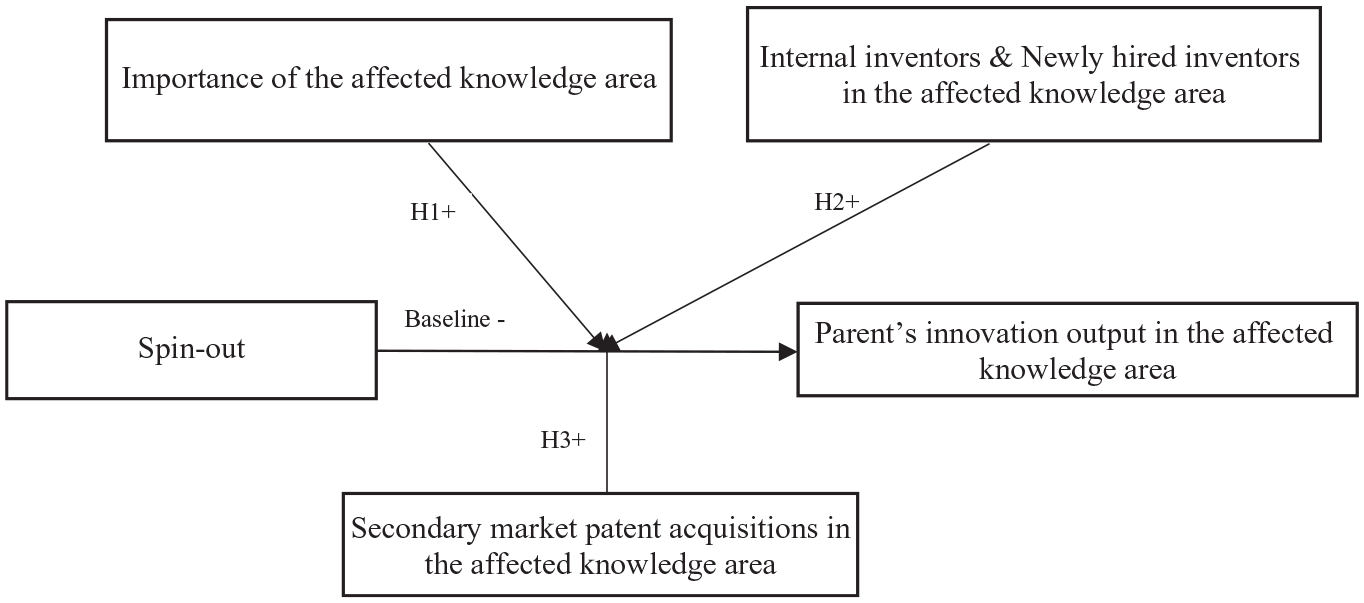
Conceptual framework.
Methods
Industry context and data description
We tested our hypotheses using a comprehensive data set from the US semiconductor industry between 1997 and 2014. This industry provides an interesting and appropriate context for our investigation of the relation between spin-outs and parents’ innovation output for several reasons. First, spin-out activity in this industry has been very high since its inception and has attracted considerable research; therefore, this focus is useful for building on extant research (Brittain and Freeman, 1986; Holbrook et al., 2000). Second, the industry offers a suitable context for studying inventive adaptation because of its high rate of innovation (Macher et al., 1998). Finally, firms in this industry have a high propensity to file patents, which allows the creation of patent-based measures of innovation output (Hall and Ziedonis, 2001).
We assembled our data set using several archival sources. We obtained a list of publicly traded US semiconductor firms, including their financials, from Compustat. We constructed the patent histories of firms and individuals from patent records provided by PatentsView (www.patentsview.org). To track the alliance as well as the merger and acquisition activity of the companies in the data, we drew from the Strategic Alliance and Mergers and Acquisitions database of Refinitiv SDC. Finally, to identify which firms on the list have experienced a spin-out, we compiled a list of all new entrants in the semiconductor industry and their life histories using data from the Pinestream Consulting Group (Pinestream). Pinestream has been tracking all new entrants in the semiconductor industry since 1997 to build a comprehensive database covering the details of new entrants, their founders, and their early employees (Adams et al., 2016). We verified and augmented data from Pinestream with data from other sources, such as ThompsonOne’s VentureXpert, Venture Source, Crunchbase, and company websites (including archived websites using www.archive.org). We cross-validated the founder status and employment history of each ex-employee using LinkedIn.
We followed prior spin-out research to construct our sample (Adams et al., 2016; Agarwal et al., 2004; Ioannou, 2014; McKendrick et al., 2009). First, we obtained a list of publicly traded US semiconductor firms (as defined by North American Industry Classification System codes). Focusing on publicly traded firms was necessary to observe the financial characteristics of firms and to control for their effects on innovation output. Because we used patent data to track the innovation output and knowledge areas of firms and their inventors, only firms that filed at least one patent during the observation period could be used in the final sample. These steps yielded a final sample of 293 publicly traded firms between 1997 and 2014. This timeframe allowed for the greatest overlap between databases, providing better triangulation and data coverage.
To identify spin-outs and their parents, our approach follows prior work that considers startup founders’ employment in the same industry (Agarwal et al., 2004; Ioannou, 2014; Klepper and Sleeper, 2005; McKendrick et al., 2009). First, we compiled a comprehensive list of all new entrants in the US semiconductor industry since 1997 and their life histories. Second, because our focus is on startups, we excluded subsidiaries, joint ventures, consortia, management buyouts, corporate spinoffs, business combinations, and incumbent-backed ventures created through intrapreneurship from our list of new entrants. Third, for every startup, we identified the names of the founders and constructed the employment histories of the founders as well as the patent histories (above, we explain in detail the data sources). Fourth, we matched the founders’ prior employers’ names with the names of the 293 publicly traded firms in our sample. In the sample period, we identified 93 parents that spawned a total of 199 unique spin-outs. Because a single spin-out can have multiple parents, there are 234 spin-outs associated with 93 parents. The average number of founders per spin-out is 2.42.
To tease out the fine-grained effects of spin-outs on parents, we must track (a) the knowledge areas in which parents innovate over time and (b) the knowledge areas in which the departing employees were inventing before departing. As argued above, inventors departing to found spin-outs are more likely to disrupt the parent’s innovation processes and routines in the knowledge areas where these employees were active. Accordingly, the data set is constructed as an unbalanced panel with firm–knowledge area–year observations. We define a knowledge area as a four-digit category called a patent subclass under the Cooperative Patent Classification (CPC) scheme (www.cooperativeclassification.org). The CPC scheme is hierarchical, and the patent classes within this hierarchy contain similar types of inventions. This panel construction allows us to test our hypotheses at a granular level and gain deeper insights into the hypothesized relationships. After accounting for missing values, our final sample contains 293 (parent and non-parent) firms and 1,569,275 firm–knowledge area–year observations.
Measures
Dependent variable
The dependent variable, patents, captures a firm’s innovation output in a given knowledge area and is measured as the log of the number of new patents a firm has filed (and ultimately granted) in a given knowledge area in a given year. As mentioned above, we relied on the patent group system to empirically gauge firms’ knowledge areas. This means that in our unit of observation—firm–knowledge area–year—the knowledge area refers to a patent subclass. For example, the subclass H01L under the CPC scheme is related to “semiconductor devices for rectifying, amplifying, oscillating or switching.” 1 We track the number of patents filed (and ultimately granted) in each subclass by year filed by each firm in our sample. Given that patents are classified under multiple subclasses, we consider all the subclasses in which a patent is classified.
Independent variables
Our baseline hypothesis is about the impact of spin-outs on parents over time. We follow prior work to capture these effects using dummy variables for each year following a spin-out, which we label Years 1 through 5 (e.g. McKendrick et al., 2009). For example, Year 1 is set to one in the first year following a spin-out and zero otherwise. More generally, the dummy for Year i (i = 1, 2, 3, 4, 5) is set to one for the ith year since a spin-out has occurred. Recall that our unit of observation is the firm–knowledge area–year, which means that we must identify the knowledge areas affected by a spin-out. To do so, we considered the knowledge areas in which the departing founders had invented before forming the spin-outs. 2 As in the case of our dependent variable, we use the patent subclasses of the patents filed by founders to identify the affected knowledge areas. Finally, for firms that experienced more than one spin-out within a 5-year period, we followed prior work to restart the clock (e.g. McKendrick et al., 2009). The coefficients of the Year i (i = 1, 2, 3, 4, 5) dummies can be interpreted as the average difference in the innovation output in a knowledge area in the ith year after the spin-out relative to all other years. According to our baseline hypothesis, we expect the coefficients of these dummies to be negative.
We now proceed to the variables that unpack and explain the heterogeneity in how parents recover innovation output following spin-outs. Inspired by prior work that shows that patents that are more highly cited by other patents tend to be more valuable inventions (Ganco et al., 2015; Hall et al., 2001), the first contingency of interest, knowledge area importance, captures the importance of a knowledge area for a firm. Knowledge area importance is measured as the sum of the citations received by the patents granted to the firm in the knowledge area in a 5-year window before the focal year (log-transformed). We only count citations received in the 5-year window post-grant (Trajtenberg et al., 1997). Under H1, we expect the interaction between Year i (i = 1, 2, 3, 4, 5) dummies and knowledge area importance to be positive.
While the first contingency considers firms’ motivation to adjust in response to spin-outs, our next contingencies address the specific mechanisms behind the recovery of parents’ innovation output. As part of the second contingency, we consider the human capital available internally and externally. This is based on the idea that knowledge resides in individuals (Grant, 1996b). Following prior work, for the availability of internal human capital, we consider the stock of recent inventors employed by firms that have patented in the focal knowledge area (e.g. Ganco et al., 2020). Using the patenting histories of firms’ inventors (excluding departed spin-out founders), we constructed the variable internal inventors, measured as the number of unique inventors who patented in a knowledge area in a 4-year window preceding the focal year (log-transformed). Under H2a, we expect the interaction between Year i (i = 1, 2, 3, 4, 5) dummies and internal inventors to be positive. For the deployment of human capital recruited from outside the firm, we constructed the variable newly hired inventors, measured as the number of unique newly recruited inventors (in a 4-year window) who had experience patenting in a knowledge area (log-transformed). Under H2b, we expect the interaction between Year i (i = 1, 2, 3, 4, 5) dummies and newly hired inventors to be positive.
The third contingency considers the extent to which the acquisition of already patented knowledge enables firms to recover lost ground. To construct this variable, we obtained the number of patents purchased by the firm from other firms that originally filed them in the secondary market for patents (e.g. Figueroa and Serrano, 2019). We mapped the acquired patents to knowledge areas using the CPC patent subclasses under which they are classified. The variable patents acquired is thus the total number of patents acquired by the firm in a knowledge area in a 4-year window before the focal year (log-transformed). Under H3, we expect the interaction between Year i (i = 1, 2, 3, 4, 5) dummies and patents acquired to be positive.
Control variables
We included several control variables capturing heterogeneity at the levels of (a) firm knowledge area, (b) knowledge area, and (c) firm, which may impact our core relationships of interest. At the firm knowledge area level, we controlled for the innovation output of the departed employees at the parent (patents departed inventors). We also controlled for the share of the firm’s patent portfolio that belongs to the knowledge area (knowledge area portfolio share). To account for variation at the knowledge area level, we controlled for the share of the knowledge area relative to the innovative output across all knowledge areas by all organizations that patented with the USPTO (United States Patent and Trademark Office; knowledge area market share).
Moving on to firm-level controls, we controlled for R&D intensity, measured as R&D expenditures divided by sales. We do so to account for investments in R&D activities, which could shape the firm’s innovation output in all knowledge areas, as well as the likelihood of employees founding new ventures (Ganco et al., 2015). Second, we controlled for firm size using total assets (log-transformed) and the number of employees (log-transformed). Firm size is an important factor that can influence both the innovation output a firm can pursue and the likelihood of experiencing a spin-out. Smaller incumbents are more likely to experience spin-outs because they cannot generate sufficient internal opportunities for their employees (Klepper and Sleeper, 2005) and may have fewer means to maintain their innovation output in knowledge areas. Larger firms have more employees who can form spin-outs (Franco and Filson, 2006) and have the means to maintain and increase their innovation output in various knowledge areas. Third, we included a variable that reflects the number of spin-outs (Spin-out number) a firm had in the previous year to account for better firms having more spin-outs (Ioannou, 2014; McKendrick et al., 2009). Fourth, undertaking mergers and acquisitions, and alliances may affect the knowledge that is available to a firm. Accordingly, we included acquisitions, measured as the number of mergers and acquisitions undertaken by the firm during the preceding 3 years. We also included alliances, measured as the number of alliances that a firm formed during the preceding 3 years. Finally, we included year-fixed effects to account for the environmental influences that may affect all firms.
Statistical methods
For our main analyses, we estimated our models using the generalized estimating equation (GEE) approach to model the longitudinal data (Liang and Zeger, 1986). The GEE approach accounts for any correlation between the residuals of the same firm, as any unobserved heterogeneity that is influencing the dependent variable should be reflected in the correlation between the residuals of the same firm (Ahuja and Katila, 2001; Ahuja and Lampert, 2001). We specified a GEE model using a linear link function and a Gaussian distribution to model the error covariance structure. We also treated the within-firm correlation to follow a first-order autoregressive (AR1) process. We used heteroskedasticity robust standard errors to construct confidence intervals for the parameter estimates.
Results
Table 1 presents descriptive statistics and variable descriptions. Table 2 shows the pairwise correlations between variables. As previously mentioned, our level of analysis is the firm–knowledge area–year. The mean of patents, the dependent variable, is 0.24. The firms in our sample invested approximately 17% of their revenues in R&D. We note that the pairwise correlations among our core explanatory variables are high (> 0.67). Owing to these high correlations, we estimated our main models by introducing each independent variable separately.
Summary statistics and variable description.
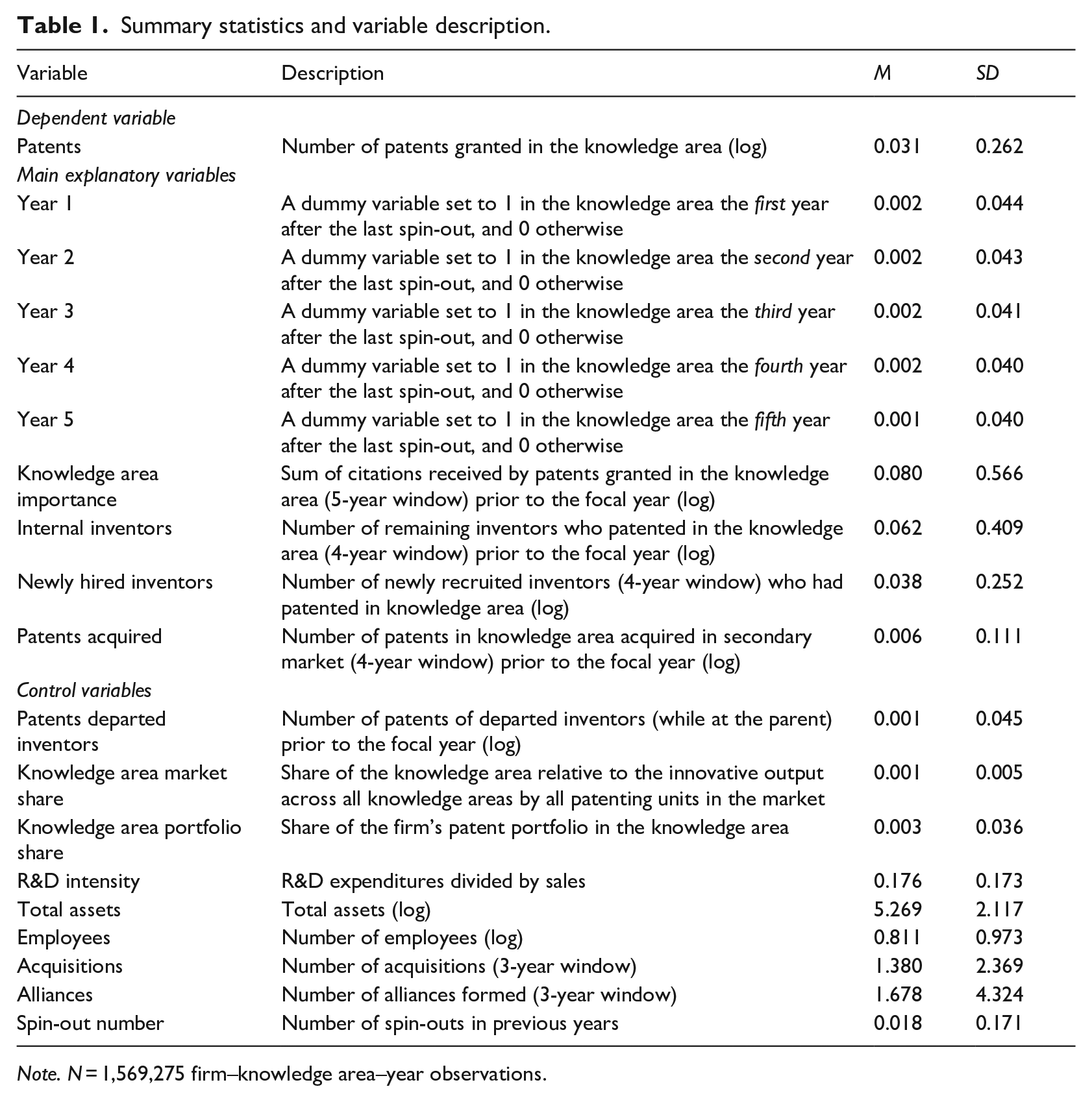
Note. N = 1,569,275 firm–knowledge area–year observations.
Correlations matrix.
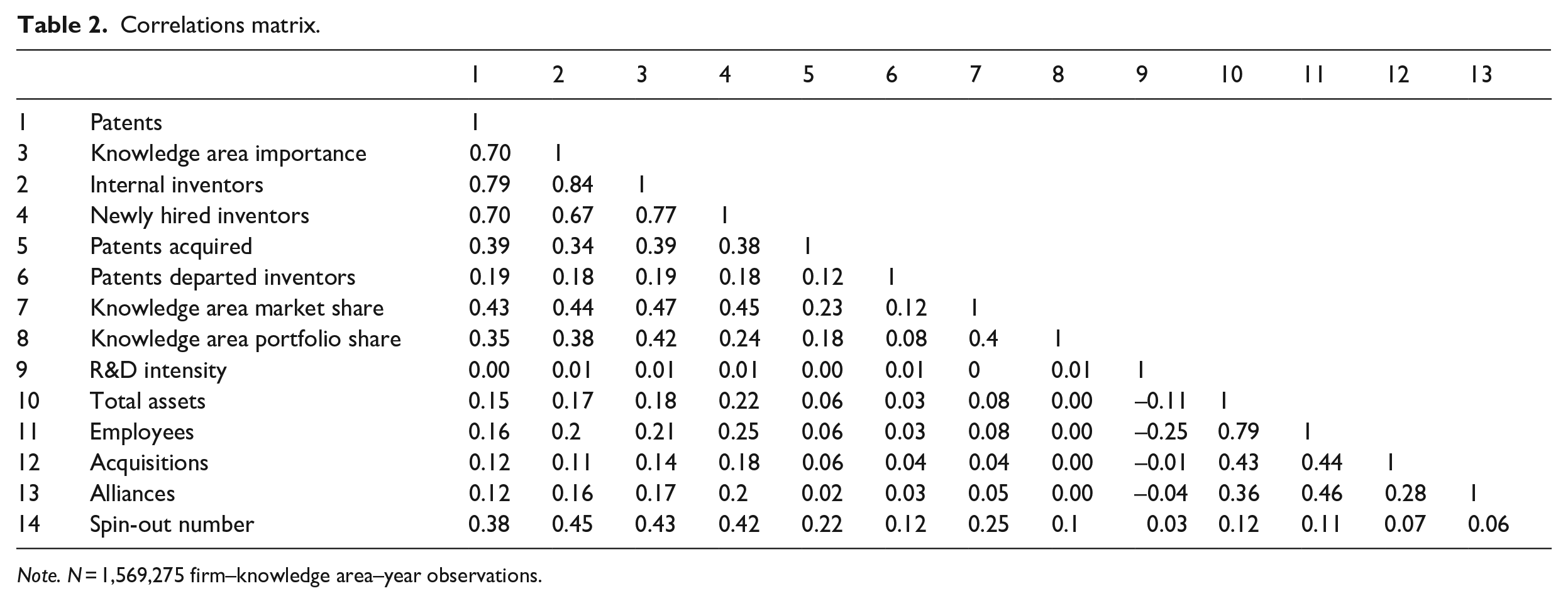
Note. N = 1,569,275 firm–knowledge area–year observations.
We now turn to regression analyses to test our hypotheses on how spin-outs are associated with parents’ innovation output and the conditions that alter this relationship. Table 3 presents the results of the GEE specifications with the standard errors clustered at the firm level (293 clusters). Model 1 reports the estimates of a model with only the control variables; Model 2 introduces the main effects of the five dummy variables indicating years since spin-out; and Models 3–6 separately introduce the moderating effects proposed in Hypotheses 1–3.
Dynamic linear regression estimates. DV = number of patents granted (log-transformed). Year i (1, 2, 3, 4, 5) captures yearly changes on parent’s innovation output on the areas of the departed employees
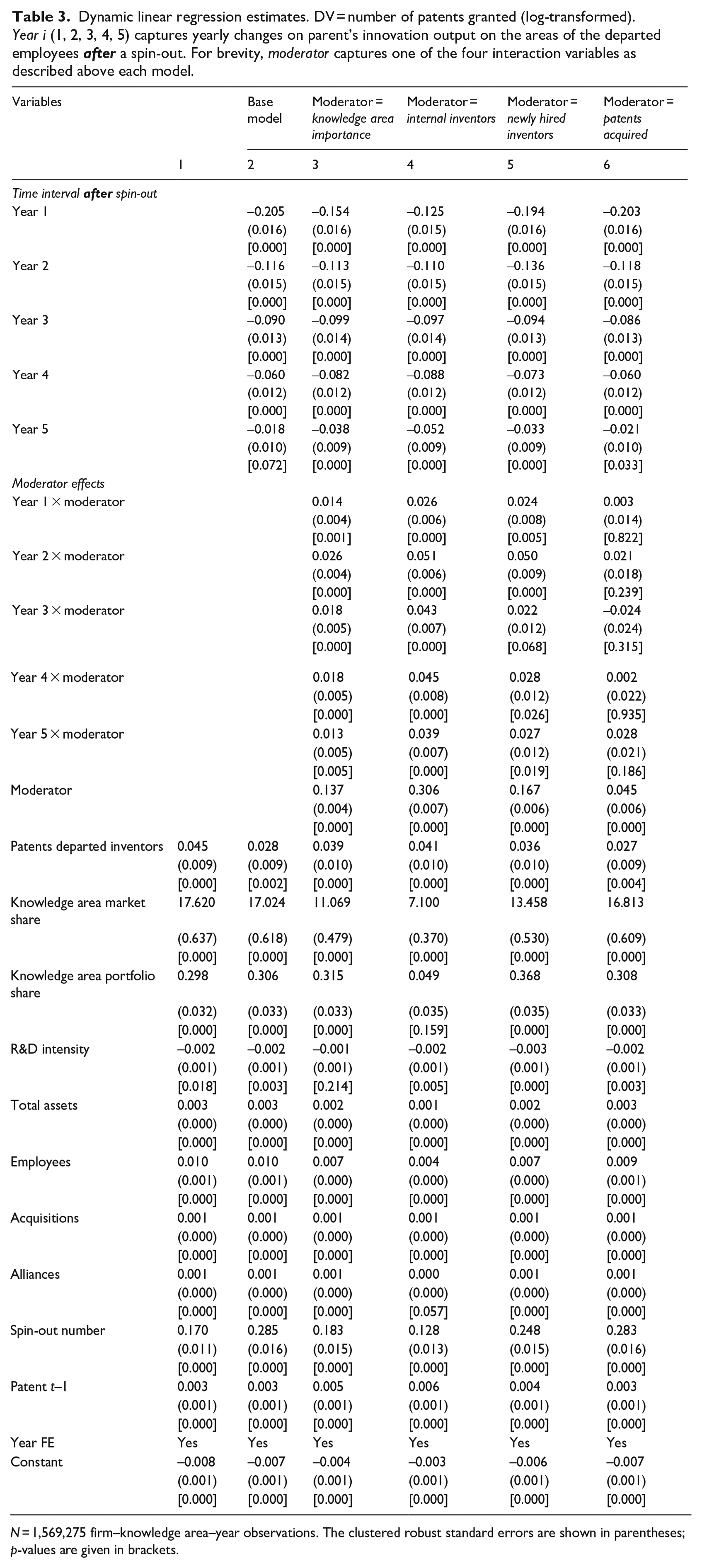
N = 1,569,275 firm–knowledge area–year observations. The clustered robust standard errors are shown in parentheses; p-values are given in brackets.
Our baseline hypothesis predicts that spin-outs lower parents’ innovation output in the knowledge areas in which departed employees had been active during their employment, an effect that is non-enduring. To test this hypothesis, we consider the coefficients of the year dummies since the spin-out, that is, the coefficients of Year i (i = 1,2,3,4,5) dummies. The coefficients of these five dummy variables estimate the contrast in patenting levels for Year i relative to the period outside the 5-year window. In Model 2, the coefficients of Years 1–5 are negative and significant (p < 0.001 for Years 1–4; p < 0.1 for Year 5). These negative coefficients indicate that parents’ patenting levels decrease in knowledge areas experiencing spin-outs in the 5-year window after a spin-out.
Panel A of Figure 2 shows the marginal effects of spin-outs on parents. In this graph, we show two lines: (1) the dashed line depicts the year-wise effects (i.e. the marginal effect for each year) and (2) the continuous line depicts the difference in the marginal effect relative to the previous year. Vertical bars indicate the 95% confidence intervals. The year-wise effects show that parents’ innovation output in knowledge areas experiencing spin-outs decreases by 20.5% on average in the year immediately following the spin-out formation. This effect fell to 11.5% in the second year, 9% in the third year, 6% in the fourth year, and 1.7% in the fifth year. The upward slope of the dashed line indicates the recovery of the parents’ patenting output. The change relative to the previous year helps us understand the extent to which the marginal effects for a given year are significantly different from those of the preceding year. The change relative to the previous year shows that the difference in the effects between two consecutive years in the 5-year window ranges between two and nine percentage points (p < 0.05). This demonstrates how the initial adverse impact of a spin-out event decreases over time. Overall, the baseline results provide a fine-grained snapshot at the level of the knowledge area, revealing both the extent of loss and the recovery pattern after a spin-out.
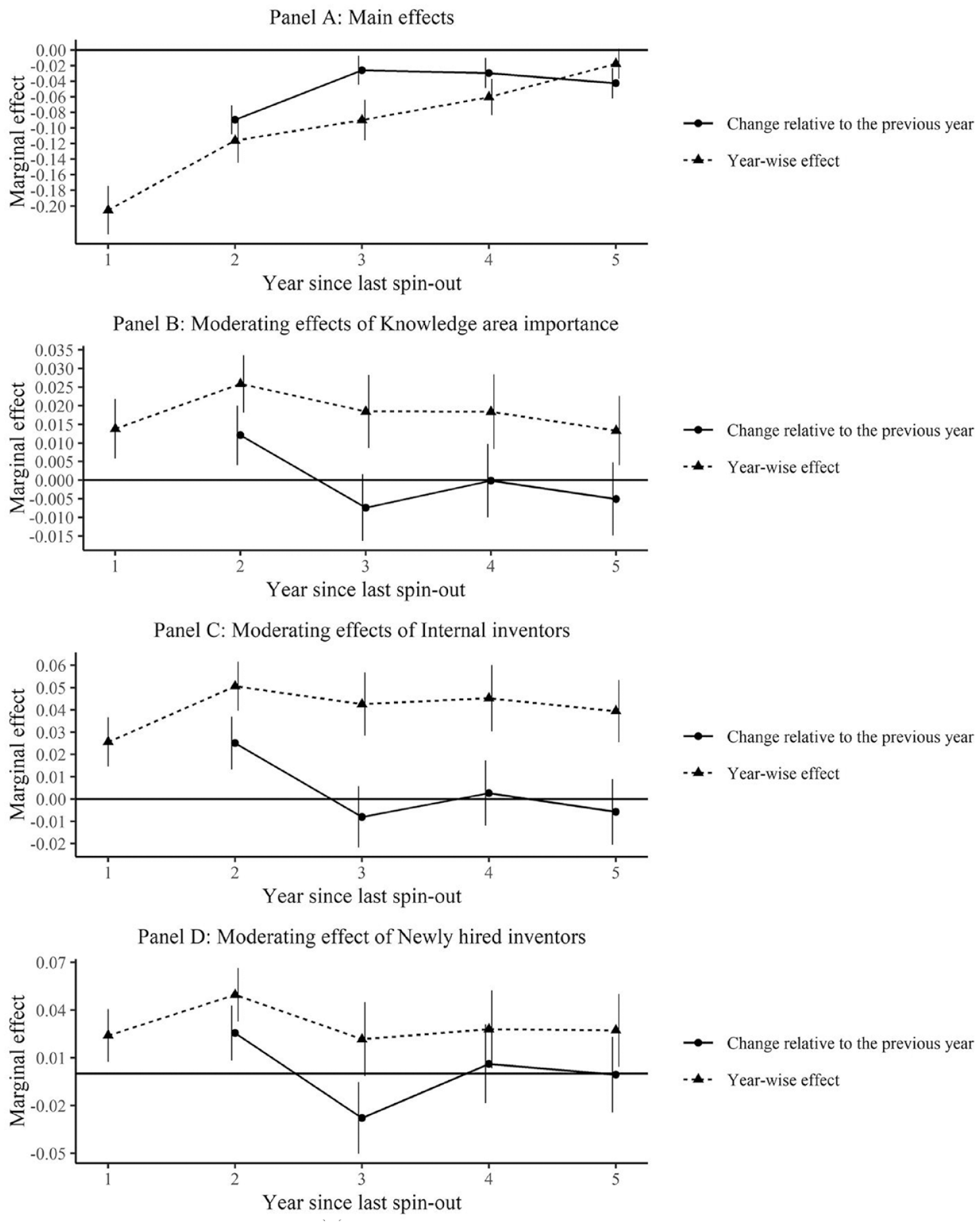
Spin-out effects on parents in the 5-year window. The dashed lines depict the marginal effect for the year (year-wise effect). The continuous lines depict the difference in the marginal effect relative to previous year.
We now turn to the analysis of the contingencies that modify the effects of spin-outs. The first contingency we consider in Hypothesis 1 is the importance of the affected knowledge area to the parent. Our first hypothesis implies that the importance of the focal knowledge area for the parent may motivate a faster rate of recovery from the negative effect of spin-outs. We tested this using the interaction effects between Year i (i = 1, 2, 3, 4, 5) and knowledge area importance in Model 3 in Table 3. The coefficients of the interaction terms are positive and significant (p < 0.001 for 1–4; p < 0.01 for 5), supporting Hypothesis 1. The coefficients of the interaction terms indicate the marginal percentage gain in patenting levels for a unit change in knowledge area importance. Using estimates from Model 3, these incremental gains range from 0.7% in Year 1 (p = 0.001) to 1.4% (p = 0.000) in Year 2 for a one standard deviation increase in knowledge area importance. These positive coefficients indicate that the importance of the knowledge areas impacted by a spin-out shapes the rate of recovery—the more important the area is for the parent, the faster the observed recovery.
We illustrate the interaction effects between Year i (i = 1, 2, 3, 4, 5) and knowledge area importance using the plots in Panel B of Figure 2 and Panel A of Figure 3. Panel B of Figure 2 plots the marginal effects of knowledge area importance for each year in the focal time window. The year-wise effects show that, except for the second year, the moderating effect of knowledge area importance remains flat. In Panel B, the continuous line showing change relative to the previous year confirms the flattened moderating effect of knowledge area importance (the confidence interval for Years 3, 4, and 5 on the continuous line straddles zero).
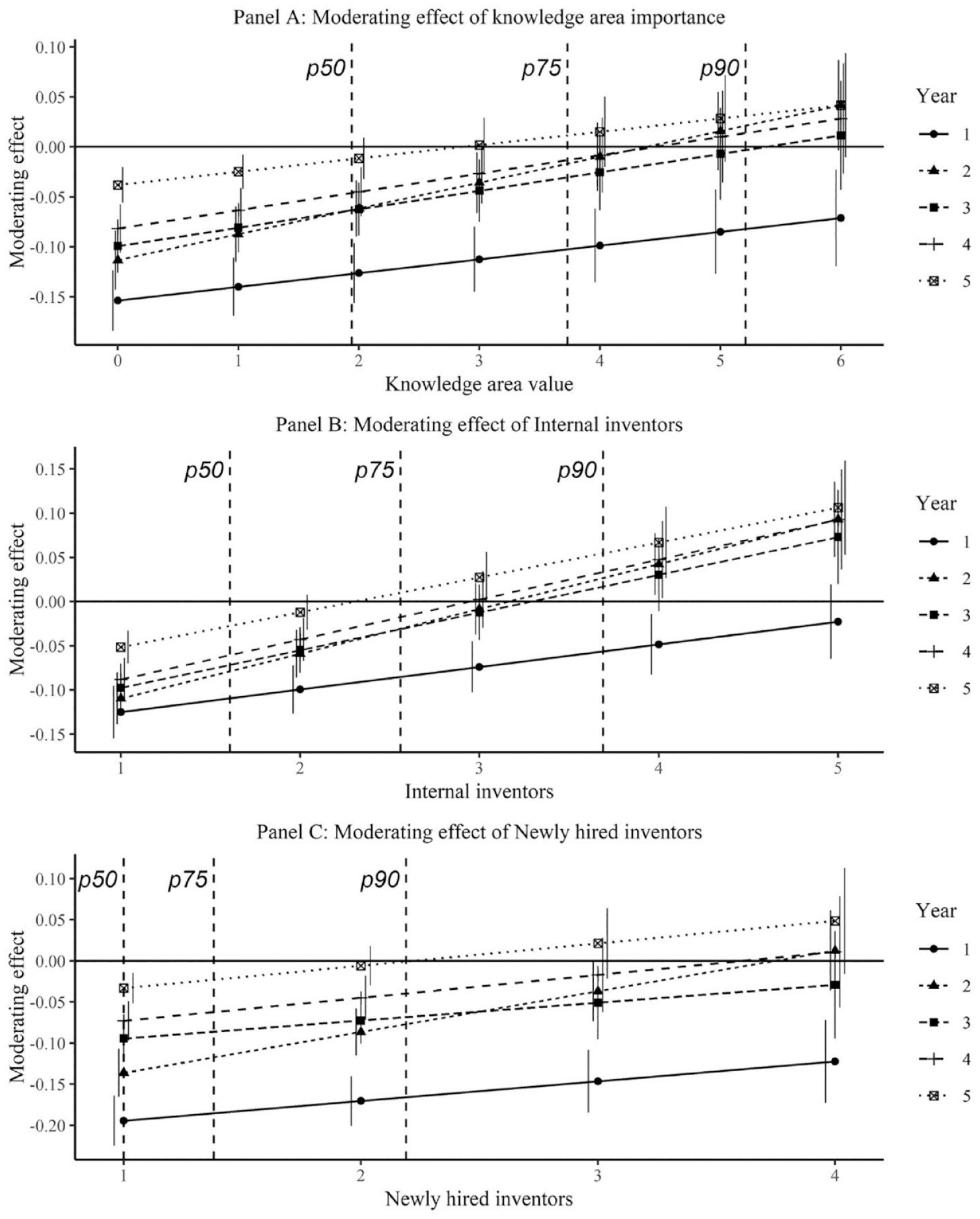
Moderating effects of knowledge area importance, internal inventors, and newly hired inventors on the spin-out effects on parents in the 5-year window. The lines show the effects in different years (i.e. 1, 2, 3, 4, 5).
Panel A in Figure 3 shows the variation in the moderating effect of knowledge area importance for each year in the 5-year window following a spin-out. In this plot, the x-axis shows the 0–95 percentile range of knowledge area importance, and the y-axis shows the yearly effects averaged over the sample. We plotted the effects for each year separately. As before, the vertical bars indicate 95% confidence intervals. The broken vertical lines show the 50th, 75th, and 90th percentiles of the knowledge area importance conditional on parents with a recent history of patenting in a given knowledge area. This plot reveals that spin-out effects are negative in the first year regardless of how important the knowledge area is to the parent. However, the negative effects in Years 4 and 5 begin to fade when the importance of the knowledge area falls in the upper percentiles, whereas those in years 2 and 3 recede only in the highest percentile of knowledge area importance. These results support our argument that knowledge area importance motivates firms to recover their patenting levels faster in the immediate aftermath of a spin-out event.
In our second set of hypotheses, we posited that the parent’s capacity to redeploy human capital in focal knowledge areas can mitigate the negative effects of spin-outs. Hypothesis 2a implies a positive sign for the interaction between Year i (i = 1, 2, 3, 4, 5) and internal inventors, and Hypothesis 2b implies a positive sign for the interaction between year i (i = 1, 2, 3, 4, 5) and newly hired inventors. We tested Hypotheses 2a and 2b in Models 4 and 5 in Table 3. In Model 4, the coefficients of the interaction terms between Year i (i = 1, 2,3,4,5) and Internal inventors are positive and significant (p < 0.001 for Years 1–5), supporting Hypothesis 2a. Using the estimates from Model 4, these incremental gains range from 1% in Year 1 (p = 0.001) to 2% (p = 0.000) in Year 2 for a one standard deviation increase in internal inventors. Similarly, consistent with Hypothesis 2b, the coefficients of the interaction terms between Year i (i = 1, 2, 3, 4, 5) and newly hired inventors in Model 5 are positive and significant (p < 0.01, Year 1; p < 0.001, Year 2; p < 0.10, Year 3; p < 0.05, Years 4 and 5). Using estimates from Model 5, these incremental gains range from 0.5% to 1% for a one standard deviation increase in newly hired inventors.
Graphical analysis allows us to better illuminate the interaction effects of Hypotheses 2a and 2b. We begin by examining the effects between Year i (i = 1, 2, 3, 4, 5) and internal inventors, as shown in Panel C of Figure 2 and Panel B of Figure 3. Panel C of Figure 2 plots the marginal effects of internal inventors for each year in the focal time window. The year-wise effects show that the moderating effect of internal inventors evens out after the second year. In Panel C, the continuous line showing change relative to the previous year confirms the flattened moderating effect of internal inventors (the confidence interval for Years 3, 4, and 5 on the continuous line straddles zero).
Panel B of Figure 3 demonstrates the variation in the moderating effect of internal inventors for each year in the 5-year window after a spin-out. The x-axis shows the 0–95 percentile range of internal inventors, and the y-axis shows the yearly effects averaged over the sample. The broken vertical lines show the 50th, 75th, and 90th percentiles of internal inventors, conditional on parents having a recent history of patenting in a given knowledge area. This plot reveals that spin-out effects are negative in the first year at all but the highest levels of parents’ capacity to redeploy internal inventors. However, the negative effects in Years 2–5 vanish when the parents’ capacity to redeploy internal inventors is in the upper quartile, while those in Year 5 already wither in the third quartile.
Moving on to Hypothesis 2b, the interactions between Year i (i = 1, 2, 3, 4, 5) and newly hired inventors are shown in Panels D and C of Figures 2 and 3, respectively. The year-wise effects in Panel D of Figure 2 follow those of internal inventors in that, except for the second year, the moderating effects of newly hired inventors in Years 3, 4, and 5 are positive and significant, but these effects are statistically indistinguishable from each other (the confidence interval for Years 3, 4, and 5 on the continuous line include zero).
Panel C of Figure 3 unpacks the heterogeneity in the moderating effect of newly hired inventors for each year in the 5-year window after a spin-out. The x-axis shows the 0–95 percentile range of newly hired inventors, and the y-axis shows the yearly effects averaged over the sample. The broken vertical lines show the 50th, 75th, and 90th percentiles of newly hired inventors conditional on parents with a recent history of patenting in a given knowledge area. This plot tells us that spin-out effects are negative in the first year, irrespective of parents’ capacity to deploy newly hired human capital. Furthermore, the negative effects tend to persist even in the upper percentiles of the distribution of newly hired inventors for all years except Year 5, suggesting that newly hired human capital assists in the recovery of innovation output, but not at the rate permitted by internal human capital deployment. Broadly, these results support our argument that human capital redeployment is an essential mechanism that enables firms to recover their innovative output after spin-outs. Furthermore, they cast light on the differences in the extent of recovery enabled by alternative human capital deployment mechanisms.
In Hypothesis 3, we argued that the acquisition of externally developed patents in focal knowledge areas can aid recovery from the negative effects of spin-outs. This implies a positive sign for the interaction between Year i (i = 1, 2, 3, 4, 5) and patents acquired. The coefficients of the interaction terms between Year i (i = 1, 2, 3, 4, 5) and patents acquired in Model 6 of Table 3 are positive but small and insignificant, thus providing no empirical support for this hypothesis.
Additional analyses
We conducted additional sensitivity analyses. First, we tested our predictions using Poisson-fixed effects estimations, in which the dependent variable is the number of patents granted. The Poisson-fixed effects estimations in Table 4 are consistent with the results in Table 3, demonstrating the robustness of our main results. Second, in the unreported analyses (available upon request), we used alternative measures for the independent and control variables. Our results remain robust when using alternative measures for our independent variables. These alternative measures use different time windows (i.e. 2, 3, and 4 years). In addition, our results are robust when using an alternative measure of time since the spin-out, which involves a unique dummy for the entire 5-year period. Furthermore, our results remain robust when including alternative control variables that capture the importance of the departed employees. Specifically, although we used the number of patents of departed employees to control for their importance, we verified our results by considering alternative measures: (a) the average number of co-inventors of the departed employees, (b) the total number of departed inventors, and (c) the number of forward citations received by the patents of the departed inventors.
Poisson-fixed effects regression estimates. DV = number of patents granted. Year i (1, 2, 3, 4, 5) capture yearly changes on parent’s innovation output on the areas of the departed employees
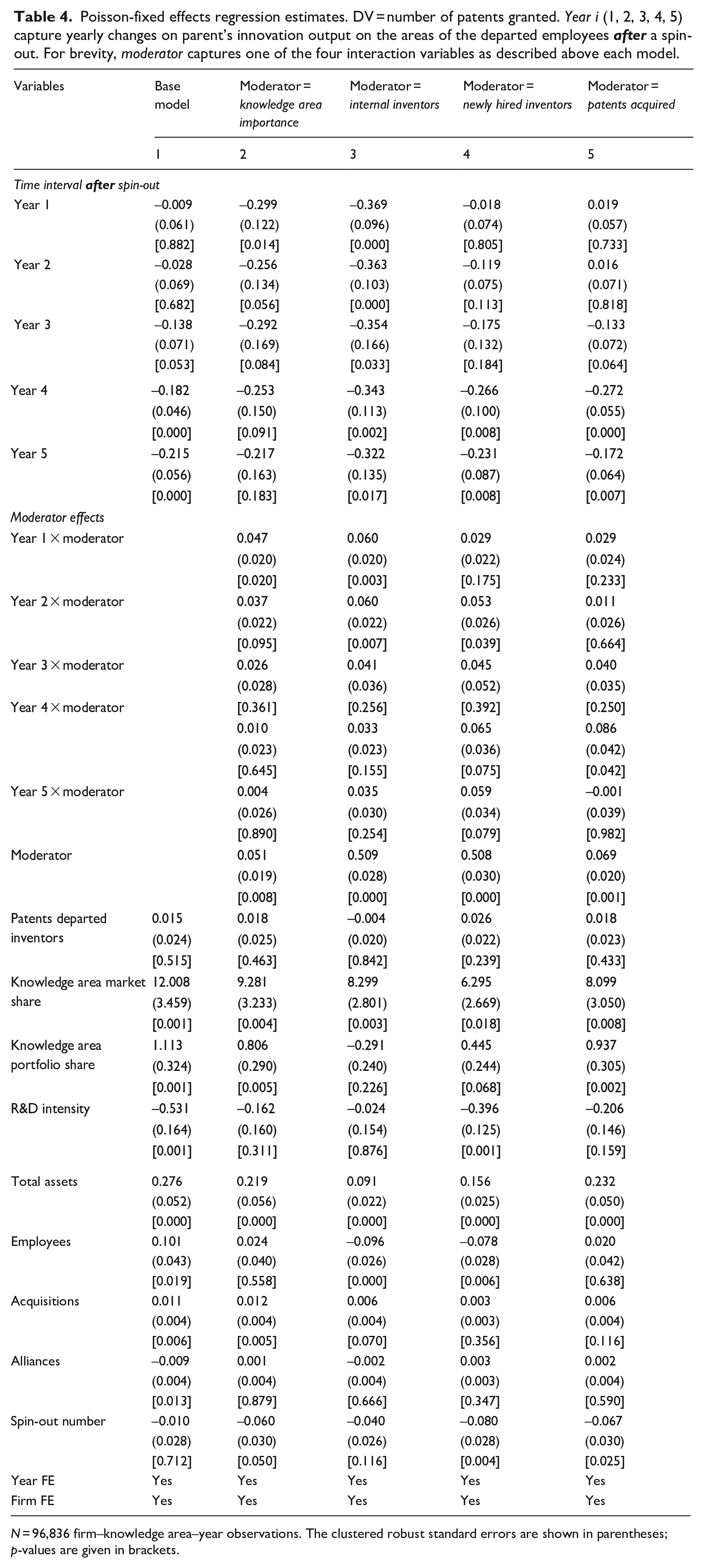
N = 96,836 firm–knowledge area–year observations. The clustered robust standard errors are shown in parentheses; p-values are given in brackets.
Finally, the effects documented above may also arise because of parents’ declining interest in a knowledge area. To assess this effect, we tested whether parents are contracting their innovation activity in the affected knowledge area. We created four dummy variables that capture the yearly change in the innovation output of the affected knowledge area in the 4-year window before the spin-out, with the year of spin-out formation serving as the baseline (see Table 5). The year dummies prior to the spin-out event are positive and significant (p < 0.01), showing that parents’ activity is not shrinking in the area of the departed employees prior to the event. Overall, these results strengthen the above findings and support our argument that spin-outs disrupt parents’ innovation output in affected knowledge areas relative to the period before and the 5-year window after the event.
Dynamic linear regression estimates. DV = number of patents granted (log-transformed). Year i (–1, –2, –3, –4, –5) capture yearly changes on parent’s innovation output on the areas of the departed employees prior to a spin-out.
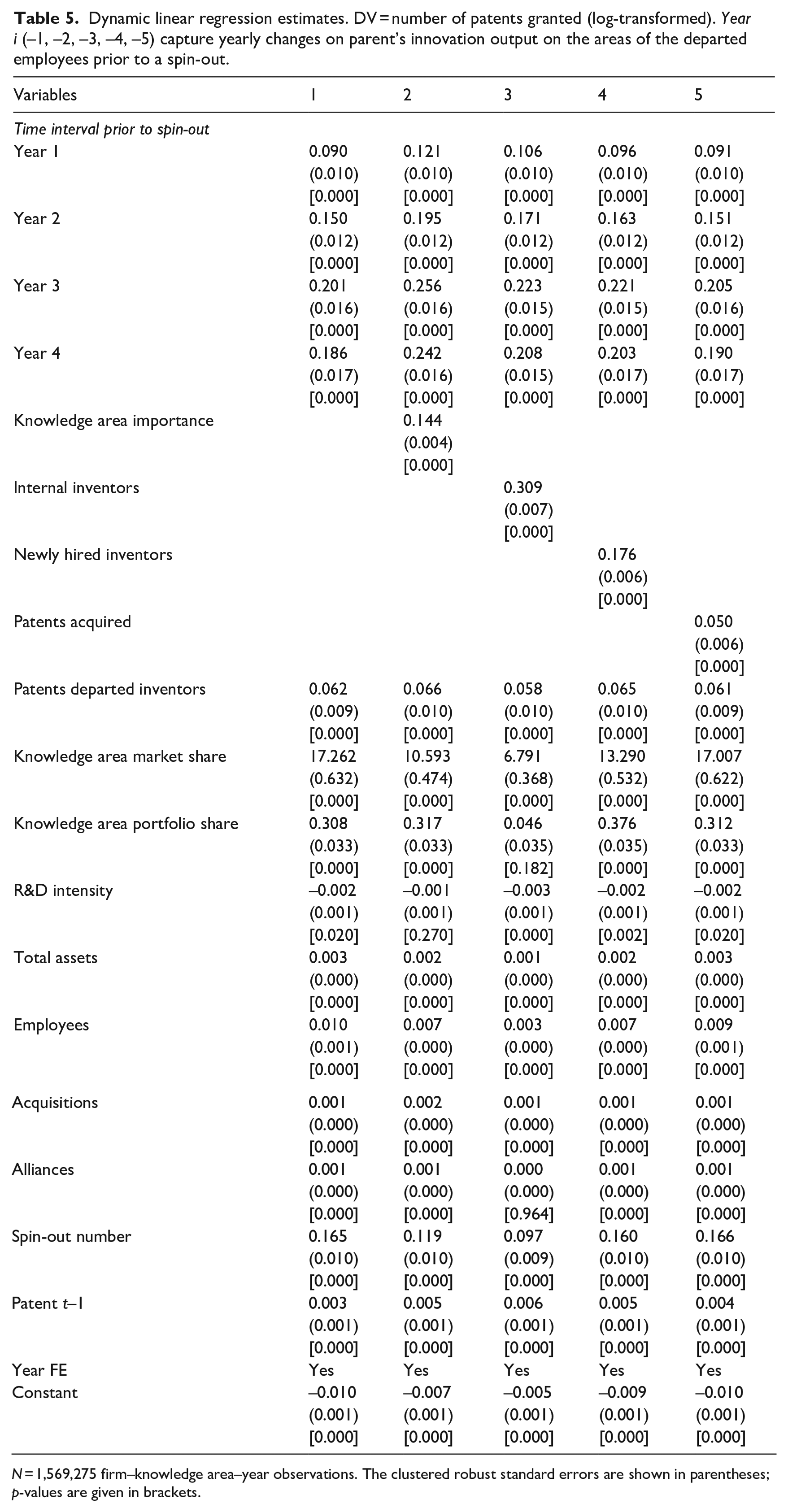
N = 1,569,275 firm–knowledge area–year observations. The clustered robust standard errors are shown in parentheses; p-values are given in brackets.
Discussion
In many knowledge-intensive industries, wave after wave of skilled employees leave incumbent firms to found spin-outs (Agarwal et al., 2004; Berchicci et al., 2011; Klepper, 2001). From the incumbent’s perspective, employee departures to form spin-outs can prove disruptive and set off a decline in innovation output because employees create, store, and recombine knowledge for innovation (Kogut and Zander, 1992; Xiao et al., 2022). Consistent with this view, some empirical studies have shown that such a decline can threaten parents’ performance and survival (Agarwal et al., 2016; Campbell et al., 2012; Phillips, 2002). A few studies have alluded to the prospect of parents’ recovery following spin-outs, but they locate this recovery not in parents’ adaptation but in auxiliary benefits originating from spin-out features (Agarwal et al., 2007; Cirillo, 2019; Ioannou, 2014; McKendrick et al., 2009). While we learn from this line of work that spin-outs are not always detrimental for parents, we know relatively little about the extent and conditions under which parents can recover through adaptation. We need a sharper understanding of the extent to and the conditions under which parents may recover in the knowledge areas disrupted by spin-outs.
Our study examines the effects of spin-outs on parents’ innovation and the conditions under which a parent will recover. We show that spin-outs have a diminishing negative effect on parents’ innovation output in the impacted knowledge areas. We also find that parents recover their patenting levels in the immediate aftermath of a spin-out event (a) when the spin-out occurs in a strategically important knowledge area for the firm, (b) when the firm can redeploy human internal capital, and (c) when the firm recruits new inventors in the affected knowledge area. However, we did not find evidence in support of recovery of the innovation output when parents acquire externally developed patented knowledge.
We make two main contributions to the literature on strategy and organizations. First, we expand the research on the strategic impact of spin-outs by emphasizing parents’ adaptation. This emphasis allows us to depart from the assumption that parents are mere bystanders when employees leave to form spin-outs (Agarwal et al., 2016; Campbell et al., 2012; Phillips, 2002; Wezel et al., 2006). By ascribing an active and adaptive role to parents, our study provides new insights into the degree to which parents recover from the adverse effects of spin-outs and the conditions that shape this recovery. Our results imply that the effects of spin-outs are mostly non-enduring and vary significantly depending on whether parents are motivated and able to make adjustments afterward. Our theoretical setup also informs research on the compensating benefits that spin-outs are likely to bestow on parents (Agarwal et al., 2007; Cirillo, 2019; Ioannou, 2014; Kim and Steensma, 2017; McKendrick et al., 2009).
Our study’s focus on adaptation complements previous work on organizational change (Dutton and Jackson, 1987) in two ways. First, in the spin-out case, the impetus is an internal resource and an organizational shock for the parent. This contrasts with the more common external shocks caused by factors, such as competition, regulation, technological upheaval (Eggers and Kaul, 2018; Miller and Chen, 1994; Schijven and Hitt, 2012), or planned separation through divestitures (e.g. Moschieri, 2011; Moschieri and Mair, 2012). Our study underscores the human capital and knowledge-based mechanisms that support adaptation (Ganco et al., 2020; Karim and Capron, 2016; Karim and Kaul, 2015). Our results suggest that redeploying internal human capital offers advantages in adapting to changes that align with a firm’s strategic direction. Second, in the spin-out case, the shock is negative at least initially. However, we show that the contingencies that determine the motivation and ability to adapt can explain the variation among firms in the rate and eventual success of adaptation (Schijven and Hitt, 2012). Thus, beyond describing parents as both sensitive and resilient to losses associated with spin-out events, our model may inspire fruitful research on other sources of internal upheaval, including those with more positive implications.
Limitations and future research
The findings of this study come with certain limitations that point to avenues for future research. An essential consideration is that spin-outs are not random. Accordingly, despite our best efforts to control for the observable attributes that correlate with the formation of spin-outs and parents’ innovation output, other unobserved factors may be at play. Although our results show a statistical association between variables, we caution readers against assigning a strict causal interpretation. Despite this limitation, we believe that the empirical approach represents a valuable test for our theory for several reasons. First, our theory relies on existing research that provides robust evidence of the adverse impact of spin-outs on parents due to the loss of human capital and disruption of routines (Phillips, 2002; Wezel et al., 2006). We also took several steps to set up an across- and within-group comparison of the effects of a spin-out, namely, using a comparable control group and comparing parents’ innovation before and after the spin-out.
Furthermore, although the semiconductor industry represents a rich context for examining our research question, a single industry focus may limit the generalizability of the results. The findings should also be generalized to other knowledge-intensive sectors where problem-solving and innovation are essential for the survival of firms (Von Hippel and Katz, 2002; Von Hippel and Tyre, 1995). Whether these results can be generalized to more stable environments, where firms may have less motivation to adjust to disruptions, remains an open question (Carroll and Hannan, 2000; McKendrick et al., 2009). Nonetheless, we would expect motivation and ability to be essential factors, although adaptation may unfold at a slower pace. Future studies can investigate whether and under what conditions parents adapt to spin-outs in industries where problem-solving and innovation are less critical to survival.
While our microanalytic focus at the knowledge area level allows us to generate insights into specific knowledge areas through a clean slice of analysis, it limits us from providing an account of broader organizational dynamics. For instance, disruptions caused by spin-outs and the internal redeployment of human capital may impose externalities on other knowledge areas, thus affecting innovation at the firm level. Managers are likely to contemplate these externalities when electing to pursue internal redeployment to adapt to spin-outs. Future research can address these externalities to unearth the broader organizational consequences of the various adaptation mechanisms examined here.
Another angle for future research is the competitive dynamics between parents and spin-outs (e.g. Walter et al., 2014), and potential cooperative dynamics. From a knowledge standpoint, a spin-out is unlikely to pursue innovation in all technology areas in which departed employees possess expertise. While we acknowledge that potential competition from the spin-out may spur parents to act promptly, our study focuses not on these competition effects but on the disruption effects—the disturbance to internal knowledge production caused by spin-outs as well as the parent-specific factors that help parents adapt. From a product market perspective, it is plausible that a spin-out poses competitive threats to the parent at some point in the future, if not within the immediate 4-year window. To the extent that the affected knowledge areas are crucial for a firm’s innovation output, the parent is likely to take adaptive measures to avoid ceding ground to the upstart. However, previous ties may also foster cooperative opportunities (Chila and Martin, 2019; Moschieri and Mair, 2017). We encourage future studies to examine these dynamics in greater detail.
Finally, given that our empirical tests rely heavily on patent data, our observations are restricted to cases in which the departed employees were listed in parents’ patents and where the parents continued to patent after spin-outs. Therefore, cases in which a departed employee has no patents are missing from the sample. Furthermore, inventions that were in the initial stages of development but not patented before the spin-out were not captured in the study. An interesting area of study is the effect of the departure of inventors with non-patented expertise. Although the absence of patents may suggest fewer unique skills, the departure of inventors with more tacit or strategic knowledge could cause even more disruption, albeit more difficult to measure.
Conclusion
In conclusion, the study aimed to gain a deeper understanding of the parent-specific factors that shape the effect of spin-outs on parents’ innovation. Our analysis hones on the fact that disruptions and adaptations pertain to specific knowledge areas in which departed inventors were previously active. Specifically, our results demonstrate that spin-outs lower parents’ innovation output in the knowledge areas where departed employees were active. However, the importance of the knowledge area where a spin-out occurs motivates firms to recover their patenting levels following the spin-out. In addition, parents’ capacity to redeploy internal and external human capital in focal knowledge areas can mitigate the negative effects of spin-outs. We hope that this research will inspire further advances in the understanding of how firms handle the loss of firm-specific resources.
Footnotes
Funding
The author(s) received no financial support for the research, authorship, and/or publication of this article.
