



Abstract
In this paper, we examine how a practice-theoretical perspective may complement and expand the central tenet of the attention-based view (ABV) that attention is contextually situated. We put forward three main arguments. First, the components that make a practice possible and that locate it in history and context (practice architecture) also prefigure a situated horizon of relevance and possibilities (pragmatic field of attention). Attention thus often befalls organizational members outside the realm of discursive consciousness as a consequence of being engaged in socio-material practices. Second, attention is situated at the crossroads of multiple practices, each with its practice architecture and local pragmatic field of attention. Organizational attention implies tensions, conflict, and contradictions and emerges from the interaction and negotiation of multiple individual and group pragmatic fields of attention. Finally, attention is situated in the temporal dynamics of sustaining and turning attention. This allows us to distinguish between inattention, dysfunctional distraction, and potentially productive attention turning. We argue that by focusing on the ordinary and routinized nature of attention, a theoretical practice view complements and enriches the ABV by offering a less voluntarist and top-down view and proposing a richer view of situatedness. A practice-theoretical approach also distributes attention among a broader set of elements, offering resources to theorize how these elements are connected. The approach also establishes a link between paying attention and caring, thus bringing emotions back into the study of organizational attention. In turn, the ABV helps the practice-theoretical perspective to recognize the central role of attention in organizational matters and the importance of engaging in full with the organizational unit of analysis when dealing with attention-related issues.
Keywords
Over recent decades, the attention-based view of the firm (ABV) has emerged as one of the main metatheories for examining the role of attention in strategic decision-making and explaining organizational action, competition, and adaptation from an attentional perspective (Ocasio, 1997, 2011). ABV scholars define attention as “the noticing, encoding, interpreting, and focusing of time and effort by organizational decision-makers on both (a) issues: the available repertoire of categories for making sense of the environment and (b) answers: the available repertoire of action alternatives” (Ocasio, 1997: 189). The theory develops Simon’s (1971) intuition that because individuals’ and organizations’ attentional capacity is limited, any increase in the availability, access, and use of information generates corresponding attentional scarcity and poverty. Accordingly, in an information-rich environment, attention is a limiting factor in the consumption of information, so that capturing, retaining, and orienting attention are sources of competitive advantage. Studying and managing attentional phenomena is therefore increasingly important in contemporary societies characterized as attention economies (Davenport and Beck, 2001).
A central tenet of the ABV is that attention is inherently situation-dependent and varies across spatial and temporal contexts (Ocasio, 1997). ABV authors state that organizations are “systems of structurally distributed attention . . . in which the cognition and action of individuals are derived from the specific organizational context and situations that individual decision-makers find themselves in” (Ocasio, 1997: 198, emphasis added). Attention ebbs and flows depending on how problems, solutions, and participants become coupled in specific interactions, meetings, or email exchanges as choice opportunities (Ocasio, 2012: 301). The situational variability of attention is partially tempered by organizational attention regulators and societal influences. Organizational regulators distribute decision-making activities and related information within the firm (Joseph and Ocasio, 2012), while societal mechanisms such as institutionalization processes, fads, and fashion convey values and guiding concepts that “order the legitimacy, importance, and relevance of issues and answers” (Ocasio, 1997: 196; see also Brielmaier and Friesl, 2022; Ocasio, 2011).
Despite recognition of situatedness as a central pillar of the ABV approach, conceptual and empirical investigations of the situated nature of organizational attention remain relatively rare (Brielmaier and Friesl, 2022). This is partly because analysis by ABV scholars traditionally focused on the industry and firm characteristics (e.g. McCann and Bahl, 2017) as well as institutional regulators (e.g. Cho and Hambrick, 2006) constituting the context for attention processes, without ever zooming in on the actual nature and workings of situatedness (e.g. Joseph and Wilson, 2018; Sullivan, 2010). In the few cases in which the nature of attentional situatedness has been brought into focus, it has been examined mainly within the paradigmatic boundaries of the information-processing view of communication (Ocasio, 1997), which focuses principally on flows of information and communication channels (see, e.g. Fu et al., 2020; Joseph and Ocasio, 2012). Consequently, how attention is distributed in material infrastructure and embodied work, and situated in everyday interactions has remained largely unexplored (Jarzabkowski et al., 2021; Ocasio et al., 2018).
To address these limitations, we examine contemporary practice theories’ contributions to understanding the situational characteristics of attention in organizations. We focus especially on practice-theoretical approaches that build on the work of Schatzki (2005; Nicolini et al., 2023).
Central to a practice-theoretical understanding of attention is the idea that work practices are associated with a particular set of attention priorities, resulting from the discursive, material, and interactional mediatory elements that comprise the practice. In this paper, we argue that focusing on attention as the effect of socio-material practices and their nexuses provides an expanded, more nuanced, and fine-grained view of the situated nature of organizational attention. A practice-theoretical understanding of attention has three key implications. The first is that paying attention in organizations is at least partly routine and unnoticed, as in most cases attention is largely prefigured by what we are involved in—the implication being that the processes considered by the ABV are the tip of the iceberg of a broad set allocation processes of attention, which as a whole constitute the attentional perspective of the firm. Second, organizational attention is distributed across a much broader set of “characters” (and “places”) than admitted by the ABV, which traditionally focuses mainly on individual human actors and communication (Ocasio, 1997, 2012; Ocasio et al., 2018). These “characters” and “places” include mundane activities (Nicolini and Korica, 2021), attentional communities that emerge around specific practices (Zerubavel, 2015), non-human actors (e.g. technology), interactional encounters in specific situations, relationships that connect these situations in time and space, and broader socially structured attentional conventions, expectations, and mechanisms (Citton, 2017; Hannah, 2019). Organizational attention emerges from the nexus of all these heterogeneous elements. Finally, a practice-theoretical understanding of attention indicates that attention and caring are inextricably linked together. This means that we need to bring emotions back into the study of organizational attention.
By expanding the current understanding of the situated nature of organizational attention, a practice-theoretical approach offers a wider range of (material) actors and dynamics to consider, and new units of analysis for studying organizational attention, thus opening up unexplored opportunities for future research.
Our effort to re-examine the ABV concept of situatedness from a practice-theoretical perspective responds to recent calls to establish new conversations between the ABV and other approaches to expand our understanding of organizational attention and its strategic implications (Ocasio et al., 2018, 2021). Shedding more and better light on the situated and socially constrained nature of attention is especially important for advancing our understanding of the strategic dimension of organizational attention. As strategy-as-practice scholars have suggested, we can obtain significant insight from expanding our view of the study of strategy when including actors and phenomena beyond the behavior of the formal higher echelon of the organization (Chia and Holt, 2006; Jarzabkowski et al., 2021). The intuition shared by strategy-as-practice and ABV scholars is that strategy is at least partially an emergent phenomenon (Mintzberg and Waters, 1985), and that what makes practices strategic is their consequentiality for the direction of the firm, rather than their explicit labeling as strategy-making activities.
Revisiting some of the basic tenets of the ABV
The ABV integrates individual and organizational levels of analysis and considers organizations as “systems of structurally distributed attention . . . in which the cognition and action of individuals are derived from the specific organizational context and situations that individual decision-makers find themselves in” (Ocasio, 1997: 198). ABV authors assume that decision-makers’ focus of attention affects strategic choices and outcomes because organizational attention shapes the firm’s strategic agenda, which guides resource allocation and deployment (Ocasio and Joseph, 2005, 2018). Since its original elaboration in the 1990s, the ABV has produced a rich and diverse body of strategy research. ABV scholars have examined relationships between organizational attention and various aspects of strategic organization, including strategic change (Cho and Hambrick, 2006), adaptation (Joseph and Ocasio, 2012), growth (Joseph and Wilson, 2018), strategic managerial decision-making (Eggers and Kaplan, 2009), and innovation (Rhee and Leonardi, 2018).
The ABV builds on three core principles. First, organizational attention derives from the combination and alignment of different types of attention that take place across the organization, meaning that attention is seen as differentiated and internally inconsistent (Barreto and Patient, 2013; Joseph and Wilson, 2018; Ocasio, 2011; Rerup, 2009; Vuori and Huy, 2016). Second, managerial attention is contextually situated, in the sense that “the focus of attention, rather than being a purely intra-individual phenomenon, largely depends on the context an individual is located in at a certain point in time” (Brielmaier and Friesl, 2022: 3). Organizational attention emerges in encounters between individual actors and organizational structures (Joseph and Ocasio, 2012), which include collective decision-making processes, distributed cognition, situated actions (Ocasio, 1997), shared emotions, and historical experiences (Vuori and Huy, 2016). Finally, organizational attention is distributed, as it derives from “how the firm’s rules, resources, and relationships distribute various issues, answers, and decision-makers into specific communications and procedures” (Ocasio, 1997: 188).
The ABV’s attempt to link attentional phenomena and strategic outcomes has led to three main streams of ABV research. Studies of the attentional perspective address the nature and effects of organizational structuring of attention by focusing mainly on top-down regulators, which act as “antecedents” of individual and organizational attention (Suzuki, 2017). Studies of attentional engagement instead examine how managers allocate, direct, and sustain attention to problems and opportunities for problem solving, sensemaking, and decision-making (Ocasio and Joseph, 2018), how they monitor the environment, and how they combine individual oversight and foresight (Schoemaker, 2019). Finally, studies of attentional selection focus on the emergent outcomes of organizational attention processes, including both content (what the firm pays attention to), and the congruence and consistency of selection processes.
Figure 1, modified from Brielmaier and Friesl (2022), represents the dominant framing of organizational attention in the ABV and illustrates how situated attention is central to the concept: the situation links the principles of individuals’ attentional engagement with firm-level behavior by suggesting that an individual’s attentional engagement “depends on the situation and the situation is, in turn, shaped by the organization” (Brielmaier and Friesl, 2022: 4).
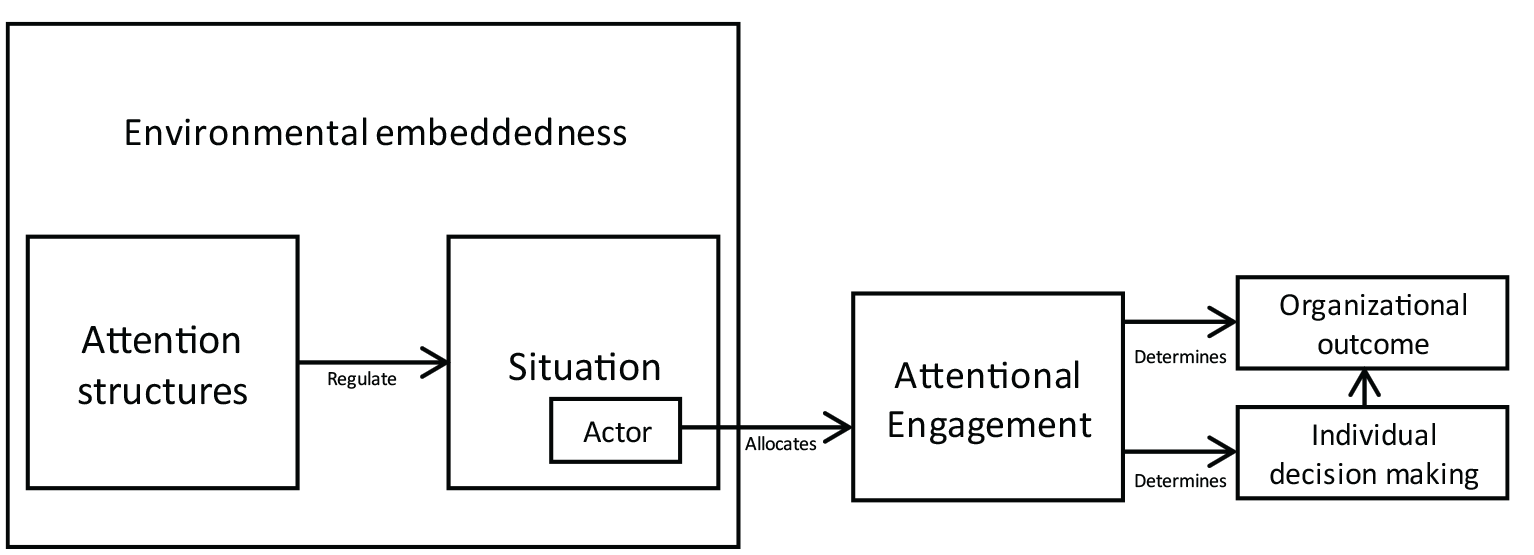
The understanding of situated attention within the ABV.
The concept of situatedness in the ABV tradition
Despite its importance in ABV studies, situatedness is often overlooked, undertheorized, or simply taken for granted. As a result, understanding of how decision-makers’ attention emerges in particular situations, and how this broad range of environmental stimuli affects attention is “nascent, at best” (Brielmaier and Friesl, 2022: 22). While scholars have identified several structural and institutional factors that contextualize managerial attention, such as the nature of the competitive environment (McCann and Bahl, 2017), the industrial regulatory environment (Cho and Hambrick, 2006), industry velocity (Nadkarni and Barr, 2008), and firm-specific aspects such as performance and internationalization (McCann and Shinkle, 2017; Tuggle et al., 2010), we know relatively little about how these factors actually affect attentional processes at the point where decisions are made. There are several reasons for this.
First, the traditional ABV’s focus on individuals and their information-processing capacities leads to a rather narrow understanding of situatedness (when does an issue manifest itself within a decision-making arena?). As in the garbage can model, the ABV sees attention as the coupling or coming together of problems, solutions, and decision-makers in space and time within decision-making arenas (Cohen et al., 1972: 12), which ABV authors call “communication channels” (Ocasio, 2012: 301). These include “interactions among participants through meetings, assemblies, workshops, and conferences—formal and informal—as well as written, oral, and technological (e.g. email and blogs) forms of transmission of messages among participants” (Ocasio, 2012: 301). Communication channels thus become the contextual “containers” within which attentional effects are produced, reproducing what some authors call the “bowl and soup” view of context (Korica and Nicolini, 2019). The bowl and soup view is a useful simplification to enable empirical tracing of the link between attention determinants and regulators on the one hand, and strategic decisions and organizational outcomes on the other. However, it glosses over the actual mechanisms of contextualization, and fails to explain in detail “how attention unfolds in particular situations, or how the peculiar issues embedded in situations affect actors’ attention allocation” (Brielmaier and Friesl, 2022: 18).
Second, the ABV’s information-processing underpinnings also lead authors to consider attention and its regulation mainly in terms of informational and ideational phenomena relating to the sphere of the mind, while virtually ignoring mundane activities and technological/material aspects. Beyond observing that communication technology absorbs (Stanko and Beckman, 2010), and that office design guides employees’ attention (Newburry, 2001), very limited insights are given into how the socio-material arrangement of everyday work requires and shapes organizational attention.
Finally, the tendency of many authors to conceive both executive attention and vigilance as willed information processing activities whereby individuals deliberately allocate cognitive resources to specific issues in view of possible solutions, means that less voluntaristic 1 mechanisms and non-cognitive aspects, such as the role of affect and emotion, are rarely considered (for a rare exception, see Vuori and Huy, 2016). Consequently, we have little understanding of how affective states might explain qualities of attention such as its intensity, breadth, or reorientation over time.
In the remainder of this paper, we contribute to addressing this gap by applying a practice-theoretical sensitivity to the understanding of the situated nature of organizational attention. We argue that this allows us to offer a more comprehensive and convincing view of situatedness. It does so by theorizing attentional engagement as more than an individualistic, voluntaristic, and ideational (i.e. cognitive) process, providing an enriched view of the mechanisms of the embeddedness of attention, and shedding light on the structuring of attention. Accordingly, we respond to the question of how a practice-theoretical view can enrich our understanding of the situated nature of attentional engagement and embeddedness. 2
Toward a practice-theoretical view of attention
In this paper, we use the terms practice-theoretical view or orientation to refer to a family of approaches in which social practices form the fundamental theoretical category and unit of analysis (Nicolini, 2013). We build on the version of practice theory developed by Schatzki (2002, 2005) and others (e.g. Shove et al., 2012; for a review, see Nicolini et al., 2023). From this perspective, practices are defined as routinized social regimes of materially mediated doings, sayings, knowing, and ways of relating, organized around a negotiated end (Feldman and Orlikowski, 2011; Nicolini, 2013; Schatzki, 2005; Shove et al., 2012). This approach has been successfully used to offer practice-theoretical accounts of strategy, which are referred to as “strategy-as-practice” (Carter et al., 2008; Golsorkhi et al., 2015; Vaara and Whittington, 2012; Whittington, 1996). Recently, it has also found first applications in the study of attention (Brielmaier and Friesl, 2022; Nicolini and Korica, 2021).
Brielmaier and Friesl (2022) argue in their literature review that studying organizational attention as material, social, temporal, and discursive practices might enable us to shed light on aspects rarely addressed in studies of organizational attention. These include the role of material artifacts (e.g. electronic devices) in influencing managers’ attentional behaviors, how spaces and temporal dynamics (time pressure, timing of attentional inputs) affect how managers intentionally allocate attentional resources, and how the discursive framing of issues alters attentional focus (Brielmaier and Friesl, 2022: 23). Nicolini and Korica (2021) adopt a practice-theoretical sensitivity to study the attentional engagement of health-sector CEOs. They find that CEOs address the three basic challenges of volume, fragmentation, and variety of attentional demands by deploying several interconnected practices, which the authors call the “attentional infrastructure.” Importantly, the attentional infrastructure comprises a variety of tools: mundane objects like post-its and plastic folders, technological artifacts and spaces; the discursive resources and texts that attract and direct the attention of managers; and people who actively help managers to regulate the volume of attentional demands, but also steer their attention in one direction or another by virtue of their relationships, informal ties, formal roles, and power positions (Nicolini and Korica, 2021).
While this early work illustrates the potential for using a practice-theoretical sensitivity to study attention, and foregrounds elements that are notably absent in extant ABV work (e.g. material and technological tools involved in everyday work, quality of communication), it still has important limitations. For example, studying attentional engagement as something that CEOs do still centers on individual managers and individual practices of paying attention, leaving the attentional effects of the practices themselves largely unexplored.
A distinctive characteristic of the practice-theoretical view is its assumption that a variety of human phenomena, including sociality, meaning, knowledge, and power—as well as attention—emerge from and transpire through configurations and nexuses of practices. From this perspective, practices and their nexuses, rather than human agents, are the primary units of analysis. Human actors play an important role (they carry, perform, and perpetuate practices), but they do not take center stage. It is this decentering move that allows practice theory to offer a unique perspective and enrich understanding of organizational and social phenomena.
Central to this way of understanding is the idea that practices and their material components prefigure but do not causally determine human conduct (Schatzki, 2005); for a discussion, see Nicolini et al., 2023). Practices are thus inherently open in the moment of their performance: “until action occurs, it is never determinate which end a person will have acted for, what project he will have carried out for that end, what emotions will have affected this” (Schatzki, 1996: 166). The prefiguration manifests itself as a sense of what is to be done next and what is justifiably appropriate to do in a specific situation. This sense has been described as an “anticipation arousing movement” (Shotter and Tsoukas, 2011: 316) that is both ideational, having to do with minding processes, and affective, being related to the non-cognitive and emotional dimensions of being. Viewing social phenomena in terms of practices and their carriers still makes room for human agency, although agency is understood as much less muscular and voluntaristic than in more traditional actor-centered views. Accordingly, deviations from routine, innovations, and mistakes—as well as resistance and refusal to act as expected—are always a possibility, although the latter requires greater reflexivity on the part of the actor and thus only occurs in specific situations such as in the case of novelty, interruptions, and breakdowns. While humans (and the other components) can prevent and derail the reproduction of practices, the uniqueness of the approach stems from analyzing social phenomena in terms of practices and their human carriers rather than people doing practices.
When applied to the study of attention, a practice-theoretical orientation thus encourages us to see this phenomenon as the outcome of mundane socio-material activities, focusing on how organizational attention is obtained in real time through and amid sentient bodies, discourses, tools, and social interactions (Jarzabkowski et al., 2021). It also invites scholars to focus on human and non-human actors, including objects, technological infrastructure, discourse, and spaces, and how they link activities and collective practices. Finally, it provides theoretical ways to include references to the historical context and “attentional regimes” in our explanations (Citton, 2017: 18). These are socially structured attentional conventions and expectations that may originate from within or outside organizations and are performative with regard to their members’ attention processes (Ocasio et al., 2018). According to Nicolini (2009), this allows us both to zoom in on local attentional phenomena, and zoom out on their situational and contextual embeddedness, theorizing how attention comes to happen.
In what follows, we show that a practice-theoretical orientation is especially useful in providing an enriched understanding of the situated nature of attention. We start by arguing that attentional engagement is not always and necessarily a phenomenon that pertains to the sphere of discursive consciousness (Giddens, 1979) as is often the case in ABV studies (due to their interest in strategic decision-making). Attention is at least partly constituted in and through practices. This premise allows us to provide a more comprehensive explanation of how attentional engagement unfolds in particular situations and how this affects managers’ attentional allocation.
Attentional engagement as an (unintentional) effect of practices
As noted above, although the ABV suggests that attention is not reducible to the cognitive properties of individuals, it still assumes that attention is mainly an individual effort: “it is individuals [who] ultimately do the attending” (Ocasio, 1997: 189). Moreover, the ABV’s traditional focus on the work of top-echelon strategy makers ends up considering disproportionately executive attention—the type of deliberate and voluntaristic information processing, based on conscious and reflexive decisions in a regime of free will that characterizes deliberation. This is reflected in the use of the term “intentional” in most standard definitions in the ABV, for example, “attentional engagement is the process of intentional, sustained allocation of cognitive resources” (Ocasio, 2011: 1287: emphasis added). Although ABV scholars like Ocasio (2011) tend to stay away from a hyper muscular view of intentionality, their approach still gives unwarranted prominence to the attentionality that manifests at the level of discursive consciousness, while other forms of attention such as vigilance and mindfulness are rarely considered.
A practice-theoretical sensitivity integrates and corrects this view by suggesting that attentional engagement is at least partly a property of practices rather than individual actors. It is also largely pre-reflexive, although not unconscious. In other words, attentional engagement is something that occurs to people under conditions that they do not choose: the nature, focus, depth, and breadth of attention are already partially built into the fabric of the practices in which they participate. Managers seem fully aware of this. In their study of attentional engagement, Nicolini and Korica (2021) report that CEOs have a clear sense that most of their attention is already “mortgaged” by existing obligations and routine practices (p. 1165). Their study thus raises the question of how this mortgaging arises: how do mundane practices create attentional effects?
Our argument revolves around the idea that all social practices (e.g. teaching, smelting iron, managing) already carry a specific attentional focus, which derives from the fact that all practices aim toward particular ends. According to Schatzki (1996), practices are oriented toward and expressive of a “teleoaffective structure,” a term used to refer to the organizing principle that keeps together dispersed doings, sayings, and ways of relating, so that they become part of a recognizable practice. 3 The teleoaffective structure of a practice comprises a range of normativized and hierarchically ordered ends, an array of activities and tasks to achieve those ends, and a set of emotions associated both with achieving the ends and with the activities conducted. For example, knowing how to bid for a contract (the practice of tendering) implies also knowing what activities and tasks are involved, recognizing their ends and mutual dependencies, and understanding how to feel about certain aspects of those activities (you feel “elated” when you win). To an expert manager, the overarching organizing end (i.e. the teleoaffective structure) of the practice of tendering —winning the new contract—signifies triggering and conducting a number of sub-activities, such as putting together a strong team and collecting quotes from suppliers. Each requires a particular set of tasks, such as meeting with someone to discuss who needs to be on the team, or calling HR to set up a job advert. The teleoaffective structure, which actors embrace when they learn to carry out the practice, “governs action by shaping what is signified to an actor to do next” (Schatzki, 1996: 123). The argument put forward here is that the teleoaffective structure also actively organizes practitioners’ attention. It does so through anticipation (the telos, or sense of direction inherent in the practice) and general understanding (the discursive understanding of a practice that allows self-monitoring and mutual control; see Schatzki, 2005). When we learn how to master a practice, we also learn what to pay attention to, what to disregard, and when to do so. By signifying to people what is to be done next, the teleoaffective structure of practices constitutes a horizon of attentional relevance, prefiguring what we should pay attention to.
Hannah (2019) calls this horizon of relevance the “pragmatic field of attention,” defined as “the range of attentional states relating to the practice in question” (p. 79). In this view, the process of attentional engagement is mindful (it is present in the experience of the subject), but not always and necessarily discursively conscious and a decision in the micro-economic sense of the term. In fact, practice-driven attentional engagement befalls us: we find ourselves turning our attention to or doing something because the practice encourages us to do so or because we are interpellated by different (competing) practices or projects (Hannah, 2019). The process becomes fully deliberate only on rare and specific occasions. In all other instances, a pragmatic field of attention is already prefigured by what we are involved in. In clearer terms, the prevailing voluntaristic ABV view of attentional engagement only applies in specific circumstances, mainly under the conditions of intentional reflexivity typical of deliberation and decision-making (Schatzki, 1996). The highly reflexive, intentional processes considered by the ABV are thus only the tip of an iceberg composed also of pre-reflexive and partially reflexive processes of attentional allocation. Some interesting theoretical consequences ensue from this. First, it is possible that routinized practices and their tools may orient managers’ attention in specific directions, possibly against their intentions. For example, Nicolini and Korica (2021) report the case of a manager who would like to focus on the big picture but is drawn into focusing on minute operational details by the attentional tools she uses.
Second, an organization’s attentional perspective (or parts thereof) is the result of the coming together of multiple, potentially clashing pragmatic fields of attention. Attentional conflict and contradictions may emerge “unintentionally” from the coming together of practices with misaligned ends or conflicting pragmatic fields, and may not be immediately visible to managers. By extension, this means that the attention view of the top echelon and the rest of the organization does not necessarily coincide.
Third, attentional phenomena inherently overflow the boundaries of the organization. In fact, practices are often created and perpetuated by informal communities of practice (Lave and Wenger, 1991) and professional groups that straddle the boundaries of formal organizations. Allocations of the cognitive resources and time of members of professional groups, like doctors and lawyers, may be regulated by “factors” that go well beyond the intentional control of the organization, and may not result (only) from the deliberate choices of individuals (Zerubavel, 2015).
Taken together, respecifying attentional engagement as an effect of practices responds to recent calls by leading scholars to break away from the still “dominant focus on articulated strategies” (Jarzabkowski et al., 2021: 1) as a way to fully realize the promise of the SAP program. Conceiving the attentional perspective of organizations as constituted in large part by and through the practices does not question the strategic consequentiality of attentional phenomena posited by the ABV, although it distributes the effort differently and more broadly.
Situating attention in practice architectures
The ABV conceives attention as being situated in the firm’s procedural and communicational channels, and suggests that the situational context of these “channels” results from “a combination of environmental stimuli, the embodiment of issues and answers in cultural symbols, artifacts and narratives and the interaction among participants in the channel” (Ocasio, 1997: 192). As indicated above, the constitution of situational contexts can be explained by the garbage can model (Ocasio, 2012). However, appreciation of the situatedness of attention needs to go beyond this relatively narrow view that situatedness can be reduced to observing where and when issues show up, for the attention of whom, and the ensuing process of coupling problems and solutions when a choice needs to be made.
The ABV’s recent attention to discursive phenomena goes some way toward addressing this issue (Ocasio et al., 2018). Indeed, Ocasio et al. (2018) question the ABV’s information-processing underpinning and problematize its tendency to consider communication mainly as a channel with the capacity to address specific issues, such as information quality, volume, and overload (Eppler and Mengis, 2004), and to think of communication channels only “as the pipes and prisms through which information flows” (Ocasio et al., 2018). As an alternative, they suggest focusing more broadly on how vocabularies, rhetorical tactics, and communication practices shape organizational attention. Adopting a broader understanding of communication as a form of meaningful social interaction helps to shed light on how attention becomes shared across individuals, how attention to the firm’s goals cascades discursively within the organization, how attentional biases come about in talk and interaction (as opposed to being individual or structural inclinations (Barnett, 2008)), and how patterns of attention translate into sense-giving or dynamic capabilities. It also introduces a range of new aspects to consider when studying the embeddedness of attention, such as framing (Brielmaier and Friesl, 2022; Gilbert, 2006).
Exploring the link between discourse and attention is very promising, but risks perpetuating the idea that attention is an ideational phenomenon that unfolds in the abstract sphere of information processing, symbols, and meanings. This contrasts with recent research, which suggests that much is to be gained if we conceive attention as a social and material phenomenon (Brielmaier and Friesl, 2022; Nicolini and Korica, 2021). Indeed, through a practice-theoretical orientation, one can introduce the idea of a “practice architecture” (Kemmis, 2019; Kemmis and Grootenboer, 2008). While the notion acknowledges the importance of discourse, it enables a richer view that offers an explanation of the radical positioning of practices in the immediate context of their production, their broader historical and material conditions (Haraway, 1988), and how these conditions manifest in practitioners’ daily activities, as we will show below.
The theory of practice architecture
The notion of a practice architecture builds on the idea discussed above that human agents always find themselves doing, saying, and paying attention to things in specific spatio-temporal conditions prefigured by the ends and motives (the teleoaffctive structure) carried by the practice in which they are involved. Kemmis and Grootenboer (2008) and Kemmis (2019) theorize that in the moment of practicing, the perceived legitimate ends and appropriate sayings, doings, and ways of relating in a specific situation dependon specific cultural-discursive, material-economic, and social-political arrangements. These arrangements are prefigured or mediated to the scene of action by the actual “components” of the practice, such as the tools, concepts, and words used to perform a task. Think, for example, of a performance review. This particular routinized practice and its material tools select a specific set of sayings, doings, and ways of relating (and emotions) that are congruent with the end of the activity. This end, in turn, organizes these elements in a way that is recognizable and justifiable by the participants (not everything goes in a performance review). The practice and its constituting elements also interpellate the participants in a specific way, distributing roles and power unequally. Taking part in a performance review requires very few reflexive decisions, because much of the attending in our sayings, doings, and ways of relating is prefigured for us. It is partly inscribed in our disciplined bodies through learning, and partly introduced into the scene of action by artifacts and texts (the performance review form). Kemmis (2019) and his colleagues call these prefiguring conditions the architecture of a practice. Extending our earlier discussion on the attentionality inherent in all practices, we can argue that the same elements that prefigure what to do next also constitute the pragmatic field of attention—what is to be noticed, monitored, and attended to. Most of what we need to pay attention to during a performance review is not something that we intentionally decide. Almost no deliberation is 00involved, although where the attention will go next is always open. For example, the reviewer may decide to ignore all the boxes that need ticking, and focus on a completely different topic.
For Kemmis (2019) and associates, practice architectures comprise three main elements and the specific ways in which they are bundled together in landscapes of legitimate practices:
1. Cultural discursive arrangements, which designate the resources that make possible the language and discourses used in and about this practice. These arrangements enable and constrain the sayings characteristic of the practice. They include vocabularies, categories, concepts, and textual materials that delimit what can be legitimately said and thought.
2. Material-economic arrangements, which include the physical environment, financial resources, funding arrangements, technologies, physical artifacts, spatial configurations, schedules, and division of labor. These enable and shape what, when, how, and by whom something can be done.
3. Socio-political arrangements, which prefigure the range of possible relationships between people (and non-human objects) that occur in the practice. They include organizational rules, hierarchies, and community, familial, and organizational relationships. These arrangements enable and constrain the conventionalized social arrangements and relationships associated with a practice (and related attentional foci). For example, the attentional structure built into the interaction order (Goffman, 1983) of a one-to-one conversation between doctor and patient around a clinical diagnosis differs from one resulting from an interaction among a wider group of peers.
We find it useful to add to a fourth element to the practice architecture, drawing on Scollon and Scollon (2004), namely:
4. Historical bodies and personal biographies. Scollon and Scollon (2004) use this element to refer to the embodied directionalities, experiences, and learnings through which people discern what to pay attention to and what to let fade into the background. For example, an experienced car driver no longer worries about using the different pedals (Scollon and Scollon, 2004). As we explain below, foregrounding the sentient body and personalized biographies makes room for emotions as a critical aspect of attentional processes.
Kemmis (2019) adds that at any point in time (history) and material location (geography, political and economic conditions, etc.) there exists only a limited set (repertoire) of available legitimate practices that an actor can tap into. Each prefigures specific ways of bundling together sayings, doings, modes of relating, and historical bodies around legitimate ends (teleo-affective structures). Kemmis (2019) calls this set the landscape of available practice traditions, hinting that practices themselves have a social life—they are created, grow by enrolling practitioners, and disappear when insufficient practitioners perpetuate them (see Shove et al., 2012). The landscape can be imagined as being composed of several co-existing practice traditions that capture the history of the performance of the practice, allow it to be reproduced, and act as a kind of collective “memory” of the practice (Kemmis et al., 2014).
Figure 2 summarizes the main concepts of the theory of practice architecture. The two arrows indicate the recursive relationship between local instances of practice and the conditions that make them possible (Giddens, 1984).
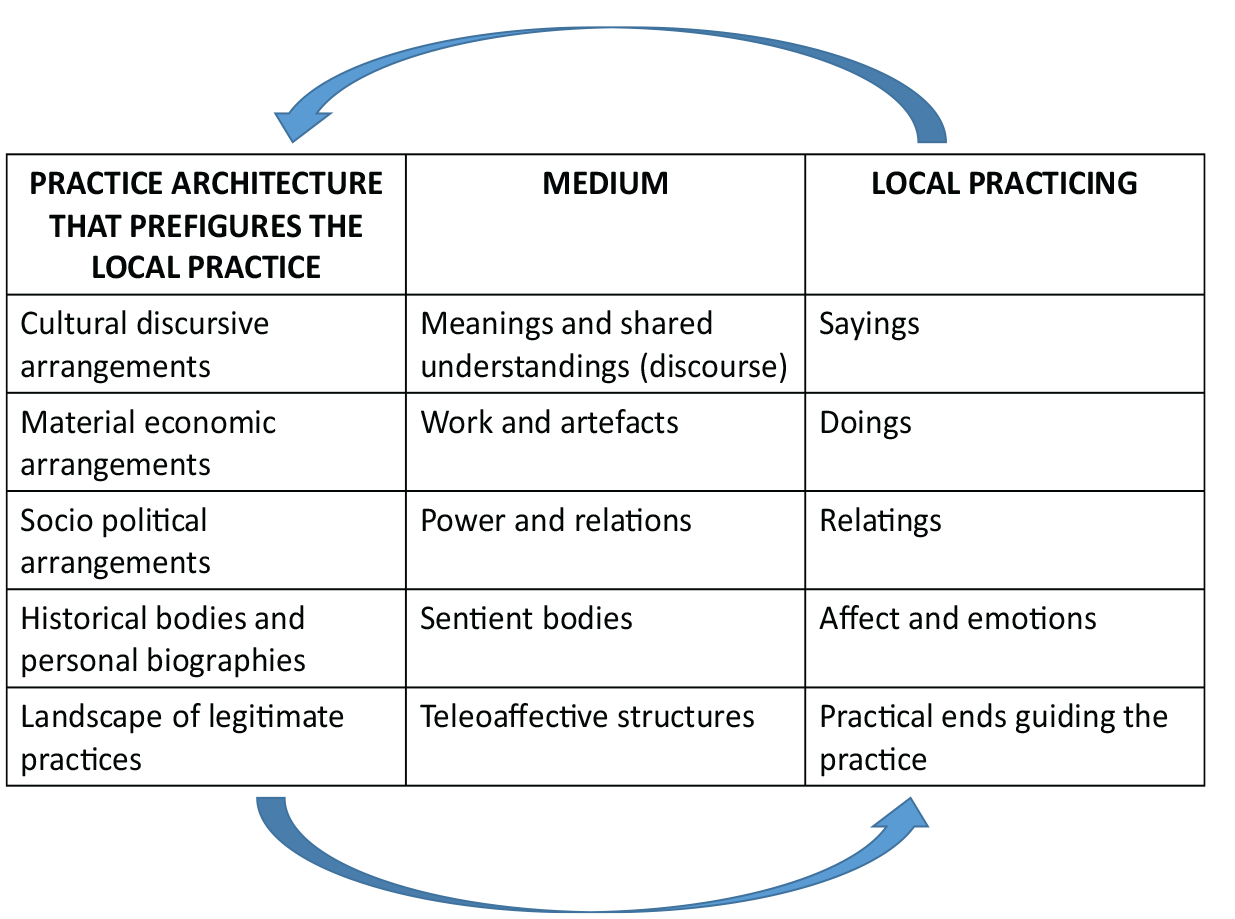
Summary of the theory of practice architectures.
Practice architectures as the site of attention
Our argument is that the same elements that build the practice architecture also structure the pragmatic field of attention discussed above. Through the mediation of the practice architecture, past history, and present culture, institutions and power relations are all concretely manifested in the scene of action (Blackler, 1995), thereby assisting in the establishment of a horizon of relevance, future possibilities, and things to pay attention to when carrying out the activity (the pragmatic field of attention of the specific practice). This idea is summarized in Figure 3.
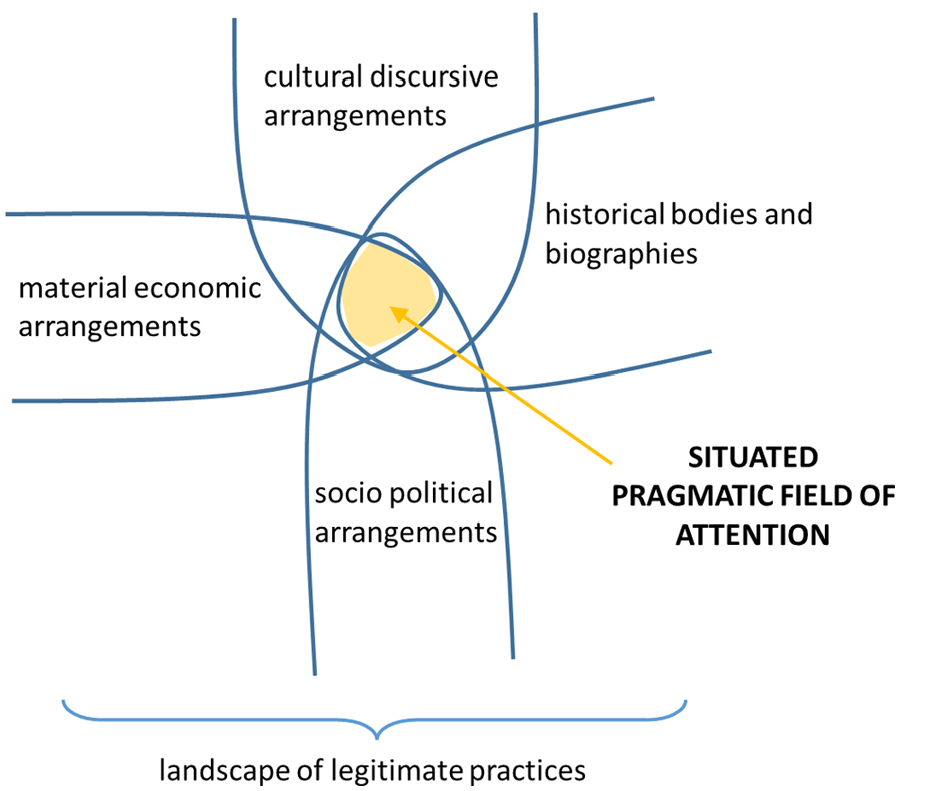
Situating attention in practice: How practice architectures structure practitioners’ pragmatic field of attention.
The idea of practice architecture (Kemmis, 2019), expanded by the work of Scollon and Scollon (2004; see also Jones and Norris, 2005), helps to shed light on the mechanisms underpinning the situatedness and embeddedness of attention. In fact, the practice architecture accounts for the role of both immediate local concerns and organizational conditions (often materialized in the form of text and artifacts), and broader “factors” such as the attentional regimes (Citton, 2017) circulating within an industry. The relationship between practices, attention, and architectures is two-way (see Figure 3). When practices happen, they become part of the happening: they take up the available ends, doings, sayings, and relating, modify them, and leave behind traces that in turn become part of the practice architecture of future activities. Through this interlocking, which manifests in terms of the elements described above and the idea that practices “feed upon each other” (Kemmis et al., 2014: 47), practices are interconnected and constitute extended webs of human social activities that are mutually necessary and interdependent (Kemmis, 2019).
In summary, the idea of a practice architecture allows us to empirically investigate the dual nature of situatedness by tracing it back to the components in which practices are grounded, such as their material substratum, their historical origins, and the vested interests that they serve. It can also help to disclose what needs to change (discursive, material, and socio-political aspects) in order for the organization’s or unit’s attentional selection to shift. Importantly, this model of situated attention can be applied to all levels of the organization, from employees’ attentional engagement to top management teams’ attentional orientation. The model thus offers a micro-foundational way to envisage the emergence of local (yet organizational) attentional styles that may arise from the institutionalization of specific ways of working, together with types of attentional resources. Finally, the idea of a practice architecture helps to further specify how to analyze the origin and nature of the pragmatic field of attention discussed above, and to link explanations of how practices produce attentional effects and how attention is situated and prefigured in practice.
Situating attention in the temporal dynamics of sustaining and turning attention
Seeing attention as situated within practice architectures that perform specific attentional fields allows further light to be shed on the dynamics between attentional engagement and attentional disengagement—when, how, and why managers turn away from certain matters of concern (Hannah, 2019: 2). This is critical, as the strategic value of attention derives not only from what and for how long we pay attention, but also from what we disregard.
To do this, we first need to differentiate between stimuli within the pragmatic field of attention discussed above. Hannah (2019) observes that the field of attention prefigured by practices is not homogeneous and broadly comprises three “areas”: a thematic focus around the task at hand; 4 a zone of monitoring within the domain of the practical end, which allows actors to switch between tasks and projects without this being considered a distraction (e.g. if HR calls about a hiring during another meeting, I might take the call); and a broader zone of temporary vigilance outside the immediate task at hand. During any activity, we remain open to noticing things that happen “outside” the practice’s pragmatic field of attention. For example, during a meeting about my new contract, I might hear something about a new business opportunity completely unrelated to the current one but still worth taking note of. However, noticing is one thing; attending to what we notice and thus shifting our attention in that direction is another. This figurative space between noticing and attending is where (and when) human agency manifests itself, and is also where competition for attention takes place.
This observation is important, as it expands the ABV in at least three ways.
First, it allows us to distinguish between functional and dysfunctional attention turning, such as stopping an activity to prevent an accident versus stopping to check one’s social media account.
Second, it allows problematization of the ABV’s inherently normative view that focused attention is good, while insufficient attention or distraction is bad. This view excludes the possibility of understanding distractions as occasions of serendipity, or as a generative diversion to counteract some well-known pathologies of attentional intensity, for example, when too much organizational attention is devoted to a narrow set of issues (Rerup, 2009). Third, it allows the inclusion of emotional dimensions in discussion of attentional engagement, aspects that have largely been ignored by ABV scholarship—and that are central in the work of Schatzki (2002), for whom the “teleoaffective structure” as the organizing principle of practices has a strong emotional quality. Attending to something, rather than simply noticing it in passing, expresses believing and caring for what is prefigured by the course of action. Equally, when we turn our attention toward a (new) object of attention, considerations of relevance, future anticipation, and emotional aspects always work together. Directing and maintaining attention is thus closely connected to what we care about (Hannah, 2019). The message is that determining how attentional engagement is sustained and turned over time depends on a logic of belief, whereby decision-makers select issues, objects, and events when these are consistent with their belief systems; on a logic of interest, whereby attention is generated in pursuit of various personal and organizational interests; and on a logic of care, whereby we pay attention to what we feel (or are induced to feel) strongly about. Scholars such as Vuori and Huy (2016) have already started to unpack how this might happen. Studying the case of Nokia, they foregrounded the recursive relationship between fear and attentional engagement, also showing the (negative) strategic implications that might ensue.
Finally, understanding the mechanisms and dynamics of attentional stability and the turning of attention is critical, as attention is often situated at the intersection of not one but multiple practices. This also requires us to understand attentional contradictions, opportunities for distraction, and attentional deviations, as we shall explain next.
Situating attention at the crossroads between practices
The idea that multiple practices can create attentional tensions, conflict, and contradictions is aligned with the ABV’s intuition that choice opportunities often compete for attention in organizational channels (Ocasio, 2012: 302). A practice-theoretical perspective expands this view by suggesting that misalignments and contradictions may derive from a broad range of sources and can be mediated into the scene of action by different practices, practices belonging to different traditions, and any of the elements of the practice architecture.
In the case of different practices, participants may be figuratively pulled in divergent directions by the multiple practices competing for attention (Shove et al., 2012). It is here that the politics of attention takes place. Practice (working versus checking social media) tries to enroll (or retain) participants using a variety of rational, cultural, and emotional means, including leveraging beliefs and interests and affecting what we care about, for example, through persuasion and seduction.
Attentional discrepancies and conflicts can also be mediated into the scene of action by elements of the practice architecture. Returning to the example of the performance review, the participants may come to the scene of action with divergent understandings of what a review looks like and what it is important for them to pay attention to. Different material resources (such as two different versions of the review form) may also generate attentional discrepancies and contradictions. Different discourses (and conceptions of what constitutes a good employee) may lead the participants to focus on different things, such as achieving targets versus other contributions.
From a practice perspective, discrepancies and attentional misalignments are ubiquitous and likely to occur whenever multiple carriers of practice find themselves in a specific place and time. These discrepancies need to be resolved interactionally and negotiated locally through intuitive adjustments, informal mutual attunements, or reflexive negotiations (Citton, 2017). We can ignore discrepancies, go with the flow, or raise the issue discursively (either participant in the performance review might say “I think we are deviating here”). The results of these negotiations are sedimented in the practice architecture and affect future attentional engagements (“we can tell the office to update the review form”). The implication of this is that joint attention constitutes a further level of analysis to understand the situated nature of attention. Future research on this aspect can build on existing SAP scholarship. For example, research by Nathues et al. (2022) show that when conditions are complex, equivocal, and ambiguous, collaborative strategy can be achieved through three coauthoring practices (proposing, appropriating, and expropriating voices). A similar approach could be used to explore how joint attention is collaboratively achieved through discursive and material practices.
Situating attention at the crossroad between practices also suggests that an organization should be conceived as a nexus of practices, with each practice having its specific attentions prefigured into the scene of action, and with itsown negotiated order of pragmatic fields of attention (Strauss, 1978). Recent SAP scholarship offers promising ways to unpack the mechanisms that might underpin the distributed and emergent nature of attention as practice. For example, recent work by Skov et al. (2022) unpacks how chronological sequence of meetings and between-meeting interactions cumulatively foster the emergence, stabilization and change of strategic orientations. While their focus is on the ongoing process of strategy formation, their approach can be extended to study the emergence of a negotiated order of pragmatic fields of attention. Simalrly, Soderstrom and Weber (2020) theorize that in organizations, issues become central and enduring through a process of progressive accumulation. This is facilitated by the fact that a successful local interaction produces knowledge and carries over (and accumulates) relational, motivational and attentional traces of that knowledge in the course of interactionsequences. Although the authors take attention as one of the traces, one can also think of attention itself as the product of such a distributed process of accumulation and structuration process.
Finally, shifting the unit of analysis from managers’ cognition or behavior toward interconnected practices and the negotiation of local orders of attention introduces the idea that attention, like culture, may be internally differentiated (Martin, 1992). Different bundles of work practices and negotiation processes may generate different local pragmatic fields of attention, which may be aligned with or contradict each other. This may create problems for the organization, such as tunnel vision and incapacity to identify early warning signs, leading to missed opportunities and foresight failures (Nicolini and Korica, 2021; Rerup, 2009). Unlike the ABV, a practice-theoretical sensitivity suggests that such differences in local regimes of attention are rooted in the nature of work practices, rather than stemming primarily from the formal system of governance.
Concluding remarks
This paper has examined how a practice-theoretical perspective might complement, integrate, and expand important work conducted in the ABV tradition, including some of its most recent developments (Ocasio et al., 2018). We argue that attentional engagement is at least partly constituted tacitly in and through practices. This allows us to theorize the situational and embedded nature of attention and attentional engagement in terms of practice architectures. Figure 4 provides a pictorial representation of our view of the situated nature of attention. The right side of the pictures is faded, as this aspect is not considered in the present discussion.
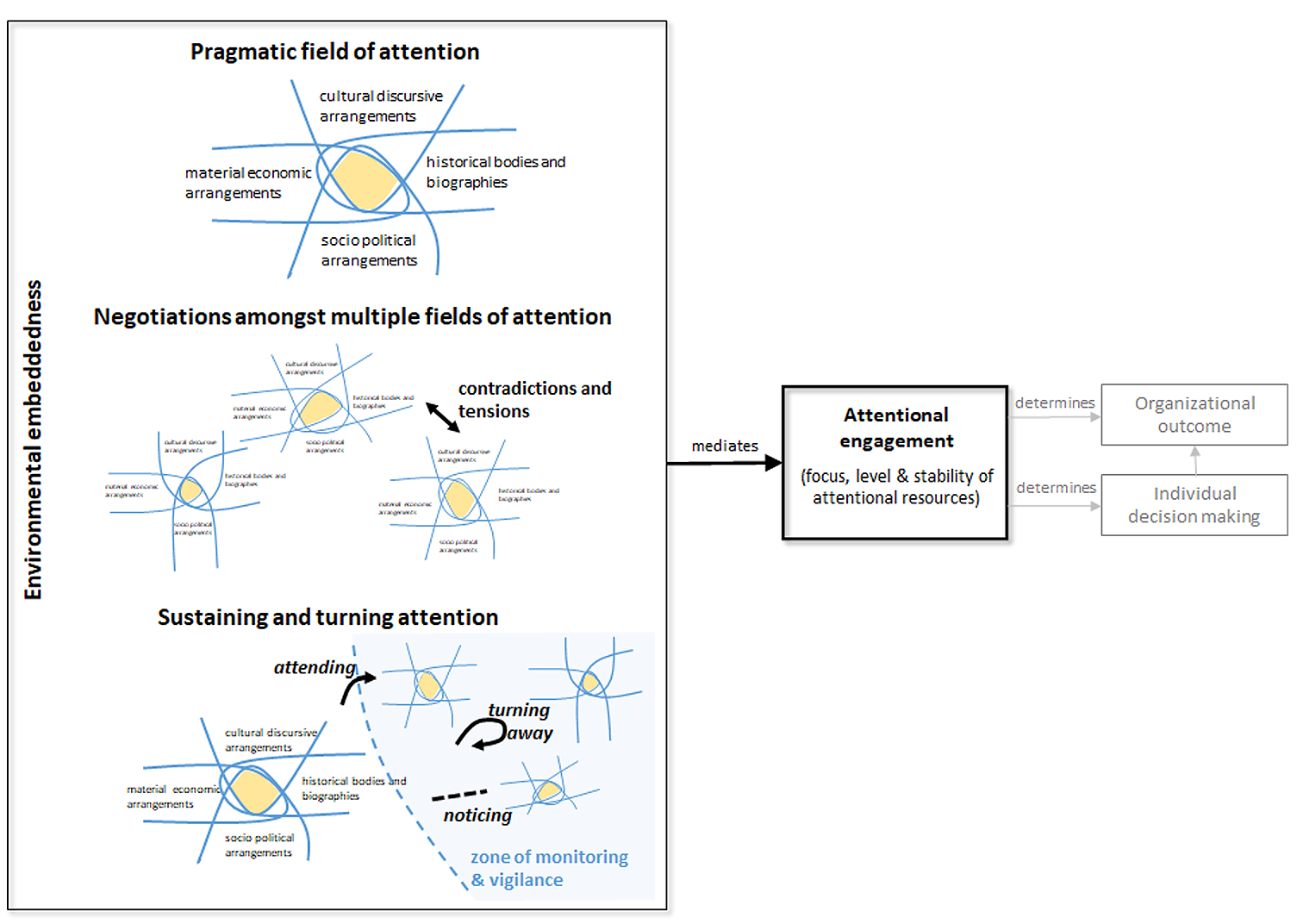
A practice-theoretical view of the situated nature of attention.
From a practice-theoretical perspective, the resources used to carry out a practice also constitute the pragmatic field of attention associated with the specific activity. Attention is at least partly prefigured for us by the practice in which we are involved: when performing a work practice, skilled practitioners find themselves already oriented toward certain aspects and not others. Maintaining a specific attentional focus within the pragmatic field or letting go and paying attention to something else is affected both by rational calculation and beliefs and by emotional attachment: we pay attention to what we care about. Finally, a practice-theoretical perspective introduces the idea that interactional situations are further sites where attentional differences are ordinarily negotiated and resolved in search of joint attention. Attention is not only situated but also situational, negotiated in situ.
Taken together, these conceptual developments advance, theoretically and methodologically, our understanding of how attention is situated and embedded, of how attentional engagement is obtained, and of the nature of the organization’s attentional perspective.
First, the view developed here suggests that much, if not most, attentional engagement is prefigured and unnoticed: we tend to let it happen, and only rarely allocate attentional resources in a deliberate fashion through decision-making (see Ocasio, 2011). This also applies to interactional situations: obtaining joint attention is often a matter of mutual adjustment rather than collective deliberation.
Second, a practice-theoretical orientation offers a richer view of situatedness, embeddedness, and their underlying mechanisms. Central to this expanded view is the idea that practices are associated with a particular pragmatic field of attention, resulting from the discursive, material, and interactional mediatory elements amid and through which practices transpire. This view complements the ABV’s under-socialized and simplified notion of situatedness derived from cognitive psychology. Rather than understanding situatedness as the local recursive process in which attributes of a situation evoke and shape particular perceptual frameworks and interpretation schema (Elsbach et al., 2005), a practice-theoretical orientation takes a more radical view of embeddedness and situatedness that considers local factors (see, for example, Brielmaier and Friesl, 2022) and broader historical and social conditions. Importantly, a practice-theoretical orientation offers an explanation of how these “contextual” conditions manifest themselves in the moment of action, thus expanding and providing depth to the idea that attention is socially determined.
Third, a practice-theoretical orientation offers a broader view of the distributed nature of organizational attention. For one thing, the approach admits a much wider cast of characters in explaining attentional phenomena. The ABV has focused primarily on the information and communication-specific context and—more recently—discourse (Ocasio et al., 2021), whereas a practice-theoretical view invites us also to consider the attentional role of materiality, interactions, time, and emotions (see also Brielmaier and Friesl, 2022). Foregrounding the role of non-human entities is especially important with the emergence of “super”-agential attentional artifacts, such as algorithms and machine learning systems. These artifacts inscribe, carry out, perform, and—in the case of machine learning—potentially create specific ex novo rules of attention that actively participate in determining the organization’s attention, occasionally without human actors being fully aware of it.
At the same time, a practice-theoretical orientation introduces a host of new units of analysis when studying organizational attention, including practices, nexuses of practices, communities of practice, and interactional encounters. To understand attention in organizations, we may need to pay more attention to the mundane aspects of organizational life. In doing so, a practice-theoretical orientation might act as a corrective to the ABV’s tendency to focus almost exclusively on the attention of strategic-level decision-makers. This top-down view often conflates (top) managerial and organizational attention, thereby discounting the potential for organizational attention to be internally differentiated, fragmented, and inconsistent (Martin, 1992; Nicolini and Korica, 2021; Rerup, 2009). The intuition is that, like culture, attention may be internally differentiated (Martin, 1992). Different bundles of work practices may generate different local pragmatic fields of attention, which may be aligned with or contradict each other (Rerup, 2009). This may create problems for the organization, such as tunnel vision and incapacity to identify early warning signs, leading to missed opportunities and foresight failures (Nicolini and Korica, 2021). Unlike the ABV, a practice-theoretical sensitivity suggests that such differences in local regimes of attention are rooted in the nature of the work practices, rather than stemming from the formal system of governance.
Table 1 summarizes how a practice-theoretical perspective might contribute to understanding the situated, distributed, and socially determined nature of attention.
How a practice-theoretical view helps to expand the ABV’s view of attention situatedness.
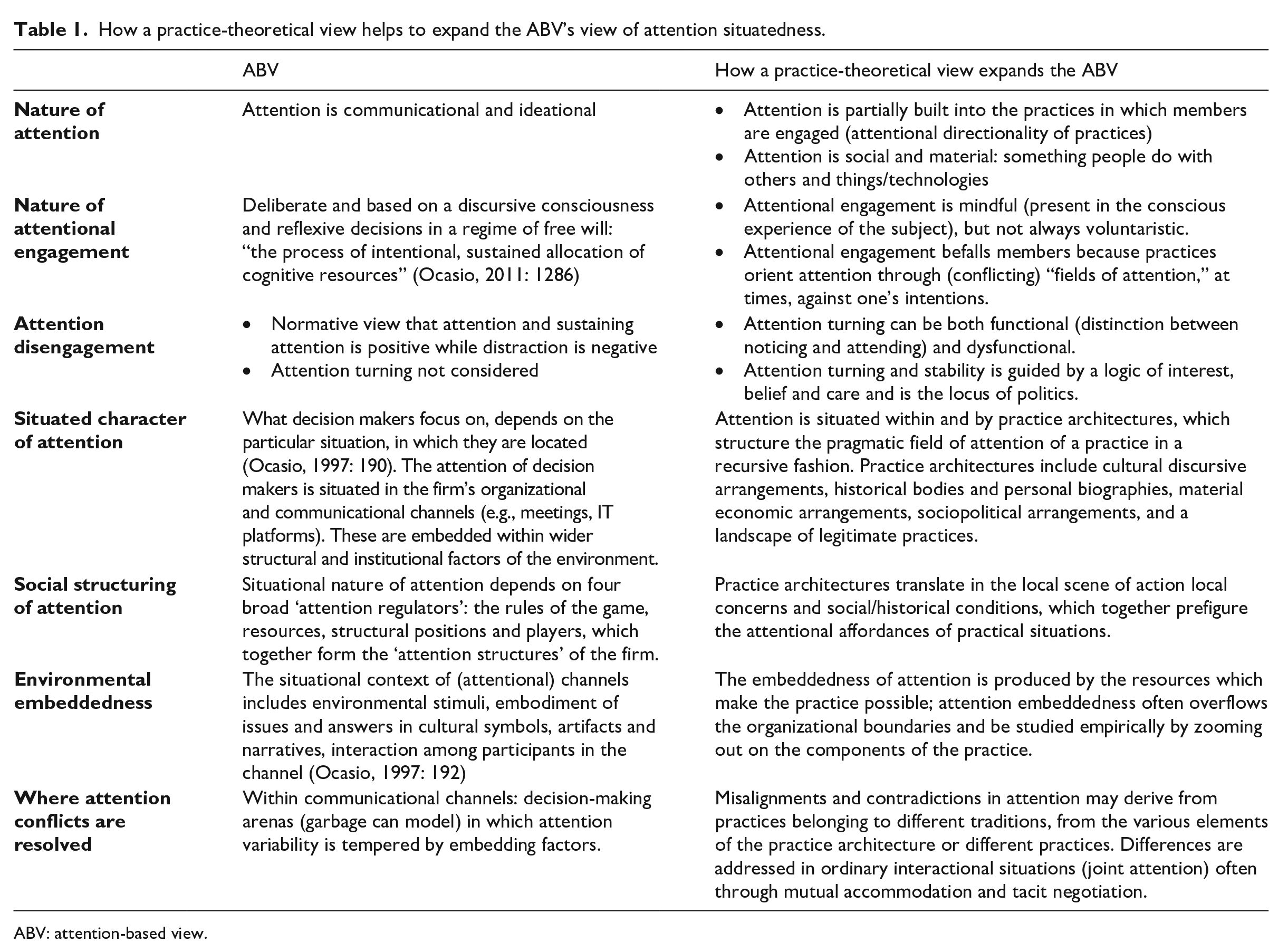
ABV: attention-based view.
On the relationship between the ABV and a practice-theoretical view of attention
A final question regards the nature of the relationship between the ABV and a practice-theoretical view of attention. The relationship can be framed in at least three different ways.
One could see the practice perspective as an enrichment and extension or an integration of the ABV. The idea that attentional engagement occurs to people under conditions they do not choose would lead us to understandpractices as a particular category of attention determinants. One could thus integrate practices within the existing ABV model and consider them one of the resources that distribute issues and answers among decision-makers. After all, the Carnegie School perspective already takes into consideration programs and routines (Brielmaier and Friesl, 2022). Moreover, ABV communication channels (meetings, assemblies, conferences, etc) are often established practices (or part of established practices). For example, the channel structure and channel integration processes (Joseph and Ocasio, 2012; Yu et al., 2005) exemplify diverse strategic planning practices employed by CEOs.
One could also see the two approaches as alternative and incommensurable. The Schatzkian perspective on practices builds on ontological premises that are different from those of the Carnegie School. Take, for example, March and Simon’s emphasis on individual bounded rationality as the source of programs and routines. For Schatzki (2002, 2005) as for other practice-theorists, the basic domain of study and the foundational unit of analysis of the social sciences are social and material “practices ordered across space and time” (p. 1989). Accordingly, while the ABV is interested in people and their attention (including their attention practices), a Schatzkian view would encourage them to think in terms of attention (practices) and “their” people. 5
We prefer a third view that denotes the relationship in terms of an alliance. Schatzki (2021) noted that combinations of two or more social theories tend to furnish accounts of social life that are more comprehensive than when we mobilize solely on approach. We favor this idea as it embraces a complexifying rather than a reductive orientation—both the former approaches are reductive in that they require seeing the world from one perspective only (Nicolini, 2013). Of course, the alliance would require that the ABV forsakes the idea that one single meta-theory could explain all things relating to attention. Theories that cover everything do not need allies and alliances.
The alliance between ABV and a practice-theoretical view could build on the shared intuition that to understand attention, we need to consider aspects that transcend the individual level, and on the shared assumption that in organizations, attention is up for grabs. The terms of the alliance are nicely captured by the idea of the iceberg suggested above. The ABV was initially conceived and remained a theory of strategic decision-making that explains organizational moves that depart from existing practices (Ocasio, 1997). The primary focus is on non-routine contexts—hence the lack of explicit attention to practices or routines. An alliance with practice theory (and the SAP approach more generally) would allow us to study both parts of the iceberg, and also to inquire into the relationship between the two. For example, a practice theoretical approach does not discount the centrality of the attentional perspective of the corporate actor and the importance of formal “channels” and organizational architecture (Joseph and Ocasio, 2012) in configuring attention. However, by interpreting this as a practical effort by the managerial elite to prompt a specific set of attention priorities on the rest of the organization, this approach would invite to investigate the related dynamics and consequences empirically. Similarly, the ABV typically takes a very local view of situations: situations occur in time and place, and channels are ways to enact the context in which a situation is experienced. Moreover, each situation is considered in isolation as per the view proposed by Cohen et al. (1972). A practice theory view does not disregard the idea that, at a strategic level, situations tend to be unique. However, it invites us to examine the many other situations in organizations that are quite routine. In short, the alliance is formed around the idea that there is considerable variation in how determinative practices are to each situation, and that different approaches might be useful to explain different situations. A practice approach could also provide the theoretical and methodological resources to investigate how situations are connected into chains and sequences (Skov et al., 2022; Soderstrom and Weber, 2020) over and beyond the ABV intuition that channels are “programmatically” (i.e. deliberately) integrated (Joseph and Ocasio, 2012).
The alliance would also benefit those adopting a practice-theoretical view. For one thing, attention is still a peripheral concern among practice-oriented scholars, including scholars from the SAP camp. This contrasts with the convincing message from ABV scholars that understanding how attention operates can have far-reaching consequences both for organizations and for addressing pressing societal issues. For example, (Bansal et al., 2018) show how inadequate attention structures can lead organizations (both private and governmental) to “miss” large-scale processes, such as those related to climate change, or micro-scale processes, such as those related to local variations in poverty. The ABV also has the great merit of identifying organizations and corporate actors (i.e. the type of agency associated with the top echelon of the firm) as critical levels of analysis to understand attention phenomena. This is important as, until now, both practice and sociologically oriented scholars tended to jump between individual practices and societal level (see Hannah, 2019; Nicolini and Korica, 2021). Together, the two approaches would thus provide a more complete and convincing vista of the attention texture of the organization. They would temper the top-down perspective of the ABV, for example, by examining the processes hidden beneath the immediate horizon of visibility that can scupper attempts of elite attentional direction. It would do so without ignoring that hierarchy and power are a fact of (organizational) life—and that some organizational practices and voices are more equal than others. The alliance would bring theoretical, methodological, and practical benefits, opening novel and promising avenues of research into the phenomenon of organizational attention and attention in organizations.
Theoretically, the alliance between the ABV and a practice theoretical view (both the view outlined here and developments within the SAP scholarship more broadly) could help to expand our understanding of attention phenomena, providing further fine-grained accounts of the critical mechanisms involved. While the ABV has been around for a quarter of a century, the practice theoretical view is only at its beginning, and further theoretical and especially empirical research is required to explore in detail the processes and mechanisms illustrated in Figure 4.
Methodologically, giving further attention to attention practices would allow us to expand how we study attention and examine the consequentiality of attentional practices for organizations over and beyond the current tendency to focus primarily on the relationship between attention and performance (Jarzabkowski et al., 2021: 7). As we discussed above, recent research demonstrates the heuristic value of real-time and process-oriented studies of organizational attention (Nicolini and Korica, 2021). Further empirical work is needed by SAP and other process-oriented scholars to zoom in on the mechanisms and dynamics underpinning attention. SAP scholars, however, caution that practice-theoretical studies should not be confused with turning practices into variables and factors, a risk that is inherent in the alliance prefigured here (Jarzabkowski et al., 2016). This is because “the relationship between practices and economic performance cannot be understood without taking into account not only ‘what’ practices exist but also ‘who’ implements them and ‘how’” (Jarzabkowski et al., 2016: 250). Studying the attentional effects of bundles of practices thus requires preserving a processual orientation, tapping into the wide array of methods developed by the interpretive research tradition. These include qualitative, interpretive, process-oriented, and—when appropriate—observational and video-based methods (Nicolini and Korica, 2021).
Finally, the alliance could be beneficial also in terms of contribution to practice. Approaches like practice architectures (Kemmis, 2019) and the nexus of practice (Scollon and Scollon, 2004) may help to shed light on the micro-processes that constitute, constrain, or enable attention to new strategic issues and initiatives. The approach could help practitioners refine and hone their attention practices, improve their strategic oversight and the foresight capabilities of organizations, and find ways to prevent the generation of strategic blindspots and decision-making biases (Gavetti, 2012; Schoemaker, 2019).
Footnotes
Funding
The author(s) disclosed receipt of the following financial support for the research, authorship, and/or publication of this article: This study is supported by a grant from the Swiss National Science Foundation (SNSF) No. 100013M_204597.
