




Abstract
Interpersonal relationships among organization members based on trust, disclosure, and mutual respect are an important capability that organizations need to be resilient in times of crisis. Using the attention-based view, we theorize how the attention paid to interpersonal relationships among top managers continually shapes and is shaped by the quality of relationships that emerge at the unit level. We leverage the attention-based view to theorize how different patterns of attention are associated with configurations of structures for building interpersonal relationships, with the resulting patterns of behavior producing distinct relational systems. We contrast three relational system archetypes: relational advocacy, relational antipathy, and what we argue is the most common but least understood and most likely to weaken organizational resilience—relational indifference. These systems are theorized as central to the attentional infrastructure of the organization, impacting its capacity for attentional stability and coherence on emergent issues. The proposed framework offers a novel view of organizational resilience and interpersonal relationships with notable contributions to multiple research domains and to practice.
Keywords
Interpersonal relationships between employees matter particularly in times of adversity and crisis when organizational resilience is required. Resilience is the process by which an organization draws on its capabilities to effectively absorb, generate customized responses to, and engage in transformative activities to overcome disruptive events that can jeopardize its vitality and survival (Lengnick-Hall et al., 2011; Sutcliffe and Vogus, 2003). Organizations comprising interpersonal relationships defined by greater trust, disclosure, and mutual respect are better equipped to execute resilient responses as members are better able to align their attention and actions (Gittell et al., 2006), exchange more information and ideas, and collaborate more to understand and solve problems (Barton and Sutcliffe, 2009; Collins and Smith, 2006; Gittell et al., 2010). Resilience has even been construed as an interactive process of relational adaptation that enables positive adjustment in the form of absorbing, abating, and answering threats; and sustaining, salvaging, and securing new resources (Williams et al., 2017: 742). Recognizing that the need to dynamically relate to a changing environment relies on the ideas, involvement, and cooperation of each and every organization member, relational deficiencies indicate an emerging or realized organizational vulnerability.
The nature and quality of interpersonal relationships affect how and with what success members are able to work together—developing similar or compatible attention to issues—both within and across departmental boundaries and hierarchical levels (Rerup, 2009; Vuori and Huy, 2016; Weick and Sutcliffe, 2006). In the now classic analysis of the Mann Gulch disaster, Weick (1993) asserted that underdeveloped interpersonal connections (i.e. low openness and respect) between smokejumpers interfered with enacting vital ad hoc capabilities as their conventional role structures collapsed, such as improvised decision-making and emergent communication and coordination. Vendelø and Rerup’s (2009) analysis of the accidental death of nine men during the Pearl Jam concert at the 2000 Roskilde music festival suggested that physical distance and anonymity created an us-versus-them relationship between security guards and the audience that hindered the coordination of information about emerging dangers on the concert floor. And in Vuori and Huy’s (2016) account of Nokia’s rise and fall in the smartphone industry between 2005 and 2010, distrustful relationships between temperamental and often aggressive executives and fearful unit managers prevented the necessary communication and integrated sensemaking of information about intensifying competitive threats and internal operational problems. Such examples implicate how member relationships enable attentional coherence—how “similar or compatible attention is across levels, units, and people” and attentional stability—how effectively organizations are able to maintain “sustained attention to issues” (Rerup, 2009: 878).
Interpersonal relationships were not a centerpiece of the seminal formulation of the attention-based view (ABV) of the firm (Ocasio, 1997; Ocasio and Joseph, 2005), but their relevance resonates in such accounts of attentional failures. Joseph and Ocasio (2012) note that organizational structures and collaborative practices enable communication and synchronization of attention within and across a firm’s governance channels, contingent on members’ capacity for open and frank dialogue (p. 644). This implication is significant. Despite the presence of organizational structures to deploy attention on certain issues (e.g. controlling the direction, volume, and velocity of information that is shared), attentional coherence nevertheless may be thwarted if organization members do not trust and feel safe with each other, and attentional stability will be affected as gaps in social structures will inhibit momentum toward issues over time. Interpersonal relationships thus are essential conduits through which organizations can effectively direct, sustain, and integrate members’ attention in times of crisis. Arguably, then, structural approaches to regulating attention featured in the ABV depend on a broader attentional infrastructure. We submit that an organization’s relational system—the nature and pattern of interpersonal relationships that stretch across the organization—is integral to this attentional infrastructure. Just as roads, airports, and rail systems provide a transportation infrastructure that supports essential activities of a community—relational systems provide an attentional infrastructure that supports attentional processes across the organization. The purpose of our inquiry is to advance an attention-based perspective of how relational systems emerge and the downstream impact on an organization’s capacity to deliver resilient responses in a crisis.
Our perspective offers several contributions. First, we expose relational systems as an understudied facet of the ABV that is integral to attention integration in organizations facing disruption, adversity, or crisis. Whereas the ABV centers on how organizations can intentionally direct attention toward certain issues (Joseph and Ocasio, 2012; Joseph and Wilson, 2017; Ocasio, 1997), we theorize how organizations can purposely direct attention toward—or—away from interpersonal relationships and relational dynamics among members, or exhibit inattention to relationships altogether. These different forms of attention fuel the production of distinct relational systems. Importantly, whereas prior research construes the impact of inattention to issues mostly in terms of missed opportunities to detect signals suggestive of emergent problems (Rerup, 2009; Weick and Sutcliffe, 2006), we highlight other particularly pernicious effects of inattention to relationships. We use relational systems to argue that the ABV has underplayed how patterns of relationships can be damaging to the organization’s attentional infrastructure.
Second, we offer a deeper theoretical treatment of how relational systems emerge and the subsequent impact on an organization’s capacity to deliver resilient responses in a crisis. Research on managerial cognition and attention have argued that for an organization to take action with respect to an issue, the issue first must be noticed and second, must be interpreted as relevant (Daft and Weick, 1984; Ocasio, 1997). Thus, the adoption of structures and practices that build interpersonal relationships would, at least in part, be a function of whether key decision-makers have noticed and perceived interpersonal relationships as likely to have an impact on the organization’s functioning. As attention is fundamental to organizational structures and practices, attention thus is implicated, yet undertheorized, in relational theories. Notably, across research that identifies organizational structures that contribute to dyadic relationship formation (Stephens et al., 2011), relational coordination (Bolton et al., 2021; Carmeli and Gittell, 2009; Gittell, 2001, 2002; Gittell et al., 2010), and shared relational beliefs (such as psychological safety, Edmondson and Lei, 2014), we see an implicit assumption that attention is intentionally focused on relationships and relationship building. While scholars have questioned whether the presence of particular practices alone is sufficient to generate relational systems (Gittell, 2016; Stephens et al., 2011)—our position is that whether these practices receive proper attention matters a great deal. We argue that how attention is directed to relationships and relational management, or ignored altogether, is evidenced in the structures and practices in which top managers invest and that unit managers implement and endorse. Such attention signals to organization members that relationships are (or not) relevant and vital to organizational effectiveness.
Third, our perspective construes relational systems as playing a pivotal role in crisis-mitigation. The crisis management and organizational resilience literatures detail how organizations’ relational capabilities buoy responses to adverse events, but our focus on the impact of relational systems on the attentional infrastructure offers a new angle. While this past work has demonstrated how interpersonal relationships can positively affect daily organizational functioning and overall resilience in the face of adversity (Gittell et al., 2006; Shepherd and Williams, 2014; Weick, 1993; also see Williams et al., 2017), as well as how adversity can affect relationships, in turn (Kahn et al., 2013), this work is limited by the lack of focus outside of the post-event response period. By arguing that relational systems provide (to varying degrees) the necessary infrastructure for attentional stability and coherence, our perspective outlines how organizational attention dedicated to interpersonal relationships can create (or not) a fertile enabling context for effective relational functioning, thereby revealing a critical preventive measure that can reduce organizations’ vulnerability when crises emerge.
Finally, we see broader theoretical relevance of our attention-based perspective given the modern structure of firms. In a recent research dialog, Ocasio et al. (2022) reflect on the dwindling presence of the prototypical Chandlerian firm (1962, 1977) that served as a muse for seminal work on the ABV. In contrast to these multidivisional, vertically integrated, and hierarchically structured organizations, the post-Chandlerian firm is more distributed and permeable. Correspondingly, organization members confront more dynamism in their external and internal environments and higher volumes of information from more diverse sources that compel ad hoc decision-making, rapid identification and mobilization of resources, and emergent communication and coordination across units and up the hierarchy. Such firms face ongoing hurdles in creating a sustained and cohesive focus on similar or compatible issues across their members. Figuring out what to attend to and aligning attention so that it is clear what issues (or the specific aspects of an issue) different units/groups are focusing on requires a robust attentional infrastructure. Our perspective on relational systems—the pattern of interpersonal relationships across the organization and the attention structures that support them—offers insight into the foundations of an attentional infrastructure capable of supporting swift, non-routine, and highly interdependent activities.
To build our model, we take the following track. First, we use the ABV to define what attention to interpersonal relationships means at the organizational-level. We theorize how different forms of attention among top-level leaders are reflected in configurations of structures and practices that signal the relevance and importance of interpersonal relationships to organizational effectiveness. We then define and describe three system archetypes associated with positive and negative organizational attention, and inattention to relationships—which we refer to as systems of relational advocacy, relational antipathy, and relational indifference. Next, we discuss how these relational systems implicate distinct interpersonal networks at the unit-level that operate to reinforce the relational system in place. As we build our framework, we give particular emphasis to relational indifference systems which we propose are the most prevalent, least understood, and most likely to create relational vulnerabilities across an organization.
An attention-based view of relational systems
Attention-based theories define organizational attention as the noticing, encoding, interpreting, and focusing of time and effort by decision-makers on particular issues and responses (Ocasio, 1997: 189). Traditionally, an organization’s CEO and members of the top management team are influential regulators of attention (Hambrick and Mason, 1984; Ocasio, 1997). The attention of top managers directs what goals and activities become priorities and, in turn, where time and resources are invested. Attention signals a willingness to prioritize concerns and pursue courses of action, providing organization members with critical guideposts for their decisions and conduct (Eggers and Kaplan, 2009; Ocasio, 1997).
Organizational attention to interpersonal relationships
Closer inspection of organizational attention to interpersonal relationships requires that we first outline what we mean by interpersonal relationships and attention to relationships. Interpersonal relationships are attachments reflecting socioemotional ties between organization members (Granovetter, 1973; Kahn, 1993; Methot et al., 2017; Reis and Patrick, 1996). These relationships are conceptualized in terms of their directionality (positive or negative) and strength as a function of the prevalence of supportive behaviors offered and received between members. Kahn (1998) characterized such behaviors as caregiving acts that promote each other’s welfare and include, for example, inquiring about and being responsive to others’ emotional, physical, and cognitive needs and concerns, validating other’s experiences, communicating positive regard and respect, and providing support. These supportive behaviors parallel how research across myriad theoretical domains has construed interpersonal relationships in the workplace (see Ferris et al., 2009). From this point on, we use the term interpersonal relationships to refer to strong, positive relationships marked by the regular provision of these behaviors.
To capture organizational attention to interpersonal relationships, we build on the concept of positive attention in Bouquet and Birkinshaw’s (2008) research on foreign subsidiaries. These authors introduced “positive headquarters attention” as value-enhancing, defined as the extent to which a parent company recognizes and gives credit to a subsidiary for its contribution to the multinational enterprise as a whole. We also see the concept of positive attention implicated in research on post-crisis learning and adaptation. For instance, drawing on examples from the Challenger and Columbia space shuttle accidents at NASA and serious drug errors in pharmaceutical firms, Haunschild et al. (2015) noted how top managers increased attention to safety and its essential role in organizational effectiveness post-incident. Such attention brought the implementation of numerous resource-intensive programs that increased the number of safety personnel and more robust safety operating procedures. We suggest that these examples capture positive organizational attention among top managers given the intentional and highly visible focus on safety as value-enhancing. Drawing inspiration from this work, we construe positive attention to relationships as the extent to which an organization not only recognizes the value of interpersonal relationships to organizational operations and effectiveness but also allocates resources to preserve and grow such relationships. Such positive attention, and subsequent allocations, increase as top managers grant higher strategic relevance and relative importance to interpersonal relationships.
In direct opposition, top managers can take a decidedly negative stance vis-à-vis the value of a particular issue to organizational operations and effectiveness. Bouquet and Birkinshaw (2008) did not theorize about negative organizational attention, yet noted that some of the interviewees in their research described more negative forms of attention from headquarters. Here, in contrast to positive attention being value-enhancing, we construe negative attention as value-depleting, and define it as the extent to which top managers recognize the unproductive impact of an issue to the organization as a whole. An example of negative attention comes from government; specifically, Florida Governor Ron DeSantis’ efforts to make salient the negative impact of Diversity, Equity and Inclusion (DEI) initiatives on the students attending Florida higher education institutions. The governor’s office released a statement in January 2023 stating the proposed ban on these initiatives in state colleges “raises the standards of learning and civil discourse of public higher education in Florida” by “prohibiting higher education institutions from using any funding, regardless of source, to support DEI . . . and other discriminatory initiatives” (quoted in Izaguirre, 2023). We suggest that this example captures negative organizational attention given top managers’ unsupportive and visible stance on such programs as detracting from the vitality and future viability of the state and its constituents.
Applying these ideas to interpersonal relationships, we construe negative attention as the extent to which an organization recognizes interpersonal relationships as an unproductive contributor to organizational operations and effectiveness. Negative attention is indicated by top managers intentionally withholding resources to develop them and more extensively communicating their unproductive impact on the organization. In some instances, top managers explicitly recognize how members’ capacity to support one another has little bearing on the organization as a whole, making interpersonal relationships unworthy of investments of time, effort, and resources. In such instances top managers see interpersonal relationships as potential distractions or obstructions to organizational functioning (cf. Ingram and Zou, 2008; Pillemer and Rothbard, 2018), purposely directing resources away from efforts that would develop or support them. In this way, negative attention necessarily involves an explicit recognition of the low value proposition of interpersonal relationships within the organization.
Finally, while organizations can focus attention on relationships in ways that are more positive or negative, top managers may lack any clearly defined intentional action as concerns interpersonal relationships. The absence of attention reflects organizational indifference to the extent that top managers do not actively direct attention toward nor away from interpersonal relationships and relational dynamics in the organization (cf. Kaplan, 1972; Thompson et al., 1995). For example, the recent layoffs at Google have brought to light how organizational leaders appear to exhibit such indifference. Once recognized for its people-centric approach, open and transparent communication across people and levels, and a “don’t be evil” code of conduct signaling an expectation of mutual respect, Google recently laid off thousands of employees—by email (Duffy and Thorbecke, 2023). Coupled with other decisions to roll back broad access to intranet documents and to other employees’ public calendars, the email notification demonstrates a lack of forethought by top managers about the impact on surviving employees and their relationships with each other. These are hallmarks of indifference. With indifference, there is mostly silence as to, or lip-service paid to, the importance of relationships (e.g. building connections, fostering inclusion, communicating openly and honesty) but with no consistent action taken. Indeed, the Google belonging website (2023, https://about.google/belonging/at-work/) states that “We’re making sure every Googler feels seen, connected, supported, and empowered . . .,” which is inconsistent with the method of layoffs and with other actions that indicate inattention to the potential impact on trust and belonging. Such mixed messages signal that relationship building likely is not an organizational priority—indeed, employees’ responses to these actions explicitly call out how leadership seemingly does not care one way or the other about relationships anymore (see Duffy and Thorbecke, 2023). When indifference prevails, top managers do not advocate for or against the relevance of interpersonal relationships to organizational operations and effectiveness, nor are resources reliably invested or divested from efforts to build and sustain relationships. In such cases, as will be argued, the formation of relationships is a function of the chance similarities and/or attentional efforts at lower levels of the organization.
Qualities of attention: stability and coherence
A core premise of the ABV is that top managers’ attention is animated via attention structures—organizational designs and practices—the potency of which depends on the strength of signals sent about an issue being an organizational priority (Joseph and Ocasio, 2012; Ocasio, 1997). This signaling capacity derives from how attention structures shape the quality of attention to particular issues. Organizational scholars who have studied mindful organizing (Vogus and Sutcliffe, 2012; Weick et al., 1999), mindful versus less-mindful learning (Levinthal and Rerup, 2006), and organizational patterns of attention (Bansal et al., 2018; Ocasio, 2011; Rerup, 2009) have observed that the quality of attention in organizations can vary along numerous dimensions. Notably, organization members’ ability to notice issues increases with attention structures that generate more attentional stability (i.e. concentration), vividness (i.e. rich understanding), and coherence (i.e. compatibility across the organization)—or what Rerup (2009) refers to as attentional triangulation. We focus on two of these dimensions, stability and coherence, which most clearly implicate top managers’ ability to generate a dominant attentional perspective (Ocasio, 2011) as pertains interpersonal relationships and relationship management. Stability is the degree to which attention is focused intently on a particular issue; higher stability reflects deep and sustained attention and the absence of disruption or drift (Weick and Sutcliffe, 2006). Coherence is the degree to which there is similar or compatible attention to issues across levels, units, and people (Rerup, 2009). Consistent with research in this area, we similarly recognize how these qualities are created and coordinated though organizational designs and practices.
Bringing together these insights, we theorize that organizational attention to interpersonal relationships will be more abundant and sufficiently potent with attention structures that generate attentional stability and coherence. Attentional stability, in our case, refers to sustained attention to the quality of interactions and relationships among employees, which is generated through focused and repeated inspection of relational dynamics in the organization over time. Note that this concerns not only dyadic relationships, such as an employee’s relationship with a supervisor or a peer, but encompasses all possible relationships that could reasonably be obtained and built given the structural interdependencies of the work (Gittell, 2006; Kahn, 1998; Kahn et al., 2013). Attentional stability captures heightened vigilance or attentional engagement (Ocasio, 2011), such that time, energy, and effort is reliably focused on relationship building.
Attentional coherence, in contrast, is an indication of whether particular relational practices and/or dedicated resources are consistently implemented across people, work units, and hierarchical levels. When similar or compatible attention to relationships is distributed across the organization, it reduces fragmentation and confusion with regard to how members’ time, effort, and resources should be directed (Barnett, 2008; Joseph and Ocasio, 2012; Ocasio and Joseph, 2005). Together, attentional stability and coherence enable organization members to achieve greater comprehension of interpersonal relationships and relational dynamics in their work settings. We therefore suggest that these attentional qualities are integral to how top managers create a pattern of attention that becomes the organization’s perspective on the value of interpersonal relationships.
Organizational structures and practices
Theories of attentional processes in organizations (Ocasio and Joseph, 2018; Rerup, 2009; Vuori and Huy, 2016; also see Sutcliffe et al., 2016) offer insight into how structures and practices affect attentional stability and coherence. For example, Rerup’s (2009) analysis of Novo Nordisk’s post-crisis structural reforms revealed how installing an organizational audit group to periodically evaluate units’ contributions to annual firm goals increased attentional stability and coherence to strategic priorities and to emerging issues that might block successful goal accomplishment. We infer that the evaluative nature of these audits motivated employees to work toward common goals and to devote attention to unit activities that advanced those goals, such as distributing information and concerns to other organizational decision-makers.
To conceptualize how top manager attention to interpersonal relationships manifests in attention structures, we draw on a rich body of research that has focused on how organizational structures and practices shape relational outcomes. Taking guidance from work on relational coordination (Gittell, 2001; Gittell and Douglass, 2012; for a review see Bolton et al., 2021), high-performance work systems (Gittell et al., 2010), and strategic human resources practices (Collins and Clark, 2003; Collins and Smith, 2006; Lengnick-Hall et al., 2011; Mossholder et al., 2011), we theorize that attentional stability and coherence as regards interpersonal relationships are enabled through structures and practices in three domains of organizational activity. These include how a firm organizes, how employees in the firm communicate, and how employee performance is defined. While these are not the only domains of activity in which attention is situated, organizing, communicating, and performing are particularly potent mechanisms for shaping attention with regard to relationships.
Organizing
Organizational structures and practices associated with relationship building include employment security, job rotation, and team-based work designs (Collins and Smith, 2006; Leana and Van Buren, 1999), with recurring interactions allowing for reciprocated care and concern (Lawler et al., 2008; Rousseau et al., 1998). Organizing also includes relational coordination practices such as work protocols that span functional boundaries, and job designs that feature flexible boundaries between areas of functional specialization (Bolton et al., 2021; Gittell, 2000; Gittell et al., 2010). As demonstrated by Gittell et al. (2010), such practices emphasize team- rather than individual-work and enable relational coordination via indicators such as increased sharing of goals and knowledge, and mutual respect. Other organizing activities with direct implications for relationship building include training protocols focused on relational competencies (e.g. active listening, empathy, and perspective taking), specialized units or venues for proactive cross-functional conflict resolution, and cross-role meeting structures (Bolton et al., 2021; Gittell and Douglass, 2012).
Communicating
How organization members communicate also shapes the nature of their interpersonal relationships. Organizational research on relationships has asserted that relational activity is dialogical in nature (Lawrence and Maitlis, 2012). Communication practices not only determine information flows (with whom members regularly talk), but with what frequency communications occur, the communication technologies and tools used, formal or informal rules governing participation in meetings and discussions, and conventions (norms) about accepted subjects for discussion and language use (Cooren et al., 2014; Ocasio et al., 2018). How communication practices may enable or encumber interpersonal relationships in organizations is implicated theoretically and empirically in multiple research domains, including relational coordination (Gittell and Douglass, 2012), organizational compassion (Dutton et al., 2006), strategic human resource management (Lengnick-Hall et al., 2011), and psychological safety (Edmondson, 2019).
Performing
Performing activities concern how employee effectiveness is evaluated; critically, what success factors are central to performance assessments and promotion decisions (Tsui et al., 1995). As both material and social consequences are tied to performing activities, their motivational properties influence organization members’ attention. By signaling what is valued via rewards, such practices shape time and energy invested in relationship management. For instance, performance assessments can recognize individual or collective achievements, and place more or less emphasis on behaviors that help create environments that allow other members to be emotionally engaged and connected (e.g. listening, coaching, offering validation) (Gittell et al., 2010). Collins and Smith (2006), for example, argued that strategic human resources practices that include team-based compensation contribute to an organization’s social climate—the collective set of norms, values, and beliefs that capture employees’ views of how they interact with one another while carrying out tasks for their firm.
We now outline how attention to relationships from top-level leaders manifests in organizing, communicating, and performing practices that signal the relevance and importance of relationships to organizational effectiveness. Different forms of attention initiate different relational systems. We define and describe three system archetypes that flow from positive attention, negative attention, and inattention to relationships, which we refer to as systems of relational advocacy, relational antipathy, and relational indifference. As we will argue, these relational systems differentially contribute to the attentional infrastructure needed to support organizational resilience in times of adversity and crisis.
Relational system archetypes
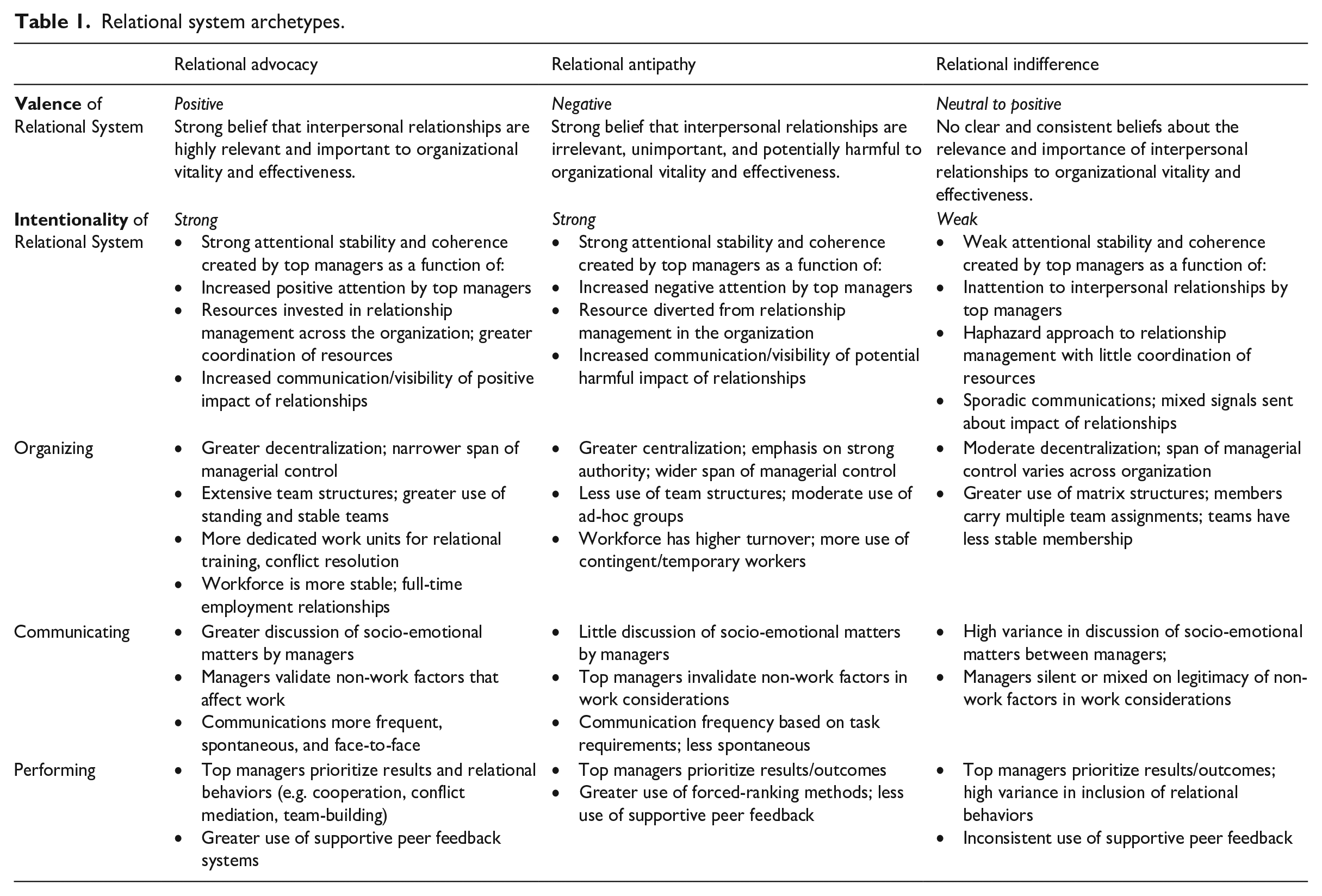
Our conceptualization of relational systems follows Kahn et al. (2013), who view interpersonal relationships across the organization as forming a coherent whole when looked at collectively. Relational systems have distinct patterns of affect, cognition, and behavior between organization members, generating resources that shape how complex organizing occurs and work gets done (Kahn, 1998). As described in Table 1, these relational system archetypes, defined by unique attention structures, comprise practices that operate as top-down influences on how organization members perceive the relevance and importance of interpersonal relationships.
Relational system archetypes.
Relational advocacy
Systems of relational advocacy initiate with positive organizational attention where leaders advocate for the value of interpersonal relationships to organizational effectiveness. These systems comprise attention structures that support recurring patterns of interrelating wherein organization members are emotionally engaged and connected to others, exhibiting a capacity to listen, exercise voice, self-disclose, convey respect, and stay focused on one another as they discuss task and relational matters (Kahn et al., 2013). Flexibility and adaptability underscore such interaction patterns as members are able to move between periods of stability and change in how they work together. As such, we see suggestive evidence of systems of relational advocacy in how certain organizational forms are conceptualized. For example, in the relational form (Follett, 1942 [1926]), interpersonal relationships comprise close ties based on trust that emerge through shared experiences. In relational bureaucracies (Gittell and Douglass, 2012), interpersonal relationships are theorized as reciprocal relationships embedded in roles and enable caring, timely, and knowledgeable responses to others’ needs.
As shown in Table 1, in a system of relational advocacy, organizing efforts send potent signals that trusting, supportive relationships are a strategic priority, with resources designated for distinct work units and roles that act on organization members’ ability, willingness, and/or opportunity for relationship building. Opportunities for repeated interaction can focus attention on and create time for relationship building; for example, through stable work arrangements (e.g. few part-time and temporary positions, longer-term contracts, offering employment security) and role structures (e.g. greater use of within and cross-functional team structures; greater use of standing teams with stable membership). Other organizing efforts involve investing resources in work roles expressly designed to train relational skills or offer interventions (e.g. conflict resolution, process consultation). For example, at Barry-Wehmiller (a global supplier of manufacturing technology and services), leaders from across the enterprise are brought together regularly to form and replenish relationships through structured activities that encourage candid discussions of their experiences, creating a “Circle of Safety” (Sinek, 2014).
Communicating practices are also an indicator of positive attention to relationships and relationship management through, for example, increased frequency and spontaneity of exchanges and face-to-face interactions (or other rich communication media) that have the bandwidth to convey emotional cues via nonverbal gestures. Importantly, conventions for communication favor not only task-related requirements but also relational matters. Such communications can include what has been described as expressions of “companionate love” (Barsade and O’Neill, 2014); that is, verbal and nonverbal displays of affection, compassion, and caring. Other relationship enhancement conversations include “State of the Union”-type discussions centering on what is and is not working well in members’ work relationships, what they appreciate and value about each other, or what would further build mutual trust (Stephens et al., 2011). For example, top-level leaders at Bridgewater Associates (a premier asset management firm) have created strong norms for truthful and transparent communications that enable trusting interpersonal relationships across the organization (Dalio, 2017).
Performing in a relational advocacy system would see recognition and rewards for individuals linked to positive contributions to other’s work (e.g. assisting, supporting others) (Gittell et al., 2010; Lilius et al., 2011). This could include managers and employees alike being incentivized to mentor or coach, train, and help retain fellow organization members, providing both motivation and vehicles for relationship building. Such incentives may increase the perceived integrity and trust of others as organization members develop norms that recognize relational contributions fostering supportive interactions (Collins and Smith, 2006; Leana and Van Buren, 1999). As we have described them, systems of relational advocacy will benefit the broader attentional infrastructure of the organization that enables resilient responses when crisis emerges.
Relational antipathy
Systems of relational antipathy initiate with negative attention to relationships whereby top managers grant less strategic relevance and importance to interpersonal relationships, purposely withhold resources from efforts that would develop or support them, and explicitly recognize how members’ capacity to support one another has little bearing on the organization as a whole. Systems of relational antipathy comprise patterns of interrelating wherein organization members connect as needed on task-specific matters in a more transactional fashion, rely on formal work roles and processes, and exhibit a limited capacity to listen, exercise voice, self-disclose, and convey respect to one another as they complete their work. As such, systems of relational antipathy are implicated in how prototypical bureaucratic forms (Weber, 1984 [1920]) are conceived wherein depersonalization and intentional prevention of emotional connection preclude interpersonal relationships built on trust, disclosure, and mutual respect.
As shown in Table 1, organizing practices in relational antipathy systems rarely recognize stable work arrangements as having strategic value, making part-time and contingent or contract work appealing options; it is less common for resources to be invested in providing job security or otherwise enabling the long-term success of members via training, coaching, or mentoring. Organizational designs rely on individual contributor roles more than teams, and fewer opportunities will be provided for employees to interact regularly or work interdependently.
Communicating practices tend to favor task-focused exchanges that occur as needed based on the requirements of the work. Managers might go so far as to criticize employees who show emotional reactions at work (Meyerson, 1994; Smith and Kleinman, 1989; Vuori and Huy, 2016). Actions such as demeaning others and harassment are not only accepted, but celebrated (see example of Uber in Berdahl et al., 2018). Performance measurement and rewards are defined in market-oriented terms (e.g. Cobb, 2016; Fiske, 1992). Individual expectations and performance indicators are set, with minimal or no emphasis on contributions to other member’s development, performance, or retention. Incentives are based on individuals’ credentials, skills, and results, and tied to external market criteria (Mossholder et al., 2011). For example, Uber has earned a reputation for condoning, if not rewarding, aggressive behavior, often pitting employees against each other, turning a blind eye to infractions, and promoting and protecting top performers (see Edmondson, 2019: 94; Issac, 2017).
Relational indifference
Systems of relational indifference initiate with organizational inattention among top managers who fail to enact a clear, integrated position on interpersonal relationships. Critically, systems of relational indifference comprise patterns of interrelating that are highly variable, if not erratic, relative to systems of relational advocacy and antipathy. In this system some organization members are emotionally engaged and connected to others (while other members are disconnected), exhibit mutual adjustment in their work roles (while other members cling to formal role prescriptions), and speak freely with others on any number of issues (while other members are more guarded).
As shown in Table 1, the attention structures that support a system of relational indifference comprise configurations of practices that exhibit high variance with regard to the relevance and importance of relationships defined by trust, candor, and mutual respect. With regard to organizing, the overall design of the organization does not readily reflect an intentional effort to spur more or less interdependence, coordination, and repeated interaction among members. Structural arrangements are highly variable with some areas of the organization requiring tight interdependence between members, while in others employees are quite independent.
Communicating within a relational indifference system tends to vary with regard to the frequency and duration of members’ interactions, how they connect, and what they communicate about. Such variance is mostly a product of the emphasis placed on interpersonal connections at the unit-level. With regard to performing, while there might be lip-service paid by top managers to the importance of elevating both one’s own performance and the performance of those around you (e.g. “be a mentor!”), few incentives are offered across the organization for actually doing so. Overall, the organizational message sent about interpersonal relations is decidedly mixed.
The attention structures supporting a relational indifference system are relatively weak as the configuration of practices adopted lacks intentional top management endorsement and sends a highly equivocal signal about how members should interact and relate to one another. Attentional stability is weak as there is little dedicated, sustained attention to the enactment of interpersonal relationships across organizational levels and units. Likewise, attentional coherence is weak as there is no consistent set of actions and interactions that suggest the importance of relationships across the various organizational systems. As a result, there is wide variation in how organization members interpret and act upon these signals. We believe that this particular relational system warrants close inspection because many organizational leaders might think they embrace relational advocacy (e.g. by including “open” or “inclusive” or “psychologically safe” in their mission statements), but the inattention to interpersonal relationships among top managers would suggest they are relationally indifferent in practice (e.g. see Google example from earlier). Meaning, top management is not anti-relationship (hence the neutral to positive position shown in Table 1), which would be consistent with negative attention and relational antipathy, rather there may be no intentional and systematic attention paid to interpersonal relationships in everyday practice. As we will argue, systems of relational indifference have an especially detrimental impact on the broader attentional infrastructure of the organization that is vital in times of adversity and crisis.
Relational systems and unit-level social structures
Unit-level attention
We have argued that organizational attention creates the context for relationship building through leader-driven top-down processes that generate relatively stable organizational structures and practices. As shown in Figures 1 to 3, managers are critical conduits through which the dynamics of attention at the organizational level are cascaded to lower levels (Ocasio, 1997; Vuori and Huy, 2016). Unit managers translate elements of an organization’s attention structures in their local units (i.e. departments, work teams), with organizing, communicating, and performing practices signaling the importance of relationships and relationship building to employees. For example, research has shown that employees’ shared perceptions that their team or work unit is psychologically safe—that there is little interpersonal risk due to high trust and respect—is shaped by supportive structures (for reviews see Edmondson and Lei, 2014; Newman et al., 2017; also, Morrison and Milliken, 2000) and also by demonstrated team leader support (Schaubroeck et al., 2011) and team leader inclusiveness (Hirak et al., 2012; Nembhard and Edmondson, 2006). Inviting input, listening, and exhibiting openness enables unit leaders to model to employees that it is appropriate and safe to engage in honest communication.
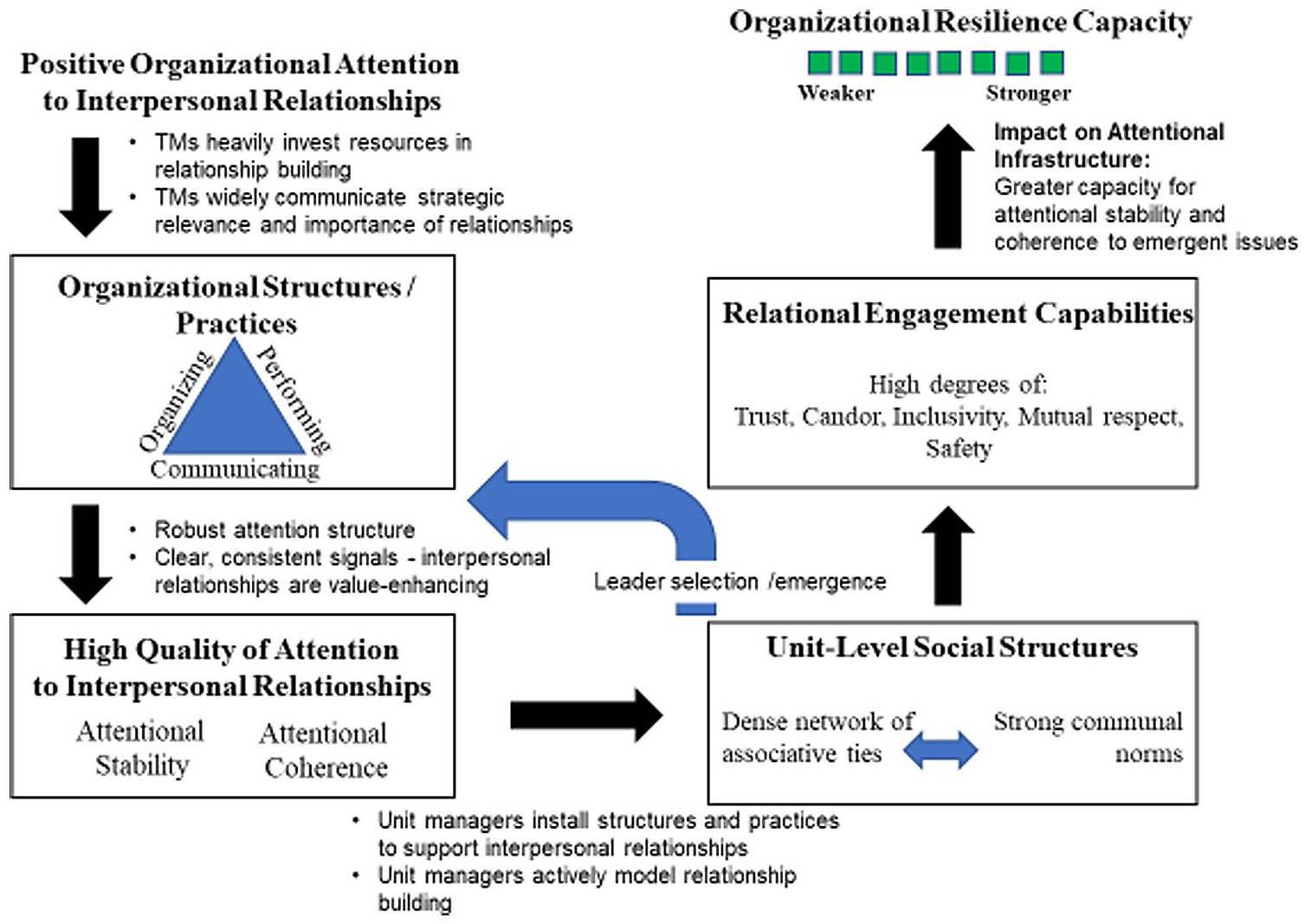
An attention-based view of systems of relational advocacy.
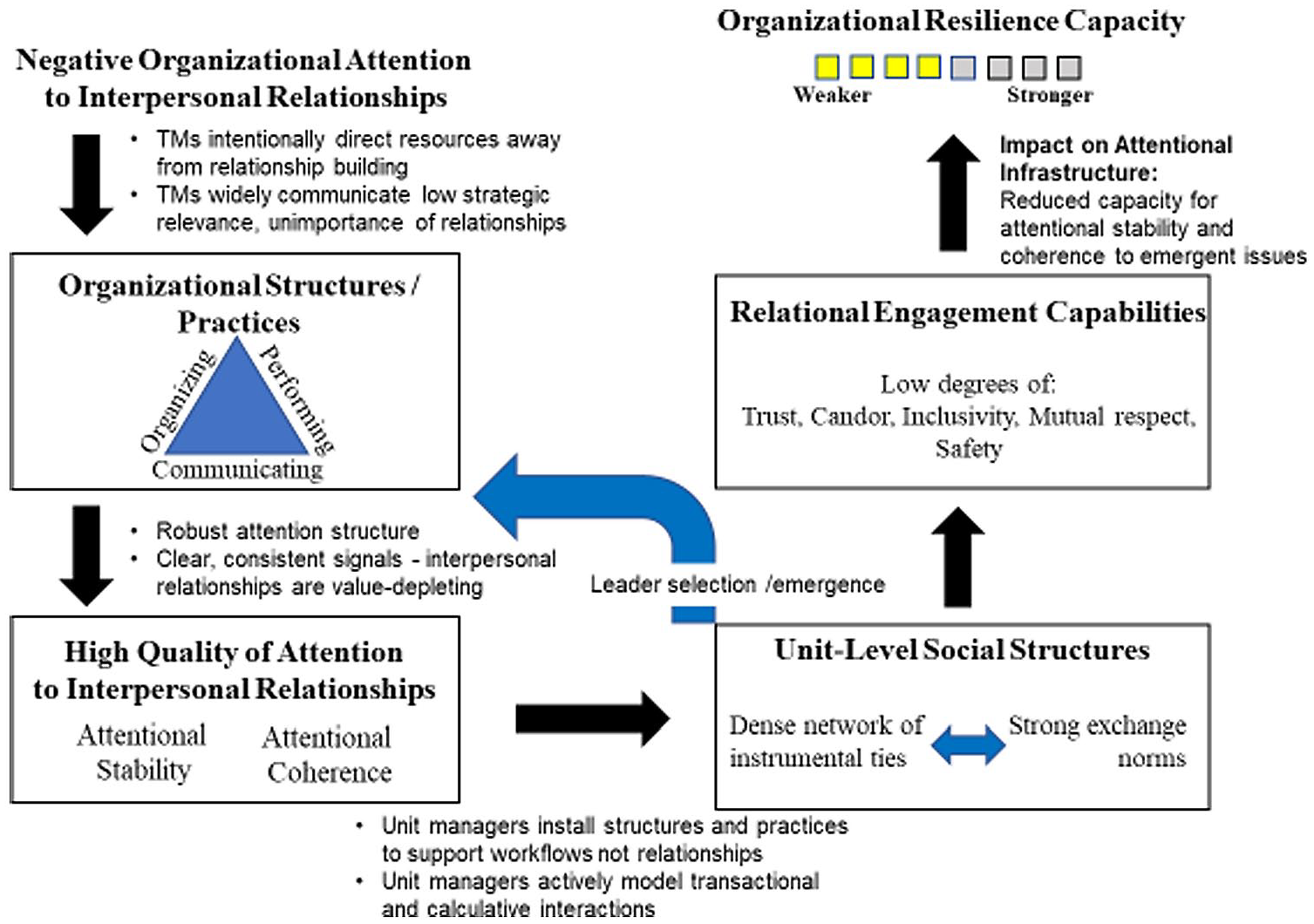
An attention-based view of systems of relational antipathy.
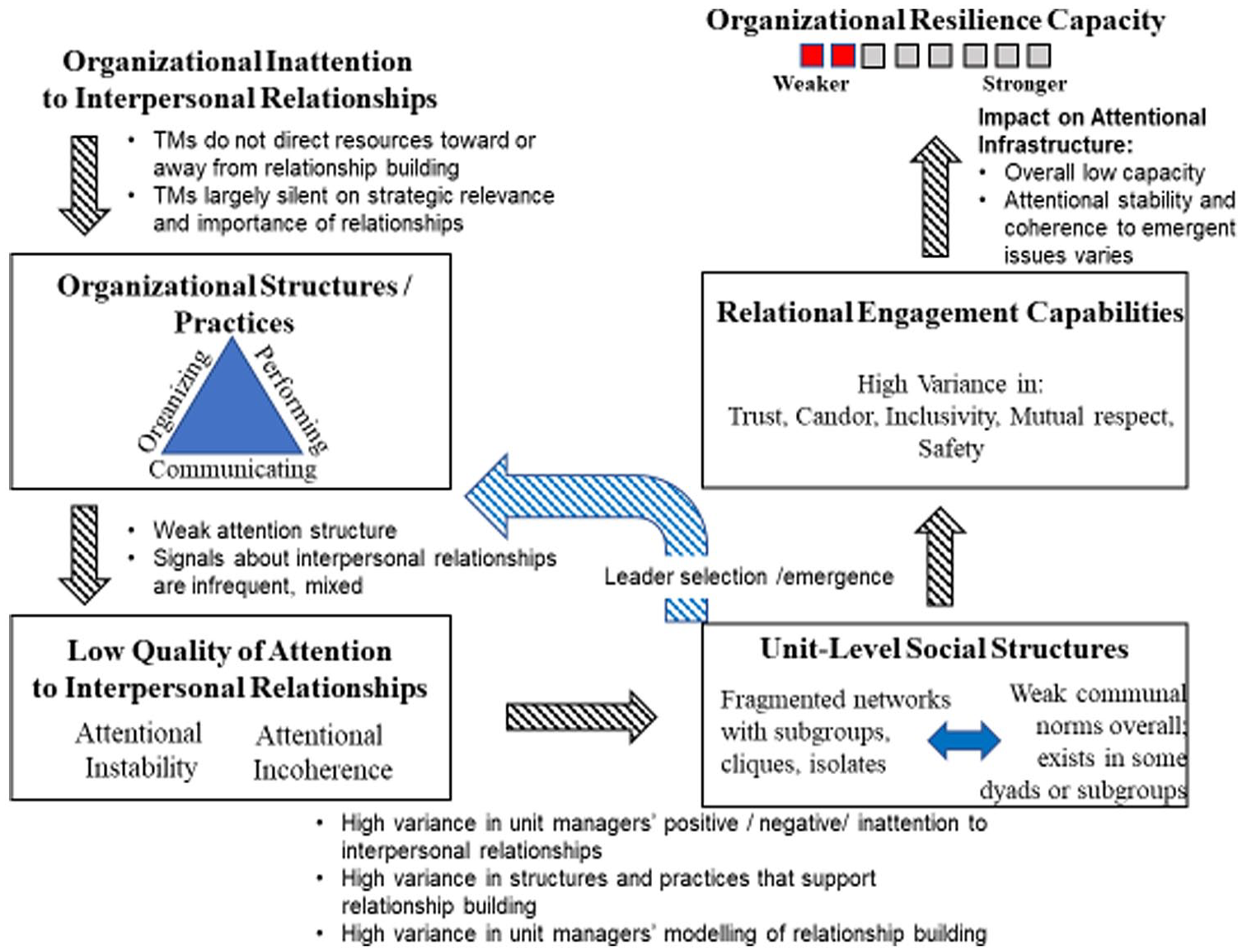
An attention-based view of systems of relational indifference.
The attention structures enacted at the unit-level, in turn, are likely to stimulate distinct social network structures among unit members. Critically, attention to relationships that occurs at the unit-level—the provision of structures and processes—affects emergent patterns of relationships among members—the experience of structures and processes. Specifically, unit-level attention shapes how employees notice and manage their interdependencies with others and how they interrelate as their efforts are coordinated. This differs from prior treatments of social networks using an ABV lens that investigate how, for example, employees in closed networks (i.e. a preponderance of reciprocated ties with few structural holes) can focus their attention selectively on information shared with particular ties, which then allows them to deeply interrogate information in ways that enable the production of good ideas (Rhee and Leonardi, 2018). Here, we focus on how managers’ attention to relationships shapes the production of social networks at the unit-level.
Relational advocacy and antipathy systems
As shown in Figures 1 and 2, the social networks that characterize systems of relational advocacy and antipathy are expected to take opposing forms. The most notable point of distinction concerns the relational properties (i.e. social network ties) that emerge within work units. In a relational advocacy system (Figure 1), a unit manager will likely put in place structures to routinely identify potential isolates (i.e. members who are disconnected from others), or a manager might perform relational pulse checks regularly with each and every team member to see if they feel like their ideas are being heard and valued. In a system of relational advocacy, the manager is not just responding to those that come to them with issues, but rather is proactively reaching out to all members. For example, in their case studies of two offshore oil platforms, Ely and Meyerson (2006) detailed managers efforts to systematically increase safety and effectiveness by focusing attention on workers’ interpersonal relationships using tactical approaches that enhanced their communication norms. As such, the attention structures that facilitate positive attention to interpersonal relationships will yield a high preponderance of associative ties (also referred to expressive ties) between unit members marked by high trust and expressions of affinity and emotional support (Krackhardt, 1992; Venkataramani et al., 2013). Importantly, such ties are reciprocated between members, creating a dense structure of interpersonal relationships across the unit (Burt, 1984, 1992; Marsden, 1990). There are few isolates and identifiable cliques (subsets of members in which everyone has a direct tie to everyone else) that create relational fractures or subgroupings.
In a relational antipathy system (Figure 2), we would expect that attention structures that facilitate negative attention to interpersonal relationships will deter the formation of these associative ties. Instead, attention structures will support ties that are more instrumental and calculative in nature with members exchanging materials, information, or assistance needed for task completion. Interpersonal relationships reflect a low degree of involvement, depth, and emotional intensity (Stephens et al., 2013). This is not to suggest that no one can have trusting, supportive relationships in such units (Yu et al., 2008). However, these connections are initiated individually—managers are not intentionally structuring work, communications, and incentives for the express purpose of building relationships defined by high levels of trust, candor, and mutual respect. 1 Accordingly, we propose that systems of relational antipathy are characterized by unit-level social networks with few of these associative ties between members.
Relational indifference systems
Following Figure 3, in instances where equivocal signals about the importance of relationships are given from top-managers, unit managers’ own beliefs and preferences will drive how much attention they pay to relationship management. Accordingly, the emergent relational patterns that characterize systems of relational indifference will vary. Unit managers who value interpersonal relationships are likely to generate positive unit-level attention by emphasizing the importance of interpersonal relationships to unit operations and effectiveness, investing resources in their development, and making visible their positive impact on the unit. The attention structures and social networks that evolve in these units are expected to resemble those that are typical of systems of relational advocacy. Likewise, managers who consider interpersonal relationships to be irrelevant, inappropriate, or even harmful will direct attention accordingly. The attention structures and social networks that evolve in these units are expected to resemble those that are typical of systems of relational antipathy.
While unit managers can intentionally align their decisions, actions, and communications in ways that support (or not) relationship formation—we assert that yet another response is even more likely. Specifically, unit-level managers will be inattentive to interpersonal relationships, much like their senior leaders, and will direct their attention elsewhere. Such inattention signals indifference toward relationships—that is, unit managers do not have a strong positive nor negative position on the value proposition of interpersonal relationships. Or, they have a definitive position but lack the organizational backing (e.g. performance system) to do anything about it. In this way, unit managers further contribute to the lack of attentional stability and coherence provided by the top leaders. In contrast to the strong, unidirectional attitudes that characterize positive and negative attention to relationships, indifferent attitudes offer weak guides for behavior (cf. Ajzen, 1985, 1991). Relational activity in these units therefore is likely to be haphazard. The combined effect of this variation across unit-level managers will create a disjointed relational landscape.
Inattention to interpersonal relationships suggests that there is little intentional manager-led effort to endorse and encourage (or disapprove and deter) supportive relations among unit members. Following Table 1, unit managers may use communication norms that allow for personal disclosure and candor in certain meetings or with some members, but not others. Or, without an incentive to do otherwise, they may respond to emergent conflicts but not proactively seek to build strong ties among team members. Since relationship management is not front of mind, attentional stability will be low with unit managers unlikely to detect such relational deficiencies. That said, it is possible that associative ties form between members, but not by intentional design nor intervention. Rather, relationships are a product of other conventional forces (e.g. similarity, proximity, and contact) that drive interpersonal attraction and trust (e.g. McPherson et al., 2001). As these forces are determined in part by propinquity and chance (e.g. uncovering common interests), the emergence of associative ties in such units will vary greatly (Tasselli et al., 2015). Such low attentional coherence at the unit-level contributes to a low fidelity relational landscape wherein social networks likely comprise identifiable cliques with relational fractures and subgroups with pockets of close relationships emerging alongside other pockets of disconnected or isolated members. That is, there are distinct patterns of “connectivity and cleavage” in member relations (Wellman, 1988: 26).
Feedback loops reinforcing attentional structures
Organization members in a given relational system fall into patterned habits of thought and action relative to one another (Kahn, 1998), suggesting that relational systems have a self-reinforcing quality. Importantly, while relational systems initiate with top-down leader-driven efforts to direct organizational attention, we also argue that attention structures enacted at the unit-level give rise to distinct social networks and relational dynamics that become embedded in normative practices that are then replicated and rewarded informally over time. Expected and accepted patterns of interrelating become part and parcel of the work culture at the unit-level (Hackman, 1992), reflected in, for example, the strength of the unit’s communal norms (e.g. responsiveness to other’s needs and welfare) or exchange norms (e.g. reciprocity to other’s actions and efforts as quid pro quo) (Clark and Mills, 2011). This suggests that peer-to-peer processes further reinforce structures and practices that sustain attention (or inattention) to interpersonal relationships across the organization.
As part of this feedback loop, we propose that leader emergence is an especially potent process that reinforces relational systems. Those who are placed in influential positions, either as leaders within their own work units or at a hierarchical level that spans multiple work units, are those who have succeeded relationally within the confines of their particular system. These individuals have forged the combination of relationships and skills needed to invoke the beliefs in current leaders that they should be the next leaders. This idea follows the received wisdom that employees who endorse organizational values and priorities, and uphold norms for behavior, are acknowledged and rewarded with favorable performance reviews and advancement opportunities (Srivastava et al., 2018). Consistent with such findings, the social identity theory of leadership (Haslam et al., 2011; Steffens et al., 2021) suggests that individuals are more likely to emerge as leaders to the extent that they are seen as prototypical of their work unit or organization—that they possess the attributes, attitudes, and actions that are seen as most typical of (or most desired from) members (Bartel and Wiesenfeld, 2013). Our core argument is that employees who are endorsed by peers and supervisors alike and ascend into leadership roles will go on to uphold and become “custodians” of the systems that made them successful.
Systems of relational advocacy and antipathy
In systems of relational advocacy, employees who actively build and protect relationships will be seen as effective in their work roles and to emerge as leaders. This is because, as shown in Table 1, cultivating interpersonal relationships for self and others likely will be built into performing processes such as employee evaluation and promotion. Employees are likely to recognize relationship building skills and competencies as factors in their success and thus will be highly attuned to the need to uphold such patterns of behavior. As promoted employees become custodians of the system in which they have been successful (Van Maanen and Schein, 1979), we suggest that they will focus their attention on interpersonal relationships in the roles and positions they go on to occupy. As shown in Figure 1, a reinforcing cycle emerges (cf. Schneider, 1987) as attention structures are maintained, if not strengthened, thus enhancing attentional stability; interpersonal relationships will be a consistent organizational priority.
In systems of relational antipathy (see Figure 2), forging interpersonal relationships among others is not linked to success—and might even be risky. In these transactional settings, being able to create close relationships for the self or others provides no clear affordances with respect to employees’ perceived effectiveness and leadership potential. This does not mean that cultivating close relationships lacks material benefits. Indeed, organizational research has shown that associative ties generate advantages with respect to accessing opportunities and securing backing and support at work (for a review, see Tasselli et al., 2015). Surely these advantages also accrue in relational antipathy systems. Nonetheless, employees in a relational antipathy system will only invest time and energy in relationship management if there are clear instrumental benefits linked to such efforts. As shown in Table 1, such outcome expectancies are less common; rather, incentives are based strictly on performance goals and metrics. Having been exposed to strong and consistent signals about the importance of not squandering resources on relationship building, we assert that employees will continue to promote the system that has made them successful, diverting attention and resources away from interpersonal relationships and toward other strict performance metrics.
Systems of relational indifference
In systems of relational indifference, organizational inattention at the top results in varied attempts at the unit-level to direct attention and resources toward cultivating interpersonal relationships. Such attentional incoherence produces a relationally diverse landscape—close dyadic relationships and cliques for some employees, while others are disconnected and possibly isolated. In these systems, employees who are granted leadership opportunities (via promotions or work assignments) and become the relational system custodians for the future organization are likely to be those who held such ties. That is, rising leaders comprise those members who found similarity with other organizational insiders and/or formed supportive relationships (Schaubroeck and Lam, 2002; Wolff and Moser, 2009). As we know, being connected has its privileges.
These employees are the byproduct of a system that supported them, but it may not be easy for them to see that others were not similarly supported. From the inside of the clique, such rising leaders in the organization will perceive a culture of support, inclusion, and warmth—the features that indeed define relational advocacy. We suggest that this will lead to the mistaken belief that their organization operates as such a supportive system when in reality they directly benefited from being part of a system of relational indifference. If relationship deficiencies are brought to their attention, these employees likely will be blind to (if not biased against) seeing fault in a system that brought them their success (Webster and Beehr, 2013). They will want to feel good about the system that has led to their own achievements, believing both that the system provided strong relational opportunities, as well as in their own acumen in leveraging such relationships to advance (Alicke and Sedikides, 2009). They would further believe that those on the fringes who lack social bonds or who didn’t fit in probably had some flaw that made them unsuitable for the organization or not prime material for leading (Janoff-Bulman et al., 1985).
This will perpetuate an organizational inertia that maintains the status quo regarding support (or the lack thereof) for interpersonal relationships (Kelly and Amburgey, 1991). Rising leaders within a unit or transferring across units may hold good intentions toward and even offer supportive statements about the utility of relationships, but are unlikely to dedicate attention and resources toward systematically building effective relationships across the organization. In their minds this would be allocating attention to a problem that does not exist. Thus, even for employees who move into leadership roles attuned to the importance of social connections in their own success, the lack of strong, consistent signals in their embedding environments makes it unlikely that they will focus attention and resources on systematically building relationships for all members. Such inattention is the hallmark of systems of relational indifference and what perpetuates the system over time.
Attentional infrastructure and organizational resilience
We have theorized how relational systems initiate with organizational attention as attentional structures created at the top facilitate sustained and cohesive attention to interpersonal relationships at the unit-level. Now we shift our focus to how relational systems affect organizational attention to emergent issues in a crisis. We will argue that relational systems create a context in which organization members are more or less able to sustain and integrate their attention to problems and solutions. That is, relational systems provide the infrastructure needed to support attentional processes in organizations when adversity or crisis arises.
Attentional infrastructure
In a comprehensive review of organizational research on crisis management and resilience, Williams et al. (2017) asserted that an organization’s relational capabilities provide a context for efforts to reallocate, reconfigure, or renew resources in times of crisis (see also Bradbury and Lichtenstein, 2000; Carmeli et al., 2015; Gerbasi et al., 2015; Gittell, 2008). Such relational capabilities, as we have characterized them, inhere in a system defined by the network of interpersonal connections across an organization and the structures that support them. Members immersed in more supportive relationships feel safe to seek, propose, question, and accept new information and ideas, and more likely to identify or invent shared solutions to organizational disruptions. Critically, such behavioral patterns shape attention.
For example, Colquitt et al. (2011) examined interpersonal relationships among firefighters and suggested that distrust undermines the focus of attention in volatile situations. More concretely, distrust leads members to reduce their dependence on and vulnerability to others (Weick, 1993), increase monitoring and surveillance of others, and exert extra effort to work around or avoid others (Colquitt et al., 2011; Vuori and Huy, 2016). Unsupportive relationships thus are distractions that siphon away valuable time and attention, preventing members from translating ability or effort into productive responses during times of adversity or crisis. Attentional stability declines as members struggle to sustain focus on particular issues; attentional coherence wanes as members are unwilling or unable to interact in ways that help align and integrate their attention to issues. The three system archetypes that we have proposed contribute to an attentional infrastructure supporting such attentional processes, each providing differential support that is integral to organizational efforts to respond and adapt to adversity.
Relational systems and attentional vulnerabilities
In relational advocacy systems, all organization members can potentially develop interpersonal relationships with each other (cf. Kahn, 1998). As shown in Figure 1, such systems, as we have conceptualized them, poise members for greater relational engagement—other-focused, cooperative behavior that supports change despite conflicting perspectives and motives (Salvato and Vassolo, 2018). With a greater capacity for relational engagement in ongoing and emergent interactions, systems of relational advocacy provide an attentional infrastructure. Open and honest dialogue, coupled with enhanced tendencies to be present for others (i.e. active listening, perspective-taking, validating other’s experiences), facilitates attentional stability as members have more available resources to stay focused on cues and information related to certain issues. In addition, attentional coherence is enabled as organization members trust and feel safe with each other to share tacit information and constructively discuss and debate ideas to achieve coordinated understanding. As the quality of these attentional processes increases, organization members are better equipped to recognize interdependencies, identify or improvise resources, and, ultimately, develop solutions or actions to address adversity (Sutcliffe et al., 2016). Thus, we propose that systems of relational advocacy contribute to more robust attentional infrastructures that support organizational resilience.
In contrast, systems of relational antipathy and indifference are both deficient in providing the infrastructure needed to deploy attention in times of crisis—but in different ways. In systems of relational antipathy (Figure 2), transactional exchanges dominate that constrain the overall level of relational engagement across the organization. Social networks within and across work units attenuate the volume, velocity, and duration of productive exchanges. As relational engagement is constrained, organization members are less apt to monitor each other’s changing operational needs and goals, proactively share information, make inquiries and exercise voice, and work cooperatively to synchronize their understanding and efforts (Kahn et al., 2018; Stephens and Lyddy, 2016). Critically, this languid pattern of relational engagement is the norm as it is expected across work units and hierarchical levels. Resource flows are weak, but reliably so. The resulting attentional infrastructure thus is less able to power a sustained and cohesive focus to problems and potential solutions in times of crisis. Relative to relational advocacy, we propose that systems of relational antipathy enable a less durable attentional infrastructure to support organizational resilience.
In systems of relational indifference (Figure 3), social networks within and across work units reflect combinations of supportive as well as transactional relationships, and disconnected or isolated members. Such a disjointed relational landscape will give rise to highly variable patterns of relational engagement (strong in some parts of the organization and weak in other parts)—unlike relational antipathy, the volume, velocity, and duration of productive exchanges are not consistently low across the organization. We envision several possible outcomes of such variance with implications for the organization’s attentional infrastructure. We draw an analogy to the flow of electrical current through a circuit as we theorize these outcomes. In a circuit, electric current requires a closed circuit (a closed path)—any break in the path creates an open circuit that halts the flow of electricity. In relational indifference systems, the presence of relational fracturing (silos, cliques, isolates), in essence, creates open circuits that prevent the flow of cognitive and behavioral resources needed to power attentional stability and coherence on emergent issues between work units and across hierarchical levels. That is, gaps, dead-ends, and bottlenecks in resource flows will occur. To this point, managers may make wrong assumptions about the willingness of isolates in their own units to contribute during times of crisis, or might be blind to the existence of isolates in the first place. As well, managers may make wrong assumptions about the willingness or unwillingness of other units to communicate candidly and to provide support and assistance to their teams. Furthermore, unit communication patterns may be focused on intragroup (i.e. clique) ties rather than across subgroups or between subgroups and isolates. This will lead organization members to increase their communications with those with whom they feel most comfortable the safe (Krackhardt and Stern, 1988), neglecting any valuable knowledge and insight that might exist outside the clique. Unit members are more likely to act on issues or pinch points that need attention in their own cliques and subgroups, and have less awareness about other parts of the organization or even their own unit where weak ties prevent them from knowing the nature of the problem.
Due to these deficiencies in the attentional infrastructure, attention to emergent issues becomes more difficult to consistently align and integrate in a coordinated manner across the organization. This stands in contrast to systems of relational antipathy where the flow of such resources is more continuous though reliably weak. While problematic in times of crisis, such reliability has a measure of pragmatic value; it enables individuals to generate expectancies about others and to regulate their behavior accordingly. Meaning, as members expect short-term reciprocity and quid pro quo exchanges with others in a system of relational antipathy, they will recognize the need to lean on other structures and communication channels or manager intervention to locate and negotiate needed resources. Therefore, in comparison, we argue that the attentional infrastructure that systems of relational indifference provide will most severely undercut an organization’s ability to execute swift, decisive, and well-coordinated action to mitigate emergent problems. Such a perspective is consistent with how Kahn et al. (2018) conceptualize the influence of intergroup relations on organizational resilience. Specifically, these authors proposed that relational histories between different departments and work units can spur action to provide or block the flow of necessary resources as well as to join together or not to assess developing situations, create attentional coherence, and synchronize efforts. Our perspective suggests that these highly variable relational dynamics are the outflow of intergroup histories that are propelled by broader systemic forces. Specifically, a system of relational indifference that generates differential patterns of relational engagement both within and between groups that weakens the infrastructure needed to deploy attention in times of crisis. We therefore propose that systems of relational indifference enable the least durable attentional infrastructure to support organizational resilience.
Discussion
Interpersonal relationships are a critical capability that contributes to organization resilience—both shaping and being shaped by organizational attention processes. To be sure, attentional processes are complicated when major disturbances arise—organization members need to engage in repeated, focused scanning of emerging cues and information to understand the situation, and work together within and across units and hierarchical levels to share information, align interpretations, and formulate responses. This transpires as uncertainty looms large, and as diversely skilled people work together on complex tasks—many of whom have never worked together before. Interpersonal relationships can support processes of attentional stability and coherence, or shut them down entirely. Building on insights from the ABV and theories of interpersonal relationships, we forward the idea that the overarching network of interpersonal relationships across an organization—its relational system—provides an infrastructure that can support (to a greater or lesser extent) attentional stability and coherence in a crisis.
Theoretical contributions
ABV of the firm
As interpersonal relationships are an understudied facet of the ABV, we have proposed that closer inspection of relational systems, specifically, holds promise for an enhanced understanding of how attentional stability and coherence are enabled in organizations facing disruption, adversity, or crisis. A core argument is that relational systems are part and parcel of an infrastructure that provides the necessary support to facilitate these attentional processes. An organization’s relational system reveals an underlying pattern of interrelating that informs how attention moves or fails to move within the organization, and where there are blockages, dead-ends, and echo chambers. Relational systems thus can augment or attenuate, if not entirely blunt, other formal attention structures that are in place to direct attention to particular issues during a crisis. Our perspective on relational systems enriches prior ABV research (e.g. Ocasio et al., 2018; Rerup, 2009; Vuori and Huy, 2016), by identifying systemic forces that account for different patterns of interrelating that make attentional stability and coherence on issues more or less possible when challenges arise.
We see top-level managers’ role in deliberately enacting organizational designs and practices that facilitate attention to relationships as crucial in creating an organization-wide system for relationship building. Our perspective elaborates prior ABV research that designates positive organizational attention (Bouquet and Birkinshaw, 2008) by conceptualizing its counterpart—negative attention—which conveys the value-depleting impact of an issue on organizational operations and effectiveness. Top managers can direct attention both toward (positive attention) or away (negative attention) from interpersonal relationships, or exhibit inattention to relationships altogether —and each of these forms of attention are worthy in their own right. To this point, different forms of attention are purported to fuel the production of distinct relational systems. Processes of attentional stability and coherence at the unit- and organizational-level are what give potency to organizing, communicating, and performing practices associated with relational systems. Consistent with research on the qualities of organizational attention (Ocasio, 2011; Rerup, 2009; Weick and Sutcliffe, 2006), attentional stability and coherence lend greater clarity and consistency in comprehension of an issue—in our case, relationships and relational dynamics. Whereas prior work concentrates on the role of these qualities in detecting weak cues and information related to emerging or realized problems (Maula et al., 2013; Vendelø and Rerup, 2009; Vuori and Huy, 2016), we construe attentional stability and coherence as mechanisms that play a broader role in producing relational systems—they help instill and shape the attentional impact of structures and practices.
We placed particular emphasis on cases of organizational inattention, which signals indifference toward relationships and relationship building. Inattention at the top does not simply mean that interpersonal relationships go unnoticed; more accurately, it means they go undirected. As interpersonal relationships define the essence of the social environment (Schneider, 1987), with relational patterns across the organization shaping how people think, feel, and act (Kahn, 1998, 2001), allowing relationships to evolve without intentional direction is potentially dangerous. With top managers who are indifferent, the onus falls on unit-level managers to direct attention. Such ideas add to the ABV by showing that inattention to interpersonal relationships at the top and the resulting disjointed relational landscape at the unit-level, specifically, invites attentional liabilities more broadly—namely, attentional stability and coherence to emerging issues will be more difficult to achieve when crisis strikes. Systems of relational indifference thus reduce what Rerup (2009) referred to as the “elasticity of an organization’s attention capacity” (p. 888).
Crisis management and organizational resilience
We contribute to the crisis management and organizational resilience literatures that identify an organization’s relational capabilities as providing a context in which other resource endowments are activated in a crisis (Williams et al., 2017). We do so with a novel conceptualization of how relational capabilities provide such a context. We construe relational capabilities (or lack thereof) in terms of the organization’s relational system, which provides (to varying degrees) the necessary infrastructure for attentional stability and coherence in efforts to configure, orchestrate, manage, and transform resources in the wake of crisis and adversity. These attentional processes shape what organization members focus on, with what duration or intensity, and how their observations and perspectives can be reconciled and integrated to create a cohesive account of what has happened and how best to respond. For instance, in systems of indifference, relationship gaps within and across units reduce the organization’s capacity for attentional stability as members struggle to engage with each other in ways that build attentional momentum on emergent cues.
Our perspective also offers new insight on the pre-crisis period; specifically, preventive measures that may reduce vulnerability. By theorizing that relational systems provide an attentional infrastructure to support impromptu and planned responses in a crisis, our perspective identifies how networks of relationships across the organization contribute to pre-crisis resilience. We construe positive organizational attention to interpersonal relationships as a critical preventive measure in which top-level leaders can proactively invest (via organizing, communicating, and performing practices) to ensure that the relational engagement needed to power resilience will be forthcoming. Of particular note, we outline how inattention to relationships—perhaps the more typical stance among top managers—can give way to systems of relational indifference that make organizations especially vulnerable when challenges arise. In the midst of a crisis, leaders may not know what resources or capabilities they need to evoke change or otherwise respond in a resilient way. The more an organization’s relational system comprises fragmented social structures due to a preponderance of cliques, dyadic ties, and isolates, the more difficult that knowledge sharing, collaboration, and coordination becomes within and across work units.
Relational theories of work
Research on relational processes in organizations offers a window into the organizational structures and practices that aid relational outcomes (e.g. dyadic relationship formation, relational coordination, and shared relational beliefs); we assert that their adoption hinges on top-level attention. Critically, theories of relational coordination theory (Gittell, 2016; Stephens et al., 2011) speculate that the mere presence of particular organizational practices sometimes have little material effect on relationship formation, which we address by identifying positive organizational attention as a necessary precondition. For example, boundary spanner roles and cross-role meetings that contribute to relational coordination (Gittell et al., 2010) operate to increase opportunities for communication but may do little to systematically generate trust, candor, and mutual respect if top managers are indifferent to relationships and employees receive mixed signals from their unit managers. Gittell and Douglass (2012) note that organizational structures, such as hiring and training for relational competence, may reflect the value an organization places on respect, attentiveness, and responsiveness to others. We agree, it may . . . but it also might not. Top managers can install conflict resolution units to claim trust and harmony are important, yet these units can be understaffed, under-resourced, and have little visibility. The presence of organizational structures does not fully reveal whether they are receiving the attention needed to influence relationship building. Our perspective thus builds an important bridge between the ABV and relational theories of work that enriches both domains. As interpersonal relationships are an understudied facet of the ABV, relational theories inform the organizing, communicating, and performing practices that, as we have argued, generate attentional stability and coherence to relationships and relationship management; in turn, the ABV informs theories of relational coordination, in particular, by recognizing top manager attention as essential in shaping the form and functioning of relational systems.
Practical implications for systems of relational indifference
We have cast systems of relational indifference as particularly harmful for organizations and speculate that such systems perhaps are the most common. An executive at a large insurance company, when we asked him about the relational system of his firm, proclaimed that a program providing rewards for supporting others across the organization was evidence that it endorsed relational advocacy. However, in follow-up questions the executive revealed that the description of the program was only provided in the on-boarding packet; as a consequence, few people knew about the rewards, no one (except the recipient) is made aware of who receives the rewards, and he couldn’t remember the last time he heard about someone taking advantage of the program. This is relational indifference. The idea of the system of relational indifference raises the possibility that many managers are a different type of RINO—they care about Relationships In Name Only. They may appoint senior leaders in charge of building within and cross-unit connections, they may adapt mission statements to reflect the importance of openness, respect, and inclusion among the workforce, but there is no sustained attention toward the enactment of relationships across the organization. What’s more damning, as suggested by our theorizing, is that they may lack the capability to see that they are embedded in such a dysfunctional system and, therefore, lack the requisite motivation to change the organization’s attention structures.
For top and unit managers who do seek to understand their social network structure, methods are available. As Leonardi and Contractor (2018) note in the subtitle of their Harvard Business Review article on employee surveys and people analytics—measure who they know, not just who they are. The authors observe that there is a tendency for organizations to use data about individual employees at the expense of data about employees’ interrelationships. They introduce a new organizational practice, relational analytics (i.e. the science of human social networks), which we see as offering a potential method for organizations to analyze their relational system. For example, zooming in on work units and uncovering a preponderance of cliques that create relational gaps is a red flag. Identifying these relational gaps could help localize high risk zones where close inspection can be given to attention structures at the unit-level that may be failing.
While our perspective on crisis and resilience centers on the organization as a whole, we recognize that adversity often burdens certain parts of the organization more than others or that crises sometimes are localized in particular departments or work units. Nonetheless, even in these instances, those parts most affected do not construct a response in isolation but, rather, depend on flows of cognitive, behavioral, and emotional resources from adjoining parts (i.e. ancillary groups or teams, work units, functions, or hierarchical levels) (Kahn et al., 2018: 512). It is possible that the focal part hit hardest in a system of relational indifference is a work unit with a dense network of supportive interpersonal relationships. However, while members of such a unit may be poised to work together productively, they will almost certainly need to secure resources and enlist assistance from other parts of the organization. In instances where a focal unit can identify which adjoining parts (and individuals within those groups) possess needed resources, their cooperation may or may not be forthcoming (or only to the leanest possible degree). In other instances, disconnections across the organization make it difficult for the focal part to identify where essential resources reside or to have awareness of other information, knowledge, or capabilities that may prove relevant and useful. In addition, as we argued, relationally supportive units may exhibit communication patterns that selectively focus on their own intragroup ties or positive ties held with other groups or units. This could result in missed opportunities to access valuable knowledge and insight that might exist outside these ties. All told, even when adversity is localized within work units comprising supportive interpersonal relationships, boundary management in a relational indifference system can have both observable and hidden trip wires that undermine resilient responses.
This perspective is also quite critical given the post-Chandlerian view of the firm as more agile, horizontal, and modular. Such structures are built on the ability to quickly and efficiently acquire information from wherever it exists in the organization; gone are the knowledge silos that dominated more traditional organizational forms. Thus, for any one manager facing a crisis, the ability to enlist anyone where a particular skill or set of capabilities resides in the organization is essential to a rapid and effective response. The relational system of the organization, because it supports the attentional infrastructure, will be key in this regard. As we’ve argued, the firms in most danger are those facing relational indifference. While managers might need to locate needed information or expertise, in many cases it will be hidden within a person or a group that is disconnected from others. Such dead ends may impede managers from doing their job or, just as problematic, managers who pursue the connections they do have may mistakenly believe they have the best solutions (from those they are close to) when in reality the best solutions reside elsewhere (with those they are disconnected from).
Future research
Our perspective opens up a number of intriguing possibilities for future research. We did not address why different forms of organizational attention to relationships exist in the first place. Numerous sources likely impact whether top managers direct positive attention, negative attention, or inattention to relationships, especially in young firms. The knowledge, skills, beliefs, and values that top-level leaders bring to the organization influence how attention is directed (Cho and Hambrick, 2006; Kammerlander and Ganter, 2014). For example, as Ingram and Zou (2008) detail, objections to close relationships often derives from beliefs that economy and intimacy should be held as separate spheres and cannot be productively combined (Zelizer, 2005). As well, cognitive frames and logics of action, and cultural values and norms, are all examples of contextual factors that may shape how top managers direct attention toward or away from issues (for reviews, see Eggers and Kaplan, 2013; Ocasio, 2011), including interpersonal relationships. For example, top-level leaders often are informed by the larger culture in which their organizations are situated (Schein, 1985); in nations such as the United States, trace evidence of the Protestant Relational Ideology remains which is characterized by an intentional effort to prevent relational concerns from entering work contexts (Sanchez-Burks, 2005).
Our conceptualization of relational systems centers on how attention structures enable more or less attentional stability and coherence; that is, a sustained and cohesive focus on relationships and relationship building. Other attentional qualities may shed further light on how organizational attention to relationships is directed. For example, we explored organizational designs and practices that create a clear and consistent focus on relationships and future research could explore how attention structures shape how deeply or richly relationships and relational dynamics are processed, and the meanings that are associated with relationship building. The attentional quality of vividness is particularly relevant in this regard. Vividness, in this case, reflects the breadth and depth with which relational issues are monitored and interpreted in the organization (cf. Rerup, 2009; Weick, 1993). More complex and detailed representations of interpersonal relationships might hinge on attention structures that spur oscillations in attentional grain (Bansal et al., 2018)—that is, moving between a higher resolution focus on dyadic relationships (as being supportive, unsupportive, or unconnected) to a lower resolution focus on the distribution of relationships within and across different groups, and an ongoing perceptiveness to changes in the organization’s relational composition (i.e. where relationships form, spread, or decay over time). Much like a heat map (a data visualization technique), attentional vividness may yield relational representations that capture the prevalence of different types of relationships in an organization and how these are clustered or vary over space.
We also recommend that research further explore how organizations sustain attention to interpersonal relationships. Attention has natural limits—we can only focus on so many issues at a given time and it is difficult to sustain attention firmly on an issue and at the same time flexibly switch back and forth between different issues (Ocasio, 1997; Rerup, 2009). A key question thus becomes how attention to interpersonal relationships in relational advocacy systems can be kept “online,” so to speak, while also freeing up attentional bandwidth for other concerns. Such a capacity, which Ocasio (2011) refers to as “executive attention” (p. 1287), is especially important in the specific case of relationships—social connections can atrophy quickly if investments are not made, the emergence of a negative tie between two individuals can easily fracture a whole a unit depending on the structure of social relationships, and individuals can transition swiftly from weakly connected to excluded and isolated. It is vital that such relational disturbances be detected and mitigated across levels, units, and people which requires that relational matters remain on the attentional radar.
Conclusion
Despite the importance of interpersonal relationships to almost every aspect of organizational life, many organizations struggle to devote the attention needed to truly be relational advocates. When organizations fail to respond productively to environmental changes, challenges, or threats, we suspect it is less likely that leaders look first at the relational landscape inside the firm. Instead, deficiencies in financial resources, human capital, technological capabilities, or organizational routines might be inspected first. While such explanations are convenient and can be partly accurate, they can obscure the systemic forces that create fragmented social structures that make it harder to deploy attention where and when it is needed. As resilience and adaptability are vital in increasingly dynamic environments, firms that fail to place attention on relationships (whether positive or negative), will not be well positioned to succeed.
Footnotes
Funding
The author(s) received no financial support for the research, authorship, and/or publication of this article.
