



Abstract
Existing category research tends to divorce categories from place. When considered at all, place is often relegated to the contextual background. We see at least three important elements of place that can inform our understanding of categories: first, categories are rooted in the materiality of place; second, those who inhabit a place often share a collective identity that can impart meaning to categories; third, places influence the collective action that underlies category processes. Accordingly, we call for categories “to be put in their place” in category research, by attending to the materialities, collective identities, and collective action present in place. We present an integrative framework for future research that links place, categories, and organizational outcomes, and suggest mechanisms that link these constructs.
Categories are social constructions that differentiate among entities, such as products, people, and organizations (Lamont and Molnár, 2002). Categories are cognitive representations that “identify and give meaning to our experience” (Hannan et al., 2019: 17). They are both “shaped by perceptions and in return shape cognition, thereby helping individuals to quickly and efficiently process vast amounts of information” (Vergne and Wry, 2014: 58). Considerable research at the intersection of strategic management and organization theory has focused on how membership in a category (or lack thereof) affects organizational outcomes (for a recent review, see David and Lee, 2022). For the most part, this research focuses on established categories—categories that reflect a shared understanding about the inclusion of objects into the category (Durand and Boulongne, 2017: 647)—and on how a product or organization’s positioning within an existing category system affects its performance (Durand and Khaire, 2017; Granqvist et al., 2013; Kovács and Johnson, 2014; Zuckerman, 1999). Another line of category research focuses on category processes rather than the performance outcomes of organizations, including studies of how actors work collectively to legitimate new categories (e.g. David et al., 2013; Grodal and Kahl, 2017; Jones et al., 2012; Navis and Glynn, 2010; Rao et al., 2003) or change existing ones (e.g. Delmestri and Greenwood, 2016; Ozcan and Gurses, 2018). This literature on category processes sees discourse, or the expression of concepts and labels, as revelatory of categories and their meaning (Loewenstein et al., 2012).
As a whole, this prior research has surfaced a number of important aspects of categories. First, tangible features are often used to demarcate a category and guide judgments about family resemblance, captured with measures of typicality to a prototype (Hannan et al., 2019). These are often material markers, such as ingredients in recipes (Rao et al., 2003, 2005); grass versus hay as feed for beef (Weber et al., 2008); stone, steel, and concrete for buildings (Jones et al., 2012); or restaurant menus (Kovács and Johnson, 2014). Second, categories can be based on goals rather than tangible features. In this latter approach, “category structure is driven more by goal pursuit than by family resemblance” (Durand and Paolella, 2013: 1109). Third, and consistent with the goal-based approach, categories come to possess collective identities that define “who we are” and “what we do” for category members and that locate categories within broader systems of meaning (Croidieu and Monin, 2010; Wry et al., 2011: 451). Finally, categories often arise from social movement-like activism, such as new categories of cuisine (Rao et al., 2003), grass-fed beef (Weber et al., 2008), wind power (Sine and Lee, 2009), and management consulting (David et al., 2013).
Despite these notable advances, existing category research tends to divorce categories from place—or at least relegate place to the contextual background. Most category research treats place as “a setting, backdrop, or context for something else . . . a proxy for demographic, structural, economic or behavioral variables” (Gieryn, 2000: 466). Although “categorization is contextual” (Durand and Paolella, 2013: 1102) and categories are “[embedded] culturally and institutionally” (Glynn and Navis, 2013: 1127), place and all it entails often remain unexamined. Yet, place “is a unique spot,” a “distinction between here and there that allows people to appreciate near and far” (Gieryn, 2000: 464). Place is invested with its own meaning and reflects collective histories, memories, and identities (Cresswell, 2004; Gieryn, 2000; Zukin, 2011). Place, instead of being an abstract concept, is the interplay among geographic location, material form, and meaning (Gieryn, 2000). 1 Geographic location entails a locality: a social order that is spatially situated, engages in meaning making, entangles not only shared histories but also jointly imagined futures and is enacted through social relations, whether physical or virtual (Fine, 2010). Explicit in locality is the notion that place anchors and reflects time: past, present, and future (Cartel et al., 2022). “Material forms are central to the social construction of place, underpinning sign systems, enabling human interaction, and engendering the relative permanence that defines institutions and provides stability and meaning” (Jones et al., 2019: 212). Thus, material forms stabilize social reality, express identities, and trigger collective memory of a place. Meaning involves emotional attachments, interpretations, memories, and subjective experiences that people have with a particular geographic location and its material forms (Crawford et al., 2020; Cresswell, 2004), creating an “unwindable spiral of material form and interpretative understandings or experiences” (Gieryn, 2000: 471). By emplacing, actors create meaning, express identities, and enact social classifications that reveal similarities and differences.
Recently, place has been “brought back in” to organization studies, both as explanandum (Crawford et al., 2020; Jones et al., 2019) and as explanans (Marquis and Battilana, 2009). “Place-bound features of local communities such as market structures, types of public policies, relational systems and networks, history, tradition, and even physical geographic factors maintain a significant influence on organizations” (Marquis and Battilana, 2009: 284). Lounsbury (2007) showed, for example, how distinct logics that were rooted in different places (Boston and New York) gave rise to different kinds of mutual fund organizations. Jones and Massa (2013) revealed that the more industrialized cities of Chicago and Buffalo generated churches in the style of modern architecture, whereas New York City, the cultural center, reinforced traditional Gothic style. Croidieu et al. (2016: 2338) explained how “various audiences increasingly connected the fine-wine genre [in Australia] with images and narratives relating to the history and identity of Australia, and its national heritage and pride.” Boghossian and David (2021) showed how the Quebecois collective identity and nationalism motivated actors (governments and market mediators in particular) to construct the Quebec terroir foods category as embodying this identity.
Given the evident connections between “place” and “category,” we call for more explicit attention to place in categories research. Although categories and categorizing occur in a specific place—a locality at a given time with a shared history—we lack an understanding of how place influences categories, such as membership, meaning, and identities, as well as the temporal and social dynamics of category processes. Despite their complementarity, place and categories are rarely examined in relationship to one another. Likewise, we lack understanding of how categories or category processes may reshape our understanding and experience of place. We speculate that one reason for this is that categorization is often seen as primarily cognitive (Douglas, 1986; Hannan et al., 2019), whereas places are fundamentally “material things,” depending on infrastructure and other material forms (Cresswell, 2004: 6).
We see at least three important and related elements relevant to categories that are missed when place is neglected. First, places possess distinct materialities. Places are shaped by their materiality, whether geographies, such as ports, rivers, and mountains that encourage or impede exchanges, and innovation (Diamond, 1999; Weiner, 2016), or express materially collective identities and shared histories (Jones et al., 2019), seen, for example, in conflict over developing uniform or distinctive architectural styles (Jones and Svejenova, 2018; Jones et al., 2012). Second, those who inhabit a place often share a collective identity that can impart meaning to categories. By virtue of a shared history, culture, religion, or lived experience, the inhabitants of a place develop a shared “we-ness” that leads those inhabitants to be attached to the place, and to external audiences seeing those inhabitants as a collective who share an identity. Such place-based collective identities can “shape local norms and social structures” and “impart a unique experience of place” (Howard-Grenville et al., 2013: 113). Third, place influences collective action by enabling social interaction, diffusing local models, or translating global ideals to local conditions. The adage “think globally, act locally” that underpins the contemporary environmental movement is credited to the Scottish urban planner Patrick Geddes (1915: 269), who advocated that “Local consciousness diffuses and intensifies; it also widens into comparison of city with city.” Thus, social movement organizations, as “collective challenges to authority in political and cultural domains” (Rao et al., 2003: 796; emphasis added), must operate locally to effect change—even if the movement has global reach. The environmental movement, for example, must ultimately effect change in local regulations, even if elements of the movement operate transnationally (Brandtner, 2022; Brandtner and Powell, 2022).
For all these reasons, we believe place should be theorized and understood as more than a control variable within category research. In short, place offers the potential to expand our understanding of categories and category processes in several ways. Both place and categories focus on meaning, social dynamics (e.g. membership in a category or geographical community), and identities. Both engage multiple levels of analysis. Thus, place can inform category research on how meaning is constructed, whether social dynamics differ for the same category across different geographic communities, or how place may define which kinds of processes are appropriate in trying to reshape categories. Place extends category scholarship by its focus on materiality rather than treating materiality primarily as an indicator of features in a category. Moreover, place may illuminate how and why some features rather than others influence perceptions of similarity, alter goals and interpretations that lead to different category judgments for the same category, or provide distinct meanings that alter the trajectory of category processes.
The articles in this volume
The eight articles we have included address many of the above gaps in the literature. We learn not only how place influences how categories are interpreted and constructed, but also how category reform and change can protect or reshape the meaning of place. Notably, we also learn how the interaction of place (such as location within a city or country) and categories (such as type of building, ethnicity, or genre) influence organizational outcomes. Table 1 summarizes the contributions these articles make to how place influences category processes and categories, how categories may reshape place, and how the interaction of place and categories affect organizational outcomes. We offer summaries of each article briefly below, before using these articles as a starting point for developing a research agenda for category research that takes place seriously.
Articles in this volume.
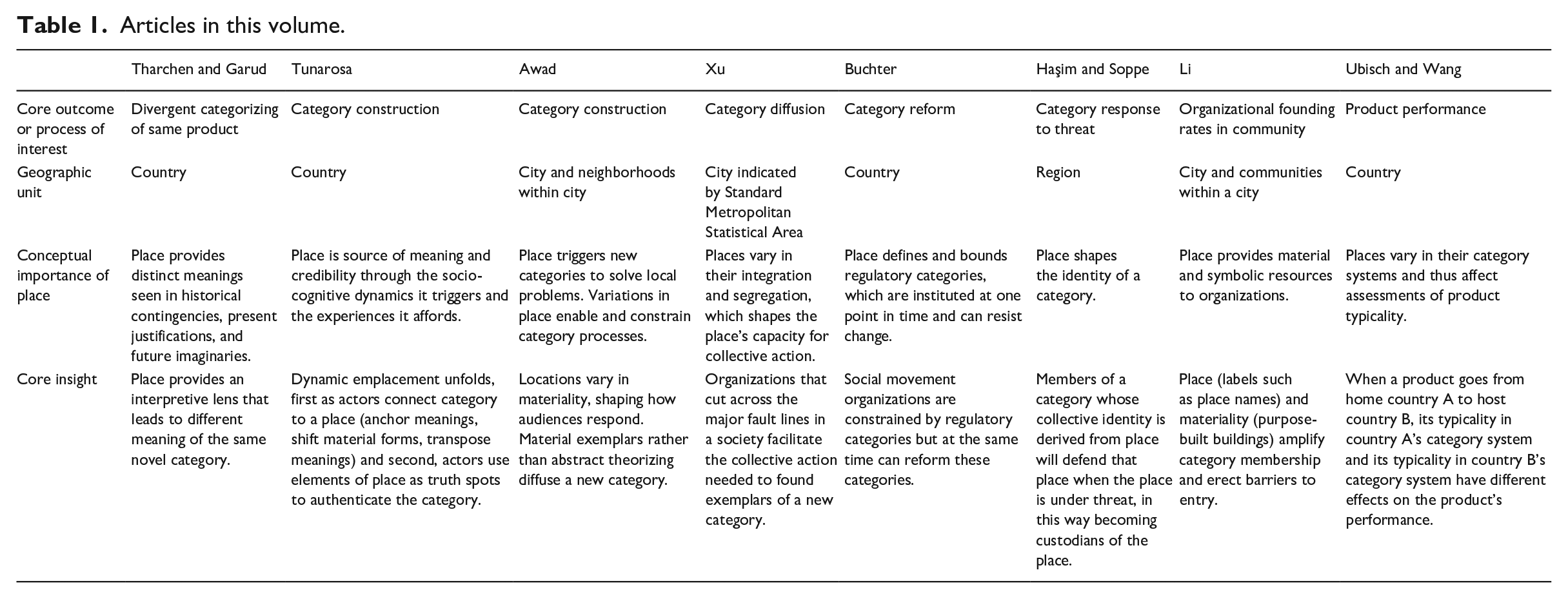
In the first article, “The differential categorization of novel products by institutional actors across places: The case of e-cigarettes in the US and the UK,” Thinley Tharchen and Raghu Garud (2022) demonstrate how the historical contingencies and future imaginaries of place—the United Kingdom and the United States—led to distinct interpretations of the same new product category: e-cigarettes. Public health organizations pursued different goals: the United Kingdom focused on reducing harm for adults whereas the United States emphasized protecting youth through precaution. The authors illuminate how place informs goal-based category processes and problematizes the prototypical view of categories based on features. The study adds to our understanding of category processes by highlighting how place—the locality of meaning and sense-making—influences category processes and can lead to distinct trajectories by altering what information institutional actors attend to when understanding and categorizing a new product.
In the article, “On solid grounds: Dynamic emplacement and category construction in US specialty coffee, 1974–2016,” Andrea Tunarosa (2022) builds upon the idea that the process of “how” a market category is constructed is contingent upon “where” this process unfolds. By looking at how the US specialty coffee category was constructed over the last 50 years, she examined the role place played in this process by combining a wealth of archives with extensive interviews of the different actors involved. Doing so, Tunarosa (2022) uncovered a process of dynamic emplacement, which shows how place is constitutive of a category through three mechanisms of anchoring meaning in location, shifting material forms, and transposing the category to a new meaning system. Tunarosa (2022) also highlights how place operates as a “truth-spot” in this process (Gieryn, 2002, 2018). By truth-spot, she suggests that place affords a material and situated experience of a category, which connects its cognitive and material facets and turns abstract ideas into the “truth believed by many” (Tunarosa, 2022). The new category hence becomes credible. With this study, Tunarosa (2022) shows how dynamic emplacement complements social evaluation processes during category construction by highlighting how place constitutes a novel category and grants it credibility.
In the article, “Emplacing category dynamics: Houselessness and the emergence of transitional micro-housing villages,” Mohamed Hassan Awad (2022) identifies four sequences to new category construction: problematizing, prototyping, implementing, and expanding. The new category of micro-housing, also known as Tiny House Villages, was triggered to address houselessness in Eugene, Oregon, where the social movement Occupy problematized existing solutions such as group housing and tent cities. Housing advocates began to prototype a new type of housing that was a materially different kind of housing for the houseless: self-contained, economical, and sturdy micro-houses arranged into collectives called Tiny House Villages. The implementation of Tiny House Villages, however, was constrained by local neighborhoods, which varied in their acceptance. Neighborhoods with lower socio-economic status or land owned by the State enabled, the presence of Tiny House Villages whereas higher socio-economic status and private land ownership impeded the presence of Tiny House Villages in the neighbohood. These variations in materiality—socio-economic status and land ownership—forced housing advocates to revise how they explained and engaged different audiences. Tiny House Villages expanded—a form of diffusion—because material exemplars enabled advocates to showcase the new category and how it resolved the problems and improved outcomes of established alternatives. Through expansion, the diffusion of the micro-housing category then reshaped neighborhoods within Eugene, Oregon, according to where and how Tiny House Villages were located.
In the article “Integration versus segregation: Newspaper diversity and museum formation in US local communities 1872–1976,” Hongwei Xu (2022) examines how the first public museums spread across US cities. He argues and shows that the diversity of general appeal newspapers has a positive relationship with the founding of a city’s first public museum, whereas the diversity of ethnic newspapers in a city delays this first founding. Xu (2022) argues that general appeal newspapers act as meeting places that enable collective action for a public good; conversely, more ethnically oriented newspapers reinforce social fault lines and distinct identities that hinder the ability to act collectively. In this way, Xu (2022) shows us that the spread of certain new organizational categories—those that rely on collective action—across places may hinge on the social solidarity present in those places, which itself depends on the presence of other forms of organization that can bridge social fault lines.
In addition to examining the ways in which place shapes categories, other articles in our special issue also explore how actors can reshape places. In the article “Addressing racism and Islamophobia under the rules of colorblindness: When social movements engage in category work to reform the meanings of regulatory categories,” Lisa Buchter (2022) explores the regulatory categories of “underprivileged neighborhoods” and “diversity” in France, where the official state policy is one of colorblindness, or “indifference to difference.” Notably, in France, the regulatory category “diversity” became associated with diversity of gender, age, and disabilities rather than ethnic or religious diversity—making racism hard to address. Buchter (2022) reveals how a social movement organization that she calls “Rainbow”—a non-profit recruitment agency that links corporations with job seekers from underprivileged neighborhoods—engaged in category reform as a special case of category change. Rainbow, founded by a Muslim man, publicly signaled a strong alignment with the state-sanctioned (i.e. colorblind) meanings of these categories, but in fact fought against racial and religious discrimination in hiring practices. Rainbow not only addressed racial discrimination directly through supporting racial and religious minorities in their quest for employment, but also worked to reform the state categories of underprivileged neighborhoods and diversity to acknowledge racism. As Buchter (2022) explains, Rainbow’s strategy was more reformist than revolutionary, as it avoided directly challenging the state categories while at the same time seeking to alter them subtly and incrementally.
In their article “When entrepreneurs become custodians: Place-based identity and collective coping responses in extreme contexts,” Kemal Haşim and Birthe Soppe (2022) explore how entrepreneurs who share a collective identity rooted in a deep-seated attachment to place cope with threats to this place. They examine the collective action of a group of independent hoteliers in the politically contested territory of Northern Cyprus, a place that faces cultural suppression. These entrepreneurs engage in five tangible “custodial activities” to defend the place in response to this threat. As the authors explain, the category of small, independent hotels is place-based in a way that large chain hotels are not. Characterizing Northern Cyprus as an “extreme case,” Haşim and Soppe (2022) leverage their rich data to show how the attachment category members have for place leads them to “become custodians of local culture and traditions as they collectively mobilize a set of custodial activities aimed at conveying and maintaining the local cultural heritage.”
Two articles in our volume also focus on organizational outcomes. Ying Li’s (2022) study, “Its name suggests it belongs here! The power of a community namesake in decreasing founding rates during industry emergence,” reveals that by signaling place as a form of category membership, an organization can reduce competition, seen in fewer competitors who enter the community (e.g. lower founding rates). Li (2022) examines communities within Chicago, one of the birthplaces of the movie industry. The symbolic power of place-based category membership was signaled by a theater being named after its community (Cresswell, 2004). The community name signaled commitment to and resources from the community to the organization, which erected an entry barrier for competitors. The benefit of place-signaling category membership was amplified by materiality—purpose-built theaters—that made category membership (being a member of the community) more visible and further decreased competition at a higher rate than namesake theaters that were converted from other buildings to movie theaters. Place indicated by symbolic names and material forms made visible an organization’s category membership and dampened local competition.
In their article “Typical products for outside audiences: The role of typicality when products traverse countries,” Sverre Ubisch and Pengfei Wang (2022) find that category systems are tied to place, such that what is typical in one place may be atypical in another. Products that cross country borders may therefore experience different outcomes in different places. How will the typicality of a product in a home country’s category system affect product outcomes in a host country? And how will typicality of the imported product in the host country’s category system affect product outcomes? In a clever design, Ubisch and Wang (2022) compile a data set of 8416 unique films from 44 home countries introduced across 40 different host countries. They define typicality using genre: if a country makes a lot of comedies, a comedy is operationalized as having a high typicality for that (home) country. The authors then find that films with high typicality in their home country are more likely to be exported and more likely to have better performance in host countries. For example, a comedy coming from a country that makes a lot of comedies will fare well in host countries. Conversely, imported films that are typical in genre to a host country are less likely to perform well in that host country. For example, a drama imported to a country that makes a lot of dramas will fare poorly. At least in the case of films that cross borders, Ubisch and Wang (2022) show us that audiences prefer films that reflect the country of origin, but that are different from films made in the host country.
Next, we discuss and integrate the main findings of the eight articles in an integrative framework before concluding with directions for future research.
Integrative framework
Figure 1 provides an integrative framework for conceptualizing the relations among place, categories, and organizations and the mechanisms that link these constructs. As many of the articles in our volume show, place offers distinct geographic locations for collective action, material resources, and meaning systems that are used to interpret and construct categories (the top arrow from left-to-right). Other articles in the volume also address the reverse arrow: how categories may shape place, either by altering or defending elements of a place (the top right-to-left arrow). Finally, articles in our volume illuminate how the relations between place and categories influence organizations, such as organizational foundings, performance, and competition. Below, we elaborate on how this framework may guide theorizing about place, categories, and organizations.
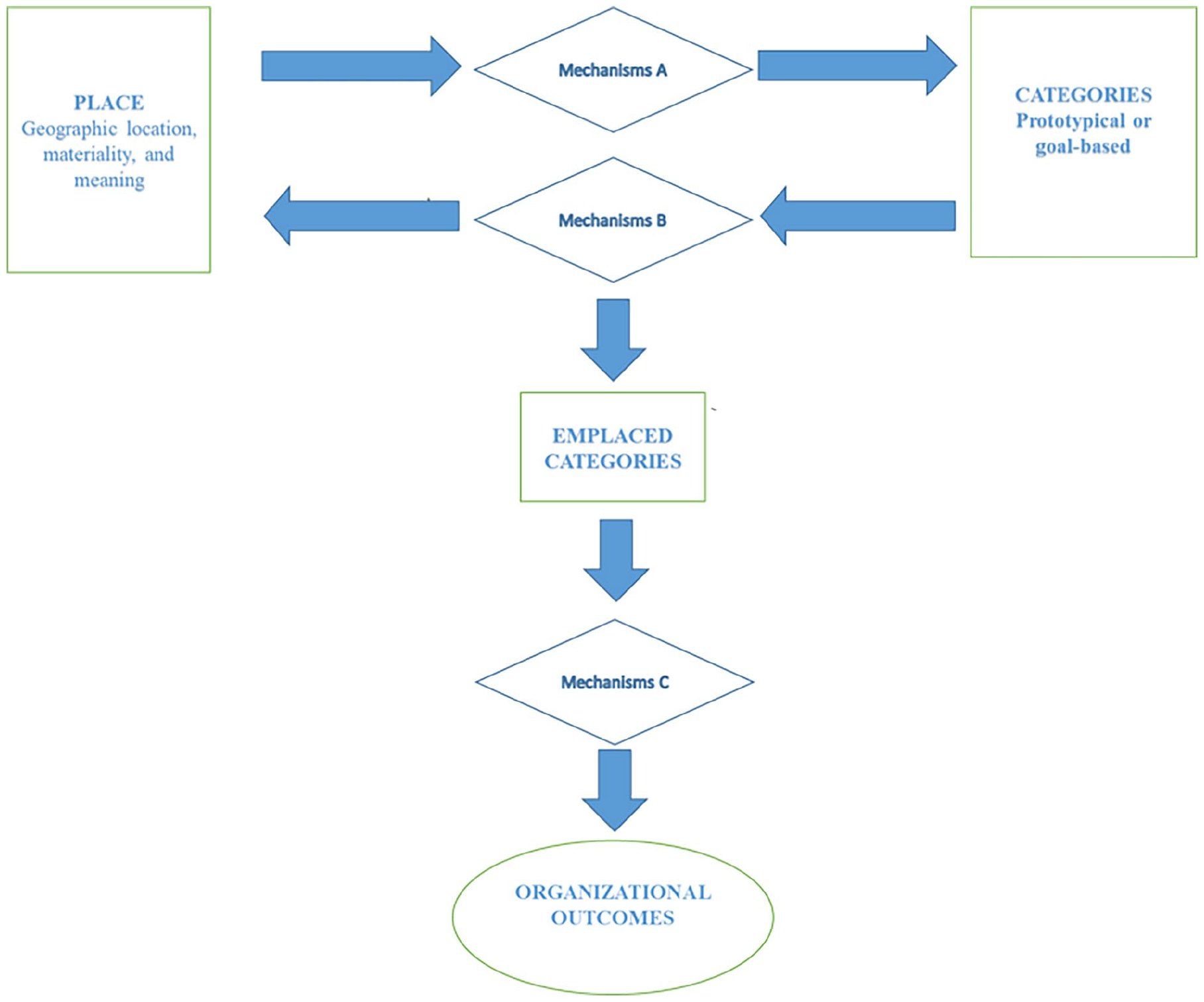
A research framework for theorizing place in category research.
The first set of relations illuminates Mechanisms A by which place influences categories and categorizing. Categories are shared representations and are thus inherently social. Place offers meanings systems by which actors interpret and enact categories. For instance, Tharchen and Garud (2022) demonstrate that the meaning of e-cigarettes depended the country, with specific historical contingencies that shaped imagined futures with goals that defined how e-cigarettes were categorized as harm-reducing or protecting. Place also influences categories by not only shaping interpretation but also constraining their possibilities, as Tharchen and Garud (2022) show. Buchter (2022) highlights how the regulatory categories of diversity and underprivileged neighborhoods have a particular meaning in the French context. In other places, they mean something different. Buchter (2022) further demonstrates how state support for these categories renders them difficult to change. Differently, Tunarosa (2022) shows how independent coffee roasters, in their struggle against mass producers, anchored place-based meanings in the new specialty coffee category they aimed to create, and later transposed meanings from locavore movements. In that perspective, place is more than a prism or a collar for categories, be they emerging or existing; place also provides walls and draws boundaries, as emplacing categories allows both symbolic differentiation from and protection against incumbents.
The studies in this volume extend the limited research on how categories are constructed materially (e.g. Jones and Massa, 2013; Jones et al., 2012). Awad (2022) reveals that Eugene’s material housing shortage problematized existing housing categories for the houseless and triggered the search for a new kind of material form to address needs, such as safety, weather impermeability, and privacy. Li (2022) demonstrates that materiality can amplify category processes, such as the advantage to firms when they had purpose-built versus converted buildings for movie theaters. The material basis of categories is not uniform, creating variance even within the same city neighborhood (Jones et al., 2019) or geographic region (Molotch et al., 2000), leading to distinct historical trajectories of category construction. The ability to implement the new category of housing—micro-houses organized into Tiny House Villages—varied dramatically across the city of Eugene, and housing advocates had to adjust their tactics, deploying their local understandings, such as which neighborhoods had lower socio-economic status or which were owned by the State, to gain their desired outcomes of more micro-housing for the houseless and located in a variety of neighborhoods across the city of Eugene. Material exemplars are key to the spread of a new category (Boghossian and David, 2021; Jones et al., 2012); in contrast to abstract theorizing (Strang and Meyer, 1993), Tiny House Villages as material exemplars enabled the new category of micro-housing villages to diffuse across neighborhoods in Eugene and across cities in the United States.
Place also enables (or constrains) the collective action that can alter an existing category system. Buchter (2022), Awad (2022) and Xu (2022) all illuminate how collective action transforms a category. In Buchter (2022), the social movement organization Rainbow reformed the regulatory categories of “diversity” and “underprivileged neighborhoods” through collective action deeply rooted in place—France’s history, politics, and culture. Awad (2022) reveals how the housing crisis in Eugene, Oregon, was citywide and catalyzed the Occupy movement to make visible the material shortage of adequate housing. Xu (2022) argues that the general content newspapers present in a city provided a platform that allowed residents from different racial backgrounds to meet and exchange, thereby facilitating the collective action needed to found public museums, this in contrast to cities with mostly ethnic newspapers where cross-racial interaction was more limited. Places thus provide a set of social mechanisms through which collectives arise and influence category processes.
The influence of place on category processes also often involves interactions among multiple elements of place. For instance, Tunarosa (2022) shows that symbolic activities, material forms, and situated experiences interact to expand and authenticate the emerging specialty coffee category. Her dynamic emplacement model contributes to the theorizing of place in category research by highlighting four specific mechanisms—anchoring meanings, shifting material forms, transposing meanings, place as truth spot—through which place influences category construction. Clearly, categories and category processes can only be well understood in the context of place and in light of its dimensions. Emplacing categories encourages researchers to gather rich and multifaceted data sets to unravel the multiple, overlapping, and co-occurring mechanisms through which categories populate, if not infiltrate, our lives.
The articles in our volume also address—to a lesser extent—the reverse arrow: how categories may shape place, whether by defending elements of a place or altering them (Mechanisms B). Awad’s (2022) study on micro-housing reveals a normative mechanism through which category shapes place. In his case, micro-housing is initially resisted by neighborhoods with higher socio-economic status, in a logic of NIMBY-ism (or not-in-my-backyard). When prototypes of the houses and villages are made available, activists of the Rest-Stop program held a material exemplar that became pivotal in overturning objections and obstacles to its wide diffusion in Eugene, Oregon. Akin to Jones and Massa’s (2013) study of the Unity temple, materialized exemplarity has powerful evangelizing effects that can change places and their material, both geographic and economic.
If geographic communities are a mobilizing platform, they also convey a sense of belonging rooted in collective identities, as shown in Haşim and Soppe’s (2022) study. In their case, tourism entrepreneurs in Northern Cyprus cope with threats to the culture of that place by taking upon a custodian role that both promotes and protects the place they are bound and attached to. By showcasing the distinctive materiality of the place, providing venues for cultural expression, and socializing visitors, the category members act to preserve the culture of the region. In a reciprocal dynamic, therefore, the category derives its collective identity from the place and then comes to its defense when that place is threatened. This study expands our understanding of custodianship of traditions that highlight actors motivated primarily by power and interests (Dacin et al., 2019) to actors motivated by attachment to an identity with place. Haşim and Soppe (2022) also expand the focus on individual custodianship based in rituals that institutionalize or de-institutionalize traditions (Dacin and Dacin, 2008) to collective action that maintains traditions by protecting a category. In this way, Haşim and Soppe’s (2022) study speaks to the role custodial collective work at the category level may have on maintaining important institutions in society.
Finally, articles in our volume highlight how place and categories influence organizational dynamics and outcomes (Mechanisms C). Li (2022) illuminates how being located in a community and symbolically associating with that community by taking its name generates perceptions of resources and support that deter competitors from entering, erect entry barriers, and offer advantage to firms. Ubisch and Wang (2022) show how the notion of typicality is place bound: what is “typical” in one place is not necessarily in another. Perhaps less intuitively, the typicality of a product in its country of origin has effects in other countries to which the product has been exported, as does the typicality of the imported product within the host country’s categorical system. These studies remind us that evaluations of products and organizations (for example by assessing typicality) are done “in place,” and such evaluations may differ if done in other places.
Discussion and directions for future research
We were extremely pleased with the number, quality, and variety of the papers we received. As a result of these fine submissions, this special issue displays theoretical diversity and methodological pluralism from research done in many places across the world. This section reflects the inspirations we derived from these eight studies that explore the intersections between place and category. We organize this section by setting an agenda structured around materiality, collective identity, and collective action, the three areas of focus we believe are most fruitful for integrating place more fully in category research. 2
First, materiality, which is central to place, affords new insights for future research on categories and categorizing. Future research can build on the budding area of research that has shown how categories are not only cognitive devices, but are also situated and rooted in materiality, experiences, and interactions (Jones et al., 2017, 2019). Materials reveal and construct a new category because materials instantiate the new category’s concept, features, and purposes (Jones et al., 2012), enabling the category to be perceived as exterior and objective. Awad’s (2022) study illuminates how material prototyping made visible how the new category resolved problems with existing categories of housing: the lack of privacy and weather resistance. Tunarosa’s (2022) piece highlights the shifting material forms, which radically changed consumers’ experience and helped spread specialty coffee. Materials also offer evidence of category interpretation, such as Haşim and Soppe’s (2022) visuals of their tourist guest houses/hotels and Awad’s (2022) visuals of micro-housing. Second, material exemplars enable the diffusion of new categories (Boghossian and David, 2021; Jones and Massa, 2013; Jones et al., 2012), which expand our understanding of diffusion as driven primarily by theorizing. Awad (2022) reveals the importance of material exemplars in enhancing understanding of a category for it to diffuse, and Li (2022) illuminates how the materialization of purpose-built theaters made the exemplars more visible to others, providing an advantage to the firm.
Category construction or expansion is not only a socio-cognitive process, but is anchored and originates from the concrete, place-based, material forms actors deploy, as the studies above show. Thus, categories have a material geography, and hence a history, that might shape their antecedents and consequences (Molotch et al., 2000). As Tharchen and Garud (2022) demonstrate, categories are translated, and their interpretation depends on the history of place. Place and its focus on materiality also offer important conceptual linkages between categories and institutional theory (David et al., 2017: 682). A critical question is whether the material forms of a category become dominant and diffuse a relatively uniform interpretation of a category, such as late Modernism with concrete skyscrapers in every major city across the world (Jones et al., 2012), or are translated in unique ways that alter or expand a category. Future research can engage in more comparative research on how categories are materially and historically constituted, driving their translation, diffusion, and evolution.
Second, future research on place and categories could further explore the role of collective identities in category processes. Collective identities are an intriguing mechanism as both categories and place can be grounded in them. Collective identities are key to mediating the influence of place on category construction and diffusion (Wry et al., 2011). For instance, Rao et al. (2003) showed how the nouvelle cuisine identity movement diffused, while Croidieu and Monin (2010) explored how regional identities impede or facilitate the diffusion of innovations, as logics of identity-based appropriateness supersede logics of interest-based consequences. In this issue, Haşim and Soppe (2022) study how the collective identity of category members is rooted in place and how these category members develop custodial activities to defend it. Future research could further this line of work by exploring other outcomes, be it opposition, polarization, competition, or contention (Chreim et al., 2020; Hsu and Grodal, 2021; Jones et al., 2012; Negro and Hannan, 2022). For instance, Tunarosa (2022) suggests how the place-based specialty coffee category emerges in competition with the price-based premium category or the Arabica and flavored-based gourmet category. Focusing on different outcomes is intriguing as Haşim and Soppe (2022) highlight the unity that prevailed among a (small group of) entrepreneurs, which other research looking at other outcomes also found, such as in the case of nationalistic discourses in the creation of fine wines in Australia or artisan cheese in Québec (Boghossian and David, 2021; Croidieu et al., 2016). Yet, Navis and Glynn (2010) suggested that unity and coordination is often high in the early stages of category construction but then declines as differentiation and competition concerns grew.
Related to this question of temporal variation in “we-ness,” one might consider the homogeneity/heterogeneity of collective identities present in a place. Does place unify when there is a dominant, shared identity but create variance when identities diverge? Both Northern Cyprus (Haşim and Soppe, 2022) and Quebec (Boghossian and David, 2021) could be said to have a dominant identity that is under threat, prompting categorical action. In a place where identities are fragmented this may be less likely to occur. Future research can examine under what conditions place generates variety versus similarity in categories and category processes, as well as study the varied conditions and pathways to different categorical outcomes (e.g. Micelotta et al., 2017). Also, further research could clarify how, when, and why collective identities facilitate versus impede these processes. The role of place-based collective identity in catalyzing collective action and custodianship is critically important as political instability, cultural oppression, and territorial occupation are a reality that exists in many parts of the world and as acknowledged by anthropologists, tends to suppress indigenous, local culture (Moore, 2005).
Future research along these lines would be valued because categories are shared representations. Because, they are shared, this line of thinking also calls for a detailed attention to the underlying social structures (class, status, gender, generations, etc.) of the geographic (or virtual) communities under study and how they relate to identity dynamics. Xu (2022) in this issue shows how social structures influenced collective action, while Rao et al. (2003), for instance, highlighted the formation of an identity movement and how high-status members enrolled new members to the movement as it grew. What seems to also warrant further attention is an understanding of how place becomes disputed and conflicted as a result of these identity dynamics mediating category and place.
The articles in our issue also suggest a line of future research investigating competitive dynamics. Along the lines of resource partitioning (Carroll and Swaminathan, 2000; Swaminathan, 2001), one can wonder about the conditions under which place and place-based identities are effective barriers to entry and sources of differentiation, and the kinds of strategies communities can develop to mobilize place effectively for their industries. For instance, the European wine industry has built systems of appellation contrôlée, on ideas about terroir and the pre-eminence of place, that have been emulated elsewhere and in other industries, some benefiting greatly from it, others less so. In this issue, Tunarosa (2022) shows how emplacement is, at least initially, a source of differentiation and value creation and appropriation along the whole supply chain. Li (2022) demonstrates how labels that signal symbolic association with a specific community interact with purpose-built theaters to dampen competitive entry and enable advantage for the firm. While attaching categories to place might confer competitive advantage in some cases (e.g., Ubisch and Wang, 2022), doing so could also limit growth or diffusion.
Third, future research on categories can further illuminate how place shapes the collective action underpinning category processes. We know from prior research on nouvelle cuisine (Rao et al., 2003), grass-fed beef (Weber et al., 2008), and management consulting (David et al., 2013), among others, that collective action has been critical to category construction. But this collective action occurs at a time and in a place—and perhaps would not at another time or in another place. As the studies in this special issue make clear, place is more than a context in which collective action occurs—it motivates and shapes the collective action. In this sense, all battles are local and fought on local ground. While prior research has helped us understand the important role of collective action in category construction, we know far less about how collective action might affect other category outcomes. How might place motivate collective action aimed at changing or even eliminating categories? One might reasonably posit that some forms of collective action are more present—and more welcome—in some places rather than others. While the effects of place on categories via collective action has received some attention (Mechanisms A in Figure 1), we know much less about how the collective action of the members of a category affect place (Mechanisms B in Figure 1). Haşim and Soppe (2022) point to custodianship of place, but collective action among category members may work in the opposite direction, to change important elements of place. How might the composition of a category affect the likelihood, form, and effectiveness of collective action aimed at changing aspects of a place?
Our hope with this issue is to start a conversation among category scholars about “putting categories in their place.” Categories are too often researched as powerful yet abstract concepts, talked about and thought through, but considered less often as lived and experienced on the ground. By emplacing category research, we call for future work studying how categories are “real” and part of our human and organizational experiences, notably as shared representations with materiality, collective identities, and collective action. As category scholars, we think the time for place has come. Perhaps, scholars of place will also notice this conversation and help us further ground these ideas.
Footnotes
Acknowledgements
We thank co-editor Ann Langley for all her help and support in making this Special Issue come to fruition. Thank-you also to Yoojin Lee for diligently helping us get the manuscript into shape. We also thank the many reviewers for giving of their time and expertise to improve the articles, and the authors for entrusting us with their work and responding so diligently to our feedback.
Funding
The author(s) received no financial support for the research, authorship, and/or publication of this article.