




Abstract
As Strategic Organization—SO!—turns 20, we reflect on the inspirations and aspirations behind the journal’s creation, contemplate its accomplishments, and share some themes it might amplify in the future. We find much to celebrate, as well as things to contemplate. The journal has accomplished a great deal during its adolescent and teen years. Our original inspirations and aspirations, updated by our successors, have positioned the journal as the forum for integrative research on strategy and organizations that is pursued rigorously and in an open-minded way. While we think our original vision for Strategic Organization has largely been realized—both for the journal and the field—we see interesting and important openings for new strategic organization research initiatives in areas including novel designs, emerging socio-political processes, and widening societal effects; initiatives we believe will benefit from research approaches that emphasize template eclecticism and careful detective work.
Keywords
Introduction
At the 2001 Academy of Management conference in Washington DC, we three friends agreed (over a beer of course, we are Canadians after all) to create a new journal called Strategic Organization—SO! 1 We announced the journal that fall and, after recruiting a truly outstanding 100-member editorial board who helped us process dozens of early article and essay submissions, published the first issue in February 2003. Ten years later, as we readied the reigns of Strategic Organization for an able new team of coeditors, we felt a great sense of accomplishment. On virtually, any conceivable metric the journal had excelled, having ranked eighth among all management journals in its first appearance in the 2009 ISI Journal Citation Reports, with an Impact Factor of 4.059. Now, 20 volumes, 80 issues, and nearly 400 articles and essays later, the journal continues to prosper, and so we are grateful to the current coeditors for their invitation to reflect on our original aspirations and the choices we made about the journal’s character and operation, as well as to revisit those aspirations and choices and to reflect on how they might differ if we were founding the journal now. We invite you—fellow students and practitioners of strategic organization—to join us on this journey by reflecting along with us as we share our views on the state, ongoing development and future of strategic organization—both the journal and the field.
Inspirations and aspirations
Reintegration of strategy and organization
Our original inspiration for the journal stemmed from divisions and tensions we observed in research on strategy and organization at the time. The most galvanizing of these was the separation we observed characterizing the study of strategic and organizational phenomena. Early research—exemplified in the work of Tom Burns, Alfred Chandler, Paul Lawrence and Jay Lorsch, James March and Herbert Simon, Edith Penrose, and Philip Selznick—embraced issues of strategy and organization together, irrespective of disciplinary starting point. Problems of strategy and organization were inseparably entwined. Although this holistic approach was sustained in the work of such notable scholars as Jay Barney, John Child, Kathy Eisenhardt, Michael Hannan and John Freeman, Rosabeth Moss Kanter, Danny Miller, Henry Mintzberg, Cynthia Montgomery, Richard Nelson and Sidney Winter, Andrew Pettigrew, Jeffrey Pfeffer and Gerald Salancik, Michael Tushman, and Oliver Williamson, as early as the 1960s, a tendency to treat issues of strategy separately from issues of organization had taken root.
Structurally, this separation appeared in journals and professional associations. Administrative Science Quarterly (1956) was the first North American journal to focus explicitly on organizational issues; Organization Studies (1980), launched by the European Group for Organizations Studies (EGOS), was the first in Europe. As the Academy of Management grew, nine professional divisions were established (1971), two of which we now know as Organization and Management Theory and Strategic Management. The separation was further articulated with creation of Strategic Management Journal (1979) and the Strategic Management Society (1981). These early divisions were reinforced by the appearance of additional specialized journals emphasizing strategy or organization (e.g. Organization Science, 1990), but not their integration, and this trend has continued to the present (e.g. Strategy Science, 2016; Strategic Management Review, 2020; Organization Theory, 2020). These divisions—whether the product of journal policies or expressions of academic preferences and commitments—fueled further impetus to distinct research agendas, legitimating and reinforcing divergent emphases and thus fragmentation.
The separation of the study of strategic and organizational phenomena into distinct semi-disciplines with their own professional associations, interest groups, journals, and academic departments can of course be seen, in part, as a natural product of academic specialization. While perhaps useful for their early development, these divisions were hardly benign, quickly becoming a source of more fundamental choices of disciplinary perspective and research approach—particularly for new scholars establishing their research identity—as well as of tensions within the field as the theoretical and empirical foundations of the two groups diverged.
The study of strategy was most strongly rooted in the research traditions and discipline of economics, and researchers located firmly within schools of business and management. The study of organization was most closely tied to the research traditions and discipline of sociology and, historically, researchers located in sociology departments, although a migration from disciplinary departments to management schools (as well as management journals and associations) was well underway. Twenty years later, this migration appears largely complete, with the vast majority of North American and European organization scholars now concentrated within business schools.
Specialization has its advantages, of course. But, as March and Simon and Lawrence and Lorsch observed long ago, periodic reintegration does as well. Back in 2001, each of us was trying in our own way to reintegrate organization and strategy in our work. Certainly, we were not the only ones reaching across the growing divide, but we believed the connections between strategy and organization were too often ignored and, consequently, remained poorly understood. We felt it was time to rethink and reintegrate our understanding of organization with serious consideration of strategy and our understanding of strategy with detailed attention to organization. We sensed—with some urgency after witnessing fallout from the so-called “paradigm wars” (Pfeffer, 1993; Van Maanen, 1995) in organization theory—that the time had come for a venue in which researchers in strategy and organization could rejoin forces for further theoretical development—a platform for those seeking more active discussion and collaboration across the divide.
An international forum
A second division we observed in strategy and organization scholarship was among intellectual traditions in different parts of the world. European and North American scholarship, for example, were two solitudes. Researchers infrequently cited work across the Atlantic divide and European and North American scholars generally disagreed on seminal contributions. The division was marked both by different topical interests and methodological preferences. The North American tradition emphasized practical managerial relevance and performance, and pragmatic quantitative empirical approaches. The European tradition was more attentive to considerations of power and society, and informed by philosophical and historical discussion and qualitative empirical approaches.
Although European strategy and organization researchers were attending more than North Americans to scholarship across the Atlantic divide, the different ways in which they tended to frame and address research questions made it difficult for them to participate fully. Reflective of these divisions, the European Group for Organization Studies was, according to March (2007: 10), originally conceived “as a kind of intellectual social movement within organizational scholarship, defending, developing, and extending a particular scholarly point of view, and proclaiming European resistance to both the hegemony of North American scholars and the glorification of quantitative analysis.”
These tensions notwithstanding, there was a counter-flow of research and article publication by European scholars in North American journals, and European scholars were increasingly attending North American conferences. At the time, many strategy and organization researchers considered this flow a natural (and homogenizing) process reflecting “enlightened recognition”—as well, of course, as the power of journal rankings. In hindsight, the 1999 Bologna Accord, which aimed to harmonize the structure of European business education (and higher education more generally) by conforming to the Anglo-American Bachelors-Masters standard, was probably a more important impetus.
Still, barriers to having more European thought and scholarship in North American journals were evident. Many European topics of interest, such as the construction of organizations and meaning, the micro-foundations of strategy and organization, the nature of work and process, the strategy as practice perspective, and the nature and influence of “fields,” were not as popular in mainstream North American organization theory and strategic management journals. The moment seemed right for providing a more open international forum in which to connect the different traditions, lines of conversation, and evolving research from “across the pond.”
Building a new field
We named the new journal to reflect the intellectual convergence it aimed to promote and encourage and to carve out a new research area that the convergence created. Supporting the development of new research and understanding at the intersection of strategy and organization to build a new multidisciplinary, multimethod field of study—Strategic Organization—was our raison d’etre.
We explicitly removed constraints on topic, discipline and method, freeing our authors to combine ideas and methods in new ways, while at the same time, demanding sound disciplinary grounding, strong theory, and empirical rigor, to create a context conducive to new research that improved our understanding of strategic organization. If there was any preference for submissions, it was for those that identified both a compelling practical strategic organization issue and a strong theoretical framework and appropriate research design for addressing it.
The journal’s editorial policy was explicitly multidisciplinary and discipline neutral, openly accepting of theoretical grounding in an interdisciplinary set of approaches that would provide a forum in which interdisciplinary bridges could be built and interdisciplinary debate and collaboration fostered to advance strategic organization theory and practice. The editorial policy was also expressly multimethod and method neutral, attaching no greater authority to one methodological approach than to another. We encouraged a diversity of rigorous empirical approaches. We sought contributions from all research traditions—and we were open to the construction of new ones.
To allow for more direct conversations about a wide variety of strategic organization topics and issues, we created “SO!APBOX” editorial essays. A soapbox is a platform used by a self-appointed, spontaneous, or informal orator, or, more broadly an outlet for delivering opinions. These editorial essays—which quickly became a reader and author favorite—aimed to provide a forum in which interdisciplinary bridges could be forged, methodological traditions discussed, and the field of strategic organization staked out.
Strategic Organization’s editorial board and review policies also furthered the journal’s commitment to joining and generating conversations at the intersection of strategy and organization. To ensure our authors received relevant, rigorous, high-quality discipline and methods neutral feedback that would help them strengthen their work, we recruited a large (100 member), diverse editorial board and used only its members to review all article submissions. To maintain the board’s energy and ensure quality and currency, we refreshed the editorial board each year, especially by adding emerging young scholars into the mix.
To ensure a timely and engaging review process, in addition to using only board members to review submissions, we instituted a single revision policy that required publication decisions after no more than one revision, and promised (and delivered) reviews and editorial decisions within 60–90 days. We did not wish to see papers languishing in the review process and lagging behind evolving research conversations, putting authors’ work at risk of appearing late because of the review process. 2
Looking backward—what is?
Now, 20 years on, we have now been asked to reflect on our original goals and intentions as well as the future of Strategic Organization. As a first step, before looking ahead, we looked back to examine the journal’s outcomes in light of our aspirations. Has Strategic Organization been a beacon for advancing a more international and interdisciplinary conversation that encourages a diversity of rigorous empirical approaches? Has the journal advanced the reintegration of strategy and organization? To our great pleasure, we are happy to report that in our view the answer to both questions is a resounding “yes.”
International, interdisciplinary, multimethod forum
The international and interdisciplinary character of the journal has been unwavering. As Figure 1 shows, nearly 40% of Strategic Organization’s founding editorial team, established in autumn 2001, was affiliated with a university in Europe (36.7%) or Asia (3.1%), and many were trained in these regions. As the figure also shows, the journal’s international representation was far greater than that of Strategic Management Journal (18.8%), Administrative Science Quarterly (6%), and Organization Science (25.7%), particularly in terms of European participation. Twenty years later, Strategic Organization’s European (42.1%) and Asian (8.4%) board complement has grown to over half (50.5%), and includes members affiliated with universities in Australia, Austria, Belgium, Brazil, Canada, China, France, Finland, Germany, Israel, Italy, the Netherlands, New Zealand, Portugal, Singapore, South Korea, Spain, Sweden, Switzerland, the United Kingdom, and the United States. Although by 2021 international representation had roughly doubled at Strategic Management Journal (35.4%) and Administrative Science Quarterly (18.3%), it fell slightly at Organization Science (24.3%). Despite these gains, Strategic Organization clearly continues to maintain the most international editorial team. Moreover, over the years, the journal’s coeditors have been affiliated with universities in Australia, Canada, Germany, Italy, the Netherlands, United Kingdom, and United States. The diversity of disciplinary and research orientations among the editorial team is also clear—from Nicolai Foss, Sergio Lazzarini, and Joanne Oxley to Melissa Graebner, Nelson Phillips, and Davide Ravasi.
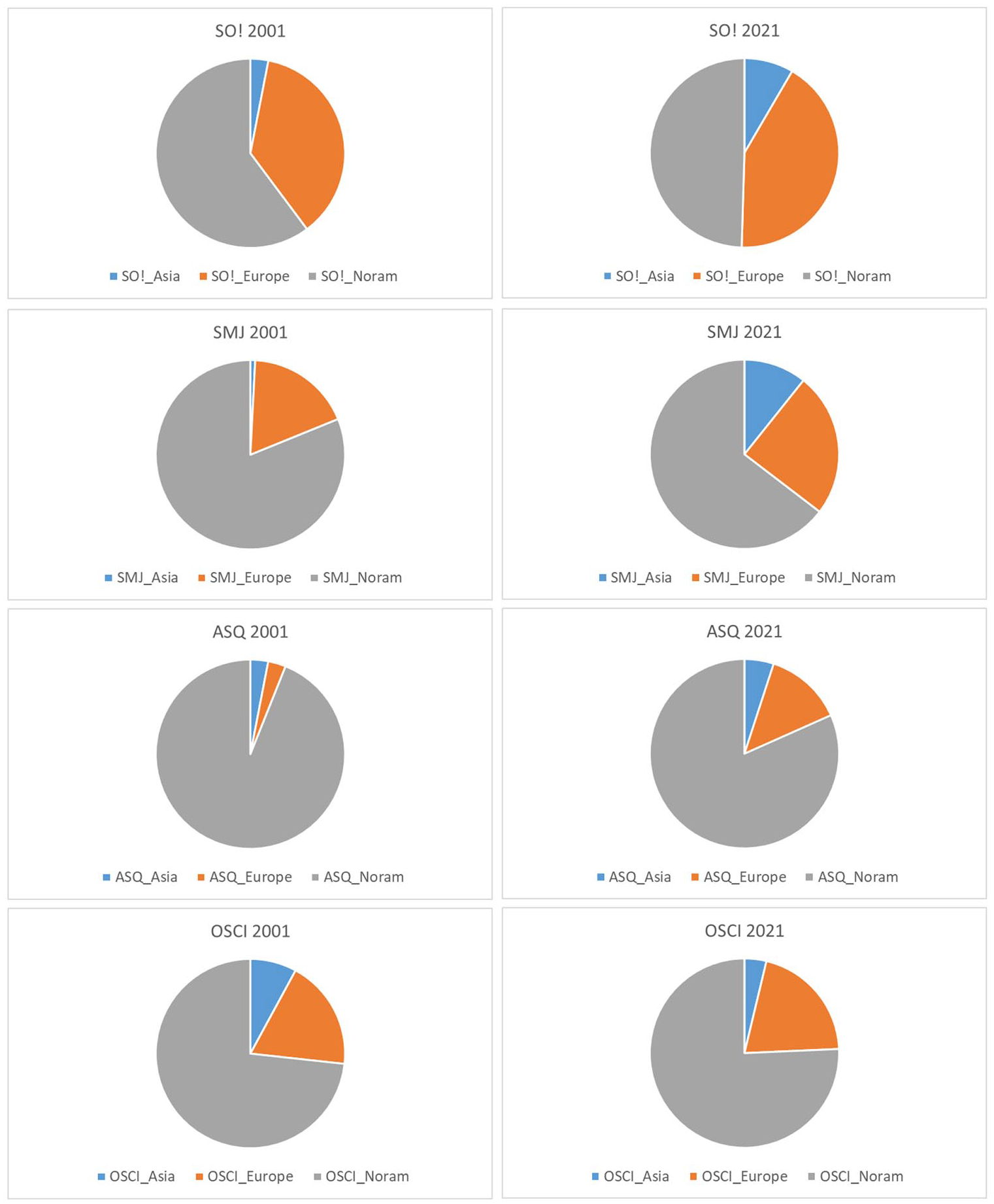
Journal editorial board members by region, 2001 and 2021.
The authors and published articles and essays also reflect this diversity. As we originally envisioned there continues to be no “prototypical” Strategic Organization article—template eclecticism is the rule. The journal continues to publish provocative and influential SO!APBOX Editorial Essays, articles on a wide variety of strategic organization phenomena, grounded in multiple disciplines and using diverse, rigorous methodologies. While particular articles and essays certainly reflect elements of the kinds of work we hoped Strategic Organization would promote (see, for example, the annual SO!WHAT award-winning articles and essays at https://journals.sagepub.com/page/soq/collections/virtual-special-issues/so-awards), it is the open-minded and pragmatic character of the portfolio of articles and essays that have appeared in the journal over the years—the relevance and creativity of their phenomena and topics of interest; the range and rigor of their empirical approaches and methods; the bridging and brokering of their theoretical and disciplinary perspectives—that best captures the vision of our aspirations. Recently, the journal has begun to publish highly regarded special issues, providing yet another avenue through which the journal can support rich conversations in diverse areas theoretical, methodological, and topical of interest to the strategic organization community. The journal has also launched the SO! Methods Collection (https://journals.sagepub.com/page/soq/collections/virtual-special-issue/so-methods), an open access archive currently comprised 35 articles offering insights into a diversity of empirical approaches and methods—from endogeneity correction and instrumental variables to process and ethnographic methods.
Strategic organization article cited journals
If Strategic Organization has helped advanced research that reintegrates strategy and organization, the journals cited in each of its published articles and essays should include work from both strategy- and organization-focused journals. To confirm this, we classified each article and essay published in Strategic Organization in each year according to its pattern of cited articles from Administrative Science Quarterly, Organization Science and Strategic Management Journal. (We limit focus to these three key specialist strategy and organization journals for simplicity.)
Figure 2 graphs the percentage of Strategic Organization articles and essays published in each year that cited one or more articles from each possible combination of these journals. The observations begin in 2003, the year in which Strategic Organization began publication. As the figure shows, in every year, the modal publication in Strategic Organization included one or more articles from all three journals. Across all years, on average, 65.8% of Strategic Organization articles and essays cited all three journals. An additional 18.4% cited Strategic Management Journal and either Administrative Science Quarterly (9.8%) or Organization Science (8.6%). Thus, on average, 84.2% of Strategic Organization articles and essays jointly cited specialist strategy and organization journals. Only 6.2% cited Strategic Management Journal alone; and 9.6% only Administrative Science Quarterly (3.1%), Organization Science (1.7%), or both (4.8%).
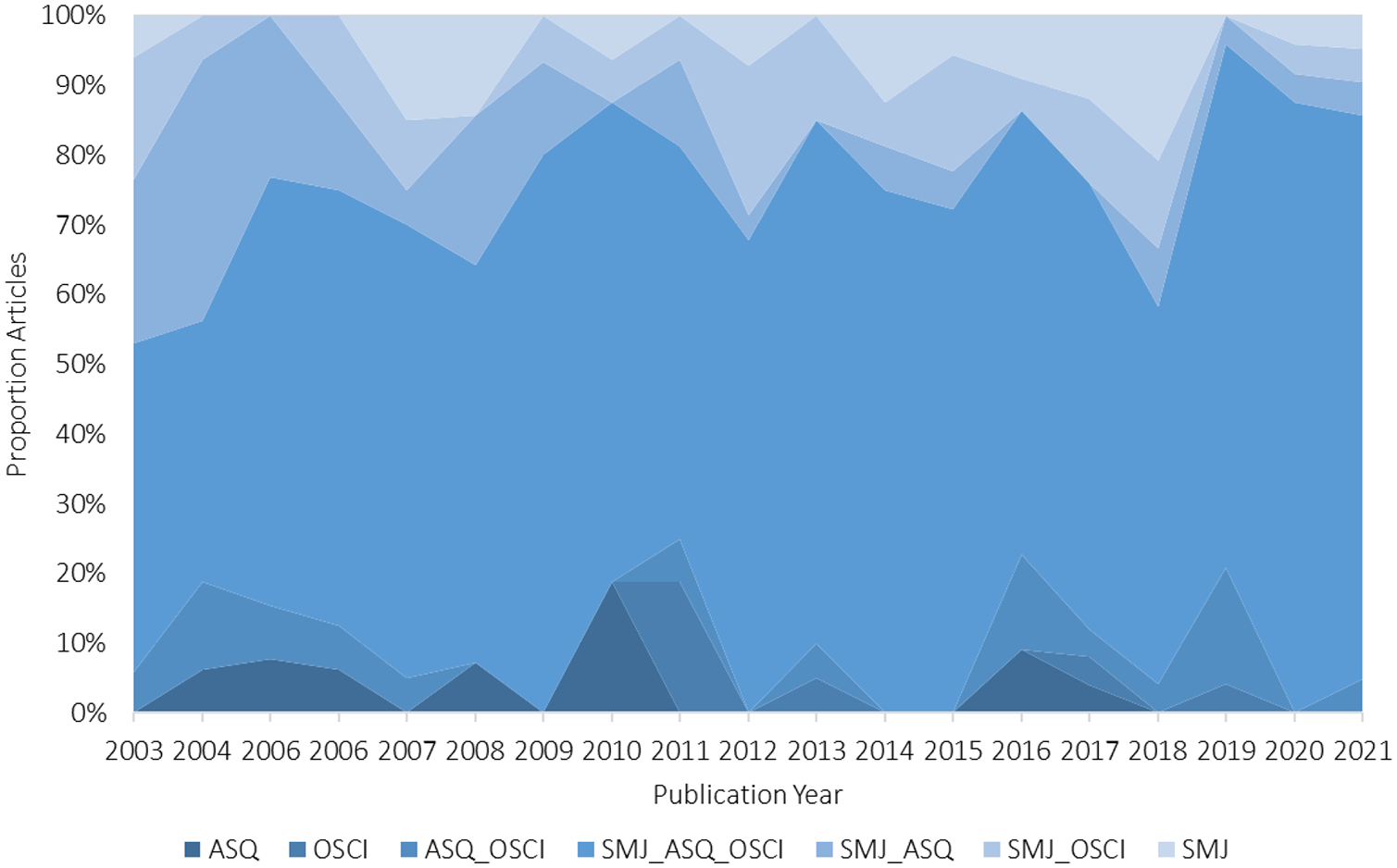
Strategic Organization articles, cited journals.
Strategic organization article citing journals
If the integrative articles and essays published in Strategic Organization have been encouraging research that reintegrates strategy and organization more broadly, we would expect to see them cited by articles published in both strategy and organization specialist journals. To check this, we examined citations to each article and essay published in Strategic Organization in each year appearing in articles published in Administrative Science Quarterly, Organization Science, and Strategic Management Journal.
Figure 3 graphs the percentage of articles published in these journals in each year that cited one or more Strategic Organization articles or essays. In this case, observations begin in 2007, the first year in which Strategic Organization was included in the ISI Web of Knowledge. The figure shows a similar trend for each journal: the percentage of articles citing one or more Strategic Organization article or essay grows from less than 5% in 2007 to over 10% in 2014 and to over 20% in 2021. Thus, over time, as Strategic Organization established itself, the articles it published not only became more likely to be cited in these top journals, but increasingly likely to be cited in all three journals.
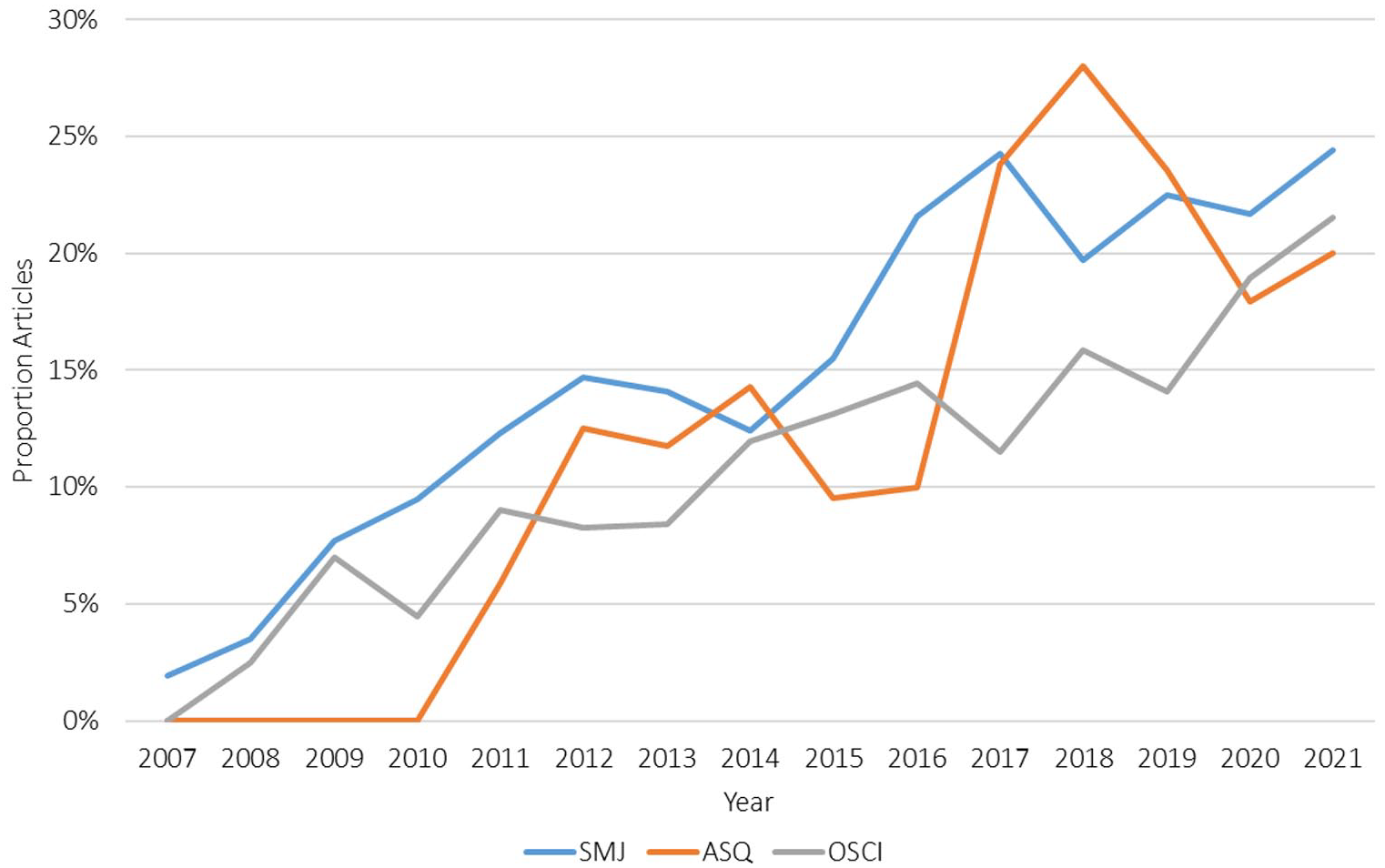
Strategic Organization articles, citing journals.
Specialist journal article cited journals
Finally, we wondered if the increasing citation of Strategic Organization publications in specialist strategy and organization journals reflected a broader research trend toward reintegration of the field. If so, we would expect to see increasing cross-citation between Administrative Science Quarterly and Organization Science on one hand, and Strategic Management Journal on the other hand.
The panels in Figure 4 graph cross-citation trends for the three journals. We focus on cited journals in the 500 most cited (and thus influential) articles published in each journal. Observations begin in 1990, the first year in which Organization Science was published, and end in 2016, the last year in which a published article accumulated sufficient citations to rank among the 500 most highly cited. Each panel shows the percentage of highly cited articles published in each journal in each year that cited one or more article from each possible combination of the three specialist journals.
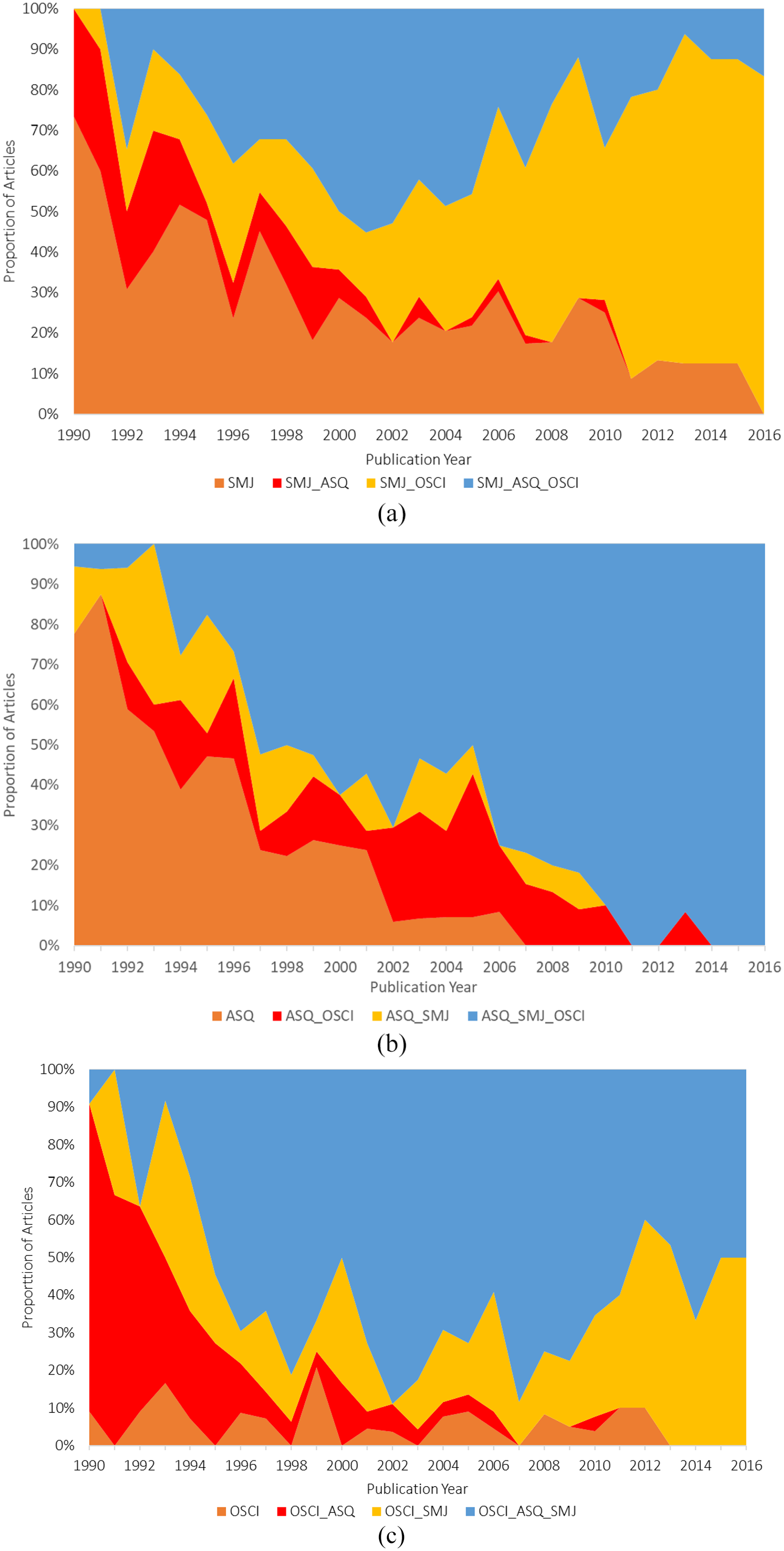
(a) Strategic Management Journal top 500 most cited articles, cited journals. (b) Administrative Science Quarterly top 500 most cited articles, cited journals. (c) Organization Science top 500 most cited articles, cited journals.
In 1990, the modal highly cited article published in each journal primarily cited articles published in journals aligned with the journal’s specialization—strategy or organization. Through the 1990s, however, the proportion of cross-cited sources increased. For example, while over 70% of highly cited Strategic Management Journal articles published in 1990 cited no articles from either Administrative Science Quarterly or Organization Science, over 70% of highly cited Strategic Management Journal articles published in 2000 cited one or more articles in one or both of these organizational journals (Panel A).
Trends were similar for Administrative Science Quarterly (Panel B) and Organization Science (Panel C). For example, while less than 25% of highly cited Administrative Science Quarterly articles published in 1990 cited articles published in Strategic Management Journal, by 2000 over 60% did so. And, while fewer than 10% of highly cited Organization Science articles published in 1990 cited articles appearing in Strategic Management Journal, 80% did in 2000.
The trend toward increased cross-citation slowed during the 2000s, but for highly cited Strategic Management Journal articles published from 2010 onward the percentage that cited articles from either or both the Administrative Science Quarterly and Organization Science, reached nearly 90%; and the percentage of highly cited Administrative Science Quarterly and Organization Science articles that cited articles from Strategic Management Journal was effectively 100%.
Thus, Strategic Organization was launched at a time of increasing efforts to reintegrate strategy and organization research, helped further that reintegration with its own publications and more broadly as it established itself. It appears now that this reintegration is effectively complete—indeed, the cross-citation patterns illustrated in Figure 4 show that Strategic Management Journal, Administrative Science Quarterly, and Organization Science are now effectively strategic organization journals—contrary to the continued trend toward establishing specialist journals noted earlier. (Notably, in this regard, the founding editor of Strategy Science had just completed a term as editor of Organization Science.)
Looking forward—what if?
We were also asked to revisit our original aspirations and choices and reflect on how they might differ if we were founding and coediting Strategic Organization now and into the future. So, we convened over Zoom (rather than a few pints thanks to the ongoing pandemic), reflected, and identified several forward-looking themes the strategic organization research community might profitably turn its attention to in the near future. As we developed these themes, we also agreed that the editorial principles and vision we originally crafted for Strategic Organization remained well-suited to enabling the new kinds of work we envisioned. These themes, which we outline below, center on the design, process, and effect elements of the definition of strategic organization we presented at the outset of this essay. We also identified two research approaches—template eclecticism and careful detective work—that we believe are well-suited to advancing the themes we identified.
New forms of strategic organization design
In 2001, we thought we had a fairly clear sense of what we meant by strategic organization, what we thought strategic organization as a field and area of study would look like, and where it might be headed. In the intervening years, we have witnessed forms of strategic organization becoming more complex and less obvious. Strategic organization has expanded to include a wider variety of forms and become entangled with a wider variety of actors, some around organizing, and some in and around organization. One implication of these developments is that we direct greater attention to taxonomic work delineating and differentiating among forms of strategic organization. Although differences among organizations and their strategic processes have been increasingly recognized (e.g. healthcare, not-for-profits, new ventures, family businesses, professional service firms), the range is much greater than is found in our journals, and we encourage systematic exploration and theorization of more diverse forms.
In academic journals and the popular press, there has been great interest in new technology-enabled forms of strategic organization, such as decentralized blockchain, crowd sourcing, peer production, and platforms, as well as in the nature of technology-assisted work, such as remote decision making, product design, and product assembly. We also see value in assessing the influences of replacing the bounded rationality of human actors with the formal algorithmic rationality of artificial intelligence (AI) actors and AI-assisted processes on strategic organization, as well as how new technology frontiers, such as near-space activity and multifarious genetic enhancements, are constructed as organizational fields and navigated. Moreover, in our turbulent times, we see evidence, on one hand, of more and more temporary, self-organizing forms of strategic organization that stand somewhere between social movement groups and proto-organizations, and, on the other hand, of ultra-large, powerful, corporate giants that anchor and influence many sectors. These extreme types of strategic organization seem to us to require theorization and empirical attention.
New politics of strategic organization processes
We encourage examination of the strategic organization of temporary activist and political entities—exemplified most recently by the crowdfunded “freedom convoy” ostensibly comprised Canadian truckers opposed to pandemic mandates, which sparked copycat convoys around the globe, many hijacked by far-right groups (in Canada, a group called Canada Unity) and media who took control of the protest narrative as well as the physical events themselves. How are these temporary collectives enabled and how do their strategies emerge and often become corrupted? Given the increasing occurrence of such micro-social movements, understanding their strategic organization could be highly informative and practically useful. A more positive exemplar is found in Kornberger et al.’s (2019) account of the strategic organization of the mass migration of 300,000 Syrian, Iraqi, and Afghan refugees by a group of nine Vienna-based groups in the fall of 2015.
Strategic organization is fundamental to social problems—whether as means by which to address them, or as their causes. Greater focus on the dark side of organizations would be timely. At the 2006 Annual Academy of Management Conference, Steve Barley received the Organization and Management Theory Division Distinguished Scholar Award, and in his acceptance speech he referred to an “asteroid belt” of organizations that stand between the electorate and governments. What do we know about the way that policy is framed and influenced by this asteroid belt of “corporate citizens” and how that framing affects the quality of democratic institutions and regimes? More broadly, organizations are important drivers of inequality within society across multiple dimensions (see Amis et al., 2020). We wonder how traditional, contemporary, and novel emerging forms of strategic organization shape who gets what, when and how (with apologies to Lasswell), and why?
Relatedly, the strategic organization of policing, with its well-documented failures of social and racial discrimination, misconduct, harassment, and incompetence, is another relatively neglected area. Perhaps, the strategic organization of the military too, with its corresponding failures compounded by its opacity and greatly increased reliance on private firms (see Baum and McGahan, 2013), should come within our compass of attention. It would also be interesting to probe more deeply the strategic organization of more clandestine entities, for example, mafia and other criminal groups, typically overlooked by our research community (for exceptions, see Cappellaro et al., 2021; Catino, 2019). Our point is that by giving attention to the complexity of organizational forms our understanding of strategic organization would be significantly enhanced, enabling richer and more relevant theories.
Widening societal effects of strategic organization
In 2001, we did not anticipate the strong move toward research on societal problems—giving attention to the place of strategic organization in the construction and reform of those problems—and efforts to include mechanism and process explanations as part of that research. Our successors have certainly done more to embrace these shifts toward “responsible research.” In the past 10 years, we have seen more SO!APBOX essays and articles on issues such as wrongdoing, climate, globalization, and inequality (see https://journals.sagepub.com/topic/collections-soq/soq-1-socialissuescollections/soq), as well as more process theorization and attention to strategy-as-practice than in the prior decade (see https://journals.sagepub.com/topic/collections-soq/soq-1-strategyprocessandpracticecollection/soq). Going forward, it seems important to connect Strategic Organization with academic, policy, and professional groups that can help researchers get closer to these problems (and perhaps the United Nation’s Sustainable Development Goals, more broadly) as strategic organization phenomena and prioritize some areas for engagement in the journal’s pages. One possibility would be to connect with the Responsible Research on Business and Management Network (https://www.rrbm.network/) on near-future problem areas of interest to strategic organization, such as racial tensions, wrongdoing, the geopolitics of organizational interactions, pandemic effects on supply chains and communities, and the impact of the surveillance state on strategic organization design and action.
A particular social problem that demands attention is the growing distrust of, and loss of respect for, core societal institutions such as science, the law, and democracy. Instances of wrongdoing demand that we dig into how these institutions are shaped, influenced, underpinned, and stigmatized by organizations. A deep, large scale debunking of institutions in societies has become evident. Principles of science, law, and democracy, the role of news and social media, the value of technology, globalization, and many other formerly “givens” have been actively debated, or simply rejected and overturned. This seems to have set us on a path of widespread erosion of social institutions. Going forward, we see opportunities for the Strategic Organization research community to explore these deep, pervasive problems, which seem to us as sweeping as the processes of industrialization, urbanization, and embracing of markets 200 years ago.
Template eclecticism and careful detective work
In 2001, we embraced multidisciplinary and multimethod approaches to move in the direction of reintegration. We sought to encourage diverse approaches to theory and method as an element of the development of solutions to pressing strategic organization problems. Over the last 20 years, Strategic Organization articles have considered theories of competitive strategy, resource-based view, transaction costs, institutional theory, culture theory, and strategy-as-practice, among others. The methods deployed have ranged from sophisticated endogeneity and instrumental variable techniques and nuanced mediation adjustments to small world network analysis, computational modeling, qualitative case and field studies, and process modeling. We think it is important to continue embracing this diversity of theory and method, and, more importantly, of variation in templates for conducting and reporting research. Journal editors and reviewers often prefer and reinforce particular research article templates—an Administrative Science Quarterly article is an Administrative Science Quarterly article is an Administrative Science Quarterly article, and an Strategic Management Journal article is something quite different, but equally identifiable. But strategic organization problems today and looking ahead—unpacking corporate corruption and wrongdoing, understanding policing and militaries, detailing surveillance organization operations, assessing the impact of AI processes, characterizing temporary micro-social movements—will often require hard-to-obtain data, novel methods, and innovative, synthetic theorizing.
Eschewing standard templates and traditional forms of data in order to carve out innovative ideas or tackle new research problems may result in some Strategic Organization submissions appearing less polished and rigorous—especially on initial reading. However, we would rather see such submissions at Strategic Organization than “cookie-cutter” submissions that, while “ticking all the boxes,” proceed to incrementally plow some area of well-tread terrain or revel in the technical merits of some new instrumental variable. Strategic Organization was established to support the development of precisely such innovative, unusual, course-charting submissions. An important feature of such “diamond-in-the-rough” submissions is that they seem to have been revealed through a spirit of careful detective work: the collection of clues, exploration of unlit alleyways, contemplation of multiple explanatory frames, and dogged building up of a novel claim or fascinating storyline. The result of such detective work may be data that are incomplete in some standard ways and explanations that are perhaps somewhat uneven, but the groundwork and reasoning behind the articulated claims is there for readers to see. Relying on careful detective work, while freed from well-worn templates, enables researchers to better engage with the kinds of strategic organization problems we see now and ahead on the horizon.
To the future and beyond
We are pleased to see that Strategic Organization has thrived through its adolescent and teen years. As it turns 20, it is clear to us that the journal has accomplished a great deal in a relatively short time and that the view of its future from here is bright. We are grateful to the journal’s coeditors, editorial board members, contributing authors, and enthusiastic readers for helping move us toward the reintegration of the field that inspired us to create Strategic Organization—and for doing so in a way that is unlocking new possibilities by promoting innovative, provocative, impactful, and rigorous work in an open-minded and pragmatic fashion. Although that reintegration now seems well underway across the field, we see many interesting and important new research challenges on the rapidly branching path ahead that Strategic Organization is uniquely positioned to tackle and advance; challenges that are sure to engage a growing strategic organization research community in developing important conceptual advances and valuable practical implications for our society of organizations.
Footnotes
Funding
The author(s) received no financial support for the research, authorship, and/or publication of this article.
