



Abstract
In our study, we examine how category density affects entrepreneurs’ propensity to engage in category spanning, and investigate the moderating effects of category fuzziness, regional density, and the number of entrants in a system of categories. We test our hypotheses by focusing on 3707 bands in the British metal music industry. Our findings indicate that increased category density reduces the degree of category spanning, but this effect is attenuated by increased category fuzziness and an increase in the number of new ventures founded in the same market. Regional density has no moderating effect, but its positive main effect points to the independence of the effects of categorical and regional density on category spanning. Our findings facilitate theory building regarding the antecedents of category spanning and the evolution of the categorical system of markets.
Keywords
Introduction
The question of what market conditions influence the degree to which new ventures 1 engage in category spanning has recently gained increasing attention in strategy and organization research (Chae, 2022; Durand and Kremp, 2016; Tang and Wezel, 2015). Category research defines a market as a system consisting of multiple submarkets—that is, of different categories (Hannan et al., 2007; Pontikes and Barnett, 2015, 2017). Categories define boundaries within markets and constitute the identity of their members through a cognitive agreement concerning the attributes of products and organizations (Carruthers and Stinchcombe, 1999; Douglas, 1986; Durand and Thornton, 2018; Zerubavel, 1991; Zuckerman, 1999).
When entering a market, entrepreneurs must decide how to position their new venture within the market’s category system—that is, whether to position the venture within an individual category or to engage in a certain degree of category spanning by combining the attributes of various categories (Kacperczyk and Younkin, 2017; Keuschnigg and Wimmer, 2017; Mendoza-Abarca and Gras, 2019; Tang and Wezel, 2015). This decision is highly important because research on the consequences of category spanning has frequently shown that whereas conforming to a category increases ventures’ legitimacy, engaging in category spanning typically results in illegitimacy discounts (Alexy and George, 2013; Barlow et al., 2019; Durand and Paolella, 2013; Kennedy et al., 2010; Younger and Fisher, 2020). However, at the same time, using category spanning as one way of differentiation may induce competitive advantages for new ventures by establishing unique market positions (Dobrev et al., 2001; Goldenstein et al., 2019; Tang and Wezel, 2015; Zuckerman, 2016).
Although the consequences of category spanning are of central importance for the long-term performance of ventures, comparatively few studies have addressed the fundamental question of what factors influence entrepreneurs with regard to their category-spanning decision (Chae, 2022; Durand and Kremp, 2016; Tang and Wezel, 2015). This lack of research concerns in particular the initial entrepreneurial decision about the degree of category spanning at the time of a new venture’s founding. Since the existing literature on antecedents of category spanning focused on established ventures, the understanding of the categorization of new ventures at founding is still limited (Durand and Paolella, 2013). However, studying factors that influence this initial entrepreneurial decision is crucial to better contextualize and understand the consequences of these decisions (Chae, 2022).
Based on the idea that the category-spanning decision of entrepreneurs is not random, and that the environment likely affects their category-spanning moves (Carnabuci et al., 2015; Chae, 2022), we investigate market conditions at the time of founding as antecedents of new ventures’ decisions on their degree of category spanning. We argue that market conditions explicitly and implicitly shape entrepreneurs’ assumptions about the consequences of category spanning. Consequently, entrepreneurs take into account these assumptions with respect to whether they enter an individual category or engage in a degree of category spanning (Durand and Khaire, 2016; Durand and Thornton, 2018; Pontikes and Barnett, 2017; Pontikes and Kim, 2017). 2
Drawing on prior organizational ecology research, we study the influence of categorical, regional, and supraregional market conditions on category spanning. We argue that these market conditions induce effects related to legitimacy and competition—two key concepts in organizational ecology research, both in early theory development (Carroll and Hannan, 1989b; Greve, 2002; Hannan and Freeman, 1987) and in studies on categories (Hsu and Hannan, 2005; Kovács and Johnson, 2014). First, considering that categories define significant boundaries within markets, we suggest that category density (Carroll and Hannan, 1989b; Hannan and Carroll, 1992) is an important market condition that does not only affect new ventures’ long-term performance but also influences the initial entrepreneurial decision concerning category spanning (Durand and Thornton, 2018; Fisher, 2020; Smith and Chae, 2017; Younger and Fisher, 2020). In categories with low density and thus low legitimacy, new ventures more likely engage in category spanning without having to be concerned about an illegitimacy discount. In contrast, clearer expectations about the attributes of products and organizations characterize high-density categories (Hsu and Hannan, 2005; Navis and Glynn, 2011). Consequently, high density leads to the assumption of a higher risk of being punished for category-spanning decisions and therefore reduces the inclination for entrepreneurs to engage in category spanning.
Second, we propose that this effect of category density depends on further market conditions, each of which affects the assumed risk of illegitimacy or give rise to expectations of competition effects through category spanning. At the categorical level, we consider the perception of ambiguity that category fuzziness (Hannan et al., 2007) 3 —the degree to which categories are characterized by clear-cut boundaries—induces. At the regional and supraregional levels, we suggest the influence of competition for scarce resources and the emergence of market opportunities evoked by regional density (Bigelow et al., 1997; Hannan et al., 1995; McKendrick et al., 2003)—the number of ventures from all categories within a geographical region—and founding numbers (Audretsch, 1995; Gartner et al., 1999)—the number of new ventures founded within the entire market.
Our study’s contributions are twofold. First, we contribute to the ongoing efforts to investigate antecedents of category spanning (Chae, 2022; Durand and Kremp, 2016; Tang and Wezel, 2015). By considering the contextuality of market conditions in the initial entrepreneurial decision-making about category spanning (Fisher, 2020; Fisher et al., 2017; Navis and Glynn, 2011), we contribute to existing research that has mainly focused on the influence of organizational determinants and already established ventures. The focus on new ventures is important because they are exposed to a particularly high risk of failure, which is likely to be influenced by their initial decision in terms of category spanning (Goldenstein et al., 2019). Thus, examining the contextuality of the initial category-spanning decision provides insights into how market conditions explicitly and implicitly shape entrepreneurs’ assumptions about the beneficial positioning of their new venture. Second, by investigating the market conditions at the time of entrepreneurs’ founding decisions, our findings enrich theory building on the evolution of the categorical system of markets (Carnabuci et al., 2015; Glynn and Navis, 2013; Durand and Khaire, 2016; Pontikes, 2018). This is because entrepreneurs’ decisions about entering an individual category or engaging in a degree of category spanning influence the category system and change the market conditions for future entrants (Negus, 1999). In this context, Durand and Khaire (2016) emphasized that “categories both inform and are informed by social structures and are malleable enough to be morphed, defended, and preserved by organizations that operate in markets” (p. 88).
We tested our hypotheses empirically using metal bands from the United Kingdom as the unit of analysis. More precisely, we focused on metal bands’ initial decision on the degree of category spanning at the time of their founding. To do so, we studied 3707 British metal bands registered on the website Encyclopaedia Metallum: The Metal Archives (MA) that were founded during the period 1967 to 2017. Based on the bands’ categorization as belonging to one or more metal music genres in the MA, we calculated our main variable of interest: a band’s degree of category spanning at its founding. Thus, the categories in this market are the various genres of metal music, 4 which can be defined as “conceptual tool[s] most often used to classify varieties of cultural products, particularly in the fields of visual art, popular culture, video games, films, literature, and music” (Lena and Peterson, 2008: 697). Given this research setting, we regard each band as a new venture and the musicians as entrepreneurs.
The empirical findings support our line of argument and show that high category density negatively affects the degree to which new ventures span categories. However, category fuzziness and founding numbers within the market attenuate this negative effect. Although we did not observe a moderating effect of regional density, a strong and significant direct effect indicates that legitimacy and competition affect entrepreneurial decisions regarding the positioning of new ventures independently.
Theory and hypotheses
The positioning of new ventures in a system of categories
One of the most important decisions for a venture’s success is its positioning within a market (Bamford et al., 2000). Consequently, the positioning of new ventures in markets is central to strategy and organization research, although various theoretical approaches address this issue (Cattani et al., 2017). For example, strategic management and economics researchers consider positioning from the perspective of entrepreneurs who aim to develop competitive advantages for their ventures through specific or unique resources, capabilities, or business issues, including reputation and pricing that differentiate their ventures from competitors in the same industry (Berry et al., 2004; Dranove et al., 1998; McGee and Thomas, 1986; Porter, 1980).
In turn, organization theory considers markets as social constructions that encompass systems of categories that influence the ventures’ positioning in their own right (Hsu, 2006; Vergne and Wry, 2014; Zuckerman, 1999). In contrast to the predominant approach in the strategic management and economics literature, in organization theory, categories are studied less as social spaces within which entrepreneurs position their ventures but as cognitive representations that impose coherence on the world through partitioning similar ventures into groups (Cattani et al., 2017). In this context, positioning involves choosing from the system of categories in a market and conforming to or deviating from the collectively shared cognitive understandings of the common attributes of a category’s products and organizations (Hannan et al., 2007; Pontikes and Barnett, 2015, 2017). Such a system of categories facilitates and guides market interactions by identifying which attributes are consistent or inconsistent with category membership (Hsu et al., 2012; Kovács and Hannan, 2010; Montauti and Wezel, 2016).
Consequently, the positioning of new ventures in a system of categories involves entrepreneurs’ decisions based on explicit or implicit assumptions about the categorical boundaries within those markets (Durand and Thornton, 2018; Pontikes and Kim, 2017). In other words, in our study, positioning does not refer to entrepreneurs’ motivation to choose a specific category that is preferred because of its content (the “what” decision). Instead, we focus on the effect of perceived market conditions (Carnabuci et al., 2015; Hannan et al., 2007; Kovács and Johnson, 2014; Pontikes and Barnett, 2015, 2017) on the degree to which entrepreneurs engage in category spanning, regardless of the specific categories they choose (the “how” decision).
Prior research on category spanning
In the past, category research has frequently analyzed the consequences of category spanning on venture performance, revealing two contradicting effects (Goldenstein et al., 2019; Hsu, 2006; Kovács and Johnson, 2014; Moss et al., 2018; Paolella and Durand, 2016).
First, because the legitimacy of new ventures results from their conformity to a certain category, those new ventures that engage in category spanning regularly suffer from decreased performance. This occurs because illegitimacy discounts arise from a general situation of social confusion in which audiences devalue ventures that do not align with expectations for the attributes of products and organizations in a given category (Alexy and George, 2013; Durand and Paolella, 2013; Kennedy et al., 2010; Wry et al., 2014; Zhao et al., 2013). In other words, new ventures that span categories cannot be assigned to a category easily; thus, audiences tend to perceive them as incomprehensible (Zuckerman, 1999) or even insufficient (Kovács and Hannan, 2010). Second, category spanning can also lead to positive performance effects because establishing unique market positions through differentiation from competitors can create competitive advantages (Dobrev et al., 2001; Keuschnigg and Wimmer, 2017; Tang and Wezel, 2015; Zuckerman, 2016).
Compared to the consequences of category spanning, for which there is a large body of research, the antecedents of category spanning have received little attention (Chae, 2022; Durand and Kremp, 2016; Tang and Wezel, 2015). Below, we acknowledge some notable examples. For instance, focusing on films, Hsu et al. (2012) showed that the more ambiguous a category was, the more likely a film was to span genres. In considering the role of networks, Tan et al. (2013) found that centrality was a critical variable affecting a venture’s ability to span categories later in its life cycle. Durand and Kremp (2016) analyzed the compositions of concert programs for symphonic orchestras and showed that social status influenced the decision to adapt to competitors over time or to differentiate themselves through category spanning. Finally, Chae (2022) recently identified audience heterogeneity as an important antecedent of restaurants’ category-spanning decisions.
Although these studies have provided important insights, they neglect to theorize explicitly on the initial entrepreneurial decision about category spanning at the time of a new venture’s founding. In an attempt to explore along these lines, Carnabuci et al. (2015) found that market entrants tended to choose categories in which audiences have clearly developed expectations regarding the attributes of products and organizations in such categories. We have taken this first attempt as an impetus to provide a broader theorization of the initial entrepreneurial decision of new ventures to engage in or refrain from category spanning.
We argue that entrepreneurs make decisions at the time of their new ventures’ founding regarding their degree of category spanning through taking into account assumptions on the effects of two seemingly contradictory demands: conformity to the attributes of a category’s products to ensure legitimacy and differentiation from competitors to gain competitive advantages (Pontikes and Kim, 2017; Zuckerman, 2016). This argument is in line with qualitative findings indicating that, at the time of founding, entrepreneurs hold explicit and implicit assumptions about the advantages of conformity to categories (i.e. legitimacy) and those of differentiation from such categories (i.e. competition), and they consider these benefits in the context of their new venture’s positioning (Younger and Fisher, 2020). The tension between conformity and differentiation is particularly relevant for the venture’s positioning at its founding because new ventures at this stage lack reputation and attention from audiences compared to their mature counterparts (Hannan and Freeman, 1977; Stinchcombe, 1965).
Market conditions and category spanning
Organizational ecologists have focused on founding and failure rates in categories of markets as a function of legitimacy and competition effects (Carroll and Hannan, 1989b; Greve, 2002; Hannan and Freeman, 1987; Hsu and Hannan, 2005; Kuilman and Wezel, 2013). However, category research has widely neglected considering these market conditions’ influence as antecedents of category spanning—that is, how to position a new venture in a market given particular market conditions (Chae, 2022; Kacperczyk and Younkin, 2017; Keuschnigg and Wimmer, 2017; Mendoza-Abarca and Gras, 2019; Tang and Wezel, 2015).
In the following, we develop hypotheses on how market conditions influence entrepreneurs’ inclination to engage in a certain degree of category spanning. Considering categories in markets are probably the most important reference point for entrepreneurs (Hannan et al., 2019), we suggest that entrepreneurs consider category density as a significant condition when assessing the potential legitimacy effect of their founding decision. Moreover, we acknowledge that entrepreneurs’ assumption about legitimacy may vary with the degree the fuzziness of categories’ boundaries induces the perception of ambiguity (Hannan et al., 2007). However, it is not only category density and category fuzziness that are relevant for the category-spanning decision, but past research has already pointed to the relevance of market conditions beyond the categorical level. Therefore, we argue that regional density and founding number influence competition and open market opportunities. While regional density concerns the number of ventures from all categories within the same region (Bigelow et al., 1997; Hannan et al., 1995; McKendrick et al., 2003), founding numbers in turn reflect the number of new ventures founded within the entire market; at the same time, an entrepreneur decides to position a new venture (Audretsch, 1995; Gartner et al., 1999). In the following sections, we elaborate on the expected effects of these market conditions.
The main effect of category density
Building on organizational ecology, we suggest that legitimacy effects unfold primarily at the categorical level and are predominantly driven by category density (Carroll and Hannan, 1989b; Hannan and Carroll, 1992). Considering category density drives the legitimacy within categories, entrepreneurs can assume that legitimacy affects new ventures’ long-term performance. Accordingly, category density is likely a fundamental market condition influencing entrepreneurs’ initial decisions about category spanning.
Categories with increasing density receive high attention from audiences, and the legitimacy of these categories expands (Carroll and Hannan, 2000; Haveman and Rao, 1997; Hsu and Hannan, 2005; Kuilman and Wezel, 2013). High-density categories are characterized by shared social understandings about what constitutes appropriate or legitimate behavior (Navis and Glynn, 2011; Santos and Eisenhardt, 2005). In other words, audiences develop clearer expectations about the attributes of products and organizations within such a category (Ruef and Patterson, 2009). During this development, a dominant business design emerges in the category, and new ventures are compelled to avoid category spanning because audiences are likely to sanction the divergence from common categorical attributes with a high illegitimacy discount (Carnabuci et al., 2015; Hsu and Grodal, 2015). Accordingly, entrepreneurs are more likely to refrain from high degrees of category spanning to ensure plausible product attributes (Pontikes and Kim, 2017). Thus, the anticipated threat of a high illegitimacy discount compels new ventures to adopt accepted business models (Zuckerman, 1999).
Conversely, low-density categories generally receive less attention and legitimacy from audiences (Durand and Paolella, 2013). Consequently, these categories exhibit only weak conformity pressures, and entrepreneurs can expect to span categories more easily (Zuckerman, 1999). The opportunity and motivation to differentiate from competitors through category spanning are primarily based on the categories’ low legitimacy and the expected absence of sanctions from audiences, which allow new ventures to span categories regardless of how distant they are (Pontikes and Kim, 2017; Zuckerman, 1999). In addition, the decision by entrepreneurs to span a nonlegitimated category with other categories can be facilitated by the motive to spread risks and to benefit from attracting the audiences of other categories (Tang and Wezel, 2015).
Consequently, our first hypothesis reads as follows:
Hypothesis 1. The density of a category negatively influences the degree of category spanning by new ventures.
The moderating effects of category fuzziness, regional density, and founding number
Recent studies have introduced the concept of category fuzziness to question the uniformity of category density effects (Hannan et al., 2007; Kovács and Hannan, 2015). In essence, the social process of legitimation within categories depends not only on the pure density of ventures, but also on the perceived ambiguity of category boundaries that category fuzziness induces—that is, the venture density does not enhance the legitimacy of all categories to the same extent. Category fuzziness is driven by the degree of homogeneity in the understanding of the central attributes that define a category. As categories can partially overlap, high density does not necessarily imply low ambiguity and a clear contrast between categories’ central attributes (McKendrick et al., 2003). Thus, in general, category density and category fuzziness operate independently, but both market conditions can influence each other (Kuilman and Wezel, 2013). In this context, previous studies note a potential enhancing effect: category density has a stronger effect on legitimacy when category fuzziness is low (Dobrev et al., 2006; Kovács and Hannan, 2010; Kuilman and Wezel, 2013). Categories with low fuzziness are characterized by a strong insistence on common attributes of the category, which makes deviations from these characteristics challenging (Carnabuci et al., 2015). Put differently, low ambiguity and clear-cut boundaries characterize these categories (Hannan et al., 2007; van Venrooij and Schmutz, 2018) and lead to a general agreement regarding how products and organizations should be designed, as well as the attributes a new venture requires to count as a member of this category. Consequently, new ventures’ inclination to span categories may vary even in categories with similar category densities. In low-fuzziness categories, increased density is associated with a higher increase in legitimacy, and correspondingly, a high illegitimacy discount for deviating from the common features via category spanning (Kovács and Hannan, 2010; Kuilman and Wezel, 2013).
In contrast, when category fuzziness is high, the identity of category members is “not well understood by audiences, then high density will have a weaker impact on legitimation” (Bogaert et al., 2016: 1346). Consequently, new ventures deciding to enter categories with a high fuzziness experience high ambiguity and will assume it is easier to span categories because they still expect benevolent attention from audiences and are likely to experience no—or at least a less dramatic—illegitimacy discount if they do so (Hsu et al., 2012; Mattsson et al., 2010).
Therefore, we propose that as category fuzziness increases, the effects of category density on category spanning should weaken because category boundaries will become broader, and the expected illegitimacy discount in a situation with high category density will subsequently become lower. Thus, we hypothesize as follows:
Hypothesis 2. Category fuzziness attenuates the negative influence of category density on the degree of category spanning by new ventures.
However, the effect of category density on the degree of category spanning of new ventures may not only be influenced by market conditions at the categorical level but also by regional density. In this context, prior studies proposed that legitimation operates at the level of categories, whereas competition effects rely primarily on the density of members from all types of categories within regional boundaries (Bigelow et al., 1997; Hannan et al., 1995; McKendrick et al., 2003). 5 Bigelow et al. (1997), for example, studied categories of car producers and found that the legitimacy effects could be observed mainly at the categorical level in the national context they studied, whereas competition effects among members of all categories of car producers unfolded at the regional level. Hannan et al. (1995) observed a similar effect in the European automobile industry. In addition, studies in diverse markets indicate that the effects of competition strengthen among members from all categories of the whole market within regional boundaries compared to members of the same category on the national level (Baum and Mezias, 1992; Carroll and Wade, 1991; Kalnins, 2016).
In our study, we follow these earlier findings and argue that regional density—the number of ventures from all categories within the region in which a new venture is founded—is likely to attenuate the negative effects of category density on category spanning. We base the proposed moderation effect on two arguments: (a) an increased need for category spanning based on the expectation of increased regional competition for scarce resources, and (b) an increased entrepreneurial inclination to seek competitive advantages through exploiting market opportunities.
First, increasing regional density may attenuate the negative effects of category density because new ventures in such situations face high competition pressure for scarce resources and, thus, aim to enhance their long-term success through differentiation, that is, category spanning. Put differently, regional density attenuates the pressure of conformity to category blueprints. Competition for scarce resources is in turn intensified at the regional level because new ventures from all different categories compete for similar input resources, such as venture capital, employees, strategic partners, and a finite customer base (Carroll and Hannan, 1989a; Hannan et al., 1995; Marion et al., 2015; Steier and Greenwood, 2000). Because “geographical areas [. . .] are tightly bounded resource arenas” (Zucker, 1989: 543), we build on the argument that, in particular, new ventures, which usually lack reputation, social ties, and capabilities in comparison to their matured counterparts, depend on the scarce input resources available at a regional level (Wang et al., 2017). One way to escape this competition is differentiation from competitors. Already, early work on organizational ecology shows that increased regional competition results in the differentiation of new ventures. For example, Baum and Haveman (1997) show that in the Manhattan hotel industry, increasing regional density yields new ventures to differentiate themselves from existing competitors in terms of market positioning to avoid local competition. Given high regional density, even new ventures that enter legitimated categories with high densities likely span categories to achieve a visible and unique regional market position that ensures access to required resources.
Second, higher numbers of regional competitors may not only increase the inclination for differentiation through category spanning but simultaneously open market opportunities for intended or unintended category spanning. Given that regional proximity allows entrepreneurs to monitor competitors more quickly, closely, and comprehensively, an increasing regional density enhances opportunities for combining attributes from different categories. In this context, the literature on economic clusters widely concludes that the spatial agglomeration of ventures from different categories working in the same market stimulates entrepreneurs to seek competitive advantages and to show innovative behavior (Fritsch, 2000; Porter and Ketels, 2009; Stanko and Olleros, 2013). This cluster effect is rooted in various sources, such as increased mobility of resources (e.g. employees) or the possibility of direct observation of and subsequent learning from others (Burt, 1987; Rogers, 1995). Moreover, cluster effects stimulate the possibility of mimicry; that is, differentiation unintendedly generated through an increasing likelihood of mutation of category blueprints (Bell, 2005).
Following both lines of argument, our hypothesis reads as follows:
Hypothesis 3. Regional density attenuates the negative influence of category density on the degree of category spanning by new ventures.
As a supraregional factor, we propose that the founding number (i.e. the number of new ventures within the entire market at the time of new ventures’ founding) attenuates the effect of category density on the degree of category spanning. We ground this argument in the supraregional increase in competition between new entrants in a market and the quest for either competitive advantages or new market niches in the perceived presence of market opportunities, both of which are affected by the founding number.
Regarding supraregional competition, a high founding number leads to high resource competition, which affects new ventures in particular, given the liability of newness (Stinchcombe, 1965). If the founding number is high, new ventures compete not only with established ventures in a category, but also with a large number of other new market participants. This high competition especially affects important resources for new ventures, such as venture capital (Pontikes and Barnett, 2017). Consequently, new ventures faced with high founding numbers more likely span categories to attract the attention of multiple audiences and avoid strong competition for resources.
Regarding competitive advantages, high founding numbers contribute to the emergence of an entrepreneurial spirit and expectations of higher innovativeness (Zahra, 1993). In this context, the enhanced likelihood that entrepreneurs will span categories is based on their expectation of gaining competitive advantages through exploiting market dynamism and questioning the existing system of categories (Russo and Fouts, 1997). Following this line of argument, we propose that the likelihood of category spanning increases in markets with high founding numbers because new ventures expect audiences’ benevolent attention and limited sanctions for less nonconforming behavior (Pontikes and Barnett, 2017). Audiences support differentiation through category spanning because they assume that high founding numbers will enable externalities in the market—that is, market opportunities enabling improved chances for interaction among ventures and the modification and recombination of products (Boschma, 2005; Boschma and Iammarino, 2009; Frenken et al., 2007). In other words, high founding numbers within markets put new ventures in situations that enable them to differentiate themselves successfully from competitors and create a strong customer base (Song and Chen, 2014).
In addition to anticipating benevolent attention and limited sanctions from audiences, new ventures may understand high founding numbers as an opportunity to create new market niches through differentiation (Antoncic and Hisrich, 2001). In other words, with a low founding number, new ventures focus strongly on the existing ventures in the category they enter. However, with higher founding numbers, entrepreneurs’ attention is increasingly divided between the existing ventures in this category and the other new ventures in the market. Because these other new ventures at least partially address different categories, new impulses for category spanning arise. Creating market niches regularly yields direct economic benefits because new ventures establish businesses under conditions of low competition (Antoncic and Hisrich, 2001; Pontikes and Kim, 2017).
Applying this concept to the negative relationship between category density and category spanning, we argue that the overarching founding number within a market attenuates the effects of conformity pressures (Zuckerman, 1999) by increasing the motivation for differentiation and opening new market opportunities to span categories. New ventures founded in markets with high founding numbers can expect high acceptance of their entrepreneurial orientation and use the opportunity to deviate from market standards, which likely results in attracting new customers and might enhance new ventures’ long-term performance. Accordingly, even given high category density, new ventures more likely span categories when the entire system of categories is dynamic. Thus, we hypothesize as follows:
Hypothesis 4. Founding number attenuates the negative influence of category density on the degree of category spanning by new ventures.
Research setting, data, and method
Research setting
We test our hypotheses using an established empirical context in category and entrepreneurship research: the music industry. This industry is comparable to other industries and follows similar dynamics of market concentration, subsequent periods of innovativeness and competition, and the establishment of new market equilibria (Askin and Mauskapf, 2017; Peterson and Berger, 1975). Because of the clear dynamic between audiences and producers, cultural product markets in general and the music market in particular have been used repeatedly to investigate the role of categorical claims on the success of actors, movies, and musicians (Askin and Mauskapf, 2017; Goldenstein et al., 2019; Hsu, 2006; Hsu et al., 2012; Kacperczyk and Younkin, 2017; Shi et al., 2018; Tang and Wezel, 2015; Younkin and Kashkooli, 2020; Zuckerman et al., 2003). Empirical results from these studies have proven compatible with insights gained from studies in other industries. Shi et al. (2018), for example, found that category spanning had a negative impact on evaluations in the music industry. Similarly, Askin and Mauskapf (2017) analyzed 25,000 songs from the Billboard Hot 100 charts and found that a song’s perceived similarity to other songs determined its chart success. Songs with an optimal balance between similarity and variation were the most successful—a finding that can also be supported with regard to the positioning of music bands within a category system (Goldenstein et al., 2019).
In creative industries, categories comprise cultural genres, or “conceptual tool[s] most often used to classify varieties of cultural products, particularly in the fields of visual art, popular culture, video games, films, literature, and music” (Lena and Peterson, 2008: 697). Despite recent concerns that cultural boundaries are eroding, Silver et al. (2016) “have proven the continued prevalence of genres as a meaningful tool through which creators, critics, and consumers focus their attention in the topology of available work” (p. 1). The appropriateness of genres as cultural forms in the categorization process has also been demonstrated with respect to genres within a specific music market, such as electronic and dance music (Montauti and Wezel, 2016; van Venrooij, 2015). Such genres structure music production and consumption, and they compose a meaningful map for all actors involved in the market (Lena and Peterson, 2008; Montauti and Wezel, 2016).
In our study, we focus on the metal music market, which is characterized by categories, that is, genres, such as Black Metal, Heavy Metal, and Thrash Metal. Metal bands within specific categories can be classified by common musical elements, such as the tempo or speed and rhythm of their music. As noted in a previously published article (Goldenstein et al., 2019), we collected our data from the Encyclopaedia Metallum: The Metal Archives (MA), one of the most comprehensive data sources on metal bands. The site offers detailed information on 124,000 metal bands from around the world (Mayer and Timberlake, 2014). To be included in the database, bands must have released at least one demo tape or have made a piece of music available to the public in some form. Given this prerequisite for database registration, exclusively hobby- or leisure-based bands are excluded from our sample. Because producing a piece of music is a complex process and often requires a certain amount of money for equipment and technology, in addition to artistic effort, we can conclude that the bands in our sample have an interest in attracting an audience. Younkin and Kashkooli (2020) described in great detail the mechanisms that urged new entrants in the music market to choose a genre designation before they even began production. The authors also emphasized the centrality of genres in both organizing artists and orienting audiences within the music market. Based on these arguments, they concluded that music genres provide “an ideal setting to test the trade-off new entrants face between establishing their legitimacy and pursuing novel offerings” (Younkin and Kashkooli, 2020: 611). We follow this argument and base our study on the bands’ category affiliation as defined by the archival designation made by the bands or their audiences. Such categorization is accepted as a reliable measure of category affiliation (e.g. Kacperczyk and Younkin, 2017).
As Younkin and Kashkooli (2020) further described, genre boundaries in the music market offer especially useful opportunities to study entrepreneurship because these boundaries are particularly relevant for emerging artists who lack a reputation on which to trade (Negus, 1999). However, viewing metal bands in the context of new ventures may raise concerns because these bands might not always be market-oriented. Thus, it may be difficult to equate them with new ventures within traditional industries. To illustrate the motives of band founders, we provide some quotes from bands within our data set taken from public interviews. These give an impression of the members’ motivations and emphasize that bands can be regarded as entrepreneurs in their field who make assumptions about their environment:
We would love for this album to reach the audience that we think it deserves. We’re extremely proud of what we’ve created here. It towers over everything we’ve done before and we’ve put our heart and soul into it. We just want as many people as possible to hear it and enjoy it, anything else that comes from that is a bonus. (Dark Forest, http://www.heavymusichq.com/dark-forest-interview/) Everything has got to where we wanted it to, it has just been a lot more hard work. Bits have been easy but then when you think you’ve done a great record and something like the Japanese market becomes whimsical it becomes a totally different matter. We always set out to do what we are doing as we had a clear vision of what we wanted to achieve. Whether or not we could achieve it at the time is here nor there. (Cradle of Filth, https://www.rockindustry.co.uk/cradle-of-filth-interview/) I kind of feel fortunate to be honest. We were around at a very good time. This music was just beginning to happen and it’s easy to innovate when there is all this fresh territory to invade musically. Nowadays it’s a lot harder to do something fresh and new. With every genre there is a time when it is cutting edge and dangerous and shocking but then there comes a time when it’s assimilated and almost safe. [. . .] Before you knew it though I was hanging out with older guys and I was in bands and I realized I could do something! Once you get to that point you realize you could one day make an album or play out of town! That’s how I perceived it. There’s other people who love the lifestyle, other people are magnetized by the business end. You need to have those people. Our band wouldn’t be here now if it weren’t for the drive Jeff [band member] has. He enjoys doing that stuff! A band needs something like that! (Carcass, https://toiletovhell.com/interview-bill-steer-carcass/) I was kind of operating still with this 90’s mindset where we had done an album that was 2 years ago so it’s time to make a new one. But I’m not the business brain of the band, that’s Jeff and he felt that it was too early to do that so we ended up squeezing in at least another couple years of touring. Dan and I had kept that material on the boil and then when Jeff came to get involved it obviously just stepped up a whole other level and that’s really where work on this album really began I guess. (Carcass, https://www.therockpit.net/2020/interview-bill-steer-carcass-download-festival/)
These quotes are in line with recent research that has demonstrated that many musicians describe themselves as entrepreneurs (Albinsson, 2018). Consistent with musicians’ self-understanding, the literature has highlighted that business aspects—market orientation or competition for scarce resources—play an important role for musicians, making them similar to more typical entrepreneurs (Coulson, 2012; Haynes and Marshall, 2018; Toynbee, 2016). For example, musicians compete for resources, such as venture capital (i.e. financial support of music labels and sponsors), employees (i.e. band members), sales channels (i.e. concert halls and music stores), and customers (i.e. metal music fans). Musicians also monitor competitors to take advantage of market opportunities, such as song ideas that they could adapt to their own music.
We focused on metal bands founded in the United Kingdom between 1967 and 2017 for two reasons. First, past research has indicated that categorical effects are based on an audience’s cultural context; thus, differences might exist between countries. Second, metal music first emerged in the United Kingdom in 1967, thus focusing on the United Kingdom allows us to capture how the system of categories evolved from the market’s beginning. As of mid-2018, the MA listed 4731 UK metal bands founded between 1967 and 2017. Due to missing data, our final sample is restricted to 3707 bands.
As our study focuses on the positioning of a band at the time of its founding, we collected the corresponding variables for each year of a band’s founding. Thus, although we capture the industry’s entire evolution, our data do not have a classical longitudinal character, and at the same time, even if we observe bands only at the time of their founding, our data do not have a classical cross-sectional structure because the founding time varies across bands.
Table 1 provides an overview of the main categories our study encompasses, including their first appearance in our data set and the distribution of pure and partial members within each genre.
Overview of metal music categories within our sample.
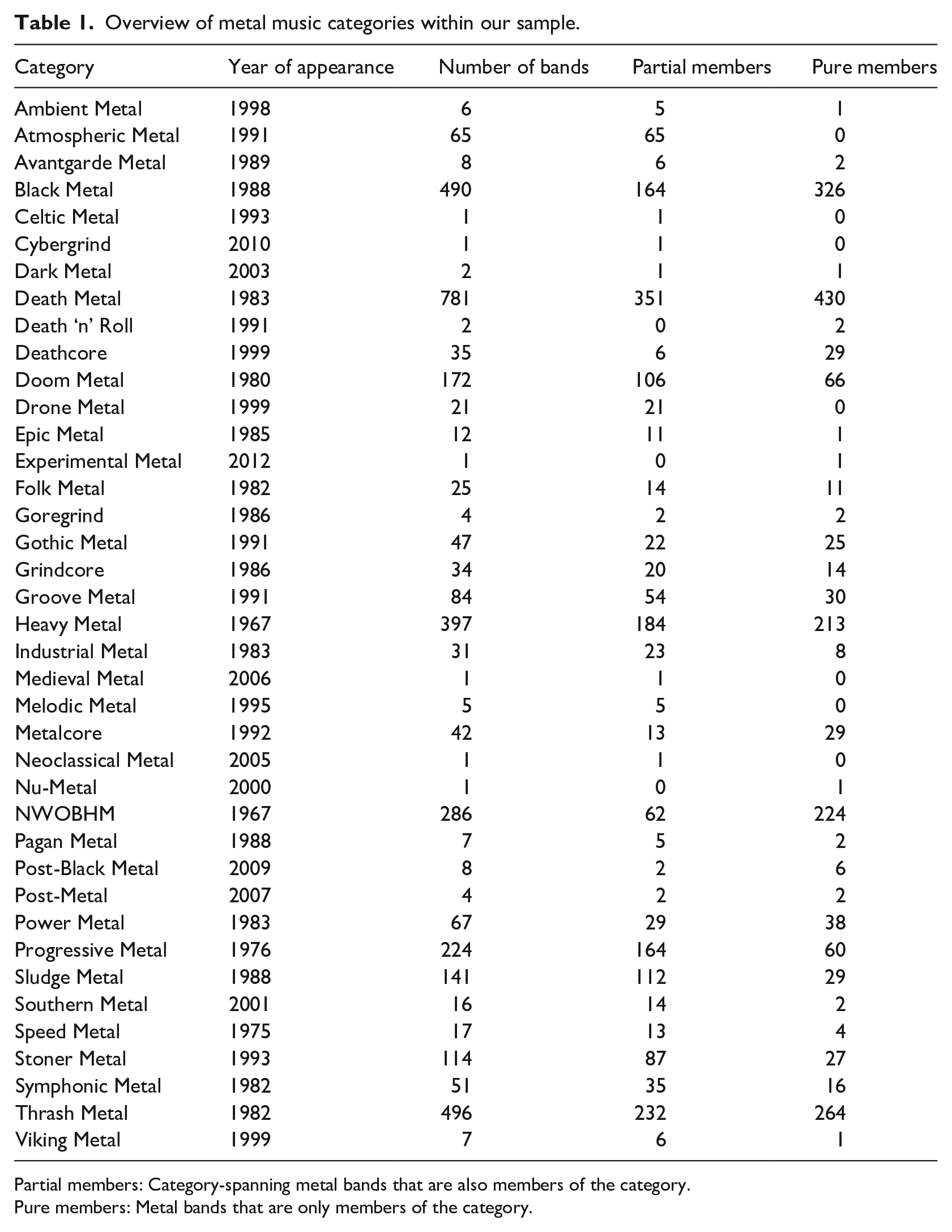
Partial members: Category-spanning metal bands that are also members of the category.
Pure members: Metal bands that are only members of the category.
Variables and methods
Dependent variable
We captured category spanning by constructing a variable measuring the degree to which a band spanned categories at its founding. The MA database includes the musical categorization of bands, which is based on the band’s self-reporting, the database operator’s assessment of the band, and the opinions of the database users (i.e. essentially the fan community). This categorization can be distinct if a band is assigned to an individual category. However, bands can also serve more than one category, and thus engage in category spanning.
Although the number of categories is often used to measure the degree of category spanning (e.g. Hsu, 2006; Hsu et al., 2009), measures accounting for dissimilarity among categories are more appropriate (Goldberg et al., 2016; Kovács and Johnson, 2014; Younkin and Kashkooli, 2020). In our study, the degree of category spanning is measured based on the degree of dissimilarity of the spanned categories

where catnum is the number of categories, and
To calculate dissimilarities between categories (i.e. the degree of category spanning), we asked three metal experts to highlight significant characteristics with which to distinguish the style of metal music categories. The metal experts suggested differentiating metal genres based on four characteristics: (a) the tempo or speed at which the music is played; (b) its virtuosity, which is defined by the complexity and structure of the notes and rhythms played; (c) its melodiousness, which is the degree of multifaceted, varied, memorable melodies, and the harmonic succession of the sound; and (d) the presence of clean vocals, which indicates the extent to which a singer sings melodically without screaming, belting, or grunting the vocals (Goldenstein et al., 2019). In this context, we must note that these characteristics do not necessarily reflect the metal bands’ capabilities because musicians, for example, can deliberately decide to play raw or simplistic metal music (e.g. Black Metal, Drone Metal, or Grindcore) even if they would be capable of a much more advanced style.
Next, we asked nine experts from metal labels to rate the four distinguishing characteristics of metal music categories using an 11-point Likert-type scale. The style of a metal music category was calculated as the mean ratings in the four assessed characteristics. Labels are central actors in the music market because they choose, develop, and market bands based on genre affiliations. Negus (1999), for example, argued that labels, in their interactions with artists, use and produce categories to balance authenticity and uniqueness. At the same time, audiences in the field of music (e.g. fans, bands, and journalists) are considered a community that also relies on the same genre expectations (Younkin and Kashkooli, 2020). Therefore, we assume here that category evaluation does not generally differ between experts at metal music labels and other types of metal music audiences (Goldenstein et al., 2019).
Finally, we applied a distance measure to calculate the dissimilarity between the two genres. Although the Kogut–Singh index (Kogut and Singh, 1988) is widely accepted in management literature for evaluating the dissimilarity of categories, it was recently criticized for its inaccuracy (Konara and Mohr, 2019). Following Konara and Mohr’s (2019) recommendation, we differed slightly from our prior work (Goldenstein et al., 2019) and applied the standardized Euclidean distance formula to our data

where
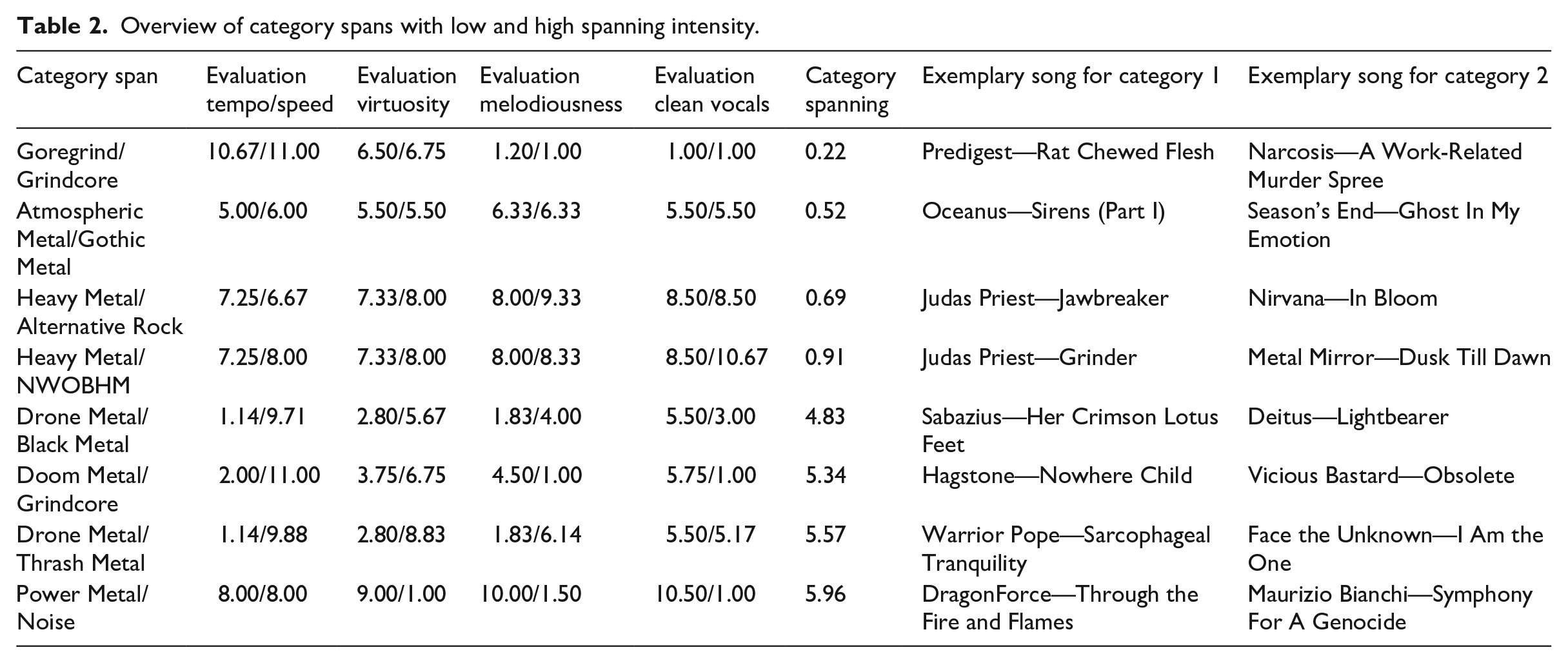
To illustrate the assessment of category spanning, we listed some examples of low- and high-rated category spans in Table 2. For each of these spans, we also included exemplary music titles for both of the combined metal music categories. When listening to these titles it becomes obvious—even for people unfamiliar with metal music—that some metal music categories have quite similar musical elements in the case of low spanning values, whereas others are highly different, as in the case of high spanning values.
Overview of category spans with low and high spanning intensity.
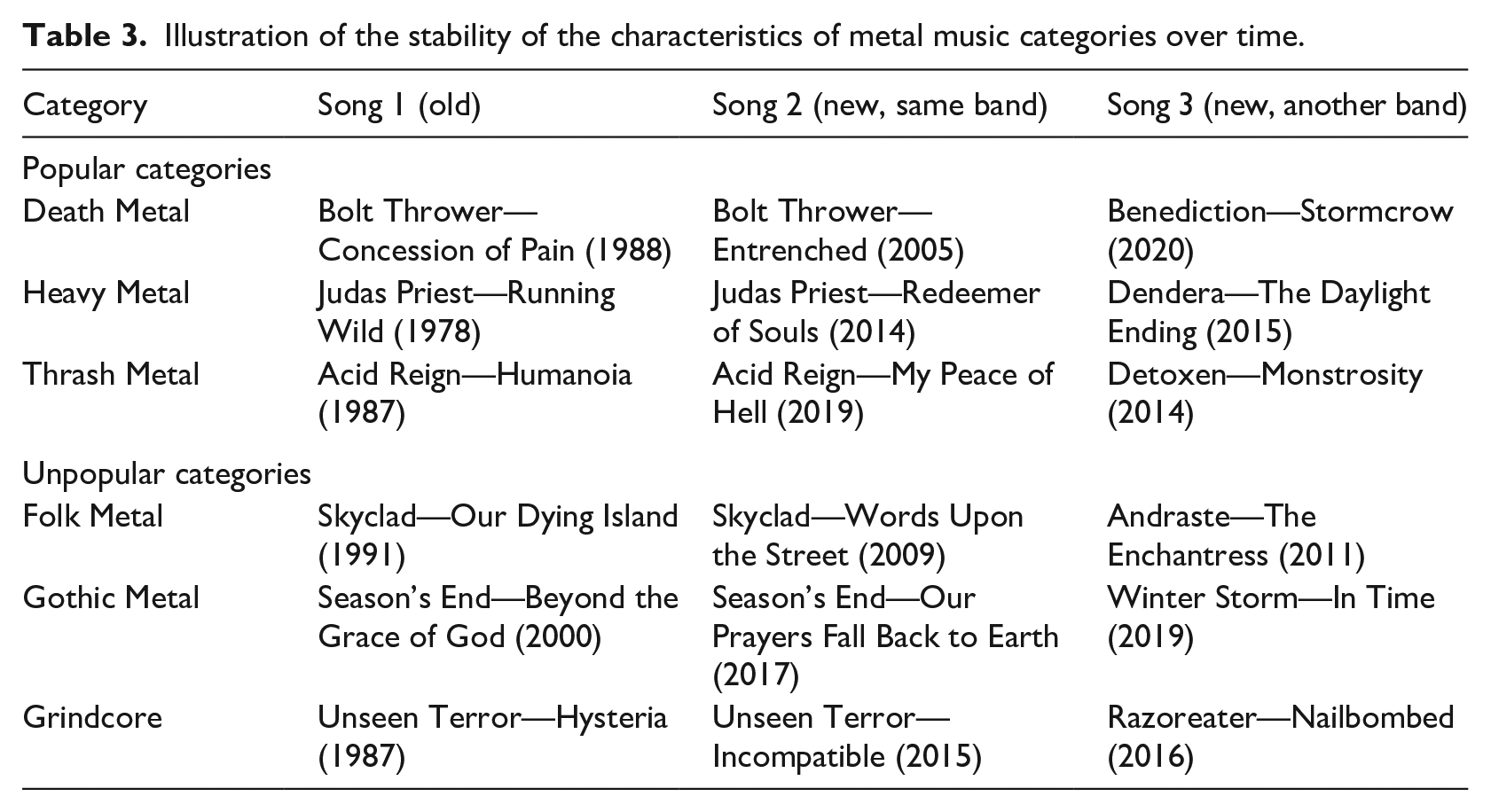
Acknowledging that our evaluation of metal music categories is retrospective, some may argue that it is not able to capture changes of characteristics over time. Although music may emerge over time, metal music categories show a low rate of change and remain quite stable in their main characteristics over time. To provide readers an intuitive sense of this fact, we listed examples of old and new songs from different bands in Table 3. Songs never really sound identical, of course, but songs in a given category show high degrees of similarity, which the time when the song title was recorded does not affect.
Illustration of the stability of the characteristics of metal music categories over time.
Independent variable
To analyze the main effect on category spanning, we constructed category density as our independent variable, which we defined as the total number of bands within a metal music category in the year before the new metal band’s founding. For all the bands, we calculated category density based on the main category that the band serves (i.e. the category the MA lists first for the band). 6
Moderators
Our first moderator is category fuzziness, which has been measured in various ways in the literature. The most commonly used measure reflects the average membership grade of all members within a category at a given time (Bogaert et al., 2010; Hannan, 2010; Hannan et al., 2007; Pontikes, 2012). However, this membership grade relies predominantly on the number of categories to which a member is assigned. Despite the merits of this measurement method, the similarity of categories to which a member is assigned is nevertheless of great relevance in capturing how clearly a category label is defined (Kovács and Hannan, 2015). Given that category spans differ based on the category overlap, a band spanning categories with high dissimilarity should blur category boundaries to a great extent. In contrast, bands spanning categories with high similarity should blur category boundaries only slightly.
Building on this idea, we decided to adopt a measurement of category fuzziness that also accounts for the degree of category dissimilarity. We used the average degree of category spanning for all active members of a focal category in the year before the metal band’s founding. This measure allows for a finer-grained assessment of categories’ fuzziness. A value of 0 indicates that all of the members lack any other categorical membership. An increasing value reflects an increasing average amount of category spanning among all active members in a category.
Our second moderator is regional density, which we defined as the total number of all active metal bands, regardless of their category affiliations, within the founding region in the year before a metal band’s founding year. We applied the regional accounts of the United Kingdom’s Office for National Statistics and calculated regional density based on the nine English regions: North West, North East, West Midlands, Yorkshire and the Humber, East Midlands, South West, East of England, South East, and Greater London. We included Scotland, Wales, and Northern Ireland as additional regions without any further subdivision (see Note 6).
Finally, as a third moderator, we defined founding number as the number of new entrants to the market in the year before the new metal band’s founding (see Note 6).
Control variables
To improve our findings’ robustness, we included several control variables to account for additional band, market, and economic factors that might influence a band’s preference for category spanning beyond the density effects. 7 First, bands with more founding members might be further inclined to include more musical influences because of the team’s diversity of perspectives and skills, which can influence innovation quantity (Peltokorpi and Hasu, 2014), the radicalness of innovation (West and Anderson, 1996), and risk-taking (Kraiczy et al., 2015). Therefore, we controlled for founding members, which measures the number of founding team members. Second, to account for the greater inclination of entrepreneurs who already had founding experiences to span categories, we also controlled for whether a given metal band had a predecessor band. Third, even small populations might become legitimized over time (Navis and Glynn, 2010; Wry et al., 2011), and low density in a developed market might reflect consolidation in a highly legitimated category (Dobrev and Gotsopoulos, 2010). Thus, category age might be an alternative way to achieve taken-for-grantedness and may influence the decision to span categories (Dobrev and Gotsopoulos, 2010; Hsu et al., 2012). To control for this effect, we included the variable category age, measured as the number of years since the category’s first band was founded. Fourth, entrepreneurs might consider the hostility of markets when deciding whether to span categories. High failure rates may signal unfavorable environmental conditions and thus might enhance the entrepreneurs’ ambition for legitimation through avoiding category spanning and choosing membership in a distinct category. Therefore, we controlled for the closure rate within the market (i.e. the number of failed metal bands divided by the number of metal bands) in the year prior to founding. Fifth, we also controlled for sales in the economic sector in which musicians aim to establish their band. To this end, we measured the annual sales of the UK music industry in millions of British pounds during the founding year of the band, as reported annually by the British Phonographic Industry. We accounted for the overall music market’s development because economic sector development is highly relevant for entrepreneurs’ founding decisions as well as their decisions regarding positioning their new ventures (Pontikes and Barnett, 2017). Finally, macroeconomic conditions might influence a band’s decision to span categories. High unemployment rates, for example, might increase the necessity of economic activities and thus facilitate entrepreneurial behavior. For example, in an individual-level analysis, Wagner and Sternberg (2004) found that unemployment increased the propensity for engaging in entrepreneurial activities. To control for this impact, we included the unemployment rate in the year before a band’s founding year, as provided by the Office for National Statistics.
Estimation procedure
Given that the dependent variable in our models for the antecedents of category spanning is nonnegative and that a high share of observations have a value of 0 (i.e. these bands do not span categories), the least-squares method would have been inappropriate (Amemiya, 1984). Therefore, we applied the Tobit model (Tobin, 1958), which fits our data structure and is used frequently in management studies that employ dependent variables with comparable characteristics (e.g. Cohen and Levinthal, 1990; Laursen and Salter, 2006) and in the context of entrepreneurship (Fernhaber and Mcdougall-Covin, 2009). Furthermore, we followed Aiken and West (1991) and mean centered our independent variable and moderators to reduce nonessential multicollinearity. We calculated the variance inflation factors (VIFs) to reject potential issues related to multicollinearity among the independent variables within our models. The highest VIF value of 3.79 was well below the recommended cutoff figure of 10 (Hair et al., 1995; Neter et al., 1989). As such, we are confident that multicollinearity is not an issue.
Results
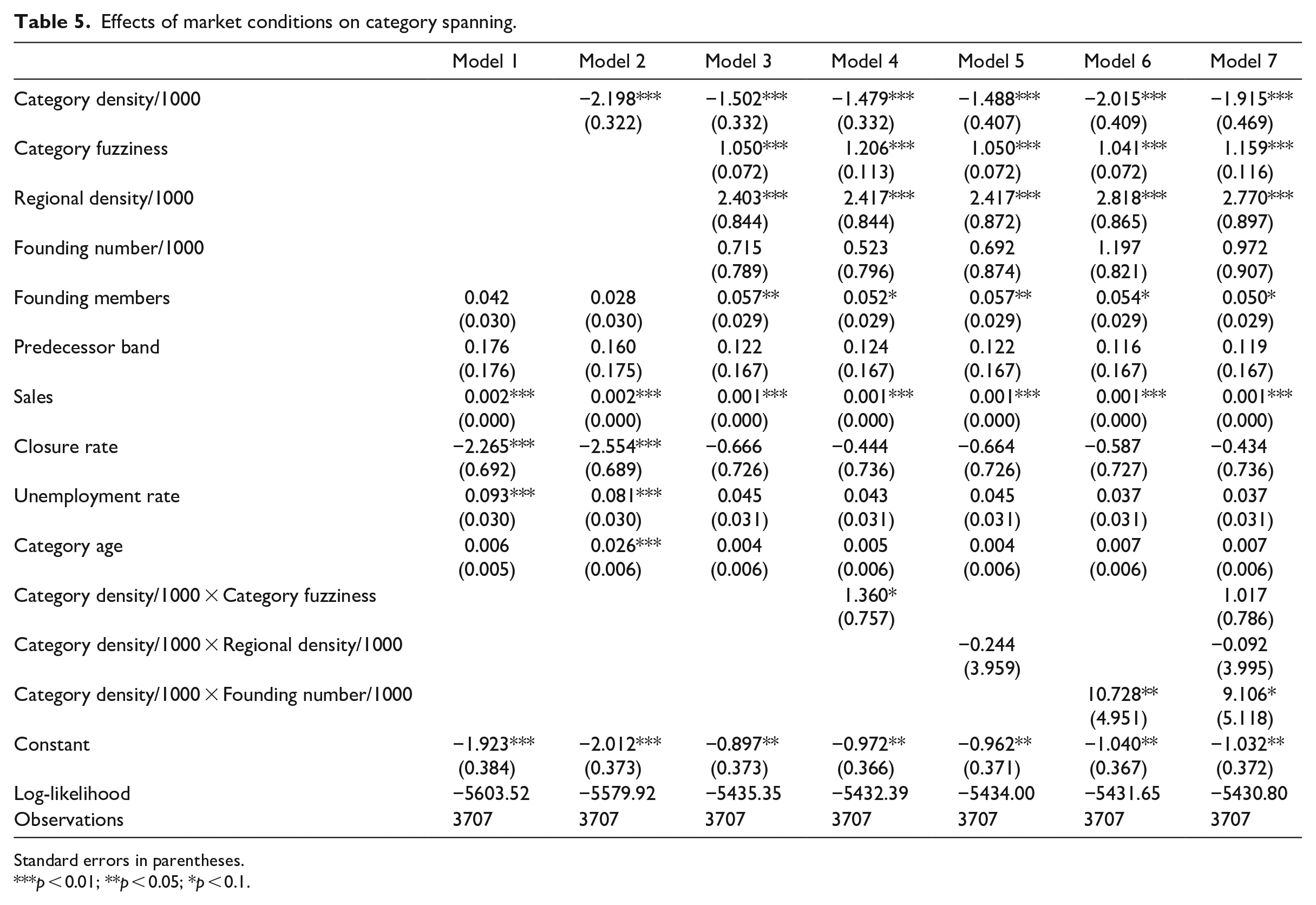
Table 4 presents the descriptive statistics of the variables in our analysis. Table 5 shows the results of our regression models.
Descriptive statistics and correlation matrix.
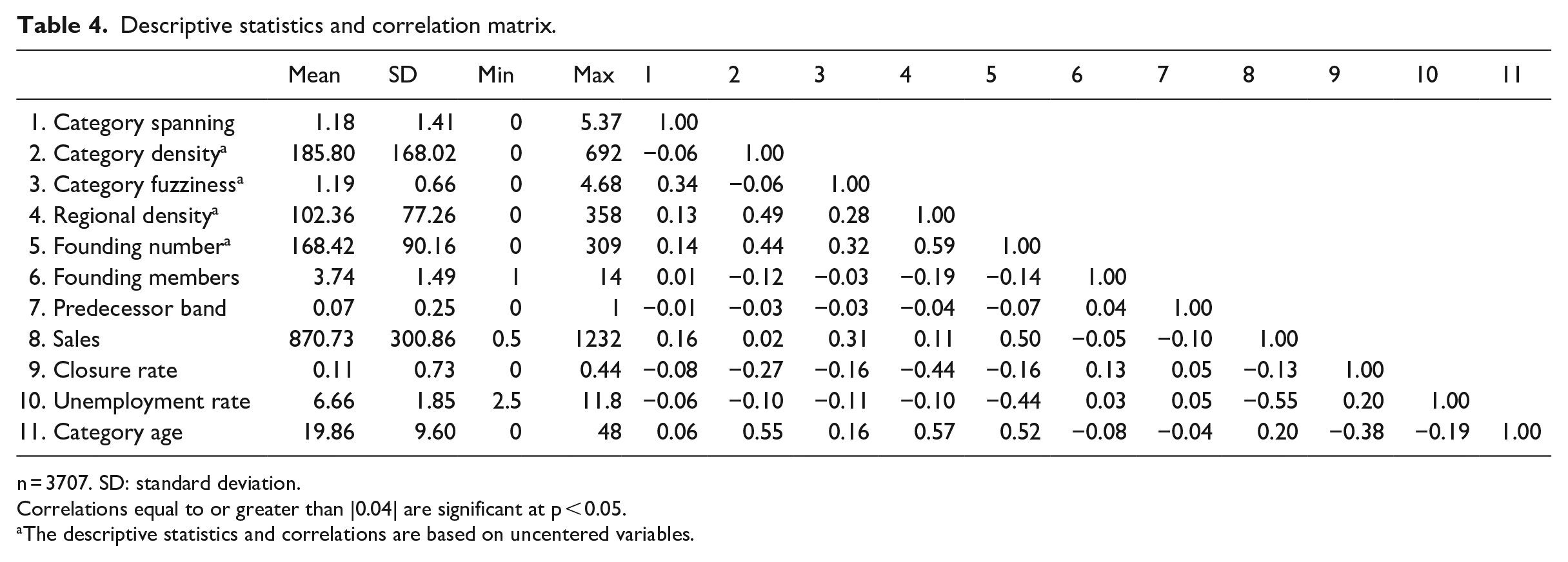
n = 3707. SD: standard deviation.
Correlations equal to or greater than |0.04| are significant at p < 0.05.
The descriptive statistics and correlations are based on uncentered variables.
Effects of market conditions on category spanning.
Standard errors in parentheses.
p < 0.01; **p < 0.05; *p < 0.1.
Model 1 is the baseline model, which includes only the control variables. Consistent with our theoretical considerations, the number of founding team members enhances the degree of category spanning. In addition, the market’s sales volume at the time of founding influences the degree of category spanning positively. In Models 2 and 3, we included category density and the moderating variables (i.e. fuzziness, regional density, and founding number). The results indicate a significant negative effect of category density on category spanning. Consequently, as category density increases, the degree of category spanning decreases. Thus, Hypothesis 1 is supported.
In Hypothesis 2, we predicted a positive moderating effect of category fuzziness on the relationship between category density and category spanning. In line with our theoretical considerations, we observed a positive moderating effect in Model 4. In other words, categories’ fuzziness attenuates the negative effect of category density on the degree of category spanning. As the boundaries of categories become more ambiguous, the effects of category density on conformity and mainstream behavior by metal bands are buffered. Consequently, Hypothesis 2 is supported. Figure 1 depicts the results of the moderating effect.
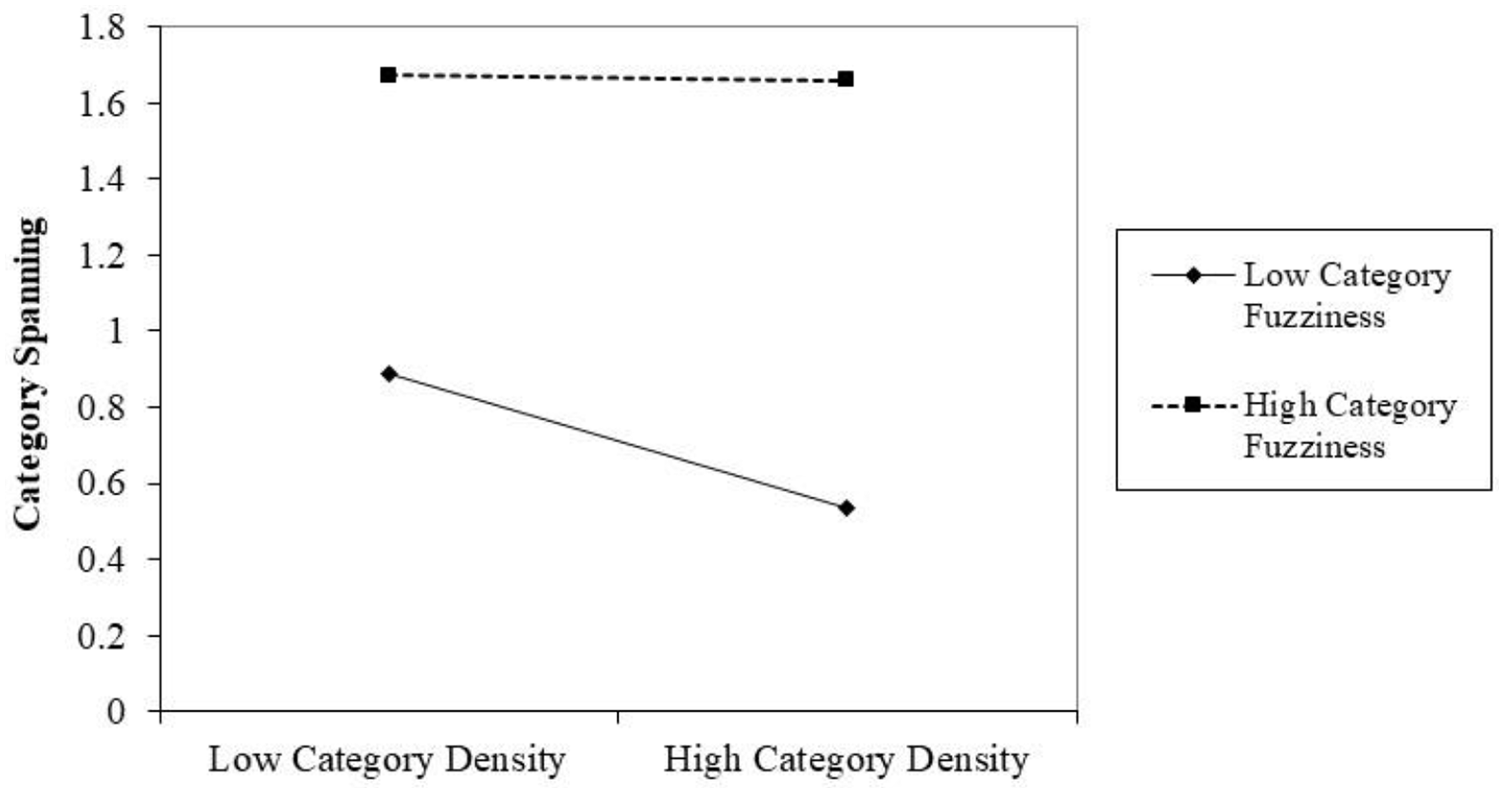
Interaction effect of category fuzziness on the relationship between category density and category spanning.
Hypothesis 3 proposes a positive moderating effect of regional density on the relationship between category density and category spanning. However, we found no significant interaction effect between category density and regional density in Model 5. Figure 2 shows the plotted interaction effect. Consequently, Hypothesis 3 must be rejected. Even so, this finding is still of interest because the main effect of regional density is significant in all models. With increasing regional density, metal bands’ nonconfirmative behavior strengthens; thus, the degree of category spanning increases.
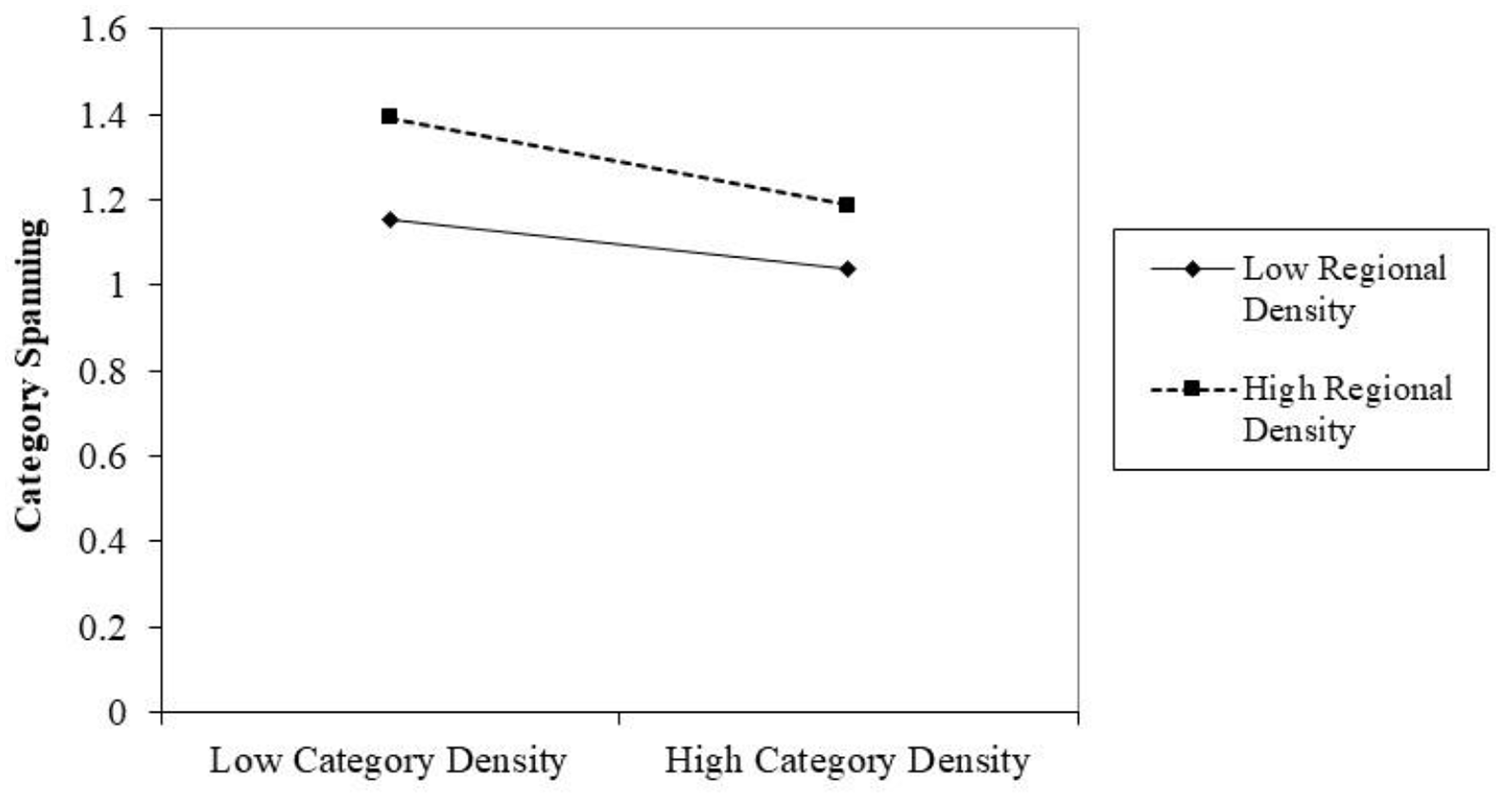
Interaction effect of regional density on the relationship between category density and category spanning.
Hypothesis 4 proposes that the founding number has a positive moderating effect on the relationship between category density and category spanning. In line with our theoretical consideration, we found a significant positive interaction effect between category density and the founding number in Model 6. Figure 3 depicts the moderating effect’s results. Consequently, Hypothesis 4 is supported.
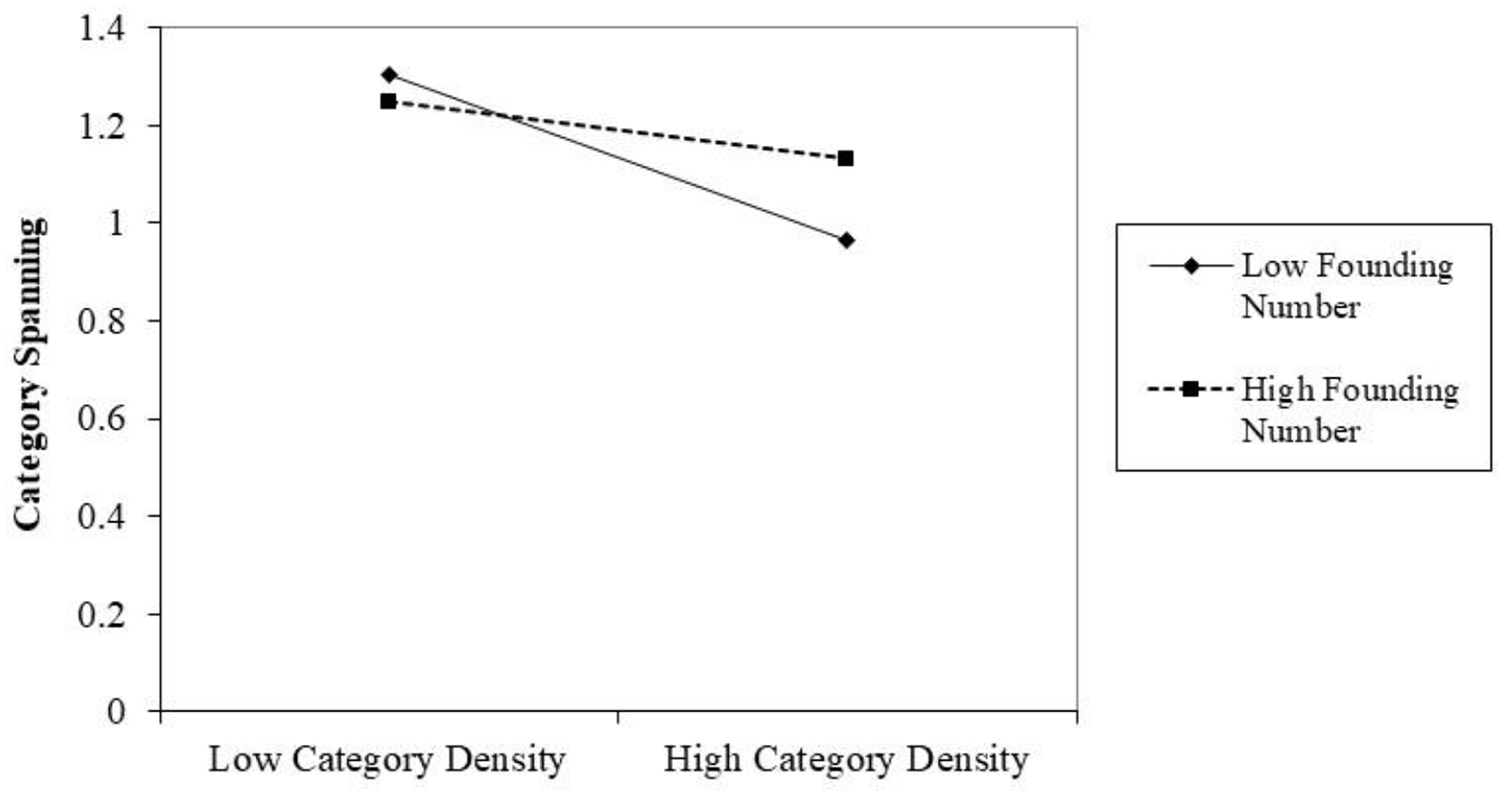
Interaction effect of founding number on the relationship between category density and category spanning.
To prove further the robustness of our findings, we applied several robustness checks. First, we employed an alternative regression model: a negative binominal regression appropriate for modeling overdispersed count variables. To do so, we rounded the degree of category spanning for each band to full numbers. Second, because the variable used to study the effects of regional density within our analyses was based on a rather coarse-grained classification, we also ran our models with a finer-grained classification. For this purpose, we further divided England into its 48 ceremonial counties, Scotland into its eight electoral regions, Wales into its eight counties, and Northern Ireland into its six counties. Third, because a relatively high density of metal bands characterizes the Greater London region, which might cause a possible bias in our findings, we also ran our regression models excluding this region from our analysis. Fourth, a small number of members characterizes some categories, which might cause a bias with respect to our study. Therefore, we also ran our regression models with a sample that excluded categories with only a few members. None of these robustness checks influenced the significance of our main findings (see Supplemental Appendix Tables 1–4). Finally, we tested another measure of fuzziness. Following studies on the relevance of population experience (Baum and Ingram, 1998), we used the average category spanning value of all metal bands founded before the new metal band in the corresponding category was founded. In contrast to the measure of fuzziness applied in our main regressions, this new variable indicates a type of historical fuzziness. We included this variable because we assumed that categories and category systems might have a type of memory. Thus, evaluating and understanding deviation based on category spanning not only reflects assumptions about the current situation at the time of founding, but also it is based on the perception of the category’s history. The findings support this assumption, but they also necessitate a more detailed discussion. On the one hand, this historical fuzziness shows a significant main effect, which supports our findings and assumptions regarding the category history’s relevance. On the other hand, there is no significant moderation effect of historical fuzziness in terms of category density. This finding leads us to conclude that although the history of a category is greatly important to an entrepreneur’s spanning decisions, it does not influence the metal band’s assumptions on potential legitimacy and competition effects (see Supplemental Appendix Table 5).
Discussion
Contributions to category spanning
Drawing on category research, this study shifts the focus from the consequences of category spanning (Alexy and George, 2013; Dobrev et al., 2001; Durand and Paolella, 2013; Kennedy et al., 2010; Tang and Wezel, 2015) to the antecedents that prompt entrepreneurs to take or avoid the risk of spanning categories. In so doing, our study holds two contributions to the literature on category spanning.
In line with past research (Carnabuci et al., 2015; Chae, 2022; Tang and Wezel, 2015), our results indicate that entrepreneurs strategically evaluate market conditions at founding by using their explicit and implicit assumptions to decide how to initially position their new ventures within a given market’s category system (Durand and Thornton, 2018; Pontikes and Barnett, 2017) by balancing legitimacy and competition effects (Younger and Fisher, 2020). Previous research on venture positioning often refers to the consequences of positioning (Jennings et al., 2009; Wry and Lounsbury, 2013) and argues that optimal distinctiveness leads to superior venture outcomes (Goldenstein et al., 2019; Younkin and Kashkooli, 2020; Zuckerman, 2016). From this, entrepreneurs can derive the recommendation that they should position their new venture as being “as different as legitimately possible” (Deephouse, 1999: 147). We argue that our findings add to this previous research by showing that the interplay among a set of market conditions in their founding environment significantly influences entrepreneurs’ assumptions of what constitutes a legitimate differentiation. In this context, market conditions on the categorical, regional, and supraregional levels seem to have important influences. Beyond the instrumental effect of category density on the degree of category spanning, we demonstrate that an increasing category fuzziness and founding numbers attenuate its negative effect. In addition, competition effects at the regional level complement these effects. Consequently, our findings extends prior qualitative work on new ventures’ identity formation (Younger and Fisher, 2020) by providing initial quantitative evidence that a set of market conditions affect new ventures’ positioning in categorical systems.
In addition to clarifying why organizations span categories even in the face of established categorical structures, this study adds to the literature on density dependency theory. Although regional density does not moderate the effects of category density, the main effect is significant; thus, regional density increases the intensity with which new ventures span categories. This finding is interesting because it sheds light on the interrelation between legitimacy and competition effects, which is frequently discussed in the context of density dependence theory (Bogaert et al., 2016; Carroll and Hannan, 2000; Hannan and Freeman, 1989; Kalnins, 2016). For example, in their study on the European automobile industry, Hannan et al. (1995) showed that density dependence yielded competition effects within nation-states, but the industry’s legitimacy as a whole unfolded on the European level. In line with this finding, Greve (2002) argued that such a theory of local density dependence and nonlocal legitimation only explains differences between populations that barriers separate, such as national borders, but not differences between subpopulations existing in uniform legal, cultural, and technical environments. However, our study provides evidence that a theory of local density dependence and nonlocal legitimation could also apply to markets within national borders. Our findings indicate that—besides the supralocal legitimation of the whole category—entrepreneurs in particular consider a local competition situation when deciding how to position their new ventures within a system of categories. Based on our robustness checks, this holds true even if excluding large geographical areas and only considering smaller areas within national borders.
Contributions to the evolution of categories and markets
On a more general theoretical level, our study’s focus on an individual market is well suited to deepening theoretical insights into the evolution of categories and markets. Although the interplay between categories and ventures is central to category research, most studies consider categories as externally defined and analyze their disciplinary function on venture behavior (Durand and Khaire, 2016).
With our study, we expand previous work that has assumed the presence of similar categorical expectations of the attributes of products and organizations in the same market, which has limited our understanding of the categories’ potential heterogeneity in an individual market (Durand and Paolella, 2013). However, given the existence of density effects across categories in an individual market, our results indicate the within-market divergence of categories in terms of their pressure on the degree of attribute conformity for products. Thus, our study joins recent research accounting for the potential heterogeneity of organizational environments (Chae, 2022) and opens space for future research concerning the role of markets’ degree of heterogeneity in the evaluation of category systems. In this context, our study illustrates that ventures, and new ventures specifically, aim to strategically assess the categorical system of markets and consider market conditions when deciding how to position themselves. Through entrepreneurs’ assessment of what degree of category spanning is appropriate, the categorical system not only affects them when making decisions, but their decisions are also a significant driver for the evolution of the category system. That is, new ventures induce or accelerate evolutionary dynamics within markets and may enhance the possibility of a new category’s formation.
By emphasizing new ventures’ role in the regularly unintended dynamics of how categorical systems evolve, our study also joins prior research that acknowledges ventures’ agent-based status (Fisher, 2020). Based on this status, new ventures not only are influenced by a categorical system that constrains their individual behavior, but also they influence boundaries and the understanding of categories, both individually and collectively (Durand and Khaire, 2016; Hsu and Grodal, 2015; Kennedy et al., 2010; Kim and Jensen, 2011; Montauti, 2019). However, given their specific need to conform and differentiate, we highlight the role of new ventures in shaping the category system of markets—a perspective that has been presented as being too weak in the quantitative research on categories. Through focusing on an individual market and new ventures’ positioning in categories with varying density levels, our study enhances the quantitative evidence on category evolution and contributes to developing a more comprehensive understanding of how markets evolve.
While previous studies indicated that when entering a market, new ventures tend to focus on conformity (Younger and Fisher, 2020), whereas established ventures focus on differentiation with respect to their organizational identity (Carnabuci et al., 2015; Navis and Glynn, 2010), our study presents a more differentiated picture of this interrelationship. Our study highlights that the behavior of new ventures depends on market conditions at their year of founding. We show that new ventures that enter high-density categories tend to correspond more to the common expectations of audiences about the attributes of products and organizations compared to new ventures entering low-density categories. We argue that this behavior is caused by the lack of legitimacy and other resources among new ventures, as compared to their established counterparts. However, the category system’s developmental stage and additional contextual factors, including category fuzziness, regional density, and the number of new entrants in the entire market, highly influences how new ventures behave when entering a market in terms of category spanning. These influences allow for a more comprehensive understanding of the relationship between incumbents and new entrants in markets as well as explain categorical systems’ different evolutionary paths.
Limitations
Despite our extensive empirical analyses and robustness checks, which support our theoretical arguments, it is important to consider our data’s limitations when interpreting the findings. In this context, five main aspects must be considered. First, our empirical setting focuses on metal bands from the United Kingdom; thus, our results apply to musicians and the country’s context. Even if the music industry and metal music musicians are comparable to typical business entrepreneurs, we acknowledge that the music industry may differ from other industries, for instance, regarding the specificity of resources (e.g. employees, sale channels, and customers), the degree of market orientation, or the degree of creativity. For example, it could be assumed that artists in general are more experimental and innovative than entrepreneurs in more traditional industries. This inclination could be based on the characteristics of entrepreneurs and the perception of audiences, both of which may value a certain degree of differentiation. Thus, metal bands may be more susceptible to market conditions that favor innovative behavior compared to ventures from more traditional industries. Therefore, replication studies in other empirical settings can meaningfully add to our study’s findings. The focus on one country appears reasonable because audiences’ expectations regarding the material attributes of new ventures within a market depend on cultural contexts (Lena and Peterson, 2008; Van Eijck, 2001). However, cross-cultural research could enhance our findings’ generalizability or could provide additional insights into how the antecedents of category spanning vary across countries. Moreover, a cross-cultural empirical design would allow us to deepen our study of the conditions under which global markets evolve over time. Second, we focus on new ventures. However, at the same time, we acknowledge the relevance of studies that question the permanence of the observed effects depending on the venture’s age. Future studies could start here and contribute to a more comprehensive understanding of how categorical systems evolve by also accounting for categorical repositioning during a venture’s lifetime. Third, even if a high degree of persistency characterizes the core attributes of metal music categories (see Table 3), this may not be true for other types of categories. Therefore, future studies could acknowledge that perceptions regarding categories can change over time as the existence of other categories might influence the assessment of characteristics. Fourth, entrepreneurs’ decisions to span categories might not depend solely on contextual conditions but also on the individual and sociographic characteristics of entrepreneurs and intraorganizational settings might also affect them, such as the specific configurations of venture teams. Elaborating upon the influences of team member characteristics on the decision to offer innovative products and services would further advance our knowledge about the intentions and strategic considerations among new ventures in terms of undertaking risky business endeavors. Finally, future studies might consider whether the popularity of individual ventures within a category could influence other ventures’ decision to engage in category spanning. The popularity of individual ventures could have a twofold effect: (a) it could stimulate new ventures to span categories to enter the category in which the popular venture is based, and (b) new ventures entering the category of the popular venture could, in turn, be stimulated to behave in a conform way and not to engage in category spanning.
Supplemental Material
sj-docx-1-soq-10.1177_14761270221086857 – Supplemental material for How market conditions affect new ventures’ propensity to engage in category spanning
Supplemental material, sj-docx-1-soq-10.1177_14761270221086857 for How market conditions affect new ventures’ propensity to engage in category spanning by Jan Goldenstein, Michael Hunoldt and Simon Oertel in Strategic Organization
Footnotes
Funding
The author(s) received no financial support for the research, authorship, and/or publication of this article.

Supplemental material
Supplemental material for this article is available online.
Notes
Author biographies
References
Supplementary Material
Please find the following supplemental material available below.
For Open Access articles published under a Creative Commons License, all supplemental material carries the same license as the article it is associated with.
For non-Open Access articles published, all supplemental material carries a non-exclusive license, and permission requests for re-use of supplemental material or any part of supplemental material shall be sent directly to the copyright owner as specified in the copyright notice associated with the article.
