



Abstract
Time and temporality are central to strategy and strategic management. Yet, relatively little attention has been paid to what organizational members do to shape temporal phenomena that are important for strategic outcomes. In this essay, we define temporal work as any individual, collective, or organizational effort to influence, sustain or redirect the temporal assumptions and patterns that shape strategic action, and we introduce the seven articles in this special issue that explore this concept. Building on the rich insights emerging from these articles, we show how temporal work acts on temporal assumptions by shaping perceptions and interpretations, reorients patterns through temporal structures underpinning action, and influences the value associated with time. This is achieved through various combinations of temporal talk, temporal practices and temporal objects. By focusing on the role of human agency in shaping temporal phenomena, the notion of temporal work opens up exciting opportunities for research on issues that are critical for the future of organizations and society.
Time, in its various dimensions and manifestations (e.g., speed, rhythm, sequence, horizon) is inherent to strategic management (Mosakowski and Earley, 2000). The very notion of strategy implies projecting organizations into the future through decisions in the present while building on the past. Yet, while considerable attention has been devoted in strategy and organization research to time-related constructs and their antecedents and consequences (Baum and Wally, 2003; Crilly, 2017; Dykes et al., 2018; Eisenhardt, 1989; Hawk and Pacheco-de-Almeida, 2018; Flammer and Bansal, 2017; Nadkarni et al., 2016; Shi and Prescott, 2012; Souitaris and Maestro, 2010; Kunisch et al., 2017), less attention has been paid to what managers and others actually do to intervene with respect to important time-related phenomena, and to how their temporally-oriented practices and activities accomplish strategic outcomes. The call for papers for this special issue on “Temporal Work: The Strategic Organization of Time” therefore invited prospective authors to focus explicitly on action and agency with respect to time and temporal phenomena.
The focus on temporal work presents a significant departure from traditional views of time in strategy research, where temporal phenomena such as speed, temporal depth, horizon and rhythm are most often compressed into explanatory variables that can be measured quantitatively and related to performance constructs. Alternatively, time may be viewed as an ordered clock-based or event-based measure on an x-axis, against which strategic processes such as timing, frequency and rates of change may be tracked and plotted (Kunisch et al., 2017).
In the temporal work perspective, temporality adds dimensionality to organizational life beyond simply a line on a graph or a variable in a model. It weaves into the way in which people experience the world, organize within it, and the actions they take. The notion of “temporal work” was first coined by Kaplan and Orlikowski (2013) to describe how organization members collectively aligned their conceptions of past, present and future to develop viable strategic projects. Their insights focused primarily on the negotiation and resolution of different interpretations of the past, present and future that serve to guide action. Theirs is a highly interpretive account, focusing on the micro-interactions among organizational actors that involves strategy in practice, which is often manifested in discourse.
Through this special issue and other published work, we recognize that temporal work not only aligns interpretations, but may significantly influence them. We also see that actors may engage in temporal work not only through daily practices, but by actively and deliberately shaping temporal phenomena. Using Kaplan and Orlikowski’s (2013) work as a springboard, we expand the definition of “temporal work” as any
Even if these temporal assumptions and patterns are socially constructed and normatively ordered, they are often taken for granted and may appear as objective and external. Temporal work is about intervening to influence temporal assumptions and patterns. Temporal work is a non-trivial venture, given that would-be “temporal workers” also hold assumptions of the past, present and future and are embedded within existing temporal structures and personal life trajectories (Emirbayer and Mische, 1998). They must engage in agentic processes of shaping temporal assumptions or patterns, while at the same time holding their own, often invisible, assumptions (Hernes et al., 2013). Temporal work, then, can be messy as temporal workers are not only working on the people in the context in which they are situated, but also on themselves.
The Papers in this Special Issue
Our call for papers was clearly timely (sic): We received a total of 66 submissions, a record for a special issue of Strategic Organization. Of these, 43 were sent for review, and ten were invited to revise and resubmit. Seven accepted articles are included in this issue. These deal with a range of topics ranging from executive succession to cross-sector collaboration to crisis recovery. All but one are empirical contributions drawing on exceptionally rich qualitative data. Many are concerned with important societal challenges. Summaries of the papers and their contributions to understandings of temporal work in strategic organization are presented in Table 1.
Articles included in the Special Issue.
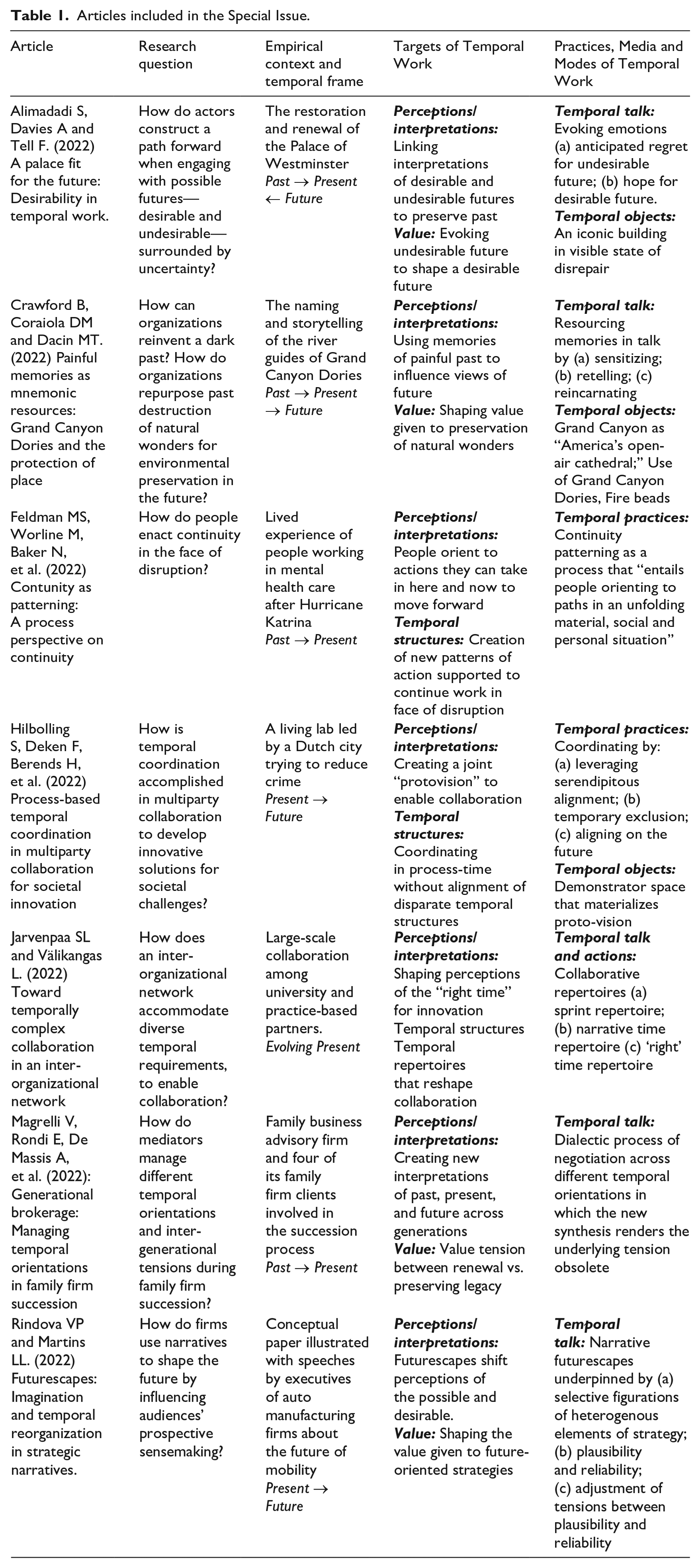
In reviewing the submissions and in reflecting on our own perspectives on time and temporal work, we noted that contributions to this area could be broadly captured under two overarching and inter-related conceptual themes that deal with the targets of temporal work (the what question), and the media or mechanisms of temporal work (the how question). Targets for temporal work include shaping temporal perceptions and interpretations, shaping temporal structures, and shaping temporal values; media for temporal work include temporal talk, temporal practices and temporal objects. In structuring our essay around these themes, we synthesize the ideas emerging from the seven articles, while at the same time reaching beyond them to identify blind spots where we see opportunities for further development.
Although we have organized this editorial around themes, we recognize that all three targets of temporal work (perceptions and interpretations, structures and value) are interrelated. For example, temporal structuring may embed implicit interpretations and assign different values to time. Conversely, efforts to reshape temporal perceptions, interpretations and values may confront or disrupt existing temporal structures, opening up further avenues for change. and influence the assumptions and patterns of time that makes strategic organization work ‘temporal’. It is no wonder that the papers in this special issue speak to one or several aspects of temporal work. However, by categorizing the targets and media of temporal work, we come closer to gaining deeper insights into what we are uncovering about temporal work, and the areas that may warrant further investigation.
Targets of Temporal Work
Shaping temporal perceptions and interpretations
People may hold divergent and sometimes even conflicting perceptions and interpretations of temporal phenomena such as the past, present and future, as well as conceptions of speed, pace and urgency or the nature of time itself. Importantly, perceptions and interpretations of the past shape projections of the future and guide present actions (Suddaby et al., 2010), while the past and future are constantly reinterpreted and renegotiated through contemporary actions (Hernes and Irgens, 2013). Temporal workers may therefore target temporal perceptions and interpretations, seeking to engage other organizational actors in rethinking the past or reimagining the future.
Violina Rindova and Luis Martins’ (2022) conceptual paper reveals, for example, how future-oriented temporal work may be directed towards changing what is perceived as possible and desirable. Drawing on examples of car manufacturers’ strategic narratives about the future of mobility, the authors show how firms’ narratives “blend the real – what they are currently doing and investing in, and the imaginary – what they would like audiences to imagine and believe to be possible” (p. 217). These “futurescapes” shape perceptions of what the future could be while also offering a collective vision that can engage parties in collaborating in the present. Similarly, Susan Hilbolling, Fleur Deken, Hans Berends and Philipp Tuertscher’s (2022) study of a social innovation initiative reveals how “aligning on the future” through a joint protovision enabled interdependent parties to collaborate by acting “as if the future was happening now” (p. 156)
While the articles by Rindova and Martins and Hilbolling et al. reveal the performative power of projecting desirable futures, Siavash Alimadadi, Andrew Davies and Fredrik Tell (2022), nuance these ideas by showing how malleable and oscillating interpretations of future states might contribute to enabling action. Based on a case study of the restoration and renewal of the Palace of Westminster, the seat of the British Parliament, they showed how temporal work linking together interpretations of desirable and undesirable outcomes mobilized future-oriented collective action, creating a shared sense of urgency. Visions of an undesirable future (risk of fire, disaster or disruption of Parliament) created a sense of “anticipated regret,” accelerating the planning process and resulting in the restoration program’s formal approval. Temporal work can thus shape perceptions of the “right timing”, urgency, or windows of opportunities for action (Granqvist and Gustafsson, 2016). In another example, Sirkka Jarvenpaa and Liisa Välikangas’ (2022) study of interorganizational collaboration emphasizes how temporal work might shape participants’ willingness to create, rather than wait for, the “right time” for innovation.
Shifting perceptions and interpretations of possible futures may also be grounded in efforts to shape perceptions and interpretations of the past. For example, Brett Crawford, Diego Coraiola and Tina Dacin (2022) write about the mnemonic resources Grand Canyon dory guides use to remind people of the destruction of the adjacent Glen Canyon. Through temporal work, memories of a painful past are repurposed to create momentum for action in the present, specifically to mobilize people to participate in a desired future for a remaining natural treasure, the Grand Canyon.
Orientations towards the past, present, and future are also at the center of Vittoria Magrelli, Emanuela Rondi, Alfredo De Massis, and Josip Kotlar’s (2022) study of the mediation process that helps family firms manage intergenerational tensions. Magrelli et al identify generational brokerage as the intersubjective process through which temporal work enables different generations to align their perceptions and interpretations of past, present, and future, creating a form of continuity. The role of temporal work in the enactment of continuity between past, present and future is again manifested in Martha Feldman, Monica Worline, Natalie Baker and Victoria Lowerson Bredow’s (2022) study of mental health professionals’ responses to Hurricane Katrina.
In sum, shaping and reshaping interpretations of the past, present and future as well as perceptions of temporal experiences such as pace, urgency and timing are a central target for temporal work. Underpinning these efforts is the assumption that interpretation and action are co-constructed and move towards alignment. Thus, temporal work directed towards interpretations and perceptions can promote coordinated action, and enable actors to imagine and bring to life a shared vision of the future.
Shaping temporal structures
Temporal structures are the shared temporal norms, routines, and devices such as schedules, timelines, and calendars, that people enact in their everyday practices and that thereby structure social processes over time (Orlikowski and Yates, 2002). Shared temporal structures play a vital role in coordinating interdependencies in complex organization, enabling the temporal alignment of activities as well as the temporal division of labor into sequences, shifts or vacation times (Zerubavel, 1985). Temporal structures provide the means for people to coordinate rhythms but also to make sense of activities in ways that provide order to events that may be otherwise chaotic. People will show up and complete tasks ‘on time’, whether the time is dictated by a clock or coordinated with an event. Although temporal structures are often treated “as if they were “out there” and independent of human action” (Orlikowski and Yates, 2002: 689), they are socially constructed and can be an important target for temporal work. Shaping temporal structures can be a powerful way of influencing people’s interactions, coordination and ongoing activities. Through scheduling, for instance, actors can speed up or slow down a project. Schedules and deadlines can pace working lives, even generating overflows into private lives (Blagoev & Schreyögg, 2019). When objectified, temporal structures can be so persuasive that they govern organizational processes unchallenged, potentially creating a speed trap and leading to an impoverishment of time and sound strategic decision making (Perlow et al., 2002).
The managerial challenge represented by temporal complexity – i.e., the coexistence of diverse and potentially conflicting temporal structures and assumptions among people who need to work together – is the central focus of both Jarvenpaa and Välikangas’ (2022) and Hilbolling et al.’s (2022) studies. While temporal complexity is often seen as a deterrent for collaboration as different parties struggle to navigate multiple or conflicting temporal requirements simultaneously (Reinecke and Ansari, 2015), Jarvenpaa and Välikangas suggest that temporal complexity may also be an enabler of interorganizational collaboration. Studying a large-scale, interorganizational network of university and practice-based partners, they observe how multiple participants engaged in temporal work to reorient temporal structures as relations developed, thus accommodating diverse temporal requirements and enabling collaboration through temporal complexity. Hilbolling et al. (2022) draw on the case of a living lab in a Dutch city seeking to reduce crime and focus on how temporal coordination is accomplished in multiparty collaboration to develop innovative solutions. Temporal work here involves loosely organized processes of temporal coordination that allow for loosely coupled episodes of joint action among multiple parties. Thus, they show how parties may be able to achieve a form of temporal coordination without fully synchronizing their pre-existing temporal structures.
These studies show that temporal structures are not always imposed from the outside, but can be created endogenously. Feldman et al. (2022) write, for example, that “People can produce music by orienting to an external and stable score, but they can also produce music by orienting to the flow of sound as it unfolds” (p. 92). In accordance with this view, Feldman et al. describe how continuity is created through “situated temporal work that individuals engage in as they make and remake patterns of action”. It is these patterns of action that allowed mental health care workers to continue giving care for people despite the prolonged disruption caused by hurricane Katrina. Workers created new temporal structures or patterns through action, by stringing together situated activities as they responded to unfolding situations. They maintained continuity, not by aligning past with future, but through day-to-day interactions and practices.
In sum, a focus on temporal structures or patterns as a target for temporal work directs attention to, but at the same time problematizes their taken-for-granted nature, at times explicit and formalized, but at other times implicit and more or less malleable to the strategic efforts of would-be temporal workers. The power of temporal structuring to orient and shape human activity offers a means to coordinate, sustain or potentially disrupt strategic action.
Shaping the value associated with time
Temporal work can also expose actors’ values by seeking to shape the value they assign to time and temporality. For instance, “making” time for a certain meaningful activity time distinguishes between activities that have different social value (Zerubavel, 1985). In many contexts, especially market contexts, time is not simply a structuring device, but can itself become objectified, quantified, commodified, and financialized. In such contexts, people talk about ‘saving’ time, ‘borrowing’ time, or ‘giving’ time. Some scholars have argued that the quantifiability of time and its expression in terms of monetary value is the essential structuring social form of capitalist society (Postone, 1993).
The normative values held by an individual or collective are translated into monetary value through financial markets and instruments, as illustrated by inherently temporal constructs such as money (as a store of human labour time, and currency to buy labour time), credit, mortgage, investment, interest, or the trading of commodity “futures” etc. Economic value and individual or societal values are tightly intertwined (Maurer et al., 2011). Time-based financial operations that appear objective are in fact highly normative and political. For instance, the discounting of time through discounted cash flow and net present value analysis reflect actors’ valuing of the present over the future (Slawinski and Bansal, 2015). Many grand challenges, such as climate change and biodiversity loss, hyperdiscount the future, which is at odds with the valuing of ‘future’ generations, asked of ‘sustainable’ development.
These intertemporal conflicts underpin important moral questions about intergenerational justice and its underlying values. As Magrelli et al. (2022) show, intergenerational conflicts in family firm succession are characterized by conflicting generational values. In a typical intergenerational conflict in family firm succession, the senior family generation values perpetuation and legacy while the junior generations values renewal and innovation. On a different scale, conflicting assessments of the value of speed and timeliness partly underpin the temporal coordination struggles revealed in the Jarvenpaa and Valikangas (2022) and Hilbolling et al. (2022) studies.
Indeed, the relationship between temporal work and value is an implicit underlying theme across several contributions in this special issue. Temporal work shapes the worth and desirability of assumptions about the future. For example, Rindova and Martins (2022) explicitly use the valueladen term “desirability” to describe a key aspect of strategic narrative shaping. The firm-specific car manufacturers’ futurescapes they study show them imagining the future in terms of peoplecentric mobility and the living street. This imagined fictional world expresses emotional and moral values around not just technological progress but community and civic freedom. Similarly, Alimadadi et al. (2022) focus on “desirability” as central to temporal work because desirable futures provide a sense of hope and emotional belief that “another world is possible” or that “things can be better” than what they are right now. In contrast, “anticipated regret” like the fear of catastrophic failure, can be equally powerful in motivating action. In Crawford et al.’s (Crawford et al., 2022) study of the Grand Canyon Dories, the temporal work of organizational remembering serves as a practice of assigning value to natural wonders in an effort to preserve them in the future. In this case, temporal work can be seen as a form of “custodial work” (Dacin et al., 2019) that infuses places, objects and experiences with value and helps to restore and preserve them. In sum, temporal work can both target the quantitative value of time but also focus on the symbolic, qualitative values grounding temporal assumptions and patterns.
Practices, Media and Modes of Temporal Work
What, then, are the practices, media and modes of temporal work through which perceptions, interpretations, social structures and value of time are potentially transformed? The studies that comprise our special issue identify a range of media through which temporal work is practiced that can be broadly organized into three main categories: temporal talk, temporal practices and temporal objects. These categories are displayed in Table 1 and elaborated below.
Temporal talk
Literary theorists have long understood that narrative time is subjectively different from clock time (Genette, 1988; Ricoeur, 1980). While clock time delineates a uniformly directional experience of time imposed exogenously (by nature, clocks etc.), narrative time describes our subjective understanding of time as experienced in the present, but is constantly interwoven with representations and memories of the past and anticipation of the future. More critically, narrative time grants agency to the narrator who can disrupt the chronological structure and relate events in an infinite variety of ways in order to influence the perceptions, values and structuration of time by the intended audience.
Temporal talk was the most commonly identified medium for temporal work identified by our contributing authors, playing a central role in four articles. For example, in their account of how the entrepreneurial founder of Grand Canyon Dories, Martin Litton successfully repurposed the sordid environmental history of the Grand Canyon into evoking emotion and stimulating positive action for the Canyon, Crawford et al. (2022) identify three narrative practices used to convert a painful past into a hopeful future. Litton first sensitized visitors by telling stories, presenting artefacts and narrating the natural wonder of the Canyon that made them fall in love with its grandeur. Second, he engaged in a dialogical process of retelling the history of the Canyon in a way that helped visitors reflect on its sad past, contrasting this with an aspirational future. Finally, he used discursive symbols, such as naming each dory with a label that reinforced the contrast.
The emotional content underpinning Litton’s historical narratives also permeate other incidences of temporal talk identified by our authors. Rindova and Martins (2022), for example, show how narrative futurescapes “combine productive and creative imagination in constructing plausible and desirable future worlds that favor a focal firm” (p. 216). Alimadadi et al. (2022) by contrast, acknowledge that while some temporal narratives may propose a utopian future, others may embed and stimulate more negative emotions in an effort to guide organizations away from undesirable futures by evoking a feeling of anticipated regret.
The interactive content of Litton’s notion of retelling also reappears as a prominent dialectical mechanism of temporal talk in Magrelli et al.’s (2022) account of how long-lived family firms manage intergenerational conflict by strategically using stories of the past as a form of mediation that works by “embracing the different temporal orientations of two generations, thereby unlocking creative repetition.” (p. 188) The practice of generational brokerage captures the power of temporal talk through narrative to manipulate the perceived meaning and value of time.
Collectively, all four papers that describe modes of temporal talk suggest that stories of the past are particularly effective in motivating strategic action because of their diegetic character, i.e. the ability of the narrator to speak through others, and because of the inherently emotional character of narrative time that incorporates nostalgia, dystoria, utopia, and dystopia (Suddaby et al., 2021).
Temporal practices
Temporal work also attends to the organization of practices in sequences of events or activities. Our authors elaborate on a series of practices through which this occurs. Feldman et al. (2022), for example, identify continuity patterning as the medium through which actors determine what actions can be taken in the future and which actions cannot. Drawing from a study of people who continued providing mental health services in the wake of Hurricane Katrina, the authors observe that the trauma of Katrina disrupted existing routines and required actors to reconstruct continuity endogenously, i.e. by drawing on the internal logic of unfolding processes rather than exogenously, or from the external logic of accepted sequences of routines as discrete properties “from one separable moment in time to another” (p. 102).
Feldman et al.’s notion of continuity patterning is echoed in Jarvenpaa & Välikangas’ (2022) study of collaborative networks in a national research program on cloud software. The authors use the construct of collaborative repertoires to describe the endogenously emerging temporal rules and relationships that came to complement the externally imposed temporal rules assigned by outside project managers. The authors identify three specific categories of temporal repertories – sprint time, narrative time and ‘right’ time that each created a unique form of continuity patterning within the network that allowed the participants to adapt to the temporal demands of their emerging but not yet formalized collective temporal structure.
This same understanding of temporal practices as improvisational repertoires, though perhaps less formally well-defined than those described by Jarvenpaa and Välikangas, can be seen in Hilbolling et al.’s longitudinal study of a “living lab” initiative designed to enhance safety and economic vigor in a municipality. The authors identify three temporal coordination mechanisms – leveraging serendipitous alignment, temporary exclusion and aligning on the future, each of which reinforces the serendipitous and evolving nature of collaborative repertoires that theorize temporal coordination as “inherently partial and transient,” arising through the evolving logic of process rather than a discrete and preplanned sequence of events.
Temporal objects
Three of the papers that comprise our special issue identified temporal objects as critical elements of temporal work. Crawford et al. (2022) describe the geological materiality of the Grand Canyon, its history as a natural wonder and its legitimate status as a UNESCO World Heritage Site, as an essential resource that necessarily informed the type of temporal strategies that would work best in that context. The authors note how Litton’s narrative strategies were embedded not just in tourists’ experiences of the Canyon itself, but in the fire beads and dories through which they engaged with the Canyon. Similarly, Alimadadi et al. (2022) draw attention to the visible state of disrepair of the Palace of Westminster as clear evidence of the ever-present threat of catastrophic fire as a critical narrative resource for motivating change. Like the Grand Canyon, the Palace of Westminster shares an iconic historical status as not only “the home of Britain’s Houses of Parliament” but also as “a global tourist attraction and an iconic symbol of the United Kingdom.”
The obvious materiality of these temporal objects enhances perceptions of their value and reinforces a growing understanding of temporal work as an embodied activity. The history of the object thereby confers useful material and symbolic resources that can be reconfigured into strategic capabilities by creative actors. An interesting extension of this line of reasoning is offered by the study of temporal multiparty coordination by Hilbolling et al. (2022) who point to the use of digital artefacts, such as the “demonstrator space,” used by participants to make visions of the future more accessible. Here we observe the extension of embodied temporal resources beyond the material world to the digital world without any diminution of their perceived value as a medium for temporal work.
Future Opportunities in Exploring Temporal Work
This special issue aligns with the increasing interest in time, temporality and history in strategy and organization theory, manifested also in other special issue calls and volumes (e.g., Reinecke et al., 2021; Argyres et al., 2020; Bansal et al., 2021). The specific and distinctive orientation of this particular collection is however its focus on human agency: the purposeful effort engaged in by individuals, organizations and collectives to influence the temporal assumptions and patterns that shape strategic outcomes, summed up in the notion of temporal work, or the strategic organization of time. The notion of temporal work also aligns with a growing interest in other forms of social-symbolic work (Lawrence and Phillips, 2019) in which people are considered as agents in constructing organizational and social life through purposeful practices.
Specifically, as we have shown, temporal work may serve to shape perceptions and interpretations of past, present and future, to reorient the temporal structures that channel collective activity, and to influence the value ascribed to time. Temporal workers may achieve such influence through temporal talk, temporal practices, and temporal objects, and perhaps through other means as well. Indeed, we hope that this collection of articles will serve as a springboard for others who might wish to further open up and develop the notion of temporal work.
For example, with one or two exceptions, most of the papers in this collection dealt only tangentially with emotions in temporal work either as a target, or as a medium for influencing temporal assumptions and patterns. In addition, the role of temporal objects and materiality deserves more attention. Hernes et al. (2021) developed the notion of “material temporality” to understand how the temporality of material objects, perishable food substances in their cases of beer and diary companies, shaped innovation process. Yakura (2002) focused on visual artifacts to represent time, Gantt charts. These artefacts embody objectivist, monotemporal assumptions about time that nevertheless provide useful temporal boundary objects to negotiate temporal structures such as schedules and timelines. It would be valuable to understand how the increasing pervasiveness of digital media and technology more broadly offer more or less scope for human agency in shaping temporal patterns and assumptions in organizations.
As well, the papers in this special issue, while implicitly placing value on the past or future, did not explicitly explore time as a ‘thing’ that can be priced, held, or exchanged. As organizations face increasing pressures to speed up to create more value for their firm, time is increasingly seen as an object in itself. As time becomes increasingly commodified, relational social arrangements are becoming increasingly transactional. There is much opportunity, arguably need, to explore how even the act of temporal work has the potential to objectify time and accelerate its devaluing.
There are also opportunities to consider different methodologies for studying temporal work. All the empirical articles in this special issue are based on qualitative data and analysis, and among the 66 submissions we received, very few involved quantitative data. We are very proud to showcase such a wonderful collection of rich and insightful qualitative work. However, other approaches to the topic could also be considered. There may for example be opportunities to draw more systematically on digital trace data to examine how temporal work oriented towards shaping temporal structures might influence strategic outcomes (Goh and Pentland, 2019). Intriguing possibilities are raised also by the quantitative clock-time/ event-time graphing techniques used by Geiger et al. (2021) in their study of the temporal coordination practices of firefighters. With the advent of big data, researchers also have the opportunity to conduct text analysis of temporal perceptions and sentiments to understand the impact of temporal work.
Finally, in titling this concluding section “Future Opportunities,” we of course wanted to signal some directions for scholarship in the future, but we also wanted to signal a key point about the very notion of temporal work. Specifically, because of its orientation towards action and agency, temporal work is quite fundamentally about future opportunities. Indeed, while temporal work may involve reshaping perceptions, interpretations, temporal structures and values of the past and the present, this is always done strategically with a view to the future, whether near or far. The future can be understood as a set of unknowable “potentialities” that are made manifest only as the future moves into the present (Lord et al., 2015). Temporal work involves creating new potentialities or shifting the probabilities of others – in other words, it can contribute to constituting our future opportunities.
It is however, an ongoing human challenge for individuals and organizations to think ahead beyond the scale of their own lifetimes, or even beyond the next performance cycle, the next year, the next week, or the next meeting (Bansal et al., 2018). We suggest that in a world facing the potentialities of catastrophic consequences from climate change, as well as other more or less knowable social, economic and ecological eventualities, collective effort to influence temporal assumptions and patterns towards more distant futures has perhaps never been more urgent (Hernes and Schultz, 2020). Thus, another opportunity for the study of temporal work might be to consider how effort to address more distant futures might be organized in order to promote the potentialities of more resilient organizations and a more sustainable world.
This special issue, while attracting a rich set of papers, has opened a gateway of possibilities. Temporal work is a research frontier that offers much opportunity to explore, especially as technology, political and social movements, and planetary limits to growth have both disrupted temporal assumptions and patterns and afforded opportunities to shape new ones. We hope you enjoy the papers in this special issue as much as we enjoyed editing them, and they spark your interest for further research.
Footnotes
Funding
The author(s) received no financial support for the research, authorship, and/or publication of this article.