




Abstract
In this article, we explore how paradoxical tensions related to exploration–exploitation dynamics may shape vicious cycles in high-growth ventures. Based on an inductive, interpretive case study at a telecommunications firm in the United Kingdom, we identify a set of drivers through which vicious cycles may emerge and persist over time. While some drivers are associated with originating the vicious cycle (cycle originators), others are associated with sustaining it (cycle perpetuators). Cycle originators identified in the study include tradeoff cognition, structural separation, and a structural leadership void. Cycle perpetuators include intergroup tensions, ineffectual integration, and a temporal leadership void. We show how the interplay between these drivers in a self-reinforcing process culminates in the escalation of tensions and a political turnover (cycle climax). In the field study, we observe the operation of this pattern over two full cycles. Based on the findings, we develop a framework relating paradoxical tensions to vicious cycles in new venture growth. We conclude by challenging traditional stage-based conceptualizations of new venture growth, and by discussing the implications of our study for research on the linkages between organizational paradox, ambidexterity, and venture growth theory.
Keywords
Introduction
The complexity and ambiguity of organizational life make it fraught with paradoxical tensions, which have attracted considerable recent attention from management scholars (Cunha and Putnam, 2017; Lewis, 2000; Lewis and Smith, 2014; Putnam et al., 2016; Schad et al., 2016; Smith and Lewis, 2011; Vince and Broussine, 1996). The literature on paradox is generally characterized by three interconnected assumptions. First, within organizations, there are often multiple contradictions at any one time—for example, flexibility versus efficiency, exploitation versus exploration, and competition versus collaboration—and these can persist for a long time (Lewis, 2000). Second, these contradictions provide fertile ground for the emergence of paradoxical tensions; that is, “ubiquitous and persistent forces that challenge and fuel long-term success” (Lewis and Smith, 2014, p. 129). Third, paradoxical tensions are dynamic and can shape either virtuous or vicious cycles. A virtuous cycle is a positive action loop in which paradoxical tensions are accepted and navigated constructively and iteratively to enable long-term success (Lewis, 2000; Poole and Van de Ven, 1989; Smith and Lewis, 2011). A vicious cycle, on the other hand, is a loop in which tensions are perpetuated and exacerbated, resulting in counterproductive outcomes (Lewis, 2000; Masuch, 1985; Repenning and Sterman, 2002).
Although researchers agree that vicious cycles pose a threat to firms and can potentially lead to their demise (Masuch, 1985; Sundaramurthy and Lewis, 2003), there have been relatively few studies attempting to reveal empirically how and why vicious cycles emerge and persist over time (Andriopoulos and Lewis, 2009). Far more consideration has been given to the managerial actions required to create and sustain virtuous cycles (Smith, 2014; Smith and Lewis, 2011; Smith and Tracey, 2016). For example, leadership capable of creating an organizational context in which defensive responses by employees are avoided is seen as fundamental to the successful management of paradoxical tensions (Birkinshaw and Gibson, 2004; Keller et al., 2017; Knight and Paroutis, 2017). Accepting and accommodating conflicting demands using a combination of differentiation and integration strategies is regarded as an effective way of preventing vicious cycles and establishing virtuous cycles (Andriopoulos and Lewis, 2009; Smith, 2014; Smith and Lewis, 2011). One might infer from this that vicious cycles may simply be the result of not having what is needed to spur a virtuous cycle. To develop a better understanding of vicious cycles, however, we need to examine in more depth their drivers and underlying patterns of action.
Another assumption that could potentially limit the investigation of vicious cycles is that they are only observable as downward spirals that occur when established firms, in the maturity or decline phase of their lifecycle, begin to experience significant organizational failures of varying kinds (Hambrick and D’Aveni, 1988; Masuch, 1985; Repenning and Sterman, 2002; Sundaramurthy and Lewis, 2003). This might be interpreted as meaning that every successful firm must have entered a virtuous cycle and that any underperforming firm is struggling with a vicious cycle. Repenning and Sterman (2002) have argued that it is possible that vicious cycles could also develop in successful firms. Earlier conceptual work by Masuch (1985) has suggested that young, high-growth ventures are even more prone to the destructive effects of vicious cycles, because they lack the financial buffers and leadership experience to counter these cycles or prevent them from developing.
We argue that empirical investigation of the drivers that fuel vicious cycles in high-growth ventures provides an ideal context for generating novel theoretical insights, because growth in such ventures is inherently paradoxical (Greiner, 1998). This is because it entails tensions between exploration and exploitation modes of growth, with the generally accepted view being that firms alternate between these two very different modes during different phases in their lifecycle (Ambos and Birkinshaw, 2010; Andriopoulos and Lewis, 2009; Quinn and Cameron, 1983; Gupta et al., 2006; Kazanjian, 1988; March, 1991; Simsek et al., 2009; Voss and Voss, 2013). It has been widely recognized that new venture growth involves complexity, yet there have been few empirical studies to shed light on the micro-level process and dynamics of vicious cycles. Our research was therefore motivated by the following questions: (1) How do vicious cycles emerge in new ventures? and (2) What are the specific drivers and outcomes of vicious cycles in new ventures?
In this article, we report an in-depth case study of a high-growth firm, WIRELESS (pseudonym), which was experiencing considerable growth. WIRELESS struggled to manage effectively the paradoxical tensions that accompanied its rapid growth, and this led it to make a radical shift from one strategic growth orientation to another. Our primary contribution is to model the dynamics of venture growth while adopting a paradox lens. Based on our findings, we challenge established theory in which successful new venture growth is modeled as starting with an exploration phase, which is then followed by an exploitation phase. We argue that this growth model is problematic, because it neglects the paradoxical tensions that can arise in this situation and develop into destructive vicious cycles, jeopardizing new ventures’ potential for stability and survival. The study also leads us to question the common assumption that founders need to leave a venture, so that it can be led into a maturity and stability phase by a new leader with a very different cognitive disposition. Uncovering the drivers and outcomes of a vicious cycle of venture growth leads us to suggest that swinging rapidly between contrasting growth orientations, as happens so often in new ventures, is something that should be avoided, rather than recommended.
Theoretical background
Managing organizational paradox
Much research has been dedicated to revealing how top managers (Smith and Tushman, 2005), operational managers (Jarzabkowski and Sillince, 2007), and other employees (Taylor, 2010) respond to paradoxical tensions. In an increasingly complex business environment, such tensions are more likely to persist. Thus, understanding the crucial organizational problem of managing paradoxical tensions is becoming increasingly important for academics and practitioners (Lewis and Smith, 2014).
Paradox research has suggested that, for a firm to achieve long-term sustainability, organizational leaders may play a central role in navigating paradoxical tensions (Knight and Paroutis, 2017; Papachroni et al., 2016; Quinn and Cameron, 1983; Smith and Berg, 1987; Smith and Lewis, 2011). It has been argued that leaders who adopt a “tradeoff strategy” (i.e. who ignore one competing demand in favor of another) may see some positive results in short-term performance. Paradox theory suggests, however, that tradeoff strategies compromise long-term, sustained performance, which can only be achieved by making a deliberate and consistent effort to deal with contradictory demands simultaneously (Lewis, 2000). Leaders who are able to do this successfully are said to have paradoxical cognition (Smith and Tushman, 2005), which has been defined as the ability to acknowledge, embrace, and accommodate negative responses to paradoxical tensions through separation and integration of activities associated with conflicting organizational demands (Andriopoulos and Lewis, 2009). Empirical studies have shown that leaders may use various approaches to manage paradoxical tensions. In the case of the specific paradoxical tension between exploration and exploitation (March, 1991; Wilden et al., 2018), these approaches may include, for example, the structural separation of units dealing with each demand (Tushman and O’Reilly, 1996), contextual integration within the same unit (Birkinshaw and Gibson, 2004), or the segmentation of strategic activities into subsystems (Jansen et al., 2006).
The pattern of decisions, actions, and responses that follow on from a successful attempt to confront contradictory demands is referred to as a virtuous cycle. Smith and Lewis (2011) conceptualize a virtuous cycle as a positive, self-reinforcing cycle that contributes to long-term success. It is driven by a managerial cognition in which tensions are accepted and are perceived not as dilemmas (i.e. either–or choices), but as opportunities for generative synergy. Once this acceptance has taken place at the top management level, the previously puzzling relationship between opposing but interdependent demands becomes clearer. Managers will then understand that if they give too much attention to one demand, this will ultimately only increase the need to attend to another. According to the theory, this requires a complex set of behaviors and emotional evenness, so that managers are not far more receptive to some organizational demands than to others. Although virtuous cycles have been discussed extensively, much less has been said about the dark side of paradoxical tensions, that is, vicious cycles.
Organizational paradox and vicious cycles
In the seminal conceptual paper by Smith and Lewis (2011), vicious cycles are described as negative and self-reinforcing, and are said to be driven in many cases by the defensiveness of managers and their preference for strategic consistency and cognitive coherence. However, this may give rise to unproductive responses in the organization as employees seek to avoid or reduce the adverse effects of paradoxical tensions. These responses in turn may trigger the reinforcement of initial attitudes and behaviors from leaders. This negative, self-reinforcing pattern may persist over time, resulting eventually in a serious decline in performance (Repenning and Sterman, 2002), widespread organizational failure (Sundaramurthy and Lewis, 2003), or organizational collapse (Masuch, 1985).
Sundaramurthy and Lewis (2003) argue that vicious cycles may often be spurred and sustained by overconfident leaders who deny or suppress tensions by persisting with selected strategies. Repenning and Sterman (2002) complement these ideas in their study on the “capability trap.” The authors explain how issues with manufacturing performance that are rooted in outdated processes are often addressed by managerial decisions to increase levels of production, reworking, or throughput. This can lead to immediate performance gains, making managers more confident about their decision to prioritize efficiency over innovation. The costs of prioritizing efficiency over innovation only become apparent much later on, however, and so are hard for managers to identify. This prevents them from developing an understanding of the true causal mechanism linking innovation and sustained performance; that is, there is a need for organizational improvement through deliberate learning. Thus, when workers once again fail to meet performance targets, managers focus again on increasing production levels, perpetuating the vicious cycle.
While studies focusing on the managerial level of analysis have shown that managers play a role in spurring and sustaining vicious cycles, studies at the organizational level have described the potential outcomes of vicious cycles. These outcomes can vary, depending on how well organizations are able to bear the effects of a particular cycle on organizational stability, harmony, and performance. An early study by Masuch (1985) suggested that established organizations have access to considerable financial buffers and other similar support measures that enable them to weather the storms of paradoxical tensions. New ventures are less likely to have such defense mechanisms in place and may perhaps not even be aware that they need them, because they have not been in existence long enough. Their leaders may not yet have sufficient understanding of how paradoxical tensions can wreak havoc on a firm’s survival and success. Thus, vicious cycles can be expected to cause more damage in these younger firms. Although there has been considerable attention devoted to the reasons why start-ups fail (e.g. Delmar and Shane, 2006; Wilson et al., 2014), there have been few studies examining paradoxical tensions in new ventures and the role they play in their failure.
Vicious cycles and new venture growth
Quinn and Cameron’s (1983) influential work highlights several concepts that are considered important in the paradox literature, notably as this concerns younger and growing firms. For example, they suggest that the criteria used to measure organizational success need to change as ventures become more mature. They argue that while a certain organizational governance regime may drive growth during a certain stage, it will become self-defeating during another (Greiner, 1972). This model of growth indicates that new venture leaders should move from one growth orientation to another to overcome organizational problems such as inefficiencies and uncontrolled growth. In their study of high-tech start-ups in universities, Ambos and Birkinshaw (2010) concur with the classical organizational lifecycle model, which suggests that certain transitions are needed as new ventures move from one orientation to another, and that different types of leadership are required to manage these distinct stages of growth.
For example, it has been argued that during the early stages of growth in an entrepreneurial firm, it is more valuable to have a leader with a strong entrepreneurial competence (Penrose, 1959), who is willing to commit resources to exploring opportunities that might offer better potential, but are highly uncertain (Gavetti, 2012; Witt, 2000). Early leaders are commonly the entrepreneurs who founded the firm, who convey their views and beliefs to employees through intensive interactions with them, and expect them to share the founder’s vision (Kor et al., 2007; Witt, 1998). In the early stages of growth, the significance of founder chief executive officers (CEOs) is evident in the dual managerial role they play (Cao et al., 2010; Ireland et al., 2009), namely formulating and directing strategy and also managing day-to-day operations. This dual role represents one of several paradoxical tensions associated with new venture growth.
The very notion that young, high-growth firms face tensions between discovery and realization or between innovation and scaling in their growth phase emphasizes the importance of incorporating paradox theory into studies on new venture growth (Foss et al., 2015). If these tensions are not dealt with effectively, paradoxical tensions may create scope for vicious cycles to develop in new ventures. New venture failure rates have been consistently high, and vicious cycles might play a role in that failure, just as they do in the failure of some established organizations. This possibility prompted our longitudinal inquiry into how a new venture deals with the challenges of organizational growth, which we investigate using the lens of paradox theory. Given the scarcity of empirical studies on vicious cycles, particularly in relation to new venture growth, our research has potential to offer insight into new venture failure, and reveal some similarities and differences between young firms and established organizations.
Method
We adopted a longitudinal approach to explore the processual dynamics of vicious cycles in rapidly growing ventures (Langley, 2007). Longitudinal case studies are particularly useful for examining phenomena that are poorly understood and temporally complex (Birkinshaw et al., 2011; Eisenhardt and Graebner, 2007). We approached the phenomenon of vicious cycles dynamically by considering how relationships between key constructs (which we call drivers) develop sequentially over time leading to significant key events at the end of each cycle.
Consistent with the idea that reliable informants who make sense of relevant events can be an important source of data (Gioia, 2014), we use an inductive theory-building approach to examine how vicious cycles emerge and develop over time in a high-growth venture. This methodological approach enables us to develop grounded theory using structured procedures for data analysis and theory articulation, and allows us to make robust and transferable theoretical contributions (Cornelissen, 2017).
The context of a young, high-growth venture gave us an opportunity to explore in depth the drivers of a vicious cycle as it emerged and developed over time. Using qualitative data from informants and archival documents enabled us to gain insights into the complex micro-level processes of cognition, decisions, actions, and interactional dynamics, which could not have been captured easily using other methods (Bettis et al., 2015; Eisenhardt and Graebner, 2007).
Research setting
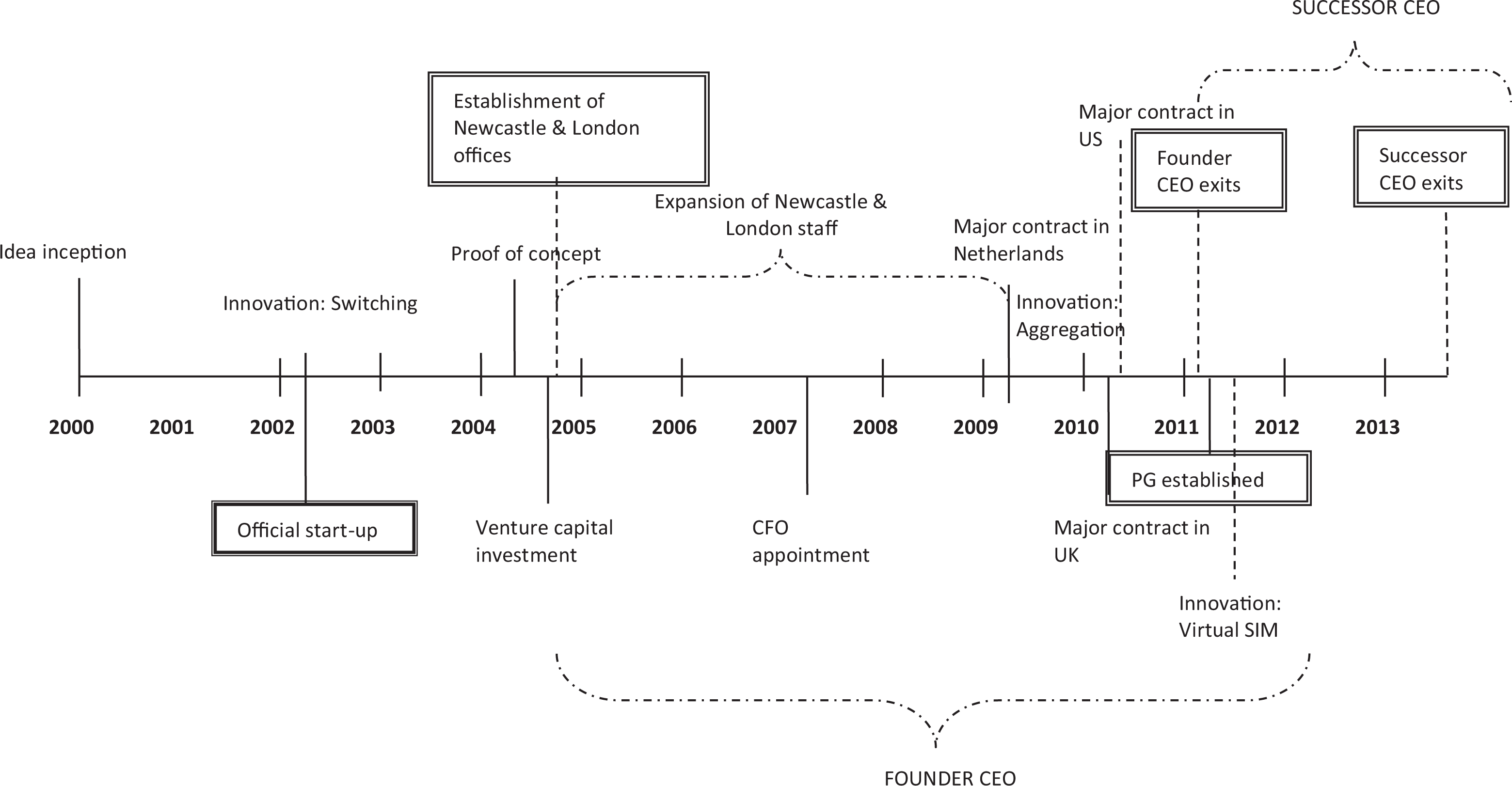
Our study of the firm spans 13 years, from the inception of the idea in 2000 to the exit of the firm’s second CEO in 2013, while data collection continued until early 2014. A summary of critical events as the company grew in financial and human resource capital is provided in Figure 1.
Timeline of critical events.
Our focal firm was a rapidly growing technology venture based in the United Kingdom. It was founded in 2002 by a lecturer in mechanical engineering and a broadcast engineer. The first opportunity to test its innovative “network switching” technology on a train arose in 2004. The test project was successful and WIRELESS became one of the first companies to realize a seamless WIFI connection on trains. This led the venture capital arm of T-Mobile to invest in WIRELESS, helping it to further develop its technology and recruit specialist staff. This investment allowed the firm to set up two offices in 2004: one in London and another in Newcastle. The London office was responsible mainly for business development (e.g. sales and prototyping), while Newcastle dealt with technical development (e.g. programming, installation, and maintenance).
By continuously pushing the boundaries of its technological offering, WIRELESS was able to win several major contracts using its highly innovative technology of “network switching” and “network aggregation,” both of which revolve around using network capacity intelligently across several mobile networks rather than across a single network. The core product platform was the communication control unit (CCU), a piece of hardware that broadcasts a local Internet network on trains using available mobile networks. In 2009, the firm won two large contracts: Amtrak and the Dutch Railways. The latter contract was particularly lucrative, as it involved a large fleet of trains, and caused annual revenues to grow by a factor of almost seven.
Despite the firm’s commercial success, it struggled to manage its operations effectively. The founder CEO’s strategy of rapid growth through continuous innovation caused serious delays in project delivery and frictions between the London and Newcastle offices. Problems eventually escalated, leading first to the voluntary exit of the founder CEO and later to the dismissal of his successor. We captured the events leading to the exit of both CEOs, revealing these to follow a self-reinforcing pattern, which we frame as a vicious cycle. Using organizational paradox as a theoretical lens, we were able to identify the processual roles and micro-level drivers of the vicious cycle.
We found this setting appealing and relevant because when we embarked on this study, the company was almost at the peak of its first stage of growth, namely, the continuous exploration that is typical of high-growth new ventures. This suggested that the firm might encounter paradoxical tensions as it moved into its next stage of growth (Kazanjian, 1988; Kazanjian and Drazin, 1990), potentially more oriented around exploitation. We, therefore, expected that this setting might provide some interesting insights with regard to the decisions, actions, and interactional dynamics involved in responding to paradoxical tensions and the effects that these had on the growth of the venture. When we started our fieldwork, the firm employed about 120 employees and we were able to interview many of the organizational actors involved in the process through which paradoxical tensions became apparent and evolved over time.
Data collection
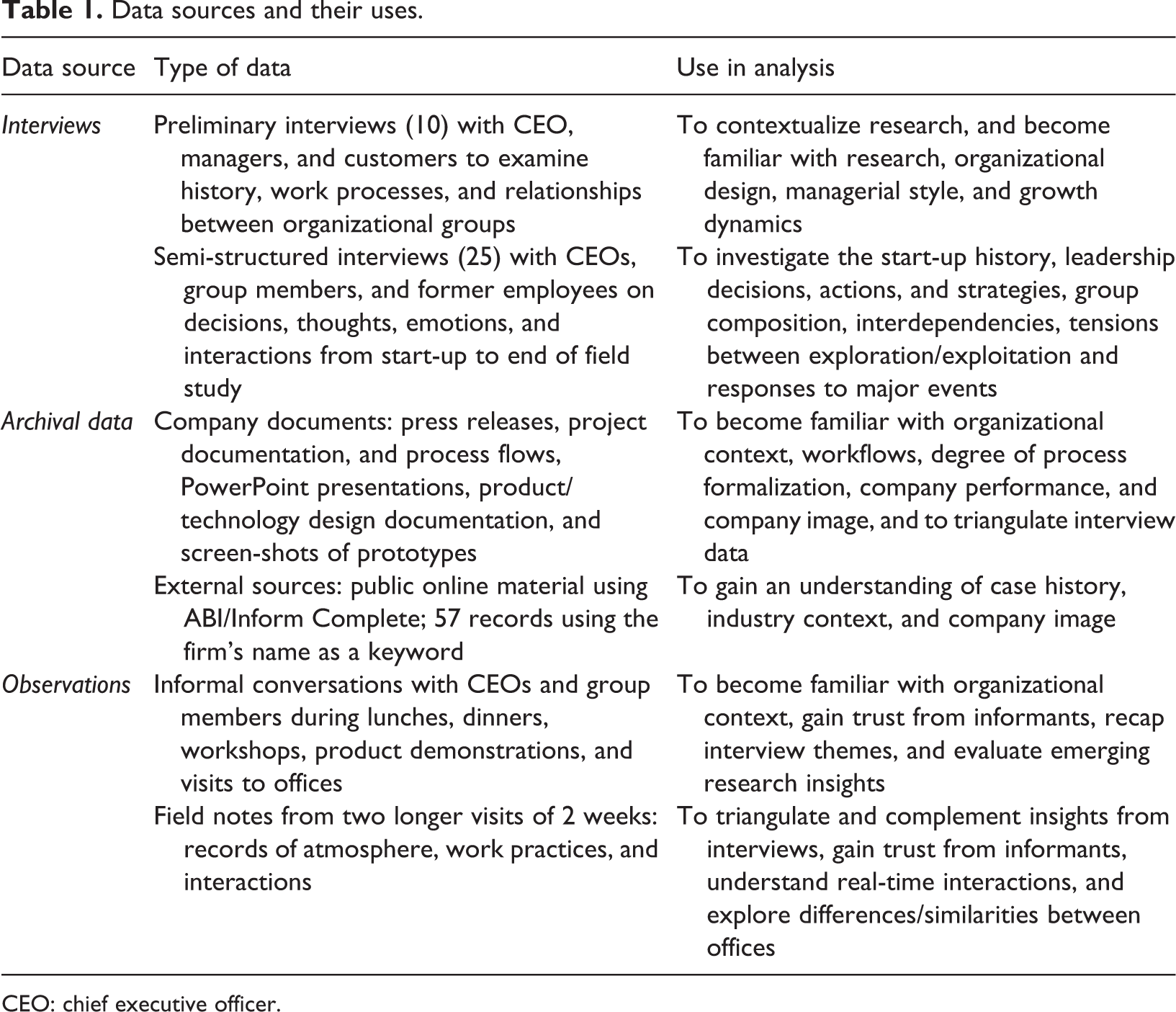
A key principle in process research is that phenomena are studied over time to collect rich, longitudinal data. Our data collection was conducted over a 34-month period, from May 2011 to March 2014 and drew on interviews, observations, and archival data. While observations and archival documents were mainly used for triangulation and contextualization, our main source of data comprised semi-structured interviews. The interview data enabled us to acquire rich accounts of events from multiple perspectives. The underlying assumption in inductive research is that informants are “knowledgeable agents,” who are able to convey what their decisions, thoughts, intentions, and interactions are/were (Corley and Gioia, 2011). There was very little corporate secrecy and few restrictions which meant that we had an exceptional level of access to both primary and secondary data. Table 1 describes our data sources and how we used them.
Data sources and their uses.
CEO: chief executive officer.
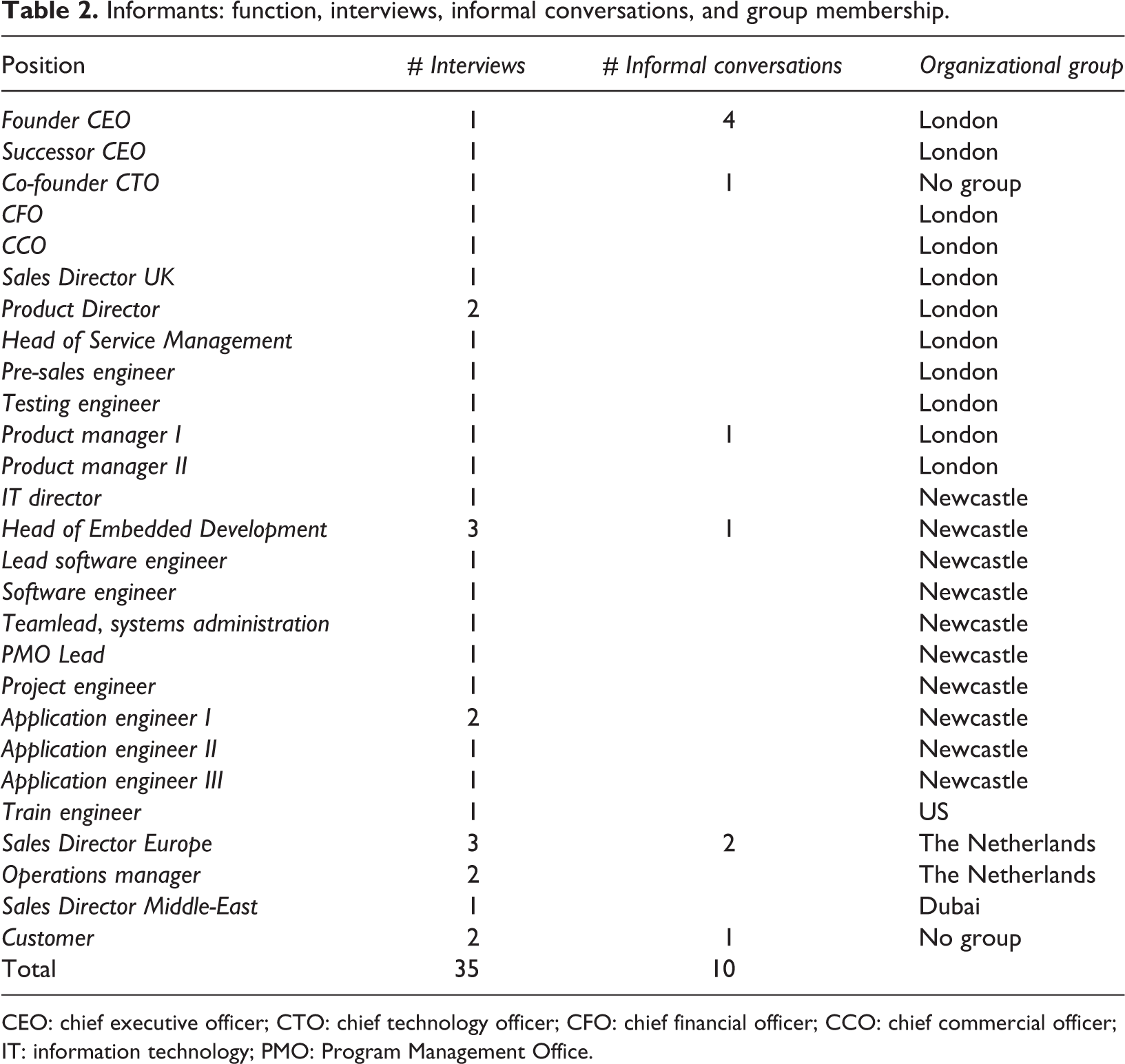
We conducted 35 interviews, which were planned in a series of waves over the course of our field study. The first wave of interviews with the founder CEO and the managers of the London and Newcastle offices was based on purposive sampling (Patton, 1990). This provided a rich account of WIRELESS’s context in terms of its industry, organizational design, products, and strategy. For the subsequent wave, we changed to theoretical sampling (Eisenhardt, 1991) where we developed more specific theoretical research interests. In the first wave, we identified the founder CEO’s preference for exploration-driven growth and the polarity between the two offices. In the second wave, we realized we needed to focus on how the decisions and behavior of the founder CEO and the two-office structure triggered particular, but different responses from employees in London and Newcastle.
After the departure of the founder CEO (third wave), we were introduced to his successor. The differences between the two CEOs were very marked. We set up interviews with the successor CEO and with members of a newly formed London-based group (Product Group, PG). In this third wave of interviews, we continued talking to London and Newcastle employees to discover their responses to the changes in vision, strategy, and design introduced by the new CEO. To complement our informants’ perspectives and interpretations, we interviewed employees at different hierarchical levels and also external informants and former employees. Table 2 indicates the informants’ roles, the number of interviews and the number of informal conversations.
Informants: function, interviews, informal conversations, and group membership.
CEO: chief executive officer; CTO: chief technology officer; CFO: chief financial officer; CCO: chief commercial officer; IT: information technology; PMO: Program Management Office.
Interviews lasted between 45 minutes and two-and-a-half hours, and were electronically recorded and transcribed. We ceased interviewing when we agreed that we had reached theoretical saturation (Glaser and Strauss, 1967).
We made use of observations to familiarize ourselves with the firm and triangulate our interview data. We had several informal conversations with the CEO, chief technology officer (CTO), and employees from the London office over lunch and dinner (Stigliani and Ravasi, 2012). We were also invited to attend a workshop and two product demonstrations. In addition, whenever there was considerable time between interviews, or when interviews had to be scheduled for different days in the same week, we were allowed to spend time at the Newcastle or London offices. This provided an opportunity to observe interactions and work practices and gain additional insights.
Data analysis
To structure and analyze data, we used QSR NVivo8 qualitative data analysis software, which enabled us to analyze data according to the commonly accepted gradual aggregation and abstraction process. First, we began data collection and data analysis following prescriptions for inductive theory-building (Locke, 2001). Shortly after the start of our fieldwork, we began the open-coding process by gathering statements that reflected how our informants responded to tensions between exploration- and exploitation-driven growth and how this affected interactions between leaders and employees, and between employees. We also gradually drew up a set of provisional themes by completing a contact summary form immediately after each interview (Miles and Huberman, 1984).
We then started analyzing the first interviews, initially using in vivo terms and phrases used by the informants (Locke, 2001). During this stage, we learned that the firm was struggling with growth tensions due to the disposition and decisions of the founder CEO and the two-office structure. Later, we were informed that the founder CEO would leave, after appointing a successor. Our interviews with the new CEO suggested that the firm had entered a very different growth phase. This prompted us to conduct additional interviews that would help us to unravel the new CEO’s thoughts and plans and to identify how informants were responding to his arrival and strategy. We compared informants’ accounts of specific projects and events with evidence from the archival data.
Second, by repeatedly revisiting the data, we progressively combined in vivo codes into tentative second-order categories (Locke, 2001). During this stage of analysis, we compared coding structures and resolved any irregularities by discussing and sporadically recoding the data. We also undertook a deeper analysis of the patterns of actions and decisions of the founder CEO and the consequent responses of employees in London and Newcastle. We then started to identify a repetitive pattern of leadership decisions and actions, and negative employee responses—particularly the competitive dynamics between organizational groups. After the appointment of the successor CEO, we already had some constructs to work with (e.g. “tradeoff cognition,” “intergroup tensions”), which helped us navigate through the data collected from informants at that point. We were able to neatly juxtapose codes and categories from the two periods of leadership. In a subsequent round of coding, we tentatively combined second-order theoretical categories (drivers of vicious cycles) into broader, aggregate theoretical dimensions (processual roles in the vicious cycle) relating to the origin, perpetuation, and climax of the vicious cycle.
By collecting data over two different growth stages, one led by the first CEO, the second by his successor, we were able to analyze in detail the two CEOs’ cognitive preferences (two first-order codes) and the effects of senior management representations at certain points in time and in certain parts of the firm (three first-order codes). We then grouped these codes into two categories: “tradeoff cognition” and “structural leadership void.” Observations on how the London and Newcastle groups were separated and interdependent, gave us three first-order codes, which were combined into the “structural separation” category. Together, these three categories (drivers) form our aggregate dimension “cycle originators.”
A considerable amount of data related to competitive dynamics between the structurally separated groups (generating the second-order category “intergroup tensions”) and attempts by both CEOs to resolve tensions (second-order category “ineffectual integration”). A second dimension, “temporal leadership void,” emerged later when the founder CEO left. These three theoretical categories were combined into the aggregate dimension “cycle perpetuators.”
An escalation of competition and conflict between organizational groups also emerged with negative effects on organizational measures (one first-order code). This code developed into the second-order category “escalating tensions.” Then finally, we included the critical event of the CEO leaving the firm under pressure from increasing tensions (one first-order code). This code was part of the second-order category, “political turnover.” These last two categories formed the third aggregate dimension “cycle climax.” Following earlier research that adopted a similar approach to analysis (Gioia and Chittipeddi, 1991; Pratt et al., 2006), we present the resulting data structure in Figure 2.
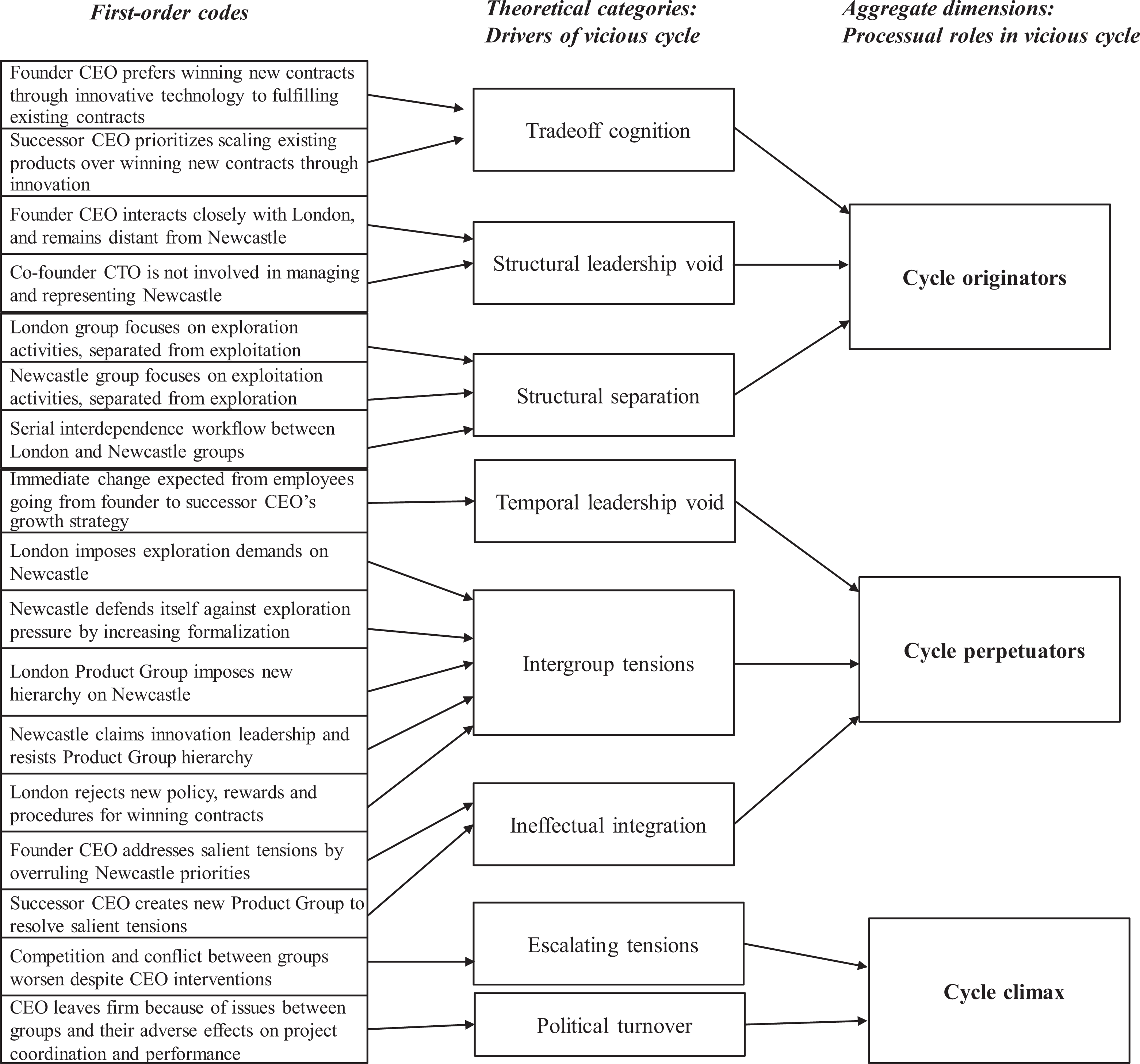
Data structure.
Findings
In this “Findings” section, we first briefly present our overarching conceptual model. This model, shown in Figure 3 emerged from the study, but we present it at the beginning of the findings to aid the reader in following the empirical story. The model illustrates how the three process roles composing a vicious cycle (cycle originators, cycle perpetuators, and cycle climax) are recursively interlinked over time. In the detailed findings below, we show how the processes illustrated in the model played out in two successive iterations, once during the management of the founder CEO (exploration phase) and again during that of his successor (exploitation phase).
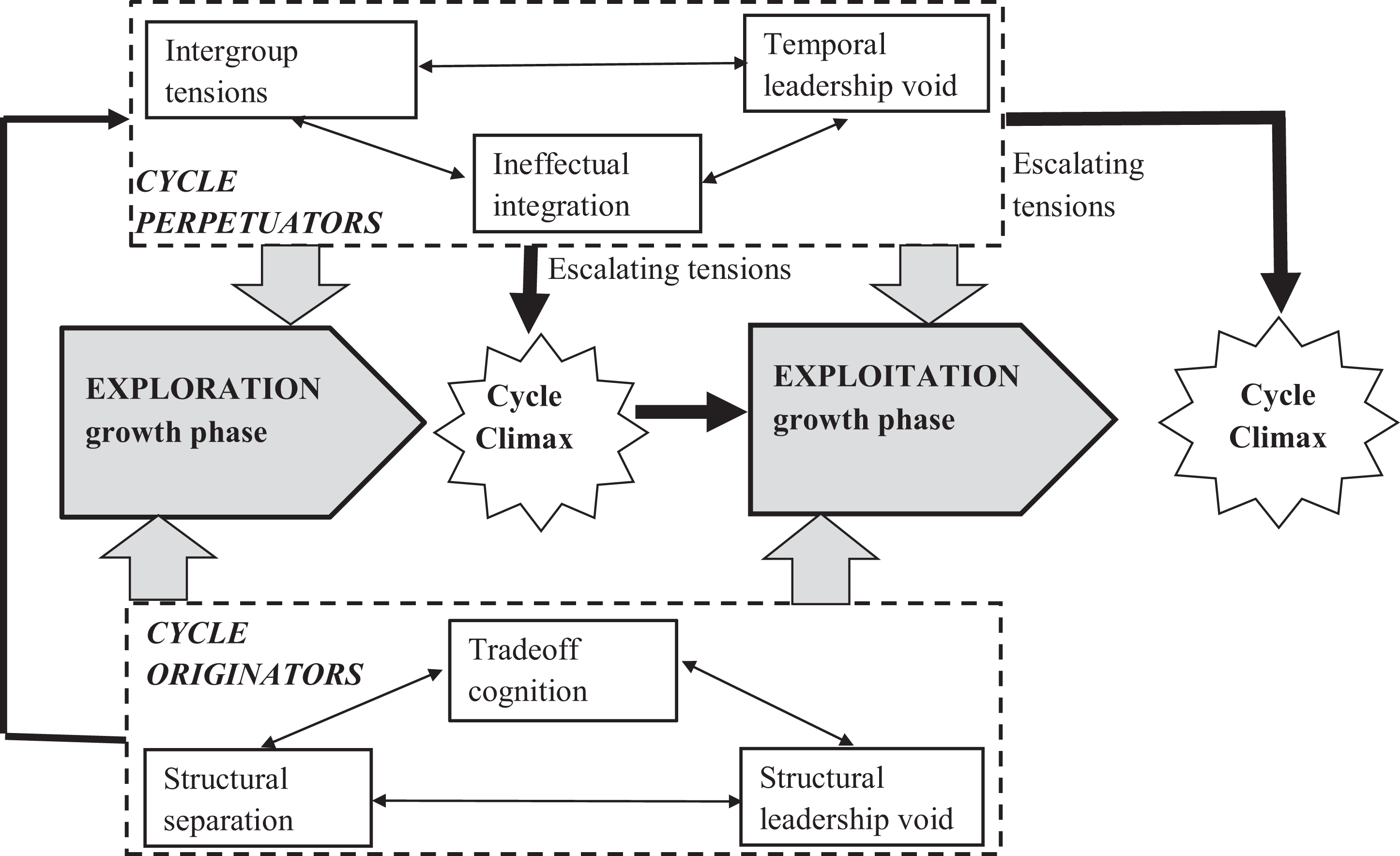
A vicious cycle model of new venture growth.
In Figure 3, the three cycle originators (tradeoff cognition, structural separation, and structural leadership void) are shown in the bottom rectangle. As we show in detail below, these elements reinforce one another and launch a vicious cycle which is then perpetuated through three cycle perpetuators (intergroup tensions, ineffectual integration, and temporal leadership void) shown in the top box of Figure 3, culminating in a cycle climax that creates a discontinuity in the process. Intriguingly, the mechanics of the vicious cycle model that we present revealed an almost symmetric structure, with cycle originators and perpetuators interacting and reinforcing in each iteration, while paradoxical tensions were able to escalate until the point of a cycle climax. Both phases revealed a push of organizational resources by the CEO in the direction of one organizational demand, increasing the pull of the opposite demand until the organization could no longer bear the escalating tensions (climax). Simplistic experiential learning shaped by tradeoff cognition (i.e. the push in one direction did not work, so the solution must reside in a push in the opposite direction), caused the process to be repeated in the subsequent phase, with pull and push forces now playing out in directions opposite to the previous phase, resulting in another climax.
Cycle originators
We begin the presentation of the findings with the processual role of cycle originators, discussing how each affected the firm’s growth and also the interactions between them over the two phases. Table 3 provides further illustrative quotes from our interviewees relating to cycle originators.
Vicious cycle originators.
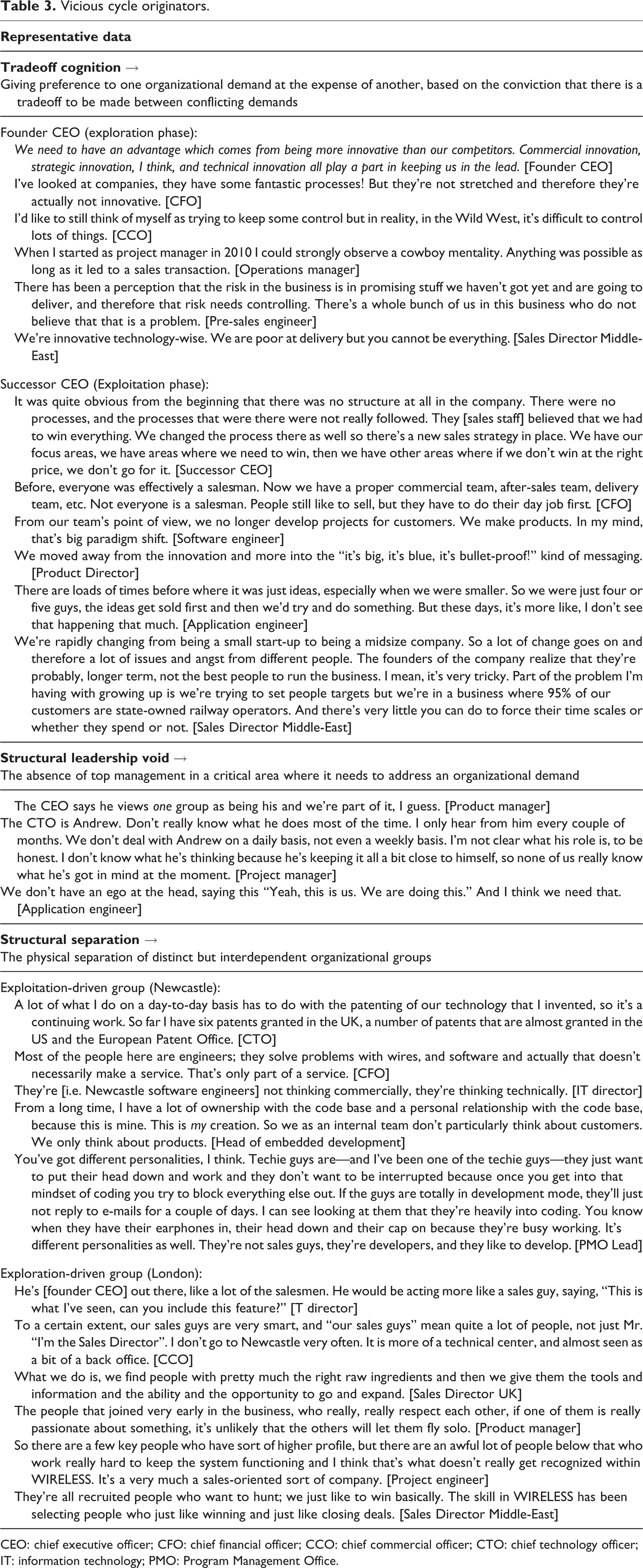
CEO: chief executive officer; CFO: chief financial officer; CCO: chief commercial officer; CTO: chief technology officer; IT: information technology; PMO: Program Management Office.
Tradeoff cognition
We define tradeoff cognition as a preference by the organizational management for one organizational demand (in this case, exploration versus exploitation) at the expense of another, based on the conviction that there is a tradeoff to be made between conflicting demands and that the most appropriate one must be selected. The decisions and actions of both CEOs in this study were driven by tradeoff cognition, but with opposite foci. Although their cognitive orientations were at opposite ends of the spectrum in terms of exploration- and exploitation-driven growth, they were similar in a number of key ways: they both had a strong belief in their own vision and strategy, made false attributions, and persisted with their chosen strategy despite escalating tensions, and blamed those tensions on employees.
In the exploration phase, the founder CEO established the firm with his co-founder who took on the role of CTO. While the CEO managed the firm from the London office, the CTO was based in Canada. After the establishment of two offices in 2004, the founder CEO’s approach to recruitment was very similar to what Witt (2007) describes as a “cognitive leadership regime.” The first individuals he recruited for the London office were friends from previous ventures. These employees were very supportive of his exploration-driven growth strategy. As the London-based chief commercial officer (CCO) said: “The whole culture was: if you want to be part of this game, then you need to be of the same mindset.” Exploration excited the founder CEO, and it was the main thrust for the firm’s rapid, commercial growth; this was achieved mainly by aggressively winning competitive bids by offering innovative offerings and flexible service agreements. Under this CEO, the firm won major contracts with large railway companies such as the Dutch Railways in 2009, Amtrak in the United States in 2010, and East Midlands Trains in the United Kingdom in 2010. WIRELESS competed with firms such as Siemens, Alcatel-Lucent, and Nokia. To win competitive bids, early stage technological concepts were sold to customers even before the development of a prototype. Whether or not it was possible to actually build and deliver the technology into a workable, acceptable product was hardly considered. For example, in 2009, the founder CEO succeeded in selling the concept of aggregation to AMTRAK before informing his most talented software engineer. He asked him to build it within 6 weeks: The CEO walked into the office one day and said, “Nick, you got six weeks to make this work. We need to present this to Amtrak because it’s a prerequisite for their tender. Show them aggregation.” [Head of Embedded Development] The level of people who report to me, they seem to spend endless time discussing this very topic, and they’re forever coming to me and saying “we need to have more of this, or we need to have more structure or more process, or less of this or change that person,” and so they’ve become massively structure-oriented. [Founder CEO]
The successor CEO made his office base London. He led the firm over a period of 2 years. He was a military academy graduate and had also worked in executive positions for Siemens and Disney. His own tradeoff cognition made him strongly focused on exploitation-driven growth, and the contrast between his decisions and those of his predecessor were very obvious. The successor CEO’s tradeoff cognition ignited the second iteration of the vicious cycle.
This CEO was convinced that he had all the solutions to WIRELESS’s problems. He argued that his own strengths were a perfect complement to the shortcomings of the founder CEO. His approach to leading WIRELESS revolved around discipline, focus, and efficiency. Although the new strategy was formally articulated and communicated by the successor CEO, the underlying ideas had already existed in the Newcastle office as became clear in an interview with the Head of Embedded Development and one of his software engineers: So introducing this process [of balancing resources between existing and new projects] was our own self-defense mechanism, and we said to rest of the company: “You now have to go through the systems [of formally applying for technical project resources] and Brenda’s [the PMO Lead] the owner or the gatekeeper of them, and things get prioritized.” [Head of Embedded Development]
The effects of the successor CEO’s tradeoff cognition were also evident in the tensions between old processes (from the time of the founder CEO) and new processes. While the successor CEO introduced new roles and processes for business and product development, he did not seriously consider the project backlog, which by then had reached more than a year. These projects involved contributions from several teams in Newcastle in their former rather than their new roles. This meant they had to work in multiple roles simultaneously, leading to confusion over which was more important.
The two offices needed time to make the shift, time which was not granted as both the founder and successor CEO were convinced that going from one growth orientation to another required an immediate change. The structural separation of the London/Newcastle offices was the second cycle originator to emerge from our data.
Structural separation
We define structural separation as the physical separation of distinct but interdependent organizational groups. The founder CEO was convinced that employees with similar professional backgrounds should be grouped together. He favored homogeneous teams, particularly those working directly with him. The founder CEO would lead the exploration group while the co-founder CTO would lead the exploitation group. Two offices were established for this purpose and the two locations thus became an extension of the leadership profiles of the two founders. Structural separation was introduced in 2004, and in both locations, distinct organizational groups emerged; each had its own set of practices and a coherent professional identity. Although the London and Newcastle groups were separated in different offices, they needed to collaborate regularly to complete projects.
The Newcastle office comprised technical teams involved in software programming, project engineering, systems administration, and graphic design. All of these teams were positioned hierarchically under the CTO (co-founder). The coordination and prioritization of projects was done by the Program Office, which was led by a software engineer.
The London office was considerably smaller than the Newcastle office. Most of its staff had both a technical and a business background, having academic degrees or experience in both areas. Their background was similar to that of their figurehead, the founder CEO. Most of the individuals working in London were directly recruited by him or by his early employees. Their tasks, included business development, technological experimentation, technology scouting, and business model innovation. The London-based roles were CEO, CCO, chief financial officer (CFO), sales director, sales manager, product director, product manager, and pre-sales engineer.
The interdependence between the two offices was serial (Thompson, 1967); that is, tasks and activities in Newcastle were dependent on inputs from London. Whenever a new project was initiated in London, the product development requirements would be sent to Newcastle for implementation. In the coordination of tasks, there was no hierarchy and no one group had decision-making authority over another. Both groups had to work together, and because of the differences in professional identity and work practices, tensions emerged because each group wanted the other group to work according to its preferences and ideas.
London continuously searched for the next technological breakthrough to win contracts, while Newcastle focused on intellectual property (IP) generation and operational excellence by rigorously testing and carefully installing WIRELESS technology on trains. The polarized structure that resulted from the London/Newcastle divide gave rise to tensions around which group, with its corresponding routines, practices, and capabilities, was superior: Newcastle does not appreciate it when people say: “They [London] are the chiefs, and they [Newcastle] are the Indians.” [Operations manager]
In the exploitation phase after the successor CEO took office, London continued to receive top management support but now in a different setting. The successor CEO created the PG in London, which was made responsible for the structuring and scaling of a limited range of products. PG was not only based in London and made up of London employees, but it was also given authority over processes and technologies that were previously under Newcastle’s control. The successor CEO’s support for PG and his exploitation-driven growth strategy, which PG was expected to implement, created another situation in which London was made superior to Newcastle: Innovation now is supposed to be sat with the Product Group that we have. We [Newcastle] just become a type of subservient function and we deliver to somebody else’s [London] requirements. [Head of Embedded Development]
Structural leadership void
We define structural leadership void as the absence of top management in a critical area, where it needs to address an organizational demand. The concept of a structural leadership void surfaced on several occasions during our interviews and observations.
The founder CEO commented on his co-founder: “He, in my view, is the best naturally gifted problem solver, technical problem solver, I’ve ever seen—just fantastic. But useless in an organization.” The CTO remained in Canada, sporadically attending conferences or meetings, but not interfering at all in how Newcastle was managed. His interests revolved around invention and IP: A lot of what I do on a day-to-day basis of has to do with the patenting of our technology that I invented, so it’s a continuing work. So far, I have six patents granted in the UK, and a number of patents that are almost granted in the US and the European Patent Office. We’ve got the senior management team [in London] going off developing this [London-driven approach to innovation], but we’ve got this void of no CTO being there at the moment. I think the problem is the void, that we don’t have the CTO position covered. The effect is that they’re marching in and trying to dictate and mandate the way that we [Newcastle] operate. [Software engineer]
In sum, we identified three cycle originators: CEO tradeoff cognition, structural separation, and structural leadership void. These three originators interacted to initiate a vicious cycle that accompanied WIRELESS’ rapid growth. The founder CEO’s tradeoff cognition made him decide that like-minded employees should work together, and he thus separated them between the London and Newcastle offices. Through this structural separation, he was able to translate his tradeoff cognition into coherent, consistent decisions, because the London office was populated by exploration-driven employees he knew from previous ventures. Moreover, the absence of his co-founder CTO left the Newcastle office without top management representation, and thus tensions between the exploration and exploitation orientations of the two offices were not resolved at that level. This interplay between cycle originators caused the vicious cycle to appear in the exploration phase and to reappear in the exploitation phase.
Cycle perpetuators
The cycle perpetuators are elements that prevented the firm from breaking free from the vicious cycle. We identified three cycle perpetuators: a temporal leadership void, intergroup tensions, and ineffectual integration. Table 4 presents some additional empirical evidence relating to the cycle perpetuators.
Vicious cycle perpetuators.
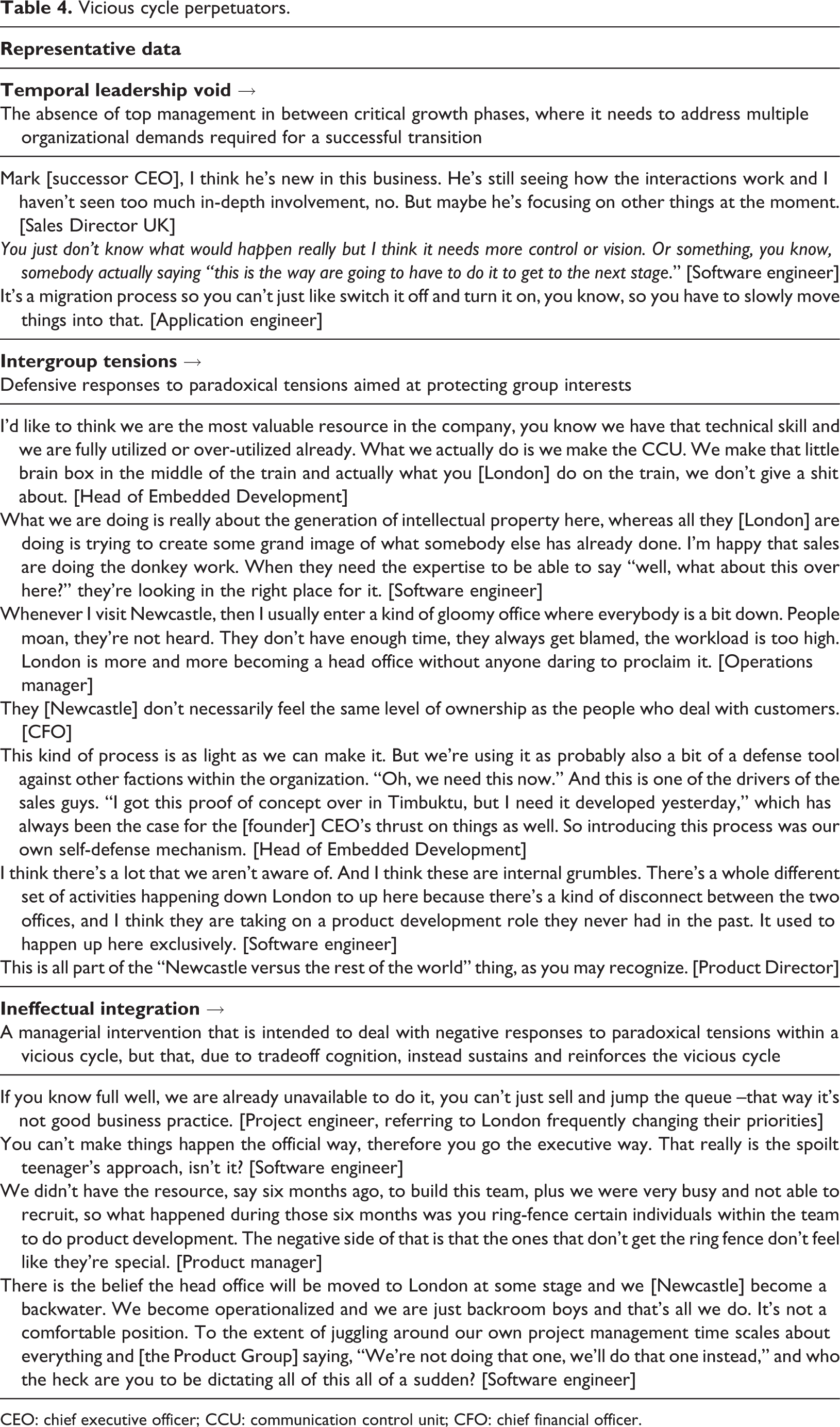
CEO: chief executive officer; CCU: communication control unit; CFO: chief financial officer.
Temporal leadership void
The notion of temporal leadership void is defined as the absence of transitional leadership guidance between venture growth phases (explorative and exploitative). Specifically, in this case, the successor CEO followed on immediately from his predecessor without a coordinated transitional phase to bridge the two strategies for growth. While the founder CEO believed that WIRELESS required radical changes, he did not allow much time or space to make the transition from the current position to the desired position. Despite having led the company over 7 years of exploration-driven growth, he still envisaged that the shift to exploitation-driven growth could be made swiftly and smoothly: You draw a box but you don’t make a plan to make that happen in a human way—you just say “that’s the new box.” That can dispirit people. [Pre-sales engineer]
Although both the founder and successor CEO agreed on an immediate, direct shift from exploration- to exploitation-driven growth, employees did not quite understand how to implement this. A London-based product manager described how they were split between the old and the new approach to product development: At the moment I think we are probably in two minds. Either we do dedicated product development [the Product Group] or either we continue as we are doing now where the teams are split between doing development for customers [London] and product development [Newcastle]. There’s an uneasy tension for me, you know—the more hats you wear, then what am I today? Am I a developer? Am I a pre-sales engineer? What is it that this company is expecting me to be today? [Software engineer]
Intergroup tensions
The second cycle perpetuator is intergroup tensions, which we define as defensive responses to paradoxical tensions, aimed at protecting group interests. We will first explain how tensions appeared under the founder CEO, and then under the successor CEO.
In the exploration growth phase, the London office had an obvious advantage over Newcastle because of its alignment with the CEO’s tradeoff cognition. The Newcastle office, however, was vital to sustaining the exploration-driven growth strategy, because it built and delivered the products that made a difference in winning commercial bids. Nonetheless, the founder CEO had little interest in how products were built or maintained. Intergroup tensions were evident in expressions by London employees such as “play” versus “the serious bit,” “shop” versus “factory,” “the NO (Newcastle) office,” and “the machine” (i.e. Newcastle). Interestingly, over time, within each office increasingly coherent professional groups with strong identities emerged. An application engineer commented: “At parties and events you can see the groups. Everyone walks straight to his or her group.”
The London office was supported by the founder CEO and was therefore able to push its ideas through the development pipeline, despite a plethora of unfinished projects in Newcastle. New projects, shifting priorities and a high workload led Newcastle staff to complain more frequently and more intensely about the need for formal processes and structures. However, they did not wait for the founder CEO and other executives to give them permission to introduce more structure. Their separate location and distance from management allowed them to satisfy this need autonomously. We were given access to product documents such as a 46-page system design for the East Midlands contract. The “Products and Services Agreement” for the same project contained 97 pages of dense technical description. Perhaps the most significant introduction of structure was the establishment of the Program Management Office (PMO) in Newcastle. This team was led by a software engineer and she tried hard to make London adhere to the software release schedule. This schedule stipulated the resources to be allocated to existing versus new projects. This meant she often replied negatively to requests for resources from London, because the available resources had already been fully allocated: Why do you [London] want to do that? Why have you [London] sold that customer something? It could be sometimes that is not resalable…you sold that?! It’s like 40 days’ development! Sales guys are sales guys—they want to sell and they don’t want to follow process, so I have to keep reining them back in to get them to follow the process. The only time I have any heated discussions is when it’s sales. [PMO Lead] Don’t waste people’s time with process that doesn’t serve the end gains. It creates tension, I think. You try to stop it at the entrance gate but it’s just going to result in continuous escalation, right up to the CEO if necessary, to make it happen, because it has to happen. I just see any structure that is “the factory trying to run the shop” as just self-defeating.
In the exploitation phase, the successor CEO made a serious attempt to reorganize WIRELESS in the way he believed was necessary. The decisions he made caused intergroup tensions to persist. For example, his introduction of sales targets, minimum profit margins per new contract, and other formal changes that should have helped WIRELESS get closer to its initial public offering, were anything but welcomed by staff. The Sales Director Middle-East described these changes as conveying distrust. The Sales Director Europe even referred to threats: “If you don’t do as I say, I will fire you.” [reference to successor CEO threat] The way there’s currently being dealt with people, with problems, with [inaudible], in reality it’s a very unhealthy situation of course, and it’s only getting worse. He’s dropped out. Quite rightly, he had no role in products. It was another bright idea by the CEO and he stepped in, but what am I going to do with him [i.e., the New Media employee]? [PG Director] People are being told this is a product team but they’re not being told this is their relationship to you. So I can fight my corner as well as anybody but that’s different from a top down statement: “This is how it’s going to hang.” [PG Director stating that the successor CEO should emphasize to Newcastle that PG is hierarchically in control of innovation] We’ve got the product management group [PG] flowing in and thinking it’s controlling half of it. So I’m challenged by the Product Director trying to impose a new architecture on us. I am the architect because that’s what I’ve been. I’m responsible for this until somebody tells me I’m not. Sorry mate, bugger off. [Head of Embedded Development]
Ineffectual integration
Effective integration of conflicting activities has been highlighted in various studies as being important for a firm’s long-term success, and managers have been shown to play a crucial role in this (Sidhu et al., 2020; Smith and Tushman, 2005). Effective integration requires leaders to adopt paradoxical frames. Our two CEOs, however, both operated from tradeoff cognition. This clouded their understanding of the causal mechanisms underlying intergroup tensions between the Newcastle and London offices, and both thus came up with ineffective interventions. We label these interventions “ineffectual integration,” which we define as a managerial intervention that is intended to deal with negative responses to paradoxical tensions within a vicious cycle, but that, due to tradeoff cognition, instead perpetuates and reinforces the vicious cycle.
In the exploration growth phase, the founder CEO regularly interfered in the product development process. Staff in the London office would often disagree with the priorities or resource allocation in Newcastle and so would contact the CEO. The PMO Lead complained about this: They [London] don’t like taking no for an answer, and if they don’t get what they want, then they just ring the CEO. It’s very hard. Then the CEO will ring me to say: “Alright Brenda, what can we do to sort this out?” The company gets more and more serious [exploitation-oriented] and less and less playful [exploration-oriented] and one of the roles I have is to say: “You [Newcastle] get on with that serious bit, we’re [London] going to have a bit of a laugh over here.” [by initiating a new technology or contract despite Newcastle’s objections]
Instead, this only emphasized to Newcastle that exploration was again being prioritized over exploitation. The London office was comfortable with these interventions by the CEO, but complaints from the Newcastle office only increased.
In the exploitation phase, the successor CEO’s intervention was embodied in the creation of the PG. By formalizing and controlling product development by creating this group, he believed that the tensions between the two offices would be resolved. Interaction between them would be reduced as their activities would no longer be serially interdependent. Instead, PG was now responsible for managing the interactions between London and Newcastle by owning and controlling the product strategy: There was nobody who actually owned the product. It was a communication directly between sales and the developers. Sales had to pull out development people to support them and there was nobody left behind to take care of the projects. That had impact on delivery, on time, and quality as well. [Successor CEO]
In sum, the cycle perpetuators extended the vicious cycle. WIRELESS was plagued by the inefficiencies created by intergroup tensions, which escalated in the setting of structural separation. The tradeoff cognition of the two CEOs prevented them from seeing structural separation as a problem. The capabilities of both groups were critical, but the inability of both CEOs to realize the importance of this led them to make futile interventions, which we have termed ineffectual integration. Also, once the founder CEO found himself caught up in the negative self-reinforcing pattern of decisions and actions, he recruited a replacement who was his polar opposite, without seeing his employees’ need for a transitional phase. Given the strong contrast between the vision and strategy of the two CEOs, the need for some form of transitional period was even more pressing. Thus, after the successor CEO took over, the firm found itself trapped in a second iteration of the vicious cycle, once again leading to another major event of the CEO leaving the firm.
Cycle climax
During both occurrences of the vicious cycle, that is in the exploration and the exploitation growth phase, the cycle perpetuators caused tensions to escalate, leading to a political turnover; that is, the CEO leaving the firm due to internal tensions. We conceptualize this cycle climax as a major organizational outcome resulting from escalating negative responses to paradoxical tensions. On paper, WIRELESS was doing everything that successful start-ups are expected to do: develop IP, secure venture capital, grow rapidly, evolve from one phase to another, and change the firm’s executive leaders if they are no longer deemed capable of leading the firm. Our data do not tell a typical start-up success story. WIRELESS was trapped in a negative, self-reinforcing pattern of decisions and actions, culminating in two CEOs leaving the firm.
The departure of the first, the founder CEO, was voluntary. The departure of the second CEO, however, was involuntary, as it was determined by a board decision. The founder CEO’s departure was triggered by his awareness that he was no longer able to address the tensions between the Newcastle and London offices. He believed strongly in his strategy and he shared with us that he genuinely did not understand why the complaints from Newcastle kept increasing over time, despite his interventions and the successes the firm had experienced. What he eventually concluded was that WIRELESS required him to be less of an entrepreneur and more of a manager: “I’m increasingly a manager, which is a role I’m less and less comfortable with, because I don’t like management very much.” He thus appointed a “manager”—the successor CEO—who was expected to resolve these tensions.
The successor CEO introduced his organizational redesign and communicated his strategy, and this led, unexpectedly, to negative responses once again. First, tensions between Newcastle and the London re-emerged and became worse because of issues over design authority and product development strategy. Second, sales directors and sales managers were resistant to the new system. The sales staff felt the new strategy compromised their business development capability: As a company we need to make sure we don’t lose that. Because the commercial flexibility, in terms of how we offer it, and what we will do to prove what we say is right, has [previously] led to a lot of sales. [Product manager] They believed that we had to win everything. We changed the process so there’s a new sales strategy in place. We have our focus areas, we have areas where we need to win, then we have other areas where if we don’t win at the right price, we don’t go for it. Right now, they can’t go out and sell a project any more. They can only sell what we have on the shelves. If we don’t have the product on the shelves then they basically can’t sell it. That’s a big change for them because before they just asked the customer “What do you want?” and then we basically developed that, whatever they wanted. [Successor CEO] I think we suffer, though, when there’s not an understanding of what’s actually going on, because if there’s conflict it doesn’t come from, you know, “the people can’t get along.” I think it’s really important for the chief [CEO] to get involved, because if there’s tension, it’s coming from miscommunication or the way it’s [the two-office structure] set up.
Discussion and conclusion
We started this article with two research questions: (1) How do vicious cycles emerge in high-growth ventures? and (2) What are the specific drivers and outcomes of vicious cycles in this type of venture?
Our evidence suggests that vicious cycles in high-growth ventures will manifest themselves during phases in which there are contrasting growth orientations (e.g. exploration vs exploitation; see Figure 3). As we have shown, these phases end abruptly after the intensive interplay between different drivers that either initiate or perpetuate the vicious cycle, resulting in a political turnover thrusting the vicious cycle in the opposite direction. This is broadly aligned with the literature (Ambos and Birkinshaw, 2010; Lewis and Smith, 2014; Masuch, 1985; Sundaramurthy and Lewis, 2003), which suggests that vicious cycles will eventually lead to a major, negative outcome. We assert that the more climactically these vicious cycles end, the more likely it is that the subsequent growth phase will involve a radical departure from the growth orientation of the previous phase.
The dynamics of vicious cycles in high-growth ventures are explained by multiple drivers that interact during the growth process, leading to the emergence, and later reappearance of the cycle. We identified tradeoff cognition, structural separation, and structural leadership void as three drivers that initiate each iteration of the vicious cycle. Previous studies (Smith and Lewis, 2011; Smith and Tushman, 2005) have argued that paradoxical leadership is crucial for overcoming organizational tensions that originate from contradictory demands. Our evidence clearly shows there was no such paradoxical leadership in our case, as this was largely replaced by the one-sided tradeoff cognition of leaders who clearly preferred one growth orientation to another. The role of tradeoff cognition is compounded in new ventures, as their leaders have both strategic and operational responsibilities (Cao et al., 2010). However, we argue that tradeoff cognition on its own is not enough to initiate a vicious cycle. If new ventures are based in multiple locations, rapid growth is likely to increase internal complexity since different albeit interdependent groups develop distinct capabilities, some of which are aligned more to exploration, and others more to exploitation. Thus, contradictions will start to become apparent, and conflicts may arise as a result of misalignment between the tradeoff cognition of an individual leader and multiple, conflicting group identities. This misalignment may be amplified if groups experience different levels of top management representation; that is, if there is a structural leadership void in parts of the firm. If the top management team is homogeneous and its actions are consistent with a particular tradeoff cognition, this may lead to some groups’ interests being compromised for the sake of others. The interplay between these drivers could then trigger a vicious cycle during different periods in the firm’s growth.
Intergroup tensions are aggravated by ineffectual interventions by leaders with tradeoff cognition, who are unaware of the true causality underpinning the vicious cycle (Masuch, 1985; Repenning and Sterman, 2002). If these tensions escalate to the point where there is a drastic shift from one growth orientation to another, then the venture’s need for a gradual, coordinated transition is likely to be overlooked. This will allow tensions from the earlier growth phase to extend into the new phase, leading to another iteration of the vicious cycle in which originators and perpetuators interact to set off and sustain a similar, negative, self-reinforcing pattern.
Our findings have implications for the linkages between the literatures on organizational paradox, ambidexterity and venture growth. We discuss these implications and opportunities for future research in detail below.
Vicious cycles in high-growth ventures
In the largely conceptual studies on vicious cycles, leaders are regarded as giving priority to one type of organizational demand rather than also addressing other conflicting demands (Masuch, 1985; Repenning and Sterman, 2002; Sundaramurthy and Lewis, 2003). In this research, leaders are seen as playing a central role in spurring and sustaining vicious cycles through consistent logic, misplaced confidence in their own strategies, and a misunderstanding of the causal mechanisms behind tensions. Their strategies and decisions evoke negative responses from employees in a self-reinforcing pattern, resulting in declines in performance, and ultimately organizational collapse. In paradox theory, this is the characteristic depiction of a failing organization, whose leaders are unable to confront paradoxical tensions effectively.
Our findings extend these contributions by showing that organizational paradox can be a valuable theoretical lens with which to study not only established organizations, but also growth in new ventures. We observed a vicious cycle of organizational growth in which leaders played a prominent role. We suggest that when considering what particular leadership issues drive vicious cycles, these can be attributed to the construct “tradeoff cognition” in the leader of a firm.
Further unpacking leadership behavior in vicious cycles, we add the concept of leadership void which includes two types. The first type, structural void, became more evident because the co-founder had no interest in managing the firm. The role of this structural void as one of the cycle originators indicates the importance of power structures and complementarities between co-founders. Smith and Tushman (2005) have highlighted the importance of top management team dynamics in the formation and maintenance of virtuous cycles. We would encourage similar studies to look at founding teams and their members’ roles in vicious cycles. We speculate that, if there are appropriate complementarities between the founders—namely different but complementary strategies, logics, or leadership styles—the negative effects of structural void in driving vicious cycles may be reduced. These interactions between the managing co-founders could become a mechanism for strategic integration of conflicting demands in high-growth ventures.
The second type of void, a temporal void, sustained intergroup tensions in our focal firm, where tradeoff cognition prevented the two leaders from seeing a need to bridge the two growth phases, with their conflicting growth logics. They believed the firm could simply move straight from one phase to the next. Future studies could shed light on the relationship between tradeoff cognition and a temporal void. We assert that tradeoff cognition is highly likely to lead to a temporal void but future studies might discover cases in which a gradual transition is realized, despite a founding CEO’s tradeoff cognition, possibly if the successor has paradoxical cognition.
Previous studies on paradoxical tensions have proposed that one important difference between leaders driving virtuous cycles and those driving vicious cycles is that the former make a deliberate attempt to integrate activities associated with conflicting organizational demands, whereas the latter supposedly do not (Andriopoulos and Lewis, 2009; Knight and Paroutis, 2017; Lewis, 2000; Smith and Lewis, 2011; Smith and Tushman, 2005; Papachroni et al., 2016). We suggest this difference needs to be rethought, because we did not find that leaders made no attempt at all to integrate activities. They actually attempted integration, but because of tradeoff cognition their interventions were ineffective and unsuccessful—in fact, they aggravated the tensions. We add to the paradox literature the construct of ineffectual integration as a characteristic leadership response to vicious cycles in high-growth ventures.
We have also reported a climax in vicious cycles in a new venture, and while political turnover is more specific than outcomes previously reported (Repenning and Sterman, 2002; Smith and Lewis, 2011; Sundaramurthy and Lewis, 2003), we admit that it is but one outcome among a myriad of other potential outcomes such as bankruptcy or acquisition. We encourage future longitudinal research to examine such outcomes using the lens of organizational paradox, as this would enrich our understanding of vicious cycle dynamics and climaxes in high-growth ventures.
We contribute to the literature on organizational paradox by showing that vicious cycles can emerge even in organizations that are seen as successful, and particularly in high-growth ventures. Our findings from a case of a successful venture contrast with existing work on vicious cycles that relates exclusively to failing organizations (Smith and Lewis, 2011). Our focal firm was led by a founder who did everything he was expected to do in leading the firm’s growth, and his efforts culminated in a major investment from a large venture capital firm. This early success can reinforce the vicious cycle as it increases founding leaders’ confidence in their beliefs of how the firm should be managed and grown. Tradeoff cognition is thus consolidated as a legitimate paradigm for decision-making. When tensions escalate over time and eventually hamper performance, it becomes very difficult for founding leaders to shift from seeing tradeoff cognition as a driver, to seeing it as an inhibitor of sustainable growth. The notion of early venture success as reinforcing feedback contributes to our understanding of why and how vicious cycles hijack the growth of promising ventures.
Structural separation of distinct but interdependent organizational groups
Our observations are also of relevance to the ambidexterity literature, particularly to studies on structural ambidexterity (Birkinshaw and Gibson, 2004; Jansen et al., 2006; Tushman and O’Reilly, 1996). One frequent recommendation in terms of how to manage opposing organizational demands is to build inconsistent, specialized structures (Gilbert, 2005; O’Reilly and Tushman, 2008), which are said to help balance exploration and exploitation. Keeping these two forms of activity structurally separate within the firm can facilitate ambidexterity.
Schreyögg and Sydow (2010) take a quite different view, arguing that structural separation is ineffective and can lead to sharp interfaces, unclear priorities and increased coordination costs. Our findings confirm this view, as we observed conflicts, unaligned priorities and project delays, despite the separation of the two initial organizational groups. What has been less clear in previous studies is what the underlying causes of these issues may be. One observed cause is the interaction between structural separation and the tradeoff cognition of leaders who regard some groups as more important than others, as we have explained in the previous section. Based on our findings, we argue that structural ambidexterity is less likely to be realized in the presence of CEO tradeoff cognition because it creates hostile competition, as inferior groups may seek to increase their relative importance (Pandza, 2011). An additional factor that may enable or inhibit structural ambidexterity is task interdependence (Es-Sajjade and Wilkins, 2017).
In the case of structural separation, it is questionable as to whether a workflow where groups need to work sequentially (i.e. involving serial interdependence) to deliver projects and products will enable conflicting demands to be managed effectively. Serial interdependence implies a direct interface between groups and frequent interactions. The idea behind structural separation, however, is that there are minimal interactions and no direct interface. Serial interdependence invites tensions, as we have observed in our case. The rival groups in our study were in continuous conflict with one another because of issues such as power, pride and ownership, which were rooted in strong professional identities. These issues meant that the firm gained none of the potential benefits of structural separation in terms of managing paradoxical tensions between exploration and exploitation. We believe that these observations are important, because they invite future research that could help give the construct of structural ambidexterity more theoretical elaboration.
Characteristic problems of new venture growth
In much of the literature on new ventures, their growth pattern is conceptualized as a sequential progression from conception, commercialization and growth to stability and maturity (Ambos and Birkinshaw, 2010; Quinn and Cameron, 1983; Greiner, 1998; Kazanjian and Drazin, 1990; Penrose, 1959). Each stage has its own dominant problems, which determine the new venture’s success or failure (Quinn and Cameron, 1983). Typical solutions reported in the literature for addressing these growth dynamics are cyclical ambidexterity (Greiner, 1998; Jansen et al., 2006; Lubatkin et al., 2006; Raisch and Birkinshaw, 2008) or a change of CEO (Ambos and Birkinshaw, 2010; Kor et al., 2007; Witt, 1998, 2000).
Our findings question the effectiveness of cyclical ambidexterity and change of CEO as solutions, as we found both to be associated with a vicious cycle. While cyclical ambidexterity has gained widespread acceptance and has been an implicit part of the classic conceptualization of new venture growth, we suggest that swings in strategy from exploration to exploitation aggravate intergroup tensions, increasing the strain on resources, which are typically scarce in new ventures. Based on our findings, we argue that these swings are not part of a natural process of successful growth but may instead represent forceful shifts imposed by leaders who are plagued by tradeoff cognition and incapable of seeing the underlying causes of tensions between groups. Indeed, the role and significance of swings between exploration and exploitation over a venture’s lifecycle should be reconceptualized, so that they may also be seen as problems, rather than solutions.
Furthermore, our findings are markedly different from what is suggested in the literature on CEO turnover within the context of new venture growth (Witt, 2007). Although there is an assumption that distinct growth phases require distinct leaders with cognitive frames aligned with a particular growth orientation (at the expense of another), in our case, this approach did not prove to be productive in terms of achieving sustainable growth. We instead suggest that, in any given growth phase, leaders need to address conflicting demands simultaneously. We found that the need for exploration and exploitation was there at least since the establishment of the two offices, and neither of the two CEOs was able to manage the resulting group dynamics effectively. Prior studies have advocated counterintuitive strategies (Foss et al., 2015; Sine et al., 2006) for new venture growth. We concur with these thoughts, and suggest that CEO turnover should be prevented rather than encouraged, and that new venture CEOs should (learn to) formulate and implement counterintuitive rather than consistent strategies at any given growth phase of a new venture.
Boundary conditions
Our model appears particularly relevant for technology-driven ventures that have secured venture capital to enable rapid growth, and that are led by visionary leaders with strong, consistent views about growth orientation, innovation strategy, and organizational design. The model is even more relevant in knowledge-based settings where professional groups with complementary expertise develop distinct identities and also have to coordinate actions interdependently.
We should also acknowledge the possible limitations of a vicious cycle model of new venture growth. For ventures with founders or leaders who are not interested in securing venture capital but opt instead for more organic growth based on revenue generation (Phillips and Tracey, 2007), the dynamics may play out completely differently. In this case, the venture may be allowed ample time and space to grow, because aggressive exploration-driven growth is not jeopardizing the venture’s ability to take on new commitments, at the expense of earlier commitments.
Another setting in which our model may have less relevance is where a venture does not have to accommodate multiple groups. Ventures may be operated from a single location or employees may work remotely. In such situations, competition between groups may not necessarily develop, with one group feeling superior to another. There may be an overarching organizational identity connecting employees, or individuals may not feel themselves to belong to any particular professional group within the firm.
Perhaps the most critical condition for the emergence of vicious cycles of new venture growth is the presence of leaders with tradeoff cognition. Where a venture has a leader with paradoxical cognition or a top management team whose members have complementary orientations and are working in a balanced power structure, growth may be managed to prevent tensions from escalating (Sidhu et al., 2020; Smith and Tushman, 2005). Where there is no tradeoff cognition and centralization of power, tensions may not get out of control, as leaders will acknowledge that there are multiple growth demands at any one time, and will act in ways that balance these demands.
Although there are boundary conditions to the vicious cycle model of venture growth, we are, however, convinced that a more general paradox model could work in many different settings, as tensions between demands in new ventures can exist in a myriad of forms. There are inevitably tensions associated with the growth of a new venture. Paradox theory provides appropriate language and tools for understanding how and why paradoxical tensions in ventures develop into virtuous or vicious cycles to provide novel additions to our understanding of how ventures grow, fail, or succeed.
Conclusion
Our study offers an inductively developed process model that reveals the drivers of a vicious cycle in a high-growth venture. We have shown how a seemingly successful new venture can experience a vicious cycle of growth that persists over time, despite managerial interventions. Using paradox theory as a lens, we challenge established theory on new venture growth by suggesting that the characteristic linear process in which firms alternate between different modes of growth, with accompanying changes of CEO, is not the process that researchers and leaders/owners of new ventures should be advocating or pursuing. Following the shift from tradeoff perspectives to paradox perspectives in research on established organizations, we emphasize the importance of encouraging a similar shift in research on new ventures. This shift in focus would imply building new, paradoxical, venture growth theory. This would expand on conflicting demands at a systems level. It could also shed light on how new ventures and their leaders can learn to manage paradoxical tensions effectively, and might thus prevent drastic events such as a change of CEO, particularly at a time where many start-ups in economies across the world struggle to survive.
Footnotes
Declaration of conflicting interests
The author(s) declared no potential conflicts of interest with respect to the research, authorship, and/or publication of this article.
Funding
The author(s) disclosed receipt of the following financial support for the research, authorship, and/or publication of this article: This paper benefited from the Marie Curie FP7 ITN grant to the first author.
