




Abstract
Qualitative process research is becoming increasingly popular, yet authors often struggle with creating an effective write-up. Process articles must demonstrate a close-knit link between process data and process theory, and, at the same time, engage the reader. This requires trade-offs among options for composing the presentation of narratives, concepts, and theoretical process models. This essay distinguishes three compositional structures authors can use to write up their findings—inductive, conceptualized, and model-led. We discuss their key characteristics, pros and cons, and conditions for effective use and offer exemplars for inspiration.
Management scholars are increasingly responding to calls for qualitative process research to explain how phenomena emerge, develop, change, and terminate over time (Langley, 2007; Langley et al., 2013; Langley and Tsoukas, 2017). Much methodological advice has been offered over the years for doing process research. In this essay, we provide reflections and suggestions for writing up the finding from qualitative process research.
Although writing up qualitative research is seldom easy (Golden-Biddle and Locke, 1997), our experience—as well as that of many colleagues and students—suggests that writing up process research has a unique set of hurdles. Process research covers dynamics that unfold over time, and describing and demonstrating the temporal coherence (Pettigrew, 1990) of these requires space—which is highly restricted in journal articles. Moreover, the rich contextual details that feature in qualitative process research make for memorable stories (e.g. Bruner, 1986; Orr, 1996), but, at the same time, are difficult to convey in truncated and abstracted presentations. Thus, authors who aim to publish journal articles face challenging trade-offs between taking readers on a journey of discovery by “letting the data speak” and highlighting theoretical interpretations.
The useful guides on writing up qualitative management research provide little guidance on how to report the findings from qualitative process research (e.g. Bansal and Corley, 2012; Jarzabkowski et al., 2014; Pratt, 2009), except for a few personal reflections (Helin, 2015; Smith, 2002). In addition, scholars have different (sometimes implicit) opinions on how to effectively compose qualitative process research papers, which may lead reviewers and editors to push in opposite directions, even for the same paper. For example, we have been advised to integrate analytical “telling” into an empirical narrative and also to separate them out; or we have been asked to start the findings with data followed by theory, as well as the other way around. Although a widely accepted format for reporting findings might simplify the work of readers, writers, reviewers, and editors, such a “boilerplate” approach does not work for qualitative research (Bansal et al., 2018; Pratt, 2009). Variety in the reporting of findings is needed to harness the richness and persuasiveness of process research and accommodate differences in phenomena, perspectives, and research objectives (Cornelissen, 2017; Garud et al., 2018).
In this essay, we argue that authors need to satisfy the following—sometimes contradictory—requirements when composing persuasive qualitative process research articles. First of all, process data and process theory must be closely and systematically tied together in the write-up. This close-knit coupling will show how the data support the theory and, at the same time, demonstrate the explanatory value of the theory. Second, the findings must be easy to read, interesting, and hence engaging to the reader. Based on these requirements, we consider three different structures authors can use to compose qualitative process research: inductive, conceptualized, and model-led structures. In this essay, we will discuss their strengths and weaknesses and point out exemplars for inspiration.
Connecting theory and data: temporal coherence
The purpose of qualitative process papers is to advance theoretical explanations of how empirical phenomena unfold over time. Rigorous process research closely connects process data and process theory. To demonstrate this link, a process paper must coherently present three elements: (1) a narrative that offers data on the case history or histories; (2) concepts to interpret temporal chunks (events, episodes, or periods) of that narrative; and (3) a model or integrated theory that connects concepts and explains the empirical case.
Process data concern evolving phenomena and are temporally structured—being tied to specific moments in an unfolding process. Therefore, process data are typically organized according to temporal units such as events, episodes, or periods (Langley, 1999; Poole et al., 2017). To investigate how change and development come about, it is crucial that authors maintain the “temporal interconnectedness” of data (Pettigrew, 1990) and avoid chunking data only thematically or conceptually, because what happens at any moment in time is affected by what comes before and what may come after. A temporal data structure, reflected in timelines or first-order case narratives, forms the backbone of process findings (e.g. Garud and Karunakaran, 2018). Presenting narratives helps readers to situate details and follow the unfolding of events as part of a whole case history (Bruner, 1986).
The challenge to maintain the temporal coherence of events in a case history is uniquely part of writing up process research findings. The presentation of a theoretical interpretation needs to show how concepts—the building blocks of theory—are linked to temporal units in the data (events, phases, episodes, or periods). Only showing how concepts link to chunks of data, irrespective of their temporal position, like in conceptually focused data structures (e.g. Gioia et al., 2013), is insufficient. A process write-up must go beyond conceptual coherence and illuminate temporal coherence, by showing the conceptual interpretation of occurrences embedded in a case history.
Ultimately, process papers must tightly link temporally structured data and emerging theory on process dynamics to convince readers that the theory is well grounded in empirical observations and that the theory helps to explain how empirical phenomena unfold (Van de Ven, 2007). Developments captured in the data, and interpreted using theoretical concepts, can represent one or more empirical instantiation(s) of a theoretical model. An excellent example is offered by Kaplan and Orlikowski (2013), who first present a generic process model of how managers revise strategic narratives to enable innovation. Then, they show for five cases how event sequences map onto this generic model, thereby demonstrating different ways to “cycle through” the model. Such a tight coupling between process model and data enables authors, for example, to demonstrate whether or not subsequent episodes or periods adhere to a linear phase model (e.g. Lingo and O’Mahony, 2010), clarify how similar dynamics recur over time (e.g. Denis et al., 2011), and identify types of progressions (e.g. Berends et al., 2016).
Reading as process
To transmit findings in engaging and persuasive ways, authors must consider how they will sequence the presentation of narratives, concepts, and a theoretical model. Reading is in itself processual, because interpretation takes time—we may have to “chew things over”—so the information’s delivery sequence matters. What people read first will color their understanding of what comes after, and, as writers, we need to anticipate that carefully—even though readers may not always read an article entirely (or in a linear fashion) from abstract to conclusion.
These processual aspects of reading have been captured by the notion of the “hermeneutic circle” (Gadamer, 1960). In the hermeneutic circle lies a paradox: readers understand the whole of a text based on their understanding of its parts, but they also understand its parts based on their understanding of the whole. So where is an author to begin if readers’ understanding of parts and whole presuppose each other? This makes the reading process sensitive to how a text is sequenced: does a text start by illuminating the whole—the ultimate answer or insight—or by providing the parts that will create and support the whole? Without understanding the parts, any understanding of the whole can only be superficial, but without understanding the whole, parts become meaningless.
Let us consider two extreme examples of sequencing from two famous pieces of writing. The first is the novel Murder on the Orient Express by Agatha Christie. In this classic “whodunit,” the reader follows investigator Hercule Poirot as he uncovers a myriad of events and clues. Poirot arrives at his conclusion on the very last page of the book, so that the last sentence reads, “‘Then’, said Poirot, ‘having placed my solution before you, I have the honor to retire from the case’.” As researchers, we might see ourselves as investigators uncovering a mystery (e.g. Alvesson and Kärreman, 2007). We may therefore be inclined to take readers on a journey to re-discover what we have found and let the plot manifest at the end of the paper.
Now let us look at the contrasting example offered by Gabriel Garcia Márquez in his novella Chronicle of a Death Foretold. Márquez summarizes the plot in the very first sentence of the book: “On the day they were going to kill him, Santiago Nasar got up at five-thirty in the morning to wait for the boat the bishop was coming on.” After revealing that Santiago Nasar was to be murdered (and by whom), the book goes on to explain how the situation leading up to that moment had come about.
In terms of the hermeneutic circle, Murder on the Orient Express offers the parts first—bits and pieces of information, clues that engage the reader as co-detective—and the meaning of those parts becomes clear as they are brought together in the end. This makes for a great read, because the reader is personally immersed in the unfolding of the mystery. For academic readers, though, playing the role of detective may require too much patience. Instead, Chronicle of a Death Foretold reveals the plot on the very first page. While readers probably could not immediately and fully understand a novel after being given such a brief synopsis, it gives depth and meaning to the parts that follow.
These two extremes correspond to opposite approaches for composing qualitative process research pieces. The close connection between process data, concepts, and theory that characterizes high-quality process research cannot be demonstrated instantaneously. Crafting a paper thus requires difficult decisions about what comes first. Do we lay out the data first, like Murder on the Orient Express, and then move toward conceptual interpretation and theoretical explanation? Or do we start by offering theoretical findings first, like Chronicle of a Death Foretold, and then illustrate these with data?
Options for composing qualitative process research
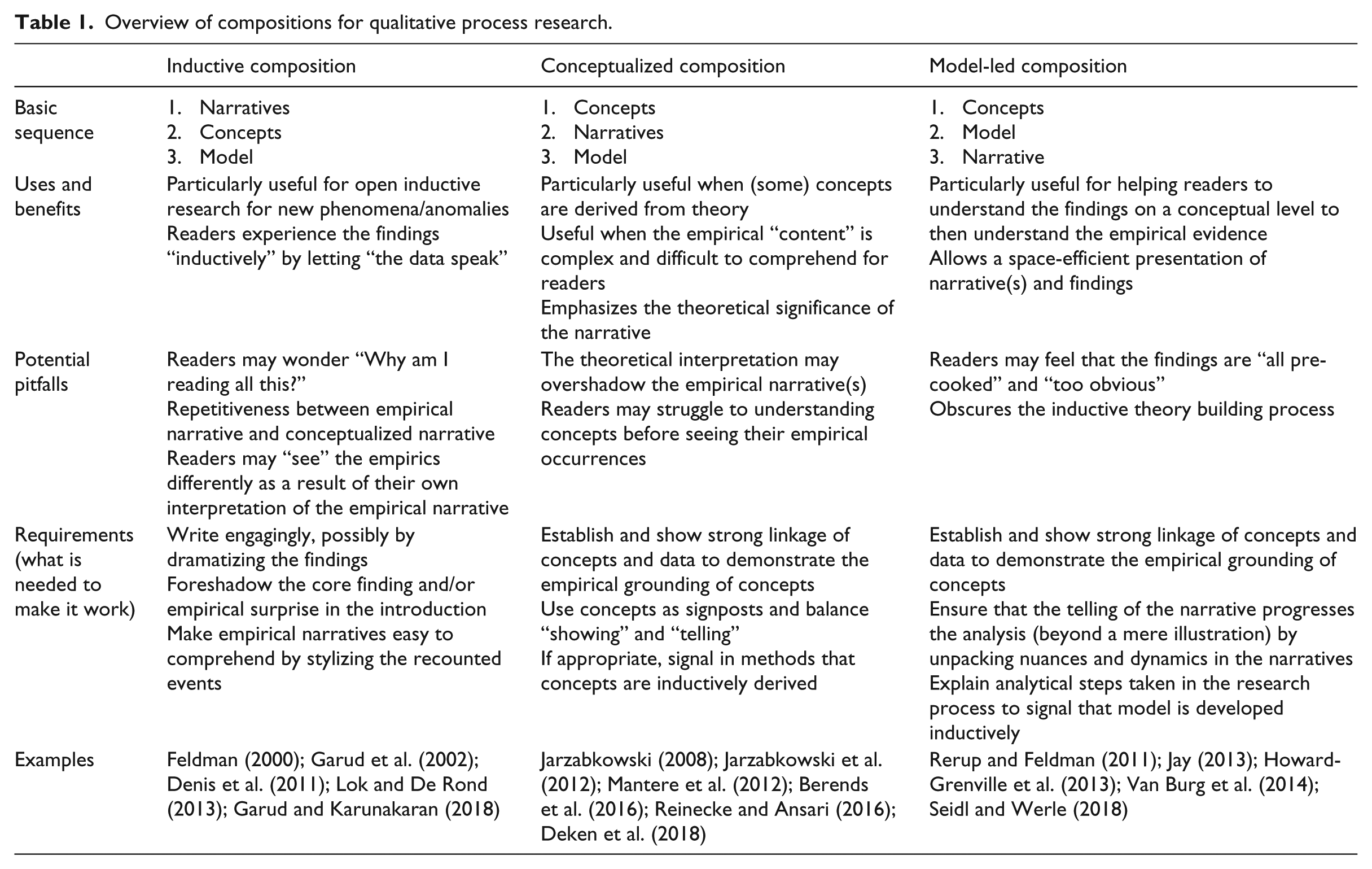
The way empirical narratives, concepts, and a theoretical model are sequenced in a paper gives a range of options for composing the findings of qualitative process research (for an overview, see Table 1). In this section, we will discuss three basic options: inductive compositions, conceptualized compositions, and model-led compositions.
Overview of compositions for qualitative process research.
Inductive composition
The first option is a fully inductive composition. Findings are presented as one or more chronologically recounted narratives that are not yet theorized (see, for example, Denis et al., 2011; Feldman, 2000; Garud et al., 2002; Garud and Karunakaran, 2018; Lok and De Rond, 2013) to let the data speak (Glaser, 1992). The narratives are followed by a presentation of a conceptual overlay to scaffold theory development while maintaining the underlying temporal structure of the data. All theoretical explanations, and often a process model, are introduced at the end of the findings section or at the start of the discussion section—like in Agatha Christie’s murder mystery.
Feldman’s (2000) seminal paper on routine dynamics is an example of an inductive composition. She presents rich narratives on the unfolding routine dynamics in a student housing organization before conceptualizing the dynamics in terms of the performative–ostensive model of routines (in the discussion section). This approach works well because Feldman presented the empirical surprise she encountered in her fieldwork in the introduction: the surprising variability in performance of routines over time, instead of the stability she had expected based upon prior theory. This powerful theoretical insight combined with Feldman’s great storytelling makes for a great read.
For many qualitative researchers, an inductive composition will feel like the most obvious approach for writing up process research as it reflects their own process of discovery. Telling a rich narrative allows readers to follow how events occurred within a case history and offers readers a sense of the participants’ and author’s experiences. Inductive compositions also clearly signal to the reader that the theory emerged from the data.
However, this approach also has its challenges. Authors may struggle to condense the unfolding empirical stories into digestible and engaging empirical narratives that maintain connected with the temporal structure of the case history. Having experienced the (contextual) richness of the empirical phenomenon, authors may be enchanted by details and feel that everything is important. Friendly reviewers may still enjoy such write-ups but more distant readers may not share such excitement for the empirical narrative and may ask, “Why am I reading all this?”
To counteract a pending “So what?” question, writers need to engage the reader until the end, when the plot manifests. It is important to anticipate that readers cannot digest every empirical nuance in the paper. Thus, a necessary step in writing up an inductive composition is for authors to simplify the empirical narratives by creating a stylized account, where only essential events in a case history are recounted, to make the narratives readable and comprehensible (see also Jazabkowski et al., 2014, for advice on writing empirical vignettes). A related tactic is to emphasize the problems and struggles of the actor(s) involved to provide readers with a narrative voice that ties together the event sequences (Pentland, 1999).
These narrative tactics may invoke in authors the feeling of being “untrue” to the data—not representing all that has happened and showcasing only specific events. It is, however, practically impossible to refrain from such stylizing, because connecting events to patterns, and patterns to an explanatory model, will always entail foregrounding some aspects while backgrounding others. Although Agatha Christie managed to introduce a dazzling array of characters (17!) in her inductively composed crime novel, in our own experience in writing qualitative process research, we had to greatly simplify the convoluted empirical stories that featured a large number of actors performing highly abstract tasks to engage our readers (Deken et al., 2016). For example, in a first empirical narrative, we grouped various actors into one of two hypothetical “characters” so that readers would not have to remember numerous names.
Another strategy to address the pending “So what?” concern is to briefly suspend the unfolding narrative for an intermezzo of analytical telling. It is easy to forget that although authors have an overarching view of their theoretical interpretation when writing, readers lack this understanding when reading the empirical narrative. For example, Denis et al. (2011) overcame this issue by including brief summary paragraphs where they retell the empirical patterns in the different periods in more theoretical terms to foreshadow concepts that are later more formally introduced to the reader. This facilitates the readers’ understanding of the whole, which supports their making sense of the parts that follow.
Separating the empirical narrative from its interpretations runs the risk of yielding process models that are not clearly connected to the empirics from a readers’ perspective. The closeness of the coupling between empirical and conceptualized narratives warrants extra attention in this composition. Authors can reiterate parts of the empirical narrative in conceptual terms to establish a transparent connection between the two (see, for example, Carlile, 2002; Rouleau, 2005). This strategy, however, runs the risk of becoming repetitive.
Another potential pitfall of presenting the empirical narratives first is that readers will interpret the narratives from their own perspectives and may be disappointed when the theorization presented in a later section moves in another direction. In such situations, the hermeneutic cycle hobbles; readers are left puzzled with a basic presentation of the parts and their own theoretical sensemaking is disconnected from the process model developed by the authors. In these situations, readers may be helped by a primer on the whole (e.g. a brief introduction of the process model in the introduction section) to understand the value of the parts (the narratives) presented in the findings section.
An inductive composition is subject to some boundary conditions. Highly complex empirical stories are less suitable for inductive compositions. When the actions recounted in narratives are highly specialized, readers find them difficult to comprehend. An inductive write-up may leave readers puzzled about what they should be seeing or picking up on in the empirical narratives.
An inductive composition works well when authors introduce a clear empirical surprise or mystery (Alvesson and Kärreman, 2007) or anomaly (Van de Ven, 2007) upfront in the introduction—invoking a bit of Márquez. Such foreshadowing can help to engage readers’ interest to read through the inductive findings and reach the plot finale (see Denis et al., 2011; Feldman, 2000). For example, Lok and De Rond (2013: 185) begin their paper observing a mystery of breakdowns and divergent practices in the stable institution of the Boat Race between Cambridge and Oxford that could not be reconciled with theorizing on institutional stability.
Conceptualized composition
The second option for authors of qualitative process research is the conceptualized composition. Here, concepts are introduced first and used as theoretical signposts in narratives that follow and later connected in a theoretical process model. To prevent readers from having to wait until after reading the narratives to understand their theoretical significance, authors can introduce their concepts before the narrative so that they support the narrative’s presentation. Concepts can be used to label actions, occurrences, or moments to signpost the relationship between the empirics and theoretical concepts. The narratives will then bring the concepts to life (Jarzabkowski et al., 2014) and allow to demonstrate empirically how theorized phenomena play a role in unfolding processes.
An example of a conceptualized composition is Jarzabkowski’s (2008) paper on strategizing at three universities. She first introduces three inductively derived concepts (different types of strategizing) at the start of the findings and then presents a conceptualized telling of case histories, applying her concepts to distinct periods in those chronologies. This structure enables her to compare cases and draw theoretical conclusions from the empirical process patterns.
Instead of introducing concepts at the start of the findings, concepts can also be introduced in the methods section as part of the explanation of an analytical process (see also, for example, Jarzabkowski et al., 2012). This method signals the inductive origins of concepts, even though the narrative is not recounted in a fully inductive manner. Concepts may also be introduced in the theory section when they have been derived from prior literature. Indeed, the conceptualized composition is particularly appropriate when drawing on concepts from prior literature, when aiming to extend and refine theory and identify boundary conditions of prior findings (see Graebner et al., 2012; Locke, 2001). When theoretical concepts were used to code sequences of events or episodes, the findings section can still explain specific progressions, and document differences and similarities between multiple case histories using those concepts (see, for example, Berends et al., 2016).
A clear advantage of a conceptualized composition is that it simultaneously conveys the theoretical significance of events in an empirical narrative, to avoid that readers feel like “why am I reading all this?” A conceptualized narrative forces authors to directly connect theoretical telling and empirical showing (Golden-Biddle and Locke, 1997), which typically involves making an even narrower selection of empirical material compared to the inductive composition. As Jarzabkowski et al. (2012) acknowledge in their paper on the emergence of coordination in a highly complex setting, “Because it is not possible to offer detailed examples of all performances we found, we use representative data and vignettes to illustrate the five cycles” (p. 913).
Furthermore, the conceptualized narrative is a space effective way of writing up findings as it avoids the potential redundancy of first telling the case history and then retelling parts of that history to offer a grounded interpretation. This composition helps readers to clearly see the connection between the empirical narratives and the theorizing, which makes this composition convincing.
Some authors may be concerned that readers will not get the “raw” story this way. But papers rarely feature raw stories anyway. Any narrative presented in a paper has already been edited, involving decisions about what is worth telling and what is not, and decisions related to how events link together. Still, a pitfall of conceptualized narratives is when theoretical telling overshadows empirical showing, so that the case narrative loses its richness and becomes superficial and obvious. Deep insights emerge from connecting the more abstract theoretical level with the more concrete level of data—having either one of these makes a write-up seem shallow.
A conceptualized composition is particularly useful when the case history features technologically complex content or unfolds in an unfamiliar context, as in Jarzabkowski et al.’s (2012) study of a strategic initiative to implement end-to-end coordination in a supply chain, and Deken et al.’s (2018) study of a strategic initiative in an ecosystem of partners to develop digital services. As the content of such initiatives drives the actors involved, both papers also coded the content of the strategy under development (referred to as “elements”) and traced evolutions in strategy content over time. Because appreciating complex content is highly taxing for readers, making them wait for the theoretical significance of such content is even more burdensome. In contrast, when the content is less complex or more familiar—such stories may be easier to remember until later interpretation (as in Murder on the Orient Express).
Model-led composition
In the model-led composition, concepts and models are “front-loaded” in the findings section and followed by supporting process data. Even though the main concepts and overall process model are outcomes of the case analysis, they are presented in advance. Placing the model upfront provides the reader with a scaffold they can use to understand the empirical dynamics that follow in detailed narratives. Using a model-led composition structure not only allows authors to conceptualize the phenomenon when telling the story, it also enables them to direct readers’ attention to the explanatory relationships the model presents. Model-led compositions can be used to present a case history as a whole (Howard-Grenville, 2013; Jay, 2013) or to structure embedded cases or periods (Van Burg et al., 2014).
An example is Seidl and Werle’s (2018) paper on collaborative sensemaking of meta-problems. They developed an inductive model, which they introduce at the beginning of the findings section. To avoid giving readers the impression that the model existed before they had performed their research, they emphasize upfront that “[On the basis of the findings reported here,] we developed a process model of inter-organizational sensemaking (see Figure 1) that we introduce already at this point in order to facilitate the understanding of the narratives.” They then present two case narratives and clearly demonstrate how the empirical developments map to the model elements. Thereafter, they compare the case narratives and explain how the mechanisms proposed in the theoretical model help to explain differences between the cases.
A clear advantage of leading with a model is that it allows illustrating the connection between process data and theory directly. Presenting an abstracted visual process model helps readers understand the backbone structure of the whole. The model offers readers an integrated perspective—an overview of the findings as a whole—which they then support using parts of the narrative. Subsequent, more detailed applications of a visual model in empirical episodes help to ground the model in the data (see also examples from Howard-Grenville et al., 2013; Rerup and Feldman, 2011). This is a space-efficient way of presenting research findings, when compared to inductive or conceptualized narrative compositions, because there is less referring back and forth between a narrative and its interpretation.
One caveat is that narratives that have been written to illustrate a model may feel pre-cooked and obvious. When using a model to scaffold research findings, it may be challenging to convey that the findings resulted from inductive theorizing. Authors need to clearly signal that the model was developed inductively and that it is only presented upfront to aid the reader (as Seidl and Werle (2018) did).
An inherent tension remains: how can authors make findings comprehensible and, at the same time, surprising? If case narratives are written primarily to illustrate a theoretical model, this downplays the element of surprise. Thus, authors need to explicate which findings were unexpected and ensure that the narrative brings novel insights. Here, the analogy with Chronicle of a Death Foretold is again an illuminating one: even though it is clear what will happen at the start of the story, the narrative that follows discloses why it occurred this way. Similarly, when presenting the model first, the subsequent presentation of narratives still needs to drive the analysis forward. Case narratives should flesh out the backbone provided by the model, by adding nuance for example. Authors might show different ways of cycling through the model or explain cross-case differences (see again Seidl and Werle, 2018 or Van Burg et al., 2014).
Finally, it may be useful to give a short initial overview of the case history, either in the methods section or at the very start of the findings section (see, for example, Howard-Grenville et al., 2013). Providing such a temporal overview will help the reader to get an initial understanding of the empirical dynamics upon which the process model is based—which will also support the grounded feeling of the process model. Moreover, an overview can make the description of the model tractable.
Combining compositions
Of course, more variety is possible than is belied by these basic composition types. Many qualitative process papers do not fit neatly within a single composition type but rather combine compositions.
When the empirical context is complex, such as when actions are unfamiliar to most readers or when cases feature numerous actors, a write-up may need “two turns of the crank.” For example, one of our papers followed a structure where we first presented a relatively simple narrative and then analyzed it using emergent theoretical concepts, following the inductive composition structure (Deken et al., 2016). Then, we introduce a more complex narrative, drawing on concepts that were introduced in the analysis of the first narrative, to deepen the analysis and set the scene for the process model, as per the conceptualized composition structure. To avoid too much repetition between the empirical and conceptual narratives, and yet clearly and precisely connect the two, we supplied an additional table that provides a stylized overview of the concepts and the empirical occurrences in the narratives. Another example is the paper by Kaplan and Orlikowski (2013). These authors present the empirical surprise first in their findings section (i.e. inductive composition), thereby underscoring their inductive analytical process, and follow this with their concepts and model (i.e. the model-led composition) to then present five cases in terms of this model.
Opportunities for alternative presentations increase when studies focus on embedded units of analysis, such as breakdowns (Lok and De Rond, 2013) and change episodes (e.g. Berends et al., 2011), or deploy cross-case analyses (e.g. Berends et al., 2016; Howard-Grenville et al., 2013; Jarzabkowski, 2008). By analytically comparing cases or embedded units of analysis within a single case, authors can, for example, identify initial conditions that explain different event sequences, show how process patterns are associated with different outcomes, or uncover different processes through which similar outcomes are generated. These comparisons deepen a paper’s theoretical implications by providing additional empirical support for a process model, adding nuance in explaining different trajectories, and identifying boundary conditions.
The writing up of a multiple-case process study is facilitated by crafting similar representations of cases, using elements of a conceptualized or model-led structure. Presenting multiple cases reduces the space available for narratives that portray the temporal ordering of events within cases. Authors may therefore include visual timelines and tabularized event histories (e.g. Kaplan and Orlikowski, 2013) to systematically represent temporal coherence. Still, after presenting the cases, comparison of dynamics across cases may lead to the subsequent formulation of new concepts and explanations, thereby blending in inductive elements as well.
Conclusion
Writing up qualitative research on unfolding processes defies any simple presentation logic. To compose persuasive findings, authors need to create a composition that matches the richness of the data and the uniqueness of their theory, shows how the data support the theory and how the theory explains their observations, and also makes for an engaging read. As qualitative process research authors, we must accept that we cannot instantly and completely convey the links between theory and data to our readers. A particular challenge for writing up qualitative process research is to maintain the temporal coherence of the empirical data, which cannot be fully captured in abstracted presentations or isolated chunks of data. Ultimately, composing a qualitative process paper involves making trade-offs in how we as authors sequence the presentation of the findings. The three compositions we discuss in this essay, and their respective uses and pitfalls, reflect our contribution to facilitating that trade-off.
First of all, there are different ways to present a close connection between process data and process theory. We have distinguished three compositional structures that differ in the order of presenting empirical narratives, theoretical concepts, and models. Their suitability depends—among other things—on the degree of prior theorizing and the complexity of the case. Each of these compositions can be effective, but they all have potential pitfalls as well as specific requirements to make them effective. Furthermore, authors should not solely use composition structures that are ill-suited for creating a close-knit tie between temporally structured data and process theory, such as the Gioia approach (e.g. Gioia et al., 2013) that centers around a conceptual rather than temporal data structure. By discussing and comparing the different composition types in this essay and pointing at examples, we hope to help authors make choices that bolster the strengths of a selected composition and downplay the weaknesses.
Second, we have argued that all compositions for qualitative process research need to offer some theoretical insight upfront: an understanding of the whole before presenting distinct parts. Expectations differ across journals but, when writing for theory-oriented journals especially, it is risky to expect readers (in particular reviewers) to be patient for the plot to unravel only at the end. Even the inductive composition benefits from a dash of Márquez as it is most effective when authors present the empirical surprise in the introduction. Authors often have to sacrifice some of the richness of the empirical narratives in order to meet journals’ stringent criteria for theoretical contributions and space constraints. It is impossible to theorize all aspects of a case—so linking data and theory is always a matter of choosing what to foreground and what to background.
Finally, it should be noted that any composition takes time to develop. Writing is experimenting (Latour, 2005) and insights develop through iterative writing and engaging with others over drafts (Huff, 1999). Reviewers and editors will inevitably steer the creation of a manuscript’s final composition. While iterations may move in different directions, the move from an inductive composition to a conceptualized narrative or process-led structure is more straightforward than vice versa. This is indicative of the process of doing process research, where theoretical insights become more pronounced over time and the empirical grounding stronger, which facilitates creating conceptualized narratives or model-led compositions. Weaving process data, concepts, and a model closely together usually requires several iterations of a paper and careful consideration of trade-offs associated with compositions.
Footnotes
Acknowledgements
We thank Ann Langley for her encouragement and helpful guidance as editor, two anonymous reviewers for their constructive comments, and Ella Hafermalz and Anastasia Sergeeva for feedback on a draft of this essay.
Funding
The author(s) received no financial support for the research, authorship, and/or publication of this article.
