




Abstract
We propose a generalized NK-model of late-mover advantage where late-mover firms leapfrog first-mover firms as user needs evolve over time. First movers face severe trade-offs between the provision of functionalities in which their products already excel and the additional functionalities requested by users later on. Late movers, by contrast, start searching when more functionalities are already known and typically come up with superior product designs. We also show that late-mover advantage is more probable for more complex technologies. Managerial implications follow.
Introduction
Few firms that invent new technologies have been able to reap the benefits from their inventions. Often, firms whose inventions “colonize” a new niche market are not the ones that “consolidate” their inventions by transforming a niche into a mass product (Markides and Geroski, 2005). This suggests that there are first-mover disadvantages that allow late entrants to take over the industry leadership from the early entrants, as the product continues to evolve over time.
Traditionally, late-mover advantage is analyzed either from the perspective of appropriability conditions or complementary assets. Following Teece (1986), second movers are more likely to be successful if they can easily imitate the original invention or if they have complementary assets that they can leverage (such as marketing, manufacturing, or after-sales). In such cases, first movers have incurred the highest costs of research and development, while late movers are able to reap most of the returns.
An alternative (though not exclusive) explanation of late-mover advantage takes into account the evolution of the invention itself. Indeed, most products continue to evolve after their first introduction in the market. As most new products start out as niche products serving specialized users, the progressive diffusion of a new product generally involves the introduction of additional functionalities associated with user needs of a wider group of consumers (Christensen, 1997; Clark, 1985). A first-mover firm may well establish technological leadership in the niche market in question. However, this advantage can only carry over to the mass market when the firm is able to adapt its technology from a niche product serving specialized users to a dominant design attracting mass consumers (Lieberman, 2013). The question holds why in some contexts first movers have been successful in adapting their products to evolving user needs, while in other contexts they have not been able to do so, allowing late movers to take over industrial leadership.
We propose a model of late-mover advantage based on Altenberg’s (1994) generalized version of Kauffman’s (1993) “NK-model.” Though the original NK-model has often been used in management science after it was first introduced by Levinthal (1997), the generalized version of the NK-model is preferable to the original model, in that it allows us to model the discovery of new functionalities within a given design space. In this way, we can compare first-mover and late-mover firms searching separately, and without imitation, in the exact same design space, but evaluating their searches against uneven number of functionalities. More specifically, we assert that the first mover starts searching for product designs once the first functionality is known, while a late mover only starts searching once all functionalities are known. Hence, the only type of learning taking place between first and late mover concerns the discovery of additional functionalities: after the introduction of a product by a first mover, additional user needs are being discovered, with these needs becoming apparent to both the first mover and the late mover.
By considering how first movers are being challenged by new functionalities emerging later in time, our model is focusing on the uncertainty created by the evolving user needs during new product development and on the technological constraints faced by first movers to deal with such needs. We choose not to model some of the other aspects that are known to affect first-mover advantage (e.g. imitation by late movers, learning curves and brand value). Hence, we do not claim to provide a comprehensive theory of late-mover advantage. Rather, our model is meant to develop a theoretical argument about how higher levels of product complexity provide more opportunities for successful entry by late movers as new user needs emerge over time. The empirical context is one in which a first mover successfully serves specialized users with specific user needs, while late movers target a mass market that demand additional functionalities. We will develop the case of BlackBerry as an empirical example, a company that pioneered the smartphone for specialized users but failed to conquer the mass market.
Using the generalized NK-model, we derive two propositions. First, we formally demonstrate that first movers find it hard to improve their product design in the face of the subsequent discovery of new product functionalities. By contrast, new functionalities open up a window of opportunity for late movers, who start designing “from scratch” and generally reach better product designs than first movers do. Second, we are able to show that first-mover disadvantage is contingent upon a product’s complexity. Complex product technologies—in terms of interdependencies between their underlying component technologies—present more severe trade-offs between existing and newly discovered functionalities compared to more modular technologies. As a result, first movers will find it harder to improve, the more complex the product technology.
Late-mover advantage
Technological leadership is a key determinant of first-mover advantage in new industries (Lieberman and Montgomery, 1988, 1998). The first firms that enter a new market are able to develop cost leadership by being the first to go down the learning curve. Though some of the economies due to learning-by-doing may spillover to later entrants, such knowledge spillovers are expected to be limited due to the tacit knowledge residing in skills and organizational routines (Nelson and Winter, 1982). First movers may also be able to protect their product technology—for example, through patenting some of its component technologies—raising even higher the barriers to entry for late movers. Patents are particularly effective in securing industry leadership in complex product industries, as technological substitutes are more difficult to integrate in complex products than in more modular products (Marengo et al., 2012). Finally, first movers also may benefit from economies of scale in doing R&D. As the firm size of first movers tends to exceed the size of late movers at the time the latter enters the market, first movers can spread the sunken investments in R&D over a larger number of items than late movers (Klepper, 1996).
Technology-based explanations of the competitive advantage of first movers are built on the implicit assumption that the structure of demand does not change fundamentally in the course of time. Indeed, without any fundamental change in demand, buyers’ inertia only reinforces the advantages for first movers (Lieberman and Montgomery, 1988, 1998). However, during the early phase of product evolution in new markets, user needs are generally still in flux and coevolve with innovative activity (Clark, 1985; Von Hippel, 1988). Sociologists coined this process domestication, which refers to the way users incorporate a new technology into their practices (Lie and Sørensen, 1996; Silverstone and Hirsch, 1992). During domestication processes, products do not necessarily fully keep their intended functions as new ways of using are discovered over time, quite differently from designers’ intents.
Examples of functionalities that generally become articulated much later than the initial introduction of a new product category include the following: (1) safety issues that only become apparent after extensive experimentation in usage, (2) ergonomic features that only become known only after early users have experienced physical complaints, and (3) interoperability issues regarding the joint use of the new product with existing devices. New functional requirements may also stem from government regulations that, by nature, considerably lag behind the creation of a new product category.
Due to uncertainties regarding user needs in the early stages of a new industry, firms cannot fully foresee ex ante how their products will be received by users. Once first movers have created niche applications for a new technology, demand becomes more articulated and the knowledge of user needs builds up. Only then, mass market applications can be envisaged, and resources to develop such mass products will be deemed legitimate. Oftentimes in this process, a dominant design emerges serving the needs of the mass market at a relatively low price (Abernathy and Utterback, 1978). Hence, late movers that are quick to adopt the dominant design may benefit from product standardization without having to incur the costs of experimentation and technology switching, which first movers face (Dowell and Swaminathan, 2006; Lieberman, 2013; Suarez et al., 2015). Often, such successful late entrants are spinoffs of earlier entrants that build on the parent’s experience, while experimenting with new designs that otherwise would cannibalize the niche product of the parent firm (Klepper and Sleeper, 2005). In economic terms, late movers benefit from positive externalities generated by first movers as they “free ride” on the innovation efforts by pioneers—that is, apart from knowledge spillovers regarding technological knowledge. Knowledge spillovers also occur because user needs get better understood, reducing market uncertainty.
Our model thus resonates with the plea by Suarez and Lanzolla (2007) to incorporate “environmental dynamics” in first-mover advantage theory. They call for theoretical frameworks where environmental dynamics may render late entry more advantageous than early entry. They argue that “technology evolution may render a firm’s knowledge obsolete, destroy existing competences” (Suarez and Lanzolla, 2007: 382–383). As an example, they mention “product categories with high ‘vintage effects’—that is, where product quality significantly improves over time.” This environmental dynamics is indeed underlying our model, where the discovery of new functionalities as an environmental dynamic leads to new product designs with higher fitness with user needs (i.e. “product quality”). These new designs are generally not developed as small variations of the pre-existing design, since the new functionality cannot be integrated easily in a design that was optimized for a different set of functionalities. Rather, taking into account a more complete list of functionalities, late movers can start designing “from scratch,” which leads them to come up with radically new design propositions. To be successful as a new entrant, a late mover does not necessarily need to match a first mover in terms of specific technological competencies that allowed the first mover to excel in some specific product functionality for specific users, but rather to come up with a product design that is optimized against all functionalities that have become known over time. As a result, first movers do not only suffer from an outdated design proposition, but they also have to devaluate the knowledge and competences built up in the past.
From a managerial perspective, the challenge holds to learn about evolving user needs. First movers will initially sell their pioneering product to specialized users. A potential disadvantage for such firms lies in the difficulty to gauge the needs of a potential mass market and to reorient their R&D investments accordingly. A parallel reasoning exists in the work on incumbents versus disrupting newcomers, where the latter can still be considered a late mover (sometimes even decades after the product was initially launched). Christensen (1997, 2003) discusses several industries in which incumbents tended to innovate myopically focusing on existing users, rather than focusing on developing new products that appeal to a wider group of users.
1
This strategy is reinforced by the sunk costs invested in specific technologies and branding, as well as by switching costs associated with developing and producing alternative products. As Christensen and Rosenbloom (1995) put it,
[i]t is difficult for established firms to marshal resources behind innovations that do not address the needs of known, present and powerful customers. In these instances […] the essence of the attacker’s advantage is in its differential ability to identify and make strategic commitments to attack and develop emerging market applications, or value networks. The issue, at its core, may be the relative abilities of successful incumbent firms vs. entrant firms to change strategies, not technologies. (pp. 255–256)
In this context, incumbents are first movers who become so successful in serving specialized users that they continue to focus on this user group, at the risk of losing out the emerging mass consumers who are characterized by different needs.
The ability of firms to reorient their R&D toward new users also depends on the characteristics of a product’s technology. Innovations focusing on new users will be especially hard to develop when many interdependencies exist between a product’s components, that is, when the product’s technology is complex (Ethiraj et al., 2012). Innovations appealing to new users may cause malfunctions in existing features, possibly offsetting existing users. Consequently, firms may be more reluctant to orient product innovations toward new users, the more complex the technology at hand.
A recent, telling example is the rise and fall of BlackBerry, the company named after its BlackBerry smartphone. 2 Until 2007, it was the market leader with competitors such as Palm and Nokia copying the BlackBerry’s layout (West and Mace, 2010). With falling prices, the smartphone became a standard consumer product attracting industry giants like Apple and Google into the market. With the advent of the Apple iPhone in 2007 and Android-based smartphones little after, BlackBerry suddenly lost its leading position with its market share shrinking to less than 2% in 2012 (www.gartner.com).
Compared to other smartphones BlackBerry excelled in two functionalities: security and instant email delivery. These functionalities were particularly valued by its main users (large companies and the US government). However, with the advent of the iPhone, the use of mobile phones was redefined as smartphones with many more functionalities, email being just one of them. Furthermore, mass consumers cared less about security than the original lead users. BlackBerry, however, was slow to realize that it had to redefine its own product, as ordinary users valued security and instant email much less than their specialized users did. On the one hand, the company suffered from agreements between Microsoft, Apple, and Android on its core professional services as the spread of Microsoft Exchange on smartphones benefiting from a large installed base of users (Kenney and Pon, 2011). On the other hand, the network externalities that should have favored BlackBerry were effectively counterbalanced by the ability of new entrants to generate indirect network effects through complementary services, in particular, in the form of the digital contents available on the Internet including Apple’s iTunes and Google’s information services (West and Mace, 2010). This convergence between smartphones and the Internet content supported the evolution of smartphones’ functionalities toward a multifunctional IT device, to the detriment of BlackBerry.
The example underlines two interrelated dynamics. First, technological evolution involves the addition of new functionalities to existing products, hereby transforming a specialized niche product into a mass product. Second, the addition of new functionalities opens up windows of opportunity for new entrants. Hence, technological evolution has a direct impact on industrial dynamics. Though examples of the transformation of niches into mass markets are well documented, 3 its implications for industrial dynamics have not been subject of explicit theorizing hitherto, which we aim to provide.
The main contribution of the model that follows is to show, in a formal sense, that the subsequent addition of functionalities indeed opens up opportunities for new entrants. While first movers find it hard to provide new functionalities by adjusting their current designs, new firms start searching “from scratch” and without the burden of previous solutions selected against an incomplete list of functional specifications. From the formal model, we are also able to show that adaptation by first movers is more difficult, when more component technologies are interdependent. Hence, ceteris paribus, we can expect that the more complex a technology, the more volatile the industrial dynamics.
The model
In order to probe the logic of the design of complex products and their effect on industry leadership, we introduce a model of complex systems based on the NK-model developed by Kauffman (1993) and generalized by Altenberg (1994). The NK-model has its roots in biology, where it is used to study the interaction between genes and traits in biological organisms. After Levinthal (1997) introduced the NK-model in management science, this model has been widely used to theorize about learning curves (Auerswald et al., 2000), modularity (Ethiraj and Levinthal, 2004; Marengo et al., 2000; Simon, 2002), imitation (Ethiraj et al., 2008; Rivkin, 2000), decentralized decision-making (Rivkin and Siggelkow, 2003; Siggelkow and Levinthal, 2003), technological evolution (Frenken and Nuvolari, 2004; Marengo et al., 2012), search strategies (Baumann and Siggelkow, 2013; Knudsen and Levinthal, 2007), industry shakeouts (Lenox et al., 2007), and entrepreneurship (Ganco, 2013). 4
Here, our objective is to assess how evolving user needs have different effects on first and late movers. Our interest in new functionalities is the reason why we rely on the generalized NK-model by Altenberg (1994), which allows us to keep constant the number of components in a product, with the number of functionalities increasing over time. We can then define first and late movers by the time they start searching the fitness landscape. First movers do so once the first functionality is known, while late movers only enter later once all functionalities are known. Hence, what differentiates first and late movers is the number of functionalities taken into account when they start their search process.
The generalized NK-model
In the generalized NK-model by Altenberg (1994),
5
a product is depicted by
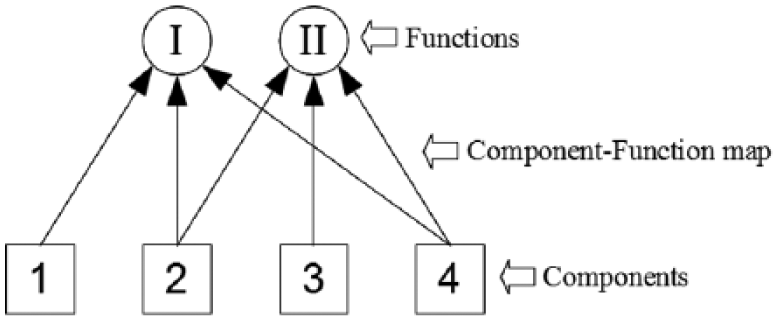
An example of component-function map with N = 4, F = 2, and K = 3.
Changes in components lead to changes in the performance (fitness) of functions according to the mapping between components and functions. For example, in Figure 1, a change in component 1 will only lead to a change in the performance of Function 1, but a change in component 2 would lead to changes in the performances of both Function 1 and Function 2. The number of functions influenced by a single component is called a component’s pleiotropy. In the example, the first and third components have a pleiotropy of one, while the second and fourth components have a pleiotropy of two. It follows from the mapping of components onto functions that the sum of pleiotropy values of components must equal the sum of polygeny values of functions.
We make the assumption, without loss of generality, that each component has two possible states, allowing for

where
Search
We model the search efforts by firms as a local and greedy search algorithm. Local means that firms mutate only one component at the time. Greedy means that among all
As we distinguish between first and late movers, firms differ in the time they enter the market, which in turn determines how they evaluate the fitness of mutations. The late mover looks at the system as a whole once all functions are known. Hence, it looks for the mutation that yields the highest fitness increase of the global fitness irrespective of the fitness level of individual functions. This search procedure is equivalent to standard (greedy) hill-climbing in NK-model (Kauffman, 1993; Levinthal, 1997). The first mover, by contrast, discovers each function gradually as time goes by. First movers, in first instance, will evaluate mutations only against the fitness of the first function
Since first movers discover functions sequentially, they have to decide how to deal with functions that they already optimized in the past. There are two possible strategies. Once they start optimizing a newly discovered function, they may decide not to compromise the fitness achieved through previously discovered functions. We call this assumption the “functional inertia” assumption. Alternatively, first movers may allow the fitness of previously discovered function to decrease as long as the mean fitness over all t functions considered at time t, increases. We refer to the latter strategy as the “functional flexibility” assumption.
Strategy 1: functional inertia
The assumption of functional inertia in the search behavior of first movers implies that, each time
Strategy 2: functional flexibility
The previous strategy, which holds that the first movers will not accept any decrease in existing functions when confronted with a newly discovered function, can be criticized as being too restrictive. From a behavioral perspective, this assumption would mean that a first-mover firm—excelling in providing particular functions in the past—would under no circumstances be willing to give up its leading position with respect to these functions. Though such instances have been documented (Christensen, 1997, 2003), one can expect that many firms are willing to give up fitness in a particular functionality in situations where the overall quality of the product will increase. This “functional flexibility” strategy thus aims at optimizing all functions insofar functions are known to the firm. That is, at any time
Simulation
We perform two sets of simulations: one set of simulations compares a first mover with a late mover assuming that the first mover follows the “functional inertia” strategy, and a second set of simulations compares a first mover with a late mover assuming that the first mover follows the “functional flexibility” strategy. For both the first-mover search strategies and the late-mover search strategy, we performed 5000 simulations for each combination of settings of the parameter values N, F, and K. Every simulation starts by creating the landscape given the combination of parameter values N, F, and K. These values are
Once the simulation is over, we save the fitness value
We also record the exact string x in each simulation, as to assess to what extent the product designs of first movers differ from those of late movers. We are interested in product similarity in the design space because the gains from licensing proprietary technologies held by the first mover to the late mover will be greater, the more similar the products of first and late movers are in terms of the choice of components, following the idea that patents apply to component technologies (Marengo et al., 2012). We refrain from modeling patenting explicitly but rather use product similarity as a first proxy of first-mover advantage over late-mover advantage in product contexts where patenting is relevant. That is, the more similar are the product designs of the first mover and late mover, the more likely licensing fees would be claimed by the first mover.
Product similarity between the two strings is given by counting how many components in the two designs are in the same state (e.g. 1110 and 1010 have a similarity score of three). To compare the similarity scores across simulations for products of different size
As an example, consider again the case given in Figure 1 of a product technology with

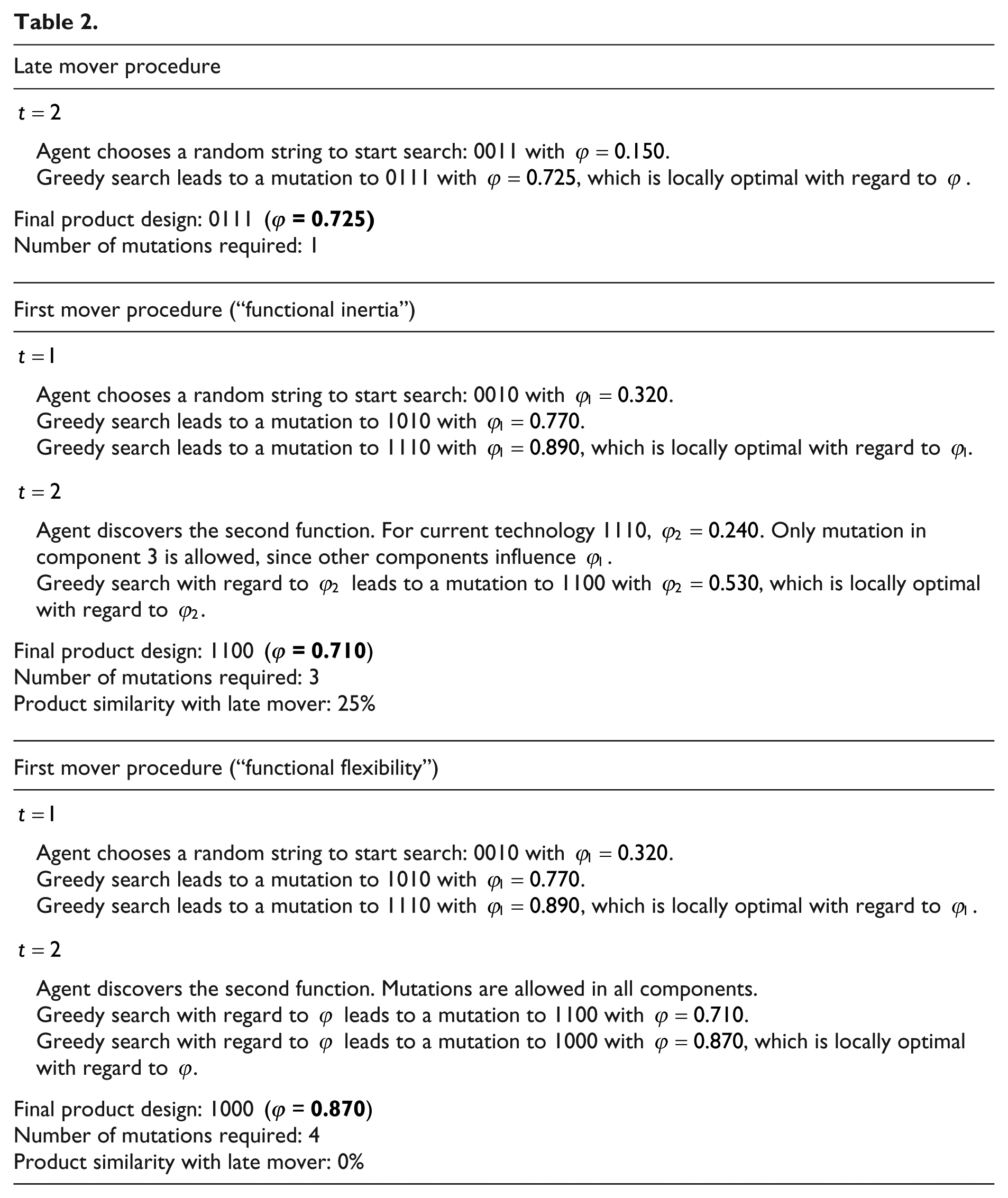
In Appendix 1, we present a simulation of fitness values of all possible designs. Using these values, we can illustrate the search strategies of late movers, first movers following the functional inertia strategy, and first movers following the functional flexibility strategy. The three strategies can be described as follows:
A late mover starts searching at time
A first mover following the functional inertia strategy starts searching at time
A first mover following the functional flexibility strategy first optimizes
Results
We present the simulation results in Figure 2, comparing late movers with first movers following the functional inertia strategy, and in Figure 3, comparing the late movers with first movers following the functional flexibility strategy. In Appendices 2 and 3, we report on the Wilcoxon signed-rank test for the results reported in Figure 2 and 3, respectively. These tests indicate for which parameter settings the values of first and late movers are significantly different. For completeness, we also study in Appendix 4 all the intermediate sequences of functionality discovery for the subset of parameters
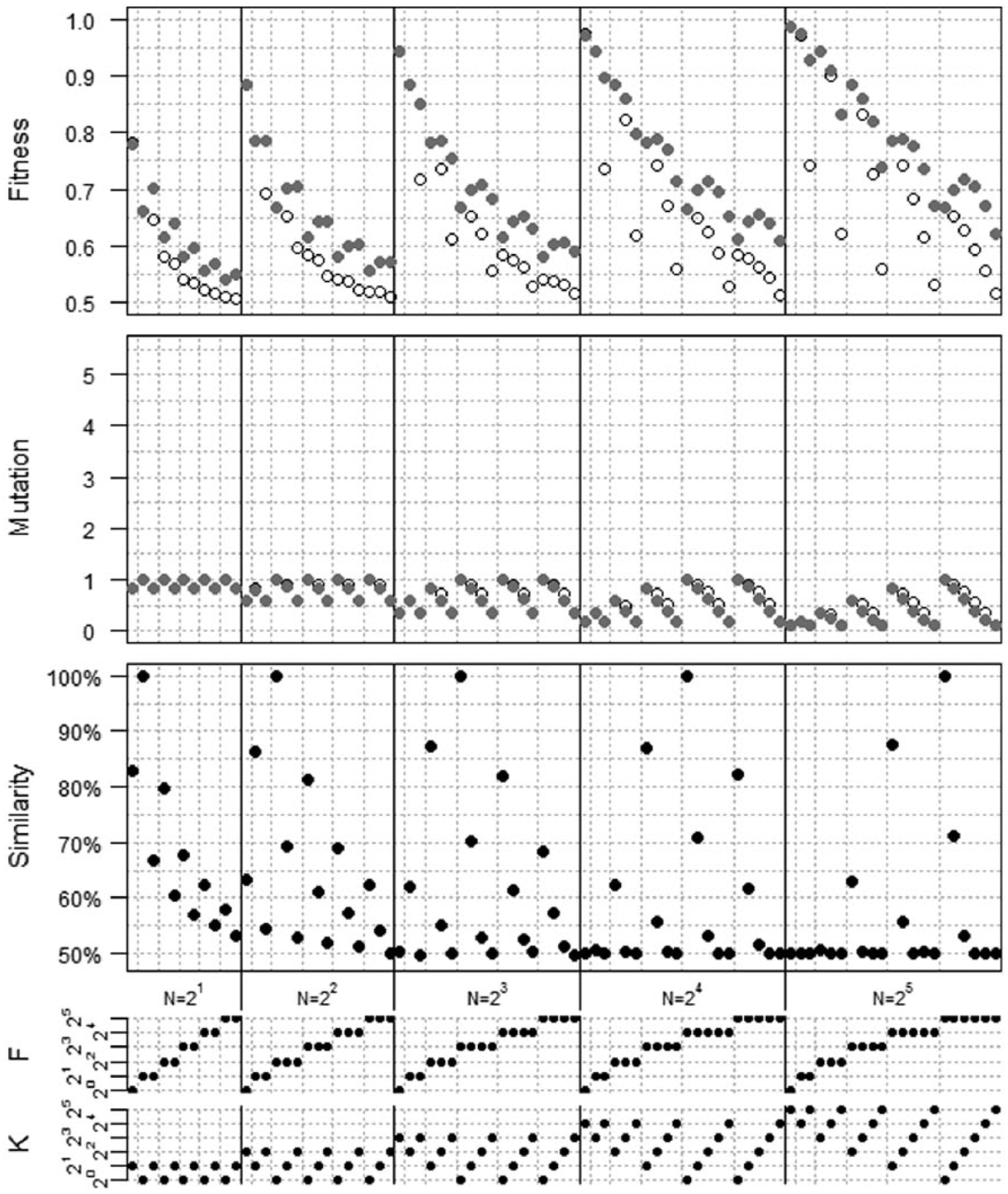
Average fitness, average normalized number of mutations, and product similarity (for the case of functional inertia). White dots (○) refer to first movers following a “functional inertia” strategy and gray dots (•) to late movers.
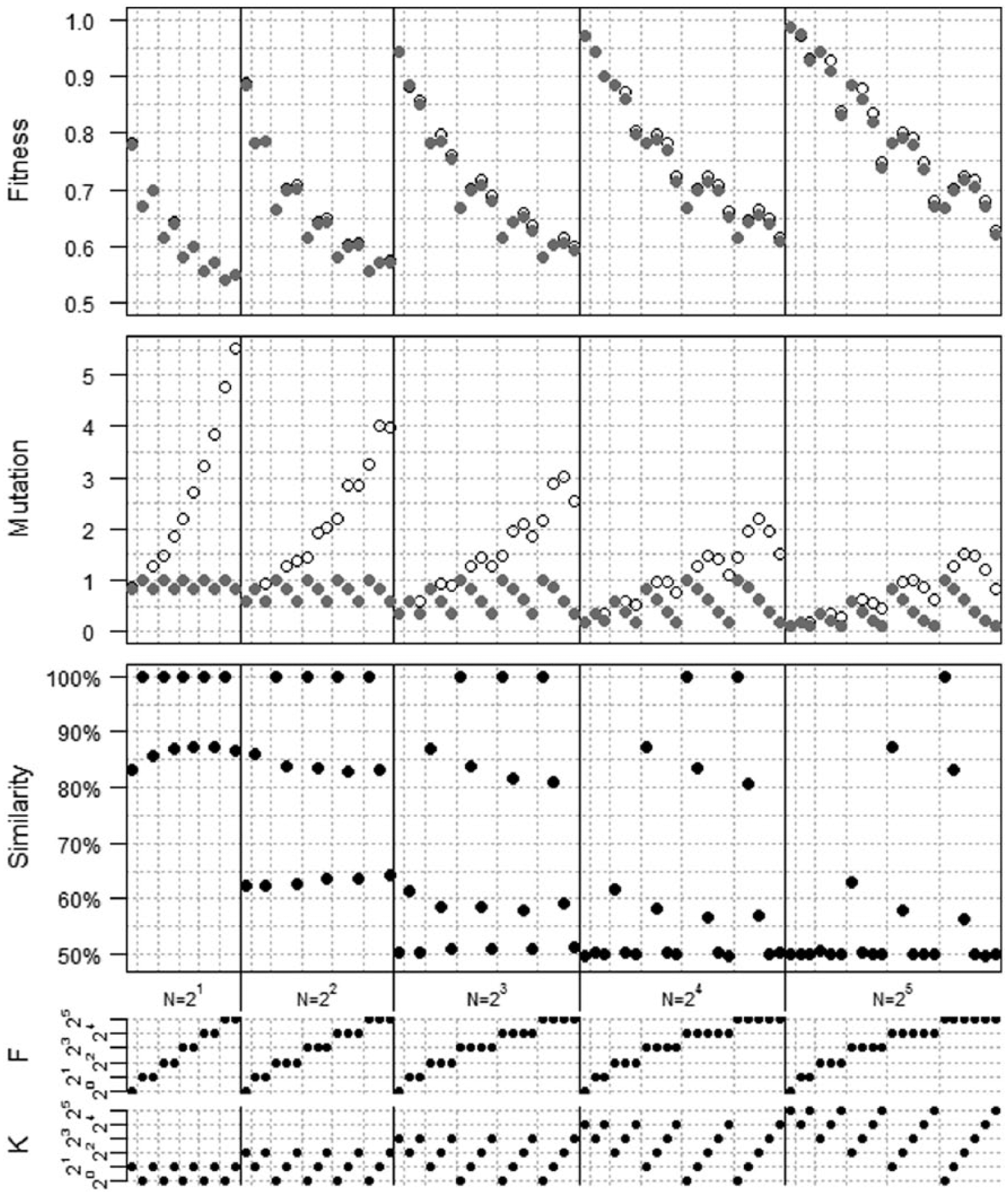
Average fitness, average normalized number of mutations, and product similarity (for the case of functional flexibility). White dots (○) refer to first movers following a “functional flexibility” strategy and gray dots (•) to late movers.
Case 1: functional inertia
Figure 2 shows the simulation results comparing first movers with late movers following a functional inertia strategy for every combination of parameters
From Figure 2, two general observations can be made that apply both to first movers and late movers. First, as long as
A second observation holds that, for given values of
Turning now to the comparison between first and late movers, the first result holds that late movers achieve higher fitness than first movers for most parameter settings, and this fitness difference—given a set of values of
Looking at the total number of mutations preceding the discovery of the final local optimum, as an indicator of search inefficiency, we also observe a small but significant advantage of late movers over first movers for most parameter settings. Late movers put less search efforts than first movers, since late movers only engage in search during the final period once all functions are known, while first movers continuously extend their search efforts each time a new function is discovered.
Finally, we can observe that the similarity in the final product design found by first and late movers goes down with increasing values for
Case 2: functional flexibility
We repeated the simulation analysis for first movers following the functional flexibility strategy instead of the functional inertia strategy. Now, unlike before, first movers consider all components as candidates for mutation at any time. Figure 3 shows again the results for the average fitness values of the local optimum discovered, the normalized number of preceding mutations, and the similarity between the strings found by first and late movers. White dots refer to first movers and gray dots to late movers.
Changing the assumption about how first movers search, leads to different results than those obtained before. First, looking at the fitness achieved by first and late movers, the clear advantage of late movers as reported in Figure 2, now turns into a small, and mostly significant, advantage for first movers in Figure 3. This result can be understood by looking at the functional flexibility strategy of first movers in closer detail. Recall that in the case of functional flexibility, both first movers and late movers are allowed to mutate all components at all times. The only difference between the two search strategies is the actual trajectory they follow through the design space. Late movers only start searching after all
The fitness advantage of first movers, however, comes at a cost of search inefficiency. Looking at the number of mutations preceding the discovery of the final local optimum, we clearly see that first movers spend much more effort than late movers. This difference goes up when
Turning to the results on the similarity in product designs found by first and late movers, we observe again that the similarity score goes down with increasing product complexity
Discussion
We have shown that the late movers may enjoy advantages over the first movers in product technologies where new functionalities are discovered over time. This is particularly the case for complex products where technological interdependencies create difficulties for first movers to adapt their product design in order to include more functionalities. The more complex a product technology is in terms of interdependencies between its component technologies, the greater the challenge for first movers to integrate new functionalities given the technology choices made early on, and the less likely they will be able to sustain their first-mover advantage. Complex products also lead late movers to explore more dissimilar designs than first movers, thus largely circumventing proprietary component technologies that first movers may hold.
In conclusion, our proposition holds that the more new functions become known as user needs evolve, the more likely a late mover will take over the industry leadership of the first mover. Our model provides one explanation why first movers are often unable to seize the opportunities of adding new functionalities and hereby expanding their user segments. It also provides a clear and testable hypothesis for the mixed empirical results on first-mover advantage (Lieberman, 2013) by using product complexity as a moderating variable: the higher a product’s complexity, the less likely first-mover advantages can be sustained in the face of evolving user needs, ceteris paribus. This role of technological interdependencies in industry dynamics is in line with an evolutionary model of industry shakeouts, which showed that in industries with more complex production processes, the rates of entry and exit remain high over longer time periods, with decreasing survival rates for incumbents (Lenox et al., 2007).
Our model complements the work by Adner and Levinthal (2001) on demand heterogeneity and technological speciation. In our model, user needs evolve because new product features are being discovered over time. Heterogeneity, then, only exists in a longitudinal sense in that the fitness function includes progressively more functionalities. Adner and Levinthal (2001), by contrast, reason from demand heterogeneity in a cross-sectional sense, that is, from the coexistence of different user groups with only partially overlapping preference sets. The explananda in the two theories are also different. The model by Adner and Levinthal (2001) focuses on the evolutionary dynamics underlying the emergence of a whole new product category when an existing technology finds a new application domain (see also, Adner, 2002; Levinthal, 1998). By contrast, we have looked at technological evolution within a single product category and with special interest in explaining late-mover advantages.
The managerial implications of our model of late-mover advantage are multiple. One managerial implication holds that early entrants in complex product markets run the risk of relying too much on their proprietary component technologies as a source of competitive advantage. Obviously, such a competitive advantage only exists to the extent that potential entrants require such components to develop competing products. However, with evolving user needs, windows of opportunity for new entrants continue to exist, by coming up with alternative product designs taking into account the new functionalities demanded by users. This conclusion from our theoretical model is in line with the related work on disruptive innovation comparing incumbents with newcomers, where newcomers were able to create a mass market while incumbents remained too focused on serving the needs of their existing customers (Christensen, 1997, 2003).
A second managerial implication holds that firms need to continuously monitor evolving user needs and experiment with the integration of new functionalities into their existing product design. In some cases, such new functionalities can be discovered by companies themselves through imagination, experimentation, and consumer surveys. In other cases, new functionalities are discovered by users themselves through innovative user practices. In such contexts, an effective user–producer interaction is crucial to guide the innovation process of a firm (Von Hippel, 1988) as well as the strategy process vis-à-vis the market segments a firm aims to target (Christensen, 1997). Thus, even though users are generally not the source of new technological solutions, their evolving practices signal new needs that are posing serious challenges to incumbents firms.
The more specific managerial lesson, then, holds that firms should avoid restricting R&D resources to the optimization of only a few functionalities demanded by their existing customers, in technologies whose potential uses are not yet well understood. Put differently, as emphasized by Winter et al. (2007), when there is a notion of some global direction of product evolution (here, when new functionalities will be added), local optimization should not undermine this preferred direction of evolution. Furthermore, to the extent that customers are few and large, the monopsony power exerted by them does not only bring down prices but also forces a firm to innovate in a focused direction optimizing the functions demanded by specialized users (Christensen and Bower, 1996). Thus, while specialized users are often critical for the introduction of a new product technology in the first place, a firm would benefit from quickly diversifying its user base as to gain a better and richer understanding of the possible uses of the product technology in question.
These managerial implications, however, are of lesser importance to first movers that still hold a critical resource that renders successful entry of late movers less likely. For example, first movers may have built up complementary assets or proprietary standards with network externalities for users, which may be difficult to build up by late movers. And, although late movers enter with an alternative product design, their new product will typically not be fully different from a first mover’s product design, as our model suggested as well. Hence, some of the critical components in a late-mover design may be patented by first movers, rendering successful entry more difficult or costly (Gans et al., 2002).
A final remark on the limitations of our model, our objective was to show that we can formalize the notion that late-mover advantage can stem from evolving user needs. Doing so, we were also able to derive that product complexity renders late-mover advantages in contexts of evolving user needs even bigger. We explicitly abstracted away from some of the other likely mechanisms and conditions that affect firms’ competitive advantage, as to be able to show theoretically that evolving user needs alone can already be responsible for late-mover advantages.
Limitations, however, remain. First, there are some minor limitations of a technical nature. For example, we assumed that the time in between the discovery of two functions was long enough to allow the firm to carry out all the mutations required to find a new local peak. In this way, we could conveniently define time in the model solely in terms of the number of functions already discovered. Future modeling may choose to drop this assumption. We also assumed that while the number of functions increases over time, the number of product components remains fixed. Following Altenberg (1994), this assumption can in principle be dropped within a generalized NK-model.
More substantially, the model can be extended by taking into account more mechanisms that are at play in industrial dynamics. Indeed, since this model is an early experiment to model evolving user needs in the first-mover advantage framework, ample room is left for future extensions. For instance, introducing heterogeneity in the demand for functions will provide an alternative framework where more strategic decisions are available for the firms. Such decisions include offering products focused on specific bundles of functions or delaying the release of functions for technical priorities. Second, one can introduce a profit function that feeds back into the level of innovative activity. This would lead one to a different assessment of the relative success of first and late movers. While we now solely focused on the number of mutations as the cost of innovation and the final fitness of the product design as the success of innovation, the explicit introduction of a profit function would also take into account that first movers can reap temporary monopoly profits, which in turn can be invested in innovative activity, while late movers are arguably more constrained financially.
A final limitation has been that we estimated the cost of search to be equal to the number of mutations carried out by a firm in design space, independently of whether another firm already carried out the same mutations before. Late movers do not profit from imitating parts of the designs that first movers already explored before them, that is, we assumed that knowledge spillovers are fully absent. We also did not explicitly model the possibility for first movers to patent parts of their designs or develop product standards with network externalities, which would severely raise the costs of late movers to enter. As a future extension of our model, one could study how late movers may try to imitate product design from first movers (Rivkin, 2000) and how a first mover’s patenting strategy or product standards may influence the opportunities and benefits for imitation for late movers (Marengo et al., 2012).
Footnotes
Appendix 1
| Late mover procedure |
|---|
|
Agent chooses a random string to start search: 0011 with . Greedy search leads to a mutation to 0111 with , which is locally optimal with regard to . Final product design: 0111 Number of mutations required: 1 |
| First mover procedure (“functional inertia”) |
|
Agent chooses a random string to start search: 0010 with . Greedy search leads to a mutation to 1010 with . Greedy search leads to a mutation to 1110 with , which is locally optimal with regard to . Agent discovers the second function. For current technology 1110, . Only mutation in component 3 is allowed, since other components influence . Greedy search with regard to leads to a mutation to 1100 with , which is locally optimal with regard to . Final product design: 1100 Number of mutations required: 3 Product similarity with late mover: 25% |
| First mover procedure (“functional flexibility”) |
|
Agent chooses a random string to start search: 0010 with . Greedy search leads to a mutation to 1010 with . Greedy search leads to a mutation to 1110 with , which is locally optimal with regard to . Agent discovers the second function. Mutations are allowed in all components. Greedy search with regard to leads to a mutation to 1100 with . Greedy search with regard to leads to a mutation to 1000 with , which is locally optimal with regard to . Final product design: 1000 Number of mutations required: 4 Product similarity with late mover: 0% |
Appendix 2
Appendix 3
Appendix 4
For completeness, we also study all the intermediate sequences of functionality discovery for the subset of parameters
Where
The results are presented in Figure 6 for the case of functional inertia of the first mover and Figure 7 for functional flexibility of the first mover. We observe in Figure 6 a nearly linear relationship between the Simpson Index and our three variables of interest. Hence, the late-mover advantage can be generalized as an advantage of any agents that improves a product while taking into account sets of functionalities larger than its competitors. And, in Figure 7, we also observe a clear correlation between the Simpson Index and our three variables of interest.
Declaration of Conflicting Interests
The author(s) declared no potential conflicts of interest with respect to the research, authorship, and/or publication of this article.
Funding
The author(s) disclosed receipt of the following financial support for the research, authorship, and/or publication of this article: This research was made possible by a grant awarded by the Netherlands Organization of Scientific Research (NWO), under the Complexity program, no. 645.000.007