




Abstract
Most research on business models lies in the literature on strategy and competitive advantage and focuses on their role as descriptors of actual phenomenon, often by reference to taxonomic categories. In this article, we explore how business models can be seen as a set of cognitive configurations that can be manipulable in the minds of managers (and academics). By proposing a typology of business models that emphasizes the connecting of traditional value chain descriptors with how customers are identified and satisfied, and how the firm monetizes its value, we explore how business model configurations can extend current work on cognitive categorization and open up new possibilities for organization research.
Keywords
Introduction
Why is the business model a useful concept for scholars of strategic organization? Clearly, the concept has gained considerable traction in the business press and its community – but some scholars (e.g. Arend, 2013) have questioned whether it really does have value to scholars beyond established existing strategy concepts? In this article, we suggest that understanding the business model as a particular kind of configuration that is cognitively manipulable may add to our understanding of important organization issues. This perspective on business models sees them not just as ‘real phenomena’ but as cognitive instruments that embody important understanding of causal links between traditional elements in the firm and those outside. We suggest that this view offers considerable potential for future scholarship.
What exactly can be considered as a ‘Business Model’ has been the subject of much debate, but – contrary to the sceptics’ view (Zott et al., 2011), – there is agreement among scholars: the model must link the workings inside the firm to outside elements including the customer side (explaining how value is created Amit and Zott, 2001 and Teece, 2010) and how that value is captured or monetized (as Teece, 2010 has emphasized).
Most of the current research on business models in the strategy domain considers the business model as something real. Articles typically explore the connections between choice of business model and competitive advantage (see, for instance, Amit and Zott, 2001; Zott and Amit, 2007). And while some might object to the emphasis on competitive advantage – perhaps because the nature of the claims is often problematic (see, for instance, Durand and Vaara, 2009) – these criticisms are capable of being surmounted (cf. Durand et al., 2008).
Other well-established groups that examine business models as real things include economic historians. They have a clear and well embedded notion that innovation in business models has been associated with progress; they have not used the term business models but rather words such as ‘recipes’ or ‘modes’ to classify the real economic activity of firms or groups of firms and discussed how changes in those recipes have defined industrial revolutions (see, for instance, Hounshell’s (1985) description of the dynamics of the change between the factory system and the American system).
And in digging deeper into other branches of management, we see articles that look at the relationship between the business model (a relatively new concept) and the ecosystem (a rather more well-established concept) – see, for instance, Adner and Kapoor (2010), and those that look at competition between business models – see, for instance, Casadesus-Masanell and Yoffee (2007). These authors see the business model as a meta concept to exemplify firm strategy.
Most challenging and promising is the cognitive agenda. As Durand and Paolella (2012) explain, categorical structures based on causal models represent a fertile avenue for researchers because such structures can help explain firm behaviours and organizational survival. In this context, business models have potentially a central place.
The business model in this agenda is not a complete description of what the firm does, but rather it should be a stripped-down characterization that captures the essence of the cause–effect relationships between customers, the organization and money. Hence, a business model is a special example of a configuration (as defined by Fiss, 2011).
In this framing, the business model is potentially separable from the firm’s context, including the technology that it uses. Thus, when probing the business model of Amazon (in its founding mode as an online book seller), it is relevant to ask ‘was Amazon deploying a novel business model’ – as it claims on its website – or rather did Amazon sense an unfulfilled customer need for easier access to books and fulfil that need (and get paid) by mobilizing highly contextual web-based technology with a generic established mail order business model (such as that used by Sears Roebuck) that was originally developed for clothes and appliances? In the second framing (the one we argue to be correct), the business model is not a complete description of everything the firm does, including the technology, but something more general (mail order) that goes beyond explaining what has happened in a particular context to providing a configuration of cause–effect relations. Seeing business models as generalized but potentially alterable configurations can help industry managers think about how to act in future states of the world and can also assist researchers in developing new theories (see, for instance, Soda and Furnari, 2012).
In this article, we are concerned with the business model as a cognitive instrument. And to probe this potential, we begin by carefully examining the components of the business model, before we explore more fully the research gaps and opportunities.
Business model configurations
Most attempts to describe and classify business models in the academic and practice literatures have been taxonomic, that is, developed by abstracting from observations typically of a single industry. With only a few exceptions, these attempts rarely deal fully and properly with all its dimensions of customers, internal organization and monetization; see, for instance, Rappa (2004) and Wirtz et al. (2010). So far, the literature lacks clear typological classifications that are robust to changing context and time (Hempel, 1965). Here we suggest the typology that considers four elements: Identifying the customers (the number of separate customer groups); customer engagement (or the customer proposition); monetization; and value chain and linkages (governance typically concerning the firm internally). 1 Each of these dimensions relates to the business model definition of either value creation or value capture or both and – as amplified below – lend themselves to creating subcategories and thus the chance of a meaningful map of possibilities. Such a map can be overlaid onto the real world of an industry – or an entrepreneur’s way of thinking – and by comparing the map with the complete typology, we can identify the range of existing models. From such a map, we can also consider possible but omitted types (perhaps because they have never been tried, or more commonly, they have been tried and found not to work well). Table 1 gives examples of some business model configurations, and we explain the dimensions more fully below.
Business model examples.
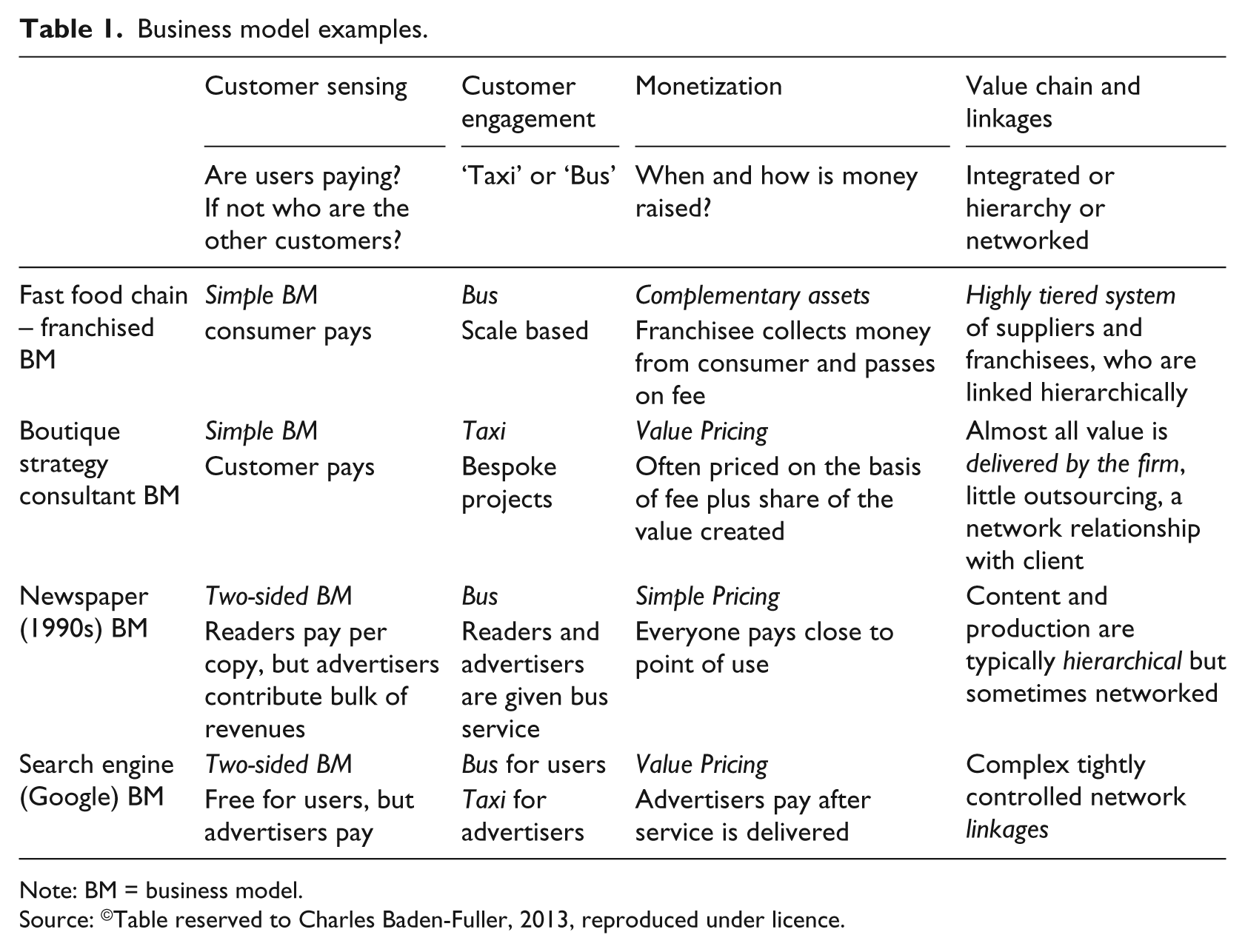
Note: BM = business model.
Source: ©Table reserved to Charles Baden-Fuller, 2013, reproduced under licence.
Identifying customers: identifies the firm’s targeted user and customer groups. This identification includes the situation when it creates new customers, such as done by Facebook. Customer identification also specifies if the business model is one sided or multi-sided, that is, whether the users pay for the services received or whether there is another group of customers who pay for services when the core offering is provided for free. The Internet and digital technology did not ‘invent’ two-sided platforms (they have long been around in newspapers and TV), but they did facilitate expansion of platforms and encourage economists to model the interactions between the different groups (cf. Rochet and Tirloe, 2001 and 2003). In Table 1, we give the newspaper-advertising-supported business model and Google advertising–supported search engine business model examples.
Customer engagement: (sometimes called the value proposition). McGrath and MacMillan (2000) and Day and Moorman (2010) emphasize the need for identifying the value proposition from each of the customer’s perspective, and this process involves a degree of creativity and sensing (see, for instance, Teece, 2010). We propose one of the oldest and most established distinctions in the literature: between ‘project based system’ and ‘pre-designed (scale) based system’ – often described as the ‘taxi’ and ‘bus’ systems. Business models using the former create value by interacting with customers to solve specific problems (as with consulting firms – such as McKinsey, large law firms and contract movie makers) – see Davies and Brady (2000), Nightingale et al. (2011), and Hobday (2000). In contrast, those utilizing the bus system (car parts makers, car assemblers, mass fast food producers, etc.) add value by producing ‘one-size-fits-all’ goods or services in a repetitive manner via standardized, mass-production processes – see Hounshell (1985), Chandler (1990), Nightingale (2000). This distinction falls close to that proposed by Thompson (1967: Chapter 2) and supported by Drucker (1986) between intensive systems (firms organized in teams to undertake project work) and long-linked systems (essentially mass production). 2 Table 1 gives examples of both types of business models and notes the really interesting example that has both – Google appears to deploy a bus-based user engagement system for search engine users but a taxi-based user engagement system for its advertisers (who can tailor their advertising offering and set the price they are willing to pay).
Monetization: is a key part of value capture and involves more than just pricing (the economists concern), but includes systems determining timings of payments and methods of collecting revenues. It also distinguishes between charging all users the same price (as in grocery supermarkets) and negotiated prices. Teece (1986) stresses the role of the system of complementary assets, pointing out how leveraging these assets can increase monetizing opportunities. In particular he explains the often discussed ‘razor-blade’ model, where part (generally a little) of the revenues are collected early (when the service or product is purchased) and the rest (often a good deal more) from the supply of complementary assets (in this case the associated consumables) as it is used. When the supply of complementary assets is controlled by a separate firm (such as is the case in the franchise fast food systems noted in Table 1), the business model takes account of the complementary asset provider passing on some of its revenues to the original producer.
Value chain and linkages: (sometimes called architecture or governance systems) are the mechanisms the firm uses to deliver its product or service to the customer (or in the case of multi-sided platforms to each of the customer groups). Here, there are many valuable contributions, particularly by Amit and Zott (2001) and by Casadesus-Masanell and Ricart (2010), who stress the overall architecture of flows of information and governance of linkages. But even these fine contributions appear to overlook the situations where there are several user–customer groups requiring multiple interlinked value chains involving multiple technologies. Rather, all of these contributions rely more or less on many classical writings, such as those that emphasize the contrasts between vertical integration systems versus horizontal contracting (e.g. Williamson, 1973), and the extensive discussions on the range of possible types of systems within contracting, such as hierarchies or networks (e.g. Miles and Snow, 1992; Lorenzoni and Baden-Fuller, 1995).
This four-part typology is offered as a valuable insight, because it provides a set of characteristics that define the business model. These dimensions are: customers – one or two (or more) sided; customer engagement – each group of customers being engaged either via a taxi or bus system; monetization – customers pay directly at the time of sale or indirectly, perhaps over a period of time related to use; and value chain and linking mechanisms – most especially integrated versus tiered hierarchically organized outsourcing or networked supply chains. These dimensions give rise to models that can be used to explain the various ways in which different contexts (industry and time) technologies (developed or yet to be developed) can be connected to fulfil customer needs and provide revenues for the connecting enterprise. The typology also shows how different business models can be applied to the same product and the same set of customers (e.g. an aircraft engine producer can offer its engines as a service on a taxi basis (through short-term rental agreements) or to sell them outright, with servicing being provided as a complementary asset on the razor-blade basis – see, for instance, Zott and Amit (2010)). Each of these business model configurations contains cause–effect explanations relating to the various possible configurations connecting customer needs, organizing delivery and monetization. In the ‘Research agenda’ section, we explore how this typological approach can inform the cognitive and organizational research agenda.
Research agenda
It can be argued that researchers long recognized the role of businesses models in cognition, even if they did not use the exact phrase. For example, Spender (1989) used the words ‘industry recipe’ to group firms following similar business models and showed that managers identified with these groups in their thinking and acting. Likewise, Porac et al. (1989) found that Scottish knitwear firms that shared a common view of competition based on the similarity of their business approach adopted similar responses to competitive threats (Baden-Fuller and Stopford, 1984; Porac et al., 2011). This work did have a rough conception of the business model at its core that contained a set of causal beliefs about the nature of the customers and how value was delivered and captured. But it was a taxonomic (using exemplars) rather than a typological (conceptually derived) categorization. Although we know that cognitive categorizations are important for how managers conceive of both their strategies and their competition – as emphasized in Kaplan’s (2011) review – the emphasis on taxonomies means we still do not fully understand how the nature of the categorization may influence the results. Only by considering typologies of business models that emphasize the configuration possibilities that transcend time and industry boundaries can we delve into the fundamental questions behind business models and their manipulability.
We suggest that rather than asking whether managers are following the iconic descriptors of their industry, we should consider whether there are fundamental cause–effect configurations that drive behaviour. For example, do managers who use ‘taxi’-based customer engagement see the world differently from those who use ‘bus’ principles? In both cases, they may compete for the attentions of the same customer group, but their approaches are likely to be very different. And do managers who adopt vertically integrated systems think of the world differently from those that subcontract – and does it matter how those relationships are organized? This approach allows old questions to be revisited using the business model lens, yielding results that are capable of being flexible to time and place. In short, using manipulable characteristics, the typological business model approach enables scholars and managers to model and articulate different activities within the firm.
Our typology of the business model classification reveals a new category that has received too little attention – that of the multi-sided model, where managers have to consider more than one kind of customer. Researchers can explore what difference in cognitive capacity is required to take on this level of complexity – for it certainly does not easily fit into traditional concepts of customer categorization that is driven by a single customer group. And related to this, does the not-for-profit business model (often two sided, with a social enterprise being supported from a separate community) also require managers to adopt novel cognitive frames. Research on social business models (cf. Thompson and MacMillan, 2010) is now unpacking some of these differences. This approach of exploring multi-sided business models has the potential to unpick some of the interesting challenges surrounding ‘big data’, an important new phenomenon.
The typological categories implied by business model research may also have relevance for the work we do on organizational survival of entrepreneurial firms. Following Perkmann and Spicer (2010), we ask whether, in the minds of observers and key actors, there is a perceived status ordering among business models? Are some preferred, and if so when and why? And by whom? For example, when might consumers prefer organizations to make their own products rather than outsourcing their manufactures? Is there an assumption that the products of a taxi-based system will be of higher quality than those of a bus system? And critically, should the multi-sided business model be considered as a boundary spanning category and essentially weaker than a single-sided model – or is it a novel category that challenges traditional views (like nouvelle cuisine in French culinary history – see Rao et al., 2002) and thus an opportunity? The success of Google and Facebook suggests the latter – but the process by which these new business models became established is not fully understood. The whole question is of particular relevance to start-ups that seek support from investors. As Doganova and Eyquem-Renault (2009) explain, entrepreneurs often refer to business models to try to gain legitimacy – but is it fashion or logic that determines what gets supported?
Finally, the business model is a model – and embedded within it is a set of cause–effect relationships. Without using the term business model, the potentially powerful effect of ‘causal claims’ has been carefully explored in the context of financial markets (see, for instance, Mackenzie, 2008); but we do not know enough about how such relationships work for entrepreneurial firms. Is a detailed and coherent business model that is strongly supported by management theories necessarily more effective than one that is vague and dependent only on empirical observations? Detailing the logic within a business model may have value for some audiences (such as venture capitalists), but it may also constrain managerial thinking and the capacity to innovate such models (see, for instance, the suggestions of Sabatier et al., 2010 and Sosna et al., 2010). It is well known in many quarters (such as medicine) that the science of explanation lags the knowledge embodied in technology.
The nature of the causality embedded in a business model not only influences entrepreneurial start-ups; the same cognitive challenge is also critical for established firms (cf. McGrath, 2010, Doz and Kosonen, 2010). Tripsas and Gavetti (2000), Chesbrough and Rosenbloom (2002) and Chesbrough (2010) have all noted that some executives are unable to comprehend the possibility of adopting business models that are ‘new to the firm’, even when it is apparent that other firms in their sectors have adopted such models. Teece (2010) suggests that managers need to engage in customer sensing (i.e. identifying new customer groups and their needs), and exploring how this takes place in established firms is yet a further promising avenue for research.
This cognitive blindness among established firms seems to have provoked legislators in the United Kingdom to require (in the 2006 Companies Act) that boards of directors charged with companies’ governance be explicit about their business model choices and be held responsible for them. While we know a great deal about change management in general, relatively little work has been done to isolate and examine particular instances of business model change and so legitimize the thinking of governance scholars and of this government policy.
Final comment
Business models serve many purposes for management researchers, as has been explained by Baden-Fuller and Morgan (2010), and our understanding has been informed in part by the wider discussion of models in the thinking processes of scientists and economists reported in Morrison and Morgan (1999) and Morgan (2012). Inspired by these insights, we emphasize that business models can be used to categorize the business world; and exploring the nature of business model categories (such as those outlined in this article) and what these categories might mean for managers provide a potentially rich agenda for cognitive researchers. And in this exploration, we stress that business models are ‘manipulable instruments’ which can be used to explore cause and effect and understand the world of business better. In this conception, we can explore when and how business model thinking can assist entrepreneurial start-ups gain resources, or probe more deeply how different business model conceptions can act as a constraint or an opportunity for managerial thinking in established firms. And in this way we will have new insights into how firms innovate their business models to adapt to new technological, environmental or market challenges.
Footnotes
Acknowledgements
We acknowledge the valuable suggestions of the editors of the journal generally and Ann Langley in particular. We would also like to thank Santi Furnari, Stefan Haefliger, Paul Nightingale and Andre Spicer for helpful comments and encouragement.
Funding
The authors would like to thank the UK Research Council (EP/K039695/1 Building Better Business Models) for financial support.