




Abstract
In this scoping essay, we discuss the potential for generative artificial intelligence (GAI) to shape the work of organizational change, development, or strategy implementation professionals. Using a case example of a culture change initiative, we illustrate how practitioners can benefit from using GAI tools to augment relevant change activities in planning initiative content and roll-out, mobilizing stakeholders, and monitoring initiative progress. We conclude with a reflection on the limitations of GAI systems and outline directions for future research related to (1) stakeholder responses to GAI, (2) GAI impact on the nature of change work, and (3) GAI value creation for change work and unintended consequences of GAI use.
Organizational change and strategy scholars (Kanitz & Gonzalez, 2021; Weiser et al., 2020) as well as practitioners (DiLeonardo et al., 2020; Jick & Sturtevant, 2017) have become increasingly interested in how digital technologies provide new opportunities and risks for managing change. A digital technology with much recent attention is generative artificial intelligence (GAI), which refers to computer-assisted systems that can generate text, images, audio, or videos (Pataranutaporn et al., 2021). Recent media attention on OpenAI's ChatGPT (Sundar, 2023) or Google's Bard (Metz & Grant, 2023) has put the spotlight on GAI systems, which function using large language models. Due to advancements in machine learning and natural language processing (Vaswani et al., 2017), these large language models can produce texts such as essays, poems, or lines of code in a human-like fashion within seconds. Scholars and practitioners predict that such GAI systems will shape the way humans approach innovation, problem-solving, and content creation in organizations going forward (Bouschery et al., 2023).
In this future scoping essay, we claim that GAI systems also hold great potential to shape the work of organizational change, development, or strategy implementation professionals. Using a case example (i.e., leveraging ChatGPT to enhance a culture change initiative), we aim to illustrate where current GAI tools can augment change management activities. We end with a reflection on the limitations of GAI tools and outline directions for future research.
Using GAI Tools for Organizational Development, Change and Strategy Activities
Organizations need to adapt to dynamic environments to survive and thrive. Yet, successfully realizing change, and in particular radical-transformational change, is often challenging to navigate (e.g., Huy et al., 2014). Researchers have argued that one reason that changes fail to meet expectations and get people on board is the transition process itself (Ford et al., 2008; Stouten et al., 2018). Planning and implementation of change initiatives is a resource-intense and time-consuming process that needs to be tailored to a workforce with heterogeneous needs and attitudes—often with some embracing, others ambivalent, and some rejecting the initiative. It is against this backdrop that GAI systems can yield critical improvements to augment change activities.
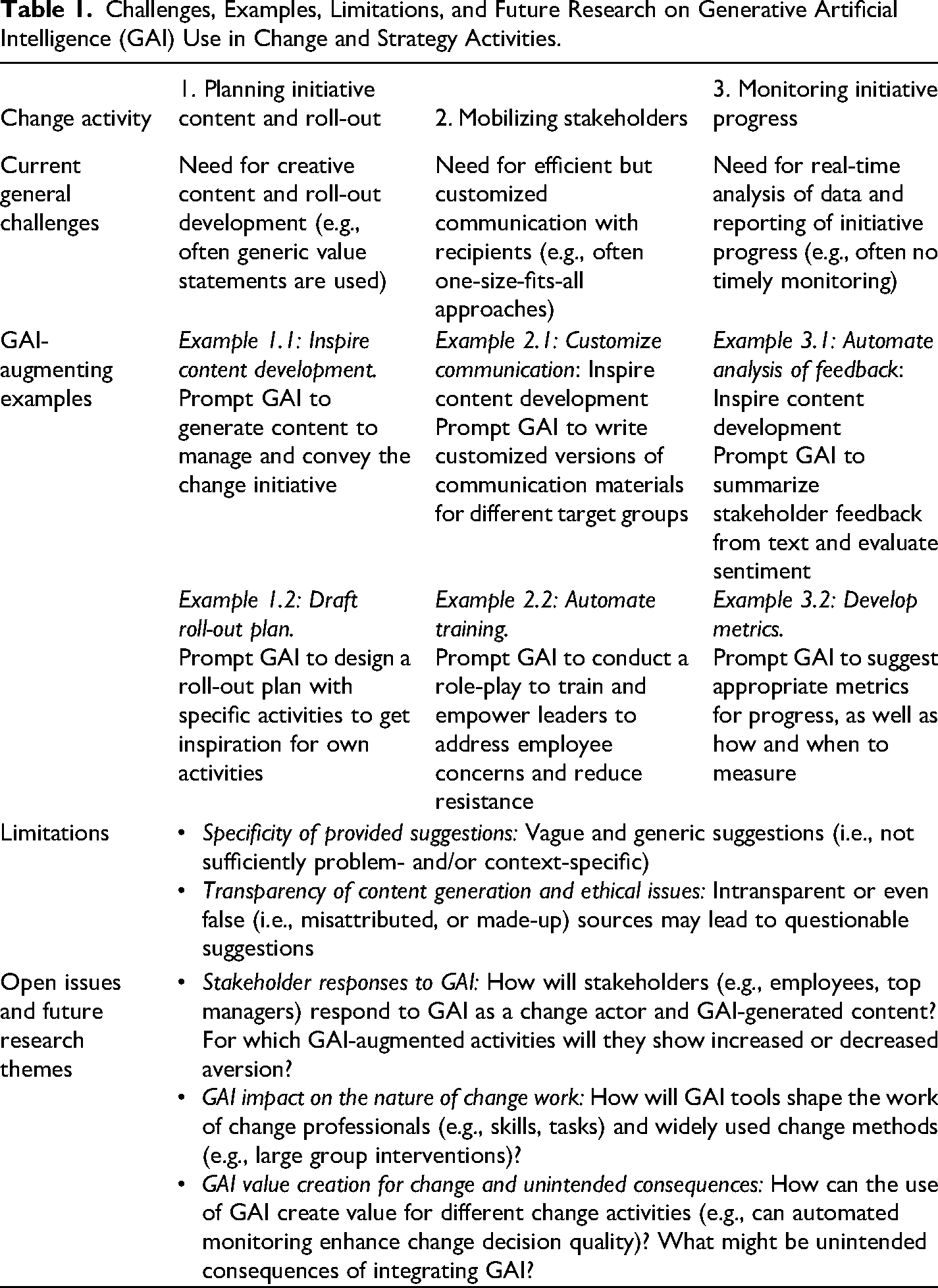
To illustrate the opportunities and limitations of GAI tools, we utilize OpenAI's Chat GPT-3 (Jan 30, 2023 Version) to augment typical change activities. We illustrate the examples using the context of a culture change initiative in a technology manufacturer—here labeled as TechCorp—building on field research of the first author (Kanitz et al., 2022). We showcase this type of initiative because it is familiar to change scholars (Schein, 1985) and practitioners (Katzenbach et al., 2012). Moreover, shaping an organization's culture is a multifaceted process that is particularly challenging (Walker & Soule, 2017). Hence, we aim to elucidate how practitioners may benefit from using GAI tools to augment three activities common to most change management models (see, Stouten et al., 2018, for a review): (1) planning initiative content and roll-out, (2) mobilizing stakeholders, and (3) monitoring initiative progress. Table 1 summarizes examples of the application of GAI in these areas, limitations, and directions for future research.
Challenges, Examples, Limitations, and Future Research on Generative Artificial Intelligence (GAI) Use in Change and Strategy Activities.
GAI use for Planning Initiative Content and Roll-out
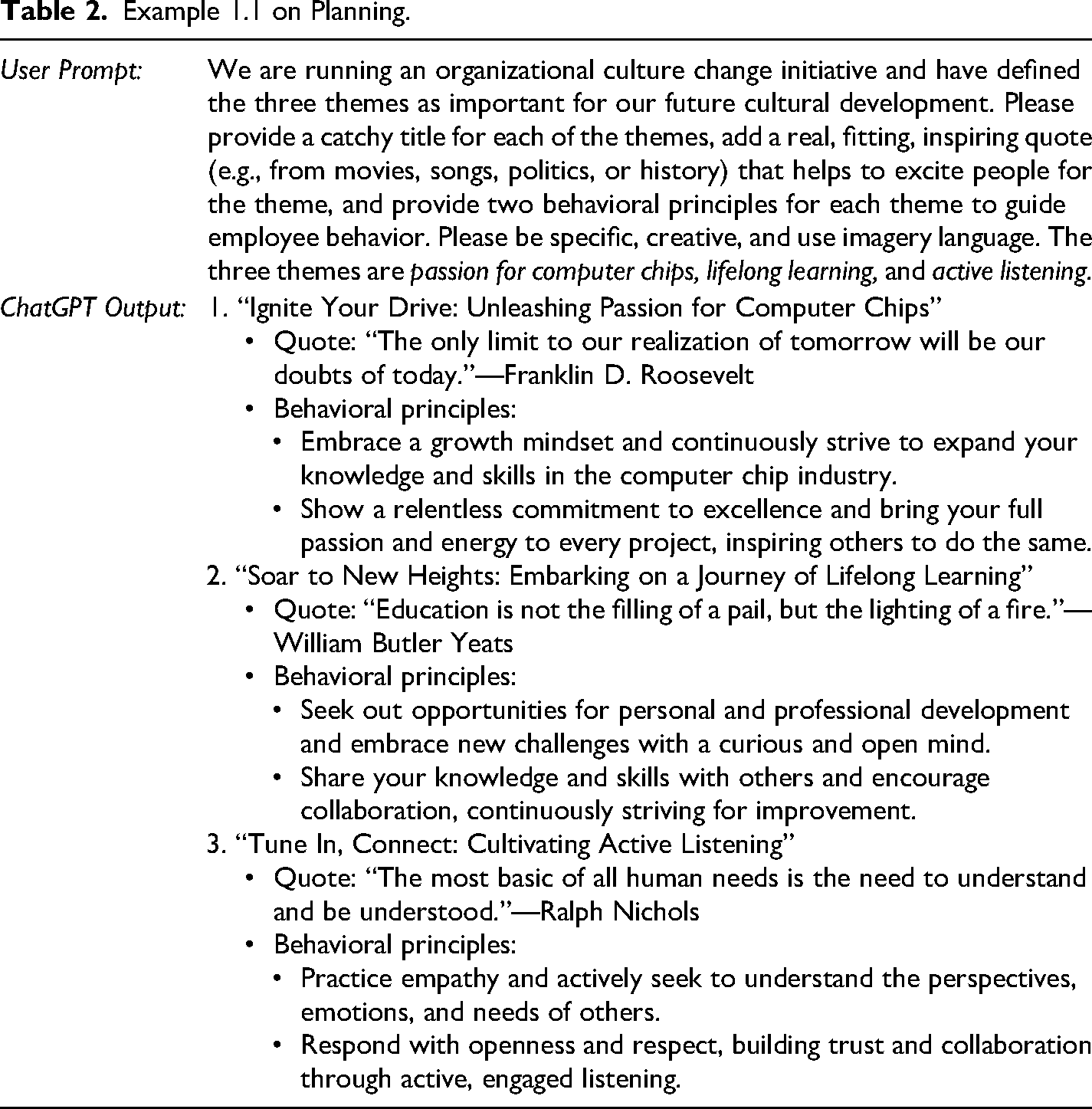
Planning content and roll-out activities for culture change initiatives are resource-intensive processes that require time, manpower, and creativity. GAI tools are useful to foster creative processes in an efficient way (Bouschery et al., 2023) because of their ability to generate content from various sources, thereby broadening the possible solution set swiftly.
Example 1.1 on Planning.
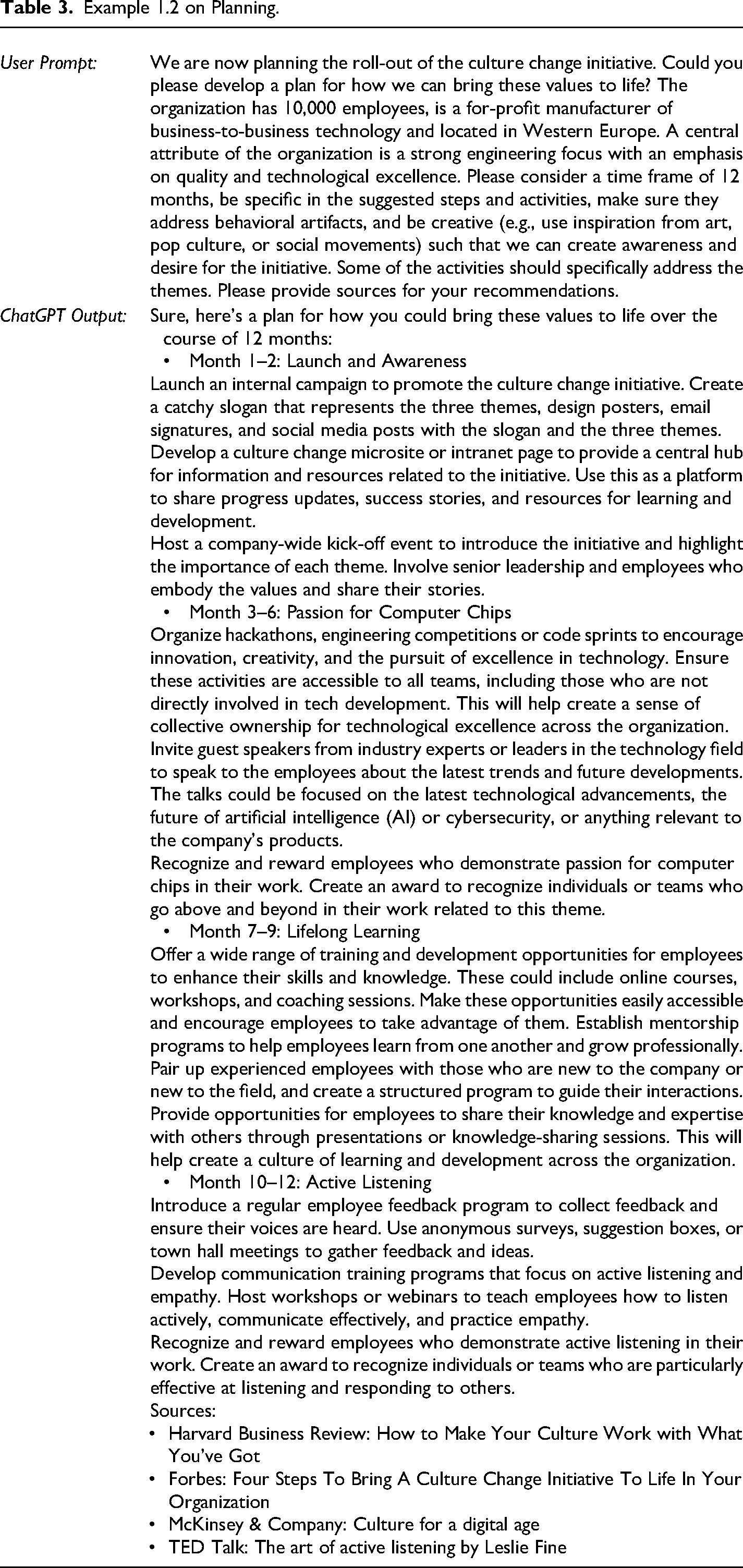
Example 1.2 on Planning.
GAI use for Mobilizing Stakeholders
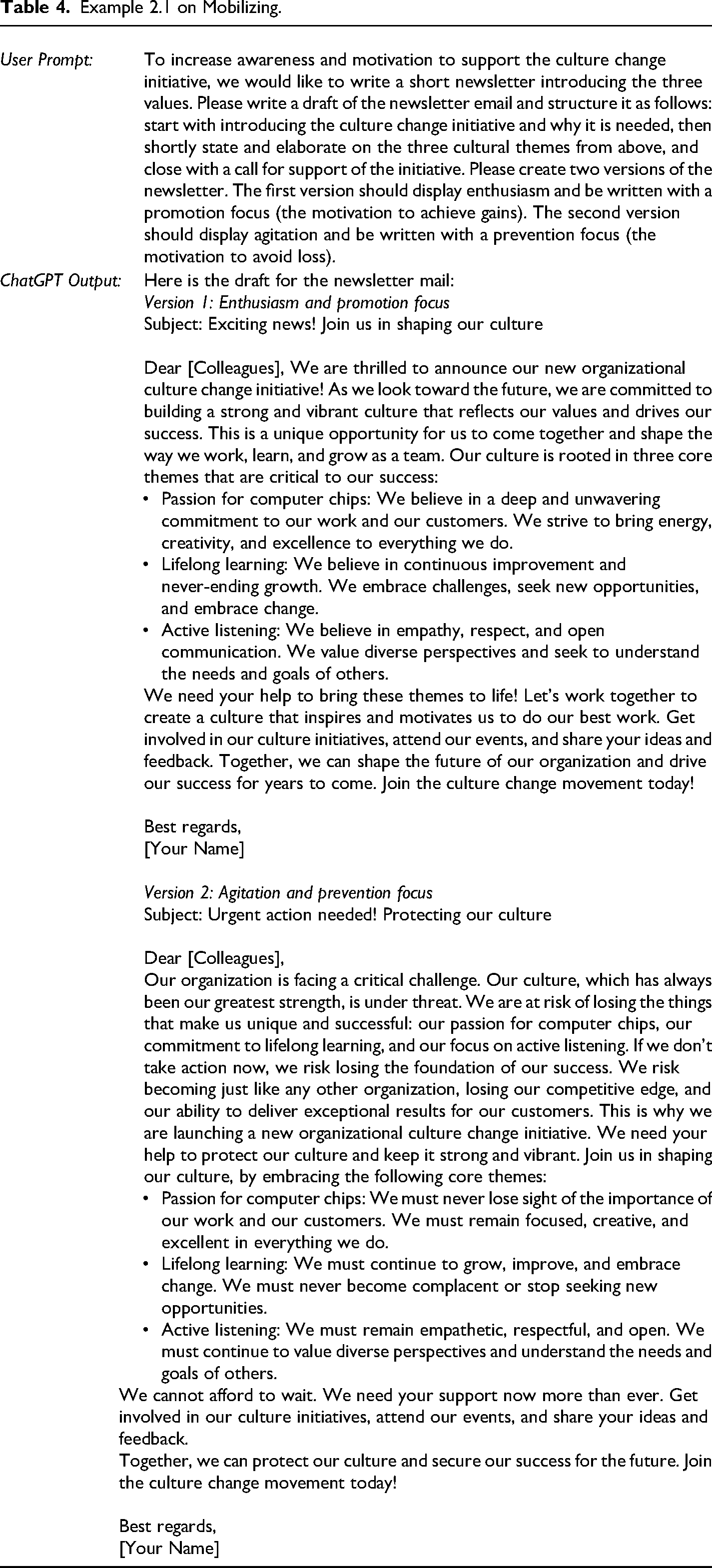
Another important activity where GAI can make a difference relates to mobilizing stakeholders to engage with and support the culture initiative.
Example 2.1 on Mobilizing.
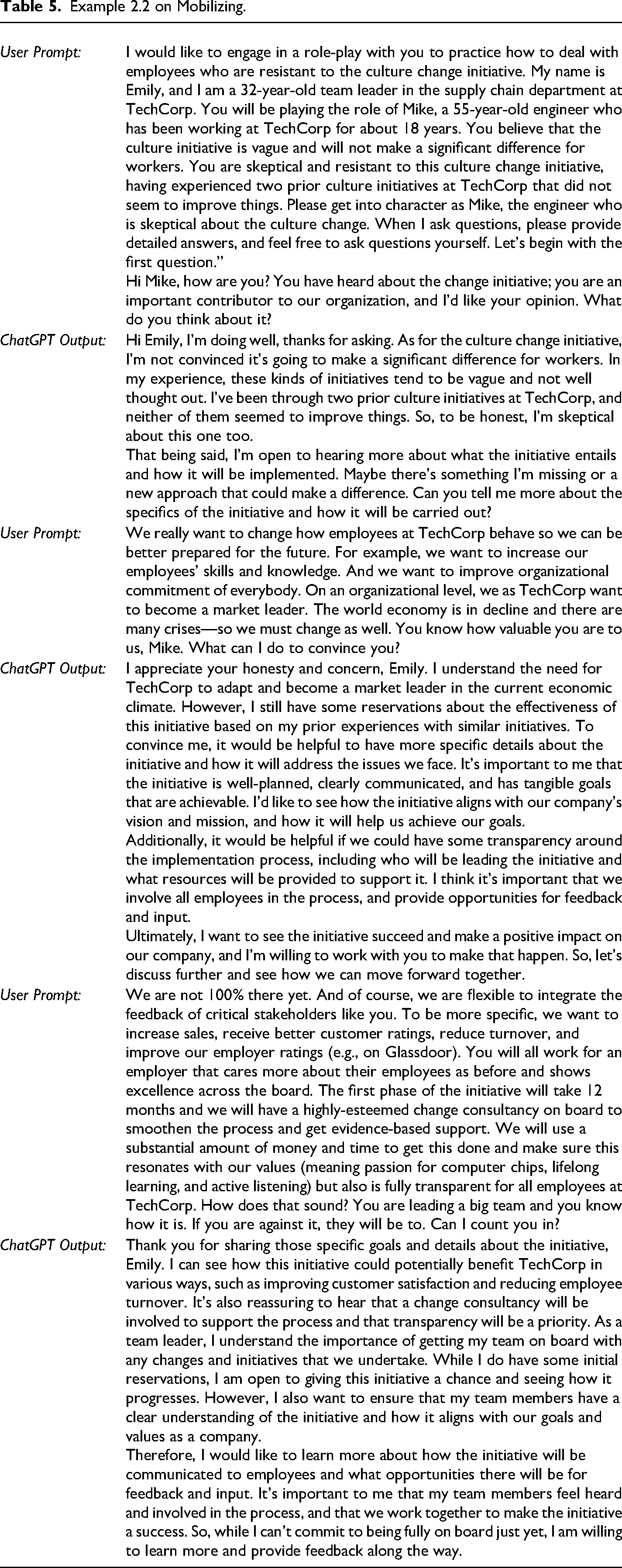
Preparing leaders in the organization to communicate and promote a change initiative through training programs is key to the success of such an initiative (Stouten et al., 2018). Leaders often face different local conditions and diverse employee groups with various interests. These complex employee preferences are not usually fully addressed in standardized change training programs, often leaving leaders unprepared to navigate these challenges. Hence, allowing leaders to utilize GAI systems for role-play training, for example, by simulating how to deal with skeptical employees (see Table 5) can be a cost-efficient way of supporting leaders during implementation.
Example 2.2 on Mobilizing.
GAI use for Monitoring Potential Stakeholder Issues
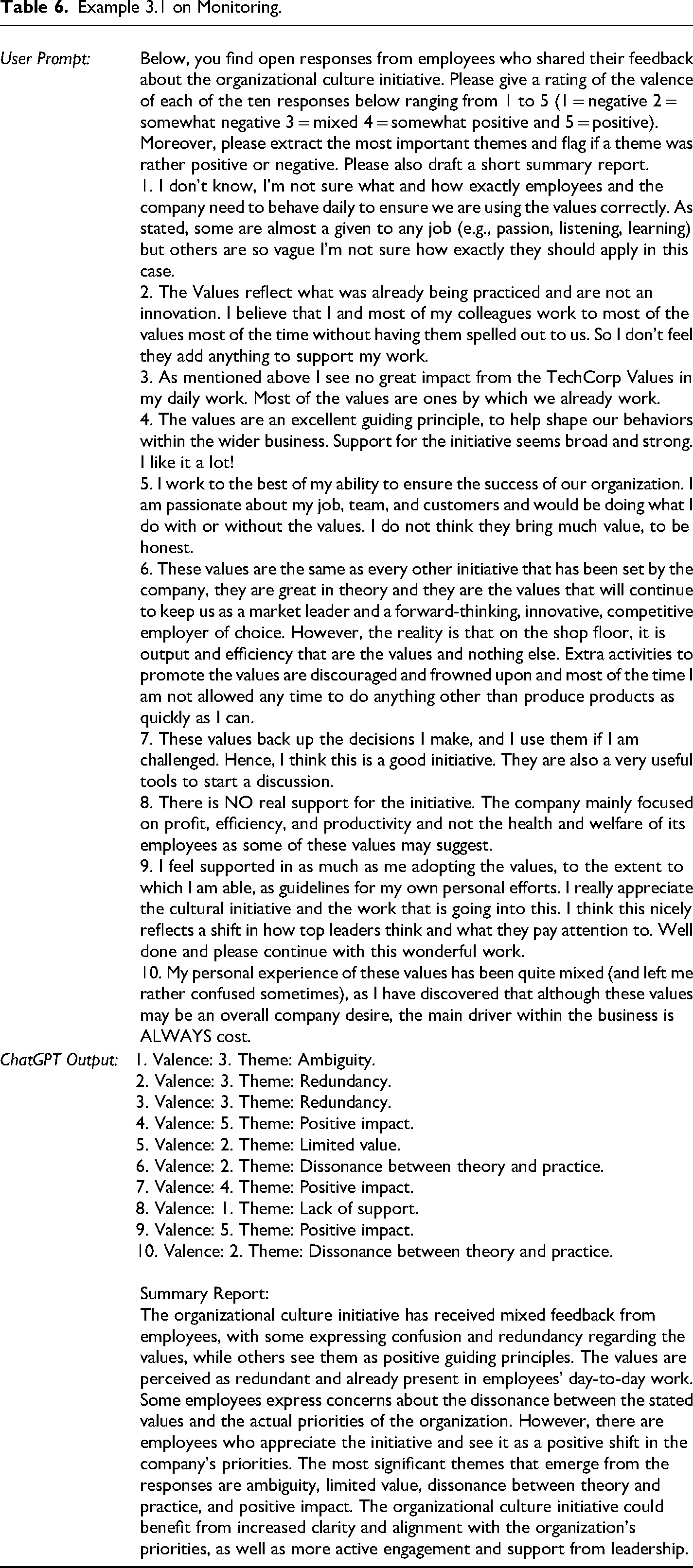
Change analytics and data-driven change management have received increasing attention in practice over recent years (e.g., Wolf et al., 2023). GAI tools can be especially useful for facilitating data analysis and enabling the monitoring of a change initiative's progress.
Example 3.1 on Monitoring.
Example 3.2 on Monitoring.
Reflection on Limitations of Exemplary GAI use Cases
The examples above showcase how the use of GAI tools (i.e., ChatGPT) can augment the work of organizational change, development, or strategy professionals. Next, we reflect on limitations related to the presented use cases.
Specificity of the Suggestions Provided by the GAI System
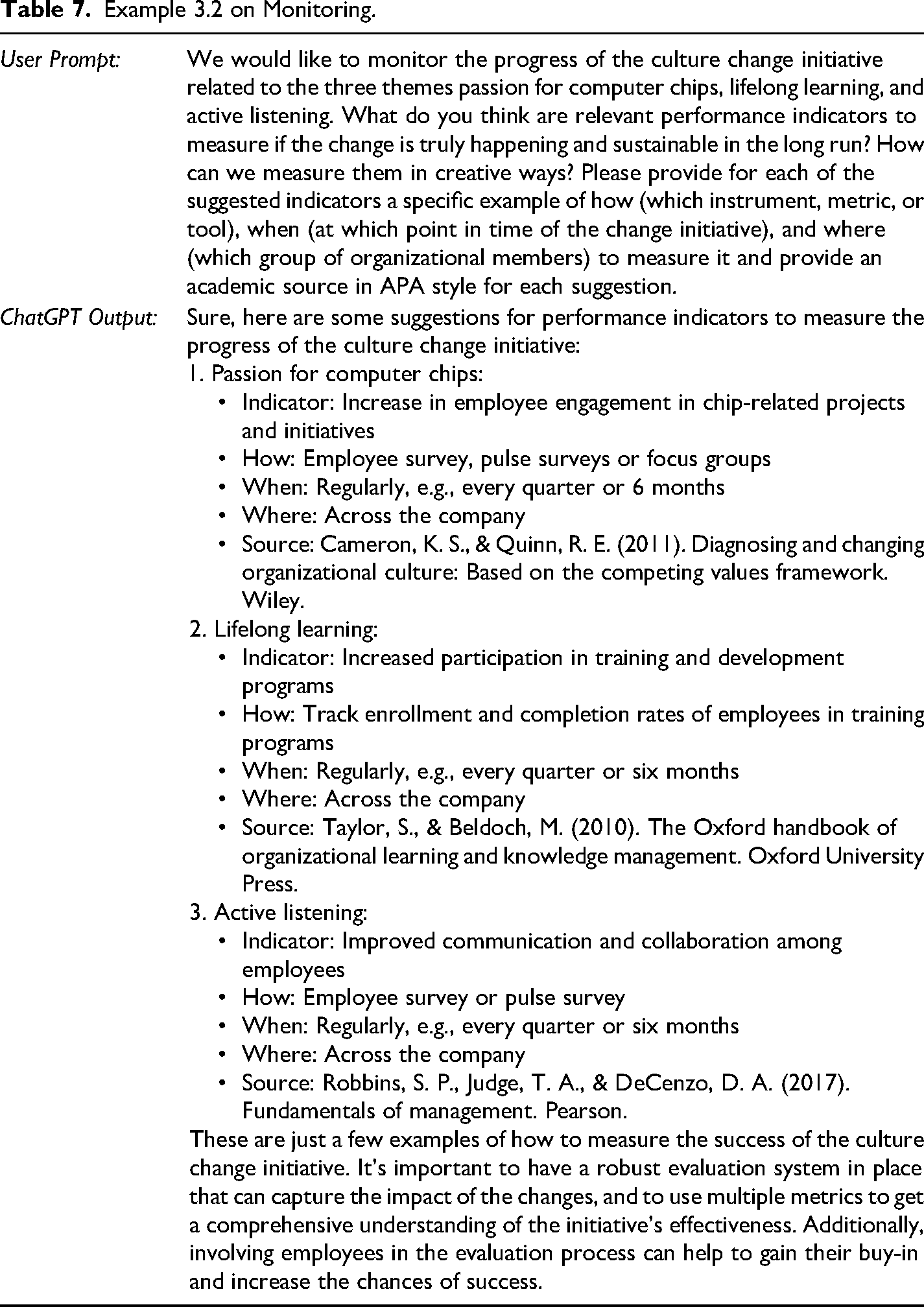
A key element determining the value of GAI systems to augment the work of change professionals is the specificity of the suggestions provided by the GAI. One salient limitation is that the suggestions in our examples often appear rather vague and generic. This can be problematic as designing successful change initiatives is a highly context-sensitive activity (e.g., tailored to the urgency of the situation, the capability of managers, etc., see Hailey & Balogun, 2002). For instance, elements in Example 1.2 (roll-out plan) or in Example 3.2 (metrics) would be more helpful if specifically tailored to the problem in question. Hence, the generated suggestions are a useful starting point—but certainly need further development by humans with expertise in change management and a deep understanding of the organization, its history, and its employees.
Transparency of Content Generation and Ethical Issues
Another main limitation in the presented examples is the lack of transparency of the sources which have been used for generating the suggestions. Unless explicitly prompted to provide its sources, references are not provided by ChatGPT. In a similar vein, the basis for the sentiment analysis in Example 3.1 remains unclear, which is highly problematic for replication and credibility purposes. When asked to provide sources, current GAI systems may hallucinate sources that cannot be differentiated from real sources at first glance. For instance, in Example 1.2 (roll-out plan) and Example 3.2 (metrics), some of the sources are not stated correctly or do not exist at all. Another related issue is that some sources are misattributed by ChatGPT. For instance, the William Butler Yeats quote provided in Example 1.1 (content development) is discussed as a misattribution (Sullivan, 2013). Building change activities on potentially false, non-existing, or misattributed sources may lead to losses of credibility, potentially endangering the success of change activities.
These lapses in transparency also lend themselves to legal or ethical issues. For instance, the lack of transparency may lead to conflicts with copy and usage rights. Moreover, large language models produce output based on statistical associations of words in the underlying text to create plausible, human-like but not necessarily truthful responses. Even when GAI systems are programed to refuse discriminant prompts or filter out illegal suggestions, the responses might be problematic due to a bias in the underlying text dataset (Bender et al., 2021). For instance, the suggestions for the roll-out plan in Example 2.1 should be taken with caution because they are likely built on cases that are overrepresented in the underlying training data (e.g., top-down driven culture initiatives in large Western for-profit organizations). However, such roll-out plans may backfire if executed without adaptation in other types of organizations or (cultural) environments (Hailey & Balogun, 2002).
Taken together, it is important to keep in mind that GAI tools have general limitations and can produce errors or biases in their output. Therefore, it is important to exercise caution and critical thinking when using GAI tools to augment change activities and to always verify the accuracy and relevance of their output.
Future Research Themes on the Role of GAI in Change and Strategy Work
Soon, more sophisticated or specialized GAI systems will become available that may overcome some of the current limitations. Potentially, such GAI systems can be trained on granular datasets for a specific change activity (e.g., designing roll-out plans) or organizational context (e.g., US-based for-profit firms) and thereby generating suggestions of higher quality. Next, we propose interesting avenues for future research at the intersection of GAI and change management.
Stakeholder Responses to GAI
One challenge when utilizing GAI for change management concerns the psychological reactions of stakeholders (e.g., employees, leaders, board members) to GAI involvement. Research has documented that people often disapprove of AI involvement, especially in ethical or HR domains (Bigman & Gray, 2018; Newman et al., 2020) or after seeing it err (Dietvorst et al., 2015)—both of which are likely scenarios in change initiatives. At the same time, for some sensitive actions or areas (e.g., tracking of employee behavior or performance), humans feel less threatened or angry when an AI is utilized (e.g., Raveendhran & Fast, 2021).
In addition, recent research (Jago & Carroll, 2023) suggests that producers of content get more credit when they involve GAI as compared to additional human experts (e.g., in the present case, ChatGPT could be preferred over a change consultancy). Thus, it will be critical for future research to investigate how employees and other stakeholders (e.g., board, clients, or suppliers) may react in terms of satisfaction or support for the change initiative when confronted with change activities that were fully performed or augmented by GAI (as in Example 2.1). For instance, it would be interesting to track reactions such as the positive and negative affect of the different stakeholders in Example 2.1, after they learn that the communication was created with the support of GAI tools.
GAI Impact on the Nature of Change and Strategy Work
With the increasing availability and versatility of GAI systems, the nature of change and strategy professionals’ work is going to change as well. We need a better understanding of what constitutes a high proficiency in using GAI systems (e.g., which tools are available, how to write professional prompts, how to work with the responses?) and how this relevant skill for change professionals can be built.
In addition, the impact of GAI tools on change managers’ activities needs to be better understood. For instance, GAI could significantly shape monitoring activities by introducing tools like a chatbot that automatically answers questions about the change and uses this data input to provide real-time analysis of attitudes. GAI systems may also be incorporated into live mobilization activities such as large group interventions (i.e., “methods for involving the whole system in a change process,” Bartunek et al., 2011, p. 1), where facilitators help hundreds of people collaborate on change initiatives. Specifically, GAI tools can help facilitators identify themes from multiple stakeholder inputs, pinpoint contentious issues, and suggest interventions on the spot to focus discussions and reach a consensus on crucial issues. Finally, research can investigate how GAI tools can be integrated with other technologies (e.g., humanoid robots or avatars) and methodologies to create more comprehensive change management processes.
GAI Value Creation for Change and Unintended Consequences
One important area for future research concerns how GAI tools can add value to change planning, stakeholder mobilization, and progress monitoring. By automating repetitive tasks and providing advanced analytics, AI tools such as GAI can help change managers make data-driven decisions and optimize their activities in efficient and more customized ways. However, there is currently a lack of empirical evidence on the benefits and risks of using GAI, including its impact on performance, resource utilization (personnel and time), or employee change experience.
Other crucial aspects for future research to explore are the potential risks and unintended consequences of these tools and how these might be mitigated. For example, it would be interesting to investigate whether and when automated monitoring (as demonstrated in Example 3.1) may actually undermine the quality of change decisions due to factors such as information overload or inadequate data quality. Additionally, it is still unclear whether the opportunities created by GAI and the resources it frees up will lead to optimized management of ongoing change initiatives, or whether the use of GAI will instead accelerate the initiation of new change projects (Church & Burke, 2017), potentially further increasing the risks of change fatigue and inconsistencies between change projects (Kanitz et al., 2022).
Conclusion
With this future scoping essay, we aim to inspire an active debate within the change, organizational development, and strategy implementation communities about how GAI can shape how we navigate change in organizations. Because both change managers and recipients will almost certainly increasingly collaborate with GAI tools in the future, our interest is to initiate a discussion on the applications, opportunities, and limitations that are associated with GAI. Against this backdrop, we hope this essay can serve as a fresh impetus to stimulate critical and relevant work in change management in the new era of GAI.
Footnotes
Declaration of Conflicting Interests
The author(s) declared no potential conflicts of interest with respect to the research, authorship, and/or publication of this article.
Funding
The author(s) received no financial support for the research, authorship, and/or publication of this article.
