



Abstract
Learners often hold inaccurate beliefs about the effectiveness of learning strategies that can impair self-regulated learning and performance. This study investigated the effectiveness of different types of instructional animations in promoting conceptual change by targeting these questionable beliefs. We compared three types of instructional animations that integrated different elements: refutations and explicit guidance (RE), refutations and implicit guidance (RI), and both implicit and explicit guidance, but no refutations (IE). This study involved 135 participants (89 female, 44 male, 2 diverse; Mage = 28.14; SD = 11.36). The findings showed that across all conditions, learners’ beliefs shifted significantly from pretest to posttest: the endorsement of less effective and moderately effective strategies decreased, while the endorsement of highly effective strategies increased. Moreover, instructional animations with refutations (RE and RI) led to more accurate posttest ratings of learning strategy effectiveness than instructional animations without refutations (IE). Regarding metacognition, no significant differences were found between the conditions. These findings contribute to multimedia learning research by showing that instructional animations with refutations are a promising tool for fostering conceptual change, increasing cognitive engagement, and teaching learners about the effectiveness of learning strategies in psychology learning and teaching.
Introduction
Questionable beliefs in educational psychology are widespread and negatively impact learning behavior (Dekker et al., 2012; Hughes et al., 2013, 2020). The term “questionable beliefs” refers to the graded nature of learners’ judgments regarding ideas and concepts that are scientifically refuted or currently unverifiable (Asberger et al., 2021; Menz & Seifried, 2022). In the context of educational psychology, one type of questionable beliefs concerns learners’ assumptions about the (in)effectiveness of learning strategies (Grospietsch & Lins, 2021). Beliefs in strategy effectiveness reflect learners’ subjective judgments about how effective learning strategies are for learning.
According to Dunlosky et al. (2013), learning strategies can be categorized as less effective (e.g., summarization, mental imagery, keyword mnemonics, rereading, highlighting), moderately effective (e.g., elaborative interrogation, self-explanation, interleaved practice), or highly effective (e.g., retrieval practice, distributed practice). However, because less effective strategies require less effort (e.g., Kirk-Johnson et al., 2019) but often produce better immediate performance than highly effective strategies, learners tend to overestimate their value. These questionable beliefs about learning strategies can hinder academic performance (e.g., Hui et al., 2021, 2022; Yan et al., 2016). Therefore, instructional interventions that promote conceptual change (the restructuring of prior knowledge to align with scientific understanding; Chi, 2008; Dole & Sinatra, 1998; Vosniadou, 2013) are essential.
Research in multimedia learning has shown that instructional animations can effectively support cognitive engagement and mental model construction (Mayer, 2014, 2017). However, their effectiveness depends on the instructional methods being implemented (Du et al., 2025; Mayer & Moreno, 2002). In the present study, we compared different types of instructional animations to examine their effectiveness in facilitating belief change regarding learning strategies.
Within the context of questionable beliefs, previous studies have shown that refutational approaches combined with explicit guidance—compared to implicit guidance—are particularly effective for fostering conceptual change (e.g., Ferrero, Hardwicke et al., 2020; Ferrero, Konstantinidis & Vadillo, 2020; Grospietsch & Mayer, 2018; Menz et al., 2021). Nevertheless, relying on a single instructional strategy may not be sufficient to elicit substantial change (McCuin et al., 2014; Palmer, 2003). Integrating refutations and explicit guidance in instructional animations may offer a promising approach, as it can simultaneously challenge learners’ questionable beliefs and promote active engagement. Hence, it may foster belief change while supporting deeper cognitive processing and the development of metacognitive knowledge (Grospietsch & Mayer, 2020; Kendeou et al., 2014; Zepeda et al., 2015).
Accordingly, we compared three types of instructional animations that differed in their use of refutations and guidance to examine their relative effectiveness in promoting conceptual change: animations with refutations and explicit guidance (RE), animations with refutations and implicit guidance (RI), and animations incorporating both implicit and explicit guidance but no refutations (IE). We also investigated how animation type influenced learners’ cognitive engagement and metacognitive knowledge related to learning strategies. To situate our research within the current literature, we next discuss the role of instructional animations, refutations, and guidance in the context of multimedia learning.
Multimedia Learning and Instructional Animations
Multimedia learning is grounded in the cognitive theory of multimedia learning (CTML; Mayer, 2002, 2005), which posits that presenting information through visual and verbal channels enhances information processing (Baddeley, 2010; Mayer, 2014, 2017, 2021; Mayer & Moreno, 2002). Instructional animations, a widely studied intervention in this context, have been shown to foster learners’ active processing of new information (e.g., Höffler & Leutner, 2007; Türkay, 2016).
Although meta-analyses indicate that instructional animations can positively affect cognitive engagement and learning outcomes, the effect sizes are small to moderate (e.g., g+ = 0.23; Berney & Bétrancourt, 2016; g+ = 0.23; Castro-Alonso et al., 2019; g+ = 0.37; Höffler & Leutner, 2007). Du et al. (2025) suggest that instructional animations are particularly effective when combined with strategies that guide attention and support the processing of dynamic information, which indicates that their effectiveness depends on what instructional methods are embedded in the animations. It is therefore necessary to investigate how different pedagogical strategies within instructional animations influence active processing and the restructuring of prior knowledge.
Refutations
Refutations are instructional interventions designed to address learners’ questionable beliefs in educational psychology and promote accurate understanding by confronting these beliefs and providing corrective information (Lassonde et al., 2016, 2017; Menz et al., 2021; Prinz et al., 2019). This allows learners to update their prior knowledge and reduces the likelihood of them relying on the same questionable beliefs in the future (Kowalski & Taylor, 2017; Posner et al., 1982; Sinatra & Broughton, 2011). To achieve this, refutations typically follow a structured format: they begin with the presentation of a questionable belief, followed by a direct corrective feedback, then an explanation of why the belief is incorrect, and finally, the provision of scientifically accurate information (Ferrero, Hardwicke et al., 2020; Menz et al., 2021).
Grospietsch and Mayer (2018) demonstrated that refutations significantly reduced the endorsement of educational misconceptions among pre-service biology teachers. Similarly, Menz et al. (2021) found that, compared to standard lectures, refutational lectures were more effective in reducing misconceptions. Moreover, in the context of multimedia learning, Özmen et al. (2009) compared refutations with and without instructional animations, showing that when refutational texts were supported with instructional animations—multimodal, dynamic step-by-step examples based on scientific evidence—learners more effectively corrected their misconceptions. These findings highlight the potential of instructional animations with refutations to support more enduring changes in learners’ beliefs about effective learning strategies in educational psychology.
Explicit and Implicit Guidance
Since questionable beliefs are highly persistent and difficult to change, research has emphasized the necessity of providing explicit rather than implicit guidance to correct such beliefs by enhancing learners’ metacognitive knowledge (e.g., Dole, 2000; Lazonder & Egberink, 2014; Tullis et al., 2013).
Ariel and Karpicke (2018) investigated the effects of explicit direct instruction on psychology students’ misconceptions about the effectiveness of various learning strategies, finding that in a delayed posttest, direct instruction significantly increased students’ self-regulated use of effective but cognitively demanding learning strategies. Similarly, Biwer et al. (2020) demonstrated that explicitly informing learners about the role of effective learning strategies for successful learning enhances metacognitive knowledge, which is a prerequisite for conceptual change to occur. McCabe (2011) employed an implicit, but targeted, instructional approach by providing information on memory-related topics, which also yielded positive effects on learners’ metacognitive knowledge, and Baleghizadeh and Derakhshesh (2017) found that in the domain of foreign language learning, explicit guidance promotes deeper thinking processes and enhances learning more effectively than implicit guidance. However, to the best of our knowledge, no studies have directly compared explicit and implicit guidance in the context of learners’ questionable beliefs in educational psychology.
Cognitive Engagement and Metacognitive Knowledge
Cognitive engagement refers to the psychological investment and intellectual effort that students devote to their learning experiences, manifesting in behaviors such as critical analysis. It is considered a key component of learning processes that aim to promote conceptual change (Alam & Mohanty, 2024). Multimedia learning environments that direct learners’ attention to essential information and facilitate dynamic knowledge reconstruction are effective at enhancing cognitive engagement (Lee & Hannafin, 2016). Hence, instructional animations that integrate refutations and explicit guidance may support engagement by inducing cognitive conflict and encouraging learners to confront their questionable beliefs. This process can direct learners’ focus to inconsistencies between their prior knowledge and scientific explanations, motivating active cognitive processing (Danielson et al., 2025; Thacker et al., 2020). Explicit guidance can also aid learners by prompting reflection on prior knowledge and explaining how effective learning strategies work—both of which foster cognitive engagement (Martin & Evans, 2019). Thus, research indicates that combining refutations with explicit guidance can effectively support the cognitive conditions necessary for cognitive engagement.
Metacognition refers to knowledge and awareness of one's own cognitive processes, including the understanding of how learning occurs (Pintrich, 2002). In our study, we distinguish between two metacognitive concepts: metacognitive knowledge and beliefs about learning strategies. While both concepts can be subsumed under the term metacognition, their meaning is slightly different: Metacognitive knowledge refers to learners’ ability to make informed judgments about which strategies are likely to support learning in specific situations, whereas beliefs about learning strategies reflect learners’ subjective evaluations of strategy effectiveness. Both measures capture facets of metacognition, with metacognitive knowledge emphasizing scenario-based judgments and learning strategy beliefs emphasizing subjective effectiveness ratings of learning strategies (Biwer et al., 2020).
Instructional animations that combine refutations and explicit guidance may also enhance metacognitive knowledge. This study examined learners’ understanding of the effectiveness of different learning strategies, particularly their ability to judge which approaches best support long-term retention. Without accurate metacognitive knowledge, learners often rely on misleading cues, such as the subjective ease of processing, which can create fluency illusions and lead them to overestimate the effectiveness of less demanding strategies (Kornell et al., 2011; Kornell & Bjork, 2008). Interventions that improve metacognitive knowledge are therefore essential for promoting more effective and durable learning (Biwer et al., 2020).
Research Questions and Hypotheses
The present study was guided by two questions. RQ1: How do different types of instructional animations affect learners’ beliefs regarding the effectiveness of learning strategies? RQ2: How do instructional animations influence cognitive engagement and metacognitive knowledge? Our approach was guided by the idea that specific combinations of instructional elements may differentially impact the revision of belief as well as underlying cognitive and metacognitive processes. We compared three types of instructional animations: refutation and explicit guidance (RE), refutation and implicit guidance (RI), and implicit and explicit guidance without refutations (IE).
Based on previous research showing that refutations and guidance can facilitate belief change and cognitive engagement (e.g., Ariel & Karpicke, 2018; Ferrero, Hardwicke et al., 2020), we hypothesized that integrating refutations and guidance in instructional animations would reduce learners’ beliefs in the effectiveness of less effective (H1.1) and moderately effective (H1.2) strategies from pretest to posttest, but that the endorsement of highly effective strategies would increase from pretest to posttest (H1.3). Furthermore, combining refutations with explicit guidance was expected to enhance strategy effectiveness by directing learners’ attention to critical aspects of the learning content and helping them organize and integrate new information (Biwer et al., 2020; Grospietsch & Mayer, 2018; Leow, 2018; Martin & Evans, 2019). Therefore, we assumed that the RE condition would be the most effective in influencing posttest beliefs concerning less effective (H1.4), moderately effective (H1.5), and highly effective learning strategies (H1.6). Additionally, we expected that the RE condition would lead to the highest levels of cognitive engagement (H2.1) and metacognitive knowledge regarding the effectiveness of learning strategies (H2.2).
Method
Participants and Design
This study involved 135 participants (89 female, 44 male, 2 diverse) who were randomly recruited from teacher students (n = 57), university students from other studies (n = 23), and volunteers from outside the university (n = 55). An a priori power analysis, based on the main effects reported by Castro-Alonso et al. (2019) and Deibl et al. (2024), indicated that a sample of 103 participants would be sufficient to detect a small-to-moderate effect (η2p = 0.04, f = 0.204) for the main effects of interest, with α = .05 and power = 0.90. To ensure adequate power for detecting potential interaction effects and to account for possible dropouts or missing data, we recruited a larger sample (n = 135). The mean participant age was 28.14 years (SD = 11.36). No financial or material compensation was provided for participation. Data collection followed the ethical guidelines of the authors’ institution.
A three-factorial repeated measures design (pretest and posttest) was used, with the between-subjects factor as type of instructional animation (RE, RI, and IE) and 45 participants in each condition. The dependent variables were learning strategy beliefs over time, cognitive engagement, and metacognitive knowledge.
Materials
Instructional Animations
The factor “type of instructional animation” was manipulated using three different instructional animations to inform learners about the effectiveness of learning strategies. Each animation consisted of two of the following three instructional parts: refutations, explicit guidance, and implicit guidance.
Refutations were designed according to the guidelines for refutational texts (Ferrero, Hardwicke et al., 2020; Prinz et al., 2019). Each refutation followed a four-step structure, as per the following “highlighting” example: (1) the questionable belief was described (“Many learners believe that highlighting information is an effective strategy for promoting learning”), (2) the belief was refuted (“However, highlighting alone usually has little to no positive effect on knowledge acquisition”), (3) an explanation of why the belief is incorrect was provided (“Highlighting too much information can even negatively impact learning”), and (4) scientifically accurate information was supplied (“Scientific studies confirm that highlighting alone does not reliably improve learning outcomes”). Overall, 10 questionable beliefs were included, with a corresponding refutation designed for each, resulting in a total of 10 refutations implemented through the RE and RI conditions (see Appendix A).
In line with previous studies, explicit guidance was used to direct learners’ attention to key principles or conclusions relevant to the learning content (Lazonder & Egberink, 2014). Here, explicit guidance was operationalized as targeted explanations that emphasize the counterintuitive nature of effective learning strategies, such as the concept of desirable difficulties (Bjork & Bjork, 2011, 2020). It was clearly communicated that effortful strategies foster long-term retention, even if they feel less productive at the time. Thus, the explicit guidance aimed to support learners’ reflection on effective strategies by making their underlying mechanisms transparent and was implemented through the RE and IE conditions.
In contrast, implicit guidance was operationalized as more general conceptual explanations that framed learning in cognitive terms without explicitly linking the learning mechanisms to specific learning strategies or prescribing how to apply them. Here, implicit guidance included information about the structure and limitations of working memory and its interaction with long-term memory (e.g., Baddeley, 2010; Sweller, 2023). This was aimed at providing learners with a broad conceptual foundation of how learning works, encouraging them to draw their own conclusions about effective study behaviors. Unlike explicit guidance, the implicit guidance did not directly communicate why effortful strategies are more effective, but instead, required learners to independently relate general cognitive principles to practical applications. It was implemented through the RI and IE conditions.
Example instructional animations are shown in Figure 1; as can be seen, they include both graphical and textual information. All the instructional animations lasted for 7.34 min and could not be forwarded or rewound.
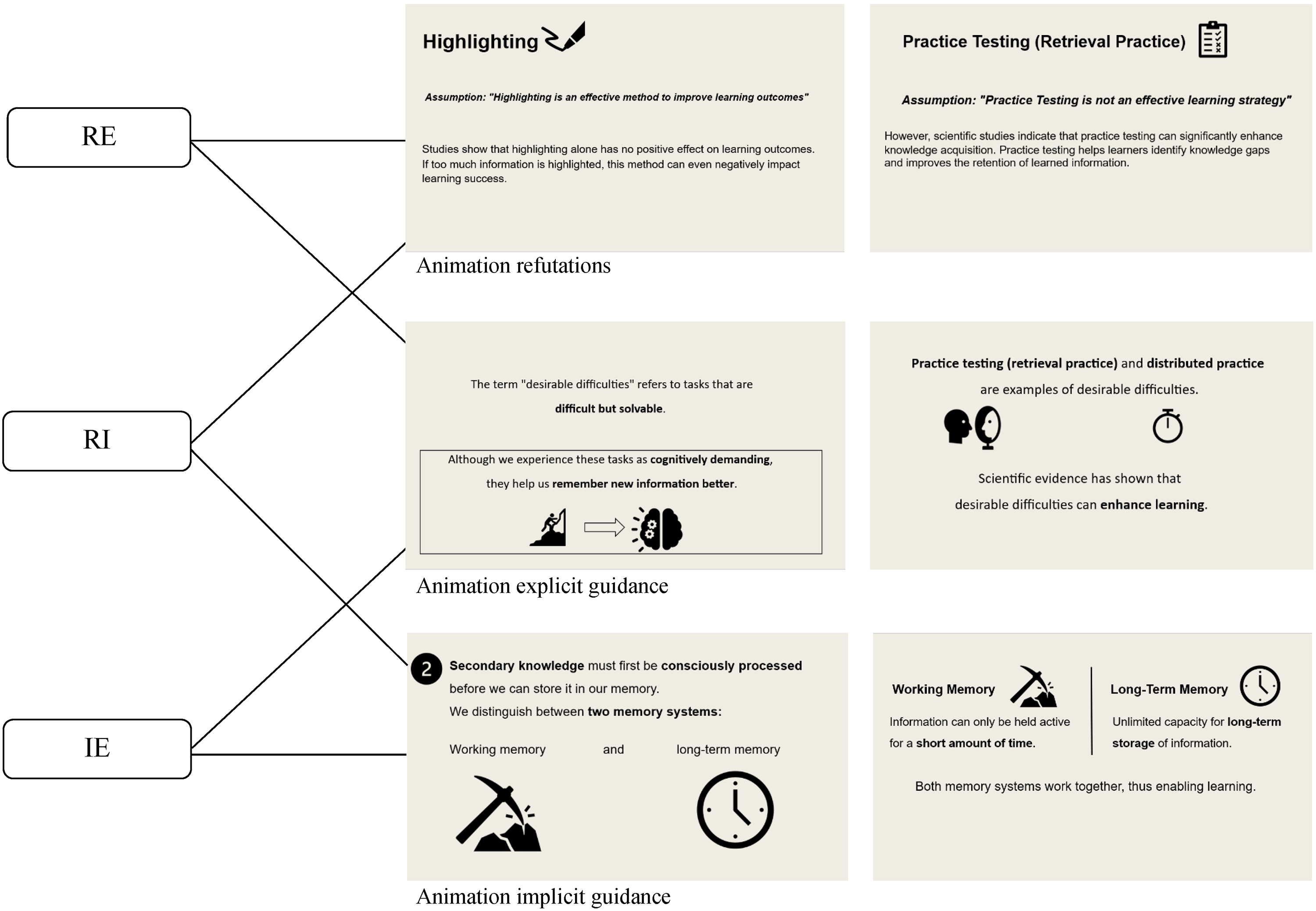
Experimental conditions and instructional methods used in the respective animations.
Measures
Learning Strategy Beliefs
To assess learners’ strategy beliefs in the immediate pretest and posttest, participants rated the perceived effectiveness of 10 learning strategies, which were categorized as less effective, moderately effective, and highly effective (Dunlosky et al., 2013). The less effective strategies comprised summarization, mental imagery, keyword mnemonics, rereading, and highlighting; the moderately effective strategies comprised elaborative interrogation, self-explanation, and interleaved practice; and the highly effective strategies included retrieval practice and distributed practice (see Appendix B). Beliefs about the effectiveness of these strategies were measured using a 5-point Likert scale (from 1 = highly effective to 5 = not effective). For the analyses, mean scores were calculated for each strategy category and used as dependent variables. Correlations between pre- and posttest ratings are reported in Appendix A (Table A1) to describe the degree of association between the two measurement points.
Cognitive Engagement
Participants’ cognitive engagement was measured using a questionnaire developed and previously applied by Johnson and Sinatra (2013) that comprised 11 items (e.g., “If the instructional animation contained new information, I tried to link it to things I already know and am familiar with”), which were adapted to the context of the present study (i.e., beliefs about learning strategies). The responses were rated on a 5-point Likert scale (1 = strongly agree to 5 = strongly disagree). The internal consistency in the present sample was Cronbach's alpha = .62, indicating a considerable measurement error, which may have been due to the heterogeneity of the construct and the limited number of items. Nevertheless, the use of the scale in previous related research supports its appropriateness for this study.
Metacognitive Knowledge
Metacognitive knowledge was assessed using five scenario-based items adapted from Biwer et al. (2020) and McCabe (2011). Each scenario presented two learning strategies with differing levels of empirically supported effectiveness, applied to a specific learning context (see Appendix C). The participants were instructed to read each scenario and indicate which of the two strategies would be more effective in the given situation. The learning strategies described in the scenarios were as follows (the more effective strategies are marked in italics): testing vs. restudying, interleaving vs. blocking, massing and rereading vs. spacing, rereading vs. interrogative elaboration, and self-explanation vs. mental imagery. Internal consistency calculations (using the Guttman split-half coefficient) yielded a value of 0.48, indicating that the measure had low internal reliability for capturing metacognitive knowledge across the different scenarios.
Procedure
At the beginning of the study, the participants were randomly assigned to one of three conditions: RE, RI, or IE. To ensure familiarity with the 10 learning strategies, a brief explanation was provided for each one: retrieval practice, distributed practice, elaborative interrogation, self-explanation, interleaved practice, summarization, mental imagery, keyword mnemonics, rereading, and highlighting. Participants’ beliefs about the effectiveness of these learning strategies were then assessed (pretest). Based on their assigned condition, the participants then viewed one of the three instructional animations. Cognitive engagement, posttest learning strategy beliefs, and metacognitive knowledge were then assessed. Learning strategy beliefs and metacognitive knowledge were both measured using knowledge tests, but they differed in focus: the former were assessed by asking learners to rate their beliefs about the effectiveness of various learning strategies, capturing their subjective understanding, while the latter was measured through a knowledge test requiring participants to evaluate the effectiveness of the strategies in each given scenario, providing a more objective measure of their knowledge.
Data Analysis
RQ1 was examined using a repeated-measures MANOVA, with type of instructional animation as the independent variable and learning strategy beliefs over time as the dependent variables.
RQ2 was examined using a MANOVA, with type of instructional animation as the independent variable and cognitive engagement and metacognitive knowledge as the dependent variables.
Results
The descriptive results revealed that across all the groups, the belief in less effective and moderately effective strategies decreased over time, while the belief in highly effective strategies increased over time (see Figure 2). Table A2 (Appendix A) provides the corresponding descriptive statistics.
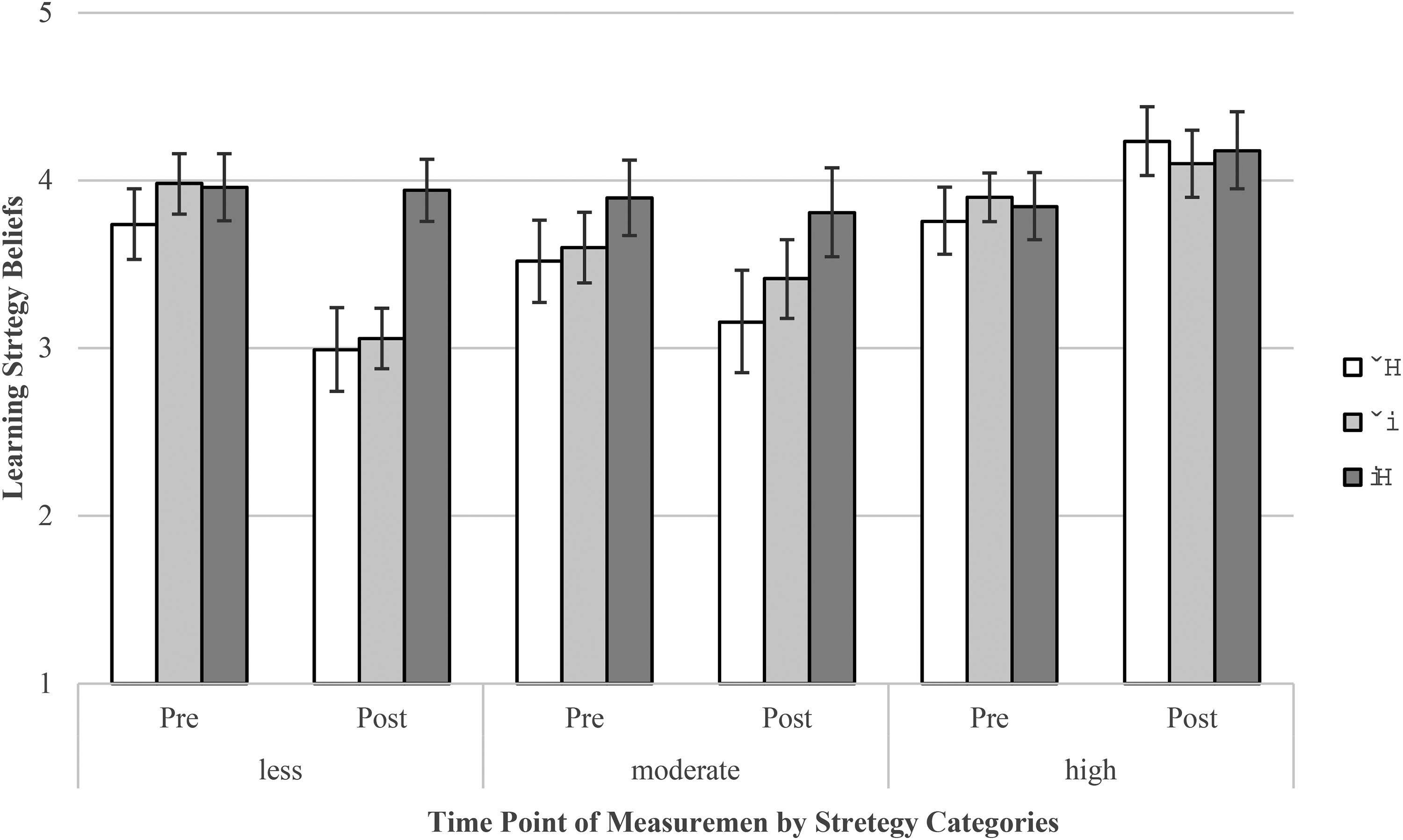
Mean belief ratings at pretest and posttest for less-, moderately-, and highly effective strategies by instructional condition, with 95% confidence intervals.
Regarding RQ1, at the multivariate level, there was a significant main effect of time, F(3, 130) = 33.69, p < .001; η2 = .44, a significant main effect of type of instructional animation, F(6, 262) = 5.00, p < .001; η2 = .10, and an interaction effect of time and type of instructional animation, F(6, 262) = 6.58, p < .001; η2 = .13.
The univariate within-subjects comparisons showed that learning strategy beliefs changed significantly over time for less effective strategies, F(1, 132) = 75.06, p < .001; η2 = .36; values decreased; H1.1, moderately effective strategies, F(1, 132) = 11.00, p = .001; η2 = .08; values decreased; H1.2, and effective strategies, F(1, 132) = 28.24, p < .001; η2 = .18; values increased; H1.3. The interaction patterns between time and type of instructional animation revealed a significant univariate effect for less effective strategies, F(2, 132) = 18.22, p < .001; η2 = .22, but not for moderately effective strategies, F(2, 132) = 1.57, p = .21; η2 = .02, or highly effective strategies, F(2, 132) = 1.60, p = .21; η2 = .02.
A post-hoc analysis (Bonferroni) comparing all the conditions of the independent variable showed that RE differed significantly from IE for less effective strategies (p < .001) and moderately effective strategies (p < .001), but not for highly effective strategies (p = 1.00). A similar pattern was found for the contrast between RI and IE (less effective strategies: p = .01; moderately effective strategies: p = .009; highly effective strategies: p = 1.00). RE and RI did not differ over all three categories (less effective strategies: p = .86; moderately effective strategies: p = .42; highly effective strategies: p = 1.00).
Overall, the results partly confirm the hypotheses, indicating that RE and RI were more effective than IE with respect to less effective (H1.4), moderately effective (H1.5), and highly effective (H1.6) strategies. Mean comparisons (see Table A1, Appendix C) show that participants in the RE condition reported the lowest belief ratings for less- and moderately effective strategies, followed by those in the RI condition, while the highest ratings were observed in the IE condition.
Regarding RQ2, there was a small but significant effect of type of instructional animation on cognitive engagement, F(2, 132) = 3.38, p < .04; η2 = .05; H2.1. Post-hoc tests (Bonferroni) showed that RE differed significantly from IE (p = .047; see Figure 3), but not from RI (p = 1.00). RI and IE did not differ significantly (p = .15). Regarding metacognitive knowledge, there was no significant effect of type of instructional animation, F(2, 132) = 1.44, p > .24; η2 = .02; H2.2. Mean comparisons revealed that cognitive engagement was higher in the RE and the RI conditions than in the IE condition.
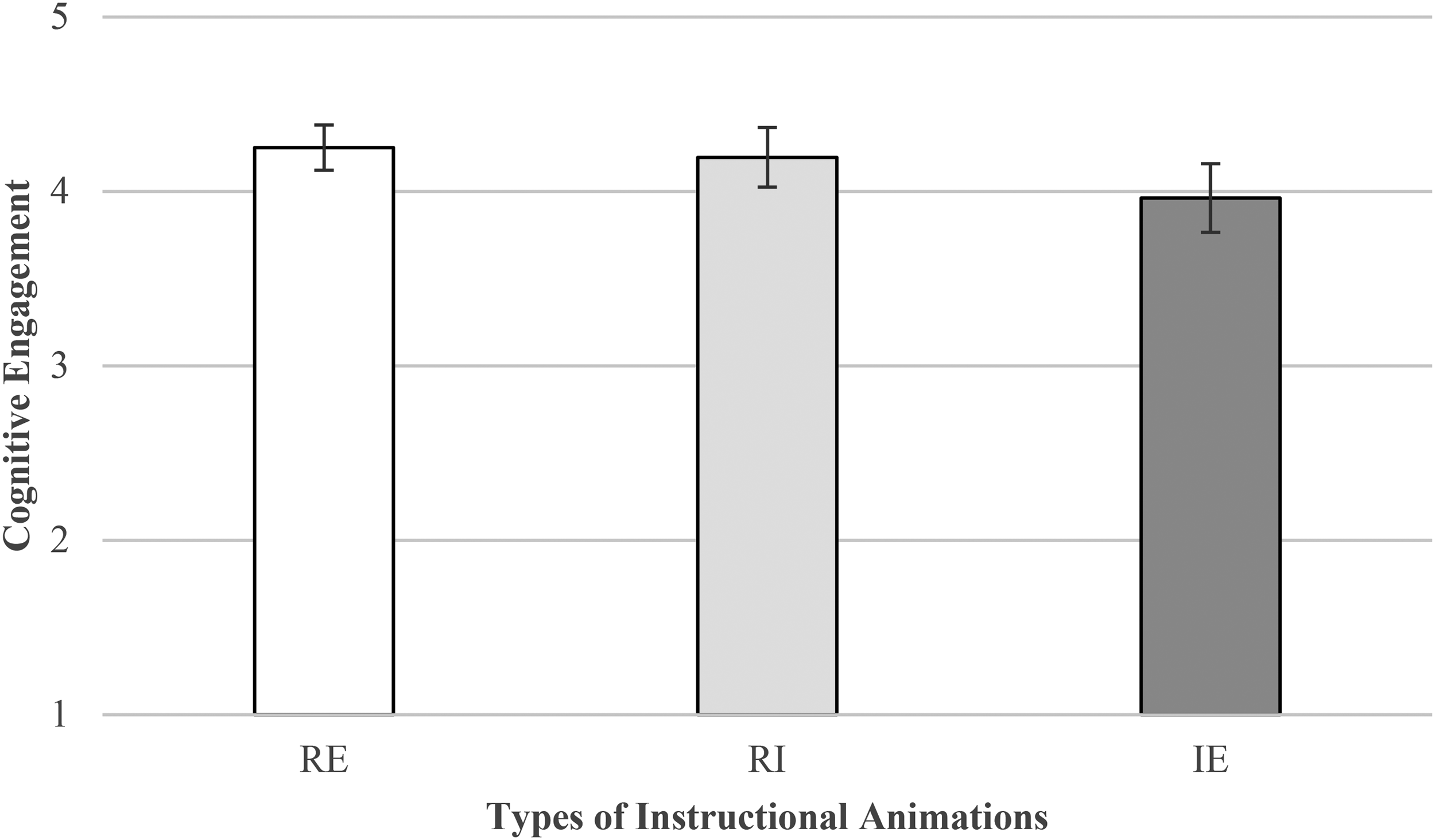
Mean cognitive engagement across experimental conditions with 95% confidence intervals.
Overall, cognitive engagement was significantly higher in the RE and RI conditions than in the IE condition (H2.1). No significant differences in metacognitive knowledge were found between the conditions (H2.2).
Discussion
Overcoming learners’ questionable beliefs about the effectiveness of learning strategies presents a significant challenge in the field of psychology learning and teaching, as recent research indicates that learners often hold questionable beliefs regarding the effectiveness of various learning strategies (e.g., Carpenter et al., 2022; Hui et al., 2021, 2022; Scheiter et al., 2020). This is especially problematic, considering that using ineffective strategies can adversely affect academic performance (Biwer et al., 2020), which underscores the need for effective instructional interventions.
This study contributes to multimedia learning and conceptual change research by examining how the type of instructional animation affects learners’ beliefs about the effectiveness of learning strategies (RQ1). The results confirmed our hypothesis regarding belief change over time: the endorsement of less effective (H1.1) and moderately effective strategies (H1.2) significantly decreased from pretest to posttest, whereas the endorsement of highly effective strategies (H1.3) increased across all three conditions (RE, RI, and IE).
With respect to posttest learning strategy beliefs, the results partially supported our hypotheses. Both the RE and RI conditions were more effective than the IE condition for reducing beliefs in less effective (H1.4) and moderately effective strategies (H1.5). The difference between the RE and RI conditions was not significant. For highly effective strategies, no significant difference was found for the type of instructional animation (H1.6).
In examining how the type of instructional animation affects cognitive engagement and metacognitive knowledge (RQ2), the results partially confirmed our hypothesis (H2.1), showing that cognitive engagement was significantly higher in the RE than in the IE condition. No significant differences were found between the RE and RI conditions. For metacognitive knowledge, no significant differences were observed between the conditions (H2.2).
Influence of the Type of Instructional Animation on Change in Beliefs
Analyzing how the type of instructional animation influences belief change over time (RQ1), the results indicate that learners’ beliefs about the effectiveness of learning strategies shifted in the intended direction across all three instructional conditions. Thus, the RE, RI, and IE conditions all appeared to be effective in fostering belief change. Notably, the effect sizes varied by strategy type: changes over time were large for less effective and highly effective strategies, but smaller for moderately effective strategies. This pattern can be explained by descriptive data showing that learner beliefs changed strongly for less- and highly effective strategies, but the changes for moderately effective strategies, although significant, were smaller. Pretest ratings for all the strategy types were already at mid-level, suggesting that participants initially perceived them as roughly equally effective. Consequently, only moderate changes were possible for moderately effective strategies, whereas less- and highly effective strategies were able to show larger shifts after the intervention.
Regarding the instructional animation type, comparisons of posttest learning strategy beliefs highlight the added value of animations incorporating refutations for moderately- and less effective strategies. This finding aligns with previous research showing that directly confronting learners with their questionable beliefs through the use of refutations can prompt deeper reflection and belief change (e.g., Lassonde et al., 2016, 2017). Based on our findings, for less effective and moderately effective strategies, instructional animations integrating refutations may have triggered cognitive conflict, a central mechanism of cognitive change, thereby fostering the reevaluation of previously held beliefs.
Moreover, previous research shows that explicit guidance, as opposed to implicit guidance, supports learners in developing a deeper understanding of the learning material and constructing accurate mental representations (Decristan et al., 2015; Dole, 2000). In the present study, however, adding explicit guidance to instructional animations with refutations showed no significant advantage over implicit guidance. A possible explanation for this is that instructional animations with refutations alone may have already elicited sufficient cognitive conflict and reflection to prompt belief revision, reducing the additional impact of further guidance. Research suggests that when learners are already cognitively engaged through mechanisms such as refutational texts, additional support may yield diminishing returns unless it introduces substantially new or personally relevant insights (Dole & Sinatra, 1998; Kendeou et al., 2014).
No difference between conditions was found for posttest beliefs in highly effective learning strategies. A possible explanation for this is that learners may already hold strong and stable beliefs about the usefulness of these strategies, leaving little room for instructional interventions to produce additional changes. Moreover, instructional animations containing refutations and guidance may be less about strengthening existing accurate beliefs and more about correcting misconceptions.
Overall, the findings underscore the potential of instructional animations with refutations to foster belief change in psychology education. While the added value of explicit guidance appeared limited in this context, future research may clarify under which conditions such guidance can meaningfully enhance learners’ conceptual understanding.
Influence of Type of Instructional Animation on Cognitive Engagement and Metacognitive Knowledge
This study also investigated how different types of instructional animations influence learners’ cognitive and metacognitive processes (RQ2). The findings indicate that RE led to significantly higher cognitive engagement than IE. In contrast, no significant difference was found between RE and RI. These findings suggest that instructional animations with refutations may effectively stimulate learners’ active involvement in processing information. Animation-based refutations likely triggered cognitive conflict by directly confronting learners with their prior beliefs, prompting deeper reflection and engagement with the material. In contrast, the guidance added did not lead to significant differences in cognitive engagement, whether it was implicit or explicit. One possible explanation for this may be that refutations already created a high level of cognitive conflict, thereby reducing the incremental impact of guidance type.
Regarding metacognitive knowledge, no significant difference between the types of instructional animation was found. Prior research suggests that developing insight into when and why certain strategies are effective is a gradual and often effortful process (Jones et al., 2015; Kendeou et al., 2014). Even with increased awareness, learners may struggle to apply this knowledge when evaluating learning situations, highlighting the need for repeated exposure and guided reflection (e.g., Callender et al., 2016; Tiede & Leboe, 2009).
Taken together, these results indicate that instructional animations with refutations are particularly effective in stimulating learners’ cognitive engagement. However, to support improvements in metacognitive knowledge, interventions should be extended over time and include opportunities for application and feedback.
Limitations and Future Directions
This study has several limitations. First, the operationalization of learning strategies in relation to their effectiveness was problematic, as their efficacy can vary depending on factors such as task difficulty and learners’ prior knowledge (Bjork & Bjork, 2011, 2020; Sweller, 2010, 2020, 2023).
Second, the impact of the type of instructional animation on learners’ beliefs about the effectiveness of learning strategies was assessed immediately following the intervention. However, previous research has shown that the effects of instructional interventions on learners’ beliefs are often short-lived and do not result in enduring change to deep knowledge structures (e.g., Ferrero, Hardwicke et al., 2020; Ferrero, Konstantinidis & Vadillo, 2020; Rousseau, 2021). In the present study, this limitation may be reflected in the non-significant effects of the type of instructional animation on learners’ metacognitive knowledge. Accordingly, future research should assess metacognitive knowledge over an extended period and investigate the sustained impact of different types of instructional animations on learners’ beliefs regarding the efficacy of learning strategies.
Third, cognitive engagement was measured only via a self-report at posttest, and no process-based measures were applied. While this approach aligns with prior research (e.g., Johnson & Sinatra, 2013), it limits the ability to draw conclusions about the underlying mechanisms of belief change. Future studies should also consider modeling cognitive engagement as a potential mediator to better understand whether and how it mediates the relationship between instructional features and belief change.
Fourth, test–retest reliability was calculated in the context of an intervention designed to change participants’ beliefs in learning strategies. While test–retest reliability typically assumes temporal stability of the construct, in our study, the coefficient primarily reflects the consistency of the measurement rather than the invariance of the construct. Although mean-level changes were expected, the substantial test–retest correlation indicates that the instrument reliably captured individual differences across time. Nevertheless, this correlation should be interpreted with caution, as it may partly reflect intervention-related changes rather than pure temporal stability.
Fifth, the quality and strength of the refutation texts used in this study represent a potential limitation. While effective refutations ideally combine a clear statement of questionable beliefs with strong, alternative explanations (Ferrero, Hardwicke et al., 2020; Menz et al., 2021), some of the texts used here primarily presented empirical findings without extensive conceptual elaboration. The variability in refutational strength across materials was not formally assessed. Future research should therefore consider evaluating and standardizing the quality of refutation materials to ensure consistent effectiveness.
Finally, it may be informative to ask students whether they would choose to apply learning strategies that are deemed highly effective—such as retrieval practice or distributed practice—even when they are aware that these strategies require greater mental effort (e.g., Hui et al., 2021, 2022; Onan et al., 2024).
Theoretical and Practical Implications
The present study extends theoretical perspectives on conceptual change and multimedia learning by demonstrating that instructional animations incorporating refutations—whether combined with implicit or explicit guidance—can significantly alter learners’ beliefs about the effectiveness of learning strategies. This reinforces the theoretical assumption that cognitive conflict triggered by confronting prior questionable beliefs is a central mechanism for belief revision (e.g., Chi, 2008; Posner et al., 1982). Moreover, our results nuance the existing literature by suggesting that the added value of explicit guidance may be context-dependent—while explicit guidance is often theorized to support reflection and reevaluation processes (e.g., Biwer et al., 2020), in this study, its benefit over implicit guidance with regard to belief change was limited. This highlights the need for further theoretical refinement regarding the boundary conditions under which different instructional support mechanisms facilitate conceptual change.
From a practical perspective, the findings of the current study offer important insights for the design of instructional interventions in psychology learning and teaching. Given the persistence of questionable beliefs about learning strategies and their negative impact on academic performance, the use of instructional animations with refutations emerges as a promising tool for addressing widespread misconceptions. Educators and instructional designers might consider integrating these into digital learning environments to foster more accurate beliefs about learning strategies. This is especially important in higher education contexts, where self-regulated learning is critical.
However, given the limited effect of instructional animations on metacognitive knowledge, the intervention tested here should be extended over time and combined with activities that encourage application, feedback, and reflection. Especially in the context of learners’ beliefs regarding the effectiveness of learning strategies, instructors should aim to correct questionable beliefs as well as support learners in understanding when and why certain strategies work, thereby fostering deeper metacognitive understanding and transfer.
Conclusion
This study shows that instructional animations with refutations can effectively support belief change about learning strategies. Learners in all conditions revised their beliefs in the intended direction, with animations with refutations leading to the most accurate effectiveness ratings and higher cognitive engagement. When refutations were incorporated into the animations, no difference was found when adding explicit or implicit guidance. As no significant impact of the type of instructional animation on metacognitive knowledge was found, fostering metacognitive knowledge likely requires longer-term interventions with opportunities for application and reflection.
Footnotes

Ethical Approval and Informed Consent Statements
The study adhered to the ethical guidelines of Paris Lodron University of Salzburg. Informed consent was obtained from all participants.
Author Contributions
Ines Zeitlhofer: conceptualization, data curation, formal analysis, investigation, methodology, writing—original draft, and writing—review and editing. Magdalena Adlesgruber: writing—original draft and writing—review and editing. Joerg Zumbach: conceptualization, formal analysis, and writing—review and editing.
Funding
The authors received no financial support for the research, authorship, and/or publication of this article.
Declaration of Conflicting Interests
The authors declared no potential conflicts of interest with respect to research, authorship, and/or publication of this article.
Data Availability Statement
The data will be made available upon request from the corresponding author.
Author Biographies
Appendix B: Refutations Concerning the Effectiveness of Learning Strategies (based on Dunlosky et al. (2013 ))
The refutational texts used in the present study are provided below and were analyzed according to established criteria, which define a refutational text as consisting of (a) the presentation of a questionable belief, (b) a direct refutation of this belief, (c) an explanation of why the belief is incorrect, and (d) the provision of scientifically accurate information (e.g., Ferrero, Hardwicke et al., 2020; Menz et al., 2021).