



Abstract
Online-only course design has to balance students’ needs to experience (1) competence and (2) autonomy as it may affect their motivation. Lecture units can provide structured guidance by being made accessible in a fixed order, or support students’ autonomy by providing free access to all lecture units. Online-only courses with lecture units including videos and quizzes can help provide psychology education to diverse populations. This includes nontraditional students who might struggle to attend traditional courses. We used a questionnaire with two vignettes in Study 1 (N = 152) and found that most students preferred free access to lecture units. Yet, using Moodle log data in Study 2 (N = 424) showed that most students did follow structured guidance in an asynchronous online-only course. Combining the assessment of preferences and behavior in Study 3 (N = 159), we replicated the divergence of preferences and behavior. Students preferring structured guidance and students following it in asynchronous online-only courses reported higher intrinsic motivation than students with diverging preferences and study behavior. This suggests that for many students, support through structured guidance does not compromise perceived autonomy. Structured guidance can be useful for course designers to balance students’ needs for autonomy and competence.
Asynchronous Online-Only Courses
Asynchronous online-only course design can place more weight on guiding students through videos and activities (Presley et al., 2023). It can emulate traditional courses with less freedom of choice by providing a mandatory sequence of lecture units containing learning materials and tasks. Alternatively, the course design could prioritize giving students the freedom to choose the pace, sequence, and how to manage their learning process (cf. Miller & Wu, 2018). Recently, the design options of asynchronous online-only courses have come critically into focus due to the importance of course design for students’ learning experience and learning outcomes, as well as the COVID-19 pandemic imposing the critical need for distance education (Ali, 2020; Breitenbach, 2021).
Many potential students who cannot attend weekly face-to-face courses, such as nontraditional students, may profit from knowledge about psychology for their professional development. Nontraditional (e.g., exchange or in-service) students’ work- and family obligations, or geographical problems (Van Doorn & Van Doorn, 2014) further constrain the potential of synchronous online classes. Rather than regularly meeting online at specific hours, students’ needs can be met by asynchronous online-only courses. In these courses, students can work on materials such as lecture units consisting of quizzes and prerecorded lectures when it fits their schedule (cf. Presley et al., 2023). In the current article, we explore to what extent this flexibility can be reduced to provide guidance. We target students’ perception and use of course elements that guide them through lecture units in a sequence predetermined by the faculty, rather than providing free access to all materials at once (see Figure 1).
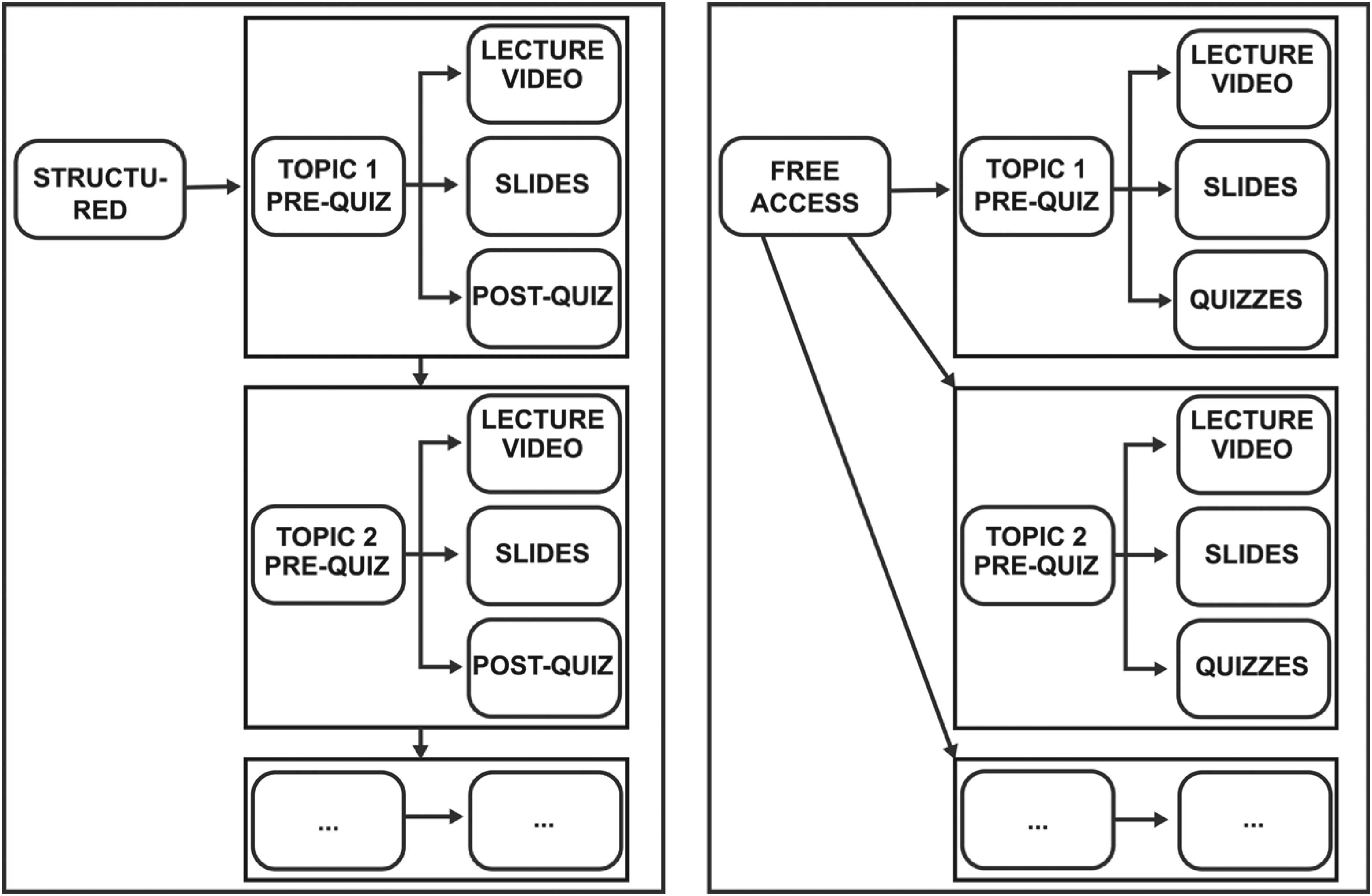
Structured guidance with gatekeeping quizzes vs. free access (left to right), arrows indicate access.
Students’ preferences and attendance likely differ between course formats. Blended learning courses integrate for instance traditional face-to-face and online activities, while traditional courses deliver instruction face-to-face (Kaur, 2013). Al Mamun and Lawrie (2023b) state that in difference to face-to-face settings, online-only courses are likely to be more individual. Asynchronous online-only courses offer for instance flexibility of time and location (Kumar et al., 2021).
Students choosing online-only instead of traditional distance education courses have been found to value flexibility by being independent in their learning process over structured lectures more than students choosing to attend traditional distance education courses (Beyth-Marom et al., 2003). Traditional students (i.e., full-time students) in the investigated business programs mostly claimed to prefer face-to-face over online-only courses. This might be due to students’ familiarity with traditional courses, which are structured by lecturers (Lee, 2000). Nontraditional students, however, expressed the need and preference for flexibility regarding learning times, for instance, due to time constraints through work schedules, location, or care work (Van Doorn & Van Doorn, 2014; Chen, 2023). These can be accommodated in asynchronous online-only courses. Yet, this flexibility might come at the cost of challenges with respect to motivation and study behavior. Students reported for instance lowered motivation, disengagement, isolation, and technical issues in asynchronous online courses (Chen, 2023). This indicates a discrepancy not only between students’ preferences, but also regarding the quality of guidance provided by the courses.
Asynchronous online-only courses require students to regulate when to work on different types of learning materials, and which tasks to prioritize (Anderson et al., 2014; Boroujeni & Dillenbourg, 2018). Since students have to rely on themselves to manage their learning process, this extra task might increase learning time and workload compared to a traditional course (Maqableh & Alia, 2021). Structured guidance might help students manage learning time and workload in asynchronous online-only courses (cf. Sher & Toor, 2021). This introduces the question of how such design elements align with students’ preferences and whether they are actually being used. In line with this query, a review of research regarding online learning (Park & Shea, 2020) suggests that in recent years, student satisfaction and self-regulation have come into focus apart from student interactions in asynchronous online-only courses (Park & Shea, 2020). Students’ attitude towards online-only courses for instance affects their usage intentions (Damnjanovic et al., 2015; Teo et al., 2019), which determine the actual use of online-only courses (Hsu, 2012). Balancing the extent of guidance and considering students’ preferences therefore appears to be relevant for designing asynchronous online-only courses. In three studies we examined students’ preferences with regard to guidance, motivational correlates, and adherence to structured guidance in asynchronous online-only courses.
Structured Guidance in Asynchronous Online-Only Courses
Previous research on category learning has shown that providing additional information in line with category structures can lead students to approach learning materials in a more analytical way and can lead to better performance (Elio & Anderson, 1984). Online courses can be designed as a macrocycle, such as a semester-long course including a final exam that provides a broad course structure, as well as a microcycle, such as lecture units containing learning activities, that may not necessarily relate directly to a macrocycle's final exam and structure (Snelson & Elison-Bowers, 2007). Microcycles can also be designed to provide structured guidance by introducing related topics in a linear way such as implementing a categorial information order, adding information step by step, or providing access to learning materials through the completion of learning activities. A microcycle, such as a lecture unit, may in this context provide access to a subsequent microcycle (i.e., another lecture unit) through structured guidance, as part of a macrocycle. This article aims to investigate the structure of microcycles such as learning materials and resources supplied within an online-only course, which are relevant for the learning process, but not mandatory to complete to pass the final exam of a macrocycle.
Asynchronous online-only courses are likely more self-regulated due to the absence of direct teacher support (Al Mamun & Lawrie, 2023b). Therefore, this support has to be replaced by course design prompting self-regulation to sustain a high frequency of interaction with the course material (cf. Wong et al., 2019). While neither lecture videos nor quizzes are unique features of asynchronous online-only courses, they are necessary in these courses for learning material distribution and structuring (Kumar et al., 2021). In line with this, Bannert et al. (2015) reported that by including metacognitive prompts (e.g., questions regarding the reasons for a behavioral activity such as orientation or planning), students visited relevant webpages more often and longer than a control group. Importantly, structured guidance in asynchronous online-only courses is associated with increased behavioral engagement, self-regulation, and positive emotions (Hospel & Galand, 2016). For instance, structured guidance improved behavioral engagement in asynchronous online-only students (Al Mamun & Lawrie, 2023b).
Structured guidance in asynchronous online-only courses can be offered through segmenting tasks and pacing support (Tate & Warschauer, 2022). Restricting release times of learning material, for instance, led to students browsing through materials earlier and spending more time per session, compared with free material access (Martin & Whitmer, 2016). When considering the option to offer structured guidance in the context of the affordances of asynchronous online-only courses, lecturers need to plan learning time and learning activities (García-Morales et al., 2021). Implementing self-regulation strategies for structured study behavior, such as time management and effort regulation, could affect students’ performance (Broadbent & Poon, 2015). Online learning has for example been improved through time management (Alzahrani, 2022). Time management could for instance be supported by structured weekly diaries, which were used to reflect on learning activities (Mou, 2023). Self-regulation may improve text comprehension online and could be supported through prompts (Reid & Morrison, 2014). Students’ strategic planning in asynchronous online-only courses predicts their personal course goal achievement and self-regulative learning skills predict how often students revisit course materials (Kizilcec et al., 2017). Structured guidance in asynchronous online-only courses might support self-regulation despite variability in motivation. While self-regulation based on intrinsic interest in the courses might be preferable, students with extrinsic motivation might also be able to adjust their study behavior through time management, as well as evaluating their online learning and seeking for help (Rahimi & Cheraghi, 2022).
Students’ Preference for Structured Guidance vs. Free Access
While most studies on student preferences contrast preferences for asynchronous online-only vs. traditional courses (Alsaaty et al. 2016; Castro & Tumibay, 2021; Coffman, 2022; O’Neill & Sai, 2014; Rabayah & Amira, 2022; Weldy, 2018; Yang & Tsai, 2008), results are partially conflicting, and these preferences are associated with the appreciation of structure. Potentially, students preferring flexible access to learning materials and activities benefit more from managing their own learning, than students preferring structured guidance, when this type of flexible access is provided (Wiley, 1983). This early finding predates online courses, but might in principle transfer to the asynchronous online-only course format.
While numbers of enrollment in online-only courses are increasing, Weldy (2018) found, that students preferred and reported more positive experiences associated with course structures (i.e., learning experience, study time, expected grade, and self-teaching) in traditional compared to blended learning and online-only courses. Students have however been found to choose online-only courses specifically due to their need of more flexible schedules, the opportunity to work at their own pace, and the physical distance to the university as well as health concerns (Castro & Tumibay, 2021; Coffman, 2022).
Students’ self-categorized preference for online-only over face-to-face courses has been predicted by lower task value beliefs and students preferring online-only courses have also been found to have greater confidence in their ability to learn online (Artino, 2010). With an assumedly high ability to learn online, students might specifically prefer asynchronous online-only courses with free access to different elements. Students’ need for flexibility might entail a preference for online-only courses, which can provide flexible access to all learning materials, rather than imposing a fixed sequence in which materials can be used.
Interestingly, increased cognitive presence (i.e., students’ perception of interest, engagement, and applicability of knowledge in a topic) has been found in asynchronous compared to synchronous online-only courses (Presley et al., 2023). Similarly, Eldy and Sulaiman (2023) found that some students preferred asynchronous online-only courses due to their flexibility, and perceived them as rewarding and motivational, while others preferred synchronous online-only courses due to better self-regulation, self-motivation, and improved understanding.
Students perceived the improvement of their digital learning skills and connectivity during the transfer to online-only courses due to the COVID-19 pandemic as beneficial, but many reported time management and distractions as their main problems in the online-only courses (Li, 2022). Students specifically choosing to not partake in an online-only course were found to believe that they would learn more, in a more efficient way, engage better with the learning materials, and be more motivated in a traditional compared with an online-only course (O’Neill & Sai, 2014). Alsaaty et al. (2016) found that a majority of students believed that they would learn more in a traditional compared to an online-only course, which the researchers attributed to less structured materials in online-only courses. Similarly, two-thirds of N = 11,000 students in a study by Rabayah and Amira (2022) were apprehensive toward online-only courses, due to their perceived methodical ineffectiveness. The majority of N = 500 students in a study by Yang and Tsai (2008) also expressed the opinion, that there is a limitation to topics that can be taught via online-only courses, while other topics are only suitable in traditional settings. Among options for online courses, the students preferred structured online-only courses with individual learning opportunities.
Furthermore, there are indications that structured guidance is indeed needed. The majority of students in an online-only course located in a traditional university setting displayed low levels of self-regulation skills (Schwam et al., 2021). This might indicate, that structures might be valuable for these students if they struggle with task planning, self-control behaviors, and self-judgment (Schwam et al., 2021). Another study found, that students preferred and displayed a higher completion rate of chunk-style (i.e., short, single-topic) video lectures, which might have supported their attention, assisted with time management, and increased unit engagement in difference to long, didactic video formats (Humphries & Clark, 2021). Long video lectures might mimic traditional lectures in structure, while chunk-style lecture videos with more direct and flexible access to specific information might be preferable for students. It was however also found that students expressed the need for structured and organized classes in online-only settings, which allow for accessible, understandable, and navigable content (Greaves, 2024). Offering structured guidance to students preferring structure enhanced positive attitudes (Chang & Tsai, 2005). Aligning students’ preference for guidance or free access in online-only courses in this context could be beneficial for learning via the impact on motivation (cf. Javora et al., 2019).
Motivation and Study Behavior in Asynchronous Online-Only Courses
Deci and Ryan (1994) suggest that self-determined, motivated students have an improved quality of learning, based on fulfilling their need for autonomy, competence, and relatedness. Motivation in online-only courses should be investigated as a continuum of intrinsic to extrinsic motivation (Hartnett & Hartnett, 2016). More extrinsically motivated students in online-only courses follow stricter schedules than more intrinsically motivated students (Zhu et al., 2022). Students’ perception and need satisfaction can be increased by digital support of perceived autonomy (i.e., flexible times, structure, and involvement; Chen & Jang, 2010; Chiu, 2021; Chiu, 2022). Setting realistic course goals could also support the perception of competence (Hoi, 2022).
Most students preferred an online-only course with more autonomy over a traditional course design (Díaz-Noguera et al., 2022). Yet, course design might favor the satisfaction of one at the cost of another basic need. Offering structured guidance might support students’ need for competence, while free access might fulfill students’ need for autonomy by offering flexibility. Students’ perception of learning environments such as online-only courses predicted learning motivation (Müller et al., 2006). In turn, several motivational variables such as students perceived self-efficacy, reinforcement, and course relevance affected learning positively (Lim & Kim, 2003). Further, the perceived quality of instruction predicted motivation during learning (Kim & Frick, 2011). Students’ motivation could affect learning in this context and might in turn be affected by the learning environment, such as an asynchronous online-only course and instructional quality, for example, offering structured guidance. The offered structured guidance, however, needs to be designed carefully and support students’ self-regulation, to effectively tap into the advantages of structured study behavior. Therefore, considering students’ motivation is relevant for online-only course design.
Structured vs. Unstructured Study Behavior
Asynchronous online-only courses can provide scripts or videos and tasks such as quizzes, for students to engage with. Which materials and tasks to focus on is part of the students’ responsibility and decision in an online-only course. Students might, for instance, primarily view content, mainly complete assignments or balance learning activities equally, which could be labeled as unstructured vs. structured study behavior (Boroujeni & Dillenbourg, 2018; Anderson et al. 2014). For instance, in Barenberg et al., (2018), students accessed weekly published materials more continuously, if their online-only course required assignments throughout the semester instead of one test at the end of the term. Wong et al. (2019) reported that videos prompting self-regulated learning led students to access and complete course activities in a more regular sequential pattern. Access pace and consistency of engagement influenced course performance positively (Asarta & Schmidt, 2013), and the number of log files correlated with grades (Kadoić & Oreški, 2018) in online-only courses.
Contrasting an online-only learning environment with self-chosen vs. assigned study material sequences, Carvalho et al. (2016) reported improved performance for the self-chosen sequences. It was observed that students succeeded in picking sequences of similar topics. The benefits of flexibility might be moderated by students’ competencies. In Hatsidimitris and Kalyuga (2013), learning with an imposed sequence was beneficial for novice learners, but not for learners with higher previous knowledge. Especially lower- compared to higher-performance students might face a risk of hampered learning outcomes in weakly structured online-only courses (Sanford, 2017). Implementing structured learning activities such as a structured discussion forum has been found to lead to positive attitudes toward their use in general, compared to students using an unstructured variant (Tibi, 2018), and incorporating elements supporting scaffolding in online-only courses has also been found to heighten students’ cognitive presence (Al Mamun & Lawrie, 2023a).
Finally, when weighing students’ needs to experience autonomy and competence it has to be considered that the students play an active part in adjusting the balance between structured guidance and flexibility. In asynchronous online-only courses with structured guidance students often have options to omit structures and choose alternative, individual sequences that do not match the affordances. Students have been found to use the flexibility of online-only courses by developing individual patterns regarding their learning time, place, and access to content (Soffer et al., 2019). Therefore, preferences regarding structured guidance as well as usage of the structuring elements have to be taken into account.
Research Questions and Methodological Approach
In three studies we investigated whether students prefer structured guidance or free access in asynchronous online-only courses, if students’ study behavior is rather structured in an asynchronous online-only course with structured guidance and how such a course affects students’ motivation. The institutional review board of the School of Psychology provided ethical approval for the studies (EA_232_2020, letter of February 8th, 2020).
Does the majority of students prefer structured guidance or free access in asynchronous online-only courses?
Does students’ preference correlate with their motivation in asynchronous online-only courses with structured guidance?
Study 1 aimed to answer the first and second research questions regarding preference and motivation in online-only courses. To investigate the first research question, the variable preference was used, which was based on students’ self-categorization regarding their preference of guidance in online-only courses (structured guidance vs. free access). This variable was measured in Study 1 and Study 3 in Vignette 1 in an online questionnaire through a mandatory binary question. Vignette 1 described the following scenario to students: Imagine that you are in a new Moodle learning environment and two different settings are possible: you can either see all learning materials at once or unlock the learning materials step by step by progressing through the activities offered in the suggested sequence. Then they were asked the following question: If you had the choice, would you want to see all learning materials at once, or would you want to unlock learning materials step by step? The possible answers for students were: I would like to see all learning materials at once./ I would like to unlock learning materials step by step.
To investigate the second research question, the online questionnaire included a second vignette. Vignette 2 asked students to imagine that they are indeed in a Moodle learning environment, in which they unlock learning materials step by step. They were asked how they gauge their self-regulation and motivation in such a Moodle learning environment (see Appendix). This vignette was used to investigate the variable SDI (Self-Determination Index), which refers to students’ perceived motivation and was categorized on the spectrum of more self-determined intrinsic and less self-determined extrinsic motivation (Deci & Ryan, 1985; Ryan & Deci, 2000). To analyze the spectrum of motivation, four corresponding regulation styles (i.e., intrinsic, identified, introjected, and extrinsic) can be investigated (Ryan & Deci, 2000). The self-determination index is a relative measure of these regulation styles (Müller et al., 2007). Students rated four items of the German self-determination index (SDI; Müller et al., 2007, from SQR-A by Ryan & Connell, 1989) on a 5-point Likert scale (1 = fully disagree to 5 = fully agree). One item regarding intrinsic regulation (“I like to solve the tasks and to think about them.”) and three items covering extrinsic motivation through two items regarding introjected regulation (“I would feel guilty if I would not study much.”, “I would receive bad grades if I don't study.”) and one item regarding extrinsic regulation (“I simply have to learn the topic.”) were used. The self-determination indices were calculated in the following way (Ryan & Connell, 1989; Levesque et al., 2004): To what extent do students follow structured guidance in an asynchronous online-only course?
Study 2 was conducted to answer the third research question on following vs. omitting structured guidance. To answer this research question, the variable latency between quiz submission and start of the subsequent quiz was investigated in Study 2 and Study 3, to observe to what extent students followed the suggested sequence of Moodle lecture unit activities. The course was programmed to only grant access to a lecture video after completing the previous, corresponding quiz. Yet, students could in principle quickly click through many quizzes to unlock all corresponding lecture videos to watch them later (rather than working on the quiz scheduled before a lecture video, watching the video, and doing the quiz after the video as suggested by the course structure). By assessing the time between submitting the quiz scheduled before a lecture video and starting the quiz after a lecture video, we could derive a proxy for whether the course units were processed one by one or were unlocked to gain free access. The latency between these two subsequent data points was derived using R lubridate (Grolemund & Wickham, 2011). We accounted for students engaging in unrelated tasks as a source of error by setting a cut-off of 15 min (> 15 = slow progression, < 15 = fast progression), focusing on the time between taking quizzes, not within (i.e., how long a student worked on one quiz). By taking quizzes quickly rather than one by one, students could omit the suggested structure of the course and obtain access to the lectures in free order. Such omission of the suggested course structure should show in fast transitions between pre- and post-lecture quizzes (i.e., too fast to watch the lecture videos in between).
Study 3 was conceptualized to replicate results for the first, second, and third research questions, as well as investigate the fourth research question regarding preferences matching omitting habits in an asynchronous online-only course offering structured guidance. To investigate this research question, the variable preference was used to separate students into groups preferring structured guidance or free access. These groups were subsequently compared with regard to the variable latency between quiz submission and start of the subsequent quiz.
Does students’ preference of structured guidance vs. free access match with their study behavior?
Study 1
Study 1 examined students’ preference of structured guidance vs. free access (Research Question 1) in an online survey. Further, we investigated Research Question 2, regarding the correlation of students’ preference with motivation.
Procedure
In Study 1 we used an online questionnaire with two vignettes to examine students’ preferences. The German vignettes, questions, and the items used from the self-determination index, with corresponding English translations, as well as the studies’ data are available here (Wehrhahn et al., 2024): https://osf.io/ubfh4.
The data in Study 1 was collected in an anonymized format, independently of students’ courses via a virtual laboratory using Unipark (Taddicken, 2013). They first provided informed consent. They then entered demographic information regarding gender, age, and semester. Afterwards, they were asked to choose if they preferred structured guidance or free access in an asynchronous online-only course. Following up on this, students answered questions regarding their perceived self-regulation in an asynchronous online-only course providing structured guidance. Upon completion of the questionnaire, participants could earn 0.5 experimental participation hours.
Participants
We collected informed consent and data from N = 152 BSc. Psychology students (114 female, 38 male) in fall term 2021/2022. Inclusion criteria were informed consent and the completion of the survey without missing data (n = 48 excluded in total). They participated for course credit. The average age of participants was M = 29.09 (SD = 7.83) and they were in semester M = 4.79 (SD = 3.14). Further information on the composition of the student body in the corresponding term for all three studies is provided here: https://osf.io/ubfh4.
Results
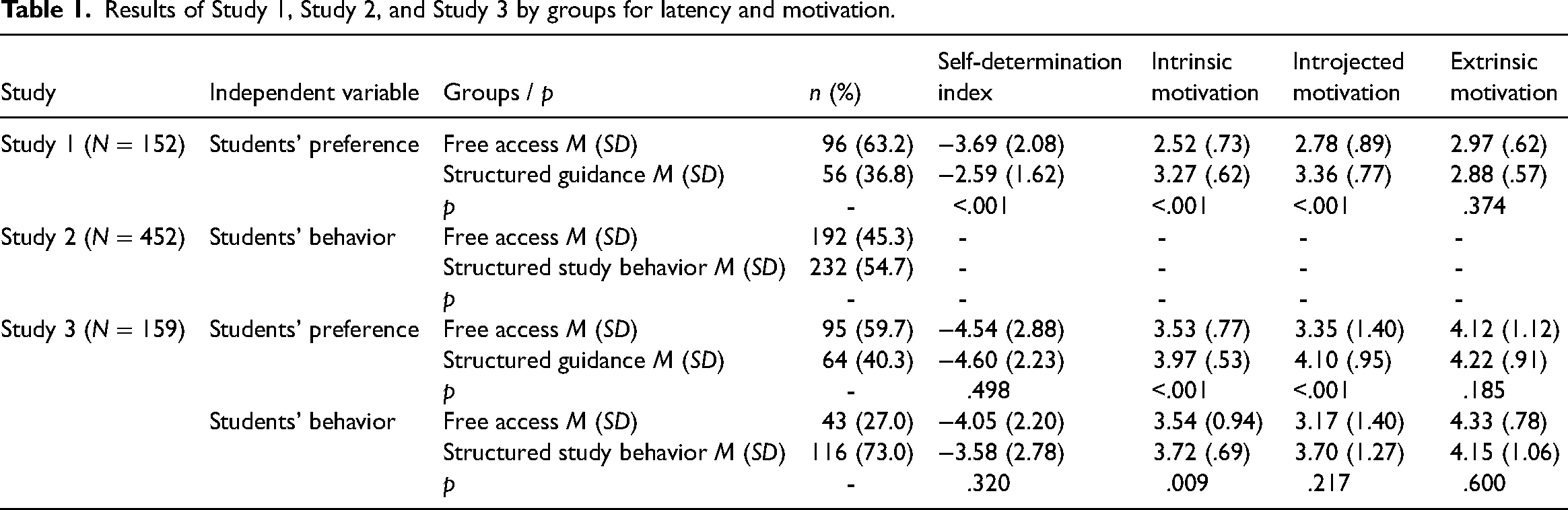
A majority of 63.2% of the participants in Study 1 preferred free access in asynchronous online-only courses, as shown in Table 1 (Hypothesis 1 not supported). In a scenario of an online-only course with structured guidance, students actually preferring structured guidance reported a higher self-determination index, t(150) = −3.40, p < .001, d = –.571 and perceived more intrinsic, t(150) = −6.46, p < .001, d = −1.086, and introjected motivation, t(150) = −4.05, p < .001, d = –.678, (see Table 1) compared with students preferring free access (Hypothesis 2 supported). There was no significant difference for extrinsic regulation between groups, t(150) = .89, p = .374, d = .150.
Results of Study 1, Study 2, and Study 3 by groups for latency and motivation.
Discussion
The majority of students preferred free access in online-only courses in Study 1. The results document students’ preference for flexible study behavior in less structured courses. This is in line with earlier studies (Beyth-Marom et al., 2003; Chang & Tsai, 2005). Specifically, nontraditional students might prefer the increased flexibility free access could provide (Chen, 2023; Van Doorn & Van Doorn, 2014). In a scenario with an asynchronous online-only course offering structured guidance, students preferring structured guidance perceived more intrinsic motivation compared to students preferring free access. The satisfaction of the need of competence through structured guidance could affect students’ motivation (Chiu, 2021; Chen & Jang, 2010; Javora et al., 2019). It might in this context lead to higher intrinsic motivation for students preferring structured guidance.
Study 2
In Study 2, we assessed to what extent students followed the suggested sequence of Moodle activities by assessing how much time it took students to progress from the pre-lecture quiz to the post-lecture quiz. Study 2 aimed to investigate the third research question, asking if students follow structured guidance offered in an asynchronous online-only course. The course contained 19 prerecorded video lectures to be watched on demand. For 10 of these lectures, there was a quiz to be taken before, as well as one to be taken after the video lecture. We focused on identifying the proportion of fast transitions (< 15 min) between pre- and post-quizzes for these 10 units.
Procedure
In Study 2, we used Moodle log data to assess if students followed or omitted the structure provided in an asynchronous online-only course. Moodle is a free open-source software that offers a variety of features for instructors to distribute assignments, learning activities, or materials (Al-Ajlan & Zedan, 2008). It is a tool widely used in online education, specifically in university programs, and Moodle activities such as quizzes are investigated extensively (Gamage et al., 2022). Learning activities are associated with behavioral activities in learning environments (Domagk et al., 2010), which allow to investigate students’ study behavior via log data. The gathered Moodle log data and informed consent were matched by matriculation numbers and anonymized by assigning randomized ID numbers to the participants. The matriculation numbers were then removed from the dataset utilizing R (version 4.2.1) with the packages tidyverse (Wickham, 2023) and dplyr (Wickham et al., 2019).
Students in a 10 ECTs undergraduate psychology, asynchronous online-only course on biological bases of psychology (5 ECTs) and learning, motivation, and emotion (5 ECTs) could consent to the usage of their log data. Students were informed about the structured guidance in the asynchronous online-only course through quizzes that act as gatekeepers for lecture units at the start of the term. Students enrolled in the investigated asynchronous, Moodle online-only course were presented with a general structure of the course, a timeframe offering guidance on how to proceed through the two lecture topics, and received information regarding the log data collection, data usage, and anonymity, upon which students were required to give or deny informed consent (binary yes/ no input). Students could only access the first lecture unit's pre-quiz and subsequently unlock the learning materials if they had completed the informed consent form (regardless if they gave or denied consent). Informed consent could be revoked at any time during the semester without repercussions.
After completing the informed consent form, students could access the pre-quiz of the first video lecture and the lecture unit's post-quiz, which upon completion provided outcome feedback and access to the next lecture unit. Moodle displayed for each element what students would need to do to unlock it. Every other lecture unit within this course provided lecture materials and a post-quiz only, which was always followed by a lecture unit providing a mandatory pre-quiz. This access structure was repeated throughout the whole course. After the semester had resumed, log data was extracted, matched, and subsequently anonymized using R.
Participants
There was no demographic data regarding gender, age, or number of semesters gathered in Study 2, as it relied on quiz log data only. Of N = 956 students in spring term 2020 consenting to the usage of their log data, n = 424 completed all quizzes offered within the asynchronous online-only Moodle course, which was set as inclusion criterium for Study 2 (see Table 1).
Results
The average proportion of fast progressions was used to identify students who rarely showed omitting behavior and those showing omitting behavior more often, which could indicate that they chose to learn in a rather unstructured way. The average proportion of quizzes in lecture units processed so fast (< 15 min) that the video lecture obviously was not watched was low (M = 16.3%, SD = 24.9%). While the majority of students (54.7%) rarely (never or only once) showed such omitting behavior, some showed it for many or even all lectures. Most students seemed to have used the course material in a structured way (Hypothesis 3 supported). Figure 2 shows the distribution of participants’ fast transitions for Study 2 in spring term 2020 and Study 3 in spring term 2022 with most participants rarely showing omitting behavior.
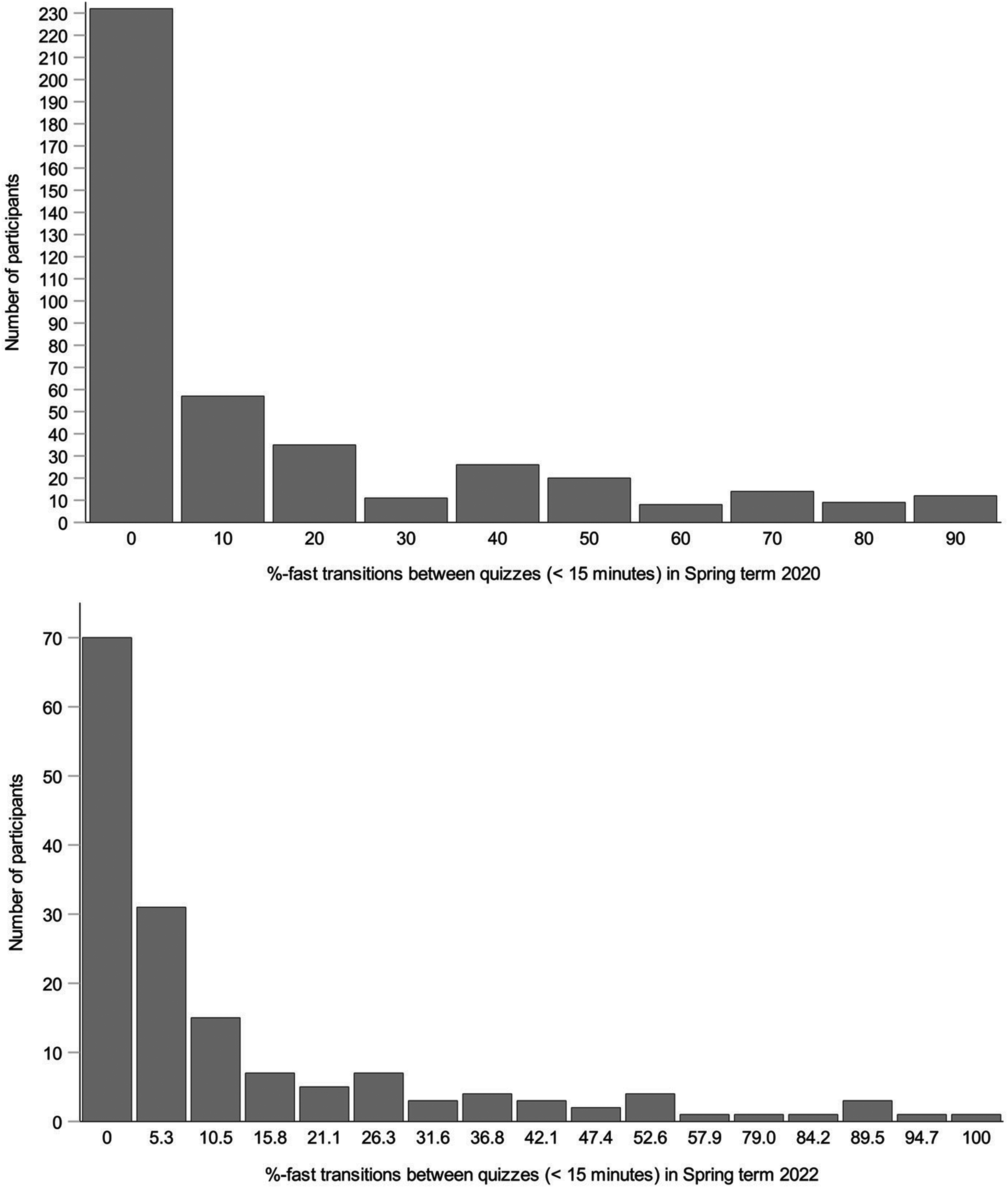
Number of participants with fast transitions for spring term 2020 and 2022.
Discussion
Progressing between pre- and post-quizzes within a lecture unit without watching the lecture videos would imply that students use the quizzes to quickly unlock the video lectures, which could then be watched in free order. It might also imply that students potentially use quizzes (rather than lecture videos) to learn (Brothen & Wambach, 2001). While behavioral traces of omitting the course structure were observed in some students, the majority apparently used the online material in a rather structured way in the asynchronous online-only course. The results of Study 2 appear to contradict the findings from Study 1, as most students preferred free access in Study 1.
One goal of omitting structured guidance (i.e., taking the quizzes very quickly without watching the lectures in between) may be trying to gain an overview of the course materials through browsing (Martin & Whitmer, 2016). Students might also perceive the offered quizzes as repetitive tasks, which could lower their perception of autonomy and their interest in completing the tasks (Hoi, 2022). Yet, students might follow the suggested sequence as the relevance of preferences (Beyth-Marom et al., 2003) might compete with the affordances of the course design. Furthermore, they might suspect that following the offered structure is relevant for passing the course (Murray et al., 2012).
Study 3
In Study 3, preference data and Moodle log data were collected in a new cohort in the subsequent semester in the asynchronous online-only course. As now every lecture unit comes with a pre- and a post-quiz, the proportion of fast transitions could be assessed based on all 19 lecture units. Study 3 aimed to answer the first and second research questions regarding students’ preference of structured guidance or free access and its’ correlation with motivation, as well as the third research question regarding students’ adherence to the structure suggested. Most importantly, Study 3 aimed to investigate Research Question 4, asking if students’ preference matches their study behavior.
Procedure
Study 3 combined the questionnaire of Study 1 with the log data assessment of Study 2. This time, the questionnaire was provided directly in Moodle at the beginning of the semester in the asynchronous online-only course. After providing informed consent students proceeded to enter demographic information regarding gender, age, and semester of study. Afterwards, they were introduced to Vignette 1 and asked to choose if they preferred structured guidance or free access in an asynchronous online-only course. Following up, students answered questions regarding their perceived self-regulation in an asynchronous online-only course providing structured guidance. Participation in the survey was not required to proceed or pass the asynchronous online-only course and no course credit was awarded for participation. In Study 3, we combined the questionnaire utilized in Study 1 and Moodle log data to compare students’ preference and behavior. Study 3 followed the same procedure and ethical protocol for anonymizing Moodle log data as Study 2, incorporating the questionnaire data in line with the procedure and protocol.
Participants
Of 974 students enrolled in the asynchronous online-only Moodle course, N = 159 participants (125 female, 32 male, 2 no indication) met the inclusion criteria: informed consent for quiz log data usage (n = 57 excluded), participation in the questionnaire and informed consent for questionnaire data usage (n = 669 excluded), completion of all quizzes within the course (n = 80 excluded) and the completion of the questionnaire (n = 9 excluded). The mean age of participants was M = 33.47 (SD = 12.29), and they were in semester M = 3.18 (SD = 1.84).
Results
In Study 3, 59.7% of N = 159 students preferred free access in the asynchronous online-only course, matching the results of Study 1 (Hypothesis 1 again not supported). The average proportion of fast progressions was used again to identify students who rarely showed omitting behavior and those showing omitting behavior more often, which could indicate that they chose to learn in a rather unstructured way. The average proportion of quizzes in lecture units processed so fast (< 15 min) that the video lecture obviously was not watched was low (M = 13.1%, SD = 21.5%). Similar to Study 2, 73.0% of students rarely (never, once, or maximum twice) showed such omitting behavior. Yet, some showed it for many lectures (see Figure 2). Importantly, there was no difference between the preference groups (structured guidance vs. free access preferred) in the percent of fast transitions, t(157) = 1.31, p = .193, d = .212 (Hypothesis 4 not supported).
In line with Study 1, students preferring structured guidance in the asynchronous online-only course perceived more intrinsic, t(157) = −4.55, p < .001, d = −.736, and introjected motivation, t(157) = −3.61, p < .001, d = -.584, when being presented with an asynchronous online-only course with structured guidance compared with students preferring free access (Hypothesis 2 supported). Yet, there was no difference regarding the self-determination index, t(157) = –.68, p = .498, d = –.110, or extrinsic motivation between groups, t(157) = −1.28, p = .185, d = –.207.
To further investigate students’ motivation in the asynchronous online-only course, they were split into groups depending on the percentage of fast transitions between quizzes. We categorized students who had no, just one, or maximum two fast transitions as following structured guidance and those with more than two fast transitions as not following structured guidance. The corresponding t-tests revealed that students using the material according to the suggested structure indicated higher intrinsic motivation than students choosing to learn in a rather unstructured way, t(152) = 2.66, p = .009, d = .476 (Hypothesis 2 supported). Yet, no difference regarding the self-determination index, t(157) = 1.00, p = .320, d = −.286, introjected, t(157) = 1.24, p = .217, d = .221, and extrinsic motivation, t(157) = .24, p = .600, d = .094, was found. This highlights a discrepancy between consciously expressed preferences compared to the way students choose to learn in an asynchronous online-only course with structured guidance.
Discussion
The majority of students preferred free access in asynchronous online-only courses. This might correspond with a preference for flexible study behavior approaches and reduced interest in structure (e.g., Beyth-Marom et al., 2003; Chang & Tsai, 2005). It could also be an indicator for students’ valuing the flexibility of online-only courses over associated issues, such as the structure of online-only courses or difficult lecture materials (Alsaaty et al., 2016). Especially nontraditional students might value the additional flexibility of free access (Chen, 2023; Van Doorn & Van Doorn, 2014). Yet, despite these preferences, the majority of students followed the suggested course structure. One might suspect, that this could have indicated that students are rather extrinsically motivated and therefore following a stricter schedule (Zhu et al., 2022). This does not seem to be the case, if anything, students using rather than omitting the course structure reported higher intrinsic motivation. Furthermore, students preferring structured guidance over free access in asynchronous online-only courses in the vignette were reporting more intrinsic and introjected motivation in an asynchronous online-only course with structured guidance. This further confirms that students preferring structured guidance might see their need of competence supported by the structured guidance in the asynchronous online-only course, which could affect their motivation (Chiu, 2021; Chen & Jang, 2010; Javora et al., 2019), while students preferring free access might feel restricted in their need for autonomy when being provided with more controlled structured guidance in contrast to their proclaimed preference in an asynchronous online-only course.
General Discussion
Students Prefer Asynchronous Online-Only Courses with Free Access
Increasing usage of asynchronous online-only courses makes it necessary to study how students view and use structuring elements, such as fixed sequences between lecture units. In Study 1 and Study 3, students favored free access over structured guidance in asynchronous online-only courses. Yet, most students followed the provided course structure in an asynchronous online-only course (Studies 2 and 3).
The majority of students participating in the studies might have been nontraditional students, who have been found to need flexibility and freedom in their courses (Chen, 2023; Van Doorn & Van Doorn, 2014). These students might value flexibility (Alsaaty et al., 2016) and care less about structure in a course (Beyth-Marom et al., 2003), while still adapting their behavior through self-regulative strategies such as time management (Alzahrani, 2022). The discrepancy between students’ preference for free access, while following the course structure in the asynchronous online-only course might originate from students’ need for competence (Deci & Ryan, 1985). Digital support of structure (Chiu, 2021) in an asynchronous online-only course can fulfill students’ need of competence and subsequently affect students’ self-regulation, behavioral engagement and motivation. Further, students might adapt their study behavior depending on the perceived relevance of structured study behavior for their learning outcomes (Murray et al., 2012).
Students' Study Behavior is Rather Structured Despite Diverging Preferences
The finding that most students followed the course structure in the asynchronous online-only course fits with previous research showing, that time restricted access to learning materials and multiple assignments throughout the semester help students to access the course continuously (Barenberg et al., 2018). Students access learning materials in online-only courses depending on the perceived importance for outcomes in assignments and tests (Murray et al., 2012). This could explain the discrepancy between students’ preferences and behavior in the asynchronous online-only course. Students have also been found to show high commitment to completing tasks that require little proactive effort (Al Mamun & Lawrie, 2023b). Following structured guidance through quizzes in an asynchronous online-only course requires little proactive effort from students and might therefore encourage students to adhere to the structure. This finding could also relate to research by Tappin & Capraro (2018), who found that humans tended to be inclined to not only prefer doing the morally right thing, but that their preference to avoid doing “bad” was just as strong. Students in an asynchronous online-only course with structured lecture unit sequences might therefore feel inclined to follow the provided structure to do “good”. More specifically, students might adhere to the suggested sequence of course elements in an asynchronous online-only course, because they might assume that their faculty has set up a sequence based on pedagogical considerations. One could suspect that this is especially the case in subjects such as education and psychology that cover topics related to learning, and students might therefore disregard opposing preferences.
Students’ Preference and Study Behavior Affects Motivation
When providing structured guidance in asynchronous online-only courses for students who have the according preference, higher intrinsic motivation and more self-determined extrinsic motivation through introjected regulation were observed. This is in line with recent findings showing that digital support increases the perception of competence through structure (Chiu, 2021, 2022). Students following a supporting course structure might increase their perception of competence, while students omitting course structures might increase their perception of autonomy (cf. Deci & Ryan, 1985).
In the current study, we assessed motivational orientation within the context of a vignette describing a course variant. Future studies should test whether a more fine-grained assessment of motivational perspectives with respect to course elements can be of additional value and whether the motivational perspective involved in the current research generalizes beyond the specific issues in course design in asynchronous online-only courses. While considering these limitations, in Study 1 and Study 3 we observed a rather strong intrinsic and introjected motivational orientation in students preferring structured guidance compared to students preferring free access in asynchronous online-only courses. This finding appears counterintuitive when relating it to Deci and Ryan's (2000) continuum of motivation, as more intrinsically motivated students could presumably thrive with a less pronounced external locus of control. Yet, the finding could also indicate that students preferring structured guidance in (asynchronous online-only) courses, might overall have a stronger grasp on how their needs for autonomy, competence, and relatedness could be fulfilled in a learning environment, which might express in their preference. Further, we do see a matching behavioral pattern in the context of motivational orientation in Study 3. Students mostly following provided structured guidance in the asynchronous online-only course reported a higher intrinsic motivational orientation than students who rather omitted the suggested structure. This could relate to earlier findings by Chiu (2021) indicating that the implementation of structure, autonomy support, and engagement could increase the perception of intrinsic motivational orientation, as students mostly following structured guidance, might generally act in accordance with their need of competence by utilizing any provided structure at hand. Students mostly omitting structured guidance in an asynchronous online-only course, might in turn focus primarily on fulfilling their need of autonomy. This might however hamper their perception of competence via immediate learning outcomes such as quiz results. While we observed that structured guidance in an asynchronous online-only course is compatible with high motivation for some students in the current study, future work should detail the interplay of needs for perceiving autonomy and guidance with course structure preferences and behavior in asynchronous online-only courses, that are either in line with the expressed preferences or do not honor the preferences in an experimentally balanced design.
Practical Implications
Offering continuous structured guidance in an asynchronous online-only course might encourage structured study behavior even for students who would prefer free access to course materials. This is especially relevant as structured guidance might sustain self-regulated learning, despite not all learning activities in online-only courses being motivating for students (Zhou & Zhang, 2023). Potentially, underlining the fulfillment of students’ need for competence might compensate for a possible reduction of perceived autonomy. Alternatively, a reduction of perceived autonomy through implementing a fixed sequence of course elements might be avoided by explicitly offering choices about some sequences within an asynchronous online-only course. For instance, in the current asynchronous online-only course students could either start with the (fixed sequence of) lecture units on the biological bases of psychology or with the lecture units on learning, motivation, and emotion. By making the choices that students do have within a given course structure explicit, the risks, that structured guidance might involve for students’ perceived autonomy might be buffered on the one hand (cf. Patall, 2019; Patall & Hooper, 2019). On the other hand, providing further information for students, for instance by utilizing adaptive learning analytics dashboards, could address students’ responses to challenges in their learning process, with different types of feedback (Sedrakyan et al., 2020) in an asynchronous online-only course. This could aid students to acquire a role matching their structural preferences in asynchronous online-only courses, by granting them partial autonomy by monitoring their own learning process, even in a course offering structured guidance.
Limitations
Choosing vignettes as observational settings relies on students’ understanding and knowledge of different asynchronous online-only courses. Students’ interpretation of vignette scenarios can be flawed for different reasons (e.g., adjusting to the vignettes’ implications despite varying preferences, or lack of experience with the presented scenarios) and could therefore hamper the reliability of results (O’Dell et al., 2012). Participants of Study 2 and Study 3 had prior experience with at least two modules providing them with some background to gauge the vignettes.
Further studies might tap into the concerns and assumptions associated with course design variants presented in the vignettes, for instance by using think-aloud protocols or written open answers. For instance, it is not clear whether participants uniformly see structured guidance as guaranteeing a good overview of the course structure, or whether some value free access in particular because they suspect that this provides them with a sufficient overview.
Using authentic asynchronous online-only course log data leads to high variance in latencies and other behavioral traces, so noise and skew have to be reduced by using cut-offs (e.g., latencies < 15 min). Furthermore, despite the pre- and post-quizzes offering detailed traces of when and how participants progress through the course, some aspects can be inferred only indirectly. For instance, while we can rely on quiz latencies to suspect that some participants have watched a particular lecture video at the suggested time in the sequence (after working on the pre-quiz and before working on the post-quiz), we have no direct behavioral trace of the video being watched. More fundamentally, traces from within the course might only capture part of the picture, if students additionally use other means of studying in their learning process (cf. Baker et al., 2020).
Conclusion
This study shows that it is feasible to assess to what extent students prefer different variants of asynchronous online-only course structures using vignettes and to assess to what extent they use or omit provided course structures. There seems to be room for implementing structured guidance with respect to the sequence of lecture videos and quizzes: This is even used by most students preferring free access to all learning materials in unconstrained order in asynchronous online-only courses. While guidance through structure in asynchronous online-only courses is compatible with high motivation for many students, following up on the current work, future studies can address how compromising perceived autonomy when providing structure might be avoided.
Supplemental Material
sj-docx-1-plj-10.1177_14757257241276078 - Supplemental material for Students Follow Structured Guidance in an Asynchronous Online-Only Course, Despite Diverging Preferences
Supplemental material, sj-docx-1-plj-10.1177_14757257241276078 for Students Follow Structured Guidance in an Asynchronous Online-Only Course, Despite Diverging Preferences by Franziska Wehrhahn, Robert Gaschler and Fang Zhao in Psychology Learning & Teaching
Footnotes
Author Contributions
All authors (Franziska Wehrhahn, Robert Gaschler, and Fang Zhao) contributed to the study conception, design, data collection, and analysis. The first draft of the manuscript was written by Franziska Wehrhahn and all authors commented on previous versions of the manuscript. All authors read and approved the final manuscript.
Declaration of Conflicting Interests
The author(s) declared no potential conflicts of interest with respect to the research, authorship, and/or publication of this article.
Ethics Approval
The institutional review board of the School of Psychology has approved the research (EA_232_2020, letter of February 8th, 2020).
Funding
The author(s) received no financial support for the research, authorship, and/or publication of this article.

Supplemental Material
Supplemental material for this article is available online.
Correction (October 2024):
In the earlier version, the current affiliation footnote was incorrectly linked to Franziska Wehrhahn. It has now been correctly linked to Fang Zhao, to whom the footnote refers.
Author Biographies
References
Supplementary Material
Please find the following supplemental material available below.
For Open Access articles published under a Creative Commons License, all supplemental material carries the same license as the article it is associated with.
For non-Open Access articles published, all supplemental material carries a non-exclusive license, and permission requests for re-use of supplemental material or any part of supplemental material shall be sent directly to the copyright owner as specified in the copyright notice associated with the article.
