



Abstract
Recent research has shown a growing interest in myths about teaching and learning and their prevalence among different populations. However, little is known about the extent to which these myths are prevalent among high school students. Future research must focus on methods that best support dispelling these myths to promote high school students in terms of knowledge security, recognition of fake news, and critical thinking, to foster their acquisition of competencies and to implement conceptual change. In the field of natural sciences, studies have shown that the use of learning videos can be an effective method to provoke conceptual change. For this purpose, two versions of a digital learning video (interactive [N = 36] vs. not interactive [N = 35]) have been developed to help high school students overcome five common and widely distributed myths (e.g., the learning style myth). The aim of our study was to analyze whether educational videos in an educational psychology context, in this case, neuromyths, can also lead to conceptual change. Furthermore, we wanted to know what role the degree of interactivity of the learning video plays in this. Results reveal that the interventions lead to a reduction of beliefs in myths, but only for those myths that were presented within the interventions. Results also reveal that the interactivity of the video did not make a difference in whether students believed in myths or not.
Introduction
Overcoming myths and psychological misconceptions is an important issue that has a long-standing tradition in psychological and educational research (Nixon, 1925). This might be particularly relevant as in the last few years there has been an increased interest from the educational sector in the research field of neuroscience. Universities have launched so-called “third mission” activities, aiming to make scientific findings available to a broader public (Spiel et al., 2018). Especially in the field of teaching and learning, findings need to be communicated in a way that is understandable for teachers and students.
We know from several studies that myths about teaching and learning as well as those related to the function of the human brain (i.e., “Neuromyths”) are widely spread and disseminated at several stages of teacher education programs (e.g., Deibl & Zumbach, 2023; Grospietsch & Mayer, 2019) and among in-service teachers (e.g., Dekker et al., 2012). Findings reveal here, for example, that 50% to 70% of teachers in primary and secondary schools are not able to identify neuromyths (Dekker et al., 2012; Düvel et al., 2017). We found similar results for pre-service teacher students, showing that around 62% of the pre-service teacher students were not able to identify myths, but data on high school students are lacking (Deibl & Zumbach, 2023).
Myths, such as those about learning styles, seem persistent and unchanging, having endured for generations despite empirical evidence against their existence (Dekker et al., 2012; Kuhle et al., 2009; Menz et al., 2021a; OECD, 2002; Sullivan et al., 2021). Although various types of learning myths have been examined (e.g., Dekker et al., 2012; Guevara et al., 2021; Krammer et al., 2021) along with possible reasons for their persistence by previous studies (e.g., Bates et al., 2006; Deibl & Zumbach, 2023; Szollosi et al., 2019; Wiley et al., 2009), it remains unknown which intervention methods are effective in dispelling these myths.
Given the prevalence of myths in various educational settings, the adoption of motivating instructional methods that encourage individuals to confront learning myths appears to be crucial. Research in the field of self-regulated learning has demonstrated that the utilization of interactive learning videos, in particular, can enhance enjoyment and intrinsic motivation (Barut Tugtekin & Dursun, 2022; Merkt et al., 2011; Zhang et al., 2006).
The present study investigates the prevalence of belief in neuromyths among high school students and examines whether interactive learning videos are an effective method for debunking educational psychological misconceptions in schools. This study proposes a method to reduce beliefs in neuromyths among students through the use of interactive learning videos.
Neuromyth and Possible Ways to Bust Them
Some neuromyths seem to persist strongly across decades (Dekker et al., 2012; Kuhle et al., 2009; Menz et al., 2021a; OECD, 2002; Sullivan et al., 2021). In order to overcome possible misconceptions, it may be crucial to know where these myths came from and what caused the belief in them. Reasons and causes for the emergence and perpetuation of neuromyths may include that (a) representations in and reports from the media are incorrect or incorrectly received (Hughes et al., 2013; Taylor & Kowalski, 2004). Another possibility is that (b) personal experiences or narratives about personal experiences from close people as sources of neuromyths are perceived as true (Chew, 2006). However, such narratives are not systematically acquired and are based on small, unrepresentative samples (Menz & Seifried, 2022). Furthermore, (c) cognitive biases in personal experiences may also fuel belief in neuromyths (Chew, 2006). Another source of myths is (d) their dissemination in educational psychology courses and textbooks at universities (Grospietsch & Mayer, 2019). Indirectly, the incorrectly taught content from the course is, thus, passed on by teachers to their (school) students (Taylor & Kowalski, 2004). From the field of educational psychology and teacher training programs at universities, we know that lectures are not effective in helping students change misconceptions. Thus, changing beliefs about learning myths seems to require specific techniques such as implementing refutational lectures (Menz et al., 2021a; Taylor & Kowalski, 2004). Menz et al. (2021a) followed this technique by using refutational written text in their courses. It is assumed that these refutation texts activate misconceptions and then refute and replace them with correct information and explanations (Lassonde et al., 2017). Such texts cause a cognitive conflict, which is essential for a change to occur (Vosniadou et al., 2001). Moreover, these conflicts also provide the correct information with the corresponding scientific evidence (Jacobson et al., 2022; Muller et al., 2008). Therefore, in a refutation text, a common misconception about a topic is addressed, then refuted and the correct view is explained to the learner (Schroeder & Kucera, 2022; Tippett, 2010). Schroeder and Kucera (2022) assessed the effectiveness of refutation text on learning outcomes in a meta-analysis and found that refutation text can be an effective way to facilitate learning, but needs to be designed differently depending on the learning context (Zengilowski et al., 2021). Schroeder and Kucera (2022) point out that although refutation texts are not a panacea for promoting conceptual change in learners, they can certainly be seen as a way of reducing belief in myths and misconceptions.
However, such conceptual change processes require increased mental effort, which can also affect the cognitive load of learners (Paas et al., 2003). Since the cognitive capacities of learners are limited, it is necessary not to increase cognitive load unnecessarily through the design of the material. Another important factor in conceptual change is students’ motivation. Research has shown that (school) students with higher levels of motivation put more mental effort into processing the encountering information (Jin, 2023; Palmer, 2003). In particular, students with a high level of intrinsic motivation invest more effort into processing strategies of conceptual change (Johnson & Sinatra, 2014; Linnenbrink & Pintrich, 2002). Especially in the field of natural sciences, conceptual change processes have been well studied. Previous studies have shown that the use of learning videos can be an effective method to provoke conceptual change (e.g., Aslan & Demircioğlu, 2014; Cakiroglu & Yilmaz, 2017; Gedera & Zalipour, 2018; Haqqo et al., 2023). Besides increasing intrinsic motivation, the combination of auditory and visual information in learning videos makes it possible to keep extrinsic cognitive load low (Mayer, 2020) and allows learners to engage in the conceptual change of persisting neuromyths.
In the field of educational psychology, to the best of our knowledge, there have been no previous studies specifically addressing myths about teaching and learning among high school students. Consequently, our focus has shifted toward preparing high school students to address these myths effectively. The approach of an interactive learning video seemed to us to be a suitable method to actively engage learners in a self-directed learning environment.
Learning Videos to Overcome Myths About Learning and Teaching
Concerning the effectiveness of videos in schools, meta-analyses have shown that learning videos can significantly enhance knowledge acquisition and promote in-depth learning (Gedera & Zalipour, 2018). Noetel et al. (2021) for example analyzed the effects of videos in the context of higher education and found that the inclusion of videos with accompanying text can lead to improved learning outcomes. Furthermore, research has highlighted that the use of videos not only enhances learning outcomes but also encourages active student engagement while reducing the cognitive load (Benkada & Moccozet, 2017; Qadha & Alward, 2020; Shi et al., 2020).
However, as emphasized by Brame (2016), the mere use of videos in classrooms does not guarantee effectiveness. Therefore, it is essential to consider various strategies to enhance the efficacy of learning videos. Apart from video length, which should generally be kept concise (e.g., Guo et al., 2014), the integration of interactive elements emerges as a crucial factor contributing to the positive impact of learning videos (Ploetzner, 2022; Wachtler et al., 2016). Interactivity is widely recognized as one of the fundamental elements of successful learning. In the context of e-learning, interactivity encompasses the integration of technological features that enable students to actively engage with the learning content (Violante & Vezzetti, 2015; Yang & Shen, 2018).
Comparing the effect of interactive and non-interactive videos on performance, Zhang et al. (2006) revealed that learners who could control their progress and revisit specific sections of the video achieved better learning outcomes and reported greater satisfaction. These findings are consistent with research by Merkt et al. (2011). Moreover, interactive videos have been shown to reduce cognitive load, guide learners’ attention, and increase their awareness of the learning material (Gedera & Zalipour, 2018; Kolås, 2015; Lin & Yu, 2023; Palaigeorgiou & Papadopoulou, 2019).
Additionally, the degree of interactivity in videos significantly influences their effectiveness. As demonstrated by Teo et al. (2003), learners exposed to the highest level of interactivity reported more positive attitudes toward the learning environment compared to those in conditions with medium or low interactivity. A promising method to elevate interactivity levels is the integration of interactive questions. Szpunar et al. (2014) and Vural (2013) revealed that videos with embedded questions not only enhance performance but also increase students’ engagement with the learning material. In the context of the present study, it is reasonable to assume that learning videos featuring a high degree of interactivity will yield improved learning outcomes and contribute to dispelling educational myths.
Motivation
Besides performance, interactivity can also increase students’ enjoyment, attitude, and motivation (Yang & Shen, 2018). A motivation theory that is frequently applied in the context of self-regulated multimedia learning is self-determination theory (SDT; Ryan & Deci, 2000, 2022). The SDT is a macro-theory comprised of six mini-theories. One of these mini-theories is causality orientation theory (COT). COT assumes that individuals’ feelings of competence, relatedness, and autonomy affect their motivation when learning with interactive media (Chen & Jang, 2010; Schneider et al., 2018). Meeting these basic needs enhances self-determination and increases learners’ intrinsic motivation. However, if no need is satisfied, the behavior is rated as non-self-determined, and people can remain in a state of amotivation (Huang et al., 2019; Roca & Gagné, 2008). Regarding the effect of interactivity on motivation, Hsu et al. (2019) as well as Chiu (2022, 2023), have shown that multimedia learning environments that support autonomy encourage self-determination.
Furthermore, it can be added that not only self-determination plays an important role in learning in order to increase motivation, but also the extent to which a learner is able to apply self-regulated learning to a task. The social-cognitive view of learning should also be taken into account, which states that self-directed learning varies not only between individuals, but also within individuals (Crede & Phillips, 2011; Pintrich, 2000). Therefore, a distinction can be made between intrinsic goal orientation (the extent to which students stay with a task because of the challenge, curiosity, or mastery of a task) and extrinsic goal orientation (the extent to which students stay caused by primarily external goals, e.g., good grades, competing with others, rewards). The focus of extrinsic goal orientation is therefore on the reward rather than the task itself. A valid instrument that measures these two motivational goal orientations is the Motivated Strategies for Learning Questionnaire (MSLQ; Pintrich & De Groot, 1990).
Ability Self-Concept
Another important factor for learning is the ability to self-concept. Studies have shown that individuals’ perception of their academic capacities influences learning behavior and cognitive functioning (DeDonno & Rivera-Torres, 2018; Green et al., 2006; Guo et al., 2022). Furthermore, academic self-concept has been found to be a positive predictor for intrinsically motivated learning and engagement in difficult tasks (Marsh & Martin, 2011; Usán Supervía et al., 2020; Wu et al., 2021). Regarding the effects of learning videos on individuals’ ability to self-concept, the control-value theory of achievement emotions (Pekrun, 2006) assumes that learning environments enhancing the feeling of action control have a positive effect on the ability-related academic self-concept and intrinsic motivation. This can further lead to an effective use of learning strategies. With regard to interactive videos, Elsayed Abdelhalim et al. (2020) showed that interactive learning environments enhance learners’ academic self-concept and increase classroom engagement.
Cognitive Load
Besides motivational aspects, interactive learning videos also affect cognitive load. Based on the assumption that working memory capacity is limited, cognitive load theory (CLT; Sweller, 2010; Sweller et al., 2019) distinguishes three types of cognitive load: intrinsic cognitive load (ICL), extraneous cognitive load (ECL), and germane cognitive load (GCL). While ICL is determined by task characteristics and learners’ prior knowledge, ECL describes cognitive processes that are irrelevant to learning. Thereby, ICL and ECL are assumed to be additive. In contrast, GCL has been excluded from this additivity (e.g., Sweller, 2010) and refers to the cognitive activity necessary to reach a learning goal (Afify, 2020; Brame, 2016).
The cognitive theory of multimedia learning (Mayer, 2005) is based on the CLT and indicates that the combination of visual and oral information leads to an optimal use of learners’ cognitive capacities (Kalyuga, 2007). Although the processing capacity of both channels (visual/pictorial channel and verbal/auditory channel) is limited, the combination of text and graphics can enhance the construction of mental representations (Lee & Mayer, 2018; Liu et al., 2018). Here, Schwan and Riempp (2004) as well as Weng et al. (2018) showed that, compared to textbooks, the use of learning videos improves performance. Furthermore, Noetel et al. (2021) indicated that learning with videos is even more effective if interactive features are embedded. Although providing options might be classified as a mental cost, Chen and Yen (2021) showed that giving learners the opportunity to adapt the pace and difficulty of learning to their individual needs can have a positive effect on cognitive load and enhance learning performance.
Research Question and Hypotheses
Previous studies on myths about teaching and learning, including neuromyths, have primarily focused on their prevalence among teachers or pre-service teacher students (e.g., Hughes et al., 2020; Tardif et al., 2015). These studies have revealed a high prevalence of popular (neuro-) myths, which often display notable persistence. However, there is limited knowledge about the prevalence of myths about teaching and learning among children and adolescents. While some research has explored the possibilities of dispelling these myths within the target group of teachers or pre-service teacher students, there is a scarcity of such work in the school sector (e.g., Rousseau, 2021). This research aims to bridge this gap and leverage findings from previous studies on learning videos to address neuromyths. In light of this, the following research questions (RQs) arise:
RQ1: Can interactive learning environments contribute to reducing educational myths?
We hypothesize that the preparation of scientific data in a language and format suitable for the target group through an interactive learning video will meet the needs of high school students and motivate them to engage with the topic independently and autonomously (Ryan & Deci, 2000, 2022). This, in turn, is expected to reduce myths about teaching and learning. Additionally, the preparation of the topic in the learning video leads to cognitive activation, which is essential for conceptual change, allowing students to compare their existing experiences and knowledge with new information (Förtsch et al., 2017).
Hypothesis 1: Students’ belief in myths changes to the extent that they recognize more myths after completing an interactive learning video on the topic than at the beginning of the video.
RQ2: Does the degree of interactivity influence knowledge about educational myths?
Research has demonstrated that the use of interactive videos can reduce cognitive load, direct learners’ attention, and heighten their awareness of the learning content (Gedera & Zalipour, 2018; Kolås, 2015; Lin & Yu, 2023; Palaigeorgiou & Papadopoulou, 2019). Moreover, Teo et al. (2003) have established that the level of interactivity affects its outcomes. Therefore, we also posit that for the subject of myths about teaching and learning, the higher the degree of interactivity, the more likely is it for students to determine whether it constitutes a neuromyth by the end.
Hypothesis 2: There is a difference in terms of recognizing myths between those students who learn with an interactive video and students who learn with a non-interactive video.
Hypothesis 3: The covariates motivation, ability self-concept, and cognitive load have an influence on the recognition of myths at the end of the learning video.
Method
Participants and Data Collection
There is mixed evidence for the effects and effect sizes of interactivity on learning. While the meta-analysis by Yang and Shen (2018) provides in sum hardly effects on learning outcomes related to objectively measured cognitive variables, single studies such as the one provided by Sicilia et al. (2005; r = .20) or by Tremayne (2008; r = .34) indicate rather large effect sizes in favor of interactivity. Similar results are provided by Delen et al. (2014) comparing interactive versus non-interactive video (r = .32). An a priori power analysis reveals that in order to detect large effects with
A total of 71 vocational secondary school students participated in this study (84.5% women, 8.5% men, 4.2% divers, and 2.8% answers were missing). The average age was 16.69 years (SD = 1.23). All participants were recruited as part of a broader cooperation involving a science project between a university and a school participation was voluntary, and no rewards were given for participation. All participants provided informed consent, and data acquisition was anonymous. Participants had the freedom to withdraw from the study at any time. The study followed the ethical guidelines of the authors’ university. No person-related data were assessed.
Design
By means of a one-factorial experiment with pre–post design, two versions of a learning video have been developed. One version is a highly interactive learning video that supports learners in validating information presented within the program, where learners have the possibility to answer two questions and to self-check and explore the facts. The control version contains the same information material but is not interactive except for the linear navigation options. The study was conducted in the school's computer room. Each student sat at their own computer. The participating students came from different classes at the same school and were randomly assigned to one of the two conditions (36 persons in the interactive learning group).
Material and Learning Environment
In this study, a digital learning environment for teaching high school students about teaching and learning myths was developed (see Figure 1). Initially, this multimedia environment provided information about the function and the dissemination of myths. Subsequently, five popular learning myths were addressed: (a) people have different learning styles; (b) repetition is a highly effective learning strategy; (c) more time in class leads to better performance; (d) 70% of learning is based on ones’ own experience, 20% on interaction with others, and only 10% on formal education; and (e) active engagement in knowledge acquisition improves learning.
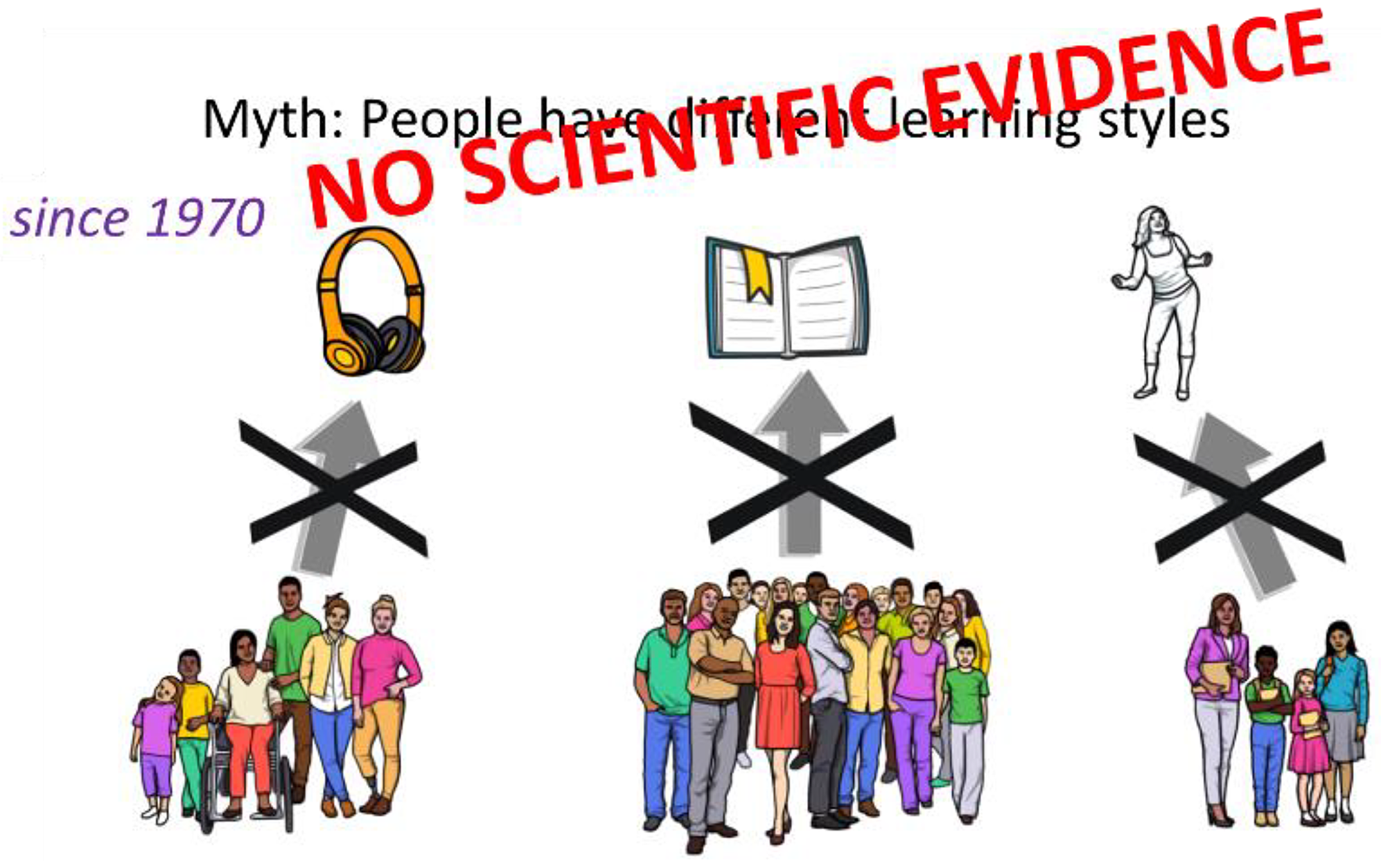
Learning video.
The video lasted for 11 minutes. During the learning video, graphical, textual, and auditory information was provided. Additionally, the learning process of the experimental group was supported by interactive questions (see Figure 2). The degree of interactivity ranged from simple navigation to self-assessment. The questions used included both multiple-choice and single-choice questions, which aimed to assess learners’ understanding of the information presented in the video. Following their responses, participants received feedback on whether their answers were correct. In case of an incorrect response, the correct answer was not revealed automatically, learners were encouraged to attempt to find the correct solution. Participants had the option to proceed with the video even if they had not answered the question correctly. Learners were therefore free to decide whether they wanted to repeat the question if they answered incorrectly or continue with the learning video. The number of repetitions was not counted. These interactive questions served two main purposes: first, to enhance learners’ motivation by addressing their need for autonomy (Ryan & Deci, 2002, 2022), and second, to support participants’ cognitive processes and thereby improve learning outcomes. In total, 13 interactive questions were used in the video.
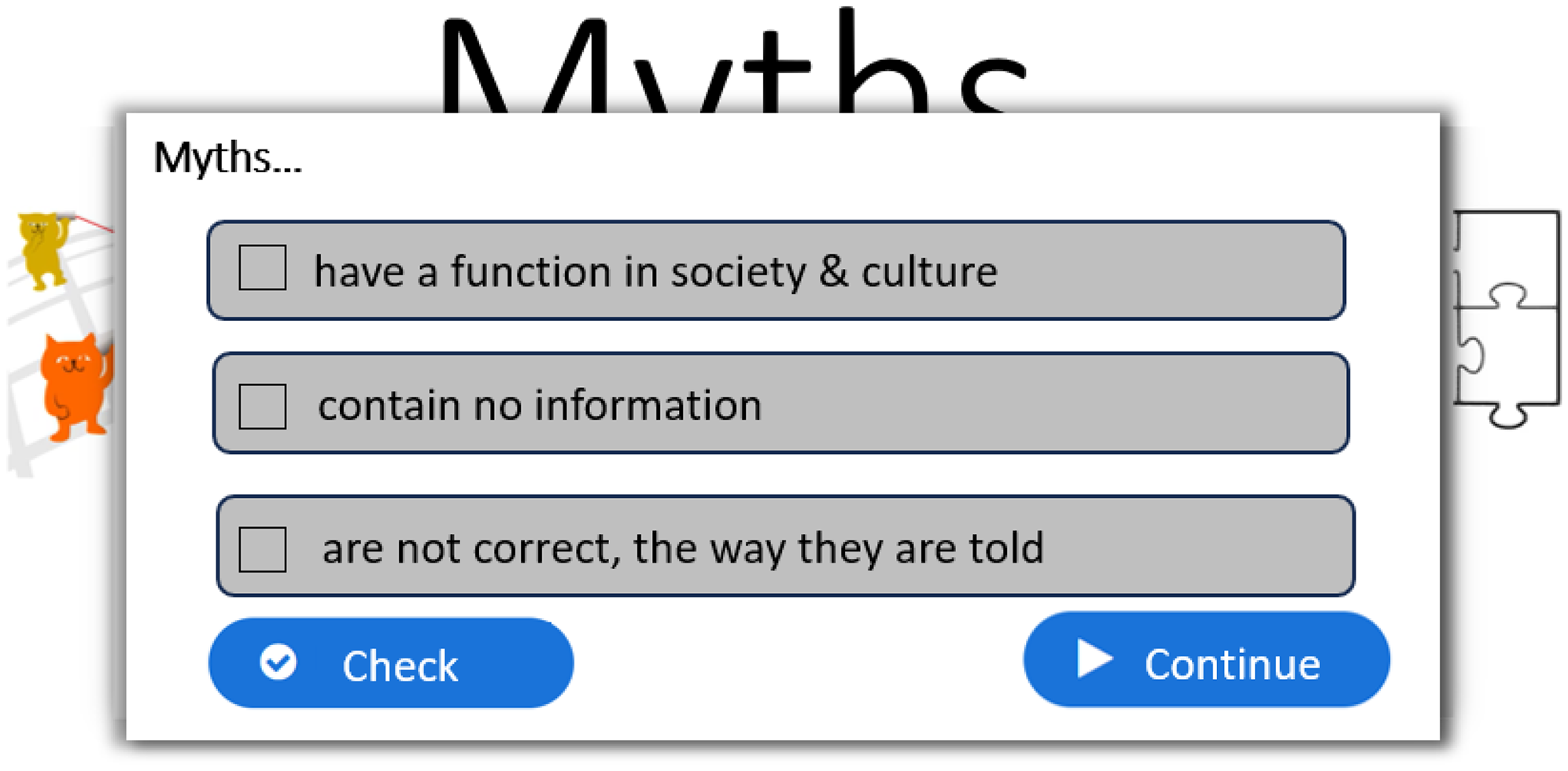
Interactive questions.
Assessment of the Truth of Statements (Myths and Facts)
Before and after the learning video, a questionnaire about myths related to teaching and learning, based on Dekker et al. (2012) and Deibl and Zumbach (2023), including nine questions addressing educational myths, was administered. A five-point Likert scale (from 1 = strongly disagree to 5 = strongly agree) assessed students’ agreement with a myth (e.g., Humans have different learning styles, pre: α = .49; post: α = .53).
Motivation
To measure students’ motivation, we used the two subscales of Pintrich and De Groot’s (1990) MSLQ, consisting of three items to intrinsic goal orientation (e.g., the most satisfying thing for me is trying to understand the content as thoroughly as possible; pre: α = .72; post: α = .73) and four items to extrinsic goal orientation (e.g., If I can, I want to get better grades than most of the other students; pre: α = .69; post: α = .73).
Ability Self-Concept
Participants’ general ability-related self-concept was assessed with an adapted version of the “Skalen zur Erfassung des schulischen Selbstkonzepts (SESSKO)” [Scales for assessing the school self-concept] questionnaire (Schöne et al., 2012). The questionnaire consists of five items, using a five-point Likert scale (from 1 = totally disagree up to 5 = totally agree; five items, e.g., I am gifted for college…; α = .86).
Cognitive Load
Considering that conceptual change and design of learning videos can increase cognitive load and therefore hinder learning, measuring cognitive load was indicated. We used the cognitive load questionnaire by Klepsch et al. (2017). Participants could indicate their answers on a seven-point Likert scale (from 1 = very low to 7 = very high; ICL, e.g., for this task, many things needed to be kept in mind simultaneously: two items, α = .51; GCL: e.g., my point while dealing with the task was to understand everything correct, two items, α = .70; ECL, e.g., the design of this task was very inconvenient for learning: two items, α = .82).
Data Analysis
To analyze within and between subjects’ effects, we computed a multivariate analysis of variance (MANOVA) with repeated measurement. The dependent variable was the assessment of the truth of the statement (myths/facts) in the post-test. The independent variable was the learning video.
To calculate the influence of the covariates, we calculated a multivariate analysis of covariance (MANCOVA). The dependent variables were the cognitive load scales, motivation in the post-test, and the assessment of the truth of the statement (myths/facts) in the post-test. The independent variables were variants of the learning video (interactive/non-interactive). The ability to self-concept, the assessment of the truth of the statement (myths/facts) in the pre-test, and the motivation from the pre-test were added as covariates.
Results
The results are now reported based on the hypotheses that have been formulated.
Hypothesis 1: Students’ belief in myths changes to the extent that they recognize more myths after completing an interactive learning video on the topic than at the beginning of the video.
Descriptive data show a high pre-test approval rate for selected myths, such as learning styles, and a decrease in the assessment of myths presented in the learning video.
A closer look shows that those myths that were not presented in the learning video were partly rated even higher (more encouragement that the myth is true) in the post-test than in the pre-test (Table 1).
Descriptive Data of the Myths High School Students Were Asked Before and After the Learning Video.
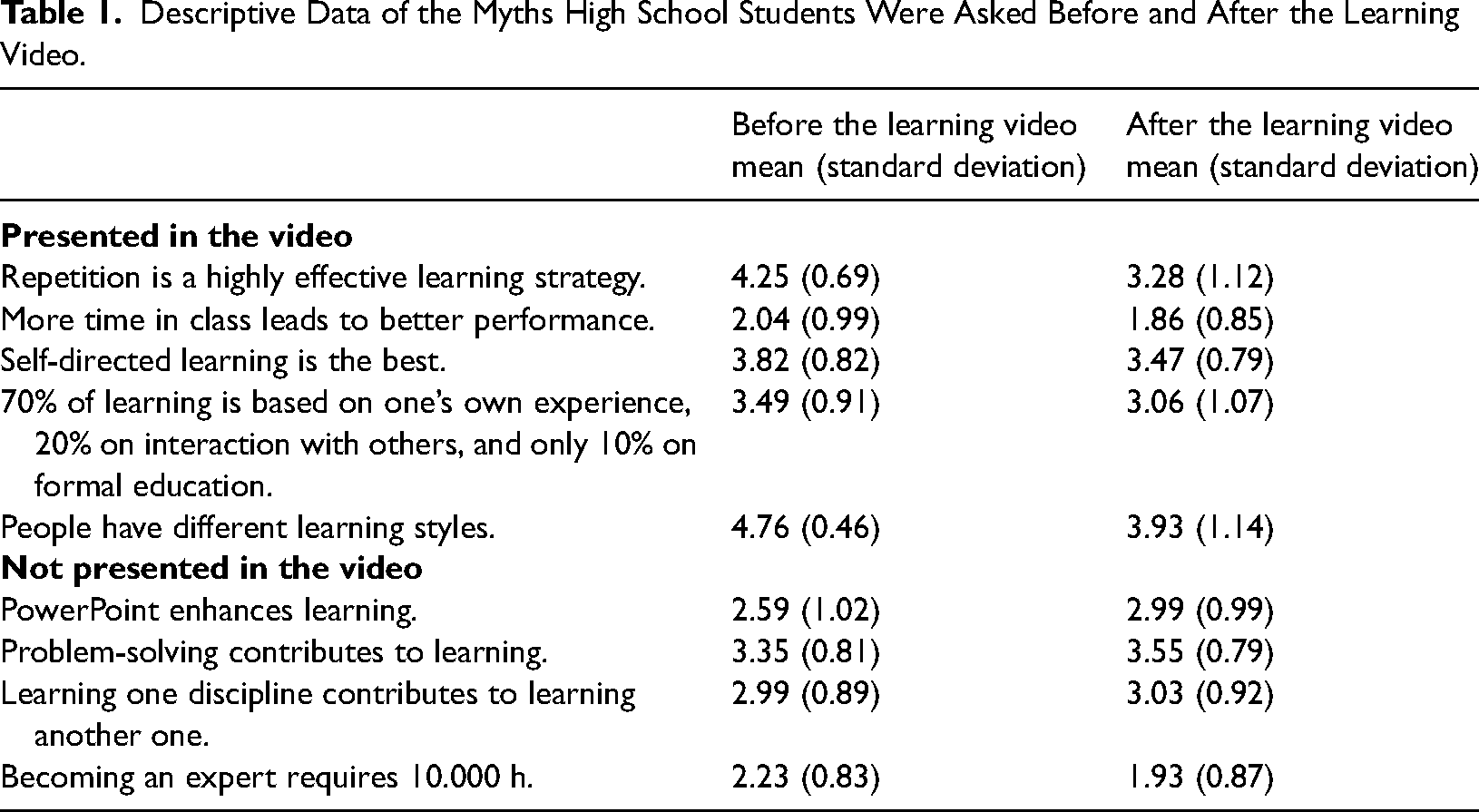
Furthermore, the descriptive data show that students’ belief in the myth is higher at the beginning of the learning video for those myths that were presented in the video than for those that were not presented in the learning video.
These results are also found in the inferential statistical analysis of the MANOVA with repeated measurement. The results show that students were able to identify more myths after the educational video when they were covered in the learning video compared to at the beginning of the learning video, F(1, 69) = 61.12, p < 0.001,
In addition, we took a closer look at how the students’ response behavior changed from the pre-test to the post-test. We therefore first looked at the difference between the pre- and post-test values. We looked at the myths separately, those that appear in the learning video and those that do not (Figures 3 and 4). The mean values were summarized in five categories, so that values in the minus range (−2 and −1) mean that a student has changed their answer to the effect that they now agree with the myth significantly less, or at least are no longer sure. He or she has a more negative or skeptical attitude toward the myth. Values in the plus range (+2 and +1) mean that the response behavior has changed to the effect that after the learning video, the person now believes the myth more or is no longer entirely sure whether it could be a myth after all. People tend to agree with the myth. 0 means that there has been no change. The results were converted into percentages.
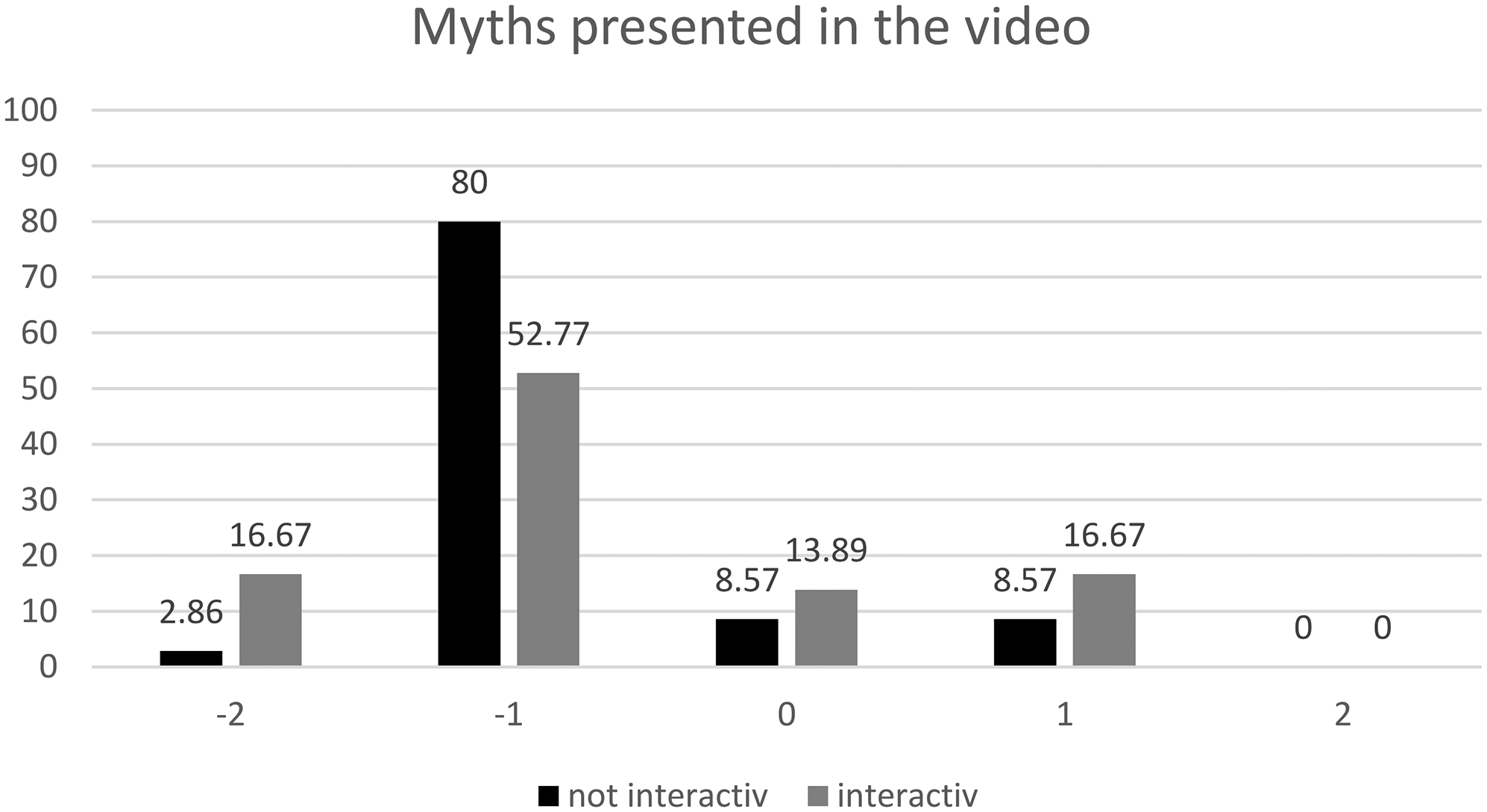
Frequencies of difference values of the results of the post-test and pre-test for those myths presented in the video.
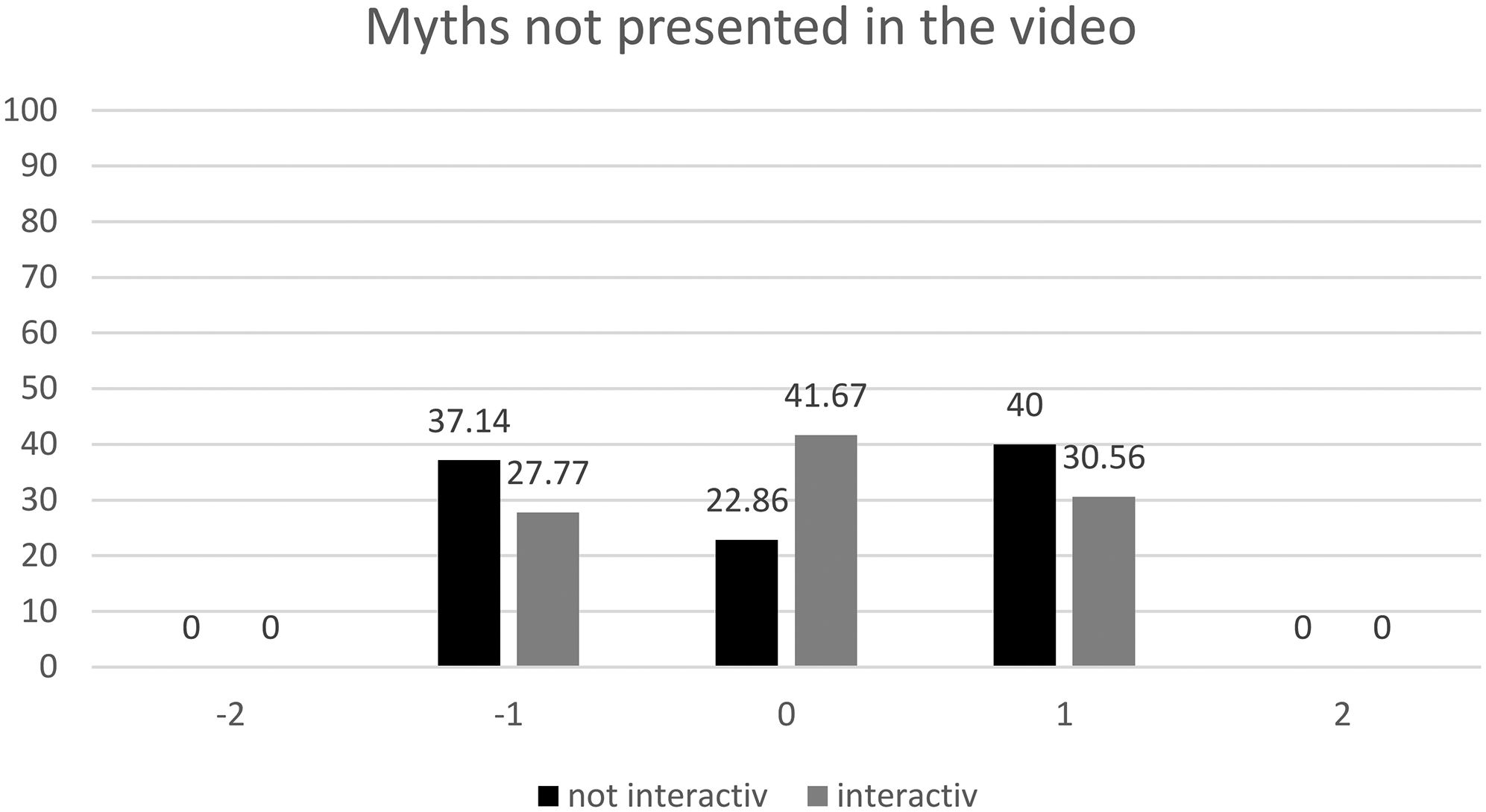
Frequencies of difference values of the results of the post-test and pre-test for those myths not presented in the video.
For a more detailed presentation of the individual myths and the changes in the students’ response behavior, a three-point scale was formed from the five-point Likert scale of the possible answers to the myths. Then a cross-tabulation was created using the new values from the pre- and post-test of the assessment of the truth of the statement to see a change from agree to disagree and the other way around. The presentation of all nine myths would go beyond the scope of this article, which is why the evaluation and tables of all nine myths can be found in the appendix.
Hypothesis 2: There is a difference in terms of recognizing myths between those students who learn with an interactive video and students who learn with a non-interactive video.
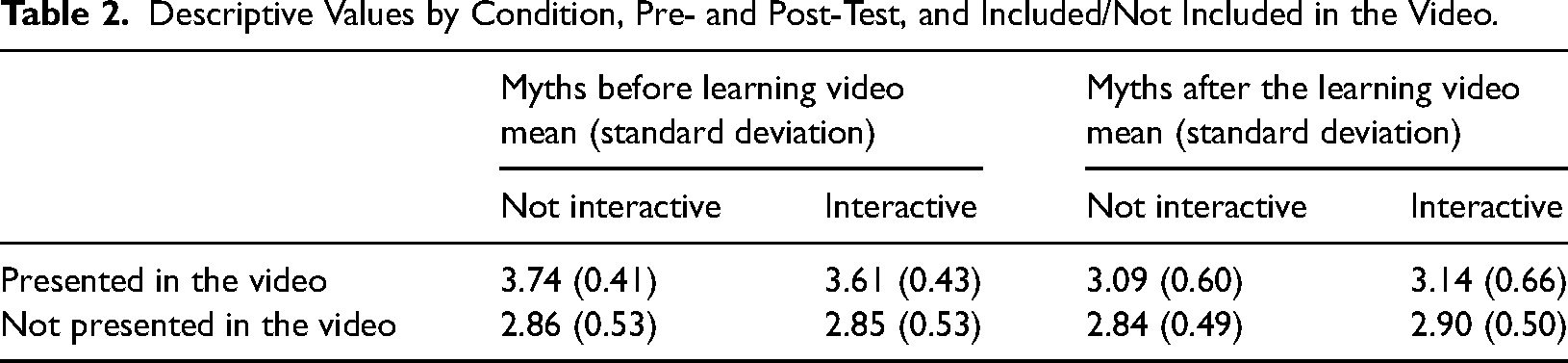
We found no effect of treatment, F(2, 68) = 1.19, p = 0.31,
Descriptive Values by Condition, Pre- and Post-Test, and Included/Not Included in the Video.
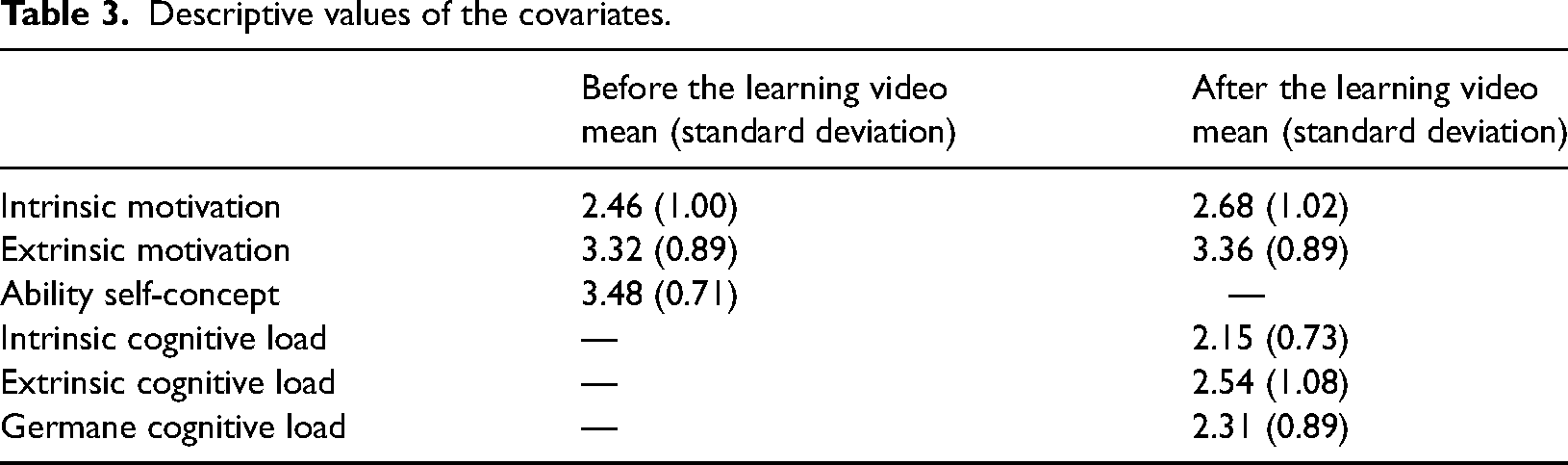
Descriptive values of the covariates.
In addition, a Bayes analysis of variance (ANOVA; using IBM SPSS statistics, vol. 29) was calculated with the independent variable (interactive vs. non-interactive) on both difference scores as dependent variables (post-test versus pre-test for myths covered and not covered each).
The Bayes factor for the difference scores of the myths covered in the learning video shows moderate evidence for the null hypothesis, F(1, 70) = 1.73; p = .193; BF = .217.
Results of the ANOVA for the difference scores of the myths not covered in the learning video show moderate evidence for the null hypothesis, F(1, 70) = .83; p = .365; BF = .141.
Hypothesis 3: The covariates motivation, ability self-concept, and cognitive load have an influence on the recognition of myths at the end of the learning video.
Results of the MANCOVA show a significant main effect for the motivation recorded in the pre-test, intrinsic: F(1, 69) = 11.142, p ≤ 0.001,
A closer look at the inter-subject effects reveals an influence of the ability self-concept on extrinsic motivation in the post-test, F(1, 69) = 5.147, p = 0.027,
We divided the participants into two groups using a median split (median = 3.6): high-ability self-concept and low-ability self-concept. The descriptive data show higher values of extrinsic motivation in the group that also achieved higher values on the ability self-concept scale (low-ability self-concept: M = 3.06, SD = .93; high-ability self-concept: M = 3.40, SD = .87)
There is also an influence of the learning video condition on extrinsic cognitive load, F(1, 69) = 4.295, p = 0.042,
We found significant correlations between condition and ECL (r = −.27; p = .024) as well as for ability self-concept with intrinsic motivation (r = .29; pre: p = .01; post: r = .24; p = .04) and with extrinsic motivation (post: r = .27; p = 0.02).
We found significant correlations between intrinsic motivation in the pre-test and intrinsic motivation in the post-test (r = .72; p < .001).
Significant correlations can be shown between intrinsic motivation in the post-test and GCL (r = .27; p = .03) and also for extrinsic motivation in the post-test and GCL (r = 25; p = .04).
We found significant correlations for GCL with ICL (r = .61; p < 0.001) and ECL (r = .36; p < .001) and a significant correlation between ICL and ECL (r = .48; p < 0.001).
Discussion
Overcoming myths about teaching and learning is one of the challenges of psychology learning and teaching within the field of educational psychology. We see that merely presenting the myths is not enough, as noted by Menz et al. (2021b). This work represents an attempt to dispel psychological myths related to teaching and learning at an earlier stage of education: here high school.
The primary goal of this study was to create a learning environment for educating high school students about five common myths. As a learning environment, two variants of a learning video were used. An interactive video was created, with the degree of interactivity ranging from simple navigation to self-assessment, and a non-interactive video. We aimed to assess how interactivity influenced learners’ evaluations of the truth of myth statements, their perceived cognitive load, ability self-concept, and motivation. The main aim was to compare the level of interactivity, which is why we decided not to add a control group. It was important for us to evaluate the learning video and the degree of interactivity itself first, as the learning objectives could have been different in a lesson without a video and other influencing factors would have played a role (e.g., the teacher).
As interactive multimedia environments have been shown to effectively contribute to learning success, we assumed that learning with interactive videos would contribute to reducing educational myths. The results show that our intervention led to a reduction in belief in myths, but only in relation to myths presented in the learning video. It was shown that there was only a slight reduction in belief in myths among the participants, so we can assume that myths are rather stable and difficult to overcome (Dekker et al., 2012; Menz et al., 2021a). This is also reflected in the histograms in the results section. It can be seen that, particularly for those myths that were included in the video, the response tendency changes in the post-test to the effect that a rethink takes place or that people no longer fully agree with the myth, while the response behavior for the myths that were not included in the video tends to remain the same as in the pre-test. The learning video presented mainly the most popular myths. Myths such as that of learning styles are still propagated by educators and textbooks, as well as by media and advertising. Such personal experiences can lead to the fact that it is mainly these myths that are deeply rooted and difficult to change. As already mentioned, myths are rather stable and difficult to change, it also shows that the myths not included in the learning video have remained very stable. We can therefore only assume why there has been no change here. One reason could be that learners were more likely to doubt their answer again, especially for those myths that were also included in the learning video, because they had gained more information about them. This even made learners believe more in the truth of the myths after the treatment than before. Here, broader information of high school students on the general characteristics of learning myths and a temporally spaced intervention over the period of several weeks may have allowed learners to gain deeper knowledge and to transfer the acquired information to myths other than those approached during the intervention. In addition, an approach that supports critical thinking combined with learners investigating the nature of statements as presented here on their own could be beneficial.
Regarding the interactivity of learning videos, we assumed that high levels of interactivity would have positive effects on learners’ assessment of the truth of the statements about myths. However, the interactivity of the learning video did not make a difference here. So perhaps the intervention was not strong enough. We found slightly higher ECL scores in the group that did not receive an interactive learning video. Here, the interactive questions may serve as prompts, guiding learners’ attention toward the central information and subsequently reducing the processing of learning irrelevant information. However, both ECL values are at a very low level, which is why it can be assumed that the cognitive load caused by the ECL was not very high in either group, as we found no effect on the interactivity of the learning video. No effects of the level of interactivity on high school students’ motivation were found. However, results showed that high school students experienced the interventions as motivating, regardless of which learning video they received. In the long run, learning through videos might further increase learners’ intrinsic motivation and thus encourage them to invest more cognitive resources in the learning activity. This could then lead to improved learning performance.
This study has some limitations. As already mentioned in an earlier paper (Deibl & Zumbach, 2023), research in this field indicates that the operationalization of (neuro-)myths and knowledge related to facts is problematic. Individual items cannot be easily delimited to the area of facts or myths due to the complexity of the field and the fact that some myths also have minor aspects that are derived from scientific findings.
In addition, participants in the interactive learning video were asked nine questions operationalizing interactivity throughout the learning video. While results reveal that this did not increase ECL, it also did not provoke higher motivation in this group compared to the control group. We assume that participants were pulled out of the learning video by the prompts and thus perceived them as a distraction and less motivating. Regularity of question spacing would provide more structure and direction for students in the future. For future studies, it is also advisable to conduct a follow-up test to determine whether the students’ response behavior has changed or whether the change in misconceptions has remained. Furthermore, it could also be informative to ask the students how confident they feel about the answer to each myth. It would also have been helpful to be able to view the log data to learn more about response behavior and navigation in the interactive video, especially how often learners revisited a section before answering the question correctly or whether they immediately clicked on the next section.
Despite these limitations, this study represents a further step in capturing the beliefs in myths about teaching and learning and gaining insights into the belief in neuromyths among high school students, as well as potential ways to bust myths at an earlier stage.
Supplemental Material
sj-docx-1-plj-10.1177_14757257241261351 - Supplemental material for Overcoming the Myths: Interactive Learning Environments as Myth Busters in Teaching and Learning
Supplemental material, sj-docx-1-plj-10.1177_14757257241261351 for Overcoming the Myths: Interactive Learning Environments as Myth Busters in Teaching and Learning by Ines Deibl, Ines Zeitlhofer, Anna Geroldinger and Jörg Zumbach in Psychology Learning & Teaching
Footnotes
Declaration of Conflicting Interests
The authors declared no potential conflicts of interest with respect to the research, authorship, and/or publication of this article.
Funding
The authors received no financial support for the research, authorship, and/or publication of this article.

Supplemental Material
Supplemental material for this article is available online.
Author Biographies
References
Supplementary Material
Please find the following supplemental material available below.
For Open Access articles published under a Creative Commons License, all supplemental material carries the same license as the article it is associated with.
For non-Open Access articles published, all supplemental material carries a non-exclusive license, and permission requests for re-use of supplemental material or any part of supplemental material shall be sent directly to the copyright owner as specified in the copyright notice associated with the article.
