




Abstract
Introduction
Psychology as a field of study is more attractive than ever before. For instance, between 2008 and 2018, the number of psychology students in Germany doubled and exceeded 100,000 for the first time in 2020 (Bühner, 2023; Spinath, 2021). Technological developments in recent years have contributed to the increasing number of online and blended learning courses and distance education programs in psychology. For example, in Germany, more than 40,000 students are currently enrolled in psychology programs at distance education or private universities that use a wide variety of online teaching-learning methods to impart psychological knowledge and skills (Bühner, 2023).
From an education science perspective, an interesting feature of psychology programs worldwide is the gender ratio of typically more than 70% female students (Fowler et al., 2018). This ratio is in marked contrast to the male-dominated study programs in science, technology, engineering, and mathematics (STEM; e.g., De Las Cuevas et al., 2022; Fowler et al., 2018; Spinath, 2021; Verdugo-Castro et al., 2022). While researchers have extensively studied the impact of gender disparities on females’ academic success in STEM, there has been comparatively less research on men in female-dominated study programs (e.g., Shen-Miller & Smiler, 2015). This is particularly true for gender disparities in specific learning arrangements such as computer-supported collaborative learning (CSCL), a widely used method in which students acquire knowledge and competencies by working together on group tasks (Chen et al., 2018).
A systematic review of gender composition effects in academic fields outside psychology suggests that in CSCL, group gender composition plays a role in student achievement (Kube et al., 2022). However, the patterns of these results are complex. For example, some studies have shown that students in single-gender CSCL groups perform better than those in gender-mixed CSCL groups (e.g., Bennett et al., 2010; Underwood et al., 1990). Other researchers have found no relationship between gender in CSCL groups and student performance, however (e.g., Wing-yi Cheng et al., 2008; Xie, 2011) other studies suggest that single-gender CSCL groups work better for women than for men (Zhan et al., 2015). Furthermore, in contexts where solving the group task requires the integration of diverse skills and perspectives, mixed-gender CSCL groups may perform better than single-gender groups (e.g., Kirschner et al., 2008). Most of these studies were conducted in CSCL groups in STEM courses, where men were traditionally in the majority. The relevance of these findings in understanding the factors affecting men in female-dominated programs such as psychology is limited.
With the present study, we aim to fill this gap in the literature. To do so, we draw on research in the realm of social and organizational psychology on the relationship between minority status and perceived diversity climate in work teams. In the most basic psychological sense, the concept of a perceived diversity climate refers to team members’ perceptions of their work environment as fair and socially integrative for all team members (e.g., Cox, 1994; Holmes et al., 2021; McKay et al., 2008; Nishii, 2013). Male psychology students in gender-mixed CSCL groups who perceive a positive diversity climate within their group feel that their contributions to the collaborative task are equally valued and discussed regardless of their gender minority status. Meta-analyses of the beneficial effects of diversity climate perceptions on psychological and behavioral outcomes offer two findings of immediate relevance for this study. First, they suggest that a perceived diversity climate typically has a stronger motivating potential among minority members than among majority members (e.g., Holmes et al., 2021). This can be explained, among other things, by the fact that in contrast to majority members, members of the minority typically are more aware of their minority status and also experience it as more unpleasant (e.g., Lücken & Simon, 2005). Therefore, minority members are often more sensitive to signals from their social environment that convey respect and acceptance. One might thus expect that, in contrast to male-dominated STEM programs, for male psychology students (representing the gender minority), diversity climate plays a greater role in gender-mixed CSCL groups than in female students (representing the gender majority). In fact, and more technically, in gender-mixed CSCL settings, psychology students’ gender may act as a moderator in the relationship between perceived diversity climate and learning-related psychological or behavioral outcomes.
A second meta-analytic finding relevant to the present research is that diversity climate typically has a stronger association with psychological outcomes than with behavioral outcomes (see Holmes et al., 2021). For instance, in the case of CSCL, this implies, that students’ perceived diversity climate in CSCL groups is more strongly related to relevant competence-related expectations (e.g., their expectations to master the course) than to their actual performance (e.g., course grades). However, it is important to keep in mind, that students’ expectations are often important determinants of academic performance (Talsma et al., 2018). Hence, although students’ perceptions of their CSCL groups’ diversity climate may not have direct effects on their individual course achievement, they may indirectly improve their performance by strengthening the development of achievement-related attitudes or expectations. One particularly relevant achievement-related expectation in the context of blended and online learning is students’ online learning self-efficacy (i.e., the individual expectation that one will be able to master an online course, Shen et al., 2013). Bandura's self-efficacy theory assumes four experiential sources of efficacy information: personal performance accomplishments, vicarious learning, emotional arousal (e.g., anxiety), and social persuasion and encouragement from others, with personal experience being considered the most important source of information (see Bandura, 1997, for a more general discussion of self-efficacy development). Several studies document that experiencing a positive social climate in the learner community fosters online learning self-efficacy (e.g., Peechapol et al., 2018). Likewise, research in organizational psychology indicates that team members report higher job self-efficacy when they perceive a high climate of inclusion (e.g., Adamovic et al., 2023; Choi et al., 2003). One reason for the observed linkages between diversity climate and self-efficacy is, that positive and fair feedback from fellow team members fosters trust and confidence in one's own abilities. Research suggests that minority members particularly benefit from a positive diversity climate with regard to self-efficacy development because it prevents them from withdrawing from mutual learning experiences (see for instance findings on women in STEM, Marra et al., 2009). Putting the pieces together, then, one might expect that students’ perceptions of a positive diversity climate within their CSCL group will have a positive impact on the development of their online learning self-efficacy. A high level of online learning self-efficacy, in turn, should increase the likelihood of achieving the learning goals of CSCL courses.
Our hypotheses, which were tested in the present context, are as follows:
(H 1): Students’ perceptions of a positive diversity climate within the CSCL group positively affect their online learning self-efficacy expectations. This relationship should be more pronounced among male students (gender minority) than among female students (gender majority), a prediction that we label the Diversity Climate × Gender Moderation hypothesis. (H 2): Online learning self-efficacy expectations should serve as a mediator of the relationships between students’ perceived diversity climate and their academic achievements after completing the course, a prediction that we label the online learning self-efficacy mediation hypothesis. Owing to the expected stronger relationship between perceived diversity climate and online learning self-efficacy expectations among male psychology students, the indirect effect of perceived diversity climate on academic achievement in gender-mixed CSCL should be more pronounced among male than female psychology students.
The data used to test these hypotheses were collected as a part of a large-scale project on the role of student diversity in CSCL (Stürmer et al., 2020). All research participants were first-year students of a psychology bachelor's program at a German distance education university, who completed a nine-week CSCL course in randomly composed gender-mixed student groups. To investigate our hypotheses statistically, we set up an exploratory moderated mediation model that allowed us to test the mediating and moderating aspects of our research questions simultaneously (Figure 1).
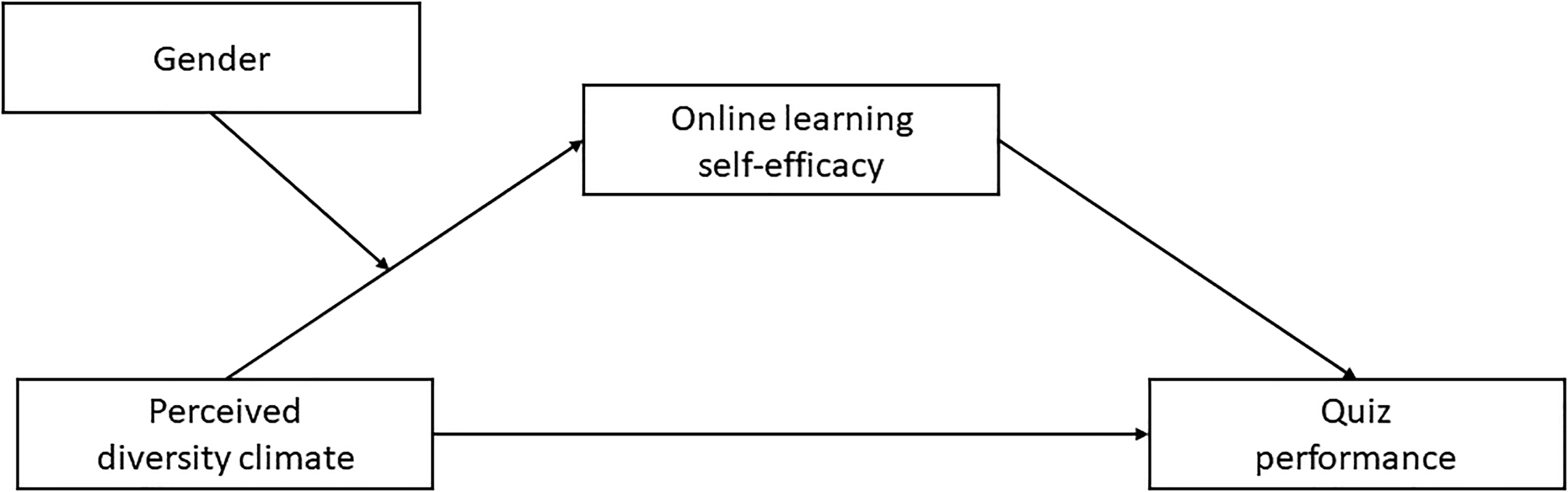
Conceptual model of the moderated mediation.
In this model, students’ perceived diversity climate (measured in the first weeks of collaboration) served as the predictor, and a measure of students’ self-evaluation of online learning self-efficacy (measured in the last week of the course) served as the potential mediator. The main learning outcomes were the baseline-corrected individual values of students’ test scores on a knowledge quiz administered after completing the course (achievement changes from precourse to postcourse). Gender served as a potential moderator in the relationship between students’ perceived diversity climate and self-efficacy expectations. As gender is the only potentially relevant diversity dimension, we controlled for the influence of other potentially relevant socio-demographic dimensions in our statistical analyses. These were the students’ age, first language and part-time status.
Method
Institutional Context
The participants were enrolled in the BSc Psychology program at the FernUniversität in Hagen. With more than 70,000 students enrolled in more than 28 study programs in five faculties, the FernUniversität in Hagen is Germany’s largest public university by student number and one of the largest distance education institutions worldwide. The blended learning approach of the FernUniversität in Hagen combines classroom teaching and print-based study materials with computer-mediated activities and online learning-management systems. Similar to other campus-based universities in Germany, the FernUniversität in Hagen awards undergraduate and postgraduate degrees in psychology. The gender ratio in the program at the time of our study was 69% female to 30% male (1% were diverse). Long-term evaluations by the university's Research and Quality monitoring office based on data from over 40.000 psychology students in that program showed that, overall, male students are about 13% less likely to successfully complete the psychology program than female students. This figure stands in marked contrast to evaluations in the university's Mathematics and Computer Science programs in which males have a 20% higher likelihood of completing the program than females.
Participants and Procedure
Students participated in the CSCL group course as part of a mandatory requirement in the Introduction to Psychology module. In the winter semester, this course typically includes more than 2,500 students. The learning outcomes of the CSCL course were twofold: First, students learned how to read a psychological research article. Second, they developed skills in online learning and communication with other students through practical work. To this end, students were required to work in groups of eight students to collaboratively summarize a psychological research article. Following the procedures of De Wever et al. (2015) students created four separate wikis containing separate summaries of the introduction, methods, results, and discussion of the research article. For this assignment, we provided students with a protected moodle environment that included wikis for the summary assignment, forums for communicating with their group members and instructors, and learning materials and the surveys for this study. The data used for the present study were collected in the context of a larger research project on the role of different aspects of student diversity in CSCL (see Reich-Stiebert et al., 2023; Voltmer et al., 2022). Specifically, all students in the CSCL course were invited to complete individual online questionnaires gathering individual self-reports on personal characteristics and feelings and thoughts regarding various aspects of the group collaboration. Questionnaires were provided at three different time points: After 2 weeks of getting to know each other and before participating in the course (T1); after 3 weeks of CSCL (T2); and after 6 weeks of CSCL interaction (T3). Additionally, all students completed a pretest quiz on their relevant methodological knowledge of how to read a research article in psychology and a post-test quiz. Completion of the questionnaires was voluntary and in accordance with the ethical recommendations of the German Psychological Association, the German Federal General Data Protection Act, and the Declaration of Helsinki. Students received course credits for their participation.
The study flow is shown in Table 1. After logging into the course for the first time, students provided informed consent for this study and completed the first survey and the first moodle quiz. Students then had two weeks to become familiar with the moodle environment without any specific instruction. During this precollaboration phase, communication forums were already available to allow students to get to know their fellow group members (e.g., by introducing themselves to others). After these first 2 weeks, students had 3 weeks to summarize the introduction and methods section of the research article in Collaboration Phase 1, followed by an interim evaluation and another 3 weeks to summarize the results and discussion section in Collaboration Phase 2. After Collaboration Phase 2, students completed the second moodle quiz and had to upload the final summary of the research article, which was then assessed by independent tutors. The tutor ratings were provided to the groups as feedback on their group performance. To promote the development of students’ self-regulation skills, we otherwise limited supervision and feedback from instructors or tutors to administrative or technical issues. Students were instructed to complete all assigned tasks using the asynchronous moodle communication tools. Only students who participated in this group assignment were allowed participating in the final exam of the Introduction to Psychology module at the end of the semester. Neither the summary ratings nor quiz scores contributed to their final exam grades.
Overview of Course Workflow, Data, Students, and Groups.
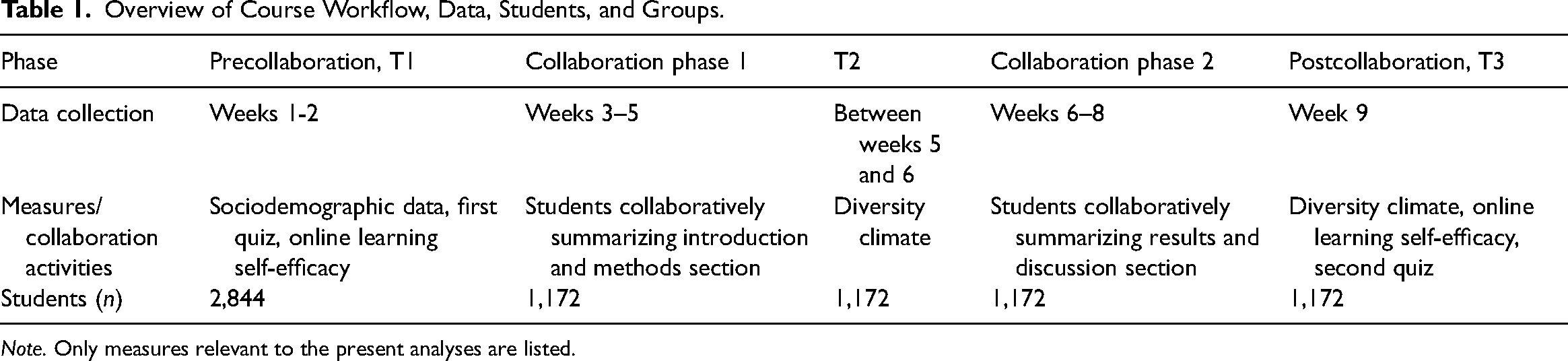
Note. Only measures relevant to the present analyses are listed.
Of all students registered for the course, 2,202 students took part in the first moodle quiz. Of these, 1,172 participants voluntarily completed all three online questionnaires and the pre- and postquizzes and were thus included in the final sample for this study. The descriptive statistics of this sample are consistent with the general student population in the psychology program at the FernUniversität in Hagen. 75% (n = 882) of the students were women, 44% (n = 510) of the students were 30 years or older, and 48% (n = 559) were part-time students. Additionally, 12% (n = 144) reported to be nonnative speakers of German.
After enrolling in the course, students were randomly assigned to groups of eight students each. The average proportion of women in our groups was 0.71 (SD = 0.18), which closely matches the overall gender ratio in the psychology program at the university in the study. Of the total groups, 281 were gender-mixed and 50 were all-female. Of the gender-mixed groups, 226 had a majority of women, 25 had a majority of men, and 30 groups had an even gender distribution. Although the focus of our research was on gender-mixed CSCL, we kept participants in the all-female groups in the sample because this allowed us to further compare the role of diversity climate perceptions on students’ learning outcomes across all possible gender group compositions.
Statistical comparisons between students who completed all questionnaires and quizzes (the “survivors”) and students who dropped out revealed that dropouts were older, χ2(1) = 12.93, p < .001, to a higher percentage part-time students, χ2(1) = 22.95, p < .001, and more often nonnative speakers of German, χ2(1) = 7.87, p = .005, than the “survivors.” Further, and of particular interest to the present study, dropouts were disproportionally more often men than women, χ2(1) = 19.18, p < .001, corresponding to an odds ratio of OR = 1.52, 95% CI [1.26, 1.84]. This finding is interesting in itself, as it falls clearly in line with the perspective presented in this study, suggesting that in female-dominated study programs, men have a significantly higher drop-out risk. Importantly, male students dropping out of the course did not differ in their quiz performance at T1 from male survivors, t(588) = −0.96, p = .335. Still, they had a lower level of online learning self-efficacy at T1 than male students in the survivor sample, t(602) = −2.23, p = .026, Mdrop−outs = 3.81 vs Msurvivors = 3.90.
Measures
The data collected during the CSCL collaboration relate to different issues included in the larger-scale research project. In the following section, only the measures relevant to this study are described.
Sociodemographic Characteristics (T1; precollaboration)
Before participating in the course, students completed a questionnaire that included measures of sociodemographic variables. Students indicated their self-identified gender (male, female or diverse/nonspecified). As the number of diverse students was too small to be included in the present analyses (n = 17, diverse/nonspecified), we used a dichotomous gender measure (0 = male, 1 = female). Likewise, to ensure students’ privacy, we used dichotomous measures to assess age (coded 0 = 30 or younger, 1 = 31 or older, differentiating between participants in emerging adulthood and those outside emerging adulthood, see, for example, Chatterjee et al., 2021), first language (0 = German, 1 = non-German), and part-time status (0 = studying full-time, 1 = studying part-time). To test whether students were aware of the gender distribution within their groups, students indicated how similar they perceived the members of their work group to be (1 = rather similar, 2 = rather dissimilar).
Perceived Diversity Climate (T2)
The CSCL groups were characterized by differences between students on multiple diversity dimensions (e.g., age, gender, native language, SES and so on, see Voltmer et al., 2022). To avoid measurement reactivity through an artificially induced focus on the gender category, we refrained from singling out gender in our diversity climate measure but used standard items measuring diversity climate for the multidiverse CSCL group as a whole. Specifically, after 3 weeks of collaboration (T2), students completed five items that were adapted from established multi-item measures of perceived diversity climate (e.g., Chrobot-Mason & Aramovich, 2013; McKay et al., 2008): “I fit in the group without having to change,” “I consider myself quite different from the other group members,” (reverse coded) “I felt free to express my ideas,” “Different views, ideas, and perspectives were valued in the group,” and “I trusted the group members to treat me fairly.” Students rated each item by using five-point rating scales ranging from 1 = “does not apply at all” to 5 = “totally applies.” The selection of these items was guided by our aim to capture a broad and inclusive sense of the diversity climate within the groups. This approach aligns with the conceptualization of diversity climate as an overarching perception of inclusivity and fairness across different diversity dimensions (Perry & Li, 2019). We calculated for each student a diversity climate index score for T2 by averaging responses over the corresponding items (Cronbach's α = .80). 1
Online Learning Self-Efficacy (T1; precollaboration and T3; postcollaboration)
To measure course outcomes, we used self-efficacy to complete an online course subscale of Shen et al.'s (2013) online learning self-efficacy instrument. The subscale's item stem asks students to indicate their confidence to do the following tasks in the online course: “Complete an online course with a good grade,” “Understand complex concepts,” “Willing to face challenges,” “Successfully complete all of the required online activities,” “Keep up with course schedule,” “Create a plan to complete the given assignments,” “Willingly adapt my learning styles to meet course expectations” and “Evaluate assignments according to the criteria provided by the instructor.” Students rated each activity by using five-point rating scales ranging from 1 = “not at all sure” to 5 = “totally sure.” To model changes in students’ self-efficacy expectancies as a course outcome, students completed identical items before participating in the course, as a baseline measurement, and at the end of the 9-week CSCL course as a learning outcome of their course participation. We calculated separate pre- and postcourse indexes for each student for online self-efficacy to complete the course by averaging responses over the corresponding items (Cronbach's α = .81 for precourse and α = .87 for postcourse).
Pretest and Posttest Knowledge Quiz (T1; precollaboration and T3; postcollaboration)
To measure students’ individual knowledge gains, we created a knowledge quiz with 10 multiple-choice questions tapping the relevant issues presented in the article (theories, methods, results, and discussion). Each multiple-choice question had five alternatives; one or more correct. The students’ test scores ranged from 1 to 10. Students took quizzes individually outside the CSCL group. To model changes in students’ individual knowledge gains, they completed an identical quiz before participating in the course (pretest), and at the end of the 9-week CSCL course (posttest). We calculated separate pre- and posttest scores for each student by averaging the correct responses to the 10 questions.
Results
Preliminary Analyses
Since our data structure was nested (individual students in the CSCL groups), we conducted a set of preliminary analyses to check for group-level variations in our central outcome and mediator variables, online learning self-efficacy and quiz scores at T3. These analyses confirmed that the group-level variation in our data was small (ICCs ≤ .037), and individual-level analyses were appropriate. Thus, we conducted all hypothesis tests at the individual level. An inspection of students’ online activity data indicated a plausible amount of student activity in our moodle course environment. M = 2.60, SD = 2.37 threads posted per student and M = 7.81, SD = 7.39 responses written per student. These data suggest that the students interacted with each other in their CSCL groups through the moodle system and had the opportunity to develop perceptions of the climate of diversity.
Table 2 presents the means, standard deviations, confidence intervals, and correlations for all the relevant variables. A 2 × 2 chi-squared test showed that students in the mixed-gender groups were more likely to perceive themselves as rather dissimilar on the gender dimension (48%) than were students in the single-gender groups, 2%, χ²(1, N = 1,105) = 118.83, p < .001. These results further confirm that participants were aware of the gender composition of their group.
Means, Standard Deviations and Correlations for Predictor, Moderator, Mediator, Criterion, and Control Variables (n = 1,172).
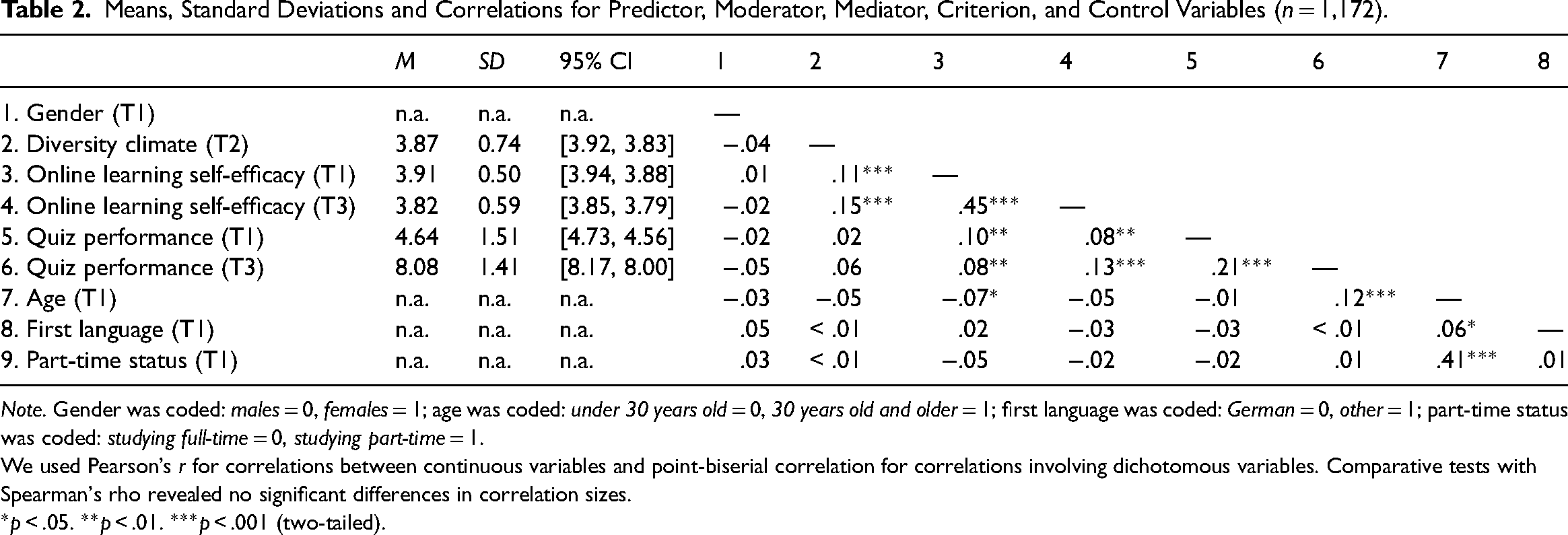
Note. Gender was coded: males = 0, females = 1; age was coded: under 30 years old = 0, 30 years old and older = 1; first language was coded: German = 0, other = 1; part-time status was coded: studying full-time = 0, studying part-time = 1.
We used Pearson's r for correlations between continuous variables and point-biserial correlation for correlations involving dichotomous variables. Comparative tests with Spearman's rho revealed no significant differences in correlation sizes.
*p < .05. **p < .01. ***p < .001 (two-tailed).
A preliminary mixed-model analysis of variance with participants’ gender as the between-subject variable and knowledge quiz scores at T1 and T3 as the within-subject variable revealed a significant and large increase in knowledge over time F(1, 1170) = 1075.21, p < .001, ηp² = .479. The gender effect and the Gender × Time interaction were both nonsignificant indicating that increases in knowledge from T1 to T3 hold both for female and male students, ps ≥ .375. We also conducted an analogous mixed-model ANOVA using online learning self-efficacy scores at T1 and T3 as the within-subject variables. Interestingly, these analyses produced no significant effects, all Fs ≤ 3.71, ps ≥ .054. The null effect of course participation in online-learning over time is interesting because it falls in line with our general argument that the development of online learning self-efficacy in gender-mixed learning groups cannot be taken for granted, but hinges, among other things, upon the groups’ diversity climate. We now turn to our main analyses in which we subject this argument to systematic empirical testing.
Main Analyses
We used path analyses, which allowed us to test our specific Gender × Diversity climate moderation hypothesis, and the online learning self-efficacy mediation hypothesis in a single path model. Moderated mediation is established when: (a) The moderator affects the strength of the predictor–mediator relationship. (b) The mediator affects the criterion when the effects of all the other variables in the model are controlled. (c) The size of the predictor's indirect effect via the mediator changes depending on the moderator level. Students’ baseline and pretest scores for perceived online learning self-efficacy and quiz performance were included as control variables in the regressions. Thus, we tested our model with regard to the actual residual gains in online learning self-efficacy or knowledge resulting from course participation after controlling for (baseline) precourse scores (Cronbach & Furby, 1970).
Our first model contained all paths from diversity climate at T2, gender, online learning self-efficacy and quiz performance at T1 → online learning self-efficacy at T3, and all paths from online learning self-efficacy at T3, as well as diversity climate at T2, gender, online learning self-efficacy and quiz performance at T1 → quiz score at T3, thus reducing spuriousness in the estimation of direct and indirect relationships. Figure 2 shows the standardized path coefficients of our model. In total, the model explained 22% (R² = .223) of the variance in online learning self-efficacy at T3, and 6% (R² = .062) of the variance in quiz scores at T3. Online learning self-efficacy at T1 was positively related to online learning self-efficacy at T3, b = 0.53, 95% CI [0.46, 0.59], z = 16.81, p < .001, and quiz scores at T1 were positively related to quiz scores at T3, b = 0.19, 95% CI [0.14, 0.24], z = 7.12, p < .001.
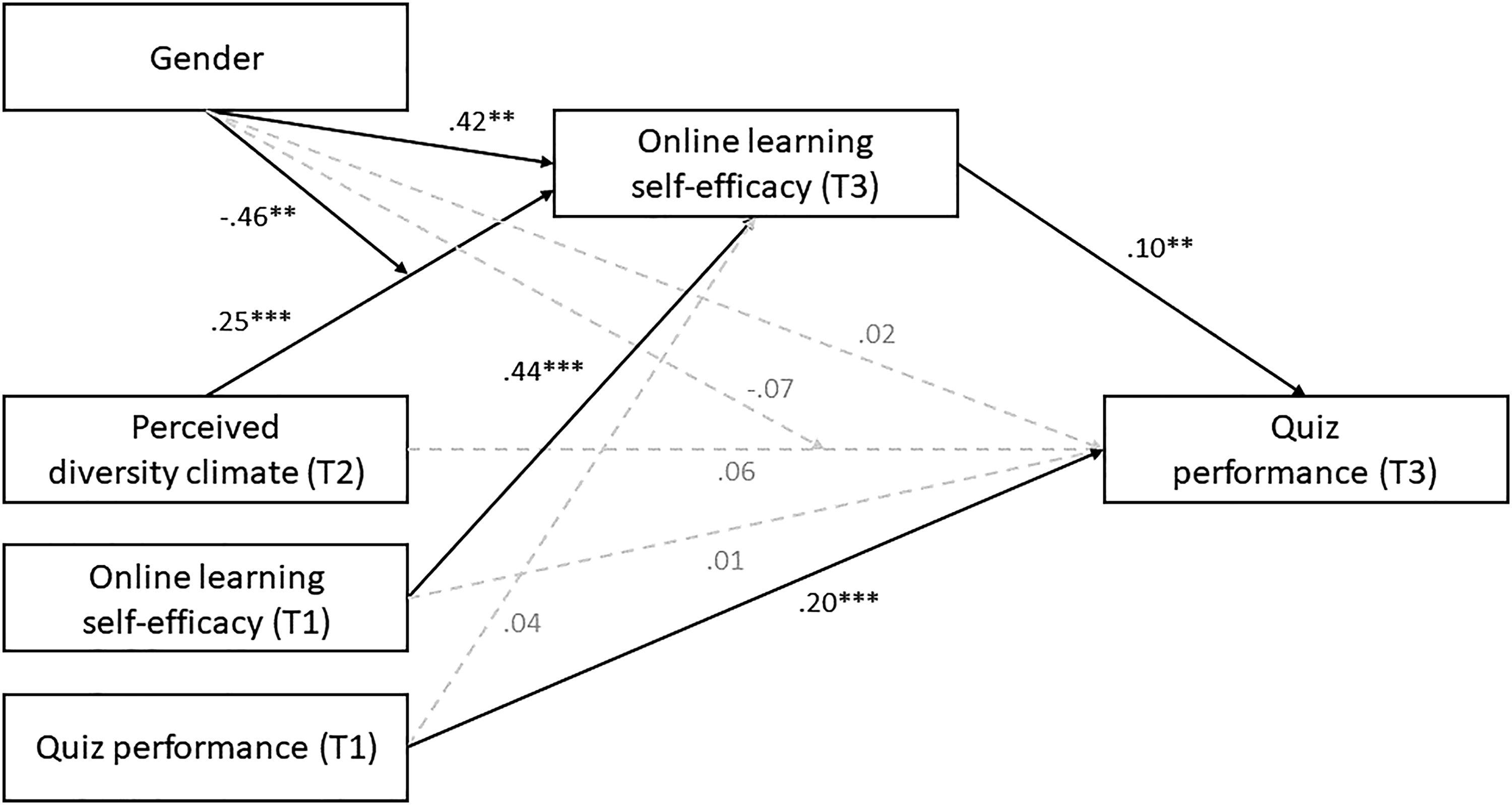
Moderated mediation path model.
Supporting our first hypothesis, diversity climate at T2 was significantly and positively related to the mediator, residual gains in online learning self-efficacy at T3, b = 0.20, 95% CI [0.11, 0.28], z = 4.37, p < .001. In addition, and also in line with our first hypothesis, there was a significant interaction between diversity climate participants’ gender on online learning self-efficacy, b = −0.15, 95% CI [−0.25, −0.05], z = −3.00, p = .003. Because participants’ gender was dichotomous, this interaction effect reflects a significant difference in the strength of the relationships between diversity climate and residual gains in online learning self-efficacy for male and female students. For male students perceived diversity climate at T2 was a significant predictor of online learning self-efficacy residual gains at T3. By contrast, for female students, the relationship between diversity climate and residual gains in online learning self-efficacy was nonsignificant (see Figure 3 for conditional simple slopes).
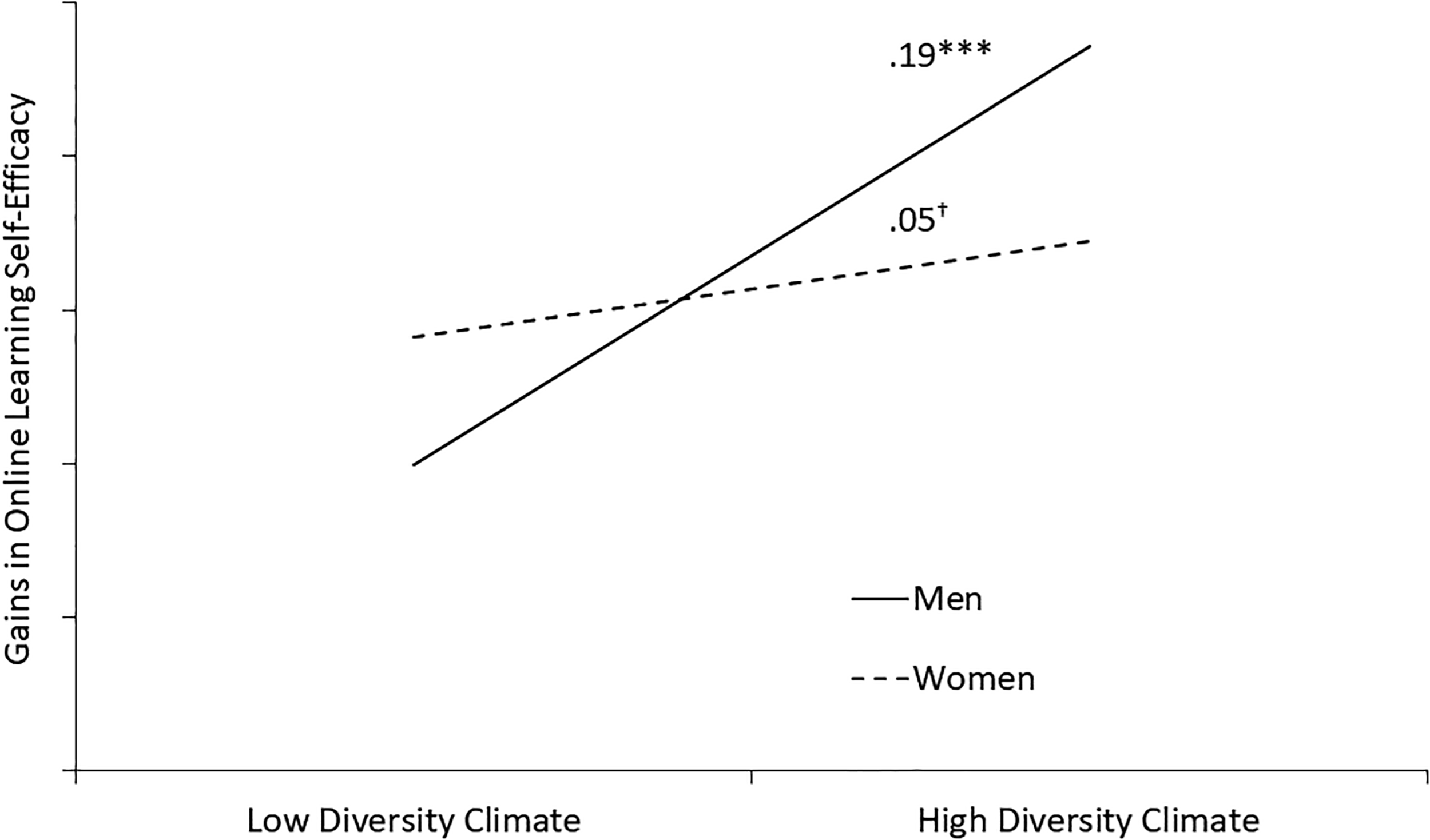
Simple slopes for the Diversity Climate × Gender interaction on online learning self-efficacy (T3).
Our path analysis also yielded support for our second hypothesis: Firstly, online learning self-efficacy at T3 was significantly and positively related to residual gains in quiz performance at T3, b = 0.25, 95% CI [0.10, 0.40], z = 3.19, p = .001, establishing the second condition for moderated mediation. Secondly, there was a significant indirect relationship between diversity climate at T2 and quiz performance at T3 that was mediated by online learning self-efficacy at T3, indirect effect = 0.02, 95% CI [0.004, 0.036], z = 2.49, p = .013. In line with the third condition to establish moderated-mediation, this effect was significantly stronger for men, conditional indirect effect = 0.05, 95% CI [0.01, 0.09], z = 2.58, p = .010, than for women, conditional indirect effect = 0.01, 95% CI [−0.002, 0.024], z = 1.67, p = .096, for the critical indirect interaction, IE = 0.04, 95% CI [0.004, 0.070], z = 2.19, p = .029. The remaining and theoretically unpredictable paths were all nonsignificant, ps ≥ .147. Deleting the unpredicted paths from the path model confirmed excellent model fit, χ2 (5, N = 1,172) = 6.56, p = .255, RMSEA = .016.
These results remained virtually unchanged when we additionally controlled for three alternative diversity dimensions, namely students’ age, their first language, and part-time status as additional predictors of the focal mediator and criterion variables in our path model depicted in Figure 1. Of the three alternative dimensions only students’ age received a unique significant predictive value, indicating that older students showed higher knowledge gains than younger students, β = .141, p < .001; the remaining predictive values were all nonsignificant, all ps ≥ .250.
Because the shares of males and females were uneven across CSCL groups, we also conducted further analyses in which we included the gender ratio in the CSCL groups as an additional moderator variable in our model. Including the gender ratio as an additional moderator of the effects of gender and diversity climate did not improve the model compared to a model where these effects were set to zero, Δχ2 (7) = 11.23, p = .13. Further, these analyses showed that the gender ratio had no effect on the findings reported above (for the critical three-way interaction between Diversity Climate × Gender × Group composition on residual gains in online learning self-efficacy, p = .374). Analyses in which we excluded the 25 CSCL groups in which men were in the majority from the sample replicated all relevant findings reported above (for the critical path of gender on online learning self-efficacy, β = .37, p = .062 and the interaction between Gender × Diversity Climate, β = −.42, p = .039). Taken together, these analyses suggest that the higher importance of the groups’ diversity climate among male students existed independently of the specific majority–minority constellation in their CSCL group, presumably because male students generally considered themselves to be the minority in the female-dominated study program. For female students (the majority), on the other hand, the diversity climate was generally unaffected by the relative proportion of fellow female groups (i.e., there was no significant variation in the relative predictive of perceived diversity climate for female students in the gender-balance, female-majority, female-minority or all-female groups).
Further Analyses: Additional Moderators and Intersectionality
To explore whether and to what extent other sociodemographic diversity dimensions (i.e., age, first language, or part-time status) operated as additional moderators of the relationship between diversity climate perceptions and self-efficacy gains, we ran a series of additional two-moderator path models in which we successively examined (a) whether any of the three dimensions functioned as an additional moderator when we kept gender as the focal moderator simultaneously in the model, and b) whether any of the possible predictor (diversity climate) by focal moderator (gender) by additional moderator (either age, first language or part-time status) three-way interactions was significant (which would indicate intersectionality effects). This was not the case, however. There was no indication that age, first language or part-time status moderated the relationship between perceived diversity climate at T1 and self-efficacy gains at T2 reported above, for all critical interactions ps ≥ .085. Further, there was also no reliable indication for significant three-way interactions produced through students’ intersectionality (e.g., the combination of being male and nonnative speakers of German), for all critical three-way interactions, ps ≥ .061. The lack of significant additional moderator or intersectionality effects thus strengthens our confidence in gender as the focal moderator of the relationships between diversity climate and self-efficacy gains.
Discussion
To date, the achievements of male students in female-dominated study programs have garnered little attention. This study on male psychology students in a gender-mixed CSCL course shows that similar to what is known from courses in traditionally dominated STEM programs, students’ gender is significantly implicated in their learning outcomes, but with reversed patterns. We conducted our study in a CSCL course in a psychology program in which 70% majority of students were females. Furthermore, males had, on average, a 13% lower likelihood of completing the program than females. Consistent with these data at the program level, preliminary analyses at the level of the CSCL course in the focus of the present study, we found that male students were disproportionately more likely to drop out than female students. Using a moderated mediation modeling approach the present study examined the relationships between students’ perceived diversity climate within gender-mixed CSCL groups and two interrelated learning outcomes of the course (online learning self-efficacy and knowledge of how to read a research article over time). Our results showed that the perceived diversity climate in the course contributed significantly to the prediction of precourse/postcourse gains in online learning self-efficacy; however, and as expected, this relationship varied with students’ gender. More specifically, in line with the Diversity Climate × Gender Moderation hypothesis, our analyses confirmed that the diversity climate measured after 3 weeks of collaboration had a stronger effect on students’ precourse/postcourse online-learning self-efficacy gains among male students than female students. Further, our mediation analyses also confirmed that perceived diversity climate had a significant indirect effect on actual pretest/posttest knowledge gains from taking the CSCL course. Specifically, in line with our online learning self-efficacy mediation hypothesis, we observed that by strengthening students’ online learning self-efficacy, perceived diversity climate indirectly contributed to significant gains in students’ knowledge of how to read research articles in psychology. However, and as predicted by our moderated mediation model, this indirect effect was significant only for male, but not for female students. In summary, with respect to individual course's learning outcomes, the perceived diversity climate in the CSCL course was thus only relevant for male students (representing a student minority); it did not play any role for female students (representing the student majority). Our findings fit nicely with meta-analytic findings, showing that the relationships between perceived diversity climate and contextually relevant attitudes and expectations are often stronger among minority than majority members (Holmes et al., 2021).
The interesting and unique aspect of the present study is, however, that the minority members in the present study (men in a psychology program) belong to a group that still holds privileges in many areas of society (e.g., Joshi & Roh, 2009; Liu, 2017). In contrast to women in STEM, men in psychology programs are not confronted with pejorative stereotypes (especially since the majority of psychology professors are still male, see, e.g., Billmann-Mahecha, 2004; Metavorhaben Innovative Frauen im Fokus, 2023; Statistisches Landesamt Baden-Württemberg, 2023). The social psychological dynamics underlying the observed diversity climate effects for women in STEM and the effects for men in psychology observed here are thus likely to be of a rather different nature. The design of our study does not allow us to precisely delineate the processes that rendered diversity climate perceptions more relevant for the male than for female students in the CSCL course, and we acknowledge this as a major limitation of the present work. It is telling, however, that we also observed a higher dropout rate of male students from the course than for female students (see Method section for details). At a more general level, these observations fall in line with other research on males in female-dominated vocations (e.g., Saadat et al., 2022). They thus call for paying the specific psychological needs and experiences of male students in psychology programs greater attention in future work.
To ensure the validity of our results, we statistically controlled for several other potentially relevant sociodemographic variables (students’ age, their first language, their part-time status), as well as indicators of potential intersectionality (i.e., the combination of these diversity dimensions with gender). In sum, these additional analyses and controls confirmed that our findings are robust and that our interpretation of the observed gender moderation effects is appropriate. Nevertheless, we also have to address the limitations of the present work.
A first possible limitation is the potential impact of other group work on students’ perceptions of CSCL in this degree program, which could potentially “spill over” on the self-assessments of the diversity climate assessed in the present course. However, it is important to note that the course under study was the first and only CSCL group course for first-year students according to the curriculum. Therefore, we believe the risk of such distortion is low.
A second possible limitation concerns the use of a “global” measure of diversity climate to test our hypotheses (i.e., a measure tapping the climate in the multidiverse CSCL group as a whole and not only among male and female students). We assumed that focusing our measurement on the gender dimension would produce unintended effects (e.g., self-presentational concerns, normative responding). Still, a global diversity climate measure does represent an indirect indicator of the microdynamics and experiences among male and female students in the CSCL group. It should be noted, however, that despite the potential slippage between students’ global diversity climate assessments and their feelings and perceptions based on interactions among male and female students, our measure produced the theoretically predicted relationships. Given the fact that deficits in measurement typically attenuate the observed relations between variables (Bollen, 1989), our use of a global diversity climate measure might actually be construed as a rather conservative test of our hypotheses.
Third, one could argue that the effect sizes in our study are relatively small. With regard to this issue, it should be considered that we conducted this study in a field setting in which, owing to the variety of influences operating in the field, detecting moderation and mediation effects is often difficult (McClelland & Judd, 1993). Considering that the time span between the measurement of the main predictor variable (perceived diversity climate) and the mediator and criteria (online learning self-efficacy, posttest quiz results) was approximately 3 weeks, finding that, among males, the diversity climate predicted these learning outcomes over this time span suggests, in fact, a relatively robust influence on learning.
We drew our hypotheses from general theoretical considerations and meta-analytic evidence (Holmes et al., 2021). Our results supported these assumptions. Therefore, we are tentatively optimistic that our assumptions also hold for other female-dominated study programs in psychology, and perhaps even for learning settings above and beyond CSCL. Ultimately, however, the generalizability of our findings remains an empirical question. This brings us back to the starting point of our study: Research on males in female-dominated programs is limited. In a report on the future of psychology, the German Council of Science and Humanities encouraged psychological institutions to recruit more male students to study psychology and address gender disparities in psychotherapy care (Wissenschaftsrat, 2018). The present study shows that, for males, even in the benevolent context of an introductory course, the perceived diversity climate is a significant determinant of their individual learning outcomes. In conclusion, based on the results of this study, we wish to emphasize and encourage further theoretical and empirical investigations of male students’ perspectives in female-dominated psychology programs.
Footnotes
Acknowledgements
This work was conducted in the research center CATALPA - Center of Advanced Technology for Assisted Learning and Predictive Analytics of the FernUniversität in Hagen, Germany.
Declaration of Conflicting Interests
The authors declared no potential conflicts of interest with respect to the research, authorship, and/or publication of this article.
Funding
The authors received no financial support for the research, authorship, and/or publication of this article.
Informed Consent
The authors confirm that any participant in the present work has given informed consent before participating in the study.
