




Abstract
Writing a final thesis is an important step for many students. Many thesis programs in research-oriented fields are structured as projects in which there is a one-to-one working relationship with a supervisor. In addition, the thesis’ final grade is often perceived as particularly important. This research uses a cross-sectional survey design (N = 217) to assess student-perceived supervisor motivation and experienced grade pressure as predictors of student motivation when writing their thesis. Derived from expectancy-value models, valence, expectancy, and instrumentality towards achieving a good thesis grade as well as stress from the thesis work are assessed as mediating variables. The results indicate that, as hypothesized, high student-perceived supervisor motivation is associated with higher motivation components and less stress. Grade pressure is associated with higher valence, but also more stress. In turn, motivational components are positively and stress negatively associated with student motivation. The mediation analysis suggests a partially mediated positive effect of student-perceived supervisor motivation and a suppressed net zero effect of grade pressure on student motivation. Although this research cannot establish causality, the results suggest that motivating supervisors may improve student motivation in thesis writing significantly. Furthermore, the negative effects of high grade pressure may not extend to student motivation.
Much research exists on university-level students’ experiences during the academic year or exams. However, comparatively little research has focused on students’ final theses. Although there are many different terms used for this step in students’ higher education, the final thesis in this context refers to project work that is conducted to conclude a bachelor's or master's degree (Råde, 2019), generally in line with a certifying organization's requirements, for example the APA or EuroPsy. For many students, a course's final thesis constitutes an important milestone (Wisker, 2019). In addition, it can be considered the culmination of a student's learning and the expression of the skills they have acquired during their studies (Krishna & Peter, 2018; Wisker, 2019). Keeping up student motivation during the process of writing a thesis can be essential to achieving successful thesis outcomes (Mbato & Cendra, 2019; Russell-Pinson & Harris, 2019), in line with research showing the importance of academic motivation in students more generally for both performance and well-being-related outcomes (Howard et al., 2021; Kim et al., 2020). Thus, identifying predictors that influence student motivation in writing a final thesis represents a worthwhile pursuit.
The length and supervised nature of a final thesis suggest several factors that may play a uniquely important role in determining student motivation. First, as a comparatively distinctive and weighty examination form, a student's grade in a final thesis may be perceived as particularly important. Thesis topics can be relevant when applying for jobs (Meeus et al., 2004) and have been argued to be considered special by students (Webster et al., 2000). The common requirement for a defense in front of a committee of scholars may also increase the perceived importance of the thesis. Accordingly, the final thesis and its defense may cause particularly large stress responses (Ramírez-Adrados et al., 2020, 2022). Thus, it seems likely that the grading of the final thesis is perceived as particularly important compared to individual other exams. Students may feel under pressure to achieve a good grade in their thesis to be able to present it as an asset in their further career. Thus, investigating whether grade pressure affects student motivation in thesis work seems warranted.
In addition, in German research-oriented contexts, the final thesis is often characterized by a de facto one-to-one relationship to a supervisor with professional research experience (e.g., de Kleijn et al., 2012). It should be noted at this point that even within Germany, there exists significant heterogeneity regarding precise thesis requirements and supervision. For example, some universities require an oral defence while others do not; some universities require assessment by only a single member of the institution, while others require multiple assessors (potentially from different institutions). Thus, the ‘main’ thesis advisor may not be the only relevant individual for supervision and grading. Nevertheless, the main thesis advisor may play an important role in students’ perceptions and further outcomes (de Kleijn et al., 2012; Krishna & Peter, 2018; Martinez & Elue, 2020; Mbato & Cendra, 2019). Research from school-level education indicates that a teacher's perceived motivation can be directly related to students’ motivation levels (Bardach & Klassen, 2021), and in a similar vein, the general interpersonal relationship between a supervisor and a student has been identified as an important predictor of both satisfaction with and performance in the final thesis by students (de Kleijn et al., 2012, 2014). However, although supervisor motivation has been recognized as a potentially important contributor to student outcomes in thesis research work (Hayward et al., 2017), no research has yet quantified the role of the supervisor's motivation level as perceived by the student in determining student thesis motivation.
An expectancy-value perspective of motivation (e.g., Creten et al., 2001; Hancock, 1995; Wigfield & Cambria, 2010) may offer particular insight into the effects of perceived grade pressure and of the student-perceived supervisor's motivation on student thesis motivation. Expectancy-value theory differentiates between three components that contribute to resulting motivation: expectancy, the perceived likelihood of successfully performing a specific behavior (e.g., of being able to produce high-quality thesis work), instrumentality, the perceived likelihood that said behavior will result in a specific outcome (e.g., that a high-quality thesis will result in a good grade), and valence, the positive or negative evaluation of the respective outcome (e.g., the value a student places on a grade). This theory has been successfully applied to various student-focused research questions in the past (e.g., Creten et al., 2001; Miller et al., 1999; Singer et al., 1993), but never yet to the specific context of thesis motivation. In addition, a better understanding of how the components underpinning thesis motivation are affected by external variables would potentially allow for both generalization of these relationships to variables that have also been shown to depend on expectancy-value structures (e.g., perceived meaningfulness; van Tilburg & Igou, 2013) and for more nuanced predictions of what motivation-related outcomes are affected (e.g., Singer et al., 1993).
Motivational components should predict the final motivation and interest experienced by students. In turn, there are reasons to assume that the external influences experienced by students, such as grade pressure and perceptions of their supervisor's motivation, should affect the motivation components in specific ways. Thus, motivational components should play a mediating role between said influences and students’ actual motivation. Formally, expectancy-value theory states a multiplicative relationship between motivational components and motivation (Vroom, 1964); however, this aspect of the theory has been criticized due to problems with the interpretability of multiplied response scales (e.g., French & Hankins, 2003).
Turning to the specific plausible effects of external influences on motivational components, it can be argued that increasing grade pressure should be associated with increasingly positive valence of the outcome. However, it seems less likely that increasing grade pressure should directly impact expectancy or instrumentality, as the perceived probabilities of being able to achieve and of that achievement leading to a good grade should not be affected by greater pressure to achieve good grades. Similarly, perceiving a supervisor as particularly motivated might also increase the valence of a good thesis grade due to reciprocity and not wanting to disappoint the supervisor. However, high student-perceived supervisor motivation might also be associated with higher expectancy, as the perceived supervisor motivation could be seen as a signal of high supervisor support, which can in turn be perceived as leading to a higher likelihood of high-quality performance outcomes. In addition, a highly motivated supervisor should also be more likely to be perceived as being able to correctly diagnose and reward good performance, thereby increasing instrumentality.
However, expectancy-value components are not the only relevant mediators of the effects of external influences on motivation in thesis-writing. As mentioned above, the final thesis can be associated with strong stress responses (Ramírez-Adrados et al., 2020, 2022). Experienced stress when writing a thesis has been shown to affect emotional well-being and productivity (Russell-Pinson & Harris, 2019), in line with more general research on academic stress (Madigan & Curran, 2021; Richardson et al., 2012). Organizational models also predict a negative effect of stress on motivation (Bakker & Demerouti, 2007). Pressure to achieve good grades may increase stress due to the increased demand of the project. This may be particularly relevant due to the external character of pressure resulting from a desire to be competitive on the job market, for example, as strong extrinsic goals have been shown to correlate with extreme consequences of stress such as burnout (Cazan, 2015; Chang et al., 2015). On the other hand, high student-perceived supervisor motivation may be negatively associated with stress during thesis work, as the supervisor's readiness to work on the project can function as a signal of their availability as a resource (Bakker & Demerouti, 2007).
The present research seeks to test these predictions in an existing dataset sampled from the population of German psychology students. Specifically, student-perceived supervisor motivation and grade pressure are assumed to affect the components of motivation and the level of stress directly as outlined above. These are in turn expected to predict student motivation to work on the thesis. By employing a model comparison approach, this study also explores whether a multiplicative or independent contribution of the expectancy-value components to motivation is more appropriate.
Method
Compliance with Ethical Standards
Participants provided informed consent before starting the survey. This research was conducted in accordance with the 1964 Declaration of Helsinki and its amendments. In accordance with the German Psychological Society's norms at the time of data collection, no ethics approval was required for this research from an IRB.
Design and Sample
252 German psychology students participated in an online questionnaire that contained all items analysed in this paper, as well as additional items on questionable research practices. 35 individuals produced no data on any variable of interest, resulting in a final sample size of N = 217. Due to the sensitive nature of some of the items, no demographic data was collected beyond the university and time of writing the thesis to ensure anonymity. All participants were either currently writing a Bachelor's (n = 38) or Master's (n = 63) thesis or had completed either (Bachelor's: n = 86; Master's: n = 30) within the last two years at time of data collection.
The data from this questionnaire were previously published in Krishna and Peters (2018). Of the scales and items analysed in this paper, only the stress and student motivation items also appeared in the prior analysis; both were included as predictors of usage of and attitudes towards questionable research practices. As this research was a reanalysis of existing data by the authors, no preregistration was possible.
Procedure
The study was conducted online using the SoSciSurvey platform as part of a longer questionnaire that assessed various aspects of students’ experiences when writing their final theses. All measures are listed for completeness, including those that are not relevant to this study. Participants first provided information on the type of thesis they were writing, including which institution, subfield of psychology, degree of supervisor, and start/end date as applicable. They then completed items measuring the amount of work and perceived autonomy they had during their thesis, followed by the stress measure, the student motivation measure, the measure of student-perceived supervisor motivation, and the motivation components measure. Next, participants completed the grade pressure items, followed by measures of beliefs about good science and about the supervisor's view of good science. Items on questionable research practices (usage, attitudes, and perceived supervisor attitudes) followed before the study ended.
Measures
All measures were self-generated for this study. The reasoning for this was based on similar research in other fields of higher education involving expectancy-value theory (Akbuga & Havan, 2022; Durik & Harackiewicz, 2007; Hulleman & Harackiewicz, 2009; Zaniboni et al., 2011). Generally, scales for motivational components must be developed specifically for the task of interest, as is also practiced in foundational research (e.g., Shepperd & Taylor, 1999). The motivation scale has also been argued to be better focused on the specific task in order to capture aspects unique to the situation (Hulleman et al., 2010), in line with the general principle of specific constructs yielding better predictions (Ajzen & Fishbein, 2005). Measures were therefore constructed to be close to the specific construct pertaining to thesis writing as well as short (in order to prevent participant dropout due to fatigue).
Only the relevant measures are discussed in detail. All item wordings were adjusted to past tense for individuals who indicated they had finished their thesis.
Stress Measure
The stress measure consisted of three items (α = .82), measured on 4-point Likert scales from 1 “statement does not apply” to 4 “statement applies”: “I feel stressed working on my final thesis”, “Working on my final thesis is a strain to me”, “I don’t find working on my final thesis particularly stressful” (reverse-coded).
Student Motivation Measure
The student motivation measure consisted of three items (α = .63), measured on 5-point Likert scales from 1 “disagree” to 5 “agree”: “I am motivated to work on my final thesis”, “I find working on my final thesis exciting and interesting”, “Working on my final thesis is not particularly important for me” (reverse-coded). Eliminating the third item increased reliability appreciably, α = .80, but as this did not change the outcome of any analyses meaningfully (see supplementary material), results are reported using the entire scale.
Student-Perceived Supervisor Motivation Measure
The student-perceived supervisor motivation measure consisted of three items (α = .88), measured on 5-point Likert scales from 1 “disagree” to 5 “agree”: “My advisor seems motivated to advise me with my thesis”, “My advisor leaves the impression that advising me on my thesis is exciting and interesting for him”, “My advisor doesn't seem to finding advising me on my thesis very important” (reverse-coded).
Motivation Components Measure
The motivation components measure consisted of three subscales of three items each, all, measured on 5-point Likert scales from 1 “disagree” to 5 “agree”. The subscales were valence (α = .70): “I am sure that a good thesis will have advantages for me in future”, “It is very important for me to get a good grade on my thesis”, “Getting a good grade on my thesis isn't very important to me” (reverse-coded); expectancy (α = .77): “I am sure that if I work hard, I will write a high quality thesis”, “I am sure I have the necessary skills to succeed well at a thesis”, “I am not sure whether I have the skills and knowledge required to write a high quality thesis” (reverse-coded); and instrumentality (α = .71): “I expect to be rewarded for high quality work with a good grade”, “I am sure that I will receive a good grade on a well-written thesis “, “I'm not sure whether I will really get a good grade for a well-written thesis” (reverse-coded).
Grade Pressure Measure
The grade pressure measure consisted of three items (α = .74), measured on 5-point Likert scales from 1 “disagree” to 5 “agree”: “I feel pressured to get a good grade in my thesis”, “I fear that I will not be able to compete with others without a good grade in my thesis”, “I don't think my grade in my thesis is particularly relevant for my future” (reverse-coded).
Data Analysis
Analyses were conducted using R 4.3.2 (R Core Team, 2023), using the packages rmarkdown (Allaire et al., 2023), tidyverse (Wickham et al., 2019), tidymodels (Kuhn & Wickham, 2020), knitr (Xie, 2023), lavaan (Rosseel, 2012), corrr (Kuhn et al., 2022), and car (Fox & Weisberg, 2019).
As outlined above, the core predictions were that student-perceived supervisor motivation and grade pressure affect the components of motivation as well as stress, which in turn impact student motivation. If this is the case, then a statistical mediation model reflecting this structure should achieve significance. In addition, we wished to compare the relative fit of an additive vs. multiplicative effect of motivational components on motivation, as the latter is postulated by expectancy-value theory.
Two mediation models were calculated. The first individual contributions model was structured such that student-perceived supervisor motivation and grade pressure were predictors, the motivation components and stress were mediators, and student motivation was the criterion. The second multiplicative contributions model was structured similarly, except that the motivation components were first mean-standardized around the scale center of 3 (as a conceptually meaningful zero point at which disagreement changes to agreement) and then multiplied with one another. The resulting variable was included as a single mediator variable in place of the individual motivation components (see Figure 1). All predictors and mediators were z-standardized prior to analysis. Standard errors for the effects were estimated by bootstrapping in both models (N = 1000). Cases with missing data on any variable were excluded listwise. Full model specification in lavaan code and additional analyses comparing current and past thesis work, reverse mediation, and analyses after excluding an item from the motivation scale to increase reliability are presented in the supplemental materials.
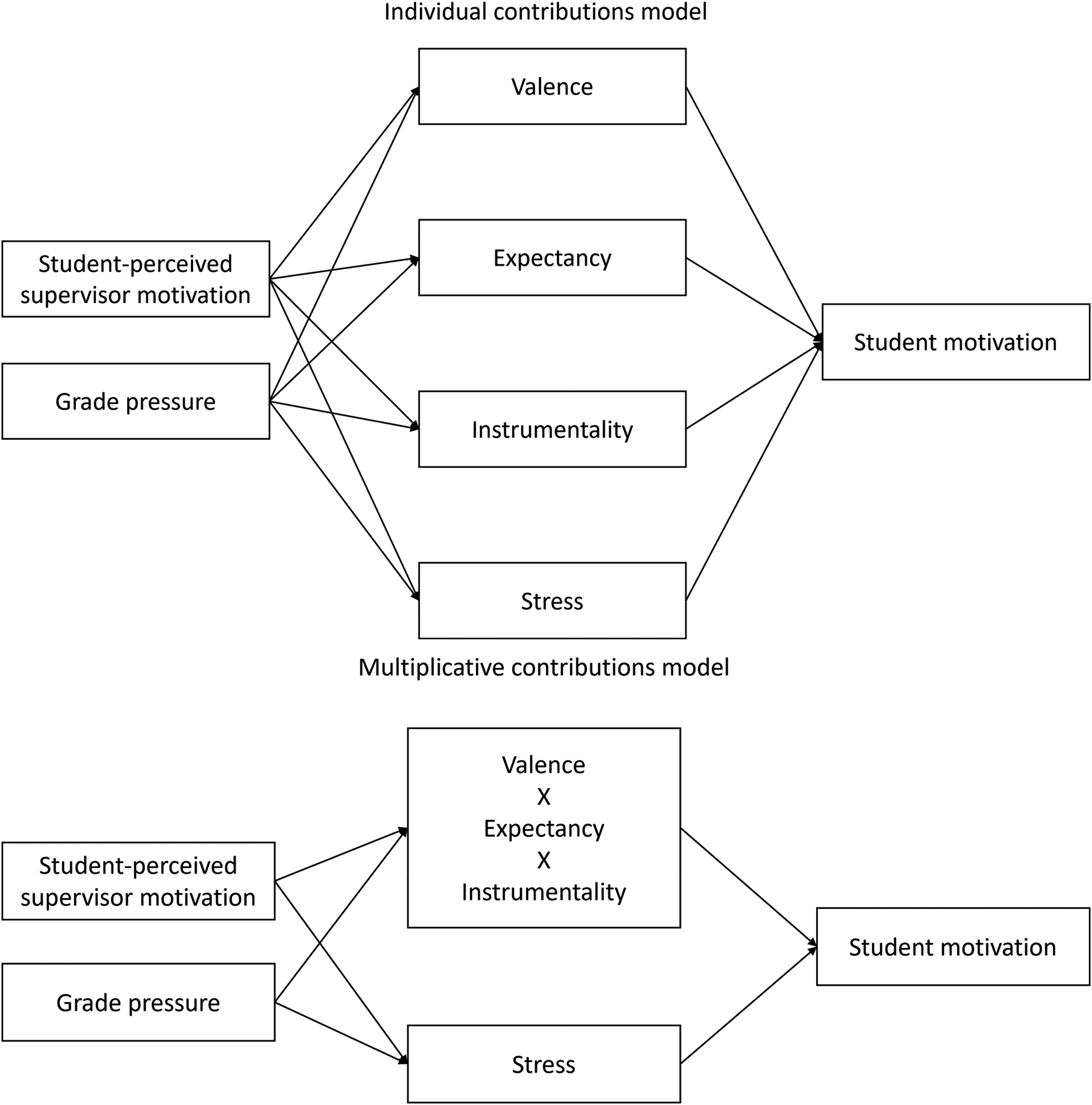
Schematic structure of statistical mediation models.
The concrete analytical approach was first to establish which model fit the data better based on AIC comparison. Then, the better-fitting model's results were evaluated regarding the specific predictions for the individual variables argued above: student-perceived supervisor motivation was expected to be positively associated with all motivation components and negatively with stress, whereas grade pressure was expected to be positively associated with valence and stress, but not expected to have any specific relationship with instrumentality and expectancy. Motivation components in turn were expected to correlate positively and stress negatively with student motivation.
In order to test assumptions for the analyses, each subcomponent of the mediation models (predictors’ effect on mediators; predictors’ and mediators’ effects on criterion variables) was considered separately with regard to multicollinearity (using variance inflation factors), outliers (using Bonferroni-corrected tests of Studentized residuals per observation), and normal distribution of residuals (using QQ-plots). There were no indications of multicollinearity for any model (all VIFs < 2). Outliers were identified for the predictors estimating valence and instrumentality components; however, their exclusion did not substantively change any results. All results below include the outlier cases. QQ-plot inspection did not indicate substantial deviations from normality for any residuals. Full analyses and plots are available in the supplementary material.
Results
Data and analysis scripts underlying this report can be found on the OSF under https://osf.io/v2w4d.
Descriptive Data
Descriptive data for all variables is summarised in Table 1. Correlation coefficients can be found in the supplementary material.
Means and Standard Deviations for all Variables.
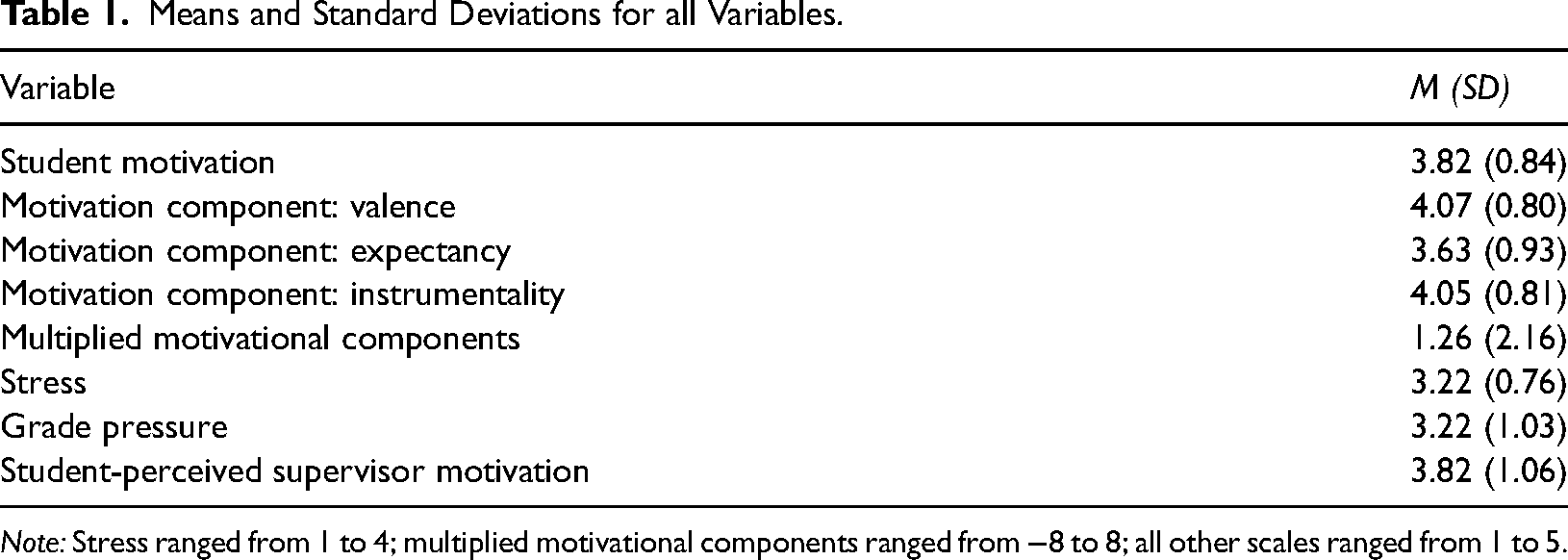
Note: Stress ranged from 1 to 4; multiplied motivational components ranged from −8 to 8; all other scales ranged from 1 to 5.
Mediation Analyses
The results of the mediation analysis are summarized in Tables 2 and 3. The multiplicative model showed a better model fit, AIC = 1609.5, than the individual contributions model, AIC = 2608.6, with the magnitude of the AIC difference indicating no support for the latter (ΔAIC > 10; Burnham & Anderson, 2004). In the multiplicative model, both predictors exhibited significant indirect effects mediated via stress and via the multiplied motivation components. Student-perceived supervisor motivation exerted a positive direct effect on student motivation, but was also positively associated with the motivation components, B = .33, SE = .05, p < .001. It was also negatively associated with stress, B = -.16, SE = .06, p = .009. Grade pressure was also positively associated with the motivation components, B = .23, SE = .06, p < .001, but also positively associated with stress, B = .22, SE = .06, p < .001. As the motivation components were in turn positively, B = .17, SE = .05, p = .001, and stress negatively, B = -.19, SE = .06, p = .002, associated with student motivation, this resulted in the indirect effects shown in Table 3. This pattern is consistent with a partial mediation of a positive impact of student-perceived supervisor motivation on student motivation, as well as with a full suppressed mediation of effects of grade pressure: though grade pressure increases motivation components, it also increases stress, thereby suppressing the positive effects of increased motivation components. This result is in line with the nonsignificant bivariate correlation between grade pressure and student motivation. We stress once more that although the statistical results are consistent with a mediation as described, the design does not allow a positive inference of causality. At best, the causal hypothesis is not falsified by this result.
Results of Individual Contributions Mediation Analysis.
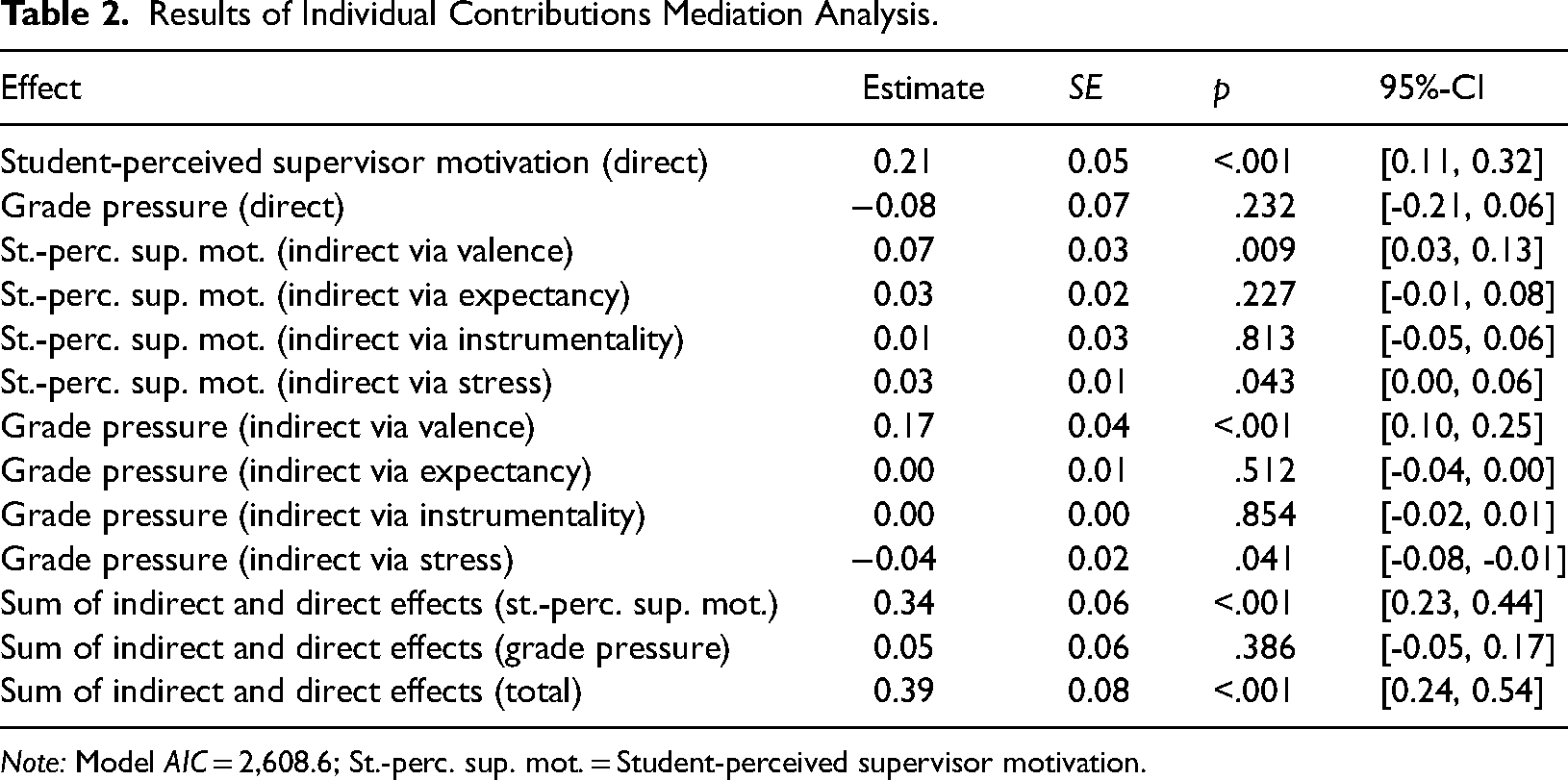
Note: Model AIC = 2,608.6; St.-perc. sup. mot. = Student-perceived supervisor motivation.
Results of Multiplicative Contributions Mediation Analysis.
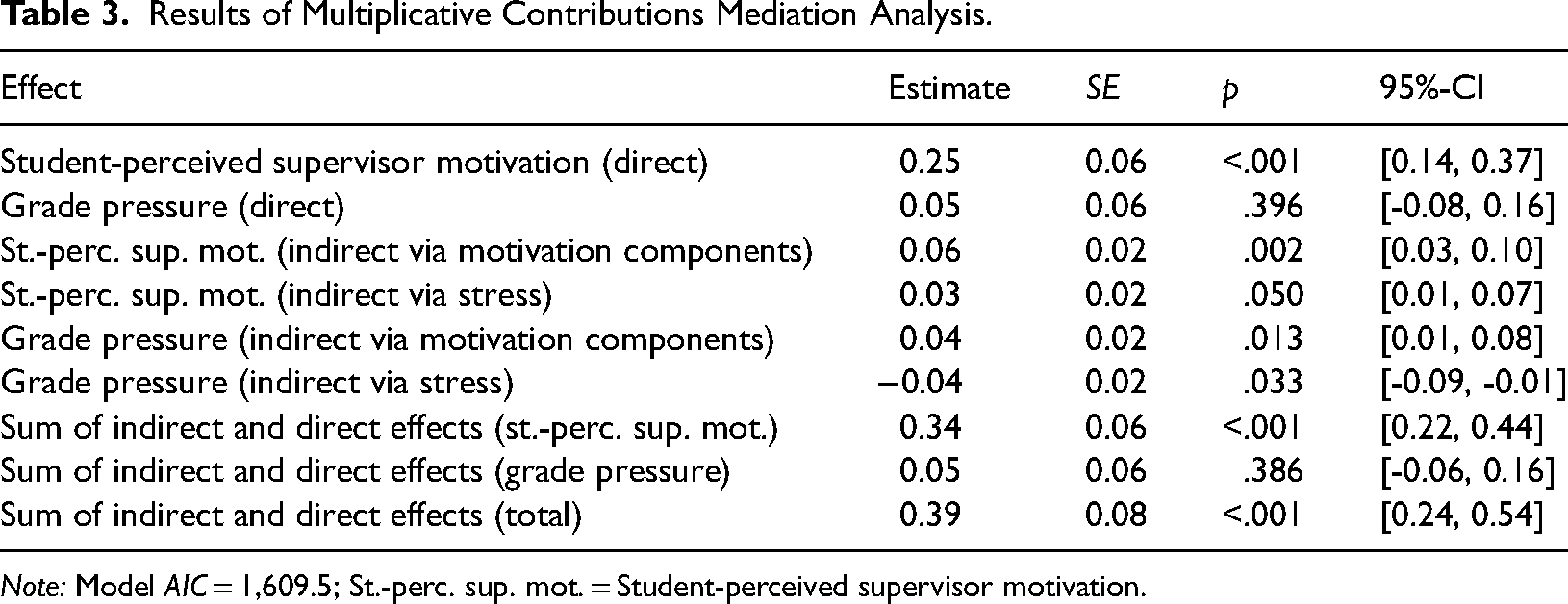
Note: Model AIC = 1,609.5; St.-perc. sup. mot. = Student-perceived supervisor motivation.
Although the individual contributions model showed worse model fit, its results are still informative with regard to how student-perceived supervisor motivation and grade pressure affect individual motivation components. For student-perceived supervisor motivation, the expected positive effects on valence, B = 0.23, SE = 0.06, p < .001, expectancy, B = 0.36, SE = 0.06, p < .001, and instrumentality, B = 0.47, SE = 0.06, p < .001, all achieved significance. For grade pressure, the expected positive effect on valence achieved significance, B = 0.56, SE = .06, p < .001. Also in line with predictions, grade pressure did not predict expectancy, B = -0.07, SE = 0.07, p = .283, or instrumentality, B = -0.07, SE = 0.06, p = .241.
Discussion
In this study, predictors for student's motivation to write their thesis were assessed in a cross-sectional design. Specifically, student-perceived supervisor motivation was expected to be associated with reduced stress while writing a thesis and increase all expectancy-value components of motivation, whereas grade pressure was expected to be associated with increased stress, but also (specifically) with a higher valence component of motivation. The results were in line with these hypotheses. Student-perceived supervisor motivation correlated positively with all components of motivation and negatively with stress, which in turn was associated with higher student motivation, although the analysis suggested that even if one accepts the proposed causal model, these mediators would not account for the entire effect of student-perceived supervisor motivation. Grade pressure was associated with increased thesis valence, but had no relation to expectancy or instrumentality, resulting in a positive indirect effect on student motivation. However, as predicted, grade pressure was also associated with higher student stress, resulting in a negative indirect effect on student motivation of similar magnitude.
Limitations
Several limitations of this study must first be noted. First, there are substantial methodological issues associated with the use of mediation analyses in cross-sectional designs (e.g., Jose, 2016; Maxwell et al., 2011; Maxwell & Cole, 2007). In particular, strong statements about what proportion of an effect is mediated are unwarranted in such a design. Further, the existence of a statistically significant mediation effect cannot and should not be taken as evidence for causality. Thus, the results of the mediation analysis presented above must be interpreted with extreme caution and alternative causal models are explicitly discussed below. The results of reverse mediation models which switched the mediators and predictors in the models (see supplementary analyses) show results mostly consistent with a reverse mediation. Thus, neither causal direction can be falsified with the current data; nor can the possibility of a non-observed third variable driving the effects.
Second, multiplicative analyses of expectancy-value variables have been conceptually criticized (French & Hankins, 2003). In particular, meaningful multiplication of scale scores requires a meaningful zero point on the scale. The use of the center of the scale as this zero point may be conceptually plausible, but it is by no means an assumption to be made uncritically. Thus, any conclusions drawn primarily from the multiplicative analysis (without additional support from other analyses) should also be viewed with caution. However, the results of the individual contributions analysis led to broadly the same conclusions, mitigating this issue somewhat.
Third, the sample of this study comprised both students who were currently working on their thesis and students who had submitted their thesis no earlier than two years before data collection. It is likely that retrospective evaluations of the period spent writing the thesis will differ from the experience of students currently engaged in their thesis work, for example due to increased psychological distance (Trope & Liberman, 2010). Supplementary analyses conducted separately for these subsamples showed that the currently engaged subsample showed descriptively similar results to the combined analysis. The retrospective subsample differed from the currently engaged subsample only regarding the indirect effects of stress, which was no longer present. Specifically, stress was not linked to motivation in the retrospective sample, rendering indirect effects negligible. While this does indicate there may be systematic differences within the sample, the presumably more valid currently engaged subsample showed stronger results in line with the hypothesis. Thus, it seems likely that our data underestimate the effects specifically of stress rather than overestimating them.
Fourth, the sample was focused on specifically German psychology students. It could be questioned whether our findings apply to students from other disciplines or cultural contexts (Liu et al., 2023), especially considering how thesis requirements may vary. However, our hypotheses were based on principles from general psychology, namely expectancy-value theory (Feather, 1988; Wigfield & Eccles, 2000), and on experiences common to any highly valued and challenging outcome, namely stress (e.g., Karasek, 1979), as mediating factors. It is thus unclear why these processes and relationships should not affect student motivation in other fields or contexts. The connection of grade pressure to the mediators is also likely to be a generalizable process, given the conceptual relationship between these variables. Nevertheless, the student-perceived supervisor motivation variable is more likely to differ in its relationship with the mediators and the student motivation outcome depending on context. The way final theses work in Germany, and in the field of psychology specifically, affects the quality and nature of student-supervisor relationships, for example due to the prevalence of one-to-one relationships and the common necessity to coordinate data collection. Thus, the supervisor's motivation may be particularly easy to perceive for students and also have many avenues to affect thesis work. It would thus be premature to generalize our findings to other styles of student-supervisor relationships, at least with regard to the role of student-perceived supervisor motivation. However, the majority of the relationships we find are theoretically likely to be somewhat robust across different contexts and disciplines.
Fifth, the current study was conducted using existing data and therefore not preregistered. Thus, even though we took scrupulous care to avoid explicitly biasing the results, it cannot be ruled out that the selection of the analytical model was unconsciously biased towards significant results. However, recent comparisons of preregistered and non-preregistered studies do not find large differences in the proportion of positive results (van den Akker et al., 2023). In addition, we discuss several alternative explanations for our results in this section, in line with principles of strong inference (Platt, 1964). Thus, we argue that our findings, while constrained by the limitations already discussed, are more likely valid than not. In addition, we have shared our data and detailed analysis scripts to facilitate cross-validation of our work by interested parties.
Implications
In general, one interpretation of this study is that student-perceived supervisor motivation is likely an important predictor of student motivation. The analysis suggests that some effects of student-perceived supervisor motivation may unfold by increasing students’ expectancy, instrumentality, and valence regarding their thesis. There are several possible mechanisms that would fit such an interpretation. For example, students who perceive their supervisor as motivated are presumably more likely to feel comfortable engaging with their supervisor on their thesis work and thus more likely to be comfortable seeking feedback or asking questions, which is likely to increase their understanding of how they can direct their effort to achieve good work and what aspects of good work translate to good grades (Webster et al., 2000), potentially even if the affiliative quality of the relationship is low (de Kleijn et al., 2014). Furthermore, perceiving their supervisor as putting effort into working with them may motivate them to reciprocate, increasing the value of achieving a good grade.
However, it could also be argued that a student high in these motivational components might be more motivating for their supervisor, thus increasing student-perceived supervisor motivation as well. Specifically, supervising a student who appears self-confident (high expectancy) and values the thesis work highly (high valence) may be more rewarding and less effortful for a supervisor, which could contribute to their motivation and thereby to the students’ perception of their motivation. The reverse mediation models are consistent with this idea, especially for the motivational components of expectancy and instrumentality (perhaps reflective of students’ trust in supervisor fairness). Ultimately, however, though this study cannot establish causality, these two causal directions are not mutually contradictory.
With regard to stress, similar reasoning may apply: a student who feels their supervisor is motivated may perceive this as a resource (Bakker & Demerouti, 2007), which can buffer their thesis stress level, while students with unmotivated supervisors might feel left alone with their thesis work, leading to increased strain. Alternatively, it is possible that students who experience strong stress may be more likely to feel cut off from their supervisor, thus perceiving them as less motivated. However, such responses may be more dependent on individual differences, such as hostile attribution bias (Orobio de Castro et al., 2003), implying that the perception of student-perceived supervisor motivation is potentially more likely cause than effect.
A further contribution of this study is the illumination of the dual role of grade pressure. Pressure to achieve good grades has been identified as a potential health risk (e.g., Macgeorge et al., 2005), likely due to increased academic stress. Thus, the link between grade pressure and stress demonstrated in this study is not surprising. However, this study demonstrates that grade pressure is also linked to increased motivation via grade valence. Thus, in circumstances where the negative effects of stress can be buffered, for example by additional resources (Bakker & Demerouti, 2007) or by social support (Macgeorge et al., 2005), grade pressure may in fact have a net positive effect on motivation to write a thesis.
However, as noted, an alternative causal direction must be considered. While it is conceptually unclear how stress would cause grade pressure rather than be caused by it, it could certainly be argued that higher grade valence causes stress rather than the other way around. Students who value a good grade highly might consequentially feel increased pressure to achieve one. In this case, however, the practical implication would remain similar: placing value on a good grade can only increase motivation to write the thesis if the possibly resulting stress from increased subjective pressure is attenuated.
Taken together with the findings on student-perceived supervisor motivation, it seems likely that motivated supervisors may play a particularly important role in highly competitive fields, where the grade of a thesis is perceived as very important for future outcomes. From the perspective of interventions to improve student motivation for their thesis, it is thus likely beneficial to incentivize and motivate supervisors, which is likely to be reflected in their students’ perceptions. Of course, reducing grade pressure is still a useful goal for interventions in such fields, as the high levels of exam stress and grade pressure experienced by some students at peak exam times are likely to overwhelm many students’ coping resources. However, this research provides a cautionary note especially for less competitive fields: if the level of grade pressure only increases stress to levels with which students can cope using available resources, it may be better to avoid reducing it further, especially by downplaying the positivity of a good grade. A related conclusion is that focusing only on student motivation may belie negative effects of variables such as grade pressure, as the increase in stress from higher pressure may not be reflected in students’ motivation, but rather their sleep quality, substance abuse, or general well-being (e.g., Zunhammer et al., 2014).
In conclusion, this study provides some evidence of the likely importance of student-perceived supervisor motivation for students’ motivation to succeed in their thesis. In addition, grade pressure may not have any visible effect on student motivation, but these results suggest that it may indeed affect antecedents of motivation by increasing stress and the perceived valence of the outcome, resulting in a suppressed effect visible only in these antecedent variables. Future research must establish the precise causality and mechanisms underlying these effects.
Supplemental Material
sj-docx-1-plj-10.1177_14757257241239622 - Supplemental material for Student-Perceived Supervisor Motivation and Grade Pressure as Predictors of German Psychology Students’ Thesis Motivation
Supplemental material, sj-docx-1-plj-10.1177_14757257241239622 for Student-Perceived Supervisor Motivation and Grade Pressure as Predictors of German Psychology Students’ Thesis Motivation by Anand Krishna and Julia Grund in Psychology Learning & Teaching
Footnotes
Author Note
Some of the data underlying this research were previously analyzed in a different journal publication (Krishna & Peter, 2018, in PLOS ONE, DOI 10.1371/journal.pone.0203470). The data and analysis files underlying this research are available at https://osf.io/v2w4d.
Declaration of Conflicting Interests
The authors declared no potential conflicts of interest with respect to the research, authorship, and/or publication of this article.
Funding
The authors received no financial support for the research, authorship, and/or publication of this article.

Supplemental Material
Supplemental material for this article is available online.
Author Biographies
References
Supplementary Material
Please find the following supplemental material available below.
For Open Access articles published under a Creative Commons License, all supplemental material carries the same license as the article it is associated with.
For non-Open Access articles published, all supplemental material carries a non-exclusive license, and permission requests for re-use of supplemental material or any part of supplemental material shall be sent directly to the copyright owner as specified in the copyright notice associated with the article.
