



Abstract
Addressing and creating awareness on the topic of neuromyths in educational sciences has increased in recent years. We know very little about how widespread the belief in neuromyths is among pre-service teacher students and whether this belief affects their subsequent approach to teaching and consequently possibly also the performance of their students. The aim of the study was to analyze students’ belief in neuromyths, focusing on differences between freshmen (N = 82) and advanced students (N = 74) studying in pre-service teacher education. Using a questionnaire approach, students had to judge whether given statements were objectively wrong (i.e., “Neuromyths”) or objectively correct (i.e., “Neurofacts”). They could also choose the option “I don’t know”. For each statement, we asked students to indicate how self-confident they were about their answer. Furthermore, students’ self-assessment of their need for cognition and ability-related academic self-concept was measured. Results reveal no significant difference between freshmen and advanced students for identifying the myths correctly, but a significant difference for identifying the facts correctly, showing that freshmen identified slightly more facts correctly than advanced students. Self-confidence plays an important role here, as we see that within the master students, students with high self-confidence values identified more facts correctly.
Introduction
Overcoming myths and psychological misconceptions is an important issue that has a long-standing tradition in psychological and educational research (e.g., Nixon, 1925). Especially with the rise of neuroscience research, the impact of findings on theories and practice of education has been widely discussed (e.g., Cruickshank, 1981; Rato et al., 2013). However, it was the 2002 OECD's Brain and Learning project about educators and the prevalence of myths and misconceptions about the brain and learning among them that brought this up as an important research issue. Thus, the interest to incorporate implications of neuroscience research into educational theory, practice, and policy also increased during the last years.
Nevertheless, the role of neuroscience in educational practice and teaching quality has not yet been sufficiently examined. As can be seen in the current volume of Stein et al. (2022), there are many myths about education and neuromyths. One characteristic of such educational myths is that they are widespread (De Bruyckere et al., 2015). Even if they do not attract attention or influence everyday life, when they become part of decisions and actions in education, it becomes problematic (Asberger et al., 2022; König et al., 2012). However, it remains unclear so far whether and in what form such beliefs have an influence on teacher action and thereby on student achievement, and whether this applies equally to all myths or whether certain myths might have a particular influence here. Little is known about when this belief in neuromyths forms and becomes entrenched, and whether and how it can be overcome. Regarding education and teachers, this raises the question of the special role that pre-service teacher education plays or could play.
Dealing with neuromyths in an educational context, therefore, poses some challenges. The first major challenge is translating research findings into classroom practice (Elliott, 1986). A second major challenge is determining whether teachers and educators are able to identify false information about neuroscience and teaching (so-called “neuromyths”; Hughes et al., 2020). This is a highly demanding cognitive and metacognitive task because the field of neuroscience is complex and the transfer into classroom practice is also quite demanding. We see that even experts here are not averse to continuing to teach neuromyths (Macdonald et al., 2017). One reason might be that misconceptions are often based on genuine scientific findings. However, they result from incorrectly or only partly transferred laboratory findings into educational practice.
Studies from all over the world reveal that neuromyths are widely spread and disseminated at several stages of teacher education programs (e.g., Grospietsch & Mayer, 2019) and among in-service teachers too (e.g., Dekker et al., 2012). Studies reveal that between 50% and 70% of teachers in primary and secondary schools believe in neuromyths (Dekker et al., 2012; Düvel et al., 2017). It seems that there are some myths, for example, the myth that learning styles exist and determine learning and thus better learning success is achieved that persist across all levels of training and education. Although this myth was disproved very early on (Arter & Jenkins, 1977), it continues to be propagated in pedagogical-didactic literature and even in individual courses in teacher education (Bauer & Asberger, 2022; Newton, 2015). Such myths about teaching and learning are not only prevalent at single points but rather exist over decades, as we can see from similar findings in studies over the years (Dekker et al., 2012; Kuhle et al., 2009; Menz et al., 2020; OECD, 2002; Sullivan et al., 2021).
Major reasons here might be the combination of real facts that are incorrectly or only partly adopted from easily accessed (originally) valid findings (Wiley et al., 2009). This is fostered by the lack of background information as well as the lack of competence to evaluate the credibility of a source (Bates et al., 2006). Another reason for this could be the mere-exposure effect (Zajonc, 1968): the more often I hear something, the more likely I am to believe it at some point. In addition, popular media presentations or programs like brain gym and learning style tests reinforce this belief. Furthermore, missing competencies in research methods and statistical analysis, especially at the beginning of the teacher education programs, can contribute to an under- and overestimation of probabilities (Szollosi et al., 2019) or falsely interpreting probabilities as causal relations (Wasserman et al., 1993). It is therefore even more important that teachers and future teachers teach in an evidence-based manner, consider scientific findings to be significant for their teaching practice and do not contribute to spreading myths. It may have little impact on learning or ability-related academic self-concept in one single specific lesson, but looking at an entire school career, it can be problematic (Stein et al., 2022).
For that reason, it is important to address the issue of neuromyths in the teaching profession and to increase students’ interest in neuroscience so that evidence-based teaching can succeed. This makes it even more important that we come to evidence-based findings about (a) how and when neuromyths emerge, (b) how prevalent they are in teacher education, and (c) whether teacher education can help decrease belief in neuromyths, especially the ones pointed out to be relevant for the pedagogical practice. Assuming that first-year students have little to no prior knowledge of scientific studies, evaluation, and interpretation of statistical measures, and other science-related topics, belief in neuromyths should be less pronounced among master's students compared to freshmen. The study presented here is a first step to get an overview of how pronounced the belief in neuromyths is at an Austrian university and whether there is a difference between bachelor and master students regarding this belief in the context of teacher training. As neuromyths, like other misconceptions about science, are rather stable, it is difficult to overcome teachers’ and pre-service teacher students’ misconceptions and neuromyths about the human brain and learning. Thus, it is essential to analyze variables that are associated with the development and stableness of neuromyths (Hughes et al., 2020).
Need for Cognition
One assumption might be that there is a strong relationship between cognitive biases like a high need for cognitive closure, a fixed mindset, one's view of scientific knowledge (simple vs. complex), or scientific literacy and beliefs in myths, paranormal phenomena or skepticism, for example, climate change (e.g., Brotherton & French, 2014; Lindeman & Svedholm-Häkkinen, 2016; Rutjens et al., 2017, van Elk, 2019). We assume here that the construct “need for cognition” (NFC) is one significant predictor of the belief in neuromyths. Cacioppo and Petty (1982) define NFC as “an individual's tendency to engage in and enjoy effortful cognitive endeavors” (p. 306). Studies related to NFC reveal that this construct is related to critical thinking (e.g., Stedman et al., 2009), can increase interest in science (Feist, 2012), and increase deep reading and learning strategies (Juric, 2017). In the study by Kudrna et al. (2015), the authors were able to show that students with high NFC-level were less vulnerable toward misconceptions about climate change and evolution. Taken together, these findings suggest that NFC might be a predictor for critical thinking and elaborated information processing and, thus, might reduce also misconceptions related to neuroscience and learning. Following Feist (2012), NFC is also a predictor for intrinsically motivated information processing.
Ability-Related Academic Self-Concept
Another factor that contributes to motivated information processing is learners’ ability-related academic self-concept (e.g., following the control-value theory; Pekrun, 2006). Ability-related academic self-concept is a well-proven predictor for learning behavior and performance (Marsh & Yeung, 1997; Yeung & Lee, 1999), especially with regard to intrinsically motivated learning (Jansen et al., 2015). The study by Miñano Pérez et al. (2012) showed that general ability-related academic self-concept impacts academic achievement, goal orientations and effort, and mediates effort and learning strategies. This is also important regarding metacognitive abilities because ability-related academic self-concept does not only mediate effort and elaboration strategies, but also positively affects self-confidence (Kröner & Biermann, 2007).
Self-Confidence
Another predictor that may have an influence on whether someone can distinguish myths from facts may be the self-confidence of a learner. Self-confidence is one important aspect of one's own regulation or self-monitoring, which refers to the concept of metacognition (Kleitman & Stankov, 2013; Stankov & Crawford, 1996). Self-confidence shows one's own conviction about a decision made following a particular cognitive act. Schraw and Dennison (1994) see self-confidence as the knowledge about cognition facet of metacognition.
Furthermore, we assume that metacognitive processes are closely linked to the predictor NFC, that is, critical thinking and reflection, as thinking about thinking refers to metacognition. When it comes to evaluating statements, here myths and facts, the question is on the one hand (a) what the learners know, but also (b) whether they know more about their own knowledge, for example, how self-confident they are about it (Stankov & Lee, 2007).
Self-Confidence is often measured by confidence ratings. We see that these ratings are strongly accompanied by accuracy in different domains like general knowledge tests (Perfect et al., 1993), perceptual decisions (Fleming et al., 2010), or reasoning tasks (Double & Birney, 2019; Stankov, 2000).
Pre-service teacher education has one special nature, namely that students already know the school system very well, through their 12–13 years of school practice when they start with their teacher education (Hedtke, 2020). They might have been confronted with different methods based on different assumptions or preferences of their former teachers, for example, that they learn better when the material is prepared in their preferred learning style or the learning pyramid. This might lead to the erroneous belief that they already know from experience which scientific knowledge they need for their later professional activity and which they do not. Out of this self-confidence, they might overestimate their actual knowledge about neuromyths and neurofacts, especially the ones that can be attached to teaching practices.
Taken together, we assume that persons with a higher NFC should be more likely to use elaborated information processing, are more critical toward facts presented to them and, thus, are less vulnerable toward misconceptions. In addition, persons with a high ability-related academic self-concept also tend to have increased motivated information processing and use more metacognitive evaluation strategies, which in turn make them more self-confident about knowledge-based judgments.
Teachers’ Beliefs on Neuromyths
There is some prior research about the prevalence of neuromyths among in- and pre-service teachers. Dekker et al. (2012) analyzed 242 teachers with regard to their beliefs on neuromyths and knowledge about facts in neurosciences. Outcomes reveal that knowledge about the brain and its functions goes along with significantly higher beliefs in neuromyths (ß = 0.24). Teachers with more knowledge were more likely to believe in the presented myths. No other predictors like country, sex, age, school type, reading popular science, reading scientific journals or in-service training made a difference for the prevalence of neuromyths (Dekker et al., 2012).
Howard-Jones (2014) compared five international studies (UK, Netherlands, Turkey, Greece, and China) examining teachers’ prevalence of neuromyths. Results show that—regardless of country of origin—neuromyths are widely spread among teachers. The rank order of most prevalent myths was comparable across different nations: The most widespread myth was the one about learning styles with 90% of all teachers surveyed believing that learning styles exist and determine learning processes and outcomes. A study on teachers’ beliefs in Portugal showed that it is difficult for teachers to distinguish between neuromyths and solid scientific knowledge (“neurofacts”), regardless of their level of education or teaching practice. However, this does not affect teachers’ interest in neuroscience, which is consistently high (Rato et al., 2013).
There is a debate about whether belief in neuromyths negatively affects teaching behavior and instruction and, as a result, student achievement. However, a larger number of conclusive studies on this phenomenon are needed. Horvath et al. (2018) investigated whether the most capable teachers are also those who can identify the most neuromyths. They compared non-award-winning teachers with award-winning teachers in terms of how well they could identify neuromyths. Results showed that there is no significant difference between these two groups of teachers (Horvath et al., 2018). Horvath et al. (2018) also note that the relationships between teachers’ beliefs in neuromyths, their teaching, and their students’ achievements are not well-researched.
Unlike Horvath et al. (2018), Hughes et al. (2020) report in their study with Australian teachers as participants two significant independent predictors determining high beliefs in neuromyths: greater expertise related to the brain and lower teacher qualification (R2 = 0.18). Teachers with higher formal educational qualifications were able to identify more neuromyths correctly. They assume that the major reason for being able to identify neuromyths correctly is sound scientific education and university training. According to Krammer et al. (2019), the different findings may also be due to the fact that different neuromyths were combined into one construct, which, however, capture several constructs and not just one. So, in this context, another distinction to consider is the one between myths that might have a real impact (negative or positive) on classroom practice or teaching and those that might not, such as is required by Macdonald et al. (2017) or Krammer et al. (2019). So far, little is known about the influence of teachers’ belief in neuromyths in general, such as “when we sleep the brain shuts down” (here, no or hardly any reference to teacher action, lesson design, classroom situation, e.g., can be established), or the belief in neuromyths that might affect, for example, teachers’ creation of learning materials or the way they teach such as the myth about learning types.
Another reason may be that it is difficult to overcome misconceptions and myths and that—especially in the teaching profession—experiences and experience-based knowledge are often weighted higher than facts and research (Allen, 2009; Menz et al., 2021; Parr & Timperley, 2008; Williams & Coles, 2007). Nevertheless, valid and reliable data on predictors that influence beliefs in neuromyths are still missing.
Pre-Service Teacher Education Students’ Beliefs in Neuromyths
While most studies have analyzed teachers’ beliefs in neuromyths, only few have surveyed pre-service teacher students. In order to examine the origin of misconceptions it is crucial to include participants from this group (e.g., due to insufficient academic education) and to develop and/or modify programs and courses to reduce neuromyths. It seems to be important to reduce pre-service teacher students’ beliefs in neuromyths to avoid possible subsequent consequences on their teaching practice later on in their career (e.g., regarding evidence-based teaching methods, practices, material, etc.; Pasquinelli, 2012).
Reviewing studies on pre-service teacher students’ beliefs in neuromyths reveal almost identical results as those for in-service teachers. Kuhle et al. (2009) found that the more psychological misconceptions students had at the beginning of an introductory psychology course, the worse was their grades at the end of the course. Krammer et al. (2019) examined the prevalence of neuromyths among pre-service teacher students in Austria. The study shows similar results to those of Dekker et al. (2012), except that there was no significant correlation within students’ knowledge about the brain and beliefs in neuromyths. In a subsequent study, Krammer et al. (2020) investigated whether the beliefs in neuromyths of 255 student-teachers are related to their performance during their initial teacher education. Unlike results from Kuhle et al. (2009), Krammer et al. (2020) found no relation between the prevalence of neuromyths and academic achievement when these myths were not related to terms of the educability of learners. Believing or rejecting neuromyths that explicitly deny the educability of learners was only marginally related to their performance during the study program.
A study by Grospietsch and Mayer (2019) showed that belief in such myths is independent of pre-service teacher students’ level of academic progress. In their sample of 550 participants there was no significant difference between freshmen, more advanced students or in-service teachers concerning their abilities in correctly identifying myths and facts. In addition, results show that professional knowledge as well as autobiographical beliefs on learning were no significant predictors here. Grospietsch and Mayer (2019) assume that neuromyths can co-exist with professional knowledge and scientific concepts. Authors suggest that neuromyths are misconceptions that are hard or resistant to change and should therefore be explicitly addressed in university teacher education programs.
The stability of misconceptions was shown in a study by Im et al. (2018) with 99 pre-service teacher students. Results reveal that lectures in educational psychology increase students’ knowledge of neuroscience but do not significantly reduce neuromyths. Empirical findings (Gitlin et al., 1999; Menz et al., 2021) show that, especially in teacher education, pre-service teacher students often consider the experiences of their supervisors, colleagues, or other students to be more important and more true than the scientific knowledge they construct through their programs. This makes it even more difficult to reduce beliefs in myths; hence, presenting scientific evidence is not enough as Menz et al. (2020) show. Authors hypothesized that confronting students with empirical evidence is an effective method to reduce students’ prevalence to psychological misconceptions. Nevertheless, results reveal that it is hardly possible to change students’ misconceptions (within the domain of educational psychology) from “(rather) endorsing a misconception to (rather) not endorsing it after reading refutation-style texts” (Menz et al., 2020, p. 477).
Research Question and Hypotheses
Numerous studies show that there is a high prevalence of neuromyths among teachers with a high stability of these misconceptions. However, there is a lack of studies that specifically focus on pre-service teacher students’ beliefs in neuromyths. In this study, the specific population of pre-service teachers studying to become secondary school teachers in Austria is examined. University education in Austria requires studying at least two different disciplines (e.g., Geography, Spanish language, History, etc.). Pre-service teacher education students must acquire competences in educational sciences and develop professional skills by conducting several stages of student teaching. What we don’t know is if the pre-service teacher education influences students’ ability to difference between myths and facts about learning. We know from Krammer et al. (2019, 2020) that Austrian students do not differ from the results of international studies in terms of myths, but the difference between freshmen and master students in Austria has not been analyzed yet.
For our study, we wanted to analyze how pronounced the belief in myths is among these two groups, freshmen and master students. To investigate the differences between freshmen and master students, it was important to examine the prevalence of neuromyths among pre-service teacher students in general. This study has been designed to analyze the level of agreement and self-confidence with statements representing neuromyths. Furthermore, predictors that contribute to increased beliefs in neuromyths should be identified. Thus, this study addresses the following research questions and hypotheses:
What is the prevalence of beliefs in neuromyths among pre-service teacher students in Austria? How confident are they in agreeing or disagreeing with given statements representing facts or neuromyths?
It is assumed that students’ beliefs in neuromyths do not differ from results obtained in prior studies (e.g., Krammer et al., 2019, 2020) and that well-known myths, such as that of learning types, are also widespread among students.
Furthermore, we assume that students consider themselves to be relatively self-confident in evaluating the myths, especially with myths that might have already been heard frequently in school and education. They are likely to be less self-confident when evaluating neurofacts as freshmen are likely to have rather little prior knowledge in this area.
Is there a difference between freshmen (Bachelor level) and advanced students (Master level)?
Many courses include instructional units regarding neuroscience and education. Thus, we assume that beliefs in neuromyths will diminish and that knowledge regarding neurofacts is increasing until graduation. Teacher programs in Austria include several lectures on developmental psychology, educational psychology, research methodology, and other courses addressing empirical educational research. Even though there is no specific lecture or course on neuroscience, the topic and its underlying concept are represented in the program at several stages and in several courses. Therefore, it is assumed that more advanced students can correctly identify more myths and facts concerning neuroscience than freshmen.
What are significant predictors influencing prevalence among neuromyths?
Findings and replications on predictors that promote belief in neuromyths are still rare. A basic trait that has proven to be a significant predictor for academic performance and related variables is the need for cognition (NFC; Cacioppo & Petty, 1982). NFC is a stable trait that represents the aptitude to engage in and enjoy effortful thinking and positively influences several aspects of academic performance (e.g., essay writing, in-class test performance, standardized test performance, and student grade point average (Neigel et al., 2017). Another predictor for academic success and motivation is the ability-related academic self-concept (Schöne et al., 2012). Thus, it is hypothesized that NFC and ability-related academic self-concept influence beliefs in neuromyths, that is, correctly identifying myths as such is concomitant with a high NFC level and a high level of ability-related academic self-concept.
Can future teachers identify especially those myths that might later have an influence on what happens in class?
We assume that master students are more elaborate in their choice of teaching methods based on their acquired knowledge during the study program, especially on those myths, that have the potential to have an influence on teaching and learning.
Is there a difference between students in terms of how they evaluate facts and myths depending on whether they rate themselves as high or low self-confidence?
We assume that self-confidence plays a role in judging neuromyths and neurofacts, as it requires students to evaluate their own knowledge and thus act metacognitively. Someone who is aware of whether he or she has knowledge about it is more likely to be able to order, organize, and reflect on his or her already existing knowledge of certain myths, which in turn can lead to prior knowledge being activated.
Method
Participants
A total of 156 pre-service teacher students (82 freshmen and 74 master students) participated in this study. There were 50 men (32.1%), 105 women (67.3%) and 1 answer was missing (0.6%). The average age of the participants was 22.24 years (SD = 4.13). The average number of semesters among freshmen was 1.09 (SD = 0.78) and among master’s students was 7.19 semesters (SD = 3.75). In Austria, the university pre-service teacher education focuses on the academic education of secondary school teachers and is divided into a Bachelor study program (six semesters) and a Master study program (four semesters). Usually, students study at least two school subjects. As a first teaching subject, the top four school subjects for our participants were English language (21.9%), German language (21.8%), Mathematics (10.4%), and Sport (7.2%). The top four school subjects for the chosen second teaching subject were History (21.8%), Philosophy & Psychology (11.3%), Geography (7.7%), and Biology (4.6%).
Data Collection
For this study, participants had to fill out a paper–pencil questionnaire. Bachelor students completed the questionnaire at the end of their second unit of a lecture on educational psychology at the beginning of their first semester. There were 419 students registered for the lecture. The completion of the lecture is mandatory, however, there is no attendance obligation for the individual weekly dates. It is not possible to track exactly how many students are present, as it does not require an attendance list. At the first appointments, there are usually between 70 and 100 students, 82 filled out our questionnaire.
Students in the master's program filled in the questionnaire at the end of a regular course lesson (with compulsory attendance) at the beginning of the semester. All master students of the course filled out the questionnaire.
Students were asked to take part in a study about the perception of different statements in the area of “human brain and learning”. The study was voluntary and anonymous. No reward and no course credits were given for participation. Participants were able to stop the survey at any time. Participation took approximately 25 min.
Material
Myths and Facts Questionnaire
The questionnaire about neuromyths and neurofacts was based on the work of Dekker et al. (2012) as well as on the work of Krammer et al. (2019, 2020), including 25 myths and 21 facts about neuroscience and learning. The questionnaire includes a wide variety of neuromyths. Students had to identify whether a statement (myth or fact) is true or false or the answer is not known, and therefore identify a myth (correct answer: false) or recognize a fact (correct answer: true). We decided to add the third category in order to avoid guessing.
Students’ Self-Confidence During Rating the Myths and Facts
To answer the questions, participants must be able to regulate, monitor, and reflect on their own knowledge (meta-reasoning; Ackerman & Thompson, 2015), which is why metacognitive skills are required. In addition, we would like to assess to what extent students themselves assess how self-confident and sound their answer is or whether it was rather guessed. We used self-confidence ratings here. Participants are asked to give a rating immediately after responding to an item in the questionnaire to indicate how self-confident they are that their chosen answer for this item is correct (see Stankov, 1999).
Following Macdonald et al. (2017), a five-point Likert scale assessed students’ confidence during rating correctness/incorrectness of each statement; 1 = not confident to 5 = very confident (students’ confidence on myths: 25 items, Cronbach's Alpha = .82 for bachelor students; Cronbachs Alpha = .86 for master students); students’ confidence on facts: 21 items, Cronbach's Alpha = .84 for bachelor students; Cronbach's Alpha = .89 for master students).
Ability-Related Academic Self-Concept
Participants’ general ability-related academic self-concept was assessed with an adapted version of the SESSKO questionnaire (Schöne et al., 2012). The questionnaire consists of five items using a five-point Likert scale (from 1 = totally disagree up to 5 = totally agree; five items, for example, “I am gifted for college…”; Cronbach's Alpha = .66 for bachelor students; Cronbachs Alpha = .67 for master students).
Need for Cognition
Need for Cognition was assessed using the scale provided by Beißert et al. (2015, p. 4 Items, e.g., “I think because I have to”; Cronbach's Alpha = .67 for bachelor students; Cronbach's Alpha = .48 for master students)
Demographic Information
At the end of the questionnaire, participants were asked to fill in demographic information about age, gender, study subjects, family status, and the number of children.
Data Analysis
The following analyses refer only to data on pre-service teacher students; the data on law students, which are also included in the data set, was not included. Further scales from the questionnaire, which deal with students’ attitudes and interest regarding scientific knowledge in the teaching profession, are not presented, as they are not part of the presented research question.
In the first descriptive step, we were looking at how many myths and facts were identified correct or false and about how many myths students were just not sure about if it is a myth or a fact.
In a second step, for the statistical analysis, “don’t-know” answers were coded as wrong answers (both neuromyths and neurofacts statements) to see if there is a difference between correct identified myths (correct answer: false) and facts (correct answer: true) between freshmen and advanced students. (e.g., If a participant answers “true” to the statement “there are different learning styles”, then the myth could not be identified, and no point was awarded. No point was awarded for the answer “don’t know” either. If the given answer was “false”, we assume that the myth was identified, and 1 point was awarded.) The data were analyzed using the program IBM SPSS (v.26) for all statistical analyses. For examining the differences between the groups (freshmen, master students), all single items were aggregated corresponding to their assigned scales, and mean values were computed. A sum value for all correctly identified myths (answer: false) as well as a sum value for all correctly identified facts (answer: true) were formed.
To get an overview of the belief in neuromyths and students’ confidence in judging neuromyths and neurofacts, the descriptive values were analyzed. A correlation analysis was done to determine the relationship between belief in myths and students’ confidence (RQ1).
To analyze the difference among the student groups as well as the influence of the assumed predictors on the dependent variables two ANOVA were computed.
Neuromyths: The dependent variables were the total number of neuromyths identified correctly as myths. The independent variable was the university program they were enrolled in (freshmen, master). As covariates need for cognition, participants’ general ability-related academic self-concept and self-confidence in judging neuromyths were included.
Neurofacts: The dependent variable was the total number of facts identified correctly. The independent variable was the university program they were enrolled in (freshmen, master). As covariates need for cognition, participants’ general ability-related academic self-concept and self-confidence in judging neurofacts were included (RQ2 and RQ3).
In a further step, we have reduced the number of the selected myths, with a focus on pre-service teacher students and as recommended by several authors (e.g., Krammer et al., 2020), the emphasis was put on myths having the potential to affect student learning and teaching applied later in classroom teaching. As Krammer et al. (2020) point out, it is necessary to distinguish between different types of neuromyths, as also Horvath et al. (2018) and Macdonald et al. (2017) pointed out in their study, that the assessed neuromyths did not have a coherent underlying construct. Following Krammer et al. (2020), we also evaluate each neuromyth by its potentially effect on teaching practice. Following the three categories mentioned by Krammer et al. (2020): (a) Myths that are not related to teaching practice (e.g., When we sleep, the brain shuts down may not directly affect the methods a teacher uses in classroom), (b) Myths that have the potential to have influence on teaching practice (e.g., the learning style myth: on the one hand this belief might be counterproductive to students’ learning (see Rogowsky et al., 2020) but on the other hand has the potential to prompt teachers to create a variety of learning material and therefore motivate students with the different materials (see Krammer et al., 2019), and (c) Myths that have the potential to have negative implications for practice (e.g., brain development is completed between the ages of 11–12) we identified out of our 25 myths 12 myths that fit into category 2 or 3 (see the full list of our 12 items in the appendix). We calculated one ANOVA again, but this time with the new dependent variable, where we only looked at the differences between pre-service students’ and master students’ beliefs in neuromyths that might have an influence on their later teaching methods and practice (only 12 myths out of the 26). The university program in which participants were enrolled in was the independent variable (bachelor, master). Need for cognition, participants’ general ability-related academic self-concept, and self-confidence were included as covariates (RQ4).
To examine the influence of self-confidence on judging myths and facts right or wrong in more detail, we divided the participants into two groups using a median split (median = 3.84): high and low self-confidence (RQ5). Two ANOVAs were calculated to answer the question.
Myths: The dependent variable was the total number of neuromyths identified correctly as myths. The independent variable was self-confidence (high vs. low). As covariates NFC and participants’ general ability-related academic self-concept were included.
Facts: The dependent variable was the total number of neurofacts identified correctly as myths. The independent variable was self-confidence (high vs. low). As covariates NFC and participants’ general ability-related academic self-concept were included.
Results
How pronounced is the belief in myths and the knowledge of facts and how self-confident are students in judging myths and facts?
The descriptive data reveals that pre-service teacher students can identify 37.16% of the presented 25 neuromyths (M = 9.29; SD = 2.35) and 62.52% of the 21 neurofacts (M = 13.13; SD = 2.39), independent of their academic progress.
Table 1 shows the seven most likely believed myths, which are almost identical to those identified in prior research on neuromyths (e.g., Dekker et al., 2012; Krammer et al., 2019; learning styles at the top of the list was believed by 96.3% of the fresh men and 83.8% of the master students). We included those myths for the list where more than one-third of the students did not recognize them as myths, that is, answered: true.
Descriptive Data of the Seven Most Believed Myths That Have the Potential to Negatively Influence Later Teaching Practice.
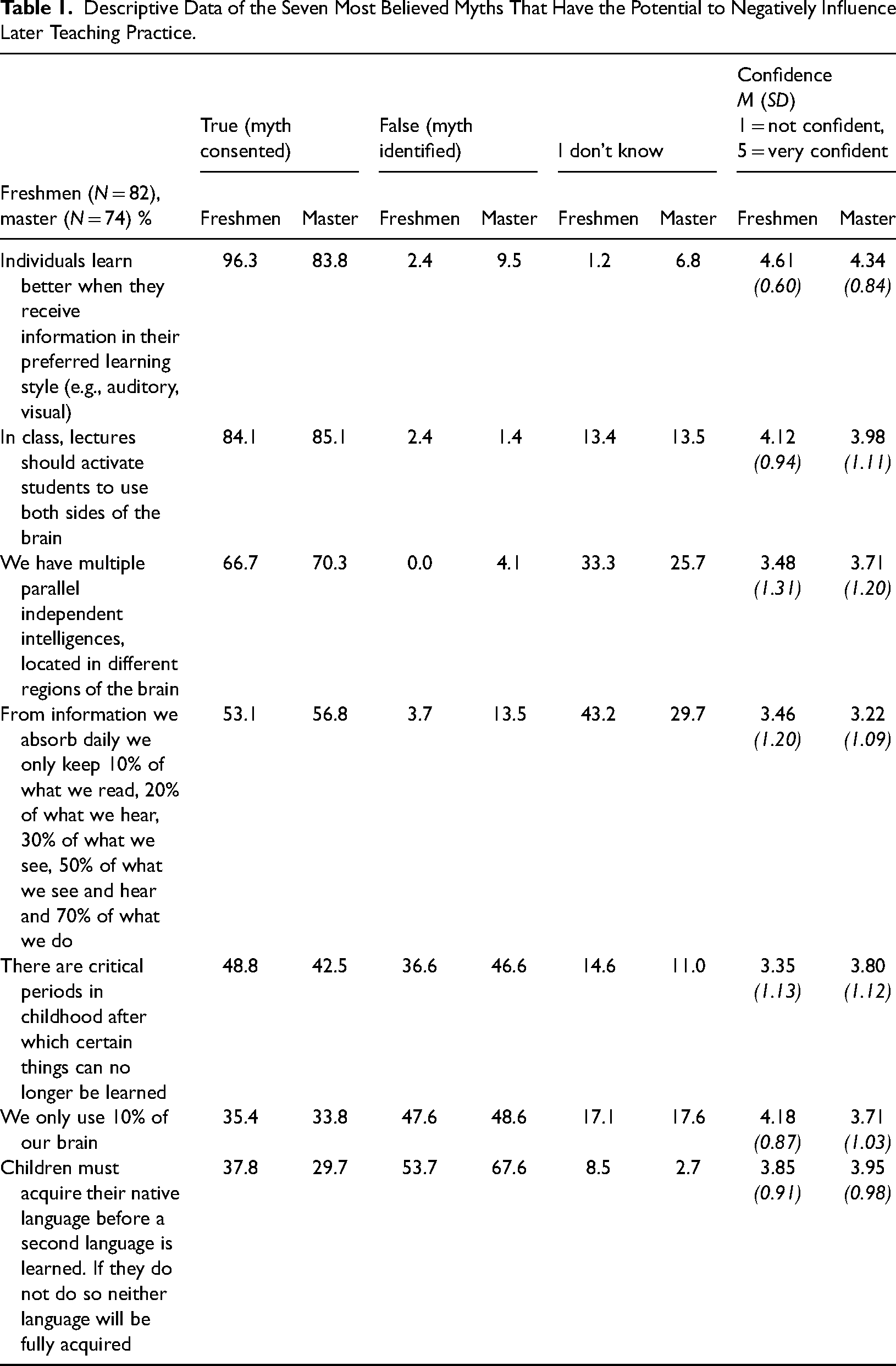
For each judgment, participants had to report their self-confidence. Results of these ratings show a medium-high level of self-confidence for all groups of students. For all myths that were to judge the mean value of self-confidence for freshmen was M = 3.83 (SD = 0.43) and for master students M = 3.76 (SD = 0.56). For all facts that were to judge, the mean value of self-confidence for the freshmen was M = 3.71 (SD = 0.50) and for the master students M = 3.81 (SD = 0.60) (scale from 1 = not confident to 5 = very confident).
No significant correlation between the total number of neuromyths correctly identified and the self-confidence in agreeing with these myths was found for bachelor (r = -.131; p = .241) and master students (r = -.223; p = .056). We found a significant correlation for master students between the total number of facts correctly identified and the confidence in agreeing with these facts (r = .459; p < .001), but no significant correlation for bachelor students (r = .104; p = .354).
Is there a difference between the different stages of the academic program?
Neuromyths: Results reveal no significant difference between freshmen and master students (F(1/151)) = .423; p = .516; ŋ2 = .003) for identifying the myths correctly.
On a descriptive level, freshmen identified M = 9.00 (SD = 2.24) and master students M = 9.55 (SD = 2.5) myths as such (as false).
Neurofacts: Results reveal a significant difference between freshmen and master students for neurofacts (F(1/151) = 4.613; p = .033; ŋ2 = .031). Freshmen (M = 13.50; SD = 2.39) identified slightly more facts than master students (M = 12.86; SD = 2.36) as correct.
What predicts beliefs on neuromyths?
Regarding these variables as covariates, results reveal that NFC just missed the significant level (F(1,151) = 3.698; p = .056; ŋ2 = .025). Ability-related academic self-concept was not significant (F(1,151) = 2.659; p = .105; ŋ2 = .018) as well as self-confidence in judging myths (F(1/151) = .423; p = .516; ŋ2 = .018).
Can future teachers identify especially those myths that might later have an influence on what happens in class?
On a descriptive level, we see that students can identify 44.92% of the myths that might later have an influence on what happens in class (M = 5.39; SD = 1.54) which is a higher score compared to the score of general neuromyths (29,92%). Freshmen can identify 43,66% (M = 5.24; SD = 1.40) and advanced students are able to identify 46,42% (M = 5.57; SD = 0.166) of the myths correctly.
Results show no significant effect related to the study program (F(1,151) = .538; p = .464; ŋ2 = .004) concerning the number of neuromyths that might have later an influence in class identified as false.
Is there a difference between students with high self-confidence and low self-confidence on their judging if it is a myth or a fact?
Neuromyths: Results show no significant effect related to the high or low self-confidence of students (F(1,151) = .028; p = .868; ŋ2 = .000). No significant difference was shown when differentiating by study progress (freshmen (F(1/77) = .875; p = .353; ŋ2 = .012) vs. advanced students (F(1/70) = .558; p = .457; ŋ2 = .008).
Neurofacts: We found significant difference for self-confidence on judging neurofacts correctly (F(1/151) = 9.557; p = .002; ŋ2 = .061), showing that students with high self-confidence in judging neurofacts can identify more neurofacts correctly (M = 13.80; SD = 2.21) than students with low self-confidence in judging neurofacts (M = 12.61; SD = 2.41)
Taking a closer look on the level of study program as well, we found no significant difference for freshmen (F(1/77) = .432; p = .513; ŋ2 = .006), but we found significant difference for the advanced students (F(1/74) = 15.564; p < .001; ŋ2 = .182), showing that students with high self-confidence in judging neurofacts can identify more neurofacts correctly (M = 13.87; SD = 2.02) than students with low self-confidence in judging neurofacts (M = 11.71; SD = 2.23).
Discussion
This study analyzed students’ belief in neuromyths, focusing on differences between freshmen and advanced students studying in the teacher education program. The study examined this belief in myths among bachelor students and master students in the teacher education program at the University. In addition, factors influencing students’ prevalence of neuromyths were analyzed.
Descriptive data reveals that pre-service teacher students face difficulties in identifying whether a statement is a neuromyth or a neurofact. These findings are in line with prior work in this field (e.g., Dekker et al., 2012; Howard-Jones, 2014) showing high agreement with myths like the learning style myth. Moreover, they occur independent of students’ academic progress. No objective knowledge test was applied in this study. Consequently, it cannot be clearly stated whether the lack of knowledge regarding neurosciences and the role of the brain in learning is the major reason why students could not identify most neuromyths and neurofacts correctly.
Examining differences between freshmen and advanced students in the teacher education program, there were no significant differences between their classifications of neuromyths. A significant difference between students’ classification of neurofacts was found, showing that surprisingly, freshmen identified more neurofacts as such than advanced students.
Looking at students’ self-confidence during the assessment, students had a moderately high value when judging neuromyths and neurofacts, but no significant effect on differences between freshmen and advanced students was found here on judging myths correctly.
Further calculations have shown that in relation to the myths, self-confidence has not brought any difference here in relation to the evaluation of the statements.
If we look only at the neurofacts, we see for this data set that those students who had high self-confidence values were also able to identify more facts. This can also be seen in the group of master students but cannot be confirmed for the bachelor group.
Taking a look on the results, the question arises why on the one hand freshmen can identify more facts correctly than advanced students, but advanced students are more confident in judging the neurofacts in our questionnaire. We assume, that this is an appearance of the Dunning-Kruger-Effect (Kruger & Dunning, 1999), that a form of cognitive distortion is taking place here, namely that students who are already in the master program believe themselves to be more capable and rate their knowledge higher than it is. Nevertheless, within the group of master students, it can be assumed that those who gave themselves higher values on the self-confidence scale may have better metacognitive abilities, have thought more about their knowledge and thus were able to identify more facts. Further studies are necessary to identify additional factors.
Furthermore, there was also no difference concerning the evaluation of neuromyths, which can have an impact on (future) teaching planning and behavior. This indicates basic deficits regarding knowledge within this domain or lack of transfer of knowledge within the domain of neurosciences to applied teaching and learning processes at school. This assumption is also supported by the high percentage of students agreeing to myths that could be simply identified by using basic knowledge from educational courses (e.g., “Things not learned in critical periods in childhood will never be learned”). This study involved pre-service teacher students; hence, the question arises to what extent their beliefs in neuromyths will influence their own teaching (and their future students) later on. What we found was, that the percentage of identifying myth was higher for those that might have an impact on teaching compared to the rest of the neuromyths for the whole sample and that master students are able to identify more of these myths related to teaching in class than bachelor students, but the findings are only on a descriptive level.
The results of this study show that there is a high prevalence of neuromyths among freshmen, and as we see on the cohort of master students, one can assume that there is hardly any difference between these two groups, even though this was not a longitudinal design. In our study, between freshmen and master students were about four semesters of academic education. We assumed, that even a cross-sectional research design should be able to show effects, but as results show, it did not. Hence, we assume that students already enter academia with a preexisting knowledge structure related to educational issues and neuromyths. It remains unclear where this knowledge and, as such, their misconceptions come from.
Therefore, future teacher education (programs) needs to aim at specifically addressing and eliminating neuromyths among pre-service and in-service teachers. This might keep future teachers from passing on misconceptions and wrong beliefs to their students. In contrast, there are protective variables that might support students in critically and successfully evaluating myths and facts, we assumed that one here is the need for cognition. Nevertheless, NFC just missed a significant level (p = .056; two-sided) here, but this measure is an indicator for intrinsically motivated and critical evaluation of facts. To have more clarity about which other factors have an influence on this correlation, further analyses are needed that may also capture the construct NFC in more detail than the short scale used here, as well as other metacognitive and cognitive factors or motivational factors. Implications on teacher education programs at the university show that education needs to focus on identifying and removing such neuromyths by including these themes in teachers’ regular training and continuing programs.
This study has several limitations. Research in this field indicates that the operationalization of neuromyths and knowledge related to neurofacts is problematic. That is, individual items cannot be easily delimited to the area of neurofacts or myths. Another issue is the chosen answering format (true vs. false vs. I don’t know) which became a dichotomous format for statistical analysis and therefore it is detrimental to variance (see also Sullivan et al., 2021). Alternative answering formats and approaches to assess students’ misconceptions combined with more qualitative approaches might lead to more detailed insight in subsequent studies. Future assessments can also include a more differentiated approach and assessment of possible teaching activities and teacher actions in order to provide (predictive) validity of findings such as vignette assignments or concept change texts (e.g., Grospietsch, 2021). In contrast to refuting texts, concept change texts have additional metaconceptual elements (e.g., written position papers before and after reading the texts) that are intended to invite engagement with subjective conceptions and to create awareness of the differences between naïve and scientifically appropriate conceptions (Chambers & Andre, 1997; Egbers & Marohn, 2013; Mikkilä-Erdmann, 2001). Another limitation is that we only used between-designs and no within-designs. Here, long term within-designs might contribute to identifying different developments among students.
Despite these limitations, this study represents a further step to capture the belief in neuromyths and to get a picture of the belief in neuromyths of pre-service teacher students during their study progress.
We confirm that we have described how we determined the sample size, which data were used, and which were excluded, all statistical parameters and conditions.
Footnotes
Declaration of Conflicting Interests
The authors declared no potential conflicts of interest with respect to the research, authorship, and/or publication of this article.
Funding
The authors received no financial support for the research, authorship, and/or publication of this article.

Appendix
12 myths that might have the potential to have an influence on teaching
Children must acquire their native language before a second language is learned. If they do not do so neither language will be fully acquired. We only use 10% of our brain. The brains of boys and girls develop at the same rate. Brain development is completed between the ages of 11–12. There are critical periods in childhood after which certain things can no longer be learned. Individuals learn better when they receive information in their preferred learning style (e.g., auditory, visual, kinesthetic). Intelligence is inherited and cannot be changed by experience or environmental influences. Learning problems associated with developmental differences in brain function cannot be remediated by education. There is not only one, but several independent intelligences localized in different brain regions. Lessons should be designed to engage both sides of the brain. Gifted students do not need to learn in order to perform well in school. Of the information we take in daily, we retain: 10% read, 20% heard, 30% seen, 50% heard and seen, 70% said, and 90% done.