




Abstract
The COVID-19 pandemic led to an abrupt change from in-person to online teaching in higher education, resulting in increased use of information and communication technology (ICT) and students’ stress and uncertainty. Integrating theories of human motivation, stress, and humane work design, we investigated whether different types of action regulation hindrances (ARH) pertaining to human (ICT competence deficits), technology (technical problems), interaction (coordination difficulties), and task aspects (work overload) related to technostress (H1). Furthermore, we examined if this relationship was mediated by satisfaction of the basic human needs for competence, autonomy, and relatedness (H2). Our analysis of causes and mechanisms of technostress is based on cross-sectional survey data (self-report) from 205 psychology students attending an organizational psychology class that was switched from an in-person to an online format due to the COVID-19 pandemic. Structural equation modeling revealed that different types of ARH (i.e., ICT competence deficits, technical problems, coordination difficulties, work overload) positively predicted technostress (β = .17 to β = .42, p < .05). The effects were (partially) mediated by satisfaction of the need for autonomy (β = .11 to β = .15, p < .05), for all ARH except technical problems (β = .01, p = .86). We discuss implications for online course planning, technostress prevention as well as potential interventions beyond pandemic times.
Introduction
During the COVID-19 pandemic, social distancing was given top priority, leading to an abrupt shift from in-person to online teaching in higher education. With the extended use of information and communication technology (ICT) in teaching, students were increasingly exposed to technostress. The stress subdimension technostress describes the subjective feeling of burnout-like exhaustion in the context of ICT (Maier, 2014; Schellhammer et al., 2013).
In modern stress theories, action regulation hindrances (ARH) are common causes of stress (Pindek & Spector, 2016; Tuckey et al., 2015). ARH describe obstructive conditions in contradiction to goal achievement (Oesterreich et al., 2000). From a sociotechnical work design perspective (e.g., Karltun et al., 2017), one can differentiate different types of ARH in online teaching rooted in the human (e.g., ICT competence deficits), technology (e.g., technical problems), interaction (e.g., coordination difficulties), or the task (e.g., work overload). Especially with the abrupt (i.e., little prepared) shift to online teaching during the pandemic, resulting in misalignment of course planning, technical equipment, and human competences, it is important to explore the role of these ARH types in the emergence of technostress. Furthermore, individuals differ in their experience of technostress, even if they work under the same obstructive conditions (cf., Lazarus & Folkman, 1984). Students may respond differently to the same technical problem based on their individual resources and appraisal processes. While one student feels helpless and reacts petrified when confronted with a missing audio signal in a video conference, another student stays calm, proactively trying other audio inputs to solve the problem. One way to explain differences in stress appraisals and coping is to look at basic human need satisfaction (cf., Ntoumanis et al., 2009). Satisfaction of basic human needs for competence, autonomy, and relatedness proved to be a key mechanism to explain stress (e.g., Deci et al., 2017; Fernet et al. 2013; Quested & Duda, 2011). However, there is little empirical evidence for the need-mechanism concerning the stress subdimension technostress. This is particularly true for the unprecedented situation of the COVID-19 pandemic, where long-term planning of online teaching was not feasible due to the abruptness of the events.
In this paper, using structural equation modeling (SEM), we first investigate whether different ARH types relate to technostress in students during the COVID-19 pandemic. Second, we examine if these relationships can be explained by satisfaction of the basic human needs for competence, autonomy, and relatedness.
In doing so, we amplify existing theoretical approaches to integrate basic human need satisfaction into stress appraisal and coping (e.g., Ntoumanis et al., 2009) and expand empirical findings to the new context of technostress in higher education during the COVID-19 pandemic. Methodologically, our systematization into four ARH types promotes the evaluation and improvement of modern learning environments, highlighting the potential of work psychological concepts for educational science. On a more practical level, stress can negatively affect learning ability and success (Moreira et al., 2016; Pritchard & Wilson, 2003; Song et al., 2006) as well as technology acceptance and use (Fuglseth & Sørebø, 2014; Maier, 2014). Knowledge of mediating processes represents an important approach for technostress prevention (e.g., course planning) and intervention (e.g., reflection methods) beyond pandemic times.
Technostress During the COVID-19 Pandemic
The large field of stress research has its beginnings with the theories of Cannon (1932) and Selye (1936) in the 1930s. 1 With the advent of the first computers around 1980, stress was also observed in the context of ICT use (Riedl, 2013), and technostress, a subdimension of stress, was introduced (Weil & Rosen, 1997). Technostress is a topic of interest across disciplines, such as computer science, psychology, or occupational health, with different methods and research foci. This results in heterogeneous terminology including technostress (Ayyagari, 2012; Brod, 1984; Riedl, 2013), digital stress (Gimpel et al., 2018), IT stress (Åborg, 2002), technoexhaustion, (Maier et al., 2015), and technostrain (Salanova et al., 2013). In this paper, technostress is defined as a subjective state of burnout-like exhaustion that occurs in the context of ICT use, following Schellhammer et al. (2013). 2 Technostress can have negative consequences for individual physical (e.g., Gimpel et al., 2018) and mental health (Lauber, 2016) as well as productivity (Tarafdar et al., 2007, 2015).
With the COVID-19 pandemic and the related lockdown of universities, teachers and students had to abruptly switch from in-person to online teaching, without sufficient time to adjust methods and course planning, guarantee sufficient ICT competences, or provide teachers and students with necessary technical equipment. Yet, recent experience shows that online teaching during emergencies (e.g., COVID-19 pandemic) requires different teaching methods compared to in-person formats (Harasim, 2000), but also compared to planned online teaching (Hodges et al., 2020). While technology can be seen solely as a tool to deliver the contents, it is important to integrate ICT constructively into the learning process for actual educational innovation (Koh et al., 2017). ICT proficiency cannot be seen as guaranteed on either the student or teacher side (Chen, 2008; OECD, 2005, 2020). This goes hand in hand with deficits in the technological equipment in the educational sector (OECD, 2005, 2020). Not surprisingly, public and research interest in technostress in (higher) education experienced a boost during the COVID-19 pandemic. Recent studies focused on capturing the level of technostress (e.g., Penado Abilleira et al., 2021), its measurement (e.g., Molino et al., 2020), and potential consequences (e.g, Alvarez-Risco et al., 2021). This paper intends to expand knowledge on technostress during the unprecedented situation of the COVID-19 pandemic, focusing on ARH as technostress causes and basic human need satisfaction as an underlying mechanism to explain technostress.
Action Regulation Hindrances as Causes of Technostress
ARH describe work conditions obstructing the achievement of a specific goal, leading to additional effort, risky and inaccurate work, and psychological stress (Oesterreich et al., 2000). ARH at work can be diverse and are often considered in the context of humane work design (Leitner et al., 1987; Oesterreich et al., 2000) and work stress (e.g., Tuckey et al., 2015). From a work design perspective, emergency online teaching during pandemic times represents a sociotechnical system because at least one person (i.e., teacher and/or student) and technological tool(s) interact in a given context and task.
In a sociotechnical system, the individual human and technological tools, the task, and the interaction process (e.g., team coordination) are interdependent subsystems and need to be considered together to be successful (Karltun et al., 2017). ARH can occur in all subsystems and can thus represent human-related, technology-related, interaction-related, or task-related hindrances to goal achievement with an impact on human well-being and stress. This sociotechnical perspective on online teaching offers a valuable systematization to investigate ARH as technostress causes, particularly during the COVID-19 pandemic: Here, neither the human (e.g., ICT competence), the technology (e.g., technical equipment), nor the task (e.g., course planning) were aligned due to the abruptness of the pandemic lockdown and the uncertainty of future pandemic developments (i.e., no clear time perspective when to return to in-person elements). Some evidence for the connection between ARH in all four subsystems and technostress can be found in existing technostress literature.
Human-related ARH such as insecurity in dealing with ICT are crucial for the emergence of technostress. Several studies found that people with lower confidence in dealing with ICT experienced higher technostress (e.g., Shu et al., 2011) and that the perceived complexity of ICT was positively associated with technostress (Maier et al., 2014). In a study by Tu et al. (2007), ICT literacy and experience were also significant causes of technostress creating conditions. Technology-related ARH, including internet connection issues or hardware breakdowns, have often been characterized as ICT hassles. Those hassles correlated with perceived technostress (Day et al., 2012; Hudiburg, 1989; Salanova et al., 2013), emotional exhaustion as well as physiological stress symptoms (Day et al., 2012). Some experimental studies have also shown that technical problems and unreliable systems can affect physiological stress parameters (Riedl et al., 2012; Trimmel et al., 2003). Interaction-related ARH, such as limited inquiry possibilities or asynchronous work schedules, can correspond to technostress. In a study by Day et al. (2012), communication difficulties were associated with technostress, emotional exhaustion, and physiological stress symptoms. In general, difficulties in communication and coordination can occur more often in digital than in face-to-face contexts because the amount and availability of information is increased (Ramirez et al., 2002). Task-related ARH, like work overload, are vital when reflecting on technostress as the task links the human, technological, and social (i.e., interaction) subsystems involved (Ulich, 2013). Miscalibrations, such as work overload, were found to be positively correlated with perceived technostress (Ayyagari et al., 2011; Day et al., 2012; Salanova et al., 2013).
Concluding, different ARH types rooted in human, technology, interaction, and task aspects may result in technostress. Examining the relationship between ARH and technostress in the unprecedented context of online teaching during the COVID-19 pandemic, we hypothesize based on existing literature: Hypothesis 1 (H1): Higher teaching impairment by each ARH type (M1–M4: human-, technology-, interaction-, and task-related ARH) relate to higher technostress.
Basic Human Needs as Mediators of Technostress
Given the above-mentioned empirical evidence, diverse ARH can cause technostress. However, individuals differ in their experience of technostress (Marchiori et al., 2019; Tarafdar et al., 2011). Ntoumanis et al. (2009) argue that basic human need satisfaction acts as a central mechanism for whether individuals evaluate situations as stressful or not.
Following self-determination theory (SDT, Deci & Ryan, 1985), three basic human needs exist: the need for competence, for interacting effectively with the environment and overcoming challenges; the need for autonomy, for the freedom to proceed in a self-determined and self-congruent manner; and the need for relatedness, for being valued as part of a community (Weinstein & Ryan, 2011). 3 Empirical findings support the mediating role of basic human need satisfaction between situational factors (e.g., ARH) and stress consequences (e.g., burnout, role threat, stress experience) in non-digital contexts. Quested and Duda (2011) found longitudinal evidence that satisfaction of the three basic human needs mediates the effect of autonomy support (i.e., contrary to ARH) on burnout. Van den Broeck et al. (2008) and Fernet et al. (2013) showed that basic human need satisfaction mediates the effect of job demands on burnout (e.g., emotional exhaustion). In the context of online teaching, no empirical evidence on the mediating role of basic human need satisfaction between ARH and technostress exists to date. However, results would have tremendous implications for online teaching, offering precise starting points for technostress interventions (i.e., reflection on technostress and its causes) and prevention (i.e., appraisal of ARH). It is already known that ICT problems can impair the perception of control and thus result in negative consequences like stress (Coovert & Thompson, 2003). Involuntary use of ICT-mediated instead of physical contact during the COVID-19 pandemic negatively impacted the feeling of belonging and increased loneliness among students (Elmer et al., 2020). Low perceived competence in general or regarding technology (i.e., self-efficacy) has been found to correspond to higher technostress (Ragu-Nathan et al. 2008; Shu et al., 2011; Tarafdar et al., 2011) and partially mediated the relationship between difficulties in organizing distance learning and stress among teachers (Rabaglietti et al., 2021).
Concluding, existing evidence points to the relevance of basic human need satisfaction in technostress emergence. Examining the mediating role of basic human need satisfaction between ARH and technostress in the context of online teaching during the COVID-19 pandemic, we hypothesize: Hypothesis 2 (H2): For each ARH type (M1–M4: human-, technology-, interaction-, and task-related ARH), satisfaction of the basic human needs for competence, autonomy, and relatedness mediates the relationship between ARH and technostress.
Method
Design and Sample
The online survey (administered in German) was part of a larger project to monitor the effects of the COVID-19 pandemic on learning and teaching among psychology students. The University's ethics committee confirmed compliance with ethical and data protection standards. Participation was voluntary, informed consent was obtained, and withdrawal was possible at any given time. Study participation was rewarded with credits or money. We present data from 205 students who attended a lecture series in organizational psychology at a German university (mid-summer semester 2020). 87.3% of the students were female, 12.7% were male. On average, the students were 21.8 years old (SD = 2.4, range: 19–40 years). For the vast majority of students (86.3%), this course represented their first online course.
Measures
For the present article, all items were translated into English by the authors. Technostress was measured with four items (“I feel drained from activities that require the use of ICTs”, “I feel tired from my ICT activities”, “Working all day with ICTs is a strain for me”, “I feel burned out from my ICT activities”, ω = .93), from the technostrain subscale used by Ayyagari et al. (2011). The students were instructed to relate their responses to the respective online course in organizational psychology and the current workweek. The response format was a six-point Likert scale ranging from strongly disagree (1) to strongly agree (6).
Action regulation hindrances (ARH) were assessed with four items, one for each ARH type, so that human-related (ICT competence deficits), technology-related (technical problems), interaction-related (coordination difficulties), and task-related ARH (work overload) were measured. 4 Students were instructed to relate their responses to the respective course and workweek. The response format ranged from The problem did not occur (1) to The problem has occurred and has greatly impaired online teaching (4).
Basic human need satisfaction was measured using nine items adapted from Ellwart & Rynek (2020), which were based on the Basic Psychological Need Satisfaction at Work Scale (Deci et al., 2001; Ilardi et al., 1993; Kasser et al., 1992) and the Work-related Basic Need Satisfaction Scale (Van den Broeck et al., 2010). Three items each measured satisfaction of the need for competence (e.g., “I felt like I was competent“, ω = . 94), the need for autonomy (e.g., “I felt like I could decide how to proceed“, ω = . 88), and the need for relatedness (e.g., “I felt like I belong to others“, ω = .89). Again, the frame of reference was the respective course and workweek. The response format was a six-point Likert scale ranging from strongly disagree (1) to strongly agree (6).
Data Analysis
To examine if different ARH types relate to technostress (H1) and if the relationship is mediated by basic human need satisfaction (H2), we employed structural equation modeling (SEM) using Mplus 8 (Muthén & Muthén, 1998–2017). SEM is particularly advantageous for mediations that involve latent constructs such as technostress or that seek to test a mediation across multiple mediators simultaneously (Gunzler et al., 2013). In prior analyses, we calculated item and scale characteristics and examined the preconditions for mediation analyses (see ESM 1).
In the main analyses, we calculated four regression models and four mediation models, one for each of the four ARH types. We used the maximum likelihood estimator (MLR) with robust standard errors for the regression analyses (H1) and a bootstrapping procedure with 10,000 replicates for the mediation analyses (H2) due to the procedures’ adequacy and robustness in the case of data with violated normal distribution assumptions (Field, 2009; MacKinnon et al., 2004; Hayes, 2009). For the regressions, we specified models in which technostress (latently modeled) is regressed on the respective ARH. In the mediation models (see Figure 1), a direct pathway from ARH to technostress is assumed. Additionally, three indirect pathways are estimated via the three latently modeled need factors. The indirect effects are defined as the product of the two paths linking ARH to technostress (cf., Martela & Riekki, 2018). We specified individually modeled needs because various findings show that a solution with separate factors represents the data structure better than an overall need score (Martela & Riekki, 2018; Van den Broeck et al., 2016). The three basic human needs were set to correlate with each other. To evaluate model fit, we used well-established fit indices: chi-square (χ²), the comparative fit index (CFI >.95), the Tucker-Lewis index (TLI >.95), the root-mean-square error of approximation (RMSEA < .06), and the standardized root-mean-square residual (SRMR < .08, Hu & Bentler, 1999).
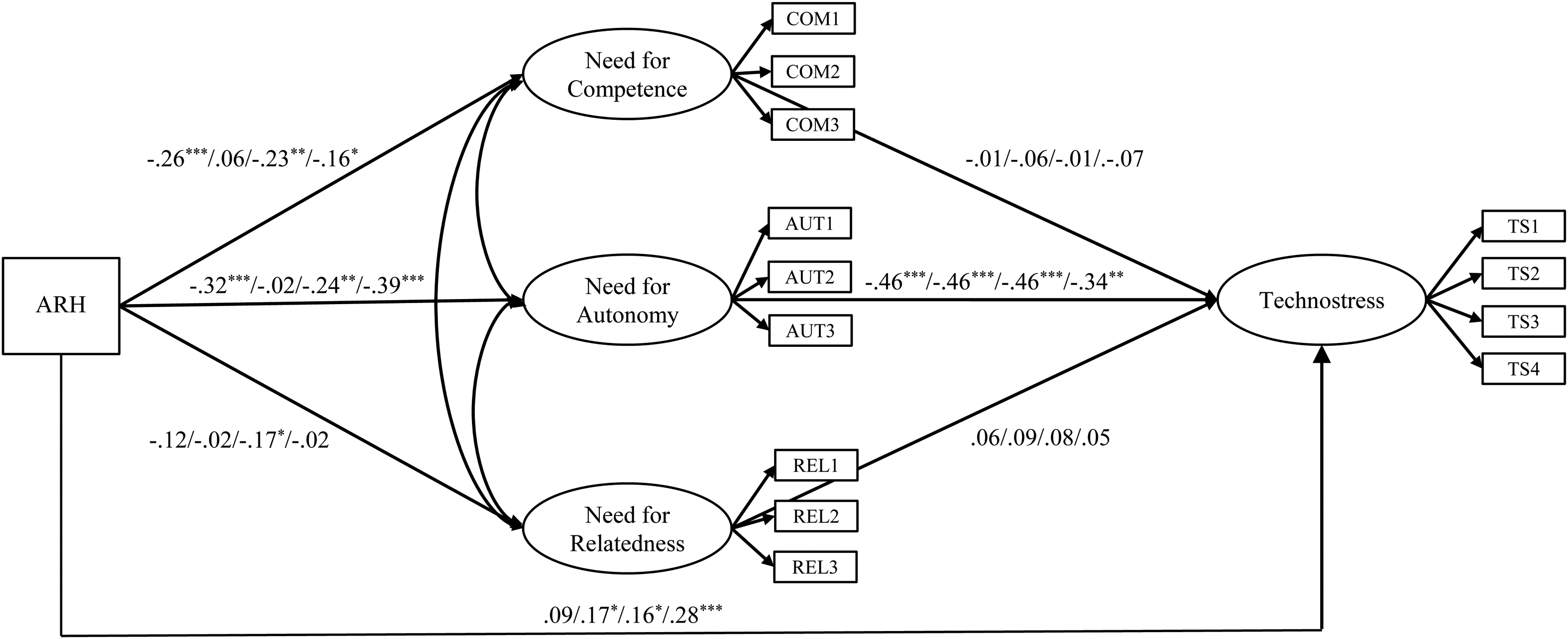
Standardized path coefficients of the four mediation models (human-, technology-, interaction-, and task-related action regulation hindrances, M1–M4). Note. N = 205; M1/M2/M3/M4. ARH = action regulation hindrances. M1 = model with human-related ARH (ICT competence deficits); M2 = model with technology-related ARH (technical problems); M3 = model with interaction-related ARH (coordination difficulties); M4 = model with task-related ARH (work overload). Details on factor loadings, R2, and latent correlations are omitted for clarity but can be found in ESM 3, Table E3.2, and Table E3.3. *p < .05, **p < .01, ***p < .001.
Results
The Relation Between ARH and Technostress (H1)
We hypothesized that greater impairment by each of the four ARH types was associated with higher levels of technostress. The results of our regression analysis showed good model fit for all four regression models (CFI >.97, TLI > .94, RMSEA < .12, SRMR < .03, for details, see ESM 2, Table E2.1). All factor loadings of the technostress items reached acceptable levels (λ = .83 to λ = .91). In line with H1, all four ARH types had a significant path to technostress (β = .17 to β = .42, for details, see ESM 2, Table E2.2).
In conclusion, higher teaching impairment by human-, technology-, interaction-, and task-related ARH were significantly related to higher technostress.
The Mediating Role of Basic Human Needs (H2)
We hypothesized that basic human need satisfaction mediates the relationship between four different ARH types and technostress. Key results of the mediation analyses are displayed in Figure 1 and Table 1. The ESM 3 documents extensive results of the mediation analyses. The model fit for all four mediation models was good (CFI > .96, TLI > .95, RMSEA < .08, SRMR < .04, for details, see ESM 3, Table E3.1). Latent correlations between the basic human needs were medium to high (r = .36 to r = .70, for details, see ESM 3, Table E3.2). All factor loadings were significant and high (λ = .82 to λ = .95, p < .001, for details, see ESM 3, Table E3.3).
Standardized indirect effects of the four mediation models (human-, technology-, interaction-, and task-related action regulation hindrances, M1–M4).
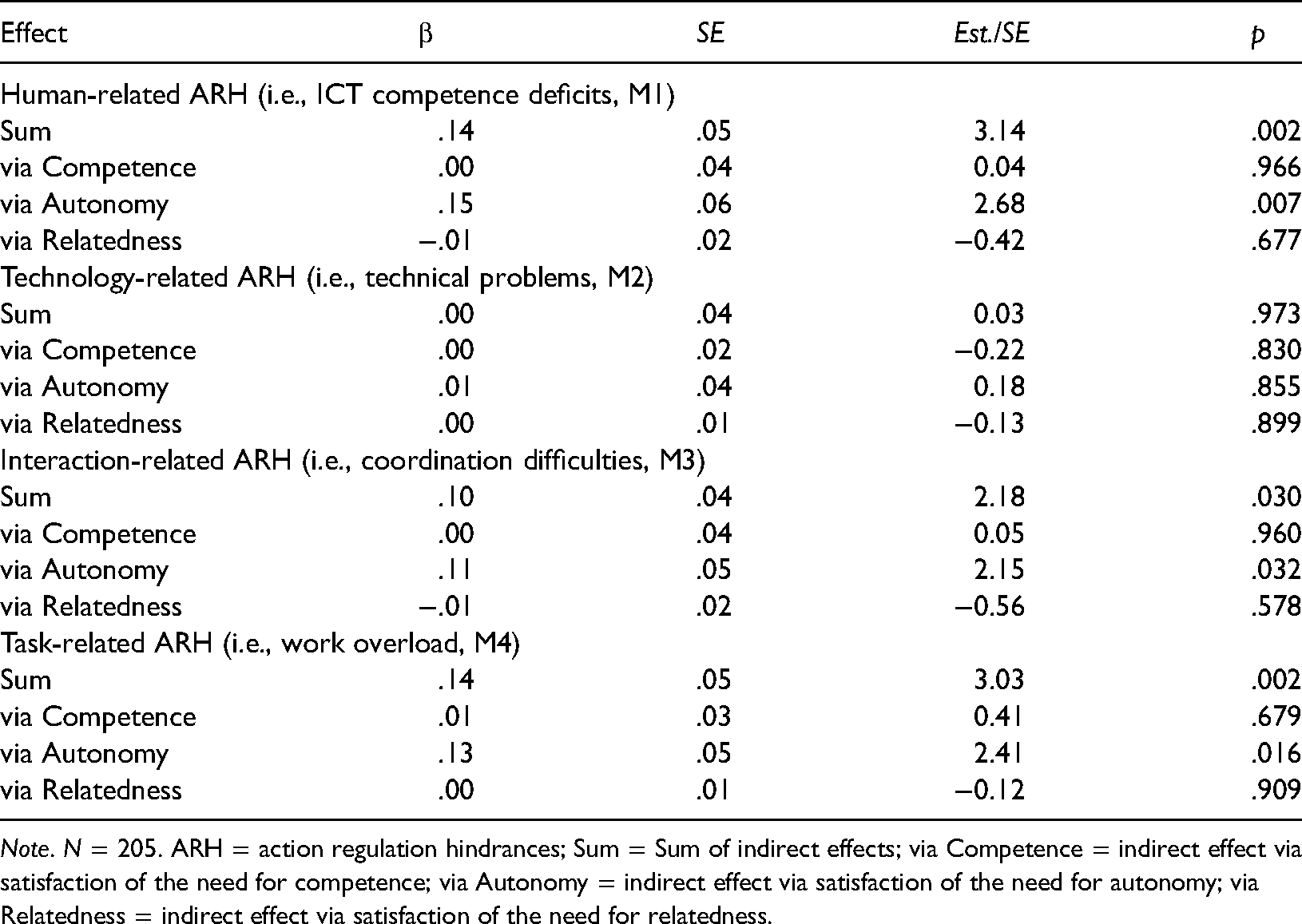
Note. N = 205. ARH = action regulation hindrances; Sum = Sum of indirect effects; via Competence = indirect effect via satisfaction of the need for competence; via Autonomy = indirect effect via satisfaction of the need for autonomy; via Relatedness = indirect effect via satisfaction of the need for relatedness.
Human-related ARH (ICT competence deficits) had a significant indirect effect on technostress via the need for autonomy (β = .15, p = .007, Table 1). The sum of indirect effects was also significant (β = .14, p = .002, Table 1). The direct effect between human-related ARH and technostress was nonsignificant (β = .09, p = .154, Figure 1). Regarding technology-related ARH (technical problems), only the direct path to technostress was significant (β = .17, p = .012, Figure 1), but no indirect paths reached significance (Table 1). Regarding the model with interaction-related ARH (coordination difficulties) as the predictor, the direct path between interaction-related ARH and technostress (β = .16, p = .011, Figure 1) and the sum of all indirect effects across all needs were significant (β = .10, p = .030, Table 1). Looking at individual indirect effects, the indirect path across the need for autonomy was significant (β = .11, p = .032, Table 1). A similar picture emerged with regard to work overload as task-related ARH, since the direct path (β = .28, p < .001, Figure 1), the sum of all indirect effects (β = .14, p = .002, Table 1) as well as the specific indirect effect via the need for autonomy (β = .13, p = .016, Table 1) were significant.
In summary, the relationships between different types of ARH and technostress were partially (for interaction- and task-related ARH) or fully mediated (for human-related ARH) by the satisfaction of the basic human need for autonomy, except for technology-related ARH.
Discussion
We investigated the relationship between four different ARH types and technostress in the context of online teaching in higher education during the COVID-19 pandemic and examined basic human need satisfaction as an underlying mediating mechanism. As expected, greater perceived impairment by human- (ICT competence deficits), technology- (technical problems), interaction- (coordination difficulties), and task-related (work overload) ARH was associated with higher technostress among psychology students (H1). Regarding the mediating role of basic human need satisfaction, an ARH- and need-specific pattern occurred. Satisfaction of the need for autonomy appeared to be particularly important in explaining technostress, (partially) mediating the relationships of interaction difficulties, work overload, and ICT competence deficits on technostress (H2).
Our findings are in line with recent stress theories (Tuckey et al., 2015) and a sociotechnical understanding (Karltun et al., 2017; Ulich, 2013) of online teaching, suggesting that human-, technology-, interaction-, and task-related ARH are important causes of technostress. To explain why different ARH types result in technostress, our results highlight the role of autonomy in the context of online teaching during pandemic times. Although the needs for autonomy, competence, and relatedness are all three innate, distinctive, and universal (Deci & Ryan, 2000), existing literature suggests that the need for autonomy is essential among these needs (Gagné & Deci, 2005) and constitutes the central core of SDT (Deci et al., 1989). Autonomy is also one of the most important determinants of well-being in other stress and resource models (e.g., Job Demands Control Model, Karasek & Theorell, 1990). In digital contexts, the importance of autonomy is likewise recognized (cf., Day et al., 2010; Dragano & Lunau, 2020). Perceived autonomy reduces the negative consequences of technology use and strengthens the motivation for continued use (Karimikia & Singh, 2019). In our study, the satisfaction of the need for competence and relatedness did not play a critical role in technostress emergence. This contradicts the classic assumptions of SDT according to which satisfaction of each need is related to well-being and stress (cf., Gagné & Deci, 2014), but it all the more emphasizes the critical role of autonomy in digital contexts.
The nonsignificant relationship between need satisfaction of competence and relatedness with technostress might be also explained by our study design (i.e., timing, course selection). Data collection took place in the middle of the semester, while performance tests (written exams) were due at the end of the semester. It might be that competence self-perceptions become more important for technostress, the closer the exam day gets, due to increasing time spent reflecting on one's competences. Regarding the need for relatedness, one has to consider that data were collected within an psychology lecture. Lectures are characterized by lower levels of social interaction and group work than other course formats (e.g., practical seminars). During the COVID-19 pandemic, the lecture context was even less relational because in-person interaction was nonexistent. Consequently, students might not have expected that they will become “related” to other students via this format under the circumstances of the pandemic. Thus, lower need satisfaction (regarding relatedness) might cause stress in general, but not technostress in this context.
Furthermore, technology-related ARH resulted in technostress but did not relate to students’ self-perception of competence, autonomy, and relatedness. During the COVID-19 pandemic, it seems that students did not attribute existing technical problems to themselves. Considering the abruptness of online teaching implementation during the pandemic and the associated experimental character of the new lecture format, these results speak in favor of a positive coping mechanism (i.e., technical problems did not threaten the students’ need satisfaction).
The direct effects of ARH on technostress remained significant regarding task-, technology-, and interaction-related ARH. Thus, students’ autonomy is crucial but cannot fully explain why students feel exhausted when confronted with ARH. First, work overload is directly related to technostress. Excessive workload is the most important cause of stress at work (Ellwart et al., 2015; Techniker Krankenkasse, 2016) and a common problem in online teaching (Chen et al., 2011). Second, technical problems as technology-related ARH were also significantly related to technostress which fits well with existing literature (Day et al., 2012; Maier et al., 2015; Riedl et al., 2012). Although in our study only very few people experienced severe technical problems in the middle of the ongoing semester, we found a significant effect on technostress. As technical problems often occur during the introduction of online teaching (Vladova et al., 2021), our results (mid-semester) might underestimate their relevance for emergency online teaching during the first weeks of the COVID-19 semester. Third, the direct effect of students’ coordination difficulties (interaction-related ARH) on technostress remained significant. Social interaction and social support are important protective factors against stress (Cohen & Wills, 1985; Viswesvaran et al., 1999; Wang et al., 2003). In the absence of social interaction, learners’ social isolation can affect the learning process (Hameed et al., 2008), for example, by hindering the development of communication skills or making feedback and support processes difficult (Al-Qahtani & Higgins, 2013).
The present study uncovers obstacles (i.e., ARH), processes (i.e., need satisfaction), and consequences (i.e., technostress) of COVID-19 prompted online teaching in higher education during an emergency situation (Hodges et al., 2020). Combined with other empirical findings on technostress in higher education during COVID-19 (e.g., Alvarez-Risco et al., 2021; Penado Abilleira et al., 2021), the study contributes to document how the pandemic comprehensively affected higher education and to draw initial conclusions beyond pandemic times.
Furthermore, the study highlights that with the implementation of virtual collaboration in higher education concepts (e.g., socio-technical systems: Karltun et al., 2017) and challenges (e.g., technostress: Ayyagari et al., 2011; zoom fatigue: Asgari et al., 2021) more extensively studied in work science enter educational science. Integrating theoretical considerations from motivational psychology (i.e., basic human needs), work science, and human factors (i.e., ARH systematization), the present study addresses current educational topics from an interdisciplinary perspective.
In addition, the fact that students’ feeling of self-determination and control was a key player in coping with obstructive conditions during the COVID-19 pandemic should be considered when designing and implementing technostress preventions and interventions (e.g., psychoeducative elements, reflective methods, attributional training). Concrete implications for the educational practice are elaborated on in the concluding paragraph.
However, the present study comes with some limitations as starting points for future research.
Limitations and Directions for Future Research
The present results are based on survey data from a rather specific student sample. The sample consists primarily of females in their twenties enrolled in one German University, attending a mandatory lecture (i.e., organizational psychology) as part of their bachelor's program. While this sample reflects the typical cohort of psychology students, the given sample limits the generalizability of the findings. We expect rather similar results for students attending lectures in other humanities, with partly overlapping curricula (e.g., pedagogy) and a highly female study cohort, facing similar ARH during the COVID-19 pandemic. However, the results might differ in more psychology-distant subjects with a higher proportion of male students (e.g., chemics, informatics; for studies that investigated gender effects, see Ragu-Nathan et al., 2008; Wang et al., 2020), in different age groups (see Gimpel et al. 2018; Nimrod 2018), or in samples from different cultures (see Tarafdar et al., 2007, 2015). Here, different situational demands (e.g., teamwork, practical exercises) and person characteristics (e.g., technology affinity, ICT competence, ICT self-efficacy) might lead to a different pattern regarding ARH or technostress.
Nevertheless, the key goal of this study was to show the underlying need mechanism behind technostress in psychological education. As needs are postulated as universal in the SDT (Deci & Ryan, 2000), this mechanism (i.e., the highlighted role of autonomy) should allow for replication in diverse populations.
Future research using more heterogeneous samples should examine the role of socio-demographics, as well as other potential covariates of the need-mechanism such as ICT experience or (perceived) ICT competence (e.g., Ragu-Nathan et al., 2008; Schauffel et al., 2021; Shu et al., 2011; Tarafdar et al., 2011) to gain additional insights in the underlying need mechanism.
We see great potential in a sociotechnical system perspective on ARH in online teaching, adapted from humane work design (Karltun et al., 2017). Because the focus of our study was to exemplify the mediating role of basic human need satisfaction against the background of broad ARH, we looked at different ARH with ad hoc developed single items. In this way, we were able to use tailored items (e.g., include Seafile as a university-specific cloud server) in a time-efficient manner. However, this method reduces the comparability of our results with other studies and cannot map the plethora of ARH exhaustively. Future research should use a multi-step approach, first qualitatively approaching the variety of ARH and then developing and validating a multi-item scale for ARH.
Furthermore, we used self-report measures only. Especially in the context of technostress, objective measures (e.g., cortisol assessments) next to subjective stress assessments would be beneficial to better understand technostress (Riedl et al., 2012; Stalder et al., 2017). The same extends to ARH measurement. In its original framework, ARH were supposed to be measured objectively by a third party (RHIA, Leitner et al., 1987). Subjective and objective measures of ARH and technostress might diverge; future research could extend the present work by including objective measures.
Moreover, the cross-sectional data structure limits our findings. Method artifacts cannot be ruled out (Podsakoff et al., 2003) and habituation or competence development are conceivable over the semester. Only in longitudinal designs, causalities would be testable and long-term development of need satisfaction would be visible. In the current study, students’ responses however referred specifically to the events of the respective workweek and lecture in organizational psychology.
It would be further beneficial to cross technostress into technology acceptance research (which has already been done for need satisfaction, see e.g., Nikou & Economides, 2017; Sørebø et al., 2009). Especially beyond pandemic times, it is important to know how the perception of technostress relates to future user behavior, with regard to autonomous course selection in higher education (in-person vs. online course format) and the rising popularity of working and studying from home.
Concluding Lessons Learned Beyond Pandemic Times
The COVID-19 related lockdown induced an abrupt switch from in-person to online teaching in higher education. This forced virtuality hindered students’ action regulation in multiple ways, resulting in students’ technostress. Our study shows that the need for autonomy is crucial to explain the relationship between multiple ARH and technostress. Lessons learned for (online) teaching beyond pandemic times can be derived from this.
Consider the Variety of ARH in Online Teaching
To anticipate and reduce obstructive conditions in online teaching, one should consider the variety of ARH types that might lead to technostress, and not only focus on the prevention of technical problems (e.g., using user-friendly systems). Aspects like individual competences (e.g., familiarizing students and teachers with these tools via tutorials or try-out sessions), student-teacher interaction (e.g., transparent rules of conduct), and work demands (e.g., adaptive workload) are also critical for technostress and have to be well-calibrated to ensure high quality online teaching. In post-pandemic times, teaching will remain online to some extent, and digital elements and platforms will be integrated into in-person teaching. Teachers and students should ensure transparent rules so that shared mental models specifying when, why, and how to use which ICT can emerge (Müller & Antoni, 2022).
Foster Students’ Autonomy by Course Planning
Course planning should explicitly consider students’ desire for self-determination and its buffering effect regarding technostress. Mank (2011), as well as Reeve and Jang (2006), provide helpful elements on how to foster autonomy by course planning (e.g., freedom of choice, self-initiative, question times). Furthermore, it seems helpful to directly discuss topics related to technostress emergence, manifestation, and consequences in class. Knowledge about and the anticipation of potential obstructive conditions of online teaching itself represents a coping strategy to deal with stress (i.e., anticipatory coping). Anticipatory coping fosters individuals’ perception of control by preparing for obstructive conditions (Borsellino & Young, 2011), such as organizing a backup headset to guarantee sufficient audio quality or protocolling lectures in a shared online document to synchronize group processes. Knowledge about the crucial role of basic human needs helps students (and teachers) to critically reflect on technostress experiences, so that occurring ARH are not necessarily appraised as technostressors.
Supplemental Material
sj-docx-1-plj-10.1177_14757257221102563 - Supplemental material for Technostress During COVID-19: Action Regulation Hindrances and the Mediating Role of Basic Human Needs among Psychology Students
Supplemental material, sj-docx-1-plj-10.1177_14757257221102563 for Technostress During COVID-19: Action Regulation Hindrances and the Mediating Role of Basic Human Needs among Psychology Students by Nathalie Schauffel, Lena Maria Kaufmann, Mona Rynek and Thomas Ellwart in Psychology Learning & Teaching
Supplemental Material
sj-docx-2-plj-10.1177_14757257221102563 - Supplemental material for Technostress During COVID-19: Action Regulation Hindrances and the Mediating Role of Basic Human Needs among Psychology Students
Supplemental material, sj-docx-2-plj-10.1177_14757257221102563 for Technostress During COVID-19: Action Regulation Hindrances and the Mediating Role of Basic Human Needs among Psychology Students by Nathalie Schauffel, Lena Maria Kaufmann, Mona Rynek and Thomas Ellwart in Psychology Learning & Teaching
Supplemental Material
sj-docx-3-plj-10.1177_14757257221102563 - Supplemental material for Technostress During COVID-19: Action Regulation Hindrances and the Mediating Role of Basic Human Needs among Psychology Students
Supplemental material, sj-docx-3-plj-10.1177_14757257221102563 for Technostress During COVID-19: Action Regulation Hindrances and the Mediating Role of Basic Human Needs among Psychology Students by Nathalie Schauffel, Lena Maria Kaufmann, Mona Rynek and Thomas Ellwart in Psychology Learning & Teaching
Footnotes
Declaration of Conflicting Interests
The authors declared no potential conflicts of interest with respect to the research, authorship, and/or publication of this article.
Funding
The authors disclosed receipt of the following financial support for the research, authorship, and/or publication of this article: This research received financial support by Trier University.

Supplemental material
Supplemental material for this article is available online.
Notes
Author Biographies
References
Supplementary Material
Please find the following supplemental material available below.
For Open Access articles published under a Creative Commons License, all supplemental material carries the same license as the article it is associated with.
For non-Open Access articles published, all supplemental material carries a non-exclusive license, and permission requests for re-use of supplemental material or any part of supplemental material shall be sent directly to the copyright owner as specified in the copyright notice associated with the article.
