



Abstract
We surveyed college students (N = 105) asking them to rate the importance of workplace skills as if they were responding as themselves, as their parents, and as future employers. We also asked participants to generate a list of skills they considered most important to develop in college, and to evaluate workplace behaviors for the likelihood of any of these resulting in termination of employment for new hires. Results revealed that college students perceived that the value they place on workplace skills matched more closely their parents’ views than those of future employers. College students’ list of skills considered important to develop in college was more focused on college success than career success. College students accurately identified five out of six behaviors most likely to lead to termination of employment for new staff (Gardner, 2007), but failed to identify inappropriate use of technology. These findings provide insight for faculty members who want students to succeed both at college and in their careers.
The workplace has dramatically changed in the last three decades (Hettich & Landrum, 2014). The skills that employers desire have been heavily researched (e.g., Hansen & Hansen, 2014; O’Hare & McGuiness, 2004); however, college students may not always exhibit these necessary skills once hired. For example, Gardner (2007) found that companies that relied on college campus recruiting, rather than those who used other strategies, were more likely to have to reprimand their new hires for lack of work ethic, unethical behavior, inappropriate computer use, and missing deadlines.
Ironically, many researchers and professionals strongly argue that the psychology major provides a multitude of job-relevant skills in addition to course content (e.g., Dunn & Halonen, 2017; Hettich & Landrum, 2014). If the psychology major is providing relevant skills, why are these not being readily translated to the workplace? This question is particularly perplexing given that today’s college students, even more so than previous generations, view a primary goal of college as preparation for a career (Eagan et al., 2014; Pryor et al., 2007).
One issue may be that college students who are aware of desirable workplace skills may not have the self-efficacy to translate them to the workplace. Toven-Lindsey (2017) found that college students are often unable to communicate how the skills they obtained in college apply to the job market and, thus, miss an opportunity to sell themselves to potential employers and utilize their skill set effectively. A secondary issue could be that young adults are not motivated to apply their knowledge of workplace skills to their actual jobs, because they often think of their jobs as temporary placeholders until a more desirable opportunity arises (Gardner, 2007). In fact, data suggests that job switching is typical in today’s job market (Berger, 2016). A third possibility is that today’s college students lack clarity about the skills they are developing in college and how these will be perceived by employers. Previous researchers have documented what employers want, but do college students have this knowledge?
With this last question in mind, we investigated college students’ perceptions and awareness of employer-desired workplace skills. We were particularly interested in how students prioritize skills that previous research has indicated are valued in the workplace. Whiston and Keller (2004) found that beginning in adolescence, parents play a significant role in how children conceptualize and plan for their careers. Thus, we also wanted to assess how college students valued skills related to what they believed would be valued by their parents and future employers. Although some of our study was exploratory, we made the following specific hypotheses: (1) College students would evaluate workplace skills similarly to the way they believed their parents would evaluate those same skills; (2) College students responding as themselves, parents, and employers would place a high value on computer and technology skills because of their usefulness in today’s electronically connected world (Carnevale & Smith, 2013); (3) College students would be unable to accurately predict the five behaviors that most often lead to termination of employment for new hires.
Method
Participants
Participants were 105 college students enrolled in undergraduate psychology courses with a mean age of 19.76 (SD = 1.70). Participation was one option students could select to earn extra credit in their courses. Seventy-six percent were women. Fifty-five percent were Caucasian, 39% were African American, and the remainder equally self-categorized as Asian (2%), Hispanic/Latino (2%), and Interracial (2%). Fifty percent of the sample were freshmen and sophomore students, and 50% were juniors and seniors. Fifty-three participants had declared psychology as their major, 50 participants selected an option indicating that they had a major “other than psychology,” and two participants indicated that they had not yet declared a major. Half of the students (51%) reported their family’s income level as middle class, 25% reported their income level as below middle class, and 24% reported their family as living above middle class. The average reported college grade point average (GPA) was 3.21 (SD = .41), with a range of 2.1 to 4.0. This study was approved by the university’s Institutional Review Board, and participation was voluntary.
Materials and Procedure
Participants responded to a researcher-created survey in undergraduate classrooms. Ten questions were presented with rating scales that asked participants to rate their feelings about their major, their feelings about their future/career, and their perceptions of their parents’ feelings about these two issues. We also asked participants to tell us how much they expected their annual income to be after graduation.
Means and Standard Deviations of Importance Ratings for Workplace Skills
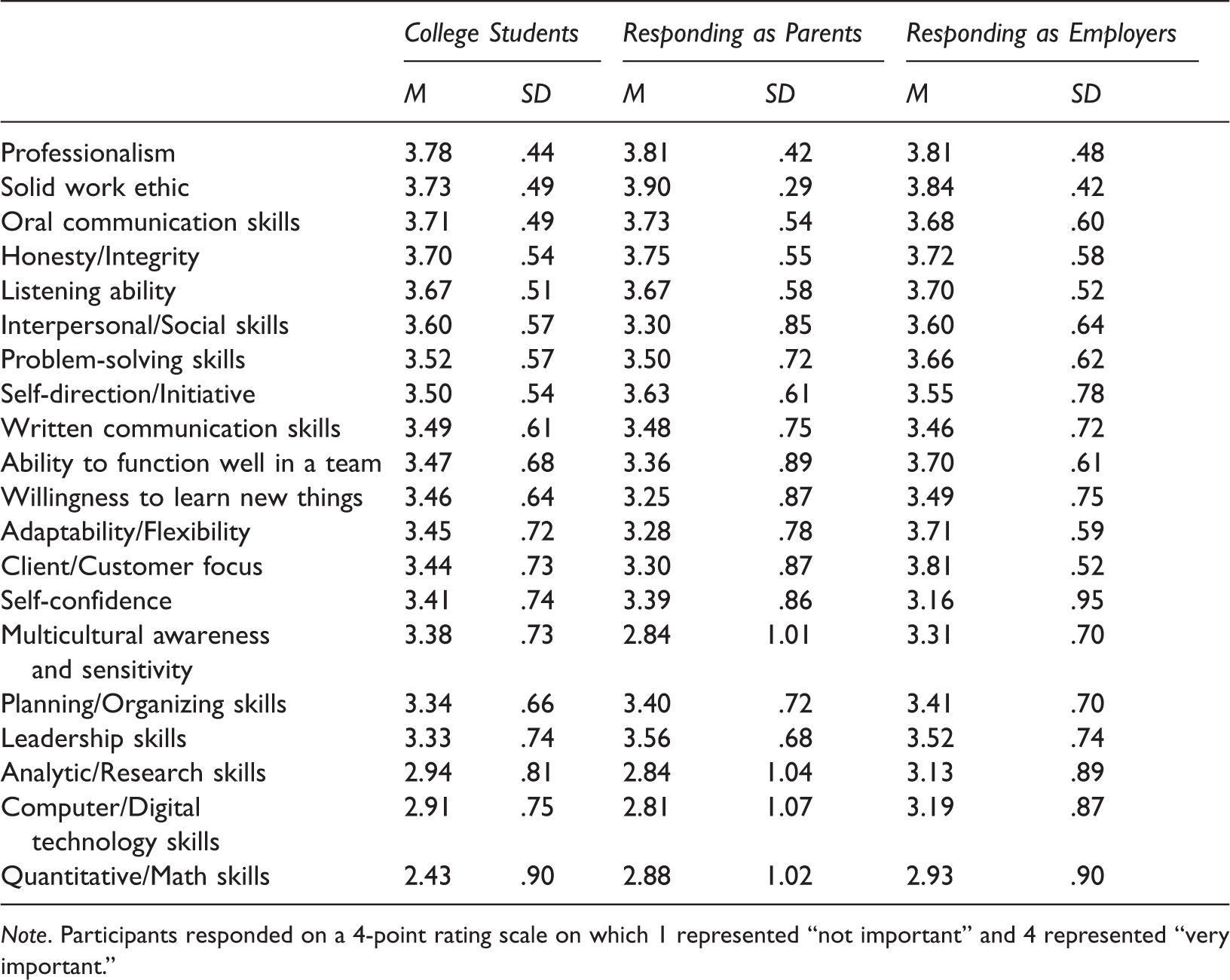
Note. Participants responded on a 4-point rating scale on which 1 represented “not important” and 4 represented “very important.”
Participants were presented with the same list of skills, but this time they were instructed as follows: “Parents/caregivers often have opinions about what you should be doing in college. Rate these characteristics again but, this time, pretend you are your parent. How do you think your parents/caregivers would rate the importance of each of these skills for the workplace?” The Chronbach’s alpha for these items, as evaluated from the parents’ perspective, was .90. Participants were presented with the list of skills a third time and were instructed as follows: “Employers have actually rated these workplace skills based on how important they are in hiring and keeping college graduates as employees. Rate these characteristics again but, this time, pretend you are an employer trying to pick a new employee. Which traits would be most important for you to see?” The Chronbach’s alpha for these items, as evaluated from the employers’ perspective, was also .90.
The next section of the survey presented a list of 10 negative behaviors developed by Gardner (2007) linked to the disciplining of and termination of employment for new hires (lack of work ethic/commitment, unethical behavior, failure to follow instructions, inability to work well in a team, failure to show initiative, missing assignments/deadlines, poor verbal communication, inappropriate use of technology, being late for work, unable to communicate effectively in writing). The first time participants encountered the list we asked them to mark the six behaviors that they thought would be most likely to result in a new employee being fired. Gardner (2007) previously identified these as unethical behavior, lack of work ethic/commitment, inappropriate use of technology, failure to follow instructions, being late for work, and missing assignments/deadlines. The participants saw the list a second time and were asked to identify the three that they felt they would be most likely to exhibit as employees in a post-graduation job. Last, participants responded to demographic questions.
Results
We ranked the workplace behaviors based on how important participants rated them, responding as themselves and as their parents. We also calculated the means and standard deviations for the case in which participants responded as if they were employers of new hires.
We calculated an overall importance rating for each group (participants, parents, and employers) by summing the responses given for all 20 skills and then calculating an average. A repeated measures ANOVA revealed significant differences, F(2, 104) = 5.94, p = .003, partial η2 = .054, that approached a medium effect size. Pairwise comparisons revealed that the participants’ mean ratings responding as potential employers (M = 70.40, SD = 8.34) were higher than those for the students themselves (M = 68.22, SD = 5.79) and higher than those for the students responding as their parents (M = 67.66, SD = 9.29).
We took the top five highest-rated skills provided by participants and ran repeated measures ANOVAs to assess whether the ratings differed significantly among the three groups. Results can be seen in Table 1. There were no differences in the three ratings (participants, participants as parents, and participants as employers) on professionalism, oral communication skills, honesty/integrity, and listening ability. However, there was significance for a solid work ethic, F(2,105) = 5.61, p < .004, partial η2 = .051, which approached a medium effect size. Pairwise comparisons revealed that participants’ self-ratings (M = 3.73, SD = .49) significantly differed from the ratings they gave as their parents (M = 3.90, SD = .29), but not from the ratings they provided as employers (M = 3.84, SD = .42).
We repeated this process with the five lowest-rated skills provided by participants and found more variability; these results are also available in Table 1. There were no differences in the ratings provided for planning/organizing. Participants responding as themselves (M = 2.43, SD = .90) rated quantitative/math skills as less important than they did when responding as their parents (M = 2.88, SD = 1.02) or employers (M = 2.93, SD = .90), F(2,105) = 14.15, p < .001, partial η2 = .12. This was a large effect size. Participants’ self-ratings (M = 3.33, SD = .74) for leadership skills was lower than their ratings when responding as parents (M = 3.56, SD = .68) or employers (M = 3.52, SD = .74), F(2,105) = 4.15, p = .017, partial η2 = .038, reflecting a small effect. Participants felt that potential employers (M = 3.19, SD = .87) would rate computer/digital technology skills as more important than the participants themselves (M = 2.91, SD = .75) or the participants responding as their parents (M = 2.81, SD = 1.07) would, F(2,105) = 8.09, p < .001, partial η2 = .072, reflecting a medium effect size. Participants also felt that employers (M = 3.13, SD = .89) would rate analytic/research skills as more important than they felt their parents would (M = 2.84, SD = 1.04), F(2,105) = 4.10, p = .018, partial η2 = .038, reflecting a small effect.
Number of Participants Identifying Category as Containing Skill Important to Develop During Undergraduate Years
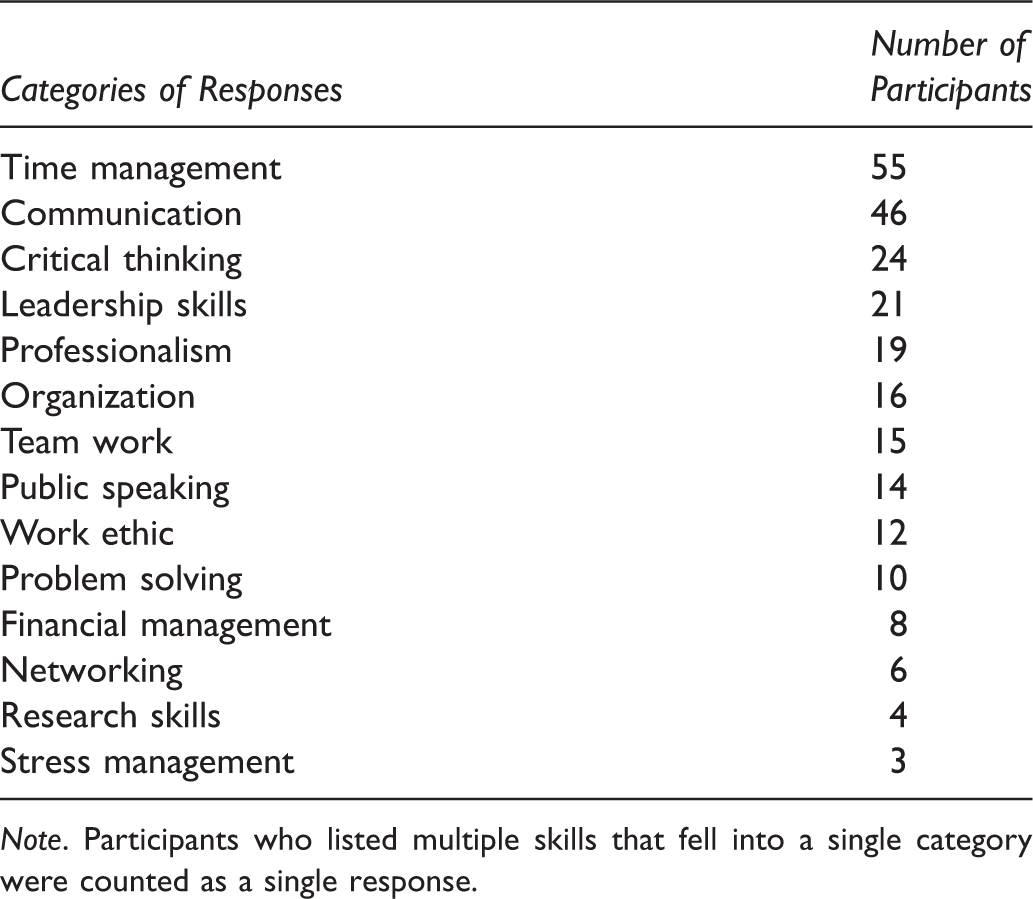
Note. Participants who listed multiple skills that fell into a single category were counted as a single response.
Number of Participants Identifying Behaviors as Leading to Termination of Employment or Likely They Would Exhibit
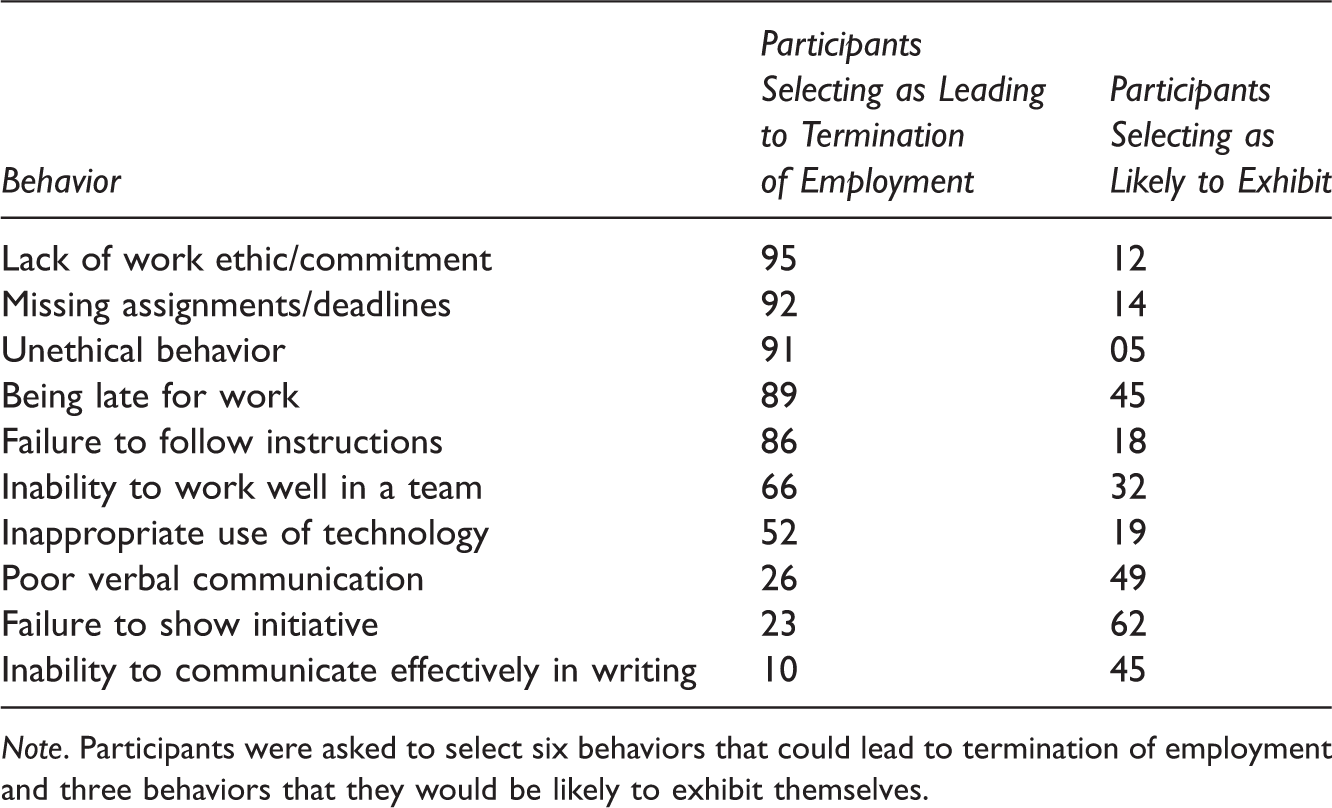
Note. Participants were asked to select six behaviors that could lead to termination of employment and three behaviors that they would be likely to exhibit themselves.
When participants were asked to select three negative behaviors that they would most likely exhibit as a new employee, they most frequently selected: failure to show initiative (59%); poor verbal communication (46.7%); being late for work (42.9%); inability to communicate effectively in writing (42.9%); inability to work well in a team (30.5%); and inappropriate use of technology (18.1%). Although all participants responded when asked which behaviors would lead to termination of employment, four participants did not respond to the question about which negative behaviors they would likely exhibit as a new hire, and one participant selected only one behavior. The number of participants selecting each behavior can be seen in Table 3.
We analyzed some exploratory data not directly related to our hypotheses. Compared to other or non-declared majors (M = 2.63, SD = .69), psychology students (M = 2.15, SD = .83) were less likely to agree that they would be able to get a “good job” after graduation, t(103) = −3.16, p = .002, d = .62. Non-psychology majors (M = 2.40, SD = .69) also agreed more than psychology majors (M = 2.02, SD = .84) that their parents had a big influence on their choice of major and career, t(105) = −2.55, p = .012, d = .50. Psychology majors predicted making an average of $29,146 (SD = $19, 024) immediately following graduation, whereas non-psychology majors predicted making an average of $37,063 (SD = $15,592); this difference was significant, t(98) = −2.25, p = .027, d = .46. These major and non-major comparisons reveal medium effect sizes. Psychology majors and non-majors did not differ on how nervous they felt about their future, their certainty of where they would be in 10 years, or how positively they felt about life after graduation.
The more positively students felt about their major, the more they agreed that there are opportunities to gain skills for the workplace while in college, r(104) = .28, p = .004, and the more certain they felt they knew where they would be in 10 years, r(104) = .23, p = .02; both of these reflect small effect sizes. The more positively students felt about their major, the more positively they believed their parents felt about their major, r(101) = .53, p < .001, which is a large effect size.
Means and Standard Deviations of Importance Ratings for Workplace Skills from Imagined Employers’ Perspective
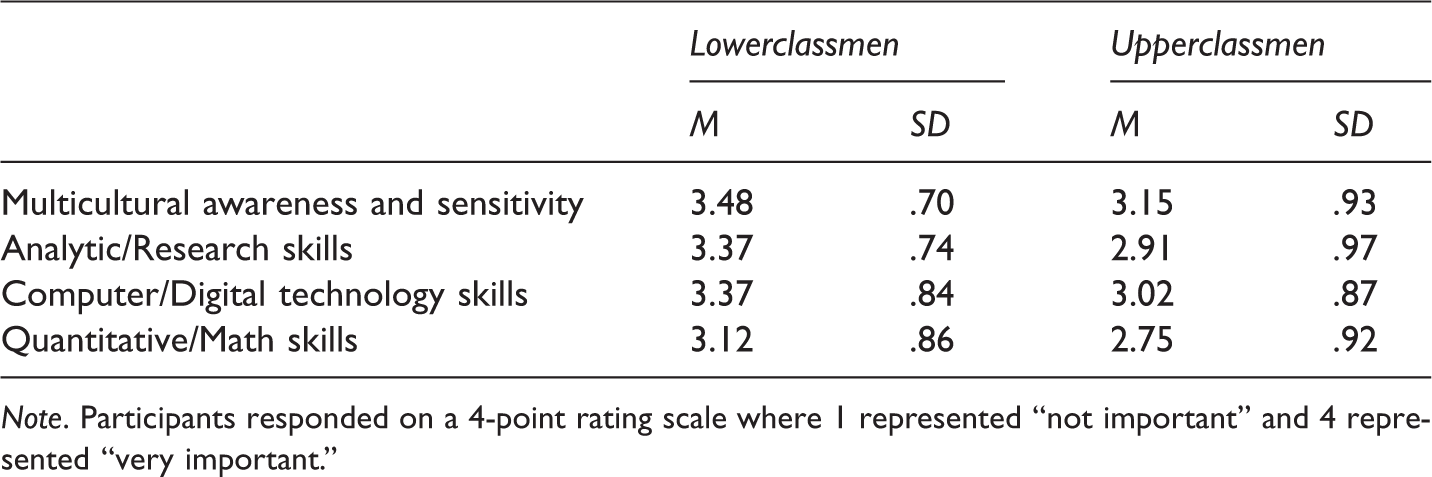
Note. Participants responded on a 4-point rating scale where 1 represented “not important” and 4 represented “very important.”
Discussion
We hypothesized that participants would evaluate workplace skills similarly to the way they believed their parents would. This hypothesis was supported. With slight variance in the placement, participants responding as themselves and as their parents ranked professionalism and a solid work ethic as their most important skills, followed by oral communication and honesty/integrity. Both groups ranked listening ability as the fifth most important skill. These results suggest that college students are either maintaining priorities established by their parents or are misperceiving their parents as agreeing with them. These same participants disagreed that their parents had exerted a “big influence” on their major and career plans, especially declared psychology majors. The fact that the participants reported disagreement with their parents in other parts of the survey provides some support for the probability that when they claimed to agree with their parents, the agreement may have been accurate. Previous researchers demonstrated that parents play an influential role in guiding career development in adolescence (Whiston & Keller, 2004), and our findings suggest this influence may extend into the young adult years.
Despite the early reported similarities in perceptions, the rankings participants gave compared to those they felt their parents would provide started to differ after the top five. Participants ranked interpersonal/social skills as the sixth most important and problem-solving skills as seventh. They felt their parents would rate self-direction/initiative and leadership skills as sixth and seventh. This divergence may reflect unique priorities that the two groups place on the college experience in general. Students, in the midst of a large peer group and being asked to function without the previously experienced level of support from their families, perceived the usefulness of interpersonal and problem-solving skills. College students perceived that their parents valued self-direction, initiative, and leadership. Our participants’ parents had perhaps been discussing these characteristics with their grown children as they watched them take on a new level of independence as college students.
Participants also reported unique rankings when asked to evaluate what skills employers would most like to see in new hires. Similar to their own and the imagined rankings of their parents, young adults felt that employers would highly value a solid work ethic, professionalism, and honesty/integrity. However, they also reported that employers would care more about customer focus, flexibility, and teamwork. Revealing another difference, college students gave overall higher importance ratings when responding as an employer than responding as themselves or their parents. The fact that college students think employers care more about job skills than they do themselves is noteworthy, because preparing for a career is an oft-cited goal of a college degree (Eagan et al., 2014). Future researchers may want to investigate whether students are perceiving the skills as less valuable because they are not yet actively engaged in a career, or if it is a persistent belief that employers should care more about workplace skills than do their employees.
We also hypothesized that students responding as themselves, parents, and employers would place a high value on computer and technology skills because of their usefulness in today’s electronically connected world (Carnevale & Smith, 2013). This hypothesis was not supported. Students placed the lowest value on quantitative/math, computer, and research skills and believed that their parents would agree with them in terms of computer and research skills. Although students reported that employers would value the skills more than they would, students still believed that employers would place low importance on them. One possibility is that the specific downgrading of quantitative skills may reflect math anxiety that is commonly seen in college students (Hendy, Schorschinsky, & Wade, 2014). Another plausible explanation is that students feel proficient with technology and, thus, do not see these skills as ones that need to be developed; however, this response pattern would not match the prompt we gave them, in which we asked them to consider the importance of these skills in the workplace.
These discrepancies between what students valued and what they felt employers would value was also seen when students were asked to generate a list of skills that they considered important to develop as an undergraduate. Students felt that their undergraduate years would benefit from skills in time management, communication, critical thinking, and leadership. These categories do not offer a clear overlap with the behaviors students felt were most important to develop in anticipation of the workplace. The closest connection occurred in the category of communication, with students rating highly the workplace skills of communication, listening, and interpersonal skills. If students want to prepare for the job market, why would they not choose to value the same skills they believe their future employers value? One explanation may be the skills students listed as most important to develop during college may have been more about succeeding in the classroom than at work. Students may perceive that a short-term focus on successfully navigating college is the first step toward successfully navigating the job market. Another possibility is that college students mistakenly think that a job will function similarly to college, underestimating the many differences between the two environments, and assume that the skills that work in one situation will lead to success in the other (Hettich & Landrum, 2014; Holton & Naquin, 2001).
Our third hypothesis was that college students would be unable to accurately predict the five behaviors that most often lead to termination of employment for new hires. Somewhat refuting our hypothesis, college students accurately predicted five of the six termination behaviors identified by Gardner (2007) in a national survey of employers of college graduates. Our participants failed to identify inappropriate use of technology and instead selected the inability to work well in a team. This response reflects a consistent pattern, in which students minimize the impact of technology in the workplace while maximizing the importance of social skills. This omission may also be dangerous for college students entering the workforce, because Gardner (2007) found that employers often connected inappropriate use of technology to being unethical. An additional concern is that new employees who are unaware of behaviors that elicit reprimands are more vulnerable to receiving such feedback. College students who receive negative feedback at work tend to disengage from work and lessen their career goals (Hu, Creed, & Hood, 2017).
Revealing a further discrepancy, when asked about inappropriate behaviors they would exhibit as employees, students picked behaviors that their previous ratings had shown would upset employers. Students reported that they would fail to show initiative and be late for work after rating a solid work ethic as highly valued by employers. Students also felt that they would display poor communication skills despite rating communication skills as important for them, their parents, and future employers. Future research may want to investigate if this was a self-efficacy or motivational issue, a difference that could be meaningful to those tasked with preparing students for the job market.
Alternatively, it is possible that we are overestimating college students’ potential to engage in any of these offenses that might result in them being fired. Our participants may have felt pressured to select some behaviors because we had instructed them to do so. Only five participants out of the 105 sampled failed to provide a full response to this question. Although there is room for hope, previous researchers, such as Gardner (2007), indicate that college graduates are being fired for the very behaviors they told us they would be likely to exhibit.
When we compared lowerclassmen to upperclassmen, we found a pattern in which students expected to make less money upon graduation later in their college career. This pessimism may reflect the fact that upperclassmen are more vulnerable to anxiety, particularly related to their post-graduation success (Beiter et al., 2015). We also found that lowerclassmen rated math as more important and written skills as less so. Similarly, compared to upperclassmen, lowerclassmen perceived math, technology, and analytic skills as more desirable to potential employees. These differences may reflect the typical evolution of college coursework, in which at least one math course is required for general education whereas upper-level classes become more writing intensive. Perhaps more meaningful than these differences is that lower- and upperclassmen agreed on the importance of the majority of skills both from their own perspective and that of a potential employer, perhaps indicating that students are not substantially modifying their perceptions of job preparation as they progress through their undergraduate degree.
Psychology majors felt similarly to other students in terms of their major and life after college; however, they were less optimistic about their ability to get a good job and expected a lower salary. These findings seem to match data showing that compared to their peers, psychology majors report the lowest career satisfaction following graduation (Light, 2010). Fortunately, our results also suggest that providing job skills training to students may increase optimism about the major, and feeling positively about the major provided some career certainty.
Although this is one of the first studies to examine how college students’ parents may prioritize workplace skills, one of its obvious limitations is our reliance on students’ perceptions of their parents’ beliefs. Future researchers may want to compare student perceptions to parent perceptions to gauge the accuracy of what students reported in our study. Future studies may also consider evaluating the perceptions of male and female parents/caregivers separately, and then assessing their relative influence on their children’s prioritization of workplace skills. Relatedly, future studies may focus on students’ perceptions of their parent’s beliefs for first generation (students whose parents did not complete college) compared to other college students.
In conclusion, these findings provide insight for faculty members who want students to succeed both at college and in their careers. Students seem to intuitively understand the importance of a strong work ethic. It may be the role of college staff to stress the importance of applying that knowledge to a work situation, perhaps through specific instruction about behaviors that display commitment and hard work. In other words, college students may need to be educated about both the “why” and “how to” regarding desirable workplace behaviors. To this end, psychologists have begun strongly advocating for career development courses, a career-relevant curriculum, and clear links between course activities and the associated workplace skills (Dunn & Halonen, 2017; Landrum, 2015; Landrum, Hettich, & Wilner, 2010). Although these results offer fruitful suggestions for helping undergraduates navigate the job market, it is worth remembering a point emphasized by Landrum and Harrold (2003): job preparation is only one aspect of the many personal and social benefits provided by a psychology major and liberal arts education.
Footnotes
Declaration of Conflicting Interests
The author(s) declared no potential conflicts of interest with respect to the research, authorship, and/or publication of this article.
Funding
The author(s) received no financial support for the research, authorship, and/or publication of this article.