




Abstract
The primary goal of this paper is to describe an innovative active learning experience (i.e., class trip to a children’s museum) aimed at expanding child psychology students’ knowledge of the developmental benefits of play. A secondary goal is to present preliminary data about the impact of this experience on students’ learning by examining scores of a pre /post knowledge assessment for students who went to the museum (N = 30; 27 female) and a comparison group who did not (N = 31; 29 female). Students who visited the museum demonstrated significantly greater improvement on the knowledge assessment relative to the comparison group. In response to an open-ended question, trip group students indicated that the museum experience helped them to better understand the role of play in children’s development and ways in which play behavior varies by age. Limitations of the empirical results related to the sample characteristics, scope of the knowledge assessment, and the nature of the museum trip are highlighted, along with a call for more rigorous future research on this topic.
A fundamental goal of undergraduate child psychology courses is for students to gain an understanding of developmental theories and milestones from infancy through late childhood. Instructors often utilize applied learning experiences such as observing children’s behavior in a naturalistic setting (e.g., preschool, playground) to facilitate students’ understanding of these concepts. This approach is consistent with constructivist theory, which emphasizes active learning as a meaningful form of education in which “learners actively construct knowledge and make meaning based on their experiences” (Narayan, Rodriguez, Araujo, Shaqlaih, & Moss, 2013, p. 169). Commonly occurring in authentic environments, constructivist learning challenges students to uncover facts for themselves, often leading to better retention of material (Narayan et al., 2013).
Previous research suggests that college students do not pay attention continuously during a traditional lecture. Instead, their attention alternates between being engaged and non-engaged in ever-shortening cycles throughout the lecture time period (Bunce, Flens, & Neiles, 2010). Actively engaging students via strategies such as small-group work, electronic response devices, fieldwork, and other experiential activities has been shown to decrease student inattention during lectures, enhance interest and motivation, and increase retention of course material (e.g., Behrendt & Franklin, 2014; Freeman et al., 2014).
Supporting this approach, Fallahi (2008) reported that compared to students in a traditional lecture-based lifespan development course, those in a redesigned active learning course with assignments such as self-reflections and case studies demonstrated higher retention of course material and more advanced problem-solving abilities. Similarly, when active learning techniques were applied in a large lecture-based introductory psychology course (e.g., creating different sugar-water solutions to test thresholds and differences in taste), students reported greater retention of and engagement with the course material (Smith & Cardaciotto, 2012).
The active learning experience described in this paper was designed to give students enrolled in a child psychology class real-world examples of course concepts by visiting a children’s museum. Students in this class were learning about the ways in which play is beneficial for children’s development. Through play, children expand their language/literacy and communication abilities, learn numerical and spatial concepts, develop problem-solving skills, use their imagination and creativity, practice memory skills and the ability to sustain their attention, rehearse social roles, and develop the ability to regulate their behavior and emotions (Hirsh-Pasek, Golinkoff, Berk, & Singer, 2009; Wenner, 2009). The instructor of this course felt that it was essential for students to see these benefits first-hand. Students were assigned to observe one of three functions of play consistent with the literature on this topic (i.e., language and literacy, numerical and spatial concepts, attention and problem-solving) across specific areas of the museum.
The literature on children’s museums provides a rationale as to why this setting is favorable for observing children’s play. According to Lewin (1989), the following characteristics distinguish children’s museums from traditional (e.g., art, history) museums: they provide hands-on experiences; they are organized based on space rather than time, allowing children to follow their interests; they promote contextual learning through realistic child-sized settings; and they offer exhibits that facilitate children’s memory and imagination. Exhibits at children’s museums often encourage pretend play by providing costumes, props, and familiar settings such as houses, towns, and grocery stores (see also Mayfield, 2005; Song et al., 2017). Based upon these characteristics, this setting provided an ideal environment in which students could experience first-hand examples of the developmental benefits of play.
This paper describes an active learning experience aimed at helping students better understand how play influences development through a class trip to a children’s museum. The goals of this paper are as follows: (1) to describe the museum trip and related assignments in order to help faculty expand their repertoire of active learning strategies; and (2) to provide preliminary data on how the museum experience impacted students’ learning about children’s play.
Study Overview
Participants
Participants included 61 undergraduate students enrolled in two separate sections of a child psychology course at a small liberal arts institution. One section (30 students, 27 female) participated in the museum trip (“trip group”), whereas the other section (31 students, 29 female) did not visit the museum (“comparison group”). Both sections had the same instructor and used the same textbook. All students learned about the developmental benefits of play through assigned readings (i.e., Hirsh-Pasek et al., 2009, pp. 17–40; Wenner, 2009) and class discussion. Prior to completing the readings on play, students completed a pre knowledge assessment. Approximately one week later, students completed a post knowledge assessment (i.e., after the readings, class discussion of the developmental benefits of play, and a museum visit for the trip group; after only the readings and class discussion of the developmental benefits of play for the comparison group). This project was reviewed and approved by the Institutional Review Board, and all students provided written consent prior to participating. All of the students enrolled in the section that went to the museum attended the trip and completed the pre and post assessment measures, and all of the students in the section that served as the comparison group completed the pre and post assessment measures.
Pre/Post Knowledge Assessment
The knowledge assessment included seven true–false questions (e.g., “Research supports Vygotsky’s view that children’s pretend play can advance their thinking (T)” “Play provides short-term benefits during childhood that do not last through adulthood (F)”), three multiple-choice questions (e.g., “Which of the following is an example of sociodramatic play?” with four choices provided), and one short-answer question (i.e., “List the ways in which play can be beneficial for children’s development.”). Two research assistants who were blind to both condition (i.e., trip group versus comparison group) and assessment point (i.e., pre or post) independently reviewed and tallied the number of developmental benefits of play listed by each student in response to the short-answer question. Student responses were compared to a list of developmental benefits of play that was provided by the first author (based upon Hirsh-Pasek et al., 2009; Siegler, DeLoache, & Eisenberg, 2011; Wenner, 2009). Results of these two raters were compared and a small number of discrepancies were resolved through discussion with the first author. For data analysis purposes, students’ scores on the true–false and multiple-choice questions were combined with their short-answer score to create a knowledge assessment total score.
Description of Museum Trip and Related Assignments
Faculty Preparations for the Museum Trip
To prepare for the museum trip, the course instructor visited the museum, and consulted with staff via phone to discuss exhibits that would work well for this assignment. The instructor completed a class trip application and submitted assignment and observation sheets to the museum. The trip was planned for a Saturday afternoon and listed on the course syllabus as mandatory. Other logistics included reserving a school bus, developing the pre- and post-trip knowledge assessment, preparing an assignment handout, and creating a behavioral observation sheet. The behavioral observation sheet is included in Appendix A and the assignment handout is available from the first author upon request.
Class Preparations and Visit to the Museum
The class meeting prior to the trip was devoted to discussing the developmental benefits of play, preparing students for the assigned tasks, reviewing the museum’s guidelines, and going over the requirements for a post-trip response paper. Upon arrival at the museum, behavioral observation sheets were distributed. Students were reminded to follow the guidelines listed on that sheet. They were given a clipboard and lanyard to display student identification. If parents asked about the purpose of their observations, students were instructed to explain the project and refer parents to the course instructor.
The class was divided into three groups, with each group observing a different function of children’s play (i.e., language and literacy; numerical and spatial concepts; attention and problem-solving). Within each group, students were further divided into teams of two to complete their observations. All students in the class visited the same two museum exhibits (i.e., Super Kids Market, The Berenstain Bears), and each team selected a third exhibit of their choice (e.g., Reading Adventureland, Sesame Street, Adventures of Mr. Potato Head). Consistent with the characteristics of children’s museums, all of these exhibits provided interactive play experiences that encouraged skills such as communication and problem-solving. The Berenstain Bears exhibit was a small village with a woodworking shop, restaurant, dentist’s office, quilt shop, and farm. Each area of the village included costumes and props (e.g., lab coat, large teeth, and toothbrushes in the dentist’s office). Super Kids Market was a child-sized replica of a grocery store, complete with shopping carts and pretend food items that could be scanned at checkout counters. Reading Adventureland consisted of exhibits based on various children’s books, which provided opportunities for children to solve riddles, experiment with words, and act out stories. Additional information about these and other exhibits, can be found at: www.museumofplay.org.
In addition to observing the assigned function of play at each exhibit, students noted how behaviors varied for older (i.e., elementary school age) versus younger children (i.e., toddlers and preschoolers). Students were given approximately two hours to complete their observations. They spent the first 15–20 minutes in an introductory area of the museum called the Field of Play, which included a brief slideshow on the developmental benefits of play. Next, students walked around the museum in pairs, spending about 20 minutes observing and taking notes at each of the three exhibits. With the remaining time, students were encouraged to visit other exhibits in the museum that were not part of their formal observations. After the observation period, the class met to discuss the patterns of behavior that each group had observed.
After the Museum Trip
During the first class meeting after the trip, students completed the post-trip knowledge assessment, which was identical to the pre-trip assessment with the exception of one additional open-ended reflection question for those who attended the museum trip (i.e., “How did the museum experience influence your learning about children’s play?”). They turned in a three- to four-page response paper that included the following information: two examples of the function of play that they observed across two different exhibits, an observation that illustrated age differences in play, connections with assigned readings, and a reflection on how the experience contributed to their learning about play. Also during this class meeting, additional time was devoted to discussing the museum experience.
Impact of the Museum Trip on Students’ Learning
A one-way analysis of covariance (ANCOVA) was conducted to determine whether or not a statistically significant difference existed between the trip group and the comparison group on the knowledge assessment total score at the post-trip assessment. After controlling for the pre-trip assessment score, there was a significant effect of group on the post-trip assessment score, F (1, 58) = 16.57, p = .000,
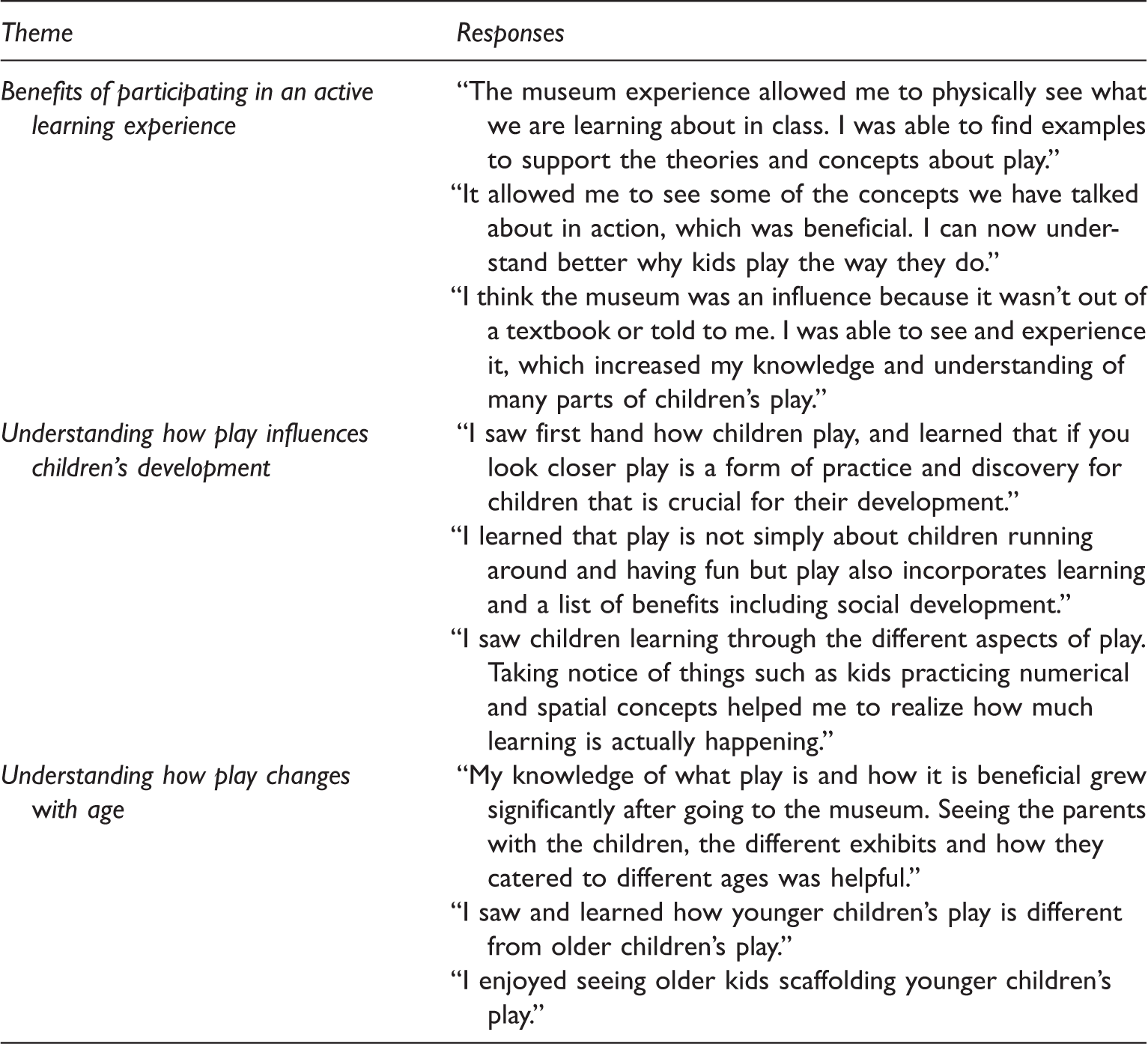
Example Student Responses to the Open-Ended Post Assessment Question, “How Did the Museum Experience Influence Your Learning About Children’s Play?”
Discussion of Results and Implications for Teaching Child Psychology
The goals of this paper were to describe an innovative pedagogical approach involving an active learning experience at a children’s museum and report initial data regarding how the museum experience may have impacted students’ knowledge of the developmental benefits of play. Overall, the results of this study provide preliminary evidence for the benefits of the museum experience for undergraduate child psychology students.
There are several possible reasons why the museum experience appeared beneficial for students’ learning about play. First, consistent with constructivist theory, which emphasizes applied learning through active discovery (Narayan et al., 2013), students were engaged in the learning process. Many students commented that the museum trip allowed them to see course concepts “in action” and learn in a way that may not have been possible through lecture and reading alone. Second, this experience provided an opportunity for students to apply what they learned in class. They were challenged to think critically while identifying the child behaviors that best illustrated the function of play that they were observing. While writing their response papers, students evaluated and synthesized what they had observed, which may help to explain why the museum trip appeared to be related to gains in students’ learning about the developmental benefits of play.
Based upon the small-scale nature of this study and its many limitations, the empirical results presented in this paper are limited in scope and therefore should be viewed cautiously as preliminary findings. We recognize that students in the trip group participated in a variety of activities (e.g., the trip itself, class discussion of developmental benefits of play prior to the trip, watching a short video about the benefits of play upon entering the museum, writing a response paper about the trip) in which the comparison group students did not participate. One alternative explanation for our findings is that students in the trip group gained additional exposure to course content through some combination of these activities rather than just the trip itself. By participating in a broader range of activities related to the developmental benefits of play, the trip group spent a greater amount of time on this topic than the comparison group, which also could have contributed to the findings. According to Lew and Schmidt (2011), self-reflection on the processes of learning and the course content is effective to a small extent in improving undergraduate students’ academic performance in introductory applied science classes. Engaging in reflection activities (e.g., class discussion after the observation time at the museum, the response paper) may have contributed to the improvements in learning for students in the trip group instead of (or perhaps in addition to) the trip itself. Future studies should be conducted to isolate which specific aspects of the trip condition produced significant changes in students’ knowledge from pre to post.
From the perspective of faculty who teach child psychology courses, incorporating experiences such as the museum trip can help to accomplish course goals. Although planning the museum trip required additional effort for the instructor, the benefits extended beyond what students reported on the knowledge assessment. One unanticipated result was a change in class dynamics, with students feeling more comfortable with each other and participating more frequently in class discussions after the trip. This observation is consistent with Galizzi (2014), who reported stronger classroom camaraderie and a sense of “belonging” among classmates following an undergraduate economics class field trip that fostered increased interaction with the teacher and peers. For instructors who do not have access to a children’s museum, other possible activities include inviting children to class, having students host a child-friendly event on campus (e.g., carnival for children/families), or incorporating a service-learning component with children in the community.
The current evaluation involved a small number of students from only one institution, and a knowledge assessment that included a limited number of items that were identical across two assessment points. The wording of the open-ended reflection question completed by the trip group at the post assessment (i.e., “How did the museum experience influence your learning about children’s play?”) assumed that the museum trip positively influenced students’ learning. Future studies on this topic could restate this question more neutrally. Students could also be asked to state explicitly what they learned about children’s play at the museum and which aspects of the trip may have promoted their learning about play to more accurately assess the relationship between their observations and changes in their understanding of course material. Given that the majority of the sample was female, we were unable to examine possible gender differences. Future studies with a more even gender balance could address this limitation. Future studies should also gather other participant demographics (e.g., race, ethnicity, class year) so that these characteristics of the sample could be reported and incorporated into the analyses as well.
Additional research that utilizes a more comprehensive knowledge assessment (e.g., larger number of both factual and applied items) would build upon the current findings. Administering alternate forms of the assessment at pre and post would also allow for a more rigorous evaluation of students’ learning. Future studies could also examine whether the performance on the post assessment differed depending upon the particular function of play that students observed. Additional studies could assess other active learning strategies to determine which are most effective and meaningful for students in child psychology courses. In summary, we urge other child psychology course instructors who are interested in utilizing the pedagogical strategy of a museum class trip to design more rigorous studies that address the limitations of this study to reach more firm conclusions about the impact of this experience on students’ knowledge of the developmental benefits of play.
Footnotes
Declaration of Conflicting Interests
The author(s) declared no potential conflicts of interest with respect to the research, authorship, and/or publication of this article.
Funding
The author(s) disclosed receipt of the following financial support for the research, authorship, and/or publication of this article: This research was supported by a teaching grant awarded to the first author from the Center for Teaching at Learning at Hobart and William Smith Colleges.