




Abstract
Reflective learning entails a thoughtful learning process through which one not only learns a particular piece of knowledge or skill, but better understands how one learned it—knowledge that can then be transferred well beyond the scope of the specific learning experience. This type of thinking empowers learners by making them more active participants in the learning process. There is also evidence to suggest that reflective learning can help students manage the negative emotions (e.g., anxiety, and disappointment) that may arise while taking a challenging course. Such emotions can be rampant in statistics courses, especially for non-statistics majors (e.g., psychology students). Because the introductory statistics course is such an important (though often dreaded) course for psychology undergraduates, I believed that the learning experience could be improved if students were encouraged to engage in more reflective thinking. To this end, I introduced a reflective learning journal into my class. In this report, I briefly review my rationale for incorporating a reflective learning journal into an introductory statistics course. I then describe how this was accomplished and share some preliminary evidence of its positive effects on the student learning experience.
Introduction
Introductory statistics is a compulsory course for virtually all psychology majors (e.g., American Psychological Association, 2013) and yet it is no secret that this course is often dreaded. Students tend to assume that learning statistics is either going to be boring, difficult, or both. Unlike most other psychology courses, the majority of students enter statistics courses out of necessity, rather than out of excitement or general interest in the course material (Conners, McCown, & Roskos-Ewoldsen, 1998; Schutz, Drogosz, White, & Distefano, 1998). Even those who are genuinely curious about the material tend to be reticent about the class, worrying about their ability to do well. As others have pointed out, statistics instructors face a number of unique challenges, with student anxiety being chief among them (Conners et al., 1998).
Statistics Anxiety
Worry and fear surrounding statistics is so prominent that it has received a great deal of attention from researchers and instructors, and the term statistics anxiety is used to refer to the anxiety that students’ feel when encountering statistics of any kind (Onwuegbuzie, Daros, & Ryan, 1997). This anxiety (like any anxiety) is characterized by features such as extensive worry, intrusive thoughts, and mental disorganization, and importantly, it can interfere with the ability to complete statistical tasks (Zeidner, 1990). It is distinct from mathematics anxiety, although the two are often correlated, as one might expect (Malik, 2014; Zeidner, 1991). Students in psychology and other non-mathematics programs are particularly likely to experience anxiety toward statistics (Onwuegbuzie & Wilson, 2003), and notably, such anxiety can afflict even high-achieving students and those who are highly motivated, such as students in graduate programs (Onwuegbuzie & Daley, 1999). The experience of anxiety during a test-taking situation can interfere with working memory and lead to decrements in performance (e.g., Macher et al., 2013). However, statistics anxiety can also have indirect effects on learning, for example, by causing students to delay in enrolling in statistics courses or promoting other self-handicapping (e.g., procrastination) behaviours (Onwuegbuzie, 2004). For example, Onwuegbuzie (2004) has found that graduate students with high statistics anxiety will at times delay enrolling into required statistics courses until the final semester of their program. Students with higher levels of statistics anxiety are also less likely to persist on difficult statistics-related tasks, less likely to engage in deep processing of the material, and less likely to use self-regulation strategies when they are studying, such as checking to see whether their answers to practice problems are correct (Gonzalez, Rodriguez, Failde, & Carrera, 2016). Unsurprisingly, this contributes to these students earning lower final grades in their statistics courses, compared to those who experience lower levels of statistics anxiety.
Of course, anxiety is not always bad, and the experience of statistics anxiety can sometimes lead to better learning, as it can increase the motivation and effort of the student (Macher et al., 2013; Macher, Papousek, Ruggeri & Paecher, 2015). Researchers have suggested that self-efficacy, broadly defined as the level of confidence a person has in their ability to obtain a particular goal (Bandura, 1977), may be one of the key factors in determining the outcome of statistics anxiety on learning and performance. Statistical self-efficacy can refer to either the confidence one has in their ability to perform statistical tasks (known as current statistics self-efficacy) or the confidence one has in their ability to learn how to successfully perform statistical tasks (known as self-efficacy to learn statistics; see Finney & Schraw, 2003). Students who score higher on these statistical self-efficacy measures tend to perform better on statistical tasks or in statistics courses, and also tend to report having lower levels of anxiety (Finney & Schraw, 2003). So, as instructors of statistics courses, how might we help students deal with their anxiety and increase their self-efficacy? One possibility is to encourage them to adopt a more reflective approach to their learning, and to have them put their thoughts and feelings in writing (for other possibilities, see McGrath, Ferns, Greiner, Wanamaker, & Brown, 2015).
Reflective Learning and Writing
Reflective learning involves more than the simple acquisition of new knowledge or skills. Rather, it refers to a considerate and meaningful learning process, through which one also gains insight into the process of how that learning occurred. This understanding can then be applied beyond the specific learning experience (see Brockbank & McGill, 1998). Reflective learning empowers learners by making them more active participants in the learning process, encouraging them to think about their learning in a deeper and more critical way. For example, in addition to learning the steps that one must take to calculate a particular value (e.g., within-group variance) and understanding what information this value provides, a reflective learner might also think about how much easier it was to remember the steps after they truly understood the conceptual meaning of the value they were calculating. They might then apply this to future situations and focus on first developing their conceptual understanding before turning to the procedural side of things. Many definitions exist for reflective learning, a term sometimes used synonymously with reflecting thinking, critical thinking, critical reflection, and so on. However, the following definition from the UK Qualifications and Curriculum Authority (QCA, 2001, as cited in King, 2002), is one that I like best, and it nicely captures what my intent was for adopting the reflective learning journal in my class: Critical reflection is taken to mean a deliberate process when the candidate takes time, within the course of their work, to focus on their performance and think carefully about the thinking that led to particular actions, what happened and what they are learning from the experience, in order to inform what they might do in the future. (QCA, 2001, p. 8)
Journal writing also provides an outlet for emotional expression, allowing students to label their feelings (e.g., disappointment, and nervousness) which can lead to a greater understanding of the experience that led to the emotion (Pennebaker, 1997) and better performance. In a series of laboratory and field experiments, Ramirez and Beilock (2011) demonstrated that completing a short expressive writing assignment immediately before an anxiety-inducing test resulted in higher test scores compared to students in control (no writing or writing about unrelated topics) conditions. The effect of the expressive writing task was particularly strong for those with chronic test anxiety. Similarly, Salinas (2004) reported that some students found it useful to be able to express their emotions (e.g., frustration) in their journal entries, and that it enabled them to move past the negative feelings and concentrate better on the course material.
The Course and Reflective Learning Journal Assignment
One semester of introductory statistics is mandatory for all psychology majors and specialists in our department, and it is a prerequisite for all upper-level (third and fourth year) psychology courses. In the semester that I introduced the journals, the final enrollment in my class was 179 students. Survey data collected before the first day of class (n = 97) indicated that over 50% of the students entering the course agreed with the statement “I feel very anxious about this class”, and over 90% of them agreed with the statement “I feel very motivated to do well in this class”. These findings thus confirmed my belief that the students entering my class were nervous but highly motivated to succeed, and provided further incentive for me to implement the reflective learning journal as a way to help the students improve their learning and deal with their anxiety.
Students were informed (via the syllabus and during the first day of class) that the completion of a reflective learning journal would be worth 5% of their final grade. The reflective learning journal was set up using the journal tool in our course learning management system (LMS) and students were required to submit eight unique journal entries throughout the (12 week) semester. Students were encouraged to set aside time each week for reflection, and instructed that they would not receive credit for entries that were made in quick succession of each other (e.g., they could not submit all eight entries during the last week of class), as this defeated the purpose of the journals. It was emphasized that the journals were for them, and that if done properly, this type of reflective thinking could help them perform better in the course and learn better more generally. During the first day of class I discussed how the journal could help them learn more effectively, organize their thoughts and emotions, and track and evaluate their progress throughout the course. Written information was also provided in the instruction section of the journal, so that the students could easily remind themselves of what they were supposed to be doing with these entries. For example, students were told that reflective learners continually think about what, why, and how they are learning, what their strengths and weaknesses in learning are, and how they are working toward their learning goals (see Coughlan, 2007, p. 3). Importantly, emphasis was also placed on what the journals were not meant to be. Specifically, it was explained that the journals were not a diary (not a narrative account of their personal lives), not a log of events (a purely descriptive summary of how they studied, for example, would not be given credit), and not a discussion board (not a place to ask the instructor questions about the course).
I personally reviewed all of the journal entries, and students were notified if an entry was not acceptable (and would therefore not count as one of their eight entries). The students could see through the LMS that the journal was worth eight points, and they knew that their entry was accepted if they saw that their mark had increased by a point (e.g., 1/8 for their first entry). With a few exceptions (during the busiest times of semester), I devoted time at the end of each week to reviewing the journal entries. I was particularly vigilant about reviewing students’ entries at the beginning of the semester, so that the students could be confident they were following instructions appropriately. In the few rare cases where entries were deemed inappropriate (e.g., too personal, too short, and lacking any evidence of reflection), students were given the opportunity to submit another entry to make up for it. No student ever submitted multiple rejected entries. At the end of the semester, the mark out of eight was converted into a mark out of five, such that students who submitted more entries were rewarded with a higher overall mark for the journal (e.g., a student who had submitted 7/8 entries would have earned 4.375% out of the possible 5%).
Journal Completion Rate and Overall Impression
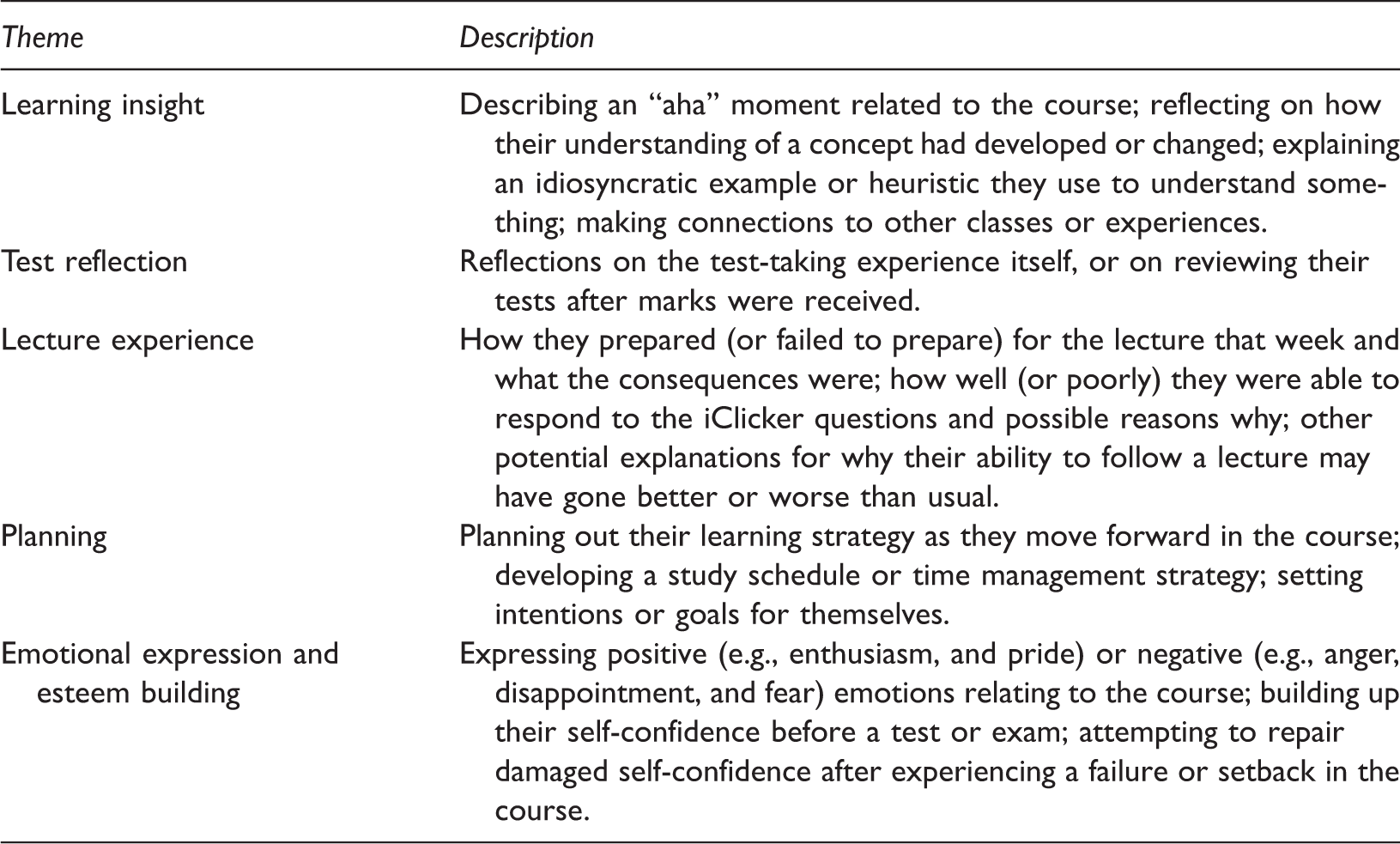
As can be seen in Figure 1, of the 179 students who completed the course, 164 of them completed at least one journal entry, and almost half (44%) completed all eight required entries (mean (M) = 6.15, standard deviation (SD) = 2.45, median = 7). Entries were typically a single paragraph in length. While the journals varied greatly in terms of their content and style, as I read through the entries over the course of the semester, it became easy to notice a number of common recurring themes. While I was not able to devote the time or resources to a formal thematic analysis (e.g., Fereday & Muir-Cochrane, 2006), Table 1 provides an overview of some of the most common themes that I noticed throughout my reading of the journal entries: learning insights; test reflection; lecture experience; planning; and emotional expression/esteem building. Together, this provides an illustrative summary of what the (approximately 1000) journal entries looked like. Needless to say, many of the entries showcased more than one of these themes. For example, in one entry a student shared a learning insight she had had regarding the benefits of learning how to use multiple approaches (e.g., alternative equations) to solve the same problem (e.g., finding pooled variance). She then went on to describe her plan for using this insight to improve her studying for the final exam. Another student wrote an entry after attending a test review session and realizing that he had made many small but costly errors on his test. He recognized that he had been careless while taking the test and overconfident while studying, and expressed his annoyance and frustration with himself for acting in this way. Critically, he then formulated a plan for remedying these problems and changing his overall approach to all of his courses. Overall, I was impressed (and pleasantly surprised) with the quality of the journal entries. Reviewing the journals also allowed me to learn more about the students and track their progress more closely than I had previously been able to do in the course, which was a benefit I had not considered before assigning the journals.
Frequency distribution of the final number of journal entries submitted. Description of Common Themes Found in the Students’ Journal Entries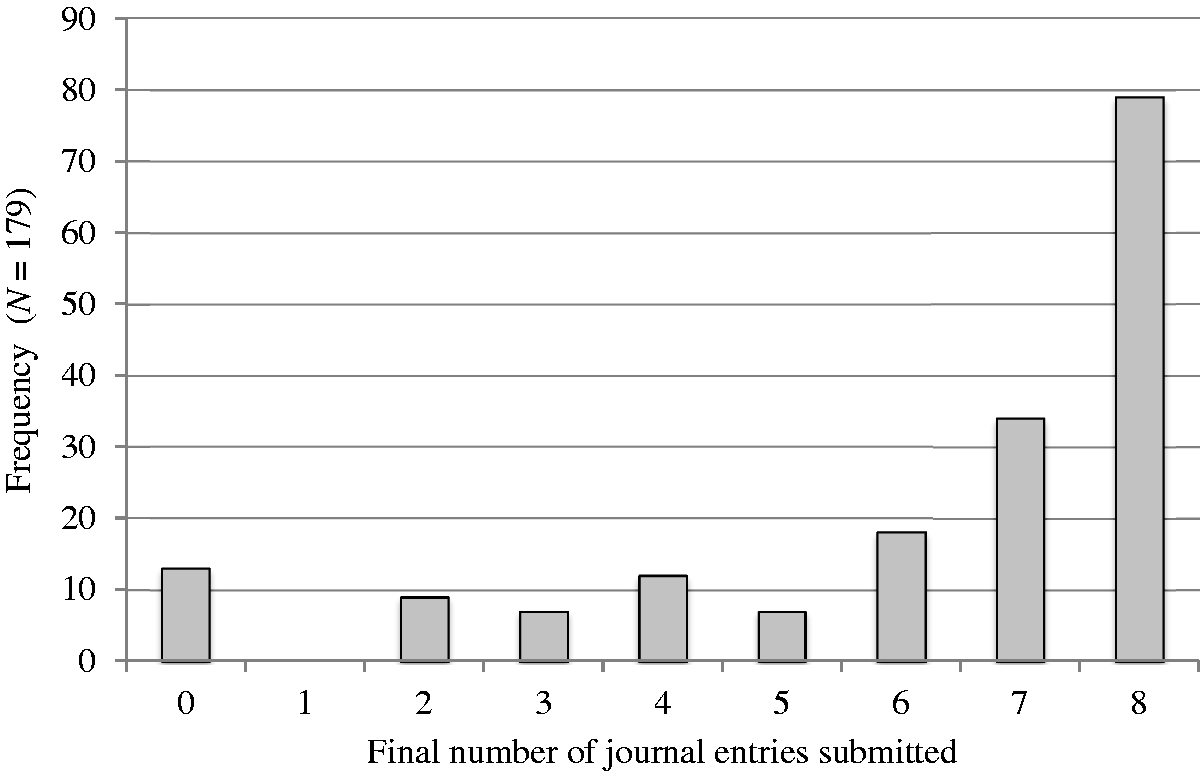
Students’ Perceptions of the Journals
As part of a mid-semester course evaluation, the students were asked two questions that were relevant to the journals. Responses to the following items were provided on a 5-point Likert-type scale that ranged from 1 (strongly disagree) to 5 (strongly agree). The most frequent response to the item “I like completing the journal entries” (n = 78) was neither agree nor disagree (n = 29), with the rest of the responses approximately evenly divided between agree and disagree (M = 3.05, SD = 1.02, median = 3). So, while the class did not appear to love the extra work of completing the journal entries, I was relieved to know that the task was not universally hated. The class was similarly split in their responses to the item “Knowing that I need to write a journal entry encourages me to pay more attention to how I am learning as I go through the course material”, M = 3.06, SD = 1.02, median = 3, though in this case agree was the single most common response (n = 31 out of 82 responses). Responses to these two items were moderately correlated, r(76) = 0.57, p < 0.001, indicating that students who tended to enjoy the journals more were also paying more attention to their learning.
Interestingly, many of the students devoted their final journal entry to a reflection on the journal writing assignment as a whole, with many commenting on how their opinion of the journals had changed throughout the semester. For example, one student wrote: I was really skeptical about these journals. I thought they would be pointless and a waste of time, but now I am so glad that we had to do them. It really forced me to reflect about statistics and my studying habits. I have started to reflect more about my other courses as well. I don't write anything but I spend a few minutes each week to think about my courses, assignments and lectures. I think it has helped to calm me down during exam periods. Usually I always freak out, but I was pretty calm this exam period. Maybe it is because I have been forcing myself to take responsibilities for my faults and prioritize better.
Although I did not have the opportunity to survey the students on their anxiety levels at the end of the semester, one of the standard student course evaluation items at our institution asks the students to indicate (on a scale from 1 not at all to 5 a great deal) whether the course material “inspired me to learn more about the subject matter”. Given that statistics anxiety is associated with an avoidance of statistics-related material (e.g., Gonzalez et al., 2016; Onwuegbuzie, 2004), this question may be viewed as an indirect (and admittedly far from perfect) indicator of students’ anxiety levels at the end of the course. It is also, of course, simply an indicator of how much students like the course material. Compared to the previous semester of the course in which the students did not complete the journal assignment (M = 2.8, SD = 1.2), students from this class with the journal assignment rated this item a full scale point higher (M = 3.8, SD = 1.1), t(267) = 6.56, p < 0.001. Of course, there are other differences between these two classes (e.g., the time of day in which the course was taught) that may also be contributing to this difference, but the result is promising nonetheless. In the future, it would be beneficial to more closely track students’ statistics anxiety throughout the course, in order to more accurately assess the specific impact of reflective journal writing on anxiety.
Relationship Between Reflection and Learning
Of course, one remaining question is whether or not the journals actually helped the students learn the course material. Because I do not have a control group, I do not have the appropriate data to be able to answer this question. However, there is at least some evidence to tentatively suggest that the journals may have helped the students perform better in the class. Specifically, data from the class show that students who completed more journal entries performed better on the final exam, r(172) = 0.51, p < 0.001, and that this relationship holds even when controlling for scores on the first test r(171) = 0.29, p < 0.001. This indicates that the positive relationship between journal completion and exam scores cannot be entirely explained by the higher achieving students simply doing well on everything (or the weaker students doing poorly across the board). Because so many of the students commented on how the journals had helped them manage their time, organize their thoughts, or keep on track, it certainly seems possible that being a more dedicated journal writer could have left students better prepared to deal with the challenges of preparing for the final exam. I hope to explore this idea more fully in the future.
Limitations and Future Directions
While this paper describes a novel assignment for a statistics course and provides instructors with the rationale and information they would need to implement such an assignment within their own courses, it is important to highlight the limitations of the current evidence regarding the effectiveness of the assignment. For example, I have relied on self-reported assessments of whether students believe the journals are encouraging them to pay attention to their learning, but students may lack such introspective awareness (Nisbett & Wilson, 1977). It would be better to have a more direct assessment of the impact of the journals on the student learning process. Future research should examine the impact of the journal assignment on specific outcomes including statistics anxiety, statistical self-efficacy, comprehension of course material, motivation, and engagement, using valid and reliable measures of these constructs (for example, by using the Statistics Anxiety Rating Scale to measure statistics anxiety; Cruise, Cash, & Bolton, 1985). The journal entries themselves also provide a rich source of data, and important insights may be gained by performing a more formal thematic analysis on the journal data (e.g., Fereday & Muir-Cochrane, 2006).
In addition, it would be useful to gather information on why some students seem to enjoy the reflective writing task more than others. For example, some students (e.g., English Language Learners) may find the writing process to be particularly burdensome. Allowing for different types of journal entries (e.g., audio or video) may help these students reflect in a way that is more comfortable, and therefore more constructive, for them. Other students may benefit from receiving more specific prompts for their journal entries. These types of structured journals can be beneficial for getting students to recognize difficulties, but they can also prevent more personal reflection from occurring (Learning to Learn Project, 2002). Because I think it is important that the students feel in control of their own reflection, it may be useful to provide a weekly prompt as an option, but make it clear that the students are not required to follow it.
Conclusion
Reflection is critical to learning, and reflective writing in particular can help students cope with anxiety. Though statistics is not a course that one generally associates with writing, it is precisely this type of challenging and anxiety-provoking course where the students may benefit the most from engaging in a reflective writing practice. Preliminary evidence from my course supports what many others have found—that such a practice can indeed be beneficial to students in terms of helping them recognize more effective strategies for learning and managing their anxiety. Unlike many other approaches for helping students deal with statistics anxiety (e.g., McGrath et al., 2015), this activity does not require instructors to modify their approach to teaching or change their existing course in any significant way. Indeed, the adoption of a reflective learning journal is a relatively minor addition that could be made to any course, regardless of class size or delivery-method (e.g., online or in person). By doing so, instructors can encourage their students to gain insights into their learning that will hopefully stay with them far beyond the last day of class.
Footnotes
Declaration of Conflicting Interests
The author(s) declared no potential conflicts of interest with respect to the research, authorship, and/or publication of this article.
Funding
The author(s) received no financial support for the research, authorship, and/or publication of this article.