



Abstract
Evidence-based knowledge about intellectual giftedness is important for identifying, counseling, and fostering intellectually gifted students. How much teachers actually know about intellectual giftedness is unclear because previous studies have relied solely on self-reports. This study aimed to: (a) develop a test for the assessment of teachers’ knowledge about intellectual giftedness defined as an intellectual capacity significantly above average, the identification of giftedness, and characteristics of gifted students; and (b) inspect some correlates of teachers’ performance on a knowledge test. The final version of the test comprised 38 items and a true–false–do-not-know response format. Sixty-three German secondary school teachers completed the test. On average, teachers answered 26.8% of the items correctly, 34.7% incorrectly, and 38.1% with “do not know.” The higher teachers’ rate of misconceptions, the more negative was their attitude toward fostering gifted students. Personal contact with the gifted was correlated with subjective knowledge but not with assessed knowledge. The results stress the importance of intellectual giftedness as a psychological topic to be addressed during teacher education.
Keywords
In each field, whether it is music, sports, or the intellectual domain, there are exceptional talents. Among them, intellectual giftedness is probably one of the most glamorous types of giftedness, surrounded by many myths. On the one hand, there is the picture of the admired intellectual genius. On the other hand, intellectually gifted persons are portrayed as suffering more often than others from social and emotional problems such as distress, depression, or loneliness (e.g., Bain, Choate, & Bliss, 2006). Whereas some of these characteristics might be true for some individual intellectually gifted students, studies systematically comparing unselected samples of intellectually gifted students with appropriately matched samples of non-gifted students have hardly supported these myths. On the contrary, if differences between intellectually gifted and non-gifted students exist, they tend to favor gifted students (for a summary, see, e.g., Francis, Hawes, & Abbott, 2016). If teachers share such myths, they are at risk of not meeting intellectually gifted students’ needs adequately. Therefore, evidence-based knowledge about intellectual giftedness and intellectually gifted students is part of the professional knowledge that teachers need to obtain during teacher education at university. However, how much teachers actually know about intellectual giftedness is unclear because previous studies have relied solely on teachers’ self-reports.
Against this background, this study sought to develop a test for assessing teachers’ actual knowledge about empirical research findings on both intellectual giftedness and intellectually gifted students and to explore the relations between teachers’ knowledge, attitudes toward fostering gifted students, and personal contact with gifted students. We thereby focused on intellectual giftedness because evidence-based knowledge about intellectual giftedness is relevant for all teachers, irrespective of the subjects they teach (maybe except from subjects such as physical education or arts), which makes intellectual giftedness an important research field in educational psychology and an important topic in teacher education too. Thus, in what follows, the term giftedness refers exclusively to intellectual giftedness, without any intention to devalue research on other types of giftedness (e.g., musical giftedness).
Giftedness as a Psychological Construct
In the history of research on intellectual giftedness, several definitions of giftedness have been proposed (see, e.g., Sternberg & Davidson, 2005). Terman (1925) established the traditional definition by defining giftedness as a high level of Spearman’s (1904) general intelligence g. More precisely, among the followers of the traditional conception, it has become common to define giftedness by an intelligence test score that is more than two standard deviations above the mean (e.g., Rost, 1993, 2009; Roznowski, Reith, & Hong, 2000; Thompson & Oehlert, 2010; however, when nominating students for gifted promotion programs, this cut-off value is sometimes softened). In contrast to this unidimensional approach, from the 1970s on, alternative definitions of giftedness have been suggested; these propose a multidimensional structure of intellectual giftedness. For example, Renzulli (1978) and Mönks (1990) assigned major roles not only to intelligence but also to creativity and motivation in bringing forth giftedness. Further, these conceptions regard giftedness as high achievement rather than as high potential.
However, despite these alternative developments, there are many theoretical and methodological reasons to adopt the unidimensional conception (Rost, 2013; see also Bergold, Wirthwein, Rost, & Steinmayr, 2015). For example, general intelligence is a highly stable construct and the best singular psychological predictor of many important life outcomes such as scholastic achievement, professional success, and socioeconomic status. Furthermore, multidimensional models such as those by Renzulli (1978) or Mönks (1990) require high scores on several different constructs unless there are rules about weighting the importance of different dimensions or about compensatory effects between the dimensions when identifying the gifted. The need for high scores on several constructs poses the problem that the group of gifted individuals will shrink and finally vanish as the number of constructs rises. Further, general intelligence can be reliably assessed, and there are a large number of valid intelligence tests with reasonable psychometric properties. By contrast, measures of, for example, creativity and motivation often do not meet the same high psychometric standards that intelligence tests meet (see also Robinson, 2005). Thus, the use of general intelligence as the decisive characteristic underlying the definition of giftedness has prevailed in giftedness research (e.g., Baudson & Preckel, 2013; Rost, 1993, 2013; Roznowski et al., 2000; Wirthwein & Rost, 2011).
Characteristics of Gifted Students
If giftedness is defined as a general intellectual capacity that is significantly above average (e.g., Terman 1925), gifted students are naturally characterized by very high intelligence test scores. Gifted students also show higher academic achievement than students of average ability, which is in line with the finding that intelligence is one of the most powerful positive predictors of academic achievement (e.g., Gottfredson, 1997). For instance, gifted students earn higher grades than non-gifted students (Roznowski et al., 2000). In line with their higher achievement, gifted students also report higher academic self-concepts (Davis & Connell, 1985; Preckel, Götz, & Frenzel, 2010; Rost & Hanses, 1997). They further seem to be more strongly intrinsically motivated for school (Gottfried & Gottfried, 1996) and tend to put more effort into school (Roznowski et al., 2000). Only around 12% of gifted students are referred to as underachievers, that is, students showing lower academic achievement than would be expected on the basis of their intellectual potential (Rost & Hanses, 1997).
In contrast to this rather positive picture of gifted students’ intellectual abilities and academic achievement, public opinion often paints a negative picture of gifted students with regard to their personality and socioemotional competencies. For example, public media often portray gifted students as nerdy, emotionally unstable, and unsocial (e.g., Cox, 2000; Vialle, 2007; for an overview, see Baudson, 2016). However, ample research on the psychosocial adjustment of gifted students has contradicted this opinion (for a recent literature review, see Francis et al., 2016). Gifted students were found to be at least as well-adjusted as their non-gifted peers (e.g., Richards, Encel, & Shute, 2003; Sayler & Brookshire, 1993; Shechtman & Silektor, 2012) except for underachievers or some extremely gifted students, that is, students with intelligence test scores around three standard deviations or more above the mean (e.g., Francis et al., 2016). For example, gifted students were not at higher risk for psychiatric disorders (Martin, Burns, & Schonlau, 2010; Reis & Renzulli, 2004). In addition, they reported similar levels of well-being (Wirthwein & Rost, 2011), stress (Zeidner & Shani-Zinovich, 2011), life satisfaction (Bergold et al., 2015), and social relationships (Schilling, 2000). They also participated in leisure activities at least as much as their non-gifted counterparts (Roznowski et al., 2000). Extremely gifted students and gifted underachievers, however, seem to have, on average, more social or emotional problems than other gifted students have (Francis et al., 2016; Sparfeldt, Schilling, & Rost, 2006).
In sum, the majority of gifted students show higher academic achievement and higher academic motivation than their non-gifted peers. Empirical research has further suggested that most gifted students do not differ from non-gifted students regarding their psychosocial adjustment. When differences were found, they tended to favor the gifted, except for extremely gifted students. Also, gifted underachievers seem to be more prone to a lack of motivation and psychosocial or emotional problems, all of which have also been discussed as possible reasons for the underachievement phenomenon (for a summary, see Obergriesser & Stoeger, 2015).
Knowledge about Giftedness as a Part of Teachers’ Professional Competence
Teachers’ professional knowledge and beliefs are both ingredients of teachers’ professional competence (e.g., Kunter et al., 2013). Whereas beliefs are not required to be consistent or justified when challenged, knowledge is (Baumert & Kunter, 2013; for a more profound discussion of the relation between the constructs, see Pajares, 1992). In his seminal teacher knowledge taxonomy, Shulman (1987) distinguished between content knowledge, pedagogical content knowledge, and pedagogical knowledge. Various subsequent models and studies on teachers’ professional competence have applied this distinction (e.g., Blömeke, Kaiser, & Lehmann, 2010; Kunter et al., 2013). Current research on teachers’ professional knowledge often extends pedagogical knowledge to pedagogical–psychological knowledge (PPK; e.g., Kunter et al., 2013; Voss, Kunter, & Baumert, 2011). This approach views PPK as subject-unspecific knowledge that contains declarative and procedural knowledge. This is “needed to create and optimize teaching-learning situations across subjects,” and covers knowledge about learners, learning, and teaching (Voss et al., 2011, p. 952). Knowledge about giftedness and (fostering) gifted students is a part of PPK that falls within the scope of (educational) psychology courses that are a compulsory component of university teacher education in most countries (Patrick, Anderman, Bruening, & Duffin, 2011; Woolfolk Hoy, 2010).
As a part of teachers’ PPK, knowledge about giftedness is assumed to contribute to teachers’ overall success. For instance, teachers’ PPK in general was found to be an important positive predictor of teachers’ instructional quality (e.g., König & Pflanzl, 2016; Voss et al., 2011) and teachers’ well-being (e.g., Klusmann, Kunter, Voss, & Baumert, 2012; Lauermann & König, 2016). Knowledge about giftedness is considered especially relevant for identifying gifted students, for adaptive teaching and promotion that meets the needs of gifted students, and for counseling parents of gifted students (Heller, Reimann, & Senfter, 2005; Troxclair, 2013). It gains further importance as a counterbalance to the myths and misconceptions surrounding giftedness in public opinion.
In Germany, knowledge about giftedness, special aptitudes, and their diagnosis is explicitly described as a set of competencies that should be obtained during teacher education at university (Kultusministerkonferenz, 2004). However, whether teachers actually meet this standard is not yet known. Although various tests for assessing teachers’ PPK have been developed, knowledge about giftedness has largely been neglected (for a recent overview of German instruments, see Voss, Kunina-Habenicht, Hoehne, & Kunter, 2015). Heller et al. (2005) found that nearly 90% of the elementary school teachers in their sample reported that they did not gain knowledge about giftedness during university teacher education; approximately 80% agreed with this statement for teacher training too. Less than 50% felt confident about identifying gifted students, and less than 20% felt confident about fostering gifted students (Heller et al., 2005). These self-reports convey an alarming picture of teachers’ knowledge about giftedness even if they are somewhat biased by memory effects.
Empirical research has further suggested that teachers hold negative stereotypes and misconceptions about gifted students, and these reflect the portrayal of giftedness in the media summarized above. For instance, teachers were found to associate giftedness in male students with adjustment problems (Preckel, Baudson, Krolak-Schwerdt, & Glock, 2015) and to rate gifted students in vignette experiments as less extraverted, less emotionally stable, less agreeable, less prosocial, and more maladjusted than non-gifted students (e.g., Baudson & Preckel, 2013, 2016). All of these conceptions contradict the empirical evidence summarized above. School type or teachers’ experience with gifted students was not found to moderate the effects (Baudson & Preckel, 2016). However, these studies focused on beliefs about fictitious gifted students and did not assess teachers’ actual knowledge about giftedness. Further, the higher internal validity of experimental studies comes at the price of lower external validity. The extent to which teachers outside of experimental or laboratory settings share such beliefs or possess actual knowledge about both giftedness and the characteristics of gifted students is unclear.
Indeed, if teachers were asked to describe real students they had identified as gifted, they portrayed a very positive picture (Busse, Dahme, Wagner, & Wieczerkowski, 1986; Endepohls-Ulpe, 2004). However, research on the accuracy of teachers’ judgments has shown that teachers’ judgments of students’ intelligence or giftedness was only moderately correlated with students’ intelligence as measured by intelligence tests (e.g., Heller et al., 2005; Machts, Kaiser, Schmidt, & Möller, 2016). Instead, teachers’ judgments seemed to rely greatly on students’ academic achievement. Recent meta-analyses revealed stronger relations between teachers’ judgments of intelligence and academic achievement tests than between teachers’ judgments of intelligence and intelligence tests (Machts et al., 2016). Thus, gifted students with low achievement (i.e., underachievers) are at risk of being ignored by their teachers, whereas high-achieving students with average intelligence might erroneously be nominated as gifted (e.g., Heller et al., 2005; Rost & Hanses, 1997). Particularly, minority students, students from families with lower socioeconomic status, and girls have been found to be at risk of not being identified as gifted (e.g., Carman, 2011; Endepohls-Ulpe & Ruf, 2006). Higher knowledge about giftedness and gifted underachievers should help teachers identify gifted students more accurately, which in turn should enable teachers to better meet the individual needs of both gifted and non-gifted students.
On the Relation between Knowledge, Attitudes, and Personal Contact with Gifted Students
With an intrapersonal focus, teachers’ knowledge is expected to be related to other personal characteristics such as teachers’ attitudes or personal contact with gifted students. Attitudes are defined as a tendency to evaluate someone or something with some degree of favor or disfavor (Eagly & Chaiken, 1993). Attitudes comprise a cognitive component based on beliefs and opinions, an affective component, and a behavioral component. For instance, someone might believe that gifted persons are troublesome, might feel uncomfortable with gifted persons, and might try to avoid spending time with them. Gaining knowledge about the characteristics of gifted persons, through training or personal contact, might change negative beliefs and misconceptions about gifted persons, leading to more positive attitudes. However, there is no reason to expect that knowledge per default leads to more positive attitudes because attitudes are built on the personal evaluation of information. For instance, knowing that nuclear energy can be harmful (knowledge) can lead to a negative attitude toward nuclear power stations in some cases (attitude change), but such change would not be likely to occur in those who view nuclear power stations as safe (no attitude change). For giftedness, however, a positive relation between teachers’ knowledge and attitudes, or rather a negative relation between teachers’ misconceptions and attitudes is likely because research has suggested that teachers (like other persons; Baudson, 2016) hold negative misconceptions (i.e., false beliefs) about gifted students. Providing information that corrects such false beliefs could foster positive attitudes toward gifted students. In a similar vein, knowledge about how to foster gifted students was identified as a prerequisite for a positive attitude toward gifted students and their promotion (Troxclair, 2013). For another group of students who are also confronted with many misconceptions, namely students with intellectual disabilities (Seewooruttun & Scior, 2014), positive relations between teachers’ self-rated knowledge, attitude, and personal contact have already been established (McManus, Feyes, & Saucier, 2011; Seewooruttun & Scior, 2014).
Because no test for the objective assessment of teachers’ knowledge about giftedness exists, studies on the relations between knowledge, personal contact, and attitudes has had to rely on subjective self-reports so far. Whether they are accurate is unclear. A descriptive review study reported slightly positive results on the relation between self-rated knowledge about giftedness and attitudes toward the gifted (Begin & Gagné, 1994): In three out of four studies, higher self-perceived knowledge about giftedness was associated with a more positive attitude. However, these studies could not provide information about the direction of the effect, that is, whether self-rated knowledge caused attitudes, attitudes caused self-rated knowledge, or whether a third variable caused the relation between the constructs. In a more recent study, self-perceived knowledge and personal contact were found to predict support for special gifted promotion programs, with the latter being a stronger predictor than the first (Jung, 2014). An intervention study promoting teachers’ knowledge about acceleration and giftedness (Hoogeveen, van Hell, & Verhoeven, 2005) revealed that teachers who attended an informational meeting and received written information rated accelerated gifted students’ social competence, school achievement, and motivation higher and accelerated gifted students’ emotional problems lower than teachers in the control group. However, as teachers were not randomly assigned to the groups, the study could not conclude that the positive effect in the intervention group was due (solely) to the informational meeting.
Taken together, knowledge about giftedness is considered a prerequisite for identifying and fostering gifted students and a part of teachers’ professional competence. Whether teachers actually possess such knowledge is unclear, as previous studies relied solely on teachers’ self-reports and did not use a more objective test. Teachers’ self-reported knowledge seems to go along with more positive attitudes toward both gifted students and fostering them. However, teachers’ self-reports and experimental studies suggest a substantial level of misconceptions about giftedness and gifted students.
This study pursued two goals. First, we aimed to develop a test for measuring teachers’ declarative knowledge about empirical research on giftedness and gifted students in a sample of in-service teachers. Second, we wanted to explore relations between teachers’ actual knowledge, subjective knowledge, attitudes toward fostering gifted students, and personal contact with gifted students. Prior research has suggested positive relations between self-rated knowledge, attitudes, and personal contact, respectively. We further expected positive relations between attitudes, contact, and assessed knowledge, and negative relations between attitudes, contact, and assessed misconceptions.
Method
Sample
A total of 63 German in-service teachers (65% female) who taught in academic track schools (Gymnasium) or comprehensive schools (Gesamtschule) participated. Their mean age was 35.34 years (standard deviation = 11.01). They were recruited via school mailing lists and were administered the paper–pencil questionnaires at school. Participation was voluntary and not compensated.
Measures
Knowledge test
Due to the methodological challenges attached to multidimensional models of giftedness, their relatively scarce empirical evidence, and the predominance of the unidimensional model in empirical research, we relied on the unidimensional model and findings based on that model and did not take into account alternative definitions of giftedness. More precisely, we constructed true–false items that were based on Terman’s (1925) definition of giftedness (intelligence test score two standard deviations or more above average) and the results of the Marburg Giftedness Project (MGP). The MGP is a German longitudinal study that began in 1987. At that time, 7,023 third graders from 390 classrooms distributed across nine of the 11 Federal States of the Federal Republic of Germany were recruited. Therefore, the MGP draws on a large, unselected sample of gifted students, non-gifted students, their parents, and their teachers. Post hoc analyses revealed that there was no bias with regard to intelligence, indicating that the sample can be seen as roughly representative of its cohort (Hanses, 2009). Furthermore, gifted and non-gifted students were matched with each other according to gender, school environment, and socioeconomic status. This allowed accurate descriptions of the characteristics of gifted students to be made in comparison with non-gifted students (e.g., Rost, 1993, 2000, 2009; Sparfeldt, 2007; Sparfeldt et al., 2006; Wirthwein & Rost, 2011).
Knowledge Test Items and Item Statistics
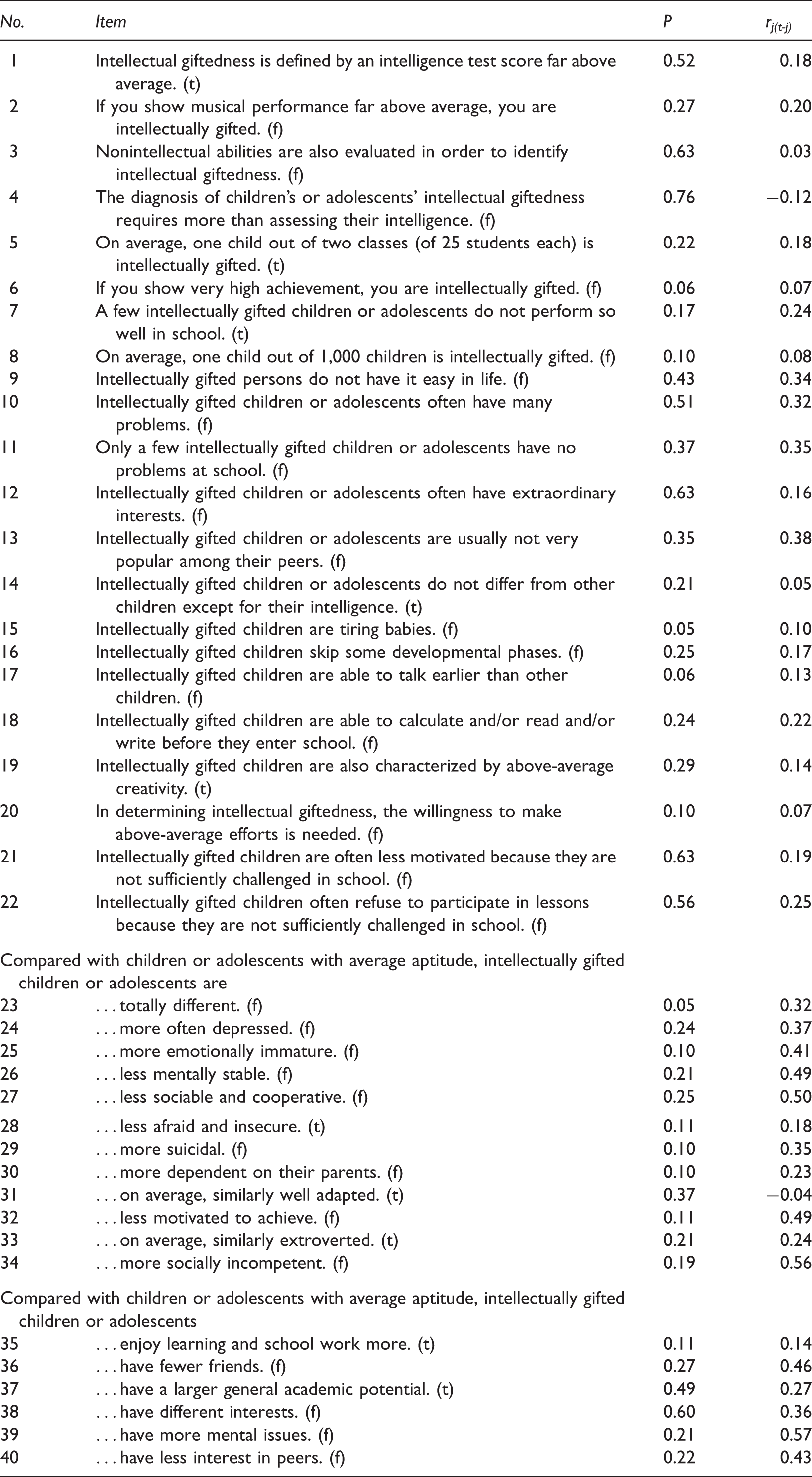
Note. t = true, f = false, P = item difficulty, rj(t-j) = corrected item-total correlation. Items 4 and 31 were dropped due to negative item-total correlations.
Subjective knowledge and its sources
A single item asked how well-informed teachers considered themselves to be about giftedness (1 = not at all, 2 = slightly, 3 = moderately, 4 = well, and 5 = very well). With a multiple-answer format, teachers then indicated where their subjective knowledge came from (university courses, textbooks, training courses, own children, children of friends, practical teacher training, popular media such as newspapers/TV/internet, own professional practice, own giftedness, and other).
Personal contact with gifted students
Three items asked how frequently teachers were in contact with children and adolescents who had been identified as gifted by professionals (e.g., psychologists). The items covered contact in school, contact in personal environment, and contact in neighborhood. The response format was 1 = never, 2 = rarely, 3 = sometimes, 4 = often, and 5 = very often. Items were summed to provide an indicator of teachers’ overall contact with gifted students (α = 0.74).
Attitude toward fostering gifted students
Teachers’ attitude toward fostering gifted students was assessed with five items that could be answered on a 5-point scale (1 = strongly disagree, 2 = disagree, 3 = neutral, 4 = agree, and 5 = strongly agree; α = 0.79). An example item was “Gifted children and adolescents should be fostered at school.”
Results
Knowledge Test
In order to gain information about the properties of the test, we computed item statistics. Results are presented in Table 1. Item difficulties ranged from 5% (Items 15 and 23) to 76% (Item 4). The item–total correlations ranged from −0.12 to 0.57. Two items with negative item–total correlations were dropped (Items 4 and 31). The other items with low item–total correlations were kept as these items had relatively high or low item difficulties, and heterogeneous constructs (e.g., knowledge about giftedness) go along with relatively low item–total correlations (e.g., Fisseni, 2004). A Cronbach’s alpha of 0.79 indicated that the 38-item version had sufficiently high internal consistency.
Because teachers’ incentives for guessing were low, we applied a simple number-right scoring procedure. On average, 10.2 responses were correct (26.8%; i.e., representing knowledge), and 13.2 responses were incorrect (34.7%; i.e., representing misconceptions). Participants selected “do not know” for an average of 14.0 items (36.8%). Teachers’ knowledge varied between 0 and 23 correct responses (0% to 60.5%). Closer inspections revealed that teachers held the strongest misconceptions with regard to the relation between achievement and giftedness: Items 6 (“If you show very high achievement you are intellectually gifted,” false) and 7 (“A few intellectually gifted children or adolescents do not perform so well in school,” true) were the two items with the highest error rates.
Descriptive Results and Correlation Analysis
Descriptive Statistics and Bivariate Correlations
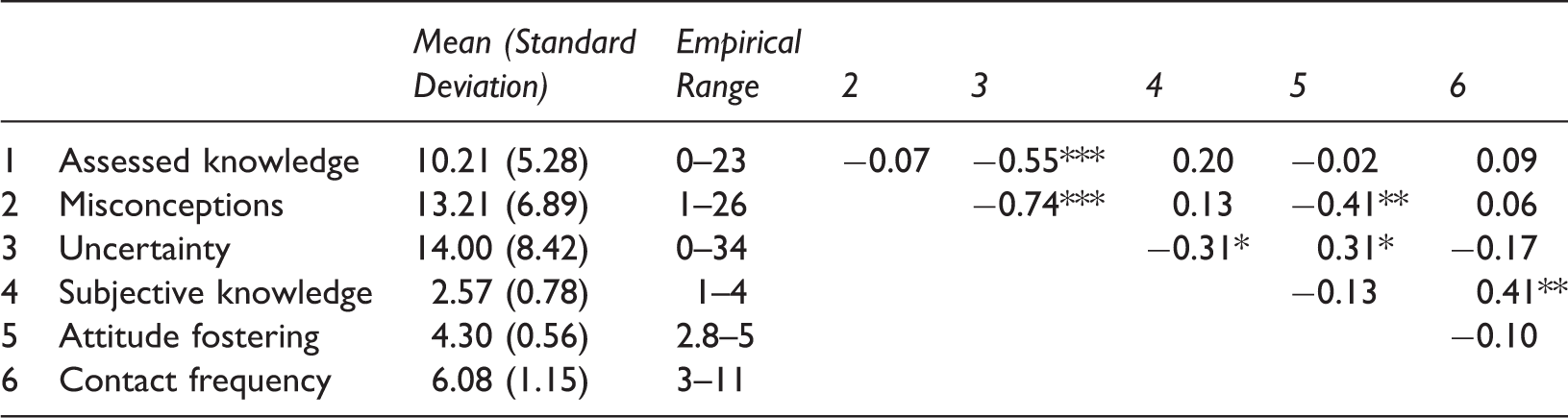
Note. N = 61–63 teachers. Assessed knowledge, misconceptions, and uncertainty refer to the results of the 38-item knowledge test. Rating scales for teachers’ subjective knowledge and attitude toward fostering gifted students ranged from 1 to 5, with higher values indicating higher subjective knowledge and a more positive attitude toward fostering gifted students. Contact frequency is the sum of three items assessing contact with gifted persons in three parts of life, each rated on a scale from 1 = never to 5 = very often.
p < 0.05; **p < 0.01; ***p < 0.001.
Teachers’ actual knowledge was not statistically significantly correlated with subjective knowledge, personal contact frequency, or attitude toward fostering gifted students. However, moderate negative correlations between teachers’ misconceptions and teachers’ attitude toward fostering gifted students were found: The more misconceptions teachers held, the more negative was their attitude toward fostering gifted students. Teachers’ subjective knowledge was significantly negatively correlated with “do-not-know” answers. The small positive correlations between subjective knowledge and actual knowledge or misconceptions failed to reach statistical significance. Personal contact was positively related to subjective knowledge but unrelated to the results of the knowledge test. 1
Discussion
Although knowledge about intellectual giftedness is part of teachers’ PPK and although various tests for assessing teachers’ PPK exist (e.g., Voss et al., 2015), knowledge about giftedness has largely been neglected so far. We aimed to develop a test for measuring teachers’ declarative knowledge about giftedness and gifted students, and exploring knowledge correlates in a sample of in-service teachers. We, thereby, relied on the unidimensional conception of giftedness (e.g., Rost, 2013; Terman, 1925). The item analyses revealed a broad range of item difficulties and a sufficient reliability, suggesting that the test has value for both future research and practice. As a second important outcome, our analyses pointed out that teachers’ level of knowledge was rather low. On average, only about one-fourth of the items were answered correctly and “do-not-know” was the most frequently chosen response. However, the “do-not-know” answer might not only have represented a subjective lack of knowledge. It might also be that teachers marking this option wished to express that the item was true or false depending on certain conditions. If this would have been the case, the knowledge test would probably have somewhat underestimated the teachers’ knowledge.
In contrast to prior studies (Heller et al., 2005) and teachers’ test performance, teachers felt slightly to moderately well-informed about the topic. This discrepancy between objectively assessed knowledge and self-rated knowledge was also documented by the positive but small and not statistically significant correlation between the constructs. Note, however, that due to the sample size the statistical power to detect small effects was limited. Nonetheless, the small correlation suggests that teachers’ perceived knowledge about giftedness does not seem to be a valid proxy for teachers’ actual knowledge about giftedness, thus corroborating the need for an objective knowledge test. Prior research revealed a similarly low accuracy of German teachers’ self-rated knowledge about (students with) Attention-Deficit-/Hyperactivity Disorder (ADHD; Schmiedeler, 2013).
Our findings further indicate a substantial level of misconception about giftedness as also suggested by prior studies (e.g., Baudson, 2016; Baudson & Preckel, 2013, 2016). For instance, around 90% of the teachers believed that high achievement signalizes giftedness (Item 6). This misconception corresponds with teachers’ difficulties in identifying gifted underachievers and their tendency to nominate high-achieving students with average intelligence as gifted (e.g., Heller et al., 2005; Rost & Hanses, 1997).
What might cause the low level of correspondence between empirical findings and teachers’ beliefs? It is striking that university courses, textbooks, or teacher trainings (i.e., opportunities to gain evidence-based knowledge provided by experts in the field) were not the main source of teachers’ subjective knowledge. Instead, popular media (e.g., newspapers, TV, and the internet) were referred to as the most important source of knowledge about giftedness. Where reputable knowledge sources run short, questionable alternative sources seem to step in. This appears quite problematic given the stereotypical picture that the media tend to paint of the gifted (e.g., Cox, 2000; Vialle, 2007). This circumstance might explain why preservice and in-service teachers hold so many misconceptions of the gifted (see also Baudson & Preckel, 2013, 2016; Preckel et al., 2015). Future studies using experimental designs should investigate this explanation more systematically.
Fostering teachers’ evidence-based knowledge about giftedness, particularly about the relation between achievement and giftedness, could be a means to increase teachers’ diagnostic competencies with regard to gifted students. Experimental research is needed to test whether higher levels of knowledge can actually help teachers identify gifted students more accurately than has been done so far (Machts et al., 2016). Increasing teachers’ diagnostic competencies with regard to giftedness would be of great benefit because teachers are often the ones who nominate students for gifted promotion programs (e.g., McClain & Pfeiffer, 2012; Rothenbusch, Zettler, Voss, Lösch, & Trautwein, 2016).
In this regard, it has to be kept in mind that we used the traditional concept of intellectual giftedness as a basis for the knowledge test. We did so because of the many theoretical and methodological advantages of the traditional concept (see Introduction). Yet, one might argue that some items of the test’s first part (Items 1–22) might have been unfair against teachers who follow an alternative conception of giftedness such as Renzulli’s (1978) model (e.g., Item 3: “Nonintellectual abilities are also evaluated in order to identify intellectual giftedness”). Further, a knowledge test based on the traditional concept might have limited practical relevance because there might be many teachers and fostering programs which follow an alternative conception of intellectual giftedness. However, first, the results were not changed greatly when we dropped the first part of the test from the analyses (teachers’ scores even became slightly worse). Second, it might be problematic in general to base selections for a fostering program on models of intellectual giftedness that have not yet been tested empirically, propose relevant dimensions of giftedness quite arbitrarily, and contain dimensions that are not as precisely measurable as is required for individual diagnosis. Therefore, we would advocate relying on the traditional concept not only in research but also in practice. In some practical fields, for example in counselling centers for the intellectually gifted, it is common practice to administer (only) an intelligence test to diagnose intellectual giftedness. Nevertheless, we acknowledge that the usability of the traditional concept of intellectual giftedness has been controversial in the context of fostering programs. In the end, the use of a certain conception of intellectual giftedness will depend on the purpose of the respective program. Therefore, it might be helpful to develop also other versions of the knowledge test, which follow alternative conceptions of intellectual giftedness.
Further, a moderate to strong negative correlation was found between teachers’ misconceptions and teachers’ attitudes toward fostering gifted students. Teachers with more false beliefs about gifted students evaluated the promotion of gifted students more negatively than other teachers did. This finding supports prior studies that reported a positive relation between self-reported knowledge and attitudes toward giftedness (e.g., Begin & Gagné, 1994). Positive correlations between assessed knowledge and attitude has also been found for ADHD (e.g., Bekle, 2004), another facet of teachers’ PPK. Therefore, if this relation proves to be causal in nature, gaining more knowledge about giftedness might help change teachers’ negative attitudes toward fostering the gifted.
Personal contact with gifted students, by contrast, was correlated only with teachers’ subjective knowledge but not with test results. This suggests that personal contact with gifted students does not necessarily help teachers acquire knowledge or reduce misconceptions. Against the background of teachers’ rather low knowledge level, however, the personal contact ratings should be interpreted with care. In most cases, teachers probably did not know students’ intelligence test scores and were therefore likely to apply other criteria to identify gifted students such as students’ achievement (e.g., McClain & Pfeiffer, 2012) to answer the question about the frequency of their personal contact. This bias of low knowledge might also explain the nonsignificant correlations between contact frequency and test results. Due to the predominance of the unidimensional model of giftedness in empirical research, we did not assess teachers’ knowledge about alternative conceptions of giftedness. In future studies, it seems fruitful to take into account what concept or model of giftedness teachers apply if they describe a “gifted” person and how their concept of giftedness is related to teachers’ attitudes or behavior with respect to gifted students. Further, experimental studies are needed to test whether there are causal relations behind the correlations identified in this study, for instance, if higher knowledge actually causes a more positive attitude toward fostering gifted students.
Taken together, the low level of knowledge and the correlational findings underscore the importance of addressing giftedness during university teacher education in order to increase teachers’ knowledge and decrease teachers’ misconceptions. Because giftedness is a prominent research topic in educational psychology, (educational) psychology courses seem to be particularly suited for this endeavor, illustrating the important role of educational psychology in the education of preservice teachers (e.g., Patrick et al., 2011). Our knowledge test itself could be part of this effort. However, mere assessment will not do the trick. Instead, it seems more fruitful to use the test in the context of teaching psychological knowledge about giftedness and gifted students. For instance, the test might be used as a tool to raise students’ awareness about public misconceptions and false stereotypes (e.g., Baudson, 2016) or to assess students’ learning progress and knowledge gains. However, feedback on the test seems to be most important because research has shown that feedback can reduce the risk of acquiring false knowledge due to memorizing distractor items (Butler & Roediger, 2008).
Limitations and Outlook
This study provided a first look at teachers’ knowledge about giftedness and its correlates. The findings are limited due to the cross-sectional study design and the rather small sample of teachers. Replications with larger samples and, thus, more power to detect even small significant correlations, or longitudinal or experimental study designs are needed to increase the generalizability of our findings and to provide insights into the mechanisms behind the correlations revealed in this study. Moreover, research is needed to explore the validity of the test, for instance, by studying the dimensionality of the test in sufficiently large samples or by having external experts in giftedness research evaluate the test items. The test also needs to be evaluated for whether it can discriminate between groups that are expected to differ in their knowledge about giftedness (Hattie & Cooksey, 1984), for example, freshmen and senior university students who have already attended courses or lectures about giftedness or preservice teachers and engineering students. In addition, revising the item wording by stressing that each item is exclusively about giftedness in the intellectual domain (and not about sports or music) could be a way to reduce the risk of misunderstandings. Further, it seems fruitful to add more easy items in order to increase the test’s discrimination at low levels of knowledge.
Concluding Summary
We developed a test to assess teachers’ knowledge about empirical research findings on giftedness, an under-investigated facet of teachers’ PKK. We, thereby, relied on the unidimensional conception of giftedness. Overall, teachers’ knowledge was low, and teachers held substantial misconceptions about giftedness and gifted students. Teachers’ subjective knowledge about giftedness and teachers’ actual knowledge were unrelated. Misconceptions were associated with negative attitudes toward fostering gifted students. Future research is needed to test for causal effects and to explore how teachers’ knowledge manifests in teachers’ behavior and the identification of gifted students.
Footnotes
Acknowledgement
We would like to thank Charlotte Siepmann for her help in constructing the items and collecting the data.
Declaration of Conflicting Interests
The author(s) declared no potential conflicts of interest with respect to the research, authorship, and/or publication of this article.
Funding
The author(s) disclosed receipt of the following financial support for the research, authorship, and/or publication of this article: The current research is part of the project Dortmunder Profil für inklusionsorientierte Lehrer/-innenbildung DoProfiL. DoProfiL is part of the “Qualitätsoffensive Lehrerbildung”, a joint initiative of the Federal Government and the Länder which aims to improve the quality of teacher training. The program is funded by the Federal Ministry of Education and Research. The authors are responsible for the content of this publication.