



Abstract
In this intervention study, we investigated how we could teach university students who were majoring in education to teach reading strategies. The goal of the study was to analyze whether and to what extent students would benefit from the intervention with respect to their own learning. Did their own reading skills improve after they attended the intervention? The sample consisted of n = 61students who were assigned to one of two conditions: (a) an adaption of reciprocal teaching; and (b) a control group that was not taught how to teach reading strategies. The evidence-based teaching method used in the intervention condition consisted of three elements: modeling, scaffolding, and repeated practice. Training success was assessed in a pre-posttest control group design with standardized reading comprehension and reading speed tests. To compare the development of the students in the two conditions, repeated measures ANOVAs were used. At posttest, intervention students outperformed control students in reading comprehension as well as in reading speed.
Introduction
Reading skills are necessary for a person to be able to learn from texts and are essential for lifelong learning. An effective way to understand texts thoroughly is to use reading strategies (McNamara, 2009). Students do not usually learn reading strategies incidentally (Artelt & Dörfler, 2010); therefore, they must be taught directly. Hence, teachers should focus on teaching reading strategies (Pressley, Graham, & Harris, 2006). In the last two decades, research on fostering reading comprehension has yielded several effective reading strategy programs. Currently, however, scientifically based reading instruction programs are still not implemented very often in the classroom by teachers (Koch & Spörer, 2016).
In the present intervention study, we had two goals. On the one hand, we wanted to familiarize students majoring in education with an evidence-based teaching program for fostering the reading skills of primary school students. In so doing, the goal was to prepare today’s university students to use the program in their future regular teaching. On the other hand, we wanted to investigate whether participants would benefit from the intervention in terms of improving their own reading skills. Therefore, the intervention we implemented was designed to determine how to apply and how to teach reading strategies.
Teaching Reading Strategies in Regular Primary School Lessons
Kline, Deshler, and Schumaker (1992) pointed out that teachers were more willing to implement a reading strategy program based on theories from educational psychology when they had experienced its effectiveness. Therefore, there is a need to provide teachers with information on psychological research, for example, regarding the effectiveness of reading strategies and the effective teaching of them (Borko & Putnam, 1996).
This need is evident as educational studies on how to teach reading in a regular classroom setting have indicated that teachers do not spend enough time teaching reading strategies (Ness, 2008). Moreover, Sailors (2009) determined that teachers often have only limited knowledge about how to teach reading strategies and tend to draw from what they learned in their own school experiences when comprehending texts. Strategies such as summarizing or asking questions are commonly used by teachers to assess reading comprehension, but they are rarely taught how to improve it (Hollenbeck & Kalchman, 2013). Indeed, on an overall basis, reading instruction in a regular classroom setting often fails to reflect scientifically based practices (Stanovich & Stanovich, 2003).
Scientifically based reading practices refer to specific programs that include the systematic and stepwise instruction of selected reading strategies that are evidently effective (Fletcher & Francis, 2004). Recent studies on effective reading instruction have pointed to the importance of teachers’ didactical competence in analyzing and systematically developing students’ literacy skills (Darling-Hammond & Bransford, 2006; McCardle & Chhabra, 2004). Incongruously, some study results have suggested that teachers are often not familiar with the knowledge that is necessary to teach reading strategies or reading literacy (Moats & Foorman, 2003; Rosenfield & Berninger, 2009). One reason for this is that teachers are often unfamiliar with specific scientifically based programs (Podhajski, Mather, Nathan, & Sammons, 2009).
Learning How to Teach Reading Strategies
Not only regular teachers, but aspiring teachers too, have a lack of reliable knowledge about scientifically based programs (Mather, Bos, & Babur, 2001). One challenging issue in teacher education is, therefore, that future teachers are not sufficiently prepared to teach reading strategies (Anders, Hoffman, & Duffy, 2000; DeGraff, Schmidt, & Waddell, 2015) even though elaborated knowledge of how to apply reading strategies is essential for them to deliver high-quality reading instruction lessons (Snow, Griffin, & Burns, 2005). Researchers agree that future teachers’ knowledge about scientifically based reading programs—and with this, the ability to teach reading strategies effectively—is an essential presupposition for their learners to become good readers (e.g., Al Otaiba, Lake, Greulich, Folsom, & Guidry, 2012; Podhajski et al., 2009). Moreover, university students’ own positive experiences with an evidence-based teaching program might initiate their openness and readiness to use it in their own future classes (Dunn, Saville, Baker, & Marek, 2013). Guskey (2002) focused on the development of regular teachers after they participated in a teacher training program. He found that a teacher training program was more effective when the teachers had the opportunity to try out a specific scientifically based program during the training. They were also more willing to incorporate such a program into their classrooms when they had positive experiences with it.
In a recent study, Drechsel, Breuning, Thurn, and Basten (2014) instructed university students in teaching fifth graders how to learn from texts. Within this study, the students had the opportunity to teach reading strategies to fifth graders in individual lessons. One result of this two-step intervention was that most of the students reported having subjectively important learning experiences and practically relevant insights with “aha” moments regarding their professional development as a teacher. This study emphasized the importance of individual (positive) experiences that students should have with an approach before teaching it in regular classroom settings.
Furthermore, there are several findings that indicate that teachers’ habits, engagement, and competence in reading are related to those of their students (see the so-called “Peter Effect,” in Applegate & Applegate, 2004; Binks-Cantrell, Washburn, Joshi, & Hougen, 2012). The presumption is that only someone who has a specific ability (here, reading-related skills) can teach this to others. This idea reflects study results indicating that the specific competences of a teacher predict students’ learning outcomes (Brouwer & Korthagen, 2005; Wayne & Youngs, 2003).
Regarding university students’ reading skills, Spinath, van Ophuysen, and Heise (2005) found that students perform on a moderate level. However, their use of reading strategies is generally rather unsystematic (Felipe & Barrios, 2014). To be a good teacher of reading, it is helpful to have a good comprehension of texts, but it is also important to be familiar with effective reading strategies (Carlisle, Kelcey, Rowan, & Phelps, 2011; Phelps, 2009). Therefore, an essential goal of research in this area is to foster the reading skills of future teachers (Joshi et al., 2009) and to teach them about scientifically based reading instruction. In addition, courses on the teaching of reading should be required for all teachers because comprehending texts is a cross-curricular competence that students need for learning in all school subjects (Drechsel & Artelt, 2007; Walsh, Glaser, & Wilcox, 2006).
One scientifically based program for promoting the reading skills of students is reciprocal teaching (RT) (see Palincsar & Brown, 1984). The term RT refers to the application of reading strategies while reading a text together with peers. In this peer group, students interact with each other and alternate in leading the group. More specifically, students learn how to use the four reading strategies of clarifying, summarizing, questioning, and predicting. In their small group, they read texts together and construct comprehension collaboratively. According to this method, students take over responsibility by leading group work and giving feedback on the group members’ application of strategy. Different research groups have demonstrated that this kind of instruction results in better reading comprehension outcomes (Rosenshine & Meister, 1994; see also Hattie, 2009). More recent studies indicated that RT is effective not only for primary school students (Hacker & Tenent, 2002; Koch & Spörer, 2016; Schünemann, Spörer, & Brunstein, 2013), but also for university students who are learning English as a foreign language (EFL) (see Freihat & Al-Makhzoomi, 2012).
So far, researchers have focused on the effects RT could have on reading strategy use and reading comprehension (Hattie, 2009; Spörer, Brunstein, & Kieschke, 2009). In RT, group interactions are organized by the different roles group members take over, and structured by help sheets. We assume that the structured and organized reading of the students benefits their conditional and procedural strategic knowledge. In accordance with prior research on reading strategies (Dole, Nokes, and Drits 2009), this conditional and procedural knowledge may enable students to use their strategic competence to construct the meaning of a text and, moreover, to read texts more fluently through focusing on the most relevant elements of a sentence as well as on linguistic elements indicating the relations of sentences. However, more research is needed for investigating these potentially multifaceted effects of RT.
Because reading instruction research should be closely connected to teacher education (Pressley & Allington, 1999), it is useful to use the RT approach to teach university students about scientifically based reading instruction (Dunlosky, Rawson, Marsh, Nathan, & Willingham, 2013; Hattie, 2009). Whether RT can effectively foster the reading skills of university students majoring in education is an open question.
Research Questions and Hypotheses
In this intervention study, we investigated how to teach university students to teach reading strategies. Four specific reading strategies are part of the RT approach, which is an effective program for supporting primary school students in becoming strategic readers (Spörer, Koch, Schünemann, & Völlinger, 2016). In learning to teach this program, the university students should use the reading strategies more effectively on study texts to gain a deeper understanding of the reading material and, consequently, to enhance their reading skills.
Since the present intervention program was being implemented for the first time, the main goal of the study was to analyze the effectiveness of the intervention in terms of reading comprehension and reading speed. The mechanism of action follows the assumption that only someone who is good at something can teach it appropriately (“Peter Effect,” see Applegate & Applegate, 2004; Binks-Cantrell et al., 2012). Therefore, teachers who teach students how to use reading strategies to become better readers should be strategic, fluent, and comprehending readers themselves. The intended outcome of our study was the enhancement of reading skills, namely, reading comprehension and reading speed.
The innovative aspect of the RT intervention in the context of our study was that we used the RT approach to teach university students how to apply this method in regular school settings. After we told the students about our recent RT research program in regular classroom contexts, and after we informed them about the specific content of RT, they practiced RT in small groups. In this way, the students learned how to apply the technique. Because RT is an approach that is used to foster a person’s reading skills, we used this as the outcome variable to test whether our intervention was effective.
Consequently, our research question was: Will students benefit directly from the RT intervention with respect to their own learning, and will their reading skills improve after attending the intervention?
In order to answer our research question we posed two hypotheses: H1: Students who took part in a university course intervention where they learned how to apply the RT approach will show better results in reading comprehension than students who took part in a university course with similar content but who were not given the opportunity to apply RT; H2: Students who took part in a university course intervention where they learned how to apply the RT approach will show better results in reading speed than students who took part in a university course with similar content but who were not given the opportunity to apply RT.
Method
Participants and Design
Sixty-one students participated in this quasi-experimental intervention study. All students were studying at a middle-sized German university with the goal of becoming a teacher. Six of them were male. On average, the students were 27.47 years old (SD = 5.37), and they had been studying for 8.51 semesters (SD = 1.85). All participants were born in Germany. Data were collected in a pre-posttest control group design. Students enrolled on one of two courses of the module, and they did not know if they would be enrolled on a course with a specific intervention. After the enrollment, the courses were randomly assigned as a block to either the intervention condition (n = 31) or the control condition (n = 30).
Research Conditions
There were two conditions: (a) an intervention condition (RT); and (b) a control condition (control group(CG)). Students in both conditions were taught principles of individual diagnosis and were given supplementary support for learning issues. In addition, the RT students in particular not only learned to apply the four reading strategies, but they also learned how to teach them. The only difference between conditions, therefore, was the presence vs. absence of a training program on how to teach reading strategies to primary school students.
Intervention condition
In the intervention condition (RT), university students were taught to apply comprehension strategies appropriately through an instructional framework. One characteristic of the RT program in general is that students work collaboratively in small groups (Palincsar & Brown, 1984) and are taught how to use the four reading strategies of clarifying, questioning, summarizing, and predicting. To teach the strategies, the teacher models the application of the strategies and comments on every one of his/her steps. Afterwards, the students apply the strategies, and the teacher gives feedback on the strategic behavior he/she observed.
After teaching the reading strategies, the teacher provides scaffolding for the groups as they practice. Gradually, the students begin to adopt the role of the teacher in directing, monitoring, and providing feedback on the group members’ reading activities. A student who assumes the teacher role guides and organizes the learning process of his/her group and, thereby, deepens his/her own knowledge about why and how a specific reading strategy should be used.
The RT program for our participants consisted of seven training sessions. These took place as part of a weekly university course. There were two components of the program: (a) the importance of the reading strategies and reflecting on how to teach these strategies to primary school students; and (b) practicing the reading strategies with the help of RT.
Component (a) lasted 90 minutes. The university students were first informed about empirical studies that have investigated the effectiveness of RT in the last decade. Following this, the RT elements were imparted. Successively, the students were taught the evidenced-based RT technique with its four reading strategies. In fact, the teaching of the reading strategies was similar to how the strategies would be taught to primary school students. Thus, the process was like a role play because the university lecturer played the role of the primary school teacher, and the students could anticipate the sample answers of primary school students as they role-played too. In addition, the students read excerpts from the teachers’ training manual (Spörer et al., 2016) to gain deeper insights into the instructional process and the whole training procedure. This initial training was based on the principle of learning with a social model as the university students learned how to teach these strategies with the think-aloud instruction technique the lecturer used. The students were asked to reflect on the whole instructional procedure so that they could gain pedagogical knowledge about how to teach the reading strategies to primary school students. They were also asked to reflect on the role play. Several questions were discussed with the students, for example: “What does a reading strategy teacher have to be aware of?”; “How can a teacher ensure that primary school students understand how to use the strategies correctly?”; and “What are the challenges of the think-aloud instructional technique?” In total, the first component focused on modeling the use and the teaching of the RT-specific reading strategies. After this, the university students were informed explicitly about the dual learning goal of this modeling process: to acquire (a) declarative, procedural, and metacognitive knowledge about reading strategies; and (b) pedagogical knowledge about how to teach reading strategies. In addition, scaffolding was provided to the students to give them security in using the reading strategies to comprehend university texts in the lessons that followed. The university lecturer observed the students’ first reciprocal dialogs and provided feedback at the end of the training session. If the students needed help with the RT technique or with applying the reading strategies correctly, the lecturer was available to give support.
In component (b), each of the six training sessions lasted 25 minutes and was integrated into a university course lesson. The aim of these lessons was to master the RT technique through repeated practice (Hagger, Burn, Mutton, & Brindley, 2008). Before the group work began, the students were able to choose one of three texts depending on their interest in the contents. Two texts were related to the course theme, and the third was an example text that was used in the program for primary school students. We allowed the students to choose a text because self-determination theory proposes that people learn better when the material captures their interest (Ryan & Deci, 2000). After choosing a text, the group members practiced RT in small groups by changing roles, and they constructed meaning from the text interactively. They applied the reading strategies and used reciprocal group dialogs to discuss, for example, the quality of the particular summaries. As the semester progressed, the lecturer reduced her support more and more and transferred the responsibly for the learning process to the students. Finally, at the end of the semester at the plenary session, the students had the opportunity to reflect on their own experiences as learners when working with RT.
Control condition
Similar to the intervention condition (RT), the control condition (CG) was also designed to foster the students’ diagnostic and teaching competences. Here, participants took part in a relevant seminar corresponding to the same master’s module with the same workload and credit points, namely, “Development of Profession-Specific Action Competences.” In the control condition, the students were not taught to apply the comprehension strategies through RT. They did not even learn about the RT approach in this course. The teaching methods used in this condition included, for example, teachers’ and students’ lectures, self-study, and group discussions about case examples.
Measures
Reading-related measures
Two measures were administered in the study at pre- and posttest. In the absence of a standardized reading test for adults, the Lesegeschwindigkeits- und -verständnistest für die Klassen 6–12 [Reading speed test and reading comprehension test for grades 6–12] (LGVT 6–12 see Schneider, Schlagmüller, & Ennemoser, 2007) was used. The LGVT 6–12 is a single choice test, originally developed for sixth- to twelfth-grade students. Participants had to read an expository text of about three and a half pages in length. Some sentences in the text had blanks with three words given in brackets. In order to select and underline the word that best fit the content of the text, it was necessary for the test taker to read the text thoroughly and comprehensively rather than only superficially (e.g., These [heads, spots,
The length of the text was deliberately designed so that nobody would be able to read it completely within the allotted processing time. After finishing the test, participants were asked to draw a vertical line behind the last word they read. Reading speed could thus be measured by counting all of the words that had been read, and the number of words per minute could be calculated afterwards. Reading comprehension was measured by adding up all of the correctly underlined words. To calculate the raw points, two points were given for every word that was underlined correctly. One point was deducted for any word underlined incorrectly. If no word was selected out of the three given words, the test taker was given zero points for that item. For both measures, the raw points were converted into standard scores, with M = 50 and SD = 10. The reference population consisted of twelfth-grade students attending academic high schools. Standard scores between 40 and 60 define a reader as comparatively average. Scores greater than 60 indicate above-average performances, whereas scores of less than 40 indicate below-average performances. Reliability (Cronbach’s Alpha) in the current study sample varied from .86 to .93 for both reading speed and reading comprehension at both time points.
Social validity
At posttest, RT students were asked whether they would use RT to improve the reading skills of their primary school students in their own future lessons. They indicated their response to this item on a 3-point Likert scale (0 = no, 1 = I do not know yet, 2 = yes). We used this item to measure the social validity.
Treatment integrity
To ensure the integrity of the treatment (Gresham, 1989) of the RT implementation, fidelity measurements were established through written self-reports provided by the trainer. Following the instructions from the training manual, the trainer had an overview of all single content points for each training lesson. In every lesson, the trainer had to rate whether each content point had been realized as intended. There was a 3-point Likert scale (0 = not realized, 1 = partially realized, 2 = fully realized) for each specific content point (e.g. introducing each reading strategy). In relation to the lesson time, the percentage of compliance with each content point was computed. The mean percent score for the fidelity of the implementation was 97% (SD = 9.00) on average.
Procedure
All participants were recruited within the scope of two courses on psychological education that they attended as part of their own studies. These courses ran for an entire 15-week semester with one lesson given per week. The pretest was administered in the second week of the semester. This session began with participants receiving an individual test person code and providing some demographic information (age, gender, number of semesters at university, and country of birth). After the research assistant had explained how the test on academic skills would work, the participants were then given 4 minutes to take the reading test. Following this, some general information about the purpose of the investigation was given, aimed at motivating the students to participate in the study and enabling informed consent. The overall length of the testing session was approximately 20 minutes. The intervention period started one week after the pretest session and, therefore, was implemented from the third week of the semester to the tenth week. The posttest was administered one week after the training concluded. For this, participants were asked to undertake the same standardized reading tasks as in the pretest and to indicate whether they would use RT in their own future lessons. For a schematic overview of the study design, see Figure 1.
Schematic overview of the study design.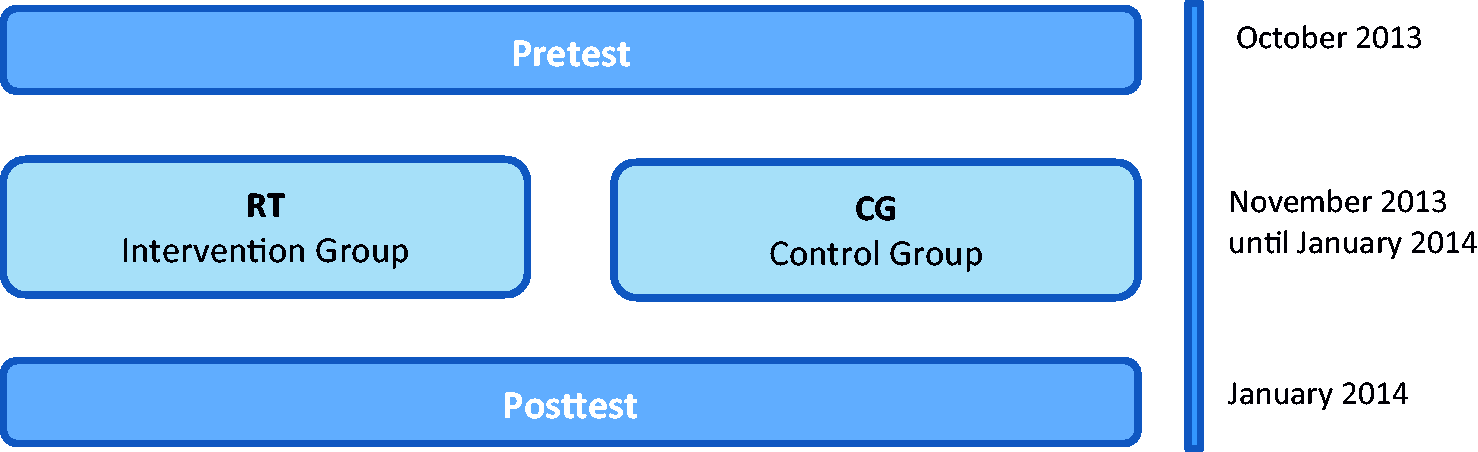
Results
Preliminary Analyses
For both conditions, 12% of the pretest data and 12% of the posttest data were missing due to the fact that students had missed one of the test sessions. However, the persons whose reading test data were missing were not excluded from the analyses. The missing values for each measurement point were replaced by the mean value of the corresponding condition instead. This procedure was chosen to retain the statistical power of the sample (Cho & Leonhart, 2013).
Participant Characteristics by Condition and Statistical Parameters
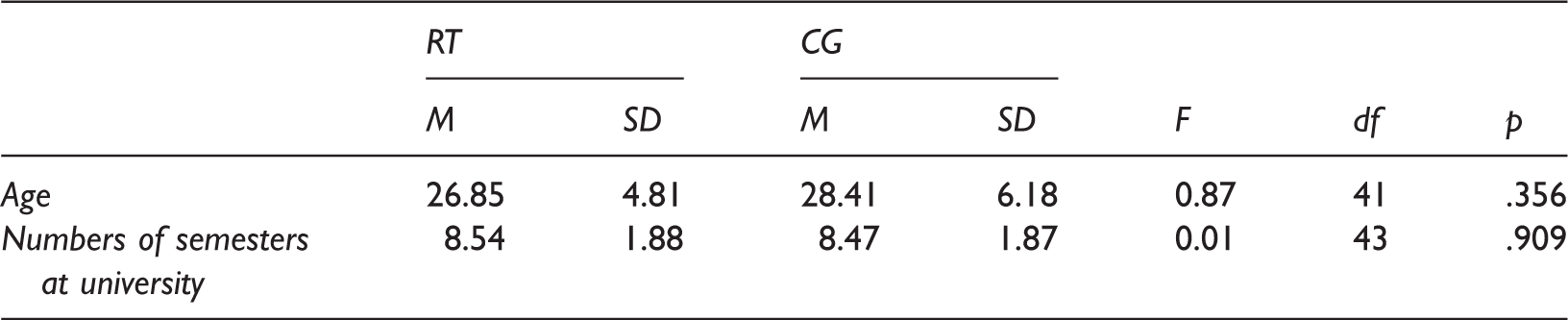
Note: Statistical comparisons between RT (intervention group with RT training) and CG (control group).
Means and Standard Deviations for Dependent Variables by Measurement Occasion and Condition
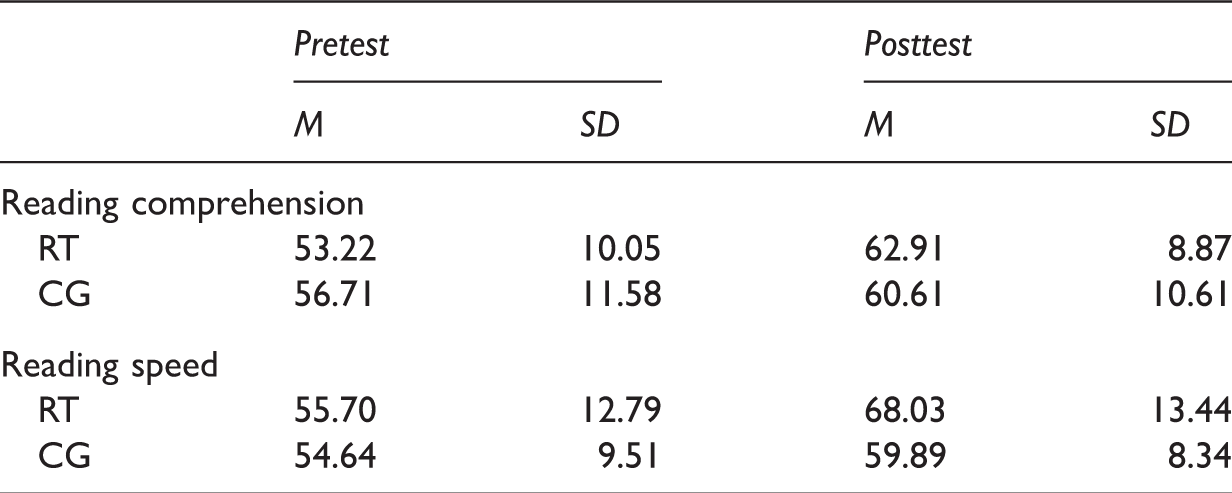
Note: RT = intervention group with RT training; CG = control group.
The social validity of the RT program was measured at posttest only. A total of 84% of the students said they would use RT to improve the reading skills of their primary school students in their own future lessons. Further, 8% said they would not and 8% said they did not know yet.
Univariate inferential statistical analyses
The effectiveness of our intervention was measured with students’ reading achievements at posttest compared to pretest. We expected that participants who took part in a university course intervention where they learned how to apply the RT approach would show better results in reading comprehension and reading speed than students who took part in a university course that was similar in content but did not give them the opportunity to apply RT. As it can be seen in the descriptive statistics (see Table 2), the means of the dependent variables for the students in both conditions were average at pretest (M ranging from 53 to 55). At posttest, the mean values of the dependent variables increased to above average at least in the RT condition (M > 60).
Furthermore, we applied inferential statistical analyses. We compared the two conditions in repeated measures analyses of variance to calculate the main (time) and interaction (condition) effects. Moreover, we determined Cohen’s d to describe the standardized mean difference between RT and CG. To calculate effect sizes, we first calculated the standardized mean pre-posttest difference for each condition and then subtracted them from each other. These effects are reported in standard deviation units (Cohen’s dcorr see Cohen, 1988).
For reading comprehension, there was a significant main effect of time, F(1, 60) = 23.39, p < .001, η2 = .28, and there was a significant interaction between time and treatment condition as well, F(1, 60) = 4.25, p < .04, η2 = .23. The resulting pattern can be described as follows: while students in both conditions did not differ significantly in reading comprehension at pretest, the significance of the interaction term indicated that RT students benefited to a greater extent from the course they attended than CG students (Cohen’s dcorr = .56).
For reading speed, there was a significant main effect of time, F(1, 60) = 30.21, p < .001, η2 = .34, and there was a significant interaction between time and treatment condition, F(1, 60) = 3.68, p < .03, η2 = .08. The pattern of the data was quite similar to the reading comprehension pattern. While there was no significant difference between RT and CG students in reading speed at pretest, RT students improved to a greater extent during the investigation period (Cohen’s dcorr = .63).
Discussion
The present study examined the effects of RT on the reading skills of students majoring in education. Previous findings have suggested that RT can be effective for improving students’ strategy use and reading comprehension (Hacker & Tenent, 2002; Koch & Spörer, 2016; Palincsar & Brown, 1984; Schünemann et al., 2013). Furthermore, RT has been found to be effective not only in primary school settings but also for EFL university students (Freihat & Al-Makhzoomi, 2012). Assuming that not only EFL students, but also university students majoring in education, profit from applying RT to their own studies, these positive experiences may be a prerequisite for implementing RT later in their own regular school lessons after they become teachers.
Therefore, the purpose of this study was twofold. First, we aimed to familiarize university students with the specific scientifically based RT program. We wanted them to learn explicitly how to apply and teach the four reading strategies of clarifying, questioning, summarizing, and predicting. The second aim of the study was to analyze the reading skills of the university students prior to and after the intervention. To demonstrate the effectiveness of the intervention, we compared the reading speed and reading comprehension of students in the RT condition with the scores of the students in the CG.
Consistent with the study’s hypotheses, students who participated in the intervention significantly outperformed the control group students statistically on both measures. These results indicate that RT is a potent method for increasing the reading skills of university students, a finding that is in line with Freihat and Al-Makhzoomi’s (2012) research results. This improvement should initiate implicitly students’ recognition of the effectiveness of RT. Hence, this recognition has the potential to motivate them to implement RT when they become in-service teachers later on.
For primary school students, our RT program (Spörer et al., 2016) is more complex because there are additional teaching materials to support self-regulated learning (e.g., learning diaries). The university students were trained without this material but, obviously, we nonetheless adapted the program so that we could foster the university students’ reading skills appropriately in this intervention. To take the reading strategy training to a university level, we used age- and context-appropriate texts for students to practice the reading strategies. For the present RT program, the texts were compressed versions of study texts that were components of the seminar reader for both university courses (i.e., conditions). Whether the CG students’ reading skills would have increased if they had read these compressed study texts with the help of reading strategies remains an open question.
Our study demonstrates that RT can be effective in higher education. Furthermore, our RT intervention was successful in the sense that after attending the program, most of the students reported that they were willing to implement RT in their own future lessons. We conclude that the RT students found the program useful and practicable for fostering reading skills as the majority of them gave the highest social validity ratings. Whereas research by Drechsel et al. (2014) indicated that teaching university students how to teach reading strategies can be useful for one-on-one tutoring, our research took this a step further by providing students with the competence to teach a scientifically based reading instruction program to an entire class in regular lessons.
Limitations of the study and implications for further research
This study has several limitations. A first constraint is related to the assessment of the participants’ outcomes. Because a German standardized reading test for university students was not available, we used the LGVT 6–12 (Schneider et al., 2007), and with it, we used the standard values of twelfth-grade students as the normed values. This practice was problematic because some students achieved relatively high values so there were likely some ceiling effects. It is possible that the actual growth of students in the RT condition was even higher, and the differences between RT and CG students’ reading comprehension and reading speed may have been even greater. In future studies, a different instrument could be used to analyze the students’ reading skills, e.g., the NEPS measurement device for assessing reading competence (Gehrer, Zimmermann, Artelt, & Weinert, 2013). Whether or not the increases in reading comprehension and reading speed could be traced back to the students’ use of reading strategies was not investigated in this research project and, therefore, this question remains unanswered. Most likely, participants’ reading comprehension was mediated by their utilization of appropriate reading strategies (McNamara, 2009). In further research, students’ knowledge about reading strategies and their effective application should also be analyzed to identify the mechanism of the intervention. In addition to this, the development of knowledge about how to teach reading strategies effectively should be measured (Rutsch, Schmitt, & Dörfler, 2016).
With respect to the reading speed criteria, there is another limitation of the study. As the literature suggests (e.g., Palincsar & Brown, 1984), RT focuses on reading comprehension rather than on reading speed. Regarding a positive development of reading speed, our assumption was that the repetitive practice of strategic reading in a learning group may lead to more focused individual reading behavior. As the CG students did not read texts during the university lectures, we were not able to control for whether they read the study texts in the self-study arrangements as they were instructed to do.
An advantage of the current intervention is that it is easy to implement in regular university courses. Likewise, the pre- and post-competence tests were efficient and easy to use as they could be administered in a relatively short time. The intervention in the current study spanned seven weekly lessons. Future studies may wish to determine whether a time-limited, abbreviated treatment could be as effective as the seven-week version. A future study could also determine whether all of the components of the treatment are relevant or if a condensed program would be more effective.
Furthermore, future studies should address not only students in master’s programs but students in bachelor’s programs as well, because reading skills are essential tools for being able to learn from scientific texts, and university students should work to improve these skills as soon as their studies begin.
A substantial limitation of our study is the sample size. In future research, the beneficial effects of the treatment group in comparison with the no-treatment group should be verified in a larger sample. Preferably, a future study will employ three measurement points instead of two. Whether students attain sustainable effects could be analyzed with a follow-up test that would take place several weeks after the posttest.
Another limitation of the current study is that we were not able to control for reading-related and teaching-related characteristics (e.g., verbal cognitive skills or self-reported reading behavior, prior knowledge of reading strategies, and experience with teaching reading in the student’s own former primary school lessons; see Behrmann, Kizilirmak, & Utesch, 2014). In future studies, these data should also be investigated and controlled for as covariates in repeated measures ANOVAs. In addition, intervention studies should be conducted in which the same lecturer teaches both the RT group and the CG that does not include the RT intervention.
It would also be interesting to evaluate whether university students’ self-efficacy in both reading, and in teaching reading strategies would increase if they took part in the RT intervention and if their beliefs about reading strategy instruction in general would change.
Conclusion
Our study suggests that a specific scientifically based reading instruction program that is based on practicing RT can be used in university courses on psychological education. RT is one example of an evidence-based teaching technique (Dunn et al., 2013) that follows the principles of modeling, scaffolding, and repeated practice and is known to be effective in several kinds of classroom settings. The study reports on a method through which university students’ own learning processes can benefit from psychological research as their reading skills improved after they participated in the intervention.
Furthermore, the study demonstrates the relevance of interventions like this as all RT participants had only average reading skills at pretest and above-average skills afterwards. Future studies should replicate our findings to ensure the generalizability of the results.
Footnotes
Declaration of Conflicting Interests
The author(s) declared no potential conflicts of interest with respect to the research, authorship, and/or publication of this article.
Funding
The author(s) received no financial support for the research, authorship, and/or publication of this article.