




Abstract
Implicit theories about the nature of human attributes as either malleable or fixed influence how people perceive knowledge and approach different tasks. Two studies explored the relationship between implicit theory of writing ability, metacognitive strategy knowledge (MSK), and strategy use in the context of academic writing. The pre-study with N = 51 university students revealed a significant correlation between students’ implicit theories and their MSK. Self-reported quality and diversity of strategy use, assessed by open-ended questions, were not significantly associated with students’ implicit theories. Expanding strategy use measures, study 2 (N = 133) found significant correlations between a more malleable theory and more frequent use of metacognitive strategies. Confirming the results of the pre-study, the results of study 2 showed that a more malleable theory of writing ability was directly associated with higher MSK. In sum, the results illustrate the importance of linking implicit theories to self-regulated learning.
Introduction
Writing academic papers is a common learning situation at university. Writing not only requires knowledge about grammar, genre, and vocabulary but also the ability to self-regulate one’s own learning (Graham & Harris, 2000; Zimmerman & Risemberg, 1997). Individuals have to plan, initiate, monitor, and evaluate their writing process, stay focused and motivated, and manage the learning environment (e.g., work in an environment where it is possible to concentrate on writing). Metacognition and appropriate strategy use have been identified as important success factors for skilful writing and are at the same time key components of self-regulated learning (SRL) (Boekaerts & Rozendaal, 2007; Graham & Harris, 2000; Hacker, Keener, & Kircher, 2009). In the last few years, researchers have discussed several factors (e.g., intelligence, and instructional settings) that influence students’ writing and SRL (Harris et al., 2012; Karlen, Maag Merki, & Ramseier, 2014); one potential factor is whether students’ implicit theories of human attributes (e.g., intelligence, and abilities) are fixed or malleable. Research has shown that if students believe that attributes are malleable, they embrace challenging tasks, persist in the face of difficulties, and try different strategies (Chen & Pajares, 2010; Dweck & Master, 2008; Job, Walton, Bernecker, & Dweck, 2015). The relationship between implicit theories of intelligence and self-regulation competencies is well documented (Burnette, O'Boyle, VanEpps, Pollack, & Finkel, 2013; Dweck & Master, 2008), but research in the domain of academic writing is still rare. The aim of this study was to examine if and how individuals’ domain-specific implicit theories about the nature of their writing ability are related to metacognitive strategy knowledge (MSK) and strategy use in academic writing.
Writing and SRL
Following different empirical traditions and perspectives, researchers have stressed diverse aspects of SRL. As a result, there are various definitions of SRL (Dinsmore, Alexander, & Loughlin, 2008; Winne & Perry, 2000). Overall, SRL can be described as an active, situational, and task-specific process whereby individuals plan, execute, and evaluate their learning (Boekaerts, 1999; Zimmerman, 2000). Thus, the competence of SRL is multi-layered and involves the activation and use of metacognitive, cognitive, motivational, and behavioral competences (e.g., ability to plan and monitor learning, use strategies to process information, and avoid distractions) to reach learning goals (Wirth & Leutner, 2008). Writing an academic essay is a complex and multidimensional process that requires the activation and use of different SRL components (Harris, Santangelo, & Graham, 2010). Writing can be subdivided into three different recursive phases that require several SRL competences: during a pre-action phase individuals plan their writing, set goals, and become motivated to start writing; during the action phase ideas are translated into written text, and actions are monitored and regulated; and in a revision phase the written text is evaluated and conclusions are drawn (Sitko, 1998; Zimmerman & Risemberg, 1997).
Appropriate strategy use and MSK have been identified as key components of successful SRL and writing (Beauvais, Olive, & Passerault, 2011; Hacker et al., 2009). Strategies can be defined as “any thoughts, behaviours, beliefs, or emotions that facilitate the acquisition, understanding, or later transfer of new knowledge and skills” (Weinstein, Husman, & Dierking, 2000, p. 727). In more detail, strategies help writers to structure and adjust the processing of information, maintain and summarize new knowledge, stay focused and motivated, regulate emotions, and verify whether the goals have been achieved (Boekaerts, 1999). The literature has provided a large number of conceptual frameworks for assessing and classifying strategies. A widely used classification and taxonomy in cognitive psychology divides strategies into three main categories: cognitive, metacognitive, and resource management strategies (e.g., Pintrich, Smith, Garcia, & McKeachie, 1993; Wild & Schiefele, 1994; Wolters, 1999). Cognitive strategies refer to the direct processing of information and include processes such as the rehearsal, elaboration, and organization of information (e.g., pulling together information from different sources, and outlining the material to organize thoughts). Metacognitive strategies are higher-order strategies that regulate the learning process. Metacognitive strategies refer to the planning, monitoring, and evaluating of the learning process (e.g., making a plan about what to do during the writing process, and thinking about whether what was written is correct). Resource management strategies involve strategies for managing and regulating internal resources (motivational regulation, emotional regulation, attention regulation, and effort regulation) and external resources (peer learning, help seeking, and learning environment). As writing is a complex process, students have to use different strategies to overcome different problems, regulate and evaluate their writing process successfully, and stay focused. Skilful writers are highly engaged metacognitively, so as to regulate the higher-order processes that underlie academic writing through the use of different strategies (Harris et al., 2010). The use of strategies is strongly linked to students’ available strategy repertoire and MSK (Borkowski, Chan, & Muthukrishna, 2000; Karlen, 2015).
Metacognitive strategy knowledge refers to the knowledge component of metacognition (Flavell, 1979) and describes verbalizable knowledge and awareness of memory, comprehension, and learning processes. It includes understanding task demands and characteristics as well as having knowledge about the quality and characteristics of strategies. This knowledge allows individuals to determine the relative benefit of one strategy over another (Borkowski et al., 2000; Paris, Lipson, & Wixson, 1983). MSK thus enables students to determine the appropriateness of a variety of specific strategies for different tasks. Moreover, it positively influences decisions on what strategy to use in specific learning situations (Luwel, Torbeyns, & Verschaffel, 2003; Vrugt & Oort, 2008). In the context of writing, individuals’ MSK affects how students analyze the specific writing task, determine the best strategies to solve the task, and when and why to employ various strategies (e.g., Harris & Graham, 2009; Harris, Graham, Brindle, & Sandmel, 2009).
Implicit Theory and SRL
Students’ implicit theories of the nature of human attributes (e.g., intelligence, personality, and abilities) as being either fixed or malleable are conceptualized as frameworks through which students interpret their domain-specific experiences. The theories play a significant role in the ways that they behave, are motivated, and perceive knowledge and themselves (for an overview, see Dweck, 2006). ‘Implicit’ means that students are most often not explicitly aware of their beliefs about the nature of their attributes; however, individuals are able to recognize their beliefs when they are asked to respond to items that make those beliefs explicit (Job et al., 2015). Students’ implicit theories lie along a continuum, ranging from a theory that attributes are fixed and that some human attributes are unchangeable and related to given talent, to a theory that some attributes are malleable, changeable, and hence can be developed with learning and effort. Empirical studies have found that domain-general implicit theories (e.g., theory of intelligence) are associated with cognitive, metacognitive, motivational, and behavioral components of SRL (Blackwell, Trzesniewski, & Dweck, 2007; Burnette et al., 2013; Chen & Pajares, 2010; Hofer & Pintrich, 1997; Kaplan, Lichtinger, & Gorodetsky, 2009; Ommundsen, Haugen, & Lund, 2005; Yan, Thai, & Bjork, 2014). Individuals with a theory of intelligence as malleable saw challenges and setbacks as learning opportunities were mastery oriented, persisted when faced with difficulties, and used more successful strategies. Students who viewed intelligence as malleable were more likely to be metacognitive sophisticated learners; they valued the benefits of self-testing and restudied old course material more often than students with a fixed theory did. Although implicit theories have been assessed mostly in a domain-general way for attributes, such as intelligence (Hong, Chiu, Dweck, Lin, & Wan, 1999; Spinath, 2001) or willpower (Job et al., 2015), evidence suggests that individuals can hold differing implicit theories regarding specific domains such as health (Schroder, Dawood, Yalch, Donnellan, & Moser, 2016), mathematics ability (Rattan, Good, & Dweck, 2012), or writing (Limpo & Alves, 2014). Studies show that although there is a relation to the overall implicit theory, domain-specific implicit theories are better predictors of domain-specific behavior (Schroder et al., 2016; Scott & Ghinea, 2014).
In the domain of writing, researchers have focused on the relationship between different implicit beliefs and SRL and have mainly examined the relation between SRL and epistemological beliefs (beliefs about knowledge and knowing) or transmission versus transaction beliefs (e.g., information must be transmitted from the author to the readers’ mind versus meaning exists in the mind of the reader and can be constructed from the text) (Mateos et al., 2011; White & Bruning, 2005); however, studies have rarely investigated domain-specific implicit theories regarding academic writing in the sense used by Dweck (2006), who distinguishes between a fixed or malleable theory. In an early study, Palmquist and Young (1992) found that university students who did not believe that writing is a gift (operationalized as the belief that writing can be learned or taught, in the sense of holding a malleable theory) had higher levels of confidence in achieving proficiency in writing, lower levels of writing apprehension, and higher self-assessments of their prior writing ability. Students who had a more fixed theory about writing had lower self-assessments of their writing skills and abilities. Palmquist and Young (1992) concluded that students’ implicit theories influence how they approach writing. In line with that, Hammann (2005) found a relationship between implicit theories of writing and components of SRL. Domain-general MSK was positively related to a malleable theory. Hammann (2005) wondered whether students with a fixed theory are not aware of their own thinking processes or if they just do not believe that they can self-regulate their learning and thus may not try to become aware of their own cognition. In line with Hammann’s (2005) findings, the first author of the current studies found in a sample of university students that a malleable theory of academic writing ability was positively associated with self-reported cognitive and metacognitive strategy use, MSK, and motivational beliefs. In a writing strategy-instruction intervention study, Limpo and Alves (2014) found that students with a malleable theory of their writing ability improved the quality of their texts more than students with a more fixed theory did. They assumed that the effect might be mediated by higher SRL competences or a higher willingness to improve writing skills through strategic behaviors; however, the hypothesis was not tested empirically, so future researchers should look closer at the relationship between metacognitive and self-regulatory factors and an implicit theory of writing. In sum, the available research on implicit theories of ability as fixed or malleable provides an initial indication that it is associated with different SRL components, but the literature underlines the importance of conducting studies that look more closely at the under-examined effect of the implicit theory of writing on domain-specific MSK and strategy use in the context of academic writing.
The Present Research
Drawing on research and theory describing writing as a complex recursive process that requires the activation and use of different SRL components, we were interested in the relationship between implicit theories of writing abilities and SRL in the context of academic writing. This study builds on the work of researchers who found that implicit theories influence students’ SRL and aimed to extend existing measures of implicit theories and SRL to a further domain-specific context, namely, academic writing at university. Our assumptions are guided by studies (e.g., Dweck, 2000; Hammann, 2005, Palmquist & Young, 1992) which found that students with a malleable theory are more willing to try different strategies and learn more about the appropriate use of strategies than students with a fixed theory are. Further, some studies have indicated that throughout their learning history, individuals with a malleable theory may have acquired more MSK and used more strategies than peers with a fixed theory have (Burnette et al., 2013; Dweck, 2000). This might lead not only to better writing performance but also to higher MSK and thus have a positive effect on the choice and quality of strategy used (Borkowski et al., 2000). Our hypotheses are the following.
Students with a malleable implicit theory of writing ability show greater diversity, quality, and quantity of self-regulated strategies than students with a fixed implicit theory. Students with a malleable implicit theory of writing ability show greater MSK than students with a fixed implicit theory. Students with higher MSK show higher quality and frequency in strategy use than students with lower MSK.
Pre-study (Study 1)
In this pre-study we aimed to examine the relationship between implicit theories of writing ability, MSK, and the quality and diversity of strategy use in academic writing. Students’ implicit theory was assessed with a questionnaire with multiple-choice format. To assess students’ self-reported task-specific quality and diversity of strategy use, three open-ended questions related to the three writing phases were used. Finally, to assess students’ MSK about writing essays, a scenario-based instrument was used. Correlational analyses in SPSS were run to test the relationships among implicit theory, MSK, and strategy use.
Methods
Participants and Design
Participants were 51 students (mean age (Mage) = 26 years, standard deviation (SD) = 6.82) in two different degree programmes in education (52% in Bachelor’s degree programs, and 48% in Master’s degree programs) at a university in Switzerland. Gender distribution (88% women) was representative for education students; two participants did not report gender. Students in both programs were given time to fill in the online questionnaire. The online questionnaire took approximately 15 minutes (range: 10–18 minutes) to complete.
Materials
Strategy use
The online questionnaire included three open-ended questions, taking the recursive three phases of the writing process into account. The first question regarding the pre-action phase (“What do you do before you start writing an academic essay?”) aimed to identify students’ strategic behavior before starting to write. The next question (“What kinds of things do you do to stay on track while writing your academic essay?”) focused on students’ strategic behavior during the action phase. The last question (“How do you proceed when you revise your academic essay?”) focused on students’ strategies to successfully finish their academic essay in the post-action phase. To obtain strategy use measures, students’ open-ended answers were coded based on existing strategies taxonomies (e.g., Pintrich et al., 1993; Wild & Schiefele, 1994). To represent students’ reported strategies as accurately as possible, the coding scheme was continuously expanded out of the empirical data in an iterative process (Mayring, 2010). The final coding scheme resulted in 18 different task-specific strategy categories that can be assigned to cognitive, metacognitive, and resource management strategies. Two trained raters coded all students’ answers based on this final coding scheme. Interrater reliability was good (k = 0.87) as determined by Cohen’s kappa.
Scale Names, Number of Items or Subscales, Item Total Correlations, Reliabilities, and Descriptive Statistics of all Scales
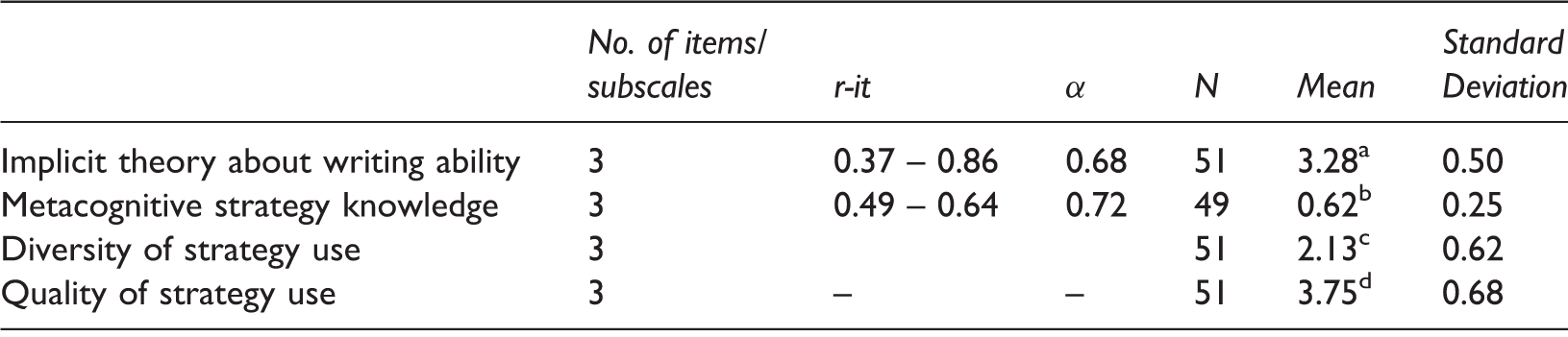
r-it = item total correlation; α = Cronbach’s alpha; a range: 1–4; b range: 0–1; c range: 0–7; d range: 0–6.
The quality of strategy use was rated on a six-point scale ranging from 1 (very low quality) to 6 (very high quality). The coding scheme to rate quality was developed based on theoretical and empirical assumptions about successful strategic behavior for each phase in academic writing. Two raters were trained to rate the quality of strategy use based on the coding scheme developed. Interrater reliability was good for all three open-ended questions (intraclass correlation coefficient = 0.78–0.91). The final quality of strategy use score was built as a mean score of the average quality value for all three questions (see Table 1).
Metacognitive strategy knowledge about writing an essay
To measure student’s MSK a short version of the metacognitive achievement test for writing an essay was used (Maag Merki, Ramseier, & Karlen, 2013). This test contained three different scenarios related to the context of writing an essay: becoming familiar with the topic; finishing up the task; and drawing conclusions regarding similar tasks in the future. In each scenario, seven to eight different strategies were presented that varied in their degree of effectiveness for the given scenario (see Figure 1). Students had to rate the usefulness of each strategy in relation to the requirements of the given scenario on a six-point Likert scale from 1 (not at all useful) to 6 (very useful). Maag Merki et al. (2013) asked experts to provide their judgments on the appropriateness of each strategy for the given scenario. Experts’ ratings were used to determine the relation between the strategies (e.g., strategy A is more useful than strategy B) and to build pair comparisons (A > B). This expert rating was used as an objective scoring procedure for students’ responses. Students’ estimated relation between two strategies (= one pair) was compared with the experts’ rating. For every estimated item pair that corresponded to the experts’ item pair, one point was given. For every non-correspondence with the experts’ rating, zero points were given; the final mean scores of the MSK test ranged from 0 (low MSK, no correspondence to the experts) to 1 (high MSK, high correspondence to the experts). The internal consistency of the scale was satisfactory (see Table 1).
Example scenario from the metacognitive strategy knowledge test. The 6-point response scale ranged from 1 (not at all useful) to 6 (very useful).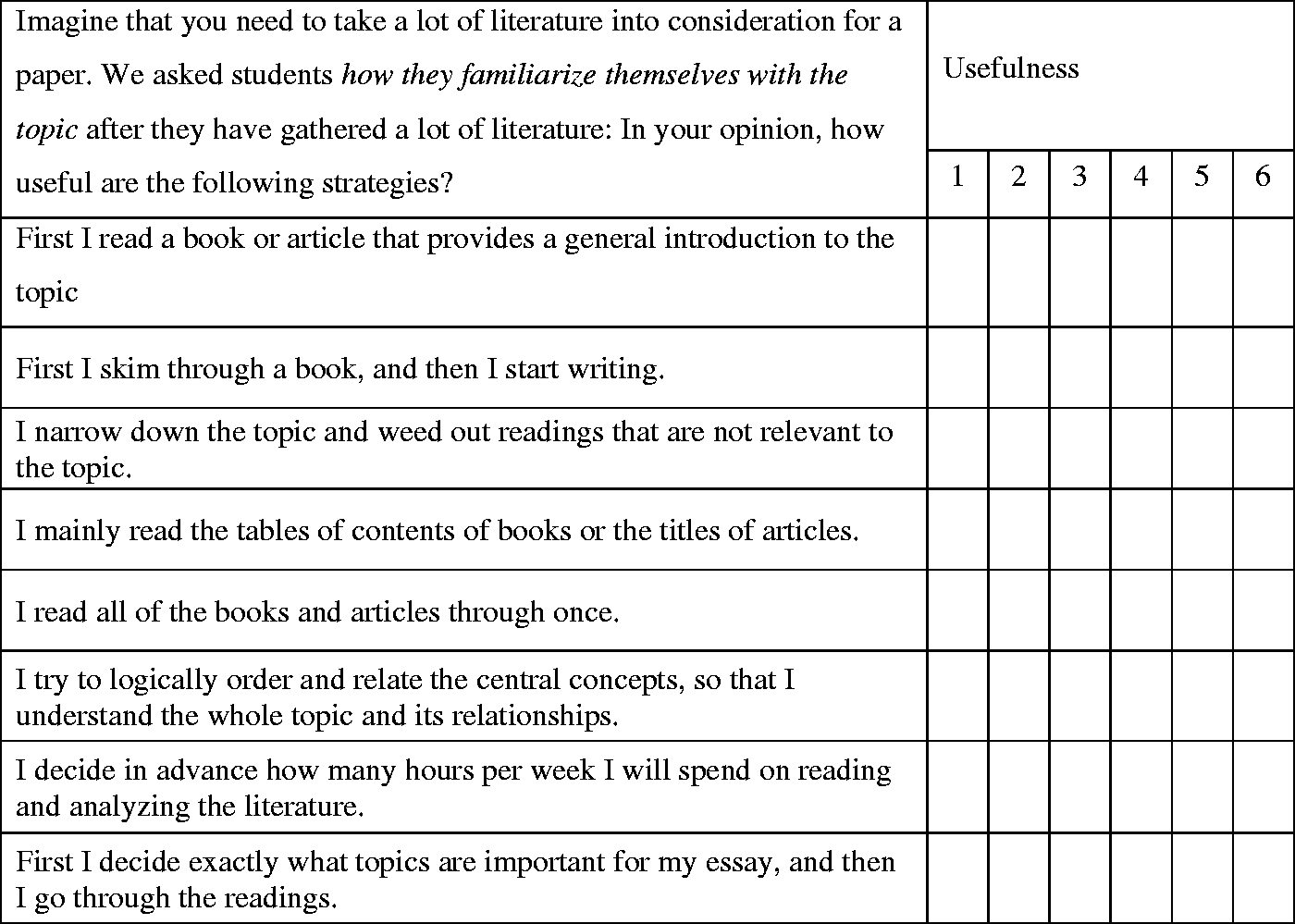
Implicit theories of writing ability
Students’ implicit theory of the learnability of academic writing at university was assessed with an adjusted scale based on Palmquist and Young (1992). Three items (e.g., “The ability to write good academic texts can be learned.”) were used. Each item was assessed on a four-point Likert scale ranging from 1 (not at all true) to 4 (very true). High scores indicate a malleable theory, and low scores indicate a fixed theory. The internal consistency was satisfactory (see Table 1).
Results and Discussion
Intercorrelations between Implicit Theory about Writing Ability, Metacognitive Strategy Knowledge (MSK), Quality of Strategy Use, and Diversity of Strategy Use

p > 0.001; **p < 0.01; *p < 0.05.
Simple linear regression analyses were used to further examine the relationship between implicit theories of writing ability, MSK, and strategy use. Implicit theories had no significant effects on students’ quality of strategy use (F(1, 49) = .004, not significant (n.s.)) or on students’ diversity of strategy use (F(1, 49) = .006, n.s.). Students’ implicit theories had a positive effect on students’ MSK (β = 0.219, F(1, 47) = 10,253, p < 0.01); 18% of the variance of students’ MSK was explained by students’ implicit theories of writing ability. With a β coefficient of 0.383 (F(1, 47) = 4,867, p < 0.05), MSK explained 10% of the variance of students’ quality of strategy use. MSK had no effect on student’s self-reported diversity of strategy use (F(1, 47) = .327, n.s.).
Contrary to our initial expectation, we found no significant association between implicit theories and quality of strategy use. Further, the results also showed no correlation between implicit theories and diversity of strategy use. However, this result can be interpreted in a positive way, since it is not more strategies but rather the more appropriate fit between strategy and task and the appropriate use of a strategy that are important for successful learning (Paris et al., 1983). In this pre-study it was found that students with a more malleable theory had higher MSK than their peers holding a more fixed theory, which was in line with our second expectation. Students with higher MSK did not report a higher diversity of strategy use than students with lower MSK. We suspect that students with higher MSK might have realized that for successful writing, it is not greater variety of strategies that is important but rather the match between specific strategies and task requirements. In line with this assumption, the results confirmed the expected positive correlation between MSK and quality of strategy use. MSK might support students in selecting appropriate strategies and applying those strategies successfully. This is relevant, as high quality of strategy use plays an important role in successful writing (Graham & Harris, 2000; Harris et al., 2010).
However, the results of this pre-study have to be interpreted carefully, as there are several limitations. The results are limited by methodological issues that might have influenced the results, especially regarding associations between implicit theories and strategy use. First, the assessment of students’ strategy use with open-ended questions may have been influenced by students’ motivation and linguistic competencies (Spörer & Brunstein, 2006). Therefore, the validity of the assessed quality and diversity of strategy use can be questioned, and other methods of measuring strategy use might be more adequate. Second, the quality and diversity of strategy use was assessed in a general way. A meta-analytic review on the relation between implicit theories of intelligence and self-regulation found that there are different effect sizes for goal setting, operating, and monitoring (Burnette et al., 2013). Therefore, the relationship between implicit theories and strategy use should be examined further by distinguishing between different strategy dimensions. Finally, due to the small sample size, robustness of the results is not given. The findings should therefore be investigated in further studies with larger samples.
Study 2
The aim of study 2 was to confirm the results of the pre-study (study 1) with a larger sample and involve further measurement methods. Instead of open-ended questions, we applied a commonly used questionnaire to measure habitual use of strategies in writing (Kaplan et al., 2009). Further, the assessment of implicit theories and MSK was more strongly tied to the domain of academic writing. A path model was run in Mplus 7.3 (Muthén & Muthén, 1998–2012) to investigate multivariate relations between implicit theories of writing ability, MSK, and habitual metacognitive strategy use.
Method
Participants and Design
Participants were 113 students (Mage = 26.00 years, SD = 6.82) at a university in Switzerland. Students were sampled out from degree programs in education and were therefore mainly women (82%). Students attended either the Bachelor’s degree programme (70%) or the Master’s degree programme (30%). On average, students were in their third semester (mean = 3.07, SD = 1.56) at the university. All students were given time to complete the online questionnaire during the course.
Materials
Metacognitive strategy use
To assess self-reported metacognitive strategy use in academic writing, we used three different sub-scales adapted from Kaplan et al. (2009). Metacognitive strategies are represented by five planning strategies (e.g., “Before I start writing, I plan an outline of what I’d be writing about”), five monitoring strategies (e.g., “During writing, I check to see if what I was writing fit”), and four evaluation strategies (e.g., “After finishing writing a section or part of it, I think about whether what I had written was connected with what I wrote before”). The response scale for all items ranged from 1 (not true at all) to 4 (very true). All three sub-scales showed appropriate Cronbach’s alpha, with values between 0.63 and 0.74.
Metacognitive strategy knowledge about academic writing
MSK was measured by a scenario-based test as described in the pre-study above. The test includes three scenarios that are allocated to the three phases of self-regulated academic writing: finding an idea; monitoring the writing process; and evaluating the writing process (more details are available from the second author of the current studies). The different strategies listed in the scenarios refer to the strategies that students reported in the pre-study. Thus, the MSK achievement test is related to students’ strategic writing behavior as accurately as possible. For the scoring procedure, experts’ rating of the relative usefulness of the presented strategies (e.g., strategy A is more useful than strategy B) was used. If students’ judgment on a strategy pair was in line with the expert rating, they received one point. If their judgment was contrary to the experts’ rating, they received zero points. Cronbach’s alpha was 0.74 and appropriate.
Implicit theories of writing ability
Students’ implicit theory of writing ability was assessed with an adjusted scale based on Dweck (2006). The scale includes three items (e.g., “I can learn new things, but I cannot improve my abilities in academic writing”), which were assessed on a four-point Likert scale (from 1 (not at all true) to 4 (very true)). High scores indicate a more malleable theory, and low scores indicate a more fixed theory of writing ability. With a Cronbach’s alpha value of 0.80, the internal consistency of the scale was good.
Results and Discussion
Intercorrelations between Implicit Theory about Writing Ability, Metacognitive Strategy Knowledge (MSK), and Metacognitive Strategies
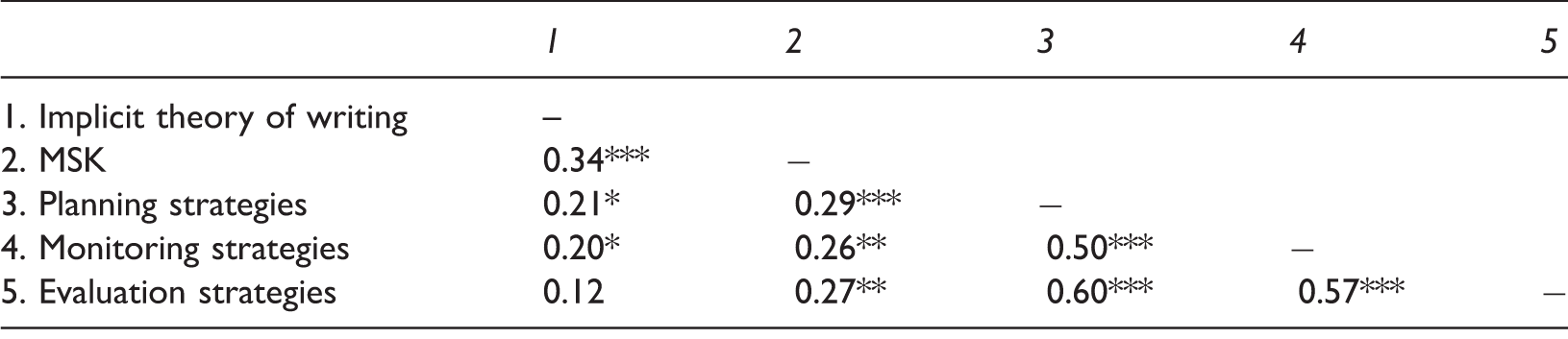
p > 0.001; **p < 0.01; *p < 0.05.
A path model with two manifest factors (implicit theories, MSK) and metacognitive strategy use as a latent factor immediately fit the data appropriately (χ = 4.052, df = 4, n.s., χ/df = 1.013, root mean square error of approximation = 0.010, Comparative Fit Index = 1.00). Therefore, no modifications were made. All three factors (planning, monitoring, and evaluation) for the latent metacognitive strategy construct showed high factor loadings from 0.67 to 0.76 and were significant (p < 0.001). As shown in Figure 2, two paths were significant. Implicit theories had a positive direct effect of β = 0.34 (p < 0.001) on MSK. The path from MSK to metacognitive strategy use indicates a positive effect of β = 0.31 (p < 0.01). The path between implicit theories and metacognitive strategy use was not significant. However, implicit theories were indirectly positively related to metacognitive strategy use via MSK (β = 0.11, p < 0.05). The path model also allowed examination of the variance in MSK and metacognitive strategy use. The proportion of explained variance in MSK was R2 = 0.12 (p < 0.05). For metacognitive strategy use the proportion of explained variance was R2 = 0.13 (p < 0.05).
A path model of the relationships between implicit theories, metacognitive strategy knowledge, and metacognitive strategies.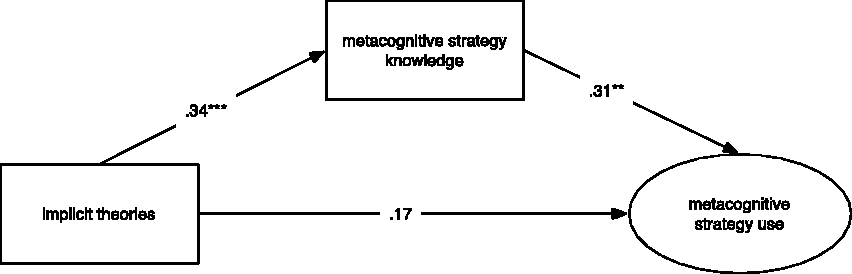
The results of this study showed that implicit theories were partially related to students’ self-reported metacognitive strategy use. In detail, students with a more malleable theory of writing ability reported using planning and monitoring strategies more than peers who endorsed a fixed theory of writing ability. No correlation was found between implicit theories and evaluation strategies. However, the results revealed an indirect effect of implicit theories on the use of metacognitive strategies in general. The results of study 2 confirmed the relationship between implicit theories and MSK found in the pre-study. Implicit theories predicted students’ MSK. Students with a more malleable theory of writing had higher MSK scores than students with a fixed theory. These results are in line with previous research that showed the importance of implicit theories on students’ metacognitive competences (e.g., first author of the current studies; Burnette et al., 2013; Ommundsen, 2003; Yan et al., 2014). Based on our results, we assume that even at universities, a malleable theory of writing ability could be fruitful for students with regard to putting effort into and using strategic behavior in their academic writing assignments. A malleable theory facilitates the use of MSK and metacognitive strategies like planning and monitoring. In sum, the implicit theory that a specific ability can be improved might lead to a belief in personal control over one’s own learning and thus keep up students’ metacognitive engagement. Students with a more malleable theory of writing ability might believe that they are able to learn more by monitoring and regulating their writing process.
General Discussion
Past research suggested that implicit theories of ability as either fixed or malleable play a significant role in the ways that students self-regulate their learning, use strategies, and show effort and persistence when dealing with challenging tasks. The present research aimed to extend existing domain-general measures of implicit theories as either malleable or fixed to the domain of academic writing. We therefore expected students with a malleable theory of academic writing to show greater quality, diversity, and frequency of self-regulated strategies than students with a fixed implicit theory. We focused on domain-specific implicit theories of writing ability in the context of academic writing.
Our research produced mixed results regarding the link between students’ implicit theories of writing ability and self-reported strategy use. Whereas in the pre-study no correlation between students’ implicit theories and the quality and diversity of strategies use was found, the second study found significant correlations between implicit theories and habitual use of planning and monitoring strategies. However, there was no correlation between implicit theories and evaluation strategies. Further, the results revealed an indirect effect of implicit theories on self-reported habitual metacognitive strategy use via MSK. Overall, the results indicate that implicit theories might affect only the use of certain strategies or only certain phases of the recursive writing process. Students with a fixed theory see effort as a sign of low ability (Dweck & Master, 2008). They might perceive planning and monitoring strategies – strategies that are used in the pre-action and action phase – as useless effort and as a sign of less talent. They might not believe in the necessity for self-regulating during the writing process, in contrast to students with a malleable theory, who see effort as the path to mastery. A glance at the literature shows that positive correlation patterns are found mainly between a malleable theory and strategies, which are related to the pre-action and the action phase (e.g., goal setting and goal operating; Burnette et al., 2013). We assessed evaluation strategies mainly through items on superficial revision strategies. We suppose that independent of students’ implicit theories, the importance of revising academic papers is seen as a necessary task after the writing process. Further studies are needed that take the whole writing process into consideration in order to understand more precisely the effect of implicit theories on the use of certain strategies in different phases. Especially, the post-action phase needs further attention.
The results of both studies confirmed our second hypothesis that students who endorse a malleable theory show higher MSK than their peers who endorsed a theory of incremental writing ability. Previous studies have shown that students with a malleable theory of ability are willing to put effort in SRL in order to learn more and be more successful (Yan et al., 2014). Students with a fixed theory might have less optimism about succeeding in writing and may have a sense of lack of personal control over the learning process. This pessimism may block their metacognitive engagement through the use of MSK, and planning and monitoring strategies (Ommundsen, 2003). Further, students with a fixed theory might not believe in the necessity for self-regulating the writing process and may be at the same time less aware of their own thinking process (Hammann, 2005). When faced with challenges and difficulties during the writing process, students endorsing fixed theories may give up faster than students holding malleable theories (Dweck & Master, 2008; Ommundsen, 2003). As discussed in the literature, different implicit theories lead to different strategic engagement patterns, which may be a further explanation for the differences in MSK and metacognitive engagement (Limpo & Alves, 2014). Thus, students with a malleable theory of writing ability might have acquired higher MSK through their higher engagement in strategic learning and a higher awareness of metacognitive processes through their previous writing experience (Dweck & Master, 2008; Hammann, 2005).
Although it was not the main focus, the results of both studies provide information on the relationship between MSK and strategy use. The findings show that MSK is related to the general quality of strategy use and to the self-reported habitual use of metacognitive strategies. No correlation was found between MSK and reported diversity of strategy use. These results indicate that students’ MSK about academic writing affects how they plan their writing, use literature, transform information, and monitor and evaluate their writing (Harris et al., 2010). Moreover, students with higher MSK might be more aware of their strengths and weaknesses with regard to a task than students holding a fixed theory (Paris et al., 1998); thus students with higher MSK might be able to identify effective strategies rather than use many but less effective strategies (Karlen, 2015). As reported in the literature, MSK affects how students analyze the specific writing task and determine the best strategies to solve the task (e.g., Harris & Graham, 2009; Harris et al., 2009). MSK plays an important role in students’ understanding of the purpose of writing and higher-order processes that underlie skilful writing (Harris et al., 2010; Lin et al., 2007; Zimmerman & Risemberg, 1997). Bringing all results together, for highly skilled writing it might be important that students hold a malleable theory of writing ability and have high MSK. Both these factors might lead to high and successful strategic engagement (Blackwell et al, 2007; Harris et al., 2010).
Limitations and Future Directions
The present studies have several limitations. First, the samples in both studies were recruited from degree programmes in education, a field of study in which more women than men tend to enrol. The participants were primarily female students, which limits the generalizability of the results to other groups and study domains. Second, although we included different procedures to measure strategy use using multiple-choice and open-ended questions, the measures relied on self-reports – with all the advantages and disadvantages of such measures (for an overview, see Wirth & Leutner, 2008). We therefore recommend that the results of the two studies be verified by complementing the measurement instruments used. Finally, both studies are limited due to their cross-sectional design, which does not allow exploration of causal relations or long-term effects. In future, it could be interesting to design longitudinal studies for a more precise understanding of the development of implicit theories of writing ability as well as to gain further knowledge about the relationship among implicit theories and MSK. It could also be interesting to combine measures of implicit theories, MSK, and achievement as both implicit theories as well as MSK are related to achievement (Blackwell et al, 2007; Maag Merki et al., 2013).
Despite these limitations, the results provide support for the influence of an implicit theory of writing ability on SRL, especially for metacognition. These findings are noteworthy for future theoretical, empirical, and practical work, and may guide researchers interested in the development of MSK. The results of our studies emphasize the necessity for teachers’ awareness of the influence of students’ implicit theories on SRL. Teachers should take students’ implicit theories into account, if they want to foster students’ metacognitive writing abilities. Teachers should modify writing instructions and training programs in order to emphasize a more malleable theory of writing. Research on praise (Gunderson et al., 2013) and comfort statements (Rattan et al., 2012) indicates that if teachers focused their feedback on effort and strategies (rather than on writing ability), they could foster a malleable implicit theory in their students. Statements such as “You are a born writer” or “To some writing comes naturally, others have to work hard for it”, even with the best intentions in mind, might backfire, especially for students who think that they are not good at writing (Schloz & Dresel, 2011). Therefore, teachers should encourage students by stressing that successful academic writing can be learned as well as improved, and is not a gift. Teachers might also encourage students to examine their implicit theories of writing, and the relationship between these beliefs and their strategic behaviors. Further, teachers should guide students’ self-reflections to encourage attribution to their own effort and appropriate strategy use. This could help students develop a malleable theory of their writing ability (Blackwell et al., 2007).
Apart from students’ implicit theories, MSK plays an important part in the quality of strategy use in academic writing. Students who know how to use strategies effectively may be able to attribute their writing difficulties to inappropriate strategy use or lack of effort rather than to a lack of writing talent. It may be that some students believe that writing is a gift, and therefore do not put effort into self-regulating their writing process and applying appropriate strategies to overcome difficulties. Those students might need to be encouraged to self-regulate their writing and to be strongly supported by teachers. Teachers might consider fostering writing strategies, MSK, and implicit theory of writing simultaneously. For this, teachers will have to have a clear understanding of their own as well as their students’ implicit theories of writing. Finally, teachers must have an understanding of their students’ SRL competencies. This knowledge could help teachers to provide more specific instructions about appropriate strategy use in writing.
Footnotes
Declaration of Conflicting Interests
The author(s) declared no potential conflicts of interest with respect to the research, authorship, and/or publication of this article.
Funding
The author(s) received no financial support for the research, authorship, and/or publication of this article.