




Abstract
In teaching social psychology, the process of identifying a particular theorist can lead to an enhanced understanding of the theories associated with that individual. Employing this process into a summative assessment, this article outlines an exercise that facilitated the teaching of introductory social psychology to 147 undergraduate students. The students completed an exercise in the critical evaluation and ranking of the contributions of several significant figures in the history of social psychology. Evaluations of the exercise revealed that the most popular triad included various combinations of Festinger, Asch, and Milgram. Additional analyses highlighted no differences in choice of triad between genders, nor were there differences in assessment grade for the chosen triad. Student choices of the exemplars suggested that decisions were guided by selected principles, and that systematic selection of the exemplars in further iterations of the exercise will enable the exploration of the links students make between the theorists and their collective work.
Introduction
Education in science involves a process of acquiring new skills that facilitate the learning of various methods and theory, which in turn underpin the process of scientific inquiry. This process applies to the field of social psychology where the need to appreciate the skills of conducting research has to be accomplished before students develop a clear understanding of what distinguishes an experimental approach to the study of social behavior from other disciplines. Such matters are set out in chapters (e.g., Wilson, Aronson, & Carlsmith, 2010) and in narrative histories of the discipline (e.g., Aron & Aron, 1986)
Learning the details of the theories established in the field and the experiments that were developed to support or to challenge these theories has long been associated with the names of particular individuals. An education in social psychology can rarely have occurred without a student learning about Festinger’s theory of cognitive dissonance (Festinger, 1957), Milgram’s obedience experiments (Milgram, 1974), Zajonc’s theory of mere exposure (Zajonc, 1968) or Tajfel’s theory of social identity (Tajfel, 1974), to select a few examples. The understanding of these theoretical positions is necessarily accompanied by an exposition of experiments conducted to test the theories. Merton (1968) noted many years ago that the major discoveries and insights in science have been the result of multiple discoveries by many independent experimenters and investigators. The theorists who become important and iconic in their fields of discovery are more likely to have multiple forms of discovery and not remain singletons in offering insight. Accordingly, nurturing an understanding of the theoretical positions will likely build familiarity with the studies that underpin the theories, and vice versa.
We can take an example from the middle history of experimental social psychology. The creation of theories of cognitive consistency, that is, possessing an understanding of the development of cognitive structures and the process of change in those structures, occurred in the middle of the twentieth century. Heider (1946) first coined his theory of cognitive balance, to be followed by Osgood and Tannenbaum’s (1955) development of congruity theory and Festinger’s theory of cognitive dissonance (Festinger, 1957; Festinger, Riecken, & Schachter, 1956). For a time there was a great deal of research around these models (cf. Abelson et al., 1968). Over time, however, work on dissonance theory became dominant over the other two models and the name and status of Festinger in social psychology grew significantly. Heider went on to become a significant figure in social psychology through attribution theory (Heider, 1958; Kelley, 1967) and Osgood had already established his status in experimental psychology (Osgood, 1953) as well as being associated with devising the ubiquitous semantic differential (Osgood, Suci, & Tannenbaum, 1957). But Festinger drew the major credit for devising the theories of consistency and the consequences thereof (Cooper, 2007; Innes, 1980) and the theory continues to be refined to the present day (cf. Harmon-Jones, Harmon-Jones, & Levy, 2015; Harmon-Jones & Mills, 1999), while the other theories attract much less empirical attention today. There were significant differences in the nature of Heider’s balance and attribution theories, Osgood’s congruity theory and human communication using a three factor structure of evaluation and the many theories expounded by Festinger. Nonetheless there are structural similarities and methodological associations. Yet, while Festinger is mainly associated with the theory of cognitive dissonance, he had been previously and singularly associated with the development of theories of level of aspiration (Festinger, 1942), informal social communication (Festinger, 1950), social comparison theory (Festinger, 1954), and finally with enhancing our understanding of the evolution of human society (Festinger, 1983).
The identification of a theorist can aid the understanding of the theories that were associated with that person. This has been noted previously by Haggbloom et al. (2002) in their identification of the major theorists in psychology over the past one hundred years and their further suggestion that the names may be used educationally. Specifically, setting an educational exercise that requires students to “identify the seminal contributions” of key contributors to the discipline, or construct a debate as to which psychologist has made a valuable contribution to psychology may facilitate a greater understanding of the theories that define psychology (Haggbloom et al., 2002, p. 151). Further, the identification of particular methods and theories with individuals who devised the methods or articulated the theories (i.e., eponymy), and the identification of particular figures around whom theories and ideas can coalesce, may serve as a beneficial educative device. This paper describes a class exercise that we have conducted over the past two years which capitalizes upon the association between key ideas in the discipline and the names of individuals who were central in the development of the theories. Provided with a list of eight key theorists who made multiple contributions to the field in the discipline of social psychology, students were to select three and rank their contributions. Rather than focus on the single contribution of a theorist in the discipline, the exercise was designed to encourage students to identify the links between separate theories mediated by their association with a single dominant figure.
Providing students with the names of significant theorists in the field and requiring them to examine the many contributions that they had made, enables the students not only to gain insight into particularly important thinking in the discipline; it also enables the student to explore the linkages created by the scientist so identified and gain further insight in the growth and development of the field over time. Hence, the aim of this exploratory exercise was to create a tertiary level assessment that built upon the works of Haggbloom et al. (2002) and Simonton (2004) that required students to become familiar with the works of several individuals in social psychology. Specifically, this was an exercise to explore student choices pertaining to an examination of key figures, and their various contributions, within the field of social psychology.
Methods
Participants
147 undergraduate psychology students (113 female, 34 male; age not collected) participated in the exercise. All students were enrolled in a second year social psychology unit and completed the exercise as part of the summative assessment structure.
Design
List of Specific Exemplars for Student Selection
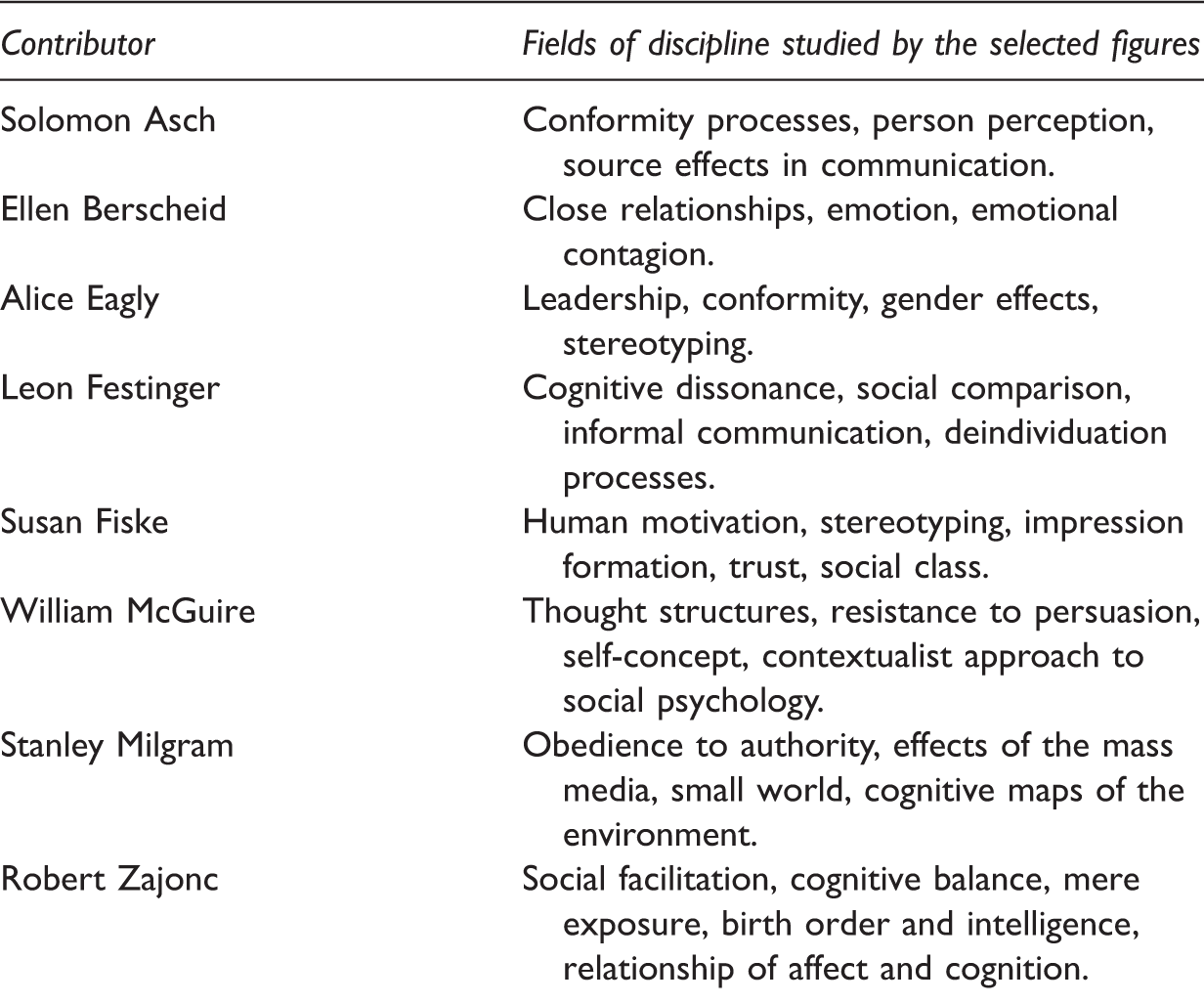
Over the last century there have been many individuals who have contributed to the evolution of theory in social psychology. Nevertheless, three factors were taken into consideration when selecting the eight individuals. First, it was decided that the individuals selected needed to represent several decades of the field and not concentrate only on very recent contributors. This decision was based on the guiding principle that an understanding of the history of the discipline remains a significant factor in understanding why social psychologists do what they do and why they do it (Benjamin & Baker, 2009). Second, it was thought important to include both men and women who have made important contributions to the field and not concentrate upon a history of “great men” (Eagly, 2012). Third, the authors selected people who had made several independent contributions to the field, preferably more than three, to give the students choice in their selection of areas and figures. It was recognized that the areas may be linked methodologically or thematically, and this factor was made clear to students in the task instructions so that they could investigate the links and associations between each psychologist’s separate contributions.
Procedure
The exercise comprised three separate, but linked stages. In the first stage, the students were instructed to examine the work of each of the eight theorists. Reading about the eight figures provided a broad exposure to a range of theories and ideas in the discipline. In the second stage the students had to choose three theorists on whom to concentrate. This enabled the student to examine work in an area of the discipline congruent with their own emerging interests. They then had to explicate briefly three areas of contribution made by each of the three theorists. The students were not provided with information pertaining to the key contributions of the selected figures. Rather, the students had to explore the literature and compile evidence on three contributions per individual. In doing so, it was anticipated that this process would facilitate the creation of linkages between the contributions, which may have been overlooked through separate examination and enable the students to gain a deeper insight into each of the areas. At the third stage each student then had to rank order the three theorists they had chosen for examination and identify the one who they thought had made the greatest contribution, with reasons given for the choice. There was no correct answer of course, as all the contributions were significant in the discipline. Rather, this exercise was designed to allow the students to explore their own interests and find social psychologists who were congruent with their own interests.
Eminence, as described by Haggbloom et al. (2002) is a multifaceted concept that is unlikely to be captured by one individual measure. Accordingly, students were instructed to use a variety of indices to identify a single top choice. For example, students were informed that they could investigate the number of entries in the indices of introductory psychology and social psychology texts, citation counts (e.g., Google Scholar), historical appraisals of the research, or through references to social psychology in literature or the press, outside of academe. Students were informed that all indices were equally weighted, such that they all attracted the same amount of marks. This exercise introduced the student to the use of indices in the evaluation of innovation and creativity and therefore an introduction to the sociology of the evaluation of science. Utilizing several ranking indices to assess contribution is also consistent with previous attempts to determine the eminence of psychologists (e.g., Haggbloom et al., 2002). Therefore, adopting multiple criteria can strengthen the objectivity of assessment, and highlight the impact that an individual has in a particular domain.
Results
Frequency of Rankings for Each Contributor
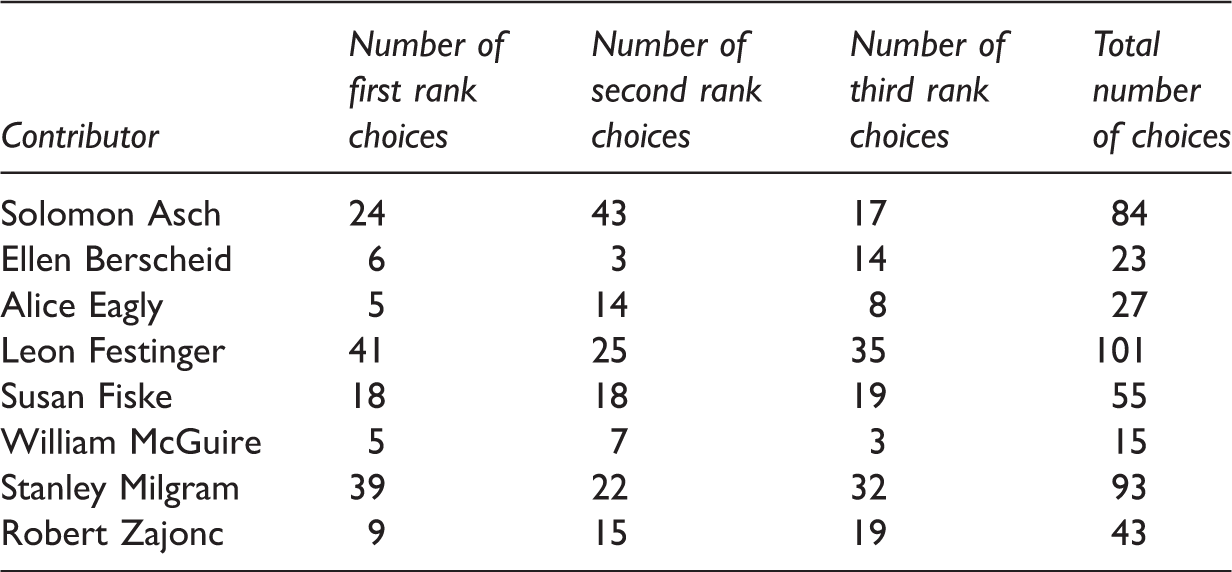
Distribution of Combinations of Psychologists Chosen by Students
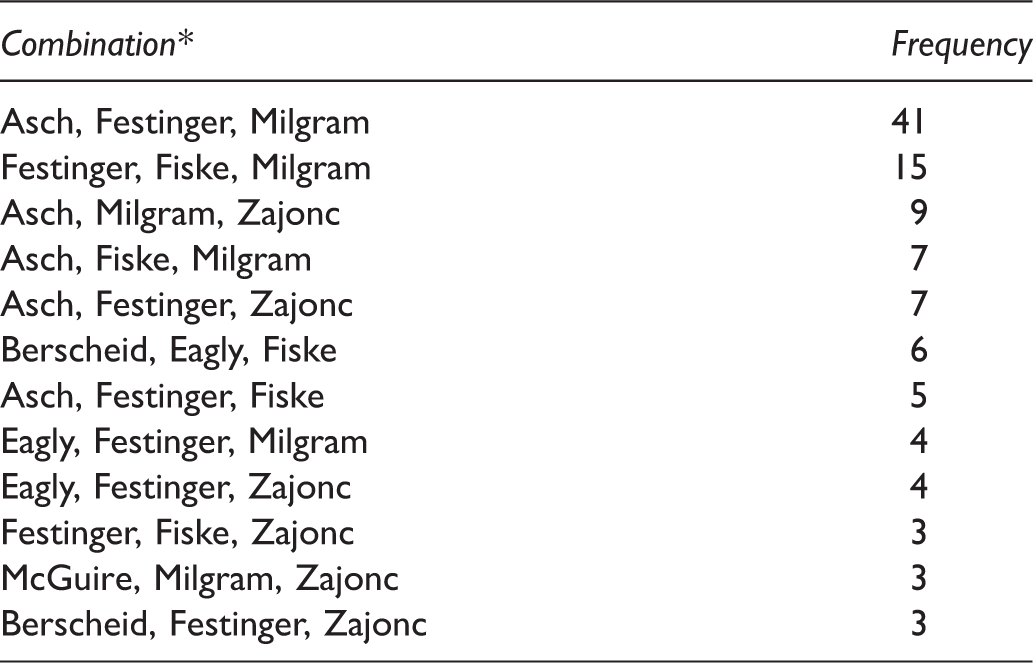
Note: only combinations of individuals that were observed more than three times are reported in Table 3. Combinations could appear in any order.
Understanding the linkages between individuals is reinforced when we examine the number of pairings of psychologists within the triads. Every one of the pairs between the eight psychologists was made at least once; so the students were able to identify links between all of the psychologists presented. McGuire, with only 15 appearances in the triad combinations, nonetheless had at least one link with every other psychologist in the list. This was shown further in the example of Festinger and Zajonc. While Festinger was predominant in the choices made and Zajonc was significantly less frequently selected, there were four links between Festinger and Zajonc when more than three links were detected. This combination expanded to seven links when all of the possible linkages are explored. So an examination of the links between researchers was performed by students, and similarities and contrasts were identified that suggested the students conducted an exploration of the various methods and theories these individuals contributed to the discipline.
Exploration of Ranking Criteria
To explore the frequency of ranking criteria employed by students, a summative content analysis (Hsieh & Shannon, 2005) was performed on the submitted assessments, which yielded nine common criteria: author citations (n = 30), theorists’ coverage in psychology textbooks (n = 13), historical appraisal of the contributions (n = 11), social significance of the findings (e.g., research promoted gender equity debates; n = 52), scientific quality of the work (n = 19), applications of the work to field (n = 39), commentary on ethics (n = 9), awards and or accolades received (n = 14), and personal significance (n = 3). Students employed various combinations of the aforementioned criteria: 107 students made explicit reference to employing one ranking criterion; 30 students employed two criteria; and 9 employed three criteria.
Investigation of Gender Differences
A factor included in the exercise was the gender of the psychologists presented. Three of the psychologists presented were prominent women. One might expect that there may be a bias towards students examining the research of psychologists of the same gender. This was examined by identification of the triads of psychologists which contained at least one female psychologist. The degree to which male and female students then studied the work of psychologists in which all three persons were male against those in which there was at least one woman showed that there was no gender bias. While there were predominantly more females than males in the social psychology class, a characteristic of all psychology programs in Australia, within genders there was no distinction in choice of triads to be studied. A cross tabulation revealed that of the 34 males, equal numbers chose triads with no females and triads with at least one female. Of the 113 female students, 53 chose triads with no female figure while 60 chose a triad with at least one female figure.
Analysis of the Graded Assessment
As noted previously, the exercise was part of the summative assessment structure. Hence, a comparison of the grades assigned to male and female students showed no differences in mean scores or in the standard deviations of the distributions. An examination of the distribution of grades for assignments which had identified three choices including at least one female psychologist showed a disproportionate number of high distinctions for those which included a female. The average grades assigned showed no significant differences between the groups of psychologists selected, although the highest average was assigned to the grouping of Berscheid, Eagly, and Fiske. This grouping, however, was only chosen by two students. There appears to be no bias in the grades assigned as a function either of gender of student or the gender mix of psychologists selected for review.
Discussion
The current paper outlined a tertiary level class exercise to explore student choices pertaining to an examination of key figures and their various contributions in social psychology. While the exercise was largely exploratory, an analysis of the student responses revealed that various combinations of contributors were discussed, with the most frequently reported triad including Festinger, Asch, and Milgram. Analyses also revealed that in determining which individual made the greatest contribution to the discipline, students employed a variety of ranking criteria; describing the social significance of the contributions, and elucidating the subsequent applications of the theories were the most frequently employed criteria.
Consistent with previous literature on the ranking of eminent psychologists (e.g., Haggbloom et al., 2002), students in the present task identified and employed a number of criteria to quantify the contributions of the chosen individuals. While some of the adopted criteria were similar to those provided in the initial assessment instructions (e.g., author citations), students generated new criteria, and elaborated on others, including the significance of the contribution(s). For example, some students wrote on the various debates in gender equity that followed the publication of Fiske’s research on sexism (e.g., Glick & Fiske, 1996). Therefore, students demonstrated an ability to objectively appraise the impact of an individual’s contributions by adopting a number of ranking criteria that facilitated a decision on the eminence of the chosen individuals.
The choice of the psychologists for study by class members was guided by the selected principles, but it is clear that many other individuals could be selected. Systematic selection of psychologists over the next iterations of the class will enable the exploration of the nature of the links that are made by students and also the investigation of whether particular figures may be more likely to stimulate breadth of understanding and associations between areas of study than are others. For example, the present sample of psychologists does in fact provide considerable overlap in the areas that are provided. The work of McGuire overlaps with that of Asch and Festinger and the research of Berscheid does to a degree overlap with that of Eagly and to some degree with Fiske. A choice of psychologists with less overlap may stimulate the student to broaden the extent of coverage. On the other hand the overlap can encourage a greater depth of understanding by stimulating the recognition of different approaches to the same issue.
It is also pertinent to note that all eight of the social psychologists selected are American. This does reflect the degree to which social psychology has been an American-centric discipline, but future replications of the exercise could capture the more global spread of contemporary social psychology by including significant authors from Europe. One feature of the group of psychologists selected in this exercise is that three of them, Asch, Festinger and Milgram are all very high profile psychologists who are featured in first year introductory courses as well as being center stage in introductory social psychology courses. It should be noted that the triad most often chosen was the one featuring these three people, as is shown in Table 3. There is, therefore, a likelihood that many students would make a choice of these based upon prior experience. It should be noted in passing that the choice of these three extremely eminent male psychologists did not result in any higher or lower grades achieved by the students making that choice. A future replication of the exercise could, therefore, benefit in widening the range of psychologists featured and facilitating the spread of links forged by students. The inclusion, therefore of a non-American psychologist, such as Serge Moscovici, the addition of another female psychologist, say Hazel Markus, Shelly Chaiken or Carolyn Sherif and other more applied and younger psychologists, such as Robert Cialdini or Daniel Gilbert would be a useful modification. All psychologists chosen, however, need to have made contributions to multiple areas of the discipline.
Conclusion
This exercise in the review and evaluation of eminent social psychologists is presented as a means of exposing students to a diversity of theoretical perspectives. The task attempts to enhance the depth of knowledge that students have about the work of their selection and also requires them to compare and contrast that work and finally to evaluate its importance. In doing so, students formulate an argument to support the evaluation and this acts as a formative assessment in creating an understanding of the fundamental activities of eminent social psychologists.
Disclaimer
It should be noted that the views of the authors expressed in the submitted article are their own and not an official position of either institution or funder.
Footnotes
Declaration of Conflicting Interests
The author(s) declared no potential conflicts of interest with respect to the research, authorship, and/or publication of this article.
Funding
The author(s) received no financial support for the research, authorship, and/or publication of this article.