




Abstract
Problem-based learning (PBL) is an internationally recognised pedagogical approach that is implemented within a number of disciplines. The relevance and uptake of PBL in psychology has to date, however, received very limited attention. The aim of this paper is therefore to review published accounts of how PBL is being used to deliver psychology curricula in higher education and to highlight psychological research that offers practical strategies for PBL theory and practice. The paper is divided into three sections. In the first, we discuss the principles of PBL and provide examples of how it can be used within psychology curricula, alongside a consideration of its advantages and disadvantages. In the second section, we outline the results of a systematic literature review of published examples of PBL used within psychology undergraduate and postgraduate courses. Finally, in the third section, we examine some of the ways in which psychological research can provide practical guidance for PBL teaching practice. We conclude this paper with some recommendations for future research across all these areas, and call for the further development of PBL curricula in psychology higher education course provision.
Introduction
Problem-based learning (PBL) is more than a pedagogical method (sometimes referred to as a didactic approach). It is an orientation to teaching and learning falling under the broad umbrella of student-centred, enquiry-based or active learning approaches (Barrett, 2005; Hmelo-Silver, 2004). PBL was pioneered in the 1960s in the Medical School at McMaster University, Canada (Barrows & Tamblyn, 1980) and has since been developed at Aalborg University (Denmark), Maastricht University (Netherlands) and Newcastle University (Australia), as well as being implemented in a number of disciplines and universities worldwide. The fundamental principle of PBL is to equip students with an investigative approach and to develop a greater sense of responsibility for their learning. As the main processes of PBL are rooted in problem-solving, self-directed learning and group interaction, this places psychology very much at the centre of how PBL works and how it may be understood as a teaching and learning approach. Despite this, there is relatively little reporting of how PBL is used in psychology and how psychology informs PBL in published work (see for example, Dunsmuir & Frederickson, 2014; Kiernan, Murrell, & Relf, 2008; Norman & Schmidt, 1992). In view of this, a main objective of this paper is to provide a systematic review of published accounts of the ways in which PBL is being used to deliver psychology curricula in higher education, with a second main objective to illustrate the ways in which psychological research can provide a range of principles and strategies that inform PBL practice. In so doing, our overall aim is to summarise the current developments in each of these areas and to stimulate a more robust engagement with PBL in psychology teaching and learning, and in psychological research. We will begin with an overview of PBL and some examples of how it might be applied to psychology teaching across different settings.
Problem-Based Learning in Psychology in Different Settings
PBL is a student-centred pedagogical approach that places open-ended problems rather than defined curriculum content at the heart of learning (Barrows & Tamblyn, 1980; Hmelo-Silver, 2004). A problem in PBL is an issue that is investigated, discussed and analysed, which could take the form of a puzzle, a scenario or a case study (Barrett, Cashman, & Moore, 2011). As there are no fixed and final solutions and numerous ways to solve these problems, students can study the same problem but learn different things from their engagement with it. The problems are used to stimulate the learning of students who are normally required to work collaboratively in small groups in order to identify what is ‘unknown’ about the problem. Students will then conduct individual research to obtain content information, before returning to the group to collectively devise an appropriate response and a possible and plausible ‘solution’ to the problem. As students are required to actively take responsibility for what and how they learn, PBL is not simply another method of teaching and relies on a very different philosophical approach to more tutor-centred pedagogies (Dolmans, Wolfhagen, van der Vleuten, & Wijnen, 2001; Savin-Baden, 2000, 2003). It also necessitates a fundamental revision of the roles of students and teachers, respectively. The main goal of PBL is to help students become self-directed learners, who are able to seek out, apply and reflect critically on knowledge, especially as this applies to professional contexts (Hmelo-Silver & Barrows, 2006; Hung et al., 2008). Skills such as these form the bedrock of psychological literacy and employability, which are currently being promoted as examples of good practice when embedded in undergraduate psychology provision across the UK (Cranney & Dunn, 2011).
PBL is often imagined as a single general education strategy, but in reality there are a number of PBL models (Barrows, 1986), as can be illustrated by the Aalborg (Kolmos, Fink, & Krogh, 2006), Maastricht seven-step (van Berkel, Scherpbier, Hillen, & van der Vleuten, 2010) and open-ended PBL (Boud, 1985; see also Davidson & Howell Major, 2014) models, with the former including project-based PBL. These models differ in terms of whether they require a tutor at every session (Maastricht) or not (Aalborg), whether they involve many short problems (Maastricht) or longer projects (Aalborg, and project-based PBL), and whether there are a series of steps to be followed (Maastricht) in terms of guiding collaborative work in groups. There are also variations in how PBL is integrated into curricula, ranging from PBL approaches underpinning a whole programme of study through to the use of PBL in a single module or session. Savin-Baden (2000), when outlining the different models and modes of PBL, notes that the decision over which specific model to use will, in part, be dependent on the discipline within which it will be used. In addition, those disciplines with more specific and clearly defined core curricula may find it harder to adopt the open-ended approaches to knowledge acquisition and transfer inherent in PBL. This may pose a particular challenge for disciplines such as psychology, due to its very broad yet tightly defined core curriculum areas, and may account for the relatively low uptake of PBL in this area, which is an issue we will return to later in the paper.
Two Examples of PBL In Psychology Programmes
Despite perceived barriers to implementing PBL in psychology, it has been successfully used on a number of courses. We provide an illustration of this in the following example based on Linköping University in Sweden, which adopts a whole programme approach to PBL, and Strathclyde University in Scotland, where PBL is used in a single module.
The Psychologist programme at Linköping University, Sweden, was established in 1995 following a tradition of being effectively used within the medical faculty at that university. The student intake is approximately 50 each year, and students are required to work in small PBL tutorial groups throughout their five years of study. The structure and applied nature of the teaching and learning on this programme provides students with an opportunity to understand a range of theoretical and applied psychological issues. The delivery of the social psychology component of the degree at Linköping provides an example of this, where subject knowledge and applied components are interrelated throughout the course in a way that challenges students to apply their psychological knowledge of groups to their own group processes and practices. This process starts with the students deciding on the membership of their tutorial groups (based on their understanding of the roles and requirements of a group), followed by the acquisition of knowledge about group composition and group working, and finally reflection on various group processes and dynamics.
Comparison of Two Forms of Problem-Based Learning (PBL) Implemented in Psychology Courses
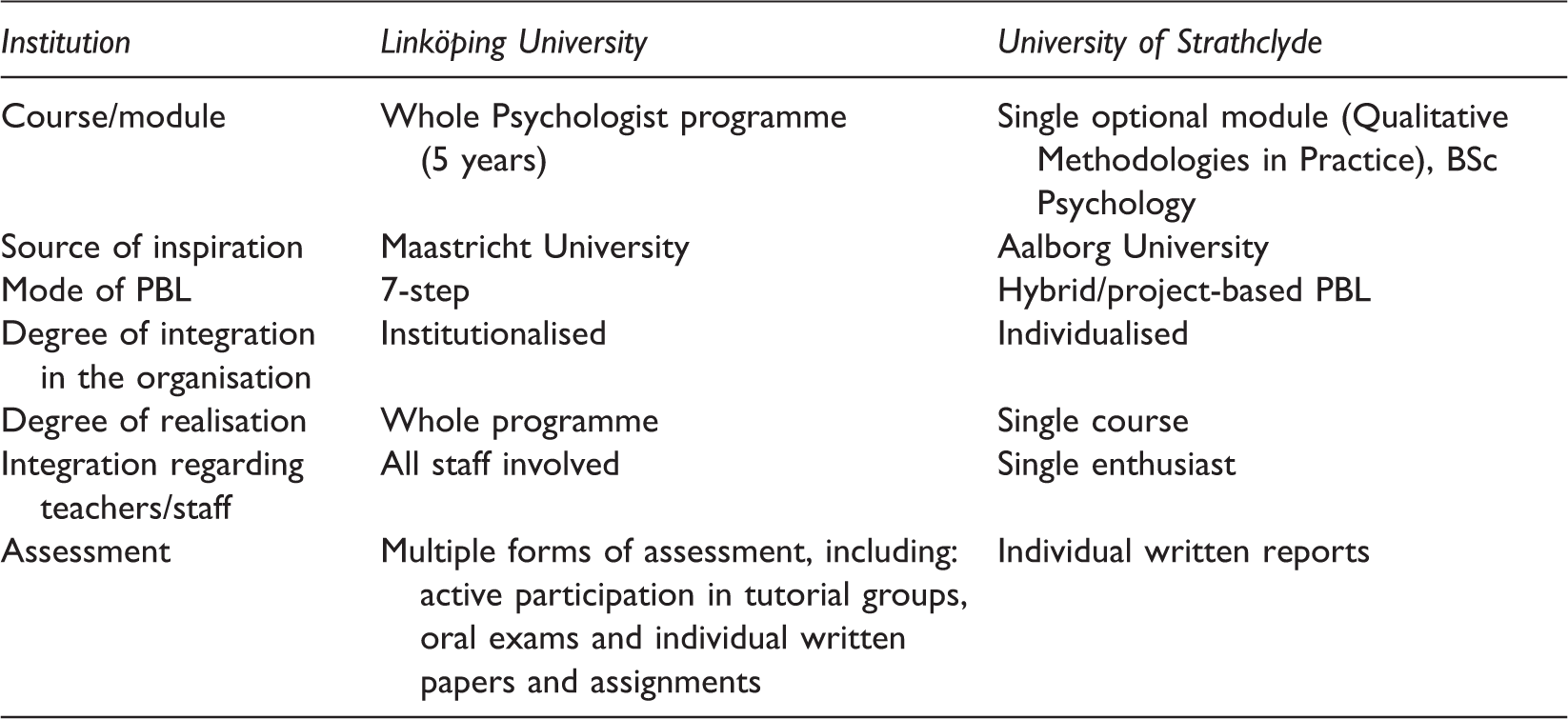
In our example we have demonstrated how PBL has been employed in very different ways in two institutions. In the following section we turn to the question of why PBL should be adopted on psychology courses by examining available evidence on the benefits of PBL approaches alongside a discussion of some of the associated challenges.
Benefits and Challenges of PBL For Psychology Teaching
A number of reviews and meta-analyses in this area have aimed to examine the effect of PBL on learning outcomes (Albanese & Mitchell, 1993; Colliver, 2000; Dochy, Segers, Van den Bossche, & Gijbels, 2003; Gijbels, Dochy, Van Den Bossche, & Segers, 2005; Hmelo-Silver, 2004; Norman and Schmidt, 1992) or have reviewed the evidence on the relationship between tutor characteristics and student learning outcomes (Leary, Walker, Shelton, & Fitt, 2013 ). Such outcome research has mainly focused on knowledge, skills and the self-reported motivation of the students. There is relatively consistent agreement that while PBL does not necessarily improve current problem-solving or team-working skills, there are benefits with, for example, long-term knowledge retention and the ability to make links between constructs, including transfer to new problems and real-world contexts (Hmelo, 1998; Hung et al., 2008), enhanced skills for long term self-directed learning, independent planning and organisation (Schmidt, Loyens, Van Gog, & Paas, 2007 ) and collaboration and team-working skills (Dolmans, de Grave, Wolfhagen, & van der Vleuten, 2005).
The use of PBL might also be considered as fundamental to the move towards a skills and employability agenda observed in a number of disciplines. For example, in the UK and USA at least, there has been a gradual shift in psychology being a largely knowledge-based discipline to one presenting a greater focus on graduate attributes, where ‘psychological literacy’ has been adopted as the conceptual framework for understanding these graduate attributes (McGovern et al., 2010; Trapp et al., 2011). Cranney and Dunn (2011) provide an account of psychological literacy drawing on the attributes psychology graduates are expected to obtain upon completion of their programme of study (see also Karantzas et al., 2013). This encompasses both general psychological literacy dimensions, such as communication, critical thinking and problem-solving skills, cultural competence and self-awareness, as well as the understanding and application of psychological concepts and research practices in real-world/professional contexts. PBL approaches are therefore well-suited to developing psychological literacy and employment-related skills due to the emphasis placed on fostering in students effective problem-solving and collaborative skills and flexible thinking styles and by supporting students to become intrinsically motivated, autonomous, lifelong learners (Hmelo-Silver, 2004).
In addition to the potential advantages of using PBL in psychology curricula, a number of challenges also need to be considered. Hmelo-Silver (2004) notes that most of the research base is informed by medical and high-achieving learner education, raising questions about the extent to which PBL is beneficial for less skilled learners. Furthermore, most of the research on PBL focuses on evaluating outcomes, with very few studies addressing the question of how the processes underpinning PBL can be enhanced to support group work and self-directed learning, which are the critical components of any PBL teaching and learning activity. Individual psychological processes, such as academic self-regulation, metacognition, academic self-efficacy and sensitivity in interpersonal contexts, may play a significant role in the success or failure of PBL, yet an assumption is made that all students are equally ready to engage in potentially challenging learning activities.
PBL requires that students actively work on problems rather than receive specific tutor-driven content, and that a drift across disciplinary boundaries is often a desired or consequent outcome of this process. In order for PBL to be deployed effectively, flexibility over what constitutes ‘core’ psychological knowledge and the extent to which psychology courses should or could be considered inter-, multi- or even trans-disciplinary is required. It also needs to be recognised that psychology programmes differ internationally in the extent to which they provide a direct route into professional occupations (McCarthy, Dickson, Cranney, Trapp, & Karandashev, 2012). For example, in Australia and the UK – and in what Reddy and Lantz (2010, p. 56) refer to as the ‘BSc career fallacy’ – a first followed by a higher degree in psychology provides the basis for employment in an accredited psychology profession (Cranney & Voudouris, 2012; Trapp et al., 2011). In a non-vocational and non-directive undergraduate degree where students can go into many future careers, it can be challenging to focus PBL on specific outcomes. By comparison, the Psychologist programme at Linköping University combines bachelor and master’s levels degrees, studied over a five-year period, which equips students with the requisite skills for professional practice upon completion (Trapp & Upton, 2010). A further challenge concerns fears over a potential ‘performance slide’ associated with the adoption of PBL pedagogies, in which generic industry-ready skills are assumed to be given priority over depth discipline knowledge (Barnett, 2009; Barnett, Parry, & Coate, 2001). A balance therefore needs to be struck between what counts as appropriate subject knowledge and providing students with adequate skills training in readiness for diverse career destinations.
University ranking schemes and league tables – including published student feedback such as the National Student Survey in the UK – may engender inertia and also resistance from faculty members who fear receiving poor evaluations from students. Resistance may also be met from students, especially those who adopt a consumerist approach to their education that seeks ‘value for money’, often translated as tutor-driven rather than student-created input, presenting further obstacles to be tackled.
In very practical terms, the introduction of PBL in psychology courses requires support at an institutional level from senior managers through to faculty members. Buy-in is also required from students who, through previous educational experiences, may associate good teaching and value for money with more traditional tutor-led pedagogies. As we noted earlier, PBL can be utilised in psychology curricula in a variety of ways, ranging from a single session or a stand-alone module, through to a whole programme approach that could be adopted incrementally by those interested in implementing PBL in their psychology curricula. Additional practical guidance for those seeking to develop and use PBL in their teaching is provided elsewhere (Papageorgiou, McCrorie, Georgiades, & Perdikogianni, 2015; Schwartz, Mennin, & Webb, 2001; van Berkel et al., 2010, see also the PBL clearinghouse at Delaware University: http://www.udel.edu/inst/clearinghouse/index.html). In the following section, we report the findings of a systematic literature review that illustrates more broadly how PBL is used in psychology degrees with the aim of supporting the integration of PBL across a greater range of psychology programmes. Having specific examples of how PBL has already been implemented in psychology teaching is important if we are to stimulate further interest in this area.
Applications of Problem-Based Learning to Psychology
Earlier we argued that making a transition to PBL requires consideration of a range of factors that are both theoretical and practical (Duch, Groh, & Allen, 2001; Paul, 2010; Schwartz, Mennin, & Webb, 2001). In this section, we draw together and review published examples of the use of PBL for psychology teaching in higher education. A systematic literature review was conducted in January 2016 to address the following question: What published evidence is there of problem-based learning being used as a teaching approach in psychology undergraduate and postgraduate curricula in higher education? This included all forms of PBL (including project-based and inquiry-based learning, but NOT related pedagogies such as case-based learning and scenario-based learning) to ensure that the review was as inclusive as possible. The following databases were searched for all dates up to January 2016: Australian Educational Index, British Education Index, Cochrane Library, Education Abstracts, ERIC, PsycINFO and Web of Science. Combinations of the following search terms were used: inquiry-based learning, learning, pedagogy, problem based learning, project based learning, psychology, teaching. In addition to this, the references of all journal articles included in the review were manually searched to identify any other papers not already captured by the review process, as well as searching Google Scholar to ensure nothing was missed. The inclusion criteria were that articles should refer directly to the use of any form of PBL in teaching psychology in higher education and be written in English. Articles were excluded if they referred to school education or if they referred to a psychology PBL class only as part of a research study but did not go on to discuss this in terms of teaching.
List of Published Examples of Problem-Based Learning (PBL) Used In Higher Education Psychology Courses

What is immediately noticeable about the list of published examples of PBL being used in psychology teaching is that PBL is mostly used within single modules (typically running over one semester and often a small part of a module) that is facilitated by only one or two tutors. The majority of the studies also reported using a hybrid approach, integrating PBL sessions with lectures or other structured activities. Some used online means, as either additional support or for the main PBL activity (e.g., Bozic & Williams, 2011; Kiernan et al., 2008). While not all studies noted class sizes, many were around 30 students or less. This was at times due to the intake into psychology degrees being around that number, or because those students were taking an optional module and so were only a proportion of the whole psychology cohort. The reviewed modules are also typically at institutions where PBL is the minority pedagogical approach. Where PBL is used in psychology bachelor education in universities that adopt PBL across numerous departments (such as Erasmus University Rotterdam, Maastricht University and McMaster University), the literature primarily reports on research that investigates PBL as an approach per se rather than as a specific pedagogy for psychology teaching (e.g., de Koning, Loyens, Rikers, Smeets, & van der Molen, 2014; Wijnia, Loyens, Derous, Koendjie, & Schmidt, 2014).
There are specific examples of PBL being used in vocational postgraduate psychology courses such as clinical psychology (Kiernan et al., 2008; Nel et al., 2008; Stedmon, Wood, Curle, & Haslam, 2005), educational (Bozic & Williams, 2011; Chernobilsky, DaCosta, & Hmelo-Silver, 2004; Razzak, 2012) and forensic psychology (Hays & Vincent, 2004; Kiernan et al., 2008). As Dunsmuir and Frederickson (2014) note, however, even here there is sparse published work in these areas and these also highlight the surprising lack of PBL reported within psychology curricula. Kiernan and colleagues (2008) argue that this might be due to the tension between the requirements of accrediting bodies (such as the Australian Psychology Accreditation Council or the British Psychological Society) to focus on content knowledge and skills, and the pedagogy of PBL, which focuses more on the processes of learning and on interdisciplinarity, as we have noted above.
The reviewed papers support some of the earlier noted learner benefits of PBL. For instance, an improvement in students’ critical thinking skills and engagement with their studies has been identified within single psychology courses (Jones, 2013; Karantzas et al., 2013; Muehlenkamp, Weiss, & Hansen, 2015), supporting the review by Dochy et al. (2003). In other studies, the findings have been mixed (Adams & Jordan, 2012; Willis, 2002). The assessment of students’ learning might also influence how the effectiveness of PBL is evaluated. Willis (2002), for example, shows that the students’ grades in the PBL course were lower at midterm compared to students who took a more traditional course, but at the end of the semester these differences levelled out. Reynolds (1997) also highlights the importance of assessment being aligned with the pedagogical method used, in what Biggs and Tang (2011) describe as constructive alignment. There is also a common challenge with the issue of control when implementing PBL approaches; for the tutors this will relate to the need to let go and for students to take control of their own learning (Reynolds, 1997).
In addition to the reviewed articles featured here, other articles were identified that are not included in the review because they did not fit the inclusion criteria, but nonetheless are worth noting for their relevance to the broader aims of this paper. They relate to potential of PBL for clinical psychology (Baillie et al., 2011; Huey, 2000), educational psychology (Dunsmuir & Frederickson, 2014; Jordan & Porath, 2006) and forensic psychology (Day & Tytler, 2012). There were also articles that drew on the use of PBL in psychology courses for primarily research purposes, notably Dahlgren and Dahlgren (2002) and Dahlgren (2003) (Linköping University, Sweden), de Koning et al. (2014; Erasmus University Rotterdam, Netherlands ), Van den Hurk (2006; Maastricht University, Netherlands), Wijnia et al. (2014; Erasmus University Rotterdam, Netherlands) and also Contreras, Rodriguez-Espartal, Augusto Landa, and Lopez-Zafra (2013; University of Jaen, Spain).
In summary, there are promising published examples of PBL being used in psychology higher education teaching, at both undergraduate and postgraduate levels. Some of these publications provide details on the structure of classes and the specific form of PBL being used. Readers will hopefully be inspired by these examples to consider how they might develop their own teaching practice in this area. Those who have been using PBL in psychology teaching are encouraged to publish their own reports, in order for tutors at other institutions to see examples of PBL in use in psychology teaching. Much more work is needed, for example, to show the specific benefits of PBL in psychology teaching (as opposed to other pedagogical approaches), to consider how PBL might help to rejuvenate psychology curricula and how psychology tutors might seek training in PBL facilitation and curriculum management.
Applications of Psychology to Problem-Based Learning
Outcome Research from A Psychological Perspective
In this final section, we consider the ways in which psychological research can make a significant contribution to the development of strategies for PBL. While the core principles of PBL are to promote greater student autonomy and responsibility for their learning and to develop their ability to apply problem-solving skills across a range of contexts, we have noted that there is a great deal of variation in the way that PBL approaches are operationalised across different institutional contexts. This variation means that it is difficult to make any meaningful comparisons across contexts when evaluating the effectiveness of PBL. This is further compounded when notions of effectiveness are reduced to simplified outcome measures such as student performance on summative assessment tasks. When factors such as the type of PBL model, type of problems used, differences between facilitators and students, resourcing for PBL and workload are taken into account, it is difficult to measure precisely what is having an effect on student performance and in what way (Hung, 2011 ). In addition, Belland, French & Ertmer (2009) have noted that reliability and validity are not routinely reported across many of the meta-analyses and systematic reviews conducted in this area, which further throws into question the extent to which a focus on outcome measures is a desirable way of assessing the utility of PBL approaches, or whether this is even possible. The emphasis placed on short-term summative assessments as outcome measures may also miss the point, as PBL offers an entirely different approach to learning that embeds long-term skills rather than emphasising short-term knowledge gains. Furthermore, assessment-focused outcome research that compares different pedagogies makes an assumption that these pedagogies are enacted in the classroom and perceived by students in comparable ways and also in the ways intended. As indicated above, this assumption may not hold where PBL is used with more varied groups of students.
Karantzas et al.’s (2013) paper exemplifies the type of outcome-oriented research that can serve to transcend the issues raised above from a psychological research perspective. They report the development of a short scale aiming to directly assess critical analysis and problem-solving skills in order to estimate the effect of PBL on student learning, thus bypassing reliance on performance in summative assessment tasks or simple ‘liking’ measures. The effect of PBL on student learning is thus measured in terms of perceived opportunities for engagement with the process as it was intended. In our own research we have taken a similar approach, assessing in the first instance the extent to which students agree that the principles of PBL have been apparent in the classroom (Pauli, Raymond-Barker, & Worrell, 2016). The focus of this research was students-as-partners (SaP) pedagogies (which includes PBL but is a broader construct). Like Karantzas et al. (2013), we developed a scale to measure self-report of SaP experience in an effort to avoid the assumption that all students experience a given pedagogy in the same way. Secondly, in common with Karantzas et al. (2013), we focused on broader and more long-term outcomes than student performance in assessment tasks, such as graduate and employability skills. An important finding in our own research was that students who were more favourably disposed to these pedagogies were more likely to benefit from them in terms of skills acquired (Pauli et al., 2016). From a perspective of examining the utility of PBL in psychology, it is suggested that outcomes worthy of evaluation include the development of psychological literacy (Trapp et al., 2011), psychology graduate skills and long-term effects in terms of usefulness for employment (Pauli et al., 2016).
Development of Self-Directed Learning
Another area in which psychological research could make a contribution to PBL practice is in the area of self-directed learning. This can be understood as a design feature of the learning environment as well as a learner characteristic, where the latter refers to students’ preparedness to initiate a learning task and take control of the learning issues (Loyens, Magda, & Rikers, 2008). Self-regulated learning, on the other hand, is often treated as a learner characteristic involving goal-directed, active and engaged learning, intrinsic motivation and efficient use of behavioural and meta-cognitive strategies, which is associated with high academic achievement (Zimmerman,1990), that is, as an individual trait rather than a PBL process. In PBL practice it is assumed that self-regulated students should be capable of self-directed learning and therefore not depend on tutors to supply them with the ‘correct’ knowledge for addressing a problem. Handing responsibility for selecting appropriate knowledge over to students is one of the issues that concerns those tutors and students who are critical of PBL (Camp, 2001). As noted above, there is evidence that not all students may be equally prepared to take this on (Pauli et al., 2016). There is also some evidence that self-regulation and individuals’ preparedness for self-direction in learning are developmental processes (Silén & Uhlin, 2008; van den Hurk, 2006; Zimmerman, Bonner, & Kovach, 1996); however, the evidence pointing towards the extent to which PBL actively fosters this development is more mixed, indicating that how PBL is implemented (e.g., group size) and how it is understood and enacted by tutors and students is critically important to the extent to which it impacts on the development of learning skills (Lloyd-Jones & Hak, 2004). This raises two specific issues that would warrant more detailed psychological and pedagogical research. Firstly, how can diverse student groups be prepared for active learning pedagogies to derive maximum benefit and, secondly, how can we understand individual differences in learner characteristics as impacting on the acceptability and benefit of PBL pedagogy?
Research on Group Processes in PBL
The final area that we will consider, in terms of how psychological research might inform PBL practice, is that of group processes. Following concerns that there was little research into PBL student group interaction – what has been termed the ‘black box’ of PBL (Hak & Maguire, 2000) – accompanied by the lack of conclusive evidence of whether PBL works or not (Svinicki, 2007), there has been a focus in recent years on the processes of facilitation, group work and learning in PBL. It is argued that what is needed is not an answer to whether PBL works, but rather how it works, and in which circumstances (Dolmans et al., 2005). As such, social psychological research offers unique insights here into both group processes and student interaction within tutorials. Hammar Chiriac (2008) noted that studies on tutorials typically focus on how the following factors influence learning: (a) the nature and role of the problems used; (b) cognitive process; (c) motivational influence; and (d) tutors. So where group dynamics are regarded as a prerequisite for learning in PBL, there is still ambiguity and a need for increased understanding of group dynamics in tutorials (Azer, 2009; Hammar Chiriac, 2008, 2011). An important difference between tutorial groups and traditional group work in education is that the dynamic interplay between students is regarded as a part of the task and a core element of learning in PBL (Cockrell, Caplow, & Donaldson, 2000; Hammar Chiriac, 2008) and that group dynamics change in and during tutorial sessions.
Some of the research that has been conducted into group interaction in PBL tutorials focuses on the importance of the tutorial formation stage on subsequent working practices (Hempel & Jern, 2001). Important aspects, such as the group contract and how to negotiate a tutor role, are topics of interest for a successful tutorial development (Azer, 2009; Hammar Chiriac & Rosander, 2010; Hempel & Jern, 2001). The importance of different types of tasks on the interactional dynamics that operate in the tutorial groups (Hammar Chiriac, 2008), as well as the tutor’s impact on group work and other processes, has also been addressed (Azer, 2005, 2009; Silén, 2006). This work draws heavily on intra-group processes in social psychology. For instance, a group’s structure (or in this case a PBL tutorial structure) can be described as a kind of network of roles, status, composition, resources and frames that organise the group, with the students acting as a key element in all of this. Understanding the psychological relevance of the tutorial processes – all the intra- and inter-personal actions – can enable us to examine issues such as cohesion, norms, communication, collective defence, group pressure, influence and conformity.
Other social psychological work has also begun to examine student interaction in PBL tutorials. This work typically examines the discursive practices within tutorials using video-recorded data (e.g., Barrett, 2010; Clouston, 2007; Imafuku, Kataoka, Mayahara, Suzuki, & Saiki, 2014; Jin, Bridges, Botelho, & Chan, 2015; Koschmann, Glenn, & Conlee, 1997) as well as the ways in which students retrospectively rate the quality of tutorials via questionnaires (e.g., Visschers-Pleijers et al., 2005, 2006) and the amount of time spent on different kinds of interaction during the tutorials (Visschers-Pleijers, Dolmans, Wolhagen, & van der Vleuten, 2005; Visschers-Pleijers, Dolmans, de Leng, Wolfhagen, & van der Vleuten, 2006). Research in this area examines the use of online technologies in PBL tutorials, for example, when and how students make use of mobile phones in tutorial settings (Hendry, Wiggins & Anderson, in press; Jin et al., 2015 ). By focusing in detail on the conversational and interactional practices through which students work together and collaboratively construct knowledge, for example, we can gain a greater insight into the processes as much as the outcomes of learning in PBL settings.
Conclusion
In conclusion, this paper is both a review of how PBL has been (and could be) used in psychology curricula in higher education, and a call to arms to encourage further psychologically informed research into PBL processes. It is also to show how this, in turn, could benefit PBL practice in any discipline. The literature review has shown that despite the broader prevalence of PBL in higher education, there are still very few published reports of its use in psychology bachelor or master’s courses. Those who do use PBL in psychology higher education are therefore urged to make available reports on issues such as problems used for specific psychology classes, tutor training or guidelines for class structures. Such information would be invaluable to those seeking to make the transition to PBL in one or more of their psychology classes. The message from the limited literature available in this area is clear: PBL is a valued and useful tool for teaching and learning in psychology.
This leads us back to an issue we raised in the introduction: that PBL works best when broaching interdisciplinary problems, and may face resistance by those who seek to police and maintain strict disciplinary boundaries. One way to tackle this issue might be to treat psychology itself as a blend of many sub-disciplines, so PBL problems could require students to learn across areas that are often separated in curricula, such as individual differences and social psychology, or developmental and neuropsychology. This small step might enable teaching staff to develop PBL problems that still adhere to regulations set out by accrediting bodies (in that students must cover specific topic and sub-discipline areas), while at the same time allowing the flexibility in which PBL learning can thrive.
There is much for psychology to gain from using PBL approaches to learning, and most of the benefits of PBL witnessed in other disciplines may apply equally well to psychology. Moreover, it may also assist psychology courses in bridging the ever-widening gulf between theoretical and applied psychology, between those who study it simply as a subject they are interested in, and those who study it and go on to pursue professional pathways in psychology. PBL shifts the focus from learning facts, theories and methods in neatly arranged, but often de-contextualised situations, to learning that can be meaningfully and readily applied in specific contexts.
While PBL could arguably be put to much greater use in psychology teaching, we have highlighted some of the ways in which psychological research has been – and might still be – put to greater use within PBL research. It has been noted that PBL is itself based on a range of psychological principles (Norman & Schmidt, 1992), yet the potential of psychological research to have an impact on both the theoretical and practical developments of PBL is to be fully realised. We have briefly covered just three areas here – problem-solving, self-directed learning and group processes – that are central to the way in which PBL works as a pedagogy. Psychological research, however, has the potential to contribute more fully to understandings of how PBL works theoretically (i.e., to have a fuller understanding of how it works, and in what settings) and practically (i.e., to inform teaching and learning practice, providing guidance for PBL tutors and students). We look forward, therefore, to a greater collaboration between PBL and psychology, and to the potential for both endeavours.
Footnotes
Declaration of Conflicting Interests
The author(s) declared no potential conflicts of interest with respect to the research, authorship, and/or publication of this article.
Funding
The author(s) received no financial support for the research, authorship, and/or publication of this article.