




Abstract
This paper discusses both challenges and opportunities for using inquiry-based learning in public administration postgraduate education in a context of internationalisation. In particular, we discuss the appropriateness of inquiry-based learning for teaching diverse groups of students from varied international backgrounds. Inquiry-based learning has been widely promoted in the United Kingdom higher education sector and seems intuitively appealing as a pedagogical approach for an applied subject such as public administration. However, there are challenges associated with using inquiry-based learning with postgraduate international students who have a short time to assimilate complex theories and concepts in a second language, and have often been educated previously in contexts with a more didactic tradition of education. With the increasing internationalisation of the United Kingdom higher education sector, we suggest there is tension between some of the teaching and learning methods that are being promoted nationally and the needs of an increasingly diverse international student body. Reflecting on our own experiences as teachers of international students on public administration programmes, we outline both the benefits and limitations of teaching with inquiry-based learning but also suggest ways in which this type of approach could be assimilated within the broader set of pedagogical practices used with international postgraduate students.
Keywords
Introduction
This paper discusses the potential arguments for, and limitations of, an inquiry-based pedagogical approach to teaching public administration at postgraduate level. It considers how inquiry-based learning (IBL) can be integrated within the broader set of pedagogical practices appropriate to these students. IBL has been promoted within the higher education sector across many countries including the UK, particularly for undergraduate curricula (Kaunert, 2009; Neary & Win, 2009; Spronken-Smith and Walker, 2010; Preston et al., 2015; Adimoto et al., 2013). However, the UK student body, especially at postgraduate level, includes those who come from overseas, which has been the outcome of universities seeking to recruit more postgraduate students to generate income, expand their global reputations and internationalise the curriculum. However, research has indicated that IBL-type pedagogies can pose particular challenges for international and postgraduate students (Bache and Hayton, 2012). We explore these challenges further while seeking to tease out what role IBL might play within the context of public administration teaching at a postgraduate level.
IBL involves ‘learning through discovery rather than instruction’ (Levy, 2009 cited in Bache and Hayton, 2012) and has been widely used in the study of Science, Technology, Engineering and Mathematics (STEM) subjects and in fields such as medicine, business and law (Hale, 2006; Oliver, 2007; Gormally et al., 2009). The use of IBL in social scientific fields such as public administration is relatively under-explored. There have, however, been some studies on the use of IBL within politics curriculums, which we refer to and draw lessons from in this paper (Hale, 2006; Kaunert, 2009; Bache and Hayton, 2012). Prior research on IBL in politics focuses on the experience of postgraduate and international students (Bache and Hayton, 2012), or documents case studies of IBL approaches such as case-based learning (Hale, 2006) and simulations (Kaunert, 2009). 1 However, to date there are no articles that bring together evidence on the variety of IBL approaches used to teach politics that might also be applicable to the subfield of public administration. The public administration discipline has tended to focus on how academics can use research methods to educate practitioners already working in the field through knowledge exchange (Ospina and Dodge, 2005; Connolly et al., 2015). Although many academics teaching public policy and administration undoubtedly make use of inquiry-based approaches in elements of their teaching, there is need for greater conceptual clarity about what IBL means in this context, including the forms it might take, the challenges and opportunities of this approach, and how teachers using this approach might evaluate its effectiveness and engage in reflective practice to refine and modify their teaching.
The paper first provides an overview of the origins, aims and various definitions of IBL that have been advanced in existing literature. The second section discusses the benefits and challenges of IBL in higher education, and research evidence on the effects of IBL, as well as discussing the implications for educators. The third section considers arguments for, as well as the limitations of, the IBL approach in the context of public administration postgraduate curricula. The final section discusses how IBL might be evaluated in the context of the public administration postgraduate curriculum and advances suggestions for future research in this area.
The origins and aims of IBL
Although IBL gained favour as an approach to school-level education in the 1970s, its use in higher education is more recent and there have been calls for greater use of IBL at this level of study. IBL, proponents claim, provides benefits to students while also capitalising on the research-intensive nature of universities (Spronken-Smith and Walker, 2010). Official commissions on higher education such as the Boyer Commission in the United States (US) (1998) encouraged greater use of this approach as a way of improving teaching in universities and IBL is now commonly used in the USA, particularly in research intensive and liberal arts and science institutions. Indeed, there is a fairly long tradition of practical, problem-focused approaches to teaching higher education in the USA, where the concept of ‘problem-based learning’ was developed in medical schools in the 1950s (Kaunert, 2009). The origins of the approach go back much further still, as documented by Neary and Winn (2009). As far back as 1810, Wilhelm Humboldt of Berlin University argued for an ‘organic scholarship’ as opposed to a didactic approach, in which he argued that ‘Students were to be directly involved in the speculative thinking of their tutors, in a Socratic dialogue and in close contact, without strictly planned courses and curricula. Students should work in research communities with time for thinking and without any practical obligations’ (cited in Neary and Winn, 2009: 196).
There have been similar calls for IBL by education ministries in countries such as New Zealand (Spronken-Smith and Walker, 2010) and the approach has gained popularity in Australia within humanities and social sciences (Preston et al., 2015), mathematics (Thornton, 2017) and Australian higher education more generally (Aditomo et al., 2013). In the UK, where there has been recognition of the need to improve and enhance the relationship between teaching and research (Brew, 2003), the Higher Education Academy has promoted IBL and encouraged its adoption across the undergraduate curriculum from year 1 onwards (Healey and Jenkins, 2009). It is now commonplace to see concepts such as IBL, active learning, research inquiry and problem-based learning as key components of British universities’ education strategies, with universities, particularly research-intensive Russel Group universities, seeking to evidence their claims to provide ‘research-led teaching’.
What are the key components of IBL and how do they relate to concepts such as research-led teaching, problem-based learning and active learning? IBL largely encapsulates all of these teaching and learning concepts, so can be regarded as a broad pedagogical approach that encompasses a variety of strategies that are oriented towards students learning through more active means, rather than through traditional didactic approaches. In the latter approach, students are expected to absorb, memorise and retain information through reading or listening to lectures. The student is relatively passive and the tutor is seen as the ‘expert’ and the authoritative imparter of knowledge. IBL, by contrast, fits within the concept of ‘communities of practice’ (Wenger, 1998; Brew, 2003) whereby students are regarded as part of the academic community in which they are located, making their own ‘peripheral’ but ‘legitimate’ contribution to this (Brew, 2003: 12). In this model, students could be considered to be ‘co-producers of knowledge – compatriots in the search for knowledge’ (Justice et al., 2007, cited in Spronken-Smith and Walker, 2010: 724). Neary and Winn (2009) also argue for the reconstruction of the notion of the student as a producer of knowledge, working in collaboration with academics. These concepts sit neatly with contemporary university education strategies that actively seek to view students as collaborators with, rather than customers of, universities.
A useful summary of IBL is provided by Spronken-Smith and Walker (2010: 726) who describe the ‘core ingredients’ of IBL as including the following: An active approach to learning by students, often involving ‘learning by doing’. A process where ‘learning is stimulated by inquiry, i.e. driven by problems and solutions’. Another way of considering this is in terms of self-directed learning or study. The teacher is a facilitator of learning rather than a mere transmitter of information. The actual learning process is considered to be a ‘process of constructing knowledge and new understanding’.
The final bullet point highlights that IBL is underpinned by constructivist pedagogy where knowledge is viewed as constructed, rather than transmitted (Neary and Winn, 2009; Levy and Petrulis, 2011; Preston et al., 2015: 73). This approach means the learning experience is based on real-world scenarios and, therefore, it is an inherently ‘experiential’ approach to learning, with IBL requiring students develop their problem-solving skills. New topics are introduced as they relate to the subject of inquiry, rather than in a linear fashion that would be more typical of a traditional textbook or lecture series format (see for example Kaunert, 2009).
IBL can take many forms as discussed by Spronken-Smith and Walker (2010) who distinguish between structured, guided and open inquiry in IBL. With structured inquiry, teachers define the issue or problem and provide guidance on how to address it; with guided inquiry, teachers encourage inquiry by setting questions but leaving freedom for students to decide how to address them. Finally, open inquiry involves students setting questions as well as devising a method for addressing them. Thus the degree of teacher guidance can vary in IBL and learners may begin using one type of inquiry, such as a highly structured form, then progress to guided or open enquiry as they progress through a task, a module or a degree course. The implication of this distinction is that different degrees of independence in IBL may be more or less appropriate according to how advanced the students are in their stage of learning (see also Gormally et al., 2009, who argue that a guided form of IBL is most appropriate for students lacking experience in tackling inquiry problems).
IBL and research-led teaching and learning are closely related approaches (Brew, 2003; Spronken-Smith and Walker, 2010). IBL can itself be considered a means of strengthening the relationship between research and teaching (Brew, 2003; Justice et al., 2007; Spronken-Smith and Walker, 2010), a relationship that some believe universities have not always managed well (Boyer, 1990; Jenkins et al., 1998; Neary and Winn, 2009). IBL can help to strengthen the relationship because it often involves academics and students researching together on common projects and engaging in co-produced knowledge or publications.
Research-led teaching and learning has also been conceptualised as one type of IBL, with the proviso that the research-led teaching involves some element of active discovery or engagement with the research on the part of students rather than merely being taught about the content of academics’ own research. Zamorski (2002) identifies a variety of active forms of research-led teaching, such as students taking part in primary research, analysis of secondary data or a desk-based literature review, either individually (e.g. dissertations) or in groups (e.g. research for group presentations). Alternatively, academics can involve students as co-researchers, either in the design phases of the research, data collection or analysis, or publication.
Benefits, challenges and effects of IBL
Numerous pedagogical benefits, and challenges, of IBL have been highlighted in the extant research literature, as summarised in Table 1. These benefits and challenges have been identified in case studies and observational research using qualitative and survey methodologies, which have been used to explore students’ and educators’ views, experiences, and satisfaction with the approach, in the context of particular courses and modules (e.g. Hale, 2006; Oliver, 2007; Deignan, 2009; Levi and Petrulis, 2012). There have also been studies employing experimental designs that compare the effects on student learning of IBL type approaches versus more traditional pedagogical approaches, with most of this work having been conducted in school settings (Gormally et al., 2009). There is much more limited empirical work of this nature in higher education, the majority of which is focused on science subjects (Gormally et al., 2009; see also Kirschner et al., 2006; Deslauriers, 2019).
Benefits and challenges of inquiry-based learning.
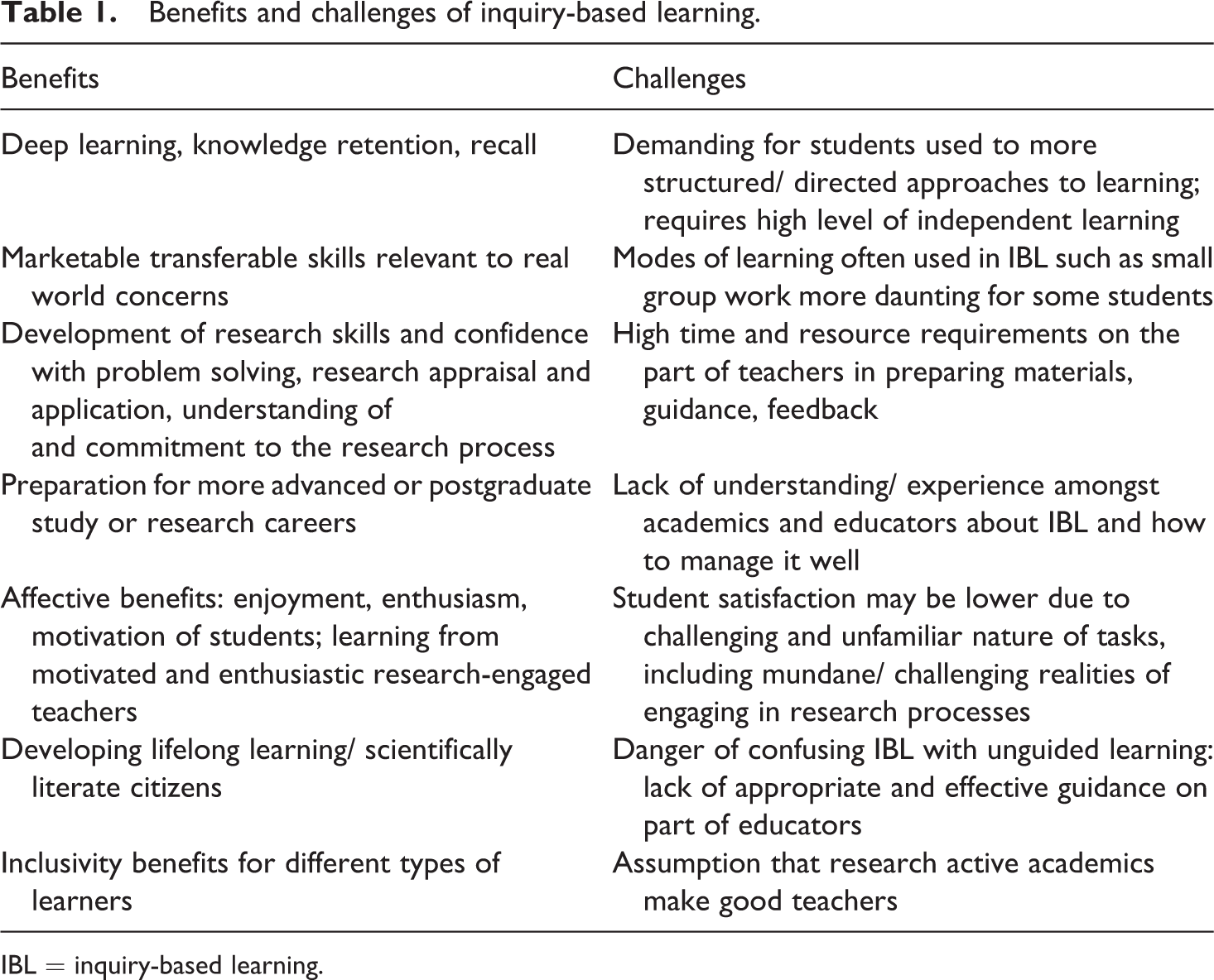
IBL = inquiry-based learning.
Intellectual and cognitive benefits of IBL have been documented across several case studies (see Levi and Petrulis, 2012, for a review). At a cognitive level, one key benefit commonly listed for IBL includes an increased likelihood of deep learning, knowledge retention and recall (Hale, 2006; Oliver, 2007), because students take a more active role in learning, as compared to surface-level learning often attained through traditional lectures. In some of the more open-ended approaches to IBL used with advanced undergraduates or postgraduates, students take part in defining the problem and identifying suitable courses of action (Spronken-Smith and Walker, 2010), which is likely to deepen learning even further. As Kaunert (2009: 259) discusses, deep learning in IBL is facilitated by the requirement for students to take ‘ownership of the learning process’ and because they are engaged in problem solving, they have to understand different perspectives on an issue and explore the subject in more depth, engaging in ‘high level cognitive activities’.
A further benefit of IBL from the student perspective is that it can help students acquire skills that are marketable to employers and transferrable to settings outside of the university, including skills in independent research, communication, team working, problem-solving and critical and analytical thinking (Hale, 2006; Oliver, 2007; Deignan, 2009; Gormally et al., 2009). As Deignan notes, students can ‘learn how to learn’, thus they acquire the skills and abilities to learn by themselves through a process of discovery – perhaps this is the greatest advantage of IBL approaches to learning. Linked to this are arguments that IBL prepares students to become lifelong learners because it equips them with skills of discovery and problem solving (Preston et al., 2015). These arguments are supported by experimental evidence from the natural sciences that indicates IBL can help improve skills for planning and undertaking research as well as understanding, evaluating and applying research findings in real world contexts, namely, helping create ‘scientifically literate citizens’ (Gormally et al., 2009: 3). In an experimental test of a guided inquiry-based laboratory setting compared to traditional laboratory-based teaching, it was found that over an entire semester the IBL approach resulted in greater levels of science literacy skills, better research skills and greater confidence in problem solving through a scientific approach (Gormally et al., 2009).
An additional advantage from the student perspective is that IBL can enhance enthusiasm and motivation for a subject, leading to higher levels of engagement. Oliver (2007), for example, cites high levels of student satisfaction with IBL focused around weekly problems in a large first-year undergraduate Bachelor of Arts communications class, although some of the weekly problems were of more interest than others, highlighting the importance of careful selection of problems or cases. In this example, there were higher levels of enjoyment of problems focused around designing and developing products, than around pure research. Cox (2008, cited in Levi and Petrulis, 2012) finds similarly high levels of engagement amongst students on a first-year information management course using IBL. Thornton (2017: 322), drawing on a range of studies of IBL in mathematics, argues that there are affective benefits of the approach, which include stronger beliefs about the subject, and commitment to it, higher levels of mathematical integrity, that is, a ‘commitment to truth and understanding’, and greater intimacy with, and ownership of, the subject. Others have noted that those undertaking forms of IBL such as research-based inquiry are more likely to go on to undertake postgraduate courses (Pascarella and Teremzini, 2005, cited in Neary and Winn, 2009), something that may be related to greater intimacy with research problems and familiarity with the real, messy, creative and unpredictable world of research. Jenkins et al. (1998) note that teachers engaged in research have credibility amongst students and one of the major benefits that students perceive from research-led teaching, a form of IBL, is enthusiasm on the part of their teachers.
Some commentators also argue that IBL methods can lead to greater inclusivity because students with less-strong academic skills benefit from the greater range of learning activities used. As such, IBL can be said to support the aims of widening participation (Hale, 2006). Yet this is a contested point, with others noting the challenges of genuine inclusivity in learning tasks typical of IBL, which can be demanding of students, particularly those who have come from an educational background emphasising more structured learning, such as first-year students or some groups of international students (Bache and Hayton, 2012). There is also anecdotal evidence based on the experiential learning of the authors of the perhaps unintended consequences of IBL in that some students (from the UK and overseas) can feel intimidated by the expectations of IBL and it can risk alienating students who are less confident and result in them feeling inferior to those with more of a flair for inductive forms of learning. The role and identity of the teacher, therefore, inevitably needs to be re-balanced from facilitator to educator in some situations to deliver an inclusive student learning experience. In other words, ‘letting go’ by tutors, which is encouraged by IBL approaches, is not always the most appropriate strategy (Craig and Hale, 2008).
A solution for enhancing the IBL experience for students while ensuring inclusivity is the greater need to ‘scaffold’ learning and to provide guidance for students at the beginning of their courses or for those who are less prepared for the challenges associated with independent inquiry. This can be facilitated by beginning with a more guided approach of inquiry and gradually progressing towards more open inquiry. However, for year-long postgraduate courses, there may be insufficient time for working towards an open-inquiry approach from a more guided approach. In these contexts, there is less time to scaffold learning in the way that IBL realistically demands.
Furthermore, others have noted that one of the most common methods of learning used in IBL, namely, the use of small group work, needs to be carefully managed to avoid common pitfalls, particularly dominance by certain group members such as those with greater confidence, males, or those who are less afraid to make mistakes and express themselves in a group setting (Hale, 2006). Overseas students studying in a UK setting may be less used to the small seminar or group work format that is often the setting for IBL in subjects such as politics, and may find this arena more challenging (Bache and Hayton, 2012).
IBL can be a highly time- and resource-intensive approach for educators, requiring the development of a variety of written materials and detailed case study research and preparation. As such, the preparation time involved has been highlighted as a major obstacle to the use of IBL by academics (Preston et al., 2015). Other obstacles include a lack of understanding and different conceptions amongst academics of what IBL actually is. Student satisfaction may be lower than with traditional approaches because the inquiry tasks are challenging, the format of undertaking them is unfamiliar and students are forced to encounter the realities of research that contains mundane elements, frustrations and setbacks (Gormally et al., 2009). Finally, students’ perceptions of the quality of learning may be different to their actual learning under IBL approaches, with greater learning occurring than students may perceive (Deslauriers et al., 2019). This implies that teachers should always explain and contextualise their use of the IBL approach so that students understand the aims and pedagogical philosophy underpinning it.
It is also important that IBL is not construed as, or practiced as, teaching through problem solving or research activity with minimal instruction, which means that rather than being a facilitator or instructor, teaching staff have to nimbly dovetail both to different degrees depending on the situation, which puts additional demands on teachers, calling for resilience and adaptability. Indeed, drawing on a substantial research literature from psychology and educational research, Kirschner et al. (2006) provide a robust and convincing account of why approaches based on problem or inquiry-based teaching do not work when students are provided with little or no guidance. Experiencing the research or inquiry process is not of itself a sufficient condition for effective learning and a ‘discovery setting’ with minimal guidance, they suggest, can be counter-productive, leading students to hold misperceptions, loss of learning or lower exam scores. Citing evidence from controlled trials of minimally guided or unguided versus highly guided learning, they find strong evidence in favour of the latter and question why a commitment to inquiry-based approaches that they describe as ‘ideological’ has persisted in popularity despite this evidence.
As noted above, varieties of research-led teaching can be grouped under the IBL umbrella. Yet the idea that having academics who are highly involved with research necessarily translates into good teaching has been challenged (Hattie and Marsh, 1996; Jenkins et al., 1998). Qualitative research indicates that students can often feel research commitments take lecturers away from their teaching duties and academic research can also be experienced by students as something that happens behind closed doors and seems inaccessible (Jenkins et al., 2008). However, we would argue the IBL approach has the potential to overcome these challenges of combining research and teaching through imaginative and creative practices, providing sufficient guidance is provided and supplemented with appropriate disciplinary knowledge.
There are many challenges with IBL as discussed above, including a need for appropriate levels of guidance, particularly when students encounter challenges in the research process (Kirschner et al., 2006; Gormally et al., 2009). Yet there are also potential benefits, including greater preparation for lifelong learning, a stronger commitment to and enthusiasm for the subject, preparation for post-graduate education or research careers and the development of ‘socially scientifically’ literate citizens. In the next section we consider the appropriateness of IBL for the teaching of public administration and discuss some ways in which IBL has been – or might be – applied in this context. In the course of this discussion, we draw on literature related to the politics discipline, which has relevance for an understanding of IBL in the context of public administration.
Applying IBL to teaching and learning in postgraduate public administration courses
We now turn to the ‘fit’ of public administration with an IBL approach. In the course of this discussion we consider a range of examples of IBL methods applicable to public administration postgraduate teaching and highlight the benefits and challenges of IBL in this context.
In terms of subject matter, public administration has a seemingly high level of ‘fit’ with the IBL approach. Public administration courses typically emphasise critical thinking, analytical skills and the ability to apply theories and concepts to real world examples – skills and faculties that IBL is considered to cultivate (Hale, 2006; Oliver, 2007; Deignan, 2009; Gormally et al., 2009). Indeed, subjects such as politics, which involve critical thinking and analysis and are engaged with real-world problems, have been described as ‘fertile ground’ for the development of IBL approaches (Hale, 2006: 85; see also Bache and Hayton, 2012). IBL involves taking a real problem or issue and learning about theories, perspectives and empirical research through the analysis of those problems. The study of public administration concerns the world around us and there is no shortage of examples from which teachers can draw. The use of real-world examples is often facilitated by the diverse student body who comprise postgraduate public administration scholars. Master’s in Public Administration (commonly referred to as ‘MPA’) courses tend to attract and are often geared towards professional public administrators with applied experience. Students on the postgraduate courses that the authors teach are typically civil servants, non-governmental organisation (NGO) professionals and local government or public officials and they come with experiences to draw on and to share in class. However, within the same cohort are often students who come from an undergraduate level, either from the same university or another university at home or overseas. The class composition greatly facilitates learning through real-world examples and there is always a diverse range of experiences to discuss, from a range of countries and continents.
But what does IBL look like in the context of public administration teaching and what challenges and opportunities does the approach present? Several case studies of IBL within the politics discipline have been highlighted to date, which provide ideas. In the literature we found examples of the use of simulation modules of European Union negotiations and decision making (Kaunert, 2009) and case-based learning involving a range of scenarios where students are asked to assume the role of a citizen, a volunteer, or a public administrator, with cases selected to teach themes such as change management and priorities in the voluntary sector and equality and diversity in the workplace (Hale, 2006). In our own experience, simulations in public administration can work well as they help to underpin work-based learning and represent a ‘live’ learning experience (Craig and Hale, 2008). In one such example used by one of this paper’s authors, drawing on a case study simulation (Le Roux, 2011), students take part in a role-play exercise, with each person assuming a persona representing an organisation in a local public service delivery network. Each organisation is aiming to secure funding in a competitive process, for which only three will succeed. The aim of the simulation is to equip students with skills and knowledge related to inter-agency collaboration and collaborative leadership. A further example is when students are asked to conduct an evaluation of a programme or initiative on behalf of an external public body (such as the National Health Service) and present to a mock corporate management team within the public health body. For the purpose of the learning experience the corporate management team is usually made up of a senior individual from the real public body along with academics. The students receive feedback on the robustness of their work and, importantly, how appropriate their output and presentation would be for the workplace.
The benefits of these exercises in our experience include a sense that the students are engaged in deep learning and they are a way to embed employability in their learning – it is likely that lessons drawn from such experiences will be remembered. As part of post-simulation debriefing in the first of our examples, the class was able to directly relate the themes of the literature to the scenario in which they had been engaged. The exercises themselves were fun and generated a good classroom dynamic. Such exercises allow certain individuals to ‘shine’, including some who were quieter in class discussions but felt more able to work together in small groups as part of a role play. In contrast, there were some challenges. Some students were less comfortable and confident in this environment. As noted above, it is important not to assume all students have the same level of resilience or start from the same position emotionally or experientially. Culturally, many students were used to a relatively didactic model of tuition with a more passive and less active role for students. Furthermore, keeping to time and ensuring discussions remained focused was a challenge for the teachers (i.e. the authors of this paper). Overall, the exercises were memorable and engaging, but also demanding for the teachers in terms of energy, facilitation and organisation. The benefits to the student were also related to the amount of prior reading they had done and how much they engaged in the discussions.
A further example of IBL used in politics courses are research-based placement modules with MPs, NGOs or local authorities (Lightfoot and Piotukh, 2015; Curtis and Blair, 2010). In the context of postgraduate public administration courses, placements are typically be made with local authorities, public agencies, government ministries or NGOs. These placements provide the opportunity for students to experience first-hand the culture of the host country’s public administration and the challenges and constraints facing public administrators. They facilitate comparison of different systems and a deeper understanding of the context, which cannot be garnered through classroom teaching and reading. However, in our experience placement opportunities can be challenging to organise. Time and resource pressures on public authorities mean there is little spare capacity in the system for public sector officials to mentor and facilitate student placements, so gaining agreement from public authorities is not always straightforward. There is also the fact that public sector bodies are still feeling the effects of austerity and this leaves little room for what those working in the public sector regard as the ‘nice to dos’ and, unfortunately, working with students falls into this category. One way of minimising this issue is when the teacher can exploit their long-established links with public sector officials and find ways to promote the mutual benefits (e.g. working with students in this way is good for the social missions of public bodies and, perhaps cynically, represents good public relations).
Yet there are other fundamental challenges in our experience. Language difficulties can make it challenging for students to communicate as easily, either in written or verbal form. In our experience, as noted above, placements can work well when there is a long-standing relationship with a public organisation, as well as realistic expectations on both sides about what the placement will entail, and there is clarity on the placement’s purpose. Importantly, the placement needs to provide something for both parties so students are engaged in meaningful work rather than simply ‘shadowing’ a member of staff and the public organisation is also benefiting from the student’s time, whether through gaining knowledge of another system of public management or administration, making new contacts or having the student undertaking a piece of work of genuine value to the organisation. The ‘lighter’ approach is, as described above, when the public official comes into the classroom to supervise a simulated real-life public administration activity, such as the production of a rapid evidence review to support a briefing that will be sent to governing ministers in response to a parliamentary question.
Another approach is to devise entire modules based around political or policy design problems. An example of this for public administration could be a module in which students are challenged to establish a code of practice for a civil service, drawing on scholarly literature on ethics in public administration and good governance and theories of bureaucratic politics. Another example might be a module in which students are tasked with reforming a country’s tax system. This would entail learning about policy instruments, fiscal policy and theories of the policy process. In these modules, core theory and research are introduced to students, but the structure of the course is framed around a central problem or challenge that public administrators might typically face. The challenge here is that such courses need careful pre-planning and require significant time commitment by teachers and the problem itself may be more relevant to some students than others. The differing international contexts and varying levels of experience of students also means sufficient explanation needs to be given and common understandings developed of key concepts.
There are several other IBL methods that can readily be used and adapted in public administration postgraduate curriculums and these are highlighted in Table 2, where we combine examples from our own practice as teachers of public administration with some other examples from the IBL literature. As can be seen, some of these examples involve small IBL-focused tasks that can fairly easily be built into regular classroom teaching to diversify the student learning experience, such as interactive problem-focused elements of teaching including discussions in pairs with class feedback (‘pair and share’), or data analysis exercises with policy documents or public administration datasets. Formative or summative assessments can also incorporate IBL approaches, such as policy briefings or consultancy reports written for external bodies. Linking these with existing organisations rather than merely providing hypothetical briefings or reports is something that has worked well for the authors. For instance, students who are existing civil servants or public officials write a policy briefing or report for their own employer. This requires the students to think carefully about the relevance of the material they include and the specific needs of the organisation concerned, including the importance of writing in an accessible yet authoritative manner. Unlike the traditional essay, students are required to tailor the written work to the specific interests of the employer, a requirement that reflects the type of skills needed in the workplace. This can be challenging for students and can sometimes create anxiety about the standard of the work required and so necessitates significant input from the tutor, but ultimately students seem pleased with the work they produce, enjoy this form of assessment and feel it provides them with transferable skills. The challenge is ensuring that those public administration students who are not civil servants are not isolated and that is when the use of external civil servants to support the learning experience is a good option. The disadvantage of students who are not civil servants learning from fellow students who are is that it can exacerbate feelings of inequality or inferiority in the learning space, which does pose challenges for inclusivity.
A range of IBL methods for public administration.
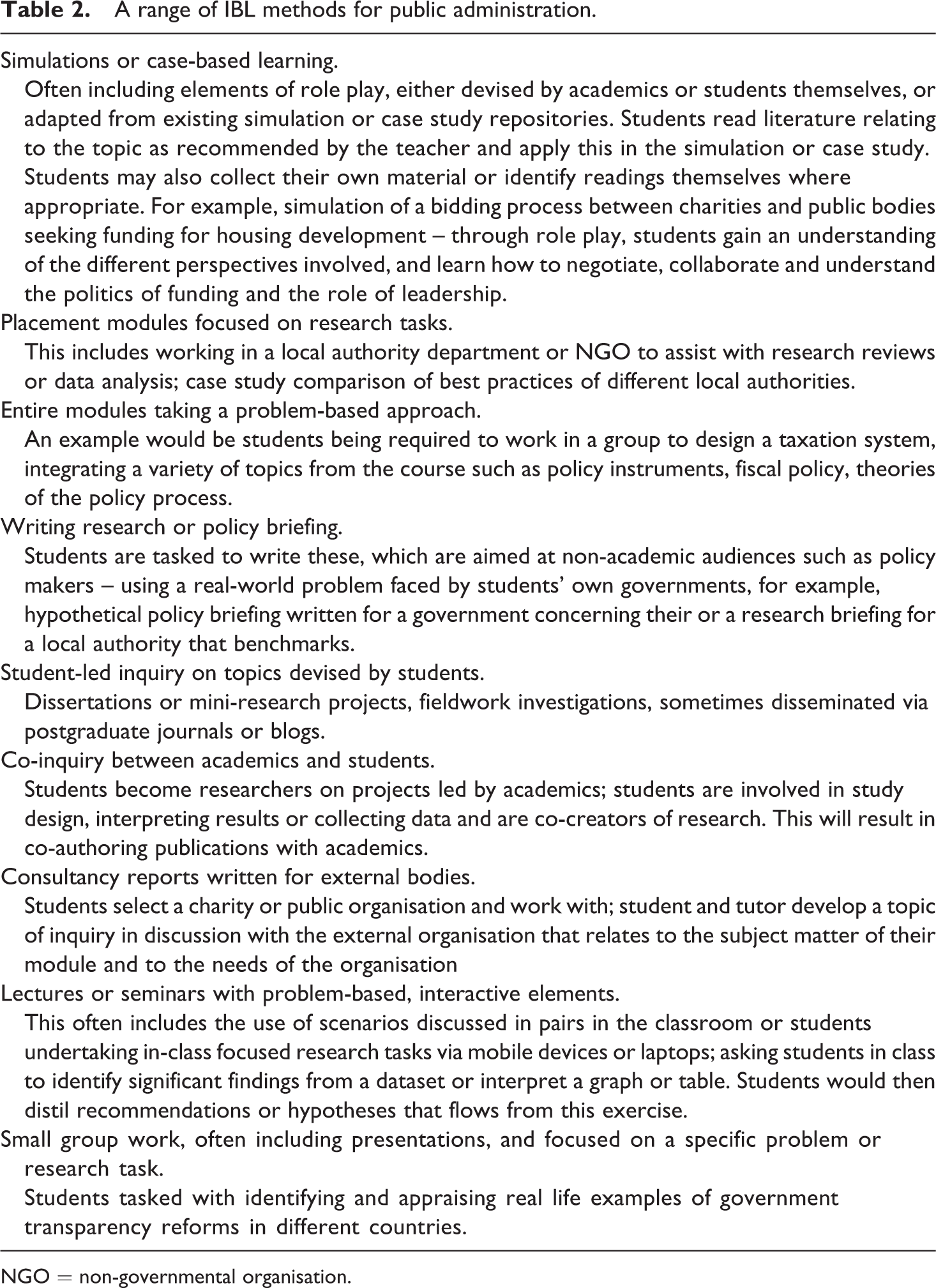
NGO = non-governmental organisation.
A final type of approach often discussed in the IBL literature is co-inquiry and co-research between academics and students. As already discussed, across higher education including the UK, there is increasing emphasis placed on students as co-creators of knowledge (Neary and Wynn, 2009) and for them to be engaged in communities of practice (Wenger, 1998). Engaging in co-produced research is particularly rewarding for students, providing them with research skills and experience and making them feel part of the culture of their departments, while also benefiting academics. In the context of public administration postgraduate courses, students can provide academics with access to public and new data sources in different countries, encourage then to consider issues in a different light and open up avenues for comparative research. However, the ambitions of research co-creators can be let down by the practical realities in that postgraduate students often need additional research methods training to provide the necessary skills and support to carry out these roles.
Despite the potentially wide menu of varieties of IBL in public administration and the general appropriateness of the subject matter for IBL, there are also challenges with implementing the approach in this context and IBL needs to be carefully managed and appropriately tutored and guided. Public administration is a pluralistic subfield, which draws on a multi-disciplinary literature with diverse epistemological standpoints and methods. Many academics are committed to a more traditional style of teaching and doubtful about the benefits that IBL brings, as well as lacking experience in this sort of approach. The agility and ability of teachers of public administration is key when it comes to understanding the appropriateness of the use of IBL and, at the same time, balancing this out with maximising the inclusivity to enhance the student learning experience.
In short, academic engagement with IBL is likely to be extremely varied and it may therefore be more challenging to generalise about the effectiveness of this approach in comparison to natural sciences, where much of the empirical research on learning effects has been conducted to date. The experiences of students with IBL may also vary depending on their level of academic preparedness for this type of approach, their year of study, the cultural context in which their prior education took place, and their personal preferences for applied problem-focused as compared to more theory-based learning. Crucially, instructors need to be careful not to mistake IBL for unguided or minimally guided inquiry learning, the effectiveness of which is challenged by empirical research.
Conclusion and directions for future research
As Hale (2006: 85) suggested, politics is indeed fertile ground for the use of IBL pedagogies. The rationale and arguments for a move towards IBL reflect pedagogical research that explores effective learning strategies but is also connected with the challenges facing the modern university, which include a need to balance and manage the dual research and teaching roles while providing employability-related skills for students. Existing practices of research-led teaching used and promoted in research intensive universities enhance the opportunities and incentives for academics to pursue this type of approach. Yet IBL is a demanding endeavour and is most likely to be used in conjunction with other approaches. It may be more suitable for some subfields than others and the variety of IBL methods needs to reflect the plurality of the discipline.
The increasingly international student body on postgraduate public administration courses provides opportunities for problem-based discussions and learning, drawing on the diverse experiences of those in the classroom. Further research, however, should explore more about how these particular students experience IBL, the degree of satisfaction with its methods and any challenges encountered both by students and teachers, with a view to generating lessons for good practice.
Academics making use of IBL should also consider how to evaluate the outcomes of this approach, as there is a relative paucity of research in this area. For example, there is no research that we know of to date that uses experimental research designs to explore the learning effects of IBL in politics or public administration education at higher-education level compared to more conventional didactic approaches. Emulating similar research designs in fields such as biology (Gormally et al., 2009) and physics (Deslauriers et al., 2019), educators could randomly allocate one group to the IBL approach and another to traditional lectures or seminars, with both groups covering the same course material delivered via different means (although we acknowledge the logistical challenges this might entail). A range of outcomes could be considered, including knowledge of subject matter, social scientific literacy in terms of ability to problem solve and apply research findings to the real world, critical skills, self-efficacy and satisfaction.
Future academic research could map out existing practices in this area across the discipline, using a survey and in-depth interviews across a representative range of institutions, following Lightfoot and Piotukh (2015) who conducted research into the research-teaching nexus in politics. This is a way to help understand how to generate the best value from IBL approaches, rather than just relying on what many in higher education regard as inherently a ‘good thing’ and avoid prejudicing other long-standing approaches to teaching and learning. We suggest that such work will serve to inform the internationalisation agenda but, at the same, time ensure a better degree of inclusivity and employability. Both student and staff perspectives should be incorporated, developing work in this area from single university settings (e.g. Bache and Hayton, 2012). Revealing the extent and forms of IBL being used within public administration in a more systematic way and shedding further light on the practicalities, benefits, challenges and effects of these types of approach would considerably aid public administration academics. Ultimately, this will help teachers and academics to develop their range of pedagogical practices to include more inquiry-based and problem-based learning approaches that can offer benefits to students and educators alike.
Footnotes
Declaration of conflicting interests
The author(s) declared no potential conflicts of interest with respect to the research, authorship, and/or publication of this article.
Funding
The author(s) received no financial support for the research, authorship, and/or publication of this article.
