




Abstract
Building on Dörner’s (1996) theory of complex problem-solving, a learning scenario for teacher students was created and tested. Classroom management is interpreted as a complex problem, which requires the integration of competing interests and tackling multiple, simultaneous tasks under time pressure and with limited information. In addition, rising emotions are likely to impede thinking and the quality of decision-making. To prepare student teachers to understand and reflect the complex problem-solving challenges inherent in classroom management, we developed the live action role play “Everyday Life in the Classroom” which was embedded in a seminar structure to guide the development of analytical competences and emotion regulation of prospective teachers. In two pilot studies, we found that Everyday Life in the Classroom was perceived to be authentic and helpful for learning. Preliminary findings suggest that the intended learning processes have been stimulated. We propose developing Everyday Life in the Classroom further and investigating the scope and sustainability of learning psychology through live action role play.
Teacher education programs need to provide a learning environment in which prospective teachers can develop their professional competences, among which the organization of learning and classroom management are critical (Seidel & Shavelson, 2007). Although progress has been made to identify teacher competences, it is widely recognized that the competence to manage a class successfully cannot be taught and learned from textbooks and that the relevant skills are more than the sum of separate parts, such as content knowledge, classroom management strategies, communication and presentation skills, and whatever else can be added to this list. Anybody who wants to teach a class needs to handle the challenge of integrating and coordinating all these components and to be able to use self-regulation strategies to adjust to situational challenges, including emotions, cognition, and behavior. As a consequence, we argue that when students in a teacher education program are faced with the challenge of learning how to teach and manage a classroom, they are facing a complex problem-solving situation (Dörner, 1996; Funke, 2003; Good & Brophy, 2002). Therefore, we propose using the structure of Dörner’s theory of complex problem-solving as a framework for building a learning environment.
Learning How to Handle Complexity
To support our basic argument, we will first explore how classroom management has the structure of a complex problem and then propose a live action role play scenario that should facilitate learning about complex problem-solving (Knogler & Lewalter, 2014).
Classroom management as a complex problem
The position of a (new) teacher is interpreted as structurally equivalent to a complex problem that needs to be solved under time pressure and with limited resources. According to Dörner (1996), a complex problem is characterized by (a) a high degree of autonomous group dynamics due to independent patterns of behavior of the individuals in a classroom; (b) unknown and erratic events in the background, such as issues in the peer group and in the families of the students; (c) a high degree of interrelation between a number of factors as varied as content knowledge, learning climate, motivation, and lesson planning skills; and (d) a generally large number of determinants that have an impact on the process and product of learning and instruction.
It is a demanding task even for experts to manage the complexity of classroom teaching and it is even harder for prospective teachers to both understand and analyze this complexity and to develop the skills to handle it efficiently. Novices in the area are likely to overlook relevant information that they need to take into consideration to make sound and effective instructional decisions (Ainley & Luntley, 2007; Chi, Feltovich, & Glaser, 1981). As a result, typical and predictable and rather errors will occur (Schaub, 1996), which in the case of classroom instruction might be observed as: Setting ill-determined goals: Teachers fail to specify what exactly they ask students to do (“Read this paragraph”; “Listen”) without offering concrete information about the procedures involved or teachers tell students what they should NOT do as opposed to telling them in a positive manner what they are expected to do (“Do not talk in class”). Oversimplification and monocausality: In stressful situations, teachers are likely to focus on information that is in line with their habitual interpretation of the situation, they take a shortcut and use a monocausal pattern (Von der Weth, 2001) to explain the situation in terms of “the usual troublemaker” (“In any case, this has not been the first time that Kevin did this!”), which may easily lead to an overreaction.
Based on the assumption that classroom management can be interpreted as complex problem-solving, we offer prospective teachers a practice scenario using a simulation game. In the “Everyday Life in the Classroom” (ELC) role play setting they can experience the complexity arising from multiple perspectives in the classroom, including the emotions that might ensue, and behavioral options and their consequences. As there are no prefabricated and standardized solutions to instructional challenges, prospective teachers are encouraged to develop strategies and a broad behavioral repertoire that they can use as needed and that they can adjust to a given situation. In particular, this scenario should support them to explore (a) critical information processing while in action in the classroom; (b) emotion regulation; and (c) emotional adaptiveness.
The role of emotions in complex problem-solving
Based on previous research (Dörner, 2008), we also build on the notion that handling complexity typically involves regulation of emotions. For teachers, self-regulation competence is absolutely vital, since emotions have a direct impact on instruction and on the flow of the lesson. Individuals who have learned to recognize and regulate their emotions, arrive at better solutions in complex problem situations (Starker, 2012), and handle them more efficiently with less loss of time and focus. If a teacher can create and maintain positive emotions, such as teacher enthusiasm, sense of humor, respect, and appreciation, he or she can foster student motivation and learning (Sutton, 2004).
Emotionally loaded situations – and that comprises negative as well as positive emotions – impede both efficient instruction and learning (Humpert & Dann, 2001). For example, as a teacher is explaining a task for group work to his class, he observes two students engaged in reading a text message on their smart phone; he has just explained that smart phones are not to be used in class; he experiences feelings of anger, stress, and frustration, and he needs to make a decision on how to proceed: should he interrupt the lesson himself and discuss the misbehavior? What message would this send to the class and to the students who are violating the rules? In addition, as it is very likely that emotions will run high in such a situation, the teacher faces an increase of both the complexity of the challenge as time passes and the pressure to move on somehow (Carton & Fruchart, 2014; Chang, 2013). Simultaneously, these emotions impede the thinking process, reduce the quality of problem-solving, and compromise the efficiency of action (Dreisbach & Goschke, 2004; Hänze, 1998; Otto & Lantermann, 2004).
The resulting issue for teacher training is how prospective teachers can learn to perceive, understand, and reflect on these “hot” situations, since the pressure on problem-solving and the effect of emotions can hardly be presented as textbook knowledge or with some other analytic or cognitive approach. Unless one would want “reality” to strike in the classroom, a method needs to be identified that allows student teachers to actually go through conflict situations in a safe environment that comes as close to authentic classroom interaction as possible and still leaves room for experimenting. Therefore, our intent was to create an instructional scenario that would offer the opportunity to experience the dynamics of classroom interactions as they develop through basic routines, instructional procedures, and the negotiation of social control. Empirical evidence from teacher training suggests that learning how to teach in a situation of limited complexity, such as in microteaching, is a powerful means to foster professional development of teachers (Arsal, 2015, 2014; Bakir, 2014). However, as in other innovative learning environments (Fernandez, 2010; Lee, Cheung, & Chen, 2005), we assume that it should be prerequisite for meaningful learning that learners find the build-up of the scenario convincing and accept the challenge of operating in a simulated reality situation (Morrison & McIntyre, 1976).
Development of the Role Play Scenario “Everyday Life in the Classroom”
ELC was developed to provide a learning space to experience complex situations in a classroom in a secure, simulated environment. The design of the prototype is presented in terms of learning goals, containing a specific scene, plot and parts, material, and instructional setting.
Learning Goals of “Everyday Life in the Classroom”
The idea of using live action role plays for teaching is to create a learning environment in which the structure and the characteristics of a problem are reconstructed and can be experienced in a simplified manner. It is created in a way that allows for multiple perspectives to interpret a problem, for identifying barriers and discovering resources to solve a problem, for recognizing options for behavior, and, finally, it offers a platform for reflecting on the consequences of any decisions that have been made. The specific goals for ELC are that:
student teachers learn to analyze challenging situations in a classroom as dynamic situations caused by multiple perspectives and interaction; student teachers identify the impact of emotions in classroom interactions, locate resources to regulate emotions, and develop reflective behavior options.
The following pilot studies are our first attempts to verify if the design is conducive to learning and if it is possible to stimulate the learning experiences as intended.
Plot and Parts of the Live Action Role Play
The scene
ELC provides a setting in which everyday life in the classroom is acted out by student teachers. They assume roles, such as teachers, grade school students, school principal, and school secretary. The role play is carried on for four hours in real time and represents six class periods distributed over two imaginary school days in the simulation. The space for the role play also reflects the layout of a school, for example, the arrangement of classrooms, a space for recess, and a staff room. The locations are equipped with school props, such as signs and posters, a class register, a bell, chalkboards and chalk, and whatever is available or needed to generate a grade school atmosphere. The school days follow a set timetable and the teachers receive teaching material that they may or may not use for their lessons.
Dramatis personae
The actors comprise both teachers and students. Some of their roles are illustrated below.
Teacher and staff roles
The school principal is Dr. von Buchtal; he also teaches history. He is new to the office and strives to establish rules to foster respectful behavior, and to control mobbing and hostility in his school. He plans to prepare an address to the school to kick off the new academic year. Ms/Mr Emminger is the chemistry teacher with a preference for direct instruction. S/he is an experienced teacher who has seen many generations of students and can read their minds. Currently, his or her personal life is somewhat disturbed because his/her partner has recently left, and s/he has subsequently taken up smoking. Additional characters are the arts teacher, a person with a hippie background and a strong belief in free education; the German teacher, who has a year or two to go before retirement and who does not wish to change longstanding routines; and the English teacher, who comes fresh from teacher training with a bag full of enthusiasm and pedagogical ideals. The school secretary is located in the staff room. This role is that of a kind of joker, who may interfere when dynamics are slow, for example, to make an announcement, to send a student back or to cause some other kind of interruption to stimulate adaptive behavior.
Student roles
There are two eighth grade classrooms with about 12–16 students in each, both girls and boys. The average age is somewhere between 14 and 15. Students include Hannah, 14 years old, a quiet girl, who came to town only recently with her mother after her father had left the family. She is grateful that the boy who sits next to her helps her to find her way around in the new school. Her favorite subjects are arts and music. Kevin is a 16-year old boy who had to stay down a year. He does not really care about school and finds homework a waste of time. He is the oldest student in the class and wants to impress the others with his ideas for practical jokes. In a similar vein, all the role cards for the students describe a personality by briefly characterizing their family background and academic attitudes and preferences. The composition of each class is scripted in such a way that there are challenging or difficult students who act out openly, followers, and some quiet students. Their role cards specify a basic character (ambitious, not interested in school, happy with life, social animal, self-confident, nerd), and the social relationship between individuals in the class (friendships, would-be friendships, competition). The role cards also contain some background information about students' family situations and other activities, such as parties.
Material and role assignments
All materials and props for ELC are stored in a trunk: this contains envelopes with role descriptions and name tags and envelopes with additional objects, such as a paper airplane and paper pellets, a magazine, and a love letter. In addition, class registers for both classes, timetables, and a seating plan are provided. Moreover, the trunk includes teaching material, a bell and several bulletins and posters (e.g., house rules). Classrooms, staff room, and the school yard are arranged ahead of time.
Participants are randomly assigned roles as teachers or students. They each receive a package with a brief role description that allows for individual interpretation, implementation, and development by the player. Role descriptions refer to aspects such as family background, beliefs, interests, or relations to other roles. Thereby a momentum is created that has a substantial analogy to real school life. The instruction encourages players to develop their roles and to stay in character as long as they are wearing a nametag (which includes times of recess and breaks).
Instructional setting
The role play takes place after a preparatory seminar and is followed by a seminar for guided reflection. Participants receive an introduction to the theoretical background of complex problem-solving and the concept of learning through live action role plays. They learn about emotions in everyday life in the classroom, the principle of simulation games in general, and ELC in particular. Immediately after the simulation game, we administer a debriefing in which students can share their impressions, and let go of their roles. Up to a week later, at the follow-up seminar, we guide participants through a systematic reflection and a theoretical analysis of their experience. We break up the large group into smaller ones and offer a series of workshops about communication in class, the impact of emotions on cognition and behavior, and classroom management, where participants can reflect on their experiences by analyzing concrete situations that occurred during ELC.
Preliminary Evaluation
To at least preliminarily evaluate ELC, we conducted a couple of small scale pilot studies in two subsequent semesters to test acceptance and learning.
Study 1
The first study looked at the acceptance of the role play scenario, in particular at the question of whether participants found the scenario to be ecologically valid and if they perceived the roles to represent plausible characters.
Method
Participants
A group of n = 39 students enrolled in the Bachelor of Education program (teacher training) in their fourth semester participated in ELC. The Communication and Interaction course is mandatory within the Didactics, Methods, Communication, and Media module. Students are free to choose if they take this course either in the sociology or the psychology department. Role play was an optional format offered by the psychology department for this course, which is also taught as a regular class with weekly meetings.
Measures
To investigate acceptance of ELC, the institution's standard evaluation survey was administered. This includes a variety of questions concerning goals, motivation, and subjective learning. However, in the context of this study, we used the summative question [What total grade (from 1 = very good through 6 = totally inappropriate) would you give this course?] and responses to the open questions [What did you like most? What should be improved?]. Three additional questions were asked about the roles and the scenario. We wanted to know if participants could identify with the roles and assume the characters, if the situations were realistic, and if the scenario was plausible. Participants rated their answers on a 6-point Likert scale (from 1 = agree totally to 6 = do not agree at all).
Results
Participating students gave the ELC a summative average grade of M = 1.62 (SD = .49), which is somewhere between very good and good. In response to the open question asking what they liked most, participants mentioned most frequently that they found the scenario to be authentic and realistic. Furthermore, participants stated that they appreciated the link between theory and practice. They thought that theory was well illustrated through the practical examples. Participants also noted that it was important for them to reflect upon the critical situations that were presented, to hear about the perceptions from the denomination of our department is indeed Psychology in Education; perspectives of other participating students with their specific roles and learn from each other. They specifically emphasized that the small group discussions after the debriefing helped to create a bigger picture, bringing together diverse perceptions and perspectives, for example, of the more quiet roles, outsiders, and central roles in a “class”. Overall, participants found the seminar interesting and stimulating.
In answer to the question of what should be improved, there were different opinions about the design of the roles and the duration of the live action role play. Many participants would have preferred the roles to be scripted in more detail. As for the duration of the simulation, some participants proposed shorter and others longer play times. Students who had played student roles suggested that roles could be switched so that more participants would have the opportunity to assume the role of a teacher. With reference to the link between theory and practice, some participants requested a more intensive discussion of the theory and wondered if the academic teachers could not provide a practical guide on how to handle a challenging situation.
Additional questions focused on the roles used in ELC. Figure 1 shows that the mode for all responses was at 2 for the scale from 1 = totally agree to 6 = totally disagree. Most participants found the roles, the situations that occurred, and the scenarios authentic and plausible.
Perception of ELC Roles, Situations, and Scenarios.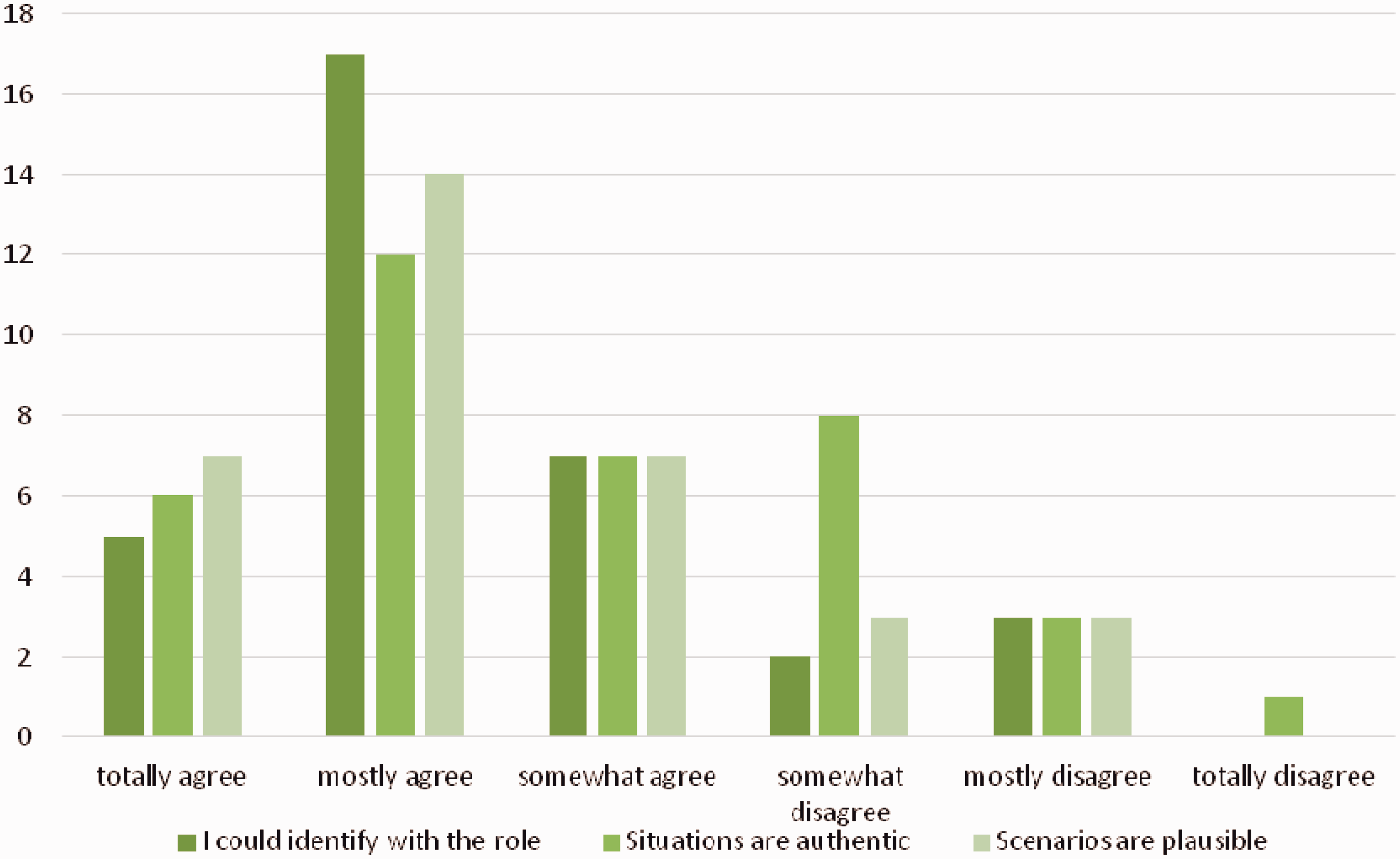
Discussion
Based on the overall evaluation of the learning experience, we conclude that participating students enjoyed the ELC experience. Participants experienced complexity both during the actual role play and throughout the course and realized that not all issues that arose from the role play had been addressed and resolved. They might still be confused, but on a higher level. To further develop ELC, we should reconsider timing in general and the relation between the role play experience on the one hand and theoretical aspects on the other hand. We will explore if more time is needed for the simulation game or more time for reflection and for linking theory and practice. Our immediate idea is to spend more time playing the simulation game and to intensify theoretical analysis in small group work as a follow-up activity.
Study 2
The second study investigated whether specific learning goals could be achieved. With another two groups of ELC participants in a different semester, we hypothesized that the following effects would occur: (H 1): Students would show an increase in sensitivity for the complexity and dynamics of a classroom situation. This is indicated by an increased number of dynamic aspects, use of multiple causes for the explanation of a problem situation, and a decrease in punishing behavior. (H 2): Students would show an increase in emotion regulation. This is indicated by reporting fewer negative emotions and more positive emotions.
Method
Participants
From a total of n = 80 students who had registered for the ELC course a subtotal of n = 49 completed the questionnaires both before and after ELC. All participants were enrolled in a teacher training program (Bachelor of Education) for secondary education; most students were in their fourth semester; the mean age of the sample was around 22.
Instruments
A vignette test was developed to measure student learning. The vignette presented a critical classroom situation and students were instructed to write a short answer as to how they interpreted and analyzed the problem and what problem-solving options they saw. (See Appendix for an example of the vignette and the tasks set for the students.) The responses were coded into five categories pertaining to two dimensions: Categories 1 through 3 represent behavioral reactions, and 4 and 5 reflect emotional reactions; that is,
Dynamic: Indication that the student recognizes the dynamic of a situation (as opposed to a static explanation). Multi-causality: Indication of multiple reasons to explain the situation. Rebuke and punish: Patterns of behavior that highlight inappropriate behavior and threaten or apply punishment. Negative Emotions: Recognition of the rise of negative emotions in response to the situation. Positive Emotions: Allowance for positive emotions, empathy and understanding.
Procedure
ELC was played for four full hours covering six class periods. The debriefing and reflection session lasted for about two hours. Students were asked to volunteer to complete the questionnaires, which were administered by a neutral person. Since students were not graded on their performance in this course, concern about the undesirable effects of negative feedback should have been limited.
Results
Descriptive Statistics for the Differences in the Number of Suggested Problem-solving Strategies Before and After ELC and Results of Two Sets of t-Tests for Dependent Samples
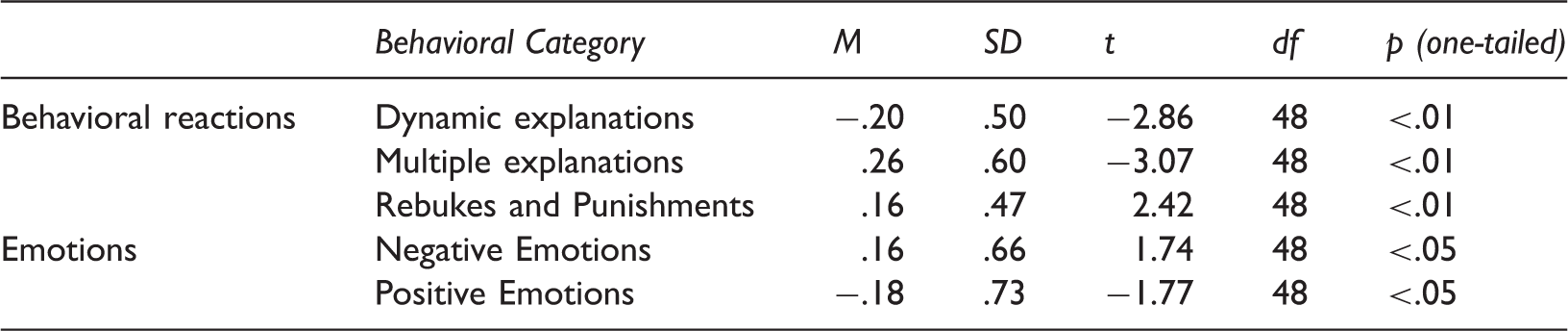
The second hypothesis stated that emotion regulation would be affected by ELC, in particular that students would report fewer negative emotions and more positive emotions. When the responses to the vignettes were analyzed for the relevant categories, we found a pattern of changes that can be taken to reflect a general trend that positive emotions increase and negative emotions decrease when we compare their frequencies before and after ELC. However, had the error level been adjusted in a rigorous manner, significance would not have been reached. So we need to approach this result with some caution.
Discussion
Participants of ELC showed in a pre- and post- measure that they had developed along the lines of our primary learning goals. The analysis of the vignette test confirms that they developed more dynamic and more varied perspectives to account for a challenging teaching situation. They recognized the role of emotions and were able to control them by more reflective analysis of the situation. This result is encouraging and provides initial evidence that ELC facilitates learning about classroom dynamics. However, due to the design of the study, we do not know if this learning is sustainable across time and if other types of learning environment might not have the same effect.
General Discussion, Conclusions, and Future Perspectives
According to Dörner (1996) problem complexity is characterized by a large number of factors that determine a situation and increase problem-solving options. In addition, these factors are both intertwined and by no means obvious. However, problem-solving behavior is not necessarily aligned to the complexity of the challenge. In particular, when individuals try to solve complex problems under pressure, they are rather likely to process information incompletely, to use inefficient shortcuts, and to jump to inefficient solutions.
We propose that the situation of any () teacher can be interpreted against this backdrop. This brings us to the question of how student teachers can prepare themselves to handle the challenges of the complexity of being a teacher. Since live action role play scenarios have been known to serve this purpose in other contexts (Knogler & Lewalter, 2014), we created a role play scenario to represent ELC as an opportunity for learning what complex problems look like in the classroom, that is, to perceive the dynamics in classroom interaction, to analyze the multi-facetted challenges facing teachers and students, and to become aware of the emotions arising as a result of these challenges. These changes might eventually facilitate the generation of problem-solving options and the reflection upon these options and their consequences. As student teachers assume a variety of roles, they experience both the intended and unintended effects of classroom management strategies used by teachers. As the students become more skilled, the live action role play scenario can be used to pose more specific problems in classroom management. The prototype that we designed might be adapted to address specific challenges in the future, such as the functioning of an inclusive classroom and the intercultural classroom.
Two small-scale studies yielded both encouraging results and critical questions for further development of ELC. While we found the intended learning effects, we still need to recognize the limitations of our evaluation. The criterion needs to be validated by a more comprehensive test of student learning. It will also be necessary to conduct additional studies that include a control group to identify the specific contributions of ELC to student learning. Although the effects we found in this study point in the expected direction, we also need to acknowledge that the assessment of these effects needs to be improved so that higher levels of significance can be set.
The challenge ahead is to identify the relevant aspects of student learning. In particular, we assume that future studies would need to take into account student attitudes and beliefs, which might function as mediators or moderators for learning. In particular, repeated measures of epistemological beliefs, and self-efficacy beliefs, could be valid candidates. We also need to take into account that the learning goals of ELC are certainly long-term goals and that it is not reasonable to expect any student to acquire the relevant competences within one semester. In a longitudinal study, we plan to investigate if the ELC experience laid the foundation for the sustainable development of complex problem-solving competence in classroom teaching. In addition to Q-data, such as self-report data on teacher behavior in a field setting, video-based observations might help to identify the efficiency of teacher behavior.
So far, we can claim to have prepared student teachers for the challenges of classroom management, the amount of (self-) regulation required, and the competing and conflicting perspectives that contribute to complex problems posed by the dynamics inherent in classroom communication and interaction. What is more, the live action role play ELC can be taken as an example of how psychological theory can be instrumental in building a framework for teaching and learning.
Footnotes
Acknowledgements
The authors wish to thank Julia Glaser and Svenja Boden for their inspiring and creative cooperation in the development of ELC. Their contribution is highly appreciated.
Declaration of Conflicting Interests
The author(s) declared no potential conflicts of interest with respect to the research, authorship, and/or publication of this article.
Funding
The author(s) disclosed receipt of the following financial support for the research, authorship, and/or publication of this article: This project was funded by a grant from the Gutenberg Lehrkolleg (Mainz University) to Professor Starker as visiting professor in the summer of 2013.